Trump Can’t Fight Anti-Semites. They’re His Base!

donald-trump-steve-bannon-720x377


“In a short time, a large number of Jews are going to be slaughtered. Their heads are going to [sic] blown off from the shrapnel. There’s a lot of shrapnel. There’s going to be a bloodbath that’s going to take place in a short time. I think I told you enough. I must go.”

This is one of at least 89 bomb threats at Jewish institutions since Donald Trump was inaugurated.

Just yesterday, alone, at least 21 Jewish community centers and Jewish day schools across the country received bomb threats.

So far, at least 72 Jewish cultural centers in 30 U.S. states and one Canadian province have been affected, according to the Jewish Community Center Association of North America.

Besides bomb threats, hundreds of graves at Jewish cemeteries were desecrated, there was a foiled massacre at a synagogue and swastika graffiti has dramatically increased in public spaces.

American Jews are victims of more reported hate crimes than any other group in the United States, and have been subject to the majority of religiously motivated offenses every year since the FBI started reporting these statistics in 1995.

Such offenses were not unknown in this country before Trump’s rise, but the rate is increasing.

This is consistent with a rise in hate crimes for all ethnic groups across the country. Southern Poverty Law Centre recorded more than 1,000 hate crimes in January alone – the same amount usually reported over a six-month period.

Far from helping the situation, Trump has made it worse.

His statement for Holocaust Remembrance Day deliberately left out any mention of Jewish people – a direct nod to Holocaust deniers everywhere.

At a press conference, an Orthodox Jewish reporter asked him about “an uptick in anti-Semitism and how the government is planning to take care of it.” Trump asked him to sit down, saying it was “not a fair question” and “I am the least anti-Semitic person that you’ve ever seen in your entire life.”

His supporters would cheerfully disagree. Ex-Ku Klux Klan leader David Duke is one of his biggest boosters. White nationalists have been recorded literally shouting, “Hail Trump!” and making a gesture similar to the Hitler salute.

In fact, his entire Presidential campaign was predicated on race baiting and xenophobia. He has gone after undocumented immigrants, African Americans, Latinos, Asians, women, Muslims and the disabled.

He led the “birther” movement challenging President Obama’s standing as a natural-born American; used various vulgar expressions to refer to women; spoke of Mexico sending rapists and other criminals across the border; called for rounding up and deporting 11 million undocumented immigrants; had public feuds with prominent Latino journalists and news outlets; mocked Asian accents; let stand a charge made in his presence that Obama is a Muslim and that Muslims are a “problem” in America; embraced the notion of forcing Muslims to register in a database; falsely claimed thousands of Muslims celebrated the 9/11 attacks in New Jersey; tweeted false statistics asserting that most killings of whites are done by blacks; approved of beating up a black demonstrator at one of his events; and publicly mocked the movements of journalist Serge Kovaleski, who has a chronic condition limiting his mobility.

If that’s not prejudiced, racist and bigoted, I don’t know what is.

But when it comes to anti-Semitism, the situation gets complicated.

His supporters will counter that Trump can’t be anti-Semitic because his daughter, Ivanka, converted to Judaism to marry his son-in-law and senior adviser, Jared Kushner.

But does that really follow?

Trump appears either to be an anti-Semite, himself, or certainly to be tolerant of anti-Semitism.

Even Ivanka’s behavior is suspect. She offered the following strange tweet about recent bomb threats: “America is a nation built on the principle of religious tolerance. We must protect our houses of worship & religious centers. #JCC”.

On the surface of it, she’s asking for the violence to stop. But why is her only mention of Judaism an abbreviation in a hashtag? Doesn’t that minimize the point just like Trump’s Holocaust Remembrance Day message?

This appears to be a kind of plausible deniability.

It’s like a black person telling racist jokes about black people. We might let him get away with it because he’s black. We might say, It’s Okay because he can’t be prejudiced against black people.

However, actions speak louder than words. And Trump’s are clearly on the side of prejudice – even anti-Jewish prejudice.

The Alt Right movement tries to pull the same kind of thing with Breitbart News. The publication has been rife with anti-Jewish conspiracy theories, yet many of its editors and/or writers claim Jewish ancestry. Andrew Breitbart – the conservative media pundit for which the site is named and who died in 2012 – was Jewish. So were many of his colleagues and successors, among them former editor-in-chief Joel Pollak and former editor-at-large Ben Shapiro. Even former senior editor and provocateur Milo Yiannopoulos claims some Jewish ancestry.

Yet Breitbart is the publication of choice for Neo-Nazis and white supremacists. The organization is pushing an anti-Jewish agenda and appealing to racists and bigots as its readership.

The organization has published multiple articles denigrating minorities, championing white nationalism and denying the existence of anti-Semitism – or at very least claiming it only exists on the left.

Trump is deeply connected with the organization through his senior adviser Steve Bannon, one of its founders.

This is the same constituency that propelled the President into the national spotlight. It’s naive to ask Trump for help stop the wave of anti-Jewish hate crimes. The people perpetrating them are most likely his hard core supporters.

Though Trump eventually did make a weak denunciation of the bomb threats and anti-Semitic violence, he can’t be too forceful. He can’t send out a series of tweets critical of Nazis and white nationalists. He can’t turn to his supporters demanding peace. He needs them. They’re just about the only folks left who support him.

In the latest national Quinnipiac poll, only 38% of American voters approve of Trump’s job performance, while 55% disapprove. These are the lowest numbers for a new President in at least 40 years, according to the Washington Post.

If Trump proposes spending federal dollars to fight anti-Semitism with tolerance programs in schools, he’s bound to upset his base. If he appoints a special task force to catch those committing hate crimes, he’s going to anger the only reliable group committed to supporting his political agenda at the polls.

So instead we get half measures. He’ll make a Holocaust Remembrance Day statement – but not mention Jews. He might admit that anti-Semitism is bad but refuse to acknowledge that it still exists.

He’s hoping to make his statements vague enough to be interpreted in two ways. He hopes his critics will interpret them as asking to stop the violence, but he wants his supporters to interpret them as tacit agreement with their anti-Semitism.

This is the exact opposite of moral courage. And it is taking its toll on the Jewish community, and every other minority.


PA Legislature Plans Taking Away Teachers’ Sick Days

thumbnail_teachers-sick-719435

Dear Pennsylvania legislators:

So now you want to take away teachers’ sick days.

Sabbatical, sick days, bereavement leaves – the Senate Education Committee voted 7-5 to strip them from the law and make teachers bargain for them with their districts.

So the next time I get sick, you don’t want to guarantee I can take the day off. If my mother dies, you don’t want to protect my right to attend her funeral.

The full legislature still has to vote on it, but that’s pretty cold.

Which brings me to my first question: Why do you hate public school teachers so much?

Seriously. What did teachers ever do to you? Did we give you a bad grade when you were kids? Did we give you detention? What did we ever do to earn such animosity?

You obviously must have something personal against teachers.

It’s understandable. Even though the majority of Pennsylvanians voted for Democrats, most of you are Republicans. You have gerrymandered the state so that you artificially have the majority, and as such you must espouse the most radical positions possible. Otherwise, you’ll be primaried by someone even farther right – a Tea Partier, a plutocrat, an anarcho-capitalist, a fascist.

We see the same thing playing out nationally. Hello, Donald Trump!

So it’s no surprise that after stripping public schools of almost $1 billion every year for the past five years, after tens of thousands of teachers have been laid off, after you’ve given away millions of dollars to private corporations to run fly-by-night charter schools or through tax credits to religious schools – well, it’s no surprise that you feel the need to continue the war on teachers.

It’s paying off for you big time.

Not so much for our school children. They have had to deal with increases in class size, narrowing of the curriculum, reductions in extra-curriculars, cuts in tutoring – just about every deprivation imaginable.

I wonder – do you realize that every attack against teachers is also an attack against students? Making sick teachers come to school won’t improve kids’ educations. Forcing educators to choose between work or seeing their loved ones off to their final resting places won’t boost test scores. Do you understand that or do you just not care?

Follow-up, if I may: do you realize that most public school teachers are women? Does that factor in at all? Which do you hate more, the gender of most teachers or the fact that we are unionized?

Oh, and Pennsylvania School Boards Association, don’t think we’ve forgotten you. We know you requested this mess, Senate Bill 229. Instead of standing with your teachers to fight for fair, equitable, sustainable funding, you’ve decided to ask the legislature if you can stiff teachers to make ends meet. We’re there for your kids everyday, and this is how you thank us. That’s gratitude.

It’s what we get for being one of the last workforces to be unionized. We have the temerity to demand fair treatment. You can’t just do whatever you like with us, you have to actually sit down with us at the bargaining table and talk.

Legislators, we know it’s something that infuriates your base. No, I don’t mean the people who vote for you. I mean your real base – the corporations, millionaires and billionaires who pay your real salaries – the unlimited and shadowy campaign contributions that, let’s be honest, are really nothing less than legal bribes.

We shouldn’t be surprised that you have prioritized taking away legal protections for teachers’ sick days. It is quite in line with what you want to do to the profession. You no longer want highly qualified teachers making a middle class income who then can stay in our schools for their entire careers. You want lightly trained temps who use teaching as a stepping stone to a job that pays enough to live.

After all, if we afford teachers the status of professionals, they might actually be able to jump all the other hurdles we’ve put in front of them and educate the poor.

That would be terrible.

Despite all the standardized testing, Common Core, value-added measures, budget cuts, and constant propaganda about “failing schools,” they might actually teach these kids to think. That’s the last thing you want.

A thinking public might see how much you’re screwing them over. They might actually rise up and fight. They might refuse to accept the status quo that you are so desperately trying to protect.

That’s your real endgame. And though it makes me sick, I suppose I will no longer be able to take off.

I’ll just spend the day, coughing and wheezing with the children.

Yours,

Steven Singer

The Gadfly on the Wall

Does Eating a Free School Lunch Give Kids “an Empty Soul?”

children-eating-school-lunch

Just about everyone admits the importance of eating lunch – especially for growing kids in school.

But if you get that lunch for free, does it leave you with “a full stomach and an empty soul”?

Speaker of the U.S. House of Representatives Paul Ryan thinks so.

He famously made these remarks at the 2014 Conservative Political Action Conference:

“Take Obamacare—not literally, but figuratively here OK? We now know that this law will discourage millions of people from working. The Left thinks this is a good thing. They say, ‘hey, this is a new freedom—the freedom not to work.’ But I don’t think the problem is too many people are working — I think the problem is not enough people can find work. And if people leave the workforce, our economy will shrink—there will be less opportunity, not more. So the Left is making a big mistake here. What they’re offering people is a full stomach—and an empty soul. The American people want more than that.”

So, for Ryan, having affordable healthcare somehow has discouraged people from working. He seems to think there are millions of poor people out there who could get a job but have decided not to because their medical bills are too low.

It’s preposterous. Most poor people are working several minimum wage jobs just to get by. Very few people are sitting at home on the public dole, and those that are need help to find jobs, as he admits. They need help finding better jobs that pay higher wages. They need help getting the skills and training necessary to get those jobs. And they need for those jobs to actually exist! They don’t need condemnation or starvation to motivate them.

If Republicans like Ryan had offered a single jobs bill, perhaps such remarks would be excusable. If they had offered an alternative to Obamacare, likewise it might be excusable. In the absence of those things, his comments seem to be nothing more than a thinly veiled excuse for doing nothing to help the less fortunate.

But Ryan goes on:

“This reminds me of a story I heard from Eloise Anderson. She serves in the cabinet of my friend Governor Scott Walker. She once met a young boy from a poor family. And every day at school, he would get a free lunch from a government program. But he told Eloise he didn’t want a free lunch. He wanted his own lunch—one in a brown-paper bag just like the other kids’. He wanted one, he said, because he knew a kid with a brown-paper bag had someone who cared for him.”

There are several problems with these remarks. First of all, Anderson later admitted that it never happened. She never met a boy who said this. She got the whole thing from “The Invisible Thread,” by Laura Schroff, either from the book, itself, or a TV interview about the book.

Second, Anderson’s cherry picking this example from the book goes completely against what the author was trying to say. The book is the true story of a business executive and an 11-year-old homeless boy who partnered together with an organization called No Kid Hungry to fight child hunger. One key part of the program is connecting hungry kids with federal programs such as school lunches and food stamps. The group also opposed Ryan’s 2013 budget for its proposed reductions in the food stamp program. In short, Schroff was trying to show how important it was to provide free lunches to students – not that we should let them go hungry. Using Schroff’s book to justify cutting school lunch programs is like using Nelson Mandela’s autobiography as a justification for apartheid.

Getting a free lunch doesn’t mean no one cares for you. On the contrary, it means that everyone does, that your community has pitched in to make sure you are fed.

Many politicians and media talking heads refuse to see the realities of modern American life. Deregulation of the banking and corporate sector along with outsourcing and rampant union busting have resulted in an economy where most of the good paying jobs are gone. This puts a tremendous strain on our education system. As a result, more than half of public school students live below the poverty line. But how to meet their needs without stigmatizing kids for circumstances beyond their control?

Many communities around the country including my own, have stepped up with a solution. For the last two years, hundreds of districts throughout my state of Pennsylvania and throughout the nation have offered free lunches to all of their students regardless of family income. Rich kids, poor kids, all kids eat for free. Though students can still bring a lunch from home, having the option to eat at school removes the dichotomy of brown bags vs. cafeteria lunches. All are the same.

The program, called the Community Eligibility Provision, is available nationwide as part of the Healthy, Hunger-Free Kids Act passed in 2010. Its goal is to provide healthy lunches and breakfasts to millions of students nationwide, according to the U.S. Department of Agriculture.

Previously only low-income students or students from families receiving federal assistance received free breakfasts and lunches.

Now, only 40 percent of a single school or an entire district’s population must come from families receiving federal assistance through the Supplemental Nutrition Assistance Program (SNAP) and/or Temporary Assistance for Needy Families (TANF). They may also be homeless or come from foster homes. Once that 40 percent threshold is reached, all students receive free lunch and breakfast. Districts are compensated by the state and federal government.

Before this program, providing school lunches, even at cost, was a losing proposition. Most districts end the year with students owing them large sums for lunches. For instance, two years ago, $25,000 of debt remained with Pittsburgh schools because some students didn’t pay for their meals.

Districts could stop letting these children eat the school lunch, but no one wants to refuse a child a meal. Under the previous system, the extra cost for unpaid lunches and the cost to complete mountains of paperwork involved in collecting the money was put on the backs of local taxpayers. Under this new program, all of this disappears. Moreover, we create a community of children who are better fed and thus better ready for the demands of school.

And mark my words, this IS helping kids become better prepared for class.

As a teacher, I used to have to buy snacks and meals for my students. I had a drawer full of Ramen noodles for children who came to me hungry. Many kids suffer from food insecurity but don’t qualify for SNAP. This program solves that problem.

My own second grade daughter has never known anything else but this system. Though I can afford to pay or pack her a lunch, she prefers to eat what her friends are eating. My wife and I are often baffled that she’ll try new foods at school that she would never give a chance had we made them at home.

And the food is actually pretty good. It’s not gourmet, but it’s better than what you’d get at most fast food restaurants. I even eat it, myself, from time-to-time. I have to pay two bucks, but it’s still a bargain. I particularly like the baked chicken.

People complain about new federal guidelines that have made school lunches healthier, but what they’ve really done is made them better. Whole grain bread and buns taste pretty much the same and are better for you. Using less salt and grease is better all around.

I’ve even noticed the kids learning new things about food from the increased menu. When all this began, I remember many of the middle schoolers expressing disgust at the chicken because it was in whole pieces. They had only seen chicken in nugget form.

Now kids will walk up to the cafeteria ladies and ask to try this or that. Many times they discover something new that they like. It’s really cool to see. Even their manners have improved.

Just today little 5th graders were remarking at how soft and delicious the croissant was on the breakfast sandwich. They had never seen a bun like that before. I literally heard comments like “delicious” and “mouth-watering.”

That’s incredibly high praise for children. Sure some of them still find the food is disgusting, but they are in the minority.

Do the kids who eat these lunches have “an empty soul”?

No, that’s just Paul Ryan.

What My Black Student Taught Me, His White Teacher, About Black Lives

student_081910-thumb-640xauto-704

I can’t tell you how many times Darnell was in detention.

After a while, it didn’t feel right if he wasn’t staying at least an hour after school.

Darnell was late to class.

Darnell swore at another student.

Darnell copied someone’s paper.

Darnell did just about everything and anything that came to his mind. And it earned him time after school with me, his newly-minted 8th grade language arts teacher.

In a class full of mostly brown and black students, many living in an impoverished high crime Pittsburgh suburb, Darnell was the standout. Or at least his misbehavior was.

At first, he complained, but I had his mom on speed dial, and she fully supported my holding him accountable.

He wanted to do his homework during this time, but I made him do busy work instead. The way I looked at it as a young teacher just starting out, if I gave him time to do his school work, it would be a reward, not a punishment.

So I made him copy down dictionary definitions, clean the tables or put up the chairs.

And once he realized there was no way out, he did it all uncomplainingly.

But an hour is a long time, so after a while I let him work on his homework, too.

I had an awful lot of work to do, myself, during these times – piles of papers to grade and lessons to plan – so whatever would keep him quiet would be okay with me.

Unfortunately, Darnell didn’t work that way. He had questions. So many questions.

I had no time, but what else was I gonna’ do?

I answered him. With frustration at first while sitting at my desk.

Then I found myself walking over to him and standing at his table. Then I sat down next to him. And pretty soon we were doing the homework together.

But an hour is a long time, so sometimes he’d finish early. I offered to let him go.

He didn’t want to.

He’d stay and talk: “Did you see the football game, Mr. Singer?”

Or “Did you hear the new Beyoncé album, Mr. Singer?”

Or “How many kids do you have at home, Mr. Singer?”

One day I remember the last bell ringing and looking up to see Darnell at his desk doing homework. I looked back at my stack of papers before I realized – Darnell didn’t have detention today.

I laughed. “You can go home, Buddy,” I said.

“I know,” he replied. “Is it okay if I stay and get this done?”

I shouldn’t have been so surprised. But I was.

I nodded, and he stayed.

I won’t say Darnell ever became a perfect student. He just didn’t have the patience for detailed work. He was more of a big picture guy.

But after months of never turning in homework – years, really – he began to turn all of it in. And I mean all of it!

He wasn’t a great speller, but he started ending all of his sentences with punctuation. And he started all of his sentences with a capitalized word.

He wasn’t a great reader, but he did crack open a few books. Nothing too difficult or complex, but it was more than any teacher I talked to had ever seen him read previously.

At the end of the year, I remember pausing by his desk and praising him.

“Darnell, that’s some mighty fine work you did in here this year,” I said.

And he got this big ol’ grin on his face like he used to get before he was about to engage in some random act of mischief.

“Thanks, Mr. Singer. You’re a really good teacher.”

I smiled and said, “No, Darnell. You’re a good student.”

I remember looking him in the eye to emphasize it. This was a kid with a reputation. I’ll bet few teachers had ever commended him on his school work before.

Then the year ended, and he was gone.

He went on to 9th grade and did even better than in my class. The same in 10th, 11th and 12th.

Oh, sure. He was still a handful and got himself in trouble lots of times. But he did his work and didn’t fail his classes.

I kept an eye on him like I do all my students when they leave me. I try to keep tabs, but there’s always a new bunch just waiting for you at the beginning of the year.

You remember anytime you think about it, which isn’t much.

So it was years later when I heard the news.

Teachers were shaking their heads in the faculty room. The principal held a meeting to tell us about it in case any of our current students were upset, in case any of us had Darnell’s cousins, brothers, sisters, or friends.

He was only 18 when he was murdered.

Shot down in the streets from a passing car.

Police still don’t know whether he was the shooter’s target or if he was just at the wrong place at the wrong time.

The high school teachers, who knew Darnell best, said he had really straightened up his act. He had gotten into community college, wanted to be an engineer.

And they shook their heads. What else was there to say?

I walked back to my classroom and opened a file cabinet.

Inside was a bunch of dusty manila folders – one for each child I had ever made serve a detention.

It didn’t take long to spot Darnell’s. It was one of the thickest.

I opened it up and took out the stack of papers inside.

There were doodles of monsters and basketball players. There were lists of badly spelled vocabulary words in his adolescent handwriting. And there were these halting paragraphs about what he’d done to get detention and how he’d never do it again.

“I’m sorry I wuz late 2 class. I will ask to use bathrom before going.”

“i will not copy LaRonns paper. i will do it myself.”

I read through them all. Every one. I read them again and again until long after everyone else but the janitors had left the building.

I had spent so much time with Darnell.

I had poured my soul into that kid.

But what had it truly accomplished?

He is dead. A victim of his environment. Nothing but a number, a statistic, a footnote.

Just not to me.

By all accounts he had been trying to do good, trying to make something of himself. But it wasn’t enough. Bullets don’t discriminate between the hardworking and the lazy. They just do what they do.

In my mind I tried to see him walking home, a stack of books weighing him down, making him slow. I saw him walking past those ramshackle apartments and slums, that shady park with the broken benches, the street corners where you could buy heroin or pills or weed.

If he was white, would it have been different? If he was white and didn’t live in the “bad neighborhood,” would it have mattered?

If his mom didn’t have to work two or three jobs, would it have helped? If he had someone at home to watch him instead of a bunch of younger siblings and cousins to watch, would things be different?

I don’t know.

But I DO know that there is a list of dead children in my community – some of them my former students – and almost all of them are black.

Darnell wasn’t killed by a policeman, but I’m sure they knew his name. He used to tell me how the cops would often follow him and his friends into the grocery store. “Why they always be doin’ that?” he’d ask me. And I’d just shrug thinking about all the times he’d wait until I wasn’t looking before slapping another child on the neck.

But if Darnell had been white, would we have had different expectations of him? Would we have given him the benefit of the doubt to begin with – like we do white kids?

I wasn’t a very good teacher to Darnell. Every scrap of respect I gave him he had to earn. Why didn’t I give him that respect at the start? Why didn’t I expect the best and then change my expectations as the situation dictated? Why did I instead expect the worst and alter my expectations from there?

I never questioned if or why Darnell was seeking my attention. I just thought of his bad behavior. It was something I wanted to change, so here’s a punishment.

I never offered Darnell my help. I offered help to the class as a whole but not to Darnell individually. Not until he wore me down. Not until helping him was easier than arguing with him.

I never thought about Darnell’s needs. I thought about MY needs of Darnell. I need him to behave so I can teach. Never Darnell’s needs to behave so he can learn.

And there are so many other kids out there like him. I’ve taught so many other little Darnells.

I approach them differently now. It’s a lesson he taught me.

I may have bestowed upon him some spelling and grammar. He taught me humanity. Who is the better teacher?

He taught me to look at black children in a different way.

He taught me to come to them on their terms. To begin anew with an expectation that they will do well no matter what they’ve done in the past. He taught me to look beyond their behaviors and see them as little people. It’s a lesson I’ve never forgotten, and it informs my teaching to this day.

As I sat there with that stack of dusty folders, I realized it doesn’t end at the classroom door.

I used to think being a parent, myself, I had an interest in the future. But that’s not entirely true. Being a parent is one of the most rewarding things you can do, but it isn’t selfless. It only means you care about your child. Not all children.

And that’s where being a teacher is different. After a while, you can’t be selfish anymore. You can’t care for only some people’s futures. You are essentially invested in a future for all, for everyone.

You can try to draw a line in the sand and say “I only care about THESE kids,” but it doesn’t work. You find yourself caring about all of them, all of the children who will become our world when we crumble to dust.

That’s how it should be for everyone.

As a human being, it is my responsibility to fight to make this world a better place for people like Darnell. It’s my responsibility to make sure they all have a future.

But it goes beyond even that. I’m not just any person. I’m a white person.

All the things stacked against a kid like Darnell were stacked in my favor. I lived in a good neighborhood. Police never followed me anywhere. No matter how much I misbehaved, it was always expected I wouldn’t cause any trouble – unless I did.

So it’s my responsibility as a white person to fight my privileged place in society. It’s my responsibility to ensure that black people aren’t held back by entitlements I have not earned and handicaps they do not deserve.

As a white teacher, it is my responsibility to see the best in my children – in ALL of my children. It is my responsibility to meet them where they are and give them support and nurturing and love.

To do so I must see beyond the walls of invisible prejudice. I must see the hurdles, the traps, the maze so I can help them overcome it.

Because Darnell never got to go to college. He never got to become an engineer.

But his life mattered.

Killed for Being a Teacher – Mexico’s Corporate Education Reform

mexico-protests

In Mexico, you can be killed for being a teacher.

Correction: you can be killed for being a teacher who opens her mouth and speaks her mind.

You can be killed, kidnapped, imprisoned – disappeared.

That’s what happened to approximately six people a week ago at a protest conducted by a teachers union in the southern state of Oaxaca.

The six (some of whom were teachers) were gunned down by police and as many as 100 more people were injured near the town of Nochixtlan, about 50 miles northwest of Oaxaca City.

Conflict between teachers and governments has become commonplace across the globe as austerity and neoliberalism have become the policies du jour. Tax cuts for the rich lead to shrinking public services. And investment in the next generation through public education becomes a thing of the past.

Even here in the United States, educators are taking to the streets to protest a system that refuses to help students – especially poor and minority students – while blaming all deficiencies on one of the only groups that actually show up to help: teachers.

Though in America educators have been ignored, unjustly fired and even arrested for such protests, the Mexican government has resorted to all out murder.

How did it come to this? Follow the trail backwards to its source.

The activists in Oaxaca were protesting because several union officials had been kidnapped by the government and unjustly imprisoned the previous weekend.

Those union officials were asking questions about the 2014 disappearance and alleged murder of 43 protesting student teachers by agents of the government.

These student teachers, in turn, were fighting incoming President Enrique Peña Nieto’s education reforms.

Specifically, Nieto threatened to fire tens of thousands of teachers by using their impoverished, neglected and under-resourced students’ test scores against them.

The government provides next to nothing to educate these kids. And just like officials in the U.S., Nieto wants to blame a situation he created on the people who volunteered to help fix it. It’s like an arsonist blaming a blaze on the fire department.

Why’s he doing it? Power. Pure power.

Poverty in Mexico is more widespread than it is even in its northern neighbor. This is because the most populace Spanish-speaking country in the world also has one of the most corrupt governments on the face of the Earth: A government in bed with the drug cartels. A government that has no interest in serving the people whom it pretends are its constituents.

Since before the Mexican Revolution in 1810, teachers have been the center of communities in impoverished neighborhoods empowering citizens to fight for their rights. These teachers learned how to fight for social justice at national teacher training schools, which Nieto proposes to shut down and allow anyone with a college degree in any subject to be a teacher.

Not only would this drastically reduce the quality of the nation’s educators, it would effectively silence the single largest political force against the President.

In short, this has nothing to do with fixing Mexico’s defunct public education system. It’s all about destroying a political foe.

The government does not have the best interests of the citizens at heart – especially the poor. The teachers do.

Though more violent than the conflict in the United States, the battle in Mexico is emblematic of the same fight teachers face here.

It remains to be seen how this southern conflict will affect us up north.

People have died – literally died – fighting against standardized testing, value added measures, school privatization and the deprofessionalization of teaching. Will this make Bill Gates, John King, Campbell Brown and other U.S. corporate education reformers more squeamish about pushing their own education agenda? After all, they are trying to sell stratagems that look almost exactly alike to Nieto’s. How long can they advocate for clearly fascist practices without acknowledging the blood on their own hands, too?

For our part, U.S. teachers, parents, students, and activists see the similarities. We see them here, in Puerto Rico, in Britain, in much of Europe, in Africa and throughout the world.

We see the violence in Mexico, and we stand with you. From sea to shinning sea, we’re calling for an end to the bloodshed.

The Network for Public Education has issued an urgent appeal to the Mexican government to stop the violence. Members of the Chicago Teachers Union have taken to the streets to protest in solidarity with their brothers and sisters south of the border.

https://www.facebook.com/plugins/video.php?href=https%3A%2F%2Fwww.facebook.com%2Ftelesurenglish%2Fvideos%2F864024527074284%2F&show_text=0&width=560


We stand with you, Mexico.

We fight with you.

We bleed with you.

We are the same.

Peace and solidarity.

Who’s Your Favorite Gadfly? Top 10 Blog Posts (By Me) That Enlightened, Entertained and Enraged in 2015

Screen shot 2015-12-30 at 12.57.49 AM

“Pennsylvania educator and public school advocate Steven Singer is one of the most powerful voices in the nation when it comes to speaking out for students, parents, teachers and our public schools.”
Jonathan Pelto, founder of the Education Bloggers Network


“Steven Singer wrote these five terrific posts last year. I didn’t see them when they appeared. Probably you didn’t either. You should.”
Diane Ravitch, education historian


“Your name should be Sweet Steven Singer. You are a delight.”
Karen Lewis, President of the Chicago Teachers Union

11206058_10152940020833860_7943827034975790194_n


Hello. My name is Steven Singer, and I am a gadfly.

I make no apologies for that. It’s what I set out to do when I started this blog in July of 2014.

I told myself that people were too complacent. There was no curiosity. People were too darn sure about things – especially education policy and social issues.

They knew, for instance, that standardized testing was good for children. Why? Because Obama said so. And he’s such a nice man. It’s too bad all those mean Republicans keep making him do all this bad stuff.

They also knew racism was over. After all… Obama! Right? Black President, therefore, the hundreds of years of struggle – finished! Move along. Nothing to see here.

Yet all this “knowledge” went against everything I saw daily as a public school teacher.

Standardized tests are good for children? Tell that to more than half of public school kids now living below the poverty line who don’t have the same resources as middle class or wealthy kids yet are expected to magically ace their assessments. Tell that to the kids who get hives, get sick, or throw up on test day. Tell it to the black and brown students who for some unexplainable reason almost always score lower than their white peers.

Racism is over? Tell that to all my minority students who are afraid to walk home from school because they might get followed, jumped, beaten or killed… by the police! Tell it to their parents who can’t get a home loan and have to move from one rental property to another. Tell it to the advertising executives and marketing gurus who shower my kids with images of successful white people and only represent them as criminals, thugs, athletes or rappers.

So when I started this blog, I consciously set out to piss people off. But with a purpose. To quote the original historical gadfly, Socrates, my role is, “to sting people and whip them into a fury, all in the service of truth.” It seems well suited to a school teacher. After all, Socrates was accused of “corruption of the youth.”

It’s been quite a year. When I went to the Network for Public Education conference in Chicago last April, some folks actually seemed to know who I was. “Don’t you write that Gadfly blog?” was a common question.

When I met NEA President Lily Eskelsen Garcia and AFT President Randi Weingarten, they both said, “I read your blog.” And then they looked me up and down suspiciously as if they were thinking, “THIS is the guy who writes all that stuff!? THIS is the guy giving me such a hard time!?”

Of course, I am human, too. One can’t sting and bite every day. Sometimes the things I write are met with love and approbation. Some weeks even Lily and Randi like me. Sometimes.

Education historian Diane Ravitch has given me tremendous moral support. I can’t tell you how gratifying it is to have one of your heroes appreciate your work! Her book “The Death and Life of the Great American School System” really woke me up as a new teacher. I’m also on the steering committee of the Badass Teachers Association, an organization that has changed my life for the better. The more than 56,000 people  there are my support. I would never have had the courage to start a blog or do half of the crazy things I do without their love and encouragement.

And there are so many more people I could thank: my fellow bloggers Jonathan Pelto, Peter Greene, Russ Walsh, Nancy Flanagan, Mitchell Robinson, and Yohuru Williams. Also the good people at the LA Progressive and Commondreams.org. The incredible and tireless radio host Rick Smith.

There are just too many to name. But no list of acknowledgment would be even close to completion without mentioning my most important supporter – you, my readers. Whether you’re one of the 9,190 people who get every new post delivered by email or if you otherwise contribute to the 486,000 hits my site has received so far, THANK YOU.

So in celebration of my first full year of blogging, I present to you an end of the year tradition – a Top 10 list. Out of the 90 posts I wrote in 2015, these are the ones that got the most attention. Often they incensed people into a fury. Sometimes they melted hearts. I just hope – whether you ended up agreeing with me or not – these posts made you think.

Feel free to share with family, friends, co-workers, etc. After all, I’m an equal opportunity gadfly. I always cherish the chance to buzz around a few new heads!


10) The Democrats May Have Just Aligned Themselves With Test and Punish – We Are Doomed

sanders_warren-620x412

Published: July 17, 2015
Views: 7,122

Description: It hit me like a slap in the face that almost all Senate Democrats voted to make the reauthorization of the federal law governing K-12 public schools a direct continuation of the same failing policies of the Bush and Obama years. Heroes like Bernie Sanders and Elizabeth Warren seemed to be turning their back on teachers, parents and school children. And they were stopped in their efforts by… Republicans!

Fun Fact: This story had some legs. It inspired a bunch of education advocates like myself who are also Bernie Sanders supporters to write the candidate an open letter asking him to explain his vote. His campaign eventually responded that it was about accountability!?


9) Punching Teachers in the Face – New Low in Presidential Politics

cc-600x400

Published: Aug. 3
Views: 14,735

Description: New Jersey Governor Chris Christie thought he’d run for the Republican nomination for President. He thought threatening to metaphorically punch teachers unions in the face would get him votes. It didn’t.

Fun Fact: This new low in Presidential politics came just after Donald Trump had announced he was running. Christie’s new low now seems almost quaint after Trump’s calls to tag all Muslims and monitor their Mosques. How innocent we were back in… August.


8) This Article May Be Illegal – Lifting the Veil of Silence on Standardized Testing

whistle
Published: April 18
Views: 15,818

Description: Teachers and students may be legally restrained from telling you what’s on federally mandated standardized tests, but we’re not restrained from telling you THAT we’re restrained. Is this just protecting intellectual property or direct legal intimidation of educators and children?

Fun Fact: I have not yet been arrested for writing this piece.


7) Stories about Teachers Union Endorsements of Hillary Clinton

Did the AFT Rank and File REALLY Endorse Hillary Clinton for President? If So, Release the Raw Data

(July 12 – 4,448 hits)


The NEA May Be About to Endorse Hillary Clinton Without Input From Majority of Members

(Sept. 21 – 3,873 hits)

A Handful of NEA Leaders Have Taken Another Step Toward Endorsing Hillary Clinton Despite Member Outcry

(Oct. 2 – 739 hits)

Teachers Told They’re Endorsing Hillary Clinton by NEA Leadership, Member Opinions Unnecessary

(Oct. 4 – 7,074 hits)

Screen shot 2015-09-21 at 12.23.19 AM

Published: July 12 – Oct. 4
Views: 16,134 TOTAL

Description: You expect your union to have your back. Unfortunately it seems our teachers unions were more interested in telling us who we’d be endorsing than asking us who the organizations representing us should endorse.

Fun Fact: I broke this story pretty much nationwide. News organizations like Politico were calling me to find out the scoop.


6) Why We Should Have ZERO Standardized Tests in Public Schools

Screen shot 2015-01-30 at 4.35.10 PM

Published: Jan. 30
Views: 16,443

Description: Someone had to say it. We don’t need any standardized tests. We need teacher-created tests. And that’s not nearly as crazy as some people think.

Fun Fact: This was written back when the Elementary and Secondary Education Act (ESEA) was being rewritten and naïve fools like me thought we might actually get a reduction in high stakes testing. Spoiler alert: we didn’t.


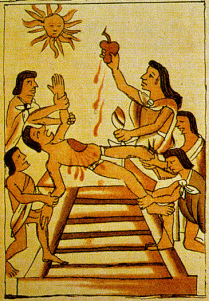
5) Atlanta Teacher RICO Conviction is Blood Sacrifice to the Testocracy

aztecshumansacrifice

Published: April 3
Views: 18,187

Description: There is something terribly wrong when we’re using laws created to stop organized crime as a means to convict  teachers cheating on standardized tests. I’m not saying cheating is right, but the mafia kills people. These were just teachers trying to keep their jobs in a system that rewards results and refuses to balance the scales, listen to research or the opinions of anyone not in the pockets of the testing and privatization industries.

Fun Fact: Watching all those seasons of “The Wire” finally came in handy.


4) Not My Daughter – One Dad’s Journey to Protect His Little Girl From Toxic Testing

FATHERS-AND-DAUGHTERS
Published: March 20
Views: 26,420

Description: How I went to my daughter’s school and demanded she not be subjected to high stakes testing in Kindergarten.

Fun Fact: They were very nice and did everything I asked. If you haven’t already, you should try it!


3) I Am Racist and (If You’re White) You Probably Are, Too

Screen shot 2015-06-02 at 1.42.34 PM

Published: June 2
Views: 28,906

Description: White folks often can’t see white privilege. This is my attempt to slap some sense into all of us. If you benefit from the system, you’re responsible to change it.

Fun Fact: Oh! The hate mail! I still get it almost every day! But I regret nothing! A black friend told me I was brave to write this. I disagreed. Anytime I want I can hide behind my complexion. She can’t.


2) I Am A Public School Teacher. Give Me All the Refugees You’ve Got

syrian_refugee_schools

Published: Nov. 19
Views: 45,196

Description: Our public schools are already places of refuge for our nation’s school children. Send me more. I’ll take them all. I’d rather they end up in my classroom than drowned by the side of a river.

Fun Fact: I got equal love and hate for this one. Some folks were afraid of terrorists. Others didn’t think we could afford it. But many told me my heart was in the right place. Lily and the folks at the NEA were especially supportive.


1) White People Need to Stop Snickering at Black Names

baby-and-parents

Published: Sept. 6
Views: 96,351

Description: Maybe we should stop laughing at black people’s names. Maybe we should try to understand why they are sometimes different.

Fun Fact: You’d have thought I threatened some people’s lives with this one! How dare I suggest people should stop mocking other people’s names! If you want to know how strong white fragility is in our country, read some of the comments! But many people thanked me for bringing up something that had bothered them for years but that they had been too polite to talk about, themselves. This is easily my most popular piece yet.


The Best Way To Honor Tamir Rice is by Reforming Our Broken Justice System

Memorial for Tamir Rice, 12-year-old shot dead by Police in Cleveland

Michael Brown – no indictment.

Eric Garner – no indictment.

Sandra Bland – no indictment.

And now Tamir Rice.

How many times will our justice system refuse to charge police with killing unarmed black people?

What will it take for our courts to accept the responsibility for at least attempting to seek justice?

When will our judicial system deem the death of people of color at the hands of law enforcement to at least be worthy of a trial?

Brown had no weapon but was shot to death by law enforcement.

Garner had no weapon but was choked to death by police.

Bland had no weapon but was found hanged in her jail cell after being assaulted by police during a traffic stop.

Rice had a legal pellet gun that was not pointed at anyone yet he was shot to death two seconds after police arrived.

This is not justice. This is a national travesty that continues to be played out daily. How many more human beings will be ground under the boot of a system that finds no value in their lives?

And don’t give me any of your excuses! Police were just doing there job! These people should have listened to law enforcement! Rice shouldn’t have had a pellet gun!

Listen to yourself. Lethal force is the only option!? Police have no tasers anymore, no pepper spray? Their guns only fire death strokes? They can’t hit non-vital areas meant to incapacitate but not kill?

What a bunch of cowards we are if we don’t demand police publicly explain themselves when they kill another human being – especially someone who posed them no bodily harm! How morally and spiritually bankrupt a nation we are not to weigh the evidence and decide guilt or innocence! “Freedom and justice for all!?” What a sham! What a lie! What a farce!

I don’t know about you, but I am sick of it. I refuse to put up with it for even one more day.

But what can we do?

No. Really.

When reading about these government sanctioned murders, I feel helpless. I’m just one person. What can I do to stop it?

Here are a few suggestions:

1) Ban Grand Juries in Fatal Shootings by Police

Connecticut and – most recently – California already have laws to this effect. District attorneys should have to decide whether officers face criminal charges when they kill people in the line of duty. This decision should be made in the light of day in full view of the public and not behind the closed doors of a grand jury hearing. These hearings involve no judges or defense attorneys and the transcripts of these proceedings are almost always sealed.

The problem is that district attorneys work closely with police and depend on them for political support. Sending cases like these to a grand jury gets the DA off the hook so he or she doesn’t offend the officers.

If the decision had to be made in public, voters could hold DAs accountable. With the grand jury system, there are no consequences because we have no concrete evidence about what happened during the proceedings, what arguments were made, by whom and who made what decisions. That’s a poor breeding ground for justice.

2) Construct a National Database on Police Killings

Right now there is no way to tell exactly how many people are killed by law enforcement in this country every year. Moreover, there is no way to tell if officers involved in these killings were ever charged.

Information can be compiled state-by-state, often through unofficial and anecdotal sources. However, this does not nearly give the full picture of what is going on. The people of this country deserve to know the full scope of the issue. That’s why apologists often claim these sorts of incidents are relatively rare and blown out of proportion by the media. But are they? A national database would prove the matter one way or the other.

Federal law from 1994 already calls for just such a database, yet it has not been funded. This may be due in part to the cost. A pilot study found that it would take a decade and cost $1 billion.

Certainly this is not a quick fix. But don’t we deserve to know this information? And isn’t it suspicious that nothing is being done to compile this data now?

3) Overturn Graham v. Connor

Perhaps the biggest obstacle to seeking justice for those unnecessarily killed by police is a precedent set by the U.S. Supreme Court 25 years ago. Graham v. Connor effectively ruled that police can kill you if they feel you present a “reasonable” threat to their own lives.

The problem is the word “reasonable.” What does that mean? In court, it can be almost anything. It’s a “Get Out of Jail Free” card to police for wanton murder. Justice Sonia Sotomayor calls this a “Shoot first, think later” approach to policing. She says this violates the Fourth Amendment which stipulates what counts as “probable cause” for police actions including arrests. However, Sotomayor is the only sitting justice publicly to take this stance.

This is why without more robust protections for citizens and more realistic expectations for law enforcement, even when cases like these go to court, they rarely result in police convictions.

But courts change. Public opinion can move mountains if given enough time. We need to start putting on the pressure.

Organize, people. Start writing letters. Write petitions. Hold rallies. Meet with your Congress-people. Make some noise.

In the meantime, let us grieve for all the Browns, Garners, Blands and Rices.

Their lives matter. And the best way to prove that is to get off our collective asses and do something about it.


NOTE: This article also was published on Commondreams.org.


Don’t Blame My Students For Society’s Ills

poverty LOCAL POVERTY GEE


As a public school teacher, I see many things – a multiplicity of the untold and obscure.

On a daily basis, I see the effects of rampant poverty, ignorance and child abuse. I see prejudice, racism and classism. I see sexism, homophobia and religious intolerance.

And hardly any of it comes from my students.

Despite what some people might say in the media, on Facebook or at the local watering hole, the kids are all right. It’s what we, the adults, are doing to them that’s messed up.

It’s always been in fashion for grown-ups to trash the next generation. At least since Hesiod bemoaned the loss of the Golden Age, we’ve been looking at the current crop of youngsters waiting in the wings to replace us and found them lacking. They just don’t have our drive and motivation. In my day, we had to work harder than they do. If only they’d apply themselves more.

It’s all untrue. In fact, today’s children have it harder than children of the ‘70s and ‘80s did when we were their age! Much harder!

For one thing, we didn’t have high stakes standardized tests hanging over our heads like the Sword of Damocles to the degree these youngsters do. Sure we took standardized assessments but not nearly as many nor did any of them mean as much. In Pennsylvania, the legislature is threatening to withhold my students’ diplomas if they don’t pass all of their Keystone Exams. No one blackmailed me with anything like that when I was a middle schooler. All I had to do was pass my classes. I worried about getting a high score on the SAT to get into college, but it didn’t affect whether I got to graduate. Nowadays, kids could ace every course for all 13-years of grade school (counting Kindergarten) and still conceivably only earn a certificate of attendance! Try using that for anything!

Moreover, my teachers back in the day didn’t rely on me so they could  continue being gainfully employed. The principal would evaluate them based on classroom observations from time-to-time to assess their effectiveness based on what he or she saw them doing. But if I was having a bad day during the assessment or if I just couldn’t grasp fractions or if I was feeling too depressed to concentrate – none of that would affect my teacher’s job rating. None of it would contribute to whether my teacher still had an income.

Think of how that changes the student-teacher relationship. Now kids as early as elementary school who love their teachers feel guilty on test day if they don’t understand how to answer some of the questions. Not only might their score and future academic success suffer, but their teacher might be hurt. That’s a lot of pressure for people who’ve just learned how to tie their shoes. They’re just kids! In many cases, the educator might be one of the only people they see all day who gives them a reassuring smile and listens to them. And now being unready to grasp high-level concepts that are being hurled at kids at increasingly younger ages may make them feel responsible for hurting the very people who have been there for them. It’s like putting a gun to a beloved adult’s head and saying, “Score well or your teacher gets it!” THAT’S not a good learning environment.

Finally, child poverty and segregation weren’t nearly as problematic as they are today. Sure when I went to school there were poor kids, but not nearly as many. Today more than half of all public school children live below the poverty line. Likewise, in my day public policy was to do away with segregation. Lawmakers were doing everything they could to make sure all my classes had increasing diversity. I met so many different kinds of people in my community school who I never would have known if I’d only talked with the kids on my street. But today our schools have reverted to the kind of separate but equal mentality that was supposed to be eradicated by Brown vs. Board of Education. Today we have schools for the rich and schools for the poor. We have schools for whites and schools for blacks. And the current obsession with charter schools and privatization has only exacerbated this situation. Efforts to increase school choice have merely resulted in more opportunities for white flight and fractured communities.

These are problems I didn’t face as a teenager. Yet so many adults describe this current generation as “entitled.” Entitled to what!? Less opportunity!? Entitled to paying more for college at higher interest for jobs that don’t exist!?

And don’t get me started on police shootings of young people. How anyone can blame an unarmed black kid for being shot or killed by law enforcement is beyond me.

Children today are different. Every few years their collective character changes.  Today’s kids love digital devices. They love things fast-paced, multi-tasked and self-referential. But they don’t expect anything they haven’t earned. They aren’t violent criminals. As a whole they aren’t spoiled or unfeeling or bratty. They’re just kids.

In fact, if I look around at my classes of 8th graders, I see a great many bright, creative and hard-working young people. I’m not kidding.

I teach the regular academic track Language Arts classes. I don’t teach the advanced students. My courses are filled with kids in the special education program, kids from various racial, cultural and religious backgrounds. Most of them come from impoverished families. Some live in foster homes. Some have probation officers, councilors or psychologists.

They don’t always turn in their homework. Sometimes they’re too sleepy to make it through class. Some don’t attend regularly. But I can honestly say that most of them are trying their best. How can I ask for more?

The same goes for their parents. It can be quite a challenge to get mom, dad, grandma, grandpa, brother, sister or other guardians on the phone. Parent-teacher conferences are very lonely in my room while the advanced teacher is mobbed. But I don’t generally blame the parents. In my experience, most moms and dads are doing the best they can for their kids. Many of my student’s have fathers and mothers working multiple jobs and are out of the home for the majority of the day. Many of my kids watch over their younger brothers and sisters after school, cooking meals, cleaning house and even putting themselves to bed.

I wish it wasn’t like that, but these are the fruits of our economy. When the recession hit, it took most of the well-paying jobs. What we got back was predominantly minimum wage work. Moreover, people of color have always had difficulty getting meaningful employment because of our government sanctioned racial caste system. Getting a home loan, getting an education, getting a job – all of these are harder to achieve if your skin is black or brown – the same hue as most of my students and their families.

So, yes, I wish things were different, but, no, I don’t blame my students. They’re trying their best. It’s not their fault our society doesn’t care about them. It’s not their fault that our nation’s laws – including its education policy – create a system where the odds are stacked against them.

As their teacher, it’s not my job to denigrate them. I’m here to lift them up. I offer a helping hand, not a pejorative finger.

And since many of the factors that most deeply affect education come from outside the school, I think my duty goes beyond the confines of the classroom. If I am to really help my students, I must be more than just an educator – I must be a class warrior.

So I will fight to my last breath. I will speak out at every opportunity. Because my students are not to blame for society’s ills. They are the victims of it.


NOTE: This article also was published in Wait What?, and the Badass Teachers Association Blog.


Putting the Arts Back in Language Arts – One Journal at a Time

d3493c8db7e1e4b423ce6b5e87f14eb6

This is the fifth in a series of blog posts focused on the value of art in our lives, and the role art can play in resisting the test and punish model of education.  See the intro and links to other posts in the series here.


Sometimes in public school you’ve just got to cut the crap.

No testing. No close reading. No multiple choice nonsense.

Get back to basics – pass out notebooks, crack them open and students just write.

Not an essay. Not a formal narrative. Not an official document. Just pick up a pencil and see where your imagination takes you.

You’d be surprised the places you’ll go.

You might invent a new superhero and describe her adventures in a marshmallow wonderland. You might create a television show about strangers trapped in an elevator. You might imagine what life would be like if you were no bigger than a flea.

Or you might write about things closer to home. You might describe what it’s like to have to take care of your three younger brothers and sisters after school until just before bedtime when your mom comes back from her third minimum wage job. You might chronicle the dangers of walking home after dismissal where drug dealers rule certain corners and gangs patrol the alleys. You might report on where you got those black and blue marks on your arms, your shoulders, places no one can see when you’re fully clothed.

My class is not for the academic all stars. It’s for children from impoverished families, kids with mostly black and brown skin and test scores that threaten to close their school and put me out of work.

So all these topics and more are fair game. You can write about pretty much whatever you want. I might give you something to get you started. I might ask you a question to get you thinking, or try to challenge you to write about something you’ve never thought about or to avoid certain words or phrases that are just too darn obvious. I might ask your opinion of something in the news or what you think about the school dress code or get your thoughts about how things could improve.

Because I actually care what you think.

Strange, I know.

At times like these, I’m not asking you to dig through a nonfiction text or try to interpret a famous literary icon’s grasp of figurative language. It’s not the author’s opinion that matters – it’s yours – because you are the author. Yes, YOU.

You matter. Your thoughts matter. Your feelings. YOU MATTER!

And sometimes students raise their hands and ask me to read what they’ve written. And sometimes – more often than not – the first thing they say is, “It’s no good.” “I don’t like it.” “I did bad on this.”

So I stop reading, I look them right in the eyes and ask them who wrote it.

“Me?” they say.

And I respond, “Then I’m sure it’s excellent.” And it usually is.

My 8th grade students have been ground down so low under the weight of a society that could care less about their well being that they’ve begun to internalize it. They think their thoughts and feelings are worthless. No one cares about what they think.

But I do.

So I offer them a chance to share what they’ve written. I don’t demand. I don’t force anyone to read anything. I know that some things that spill out on the page aren’t for sharing. But I want them to know that I value what they’ve just put down and that I think it’s worth taking the class time to let others hear it, too.

“Mr. Singer, I wrote five pages,” Jaquae tells me this afternoon. “That’s too long to share.”

“I disagree,” I say. “If you think it’s worth our time, you should read it. You deserve our attention.”

So he reads, blows out a cleansing breath and smiles.

In the process, we all become ennobled. We become more. We become a community. We get a peak at our common humanity.

It’s so easy to look at others as mere adversaries. Even our national education policy sees things in terms of a competition, a race. We set children against each other for points, for grades, for attention, just to feel valuable. You’re a Proficient. You’re a Basic. You’re a Below Basic. And somewhere along the way they lose the sense that they’re all valuable because they’re all human beings with thoughts, feelings and experiences that no one else has ever gone through before – but with which everyone can relate.

So I write, too. Every time I set my students a journal, I put pen to paper, as well.

At the beginning of the year, I share what I wrote to show them that it’s okay. At the middle of the year I ask them if they want me to share. And at the end of the year I remain silent unless they ask me to do otherwise.

Because these class moments aren’t about me. They’re about them. I’m willing to be as much a part of their creative space as they want, but it’s a choice, not a dictate.

In my class I will make you learn, but I don’t control what you learn or how you feel about it.

I extend my students this respect because I know that what we’re really doing isn’t some meaningless exercise. We’re creating art.

Not just scribbles on a page. Not something done just to please the teacher. This is an excavation of the soul. We dive into the depths of ourselves and come back all the better for it.

That’s why my students journal almost every day.

That’s why we put mechanics and spelling and grammar aside for a few moments and just write what we need to say.

Because Language Arts, after all, is an Art. It says that right in the title.

My students are artists. I am their muse. I hold a mirror up to their fractured and beaten spirits to show them the grandeur of what resides inside them.

And hopefully they come away inspired.

Because they are wonders. They are joyous. They are little pieces of my heart.


NOTE: This article was also published in Living in Dialogue, the Badass Teachers Association Blog and mentioned on Diane Ravitch’s blog.


Close Reading: Myopia as a Virtue

head in book
Painting by Pawel Kuczynski


You are reading a text.

Yes. Right now.

Your eyes are scanning over symbols called letters. They are joined together into words and sentences and paragraphs to make up the total of this article.

Your brain is in the process of translating these symbols into sounds, meanings, concepts. And you are reacting to those concepts.

You’re having thoughts about what you’re reading. Maybe you’re reminded of a similar article you’ve read sometime in the past. Maybe you’re feeling a thrill of excitement at such an original introduction to an education article. Or perhaps you’re rolling your eyes and wondering why the author is such a doofus.

No matter how you look at it, reading involves complex processes. A whole bunch of stuff is going on to make it happen – all of it essential.

Yet when we evaluate reading comprehension these days, we put the focus squarely on one or two of those multifarious processes. It’s reductive, reactionary, and lame. It’s a dumbing down of the cognitive and metacognitive process. But it makes things easy to grade on a standardized test.

That’s what the fad of close reading is all about. It’s an attempt to make the mysterious and complex mind something that can easily be labeled right or wrong.

For the uninitiated, close reading is the careful, sustained interpretation of a brief passage of text in which great emphasis is put on individual words, syntax, and the order in which sentences and ideas unfold.

It’s not that close reading is unimportant. After all, it’s something good readers do. But an overemphasis on this aspect leaves out so much that is even more vital. It’s like saying the only significant part of the Hershey bar is the wrapper, or the only salient part of eating the Hershey bar is chewing. However, when I unwrap my dessert, there better be chocolate inside, and after I bite into it, I’d better not forget to swallow!

But education specialists with little to no actual classroom experience are making a killing going from school-to-school lecturing teachers about how to teach. And they’re telling us to emphasize close reading to the detriment of all else.

They’re saying we need to give our students short texts of no more than a page or two. We should have our students read these texts without any background into who wrote them or why. We should then have students answer questions that require them to go back to the text, find something and spit it back to us.

For instance:

How does the author use figurative language to develop theme?

Explain how word choice in the passage develops characterization.

Provide examples from the passage that demonstrate the author’s bias.

To the uninitiated, it looks like really important work. It’s not. This is the literary equivalent of taking out the garbage or going on a scavenger hunt. These are good things, but they are not the be-all-end-all. They don’t capture the essential reason we read – to understand.

Imagine if I asked you to go back into the part of this article you’ve already read and find one example of a North American pejorative used by the author. You could do it. You could scan back to the beginning, look through everything I wrote and find that I used the word “Doofus.”

Huzzah! You win the scavenger hunt.

Now explain why I used that word by making reference to textual evidence. You could do that, too. You could look at all the other things I’ve written so far and explain why I probably chose that word.

Congrats!

But notice what you can’t do, what these think tank clones will never ask you to do – form a substantial opinion. Not just why do you think someone else did something but what do you think about what they did?

For example:

Do you think the use of colloquialisms and slang have a place in serious education theory? Why or why not?

When was the most or least effective time you or a colleague used a colloquialism to express a complex thought? Evaluate its effectiveness.

In what ways are forbidden words more or less meaningful than those more easily sanctioned?

At its core, reading is not about discrete facts. No one picks up a piece of text to find out minute fragments of information. Instead, we’re looking for enlightenment. We don’t care so much about how the astronaut puts on the spacesuit. We want to know why she put it on in the first place. We want to know where she’s going. We want to know what it’s like and if we’d want to do something like that ourselves.

But an overemphasis on close reading ignores all this. It pretends readers are robots. It pretends reading is a mechanical process that can be easily divided into its component parts and examined discretely.

Even worse it ignores the needs of individual students. For many children in our modern world, reading of this sort is almost entirely alien to their lives. There are so many things competing for our attention these days that reading often gets neglected. Even if you love to read, it can be difficult to find the time and inclination to sit down, quiet yourself and read.

THIS is where most educators would like to focus – getting students to read at all. We want to show learners why they might want to read. We want to engage them. Demonstrate what an amazing experience a good book can be. We want to foster that look of delight in their eyes, that sense of wonder, the epiphany of literacy.

But instead we’re being told to focus on the nuts and bolts, the everyday boring hunt and seek of mechanical mentation.

Whatever you do, don’t see the forest; see the trees. Don’t look at the big picture; look exclusively to the details and don’t worry your pretty little head about making any larger meaning out of it.

This is tantamount to child abuse. We’re putting blinders on children’s minds and telling them which direction to think. We’re taking away their ownership of the reading experience. It’s no longer about what they want, what they’ve lived through, what they believe or what they see. It’s only about the author’s view – an author they probably don’t care about because they had no part in all the other crucial facets of reading. In fact, I would argue that this isn’t even really reading at all. It’s little more than  decoding. It’s a skill set fit for a corporate drone, not someone in management or any position to make valuable decisions.

It’s no wonder that these prescriptions are only leveled at public schools. Parochial, private and charter schools are specifically left out of these mandates. The same people demanding close reading for your kids want something much different for their own.

This is class warfare as education policy. It’s all about keeping down working families and lifting up the one percent.

That’s essentially what corporate education reform is all about – every tentacle of the beast is wrapped around young minds of the poor, the brown skinned, the undesirable.

But perhaps you don’t agree with me. Perhaps you have your own thoughts on this matter which may differ from mine.

Fine, I say. Good!

Yes, please think about it. Ponder these issues carefully, because while I’m championing free thought, the other side wants nothing less than your children’s complete submission to the status quo.

Feel free to give that a nice close read.

12309794_10206881389730566_1129034647191120195_o


NOTE: This article also was published on the Badass Teachers Association Blog.