The Completely Avoidable Teacher Shortage and What To Do About It

teachers-wanted_slide-f490f6ba4043bb11d14c641c5fd6a253f638a74b-s900-c85

Hello?

Lo-lo-lo-lo…

Is anybody here?

Ere-ere-ere-ere…

Is anyone else left? Am I the only one still employed here?

Somedays it feels like it.

Somedays teaching in a public school is kind of like trying to run a resort hotel – ALL BY YOURSELF.

 
You’ve got to teach the classes and watch the lunch periods and cover the absences and monitor the halls and buy the pencils and tissues and fill out the lesson plans and conduct the staff meetings and…

Wouldn’t it be better if there were more people here?

I mean seriously. Why do we put the entire responsibility for everything – almost everything – involved in public education and put it all on the shoulders of school teachers?

And since we’re asking questions, why do we ALSO challenge their right to a fair wage, decent healthcare, benefits, reasonable hours, overtime, sick leave, training, collective bargaining… just about ANYTHING to encourage them to stay in the profession and to get the next generation interested in replacing them when they retire?

Why?

Well, that’s part of the design.

You see today’s public schools employ 250,000 fewer people than they did before the recession of 2008–09. Meanwhile enrollment has increased by 800,000 students.

So if we wanted today’s children to have the same quality of service kids received in this country only a decade ago, we’d need to hire almost 400,000 more teachers!

Instead, our children are packed into classes of 25, 30 even 40 students!

There’s no way a single teacher can give all those children her undivided attention at all times. There’s no way she can provide them with the kind of individualized instruction we know kids need in order to fulfill their potentials.

So why did we let this happen? Why do we continue to let this happen?

First, you have to understand that there are two very different kinds of public school experience. There is the kind provided by the rich schools where the local tax base has enough money to give kids everything they need including small class sizes and hiring enough teachers to get things done efficiently. And there’s the poor schools where the majority of our kids get educated by the most dedicated put upon teachers who give 110% everyday but somehow can’t manage to keep all those plates spinning in the air at the same time so the media swoops in, wags its finger and proclaims them a “failure.”

Bull.

It’s not teachers who are failing. It’s a system that stacks the deck against them and anxiously anticipates them being unable to meet unfair and impossible expectations.

Why do we let THAT happen?

Mainly because the people with money don’t care about poor and middle class children.

But also because they see the supposed failure of public schools as a business opportunity.

This is a chance to open a new market and scoop up buckets of juicy profit all for themselves and their donors.

It’s called privatized education. You know – charter schools and vouchers schools. Educational institutions not run by the public, not beholden to elected officials, but instead by bureaucrats who have the freedom to act in the shadows, cut student services and pocket the savings.

THAT’S why there’s a teacher shortage.

They want to deprofessionalize the job of teaching.

They don’t want it to be a lifelong career for highly trained, creative and caring individuals.

Why?

Those are people they have to pay a living wage. Those are people who know a thing or two and might complain about how the corporate scheme adversely affects the children in their care.

That’s why!

So these business people would rather teaching become a minimum wage stepping stone for young adults before they move on to something that pays them enough to actually support themselves and their families.

And to do that, the powers that be need to get rid of professional teachers.

People like me – folks with national board certification and a masters degree – they need to go.

THAT’S why class sizes are so large. That’s why so few young people are picking teaching as a major in college.

It’s exactly what the super-rich want.

And it doesn’t have to be some half mad Mr. Burns who makes the decisions. In my own district, the school board just decided to save money by cutting middle school math and language arts teachers – the core educators who teach the most important subjects on the standardized tests they pretend to value so much!

I’m under no illusions that my neighborhood school directors are in bed with the privatization industry. Some are clueless and some know the score. But the decision was prompted mostly by need. We’re losing too many kids to the local charter school despite its terrible academic track record, despite that an army of kids slowly trickle back to us each year after they get the boot from the privatizers, our district coffers are suffering because marketing is winning over common sense.

So number crunching administrators had a choice – straighten their backbones and fight, or suggest cutting flesh and bone to make the budget.

They chose the easier path.

As a result, middle school classes are noticeably larger, teachers have been moved to areas where they aren’t necessarily most prepared to teach and administrators actually have the gall to hold out their clipboards, show us the state test scores and cluck their tongues.

I actually heard an administrator this week claim that my subject, language arts, counts for double points on the state achievement rubric. I responded that this information should be presented to the school board as a reason to hire another language arts teacher, reduce class sizes and increase the chances of boosting test scores!

That went over like a lead balloon.

But it demonstrates why we’ve lost so much ground.

Everyone knows larger class sizes are bad – especially in core subjects, especially for younger students, especially for struggling students. Yet no one wants to do anything to cut class sizes.

If the state and federal government were really committed to increasing test scores, that’s the reform they would mandate when scores drop. Your kids aren’t doing as well in math and reading. Here’s some money to hire more teachers.

But NO.

Instead we’re warned that if we don’t somehow pull ourselves up by our bootstraps, they’ll close our school and give it to a private company to run – as if there were any evidence at all that this would help.

But, the school privatization cheerleader rebuts, why should we reward failing schools with more money?

The same reason you reward a starving stomach with more food. So the hungry person will survive!

Right now you’re doing the same thing with the testing corporations. They make the tests and grade the tests. So if students fail, the testing corporations get more money because then students have to take — MORE TESTS! And they are forced to take testing remediation classes that have to buy testing remediation materials produced by – wait for it – the same companies that make and grade the tests!

It’s a scam, ladies and gentlemen! And anyone who looks can see it.

But when you bring this up to administrators, they usually just nod and say that there’s nothing we can do about it. All we can do is keep trying to win the game – a game that’s rigged against us.

That’s exactly the attitude that’s gotten us where we are.

We can’t just keep doing it, keep appeasing the testing and privatization industry and their patsies in the media and government.

We must fight the system, itself, not go along with it.

We need to get on a bus and go to the state capital and Washington, DC, as a staff and protest. We need our school boards to pass resolutions against the unfair system. We need class action lawsuits. We need to tell everyone in the media what we know and repeat it again and again until it becomes a refrain.

And when we get these unfair evaluations of our under-resourced impoverished and multicultural districts, we need to cry foul. “Oh look! Pearson’s tests failed another group of mostly brown and black kids! I wonder what they have against children of color!”

Force them to change. Provide adequate, equitable and sustainable funding so we can hire the number of teachers necessary to actually get the job done. Make the profession attractive to the next generation by increasing teacher pay, autonomy, resources and respect. And stop evaluating educators with unproven, disproven and debunked evaluation schemes like value-added measures and standardized test scores. Judge them on what they do and not a trussed up series of expected outcomes designed by people who either have no idea what they’re talking about or actively work to stack the deck against students and teachers.

But most of all — No more going along.

No more taking the path most traveled.

Because we’ve seen where it leads.

It leads to our destruction.

Making Puerto Rico the New New Orleans – Steal the Schools and Give Them to Big Business to Run For Profit

IMG_8574

Charter school backers can’t help it.


They see a bunch of black or brown kids displaced by a natural disaster and they have to swoop in to help…


Help themselves, that is.


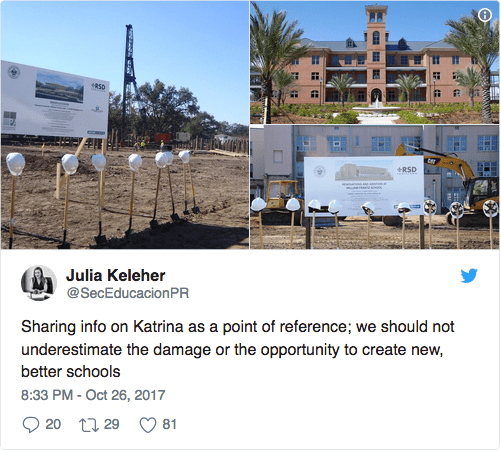
They did it in 2005 to New Orleans schools after Hurricane Katrina. Now they want to do it again in Puerto Rico after Hurricane Maria.


“This is a real opportunity to press the reset button,” said Puerto Rican Secretary of Education Julia Keleher.


“…this [is a] transformational opportunity for us to start to think fundamentally differently about what it is to be in school, and how one goes about getting an education.”

IMG_8573

A dozen years ago in Louisiana, that meant stealing almost the entire New Orleans public school system in the aftermath of Katrina. About 90 percent of the city’s 126 schools were given to the Louisiana Recovery School District, which turned them all into charter schools.


In effect, Louisiana state officials elected by the white majority stole control from local school boards elected by the city’s black majority. More than 7,000 teachers most of whom were people of color and had been displaced by the hurricane found themselves replaced by mostly white teachers brought in from other parts of the country.


Now, more than 10 years later, the New Orleans experiment has been shown to be a failure. Scores on standardized tests have improved (kinda), but the curriculum has narrowed, teacher turnover has doubled, disadvantaged and special education students have even fewer resources while schools fight over high achieving children, students spend hours being bused to schools far from their homes, communities have been erased, and parents have less control over how their own tax dollars are spent.


That is what Keleher and others want to repeat in Puerto Rico – wrest control away from the public and give it to big business all wrapped up in a bow.

Screen Shot 2017-11-09 at 12.34.02 PM

Why?


Public schools come with expensive perks like local control, transparent budgets and regulations to ensure all the money is being spent on students. It’s much cheaper to run these districts with unelected bureaucrats, closed-door budgets and the ability to grab as much of the cash as possible and stuff it into their own pockets.


It ’s not like anyone’s going to complain. These schools aren’t for rich white kids. They’re for poor brown ones.


It’s just colonialism, 2017 style!

IMG_8572

Jeanne Allen thinks that’s a great idea.

The founder and CEO of school privatization lobbying group, the Center For Education Reform, said that charterization is the best thing that could happen to Puerto Rican schools.


After dealing with the immediate effects of the hurricane, reformers “should be thinking about how to recreate the public education system in Puerto Rico.” And she should know. Allen was also involved in the New Orleans fiasco turning that system over to big business.


She added that charter school operators across the nation, including cyber charter school managers (whose schools often have even more wretched academic results), should be thinking about how to get involved in Puerto Rico post-Maria.


Keleher has already begun laying the groundwork.


Even though many Puerto Rican schools are only operational because of the work of teachers who have cleaned them up and have opened them despite being told not to by Keleher’s administration, the Education Secretary has pledged to lay off massive amounts of teachers and permanently close more schools – even schools that are structurally sound.


“Consolidating schools makes sense,” Keleher said in October. “They can go out and protest in the streets, but that doesn’t change the fact that we can’t go back to life being the same as it was before the hurricane.”


Puerto Rican teachers aren’t letting the vultures swoop in without protest.

IMG_8571

Just this week twenty-one teachers in the capitol of San Juan were arrested during a rally at the Education Department headquarters. They were demanding all structurally sound schools be opened immediately.


“Our schools have served students well and although we recognize that it can be expensive to repair some schools, what we are asking is that schools that are ready be opened,” said social worker Alba Toro just before the arrests.


Administration officials are claiming the teachers were taken into custody because they physically attacked the civil servants, but witnesses say the protest was entirely peaceful.

image

According to Education Safety Commissioner César González, the protesters assaulted at least three security employees and a public relations employee while inside the building.
However, protestors dispute this version of events. Eulalia Centeno, who was part of the group that went inside the building, but left before the arrests began, said that no violent acts were committed and that the protesters only demanded to see the secretary to request the opening of public schools.


Seven weeks after the hurricane, less than half of the island’s nearly 1,200 public schools are open in any capacity. Though many schools endured severe storm and flood damage, others were repaired and cleaned to shelter hurricane victims and are ready to take in students.

“Keleher is using the crisis as an opportunity to close hundreds of public schools, lay off senior teachers and privatize public education,” says Mercedes Martinez, President of the Federacion de Maestros of Puerto Rico, an island teachers union.

IMG_8570

Martinez was one of the teachers arrested during the protest.


When she was taken out of the building in handcuffs, her son was photographed leaning over a railing and patting his mother on the shoulder.


This is what real heroes do.


They refuse to back down despite the forces of prejudice and commerce stacked against them.


Will we let the charter school vampires suck Puerto Rico dry?

IMG_8574

Teacher Seniority – the Seat Belts of the Education Profession

Lady-Seatbelt(1)

You wouldn’t travel a long distance in your car without strapping on a seatbelt.

So why do you think teachers should spend 30 plus years in the classroom without seniority?

Everywhere you look, billionaires are paying millionaires in government to pass laws to cut taxes, slash funding and find cheaper ways to run public schools for pleb kids like yours and mine. And that often means finding ways to weaken protections for teachers, fire those with the most experience and replace them with glorified WalMart greeters.

“Hello. Welcome to SchoolMart. Please plug into your iPad and begin today’s lesson.”

This is class warfare cloaked as a coupon. It’s sabotage described as savings.

And the only way they get away with it is because reasonable people buy the steaming load of manure they’re selling.

MYTH: Seniority with Tenure means a Job for Life

Tell that to the hundreds of thousands of teachers out of work.

Tell that to all the optimistic go getters who prance out of college ready to change the world as teachers and fizzle out during the first five years.

Tell it to the handful of truly terrible teachers who for reasons only they can explain stay in a job they hate through countless interventions and retrainings until the principal has no choice but to give them their walking papers.

Oh, yes. Teachers DO get fired. I’ve seen it with my own eyes numerous times. And in each case, they truly deserved it.

(Any “bad teachers” still on the job mean there’s a worse administrator somewhere neglecting to do his or her duty.)

So what does “Seniority” and “Tenure” even mean for teachers?

Basically, it means two things:

(1) If you want to fire a teacher, you have to prove he or she deserves it. That’s Tenure.

(2) When public school districts downsize, they can’t just lay off people based on their salaries. That’s Seniority.

If you think about it, both of these are good things.

It is not a good work environment for teachers or students when educators can be fired without cause at the whim of incoming administration or radical, newly-elected school board members. Teaching is one of the most political professions we have. Tenure shields educators from the winds of partisanship. It allows them to grade children fairly whose parents have connections on the school board, it allows them to speak honestly and openly about school policy, and it empowers them to act in the best interests of their students – all things that otherwise could jeopardize their jobs.

Likewise, seniority stops the budget butchers from making experience and stability a liability.

It stops number crunchers from saying:

Hey, Mrs. Wilson has been here for 25 years. She’s got a shelf full of teaching awards. Parents and students love her. But she’s at the top of the salary scale so she’s gotta’ go.

I know what you’re going to say: Aren’t there younger teachers who are also outstanding?

Yes. There are.

However, if you put all the best teachers in one group, most of them will be more experienced.

It just makes sense. You get better at something – anything – the more you do it. This could be baking pies, building houses or teaching children how to read and write.

So why don’t we keep the best teachers and get rid of those who aren’t up to their level?

Because determining who’s the best is subjective. And if you let the moneymen decide – POOF! – suddenly the teachers who make the most money will disappear and only the cheapest ones will be left.

Couldn’t you base it on something more universal like student test scores?

Yes, you could, but student test scores are a terrible way to evaluate teachers. If you wanted to get rid of the highest paid employees, all you’d have to do is give them the most struggling students. Suddenly, their students have the worst test scores, and they’re packing up their stuff in little cardboard boxes.

Almost any stat can be gamed.

The only one that is solidly unbiased? Seniority.

You’ve either been here 15 years or you haven’t. There’s not much anyone can do to change that fact.

That’s why it prevents the kind of creative accounting you see from penny pinching number crunchers.

Along with Tenure, Seniority is a safety net. Pure and simple. It helps keep the most qualified teachers in the room with kids. Period.

But look. It’s not perfect.

Neither are seat belts.

If you’re in a car crash on a bridge where it’s necessary to get out of your vehicle quickly before it plunges into the water below, it’s possible your seat belt may make it more difficult to reach safety. This is rather rare, and it doesn’t stop most people from buckling up.

I’ve known excellent teachers who were furloughed while less creative ones were kept on. It does happen.

But if we got rid of seniority, it would happen way more often.

That’s the bottom line.

Instead of finding more leeway to fire more teachers, we should be finding ways to increase school funding – especially at the most under-resourced schools – which, by the way, are the ones where lawmakers most want to eliminate seniority. We should be looking for ways to make downsizing unnecessary. We should be investing in our children and our future.

We’ll never improve the quality of the public school system by firing our way to the bottom. That’s like trying to lose weight by hacking at yourself with a straight razor. It just won’t work.

We need to commit to public schools. We need to commit to public school students. And the best way to do that is to support the teachers who devote their lives showing up every day to help them learn.

Will the REAL Grassroots Activists Please Stand Up – Teachers or School Privatization Lobbyists?

Screen Shot 2017-10-11 at 5.07.37 PM


Everyone claims to be grassroots.


We’re the ordinary people – they say – the Hoi Polloi, the everyday Joes and Janes who make the world go round.


Which is to say we’re NOT the wealthy elite who get what they want simply by buying lawmakers and the political process.


You’d think the plutocrats wouldn’t even bother hiding. After all, it should be pretty obvious who is who.


One group has barrels full of cash. The other has numbers. However, our laws are written to obscure exactly how much money any one side has. And if you have money, you can use it to buy bodies to line up on your side and “prove” you have numbers.


So when it comes to the American education system, which side truly represents the grassroots – those supporting privatized schools like charter and voucher institutions or those supporting public schools?


It’s kind of a ridiculous question to ask, when you come to think of it.


One side actively lobbies for big business and huge corporations to take over local schools and districts. The other supports neighborhood schools.


One side pushes for schools to be striped of local control and instead to be managed by private equity firms and corporate officers. The other supports democratically elected school boards.


One side demands taxpayer dollars be available as profit that they can pocket and spend on mansions, yachts and jewelry. The other fights for transparency and for all taxpayer funds to be used in the service of educating children.


Which side do you THINK represents the little guy and which represents Goliath? Which side do you THINK represents the Rebel Alliance and which the Galactic Empire?


Come on now!


It’s the public school advocates who represent the common people. They are literally an extension of the masses struggle to reassert control over their lives and our society. Not those looking to raid our public services for fun and profit!


People get kind of upset when you try to do that. So when the villagers show up with torches and pitchforks, it does little good to argue that money equals speech. Better for the aristocrats to disguise themselves in peasant garb.


Enter Jeanne Allen.


She wants to convince you she’s the real underdog grassroots champion.


As Chief Executive Officer and Founder of the Center for Education Reform, she’s spent most of her career lobbying for public schools to be gobbled up by private enterprise.


So when the folks behind a new documentary about school privatization, “Backpack Full of Cash,” had the gall to cast her and her organization as the bad guy, she did what any grassroots activist would – she called the Hollywood Reporter.


Why would anyone be against charter and voucher schools, she whined. They just suck away necessary funds from the already underfunded neighborhood school so that businesspeople can play with your tax money. They just cut services for children and parents while miraculously transforming the savings into yummy profit.


I can’t imagine why anyone is calling her out. Can you?


But perhaps the most pernicious aspect of her argument is monetary.


Allen, the Center for Education Reform and the entire corporate education reform movement are the real grassroots, she says, because they are outspent by the opposition.


By which she means teachers unions. As if the overwhelming majority of parents, students, social scientists, civil rights activists and concerned citizens somehow didn’t count.


But oh well.


“The people praised in the film” (i.e. public school teachers) “get paid from taxpayer dollars,” Allen told the Hollywood Reporter, as if the people the film criticizes (charter and voucher operators) don’t also get paid from the same pot.


“The teachers unions spend $300 million a year on political races. We don’t have that kind of money.”


Is that true?


Are those pushing for corporate control of our schools really unable to match the monetary might of the big bad teachers unions?


Well, first let’s examine the number Allen bandies about as if it were fact.


$300 million. Do teachers unions actually spend that much annually on political races?


It’s doubtful. The entire operating budget for the National Education Association (NEA), the largest teachers union in the country, is only $367 million. And the union does an awful lot besides lobby lawmakers for pro-education public policy. It raises funds for scholarships, conducts professional development workshops, bargains contracts for school employees, files legal action on behalf of teachers to protect their rights, and partners with other education organizations to promote sound educational practices. Political lobbying is an important part of what unions do, but if they spent what they’re accused of spending on it – even if you include other unions like the American Federation of Teachers (AFT) – they couldn’t do the rest of what they do.


It turns out the figure Allen uses is a stale conservative talking point that Poltifact, a non-partisan fact checking Website, rated as false.


It’s based on a funding target the unions had for the 2008 election of which the unions fell short by almost a third. But now right-wingers and anti-labor trolls everywhere are married to that number and quote it as if it were fact.


In the real world, where Fox News talking points aren’t accepted without question, it’s increasingly difficult to determine exactly how much organizations spend on politics. But it’s incredibly doubtful teachers unions have the monetary might attributed to them by corporate school reformers.


And speaking of those who fight on behalf of poor beleaguered corporate America, how much do THEY have to spend fighting public schools?


Well, let’s just take two of their most famous backers – Charles and David Koch.


This duo runs one of the largest privately held companies in the United States: Koch Industries. It is involved in petroleum, chemicals, natural gas, plastics, paper and ranching. In 2013, Forbes said it had an annual revenue of $115 billion.


That’s an incredible amount of resources they can draw on every year when compared to teachers unions. The NEA would have to bring in more than three times its annual revenue to even come close to matching 1% of the Koch’s annual pay.


And do the Kochs spend on politics? You BET they do!


In 2012, alone, they spent at least $407 million on Mitt Romeny’s Presidential campaign! Yes, just that one campaign! They spent more on others! But even if we limit it there, that’s more than even the most absurd estimates of teacher’s unions political spending.


And they’re only two people!


We’re comparing about 3 million members of the NEA, and 1.5 million members of the AFT with two individual human beings.


Even if teachers unions spent $300 million, that only comes to less than $67 per member.


A quick look at Allen’s backers at the Center for Education Reform includes some of the richest people on Earth including: Bill and Melinda Gates, the Walton Family and Eli Broad.


And this woman has the nerve to cry poor in comparison to the big bad teachers!


Herself, she draws a six-figure salary as the organization’s President Emeritus – well more than the overwhelming majority of teachers.


But you’ll still find corporate reformers who contest this analysis with creative accounting. They’ll give you a spreadsheet with hundreds of millions of union dollars laid bare compared with a handful of poor billionaires who just can’t scrape together enough change in the couch cushions. And to do so, they’ll hide the super richs’ donations to super PACs or exclude dark money contributions, etc.


Look, I’m not saying our campaign finance system is perfect. In fact, it’s pretty messed up.


I am the first person to advocate for getting money out of politics. No more defining money as speech. One person, one vote.


But you must realize, the super wealthy don’t want that. More than anything else it would exponentially increase the power of the unions and the middle class from which they come. Not to mention their allies – the parents, students, child advocates, etc.


You really don’t need a detailed analysis of each group’s relative financial worth. You just have to look at who is in each group.


We’re talking the richest 1% of people on the planet backing charter and voucher schools versus teachers, parents, students, college professors, civil rights activists and concerned citizens backing public schools.


Which group do you think truly represents the grassroots?


Which group is an authentic demonstration of the will of the people?


And which is emblematic of the arrogant, hypocritical wealth class demanding we all bow down to the power of their pocketbooks?


You decide.

Please Help Puerto Rican Teachers and Their Communities Survive Hurricane Devastation

22016207_10155208870603152_2061682385_n

Mercedes Martinez is looking for water.

The President of the Federacion de Maestros of Puerto Rico, an island teachers union, has taken to the soggy streets to find bottled water for friends and family.

After Hurricane Maria, thousands of people including many local public school teachers have lost their homes.

Many of the 3.4 million residents of this U.S. territory don’t have access to water, power or roads. At least 13 people died during the storm and 70,000 more are at risk should a dam in the western part of the island break.

Martinez was luckier than most. Though her town is battered, the streets are flooded and many buildings damaged, her house remains standing.

But like many resilient islanders, she wasn’t satisfied just to scavenge for her immediate circle.

Even though she has no Internet at home, she gathered members of the union together and jury-rigged what signal she could to reach out for relief from the mainland.

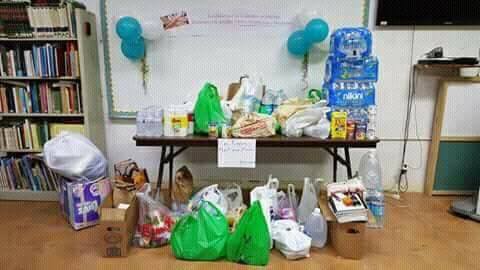
“The union is collecting donations to help,” she said.

“The Federacion de Maestros of Puerto Rico, which I preside, is receiving donations so we can help poor communities, teachers and students that lost everything.”

The union opened their offices for donations. They’re looking for canned foods, medicine, bottled water, clothes, insect repellent, bed sheets, etc.

You can send donations to:


The Federacion de Maestros of Puerto Rico

Urb El Caribe

1572 Ave Ponce de Leon
San Juan, PR, 00926.


The organization also has a gofundme Website at https://www.gofundme.com/solidaridad-victimas-huracan-maria

They’ve already received almost $7,000 in one day, but their goal is $40,000.

The Website includes this message:

“Thanks to all the compañeros and compañeras who have donated from various parts of the United States and other neighboring countries. The Federacion de Maestros of Puerto Rico (FMPR) is offering a network of support for those affected by the hurricane. Soon we will be informing the concrete steps. We encourage everyone to continue sharing the link for more partners to join in this effort. Together we will rise for Puerto Rico and help the poor and marginalized communities. Fight Yes!”

In the meantime, though schools have been closed across the island since the storm, teachers are supposed to report tomorrow.

“Right now communication on the internet is rough since a lot of towers were destroyed,” Martinez said.

“But to anyone who can help, thank you from the bottom of my heart.”

21463388_2022504187984316_4797333836297533816_n

21463416_2022504154650986_3527817112544667844_n

21753012_2021027091465359_20083949444758849_o

The following items are most in need:


* Personal Hygiene *
Towels
Toothbrush / hair brush
Soap (preferably bar)
Toothpaste
Shampoo / Conditioner
Deodorant (Unisex)
Razor Blades
Sanitary Towels / tampons / cup
Slapjones
Sanitary paper
Splash / perfume / Nenuco (F / M)
Gel
Shoes
Stockings
Interiors (Underpants / panties)
Pants
Shirts
Baby Clothes (F / M)
Diapers
Desitil / Balmex / Avenoo / A+D

* FOOD *
Canned Goods (Chicken / Tuna)
Export Cookies
Cereal
Uht milk
Rice
Oil
Salt
Soups
Sausages
Jamonilla
Corned beef
Pan (slice)
Potatoes
Guinean
Bananas
Pumpkin
Onions
Yams
Yautía
Hot
Fruit
Coffee
Sugar
Salt
Water
Pasta (Spaghetti / Mac)

* miscellaneous *
Greca / boot
Pan / pot
Gas Estufitas
Batteries
Lanterns
Candles
Sleeping bags
Mattress inflables
Bed Linen
Clorox
Mosquito repellent
Cups / utensils / plastic dishes

* MEDICINE *
Drugs “over the counter”
Panadol/Advil/Tylenol
Imodium
Pepto Bismol
Hydrogen peroxide
Alcohol
Cotton
Band-AIDS
Triple antibiotic
Syrups (e.g. Robitussin)

* school effects *
Variety

Top 10 Reasons Public Schools are the BEST Choice for Children, Parents & Communities

thumbsup


Everywhere you look today you’ll find profits prophets of doom bemoaning the quality of our public school system.


We’ve got too many failing schools, they say. The only thing to do is to invest in private and privatized institutions vouchers, charters, ANYTHING but public.


But as education professors Christopher and Sarah Lubienski wrote in their landmark book “The Public School Advantage: Why Public Schools Outperform Private Schoolsthere’s little evidence behind the hype. Public schools are far from perfect, but even given their deficiencies, they have benefits that far outweigh those of privatized schools. Indeed, market-based educational reform, wrote the Lubienskis, is “increasingly a belief system rather than a policy theory.”


Privatized schools are sometimes great at boosting standardized test scores, but when it comes to authentic indicators of student learning, they often fall well behind their traditional public school counterparts.


And when you stop to consider things like finances, accountability, self-governance, social justice and life-long learning, then public schools prove themselves to be a much better choice than any privatized system.


Clearly we’re speaking in generalities here. Every school – public or privatized – is different. But there is enough commonality to identify certain trends between each type of school to make general conclusions about each category. In short, despite any media or political propaganda to the contrary, public schools come out on top.


Here are the top 10 reasons public schools are the best choice for children, families and communities


1) Public Schools Attract the Best Teachers


When choosing a school for your children, you want them to have the best teachers possible. You want life-long, committed educators – people who entered the profession as a calling, who dedicate their lives to young people.


This is not the case at many charter or private schools. Their teachers often don’t have the same high level of education, experience, or commitment. In many states, they aren’t required to earn a 4-year degree from an accredited college, they routinely have less experience and higher turnover.


Compare that with public schools. With rare exceptions, teachers must have at least one bachelors degree in a specialized education field, and many have masters degrees or more. In addition, teacher turnover is much lower. This is partly because public school teachers usually earn a higher salary than those at privatized schools. (It’s still not comparable with professionals in other fields with similar levels of education, but it’s better than they get at privatized schools.) In addition they have higher job satisfaction because of increased union membership, which enables greater stability and helps create a safer workplace for teachers and their students.


Think about it. If you were one of the best teachers in the country, wouldn’t you want to work where you get the highest salary and benefits? Of course!


2) Public Schools Have a Greater Sense of Community


Most public schools have been around for a long time. They are the heart of the communities they serve. They do so much more than just teach children. They host continuing education courses for adults, extracurricular activities, sporting events, academic clubs, public swimming pools, open libraries, and invite the community for local events, concerts, seminars, etc.


This is rarely the case at privatized schools. Charters and private institutions are often fledgling startups. They’re located in rented office spaces, renovated store fronts and other locations chosen more for their cost benefits to investors and not for their efficacy as places of education or community outreach.


Public schools have histories that go back generations. Everyone in the community knows the teachers who work there. Parents often send their kids to the same educators who taught them when they were young. Sometimes this goes back to grandparents and even great grandparents. Older brothers can advise younger sisters what it was like to have this teacher or that principal. The kinds of relationships you get at public school just aren’t there at institutions that model themselves on big box stores like WalMart and Target.


3) Public Schools Increase Educational Choice


Privatizers often talk about charters and voucher schools as if they are the only places that offer parents and students choice. It’s simply untrue. Many public school districts offer a tremendous amount of alternatives for students living in their neighborhoods. Larger urban districts often have magnet or theme schools. But even beyond that, most schools offer a wide variety of classes and curriculum. Students can take foreign languages, vo-tech, arts and humanities, independent studies, and advanced placement or college credit courses. Students can take advantage of a plethora of services designed to personalize their academic experience to meet their individual needs with special and gifted education, even choosing which teachers are the best fit for their learning styles.

Obviously, these options increase with the degree of wealth in a community, but they prove that increasing choice doesn’t have to mean privatization. It means equitable funding.


4) Public Schools Have Greater Diversity


Students learn a lot more than reading, writing and arithmetic in school. They also learn how to deal with different kinds of people – they learn to share this world with other humans from various racial, ethnic, religious, and sexual backgrounds. The more diverse an environment they grow up in, the more well-adjusted they will be for the adult world, and the less racist, sexist and prejudiced they’ll probably become.


Public schools are often a sea of diversity. They are the best place to meet the entire spectrum of humanity. On the other hand, charter and voucher schools are routinely segregated and homogenous. Sometimes privatized schools make efforts to fight against this, but you can’t make much headway when your entire system is based on sorting out the underprivileged in favor of white, affluent children whose parents can afford tuition (private schools) or poor black but high achieving children (charter schools).


5) Public Schools Are More Fiscally Responsible


Public schools spend their money more wisely than privatized schools. They have to! Their records are an open book. All the spending decisions happen in public view. And the law requires that all expenses must relate to educating children.


Privatized schools rarely do this, and if they do, it’s by choice not necessity. They could close their books any day, make whatever decisions they like behind closed doors and layout bundles of cash for their CEOs or investors. Privatized schools are for-profit. Even when they aren’t explicitly labeled as such, they usually operate in the same way – cut student services to increase the bottom line. Their explicit goal is to make money off your child – not simply earn a middle class income like public schools. No, they want to get rich off of your dime.


Privatizers buy mansions and yachts with your money. Public school teachers pay off their mortgages. And in the rare instances where public school employees break the law and try to embezzle funds, they are much more likely to be caught because the books are right there for all to see.


6) Public Schools Are More Reliable


When you send your child to most privatized schools, you never really know if it’s going to be there tomorrow. Charter schools often close without a moments notice. Private schools declare bankruptcy.


If there’s one thing you can be reasonably sure of, it’s that your neighborhood public school will still be there. It’s been there for decades, sometimes hundreds of years. Charter and voucher schools are often fly-by-night affairs. Public schools are solid bedrock. If public schools close, it’s only after considerable public comment and a protracted political process. No one ever shows up to find the local public school chained shut. Not the same at charters or private schools.


7) Public Schools Have Greater Commitment to Students


Charter and vouchers schools don’t have to accept your child. Public schools do.


When you enroll in a privatized school, the choice is all up to administrators. Is your child a safe bet? Can they let your little one in without breaking the bank? Will he or she make the school look good with better test scores? Will he or she be easy to educate?


Public schools, on the other hand, have a commitment to educating every child who lives in the district. They even take homeless children. Only under the most extreme circumstances would they expel a young person. No matter who your offspring is, no matter how good or bad a student, public school operators have faith they can help the youngster succeed.


8) You Have Ownership of Public Schools


With privatized schools, you’re paying for a business to provide services. Public schools belong to you. In fact, you’re the boss.


Public schools are run by your friends, neighbors and co-workers. Privatized schools are most often run by appointed boards of directors who are not beholden to you but to the investors. As education blogger Peter Greene puts it, “The charter is a business, run by people who don’t ever have to let you into their board room.”


In addition, many public schools go beyond even this level of parental involvement. They more often have PTAs or PTOs. They have advisory councils where elected parents, teachers and community members can work together to advise the school board on important maters like hiring superintendents. If parents and the community want a voice, the public school system is overflowing with options. Ironically, the community rarely has any say over privatized schools and parents can only vote with their feet.


9) Public Schools Provide More Amenities


Public schools routinely offer so much more than privatized schools. At many charter and voucher schools, parents are required to buy supplies for the whole institution. Public schools accept donations and sometimes teachers ask for help, but if parents can’t (or won’t) send in pencils or tissues, the school provides it gratis. And even when the district is cheap in this regard, teachers often make up the difference from their own pockets. It’s not right that they have to do so, but they constantly step up for your children.

Moreover, public schools offer a much expanded range of services for your children than privatized schools. Special education and gifted programs are first rate at public schools while often intermittent or nonexistent at privatized schools. And the requirements put on parents at public schools are much lower – less restrictive dress codes, fewer demands on parents’ time and they take a greater responsibility for your children.

Heck, private schools rarely even pay for transportation. Public schools offer a free ride via the school bus from home and back again.


10) Public Schools Match or Outperform Privatized Schools


When it comes to academic performance, comparisons all come down to what data you think is indicative of student learning and which factors you exclude. You can find plenty of studies funded by privatizers that unsurprisingly conclude their backers business model is the best. However, when you look at peer reviewed and nonpartisan studies, the story changes.

The Lubienskis, in particular, paint an extremely compelling picture of public school superiority based on numerous complex statistical models including hierarchical linear modeling and multivariate regression. In short, the authors conclude that after accounting for the demographic differences among various school sector populations, traditional public school students outperform those at private schools over time. Students typically enter public schools with much greater degrees of poverty than those entering private schools. As such, public school students start with greater academic deficiencies. Even so, public schools are able to make up for these deficiencies over time more easily than privatized schools. And by fourth grade, public school students actually have greater academic success than their demographically similar peers at private or charter schools. The Lubienskis call it “The Public School Effect.”


With all these benefits, you’d think we’d be cheering on our public school system, not denigrating it. However, the failing schools narrative sells a lot of people on privatized alternatives. But it’s not fact. It’s marketing.


It’s time someone explicitly outlined the benefits of our public schools. We could be doing a lot more to help make them even better. But the first step is recognizing what an asset these schools already are.


Public schools, they’re what happens when we value children over profit.

A Teacher’s Dilemma: Take a Stand Against Testing or Keep Abusing Children

 AJGE5E_2026469c

What am I?


Seriously. What is it I do for a living?


When I wake up to go to work in the morning, am I preparing to be a teacher or a test proctor?


Am I engaged in the practice of nurturing young minds or am I a tool of the establishment?


Should I be held accountable to the dozens of students in my classroom, their parents and the community – or to my administrators, the bureaucrats and moneyed interests ordering us around?


I ask these questions not as a rhetorical device. I really don’t know the answers. Because the solution begins with me.


Today was not a banner day in my classroom, and I can honestly say it was not my fault.


I had to give my 7th grade students the Classroom Diagnostic Tools assessment in Reading/Lit for grades 6-high school.


If you’re not familiar with the CDT, this is an optional test offered by Data Recognition Corporation for students in Pennsylvania’s public schools. It’s a way to assess student learning to predict whether they’ll pass there annual federally mandated standardized tests (also created by Data Recognition Corp. in the Keystone State). In addition, it offers example questions of the type that students struggled to answer correctly on the diagnostic.


It’s very helpful if you want to print out a buttload of test prep, give it to students and then read the paper quietly at your desk – something I never do.


For the second straight year, I’ve been forced to give it to my students three times annually – twice before the Pennsylvania System of School Assessment (PSSA) tests and once after.


I am not a fan.


Students hate it. It does not return valuable data. And it takes precious time that I could be using to actually teach something.


When I told my kids they were going to have to take the assessment this morning, one girl said, “I hate the CDTs. It stands for I Can’t Do This.”


Another girl had a more visceral reaction. When she saw the letters “CDT” on the board, she literally began rolling around on the floor and groaning.


These are the kinds of students I have – victims of generational poverty, malnutrition, childhood trauma, violence, drug abuse and systemic racism and prejudice. Strong-arming them into another standardized test isn’t doing them any favors.


Compare their reaction this morning to yesterday’s lesson.


We had just finished a unit on plot using Dr. Seuss stories and cartoons to illustrate complex concepts like exposition, conflict, rising action, climax, resolution, theme, etc.


I made a competitive review game through a program called Kahoot, and kids were out of their seats, jumping around, squealing with delight as they demonstrated their knowledge of what they’d learned. It got so loud one of the principals came running over from the office to make sure things weren’t getting out of hand. But what he found were students so engaged by the work they could barely contain themselves.


Heck! I even gave them a test of my own creation right afterward. There were no groans. There were no protests.


They sat at their seats like grown adults, concentrated and answered the questions to the best of their abilities.


Compare that with today’s assessment.


Behaviors off the hook. Sullen looks. Demands to use the restroom, go to their lockers, visit the nurse – ANYTHING but be here in class and do this test.


Why the difference?


Because they knew what was expected on MY test, and they knew they could meet my expectations. I was there for the lesson. I made the test. I would grade it. I have a relationship with these kids and they know I will assess them fairly.


But not on this standardized CDT nonsense!


Data Recognition Corp isn’t there for the lesson. It has no rapport with students. Kids don’t know what the expectations are and don’t think they can meet them. And they have no sense that this multi-billion dollar corporation will grade them fairly for their efforts.


So they act out.


They throw wads of paper or airdrop pictures to each others’ iPads.


And here I am in front of this room of unruly children forced to have to defend the bullcrap garbage that I’m being coerced to do to them.


I want to apologize. I want to tell them this is not my idea. And after a while, I even DID that. But it’s no use.


It matters little whether the executioner does his job with reluctance or not. He’s still here to end your life. And I was still cast in the role of ending their education for the day and replacing it with “proof” that they aren’t good enough.


When the test was over, so many children showed me their scores with hurt faces.


“Mr. Singer, I really tried!” one boy said.


“This is rigged!” another said.


And what am I supposed to say to that? Should I explain how they’re right – how standardized tests have always been culturally and economically biased? Why would they care!? What kind of teacher would that make me!?


I know this is wrong, but I still do it!?


What use am I?


What purpose do I serve enforcing policies I know to be detrimental?


I went through five years of college to become a teacher – not a prison guard. But on days like today that’s what I am. I’ve devoted over a decade of my life to nourishing children, not ordering them all to march in line single file.


But here I am, a paid thug who browbeats and coerces innocents into doing things they don’t want to do for purposes that won’t benefit them and will in fact be used against them.


I wonder what the school board would say if I had the guts to stand in front of them at a public meeting and tell them.


I guess I’ll just have to keep wondering because the last time I tried to address that august body without an explicit invitation, I was told I wasn’t allowed to do so since I don’t live in the district where I teach.


But sometimes I question whether the elected representatives of my district even understand what I’m being bulldozed into doing in their name.


Do you know I am abusing your children? I am crushing their creativity, their self-respect, their curiosity. Is that really what you want of me? Is that what you hired me for?


Don’t get me wrong.


It’s not really anything new. I’ve been doing this for almost 15 years. It’s just harder every year.


I heap on justifications – you have to do the bad stuff so you can do the good stuff. You have to enforce the testing so you can do authentic teaching.


And every year the mandates get more restrictive, the teaching gets a little less and the testing a bit more.


Meanwhile, politicians pretend like they’re doing something to fix it. Gov. Tom Wolf (whom I generally like) cuts off a few days from the PSSA tests this year. But he keeps the recommendation that we take the CDTs. He keeps the entire test-and-punish framework in place. Like most Democrats, he’s willing to twiddle around the edges but has no guts to do away with what’s wrong and replace it with what’s right.


Meanwhile, parents in my state are generally clueless.


You have some strong advocates here and there. Some moms and dads who understand what’s going on. But most are either oblivious, too busy putting food on the table, in jail or dead.


I used to send home a letter to parents reminding them of their right to opt out of standardized tests. It almost got me fired.


And for my efforts, I think maybe one or two parents over five years actually took me up on it.


I go to my local union and tell them my concerns. They nod and ask for more information and then quietly forget it.


Meanwhile, the national unions are behind the testocracy 100%. They’ll wag their fingers and complain about testing, but they’re too busy making sure the teaching profession even exists tomorrow to stop for small potatoes like bad practices.


I feel so alone here.


I’m pulling my hair out and the only response I get is from the choir (Hallelujah!) and the corporate education reformers (How dare you!?).


The majority stays silent. And complicit.


I’m just not sure I can do it anymore.


I’ve thought about calling in sick whenever I have to give a standardized test. It would be a lot of days, but I could do it.


That might be safe, but it would be cowardly.


I’d just be saving myself the pain and humiliation of giving the tests. My students would still be forced to take them.


So what do I do?


I write.


I write blogs like this one.


I pound out my cares and reservations, put them in a virtual bottle and set it adrift on the seas of the Internet.


It’s a constant gamble.


Someday someone may read them who can end my career.


Or maybe someone with the power to make a difference will read them.


Maybe that’s you.


Maybe it’s all of us.


I don’t know.


I have no solutions today. Just shame and regrets.


A dilemma that I cannot solve.

Dear Teachers, Don’t Be Good Soldiers for the EdTech Industry

FullSizeRender

Dear fellow teachers,

Thank you for coming to this meeting on such short notice.

I know you have plenty more important matters to attend to this morning. I, myself, left a pile of ungraded papers on my desk so I could get here. Not to mention I urgently need to fix my seating charts now that I’ve finally met my students and know who can sit with whom. And I’ve got to track down phone numbers for my kids’ parents and go through a  mountain of Individual Education Plans, and… Well, I just want you to know that I get it.

There are a lot of seemingly more pressing concerns than listening to a teacher-blogger jabber about the intersection of politics and our profession.

Is that all of us? Okay, would someone please close the door?

Good. No administrators in here, right? Just classroom teachers? Excellent.

Let’s speak openly. There’s something very important we need to talk about.

There is a force out there that’s working to destroy our profession.

Yes, ANOTHER one!

We’ve got lawmakers beholden to the corporate education reform industry on the right and media pundits spewing Wall Street propaganda on the left. The last thing we need is yet another group dedicated to tearing down our public schools.

But there is. And it is us.

You heard me right.

It’s us.

There is an entire parasitic industry making billions of dollars selling us things we don’t need – standardized tests, Common Core workbook drivel, software test prep THIS, and computer test crap THAT.

We didn’t decide to use it. We didn’t buy it. But who is it who actually introduces most of this garbage in the classroom?

That’s right. US.

We do it. Often willingly.

We need to stop.

And before someone calls me a luddite, let me explain. I’m not saying technology is bad. It’s a tool like anything else. There are plenty of ways to use it to advance student learning. But the things we’re being asked to do… You know in your heart that they aren’t in the best interests of children.

I know. Some of you have no choice. You live in a state or district where teacher autonomy is a pathetic joke. There are ways to fight that, but they’re probably not in the classroom.

It’s not you who I’m talking to. I’m addressing everyone else. I’m talking to all the teachers out there who DO have some modicum of control over their own classrooms and who are told by their administrators to do things that they honestly disagree with – but they do it anyway.

We’ve got to stop doing it.

Corporations want to replace us with software packages. They want to create a world where kids sit in front of computers or iPads or some other devices for hours at a time doing endless test prep. You know it’s true because your administrator probably is telling you to proctor such rubbish in your own classroom so many hours a week. I know MINE is.

Listen, there are several reasons why we should refuse.

First, there’s simple job security. If your principal brought in a Teach for America temp and told you this lightly trained fresh from college kid was going to take over your classes, would you really sit down and instruct her how to do your job!?

I wouldn’t.

That’s the entire point behind this tech industry garbage. You are piloting a program that means your own redundancy.

You are engaged in an effort to prove that they don’t need a fully trained, experienced, 4-year degree professional to do this job. They just need a glorified WalMart greeter to watch the kids as they push buttons and stare at a screen. They just need a minimum wage drone to take up space while the children bask in the warm glow of the program, while it maps their eye movements, catalogues how long it takes them to answer, records their commercial preferences and sells all this data to other companies so they can better market products – educational and otherwise – back to these kids, their school and their parents.

This isn’t about improving educational outcomes. It’s about bringing the cost down and pocketing the savings as profit.

It’s about replacing the end-of-the-year standardized test with daily mini stealth assessments that are just as high stakes and just as effective at providing an excuse for the state or the feds to swoop in and steal control, disband the school board and give the whole shebang to the charter school operator who gives them the most generous campaign donations.

Do NOT be a good soldier here. Do not just follow orders. Doing so is weakening our entire profession. It is putting our jobs in jeopardy. And it’s about time our national teachers unions figured this out instead of conceding the point so their leaders can keep a seat at the table. Someone needs to tell them they shouldn’t be sitting inside the building. They should be with us, outside surrounding it with signs and pitchforks.

The EdTech shell game is not about improving student learning. It’s a commercial coup, not a progressive renaissance.

Think about it.

They call this trash “personalized learning.” How can it really be personalized if kids do the same exercises just at different rates? How is it personalized if it’s standardized? How is it personalized if it omits the presence of actual people in the education process?

It’s teach-by-numbers, correspondence school guano with graphics and a high speed Internet connection.

But we give in. We don’t want to rock the boat. We’re rule followers, most of us. We do what we’re told.

Most teachers were good students, and obedience is too often a defining quality of those who succeed in our education system.

I get it. You don’t want to be a fly in the ointment. You don’t want to make yourself a target.

Me, too.

How dearly I would love to be able to just comply. But I can’t simply go along with something I know in my heart to be wrong. And this is wrong on so many levels.

I sat through a meeting much like this one earlier this year where I was told exactly which programs to force on my students. All the while good teachers whom I respect went through the motions as if nothing was wrong. They talked about how to organize our classes in the system, how to assign test prep and how often, and how to access the data.

But we never discussed why.

We never discussed if doing so was a good idea. That was all taken for granted. It was a decision reserved for someone else, someone from a higher pay grade.

Yet classroom experience is rarely commensurate with salary scale especially once you cross the line into management. Nor is the experience of a handful of administrators equal to that of a plentitude of staff!

No. I’m sorry. At very least that is a discussion WE should be having.

It is the TEACHER’S job to determine what is educationally appropriate. Not the administrators. At most, the building principal should be part of that discussion in her role as lead teacher. But the resolution to go ahead or not should be made together as a staff.

And if an individual teacher thinks based on their own experience with their own students that they should go in a different direction, they should be respected enough as a professional to have the autonomy to do so.

Teachers have to abide by best practices, but test prep in any form is NOT a best practice.

It’s time we stood up en masse and made that clear.

We are our own worst enemy in this regard.

We are too submissive. Too meek.

This world requires teachers to be revolutionaries, to be radicals.

And that doesn’t end in the classroom.

We need to educate parents and the community about what’s happening. The classroom doors are too often closed to the public. The only information they get is from anemic administrators and a mass media that invariably just reports whatever propaganda the corporation puts on the press releases.

We are responsible for our students. We must protect them from the vultures out there trying to water down their educations and reduce the quality of their learning.

We are not the only ones who can take a stand. In fact, IF we are the only ones who do it, we will certainly fail.

But, along with parents, students and concerned citizens, we MUST be part of that resistance.

We MUST take a stand for our children and our profession.

Because without us, there is no hope of success.

So we can no longer afford to be good soldiers in someone else’s army.

It’s time to have the courage of our convictions.

It’s time to rise up, walk hand-in-hand to the front of the staff meeting and tell our administrators:

NO.

Because if we don’t, no one else will.

Why I Teach

https___blueprint-api-production.s3.amazonaws.com_uploads_card_image_488464_d6180c5d-946d-4770-9d02-091555a03a3b

Every year it’s the same nightmare.

I’m in front of a class of middle school students who aren’t paying any attention to me.

I point to the board, stamp my foot, even scream in vain.

But the children keep acting up – throwing pencils, swearing, hurting each other’s feelings.

It’s like I’m invisible.

And then I wake up.

Every teacher probably has a similar dream the night before their first day with students.

It’s a dream of impotence and redundancy.

Kind of like the businessmen and their political puppets claim we, teachers, are every day.

But the reality is much different.

Kids come bouncing in to my room, bristling with energy, half concealed hopes and fears.

Before they come in, I’m full of doubt: Can I still do this for another year? Will I be able to keep up with the work load? Will I be able to accommodate all the extra services for every special education student in my mainstreamed classroom? Do I have enough desks, pencils, paper? Have I planned enough for the first week? Will I be able to keep students interested, entertained, disciplined, engaged, working, inspired?

But the second the kids enter the classroom – literally the exact second – all my doubts disappear.

There’s no time.

I have more than two dozen children to see to at any given moment – and their needs outweigh any of mine.

It wasn’t until about halfway through the day that I even had an instant to myself to stop, breathe and reflect.

After my first bathroom break in more than 3 hours, then grabbing my lunch and collapsing into a seat- the first time I’m off my feet with no anxious little faces looking up to me – I think back on my day and realize – I absolutely love this!

No, really.

My feet hurt, my temples throb from making a hundred tiny decisions every 40 minutes, my body feels like it’s already been through a war… But there is no place in the world I would rather be.

Look what I’ve already accomplished today!

I took about 50 anxious human beings and made them feel like it was going to be okay.

I made 50 faces smile, sigh and relax.

I worked for hours on a new syllabus last week with manga graphics and punchy repartee, and when the kids got it today, they knew this class wasn’t going to be boring. I planned some ice breaker games to get them focused on our budding community of learners. I modeled how we can interact and still respect each other.

And in return I heard: “This is the best class!” “Mr. Singer is my favorite teacher!” “I don’t like to read or write but I’m really looking forward to doing your homework!”

How can you hear such things and not come away energized and new? How can you see such things and not feel a warm glow in your heart?

One of my first assignments is to have students write a letter about themselves. It’s now day 3 and I’m sitting at my desk reading through them.

It’s heartbreak city. Dead or absent parents, lost friends and pets, moving from place-to-place, older brothers and sisters serving as caregivers, pledges to work hard this year and make some missing adult proud. I find myself tearing up and writing supportive comments: “That’s so sad.” “I hope you like it here.” “You’ve already made me proud.”

I go through my Individual Education Plans and see a catalogue of hurt and trauma. Babies, they’re just babies, and they’ve gone through more than I have in my whole life. And I’m more than three times their age!

How can I not come to school every day and give my very best?

A public school is more than a building to me. It’s a temple to humanity. It’s where we go to offer ourselves to other people.

Every action, every thought spent on these children is holy. The tiniest gesture is magnified through infinite time and space. When I help a child gain confidence in her reading, I help not just her. I help everyone she will ever come into contact with –her co-workers, her friends, family, even her own children if she someday has some.

It’s humbling. Amazing. Staggering.

Where else can you see the accumulated hurt of the world and actually make a dent in it? Where else can you reach out not just to a cause or an idea but to a living person?

I’m lucky. I am so lucky. My circumstances allowed me to do whatever I wanted with my life.

I could have become a doctor or a lawyer. I could have gone into business and made a whole mess of money. But I never wanted any of that. I wanted to make a difference. I wanted to help people.

I remember the pitying looks peers would give me in my 20s. What a waste, they seemed to say. But I’ve never regretted it.

This is what I was meant to do. It’s the only thing I ever could and still respect myself.

Some folks will tell you teaching is about numbers and data. Increase these test scores. Cut costs by this much. Boost profits, escalate the graph, maximize effectiveness.

These people are fools.

Teaching has nothing to do with any of that. It’s about the children. Being there for them. Being an active part of eternity.

Thankful eyes, delighted smiles, joyous laughter. Ameliorating hurt. Igniting a tiny candle whose light will grow to encompass sights I will never see.

That’s why I teach.

I Am Not A Hero Teacher

Screen Shot 2017-08-01 at 10.53.52 AM


I’m sorry.


I am not a hero teacher.


I am not stronger than a locomotive.


I cannot jump tall ignorance in a single bound.


I am not faster than a tax-cutting zealot.


Up in the air – it’s a bird, it’s a plane, but it’s certainly not a teacher because we can’t fly.


I am not bullet proof.


If a gunman storms the building and shoots me, I will be wounded and may die.


Giving me a gun doesn’t help, either, because I am not a marksman.


I am just a man.


I cannot stand in front of a class of thirty and give them each my undivided attention. Not all at once.


When students ask a question, I need time to answer it.


When students hand in a paper, I need time to grade it.


During the workday, I need time to plan my lessons. I need time to call parents. I need time to read all the individual education plans, fill out all the weekly monitoring forms, finish all the administrative paperwork.


At the end of a long day, I get tired and need rest.


At the end of a long week, I need time to spend with my family.


At the end of a long year, I need time to myself – to get a summer job, to take continuing education courses, to plan for next year, to heal.


I need a middle class income – not because I’m trying to get rich, but because I’m human. I need food and shelter. I have a family for whom I need to provide. If you can’t give me that, I’ll need to move on.


Sorry, but it’s true.


I’ll tell you one thing I don’t need. I don’t need the state, federal or local government telling me how to do my job. When I plan my lessons, I need the freedom to teach children in the way that seems most effective to me – the professional in the room.


I also don’t need some bureaucrat telling me how to assess my students. I don’t need some standardized test to tell me what kids have learned, if they can read or write. I’ve spent an average of 80 minutes a day with these children for five days a week. If I can’t tell, I don’t deserve to be in the classroom.


And I don’t need my principal or superintendent setting my colleagues and me against each other. We’re not competing to see who can do a better job. We should be collaborating to make sure everyone succeeds.


What do I need? My union, for one.


I need my right to collective bargaining. I need the power to gather with my colleagues and co-workers so we can create the best possible work environment for myself and my students. I need due process, tenure, so I can’t be fired at the whim of the school board or administrators without having them prove my inequities.


I need my work to be evaluated fairly. Judge me on what I do – not on what my students do with what I’ve given them.


And when it comes to the racial proficiency gap, don’t look to me to exert some kind of supernatural teacher magic. I am not a white savior who can make school segregation, racism and prejudice disappear. I try to treat every student fairly, but my actions can’t undo a system that’s set up to privilege some and disadvantage others.


I guess what I’m trying to say is that if you’re expecting a superhero, I’m bound to disappoint.


And that DOES seem to be what many of you expect us to be.


Seven years ago, Davis Guggenheim characterized the public schools as if we were Waiting for Superman.


Things are so screwed up, he alleged back then, that we need someone with superpowers to swoop in and fix it all.


But there is no superman. There’s just Clark Kent.


That’s me – a bespectacled shlub who shows up everyday in the naive hope that he can make a difference.


According to landmark research by Dan Goldhaber and James Coleman, only about 9 percent of student achievement is attributable to teachers.


That’s right – 9 percent.


If you add in everything in the entire school environment – class size, curriculum, instructional time, availability of specialists and tutors, and resources for learning (books, computers, science labs, etc.), all that only accounts for 20 percent.


There’s another 20 percent they can’t explain. But the largest variable by far is out of school factors. This means parents, home life, health, poverty, nutrition, geographic location, stress, etc. Researchers estimate those count for 60 percent of student success.


Yet we somehow expect teachers (9%) to do it all.


I’m sorry, America. I can’t.


More than half of all public school students live in poverty. No matter how hard I try, I cannot solve that all by myself.


I try to teach children how to read though many are hungry and traumatized by their home lives.


I try to teach children how to write though many haven’t slept the night before, haven’t taken their ADD medication and – to be honest – many haven’t even shown up to school yet.


I most certainly try to get them to pass culturally biased, developmentally inappropriate standardized tests without sucking away every bit of creativity from the classroom.


But much of this is beyond my control.


I can’t help that the federal, state and local government are cutting school funding. I can’t help that my impoverished district has few school supplies, the students enter the building without them because their parents are too poor to buy them. But I can – and do – spend out of my own pocket to make sure all of my students have pencil, paper, whatever they need.


I can’t help that officials at every step of the way want me to narrow my teaching to only things that will appear on the yearly standardized test, that they want me to present it as a multiple choice look-a-like item, that they want me to teach by pointing at a Common Core standard as if that held any meaning in a child’s life. But I can make the lesson as creative as possible and offer kids a chance to engage with the material in a way that connects to their real lives, desires and interests.


I can’t help that kids don’t read like they used to and instead experience the bulk of text on the Internet, Facebook or Twitter. I can’t help that most of their real world writing experience is limited to thumbing social media updates, comments on YouTube videos or communicating through a string of colorful emojis. But I can try to offer them meaningful journal topics that make them think and offer them the chance to share their thoughts in a public forum with their peers.


There’s nothing super about any of it.


But it’s the kind of things teachers do everyday without anyone noticing. It’s the kind of thing that rarely gets noted on an evaluation, rarely earns you a Thank You card or even an apple to put on your desk.


However, when the day is done, students often are reluctant to leave. They cluster about in the hall or linger in the classroom asking questions, voicing concerns, just relieved that there’s someone there they can talk to.


And that’s reason enough for me to stay.


The odds are stacked against me. Help isn’t coming from any corner of our society. But sometimes despite all of that, I’m actually able to get things done.


Everyday it seems I help students understand something they never knew before. I’ve become accustomed to that look of wonder, the aha moment. And I helped it happen!


I get to see students grow. I get to nurture that growth. I get to be there for young ones who have nobody else.


It’s a wonderful feeling.


I know I’m making a difference.


So, yes, I’m no superman.


I have no special powers, no superhuman abilities. I can’t fix all of our social problems all by myself.


But I help to make the future.


That’s why I do what I do.


Thank you for letting me do it.