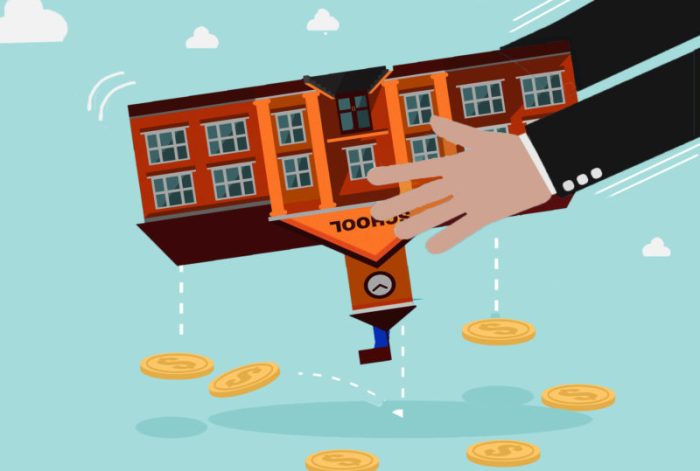
I Stand With Striking Teachers Because I Stand for Underprivileged Children

teacherstrike


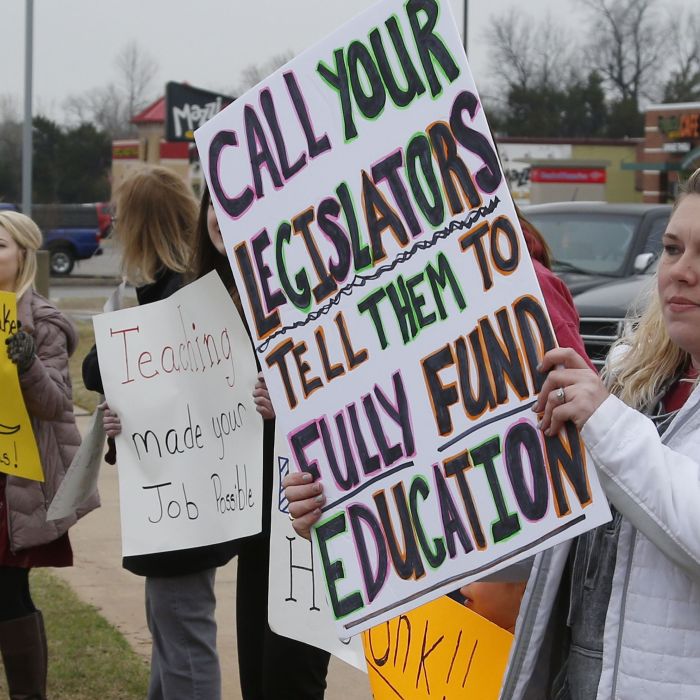
America’s teachers are taking to the streets by the thousands.


In West Virginia, Oklahoma, Kentucky and soon to be Arizona and Puerto Rico, educators are leaving the classroom and storming their state capitals.


Why?


Not because they’re greedy. Not because they don’t want to do their job. But because this country doesn’t care enough to provide them the resources they need to do it.


America doesn’t care about black and brown children.


America doesn’t care about poor white children.


America only cares about middle class and wealthy kids, preferably if their skin has a melanin deficit.


Don’t believe me?


Just look at how much these states have cut education funding. Look at how the federal government has slashed financial assistance. Look at how districts are forced to increasingly rely on local tax revenues to pay for the kind of education their children receive.


This means poor kids get poor resources. This means minority kids have to do without.


For the dark and the destitute, this means larger class sizes, out of date text books, and narrowed curriculum. It means fewer tutors, reading specialists and librarians. It means being left to your own devices to deal with the effects of generational poverty which put them behind their wealthier, lighter peers before they even enter kindergarten. It means greater emotional disturbance, greater malnutrition, higher absences, more learning disabilities, and less help to deal with any of it.


On the other hand, for the economically privileged white kids, it means just the opposite – fewer social problems, and the best of everything to deal with whatever issues they have.


It’s an unfair system, and teachers aren’t having it. We’ve been sounding the alarm for years, but it has fallen on deaf ears.


We don’t want to strike, but lawmakers are giving us no choice.


We’re saying, Enough! We’ve had it with the excuses.


Society hires us to do a job – let us do it.


Don’t refuse us the money to get it done and then blame us for the results.


That’s why there was a 9-day teachers strike in West Virginia which won educators a 5% raise in February.


That’s why 30 districts closed in Kentucky this week after a statewide sick out inspired by the legislature’s plan to cut pension benefits.


That’s why thousands of teachers in Oklahoma walked out this week demanding higher wages and better school funding.


And it’s why educators in Arizona, Puerto Rico and other states and territories may be next.


When you deny teachers the basics necessary to do their jobs, you’re refusing your responsibilities toward children.


When you deny educators a fair wage, you’re discouraging young people from entering the profession and encouraging those already there to seek work elsewhere.


And that is what we’re talking about here – a fair wage. We’re not talking about teachers getting rich off the taxpayers dole. You’re asking us to get an advanced education and do a hard job – that requires a middle class income so we can pay off our student loans and support our families.


The same goes for pensions. When teachers took their jobs, a fair pension was part of the contract. You promised that after 30-some years, educators could retire and you’d take care of them. You can’t renege on that. And if you plan to offer less for those coming in to the field, you’re going to get fewer high quality teachers willing to take the job.


When you attack unions and union benefits, you’re really attacking students. A teacher who can be fired at the whim of an administrator or school director is not as affective at her job. She has less autonomy and freedom to do what is right for her given students. And she has less reason to take a chance on the profession in the first place.


This doesn’t mean that after three years teachers should have a job for life. They don’t. It just means that if you’re going to fire a teacher for negligence, you should have to prove she’s negligent first.


This is why there’s a so-called teacher shortage in most states. As a society, we’ve become less-and-less willing to pay for teachers to do their jobs. We’ve become less-and-less willing to offer them the independence and respect necessary to get things done.


Why?


Because we’ve swallowed a pack of lies from the business community.


Many of them look at our public schools and see an opportunity for financial gain.


School funding may not be enough to give every one of the 50.7 million students in public school a first class education, but it’s more than enough to make a cabal of entrepreneurs and corporate officers rich.


That’s why they’re pushing charter schools and voucher schools and standardized tests and edtech software scams.


They want to get rid of democratic rule, get rid of teacher-based assessments and – ultimately – get rid of teachers. They want to replace us with minimum wage temps and leave the work of educating to computers that can provide test prep and standardized assessments.


But only for the poor and minorities. The affluent and middle class white kids will still get the best money can buy. It’s only those other kids they’re willing to feed to the wolves of edu-profit.


THAT is what educators are fighting.


THAT is why teachers across the nation are striking.


We’re demanding this nation does right by its public school students.


And that begins by supporting their teachers.

636581911709771782-AP-Teacher-Walkout-Taxes


Like this post? I’ve written a book, “Gadfly on the Wall: A Public School Teacher Speaks Out on Racism and Reform,” now available from Garn Press. Ten percent of the proceeds go to the Badass Teachers Association. Check it out!

book-3

Absurd Defense of Standardized Testing in Jacobin Magazine

11


A bizarre article appeared in this Month’s issue of Jacobin – a left-leaning, even socialist magazine.


It was titled, “The Progressive Case for the SAT” and was written by Freddie DeBoer.


In it, the author attempts to explain why the Scholastic Aptitude Test (SAT) – though flawed – is a more unbiased way to select which students deserve college admissions than indicators like K-12 classroom grades.


It’s all convoluted poppycock made worse by a baroque series of far left think tank connections, intellectual bias and mental illness.


In short, DeBoer argues that our schools are unfair, so we should embrace unfair high stakes tests.


I know. That doesn’t make a lot of sense.


Let me slow it down a bit, premise by premise so you can see his point – or lack thereof.


The current education system privileges white affluent children, says DeBoer, so they have an easier time getting into college than poorer children of color.


Check so far.


Richer whiter kids often go to schools that are better funded than those that teach mostly impoverished minorities. Therefore, the privileged get smaller classes, wider curriculums, more extracurricular activities, more counselors, better nutrition, etc. – while the underprivileged… don’t.


Then DeBoer says that classroom grades are often dependent on the resources students receive. Richer whiter kids get more resources, so they often get better grades.


Still with you so far.


Therefore, he concludes, we need standardized tests like the SAT to help equalize the playing field. We need so-called “objective” assessments to counteract the “subjective” classroom grades.


But DeBoer admits standardized tests aren’t objective! They are also the result of resources – that’s why richer whiter kids tend to score better on them than poorer blacker kids!


The argument makes no logical sense.


Justifying one unfair system with another unfair system is beyond bonkers.


Plus DeBoer contends out of nowhere that classroom grades are more easily manipulated than the tests and thus the tests are more valid.


Wrong again.


Classroom grades are based on roughly 180 days of instruction a year for 12 plus years. The SAT is roughly one day. More if you retake it.


It is MORE difficult to influence 2,160 days worth of grading than 1 or 2 or 3. Not the other way round.


Moreover, classroom grades are tabulated by numerous teachers, many of whom have little or no contact with each other. Standardized test scores are tabulated by a handful of temporary summer workers who often collaborate on the scores.


Whether students get good or bad grades generally doesn’t affect a given teacher. However, low test scores are actually beneficial to testing corporations because they allow the company to make additional money by retesting and selling remediation materials to the district.


If one group is more subject to bias, it is those grading the standardized tests, not the classroom teachers.


He has a point that getting rid of standardized testing won’t by itself eliminate inequality. But doubling down on it certainly won’t either.


That’s just logic.


DeBoer seems to be ignorant of history, as well.


The SAT test didn’t just spring up out of the ground. It was written by people –  Psychologist Carl Brigham building on work by U.S. Army Psychologist Robert Yerkes to be exact.


Brigham devised the SAT in the early half of the 20th Century based on Yerkes’ and his own deeply racist eugenicist theories.


And when I say they were eugenicists, I’m not speaking in hyperbole. They truly believed that some races were just smarter, more moral and downright better than others.


“American education is declining and will proceed… with an accelerating rate as the racial mixture becomes more and more extensive,” wrote Brigham in his seminal A Study of American Intelligence.


“No citizen can afford to ignore the menace of race deterioration,” wrote Yerkes in 1922.


And this idea was the foundation of their application of standardized testing, as Yerkes  noted a year later:


“The contrasting intellectual status of the white versus the negro constituents of the draft appear from table 3. Few residents of the United States probably would have anticipated so great a difference. That the negro is 90 per cent. [sic] illiterate only in part accounts for his inferior intellectual status.”


Yerkes eugenics Table 3


Brigham was basing his ideas on another test created by Yerkes, the Army Alpha and Beta tests.


As noted above, Yerkes  used test scores to “prove” black soldiers in WWI were inferior and thus more suited to menial service and the trenches while whites should be given better positions.


And Brigham continued this practice with his SAT test.


In both cases, the psychologists used standardized testing to back up a racist and classist status quo.


Yet it is this same SAT test that DeBoer is suggesting we keep because it reduces racial and economic bias!


Certainly the SAT has changed some since Yerkes time, but it hasn’t changed THAT much!


And that brings us to DeBoer, himself.


Who is this guy and why did an allegedly respectable publication like Jacobin print his crap theory?


DeBoer appears to be a very troubled individual.


Back in December of 2017, he published a blog post about his mental illness, almost being committed to an institution, the antipsychotic drugs he was taking and the break he would have to take from being a “public intellectual.”


I don’t mean to shame anyone who suffers from mental illness. But when someone offers such a bizarre policy suggestion, questions of stability arise.


Next, there’s DeBoer’s think tank connections.


On the same Website, DeBoer talks about “My anti anti-SAT take for the People’s Policy Project” – the same theory he expanded upon in his Jacobin article.


People’s Policy Project (3P) is a left-leaning think tank created by another frequent Jacobin contributor, lawyer and policy analyst, Matt Bruenig.


You may recall Bruenig. In 2015, he criticized schools that provide more resources to impoverished children by dubbing them “welfare schools.” He saw the inclusion of free healthcare, free meals, free pre-K, and other wraparound services as increasing the welfare state and making children and families dependent on the government for survival.


And, yes, like DeBoer, this is a guy who claims to be a far left Democrat.


This is all very troubling.


Sometimes we fall into the lazy attitude that high stakes testing, charter schools and other corporate education reforms are only championed by the right.


Certainly the left – or at least the far left – is immune to this neoliberal agenda.


You definitely wouldn’t expect to get a heaping helping of top down supply side school policy in Jacobin!


It just goes to show you how little policymakers on both sides of the aisle understand education and how ignorant they can be when we don’t force them to include the experts in the conversation.


I am, of course, talking about real, live classroom teachers.


Until we prize what they can tell us about education, we will continue to be led in circles by the ignorant.


Like this post? I’ve written a book, “Gadfly on the Wall: A Public School Teacher Speaks Out on Racism and Reform,” now available from Garn Press. Ten percent of the proceeds go to the Badass Teachers Association. Check it out!

book-3

When Students Stay Up All Night Playing Fortnite and You’ve got to Teach Them in the Morning

ne13feb40-ALL-addicted-to-video-games-L13FCA50-51A


There is something monstrously unfair about our teacher evaluation systems.


If your students fail because they were up all night playing video games, it’s your fault.


Seriously.


When students fail at academic tasks, there is no responsibility attributed to the students, no responsibility attributed to the parents and certainly no responsibility given to society.


It’s all just thrown on the teacher because, hey, someone’s got to be responsible. And it might as well be them.


I’ve written scores of articles about how standardized tests forced on students by the federal government are unfair.


They are developmentally inappropriate, culturally biased, and subject to a deep conflict of interest because the people making the tests get more money if test takers fail.


The tests drive the curriculum instead of the other way around. The scores needed to pass change from year-to-year invalidating annual comparisons. And many lawmakers pushing for these assessments are funded by the school privatization industry that uses failing test scores to sell its own fly-by-night brand of education.


These are real problems our education system faces every day.


But we mustn’t forget an even more fundamental one: we’re all responsible for student success or failure.


Not just teachers. EVERYONE.


Society, lawmakers, business people, parents – but those most responsible are the students, themselves.


Case and Point—


Over the last few months a word has entered my students’ vocabulary that hadn’t been there before: Fortnite.


It’s not that they’re so interested in an antiquated term for a two-week period. It’s the name of a popular multiplayer on-line shoot-em-up video game for PlayStation 4, Xbox One, Windows, and Mac. Players build forts with teammates to defend against other players or enemies.


Apparently, many of my students got it for Christmas. Or since there’s a free on-line version, they were turned on to it by others who had gotten the deluxe version as a present.


It started as an undercurrent of trash talk. “You suck at Fortnite.” “You can’t beat me on Fortnite.” “You just wish you could take me on Fortnite.”


And then it started to manifest physically.


Those same kids would come in to school with Fortnite Face – glassy red eyes, heads slumped on the table and the inability to stay awake for more than 10 minutes at a time.


It’s not all of my students, but it’s a significant percentage. Almost all boys. And almost all at a distinct learning disadvantage.


Teaching them is like teaching someone in a deep sea diver suit. They can’t really see or hear you very well. And any message you get back from them sounds like it’s coming from the bottom of the ocean.


When I noticed it, I cleared as much of my schedule as I could to call parents. It’s hard because administration decided not to fill positions in my department for teachers who retired last year – so all our classes are larger. And they gave me a new class I haven’t taught in years so the planning load is more cumbersome.


Plus I have as many special education students as legally allowed in every class, which requires mountains of extra paperwork and monitoring for each child.


And of course the phone in my room doesn’t call out and the cell reception is terrible, so I have to move to one of the few phones that will actually allow me to contact parents and try to communicate my concerns.


Most parents I talked to noticed the same things I had. Fortnite was taking over their children’s lives. Their kids were playing the game at every opportunity and ignoring most everything else.


However, most parents I couldn’t reach. Those cricket burner phones get disconnected quick. Others go straight to a voicemail box that’s so full it won’t accept new messages. Others allow me to leave a message that will never be returned.


But sometimes I did get through. And sometimes parents didn’t simply throw up their hands and say they don’t know what to do. Sometimes a parent actually laid down ground rules or took the game away.


However, if I’m being honest, contacting parents did not solve my problem.


I’m not blaming them. Most of my students live below the poverty line. That means their folks are working two or three jobs just to make ends meet. Or they’re grandparents raising their sons’ or daughters’ kids. Or they’re foster parents with a full house.


They’re doing the best they can. But it doesn’t end up stopping the addiction.


And – let’s be honest – it is an addiction.


For the first time in 2018, the World Health Organization recognized video game addiction as a real thing. Not every video game. Not every time someone sits down to play a video game. But video games can lead to addictive behavior.


That’s what I’m seeing in my students.


So after talking with as many parents as I could, I came to a mostly dead end.


My next step was to try to use student interests to influence instruction.


We were in the middle of a poetry writing unit. So I allowed students to write their poems about Fortnite.


That perked up a few heads.


Here’s a cinquain about Fortnite. Here’s an acrostic, a narrative, a concrete poem in the shape of a soldier or his gun.


To be honest, none of them were masterpieces.


They were just the normal trash talk and braggadocio written down in verse.


So I got an idea. Use the heightened competitive urge to push artistry.


We came to limericks – a difficult but fun type of poetry with five lines, a specific rhyme scheme and meter.


We read funny examples, we sang the rhythm together in chorus – da Dum da da Dum da da Dum – and then I set them the task of writing their own limericks.


With one twist. Whoever wrote the best limerick would get a homework pass.


That got them going like a shot.


All of my Fortniters perked up.


They wrote like I’d never seen.


Each wanted to one-up the others. And no one wrote about the game.


By the end of class, we had some pretty good poems. I wouldn’t say they are the best ever written, but they were miles better than where we were before.


So what does it all mean?


When we talk about video games these days, the conversation usually strays toward violence.


Pundits caution that video games will desensitize children and make them more prone to aggression and acting out. It might even contribute to the creation of school shooters.


Wrong.


In general, video games don’t make children more violent. Fortnite is a game where students shoot each other with guns all night long and it hasn’t made my students any more aggressive or violent than they already were.


Many cultures like the Japanese are much more into video games than ours and they have fewer violent incidents or school shootings.


However, video game addiction is a real thing and it impacts learning.


Some corporations want to try to harness this addiction to push learning. Hence the move to personalized or competency based education. That’s pure rubbish.


It’s a way to monetize education without paying attention to what’s best for kids. The same with gamification – using game theory to drive instruction.


And don’t think I’ve lost sight of my own use of competition in class. I haven’t.


Games and competition can be used to positive ends in moderation.


You can motivate reluctant kids to do things they wouldn’t normally do with competition. But it doesn’t work for everyone and it doesn’t work all the time.


It needs to be a novelty. Any tool can be overused.


Even video games aren’t bad in moderation. I used to be a gamer, myself.


The problem is when it becomes an addiction.


Our social structures can’t handle it.


Game corporations only care if it makes money. Parents are often stressed to the limit just to provide the basics.


The only group we require to be responsible is teachers.


And that’s just not going to work.


Video game addiction is another area where it becomes painfully clear how much work we all need to do to help our children succeed.

Arming Already Stressed Out Teachers Will Only Increase the Chance of School Shootings

1541539


It happened in Georgia yesterday.


A beloved social studies teacher locked himself in his classroom while his students stood outside the door.


When the principal came with the key, the teacher fired a handgun through an exterior window.


Students ran, one even twisting her ankle in the escape.


Thankfully, no one else appears to have been injured.


However, the incident brings into focus a vital component of the gun debate.


Teachers are already under tremendous stress.


Arming them won’t stop gun violence. All it does is add another potential shooter.


It’s only been about two weeks since a shooting at Stonemason Douglas High School in Florida left 17 dead.


That’s at least 19 school shootings so far in 2018 – and it’s only the beginning of March!


In that time, the national media and the Trump administration have focused on one specific solution to stopping such violence from happening again: giving teachers guns.


The latest incident in Georgia underlines why this is such a terrible idea.


Teachers are not super heroes.


Take it from me. I’m an almost 15 year veteran of the middle school classroom in western Pennsylvania.


We’re just human beings.


My colleagues and I have all the same human failings and weaknesses as everybody else.


We get tired and overworked and put upon and stressed and sometimes…


…Sometimes we don’t handle it well.


I know some people don’t want to hear it.


Society has piled all kinds of responsibilities and unreasonable expectations on our shoulders.


We’re no longer allowed to be just educators.


We’re parents, counselors, disciplinarians, doctors, psychologists, lawyers, nutritionists…. The list goes on-and-on.


And now politicians actually want us to add law enforcement to the job description?


We’re already under colossal pressure, and some folks want to add a gun to that situation?


That’s lighting a fuse.


But don’t just take my word for it.


Back in 2015, tens of thousands of educators filled out the Quality of Worklife Survey conducted by the American Federation of Teachers and the Badass Teachers Association.


After responses from 91,000 school employees and 31,000 who completed the entire 80-question survey, a picture of the emotional landscape became clear.


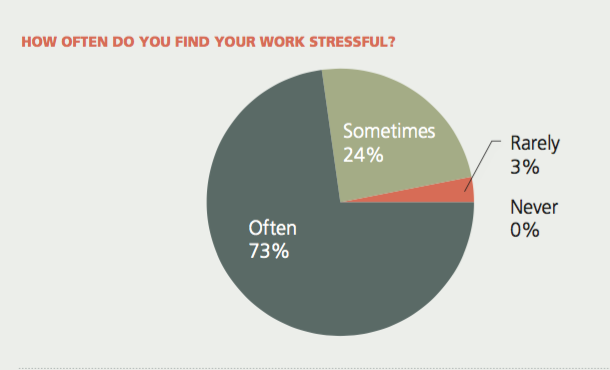
A total 73% of respondents said they often feel stressed at work.

Screen Shot 2018-03-01 at 12.48.15 PM

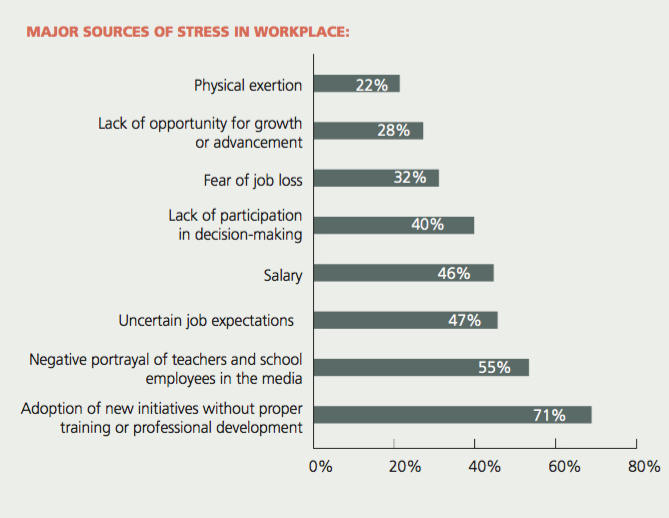
The reasons? Adoption of new initiatives without proper training or professional development (71%), negative portrayal of teachers and school employees in the media (55%), uncertain job expectations (47%) and salary (46%) were the most common responses.

Screen Shot 2018-03-01 at 12.48.58 PM

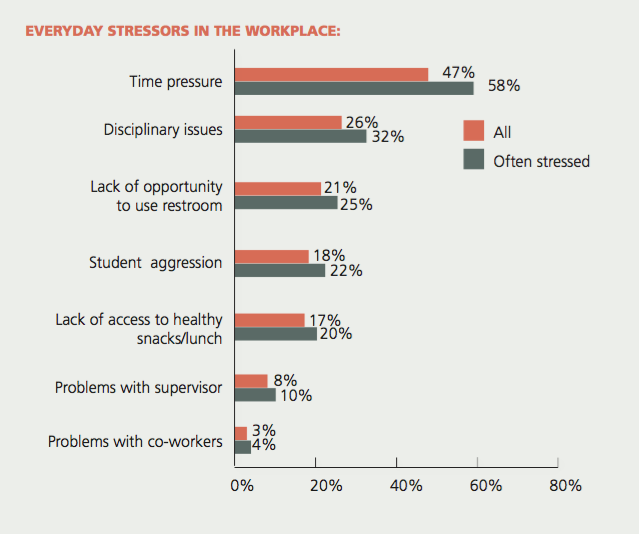
The survey identified the following as most common everyday stressors in the workplace – time pressures, disciplinary issues and even a lack of opportunity to use the bathroom.

Screen Shot 2018-03-01 at 12.49.11 PM

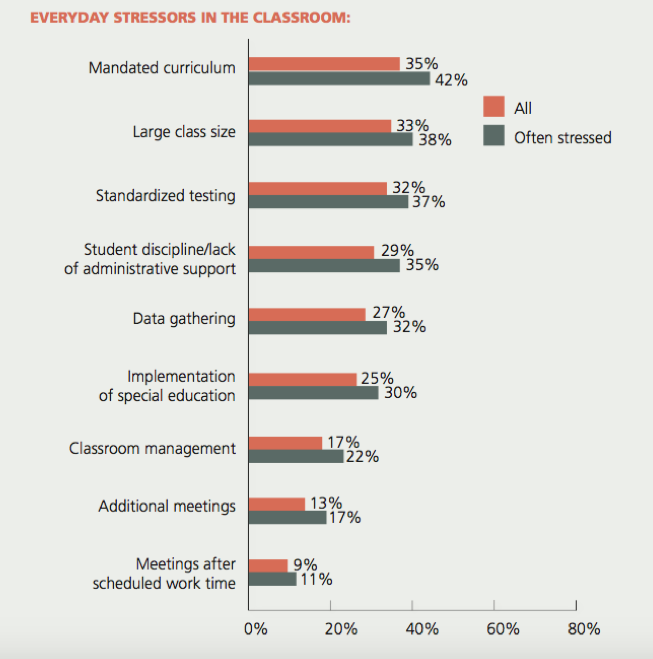
Focusing just on the classroom, top stressors were mandated curriculum, large class sizes and standardized testing.

Screen Shot 2018-03-01 at 12.49.35 PM

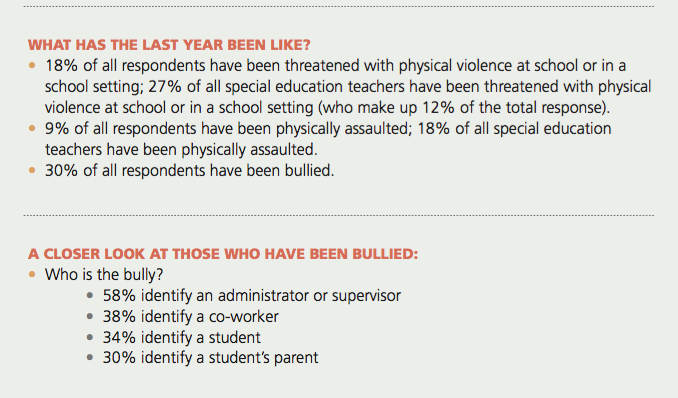
Many teachers claimed to be the victims of violence at school.


A total 18% of all respondents said they had been threatened with physical violence – though the percentage jumped to 27% when looking solely at special education teachers.


A total of 9% of all respondents claimed to have been physically assaulted at school. Again the percentage jumped to 18% of all special education teachers.


But it’s not just physical assault.


A total of 30% claim to have been bullied by administrators (58%), co-workers (38%), students (34%) and student’s parents (30%).

Screen Shot 2018-03-01 at 1.03.57 PM

This is the situation where policymakers want to throw firearms.


Most gun violence doesn’t involve a shooter doing harm to others. The great majority of gun deaths are self-inflicted.


Even without adding guns to the mix, several high profile teachers and administrators already have committed suicide.


In October of 2010, for example, a California elementary school teacher named Rigoberto Ruelas, Jr. took his own life after the Los Angeles Times published a report labeling him a “less effective teacher.” Despite the fact that students and parents praised Ruelas, who taught in one of poorest schools in his district and who also was born, raised and continued to live in area where his school was located, the Times targeted him among other so-called “less effective” teachers as part of a major propaganda campaign.


And this isn’t an isolated incident. In July of 2015, a New York City principal under investigation for altering Common Core test scores, killed herself by jumping in front of a subway car.


Adding guns to this situation will just mean more teachers taking their own lives with a bullet.


That may have been the intent of the Georgia teacher in yesterday’s shooting.


Local police said they didn’t think he was trying to injure anyone else. When he shot his gun out of the window, he appeared to be trying to get others to leave him alone.


Arming teachers is a terrible solution to school violence. It’s taking an already stifling room and turning up the heat.


We need sensible gun regulations to reduce the pressure, not increase it.


We need sensible school policies that treat teachers and students like human beings and not just cogs in the system.


But this requires us to break out of a dangerous pattern in how we deal with social problems.


When we see a problem, we generally just shrug and leave it up to public schools and teachers to solve.


Inadequate resources – leave it to teachers to buy school supplies out of pocket.


Inequitable funding – increase class size and leave it to teachers to somehow make up the difference.


We can’t do the same with gun violence. We can’t just toss teachers a gun and tell them to sort it out.


Teachers can’t solve all of society’s problems alone.


That’s going to take all of us.


And we’ll need more than disingenuous proposals like answering gun violence with more guns.

School Choice Week – Choosing Away Your Choice

Sleazy_Businessman


School Choice Week is one of the greatest scams in American history.


It is a well-funded, thoroughly organized attempt to trick parents into signing away their right to make educational choices about their children.


Seriously.


It goes like this:


Salesman: Would you like a choice?


Parent: Sure!


Salesman: Then just agree to never have another choice again.


That’s it in a nutshell.


Choose not to choose.


When you decide to send your child to a so-called choice school – a charter or voucher institution – you lose almost every other choice about what happens at your child’s school.


Sound impossible?


Let me count the decisions you lose by signing on the dotted line.


When you send your child to a school paid for with public money but run by a private organization, you lose:


AN ELECTED SCHOOL BOARD, so you have no say about what the school does.


OPEN DOCUMENTS, so you have no right to see budgets, spending agreements, bids, contracts, etc.


OPEN MEETINGS, so you have no public place to speak up to the people who run your school.


RIGHT TO SELF-GOVERNMENT, so you have no right to run for a leadership position on the school board. Instead you’re at the mercy of appointed flunkies.


THE RIGHT OF ENROLLMENT, so school operators get to choose whether your child gets to attend, unlike public schools which have to accept your child no matter what – so long as you live in the district.


QUALITY SERVICES, so school operators can cut services for your child and pocket the savings as profit or use it to advertise to get more paying butts in seats.


QUALITY TEACHERS, because most charter and voucher schools aren’t required to hire educators with 4-year degrees, and since they don’t pay as well as public schools and often refuse to let their teachers unionize, they attract less experienced and distinguished educators.


DIVERSE CLASSMATES, because charter and voucher schools increase segregation. Your children will be educated with more kids that look just like them. That’s healthy!


And that’s merely at MOST privatized schools. But that’s not all. At some privatized schools you can lose even more! You may also lose:


COMMON SENSE DISCIPLINE POLICIES, so your children will be held to a zero tolerance discipline policy where they may have to sit quietly, eyes forward, marching in line or else face aggressive public reprimands and harsh punishments.


AN UNBIASED SECULAR EDUCATION, so your children will be taught religion and politics as if they were fact all funded by public tax dollars! Hear that sound? That’s our Founders crying.


FREE TIME, so you’ll be required to volunteer at the school regardless of your ability to do so. Gotta’ work? Tough!


MONEY, so you’ll have to pay tuition, buy expensive uniforms, school supplies or other amenities.


And if your children are struggling academically, you may also lose:


ENROLLMENT, so your child is given the boot back to the public school because he or she is having difficulty learning, and thus costs too much to educate.


You lose all that if you decide to enroll your child in a charter or voucher school!


But that’s not all!


If you DON’T decide to send your child to a so-called choice school, you can still lose choice!


Why? Because of the rubes who were fooled into give up their choice. When they did that, they took some of your choices, too.


Because of them, you still lose:


-NECESSARY FUNDING, because your public school has to make up the money it lost to charter and voucher schools somewhere, and that means fewer resources and services for your child.


-LOWER CLASS SIZES, because your public school has to fire teachers and increase class size to make up for lost revenue.


-FAIR ASSESSMENTS, because the state and federal government require your child to take unfair high stakes tests to “prove” your public school is failing and thus justify replacing it with a charter or voucher schoolas if those have ever been proven to be better, but whatever! CA-CHING! CA-CHING!


This is what you get from School Choice Week.


It’s a uniquely American experience – selling the loss of choice — as choice.


And all the while they try to convince you that public schools are the ones that take away your alternatives.


Yet public schools are where you get all those things you lose at privatized schools.


You get elected school boards, open documents, open meetings, the right to self-government, the right of enrollment, quality services, quality teachers, diverse classmates, common sense discipline policies, an unbiased secular education, free time and money! That’s right! You actually get all that and more money in your pocket!


I’m not saying public schools are perfect. There are many ways they need to improve, but it’s difficult to do so when many of the people tasked with improving these schools are more concerned with sabotaging them to make room for privatized systems.


These are paid employees of the charter and voucher school movement who want to kill public schools – BUT THE KILLER IS ALREADY IN THE HOUSE!


Imagine if we dedicated ourselves to making our public school system better!


Imagine if we committed to giving parents and students more choices in the system and not trying to replace that system with one that gives all the benefits and choices away to corporate vultures!


So, yeah, School Choice Week is a scam.


But, hey, enjoy those yellow scarfs.


devosbetsey_011818gn7_lead

When You Mistreat Teachers, Beware the Unintended Lessons for Students

5a552b35785e6.image


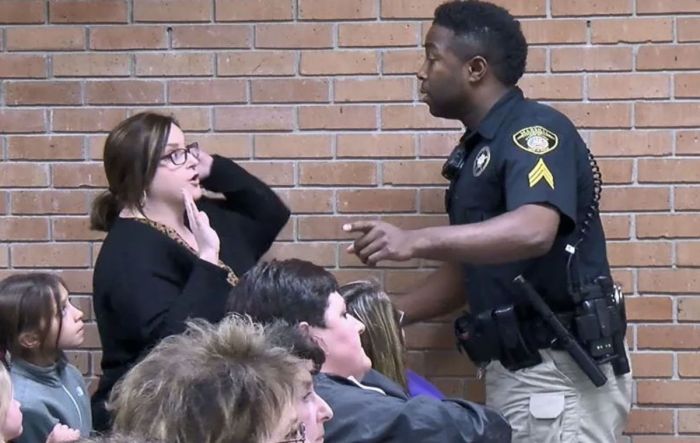
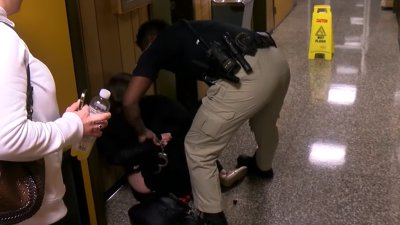
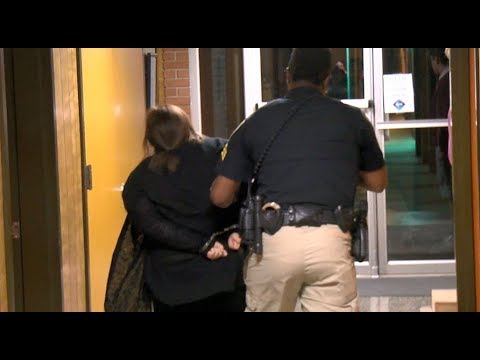
We’ve all seen the shocking video from Vermillion Parish in Louisiana this week where a teacher is tackled to the ground and arrested because she asked a question to the school board.


It’s a gross abuse of power that brings up many issues:


  • Public servants responding to the public with violence.


  • Elected representatives refusing to hear from their constituents and – in fact – taking action to silence them.


  • Leaders who are supposed to oversee children’s educations unconcerned with the lesson local kids will be taking home from the actions of adults who are supposed to set a better example.


The case is simple.


The eight-member board had been deadlocked 4-4 on whether or not to give Superintendent Jerome Puyau a raise. Then one of the members died. Instead of his wife filling in until a new election could be held, board president Anthony Fontana , who was in favor of the raise, appointed a like-minded replacement and tried to force a vote.


So Deyshia Hargrave, a district teacher and parent, asked why the superintendent should get a raise while the teachers haven’t had one in several years.


It was a reasonable question, asked at the proper time, in a respectful tone, when comments were directed specifically at her.


However, Reggie Hilts, the Abbeville city marshal who also serves as a school resource officer, told her she was being disruptive and asked her to leave – which she did. When she got out in the hall, he forced her to the ground, put her in handcuffs and pushed her out of the building.


It was completely unjustified, a horrific violation of Hargrave’s rights and goes counter to the very purpose of public school.


Local control is the great strength of our education system.


It is the idea that district wide decisions about our children’s learning should be made by duly-elected members of the community in the full light of day. Except where doing so would violate an individual’s personal rights, all school documents are public. They are voted on in public. And they are subject to question and comment by the public.


If the taxpayers – the people who foot the bill for the majority of the district costs – don’t approve of what their representatives are doing, they can take steps to replace them.


These are the very foundation of public schooling and one of the major reasons the public school system is superior to charter or voucher schools, which typically do not have them. Even when privatized systems retain the vestiges of democratic rule, they are optional and can be stripped away at the whim of the businesses and/or corporations that run them.


Vermillion Parish School Board would do well to remember this.

screen-shot-2018-01-09-at-9-38-24-am

The actions taken by City Marshall Hilts were either done at the behest of the board or certainly without any public dissent among the members.


They stomped on Hargrave’s First Amendment rights and ignored their responsibility to the community they serve.


If my description of how a public school is supposed to work sounds like a lecture, that’s intentional. These representatives could do with a lesson in how democracy works.


Our actions have consequences and those consequences only become more consequential when we become public servants. The board, the superintendent and certainly Hilts may very well have opened themselves up to legal action.


But beyond putting themselves in danger from having to pay punitive damages to Hargrave – that I hope they pay out of the superintendent’s bloated salary – they have betrayed a dangerous attitude toward the very concept of self-rule.


Whether they meant to or not, they have given the children of Vermillion Parish a lesson in government and community values.


Make no mistake. The children are watching. They get the TV news and status updates on Facebook and Twitter. They have access to YouTube. Doubtless, they have seen this video countless times. They have probably played it over and over again.


They saw their teacher brutally manhandled by a supposed law enforcement officer. And they heard the deafening silence from the school board about it.


They know now that this kind of behavior is deemed acceptable in Vermillion Parish. Beware the kind of behavior adults can expect from children who are given such a disgraceful example!


Moreover, these children are well aware of the matter in dispute.


The board is fighting to give the superintendent a $38,000 raise. Yet they refuse to give another penny to teachers – all while class sizes have jumped from 21 to 29 students, according to Hargrave.


That is not what leaders do who care about the well-being of students. It is a result of backroom deals and the good ol’ boys network.


The lesson is that hard work doesn’t matter. The only thing you should worry about is making a deal no matter whom it hurts. Just look out for numero uno.


After all, the board could give the teachers something – some token of appreciation to show that they value their continued commitment to the children of the community. But they don’t. Yet they fight tooth and nail to do so for one individual who has in no way proven himself indispensable.


It is the teachers who come in every day and give their all to help students learn. Not a superintendent who demands they jump through an increasingly complex set of irrelevant hoops.


But there’s always money for the person at the top. Never anything for the people who do the real work.


Critics complain that teachers don’t deserve a raise because they already earn more money than the majority of the people who live in the community. (An argument which – by the way – would also apply to the superintendent.)


But even beyond basic logic, it’s a bogus line of reasoning!


Doctors attend patients in poor communities. They still earn high salaries – maybe not as high as they would serving the wealthy, but they have to be able to survive, to pay back the loans they took out to go through medical school, etc. So do lawyers, accountants and specialists of all kinds. That’s just capitalism. If you want someone to provide a good or service, you have to pay them a competitive wage. Otherwise, they’ll move on to greener pastures.


The kids see you pinching pennies. They know what that means – you don’t think they’re worth the investment.


The lessons of Vermillion Parish go far beyond Louisiana.


Anytime people mistreat teachers, they’re really mistreating the children those educators serve.


An attack on teachers is an attack on students.


When Hilt wrestled a woman half his size to the ground and placed her under arrest for the crime of exercising her rights, he put the entire community in jail.


When the board directed him to act – or at very least neglected to stop him – they made themselves culpable in the crime.


It is something we have been guilty of in nearly every state of the union. We have neglected our children, abused our teachers and injured the democratic principles on which our country was founded.


Class dismissed.


hqdefault


Like this post? I’ve written a book, “Gadfly on the Wall: A Public School Teacher Speaks Out on Racism and Reform,” now available from Garn Press. Ten percent of the proceeds go to the Badass Teachers Association. Check it out!

book-3

Public School Teachers Are Absent Too Much, Says Charter School Think Tank

school-shadows


Have you ever heard of media bias?

I don’t think many so-called journalists have.

At least their editors haven’t or perhaps they just don’t care.

Otherwise, why would self-respecting hard news purveyors publish the results of a study by charter school cheerleaders that pretends to “prove” how public school teachers are worse than charter school teachers?

That’s like publishing a study denigrating apples written by the national pear council.

 
Breaking news: Pepsi says, “Coke sucks!”

In a related story McDonalds has startling evidence against the Burger King!

THIS IS NOT NEWS!

THIS IS PROPAGANDA!

I know it’s become trendy to defend the media when our lame-ass President attacks every factually-based report that puts him in a bad light as “fake news.” But the giant media conglomerates aren’t doing themselves any favors with lazy reporting like this.

And I know what many journalists are thinking when they do it, because I used to be one:

I’ll publish the report and include dissenting opinions and that will be okay because I will have shown both sides and readers can make up their own minds.

But what’s the headline? What’s the spin? Who is David in this story and who is Goliath? When multiple stories like this appear all over the news cycle, what impression is made on your readers?

It’s the same thing with climate science. Ninety seven percent of climate scientists say global climate change is man-made and happening. Yet the news gives us one scientist and one crank climate denier and pretends like that’s fair and balanced.

And here we get one biased neoliberal think tank vs. millions of public school teachers all across the country and since you’ve given us an equal number to represent each side, you pretend THAT’S fair and balanced.

It isn’t.

But who’s paying your advertising revenue?

Who owns the media conglomerates that publish your articles?

Often the same people publishing bullshit reports like this one. That’s who.

No wonder they get so much coverage!

So here’s the deal.

The Fordham Institute wrote a report called “Teacher Absenteeism in Charter and Traditional Public Schools.” They concluded that 28.3 percent of teachers in traditional public schools miss eleven or more days of school versus 10.3 percent of teachers at charter schools.

To come up with these figures they used data from Betsy Devos’ Department of Education.

So let the hand-wringing begin!

Look how bad public school teachers are and how much more dedicated is the charter school variety! Look at how much money is being lost! Look at the damage to student academic outcomes!

Won’t someone think of the children!?

WHY WON’T SOMEONE PLEEEEAAASSSEEE THINK OF THE CHILDREN!!??

This report brought to you by the Bill and Melinda Gates Foundation, Bloomberg Philanthropies, the Eli and Edythe Broad Foundation, the College Board, Education Reform Now, the Walton Family Foundation and a host of other idle rich philanthrocapitalists who are drooling over the prospect of privatizing public schools and hoovering up public money as private profit.

Oh. If that’s not enough, Fordham actually runs a series of charter schools in Ohio.

Biased much?

So what’s wrong with the report?

First of all, it’s not news.

Neoliberal think tanks have been publishing propaganda like this for at least a decade. Play with the numbers here, look only at this data and we can paint a picture of “failing” schools, “failing” teachers and therefore justify the “need” for school privatization.

Second, look at all the important data Fordham conveniently leaves out.

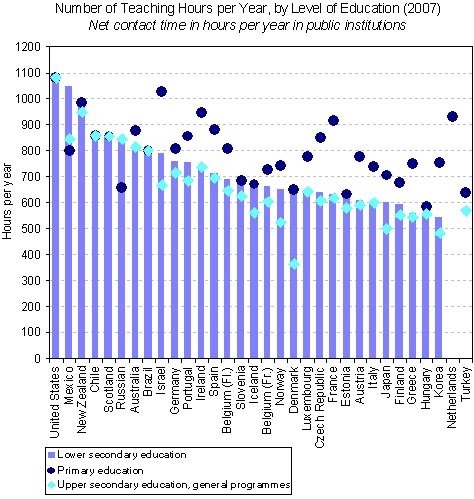
Look at the number of hours public school teachers work in the United States vs. those in other comparable countries, say those included in The Organization for Economic Cooperation and Development (OECD).

In fact, the OECD (which is not biased one way or another about American school privatization) released a mountain of statistics about how many hours teachers work in various countries.

The result: in the United States teachers on average spend more time teaching and receive less pay than those in other countries.

American teachers spend on average 1,080 hours teaching each year. Across the O.E.C.D., the average for most countries is 794 hours on primary education, 709 hours on lower secondary education, and 653 hours on upper secondary education general programs.


teachingtime
Source: OECD


Yet American teachers start at lower salaries and even after 15 years in the profession, earn less money than their international counterparts.

So – assuming Fordham’s absenteeism statistics are accurate – why do public school teachers miss so much school? They’re exhausted from the hours we demand they keep!

But what about charter school teachers? Aren’t they exhausted, too?

Some certainly are.

Working in a charter school often requires grueling hours and fewer benefits. That’s why charters have a higher turnover than public schools.

Since they’re often not unionized, charter schools usually have younger, less experienced staff who don’t stay in the profession long. In fact, they rely on a constant turnover of staff. At many of the largest charter chains such as Success Academy and the Knowledge is Power Program (KIPP), teachers average only 4 years before moving on to another career, according to the New York Times. And this is typical of most charter chains.

So why don’t charter school teachers take as many sick days as traditional public school teachers? Maybe because when they check out, they often don’t check back in.

Moreover, there is a significant difference in the student population at both kinds of school – privatized vs. public.

As their marketing departments will tell you, the students in a charter school choose to be there. The charter schools often weed out the students with behavior problems, special needs or those who are otherwise more difficult to teach. As a result, the strain on teachers may not be as severe. When you’re only serving kids who want to be there and who are easy to teach, maybe you don’t need as much downtime.

Public school teachers, on the other hand, face real dangers from burnout.

According to a study by Scholastic (that actually goes counter to its pro-privatization bias), we work 53 hours a week on average. That comes out to 7.5 hours a day in the classroom teaching. In addition, we spend 90 minutes before and/or after school mentoring, tutoring, attending staff meetings and collaborating with peers. Plus 95 additional minutes at home grading papers, preparing classroom activities and other job-related tasks.

And for teachers who oversee extracurricular clubs, that’s even more work – 11-20 additional hours a week, on average.

Add to that the additional trauma public school children have experienced over the last decade. More than half of public school students now live below the poverty line. That means increased behavior issues, increased emotional disturbances, increased special needs, increased malnutrition, increased drug use – you name it.

Public school teachers deal with that every day. And you seriously wonder that some of us need some downtime during the year to deal with it.

Moreover, let’s not forget the issue of disease.

Working in a public school is to immerse yourself in a petri dish of bacteria and viruses. My first year teaching, I got so sick I was out for weeks until I developed immunities to strains of illnesses I had never been exposed to before.

Kids are constantly asking for tissues and blowing their noses and sometimes not even washing their hands. This is why teachers often purchase the tissues and hand sanitizers that school districts can’t or won’t – we’re trying to stop the spread of infection.

When teachers get sick (and often bring these delightful little maladies home to their spouses, children and families) what do you expect them to do? Continue going to work and further spreading the sickness around to healthy children?

And speaking of illness, let’s talk stress.

Stress is a killer. Do you think pushing the responsibility for the entire school system on to teachers while cutting their autonomy has an effect on teachers individual stress levels?

I can tell you from my own personal experience I had two heart attacks last year. And in the 15 years I’ve been a teacher, my health has suffered in innumerable ways. I’m actually on medication for one malady that makes me immunosuppressed and more susceptible to other illnesses.

So, yeah, sometimes I need to take a sick day. But if you ask most teachers, they’d rather stay in the class and work through it.

Having the day off is often more trouble than it’s worth. You have to plan an entire lesson that can be conducted in your absence, you have to give the students an assignment to do and you have to grade it. Even with the day off, you have a mountain of work waiting for you when you return.

So as a practicing public school teacher, I dispute the findings of the Fordham Institute.

They don’t know what they’re talking about.

They have focused in on data to make their chosen targets, public school teachers, look bad while extolling the virtues of those who work in privatized systems.

There is a manufactured shortage of teachers across the country. We’ve got 250,000 fewer teachers in the classroom than we did before the great recession of 08-09. Yet class enrollment has increased by 800,000 students.

So if we wanted today’s students to have the same experience as those of only a decade ago, we’d need to hire at least 400,000 more teachers.

I wonder why college undergraduates aren’t racing to become education majors. I wonder why there aren’t more incentives to get more teachers in the classroom and why there isn’t a boom of more teaching jobs.

And I wonder why reports like this are talked about as if they were anything but what they are – school privatization propaganda.

The Completely Avoidable Teacher Shortage and What To Do About It

teachers-wanted_slide-f490f6ba4043bb11d14c641c5fd6a253f638a74b-s900-c85

Hello?

Lo-lo-lo-lo…

Is anybody here?

Ere-ere-ere-ere…

Is anyone else left? Am I the only one still employed here?

Somedays it feels like it.

Somedays teaching in a public school is kind of like trying to run a resort hotel – ALL BY YOURSELF.

 
You’ve got to teach the classes and watch the lunch periods and cover the absences and monitor the halls and buy the pencils and tissues and fill out the lesson plans and conduct the staff meetings and…

Wouldn’t it be better if there were more people here?

I mean seriously. Why do we put the entire responsibility for everything – almost everything – involved in public education and put it all on the shoulders of school teachers?

And since we’re asking questions, why do we ALSO challenge their right to a fair wage, decent healthcare, benefits, reasonable hours, overtime, sick leave, training, collective bargaining… just about ANYTHING to encourage them to stay in the profession and to get the next generation interested in replacing them when they retire?

Why?

Well, that’s part of the design.

You see today’s public schools employ 250,000 fewer people than they did before the recession of 2008–09. Meanwhile enrollment has increased by 800,000 students.

So if we wanted today’s children to have the same quality of service kids received in this country only a decade ago, we’d need to hire almost 400,000 more teachers!

Instead, our children are packed into classes of 25, 30 even 40 students!

There’s no way a single teacher can give all those children her undivided attention at all times. There’s no way she can provide them with the kind of individualized instruction we know kids need in order to fulfill their potentials.

So why did we let this happen? Why do we continue to let this happen?

First, you have to understand that there are two very different kinds of public school experience. There is the kind provided by the rich schools where the local tax base has enough money to give kids everything they need including small class sizes and hiring enough teachers to get things done efficiently. And there’s the poor schools where the majority of our kids get educated by the most dedicated put upon teachers who give 110% everyday but somehow can’t manage to keep all those plates spinning in the air at the same time so the media swoops in, wags its finger and proclaims them a “failure.”

Bull.

It’s not teachers who are failing. It’s a system that stacks the deck against them and anxiously anticipates them being unable to meet unfair and impossible expectations.

Why do we let THAT happen?

Mainly because the people with money don’t care about poor and middle class children.

But also because they see the supposed failure of public schools as a business opportunity.

This is a chance to open a new market and scoop up buckets of juicy profit all for themselves and their donors.

It’s called privatized education. You know – charter schools and vouchers schools. Educational institutions not run by the public, not beholden to elected officials, but instead by bureaucrats who have the freedom to act in the shadows, cut student services and pocket the savings.

THAT’S why there’s a teacher shortage.

They want to deprofessionalize the job of teaching.

They don’t want it to be a lifelong career for highly trained, creative and caring individuals.

Why?

Those are people they have to pay a living wage. Those are people who know a thing or two and might complain about how the corporate scheme adversely affects the children in their care.

That’s why!

So these business people would rather teaching become a minimum wage stepping stone for young adults before they move on to something that pays them enough to actually support themselves and their families.

And to do that, the powers that be need to get rid of professional teachers.

People like me – folks with national board certification and a masters degree – they need to go.

THAT’S why class sizes are so large. That’s why so few young people are picking teaching as a major in college.

It’s exactly what the super-rich want.

And it doesn’t have to be some half mad Mr. Burns who makes the decisions. In my own district, the school board just decided to save money by cutting middle school math and language arts teachers – the core educators who teach the most important subjects on the standardized tests they pretend to value so much!

I’m under no illusions that my neighborhood school directors are in bed with the privatization industry. Some are clueless and some know the score. But the decision was prompted mostly by need. We’re losing too many kids to the local charter school despite its terrible academic track record, despite that an army of kids slowly trickle back to us each year after they get the boot from the privatizers, our district coffers are suffering because marketing is winning over common sense.

So number crunching administrators had a choice – straighten their backbones and fight, or suggest cutting flesh and bone to make the budget.

They chose the easier path.

As a result, middle school classes are noticeably larger, teachers have been moved to areas where they aren’t necessarily most prepared to teach and administrators actually have the gall to hold out their clipboards, show us the state test scores and cluck their tongues.

I actually heard an administrator this week claim that my subject, language arts, counts for double points on the state achievement rubric. I responded that this information should be presented to the school board as a reason to hire another language arts teacher, reduce class sizes and increase the chances of boosting test scores!

That went over like a lead balloon.

But it demonstrates why we’ve lost so much ground.

Everyone knows larger class sizes are bad – especially in core subjects, especially for younger students, especially for struggling students. Yet no one wants to do anything to cut class sizes.

If the state and federal government were really committed to increasing test scores, that’s the reform they would mandate when scores drop. Your kids aren’t doing as well in math and reading. Here’s some money to hire more teachers.

But NO.

Instead we’re warned that if we don’t somehow pull ourselves up by our bootstraps, they’ll close our school and give it to a private company to run – as if there were any evidence at all that this would help.

But, the school privatization cheerleader rebuts, why should we reward failing schools with more money?

The same reason you reward a starving stomach with more food. So the hungry person will survive!

Right now you’re doing the same thing with the testing corporations. They make the tests and grade the tests. So if students fail, the testing corporations get more money because then students have to take — MORE TESTS! And they are forced to take testing remediation classes that have to buy testing remediation materials produced by – wait for it – the same companies that make and grade the tests!

It’s a scam, ladies and gentlemen! And anyone who looks can see it.

But when you bring this up to administrators, they usually just nod and say that there’s nothing we can do about it. All we can do is keep trying to win the game – a game that’s rigged against us.

That’s exactly the attitude that’s gotten us where we are.

We can’t just keep doing it, keep appeasing the testing and privatization industry and their patsies in the media and government.

We must fight the system, itself, not go along with it.

We need to get on a bus and go to the state capital and Washington, DC, as a staff and protest. We need our school boards to pass resolutions against the unfair system. We need class action lawsuits. We need to tell everyone in the media what we know and repeat it again and again until it becomes a refrain.

And when we get these unfair evaluations of our under-resourced impoverished and multicultural districts, we need to cry foul. “Oh look! Pearson’s tests failed another group of mostly brown and black kids! I wonder what they have against children of color!”

Force them to change. Provide adequate, equitable and sustainable funding so we can hire the number of teachers necessary to actually get the job done. Make the profession attractive to the next generation by increasing teacher pay, autonomy, resources and respect. And stop evaluating educators with unproven, disproven and debunked evaluation schemes like value-added measures and standardized test scores. Judge them on what they do and not a trussed up series of expected outcomes designed by people who either have no idea what they’re talking about or actively work to stack the deck against students and teachers.

But most of all — No more going along.

No more taking the path most traveled.

Because we’ve seen where it leads.

It leads to our destruction.

Stupid Ass School Voucher Bill Back for Pennsylvania Vote Tomorrow

Shake the world to make money


Close your eyes and imagine a school like the one where I teach.


The public middle school is right next door to a Catholic middle school.


Some of the wealthiest families send their kids to the religious school. The rest send their kids to the public school.


Now imagine that the state passes a school voucher bill.


Those wealthy families can now use public tax dollars to help fund their kids’ Catholic school tuition.


A truckload of taxpayer wealth would be redistributed away from the public school and into the religious one.


And this is for children who weren’t attending public school in the first place.


Imagine what an impact that would have on the two schools. At the Catholic middle school, not much would change. At most a few more kids might enroll. And wealthy parents would get to pay less in tuition.


At the public middle school, however, the results would be disastrous. It would have to survive on much less funding than it was already receiving. Services for the majority of students in the district would be degraded. Class sizes would balloon. Educational quality would take a nose dive.


So why wouldn’t more kids from the public school move to the Catholic one?


Well, first of all, few kids in the district are Catholic. Should they be forced to be indoctrinated in a faith in which they don’t believe?


Second, tuition at the Catholic school costs more than the price of the voucher. Parents would have to pay above and beyond what they’re paying now to make tuition at the Catholic school. And this is a mostly poor neighborhood. Parents simply can’t afford it.


THIS is the situation the Pennsylvania Education Committee will vote on tomorrow.


The committee will decide whether State Sen. John DiSanto’s school voucher bill should be voted on by the state Senate and House.


School vouchers are not popular at both the national and state level.


Around 70% of people across the country oppose school vouchers, according to the PDK-Gallup public opinion poll about U.S. education.


Moreover, Harrisburg wastepaper baskets are lined with school voucher bills that fail to pass despite being introduced every few years.


DiSanto’s bill is called Education Savings Accounts for Students in Underperforming Schools or SB 2.


And guess what!?


It’s almost exactly the same as a pile of similar bills offered by the American Legislative Exchange Council (ALEC).


The Special Needs Scholarship Program Act, The Foster Child Scholarship Program Act, “Opportunity Scholarships,” The Smart Start Scholarship Program – all ALEC bills that do almost the same thing.


They designate some group of at risk students and say, “Hey, you know what they need? School vouchers!”


Well, my goodness. I’m sure glad DiSanto didn’t stress himself out writing something new. I’m certain his constituents wanted him to plagiarize someone else’s bill and pretend like it was his own.


And how exactly will spending public tax dollars on non-public schools help these kids succeed? That’s never explained.


Fools like DiSanto just pretend that it will help as a matter of faith. And since the overwhelming majority of school vouchers go to religious school coffers, this makes sense.


It is a blatant violation of the separation of church and state. But privatization supporters don’t give a crap about that. They don’t care about the values on which this country where founded. Their only concern is doing what their rich donors demand.


SB 2 would target students living in districts with the most underfunded schools serving the most impoverished populations. You know – “failing schools.”


If passed, kids living in these neighborhoods would have whatever the district sets aside for each student put in a savings account to be spent in almost any way parents see fit so long as they could somehow justify it as educational.


Send your kids to a private or parochial school?


Sure!


Homeschool your child?


Yep!


Go on a trip to the life-sized replica of Noah’s Ark in Williamstown, Kentucky?


You betcha!


And the best part is there is hardly any accountability built in to the law, so we probably wouldn’t even know how this money was spent.


Your tax dollars at work. Somehow. Somewhere. Out of sight.


I guess that’s what Pennsylvania Republicans like DiSanto call fiscal conservatism.


If passed, the bill would affect 800 schools – the 15% lowest performing in the state – including mine.


Take a look at the list.


Every school serves mostly poor students. Every school is severely underfunded.


Pennsylvania ranks 45th out of 50 for school funding. There are only five states in the country where the state government pays less of the cost of educating students. The Commonwealth relies on local municipalities to make up the difference. That means local property taxes, so the richer an area you live in, the more money it can afford to pay to educate children. The poorer an area where you live, the less it can pay.


This is why Pennsylvania has the widest disparity between how much it spends on rich kids vs. poor ones. Wealthy children are cherished and coddled. Poor ones are left to fend for themselves.


This voucher bill would only exacerbate the situation.


It’s a giveaway to those who don’t need it at the expense of those who can least afford to pay.


If you live in the Commonwealth, please call and/or write your state Senator and Representative and ask them to oppose this bill.

There Are Very Few Bad Students, Bad Parents and Bad Teachers

parent-teacher-student


Maybe the problem with public schools is that people just aren’t trying hard enough.


There are too many bad students, bad parents, and bad teachers out there.


At least, that’s what the rich folks say.


They sit behind their mahogany desks, light a Cuban cigar with a thousand dollar bill and lament the kind of gumption that got them where they are today just isn’t present in the unwashed masses.


Never mind that they probably inherited their wealth. Never mind that the people they’re passing judgment on are most often poor and black. And never mind that struggling schools are almost always underfunded compared to those in wealthier neighborhoods and thus receive fewer resources and have larger class sizes.


Tax cuts feed the rich and starve the poor, but somehow the wealthy deserve all the breaks while OUR cries are always the fault of our own grumbling stomachs.


As a 15-year veteran teacher in the public school classroom, I can tell you I’ve seen very few people who aren’t trying.


I’ve seen plenty of struggling students but hardly any I’d simply write off as, “bad.” That’s a term I usually reserve for wilted fruit – not human beings.


I’ve seen plenty of parents or guardians striving to do the best with what they have, but few I’d honestly give up on. And I’ve seen lots of teachers endeavoring to do better every day, but hardly any that deserve that negative label.


In fact, if anything, I often see people trying their absolute hardest yet convinced that no matter what they do it won’t be enough.


“It’s not very good.”


That’s what I hear everyday.


Ask most students to share their writing and you’ll get that as preamble.


“I didn’t do a very good job.”


“This sucks.”


“It’s butt.”


“I can’t do this.”


“It’s grimy.”


“It’s trifling.”


Something to let you know that you should lower your expectations.


This piece of writing here is not worth your time as teacher, they imply. Why don’t you just ignore it? Ignore me.


But after all this time, I’ve learned a thing or two about student psychology.


I know that they’re really just afraid of being judged.


School probably always contained some level of labeling and sorting, distinguishing the excellent from the excreble. But that used to be a temporary state. You might not have done well today, but it was a step on the journey toward getting better.


However, these days when we allow students to be defined by their standardized test scores, the labels of Advanced, Proficient, Basic or Below are semi-permanent.


Students don’t often progress much one way or another. They’re stuck in place with a scarlet letter pinned to their chests, and we’re not even allowed to question what it really means or why we’re forced to assess them this way.


So I hear the cries of learned helplessness more often with each passing year.


And it’s my job to dispel it.


More than teaching new skills, I unteach the million lashes of an uncaring society first.


Then, sometimes, we get to grammar, reading comprehension, spelling and all that academic boogaloo.


“Mr. Singer, I don’t want you to read it. It’s not my best work.”


“Let me ask you something?” I say.


“What?”


“Did you write it?”


“Yeah.”


“Then I’m sure it’s excellent.”


And sometimes that’s enough. Sometimes not.


It’s all about trust, having an honest and respectful relationship. If you can’t do that, you can’t teach.


That’s why all this computer-based learning software crap will never adequately replace real live teachers. An avatar – a simulated person in a learning game package – can pretend to be enthusiastic or caring or a multitude of human emotions. But kids are very good at spotting lies, and that’s exactly what this is.


It’s a computer graphic pretending to care.


I actually do.


Which would you rather learn from?


When a student reads a piece of their own writing aloud, I always make sure to find something to praise.


Sometimes this is rather challenging. But often it’s not.


Most of my kids come to me because they’ve failed the government-mandated test, their grades didn’t set the world on fire, and/or they have special needs.


But I’ve been privileged to see and hear some of the most marvelous writing to come out of a middle school. Colorful adventures riding insects through a rainbow world, house parties with personal play-lists and famous friends, political discourses on the relative worth of the Roman Empire vs. African culture, and more real life crime dramas than every episode of every variation of Law and Order.


It’s just a matter of showing kids what makes them so special. And giving them the space to discover the exceptional in themselves and each other.


There’s a danger in my profession, though, of becoming bitter.


We’re under so much pressure to fix everything society has done to our children, and document every course of action, all while being shackled to a test-and-punish education policy handed down from lawmakers who don’t know a thing about education. We’re constantly threatened with being fired if test scores don’t improve – even for courses of study we don’t teach, even for kids we don’t have in our classes!


It can make the whole student-teacher relationship adversarial.


You didn’t turn in your homework!? Again! Why are you doing this to me!?


But it’s the wrong attitude. It’s understandable, but it’s wrong.


Every year I have a handful of students who don’t do their work. Or they do very little of it.


Sometimes it’s because they only attend school every third or fourth day. Sometimes it’s because when they are here, they’re high. Sometimes they’re too exhausted to stay awake, they can’t focus on anything for more than 30 seconds, they’re traumatized by violence, sickness or malnutrition. And sometimes they just don’t care.


But I don’t believe any of them are bad students.


Let me define that. They are bad at being students. But they aren’t bad students.


They aren’t doing what I’ve set up for them to demonstrate they’re learning.


They might do so if they altered behavior A, B or C. However, this isn’t happening.


Why?


It’s tempting to just blame the student.


They aren’t working hard enough. They lack rigor. They don’t care. They’re an active threat to this year’s teaching evaluation. They’re going to make me look bad.


But I rarely blame the student. Not in my heart.


Let me be clear. I firmly deny the pernicious postulation that teachers are ultimately responsible for their students’ learning.


I believe that the most responsible person for any individual student’s education is that student.


However, that isn’t to say the student is solely responsible. Their actions are necessary for success, but they aren’t always sufficient.


They’re just children, and most of them are dealing with things that would crush weaker people.


When I was young, I had a fairly stable household. I lived in a good neighborhood. I never suffered from food insecurity. I never experienced gun violence or drug abuse. And my parents were actively involved.


Not to mention the fact that I’m white and didn’t have to deal with all the societal bull crap that gets heaped on students of color. Security never followed my friends and I through the shopping mall. Police never hassled us because of the color of our skin. Moreover, I’m a csis male. Young boys love calling each other gay, but it never really bothered me because I wasn’t. And, as a man, I didn’t really have to worry about someone of an opposite gender twice my size trying to pressure me into sex, double standard gender roles or misogyny – you know, every day life for teenage girls.


So, no. I don’t believe in bad students. I believe in students who are struggling to fulfill their role as students. And I think it’s my job to try to help them out.


I pride myself in frequent success, but you never really know the result of your efforts because you only have these kids in your charge for about a year or two. And even then I will admit to some obvious failures.


If I know I’ve given it my best shot, that’s all I can do.


Which brings me to parents.


You often hear people criticizing parents for the difficulties their children experience.


That kid would do better if her parents cared more about her. She’d have better grades if her parents made sure she did her homework. She’d have less social anxiety if her folks just did A, B or C.


It’s one of those difficult things that’s both absolutely true and complete and total bullshit.


Yes, when you see a struggling student, it’s usually accompanied by some major disruption at home. In my experience, this is true 90% of the time.


However, there are cases where you have stable, committed parents and children who are an absolute mess. But it’s rare.


Children are a reflection of their home lives. When things aren’t going well there, it shows.


Does that mean parents are completely responsible for their children?


Yes and no.


They should do everything they can to help their young ones. And I think most do.


But who am I to sit in judgment over other human beings whose lives I really know nothing about?


Everyone is going through a struggle that no one else is privy to. Often I find my students parents aren’t able to be home as much as they’d like. They’re working two or more minimum wage jobs just to make ends meet. Or they work the night shift. Or they’re grandparents struggling to pick up the slack left by absentee moms and dads. Or they’re foster parents giving all they can to raise a bunch of abused and struggling children. Or they’re dealing with a plethora of their own problems – incarcerations, drugs, crime.


They’re trying. I know they are.


If you believe that most parents truly love their children – and I do believe that – it means they’re trying their best.


That may not be good enough. But it’s not my place to criticize them for that. Nor is it society’s.


Instead we should be offering help. We should have more social programs to help parents meet their responsibilities.


It may feel good to call parents names, but it does no good for the children.


So I don’t believe in bad parents, either. I just believe in parents who are struggling to do their jobs as parents.


And what about people like me – the teachers?


Are we any different?


To a degree – yes.


Students can’t help but be students. They have no choice in the matter. We require them to go to school and (hopefully) learn.


Parents have more choice. No one forced adults to procreate – but given our condemnation of birth control and abortion, we’ve kind of got our fingers on the scale. It’s hard to deny the siren song of sex and – without precautions or alternatives – that often means children.


But becoming a teacher? That’s no accident. It’s purposeful.


You have to go out and choose it.


And I think that’s significant, because no one freely chooses to do something they don’t want to do.


After the first five years, teachers know whether they’re any good at it or not. That’s why so many young teachers leave the profession in that time.


What you’re left with is an overwhelming majority of teachers who really want to teach. And if they’ve stayed that long, they’re probably at least halfway decent at it.


So, no, I don’t really believe in bad teachers either.


Certainly some are better than others. And when it comes to those just entering the profession, all bets are off. But in my experience, anyone who’s lasted is usually pretty okay.


All teachers can use improvement. We can benefit from more training, resources, encouragement, and help. Cutting class size would be particularly useful letting us fully engage all of or students on a more one-on-one basis. Wrap around services would be marvelous, too. More school psychologists, special education teachers, counselors, tutors, mentors, aides, after school programs, etc.


But bad teachers? No.


Most of the time, it’s a fiction, a fantasy.


The myths of the bad student, the bad parent and the bad teacher are connected.


They’re the stories we tell to level the blame. They’re the propaganda spread by the wealthy to stop us from demanding they pay their fair share.


We know something’s wrong with our public school system just as we know something’s wrong with our society.


But instead of criticizing our policies and our leaders, we criticize ourselves.


We’ve been told for so long to pick ourselves up by our own bootstraps, that when we can’t do it, we blame the boots, the straps and the hands that grab them.


We should be blaming the idiots who think you can raise someone up without offering any help.


We should be blaming the plutocrats waging class warfare and presenting us with the bill.


There may be few bad students, parents and teachers out there, but you don’t have to go far to find plenty of the privileged elite who are miserable failures at sharing the burdens of civil society.