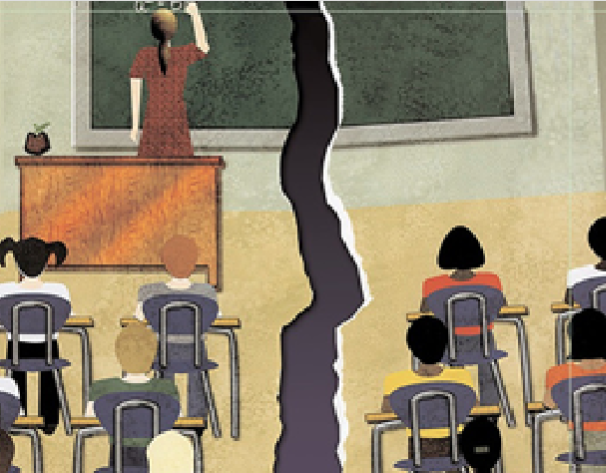
Why is There a Racial Achievement Gap?

Screen Shot 2018-11-16 at 12.15.01 PM


Sometimes the most racist aspects of a society are right there in front of you, but no one seems to notice.


Take the racial achievement gap.


It’s a term used to describe the fact that black and Latino students don’t do as well academically as white students.


Why does it even exist?


Why do students of color in the United States achieve less than their white peers?


They have worse grades, lower test scores, meager graduation rates and fewer achieve advanced degrees.


As of 2018, they had the lowest mean score of any racial group on the Scholastic Aptitude Test (SAT).


And it’s been like that for more than half a century.


In 1964, a Department of Education report found that the average black high school senior scored below 87% of white seniors (in the 13 percentile). Fifty years later, the National Assessment of Educational Progress (NAEP) found that black seniors had narrowed the gap until they were merely behind 81% of white seniors (scoring in the 19th percentile).


So what does that mean?


It’s a question that has haunted our education system for more than a century.


And the various answers that have been offered to explain it often reveal more about our society than they do about black and Latino children.


CLAIM 1: People of color are just genetically inferior


I know. This sounds glaringly racist.


And it is.


Yet this was the favorite answer for the achievement gap at the start of the 20th Century (More on that later).


However, it has been espoused as recently as 1995 by Charles Murray and Richard Herrnstein in The Bell Curve where the authors attributed relative black failure and low socio-economic status to biological inadequacy.


Murray and Herrnstein sparked such an intense academic debate at the time that the American Psychological Association (APA) convened a Task Force on Intelligence. Instead of soundly disproving this theory, the resulting APA report could come to no definite conclusion: “At this time, no one knows what is responsible for the differential,” the authors wrote.


Today the idea that people of color are genetically inferior has been soundly defeated.


There is simply no evidence that racial characteristics are strongly correlated with intelligence.


If it were true, for example, you’d expect to see the same achievement gap from native born Africans immigrating to this country as those who are born in the US. But that is not the case. In fact, we see just the opposite effect – a sizable percentage of African immigrants earn some of the best grades, have some of the highest test scores, and disproportionately graduate from high school and achieve advanced degrees.


This is something that distinguishes foreign-born Africans – especially those from Sub-Saharan Africa – even from other immigrants. African immigrants sit near the top of the scale of so-called model minorities.


If the problem was mere genes, this wouldn’t be so.


CLAIM 2: America’s people of color are culturally inferior


You’d think it would be obvious how racist such a claim is, but it is an increasingly popular explanation of the achievement gap.


In The End of Racism, popular conservative writer Dinesh D’Souza blamed the racial accomplishment gap on black cultural defects. “[T]he old discrimination” has declined and been replaced by “rational discrimination” based “on accurate group generalizations,” wrote D’Souza.


In other words, it’s not genes, but pathological community values that keep many people of color at the bottom. Black and brown students would do better in school if their culture fostered hard work, determination, grit and valued learning. They’d learn more if their parents weren’t always in jail or having innumerable children to increase their food stamp benefits.


From a purely ideological standpoint, this is textbook racism – the belief that some racially defined groups are in some sense better or worse than others.


It’s the minstrel show as case study. It boils down the attributes of 40 million people to mere stereotypes and pretends that they’re real.


The truth is most people of color don’t fit the corny clichés. In the real world, most black folks do not commit crime, only about 6 percent of unmarried black women give birth each year, and most black people are not recipients of welfare benefits. Indeed, fewer than 200,000 black adults in the entire US currently receive cash welfare benefits from the government. That’s out of about 30 million black adults in all. So these are not cultural norms.


Furthermore, black crime rates, out-of-wedlock birthrates, and welfare dependence have gone down in recent years, while white rates have increased.


Such claims show more about those making them than the people the claims are supposed to be about. When a black person struggles, the cause is assumed to be a deeply ingrained cultural attribute. When the same happens to white people, it’s an anomaly.


For instance, in the 80’s and 90’s the media blamed black culture and black communities for the crack epidemic. But today those same talking heads excuse the mostly white and rural opioid crisis as an aberration. No one seems to claim that it is because the white family is breaking down or white culture is in decline.


Black families are disproportionately poor and thus suffer higher rates of everything that comes with it.


But this is not an artifact of their culture anymore than it is for poor whites.


CLAIM 3: People of color experience higher rates of poverty and thus struggle more academically.


Finally we have a claim based in fact and not racial stereotypes!


When we look at test scores, like those on the NAEP, we see that state racial achievement gaps are strongly correlated with state racial socioeconomic disparities.


Poor people achieve worse academic outcomes than wealthier people. And this is true across race and ethnicity.


It just makes sense. Living in poverty means less access to healthcare, neonatal care, pre-kindergarten, and fewer books in the home. It often means fewer educated family members to serve as a model. And it often means suffering from malnutrition and psychological trauma. Impoverished parents usually have to work multiple jobs just to make ends meet and thus have less time to help with homework or see to their children. All of this has a direct impact on education.


The fact that a larger percentage of people of color are poor, helps explain the disparity of achievement between races.


The fact that achievement gaps tend to be largest in places where racial socioeconomic disparities are largest, supports this theory. Moreover, in neighborhoods with greater socioeconomic equality, the racial achievement gap is likewise smaller or nonexistent.


Achievement gaps are strongly correlated with racial gaps in income, poverty rates, unemployment rates, and educational attainment.


However, poverty, alone, does not explain away the problem.


Even when racial disparities are few and far between (typically in states with small black and/or Hispanic populations), the gap can persist.


We shouldn’t discount poverty. It goes a long way to explaining the problem. It just doesn’t go all the way.


CLAIM 4: Racist policies and bias widen the achievement gap


There are numerous factors that can adversely affect achievement for children of color above and beyond poverty. These include the availability and quality of early childhood education, the quality of public schools, patterns of residential and school segregation, and state educational and social policies.


For example, more than 60 years after Brown v. Board, school segregation is still a problem. In fact, in many parts of the country, they are actually more segregated today than they were at the height of the civil rights movement in the 1960s.


According to a report from the U.S. Government Accountability Office, from 2000 to 2014, school segregation has more than doubled nationwide. That’s twice the number of schools comprised almost entirely of students living in high poverty and/or students of color.


The number went from 7,009 to 15,089 schools. And that’s just the worst offenders – schools with more than three quarters of students from only one race or class. Throughout the country there are thousands more schools not as extreme but still serving mostly poor and/or minority students, and thus receiving fewer resources, more teacher layoffs, dealing with larger classes and crumbling infrastructure.


Even where segregation isn’t a problem, racist policies can creep into the academic culture.


A report by the Government Accountability Office (GAO) found that black students in K-12 schools are far more likely to be disciplined — whether through suspension or referral to law enforcement — than their racial counterparts.


A 2014 study found that people generally view black boys as older and less innocent starting at the age of 10. Another study released in 2017 produced similar results, finding that Americans overall view black girls as less innocent and more mature for their age, from ages 5 to 14.


These have real world consequences for children’s academic development. If even well-meaning (and mostly white) teachers are more likely to see children of color as potential trouble makers, that can be a self-fulfilling prophecy. And kids who are in trouble often have more difficulty making the grade.


Finally, there is the influence of charter and voucher schools, many of which target their enrollment at students of color.


These are schools that are (at least in part) publicly funded but privately managed. They are not required to have nearly the same transparency as traditional public schools, don’t have to be democratically controlled and can often be run for a profit.


They can cut services to students on a whim and if students struggle, they can give them the boot forcing them to try to catch up at the local public school.


These practices are so worrying that the National Association for the Advancement of Colored People (NAACP) and Black Lives Matter have both called for a moratorium on all new charter schools. Journey for Justice has gone even further with a call for more community schools.


Bias and policies like these can have a big impact on students, but we haven’t even discussed the largest culprit.


CLAIM 5: The standardized testing industry is essentially biased


We’ve talked a lot about why there’s a racial achievement gap.


We haven’t talked that much about if.


You have to admit, it’s counterintuitive to think that there should be academic hierarchies based on race. One race is better than others at school? Really? Isn’t that, itself, a racist assumption?


If there is no evidence for genetic or social differences along racial lines, can we explain everything else by way of socioeconomics and racist policies?


Perhaps. But even more so, we need to question the mechanism that started this whole debate in the first place – standardized testing.


That is the primary mechanism used to determine if there is a racial achievement gap at all.


If that mechanism is biased, so is the result.


This is particularly troubling for an industry that was built on the eugenicist premises with which we started this article.


Standardized testing, as we know it, originates from the work of Francis Galton – Charles Darwin’s cousin and an English statistician. In 1869, he wrote in Hereditary Genius that “[t]he average intellectual standard of the negro race is some two grades below our own.” Galton nearly invented the western eugenics movement, but couldn’t find a method to test his theories.


Enter France’s Alfred Binet and Thodore Simon. In 1905 they developed an IQ test that 11 years later was revised by Stanford University psychologist Lewis Terman for use in America.


In his book, The Measurement of Intelligence, Terman wrote that these “experimental” tests will show “enormously significant racial differences in general intelligence, differences which cannot be wiped out by any scheme of mental culture.”


For Terman, the achievement gap wasn’t a problem. It was a feature he was actively trying to prove, and he thought he had done so with his experiments on 1.7 million U.S. servicemen in World War I.


His deeply biased work convinced a generation of scholars. Princeton University psychologist Carl C. Brigham presented the results as evidence of genetic racial hierarchy in A Study of American Intelligence – merely three years before he used these same ideas to craft the SAT test in 1926.


Though that same SAT test has been revised since Brigham’s time, the fundamental principals behind it remain the same. Along with the PSAT, it was taken by more than 6.7 million students in the 2015-16 school year.


The ideals of the eugenicists lost popularity after World War II, but they were by no means finished. Famed physicist William Shockley and educational psychologist Arthur Jensen carried these concepts into the 1960s before they were revived again in The Bell Curve in the ‘90s.


These are not just bugs in the system. They are what the system was meant to prove in the first place.


Our worship of the data has made us all unwitting accomplices of an ideal that is prejudiced in its axioms.


By defining academic success or failure primarily as success or failure on standardized tests, we’ve effectively barred generations of children of color from the benefits of an education. And in using these same tests for “accountability” purposes to reward or punish their schools by granting or denying resources, high stakes testing has become the academic gatekeeper. Biased assessments have been used to grant real world opportunity.


How many opportunities have been denied because of them? How many black and brown children have been denied entry to college, professions, graduate schools, jobs, places at the highest ranked schools?


How many young black and brown children have been convinced of their own ignorance because of a test score of dubious quality?


CONCLUSIONS


So we return to the question with which we began this article:


Why is there a racial achievement gap?


The answer is NOT because of genetic or cultural deficiencies in children of color.


The gap stems from a combination of disproportionate levels of poverty among black and brown people, racist bias and policies embedded in our public school system and – more than anything else – reliance on a flawed assessment system.


If we want to really close the achievement gap, we must do several things. First, we must continually discredit and criticize the genetic and social critique of racial minorities at the heart of the conservative movement.


Next, we must create a more just and equitable education system. This means fairly funding our schools. We must increase integration. We must halt the spread of charter and voucher schools. We need to make sure all our teachers and principals have cultural sensitivity training and increase the numbers of teachers of color in our school system.


And we must get rid of our system of standardized testing.


It’s a tall order, but that’s the only way to close an even more pressing gap – the gap between our reality and our ideals.


Like this post? I’ve written a book, “Gadfly on the Wall: A Public School Teacher Speaks Out on Racism and Reform,” now available from Garn Press. Ten percent of the proceeds go to the Badass Teachers Association. Check it out!

book-4

Grit is Sh!t – It’s Just an Excuse to do Nothing for Struggling Students

 Screen Shot 2018-11-08 at 3.29.01 PM


Let’s say you’re out in public and you see a crying child alone in the street.


What would you do?


Would you run up to her and help? Or would you just shrug, mutter some derisive comment about the brat and walk on?


Our public school policymakers want us to do the later. In fact, they have a whole pedagogical justification for ignoring the needs of children.


It’s called “academic tenacity,” a “growth mindset” or “grit.”


And it goes something like this:


That child isn’t learning? If she just worked harder, she would.


It’s the political equivalent of “pull yourself up by your own bootstraps” applied to the classroom.


And it’s super helpful for politicians reluctant to allocate tax dollars to actually help kids succeed.


The idea and the euphemisms used to describe it were coined by Carol Dweck as early as 1999. It was subsequently popularized by seventh-grade math teacher and psychologist Angela Duckworth.


In the early 2000s, Duckworth realized that IQ wasn’t the only thing separating successful students from those who struggled. There was also the tendency to overcome adversity or not.


Hey, Angela. Darwin called. He wants his Theory of Natural Selection back.


You know Survival of the Fittest was never meant to be prescriptive. As human beings, we’re supposed to be better than mere animals that typically leave the pack’s sick and injured behind to get eaten by predators.


But whatever.


The term “grit,” is defined as a “passion and perseverance for long-term goals,” according to Frontiers in Psychology. And it’s become one of the buzziest of buzzwords in academia.


So much so, that as you’re reading this, standardized test manufacturers are working to develop an assessment to find it in students.


The agencies that administer the National Assessment of Education Progress (NAEP) and the Program for International Student Assessment (PISA) are close to including character assessments as a measure of student performance.


Oh goody!


They foresee a brave new world where multiple-choice tests will determine not just the entire scope of human knowledge but character as well!


But what no one wants to admit is that grit is… well… shit.


It’s just an excuse for a society that refuses to help those most in need.


In our world, there are haves and have-nots. But if we stop there, we ignore how and why this situation came to be.


Who places kids into segregated schools? WE DO.


Who allocates funding based largely on parental income? US.


We set kids up to succeed or fail before they even enter the school system with an economy that rewards the already rich and punishes generational poverty.


Yet when anyone suggests offering help to even the playing field – to make things more fair – a plethora of policy wonks wag their fingers and say, “No way! They did it to themselves.”


It’s typical “blame the victim” pathology to say that some kids get all the love, time and resources they need while others can do without — they just need more “grit” and a “growth mindset.”


Life’s tough. Get over it.


That’s easy for YOU to say! Because it’s the have’s who make the rules, it’s the people at the top who are telling the people at the bottom they’re to blame for their own suffering.


So you forget all the ways society has helped you and yours. YOU deserve all the credit for your successes.


But for those people over there, let’s forget all the ways society has refused to help and instead blame THEM for not overcoming the obstacles (we put) in their path.


Don’t get me wrong. I’m not saying effort counts for nothing. But it’s part of a complicated matrix of nature and nurture.


Our environments shape us, but we have some control over what we do with what we’re given.


Yet as a society, we can’t simply ignore our responsibilities toward others and throw it all on the individual.


Good teachers know how to get the best out of their students. We know that most kids – if given a safe, encouraging environment – can succeed.


The key often is to scaffold that success. Give them something to do that they can actually master. Then give them something slightly more challenging.


You teach them that they have the ability to succeed and success becomes a self-fulfilling prophecy – and not the opposite.


However, the teacher – and even the school, itself – can only do so much.


As a society, we need to change the environment in which these kids grow up.


We need to fully fund our public schools to meet the needs of all students. That means more funding, services and opportunities for the underserved than for those who already have the best of everything and don’t need to rely as heavily on the school system for support.


We need wraparound services, counseling, tutoring, after school programs, community schools, jobs programs, continuing education for adults and other services to help heal the trauma of growing up poor in America.


But leaving it all to this magical thing called “grit” is just ignoring our responsibilities to our fellow human beings.


When you see someone suffering, you need to help them – not comfort yourself with excuses for ignoring them.


Like this post? I’ve written a book, “Gadfly on the Wall: A Public School Teacher Speaks Out on Racism and Reform,” now available from Garn Press. Ten percent of the proceeds go to the Badass Teachers Association. Check it out!
book-2

The World Mourns for Jews After Pittsburgh’s Synagogue Shooting. What About Other Targets of Hate?

Chin110118RallyAgainstAntisemitismMet5


When a white supremacist killed 11 people and wounded 6 others at a Pittsburgh synagogue last weekend, the world took notice.


Lights dimmed at the Eiffel Tower and Empire State building.


Candlelight vigils were held nationwide – including in Boston, Houston, Washington D.C., Philadelphia, New Orleans, Atlanta, Chicago, New York City and Los Angeles.


A host of international leaders from the Pope to Canadian Prime Minister Justin Trudeau to German Chancellor Angela Merkel expressed outrage, sadness and solidarity.


I’ll admit that as a native Pittsburgher and person of Jewish descent, it touched me deeply.


For a moment, it seemed like the whole world had stopped spinning and from every corner of the globe people were with us in our tragedy.


But at the same time, it was troubling.


After all, there were at least two other major hate crimes in the U.S. perpetrated within 72 hours of the shooting.


In Kentucky, a white man shot and killed two African-Americans at a Kroger grocery store following a failed attempt to break into a black church.


Only two days later, a deranged man who had railed against Democrats and minorities with hate-filled messages online was arrested for allegedly sending mail bombs to people who’d been criticized by President Donald Trump.


IMG_8311


Where were the candlelight vigils for those atrocities?


Where were the international landmarks going dark?


Where was the worldwide condemnation?


In the wake of Pittsburgh’s tragedy, these other violent acts have been almost forgotten.


Yet they’re all symptoms of the same disease – hate and bigotry.


Don’t get me wrong.


What happened in Pittsburgh was terrible.


The Anti-Defamation League estimates that the shooting at the Tree of Life Synagogue may be the most deadly attack on Jews on American Soil in our history.


694940094001_5854810496001_5854807723001-vs


But me and mine do not have a monopoly on sorrow.


We suffer, but we are not the only ones hurting.


This all happened not far from my home.


I’ll admit that I am having a really hard time dealing with it.


I am not sleeping well.


I find myself zoning out in the middle of everyday activities.


And I feel this constant anxiety like part of me is expecting to hear a gunshot ringing down the hall at any time.


When the alleged shooter entered the sanctuary armed to the teeth and shouted “All Jews must die!” before carrying out his plan, he included me in his declaration.


All Jews.


That’s me.


That’s my daughter. My parents. My family.


It means something to me that so many people have come together to repudiate this crime.


The Islamic Center of Pittsburgh and other U.S. based Muslim groups donated more than $200,000 for funeral expenses. An Iranian refugee (who hadn’t even been to the three rivers) started a GoFundMe that brought in $1 million for the victims and their families.


You can’t go anywhere in Pittsburgh without a memorial, a moment of silence, a shared statement of solidarity and love.


At the symphony, musicians read two statements from the stage against hate before playing a Hebrew melody with string quartet.


At my school – I’m a teacher – the union decided to collect money for the victims.


I saw a barge floating down one of the rivers that had the message “Stronger Than Hate” on the side next to the modified Steelers logo where the top star had been replaced by a Star of David.


IMG_8309


I even saw a similar message on a Wendy’s sign: “PittsburghStrong/ Stronger/ Than Hate”.


IMG_8312


The community has come together in a way I’ve never seen before.


But I can’t help wondering why.


Even after Richard Baumhammers went on a racially motivated killing spree in 2000 murdering five people including two Jews, the response wasn’t this overwhelming.


Perhaps it’s just that this latest shooting is the final straw.


Perhaps it is the moment when our nation finally pulls together and says that enough is enough – We won’t tolerate this kind of hate and violence.


I hope that’s it.


However, in the shadows of my mind I wonder if it might not be a reflection of the same beast that struck us last weekend.


Could it be that we’re willing to put up with violence against brown people, but only draw the line when those targeted have lighter skin?


I guess my point – if I have one – is this: Thank you, But.


On behalf of Pittsburgh’s Jews, thank you for having our back.


If we’re going to survive this, we’re going to need your continued support and solidarity.


But it’s not just us.


Hate crimes have jumped from about 70 incidents a year in the 1990s to more than 300 a year since 2001. And after Trump was elected, 900 bias-related incidents were reported against minorities within the first 10 days.


Our country was built on the genocide of over 110 million indigenous Americans and the enslavement of 30 million Africans.


The idea of concentration camps didn’t originate with the Nazis. Hitler got the idea from U.S. treatment of Native Americans.


Racism didn’t end with the Civil Rights Movement. It just changed shape and is hidden in the way we practice health care, education, and policing all the way to mass incarceration.


The shock and solidarity in the wake of the synagogue shooting is appreciated, but it’s not enough to mourn only when 11 Jews are murdered in cold blood.


It’s not enough to take a stand against anti-Semitism.


We need to join together to fight all of it.


We need to be unified against school segregation, police brutality, xenophobia and prejudice in all of its forms.


The white supremacist who killed my friends and neighbors targeted us because he thought we were helping brown-skinned immigrants into the country.


We can’t just stand for the helpers. We need to stand for those in need of that help.


It just won’t work any other way.


We can’t just be against violence to light skinned minorities. We have to empathize and protect our brown skinned brothers and sisters, too. We have to love and cherish our LGBTQ neighbors, as well.


IMG_8310


We have to realize that our freedom, our safety, our very lives depend not just on what rights we have – but on what rights we give to all.


That is the only way any of us will ever feel safe again.


Through love and solidarity for every. Single. Human. Being.


AR-181029559.jpg&MaxH=500&MaxW=900


Like this post? I’ve written a book, “Gadfly on the Wall: A Public School Teacher Speaks Out on Racism and Reform,” now available from Garn Press. Ten percent of the proceeds go to the Badass Teachers Association. Check it out!

book-3

The Pittsburgh Community is Stronger Than the Synagogue Shooter’s Hate

43579727_10156281113318860_8423220729121603584_n


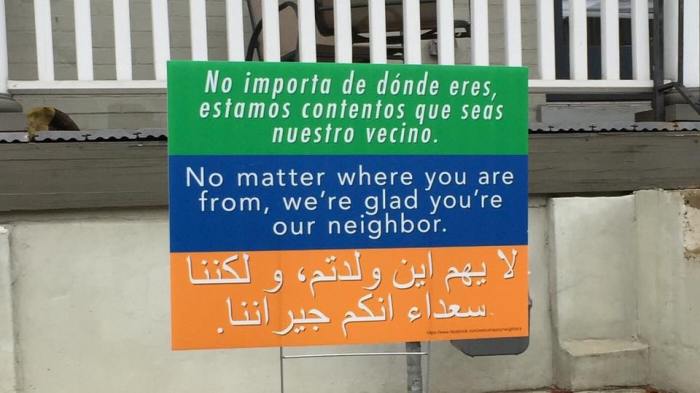
There’s a popular yard sign in the Squirrel Hill neighborhood of Pittsburgh.


In bands of green and blue and yellow, it projects the same message in Spanish, English and Arabic:


“No matter where you are from, we’re glad you’re our neighbor.”


If the community had a motto, I think that might be it.


Though known for its high concentration of Jewish residents, the Pennsylvania locale is a multicultural crossroads.


That may have made it a target today when a shooter entered the Tree of Life Synagogue.


Though the alleged culprit has been captured, details are still being uncovered. The death toll has yet to be tallied.


Unconfirmed reports state that he shouted “All Jews must die,” before opening fire.


But I don’t believe that the Jewish community was his only target.


Or more precisely – it wasn’t just the Jewish part – it was the community that had grown up around it.


I know Squirrel Hill well.


I live close by. I grew up on those streets. I’ve been to services at that synagogue. I have family who are members.


Thankfully it seems that no one related to me was there this morning. But when victims names are released, I probably will know who they are.


I know this community.


I am an extended part of it.


And that’s something of which I am proud.


Just walk along Murray Avenue and you’ll see Indian, Italian, Jewish, African, Chinese – every nationality imaginable – offering the fruits of their culture for friendly commerce.


You’ll see Hasidic Jews in dark hats and flowing tzitzit walking next to women in colorful saris next to trans and lesbians, kids with every color skin playing together in harmony.


Whenever I want a good corned beef sandwich or a quality lox and bagel, I go there. Whenever I want a spicy curry or the freshest sushi or an authentic macaroon, that’s the place. If I want to hear a string quartet or a lecture from a visiting dignitary or even if I want to swim in a public pool, membership to the Jewish Community Center is open to all.


It’s like a few blocks of cosmopolitan life tucked away in a city more known for segregation. We have many ethnic neighborhoods but few where one culture flows so easily into another.


Heck. Even the Tree of Life Synagogue, itself, doesn’t serve one congregation. It serves three who all had services going on at different parts of the building this morning.


There’s just something very special about this place.


It’s where you can go to be yourself – in fact, you’re encouraged to be who you are and not conform to any particular norm. Yet in doing so, you’re somehow demonstrating unity.


Paradoxically, being you makes you one of us.


It’s weird.


I think it may have been that sense of community that made Squirrel Hill, in general, and the Tree of Life Synagogue, in particular, a target.


The hate-filled person who attacked us today was terrified of that unity.


He was so frightened of disillusion, of losing his sense of self, that he had to end the lives of those who could do what he couldn’t.


It’s pathetic, really.


If your sense of self is only a negative, only opposition to someone else’s otherness, you really don’t have much self to lose.


If you define yourself by your hate, what are you?


Do you even really exist?


Most of us are very different.


We are complex assortments of personality – a family identity, a cultural heritage, a work persona, a spirituality, a sense of justice.


Communities like Squirrel Hill nurture this multifarious nature.


They welcome and celebrate difference.


I wish America was more like Squirrel Hill and not the other way around.


If this community’s normal was our national ideal, think of the country we would be living in!


Being different wouldn’t be an obstacle, it would be cherished.


When meeting someone with an unfamiliar name, a heritage of which you were ignorant, a sexuality or gender identity of which you had little knowledge – your response wouldn’t be fear or discomfort. It would be a thrill of excitement that you are lucky enough to broaden your understanding of the many ways there are to be human.


It would be a country where no one grew up so stunted and afraid that the only solution they could imagine would be the death of others.


That’s the America I want to live in.


Squirrel Hill is stronger than this synagogue shooters hate.


I hope our country is, too.


Like this post? I’ve written a book, “Gadfly on the Wall: A Public School Teacher Speaks Out on Racism and Reform,” now available from Garn Press. Ten percent of the proceeds go to the Badass Teachers Association. Check it out!
book-1

Disowning the Lie of Whiteness

auschwtiztattoo 

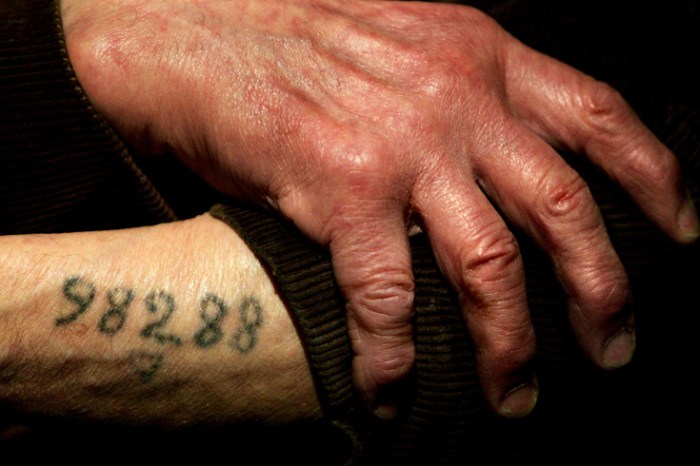
The most vivid memory I have of my great-grandfather is the tattoo on his arm.


It wasn’t an anchor or a sweetheart’s name or even the old faithful, “Mom.”


It was just a series of digits scrawled across his withered tan flesh like someone had written a note they didn’t want to forget.


Beneath the copious salt and pepper hairs was a stark number, the darkest stain on his skin.


Gramps is a kindly figure in my mind.


He died before I was even 10-years-old. All I really remember about him are wisps of impressions – his constant smile, a whiff of mothballs, how he always seemed to have butterscotch candies.


And that tattoo.


I think it was my father who told me what it meant.


When he was just a young man, Gramps escaped from Auschwitz. A guard took pity on him and smuggled him out.


His big European family didn’t make it.


My scattered relatives in the United States are all that are left of us.


Those are the only details that have come down to me. And Gramps isn’t here to add anything further.


But his tattoo has never left me.


It’s become a pillar of my subconscious.


The fact that someone could look at my kindly Gramps and still see fit to tattoo a numeric signifier on him as if he were an animal.


A little reminder that he wasn’t human, that he shouldn’t be treated like a person, that he was marked for erasure.


If I look at my own arm, there is no tell-tale integer peeking through the skin. But I am keenly aware of its presence.


I know that it’s there in a very real sense.


It is only the American dream that hides it.


Coming to this country, my family has made a deal, something of a Faustian bargain, but it’s one that most of us have accepted as the price of admission.


It’s called whiteness.


I am white.


Or I get to be white. So long as I suppress any differences to the contrary.


I agree to homogenize myself as much as possible and define myself purely by that signifier.


White. American. No hyphen necessary.


Anything else is secondary. I don’t have to deny it, but I have to keep it hidden until the right context comes to bring it out.


During Octoberfest I have license to be German. When at international village I can root for Poland. And on Saturdays I can wear a Kippah and be Jewish.


But in the normal flow of life, don’t draw attention to my differences. Don’t show everyone the number on my arm.


Because America is a great place, but people here – as in many other places – are drawn to those sorts of symbols and will do what they can to stamp them out.


I learned that in school when I was younger.


There weren’t a lot of Jewish kids where I grew up. I remember lots of cracks about “Jewing” people down, fighting against a common assumption that I would be greedy, etc. I remember one girl I had a crush on actually asked to see my horns.


And of course there were the kids who chased me home from the bus stop. The scratched graffiti on my locker: “Yid.”


The message was clear – “You’re different. We’ll put up with you, but don’t ever forget you are NOT one of us.”


There were a lot more black kids. They didn’t get it any easier but at least they could join together.


It seemed I had one choice – assimilate or face it alone.


So I did. I became white.


I played up my similarities, never talked about my differences except to close friends.


And America worked her magic.


So I’ve always been aware that whiteness is the biggest delusion in the world.


It’s not a result of the color wheel. Look at your skin. You’re not white. You’re peach or pink or salmon or rose or coral or olive or any of a million other shades.


Whiteness has as much to do with color as Red has to do with Communism or Green has to do with environmental protection.


It is the way a lose confederacy of nationalities and ethnicities have banded together to form a fake majority and lord power over all those they’ve excluded.


It’s social protection for wealth – a kind of firewall against the underclass built, manned and protected by those who are also being exploited.


It’s like a circle around the wealthy protecting them from everyone outside its borders. Yet if everyone banded together against the few rich and powerful, we could all have a more equitable share.


But in America, social class has been weaponized and racialized.


You’ll see some media outlets talking about demographics as if white people were in danger of losing their numerical majority in this country in the next few decades. But there’s no way it’s ever going to happen.


Today’s xenophobia is a direct response to this challenge. Some are trying to deport, displace and murder as many black and brown people as possible to preserve the status quo.


But even if that doesn’t work, whiteness will not become a minority. It will do what it has always done – incorporate some of those whom it had previously excluded to keep its position.


Certain groups of Hispanics and Latinos probably will find themselves allowed to identify as white, thereby solidifying the majority.


Because the only thing that matters is that there are some people who are “white” and the rest who are not.


Long ago, my family experienced this.


Before I was born, we got our provisional white card. And if I want, I can use it to hide behind.


I’ve been doing it most of my life.


Every white person does it.


It’s almost impossible not to do it.


How do you deny being white?


At this point, I could throw back my head and shout to the heavens, “I’M NOT WHITE!” and it wouldn’t matter.


Only in a closed environment like a school or a job or in a social media circle can you retain the stigma of appearing pale but still being other.


In everyday life, it doesn’t matter what you say, only how you appear.


I can’t shout my difference all the time. Every moment I’m quiet, I’ll still be seen as white.


It’s not personal. It’s social. It’s not something that happens among individuals. It’s a way of being seen.


The best I can do is try to use my whiteness as a tool. I can speak out against the illusion. I can stand up when people of color are being victimized. I can vote for leaders who will do something to dismantle white supremacy.


Not because I am some kind of savior, but because I know that my own freedom is tied to the freedom of those being oppressed by a system that provides me certain privileges.


But let me be clear: doing so is not the safe way to go.


In defending others you make yourself a target.


I get threats all the time from racists and Nazis of all sorts. They say they can tell just by looking at me that I’m not white at all.


The worst part is I’m not sure what I am anymore.


I don’t go to synagogue. I don’t even believe in God. But I’m Jewish enough to have been rounded up like Gramps was, so I won’t deny that identity. It’s just that I’m more than one thing.


That’s what whiteness tries to reduce you to – one thing.


I don’t want it anymore.


I’m not saying I don’t like the protection, the ability to be anonymous, the easy out.


But it’s not worth it if it has to come with the creation of an other.


I don’t want to live in a world where people of color are considered less than me and mine.


I don’t want to live in a world where they can be treated unfairly, beaten and brutalized so that I can get some special advantage.


I don’t want to live in a world where human beings are tattooed and numbered and sent to their deaths.


Because the Holocaust is not over.


American slavery is not over.


Neither is Jim Crow or lynching or a thousand other marks of hatred and bigotry.


Nazis march unmasked in our streets. Our prisons are the new plantation. And too many of our police use murder and atrocity to ensure the social order.


As long as we allow ourselves to be white, there will be no justice for both ourselves and others.


So consider this my renunciation of whiteness – and I make it here in public.


I know that no matter what I say, I will still be seen as part of the problem. And I will still reap the rewards.


But I will use what power is given me to tear it down.


I’m burning my white card.


I know it’s a symbolic gesture. But I invite my white brothers and sisters to add theirs to the flames.


Let us make a conflagration, a pillar of fire into the sky.


Let whiteness evaporate as the smoke it is.


Let us revel in the natural hues of our faces as we watch it burn.


Like this post? I’ve written a book, “Gadfly on the Wall: A Public School Teacher Speaks Out on Racism and Reform,” now available from Garn Press. Ten percent of the proceeds go to the Badass Teachers Association. Check it out!

WANT A SIGNED COPY?

Click here to order one directly from me to your door!

book-4

Scott Wagner Wants to be Pa.’s Anti-Education Governor. Will We Let Him?

39408873_306034386897393_1481697570328674304_n
Art by Sue Goncarovs


If there’s one thing Scott Wagner hates, it’s education.


He hates science. He hates schools. He hates teachers. And if students get in the way, he’ll hate them, too.


These are the qualities he thinks Pennsylvanians are looking for in their next governor.


The York Township Republican will challenge incumbent Democrat Tom Wolf on Nov. 6, 2018.


So who is this guy?


Wagner’s a college dropout who made a fortune starting a garbage hauling firm. He became a state senator four years ago after winning a write in campaign during a special election where only 17% of the electorate could be bothered to vote.


And ever since, he’s been consistent about one thing: he really, Really, REALLY hates teachers.


“We have 180,000 teachers in the state of Pennsylvania,” Wagner said in 2015. “If we laid off 10 percent of the teachers in the state of Pennsylvania, we’d never miss them.”


Let’s be clear.


Scott wouldn’t miss them. But the 1.75 million Commonwealth school children would.


Ever since the last Republican Governor, Tom Corbett, slashed funding by almost $1 billion a year to the poorest schools with the full help of a state legislature that is even now still under GOP control, our institutions of learning have been reeling.


We lost 27,000 education jobs, most of which were teaching positions.


That’s a deficit we still haven’t recovered from. Even today, state schools are staffed at a 10-year low. Class sizes are at an all time high.


Yet Wagner wants to fire even more teachers!?


That’s not the policy of a man who wants to help improve life throughout the state for all. That’s not the policy of a man who wants to help kids learn.


It’s the policy of a man who has a personal grudge against educators.


And his other legislative objectives?


Wagner wants to further slash education funding. He wants to spend whatever is left inequitably. And he really wants to help his heroes Donald Trump and Betsy DeVos enact school vouchers so business people like him can continue to cash in on children from Pittsburgh to Philadelphia and all places between.


By contrast, in his four years in office, Gov. Wolf has pushed to increase education funding, pushed to spend it more fairly, and even cut the time it takes for students to take high stakes standardized tests.


The good news: voters throughout the Commonwealth have never had a clearer choice for governor.


The bad news: when has that ever stopped them from getting it wrong?


Here’s a couple of Wagner’s other big ideas cribbed from the American Legislative Exchange Council (ALEC) and his buddies the Koch Brothers.


He Thinks Teachers Make Too Much Money


“We have created a special class in this state and the special class is the public sector union employee,” Wagner told Keystone Crossroads in a 2015 interview.


“Teachers are doing very well in this state,” he said. “People would be appalled if they knew what their teachers made, in certain areas.”


Unfortunately, Wagner has no idea, himself.


He keeps quoting a bogus salary figure that I’m not going to repeat. It’s not true statewide, it’s not an average, nor is it true in his home district.


In truth, the low end for teachers entering the field nationwide is around $30,000, according to the National Association of Colleges and Employers (NACE). So go to college, get a four – sometimes five – year degree including a rigorous internship of student teaching and you make a mere $10,000 above the most generous minimum wage!?


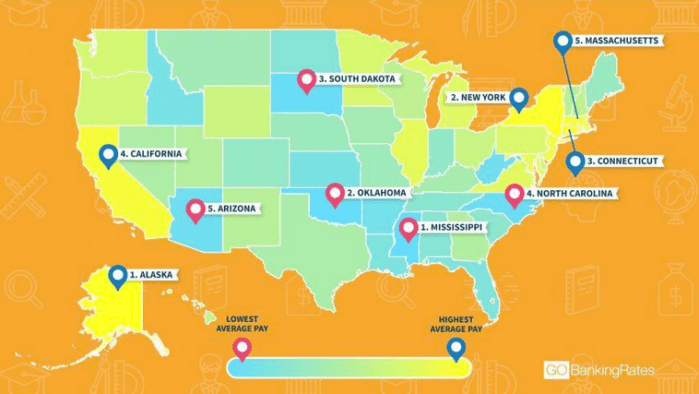
However, Pennsylvania pays its teachers better than average. We have the 12th highest pay in the country, according to financial services outlet GOBankingRates which compiled average teacher salaries by state using 2015 federal data.


According to that data, Pennsylvania teachers make on average $63,063 per year. Of neighboring states, teachers in Maryland ($65,247) and New Jersey ($71,687) make more. Teachers in Ohio (59,063) and Delaware ($59,853) make less.


Screen Shot 2018-08-16 at 2.11.40 PM
Highest and Lowest Teacher Salaries – Source: GoBankingRates


But those numbers are deceiving. They’re averages. Districts serving the wealthy pay their teachers much better than those serving the poor. Actual pay ranges from $99,253 in the affluent Philadelphia district of Lower Merion to $27,592 at Wonderland Charter School in Centre Country.


As everywhere else, many teachers struggle to make ends meet working multiple jobs while others are well compensated.


No matter how you slice it, nationwide teachers’ salaries are 14% less than those from professions that require similar levels of education, according to the Economic Policy Institute.


In other words, if prospective teachers want to make more money, all they have to do is switch majors.


That may be part of the reason for our national teachers shortage. Not only have states like ours laid off tens of thousands of educators, many don’t stay in the field if given the chance. Across the country , 46 percent of educators quit before reaching the five year mark. And it’s worse in urban districts, where 20 percent quit every single year!


We could take steps to ensure all teachers earned a living wage and even encouraged our best and brightest to enter the field. But, nah, Wagner thinks Pennsylvania already spends “enough” money on public schools.


As Governor, he would do whatever he could to win his personal crusade against teachers even if Pennsylvania’s school children were collateral damage.


He Wants to Eliminate Teachers Sick Days


Wagner has been vocal about eliminating benefits that educators earn, including sick days. He introduced a bill that’s still floating around in the state senate to strip sick days from the school code and make teachers bargain for them with their districts.


So forcing sick teachers to come to school and spread the germs to children is fine with Wagner as long as it hurts his nemesis – those evil teachers.


He Wants to Cut Teachers Pensions


He also plans to end pensions for working educators, and even wants retired educators to give back 10% of the retirement they earned.


He’s right to want reform to the state pension system but disingenuous or misinformed about the cause.


Pennsylvania pension costs have increased primarily because our legislature made bad plans and bad investments that were upended by the crash of 2008. You don’t fix that by stiffing your employees. If you do that, no one will believe any promises the state makes and no one of any substance will want to work for the state.


He Wants To Pay Teachers Based on Student Test Scores


No kidding:


“There are teachers that will exceed expectations while teaching a classroom of 100 of the toughest-to-teach students. There are also teachers that would struggle to teach just one student at a time. I want the first teacher to make a small fortune, and I want the second teacher to find a new career that is better suited for him or her.”


So if you teach the best students, you should make the most money? And if you teach struggling students, you should be fired?


But It’s Not Just Teachers. He Hates Other Working People, Too


If there is a corner to cut, he wants to take it – especially if it screws a working person. As a state senator, Wagner even introduced a bill that would exempt school districts from paying laborers the “prevailing wage” on construction projects.


Cheaper labor, shoddier work. That’s surely a recipe for success in buildings housing school children!


He Wants to Disband Unions


Oh, but he’s not done.


The man who once compared the tactics of public employee unions – including those representing teachers – to those of Adolf Hitler and Vladimir Putin also wants to end tenure end tenure, seniority, and disband unions.


I’m sure reducing teaching to a career without benefits, workers rights or protections will do wonders for the educational quality students receive.


Teachers working conditions are students learning conditions. Putting children in a building that has fewer safety precautions because there’s no union to collectively bargain for them is a great way to cut costs. But parents aren’t thrilled about having their kids try to learn in a sweat shop filled with Trump brand Russian asbestos.


He Loves School Vouchers and Charter Schools


Call them education saving accounts, education tax credits, personalized learning accounts or opportunity scholarships. It doesn’t matter. Wagner loves them all.


“I support all school choice,” he said in an interview.


Charter schools, funding private and parochial schools with public tax dollars. He’s in for all of it.


So long as it hurts public schools and enriches private businesses without helping students learn at all.


Go ahead! Take scarce funding from public schools and divert it to programs with little to no accountability. Let private school operators fraudulently misrepresent enrollment data. Let them fail to provide safe and academically appropriate learning environments. Let them game the system in any and every way.


That’s what Wagner calls fiscal accountability.


It doesn’t matter that these schools don’t improve student achievement. Evaluations of voucher programs in Milwaukee, Cleveland, and Washington, D.C., have all found no statistically significant differences in the academic achievement of voucher students compared to public school students. And recent evaluations of programs in Ohio, Indiana, and Louisiana revealed that voucher students scored lower than their peers attending public school.


But who cares about facts? This is all ideology for Wagner.


Vouchers have a record of undermining student’s civil rights – especially students with disabilities. Private school students give up due process and other rights guaranteed in public schools. Private schools are allowed to discriminate by denying admission based on religion, sexual orientation, citizenship status, English language proficiency and disability. Private schools that enroll students with disabilities may decide not to provide the services or accommodations guaranteed to such students in public schools. Or they may charge parents extra for them. Moreover, there is nothing to stop them from segregating these kids from other children. And, finally, private schools often suspend or expel students without due process.


This may be Trump and Wagner’s ideal. But it is certainly not what Commonwealth voters want for their children.


He Wants to Get Rid of Many State Colleges


Wagner caused an uproar when he said the state’s 14 state colleges will not be around in four years. “So, for those of you who think your school’s going to be around four years from now, it isn’t going to be around,” Wagner said.


Fewer institutions of higher learning. Fewer opportunities to get a college degree. That sounds like the policy of a college dropout.


He Wants to Slash School Funding


Wagner has made no bones about this from day one.


This is a guy who took a television reporter on a helicopter tour of schools in his district in 2015 to highlight the fact that “we spend a lot of money on schools.”


“They think the solution is more money,” he said of Wolf and the Democrats. “Every time you do that the money disappears and the problem is still there.”


It’s like taking a bath, Scott. You can’t just do it once and be clean for the rest of your life. You need to bathe every day. One-time funding windfalls don’t work. You need equitable and sustainable funding revenues.


But that’s either too complicated for Wagner or he just doesn’t care.


He supported Gov. Corbett’s plan to decimate Pennsylvania’s schools. And he doesn’t think the culling should be over.


When asked point blank about Corbett’s cuts in 2011, he said, “Yes, I believe that Governor Corbett needs to stick to his plan.”


He’s said repeatedly that we spend “enough money” on public schools, while stressing the need for frugality and fewer regulations.


He Wants to Play with How Schools Are Funded


He’s an advocate for legislation that would eliminate school property taxes and replace them with increased state sales and income taxes.


True we need a better funding mechanism than local property taxes. But you can bet Wagner’s plan is worse than the current system.


It would lock funding inequities among Pennsylvania’s 500 school districts into place.


He Thinks Global Warming is Caused by the Earth Getting Closer to the Sun


Wagner is an incredibly stupid man who thinks he’s rather intelligent.


But of all the dumb or evil things that come spewing out of his mouth, this one has to be my favorite.


When asked about global climate change, he didn’t simply deny that it was happening. He had an alternative theory to why it was taking place.


It’s not business and industry or fossil fuels that is causing global temperatures to rise. He actually said that it’s because the earth is getting closer to the sun every year. Another cause? Human bodies on the planet are giving off enough heat to raise the global temperature.


Perhaps it shouldn’t be surprising that a person who hates schools and teachers so much knows very little, himself.


These comments made him a national laughing stock.


His words were repeated on every late night comedy show across the country for giggles and guffaws.


The question is “Will the joke be on us come Election Day?”


It’s not “How dumb is Scott Wagner?”


It’s “Is Pennsylvania dumb enough to vote for him?”


NOTE: Special Thank you to Sue Goncarovs for the Wagner cartoon with which I began this piece. I love your work!


Like this post? I’ve written a book, “Gadfly on the Wall: A Public School Teacher Speaks Out on Racism and Reform,” now available from Garn Press. Ten percent of the proceeds go to the Badass Teachers Association. Check it out!

WANT A SIGNED COPY?

Click here to order one directly from me to your door!

book-1

STEM Education Severs the Arts from the Sciences

right-brain-left-brain


What’s the most effective way to dumb down a nation?


Focus on How without Why.


That’s really the biggest problem with the pedagogical fad of STEM education.


There’s nothing objectively wrong with teaching science, technology, engineering and math – the disciplines that make up STEM.


In many cases, doing so is essential to a well-rounded education.


But therein lies the problem – you can’t have a well-rounded education if you purposely leave out some of the most vital aspects of knowledge.


Where’s the art? Where’s the literature? Where’s the social studies, government, citizenship, drawing, painting, music – heck! Where’s the philosophical understanding of life, itself?


STEM initiatives often involve creating two tiers of school subjects. You have the serious disciplines that will earn you respect and a job. And you have the soft, mamby pamby humanities that are no good to anyone.


The problem is one of focus not content.


Corporate-minded bureaucrats who know nothing of human psychology, child development or education look solely at standardized test scores and get hysterical.


The U.S. is falling behind other nations – especially in science and math, they say. So we must do whatever we can to bring those test scores up, Up, UP!


Yet they have never bothered to see that our student test scores have never been at the top of the pack for all the decades we’ve been making international comparisons.


We started contrasting multiple choice assessment results for 13-year-olds in a dozen countries back in 1964. And ever since, America has always been right in the middle.


Yet for those five decades we’ve dominated the world in science, technology, research and innovation.


In that time we sent the first people to the moon, mapped the human genome, and invented the Internet – all while getting middling test scores.


In short, standardized assessments are a fantastically unreliable indicator of national success, just as they are poor indicators of individual learning.


We’ve never been a nation content with picking our answers from four options – A,B,C,D. We blaze new paths!


But number obsessed fools have convinced a public blinded by sports statistics that these tests mean our kids are deficient. And the only cure is to put on blinders and focus almost exclusively on those subjects most featured on the tests.


Even reading and writing are only valuable if they let us guess what a normalized reader is supposed to comprehend from a given passage and if they allow us to express ourselves in the most rudimentary and generic ways.


This is exactly what they do in countries with the highest test scores – countries that are LESS innovative than the U.S.


Asian countries from Singapore to South Korea to India are not blind to this irony. While we are trying to imitate them, they are trying to imitate the kind of broad liberal arts education in which we used to pride ourselves.


“Many painters learn by having fun,” said Jack Ma, founder of one of China’s biggest Internet companies Alibaba.


“Many works of art and literature are the products of having fun. So, our entrepreneurs need to learn how to have fun, too.”


Ma worries that his country is not as innovative as those in the West because China’s educational system focuses too much on the basics and does not foster a student’s complete intelligence, allowing him or her to experiment and enjoy the learning process.


In other words, no matter how good you are at math and science, you still need to know how to learn, think and express yourself.


To be fair, these criticisms of STEM are not new.


Even global pundits like Fareed Zakaria have made similar arguments.


The result has been a hasty addition – change STEM to STEAM by adding in the arts.


Unfortunately, this hasn’t always worked out for the best.


Most of the time, the arts component is either an after thought or merely a sweetener to get students interested in beginning the journey – a journey that is all STEM all the time.


There is still an education hierarchy with the sciences and math at the top and the humanities and social studies at the bottom.


This is extremely unfortunate and will cause long-term detrimental effects to our society.


For instance, we pride ourselves in being democratically ruled. Political power does not come from authority, it comes from the consent of the governed.


This requires a public that knows how to do more than just add and subtract. Voters need to understand the mechanisms of government so they grasp their rights. They need a knowledge of history so they don’t repeat the mistakes of the past. They need to grasp human psychology, anthropology, and sociology to understand how people work in groups and individually.


Moreover, as human beings, they need the humanities. People have thoughts and feelings. They need to know how to express those thoughts and feelings and not just by writing a five-paragraph essay. They need to be able to create works of art. They need to be able to write a story or poem. They need to be able to manipulate images. They need to understand and create music.


Without these things, it can be difficult to become fully actualized people.


That used to be the goal of education. Provide students with the tools to become the best version of themselves.


But this focus on STEM and STEAM only endeavors to make them the best cogs the workforce needs.


We have relinquished our commitment to students and replaced it with a commitment to business and industry.


The idea is that schools owe the job market workers. That could not be further from the truth. We owe our students the tools that will help them live the best lives. And employment is only one small facet of that goal.


I’m not saying we shouldn’t teach math and science. We should – we MUST. But those can’t be prioritized over and above other essential human endeavors.


We need to fund and encourage a broad liberal arts education for all students. As they get older and move on to post-secondary studies including industrial arts they will inevitably specialize in areas that they find most interesting.


But until then, it is our job to give them every opportunity to learn – not to mold them into future wage slaves or boost national pride with arbitrary and meaningless test scores.


Like this post? I’ve written a book, “Gadfly on the Wall: A Public School Teacher Speaks Out on Racism and Reform,” now available from Garn Press. Ten percent of the proceeds go to the Badass Teachers Association. Check it out!

WANT A SIGNED COPY?

Click here to order one directly from me to your door!

book-2

Democrats for Education Reform Think Being Progressive Means Mirroring Betsy DeVos


 Screen Shot 2018-08-08 at 12.24.47 PM


Democrats for Education Reform (DFER) put out a new video about what they think it means to be an education progressive.


And by the political action committee’s definition, Betsy DeVos may be the most “progressive” education secretary ever.


She champions “public charter schools.” Just like them!


She is in favor of evaluating teachers on student test scores. Just like them!


She is a booster for “holding schools accountable” through the use of standardized tests. Just like them!


And she loves putting public tax dollars into private hands to run schools “more efficiently” by disbanding school boards, closing public debate and choosing exactly which students get to attend privatized schools. Just like… you get the idea.


But perhaps the most striking similarity between DeVos and DFER is their methodologies.


DFER announced it again was going to flood Democratic races with tons of campaign cash to bolster candidates who agreed with them. That’s exactly how DeVos gets things done, too!


She gives politicians bribes to do her bidding! The only difference is she pays her money mostly to Republicans while DFER pays off Democrats. But if both DeVos and DFER are paying to get would-be lawmakers to enact the same policies, what is the difference!?


Seriously, what is the difference between Betsy DeVos and Democrats for Education Reform?


Progressives in Colorado and California say it is only the word “Democrat.”


Democratic party conferences in both states passed resolutions asking DFER to stop using the name “Democrat” because the privatization lobbying firm does not represent party ideals or goals.


It is degrading what the party stands for and hurting the brand.


Why do some progressives vote third party? Because of groups like DFER.


Voters think something like – if this charter school advocacy group represents what Democrats are all about, I can’t vote Democrat. I need a new party. Hence the surge of Green and other third party votes that is blamed for hurting Democratic candidates.


The Democrats have always been a big tent party, but the canvas can’t shelter the most regressive far right bigotry without destroying the organization’s identity as an opposition party.


It is entirely incoherent to oppose Republicans by pushing for almost the same agenda.


The reason for the confusion is that DFER is not a grassroots organization. It is funded by Wall Street hedge fund managers.


It is not an authentic expression of the public’s wants and desires. It is another avenue for the mega-rich to use their power and influence to tell the rest of us what they want us to believe.


Yet DFER tries to hide this fact with various forms of propaganda. In effect, they’re trying to convince us that their ideas are what we actually believe.


For instance, the group is now offering a nationwide poll from Benson Strategy Group as proof that Democratic voters agree with DFER’s goals.


However, the questions asked to about 2,000 people on the phone are laughably biased:


“Do you believe we have a responsibility to do everything we can to give every child a great education, and does that mean we need faster change in our schools to prepare students for the future?”


Of course people are going to agree with that! It doesn’t mean people want to privatize public schools. We SHOULD do everything – including closing failing charter schools and boosting funding at struggling public schools!


“Do you agree that we can’t go back to the way things used to be in schools? Do you think we need to keep bringing in new ideas and finding new ways to improve schools?”


Of course we need new ideas, but charter schools and standardized tests aren’t new ideas! We’ve been doing that nonsense for decades and they haven’t helped a bit. In fact, they’ve made things worse!


“Do you think funding alone is enough to give our children the education they deserve? Do you also want to see new ideas and real changes to the way public schools operate?”


Of course schools need more than just additional funding. But let’s not minimize funding equity. Students of color will never get an equitable education until we pay for the resources they need to succeed. The poor will never catch up to the rich without money to provide the services they need to learn.


Moreover, blanket statements disparaging public schools before asking about school privatization invites bias against public schools and bias in favor of privatization.


When you couch privatization as “more options” and “choice,” who doesn’t want that? But it’s not what you’re offering.


Giving administrators the ability to accept or deny my child into their school is not “more options” for me. It is greater choice for them.


Slashing funding at the public school because its finances got gobbled up by the neighborhood charter is not “choice” for me. It is providing alternative revenue for the corporations that run the charter school while my only option is to accept fewer resources for my child.


None of this is progressive. None of this is truly supported by grassroots people or organizations.


Civil rights groups like Journey for Justice and even the National Association for the Advancement of Colored People (NAACP) oppose school privatization and high stakes testing.


This is the meat and potatoes of DFER.


The only difference between these alleged Democrats and DeVos is that the Trump administration also champions school vouchers.


But both charters and vouchers involve sending public tax dollars to schools that are privately run. Both involve stripping taxpayers of control over how that money is spent until all we have are parents moving their children from school-to-school in a desperate attempt to find one that does a good job and will also accept their child.


That is not the progressive ideal.


Progressives want to make every public school excellent. They want all children to have the resources they need to succeed. They want to assess students, teachers and the system fairly to clearly understand what children are learning, what educators are doing to help them learn and how administrators and school directors are enabling that success. They want innovation – not the same old corporate-minded top-down policy failures of the past decades. They want technology as a tool to bridge understanding and not as an end in itself to drive the curriculum. They want an end to the school-to-prison pipeline. They want truly integrated schools, not the current segregated system where Cadillac funding goes to rich white districts and the scraps are thrown to the poor brown ones.


Yet DFER, these so-called Democrats, support none of this.


And they’re spending millions of dollars to convince our lawmakers not to support it either.


Politicians can’t keep accepting their dirty money and expecting grassroots voters to continue to support them.


To paraphrase Matthew, no one can serve two masters. If lawmakers are taking sacks of cash from billionaire hedge fund mangers, they aren’t going to listen to you or me.


They can serve their constituents or mammon. Not both.


So if Democrats want strong support in the coming elections, they need to do the progressive thing.


Stop accepting bribes from dark money influence peddlers like DFER.


Like this post? I’ve written a book, “Gadfly on the Wall: A Public School Teacher Speaks Out on Racism and Reform,” now available from Garn Press. Ten percent of the proceeds go to the Badass Teachers Association. Check it out!

WANT A SIGNED COPY?

Click here to order one directly from me to your door!

book-2

Since School Vouchers Don’t Increase Test Scores, Racism is an Acceptable Reason for Privatization, Says Advocate

Screen Shot 2018-07-24 at 10.20.41 AM

For decades, school voucher advocates claimed that sending poor kids to private schools with public tax dollars was acceptable because doing so would raise students’ test scores.


However, in the few cases where voucher students are even required to take the same standardized tests as public school students, the results have been dismal.


In short, poor kids at private schools don’t get better test scores.


So why are we spending billions of public tax dollars to send kids to privately run schools?


A 2018 Department of Education evaluation of the Washington, D.C., voucher program found that public school students permitted to attend a private or parochial school at public expense ended up getting worse scores than they had at public school.


Their scores went down 10 points in math and stayed about the same in reading.


These are not the pie in the sky results we were promised when we poured our tax money into private hands.


However, corporate education propaganda site, The 74, published a defense of these results that – frankly – makes some pretty jaw dropping claims.


The article is “More Regulation of D.C. School Vouchers Won’t Help Students. It Will Just Give Families Fewer Choices for Their Kids” by far right Cato Institute think tanker Corey DeAngelis.


In his piece, not only does he call for less accountability for voucher schools, he downplays the importance of standardized test scores.


And he has a point. Test scores aren’t a valid reflection of student learning – but that’s something public school advocates have been saying for decades in response to charter and voucher school cheerleaders like DeAngelis.


Supply side lobbyists have been claiming we need school privatization BECAUSE it will increase test scores. Now that we find this claim is completely bogus, the privatizers are changing their tune.


But that’s not the most shocking irony in DeAngelis article.


Parents don’t really care about the scores, he says. Instead they send their children to voucher schools because… You know what? I’ll let him tell it.


“Families choose schools for their children based on several important factors, including culture, individual attention, and, of course, safety. Research tells us that parents — unsurprisingly — often value these things more than standardized test scores.”


Certainly parents prefer their children have more individual attention. But many private schools have larger class sizes than public schools.


Moreover, reducing class size at all schools would be a more equitable reform than letting some kids enjoy smaller classes if they can just get into the right school.


However, it is his other two claims that sent my racist dog whistle senses tingling.


So parents don’t like the CULTURE of public schools. And they’re afraid public schools aren’t as SAFE.


Hmm. I wonder what culture these parents are objecting to. I wonder why they would think public schools wouldn’t be as safe.


Could it perhaps be fear of black students!?


I don’t want my little Billy to be exposed to all that rap music and kids with sagging pants. I don’t want my little Susie to cower in a class full of thugs and gangstas.


This is racist, stereotypical and just plain wrong about what you’ll actually find in public schools.


But it’s also typical white flight – the impulse behind the charter and voucher school movement in the first place.


Where did the boom for privatized schools come from historically?


It was a reaction to Brown vs. Board. When the US Supreme Court ruled in 1954 that segregated schools were unconstitutional, many white parents rebelled. They didn’t want their kids to go to school with THOSE kids. Hence, Georgia Gov. Herman Talmadge’s aborted plan to close all state schools and issue vouchers to private schools instead.


Hence, the plan that actually did take place in Price Edward County, Virginia, in 1959 where the public schools were closed and all taxpayer money for education was funneled to segregated white academies that would not admit black students. Though the term had yet to be invented, these were proto-“charter schools.” They were publicly funded but privately run. They were housed in privately owned facilities such as churches and the local Moose Lodge.


Hence, various segregationist “freedom of choice” plans in several states that allowed white students to transfer out of desegregated schools. Black students could apply but because of various administrative hurdles were never admitted.


This is the history of so-called school choice. And it is a history that DeAngelis, the 74 and the Cato Institute are willing to bring full circle.


School privatization advocates pretend they’re defending choice, but what choice are they championing?


The choice to segregate?


Pardon me, but I don’t think we should be spending public tax dollars to enable bigots.


If you want to shield your children from the horrors of kids with darker skin, do so on your own dime.


Public money should only be spent on policies that are in the public good – and that’s not segregation. It’s the exact opposite – integration.


Learning how to get along with people who are different than you is an essential skill for good citizens. Understanding that people of different races, ethnicities, religions and cultures are also human is vital if our nation is to survive.


Being exposed to another culture isn’t a bad thing. It’s the definition of the American melting pot.


Our public schools are not perfect. They suffer from targeted disinvestment – especially those situated in urban neighborhoods and those serving larger populations of children of color.


But that is because of the same segregation school privatization lobbyists are empowering. If all students went to the same schools, parents wouldn’t allow this kind of inequity.


In protecting their own kids, parents with power and resources would be protecting all kids.


But this isn’t the goal of privatization promoters. They don’t care about what’s best for children. They’re looking out for what’s best for the businesses running the privatized schools.


So what have we learned?


School vouchers do not increase test scores.


And when that excuse behind the entire school privatization movement is exposed as nonsense, opportunists have no problem using racism and prejudice to defend their industry.


Like this post? I’ve written a book, “Gadfly on the Wall: A Public School Teacher Speaks Out on Racism and Reform,” now available from Garn Press. Ten percent of the proceeds go to the Badass Teachers Association. Check it out!

WANT A SIGNED COPY?

Click here to order one directly from me to your door!

book-4

Wealth – Not Enrollment in Private School – Increases Student Achievement, According to New Study

pq2iPfteRemNHu7D5w9c_richkid


Students enrolled in private schools often get good grades and high test scores.


And there’s a reason for that – they’re from wealthier families.


A new peer-reviewed study from Professors Richard C. Pianta and Arya Ansari of the University of Virginia found that once you take family income out of the equation, there are absolutely zero benefits of going to a private school. The majority of the advantage comes from simply having money and all that comes with it – physical, emotional, and mental well-being, living in a stable and secure environment, knowing where your next meal will come from, etc.


The study published in July 2018 attempts to correct for selection bias – the factors that contribute to a student choosing private school rather than the benefits of the school, itself.


The study’s abstract puts it this way:


“Results from this investigation revealed that in unadjusted models, children with a history of enrollment in private schools performed better on nearly all outcomes assessed in adolescence. However, by simply controlling for the sociodemographic characteristics that selected children and families into these schools, all of the advantages of private school education were eliminated. There was also no evidence to suggest that low-income children or children enrolled in urban schools benefited more from private school enrollment.”


This has major policy implications.


Corporate school reformers from Barack Obama to Donald Trump, from Arne Duncan to Betsy DeVos, from Cory Booker to Charles and David Koch, have proposed increasing privatized school options to help students struggling in public schools.


Whether it be increasing charter schools or vouchers to attend private and parochial schools, the implication is the same – such measures will not help students achieve.


We need programs aimed at poverty, itself, not at replacing public schools with private alternatives.


According to the abstract:


“By and large, the evidence on the impact of school voucher programs casts doubt on any clear conclusion that private schools are superior in producing student performance…


“In sum, we find no evidence for policies that would support widespread enrollment in private schools, as a group, as a solution for achievement gaps associated with income or race. In most discussions of such gaps and educational opportunities, it is assumed that poor children attend poor quality schools and that their families, given resources and flexibility, could choose among the existing supply of private schools to select and then enroll their children in a school that is more effective and a better match for their student’s needs. It is not at all clear that this logic holds in the real world of a limited supply of effective schools (both private and public) and the indication that once one accounts for family background, the existing supply of heterogeneous private schools (from which parents select) does not result in a superior education (even for higher income students).”


Researchers repeatedly noted that this study was not simply a snapshot of student performance. It is unique because of how long and how in depth students were observed.


The study looks at student outcomes at multiple intervals giving it a much longer time frame and much greater detail than other similar investigations. Researchers examined wide ranging family backgrounds and contextual processes to reduce selection bias.


Participants were recruited in 1991 from ten different cities: Little Rock, Arkansas; Irvine, California; Lawrence, Kansas; Boston, Massachusetts; Philadelphia and Pittsburgh, Pennsylvania; Charlottesville, Virginia; Seattle, Washington; Hickory and Morganton, North Carolina; and Madison, Wisconsin. They were followed for 15 years and had to complete a month long home visit. In addition, they submitted to both annual interviews and home, school, and neighborhood observations.


The final analytic sample consisted of 1,097 children – 24% of whom were children of color, 15% had single mothers, and 10% had mothers without a high school diploma.


Moreover, student academic achievement wasn’t the only factor examined.


Researchers also assessed students social adjustment, attitudes, motivation, and risky behavior. This is significant because they noted that no other study of private schools to date has examined factors beyond academics. Also, there is a general assumption that private school has a positive effect on these nonacademic factors – an assumption for which the study could find no evidence.


From the abstract:


“In short, despite the frequent and pronounced arguments in favor of the use of vouchers or other mechanisms to support enrollment in private schools as a solution for vulnerable children and families attending local or neighborhood schools, the present study found no evidence that private schools, net of family background (particularly income), are more effective for promoting student success.”


One reason behind these results may be the startling variation in “the nature and quality of private school classrooms.” There is no consistency between what you’ll get from one private school to the next.


The x-factor appears to be family income and all that comes with it.


We see this again and again in education. For instance, standardized test scores, themselves, are highly correlated with parental wealth. Kids from wealthier families get better test scores than those from poorer families regardless of whether they attend public, charter or private schools.


It’s time our policymakers stop ignoring the effect of income inequality on our nations students.


If we really want to help our children, the solution is not increased privatization. It is increased funding and support for anti-poverty programs, teachers and a robust public school system.


Like this post? I’ve written a book, “Gadfly on the Wall: A Public School Teacher Speaks Out on Racism and Reform,” now available from Garn Press. Ten percent of the proceeds go to the Badass Teachers Association. Check it out!
WANT A SIGNED COPY?

Click here to order one directly from me to your door!


book-3