After Hurricane Harvey, Will Houston Public Schools be Charterized?

170826155218-47-hurricane-harvey-0826-super-169

It’s an all too familiar scene in America.

A natural disaster devastates a major metropolitan city.

And then the forces of profit and privatization use the chaos and uncertainty as cover to steal public services and turn them into mechanisms to increase their own bottom line.

That’s what happened to New Orleans in the wake of Hurricane Katrina in 2005. And, if Houston residents aren’t careful, it’s what could happen there in the wake of Hurricane Harvey, which struck this weekend.

Right now the immediate danger is the weather.

The storm has already affected about a quarter of the Texas population, or 6.8 million people in 18 counties. It’s been blamed for at least 8 deaths so far.

Thousands of people have evacuated to rooftops as rushing waters flooded streets and neighborhoods. Many roadways are only navigable by boat, and emergency services are so overtaxed that civilian volunteers have stepped up to help rescue stranded residents. By the time the weather system passes through, Houston could get as much as 50 inches of rain – the highest amount ever recorded in Texas.

U.S. Education Secretary Betsy DeVos was so overwhelmed by the news that she took to Twitter, saying, “Our prayers are with all those in the path of #HurricaneHarvey. @usedgov stands ready to assist impacted schools.”


thumbnail_Screenshot2017-08-28at8.57.04PM.jpg

To which noted liberal commentator Keith Olbermann responded, “The hurricane is going to do less damage to schools than you are, Motherfucker.”
thumbnail_Screenshot2017-08-28at8.57.15PM.jpg
And, if history is any guide, he may not be wrong.

In the aftermath of Katrina, New Orleans lost almost its entire public school system. About 90 percent of the city’s 126 schools were given to the Louisiana Recovery School District, which turned them all into charter schools.

For those uninitiated into the mysteries of corporate education reform, charter schools differ from traditional public schools because they are financed by tax dollars but privately operated. They often are controlled by appointed boards with little to no transparency, and are rife with opportunities for investors to profit through fraud and neglect – opportunities that just aren’t present at traditional districts.

So, in effect, Louisiana state officials elected by the white majority stole control from local school boards elected by the city’s black majority. More than 7,000 teachers most of whom were people of color and had been displaced by the hurricane found themselves replaced by mostly white teachers brought in from other parts of the country.

Now, more than 10 years later, the New Orleans experiment has been shown to be a failure. Scores on standardized tests have improved (kinda), but the curriculum has narrowed, teacher turnover has doubled, disadvantaged and special education students have even fewer resources while schools fight over high achieving children, students spend hours being bused to schools far from their homes, communities have been erased, and parents have less control over how their own tax dollars are spent.

This could be the future for the Houston Independent School District (HISD).

After all, Houston is where the infamous Knowledge is Power Program (KIPP) charter school network got its start.

KIPP is known for two things: draconian discipline and high attrition rates. Even those kids who do well there often don’t go on to graduate from college. Two thirds of KIPP students who passed the 8th grade still haven’t achieved a bachelor’s degree 10 years later.

Moreover, its methods aren’t reproducible elsewhere. The one time KIPP tried to take over an existing public school district and apply its approach without skimming the best and brightest off the top, it failed miserably – so much so that KIPP isn’t in the school turnaround business anymore.

Yet, the charter network, one of the largest such chains with 209 schools nationwide, has one of the best propaganda departments in the industry. They pass off inhumanity to children as “rigor” and gloss over inability to teach difficult students as “high standards.”


Will Texas lawmakers be swayed by powerful charter operators to use the current catastrophe as a business opportunity to gobble up the existing school system?

 
Perhaps. But there are some significant differences between Houston and New Orleans.

 
For instance, the students served by the New Orleans system a dozen years ago were almost all living below the poverty line. By contrast, Houston has high and low poverty areas. In fact, many neighborhoods cater to upper middle class children.

 
It’s doubtful that parents from more affluent neighborhoods would put up with losing local control and all that goes with it. Their political and economic power would probably stop any wholesale charterization of the district. That’s why KIPP schools – and in fact most charter schools – are nearly nonexistent in wealthy neighborhoods.

 
However, there are plenty of community schools serving high poverty populations suffering from systemic disinvestment and neglect that could be in danger of just such “reforms.” In fact, many of those are exactly the ones that have been worst hit by flooding and weather damage. At least 10 consistently struggling schools could find themselves targeted for the New Orleans treatment. The state and federal government could withhold relief funding on the condition these schools give up their elected school boards and embrace the kind of Wild West, laissez-faire, free market deregulation that charter schools bring.

 
The Republican controlled state legislature already has a law on the books to swipe local control from struggling districts and turn them into charters. It’s a blatant threat to takeover entire districts like HISD if certain schools within the district don’t improve standardized test scores and other measures favored by corporate education reformers.


Hurricane damage could become a pretext to empowering state lawmakers to expedite this process. Perhaps they might even ask local school boards to give up control of their struggling schools in exchange for leaving alone the more affluent white schools.

I had the pleasure of visiting Houston a year ago for the United Opt Out Education and Civil Rights Summit. There I met with parents, students, concerned community members and representatives of the local teachers union – the Houston Federation of Teachers.

They helped me understand that Texas has a unique perspective on school choice.

For instance, they aren’t generally too fond of school vouchers.

This session a Tea Party favored voucher initiative was squashed by more moderate Republicans. In fact, in Texas even religious leaders don’t like vouchers. This is surprising because the program usually allows tax dollars to be used at private or parochial schools. An organization, Pastors for Texas Children, has been particularly vocal about supporting public education over BOTH vouchers and charters.

However, this is the land of former Gov. George W. Bush, one of the biggest charter cheerleaders in the country. His party broadly supports charter schools, yet the Texas legislature has struggled to increase them.

Last year, Gov. Greg Abbott and Lieutenant Gov. Dan Patrick made a big push to increase charter schools across the state. In an unusual move, state House Speaker Joe Straus refused to bring the bill to the floor for a vote. Straus held the issue hostage because he couldn’t get support for a new school funding formula.

It should be noted that all of these players are Republicans. Democrats are a minority with the ability to impact policy almost not at all.

DeVos and the Trump administration are unquestionably supportive of voucher and charter school expansion.

It’s still too early to tell if the state and/or federal government will take a page from the Shock Doctrine playbook and use Harvey as a distraction to embolden their agenda.

One can only hope that voters have learned the lessons from Katrina and Louisiana.

Otherwise, over time a manmade disaster could once again eclipse the damage done by a natural one.


Special Thanks to Zakary Rodriguez for help navigating the Texas education scene.

Study: Closing Schools Doesn’t Increase Test Scores

*Jan 26 - 00:05*


You might be tempted to file this under ‘No Shit, Sherlock.’

But a new study found that closing schools where students achieve low test scores doesn’t end up helping them learn. Moreover, such closures disproportionately affect students of color.

What’s surprising, however, is who conducted the study – corporate education reform cheerleaders, the Center for Research on EDucation Outcomes (CREDO).

Like their 2013 study that found little evidence charter schools outperform traditional public schools, this year’s research found little evidence for another key plank in the school privatization platform.

These are the same folks who have suggested for at least a decade that THE solution to low test scores was to simply close struggling public schools, replace them with charter schools and voilà.

But now their own research says “no voilà.” Not to the charter part. Not to the school closing part. Not to any single part of their own backward agenda.

Stanford-based CREDO is funded by the Hoover Institution, the Walton Foundation and testing giant Pearson, among others. They have close ties to the KIPP charter school network and privatization propaganda organizations like the Center for Education Reform.

If THEY can’t find evidence to support these policies, no one can!

After funding one of the largest studies of school closures ever conducted, looking at data from 26 states from 2003 to 2013, they could find zero support that closing struggling schools increases student test scores.

The best they could do was find no evidence that it hurt.

But this is because they defined student achievement solely by raw standardized scores. No other measure – not student grades, not graduation rates, attendance, support networks, community involvement, not even improvement on those same assessments – nothing else was even considered.

Perhaps this is due to the plethora of studies showing that school closures negatively impact students in these ways. Closing schools crushes the entire community economically and socially. It affects students well beyond academic achievement.

The CREDO study did, however, find that where displaced students enrolled after their original school was closed made a difference.

If Sally moves to School B after School A is closed, her success is significantly affected by the quality of her new educational institution. Students who moved to schools that suffered from the same structural deficiencies and chronic underfunding as did their original alma mater, did not improve. But students who moved to schools that were overflowing with resources, smaller class sizes, etc. did better. However, the latter rarely happened. Displaced students almost always ended up at schools that were just about as neglected as their original institution.

Even in the fleeting instances where students traded up, researchers noted that the difference between School A and B had to be massive for students to experience positive results.

Does that mean school closures can be a constructive  reform strategy?

No. It only supports the obvious fact that increasing resources and providing equitable funding can help improve student achievement. It doesn’t justify killing struggling schools. It justifies saving them.

Another finding of the CREDO study was the racial component of school closings.

Schools with higher populations of blacks and Hispanics were more likely to be shuttered than institutions serving mostly white students. In addition, schools with higher poverty populations were also more likely to be closed than those serving middle class or rich children.

Yet you really don’t need an academic study to know that. All you have to do is read the news. Read about the closings in Chicago, New Orleans, Detroit – really any major metropolitan area.

The fact that CREDO admits it, only adds credence to arguments by critics like myself.

It is no accident that poor black schools get closed more than rich white ones. Poor students of color are targeted for this exact treatment.

Corporate education reform is not just bad policy; it is racist and classist as well.

Greg Richmond, President of the National Association of Charter School Authorizers, was shocked by these findings.

“We are especially troubled by the report’s observation of different school closure patterns based on race, ethnicity, and poverty,” he said in a statement. “These differences were present among both charter schools and traditional public schools and serve as a wake-up call to examine our practices to ensure all schools and students are being treated equitably.”

But his industry benefits from these practices. Just as CREDO’s backers do.

Never has our country been less prepared to deal with the real problems besieging it. But if the time ever comes when sanity returns, we cannot simply go back to familiar habits.

School closures and charter school proliferation are bad no matter who proposes it – Republicans or Democrats.

Regardless of who sits in the Oval Office, regardless of who represents us in federal, state and local government, we have to make sure they do the right things for our children.

That means learning from our mistakes. Beyond partisanship. Beyond economics.

It’s the only way to build a better world.

CREDO’s study just adds fuel to the fire surrounding the regressive education policies of the last decade.

If we’re ever in the position to hold a match, will we have the courage to strike it?

Surprised by Charlottesville? You Haven’t Been Paying Attention

 Charlottesville-neo-Nazis-alt-right


America is a funny place.


On the one hand, we’re one of the first modern Democracies, a product of Enlightenment thinking and unabashed pluralism and cultural diversity.


On the other, we’ve built our entire society on a cast system that is the basis of our economics, politics and cultural mores.


We’re the land of Benjamin Franklin, the Wright brothers, Duke Ellington, Toni Morrison, and Sandra Day O’Connor.


But we’re also the land of Andrew Jackson, Jefferson Davis, Charles Lindberg, Bull Connor, and David Duke.


Tolerance and love are as American as apple pie. But so are racism, sexism, prejudice and anti-Semitism.


“It is not as though the United States is the land of opportunity, or a hypocritical racist state,” says sociologist John Skrentny. “It is one or both, depending on context.”


So this week when people saw Nazis marching openly in Charlottesville, Virginia, the only thing that was really so surprising about it was how surprised so many people seem to be.


“That’s not my America!” they seem to be saying.


To which I reply, “Hell, yes, it is! Where have you been the last 241 years!?”


We base our salary scales on genitalia! You think we’re really so freaking advanced!?


The shade of your epidermis determines the likelihood of police arresting you, charging you, even killing you regardless of your having a weapon, whether you resist arrest or simply lay on the ground with your hands in the air.


Regardless of the evidence, if you’re convicted, the length and severity of the sentence are all partially determined by the amount of melanin in your skin. The cultural derivation of the name on your resume determines the likelihood of employers calling you back for an interview. In many places, your rights are legislated based on whom you love.


Our schools are segregated. Our taxes are levied most heavily on those with the least means to pay. Our prisons house more black people today than did slave plantations in the 1860s.


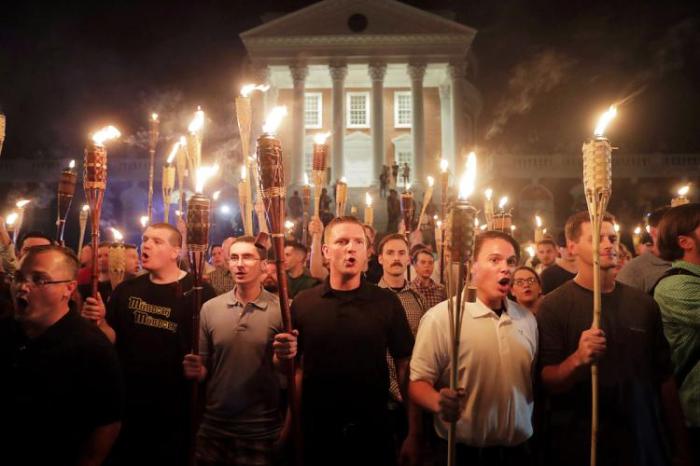
Yet a bunch of white dudes carrying Tiki torches shouting hate filled puns (“Jew will not replace us”? Seriously?) somehow doesn’t compute?


Come on.


This is America.


Racism and prejudice are not threats smuggled in past border security. They’ve always been here. At least since Europeans came offering trade and peace with one hand and guns and smallpox with the other.


The land of the free was stolen from the Native Americans. Our national wealth was built on the backs of slaves. Our laws and electoral system were built to empower one group at the expense of others.


Yet reformations in this process are rarely met with celebration. Instead of memorializing the end of slavery, we embrace the institution with fond remembrance.


Nor did prejudice and bigotry end when Rosa Parks refused to give up her seat, after Brown vs. Board, the Voting Rights Act, Freedom Rides, sit-ins or civil rights protests.


America has always been a place hostile to the under privileged, the second sex, religious dissenters, the brown skinned.


At most, we had become less confrontational in recent years, but we never really changed our core values, our social structures, who has power and who does not.


During my lifetime, people started to equate having a black President with the end of racism. Somehow they ignored the everyday reality for most black people.


They ignored the constant prejudice against the poor, the continued bigotry against LGBTs, the Islamophobia, the increase in hate crimes.


If there has been any change during the past eight months, it hasn’t been with the degree to which Americans are prejudiced. It’s the degree with which we’re willing to hide it.


Whereas before racists would claim to be colorblind, that their actions were completely devoid of racial bias, today they sigh and repeat the dusty slogans of Jim Crow Alabama or 1930s Berlin.


And somehow people are actually surprised about this.


It’s because too many of us have swallowed the lies about living in a post-racial society.


You thought we were beyond all that. It was a brave new world, morning in America, and we were finally treating everyone equally – unless you looked at what we were actually doing.


Mainly this is the reaction you get from white people. They rub their eyes and just can’t believe it.


You don’t see this too often from people of color, Muslims, LGBTs and some Jews. Why? Because they never had the luxury to ignore it.


That’s what we white folks have been doing since the beginning.


Whenever these issues come up, we have a knee jerk reaction to minimize it.


Things aren’t that bad. You’re just blowing it out of proportion.


But, no. I’m not.


That’s why you’re so damn shocked, son.


You haven’t been looking reality square in the face.


So when we’ve got undeniable video footage of angry white males (mostly) marching through Southern streets brandishing swastikas and assault rifles, it catches many white folks off guard.


They’re not prepared for it – because they haven’t been doing their homework.


We’ve been living in a bubble. Especially those living in major metropolitan areas.


That kind of thing never happens around here, right?


Of course it does!


Just because you live above the Mason Dixon Line doesn’t mean you’re safe.


You have a black friend, you like authentic Mexican food and you laugh while watching “Modern Family.”


But you haven’t opened your eyes to the reality outside your door.


You send your kids to private school or live in a mostly upper class white district. You have an exclusive gym membership that keeps out the riff-raff. You work in an office where that one token person of color makes you feel sophisticated and open-minded.


You’ve got to wake up.


You’ve got to educate yourself about race and class in America.


Because those people you saw in Charlottesville aren’t an anomaly.


They are an authentic part of this country, and if you don’t like it, you have to do something about it.


You can’t hide behind denial.


You have to take a stand, pick a side, and be counted.


Because one day soon, the torches will be outside your door.


You have to decide now – do you want to brandish or extinguish them?

Pennsylvania Proposes Smaller Tests, Same High Stakes

Screen Shot 2017-08-14 at 4.04.51 PM


It’s not the size of the tests, it’s how you use them.


And that’s kind of the problem with Gov. Tom Wolf’s new proposal for Pennsylvania public schools.


Wolf wants to reduce the amount of time students are taking standardized tests, but he seems to have little problem using those tests to hold schools accountable for all kinds of things that are beyond their control.


The proposal released today applies only to the Pennsylvania System of School Assessment (PSSA) tests – those taken by students in grades 3-8. Keystone Exams taken by high school students are unaffected.


It would cut one of three reading sections and one of three math sections – two total. Wolf also wants to cut some questions from one of the science sections.


Such a move is estimated to eliminate 48 minutes from the math test, 45 minutes from the reading test and 22 minutes from the science test. However, judging from my own students, these times vary considerably depending on the individual taking the tests. I’ve had 8th grade students finish a PSSA section in as little as 5 minutes or as much as two hours.


Most schools give either a section a day or two in one day. Therefore, this proposal probably translates to 1 to 2 fewer days testing in most districts.


Um. Thanks?


Look I don’t want to seem ungrateful here, but these suggested modifications are little more than fiddling around the edges of a massive problem.


Yes, it will be helpful to reduce testing times, but this does very little to address the fundamental problems with test-based accountability in the Commonwealth.


At best, this proposal will allow students to spend two more days a year learning. Assuming most districts don’t use that extra time for test prep, that IS a good thing.


But tacitly committing students throughout the state to taking these tests almost guarantees that test prep is exactly how these additional days will be used.


The problem with standardized testing isn’t just the number of raw days it takes students to complete the tests. It is how the tests deform the entire year-long curriculum. Students don’t just learn anymore. They learn what’s on the test – and anything else is purely optional.


Regardless of the size of the assessments, they are still being used to sort and judge students, teachers and schools. Shortening their length does nothing to address the fundamental unfairness of the evaluations. Rich white kids still tend to have high scores and poor minority kids still tend to have low ones.


At best, they reveal structural funding disparities between poor and wealthy districts. At worst, the cultural bias inherent in the questions favor those from dominant, privileged ethnicities while punishing those who don’t fit the standard.


That’s what “standardized test” means after all – defining normal and punishing those who don’t fit the definition. Most questions don’t assess universals like the value of 2 and 2. They evaluate cultural and social norms required to understand the questions and easily find an answer that another “normal” student would choose. (Don’t believe me? Watch “Black Jeopardy” on Saturday Night Live.)


This is true whether the test takes one day or 100 days.


We should not be using standardized testing to meet federal accountability standards. Period.


The federal Every Student Succeeds Act (ESSA) contains provisions to circumvent them. States are supposed to be given leeway about testing. They may even be able to replace them with projects or other non-standardized assessments. THAT’S what Wolf and the Pennsylvania Department of Education should be exploring – not half measures.


To be fair, the state Department of Education is attempting reform based on the ESSA. This year, the department introduced Future Ready PA, a new way of using test scores and other measures to assess school success. To its credit, The Index does place additional emphasis on academic growth, evaluation of school climate, attendance, graduation rates, etc. However, for my money it still gives far too much importance to standardized testing and test prep.


Like reducing the size of the PSSAs, it’s a positive step but won’t do much to get us to our destination.


Neither measure will have much impact on the day-to-day operations of our public schools. Districts will still be pressured to emphasize test prep, test taking strategies, approaches to answering multiple choice questions, etc. Meanwhile, critical thinking, problem solving, and creativity will still be pushed to the side.


Moreover, since schools and teachers will be assessed as successful or not based largely on these test scores, districts will be under tremendous pressure to give countless practice tests throughout the year to gauge how well students are prepared for the PSSAs. The state will still be providing and encouraging the optional Classroom Diagnostics Tools (CDT) tests be taken several times in reading and math throughout the year. Trimming off two days from the PSSA will affect that not at all.


In addition, today’s proposal only applies to the PSSA. While that assessment is important, the Keystone Exams given to high school students are even more so. According to existing state law, passing the Keystones in Algebra I, Literature and Biology are required in order to qualify for a diploma. However, that condition has yet to go live. So far the legislature has continuously pushed back the date when passing scores become graduation requirements. The Governor and Department of Education should be proposing the elimination of this prerequisite before anything else. Other than education funding and perhaps charter school accountability, it is the most important education issue before Commonwealth lawmakers today.


Don’t get me wrong. The Democratic Governor is somewhat hamstrung by the Republican-controlled legislature. Partisan politics has stopped lawmakers from accepting Wolf’s more progressive education measures.


Though Wolf has gotten Republicans to increase education funding by hundreds of millions of dollars during his term, K-12 schools still receive less than they did before the previous GOP governor’s administration. Moreover, there have been absolutely zero inflationary increases to keep up with the rising cost of doing business. Pennsylvania schools receive less funding – whether you adjust for inflation or not – than they should, and that has a real world impact on our public schools. Moreover, how that money has been allocated by the legislature still – even with our new better funding formula in place – benefits wealthy districts more than poor ones.


If you want to talk about accountability, that’s where the majority of the issue belongs.


And primarily it’s out of Wolf’s hands. One can understand why he is proposing changes where he can and trying to do whatever good is possible given the political climate.


Shortening the PSSA tests would benefit our students. It is a step in a positive direction.


However, it is far from solving our many education problems.


The biggest roadblock to authentic school reform is a legislature that refuses to do anything but the absolute minimum for our neediest students.

Dear White Supremacists: There Will Be No Race War

a51c6a1d-da93-4129-9050-431ae50718b9


This one goes out to all the white boys.


No.


Not ALL the white boys.


Just the ones who think being “white” and being a “boy” means the world owes them something.


Cause I’m white, too, and I know it doesn’t make me any better than anyone else.


But not you.


You think your lack of pigmentation is a special sign of your supremacy. As if being pale was synonymous for God’s chosen.


Well let me tell you something, white boy. God didn’t choose you. You did.


What you take for superiority is just a misguided attempt at self-esteem.


I’m a snowflake? YOU’RE the snowflake. Same color. Same consistency. In the first warm breeze, you’ll melt.


I’m talking to YOU, white boy. All of you.


All those melanin-starved faces wearing matching eggshell t-shirts and fat-ass khakis.


All those brave, young men holding Tiki torches and an inflated sense of self worth.


All the protesters in Charlottesville, Virginia, so fearless they can spray mace on those they disagree with, so bold they can throw punches so long as they know the police won’t hold them accountable, so courageous they can drive a car into unarmed counter-protestors, so brave that they can’t even call themselves what they are: Nazis, the Klan, white supremacists.


You hide behind “Alt Right” as if the rest of us can’t figure out who you really are.


Surprise! We see you!


We see your twisted lips, scrunched eyes and flaring nostrils. Your hood-starved heads and sweat-gelled haircuts. Your hate warped faces spouting reheated leftovers from WWII.


My grandparents fought people like you.


They dressed in army green and hopped the ocean to pound people like you into the ground.


They took your goose-stepping forebears and blasted them into bits. They buried your intellectual precursors under the ashes of their eternal Reich.


And for my grandfathers’ sacrifice, I rarely had to deal with people like you, myself. Not outright.


It’s not that people like you didn’t exist. Your attitudes and beliefs still percolated just beneath the surface of so many frustrated white boys.


The difference was that they were too smart to actually give voice to the darkness in their hearts.


It didn’t stop them from acting on it. They just wouldn’t admit why.


Segregation, red lining, broken windows policing, and a plethora of others. It was all polite, all deniable, all just the colorblind way we do things around here.


But that doesn’t really work anymore, does it?


Times are changing.


The face of America is changing. And it’s increasingly brown.


It’s got curly hair and unexpected features. It’s fed by different foods and nourished by different beliefs and customs. And it’s often called by a name that doesn’t derive from Europe.


People are starting to speak up. They’re starting to call you out.


And you don’t like it.


More than that you’re scared. Terrified.


It’s all going to end. The lie you told yourself about being special.


So you huddle together with others just like you, shivering and crying and blowing snot onto each others shoulders pretending that it’s a rally for white pride. It’s really just the world’s biggest pity party for boys too scared to be men and own up.


You’re brave when you’re in numbers, aren’t you? With numbers or with a gun.


Then you can say whatever you want. You can pretend whatever racial fantasy will protect your fragile little egos.


You’ll whine and boast and imagine you’re winning some kind of war for survival. But we know what you’re really doing.


You’re on your knees. You’re begging for a confrontation.


You’ll do anything to provoke it.


It’s your only hope.


Push them. Prod them. Insult them until they fight.


Bring them down to your level.


Prove your moral superiority by stoking a race war.


Because you can battle human bodies, but you can’t stop ideas.


You can’t triumph over equality, empathy and love.


You can’t stop the tick of time. You can just hope to reset the clock.


Well, I’ve got bad news for you.


There will be no race war.


Not now. Not ever.


Oh, there may be fighting.


You’ll try to make it happen. But it won’t be white vs. black.


It won’t be race vs. race.


It will be your minority of cowards and fools vs. the majority of the rest of us.


Do you really think people like me will fight on your side?


Do you think I’ll stand by you just because the shade of my epidermis matches yours?


Hell No!


I’ll fight with my black brothers and sisters if it comes to it.


I’ll fight on the side of equality, fairness and love.


I’ll do like my grandfathers and smash you into the ground. We all will.


But I’d rather not fight at all.


There need be no violence.


And there won’t be.


Unless you force it.


You see, you can’t make a race war happen.


All you can do is unite the rest of us against you.

Florida Looks to Hide Minority Students with Accountability Waiver

broom2


What do you do with minority students?


The state of Florida is looking to hide them under the rug.


The state is seeking a waiver from the U.S. Department of Education for certain provisions of the Every Student Succeeds Act (ESSA) – a move that has some civil rights groups alarmed.


The request goes something like this:


Federal Government: How are your English Language Learners doing?


Florida: Dunno. We lumped them in with everyone else.


Fed: Are there any big discrepancies between white students and poor, black or Latino students?


Florida: Dunno. We don’t look at that.


Fed: Do you at least allow English Language Learners to take tests in their native language?


Florida: Nope. They need to speak English or fail.


Aaaaand scene.


The waiver hasn’t even been fully drafted yet and submitted to the federal Department of Education.


However, civil rights groups such as The Leadership Conference on Civil and Human Rights, The League of United Latin American Citizens (LULAC), and several local activists are asking that the state reconsider sending it and/or the federal government categorically deny it.


These organizations are worried that such measures, if approved, would allow Florida to ignore the needs of minority students.


In fact, lumping minority students’ test scores in with the majority white population would obscure whether they were struggling at all. So would explicitly ignoring any achievement gaps between the majority and minority populations.


And forcing students to take tests in a language with which they aren’t even proficient yet is just plain cruel.


But it highlights several conflicts at the forefront of the public education debate.


First, there’s the question of who controls our schools – the state, local or federal government.


Second, there’s the question of what is the best way to ensure every child is getting a quality education.


The first question is at the heart of a disagreement between many on the political left and right. Democrats generally favor more federal intervention, while Republicans favor more state control.


Which side will end up victorious is hard to say. In situations like this, it’s even hard to say who SHOULD be victorious.


In general, local control is better than administration from a far. But it’s kind of hard to stand up for a state legislature that has no problem segregating minorities, under funding their schools and then trying to hush it all up.


It’s kind of like parenting. It’s better that children stay with their parents, but if their mom and dad are abusive jerks, perhaps all bets are off.


Secondly, we have the question of accountability. What is the best measure of whether a school is providing a quality education?


Like the No Child Left Behind legislation before it, the ESSA specifically uses standardized test scores for this purpose.


However, test scores are terrible at determining accountability. They’re economically and culturally biased. Rich kids tend to pass and poor kids tend to fail. At best, they show which students have been the most economically privileged and which have not.


But we don’t need test scores to see that. We can simply look at students’ socio-economic status. We can look at whether they’re living below the poverty line or not. We can look at their nutrition and health. We can look at whether they belong to a group that has historically been selected against in this country or not.


And once we find that out, we shouldn’t punish the school for having the audacity to teach poor and minority children. We should give them extra funding and resources to meet those students’ needs. But the current test-based accountability system doesn’t do that. Instead it cuts off funding to schools that need it most while pushing public schools to be closed and replaced with charter and voucher institutions that have a worse record of success.


In short, accountability is vital in our public schools, but the way we determine who needs help and what we consider help are drastically out of step with student needs.


These are two issues that desperately need resolution, and we’re putting them on the desk of the one Education Secretary in our nation’s history least equipped to deal with them – Betsy DeVos.


Fed vs. states? She’s for whichever pushes school privatization.


Test scores? She loves them!


Civil rights? Her administration is infamous for expressing doubts that such things even exist.


But at the same time, some on the corporate left may use her dunderheaded opposition to justify test-based accountability.


“See?” They’ll say. “We need standardized tests to protect minority children!”


Um. No. You don’t.


Likewise, some on the right might try to characterize Florida’s attempted waiver as an act of defiance against test-based accountability.


It’s not. Officials in the Sunshine State aren’t concerned with undoing the testocracy. They’re perfectly fine with high stakes testing – so long as they don’t have to do anything special to help black and brown kids.


It’s a situation where blatant self-interest can easily be hidden under a fake concern for children.


On balance, civil rights groups’ concerns are justified in relation to Florida’s drafted ESSA waiver. But they’re wrong if they think test-based accountability is in the best interests of the minorities they serve.


If you’re going to use standardized tests to hold schools accountable for providing a quality education – and that’s a Big IF – it’s unfair to obscure data about minority students and possible achievement gaps. Moreover, it’s reprehensible that you wouldn’t even bother to test them fairly by letting them take these assessments in their native languages.


However, it would be even better to dispense with test-based accountability in the first place. It would be better to see student needs directly and not as a reflection of test scores. That would more easily allow help to reach the students and not the vulture industries circling above our public schools waiting to pick them apart in the name of accountability.

Pity the Corporate School Reformers

bigstock-baby-crying-in-the-crib-80871221


It’s gotta’ be tough to be a corporate school reformer these days.


Betsy DeVos is Education Secretary. Donald Trump is President. Their entire Koch Brothers-funded, ALEC-written agenda is national policy.


But their stripes are showing – big time.


The NAACP has turned against their school privatization schemes. The Journey for Justice Alliance is having none of it. The Movement for Black Lives is skeptical. Even their trusty neoliberal Democratic allies are seeking to put some distance between them.


And it’s making them look… sad.


You’d think they’d have much to celebrate. Their policies are right up there with voter disenfranchisement, the Muslim ban and building a wall.


Charter schools – YES! Voucher schools – YES! Public schools – NO.


High stakes testing is going gangbusters pushed by the federal government with little interference from the states.


Common Core is in almost every school while the most state legislatures do about it is consider giving it a name change.


And in every district serving students of color and the poor, budgets are being slashed to pieces to make room for another juicy tax cut for the rich.


They’ve taken George W. Bush’s education vision – which neoliberal Barack Obama increased – and somehow found a way to double-triple down on it!


They should be dancing in the streets. But somehow they just don’t feel like dancing.


What’s wrong, Michelle Rhee and Campbell Brown? Is that a tear I see in Peter Cunningham’s eye?


Perhaps they’ve seen the error of their ways. Maybe after all this time, they’ve finally realized all children deserve a robust, authentic education, not just the market-driven chance of – maybe – a quality education.


But no.


It’s not that.


It’s the way the Trump administration is going about it.


You see, he’s being – gulp – honest.


He’s actually saying what he means. He’s throwing back the curtain exposing all the racist, classist, capitalist motivations behind corporate education reform.


Even when he lies – which is often – he’s no good at it. His real motives are plain as the weave on his head.


Under Obama, they could do almost the same things, but at least Barack would apologize for it. He’d clothe it in the language of civil rights and make it sound all noble. He’d excuse systemic inequality as the deserved results of competition.


But Trump!? He’s championing all their favorite causes while tweeting skepticism about the very concept of civil rights, ignoring poverty as fake news and just making an all out ass of himself and everyone with whom he associates.


That’s YOU, corporate education reformers.


That’s you. And you’re being forced to own it.


I almost pity you.


What a dark world you must inhabit. To take these sinister schemes that brutalize children and actually believe in them!


Take charter schools.


Imagine sincerely believing that poor black kids deserve to go to schools that aren’t controlled by school boards but instead by unelected bureaucrats. Imagine thinking the color of your skin should determine whether you have a say in your child’s education. White folks get to elect the people running their schools, but not black folks. And you know what, it’s for their own good, say the reformers!


Imagine thinking that the amount of melanin in your skin should determine whether your schools are transparent or not – whether they’re required to have open records, open meetings, even whether they have to follow the same safety protocols and regulations as traditional public schools!


WHITE SCHOOLS – not for profit, spend the budget all on the students. BLACK SCHOOLS – CA-CHING! CA-CHING!


And when it comes to voucher schools, imagine selling a tax cut to a wealthy family as if it somehow benefited poor folks. Letting the Walton’s pocket a few thousand from their kids exclusive private school tuition doesn’t help Ma and Pa Six Pack. Nor does offering a discount to the kind of parochial schools that brainwash kids into thinking that evolution is evil, climate change is a Chinese conspiracy, and slavery was just God’s will.


It’s the difference between trying to sell a glossy fraud like KIPP’s charter school network and an obvious one like the President’s Trump University.


But now everyone sees they’re essentially the same.


No wonder these faux reformers look so down.


Imagine pushing standardized tests as if they were a technological breakthrough. They’ve been around since at least China’s Han Dynasty (206 BC – 220 AD). If that’s cutting edge, I think you’ll like my new APP. It’s called The Wheel!


In America, standardized tests have been around since the 1910s where they were a leading feature of the eugenicist movement. They were a tool to “prove” the racial imperfection of black and brown people and the superiority of whites. Imagine demanding something like that as a civil right!


I couldn’t do it with a straight face. But they did!


And it worked! For a little while.


Now their whole pyramid scheme is just too damn clear. Make the kids take unfair, biased tests that will show how few resources poor black kids get and then use that as a justification for giving them fewer resources, closing their schools and privatizing them. No one’s even tried a scam that blatant since Bernie Madoff went to prison!


What do they have to gain by all this? Money.


Standardized testing is a multi-billion dollar industry. School privatization is a multi-billion dollar industry. If you can find a way to suck up federal, state and local tax dollars meant to educate children and divert that into your private bank account, well you’ve just struck it rich!


Racism pays, folks! Prejudice pays! Because the majority doesn’t mind so much when you take advantage of the underprivileged. That’s why they’re underprivileged in the first place!


And when people like me speak out against them, the best they can do are Ad hominem attacks – you’re too white to question policy affecting black people, or your friends are black but (somehow) not black enough. Today I actually read a response to an article I wrote that came down to these insightful criticisms – Nu-uh! And How dare you! Which we can add to their response to criticisms that charter schools increase segregation – I know you are but what am I?


The folks at the Education Post, a propaganda network passing off most of this nonsense as if it were legitimate news and funded by $12 million from the Broads, the Waltons and other usual suspects, they must really be desperate.


They’ve sold their souls to the Devil and may not even get a good return on the investment.


You see, they’re betting that by the time the Trump zeppelin explodes, their policies will be irreversible.


The problem is that he’s been extremely ineffective. He’s pushing their agenda, but isn’t getting much done.


And with multiple new scandals everyday and increasing calls for impeachment, time is running out.


It’s enough to stoke pity in the hardest of hearts.


Sure these folks have sold out our children for thirty pieces of silver, but they’re still people, after all.


They deserve our empathy, kindness, pity.


Well almost.

I Am Not A Hero Teacher

Screen Shot 2017-08-01 at 10.53.52 AM


I’m sorry.


I am not a hero teacher.


I am not stronger than a locomotive.


I cannot jump tall ignorance in a single bound.


I am not faster than a tax-cutting zealot.


Up in the air – it’s a bird, it’s a plane, but it’s certainly not a teacher because we can’t fly.


I am not bullet proof.


If a gunman storms the building and shoots me, I will be wounded and may die.


Giving me a gun doesn’t help, either, because I am not a marksman.


I am just a man.


I cannot stand in front of a class of thirty and give them each my undivided attention. Not all at once.


When students ask a question, I need time to answer it.


When students hand in a paper, I need time to grade it.


During the workday, I need time to plan my lessons. I need time to call parents. I need time to read all the individual education plans, fill out all the weekly monitoring forms, finish all the administrative paperwork.


At the end of a long day, I get tired and need rest.


At the end of a long week, I need time to spend with my family.


At the end of a long year, I need time to myself – to get a summer job, to take continuing education courses, to plan for next year, to heal.


I need a middle class income – not because I’m trying to get rich, but because I’m human. I need food and shelter. I have a family for whom I need to provide. If you can’t give me that, I’ll need to move on.


Sorry, but it’s true.


I’ll tell you one thing I don’t need. I don’t need the state, federal or local government telling me how to do my job. When I plan my lessons, I need the freedom to teach children in the way that seems most effective to me – the professional in the room.


I also don’t need some bureaucrat telling me how to assess my students. I don’t need some standardized test to tell me what kids have learned, if they can read or write. I’ve spent an average of 80 minutes a day with these children for five days a week. If I can’t tell, I don’t deserve to be in the classroom.


And I don’t need my principal or superintendent setting my colleagues and me against each other. We’re not competing to see who can do a better job. We should be collaborating to make sure everyone succeeds.


What do I need? My union, for one.


I need my right to collective bargaining. I need the power to gather with my colleagues and co-workers so we can create the best possible work environment for myself and my students. I need due process, tenure, so I can’t be fired at the whim of the school board or administrators without having them prove my inequities.


I need my work to be evaluated fairly. Judge me on what I do – not on what my students do with what I’ve given them.


And when it comes to the racial proficiency gap, don’t look to me to exert some kind of supernatural teacher magic. I am not a white savior who can make school segregation, racism and prejudice disappear. I try to treat every student fairly, but my actions can’t undo a system that’s set up to privilege some and disadvantage others.


I guess what I’m trying to say is that if you’re expecting a superhero, I’m bound to disappoint.


And that DOES seem to be what many of you expect us to be.


Seven years ago, Davis Guggenheim characterized the public schools as if we were Waiting for Superman.


Things are so screwed up, he alleged back then, that we need someone with superpowers to swoop in and fix it all.


But there is no superman. There’s just Clark Kent.


That’s me – a bespectacled shlub who shows up everyday in the naive hope that he can make a difference.


According to landmark research by Dan Goldhaber and James Coleman, only about 9 percent of student achievement is attributable to teachers.


That’s right – 9 percent.


If you add in everything in the entire school environment – class size, curriculum, instructional time, availability of specialists and tutors, and resources for learning (books, computers, science labs, etc.), all that only accounts for 20 percent.


There’s another 20 percent they can’t explain. But the largest variable by far is out of school factors. This means parents, home life, health, poverty, nutrition, geographic location, stress, etc. Researchers estimate those count for 60 percent of student success.


Yet we somehow expect teachers (9%) to do it all.


I’m sorry, America. I can’t.


More than half of all public school students live in poverty. No matter how hard I try, I cannot solve that all by myself.


I try to teach children how to read though many are hungry and traumatized by their home lives.


I try to teach children how to write though many haven’t slept the night before, haven’t taken their ADD medication and – to be honest – many haven’t even shown up to school yet.


I most certainly try to get them to pass culturally biased, developmentally inappropriate standardized tests without sucking away every bit of creativity from the classroom.


But much of this is beyond my control.


I can’t help that the federal, state and local government are cutting school funding. I can’t help that my impoverished district has few school supplies, the students enter the building without them because their parents are too poor to buy them. But I can – and do – spend out of my own pocket to make sure all of my students have pencil, paper, whatever they need.


I can’t help that officials at every step of the way want me to narrow my teaching to only things that will appear on the yearly standardized test, that they want me to present it as a multiple choice look-a-like item, that they want me to teach by pointing at a Common Core standard as if that held any meaning in a child’s life. But I can make the lesson as creative as possible and offer kids a chance to engage with the material in a way that connects to their real lives, desires and interests.


I can’t help that kids don’t read like they used to and instead experience the bulk of text on the Internet, Facebook or Twitter. I can’t help that most of their real world writing experience is limited to thumbing social media updates, comments on YouTube videos or communicating through a string of colorful emojis. But I can try to offer them meaningful journal topics that make them think and offer them the chance to share their thoughts in a public forum with their peers.


There’s nothing super about any of it.


But it’s the kind of things teachers do everyday without anyone noticing. It’s the kind of thing that rarely gets noted on an evaluation, rarely earns you a Thank You card or even an apple to put on your desk.


However, when the day is done, students often are reluctant to leave. They cluster about in the hall or linger in the classroom asking questions, voicing concerns, just relieved that there’s someone there they can talk to.


And that’s reason enough for me to stay.


The odds are stacked against me. Help isn’t coming from any corner of our society. But sometimes despite all of that, I’m actually able to get things done.


Everyday it seems I help students understand something they never knew before. I’ve become accustomed to that look of wonder, the aha moment. And I helped it happen!


I get to see students grow. I get to nurture that growth. I get to be there for young ones who have nobody else.


It’s a wonderful feeling.


I know I’m making a difference.


So, yes, I’m no superman.


I have no special powers, no superhuman abilities. I can’t fix all of our social problems all by myself.


But I help to make the future.


That’s why I do what I do.


Thank you for letting me do it.

Charter School Lobby Panics as NAACP Rejects For-Profit Schools

 Man-Freaking-Out


White America has a history of freaking out at perfectly reasonable suggestions by the black community.


Hey, maybe black people shouldn’t be slaves.


SOUTHERN STATES SECEDE! THE CIVIL WAR BEGINS!


Hey, maybe black lives should matter as much as white ones.


BLUE LIVES MATTER! MAGA! TRUMP!


Hey, maybe we shouldn’t be making money off of children’s educations?


PANIC!


That’s what seems to be happening at think tanks and school privatization lobbying firms across the country after a new report by the National Association for the Advancement of Colored People (NAACP) this week.


Some news sources are characterizing the report as “radical” or “controversial.”


However, the report, titled “Quality Education for All: One School at a Time,” basically says nothing more revolutionary than that all public schools should be transparent and accountable.


That includes charter schools.


“Public schools must be public,” the report states. “They must serve all children equitably and well. To the extent that they are part of our public education system, charter schools must be designed to serve these ends.”


And why shouldn’t they?


More than 3 million students attend charter schools across the country. Approximately 837,000 of them are black. Don’t they deserve the same kinds of democratically controlled schools and fiscal responsibility as their counterparts in traditional public schools?


Somehow your local public school is able to teach kids while still keeping a record of how it’s spending its money – your money. And if you don’t like what’s being done, you can go to a school board meeting and speak up or even run for a leadership position.


How does getting rid of that help kids learn? How does operating in secret in the shadows benefit children?


The report also recommends that local communities should have more control over whether to open charter schools in their districts and calls for an end to for-profit charter schools, altogether.


Not exactly the musings of anarchist provocateurs.


Charter school cheerleaders like Education Secretary Betsy DeVos call their movement School Choice. Shouldn’t communities get to choose whether they want them there in the first place? If the program is based on the free market, let them make their case to the community before setting up shop. They shouldn’t get to make a backroom deal with your congressman and then start peddling their wares wherever they want.


Moreover, if charter schools are, indeed, public schools, why should they be allowed to operate at a profit? They are supported by tax dollars. That money should go to educating children, not lining the pockets of venture capitalists and hedge fund managers.


The authors were very specific on this point:


“No federal, state, or local taxpayer dollars should be used to fund for-profit charter schools, nor should public funding be sent from nonprofit charters to for-profit charter management companies.”


But that’s not all.


The author’s also call out charters infamous enrollment and hiring practices. Specifically, these kinds of privatized schools are known to cherry pick the best and brightest students during admissions, and to kick out those who are difficult to teach or with learning disabilities before standardized testing season. The report called for charters to admit all students who apply and to work harder to keep difficult students – both hallmarks of traditional public schools.


In addition, the report suggests charters no longer try to save money by hiring uncertified teachers. If charters are going to accept public money, they should provide the same kind of qualified educators as their traditional public school counterparts.


However, even if such reforms are made, the report is doubtful that privatized education could ever be as effective and equitable as traditional public schools. In perhaps the most damning statement in the report, the authors wrote:


“While high-quality, accountable, and accessible charters can contribute to educational opportunity, by themselves, even the best charters are not a substitute for more stable, adequate and equitable investments in public education.”


The report was written by the 12-member NAACP Task Force on Quality Education after a set of intensive hearings or “listening sessions” across the country in cities such as New Haven, Memphis, Orlando, Los Angeles, Detroit, New Orleans and New York. The final product is the result of the input they received during these meetings.


This is only the latest in a growing movement of skepticism toward privatized education of all sorts – especially in relation to its impact on students of color.


Less than a year ago, the NAACP, the oldest civil rights organization in the country, called for a moratorium on any new charter schools. This week’s report takes that caution to the next level.


Despite a truly controversial record, over the past decade, the number of students in charter schools has nearly tripled. In terms of pure numbers, black students only make up more than a quarter of charter school enrollment. However, that’s a disproportionately high number since they make up only 15 percent of total public school enrollment. To put it another way, one in eight black students in the United States today attends a charter school.


The NAACP isn’t the only civil rights organization critical of charter schools. Groups such as the Journey for Justice Alliance, a coalition of grassroots community, youth, and parent-led organizations, and the Movement for Black Lives, a conglomeration of the nation’s youngest national civil rights organizations, have also expressed concern over the uses and abuses of students of color in charter schools.


However, this week’s report wasn’t focused solely on privatization. It also addressed the central issue at traditional public schools – funding disparities.


The report identifies severe inequalities between rich vs. poor communities as the cause of so-called failing schools. The report argues that “to solve the quality education problems that are at the root of many of the issues, school finance reform is essential to ensure that resources are allocated according to student needs.”


Closing the achievement gap requires specific investment in low-performing schools, not punitive measures. There should be more federal, state, and local policies to attract and retain fully qualified educators, improve instructional quality, and provide wraparound services for young people.


The report suggests states model their funding formulas on those of Massachusetts and California and that the federal government should fully enforce the funding-equity provisions in the Every Student Succeeds Act (ESSA).


It would be difficult to find more rational and reasonable solutions to the education problems in today’s schools.


But pay attention to the response it’s getting.


Corporate reformers are running scared with their hair on fire as someone finally has the guts to point out that the emperor is walking around stark naked!

School Voucher Industry Strikes Back: We’re Segregated!? No, You’re Segregated!

144447167


In what must count as another new low in American discourse, the school voucher industry is striking back against claims that their products lead to greater segregation of students.


Randi Weingarten, President of the American Federation of Teachers (AFT), had the audacity to voice the truth:


“Make no mistake: This use of privatization, coupled with disinvestment are only slightly more polite cousins of segregation,” she said a week ago during a speech at the AFT’s yearly convention.


To which school privatization mouthpieces quickly countered with the truth:


“If vouchers are the polite cousins of segregation, then most urban school districts are segregation’s direct descendants. The vast majority of our urban public school districts are segregated because of white flight and neighborhood neglect.”


This was from a statement by Kevin Chavous, founding board member of the American Federation for Children, the school privatization advocacy group that Secretary of Education Betsy DeVos used to lead.


So there you have it.


A nation of more than 325 million people, with a more than 241-year history reduced to – I Know You Are But What Am I?


The sad fact is that they’re both right.


School vouchers do lead to increased segregation (and so do charter schools, by the way, the method preferred by corporate Democrats). But many traditional public schools are, in fact, deeply segregated both racially and economically.


Does that mean that both systems – privatized and public – are equally at fault? Does it mean that both somehow get a pass for reprehensible behavior?


No and no.


First, we must explain why segregation is bad.


Peter Cunningham, former assistant secretary for communications and outreach at the Education Department under Obama, wagged his finger at Weingarten on the privatization propaganda Website, the 74.


He called out Weingarten’s hypocrisy, which takes some cojones for a man who only last year pondered aloud and in public whether segregation was really such a bad thing.


He had this to say last September:


“Maybe the fight’s not worth it. It’s a good thing; we all think integration is good. But it’s been a long fight, we’ve had middling success. At the same time, we have lots and lots of schools filled with kids of one race, one background, that are doing great. It’s a good question.”


Funny, isn’t it?


He calls out Weingarten because of public school segregation but defends charter schools because their segregation is somehow just swell.


Keep in mind. Cunningham is the executive director of the Education Post, a well-funded charter school public relations firm that packages its advertisements, propaganda and apologias as journalism. And he’s not about to poop where he eats.


So, yes, Mr. Cunningham, segregation is worth fighting.


When you have schools made up mostly of minority and/or economically disadvantaged students, it makes it easier to provide fewer resources and less funding to those children while sending the lion’s share to the white and wealthy.


That’s why in Brown v. Board the U.S. Supreme Court struck down “Separate but Equal” – because when races are kept separate, their schools are rarely equal.


This game of excusing one system based on the deficiencies of the other is pure sophistry.


You can’t defend voucher and charter schools from being segregated by reference to public school segregation. Nor can you ignore public school segregation by reference to the same at privatized schools.


They’re both bad, and they both need fixing.


To be fair, Weingarten seems to tacitly admit this about public schools.


She acknowledges the disinvestment in public education, how public schools have been systemically undermined by politicians and lobbyists, many of them advocating for privatized schools, so that they could use this disinvestment as an excuse for their own for-profit education schemes.


“…no amount of facts or evidence will sway voucher proponents from their agenda to starve public schools to the breaking point, then criticize their deficiencies and let the market handle the rest, all in the name of choice,” she said in a statement.


The fact of the matter is this: public schools have become more segregated not because teachers or administrators want it, but because of local, state and federal law; a series of subsequent Supreme Court decisions allowing it within district boundaries; the continuation of racist redlining in the loan and insurance industry; and the xenophobia of wealthy and middle class whites who prefer their kids be educated separately from those they consider undesirable.


These policies could be changed. The system could be fixed. All it would take is the will to do it.


Charter and vouchers schools, on the other hand, will never solve the problem of segregation, because they have turned that problem into a “solution.”


Schools serving poor and minority students aren’t getting the proper resources. So they propose further segregating them.


That’s a terrible idea. It’s like escaping from a leaky cruise ship by jumping into a leaky lifeboat. You’ll sink in both, but the lifeboat will sink quicker.


Yes, our public schools are segregated by race and class and therefore poor and minority students receive inequitable funding and resources. Charters and vouchers cannot possibly remedy that. They will always make it worse. Only a robust and integrated public school system can be truly equitable. A system that deifies choice cannot combat racism if it is freely chosen.


What Weingarten is getting at is this: if we want to help the nation’s children – all of the nation’s children – we must support and reform public schools.


We must also acknowledge that many of the problems of systemic disinvestment are caused by those who want to privatize in the first place.


We have let the wolf write our education policy. It should be no shock that his solution isn’t to build more houses of bricks but to process our little piggies into bacon.


Full disclosure: I am no fan of Weingarten.


I recently called for both her and National Education Association (NEA) President Lily Eskelsen Garcia to voluntarily step down because of undemocratic practices and mismanagement in both teachers unions.


However, I’ll stand up for her when she’s right, and in this instance, she is.


If anything, maybe she should have included charter schools in her criticism. I laid into her in June for writing an op-ed with Jonah Edelman, an anti-union activist, specifically praising charter schools over vouchers.


But I get it. Now that some charter school teachers have unionized and joined the AFT, she’s stuck between a rock and a hard place.


Frankly, it makes her ineffective in speaking out on this matter. I have nothing against charter school teachers. I know, personally, several very good educators who work at charter schools. In this job market, sometimes you have to take what you can get. However, the sad fact of the matter is that by their very structure, charter schools are inferior to public schools. They are less democratic, less transparent, less accountable and more easily subject to fraud and abuse of children. That’s not to say all charters are guilty of this, but just by being a charter school and being subject to the deregulated rules governing them, they are more susceptible to these errors than their traditional public school brethren.


But, of course, the same can be said of voucher schools. It’s just that you can’t criticize one privatization scheme without also criticizing the other.


Perhaps the biggest mistake Weingarten made was in glossing over the worst abuses of public schools. If she was going to call out the segregation at voucher schools, she also should have explicitly called it out at public schools.


But that’s something even our first black President Barack Obama refused to do. You’d think he’d make that a priority for his administration, but instead he favored the same school privatization schemes that just made it worse.


Currently, you’ll find no political party that actively champions integration. Democrats will give it more lip service than Republicans, but both parties either ignore it in practice or actively work against it.


The only use they have for it is as a club with which to hit the other side when issues like this come up.


You’re segregated!


No, YOU’RE segregated!


And so we are all lead over the cliff by partisans and fools.