Personalized Learning Without People – An Education Scam from the 1980s Returns

Screen Shot 2017-07-14 at 1.12.10 AM


Sometimes it seems that education policy is nothing but a series of scams and frauds that becomes untenable in one generation only to pop up again 10 or 20 years later with a new name.


Take Personalized Learning, the latest digital product from the ed-tech industry to invade your local public school.


It’s cutting edge stuff.


Except that it isn’t.


It’s just the same old correspondence school nonsense of the 1980s thrown onto an iPad or a laptop.


It was crap back then, and it’s crap today.


But it sounds nice.


Personalized Learning.


I like that.


That’s exactly the kind of educational experience I want for my own daughter.


I’d like her schooling to be tailor-made for her. Teach her in a way she can best understand and that will best engage her mind and build upon her competencies.


However, that’s not what Personalized Learning means.


It’s a euphemism for Competency Based Education or Outcome Based Education.


It means plopping a child in front of a computer screen for hours on end while she takes standardized tests and standardized test look-alikes on-line.


Cartoon avatars lecture students how to answer multiple-choice questions in mind numbing detail before making them go through endless drill-and-kill practice. If kids don’t get a question right, they do it again-and-again until they do.


And somehow this is personalized?


I’ll give you a little tip. You can’t have personal learning without people.


This is personalized the same way Angry Birds and Candy Crush is personalized. Except it’s way less fun – and much higher stakes.


Imagine if all of your classes were taught at the end of an automated help line. That’s really what this is:


“If you don’t understand because you need me to define a word, press 1.


If you don’t understand because you need me to explain punctuation, press 2.


If you don’t understand because you need the question repeated…”


What if your question isn’t on the menu? You have no recourse other than to just keep pushing buttons until you hit the one that’s supposedly “correct”.


Forget for a moment how ineffective that is. Just imagine how boring it is for a growing child.


Nothing stifles a young person’s natural curiosity more than being forced to suffer through hours of tedium.


And what’s worse, we already know this.


We’ve tried this kind of garbage before with similar results.


Back in the 1980s, the Reagan administration deregulated everything it could get its hands on, especially education.


This opened the floodgates to for-profit corporations to offer mail order correspondence courses with little to no accountability but funded by the federal government.

For nearly a decade, student aide systems were systemically pillaged and looted by unscrupulous vendors offering correspondence schools as a trendy alternative for trade schools and credit recovery programs. They charged hefty tuition and fees for nothing more than sending students boilerplate instructional materials, multiple choice tests, and worthless diplomas in the mail.


The blatant fraud was documented by the Senate Permanent Subcommittee on Investigations in the hearings held by then-Chairman Sam Nunn of Georgia. This lead to eliminating correspondence schools from participation in federal aide programs.


Congress realized that sending students a book wasn’t the same as actually teaching them.


But by the late 1990s and early 2000s, things began to change. With the popularization of the Internet, the defunct business model could rebrand itself simply by offering similar materials on-line. And after significant lobbying efforts over the subsequent decades, Congress conveniently forgot its objections to almost the same kind of fraud.


However, this kind of malfeasance was at first mostly confined to credit recovery programs and on-line colleges. In K-12 this was primarily a way for students who had already failed a grade to pass the required core courses over the summer on-line. It was a way to boost graduation rates or even provide resources for students to get a G.E.D.


The poor quality of these programs has been demonstrated time and again.


But instead of limiting, fixing or eliminating them, we’re pushing them into the public school system.


This is seen as a way to save money by teaching without teachers. Sure, you still need a certified educator in the class room (for now) but you can stuff even more children into the seats when the teacher is only a proctor and not responsible for actually presenting the material.


The teacher becomes more of a policeman. It’s his job to make sure students are dutifully pressing buttons, paying attention and not falling asleep.


Moreover, this is sold as a way to boost test scores and meet the requirements of the Common Core. You can easily point to exactly which standards are being assessed on a given day and then extrapolate to how much that will increase struggling students’ scores on the federally mandated standardized test when they take it later in the year.


In fact, students’ answers on these programs are kept and recorded. They are, in effect, stealth assessments that can be used to judge and sort students into remediation classes or academic tracks.


In effect, the year-end high stakes test can be entirely forgotten. Students are given a standardized test every day. Even those whose parents opt them out of the federal assessment have no escape because the tests have become the curriculum, itself.


And all the while tech companies are raking in the cash.


Education policy is not concerned with how best to teach children. It is about how best to open the trough of tax dollars to education corporations – book publishers, test manufacturers and now tech companies.


Meanwhile, the public has almost no idea what’s going on.


Educators are sounding the alarm, but well-paid corporate shills are trying to silence them as being anti-progress.


Calling out bad educational practices conducted on a computer is not Ludditism. Certainly there are better ways to use the technology to help students learn than THIS.


Moreover, there are plenty of things from the ‘80s that deserve being revisited – new wave music, romantic comedies, even the old Rubik’s cube.


But putting crappy correspondence colleges on-line!?


No, thank you.

The Problem With Public Schools Isn’t Low Test Scores. It’s Strategic Disinvestment

We-Shall-Overcome-School-Closings

Imagine you’re settling in to enjoy an article on-line or in your favorite print newspaper and you come across this headline:


U.S. Schools Ranked Low Internationally!


Or


Out of X Countries, U.S. Places Far From the Top in Math!


You feel embarrassed.


Soon that embarrassment turns to anger.


Sweat starts to break out on your brow.


And then you start to grasp for a solution to the problem – something major, something to disrupt the current system and bring us back to our proper place in the lead.


TWEEEEEEEET!


That was me blowing a gym teacher’s whistle. I’ll do it again:


TWWEEEEEEEEEEEEEEEEEEEEEEEEEEET!


Hold it right there, consumer of corporate media. You’ve just been had by one of the oldest tricks in the book.


It’s the old manipulate-the-data-to-make-it-look-like-there’s-a-crisis-that-can-only-be-solved-by-drastic-measures-that-you-would-never-approve-of-normally.


We also call it disaster capitalism or the shock doctrine.


It’s been used to get people to agree to terrible solutions like preemptive wars of choice, warrantless wiretapping of civilians, torturing prisoners, defunding public health programs and scientific research – just about everything the Koch Brothers, the Waltons, the Broads, Gateses and other billionaire hegemonists have on their fire sale wish list.


In the case of the American educational system, it’s the impetus behind high stakes standardized testing, Common Core, Teach for America, and charter and voucher schools.


And they’re all justified by misinformation about student test scores.


The argument goes like this: Our Kids Are Failing!? Quick! Standardize and Privatize Their Schools!


First, education isn’t a race.


There is no best education system followed by a second best, etc. There are only countries that meet their students needs better than others.


And if you really wanted to determine if our country was meeting student needs, you wouldn’t appeal to test scores. You’d look at specific needs and assess them individually.


But you rarely see that. You rarely see an article with the headline:


U.S. Schools More Segregated Than Any In The Industrialized World!


Or


Out of X Countries, U.S. Spends Most on Rich Students and Least on Poor Ones!


Second, we need to ask ourselves if standardized test scores are really the best way to assess (1) student learning and (2) the education system as a whole.


Multiple choice tests are written by large corporations that profit more off of student failure than success. That’s not exactly an objective measure.

Students are considered passing or failing based on an arbitrary cut score that changes every year. That’s not exactly unbiased.


Moreover, standardized tests are always graded on a curve. That means no matter how well students do, some will always be considered failing. We cannot have No Child Left Behind when our assessments are designed to do just the opposite – it’s logically impossible.


But whenever the media turns to these international rankings, they ignore these facts.


They pretend it’s a horse race and we’re losing.


I kind of expect this from the corporate media. But when so-called progressive writers fall into this trap, I have to wonder if they’re just lazy or ignorant.


At best, these test scores are a second hand indication of structural inequalities in our public education system. It’s no accident that student from wealthy families generally score higher than those from poor ones. Nor is it pure misadventure that minority children also tend to score lower than their white counterparts.


These tests are economically, racially and culturally biased. They are completely unhelpful in determining root causes.


Thankfully, they’re unnecessary. It doesn’t take a standardized test to determine which students are receiving the least funding. Nor does it take a corporate intermediary to show us which schools have the largest class sizes and lowest resources.


The sad fact is that there are an awful lot of poor children attending public school. The U.S. has one of the highest child poverty rates in the industrialized world. And despite spending a lot on our middle class and wealthy students, we’re doing next to nothing to actually help our neediest children.


A large portion of U.S. public schools have been left to their own devices for decades. What’s worse, when they struggle to meet students’ needs, we don’t swoop in with help. We level blame. We fire teachers, close buildings and privatize.


There’s absolutely zero proof that changing a public school to a charter school will help, but we do it anyway. There’s not a scrap of evidence that sending poor kids to a low end private school with a tax-funded voucher will help, but we do it anyway.


Think about it: why would getting rid of duly-elected school boards help kids learn? Why would allowing schools to spend money behind close doors with zero public accountability boost children’s ability to learn?


Yet our policymakers continue to push for these measures because they have no intention of helping poor and minority public school students. They just want to enrich their friends in the school privatization industry. They just want to divert public money to testing corporations and book publishers.


THAT is the problem with America’s education system.


Not test scores.


It’s time our nation’s journalists give up this old canard.


We must be honest about why our public schools struggle. That’s the only way to find real solutions.


We must acknowledge the increasing segregation – both racially and economically. We must acknowledge the blatant funding disparities. And we must acknowledge how the majority of education policy at the federal, state and local level has done little to help alleviate these problems – in fact it has exacerbated them.


We need to stop testing and start investing in our schools. We need to stop privatizing and start participating in our neighborhood schools.


And most of all, we need to stop the lies and disinformation.

Teachers Don’t Want All This Useless Data

26948475_l-too-much-data

One of the most frustrating things I’ve ever been forced to do as a teacher is to ignore my students and concentrate instead on the data.


I teach 8th grade Language Arts at a high poverty, mostly minority school in Western Pennsylvania. During my double period classes, I’m with these children for at least 80 minutes a day, five days a week.


During that time, we read together. We write together. We discuss important issues together. They take tests. They compose poems, stories and essays. They put on short skits, give presentations, draw pictures and even create iMovies.


I don’t need a spreadsheet to tell me whether these children can read, write or think. I know.


Anyone who had been in the room and had been paying attention would know.


But a week doesn’t go by without an administrator ambushing me at a staff meeting with a computer print out and a smile.


Look at this data set. See how your students are doing on this module. Look at the projected growth for this student during the first semester.


It’s enough to make you heave.


I always thought the purpose behind student data was to help the teacher teach. But it has become an end to itself.


It is the educational equivalent of navel gazing, of turning all your students into prospective students and trying to teach them from that remove – not as living, breathing beings, but as computer models.


It reminds me of this quote from Michael Lewis’ famous book Moneyball: The Art of Winning an Unfair Game:


“Intelligence about baseball statistics had become equated in the public mind with the ability to recite arcane baseball stats. What [Bill] James’s wider audience had failed to understand was that the statistics were beside the point. The point was understanding; the point was to make life on earth just a bit more intelligible; and that point, somehow, had been lost. ‘I wonder,’ James wrote, ‘if we haven’t become so numbed by all these numbers that we are no longer capable of truly assimilating any knowledge which might result from them.'”


The point is not the data. It is what the data reveals. However, some people have become so seduced by the cult of data that they’re blind to what’s right in front of their eyes.


You don’t need to give a child a standardized test to assess if he or she can read. You can just have them read. Nor does a child need to fill in multiple choice bubbles to indicate if he or she understands what’s been read. They can simply tell you. In fact, these would be better assessments. Doing otherwise, is like testing someone’s driving ability not by putting them behind the wheel but by making them play Mariocart.


The skill is no longer important. It is the assessment of the skill.


THAT’S what we use to measure success. It’s become the be-all, end-all. It’s the ultimate indicator of both student and teacher success. But it perverts authentic teaching. When the assessment is all that’s important, we lose sight of the actual skills we were supposed to be teaching in the first place.


The result is a never ending emphasis on test prep and poring over infinite pages of useless data and analytics.


As Scottish writer Andrew Lang put it, “He uses statistics as a drunken man uses lamp posts – for support rather than for illumination.”


Teachers like me have been pointing this out for years, but the only response we get from most lawmakers and administrators is to hysterically increase the sheer volume of data and use more sophisticated algorithms with which to interpret it.


Take the Pennsylvania Value Added Assessment System (PVAAS). This is the Commonwealth’s method of statistical analysis of students test scores on the Pennsylvania System of School Assessment (PSSA) and Keystone Exams, which students take in grades 3-8 and in high school, respectively.


It allows me to see:

  • Student scores on each test
  • Student scores broken down by subgroups (how many hit each 20 point marker)
  • Which subgroup is above, below or at the target for growth


But perhaps the most interesting piece of information is a prediction of where each student is expected to score next time they take the test.


How does it calculate this prediction? I have no idea.


That’s the kind of metric they don’t give to teachers. Or taxpayers, by the way. Pennsylvania has paid more than $1 billion for its standardized testing system in the last 8 years. You’d think lawmakers would have to justify that outlay of cash, especially when they’re cutting funding for just about everything else in our schools. But no. We’re supposed to just take that one on faith.


So much for empirical data.


Then we have the Classroom Diagnostic Tools (CDT). This is an optional computer-based test given three times a year in various core subjects.


If you’re lucky enough to have to give this to your students (and I am), you get a whole pile of data that’s supposed to be even more detailed than the PVAAS.


But it doesn’t really give you much more than the same information based on more data points.


I don’t gain much from looking at colorful graphs depicting where each of my students scored in various modules. Nor do I gain much by seeing this same material displayed for my entire class.


The biggest difference between the PVAAS and the CDT, though, is that it allows me to see examples of the kinds of questions individual students got wrong. So, in theory, I could print out a stack of look-a-like questions and have them practice endless skill and drills until they get them right.


And THAT’S education!


Imagine if a toddler stumbled walking down the hall, so you had her practice raising and lowering her left foot over-and-over again! I’m sure that would make her an expert walker in no time!


It’s ridiculous. This overreliance on data pretends that we’re engaged in programming robots and not teaching human beings.


Abstracted repetition is not generally the best tool to learning complex skills. If you’re teaching the times table, fine. But most concepts require us to engage students’ interests, to make something real, vital and important to them.


Otherwise, they’ll just go through the motions.


“If you torture the data long enough, it will confess,” wrote Economist Ronald Coase. That’s what we’re doing in our public schools. We’re prioritizing the data and making it say whatever we want.


The data justifies the use of data. And anyone who points out that circular logic is called a Luddite, a roadblock on the information superhighway.


Never mind that all this time I’m forced to pour over the scores and statistics is less time I have to actually teach the children.


Teachers don’t need more paperwork and schematics. We need those in power to actually listen to us. We need the respect and autonomy to be allowed to actually do our jobs.


Albert Einstein famously said, “Not everything that can be counted counts, and not everything that counts can be counted.”


Can we please put away the superfluous data and get back to teaching?

PA: Want to Get Rid of Keystone Exams? Then Let Us Evaluate Teachers More Unfairly

Screen Shot 2017-06-14 at 12.05.25 PM

It’s the classic Harrisburg switch.


Want something good passed by the legislature? Then let us pass something terrible – something you would never even consider unless something you cared about was on the table.


That appears to be the game being played by the Pennsylvania Senate Education Committee today as they consider SB 756.


On the one hand, the proposed bill would eliminate the state’s terrible Keystone Exams. On the other, it would force a new teacher evaluation system that is tremendously unfair.


Which one is more important?


The answer: both.


If lawmakers had any moral courage – and most don’t because they’re lawmakers after all – they would consider each of these measures one at a time on their own merits.


But if they did that, conservatives wouldn’t vote to help students by getting rid of unfair tests, and progressives wouldn’t vote to help corporations by installing unfair teacher evaluations. So they’ve apparently decided to compromise behind closed doors by putting both together in a huge omnibus bill.


Who knows what other treasures lurk in its pages!? Well if you have a limitless amount of time and energy, go ahead and read it!


THE GOOD


The bill would put an end to our costly, cruel and dishonest Keystone Exams. Not only would we no longer threaten to require these tests in Literature, Algebra and Biology as graduation requirements, but we would stop giving them altogether.


In their place to meet federal accountability regulations, the state would substitute the Scholastic Aptitude Tests (SAT), Preliminary Scholastic Aptitude Test (PSAT), armed forces exam, competency assessment or certificate for technical students, or Pennsylvania Alternative Assessment for students with special needs.


But perhaps the best part is that the bill makes explicit and generous provisions for parents to opt their children out of high school standardized tests altogether. In this case, students would NOT be required to take a substitute assessment.


Here is the exact language from the bill:


“A school entity’s governing board shall adopt a policy that provides that the parent or guardian of a student may request that the student be exempt from taking an assessment that is required for the purpose of Federal accountability as permitted under ESSA [Every Student Succeeds Act]. The policy shall provide that parents and guardians of students receive written notice of the option for a student to be exempt from taking the assessment and that the exemption shall be permitted upon the school entity’s receipt of a written request from the parent or guardian of the student. A substitute assessment or an alternative assessment, course or program may not be required of a student exempted under this section. Grounds for exemption in the school entity’s policy shall include, but not be limited to:
(1) Religious grounds.
(2) The basis of a strong moral or ethical conviction
similar to a religious belief.
(3) Philosophical grounds.
(4) Privacy concerns.
(5) Health concerns for the child, which may include stress and anxiety in preparation for the assessment.”


This is a huge improvement over our current opt out policy. At present, parents can opt out their children from the Keystone Exams but students must take an alternate assessment. This could include a project based assessment and not merely a standardized test. Also, it only allows these exemptions based on religious convictions. Parents needn’t explain these convictions in any detail, but this is the only option they are given with which to opt out.


The proposed legislation would go into effect during the 2018-19 school year, when the Keystone Exams would otherwise become a graduation requirement. Students would take the SAT or other assessment in 10th grade.


However, students in 3-8th grade would still be subjected to the Pennsylvania System of School Assessments (PSSA) tests. I assume parents could still opt out their children from these exams, but the wording is a bit murky there.


In addition, the law would require the state to establish a task force to reevaluate whether the Commonwealth should use the PSSA in the future and how to reduce the time it takes to give the assessment. If the task force concludes the PSSA is inappropriate, they must look for an alternative exam. They are required to issue a report in 6 months from passage of the bill.


This is particularly important since the PSSA has been rewritten to be closer to the Keystone Exam. It is Keystone Exam-lite. If the legislature is against the high school test, one would imagine they should be against a very similar test being given in elementary and middle school.


THE BAD


Despite all the good this proposed bill would do for our school children, it would drastically worsen the situation for our classroom teachers.


Half of a teacher’s current evaluation is based on classroom observations by district administrators. That just makes sense. The best way to tell if an educator is doing a good job is to observe what he/she is actually doing in the classroom.


This new system would reduce classroom observations to only 30% of a teacher’s annual score.


This would allow 10% to come from a “parental” score and 10% to come from “peer evaluation.” In a non-high stakes environment, input from both of these stakeholders is vital to a teacher’s success. But when you add that high stakes component, you pervert both relationships.


Having parents evaluate teachers puts them in kind of a touchy place. Teachers are required to push students to do their best. This requires them to often make calls home and ask for help from parents. If parents control a portion of a teacher’s evaluation, it incentivizes educators not to bother them with student misbehavior or failing grades. Instead teachers could be pressured to unfairly increase students grades or ignore misbehavior so as to better parental evaluations.


Moreover, peer observations can be extremely subjective when tied to teacher assessment. Administrators are discouraged from giving out distinguished evaluations to more than a handful of teachers. This incentivizes peers who are forced to compete for these few plum scores to unfairly suppress positive evaluations from their fellows.


But the worst is still to come.

The new evaluations require 50% of teachers’ evaluations to come from student growth and achievement measures. For math and English teachers, this largely means using standardized test scores to assess educators.


It’s a terrible practice that has been shown to be ineffective and downright damaging to student learning time and again. But it does help testing corporations by discouraging opt outs. Just imagine. If you have students who you think will score well on the tests but who may opt out, you are incentivized to discourage them from doing so. Otherwise, your teacher evaluation will drop.


This makes teachers the testing policemen. Learning doesn’t matter, only how well your students do on the tests. It dramatically tips the scale away from things the teacher has any control over. As such, it would cause serious harm to the quality of education students receive across the state.


CONCLUSION

We cannot support this bill in its present form. It should not go on to consideration by the full House and/or Senate. And if it somehow is passed by these Republican-controlled bodies, our Democratic Gov. Tom Wolf should not sign it.


This is unfortunate because there is much to like about it. However, you can’t save students from unfair assessments by forcing teachers to be evaluated by – drum roll please – unfair assessments.


This sets up an unsustainable and unfair relationship between students and teachers. It puts educators in the position of having to look out for their own interests and not those of their students. The interests of both should be interlinked, not separated. Teachers get into the profession to help kids learn – not to have to look out for an arbitrary score from their administrators that may require them to act against their students needs.


If legislators had any ethical fortitude, they would propose both of these measures in separate bills where they could be examined on merit. But I long ago gave up expecting such qualities from our politicians.


In my book, they almost all deserve a failing grade.

Tax Cuts Are Theft.

TAX


Ben Franklin famously said that nothing is certain in this world except death and taxes.


But in our modern age, that might have to be amended to read, “death and tax cuts.”


These days, lawmakers on both sides of the aisle can’t figure out how to govern without continually cutting taxes – and invariably the beneficiaries of such largess are the rich.


No one likes paying taxes.


You do a job, earn money and have to give a portion of it to the government.


But no one likes going to the dentist, either. Yet it’s something most adults do because we understand its necessity. We know that ignoring basic dental hygiene and avoiding regular dental check-ups will most likely result in halitosis, mouth pain and the eventual decay of our teeth.


There are similar societal problems with tax avoidance, but we’ve been tricked into willful ignorance.


The rich have paid for an army of economists, libertarians and other would-be thinkers to come up with justifications for avoiding taxation as much as possible.


It’s completely disingenuous. This is prostitution as philosophy. It’s whoring out one’s mental faculties to come up with a smoke screen behind which the wealthy can get away without paying their fair share.


The idea basically comes down to this: taxation is theft.


The government has no right to tax its citizens because it only gets rights from the consent of the governed. People can only give the government rights they already posses. Since they don’t already have the right to tax each other, they can’t give that right to the government.


It’s pure sophistry.


It imagines a mythical world without government and then tells a story about how that government got its power. But few of us have ever lived in a world without government. Neither did our parents or grandparents back through the mists of prehistory. In fact, it is hard to conceive of a time when people existed with no social structure at all from which individuals could then cede rights to a collective group.


And once government exists, each individual citizen owes it a debt. We owe it for all the public institutions from which we benefit. If we went to public school, for instance, we owe it for our education. Even if we were educated privately, we owe it for being able to live in a society where most people are educated since the great majority of those people received that education from public school.


It only takes a moment of reflection to see the complex web of benefits every person receives from society that come from some public services. Think of the inventions funded at least in part by government investment. Think of the safety we enjoy due to law enforcement and the military. Think of the roads and infrastructure that allow us to live at a high standard.


These are all provided by government, and no matter how rich or poor you are, you have benefited tremendously from being a part of it.


As such, you owe that society a certain portion of your income to help support this system.


It’s not exactly complicated. But certain economists make it complicated in a cynical shell game while their masters getaway without paying their debts.


And when they do, who has to make up the difference? You do!


It’s not taxation that’s theft. It’s tax avoidance and – often – tax cuts.


No one gets rich because they’re inherently better than others.


A person worth $500 million is not 500 million times better than a person worth $1. They are both people and equally as valuable. Nor does income equate to how hard someone works. Many billionaires spend their days lounging around the pool drinking piña coladas. Many poor people spend their days scrubbing floors and toilets. The biggest difference between the two is luck.


The wealthy most often are rich merely because they won the lottery of birth or their business ventures succeeded due to pure chance. And even in the rare instances when people made a lot of money because of their intelligence or savvy, that doesn’t justify them being so unequally rewarded by our society compared to those of us without such talents.


If you judge a person solely on his/her bank account, you misjudge the majority of the population.


Some policymakers will acknowledge these points but still insist on tax cuts based on misconceptions and/or lies about how economies work.


They’ll say the United States already has some of the highest taxes in the world. We need to cut taxes to be competitive.


However, this is not true.


In 2014, total US tax revenue equaled 26 percent of gross domestic product (GDP) – well below the 34 percent average for developed countries, according to the Organization for Economic Co-operation and Development (OECD).


Screen Shot 2017-05-12 at 10.08.40 AM


Of all OECD countries, only Korea, Chile and Mexico collected less than the United States as a percentage of GDP. In many European countries, taxes exceeded 40 percent of GDP. But those countries generally provide more extensive government services than the United States.


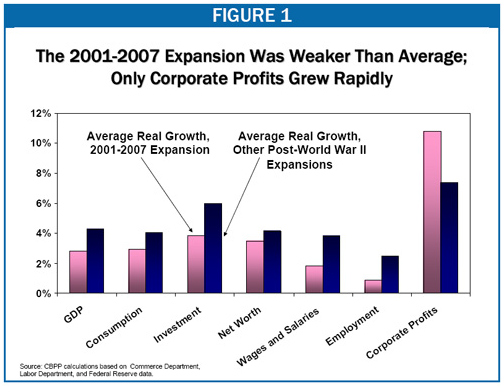
Some will argue that tax cuts are necessary to boost the economy. However, we have countless counterexamples to this popular fabrication. For instance, when President George W. Bush cut taxes from 2001 – 2007, the average annual growth rate was far below the average growth rate for any other period after World War II. In fact, only corporate profits experienced rapid growth. Over all, this expansion was among the weakest since World War II.


Screen Shot 2017-05-12 at 4.11.54 PM


In short, the US is doing a terrible job providing every citizen with the benefits of our society. We are disproportionately rewarding the rich while forcing the rest of us to pay for the services from which we all gain. Moreover, other countries provide even more bang for that buck.


Now this doesn’t mean that the government should tax us all into the ground.

Nor does it mean that the government should spend our tax dollars willy-nilly.


Taxation needs to be fair and spending needs to be regulated.


But constantly cutting rich people’s taxes is immoral. It is unfair to the majority of people making up the difference and struggling to survive when government services lag behind need.


Screen Shot 2017-05-12 at 10.34.01 AM


Our public schools are suffering under strategic disinvestment. Especially in poor neighborhoods that often disproportionately serve people of color, public schools cannot keep up with children’s needs. They aren’t providing an equitable level of service with those schools in richer, whiter neighborhoods.


Our policymakers try to solve the problem with charter schools, vouchers, standardized tests and Common Core. And the results have only been a worsening situation.


The real solution is simple – increased funding through fair increases in taxes on the wealthy.


Tax cuts are popular, but every time we let the rich get away with paying less, we have to either take more from the poor or take the knife to public services.


This affects the poor immediately in the form of reduced services, but it affects the rich, too. They have to live in a world where the majority has less – this means increased crime, increased drug abuse, increased ignorance, etc.


As a society, we must get beyond the selfish urge to look out only for what seems best for ourselves and our immediate friends and families. We must look out for our entire society. We must look out for the needs of everyone in it.


Otherwise, when we fall for these economic fallacies, we’re only stealing from ourselves.

The Joy of Opting Out of Standardized Testing

o-KIDS-ARTS-facebook

Testing season is a gray period in my classroom.


But it’s a joy in my house.


As a classroom teacher with a daughter in the public school system, I’m always struck by the difference.


In school I have to proctor the federally mandated standardized tests. But I’ve opted my own daughter out. She doesn’t take them.


So at home, I get to see all the imaginative projects she’s created in her class while the other kids had to trudge away at the exam.


“Daddy, daddy, look!” she squeals.


And I’m bombarded by an entire Picasso blue period.


Or “Daddy, will you staple these?”


And I’m besieged by a series of her creative writing.


My daughter is only in second grade and she loves standardized test time.


It’s when she gets to engage in whatever self-directed study strikes her fancy.


Back in kindergarten I missed the boat.


Even as an educator, myself, I had no idea the district would be subjecting her to standardized tests at an age when she should be doing nothing more strenuous than learning how to share and stack blocks.


But when I found out she had taken the GRADE Test, a Pearson assessment not mandated by the state but required by my home district in order the receive state grant funding, I hit the roof.


I know the GRADE test. I’m forced to give a version of it to my own 8th grade students at a nearby district where I work. It stinks.


Ask any classroom teacher and they’ll tell you how useless it is. Giving it is at best a waste of class time. At worst it demoralizes children and teaches them that the right answer is arbitrary – like trying to guess what the teacher is thinking.


Then I found out my daughter was also taking the DIBELS, a test where she reads a passage aloud and is given a score based on how quickly she reads without regard to its meaning. In fact, some of the passages test takers are forced to read are pure nonsense. It’s all about how readers pronounce words and whether they persevere through the passage. It’s not so much about reading. It’s about grit.


No. My precious little one won’t be doing that.


I talked candidly to her kindergarten teacher about it. I trust her judgment, so I wanted to know what she thought. And she agreed that these tests were far from necessary. So I set up a meeting with the principal.


The meeting lasted about an hour. Sure, it was a little scary. No one wants to rock the boat. But even he agreed with most of what I had to say. He didn’t feel as strongly about it as I did, but he respected my wishes and that was that.


Ever since, my daughter hasn’t taken a single standardized test.


For me, it was a political statement as well as a parental one. I wanted to do my part to chip away at the corporate school reform movement. I know how much they rely on these test scores to justify closing poor schools like mine. I don’t want to give them a chance.


But little did I know what bliss I would be providing for my little one.


Beyond politics, I thought I was just protecting her from a prolonged period of boredom, unfair assessments and cognitively invalid measurements.


I wanted to shield her from adult woes. What I didn’t realize was I was opening a door for her creativity.


It’s amazing. All the other poor children sit there dutifully filling in bubbles while she pours her heart out onto the page.


She loves creating these illustrated books telling the wildest narratives: Colorful superheroes blast bad guys into oblivion. Game show hosts get lost in other dimensions. Even her Mommy and Daddy get in on the action riding Yoshi through Super Mario land.


Often she adds text to these adventures. Her spelling could use some work, but I’m impressed that an 8-year-old even attempts some of these words. Sometimes she writes more in her adventure books than my 8th graders do on their assigned homework.


I’ve even noticed a marked improvement in her abilities during this time. Her handwriting, sentence construction, word choice and spelling have taken a leap to the next level. While her classmates are wasting time on the assessments, she’s actually learning something!


I wish I could provide the same opportunities for my students that I have for my daughter.


It’s strange.


As a parent, I have the power to make educational decisions on behalf of my child. But as a trained education professional, I’m not allowed the same privilege.


Don’t teachers stand in loco parentis? Well this is loco, so let me parent this. Let me at least talk to their parents about it – but if I do that on school time, in my professional capacity, I’m liable to be reprimanded.


I have studied standardized testing. It was part of my training to become a teacher. And the evidence is in. The academic world knows all this stuff is bunk, but the huge corporations that profit off of these tests and the associated test-prep material have silenced them.


I have a masters in my field. I’m a nationally board certified teacher. I have more than a decade of successful experience in the classroom. But I am not trusted enough to decide whether my students should take these tests.


It’s not like we’re even asking the parents. We start from the assumption that children will take the tests, but if the parents complain about it, we’ll give in to their wishes.


It’s insanity.


We should start from the assumption the kids won’t take the test. If parents want their kids to be cogs in the corporate machine, they should have to opt IN.


As a teacher, I can try to inform my students’ parents about all this, but at my own peril. If the administration found me talking about this with parents, I could be subject to a reprimand. Giving my honest educational opinion could result in me losing my job.


As you can see, it hasn’t stopped me. But I teach in a high poverty, mostly minority district. My kids’ parents often don’t have the time to come up to the school or even return phone calls. They’re working two or three jobs. They’re struggling just to put food on the table. They don’t have time for standardized tests!


So every test season I sadly watch my students trudge away at their federally mandated bubbles. I see their anxiety, their frustration, their sad, sad faces.


And it breaks my heart.


But then I come home to my daughter’s exuberant creations!


You would not believe the joy of opting out!

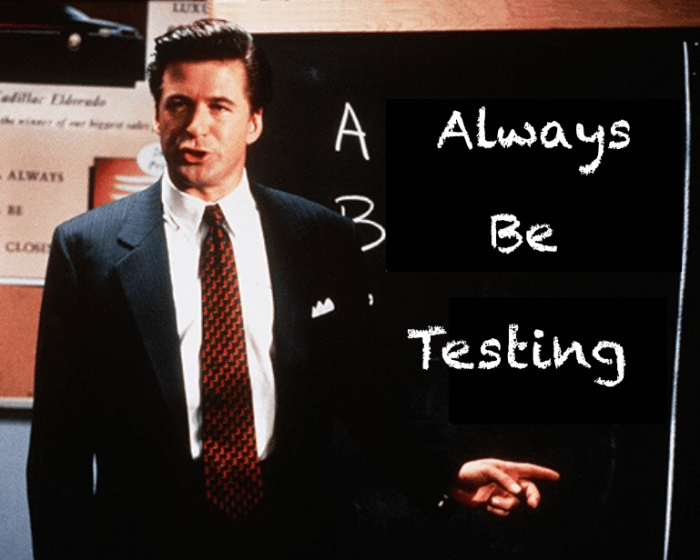
Always Be Testing – The Sales Pitch for Corporate Education Reform

Screen Shot 2017-03-15 at 10.31.13 AM

(After the “Brass Balls” speech in “Glengarry Glen Ross,” by David Mamet.)


(Rated PG-13 for language)


(Interior: a public school classroom during an after school staff meeting. Teachers are seated at student desks including Singer, Moss and Aaronow. Williamson, a middle school principal, stands in front of the room flanked by Blake, a motivational speaker brought in by the state. Singer is furiously grading papers. The other teachers are pleasantly chatting about trifles before Blake calls the gathering to attention.)


[Blake]
Let me have your attention for a moment! So you’re talking about what? You’re talking about that kid you failed, some son of a bitch who doesn’t want to pass, some snot-nosed brat you’re trying to remediate and so forth. Let’s talk about something important. Are they all here?


[Williamson]
All but one.


[Blake]
Well, I’m going anyway. Let’s talk about something important! (to Singer) Put that colored marker down!


[Singer]

But I’m grading papers…


(Blake)

I said Put that marker down! Markers are for testers only.


(Singer scoffs)


[Blake]

Do you think I’m fucking with you? I am not fucking with you. I’m here from downtown. I’m here from the Governor and the Legislature. And I’m here on a mission of mercy. Your name’s Singer?


[Singer]
Yeah. Mister Singer, actually.


[Blake]
You call yourself a teacher, you son of a bitch?


[Moss]

I don’t have to listen to this.

 
[Blake]
You certainly don’t, Madam. Cause the good news is – you’re fired. The bad news is you’ve got, all you got, just one week to regain your jobs, starting today. Starting with today’s meeting.


[Moss]

What!? The union contract doesn’t allow you to just fire us all without cause.


[Blake]

Union!? There ain’t no more union! This is a Right to Work state now, Bitch. And that means you have the right to work – for less – until I fire your sorry ass.


(Assorted grumbling)


[Blake]

Oh, have I got your attention now? Good. Cause we’re adding a little something to this month’s merit pay. As you all know, the teacher whose students get the highest test scores gets a bonus. First prize is a thousand bucks. Anyone want to see second prize? Second prize is a box of pencils. Third prize is you’re fired. You get the picture? You’re laughing now?


[Singer]

That’s ridiculous. Mrs. Moss teaches the advanced kids. All her students get high test scores.


[Blake]

What? And your kids are in the general track? They don’t get high test scores? Then step it up, Singer! You want to get a paycheck in this district, you’ve got to earn a paycheck. You got test prep manuals. The school board paid good money for them. Get those workbooks so your kids can pass the test!


[Singer]

Workbooks!? That’s not learning?


[Blake]

That’s where you’re wrong. Workbooks are the only learning that counts! Kids take the tests that show whether you’re doing your fucking jobs! You want to keep working here? You want to keep sucking at the public tit? You get those kids to pass the motherfucking tests. And those workbooks do that. They teach kids how to pass the motherfucking tests!


[Singer]

But my kids are all from poor homes. They’re malnourished. They don’t get the same medical care. There are no books in their homes. Many of them suffer from PTSD from abuse or exposure to violence….


[Blake]

And you think they deserve some kind of entitlement? A medal? Fuck them and fuck you! Let me make one thing perfectly clear – If you can’t get your students to pass shit, you ARE shit, hit the bricks, Pal, and beat it cause you are going out!


[Singer]

Are you kidding me right now? You want my students to pass these tests. The tests are unfair. They’re economically and culturally biased. The connection between the tests and learning is weak.


[Blake]
The fucking tests are weak? You’re weak. I’ve been in this business for fifteen weeks.


[Moss]
Fifteen weeks? Try thirty years.


[Blake]

Anyone who’s still a teacher after thirty years should be put to sleep. All you need is a year or two. That’s what I’m doing. Teach for America. Five weeks training, two year commitment, then move on to Washington where you can advise lawmakers on what schools need.


[Moss]

What’s your name?


[Blake]

Fuck you, that’s my name! You know why, Missy? Cause you drove a Hyundai to get to work. I drove an eighty thousand BMW. That’s my name.


[Singer]

I took the bus.


[Blake]

(To Singer) And your name is “you’re wanting.” You can’t play in a man’s game. You can’t teach them. (at a near whisper) And you go home and tell your wife your troubles.

(to everyone again) Because only one thing counts in this life! Get them to score above basic. Get them to demonstrate the minimum skills necessary!


[Singer]

What about what they think and feel?


[Blake]

No one gives a shit about what they think and feel. You hear me, you fucking faggots?


(Blake flips over a blackboard which has two sets of letters on it: ABT, and AITP.)


[Blake]

A-B-T. A- Always, B-be, T-testing. Always be testing! Always be testing!! A-I-T-P. Attention, interest, testing, passing. Attention — do I have your attention? Interest — are you interested? I know you are because it’s fuck or walk. Your kids pass or you hit the bricks! Testing – you will test those students by Christ!! And passing. A-I-T-P; get out there!! You got the students comin’ in; you think they came in to get out of the rain?


[Singer]

Actually, many of my students live in public housing down there by the railroad tracks. You know those slums? Roofs leak in half those units…


[Moss]

And for a lot of kids school is the only structure they get all day. Their parents are out working two to three jobs. They have to take care of themselves and often younger siblings.


[Singer]

And food. Don’t forget food. If it wasn’t for the free breakfast and lunch program, many of my kids wouldn’t eat…


[Blake]

Bullshit. A kid doesn’t walk into this school unless he wants to pass. That’s why they’re here! They want to learn! They’re sitting out there waiting to be told what to do. Are you gonna’ tell ‘em? Are you man enough to tell them?


[Moss]

I’m a woman. Most of us are women.


[Blake]

(to Moss) What’s the problem, Pal?


[Moss]

You think you’re such a hero, you’re so rich. Why are you coming down here and wasting your time on a bunch of bums?


(Blake sits and takes off his gold watch)


[Blake]
You see this watch? You see this watch?


[Moss]
Yeah.


[Blake]

That watch cost more than your SMART Board. (Takes off his shoe) You see this shoe? Italian. It costs more than your entire salary. (slicks back his hair) You see this haircut?


[Moss]

I get it.


[Blake]

Do you? Because I do. I made 26 million dollars last year. How much do you make? You see, Pal, that’s who I am. And you’re nothing. Nice person? I don’t give a shit. Good mother? Fuck you – go home and play with your kids!! (to everyone) You wanna work here? Test!! (to Aaronow) You think this is abuse? You think this is abuse, you cocksucker? You can’t take this — how can you take the abuse you get in a classroom?! You don’t like it — leave. I can go out there tomorrow with the materials you got, make myself a thousand dollars in merit pay! Tomorrow! In one class! Can you? Can you? Go and do likewise! A-I-T-P!! Get mad! You sons of bitches! Get mad!!


[Singer]

Oh, I’m mad. I’m mad that a shallow schmuck like you thinks he can come in here and tell us how to do our jobs. School is about so much more than test scores. You can’t reduce it all to a multiple choice assessment. These kids need a broad curriculum, not just reading and math. They need science, art, social studies, foreign language, recess – all the stuff the rich kids get at the $50,000 a year private schools. And all you want to give them are standardized tests!


[Blake]

You know what it takes to teach public school?


(He pulls something out of his briefcase. He’s holding up a hammer and a plastic model of a one-room schoolhouse. He puts the model down on Aaronow’s desk and then smashes it to pieces with the hammer.)


[Blake]
It takes school choice to teach in a public school. It takes charter and voucher schools, schools run like a business – not this mamby, pamby, commie, socialist shit!


[Moss]

Choice? Is that what you call letting private interests suck up public tax dollars without the same transparency and regulations as public schools? You mean schools not run by an elected school board, who meet in private and do almost whatever they please with our tax dollars? You mean schools that can turn away the hardest to teach children – unlike public schools that take everyone?


[Blake]
I’m talking about schools with balls!
(He puts the hammer over his crotch,– he puts it away after a pause)


[Blake]
You want a paycheck? Do like the choice schools do — Go and do likewise, folks. The money’s out there, you pick it up, it’s yours. You don’t–I have no sympathy for you. You wanna go into your classes tomorrow and test and get your kids to pass, it’s yours. If not you’re going to be shining my shoes. Bunch of losers sitting around in a bar. (in a mocking weak voice) “Oh yeah, I used to be a teacher, it’s a tough racket.” (he takes out a software package from his briefcase) This is the new Common Core aligned diagnostic system. It’s like the MAP, Study Island, iReady and iStation – only better.


[Singer]

Those programs suck.


[Blake]

This is better. With it, your students will sit behind a computer screen for several hours every day taking stealth assessments.


[Singer]

You mean mini-tests?


[Blake]

No. Not mini-tests. They’ll run through the program and get instruction on every Common Core standard and their answers will show how much they’ve learned.


[Singer]

They’re tests. Standardized tests. Every day.


[Blake]

This is the Pearson leads. And to you, it’s gold. And you don’t get it. Why? Because to give it to you is just throwing it away. (he hands the software to Williamson) It’s for testers. (sneeringly) Not teachers.


I’d wish you good luck but you wouldn’t know what to do with it if you got it. (to Moss as he puts on his watch again) And to answer your question, Pal: why am I here? I came here because the Governor and Legislature are paying me to be here. They’re paying me a lot more than you. But I don’t have to take their money. I can make that tying my shoes. They asked me for a favor. I said, the real favor, follow my advice and fire your fucking ass because a loser is a loser.


(He stares at Moss for a sec, and then picking up his briefcase, he leaves the room with Williamson)


[Singer]

What an asshole.


[Moss]

He may be an asshole but he’s got the state on his side.


[Aaronow]

This isn’t what I signed up for. This isn’t why I became a teacher.


[Moss]

What did you sign up for?


[Aaronow]

TO TEACH! Not to be some… some… glorified real estate agent!


[Singer]

It’s funny. We know how crazy all this testing, Common Core, and charter school crap is, but no one wants to hear us.


[Moss]

And now without collective bargaining, we can’t even speak up without fear of being fired.


[Aaronow]

Fear!? If we don’t push all this teaching to the test nonsense, they’re going to fire us. And if we do, they can replace us with computer programs. We’re damned if we do, damned if we don’t.


[Singer]

Not if people wake up. (Moss and Aaronow scoff) Not if the public takes a stand, if parents and teachers opt their kids out of the tests…


[Aaronow]

Didn’t you hear the man!? They’re putting the kids on computer programs to test them every day!


[Singer]

Then we fight every day. We protest every day. We get parents together and other concerned citizens and we go to the capital and we fight. Call your representative. Go to your Senator’s office. Stage a sit in. Hold a mock trial. Write a blog parodying a scene from a famous movie. Get public attention. Make some noise.


[Aaronow]

And you think people will care? You think people will know?


[Singer]

We’ll teach them. We’ll show them. That’s what we do.


[Moss]

We have no other choice.


[Aaronow]

Always be testing?


[Singer]

Always be teaching.


(Curtain)


The Original Scene from GlenGarry Glen Ross:

Republicans Suggest Federal Role in Education Be Limited to Bribery

imrs

Hey! Let’s repeal the Elementary and Secondary Education Act of 1965!

Let’s hobble the Department of Education!

Let’s make the federal role just handing out bundles of cash to private and parochial schools!

That’s apparently how you improve public education. You make it private.

And you completely eliminate any protections for students’ civil rights.

THIS is the brave new world of Trumpian education policy. It’s called HR 610 and was introduced by Republican Congressman Steve King of Iowa.

You may Remember King. He introduced an amendment in the U.S. House that would have prevented Harriet Tubman from replacing President Andrew Jackson on the front of the $20 bill. Sure she was an abolitionist, women’s suffragist and hero who rescued scores of black people from slavery in the Underground Railroad. Why would we want her to replace a former slave trader and architect of the Indian Removal Act and Trail of Tears!?

His new piece of wonderful legislation – not at all written by the American Legislative Exchange Council (ALEC) – would turn the U.S. Department of Education into merely an authorizer of block grants to qualified states to participate in a nationwide voucher program.

The department would give out money to local districts to give to parents to home school or send their children to private schools.

In effect, the federal government would become a booster for private and parochial schools. Uncle Sam would be offering free cash to private interests, corporations, entrepreneurs and business people if they can just convince parents to choose them over the public school system.

Which brings up the question – what about that public school system? Would it still receive the federal help it currently does? Would there still be Title I Grants to schools serving impoverished students? What would happen to Pell Grants? Who would make sure states are doing their jobs? Where could we go to find accurate data about how our schools are doing nationally and not just state-by-state?

These are questions that have not fully been answered. It’s possible some of these services could fall back on other governmental departments as they did before the creation of the Department of Education in 1980. However, more likely this would be a redistribution of billions of dollars that used to go to public schools now going to private hands.

Moreover, abuses against students on the grounds of civil rights, gender, special education, etc. would skyrocket with little to no recourse. And we would be in the dark about how well we were educating our nation’s children.

Oh! And the bill also would reduce nutrition standards for school lunches and breakfasts.

I’m not kidding.

King apparently is troubled that kids are eating too many fruits and vegetables, whole grains, and drinking low-fat or fat free milk. He is against reducing salt, saturated fat, and trans fat in school meals. And he doesn’t think children’s nutritional needs should be met within their caloric requirements.

I’m sure this has nothing to do with the fact that these regulations were proposed by the Obama administration. It has nothing to do with undoing legislation from our first black President. It’s all about the children.

King’s bill, HR 610, is not to be confused with a similar bill by Kentucky Rep. Thomas Massie that would simply dismantle the Department of Education in one year.

Massie, who introduced his one page, one sentence bill on the same day DeVos was confirmed, is a Tea Party Republican Libertarian. He supports disbanding the Environmental Protection Agency (EPA) and allowing guns at the nation’s schools.

He is a hardcore Trump believer. During the election cycle after revelations about the candidate’s admitted sexual molestation of women surfaced, Massie famously said, “Trump is better than 90 percent of the congressmen I serve with.”

His bill, HR 899, reads in total:

“The Department of Education shall terminate on December 31, 2018.”

As crazy as it sounds, Massie’s motivations are comprehensible. He wants to return complete control of education to the states.

It must be admitted that the Department of Education has overstepped the bounds of its authority during the last two administrations. When it was formed three decades ago, it was supposed to be a tool to support public schools, ensure student’s rights weren’t being violated and giving a boost to the poor. However, President George W. Bush made it all about standardized testing and giving slush money to charter schools. Obama was supposed to right these wrongs but, being a corporate Democrat, he only increased and administered them more efficiently.

The Department of Education is a tool, and like any tool, it can be misused. That doesn’t mean it should be disbanded. Republicans wouldn’t ban all guns because of instances of gun violence. Why disband the Department of Education because administrations of both parties misused it? Put it in check with proper regulations…

Oops. I think I’ve lost them.

Anyway, despite Massie’s slavish devotion for all things Trump, the President appears to be siding with King.

Trump and his mega-donor Education Secretary, Betsy DeVos, have already shown their commitment to King’s voucher legislation.

On Tuesday, they invited ten parents and teachers to Washington, D.C., to talk about their education agenda.

Who did they invite? One was a public school teacher. One was a public school principal for a building specializing in special education. One was a public school parent who also had children in private school.  The rest were homeschoolers, charter school parents or private school representatives.

So 70-80% of the people they invited were not associated with public schools. The Trump administration has made it clear that they are not interested in serving public school students. They are primarily concerned with children going to private and parochial schools who currently make up less than 10 percent of the country’s students.

During the meeting, Trump even praised a “Nevada charter school” that he had visited.  This school is a religious school where students pledged allegiance to the Bible for the former Reality TV star. (Don’t believe me? Watch the video by clicking here.) Like many private or parochial schools, the one Trump praised is notorious for regularly excluding students with disabilities.

The Trump administration is apparently not very concerned with special education students. DeVos refused to commit herself to defending these students during her confirmation hearing (and still was confirmed by Republican legislators!). Moreover, one of the first things the Department did after DeVos took over was to shut down its Webpage for students with disabilities and direct users to another page with fewer resources.

Currently, Republicans control both houses of Congress. They could easily ram through this legislation and Trump would almost certainly sign it. Moreover, there are numerous corporate Democrats like Sen. Cory Booker of New Jersey who may be overjoyed that the ideology they have pushed for their entire careers have finally been proposed by Trump.

The only thing standing in the way of this wrecking ball bill is parents and teachers.

We flooded our lawmakers phones, emails and town halls during the DeVos confirmation. We demanded a qualified candidate with a commitment to public education. But because she and her family have paid more than $200 million to these same GOP lawmakers, they voted for her anyway.

Will they continue to override their constituents? Only time will tell.

As the Trump administration continues to unravel and public support plummets for him and his corporate agenda, resistance will become more politically possible.

All we can do is keep up the pressure. Keep calling. Keep emailing. Keep showing up at lawmakers offices. Keep marching in the streets.

Eventually, these people will have to listen to us – or else we’ll stop them at the voting booth.

But will public schools last that long?


You can email your U.S. Representative about HR 610 by clicking HERE.

U.S. Public Schools Are NOT Failing. They’re Among the Best in the World

surprised-kid-investor-050213

Everyone knows U.S. public schools are failing.

Just like everyone knows you should never wake sleepwalkers, bulls hate red and Napoleon was short.

Wrong on all counts. Waking sleepwalkers will cause them no harm – in fact, they’re more likely to harm themselves while sleepwalking. Bulls are colorblind; they’re attracted to movement. And Napoleon was 5’7”, which was above average height for Frenchman during his lifetime.

So why do we believe that American public schools are doing such a terrible job?

Because far right policymakers have convinced us all that it’s true.

It’s not.

Let me repeat that in no uncertain terms – America’s public schools are NOT failing. They are among the best in the world. Really!

Here’s why: the United States educates everyone. Most other countries do not.

We have made a commitment to every single child regardless of what their parents can afford to pay, regardless of their access to transportation, regardless of whether they can afford uniforms, lunch or even if they have a home. Heck! We even provide education to children who are here illegally.

That can’t be said of many countries with which we’re often compared – especially countries comparable to the U.S. in size or diversity. So from the get-go, we have an advantage over most of the world.

We define education differently. Though our laws are woefully backward, in practice we look at it as a right, not a privilege. And for a full 13 years (counting kindergarten) it’s a right for every child, not just some.

But that’s not all! We also provide some of the highest quality education you can get in the world! We teach more, help more, achieve more and yet we are criticized more than any system in any country in the world.

TEST SCORES

Critics argue that our scores on international tests don’t justify such a claim. But they’re wrong before you even look at the numbers. They’re comparing apples to pears. You simply can’t compare the United States to countries that leave hundreds of thousands of rural and poor children without any education whatsoever. The Bates Motel may have the softest pillows in town, but it’s immediately disqualified because of the high chance of being murdered in the shower.

No school system of this size anywhere in the world exceeds the United States in providing free access to education for everyone. And that, alone, makes us one of the best.

It doesn’t mean our system is problem free. There are plenty of ways we could improve. We’re still incredibly segregated by race and class. Our funding formulas are often regressive and inadequate. Schools serving mostly poor students don’t have nearly the resources of those serving rich students. But at least at the very outset what we’re trying to do is better than what most of the world takes on. You can’t achieve equity if it isn’t even on the menu.

However, for some people, this will not be enough. They’ll say that despite our high ideals, the quality of what we actually provide our students is low. After all, those international test scores are so low.

First point: it depends on the scores you’re looking at. American elementary and middle school students have improved on the Trends in International Mathematics and Science Study every four years since the tests began in 1995. They are above the international average in all categories and within a few percentage points of the global leaders (something rarely mentioned on the nightly news).

Even on the PISA test administered by the Organization for Economic Cooperation and Development to 15-year-olds in about 60 countries, US children are far from the bottom of the scale. We’re somewhere in the middle. We’ve always been in the middle for all the decades since they’ve been making these comparisons. Our schools have not gotten worse. They have stayed the same.

IDEALS AND POVERTY

To some this just demonstrates that our schools have always been mediocre. But again you’re overlooking the consequences of our ideals.

The broader the spectrum of children who take a test, the lower the average score will be. In other words, if only your top students take the test, your average score will be very high. If only your top and middle students take the test, your average score will still be quite high. But if ALL of your students take the test, your average score will be lower.

Now add in poverty. Living in poverty reduces your access to health care, books, early childhood education and many other factors that increase learning throughout your life. Children from poor families are already more than a year behind those of rich parents on the first day of kindergarten. If you only test the wealthiest students, the average test score will probably be quite high. The average score will drop dramatically if you test all of your students.

That’s why many of these countries where the poorest children do not have access to education have higher test scores than the United States. You’re not comparing equals. The United States has the highest child poverty rate in the Western World. And we don’t hide them away. We include them on our tests. That has a major impact on our scores. But talking heads on TV almost always ignore it. They pretend it doesn’t exist. It’s the only way they can use these test scores to “prove” to a gullible audience that America’s schools are failing.

But if you fairly compare education systems and factor in the equal access we provide for all children to an education, our system comes out way on top. We have one of the best systems in the world.

But wait! There’s more!

SPECIAL EDUCATION

Not only does the United States serve all children regardless of academic achievement or poverty. We also serve far more students with disabilities.

Why are there so many special education children in the USA? Because we have a higher standard of living.

A standard pregnancy lasts about 280 days or 40 weeks. However, some mothers give birth to children after only 28 weeks. Two decades ago, these babies would not have survived. Today, they often do. Five years later that child will enter kindergarten and our school system will be responsible for teaching that student to read, write and learn math. In other countries, premature babies have a much lower chance of survival. They don’t survive to become the special education population. So things as diverse as the live-birth rate actually affect average test scores.

Another counterintuitive factor is the suicide rate. In many countries where pressure to perform at the highest levels on standardized tests is extreme, many children are actually driven to suicide. This is especially true in numerous Asian countries with a record of high scores on these international tests. So a higher suicide rate actually increases test scores.

Would you say this makes other countries superior to the United States? Heck no! In fact, just the opposite. I certainly wouldn’t wish more underperforming U.S. students were ending their lives so we could do better on international tests. Nor would I wish that more premature babies died to improve our international standing.

We have developed a special education system to help children at the edges that many other countries just can’t touch. In some countries these students are simply excluded. In others they are institutionalized. In some countries it’s up to parents to find ways to pay for special services. The United States is one of the only countries where these children are not only included and offered full and free access, but the schools go above and beyond to teach these children well beyond their 12th academic year.

In every public school in the United States these students are included. In math, reading, science and social studies, they are there benefiting from instruction with the rest of the class. And this, in turn, benefits even our non-special education students who gain lessons in empathy and experience the full range of human abilities.

Of course, most of our special education students are also included in our test scores. Yes, other countries that ignore these children and exclude them from testing get higher scores. But so what? Do you mean to tell me this makes them better? No, it makes them worse.

In many ways, we are the gold standard, not them. They should be emulating us, not the other way around. They should be jealous of the way we prize each other’s humanity. We shouldn’t be salivating at test scores achieved through shunning certain students in favor of others.

CURRICULUM AND STRATIFICATION

But it’s not just who we teach, it’s also what we teach.

Compared to many other countries, U.S. school curriculum is often much wider and varied. Countries that focus only on testing often leave out sciences, arts, literature and humanities.

Unfortunately, the push from policymakers even in the U.S. has been to narrow curriculum to imitate some of the worst practices of our competitors. But in many districts we still strive to create well-rounded graduates and not just good test-takers.

The bottom line: the curriculum at most American schools is more inclusive than that found internationally. We even include societal issues like alcohol and drug abuse prevention, stress reduction and relaxation, and physical fitness programs.

In addition we don’t stratify our children based on academic ability to nearly the same degree as many international schools. We don’t weed out our worst students through middle and high school until only our most capable are left in 12th grade. Nor is college only open to our best and brightest. We make a much greater effort than many other countries to keep this option open to as many students as possible regardless of whether they can afford it or not. The number of Americans with at least some college education has soared over the past 70 years, from 10 percent in 1940 to 56 percent today, even as the population has tripled and the nation has grown vastly more diverse. Meanwhile, Graduation rates are at an all-time high of 83.2 percent, and for the first time minority students are catching up with their white counterparts.

It’s not easy. But it’s something we’re committed to as a nation. And that’s not true around the world.

SIZE MATTERS

Finally, there’s the issue of size. The United States is a big country – the third most populous in the world. We have 324,450,000 people and growing. That’s about 50 million students in public schools.

It’s much easier to educate fewer children. Even excellent education systems would struggle with our sheer numbers. Small systems often outshine bigger ones. For instance, I might be able to make dinner for my immediate family, but I’d find it much more challenging to prepare a meal for a banquet hall of hundreds. Similarly, it remains to be seen whether smaller nations could handle educating a population as big and diverse as ours without collapsing.

By any fair measure, America’s public education system is simply stunning. But the media perpetuates the myth that we’re failing.

PUBLIC PERCEPTION AND THE MEDIA

After decades of hearing these falsehoods, the American public is strikingly divided. On a 2011 Gallup poll, parents were asked their opinion of their local school and the public was asked its opinion of schools in general. The results are enlightening. Parents who gave their local school an A grade were at the highest percentage ever (37%) whereas only 1% of respondents rated the nations schools that way. Why the difference? Respondents said it was mostly because people knew about their local schools through direct experience. They only learned about the state of education nationally through the news media.

Why is education reporting so biased? Part of it is monetary. Huge corporations make hundreds of millions of dollars off of the failing schools narrative. They sell new standardized tests, new test prep materials, new Common Core books, trainings for teachers, materials, etc. If they can’t demonstrate that our schools are failing, their market shrinks. And who do you think owns the shrinking media conglomerates? That’s right, many of these same corporations.

But even when journalists want to be fair, it’s difficult for them to get the inside story of how our public schools work. They are rarely permitted inside our schools to see the day-to-day classroom experience. Legal issues about which students may be photographed, filmed or interviewed, the difficulty of getting parental permissions and the possibility of embarrassment to principals and administrators often keeps the doors closed. In many districts, teachers aren’t even allowed to speak on the record to the media or doing so can make them a political target. So reporters are often in the position of being unable to directly experience the very thing they’re reporting on. Imagine if sportswriters never got to see athletes play or political reporters never attended a campaign rally. Of course there would be a disconnect!

So we’re left with a public education system that should be the envy of the world being portrayed as a loser.

THE BOTTOM LINE

As ever, far right politicians on both sides of the aisle, whether they be Democratic Neoliberals or Republican Tea Partiers, are using falsehoods about our public schools to sell an alternative. They say our public schools are beyond saving and that we need to privatize. They call it school choice but it’s really just an attempt to destroy the system that has so much going for it.

We should strengthen public education not undermine it. We should roll up our sleeves and fix the real problems we have, not invent fake ones.

People act as if “alternative facts” were invented by the Trump administration. Our policymakers have been using them for decades in a libelous and dishonest campaign against our public schools.

They are some of the best in the world – if only people knew it.

Trump says our schools are “Flush with Cash!?” They’re Falling Apart!

img_6296

Donald Trump lies.

If you haven’t learned that yet, America, you’ve got four more cringe-inducing years to do so.

Even in his inaugural address, he couldn’t help but let loose a whooper about US public schools.

“Americans want great schools for their children, safe neighborhoods for their families and good jobs for themselves,” he said. “But for too many of our citizens, a different reality exists. … An education system flush with cash but which leaves our young and beautiful students deprived of all knowledge.”

To which nearly every poor, nonwhite public school parent, student and teacher in the country replied, “What’s that heck did he just say now!?”

Los Angeles Unified School district routinely has broken desks and chairs, missing ceiling tiles, damaged flooring, broken sprinklers, damaged lunch tables and broken toilet paper dispensers.

They’re flush with cash!?

New York City public schools removed more than 160 toxic light fixtures containing polychlorinated biphenyls, a cancer causing agent that also hinders cognitive and neurological development. Yet many schools are still waiting on a fix, especially those serving minority students.

They’re flush with cash!?

At Charles L. Spain school in Detroit, the air vents are so warped and moldy, turning on the heat brings a rancid stench. Water drips from a leaky roof into the gym, warping the floor tiles. Cockroaches literally scurry around some children’s classrooms until they are squashed by student volunteers.

They’re flush with freakin cash!?

Are you serious, Donald Trump!?

And this same picture is repeated at thousands of public schools across the nation especially in impoverished neighborhoods. Especially in communities serving a disproportionate number of black, Latino or other minority students.

In predominantly white, upper class neighborhoods, the schools often ARE “flush with cash.” Olympic size swimming pools, pristine bathrooms – heck – air conditioning! But in another America across the tracks, schools are defunded, ignored and left to rot.

A full 35 states provide less overall state funding for education today than they did in 2008, according to the Center on Budget and Policy Priorities, which focuses on reducing poverty and inequality. Most states still haven’t recovered from George W. Bush’s Great Recession and the subsequent state and local budget cuts it caused. In fact, over the same period, per pupil funding fell in 27 states and still hasn’t recovered.

And the federal government has done little to help alleviate the situation. Since 2011, spending on major K-12 programs – including Title I grants for underprivileged students and special education – has been basically flat.

The problem is further exacerbated by the incredibly backward way we allocate funding at the local level which bears the majority of the cost of education.

While most advanced countries divide their school dollars evenly between students, the United States does not. Some students get more, some get less. It all depends on local wealth.

The average per pupil expenditure for U.S. secondary students is $12,731. But that figure is deceiving. It is an average. Some kids get much more. Many get much less. It all depends on where you live. If your home is in a rich neighborhood, more money is spent on your education than if you live in a poor neighborhood.

The U.S. is one of the only countries in the world – if not probably the ONLY country – that funds schools based largely on local taxes. Other developed nations either equalize funding or provide extra money for kids in need. In the Netherlands, for example, national funding is provided to all schools based on the number of pupils enrolled. But for every guilder allocated to a middle-class Dutch child, 1.25 guilders are allocated for a lower-class child and 1.9 guilders for a minority child – exactly the opposite of the situation in the U.S.

So, no. Our schools are not “flush with cash.” Just the opposite in many cases.
But what about Trump’s other claim – the much touted narrative of failing schools?

Trump says our schools “leave… our young and beautiful students deprived of all knowledge.”

Not true.

Graduation rates are at an all-time high of 83.2 percent. Moreover, for the first time minority students are catching up with their white counterparts.

It’s only international comparisons of standardized test scores that support this popular myth of academic failure. And, frankly, even that is based on a warped and unfair reading of those results.

It depends on how you interpret the data.

Raw data shows US children far from the top of the scale. It puts us somewhere in the middle – where we’ve always been for all the decades since they’ve been making these comparisons. Our schools have not gotten worse. They have stayed the same.

However, this ignores a critical factor – poverty. We’ve known for decades that standardized tests are poor measures of academic success. Bubble tests can assess simple things but nothing complex. After all, they’re scored based on answers to multiple choice questions. In fact, the only thing they seem to measure with any degree of accuracy is the parental income of the test-taker. Kids from rich families score well, and poor kids score badly.

Virtually all of the top scoring countries taking these exams have much less child poverty than the U.S. If they had the same percentage of poor students that we do, their scores would be lower than ours. Likewise, if we had the same percentage of poor students that they do, our scores would go through the roof! We would have the best scores in the world!

Moreover, the U.S. education system does something that many international systems do not. We educate everyone! Foreign systems often weed children out by high school. They don’t let every child get 13 years of grade school (counting kindergarten). They only school their highest achievers.

So when we compare ourselves to these countries, we’re comparing ALL of our students to only SOME of theirs – their best academic pupils, to be exact. Yet we still hold our own given these handicaps!

This suggests that the majority of problems with our public schools aren’t bad teachers, or a lack of charter schools and school choice. It’s money, pure and simple.

We invest the majority of our education funding in rich white kids. The poor and minorities are left to fend for themselves.

This won’t be solved by Trump’s pick for Education Secretary, Betsy DeVos and her school choice schemes. In fact, that’s exactly what’s weakened public schools across the country by leaching away what meager funding these districts have left. Nor will it be solved by a demagogue telling fairy tales to Washington’s credulous and ignorant.

We need to make a real investment in our public schools. We need to make a commitment to funding poor black kids as fairly as we do rich white kids.

Otherwise, the only thing flushed will be children’s future.