“Students, parents, teachers and others have told us that too much time in the classroom is used for test taking,” he said.
“We want to put the focus back on learning in the classroom, not teaching to a test. Standardized testing can provide a useful data point for a student’s performance, but our focus should be on teaching students for future success, not just the test in front of them.”
So at his urging we made slight cuts to our Pennsylvania System of School Assessment (PSSA) tests – the assessment for grade 3-8 students.
We removed two sections of the PSSA – one in math, one in reading – and reduced the number of science questions.
But it’s not exactly the kind of sea change the state claims, given the Department of Education’s recommendations for additional tests on top of the PSSA.
That’s right. The state wants schools to give the CDT assessment an additional 3 to 5 times a year in reading, math and science.
Unlike the PSSA, this is a voluntary assessment. Districts can decide against it, but the department’s flunkies are crisscrossing the Commonwealth advising we all give the CDT as much as possible.
So that’s between 50-90 minutes for each assessment. A district that follows the state’s guidelines would be adding as much as 270 minutes of testing every seven weeks. In a given year, that’s 1,350 minutes (or 22.5 hours) of additional testing!
Pop quiz, Governor Wolf. Cutting testing by 115 minutes while adding 1,350 minutes results in a net loss or a net gain?
The answer is an increase of 1,235 minutes (or more than 20 hours) of standardized testing.
In my classroom, that means students coming in excited to learn, but being told to put away their books, pocket their pencils and put their curiosity on standby.
The folks who work at the Department of Education instead of in the classroom with living, breathing children, will tell you that these CDT tests are a vital tool to help students learn.
They provide detailed information about which skills individual students need remediation on.
But who teaches that way?
Billy, you are having trouble with this kind of multiple-choice question, so here are 100 of them.
We don’t do that. We read. We write. We think. We communicate.
And if somewhere along the way, we struggle, we work to improve that while involved in a larger project that has intrinsic value – such as a high interest book or a report on a hero of the civil rights movement.
When learning to walk, no one concentrates on just bending your knees. Even if you have stiff joints, you work them out while trying to get from point A to point B.
Otherwise, you reduce the exercise to boring tedium.
That’s what the state is suggesting we do.
Make something essentially interesting into humdrum monotony.
I know if my students can read by observing them in that act. I know if they can write by observing them doing it. I know if they can communicate by listening to them arguing in Socratic seminar. I read their poems, essays and short stories. I watch their iMovies and Keynote projects.
I’m a teacher. I am present in the classroom.
That tells me more than any standardized diagnostic test ever will.
It’s ironic that on a Department of Education “CDT Frequently Asked Questions” sheet, the assessment is described as “minimizing testing time.”
When presented with the prospect of another day of CDT testing in my room, one of my brightest students raised his hand and asked if kids in the local Catholic school took the test.
I told him I didn’t know – though I doubt it. They COULD take the test. It is available to nonpublic schools, but do you really think they’re going to waste that much instruction time?
Heck! They don’t even take the same MANDATORY standardized testing! Why would they bother with the optional kind!?
It’s called the Opportunity Scholarship Tax Credit Program (OSTCP) – a ridiculous bit of legislation that allows children in struggling public schools to use public tax dollars to pay for tuition at a private or parochial school.
I’d say they could use that money at a participating public school, too, but in Pennsylvania the public schools taking part in the program can be counted on one hand with fingers to spare.
And why does my school now qualify for this dubious distinction? Because of our standardized test scores.
Not our test scores from this year. They won’t be released until at least June – more likely August or September.
This is based on test scores from last year – 2016-17.
Moreover, it’s not district wide. It’s just the middle school and one elementary school.
In previous years, the middle school was the district powerhouse. We had the highest test scores and the most innovation. So what happened?
About 60% of our students are poor and/or minorities. Yet if you go a few miles north, south, east or west, you’ll find schools serving every flavor of white privilege. Beautiful big buildings with the best of everything and a tax base to pay for it. My district, on the other hand, is made to do the best it can with what we’ve got, which isn’t much.
Though we only have one middle school and one high school where all our students rub shoulders, we have two elementary schools – one for the middle class white kids and one for the poorer black ones.
This has dramatic academic consequences. Kids at the better-resourced white school flourish scholastically more than kids from the crumbling black school. So the racial and economic skills gap becomes entrenched by the time kids move to the middle school in 6th grade.
If only we could integrate the elementaries.
However, we can’t bus kids from one neighborhood to the other because we can’t afford it. We have a walking district. Moreover, parents would revolt at the idea of elementary kids having to trudge long distances or take a city bus to school.
The only long-term solution is to create a new, centrally located elementary center serving both populations. However, that takes money we don’t have.
So last year we tried a partial solution – move the 5th grade up to the middle school. That way, we can at least integrate our students a year earlier.
Of course, this means taking kids from the black school with terrible test scores up to the middle school. This means adding more struggling students from the school that already is on the state’s bottom 15% list and making them the middle school’s responsibility. It means a new program, new trials and challenges.
You’d think we’d get praise or at least understanding for tackling such a problem. But no.
Taking on the 5th grade tipped the middle school’s test scores over the edge.
Now we’re in the bottom 15%, too. Now we have to let our students go to a private or parochial school with public tax dollars.
Why? Because we tried to right a wrong. We tried to correct a social and academic injustice. And the result was a kick in the gut.
Thanks, Harrisburg legislators! Way to support students of color!
Why would anyone integrate if doing so could mean losing funding and looking like a failure in the press?
Moreover, forget all the junk you hear from the state about growth.
This penalty is based on whether we hit testing benchmarks – what percentage of students we have earning proficient or advanced on the tests. It doesn’t matter how much they’ve improved. It doesn’t matter if they’ve gone from the lowest of the low to scratching at the ceiling of proficient.
My 8th graders last year (the year we’re being penalized for) experienced tremendous growth just like my students this year are doing. From where they came in to where they’re leaving, the difference is phenomenal!
But apparently that doesn’t count in Pennsylvania.
Wow! I can’t imagine why so few parents take advantage of that opportunity! My district has had a few schools on the OSTCP list before, and families overwhelmingly opt to stay put.
Let’s not forget the justification for this “opportunity” is low test scores.
Wait a minute. These cooperating private and parochial schools don’t even take the same standardized tests, if they take any at all.
In our community, there is only one cooperating private school – a catholic school located right next door.
What a great way to improve test scores for our students – comparing apples-to-pears or, to be honest, actually making no comparison at all.
This OSTCP law is based on an unjustified assumption that private schools are always better than public ones. The reality is that if the resources both schools receive are similar, the public school usually greatly outperforms the private or parochial one.
I’ve seen this first hand. I’ve toured our next door Catholic institution. A few years ago, we relocated our students there temporarily during an emergency drill.
It’s a quaint school. Cobblestones and a shaded green campus.
But the buildings are crumbling – especially on the inside. Watermarks on the walls and dirt collecting in the corners.
It’s also much smaller than my school. They only have less than 300 students from K-8. We have about 1,500 from K-12.
I can see why parents who graduated from that school and have a history with it might want to send their kids there to continue that legacy. But anyone else would be giving up much better facilities, a much wider curriculum, much better trained and experienced teachers and even smaller classes!
The OSTCP bill has nothing to do with providing better opportunities for children and families.
The private/religious schools benefit and so do the businesses who “donate” their taxes to these programs.
In 17 states you can get substantial tax credits for contributing to this scam.
Louisiana, Oklahoma, Pennsylvania, Rhode Island, and Virginia, for example, all provide tax credits worth between $65 and $95 on every $100 donated. Alabama, Arizona, Georgia, Montana, and South Carolina go even further by reimbursing 100% of the donation. You read that right. Donate $100, get $100 back.
Oh, but it gets much worse. Since these are considered donations, you can also claim them as charitable deductions and get an additional 35% off your taxes. So you donate $100 and get back $135! Yes. You actually make money off this deal!
In Pennsylvania, investors can even “triple dip” receiving a state tax credit, a reduction in their state taxable income, and a reduction in their federal taxable income. And, yes, that means they sometimes get back more in tax breaks than they provide in contributions.
Meanwhile all of these “savings” come from money stolen from local public schools like mine. Businesses and individual investors are profiting off the industrial testing complex.
In the Keystone state, we have the OSTCP and the Educational Improvement Tax Credit (EITC).
This blatant swindle is championed on both sides of the political aisle.
We already waste $200 million in business taxes to these programs in the Commonwealth, yet both Democrats and Republicans keep trying to pass another bill to increase that sum by another $50 million.
Because of this bogus philanthropy, there will always be a bottom 15% of state schools – approximately 400 “failing schools” – that are ripe for the picking from private and parochial school vultures.
In fact, you’re probably not even seeing this right now.
Though you may have read and enjoyed my articles in the past, though you may still want to have the opportunity to see and enjoy my posts in the future, you probably aren’t seeing them anymore.
Unless someone pays them to do otherwise. Then they’ll spam you with nonsense – fake news, lies, propaganda: it doesn’t matter so long as money is changing hands.
So homegrown blogs like this one are left in the dust while corporations and lobbyists get a megaphone to shout their ideas across social media.
Look, I don’t mean to minimize what Facebook does. There’s a ton of information that comes through the network that COULD be displayed on your screen. The company uses an algorithm – a complex set of steps – to determine exactly what to show you and when. But instead of basing that solely on who you’ve friended and what you’re interested in, they’ve prioritized businesses and shut down the little guy.
Since Facebook made the change in January, my blog only gets about 40% of the hits it did in years passed. And I’m not alone. Other edu-bloggers and organizations dedicated to fighting school privatization and standardization are reporting the same problems – our voices are being silenced.
And all this is happening after a series of Facebook scandals.
After the whole Cambridge Analytica outrage where Facebook gave the data of 87 million users – without their consent – to a political analysis firm that used it to help elect Trump…
After enabling the spread of hate speech in Myanmar which allowed the military to engage in “ethnic cleansing” of the Rohingya Muslim minority – which has forced 700,000 people from their homes and across the border into neighboring Bangladesh…
They are NOT cracking down on falsehoods and deception.
In fact, much of what they’re doing is completely devoid of ideology. It’s business – pure and simple.
They’re monetizing the platform. They’re finding new and creative ways to squeeze content providers to gain access to users’ news feeds.
This won’t stop propaganda and fabrications. It just charges a fee to propagate them.
It’s the same thing that allowed those Russian bots to spread Trump-friendly lies in 2016.
It’s pay-to-play. That’s all.
Founder and CEO Mark Zuckerberg characterized the change in January of 2018 as prioritizing content from “friends, family and groups.”
Zuckerberg admitted this means it will be harder for brands and publishers to reach an audience on the social media platform – unless they pay for the privilege. That’s significant because even though organic reach had been diminishing for some time, this is the first time the company admitted it.
“As we roll this out, you’ll see less public content like posts from businesses, brands, and media. And the public content you see more will be held to the same standard—it should encourage meaningful interactions between people.”
Apparently, what the company calls active interactions are more important than passive ones. So commenting and sharing is more important than just liking something.
In practice that means if you comment on someone’s post, you’re more likely to see things by that person in the future. And if they respond to your comment, their post gets seen by even more people.
Reactions matter, too, as does the intensity of those reactions. If people take the time to hit “Love” for a post, it will be seen by more people than if they hit “Like.” But whatever you do, don’t give a negative reaction like “Sad” or “Angry.” That hurts a post’s chances of being seen again.
I know it’s weird. If someone shares a sad story about their mother with cancer, the appropriate response is a negative reaction. But doing so will increase the chances the post will be hidden from other viewers. Facebook wants only happy little lab rats.
Sharing a post helps it be seen, but sharing it over messenger is even better. And just sharing it is not enough. It also needs to be engaged in by others once you share it.
Video is also prioritized over text – especially live video. So pop out those cell phone cameras, Fellini, because no one wants to read your reasoned argument against school privatization. Or they may want to, but won’t be given a chance. Better to clutter up your news feed with auto-playing videos about your trip to Disneyworld. I suppose us, social justice activists, need to become more comfortable with reading our stuff on camera.
And if you do happen to write something, be careful of the words you use to describe it. The algorithm is looking for negative words and click bait. For example, if you ask readers to like your posts or comment, that increases the chances of Facebook hiding it from others. And God forbid you say something negative even about injustice or civil rights violations. The algorithm will hide that faster than you can say “Eric Garner.” So I guess try to be positive when writing about inequality?
Do you happen to know someone famous or someone who has a lot of Facebook followers? If they engage in your posts, your writing gets seen by even more folks. It’s just like high school! Being seen with the cool kids counts.
One of the best things readers can do to make sure they see your content is having them follow you or your page. But even better is to click the “Following” tab and then select “See First.” That will guarantee they see your posts and they aren’t hidden by the algorithm.
I know. I know.
This is all kind of silly, but Facebook is a private corporation. It should be allowed to control speech however it likes. Right?
The social media giant collects a ton of data about its users and sells that to advertisers. As a user, you have to make that Faustian bargain in order to gain free access to the platform. However, as we’ve seen, that data can be used by political organizations for nefarious ends. Private business cannot be trusted with it.
Moreover, there is the echo chamber effect. Facebook controls what users see. As such, the company has tremendous power to shape public opinion and even our conception of reality. This used to be the province of a free and independent press, but after media conglomeratization and shrinking advertising revenues, our press has become a shadow of its former self.
But if we want even a chance of representative government, we need to reclaim social media for ourselves. We need control over what we get to see on Facebook – whether that be a school teacher’s blog or your cousin’s muffin recipe.
In the meantime, do what you can to take back your own news feed.
If you want to keep seeing this blog, follow me on Facebook and click “See First.” Hit “Love” on my content. Comment and share.
The only thing standing in our way right now is a brainless computer algorithm. We can outsmart it, if we work together.
I’m way too laid back for that. But my students know I will penalize them if they don’t hand in their assignments. And if it isn’t their best work, I’ll call them out on it.
The way I see it, grades and test scores offer an approximation of how well a student tries to achieve academic goals.
However, I think it transforms a self-directed, authentic pursuit of knowledge into grade grubbing. It makes an intrinsic activity purely extrinsic.
Learning no longer becomes about satisfying your curiosity. It becomes a chase after approval and acceptance.
We already know that measuring a phenomena fundamentally changes that phenomena. With a constant emphasis on measurement, children become less creative and less willing to take risks on having a wrong answer.
That’s one of the reasons I prefer teaching the academic track students to the honors kids. They aren’t used to getting all A’s, so they are free to answer a question based on their actual thoughts and feelings. If they get a question wrong, it’s not the end of the world. It hasn’t ruined a perfect GPA and put valedictorian forever out of reach.
Too much rigor (God! I hate that word!) creates academic robots who have lost the will to learn. Their only concern is the grade or the test score.
But if the goal is authentic learning, cheating doesn’t help. You can’t cheat to understand better. You can only fool the teacher or the test. You can’t fool your own comprehension.
If you find a novel way of realizing something, that’s not cheating – it’s a learning strategy.
However, classroom grades do have predictive value – especially when compared to standardized tests. Students with high grades in high school but middling test scores do better in college than students with higher test scores and lower grades.
Why? Because grades are based on something other than the ability to take one test. They demonstrate a daily commitment to work hard. They are based on 180 days (in Pennsylvania) of classroom endeavors, whereas standardized tests are based on the labor of an afternoon or a few days.
Yet even classroom grades have their limits.
I remember my high school graduation – sitting on the bleachers in my cap and gown listening to our valedictorian and salutatorian give speeches about the glorious future ahead of us.
Yet for each of those individuals, the future wasn’t quite so bright. Oh, neither of them burned out, but they didn’t exactly set the world on fire, either.
In fact, when I went to college, I found a lot of the highest achievers in high school struggled or had to drop out because they couldn’t adjust. The new freedom of college was too much – they partied and passed out. Yet a middle-of-the-road student like me (Okay, I was really good in English) did much better. I ended up in the honors college with a double major, a masters degree and graduating magna cum laude.
And it’s not just my own experience. The research backs this up.
The folks the researchers followed admitted that this wasn’t them. Many confessed that they weren’t the smartest people in their classes. They just worked really hard and gave teachers exactly what they thought they wanted.
So what’s the point?
Some people will read this and think I’m against all testing and grading.
Don’t get rid of grades and testing, just change the emphasis. Put a premium on curiosity and creativity. Reward academic risk taking, innovation and imagination. And recognize that most of the time there may be several right answers to the same question.
Heck other countries like Finland already do this.
As a result, their kids have some of the highest test scores in the world. By not focusing on standards and assessments, they counterintuitively top the charts with these very things.
There’s a lesson here for American education policy analysts.
Oh, we’re too good mannered to be brazen about it. We’d rather encourage you for trying than criticize you for getting something wrong.
But if you ask us for truth, that’s usually what you’ll get.
Just ask any first grader.
“Is my finger painting good, Miss Pebbles?”
“Oh my, it is!”
“Really?”
“Why yes. I love what you did with that smear of yellow and blue in the corner. Where they overlap, it turns green.”
“Do you think it’s good enough to compete against the seniors in the high school?”
“Maybe you’d better practice a bit more, Dear. At least wait until you can spell your name correctly before devoting your life to art.”
That’s why I was so delighted to get an invitation to do a TED talk.
Here was my chance to tell it like it is.
Sure, some people look to TED for encouragement and life affirming inspiration.
But the way I see it, the only real affirmation is honesty.
Otherwise, it’s just a bromide, a deception, an intellectual hard candy to plop into your skull and let your cranium suck on until all the sugar is gone.
We’ve all seen these TED talks on YouTube or the Internet – some well-dressed dude or dudette standing in front of a crowd with a headset microphone and a grin offering anecdotes and words of wisdom to a theater full of eager listeners.
But after hundreds of thousands of talks in scores of countries, the format has almost become a parody of itself. At many of these events, you’re just as likely to find some Silicon Valley tech millionaire waxing philosophic about his casual Friday’s management style as you are to hear something truly novel.
No, the way I see it, the TED extravaganzas are just asking for a bundle of truth wrapped in a plain brown box – quiet, unassuming and ticking!
I was rooming with Jesse “The Walking Man” Turner – an education professor at Central Connecticut University and famed social justice activist. He’s been involved with everyone from Moral Monday’s to S.O.S. Save Our Schools. But he’s most well-known for walking from Hartford to Washington, DC, to protest school privatization and standardization – a feat he did not once, but twice!
Anyway, one night as I was fading into sleep, he whispered to me from across the room, “Steve, you ever thought about doing a TED talk?”
“Huh? Whas tha, Jesse?”
“A TED talk. You ever thought about doing one?”
“Oh I don’t know. That would be pretty cool, I guess.”
“I organize an independent TED event at my school every year. We should get you on the schedule.”
And that was it.
I think. If there was any more to that conversation my conscious mind wasn’t involved in it.
But then the following year I got a call from Jesse asking if I was ready to come to Connecticut.
I wasn’t. I’d just had two mild heart attacks and wasn’t in a condition to go anywhere. I could barely gather the strength to go to school and teach my classes.
Then another surprise. I was one of three educators in western Pennsylvania nominated for a Champions of Learning Award in Teaching from the Consortium for Public Education. In the final analysis, I didn’t end up winning the award, but it was a huge honor.
And then to top it all off, Jesse called me back and asked me if I was ready to come to Hartford and give the TED talk another try.
I jumped on it.
How could I say no?
This year has been like a second chance, a new lease on life. I’ve been eating healthier, exercising, losing weight and taking nothing for granted.
But that comes with certain responsibilities.
I couldn’t go there and just mouth platitudes and self-help advice. I couldn’t just tell some touchy-feely stories from my classroom and conclude about how great it is to be a teacher.
But our profession is under attack.
Public schools are being targeted for destruction. The powers that be are using segregation, targeted disinvestment and standardized testing to destabilize public schools and replace them with privatized ones.
The school house is on fire! This is no time for heart-warming stories. It’s time for anger, agitation and activism!
But then the opportunity came to “practice” my speech in front of my entire school building.
I thought to myself, is THIS really what I want to talk about?
If I only get one shot at this – and I probably will get only one shot – do I really want to spend it on society’s unfair expectations?
That’s when I scrapped what I had and started over, this time focusing on “The Plot to Destroy Public Education.”
I must have rewritten my presentation at least five times.
Jesse said I’d have no more than 15 minutes so I practiced just about every night to make sure I was within that time.
The word may have gotten out around my school because the invitation to speak to the entire building quickly evaporated. Maybe there really was a scheduling mix up. Maybe not.
But it didn’t matter. My presentation was ready like a bomb – no hand holding, no concessions, just the truth.
The weeks flew by.
Before I knew it, it was time to fly to Connecticut. I couldn’t believe it was really happening.
When I got there, Jesse picked me up from the airport. He was a consummate host. He couldn’t have treated me better if I was royalty. He paid for my hotel, paid for most meals, drove me everywhere, kept me in good company and entertainment and even gave me a “Walking Man” mug as a token of his appreciation.
I was the only person flying in from outside of the Hartford area. Most of the other seven speakers were from there or had roots in the community.
All but two others were PhDs. The list of names, vocations and stories were impressive. Dr. Dorthy Shaw, a famed education and women’s studies professor, talked about surviving cancer. Dr. Noel Casiano, a sociologist, criminal justice expert and marriage counselor, told a heartbreaking personal story about the three people who mentored him from troubled teen to successful adult. Dr. Kurt Love, a CCSU professor focusing on social justice and education, talked about the greed underlying our economic and social problems. Dr. Barry Sponder, another CCSU professor focusing on technology in education, talked about flipped classrooms. Dr. Johnny Eric Williams, a sociology professor, talked about the myth of whiteness and how it corrupts how we speak about race.
Elsa Jones and her son Brian Nance were the only other non-PhDs. Jones is an early education consultant and the daughter of the Rev. Dr. William Augustus Jones, Jr., a famed civil rights leader who worked with Dr. Martin Luther King, Jr.
They were the ones I bonded with the most. All four of us went out for pizza after the talks.
But when I first entered the Welte Auditorium in the Central Connecticut State University campus, it was truly frightening.
The building could hold hundreds, perhaps thousands of people. Yet organizers had limited the audience to only a hundred. All the seats were up on the stage.
There was a little circular rug where we were to stand and the camera people were setting everything up.
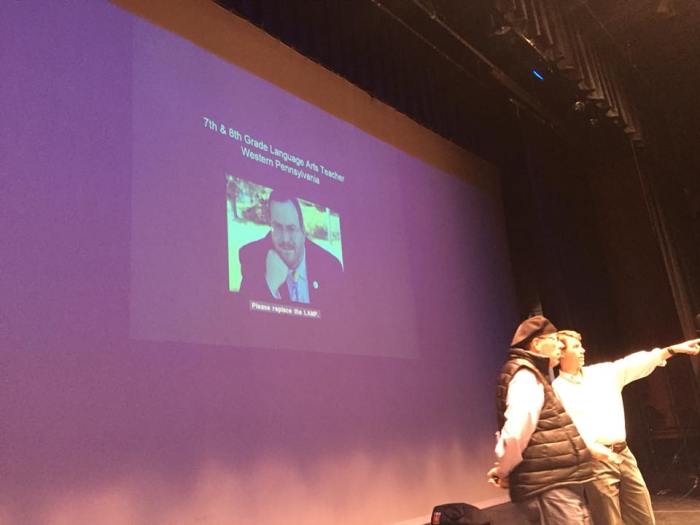
Behind us, a ceiling high blue-purple backdrop would showcase the TED logo and any slides we had prepared.
Which brings up an interesting distinction.
This was not a corporate TED event organized by the TED conference and sanctioned by their foundation. It was a TED “X” event, which means it was independently organized.
TED licenses its name for these grassroots X-events. There are a list of rules that organizers must follow. For example, all tickets to the event must be free. Contrast that with the corporate TED events where tickets go for thousands of dollars.
I was glad I was where I was. This was going to be the real deal – a thoughtful discussion of authentic issues. And somehow I was up there with these incredible thinkers and activists.
The moment came. Drs. Shaw and Casiano had already spoken. I got up from my seat in the front row to get my lapel microphone attached.
Jesse gave me a warm introduction letting everyone in on the secret of my tie – the design was a picture of my daughter repeated to infinity.
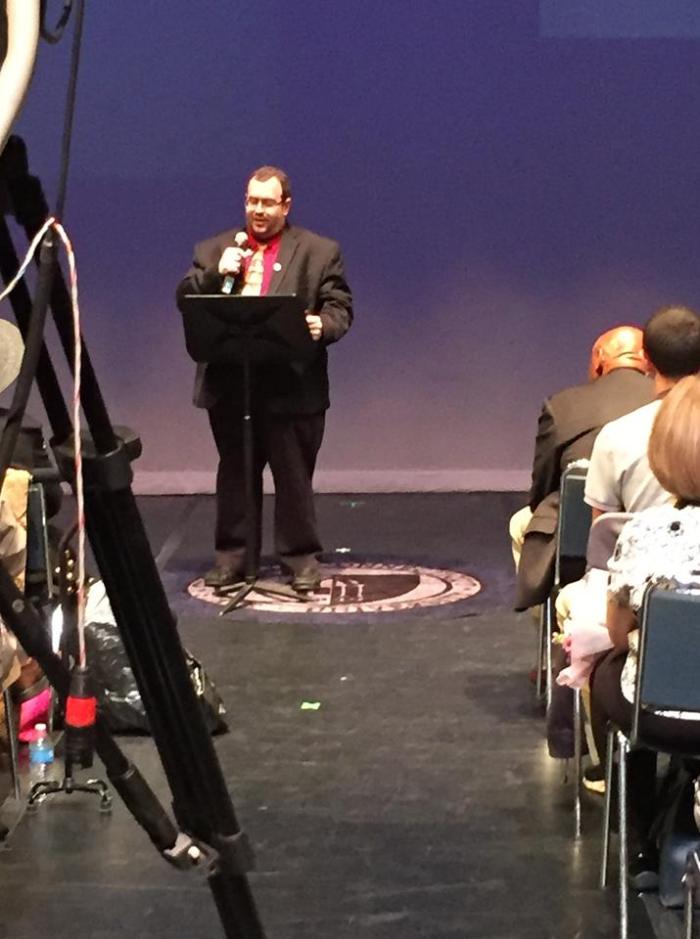
So I walked to my mark and started speaking.
It seems there was some sort of technical difficulty with the microphone. My voice didn’t appear to be coming from the speakers – or if it was, it wasn’t projecting very well. So I spoke louder.
Then Jesse came from the wings and gave me a hand mic and a music stand for my notes.
It took a moment to get used to handling the microphone, the clicker for my slides and my iPad (where I had my notes), but I got the hang of it.
And I was off and running.
I said it. I said it all.
The audience certainly didn’t seem bored. All eyes were on me. A few heads were nodding in agreement. Some faces seemed stunned.
When I ended, there was universal applause. A few folks patted me on the back when I got back to my seat and shook my hand.
And that was it.
I thoroughly enjoyed the remaining presentations but it was hard to concentrate in the post-TED elation.
Jones and Nance were probably the closest to what I was talking about and we got along like we’d known each other for years.
When I got back to the hotel, I felt elation and exhaustion in equal measure.
I had done it.
After months, years of planning, it was over.
Jesse tells me the video will be on-line in a matter of weeks. (I’ll revise this post with the video when it goes live.) Though he did mention that one point in my presentation made him a bit nervous – I had called out Bill Gates for his role in the destruction of public schools. However, Gates is a big donor to TEDs. Jesse half-jokingly said that the TED folks might take issue with that and refuse to upload my speech.
But whatever. I told the truth. If that gets me censored, so be it.
This will be something I’ll never forget.
I’m sorry this article has gone on so long, but there was much to tell. It’s not every day that someone like me gets such a stage and such a potential audience.
Hopefully, my video and my speech will be seen by many people who have never heard of this fight before. Hopefully it will open minds and stoke people to act.
And hopefully the mic issues at the opening won’t be distracting.
Thank you for following my blog and being there with me on this incredible journey.
I left nothing important unsaid. I gave it my all.
“Language is a weapon of politicians, but language is a weapon in much of human affairs.”
-Noam Chomsky
“Words are things. You must be careful, careful about calling people out of their names, using racial pejoratives and sexual pejoratives and all that ignorance. Don’t do that. Some day we’ll be able to measure the power of words. I think they are things. They get on the walls. They get in your wallpaper. They get in your rugs, in your upholstery, and your clothes, and finally in to you.”
― Maya Angelou
Names matter.
What you call something becomes an intellectual shorthand.
Positive or negative connotations become baked in.
Hence the Colorado Democratic Party’s criticism of Democrats for Education Reform (DFER).
“The real problem, politically, was not the Republican party, it was the Democratic party. So it dawned on us, over the course of six months or a year, that it had to be an inside job. The main obstacle to education reform was moving the Democratic party, and it had to be Democrats who did it, it had to be an inside job. So that was the thesis behind the organization. And the name – and the name was critical – we get a lot of flack for the name. You know, “Why are you Democrats for education reform? That’s very exclusionary. I mean, certainly there are Republicans in favor of education reform.” And we said, “We agree.” In fact, our natural allies, in many cases, are Republicans on this crusade, but the problem is not Republicans. We don’t need to convert the Republican party to our point of view…”
“We oppose making Colorado’s public schools private, or run by private corporations, or segregated again through lobbying and campaign efforts of the organization called Democrats for Education Reform and demand that they immediately stop using the Party’s name, I.e., “Democrat” in their name.”
My point is that the larger verbal slight of hand isn’t with the organization’s party affiliation. It’s with the term “Reform,” itself.
DFER is not alone in calling what they advocate “Education Reform.”
My question is this – is what they’re proposing really reform at all?
And if so, what kind of reform is it? Who does it benefit? And what does it conceal?
The word “Reform” has positive associations. It’s always seen as a good.
We always want to be reforming something – turning it from bad to good. Or at very least improving it.
And when it comes to education, this is even more urgent.
No one really wants to be against education REFORM. The only reason to oppose it would be if you thought the way we teach was perfect. Then we would need no reform at all. But this is nearly impossible. Human society does not allow perfection because it is created by human beings, who are, in themselves, far from perfect.
However, the term “Education Reform” does not mean just any kind of change to improve teaching.
It has come to mean a very specific list of changes and policies.
It means reducing democratic local control of schools, reducing transparency of how public tax dollars are spent while increasing control by appointed boards, and increasing the autonomy of such boards at the expense of accountability to the community actually paying for their work.
It means transforming money that was put aside to educate children into potential profit for those in control. It means the freedom to reduce student services to save money that can then be pocketed by private individuals running the school.
If the goal of education is to teach students, “Education Reform” is not about reforming practices for their benefit. It is not, then, reform.
If the goal is to increase profits for private businesses and corporations, then it truly is reform. It will increase their market share and throw off any extraneous concerns about kids and the efficacy of teaching.
However, this is not the goal of education.
Education is not for the benefit of business. It is not corporate welfare.
Education is essentially about providing positive opportunities for students. It is about providing them with the best learning environment, about hiring the best teachers and empowering them with the skills, pay, protections and autonomy to do their jobs. It’s about providing adequate resources – books, computers, libraries, nurses, tutors, etc. – to learn. It’s about keeping kids safe and secure, well-nourished, and healthy.
In short, it’s about everything bogus “Education Reform” either perverts or ignores.
Calling the things advocated by groups like DFER “Education Reform” is pure propaganda.
We must stop doing that.
Even if we use the term to criticize the practice, we’re helping them do their work.
“The limits of my language mean the limits of my world.”
We cannot effectively fight the forces of segregation, standardization and privatization if we have to constantly define our terms.
We have to take back the meaning of our language, first. We have to stifle the unconscious propaganda that happens every time someone innocently uses these terms in ways that smuggle in positive connotations to corporatist ends.
Am I obsessed and distressed by oppressive divestment?
Oh who cares? Kiss my assessment!
Double, Double, test and trouble;
Standards stern so fill in that bubble.
NOTE: I wrote this poem during and after proctoring this year’s PSSA test for my 7th grade students. Can’t imagine where the inspiration came from! I’ll just say that the opposite of standardized testing has always seemed to be poetry. I hope you enjoyed my verses. It was either that or spit curses!
From 1933-1945, approximately 12 million people – 6 million of whom were Jews – were systematically put to death by Nazi forces.
However, even many of those who admitted to having some knowledge of these events were unsure about the specifics. For instance, one third of respondents – and 41% of millennials – said that only 2 million people were killed.
Only a handful of states mandate Holocaust curriculum in schools – Florida, Illinois, New Jersey, California, Michigan, Indiana, New York and Rhode Island – and each one does so to varying degrees of detail.
And I write this as an educator who taught the Holocaust in middle school for more than a decade.
The first thing I did was throw those corporate-written standards in the trash.
My 8th graders and I watched various award-winning documentaries such as “Auschwitz: If You Cried, You Died.” We read the play version of “The Diary of Anne Frank,” but supplemented it with various interviews and autobiographical articles from concentration camp survivors and even a presentation from community members who had first-hand experience of these events until their age and health made that impossible.
Unfortunately, this does not appear to be the norm.
Though America students make up one third of the 1.7 million visitors to the National Holocaust Museum, 80 percent of Americans say they have never visited any Holocaust museum.
I get it. Teaching about this is hard.
It’s ugly and scary and repulsive – but it’s meant to be.
The DC National Holocaust Memorial recommends the following guidelines for teaching about the European Holocaust:
“Be sensitive to appropriate written and audiovisual content. One of the primary concerns of educators teaching the history of the Holocaust is how to present horrific images in a sensitive and appropriate manner. Graphic material should be used judiciously and only to the extent necessary to achieve the objective of the lesson. You should remind yourself that each student and each class is different and that what seems appropriate for one may not be appropriate for all . . . Some students may be so appalled by the images of brutality and mass murder that they are discouraged from studying the subject further. Others may become fascinated in a more voyeuristic fashion, subordinating further critical analysis of the history to the superficial titillation of looking at images of starvation, disfigurement, and death . . . There is also a tendency among students to glorify power, even when it is used to kill innocent people. Many teachers indicated that their students are intrigued and, in some cases, intellectually seduced by the symbols of power that pervaded Nazi propaganda (e.g., the swastika and/or Nazi flags, regalia, slogans, rituals, and music). Rather than highlight the trappings of Nazi power, you should ask your students to evaluate how such elements are used by governments (including our own) to build, protect, and mobilize a society. Students should also be encouraged to contemplate how such elements can be abused and manipulated by governments to implement and legitimize acts of terror and even genocide.”
That’s what I tried to do.
This is the first year that I’m not explicitly teaching the Holocaust – and the only reason is because I’m not teaching 8th grade, I’m teaching 7th.
It’s not in my curriculum.
However, I know my students will get it when they advance to the next grade.
When asked point blank, no one wants to admit to liking it.
To paraphrase Motown singer songwriter Edwin Starr:
“Segregation. Huh, Good God.
What is it good for?
Absolutely nothing.”
However, when it comes to supporting actual integration programs or even just education policies that don’t make segregation worse, no one in politics really gives a crap.
Both Republicans and Democrats are heavily invested in ways to divide up school students along racial and economic lines – whether they be charter and voucher schools or strategic disinvestment in the public schools that serve the poor and minorities and hording resources for wealthy whites.
Trump nominated the extremely partisan justice for a federal judgeship in Louisiana. Yet during a Senate hearing Wednesday, Vitter refused to answer a question from Sen. Richard Blumenthal (D-Conn.) about whether or not she believed the Supreme Court was right in its landmark 1954 decision, Brown v. Board of Education.
And Vitter couldn’t bring herself to affirm this ruling.
“If I start commenting on ‘I agree with this case’ or don’t agree with this case,’ I think we get into a slippery slope,” she said.
“I don’t mean to be coy, but I think I get into a difficult area when I start commenting on Supreme Court decisions which are correctly decided and which I may disagree with,” Vitter said.
She added that the ruling was “binding” and that she would uphold it if confirmed as a judge.
And there we have it, people.
That’s where the bar is set during the Trump administration.
You no longer need to pretend to be against school segregation.
On the one hand, it’s more honest than most people in the political arena.
On the other, how far have we sunk when you don’t even need to feign decency in order to expect having a chance of Congress confirming you?
Let me be clear. Vitter’s nomination should not be approved.
Congress should draw a line in the sand and say that it cannot accept people who do not share bedrock American values on the bench.
What actually happens to Vitter will probably be determined by the degree of backlash against her.
As of Thursday afternoon, the video clip of Vitter’s comments about Brown V. Board had more than 1.7 million views, and was retweeted over 13,000 times.
A few months ago, another Trump judicial nominee, Matthew Petersen, withdrew from consideration after a video in which he couldn’t answer basic legal questions went viral.
But even if this reprehensible person who has no right sitting in judgement over anything more taxing than a checkbook gets turned away from the bench, we’ll still be far from where we need to be on school segregation.
At most, you get a news story every anniversary of Brown v. Board about the increased segregation and a journalistic shrug. Well, we don’t know how to solve that one…
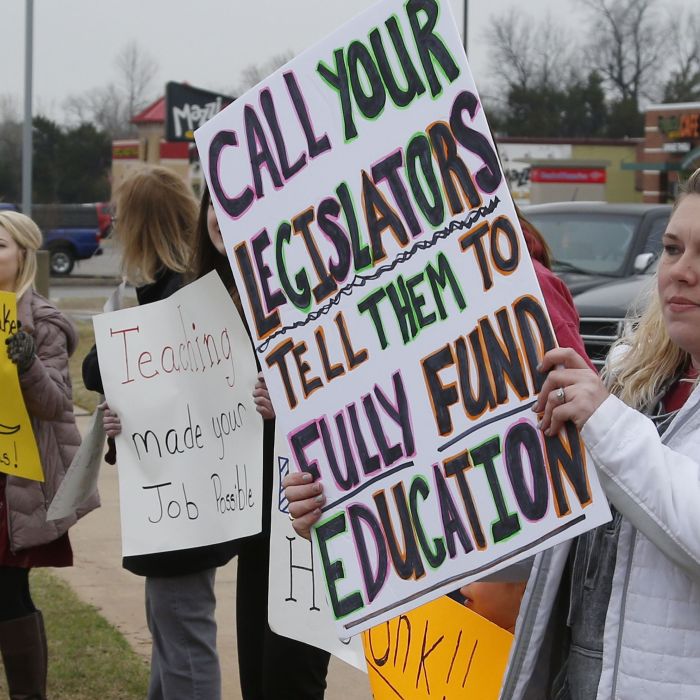
America’s teachers are taking to the streets by the thousands.
In West Virginia, Oklahoma, Kentucky and soon to be Arizona and Puerto Rico, educators are leaving the classroom and storming their state capitals.
Why?
Not because they’re greedy. Not because they don’t want to do their job. But because this country doesn’t care enough to provide them the resources they need to do it.
America only cares about middle class and wealthy kids, preferably if their skin has a melanin deficit.
Don’t believe me?
Just look at how much these states have cut education funding. Look at how the federal government has slashed financial assistance. Look at how districts are forced to increasingly rely on local tax revenues to pay for the kind of education their children receive.
For the dark and the destitute, this means larger class sizes, out of date text books, and narrowed curriculum. It means fewer tutors, reading specialists and librarians. It means being left to your own devices to deal with the effects of generational poverty which put them behind their wealthier, lighter peers before they even enter kindergarten. It means greater emotional disturbance, greater malnutrition, higher absences, more learning disabilities, and less help to deal with any of it.
On the other hand, for the economically privileged white kids, it means just the opposite – fewer social problems, and the best of everything to deal with whatever issues they have.
Don’t refuse us the money to get it done and then blame us for the results.
That’s why there was a 9-day teachers strike in West Virginia which won educators a 5% raise in February.
That’s why 30 districts closed in Kentucky this week after a statewide sick out inspired by the legislature’s plan to cut pension benefits.
That’s why thousands of teachers in Oklahoma walked out this week demanding higher wages and better school funding.
And it’s why educators in Arizona, Puerto Rico and other states and territories may be next.
When you deny teachers the basics necessary to do their jobs, you’re refusing your responsibilities toward children.
When you deny educators a fair wage, you’re discouraging young people from entering the profession and encouraging those already there to seek work elsewhere.
And that is what we’re talking about here – a fair wage. We’re not talking about teachers getting rich off the taxpayers dole. You’re asking us to get an advanced education and do a hard job – that requires a middle class income so we can pay off our student loans and support our families.
The same goes for pensions. When teachers took their jobs, a fair pension was part of the contract. You promised that after 30-some years, educators could retire and you’d take care of them. You can’t renege on that. And if you plan to offer less for those coming in to the field, you’re going to get fewer high quality teachers willing to take the job.
When you attack unions and union benefits, you’re really attacking students. A teacher who can be fired at the whim of an administrator or school director is not as affective at her job. She has less autonomy and freedom to do what is right for her given students. And she has less reason to take a chance on the profession in the first place.
This is why there’s a so-called teacher shortage in most states. As a society, we’ve become less-and-less willing to pay for teachers to do their jobs. We’ve become less-and-less willing to offer them the independence and respect necessary to get things done.
Why?
Because we’ve swallowed a pack of lies from the business community.
But only for the poor and minorities. The affluent and middle class white kids will still get the best money can buy. It’s only those other kids they’re willing to feed to the wolves of edu-profit.
THAT is what educators are fighting.
THAT is why teachers across the nation are striking.
We’re demanding this nation does right by its public school students.













 gadflyonthewallblog