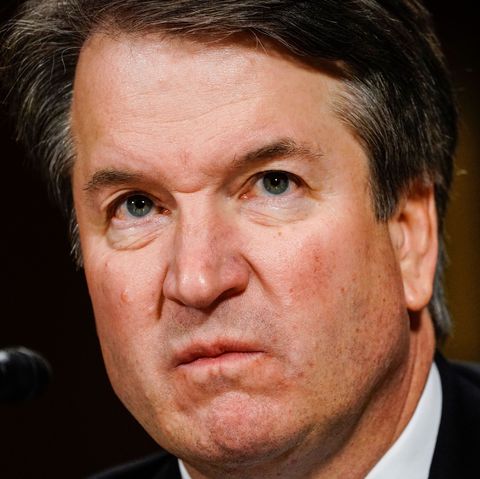
I think I will always associate Brett Kavanaugh with the taste of vomit in the back of my throat.
I couldn’t watch his sham of a confirmation hearing without my gag reflex going into overdrive.
Here was one of the most privileged of people on the planet alternatively weeping and raging that he was being denied his due.
Here was a man bemoaning that no matter what happened, his reputation forever would be ruined, but who likewise refused to call for an investigation to exonerate himself.
At least three separate women have accused him of sexual assault, yet Congressional Republicans are still planning to ram through his nomination to the Supreme Court – a lifetime appointment where he will almost certainly be the tie breaking vote to overturn Roe vs. Wade.
How fitting.
What perfect symmetry.
You couldn’t have planned it any more poetically.
A man accused of multiple attempted rapes who is doing everything in his power to make abortion illegal.
An overgrown frat boy crying into his beer that we can’t take away his God given right to take away women’s rights.
A confederacy of almost exclusively male lawmakers ready to discount women’s reports of violence so that they can limit women’s freedom to make decisions about their own bodies.
If there is one good thing to come from this farce, it is the spotlight it has shown on the relationship between rape and the movement to recriminalize abortion.
These two things are essentially intertwined.
On the one hand, we have sexual intercourse carried out under threat of violence, sex without consent or in direct violation of consent – a crime invariably perpetrated by men on women.
On the other hand, we have the removal of female consent from the birthing process.
They are almost the same thing, or at least two sides of the same coin.
In both cases, we’re removing or ignoring female permission, agreement, approval, agency. We’re saying it doesn’t matter what the woman wants. It only matters what men or a patriarchal society wants.
And the justification is an ancient text – the New Testament – that doesn’t mention abortion once. And the Old Testament actually gives instructions on how to conduct an abortion (Numbers 5:11-31).
Not that it really should matter. The United States is not a theocracy.
But it IS a patriarchy.
That’s what this is – an attempt by the most insecure, power hungry men to control women.
It is about keeping and strengthening a caste system where men are allowed to be fully realized people and women are allowed only secondary status.
It is about dehumanization clothed in piety and false morality.
All those people crying for the lost lives of a cluster of cells in female uteruses care not a wit about the thousands of women who will die from unsafe abortions once safe procedures become unlawful.
We’ve been here before. Abortion was illegal in the US from the early 1800s until 1973, and we know what will happen. There is actual history on this – back alley procedures conducted by quacks using sharp implements to pierce the womb – and there is no reason to think it won’t repeat itself.
Changing the law won’t stop abortions. It will just make them unsafe for everyone except rich women who can afford doctors willing to take a chance on going to jail for a big payday.
If these people really wanted to stop abortions, they’d support handing out free contraception. They’d turn every orphanage into a palace. They’d each adopt as many children as they could. They’d make neonatal care free, expand services to help women raise children, increase maternity leave, pay for free childcare, expand education funding.
But they don’t do any of that because despite their crocodile tears, their objection has nothing to do with unborn children.
It has to do with mature women making decisions for themselves. It has to do with conceptualizing them as people equal to men and with minds capable of consent.
It’s about allowing women the right to choose – choose whom to have sex with and what exactly the consequences of that sex will or will not be.
I am so thankful that Dr. Christine Blasey Ford came forward with her testimony. What bravery! What grace under pressure!
To be able to share with an entire nation her personal trauma at the hands of Kavanaugh. Such courage boggles the mind almost as much as those who refuse to accept her story as genuine.
They say that this is political. That it’s a hit job. Yet they pound their fists onto their ears to drown out Kavanaugh’s words in self-defense where he makes it entirely clear how partisan he is and will be once he takes the bench:
“This whole two-week effort has been a calculated and orchestrated political hit, fueled with apparent pent-up anger about President Trump and the 2016 election. Fear that has been unfairly stoked about my judicial record. Revenge on behalf of the Clintons. And millions of dollars in money from outside left-wing opposition groups.”
These are not the words of a fair arbitrator. They are the ravings of someone with an axe to grind.
But they do well to point out the elephant in the room – Donald Trump.
The man who nominated Kavanaugh has had at least 19 women accuse him of sexual assault. He even admitted to it on video in the infamous Access Hollywood tape.
Yet a minority of Americans elected him President through a legislative loophole kept open by centuries of neglect, apathy and moneyed interest.
I don’t know how this all will end. The FBI will conduct a limited investigation this week – probably stymied as much as possible by the Trump administration.
But the road that lead us here is achingly clear.
This is a tantrum of the patriarchy.
It is the weakest, most twisted men and their Stockholm syndrome suffering accomplices.
It is not about defining when life begins.
It’s about defining who gets to count as fully human – who gets the freedom to choose.
The lesson we were supposed to take away from the activity was that hiding was a losing strategy.
“Do something,” one of the police officers conducting the drill said.
They wanted us to swarm the shooter, throw things at him (Nerf balls in our scenario) or make a run for it. Anything but simply staying put and being sitting ducks.
It made me wonder why our lawmakers don’t heed the same advice.
But it’s impossible. You can’t keep out human nature.
The same things that cause shooters to enter the school and go on a killing spree are already in our classrooms.
O’Grady may have imagined he was a member of Al-Qaeda as he pretended to blow his co-workers away, but if a shooter ever enters our building, he’s more likely to be a co-worker, parent or student.
Turning the school into a prison will not help. Turning teachers into guards (armed or otherwise) will not solve anything.
Back in 1999 in the wake of the Columbine school shooting, the Secret Service and U.S. Department of Education warned against all the things we’re doing now – police officers in the schools, metal detectors, cameras, etc.
Instead, they advised us as follows:
“Specifically, Initiative findings suggest that [school] officials may wish to consider focusing their efforts to formulate strategies for preventing these attacks in two principal areas:
developing the capacity to pick up on and evaluate available or knowable information that might indicate that there is a risk of a targeted school attack; and,
employing the results of these risk evaluations or “threat assessments” in developing strategies to prevent potential school attacks from occurring.”
That means prevention over disaster prepping. Homeland Security and education officials wanted us to pay close attention to our students, their needs and their struggles.
We keep our schools safe by looking to the humans in them and not new ways to barricade the building or watch the whole disaster unfold on closed circuit TV.
The fact is that our schools are actually much safer than the communities that support them. Numerous studies have concluded that students are more secure in school than on the streets or even in their own homes.
If we want to make the schools safer, we need to make the communities safer.
And, no, I’m not just talking about high poverty neighborhoods populated mostly by people of color. I mean everywhere – in our society, itself.
According to the Graduate Institute of International and Development Studies in Geneva, Americans now own 40 per cent of all guns in the world – more than the next 25 countries combined. And with every mass shooting and the hysteria trumped up by gun manufacturers with each surge in profits, that number continues to climb.
You can do whatever you want to the schools, but you’ll never increase safety until you deal with THAT problem.
“There is no clear research evidence that the use of metal detectors, security cameras, or guards in schools is effective in preventing school violence (Addington, 2009; Borum, Cornell, Modzeleski, & Jimerson, 2010; Casella, 2006; Garcia, 2003). In fact, research has shown that their presence negatively impacts students’ perceptions of safety and even increases fear among some students (Bachman, Randolph, & Brown, 2011; Schreck & Miller, 2003). In addition, studies suggest that restrictive school security measures have the potential to harm school learning environments (Beger, 2003; Phaneuf, 2009).”
At this week’s active shooter drill in my school, one of the student aides asked the principal when he thought the state would be arming teachers.
For him, it wasn’t a matter of if. It was a matter of when.
Security cameras were present at Sandy Hook and Virginia Tech. They didn’t stop anything from happening.
Armed resource officers were present at Columbine and Parkland. That didn’t stop anything from happening.
All these measures do is criminalize our students. It turns them from prospective learners into would-be prison inmates – and as we know, our prisons are not exactly the safest places to be.
“How’d I do?” asked Mr. O’Grady, my co-worker who had posed as the shooter during the last scenario.
“You shot me in the dick,” I said.
He laughed. And I laughed.
But it was the kind of laugh that dies in your throat and leaves a taste of ashes.
School safety is a joke in 2018. Not because of what teachers and districts are doing.
The most vivid memory I have of my great-grandfather is the tattoo on his arm.
It wasn’t an anchor or a sweetheart’s name or even the old faithful, “Mom.”
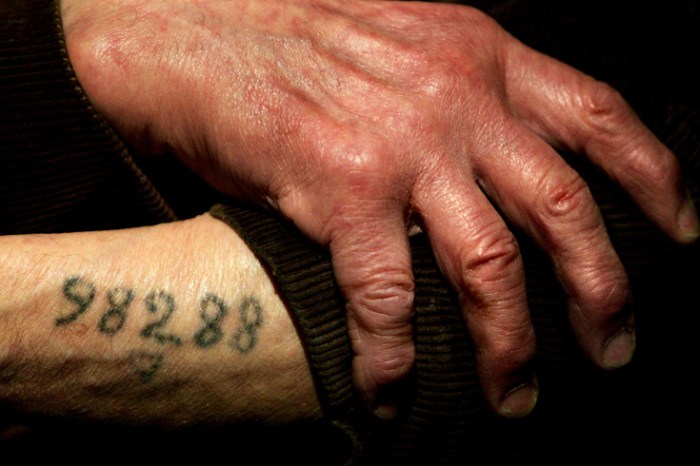
It was just a series of digits scrawled across his withered tan flesh like someone had written a note they didn’t want to forget.
Beneath the copious salt and pepper hairs was a stark number, the darkest stain on his skin.
Gramps is a kindly figure in my mind.
He died before I was even 10-years-old. All I really remember about him are wisps of impressions – his constant smile, a whiff of mothballs, how he always seemed to have butterscotch candies.
And that tattoo.
I think it was my father who told me what it meant.
When he was just a young man, Gramps escaped from Auschwitz. A guard took pity on him and smuggled him out.
His big European family didn’t make it.
My scattered relatives in the United States are all that are left of us.
Those are the only details that have come down to me. And Gramps isn’t here to add anything further.
But his tattoo has never left me.
It’s become a pillar of my subconscious.
The fact that someone could look at my kindly Gramps and still see fit to tattoo a numeric signifier on him as if he were an animal.
A little reminder that he wasn’t human, that he shouldn’t be treated like a person, that he was marked for erasure.
If I look at my own arm, there is no tell-tale integer peeking through the skin. But I am keenly aware of its presence.
I know that it’s there in a very real sense.
It is only the American dream that hides it.
Coming to this country, my family has made a deal, something of a Faustian bargain, but it’s one that most of us have accepted as the price of admission.
It’s called whiteness.
I am white.
Or I get to be white. So long as I suppress any differences to the contrary.
I agree to homogenize myself as much as possible and define myself purely by that signifier.
White. American. No hyphen necessary.
Anything else is secondary. I don’t have to deny it, but I have to keep it hidden until the right context comes to bring it out.
During Octoberfest I have license to be German. When at international village I can root for Poland. And on Saturdays I can wear a Kippah and be Jewish.
But in the normal flow of life, don’t draw attention to my differences. Don’t show everyone the number on my arm.
Because America is a great place, but people here – as in many other places – are drawn to those sorts of symbols and will do what they can to stamp them out.
I learned that in school when I was younger.
There weren’t a lot of Jewish kids where I grew up. I remember lots of cracks about “Jewing” people down, fighting against a common assumption that I would be greedy, etc. I remember one girl I had a crush on actually asked to see my horns.
And of course there were the kids who chased me home from the bus stop. The scratched graffiti on my locker: “Yid.”
The message was clear – “You’re different. We’ll put up with you, but don’t ever forget you are NOT one of us.”
There were a lot more black kids. They didn’t get it any easier but at least they could join together.
It seemed I had one choice – assimilate or face it alone.
So I did. I became white.
I played up my similarities, never talked about my differences except to close friends.
It’s not a result of the color wheel. Look at your skin. You’re not white. You’re peach or pink or salmon or rose or coral or olive or any of a million other shades.
Whiteness has as much to do with color as Red has to do with Communism or Green has to do with environmental protection.
It is the way a lose confederacy of nationalities and ethnicities have banded together to form a fake majority and lord power over all those they’ve excluded.
It’s social protection for wealth – a kind of firewall against the underclass built, manned and protected by those who are also being exploited.
It’s like a circle around the wealthy protecting them from everyone outside its borders. Yet if everyone banded together against the few rich and powerful, we could all have a more equitable share.
But in America, social class has been weaponized and racialized.
You’ll see some media outlets talking about demographics as if white people were in danger of losing their numerical majority in this country in the next few decades. But there’s no way it’s ever going to happen.
Today’s xenophobia is a direct response to this challenge. Some are trying to deport, displace and murder as many black and brown people as possible to preserve the status quo.
But even if that doesn’t work, whiteness will not become a minority. It will do what it has always done – incorporate some of those whom it had previously excluded to keep its position.
Certain groups of Hispanics and Latinos probably will find themselves allowed to identify as white, thereby solidifying the majority.
Because the only thing that matters is that there are some people who are “white” and the rest who are not.
Long ago, my family experienced this.
Before I was born, we got our provisional white card. And if I want, I can use it to hide behind.
I’ve been doing it most of my life.
Every white person does it.
It’s almost impossible not to do it.
How do you deny being white?
At this point, I could throw back my head and shout to the heavens, “I’M NOT WHITE!” and it wouldn’t matter.
Only in a closed environment like a school or a job or in a social media circle can you retain the stigma of appearing pale but still being other.
In everyday life, it doesn’t matter what you say, only how you appear.
I can’t shout my difference all the time. Every moment I’m quiet, I’ll still be seen as white.
It’s not personal. It’s social. It’s not something that happens among individuals. It’s a way of being seen.
The best I can do is try to use my whiteness as a tool. I can speak out against the illusion. I can stand up when people of color are being victimized. I can vote for leaders who will do something to dismantle white supremacy.
But let me be clear: doing so is not the safe way to go.
In defending others you make yourself a target.
I get threats all the time from racists and Nazis of all sorts. They say they can tell just by looking at me that I’m not white at all.
The worst part is I’m not sure what I am anymore.
I don’t go to synagogue. I don’t even believe in God. But I’m Jewish enough to have been rounded up like Gramps was, so I won’t deny that identity. It’s just that I’m more than one thing.
That’s what whiteness tries to reduce you to – one thing.
I don’t want it anymore.
I’m not saying I don’t like the protection, the ability to be anonymous, the easy out.
But it’s not worth it if it has to come with the creation of an other.
I don’t want to live in a world where people of color are considered less than me and mine.
I don’t want to live in a world where they can be treated unfairly, beaten and brutalized so that I can get some special advantage.
I don’t want to live in a world where human beings are tattooed and numbered and sent to their deaths.
I’m out to eat with my family and have just taken a big bite of a juicy beef taco.
That’s when I notice someone standing right next to me at the restaurant.
So I raise my eyes upward, a meat filled tortilla overfilled with lettuce and beans hanging from my mouth, and I’m greeted with a familiar face.
“Mr. Singer!” the woman says with a nervous smile on her lips.
“Do you remember me?”
I think for a moment but realize I have more pressing concerns. I couldn’t reply with an answer to the woman’s question even if I did remember her.
So I chew and swallow and then look again.
“It’s me,” she says. “Tamarind.”
And then it hits me like a flash.
The face in front of me ages backward. The adult eyes soften. The taut cheeks become chubbier. And her whole figure shrinks three feet closer to the ground.
“Oh my God! Tamarind! Of course I remember you!” I say.
She smiles and blushes. I’m surprised by how nervous she is. I’m no one to inspire anxiety. I’m just a guy out with his wife, daughter and father-in-law shoving a taco in his face.
“When I saw you here I just had to come up to you,” she said. “I was in your 6th grade class.”
“I think it was 8th grade, wasn’t it?” I said.
“Yes! That’s right! Eighth grade!”
“How old are you now? My gosh I remember you when you only came up to here off the ground.”
“I’m 22. I’m doing really well. I just wanted you to know that you taught me how to write. If it wasn’t for you I never would have made it anywhere. I just wanted to thank you so much for everything you did for me.”
We chatted a bit more and then she left us to finish our meal.
But, of course, the whole interaction got me thinking.
As a teacher, you are something of a minor public figure.
When you’re out and about – especially if you’re somewhere in your district – you’re bound to be recognized and invariably someone will want to chat.
I remember one time at the bakery counter a former student gave me my order and told me he threw in a few donuts.
I remember laughing and telling him he didn’t need to do that.
“Nah, Mr. Singer, you never wrote me up for falling asleep in your class. You knew I was watching my brothers and sisters at home and never gave me shit for it. You keep those donuts.”
Another time at the theater I was almost late to my movie because I was listening to a former student at the concession stand catch me up on her life and what all of her friends from my class were doing these days.
So many students. So many kids that have now become adults.
You lose track of how many lives you’ve had an impact on.
The first few days of school are always filled with endless administrative meetings. The superintendent welcomes you with testing data. Then your principal breaks it down by building and subject.
You find out which diagnostic exams you have to give your students and when. You find out what your Pennsylvania Value Added Assessment Score (PVAAS) is – how good a teacher you are based on how well your students from last year did on the state standardized test.
On the one hand, I suppose I have no reason to feel like much of a good teacher.
Most of my students didn’t pass the test. They rarely do.
The same number of 7th graders (that’s what I taught last year) passed the reading test as in previous years. However, many more passed that were expected to fail.
The state uses a mystery metric based on Classroom Diagnostic Assessment (CDT) data to come up with a prediction of who they expect to pass and who they expect to fail. No one really knows how they calculate this. For all we know, the state secretary of education could examine a pile of chicken entrails before entering it all into the system.
Does all that data mean I’m a good teacher or not?
I don’t know.
But I do know what Tamarind thinks.
And I know what a host of former students have told me. I know how they react when they see me out in the wild, just living my life.
I’m sure there are probably former students who don’t like me. There must be those who hold a grudge for getting a 59% on an assignment. Or maybe they remember me yelling at them for something. Or – who knows – maybe they just didn’t respond to The Singer Charm.
But an awful lot of people come up to me who don’t have to.
Yesterday was the first day of classes for the year.
For the first time, all my classes were looped. I taught 7th grade Language Arts last year and I’m teaching the 8th grade course this year.
When those kids came into the class on Friday, it was like a homecoming.
So many smiles. So much laughter and joy. And, yes, impromptu hugs.
It felt like a family gathering, not a school function.
As I left the building feeling more exhausted than I have in months, another teacher stopped me.
“Steve! I wanted to catch you before you left!” she said.
She told me that she gave her students a survey in her class as an icebreaker. One of the questions was to name their favorite teacher from last year. My name came up a lot.
He hates science. He hates schools. He hates teachers. And if students get in the way, he’ll hate them, too.
These are the qualities he thinks Pennsylvanians are looking for in their next governor.
The York Township Republican will challenge incumbent Democrat Tom Wolf on Nov. 6, 2018.
So who is this guy?
Wagner’s a college dropout who made a fortune starting a garbage hauling firm. He became a state senator four years ago after winning a write in campaign during a special election where only 17% of the electorate could be bothered to vote.
And ever since, he’s been consistent about one thing: he really, Really, REALLY hates teachers.
“We have 180,000 teachers in the state of Pennsylvania,” Wagner said in 2015. “If we laid off 10 percent of the teachers in the state of Pennsylvania, we’d never miss them.”
That’s a deficit we still haven’t recovered from. Even today, state schools are staffed at a 10-year low. Class sizes are at an all time high.
Yet Wagner wants to fire even more teachers!?
That’s not the policy of a man who wants to help improve life throughout the state for all. That’s not the policy of a man who wants to help kids learn.
It’s the policy of a man who has a personal grudge against educators.
And his other legislative objectives?
Wagner wants to further slash education funding. He wants to spend whatever is left inequitably. And he really wants to help his heroes Donald Trump and Betsy DeVos enact school vouchers so business people like him can continue to cash in on children from Pittsburgh to Philadelphia and all places between.
By contrast, in his four years in office, Gov. Wolf has pushed to increase education funding, pushed to spend it more fairly, and even cut the time it takes for students to take high stakes standardized tests.
The good news: voters throughout the Commonwealth have never had a clearer choice for governor.
The bad news: when has that ever stopped them from getting it wrong?
“We have created a special class in this state and the special class is the public sector union employee,” Wagner told Keystone Crossroads in a 2015 interview.
“Teachers are doing very well in this state,” he said. “People would be appalled if they knew what their teachers made, in certain areas.”
Unfortunately, Wagner has no idea, himself.
He keeps quoting a bogus salary figure that I’m not going to repeat. It’s not true statewide, it’s not an average, nor is it true in his home district.
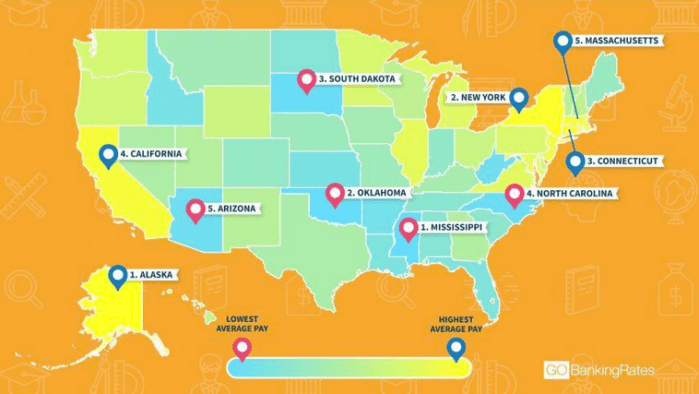
In truth, the low end for teachers entering the field nationwide is around $30,000, according to the National Association of Colleges and Employers (NACE). So go to college, get a four – sometimes five – year degree including a rigorous internship of student teaching and you make a mere $10,000 above the most generous minimum wage!?
According to that data, Pennsylvania teachers make on average $63,063 per year. Of neighboring states, teachers in Maryland ($65,247) and New Jersey ($71,687) make more. Teachers in Ohio (59,063) and Delaware ($59,853) make less.
Highest and Lowest Teacher Salaries – Source: GoBankingRates
As everywhere else, many teachers struggle to make ends meet working multiple jobs while others are well compensated.
No matter how you slice it, nationwide teachers’ salaries are 14% less than those from professions that require similar levels of education, according to the Economic Policy Institute.
In other words, if prospective teachers want to make more money, all they have to do is switch majors.
That may be part of the reason for our national teachers shortage. Not only have states like ours laid off tens of thousands of educators, many don’t stay in the field if given the chance. Across the country , 46 percent of educators quit before reaching the five year mark. And it’s worse in urban districts, where 20 percent quit every single year!
So forcing sick teachers to come to school and spread the germs to children is fine with Wagner as long as it hurts his nemesis – those evil teachers.
He Wants to Cut Teachers Pensions
He also plans to end pensions for working educators, and even wants retired educators to give back 10% of the retirement they earned.
He’s right to want reform to the state pension system but disingenuous or misinformed about the cause.
Pennsylvania pension costs have increased primarily because our legislature made bad plans and bad investments that were upended by the crash of 2008. You don’t fix that by stiffing your employees. If you do that, no one will believe any promises the state makes and no one of any substance will want to work for the state.
He Wants To Pay Teachers Based on Student Test Scores
“There are teachers that will exceed expectations while teaching a classroom of 100 of the toughest-to-teach students. There are also teachers that would struggle to teach just one student at a time. I want the first teacher to make a small fortune, and I want the second teacher to find a new career that is better suited for him or her.”
So if you teach the best students, you should make the most money? And if you teach struggling students, you should be fired?
But It’s Not Just Teachers. He Hates Other Working People, Too
If there is a corner to cut, he wants to take it – especially if it screws a working person. As a state senator, Wagner even introduced a bill that would exempt school districts from paying laborers the “prevailing wage” on construction projects.
Cheaper labor, shoddier work. That’s surely a recipe for success in buildings housing school children!
He Wants to Disband Unions
Oh, but he’s not done.
The man who once compared the tactics of public employee unions – including those representing teachers – to those of Adolf Hitler and Vladimir Putin also wants to end tenure end tenure, seniority, and disband unions.
I’m sure reducing teaching to a career without benefits, workers rights or protections will do wonders for the educational quality students receive.
Teachers working conditions are students learning conditions. Putting children in a building that has fewer safety precautions because there’s no union to collectively bargain for them is a great way to cut costs. But parents aren’t thrilled about having their kids try to learn in a sweat shop filled with Trump brand Russian asbestos.
Charter schools, funding private and parochial schools with public tax dollars. He’s in for all of it.
So long as it hurts public schools and enriches private businesses without helping students learn at all.
Go ahead! Take scarce funding from public schools and divert it to programs with little to no accountability. Let private school operators fraudulently misrepresent enrollment data. Let them fail to provide safe and academically appropriate learning environments. Let them game the system in any and every way.
That’s what Wagner calls fiscal accountability.
It doesn’t matter that these schools don’t improve student achievement. Evaluations of voucher programs in Milwaukee, Cleveland, and Washington, D.C., have all found no statistically significant differences in the academic achievement of voucher students compared to public school students. And recent evaluations of programs in Ohio, Indiana, and Louisiana revealed that voucher students scored lower than their peers attending public school.
But who cares about facts? This is all ideology for Wagner.
Vouchers have a record of undermining student’s civil rights – especially students with disabilities. Private school students give up due process and other rights guaranteed in public schools. Private schools are allowed to discriminate by denying admission based on religion, sexual orientation, citizenship status, English language proficiency and disability. Private schools that enroll students with disabilities may decide not to provide the services or accommodations guaranteed to such students in public schools. Or they may charge parents extra for them. Moreover, there is nothing to stop them from segregating these kids from other children. And, finally, private schools often suspend or expel students without due process.
This may be Trump and Wagner’s ideal. But it is certainly not what Commonwealth voters want for their children.
He Wants to Get Rid of Many State Colleges
Wagner caused an uproar when he said the state’s 14 state colleges will not be around in four years. “So, for those of you who think your school’s going to be around four years from now, it isn’t going to be around,” Wagner said.
Fewer institutions of higher learning. Fewer opportunities to get a college degree. That sounds like the policy of a college dropout.
“They think the solution is more money,” he said of Wolf and the Democrats. “Every time you do that the money disappears and the problem is still there.”
It’s like taking a bath, Scott. You can’t just do it once and be clean for the rest of your life. You need to bathe every day. One-time funding windfalls don’t work. You need equitable and sustainable funding revenues.
But that’s either too complicated for Wagner or he just doesn’t care.
He supported Gov. Corbett’s plan to decimate Pennsylvania’s schools. And he doesn’t think the culling should be over.
When asked point blank about Corbett’s cuts in 2011, he said, “Yes, I believe that Governor Corbett needs to stick to his plan.”
He’s said repeatedly that we spend “enough money” on public schools, while stressing the need for frugality and fewer regulations.
He Wants to Play with How Schools Are Funded
He’s an advocate for legislation that would eliminate school property taxes and replace them with increased state sales and income taxes.
True we need a better funding mechanism than local property taxes. But you can bet Wagner’s plan is worse than the current system.
It would lock funding inequities among Pennsylvania’s 500 school districts into place.
He Thinks Global Warming is Caused by the Earth Getting Closer to the Sun
Wagner is an incredibly stupid man who thinks he’s rather intelligent.
But of all the dumb or evil things that come spewing out of his mouth, this one has to be my favorite.
When asked about global climate change, he didn’t simply deny that it was happening. He had an alternative theory to why it was taking place.
It’s not business and industry or fossil fuels that is causing global temperatures to rise. He actually said that it’s because the earth is getting closer to the sun every year. Another cause? Human bodies on the planet are giving off enough heat to raise the global temperature.
Perhaps it shouldn’t be surprising that a person who hates schools and teachers so much knows very little, himself.
These comments made him a national laughing stock.
His words were repeated on every late night comedy show across the country for giggles and guffaws.
The question is “Will the joke be on us come Election Day?”
It’s not “How dumb is Scott Wagner?”
It’s “Is Pennsylvania dumb enough to vote for him?”
NOTE: Special Thank you to Sue Goncarovs for the Wagner cartoon with which I began this piece. I love your work!
I teach mostly students of color in a western Pennsylvania public school. I write a blog about education and issues of prejudice. And I participate in social justice campaigns to try and redress the inequality all around me.
But in my quest to be an anti-racist, one of the most common criticisms people hurl my way is to call me smug:
You think you’re so perfect!
You’re just suffering from white guilt.
You love black people more than your own people.
Things like that.
Well, I’ll let you in on a little secret.
I make mistakes.
All. The. Time.
I am just like every other white person out there. But I have recognized certain facts about my world and I’m trying to do something about them.
And it’s getting worse. Hate crimes have jumped from about 70 incidents a year in the 1990s to more than 300 a year since 2001. And after Trump was elected, 900 bias-related incidents were reported against minorities within the first 10 days.
It does not make me special that I am trying to do what little I can about that. It just makes me human.
That’s it.
I am not perfect.
I am no better than anyone else.
But I am trying to do the right thing.
When I first became a teacher, I had the chance to go to the rich white schools and work with the wealthy white kids. I hated it.
I found that I had a real affinity for the struggling students, the poor and minorities.
Why? Probably because I have more in common with them than the kids who drove to school in better cars than me, wore more expensive clothes and partied with designer drugs.
Does that make me better than a teacher who stayed in the suburbs? No. But hopefully it gives me the chance to make a greater difference against white supremacy.
When I saw how unjust our school system is, I could have gotten out. Law school was definitely an option. So was becoming a technical writer or a job as a pharmaceutical ad rep.
Does that make me better than teachers who kept plugging away at their jobs but didn’t rock the boat? No way. But hopefully I have a better chance at helping change things for the better.
It was a hard battle that made me do things I was not at all comfortable doing. You try asking a public servant on camera to break the law and go to jail for what he knew was right.
Some people look at that and other accomplishments and think I’m conceited.
They say I’m a white savior hogging the spotlight for myself and keeping the very people I’m trying to help in my shadow.
That’s not my intention at all.
I wouldn’t be anywhere without the help and support of people of color.
Everything I’ve done in this fight has been with their help and encouragement.
Does that mean I’m impervious to making a racist comment? Does it mean I’ve never participated in a microaggression? Does it mean I see every racist impact of my society and my place in it?
Absolutely not.
I screw up every day.
Multiple times.
But that’s the point. You don’t have to be perfect. You just have to try.
The chapter on “White Supremacy Culture” should be required reading for every activist organization or budding civil rights warrior.
The authors offer a list of characteristics that stem from white supremacy that can affect even the best intentioned of groups and individuals. These norms are difficult to name or identify but can lead to major dysfunction:
“They are damaging to both people of color and to white people. Organizations that are people of color led or a majority people of color can also demonstrate many damaging characteristics of white supremacy culture.”
And the number one characteristic is Perfectionism.
This involves the following bullet points:
“little appreciation expressed among people for the work that others are doing; appreciation that is expressed usually directed to those who get most of the credit anyway
more common is to point out either how the person or work is inadequate
or even more common, to talk to others about the inadequacies of a person or their work without ever talking directly to them
mistakes are seen as personal, i.e. they reflect badly on the person making them as opposed to being seen for what they are – mistakes
making a mistake is confused with being a mistake, doing wrong with being wrong
little time, energy, or money put into reflection or identifying lessons learned that can improve practice, in other words little or no learning from mistakes
tendency to identify what is wrong; little ability to identify, name, and appreciate what is right”
Solutions offered to this problem are:
“Develop a culture of appreciation, where the organization takes time to make sure that people’s work and efforts are appreciated;
develop a learning organization, where it is expected that everyone will make mistakes and those mistakes offer opportunities for learning;
create an environment where people can recognize that mistakes sometimes lead to positive results;
separate the person from the mistake;
when offering feedback, always speak to the things that went well before offering criticism;
ask people to offer specific suggestions for how to do things differently when offering criticism.”
These are things we should keep in mind as we try to move forward in this fight.
Certainly white people can be resistant to criticism and see any and every comment or appraisal as personal or demeaning – especially if that remark is made by a person of color.
Frankly, white people need to get a thicker skin about it. We need to realize that this impulse to personalize analysis is often a psychological attempt to avoid looking at oneself and what unconscious aspects of the social order one has internalized.
However, those offering criticism must realize that context is everything. We must create an environment where such remarks are constructive. Otherwise, they’ll do more harm than good.
None of this is easy.
But if we want to be anti-racists, that’s not the job we signed up to do.
Not his political victories. Not the failures of his opposition.
But the very fact that this piece of shit is President of the United States – that fact sits on my brain like an insect I can’t swat.
On those days my belief in this country wavers and disappears.
Oh, I’ve always recognized its faults, how our reality hardly ever lived up to our ideals. But I also thought that the United States was populated by mostly good people who knew right from wrong.
To run this country we wouldn’t choose an obvious conman, a racist and sexist, a person of low IQ, a man with little to no experience, a reality TV star. We wouldn’t let him pick the next Supreme Court justices. We wouldn’t give him the power to pardon whomever he likes. We wouldn’t give him the ability to write almost whatever he wants into law through signing statements. And we certainly wouldn’t give him the nuclear codes.
But we did.
We did all of that.
Or we allowed it to happen by ignoring a broken electoral system that overturns the popular vote with frightening regularity.
So there he sits in the Oval Office – when he isn’t on vacation at Mar-a-Lago – like a smear of feces on the American flag.
The D.C. Counseling and Psychotherapy Center has identified it as a “collective politically induced anxiety among patients.”
Apparently, Trump’s name comes up frequently in sessions with mental health professionals. Patients say they feel on edge because of the President’s ill-chosen, childish and undiplomatic words, fear of his bad decision making, and anxiety over his xenophobic and prejudicial policies.
Trump Anxiety Disorder is not yet an official diagnosis, but symptoms seem to include lack of sleep, a feeling of losing control and helplessness in an unpredictable political scene, along with endless negative headlines and excessive time spent on social media.
Elisabeth LaMotte, a therapist at the Washington, DC, center, said, “There is a fear of the world ending. It’s very disorienting and constantly unsettling.”
I’m not sure I fear that Armageddon is close at hand, but I certainly feel like the world I thought I knew is unraveling.
Fox News was quick to frame this story as a joke – those silly “libtards” are losing their minds over Trump. But it’s not just people on the left who suffer from the disorder, says LaMotte.
Many Trump supporters feel isolated from friends and family who don’t blindly follow their diminutive Furor. I guess it’s hard to pal around with someone who thinks it’s completely justified to separate children from their parents and lock them up in cages – unless you think the same thing.
Even the American Psychological Association (APA) has recorded a rise in anxiety since the 2016 election that increases depending on how political a person is regardless of affiliation.
The APA also noted that electronic news consumption increases that risk.
In my own case, my symptoms manifested physically on Election Day, itself.
In the months since, I’ve run that decision over in my mind a million times.
Was I right? Was I wrong? Could I have given Trump the margin of victory with my one stupid vote?
When I examine all the information I had at the time, it still makes sense.
The media was telling us that there was no way Trump could win. Clinton was going to come storming into the White House and continue or worsen the neoliberal policies of Barack Obama.
As a school teacher, I was concerned that she would continue to wage war on public education – she would continue to boost charter schools and standardized testing while shrugging at funding inequity, increased segregation and the school-to-prison pipeline.
It’s not that I didn’t realize Trump would be worse. It’s that I didn’t think Clinton would be that much better.
But had she won, I don’t think I would be suffering the same anxiety.
We would have a sane and sensible leader who wouldn’t do anything much to make things better, but certainly wouldn’t be plunging us into an abyss. She wouldn’t betray every single American value while blatantly using her office for personal gain and gaslighting anyone who had the temerity to point out what was happening in plain sight.
Even if my position as a blogger who criticized Clinton (and Trump) convinced thousands of voters to cast ballots like I did, I could not have significantly affected the outcome.
But on those days of doubt and depression, I still feel guilty.
This is not the world I want to live in.
Things would be different if I thought there were any real hope of change.
Sure Trump may be defeated. If there’s a blue wave in the midterms, the orange one may be impeached. Or he may find it increasingly difficult to continue his corruption and be ousted in 2020.
Don’t give me this false equivalency crap. I’m not saying they’re the same. The Democrats are unequivocally better. But with the exception of social issues, their policies are almost the same as Republicans. The only difference is timeframe.
Republicans will destroy the world tomorrow. Democrats will destroy it next week.
I desperately want to believe that insurgent progressives like Alexandria Ocasio-Cortez and Zephyr Teachout will somehow wrest control of the Democrats and steer the party back to real populist goals, but on most days it’s hard to keep that hope alive.
On those days it seems like the rich and powerful own our government and will never allow us to take it back no matter how many of us try to vote, no matter how often we take to the streets, no matter what we do.
He was stopped by a U.S. District judge in Seattle who temporarily banned the plans from publication on the Internet this week following a last-minute lawsuit filed by seven state attorneys general.
The issue will go back to court on August 10, when the sides will discuss whether a preliminary injunction is needed.
The whole matter was almost settled in 2013 when the Obama administration originally stopped Wilson from putting his plans online with a lawsuit. After years of back and forth, the federal case against the virtual arms merchant seemed like a slam dunk. Then Donald Trump came into office and not only stopped the suit but paid Wilson $40,000 in damages.
So the question remains – why would any sane human being want to post a do-it-yourself gun kit on the Internet where any criminal, psychotic or violent fanatic could easily access it?
Wilson says he’s not in it for financial gain. He wants to make a political point – to flood the world with so many cheap, untraceable guns that the idea of passing any kind of regulations on them would be impossible.
“All this Parkland stuff, the students, all these dreams of ‘common sense gun reforms’? No. The Internet will serve guns, the gun is downloadable. No amount of petitions or die-ins or anything else can change that.”
Not only that, but the owner and founder of Defense Distributed, an Austin, Texas, based start up that pretends to be a nonprofit organization, says he is prepared to kill police and federal agents if the courts don’t continue seeing things his way.
In the same Wired interview, he says he wasn’t expecting support from the Trump administration. He expected Hillary Clinton would win the White House in 2016 and that she would continue to oppose his 3D printed firearms.
“If that happened, as Wilson tells it, he was ready to launch his [3D printed gun] repository, regardless of the outcome of his lawsuit, and then defend it in an armed standoff. “I’d call a militia out to defend the server, Bundy-style,” Wilson says calmly, in the first overt mention of planned armed violence I’ve ever heard him make. “Our only option was to build an infrastructure where we had one final suicidal mission, where we dumped everything into the Internet,” Wilson says.”
So let’s be clear about one thing – the guy pushing for 3D printed firearms is literally a terrorist imitator.
He is an American extremist. He is to us as Osama bin Laden is to mainstream Muslims.
Or at least he wants to be that.
While we’re rounding up brown people and separating them from their children without any workable plan to reunite them on this or that side of the border, we have a US citizen making terroristic threats with the means to carry them out and he’s walking around free.
It’s hard to make a 3D-printed gun. You need an expensive, top-of-the-line 3D printer and some knowledge of how to work it. And even then the result is a shoddy firearm at best. It may only fire a few bullets before falling apart.
A shooter would have to work extra hard to accomplish his goal with Wilson’s design. It would be much easier to use one of the billions of firearms already available – and much more deadly.
But it wouldn’t take much to make a 3D-printed gun more dangerous.
Moreover, technology is always advancing – 3D printers will probably be able to create stronger and more deadly firearms in time. With these sorts of designs readily available, it is easy to imagine a school shooter accessing a device in a tech or computer lab and creating a weapon of mass destruction. He wouldn’t set off any alarms because he wouldn’t have the gun when he entered the building. He’d make it in school.
Some shrug at these dangers saying that they’re inevitable.
Even if we stop Wilson, these sorts of designs will eventually be available in some form on-line. That’s the double-edged sword of mass media – all information is available including easy ways to kill a large number of people.
However, I think this is a cop-out.
For instance, the Internet and computer technology make it fairly easy to mass produce currency as well as firearms. In fact, it’s theoretically much easier.
Yet we don’t see a major influx of counterfeit bills. The reason? Business and industry have collaborated with government to make sure this doesn’t happen.
Programs like Adobe Photoshop include software that restrict the printing of your own money. We could do the same with future 3D printers. We could recall those already in service and retrofit them with such code.
Oh, sure not everyone will comply. There will always be someone who breaks through the safety net. But if all we can do is greatly reduce the spread of 3D-printed firearms, that doesn’t make it futile.
A yellow flag showing a coiled spring of a snake above the motto, “Don’t Tread on Me.”
In my usually well-manicured suburb, you’ll find it waving bravely over the garbage house.
There’s three broken down RVs sitting on the lawn, a busted sofa in the back yard, a rotten picnic bench and several rusted out vehicles in various states of disrepair.
I’m not sure why the owners think anyone would want to tread on them. We’d much rather walk quickly on by without being seen or commented on.
Because in my experience that’s the thing about most of the people who fly this flag.
They’re indignant about anyone stepping on their rights but all too ready to step all over yours.
I remember it wasn’t really too long ago that this flag had no such connotations.
It was simply the Gadsen flag, a relic of the American Revolution. It was nothing more than a reminder of a time when we cherished our national independence from Great Britain and wanted to make sure they knew we didn’t want the King to come back and start ordering us around.
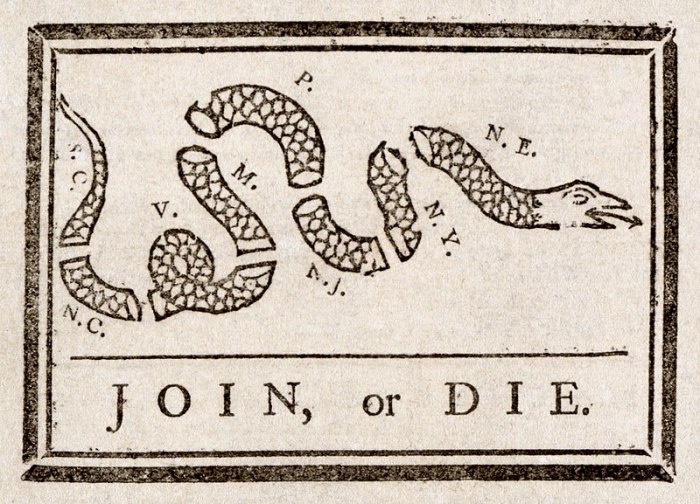
In fact, it was designed by American general and politician Christopher Gadsden in 1775. This “Sam Adams of South Carolina” modeled his patriotic statement first used by the Continental Marines on an earlier famous cartoon from Benjamin Franklin’s Pennsylvania Gazette.
You’ve probably seen it. A snake is cut into several pieces – each representing one of the colonies – with the motto, “Join or Die.”
So originally it was a call for unity, perhaps even federalism. It was a way of framing the argument that we’d be stronger as one nation than as a group of separate states.
Gadsen’s version was really a continuation of that same thought. It was as if he were saying, “Here we are, one unified nation ready to strike to protect itself from tyranny.”
It wasn’t until 2009 that Gadsen’s flag became associated with the radical right.
Like so many hitherto nonpartisan symbols, it was appropriated by the Tea Party movement, which tried to cast their libertarian extremism as somehow harkening back to the American Revolution.
Even the name Tea Party is a misnomer. The original Boston members of the Sons of Liberty who threw British tea into the harbor in 1773 were protesting taxation without representation. Modern day Tea Partiers were protesting the taxes levied by their own duly elected representatives.
They were poor people duped into thinking the rich paid too much despite the fact of gross income inequality and the wealthy not paying their fair share.
It’s this willful ignorance that typifies the contemporary right.
The truth doesn’t matter. It only matters what can be spun into a pithy sound bite that can be broadcast on Fox News or some other propaganda source and then repeated ad infinitum in place of any real debate or conversation.
To be fair, the left does it, too, but not nearly to the same degree.
When a topic makes the rounds of the 24-hour news cycle, you can hear the same canned responses from right and left on just about every channel regardless of who is speaking. The only difference is that the left usually makes at least passing reference to reality while the right closes its eyes and says whatever it believes to be true with perfect conviction.
The Gadsen flag is a perfect example of this hypocrisy.
The motto “Don’t Tread on Me” has come to mean radical individual freedom.
I can do whatever I like and there’s nothing you can do about it.
I can own as many guns as I like. I can teach my kids whatever facts I like. I can discriminate against anyone I like.
But there’s never a mention about other people except to limit what they can do in relation to the speaker.
In short, there’s nothing explicit about making this rule universal – I won’t tread on you if you won’t tread on me.
It’s just don’t tread on me and I’ll do whatever I like in relation to you.
After all, many of these personal freedoms the radical right cherishes actually do impact the rest of us.
This kind of sanctimonious duplicity has real world consequences.
Unarmed black people are shot and killed by police at a much higher rate than white people. Yet you won’t tolerate any protest, condemnation or protest. People can’t assemble in the streets, athletes can’t kneel during the national anthem, you won’t even allow the slogan “Black Lives Matter,” because you say, “All Lives Matter,” while in reality you mean “All Lives Except Black Ones.”
You oppose abortion but no one is forcing anyone to have abortions. In your headlong crusade for individual freedom you want to ensure that others don’t have this choice because they might choose differently than you. Or at least they might choose differently than you SAY you do, because when the light of day is cast upon you, we find an alarming number of hypocrites here, too.
You look to your self-interest, and I’ll look to mine, and that’s what’s best for everyone.
However, they forgot that everyone doesn’t have the same power – physical, social, financial or political. Some people are strong and some are weak. Some are rich and some are poor. If you pull the shortest straw at the lottery of birth, you won’t be able to get the same things for yourself as those who won it as soon as the doctor slapped their newborn bums.
So we have layers and layers of class and economics. We have social structures designed to keep black people here and Hispanics there and white people at the top. We have a society that worships the rich and bedevils the poor. We have belief systems that praise one kind of sexuality only and demonizes anything that diverges from that norm. And the most defining thing of any newborn baby is what you’ll find between its legs.
“Don’t Tread on Me” has become a farce.
It’s a maxim hoisted on those with very little individual power to convince them to join together and become powerful while guarding the door for the wealthy.
They sit atop their mountains of trash as if they were dragons on piles of gold.
And they point their pitchforks at the rest of us as if we wanted a piece of it.
In this way, they make themselves the willing patsies of the ruling class.
It’s a sad thing to behold.
Because if we all just stopped for a second and recognized our common humanity, we’d agree that the status quo is unacceptable.
If we were more concerned about the rights of all than just our own rights, we’d agree that the wealth of this great nation has not been fairly distributed.
The snake is coiled and ready to strike but it is pointed in the wrong direction.
It shouldn’t be pointed at 99% of us. And it shouldn’t be so solitary.
It should be a sea of snakes, a great slithering mass of humanity, hissing and spitting with venom, our reptilian eyes focused on the elites.
East Pittsburgh, the neighborhood where his car was stopped and where he ran from officers before being shot three times in the back, is minutes from my house.
He went to Woodland Hills School District, minutes from my house.
If he hadn’t been in that car, he’d still be alive. If he hadn’t run from police, they wouldn’t have shot.
Maybe. Maybe not.
But being in the wrong place at the wrong time shouldn’t bring with it a death sentence. Running away shouldn’t bring with it the finality of the grave.










 gadflyonthewallblog