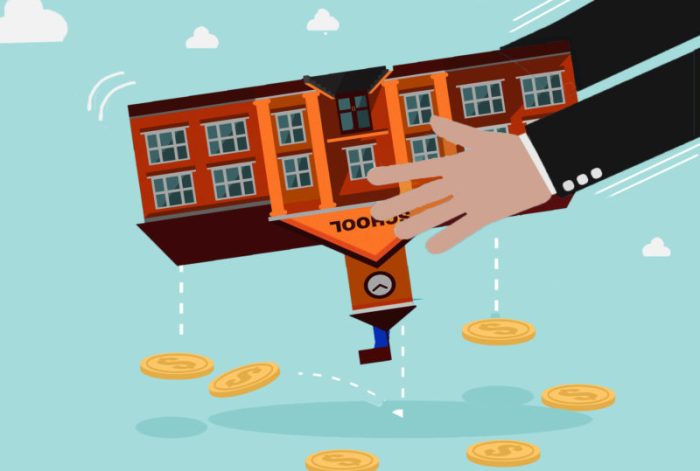
Mr. and Mrs. Public School Sabotage


Screen Shot 2017-10-27 at 1.35.14 PM


America’s public schools are in crisis.


Because people make money when America’s public schools are in crisis.


And who sits atop this mountain of bribery and malfeasance?


Who gives the money that buys the politicians who make the laws that hurt the kids and profits the donors?


It’s none other than Mr. and Mrs. Public School Sabotage!


Systemic underfunding, laissez-faire segregation and privileging privatization – this is what our children face every day.


It’s time we as a nation stop, take a moment – and offer our hearty congratulations to this years most pernicious saboteurs.


And what a year it was for disrupting education!


Charter schools, voucher schools – no one has benefited more from chucking the public school model in the trash in favor of control by corporations and bureaucrats than Betsy DeVos.


Because she’s both a dark money influence peddler AND a government flunky!


A two-for!


She turned complete ignorance and animosity toward public schools into the highest federal government job overseeing education! Her only qualification? CA-CHING!


But coming up right behind Ms. DeVos is this year’s crowned king.


He certainly knows a thing or two about CA-CHING!


It’s Bill Gates!


Progressive philanthropist by day, by night he transforms into the largest single purveyor of palm grease in the nation. No one has turned tax avoidance into influence more than Gates, the money behind the Common Core, evaluating teachers on student test scores and a plethora of irrational, untested ideas that are only considered mainstream because they have literally trillions of dollars behind them.


So there you have it, America! Your Mr. and Mrs. Public School Sabotage!


Let’s take a closer look at these… winners.


DEVOS


As U.S. Secretary of Education, she’s proposed cutting $10 billion in public school funding, announced changes to make it harder for college students to report sexual assaults, and put struggling university students at risk of higher debt payments with changes to student loans.


But that’s child’s play for the billionaire heiress who married into even more money.


Now she’s planning to weaken the rights of students with disabilities.


That’s right – Jason Vorhees, Michael Myers, Freddy Kruger, they all went after those pesky post-graduate teenagers. But none of them had the audacity to go after kids with learning disabilities!


It’s not that DeVos is undoing any laws. She’s erasing decades of government guidance about how the laws are to be interpreted. And though she claims these 72 directives are simply “outdated unnecessary or ineffective,” she’s not replacing them with anything else. They’re just – gone.


Of the 72 guidelines, 63 affect special education and 9 affect student rehabilitation. And these aren’t simply undoing the work of the Obama administration. Some of these regulations have been in place since the 1980s.


The rescinded policies include “Satellite Centers for Independent Living,” “Nondiscrimination on the Basis of Handicap in Programs and Activities Receiving or Benefiting From Federal Financial Assistance,” and “Information on the Provision of Vocational Rehabilitation Services to Individuals With Hearing Loss (Deaf and Hard of Hearing).”


Bah! Who needs all this paperwork?


Parents and students. That’s who.


These guidelines have helped parents of disabled and special education children advocate for their young ones’ rights. Without them, it may be more difficult for parents and teachers to ensure all children are receiving a free and appropriate education.


That’s some seriously stone cold sabotage, Ms. DeVos!


But at least her motivation is obvious to anyone with eyes.


She’s not purposefully making the lives of K-12, special education and college kids more difficult. Well, she is, but she’s not doing it out of spite. She’s doing it because it helps her investment portfolio.


How can she continue to promote charter and voucher schools that don’t provide the same kinds of quality services for special education and disable students as public schools do? She needs to degrade what the public schools provide, thereby making the privatized alternatives more marketable.


How can she keep making money off predatory lenders unless she loosens the rules to allow them more freedom to gorge on student debt? And how can she keep her lucrative job bending the rules in her favor unless she throws some red meat to the racists, misogynists and anti-Semites who helped elect her boss into the Oval Office?


And if kids get hurt, well those aren’t the people she’s looking out for, are they?


She’s only out for the other rich elites like herself making a mint off of our public tax dollars!


It’s almost enough to make you miss Arne Duncan.


Almost…


(Nah. Not really.)


GATES


Bill Gates, on the other hand, is more contrite.


His Common Core initiative has kind of exploded in his face.


No one likes it. NO ONE.


In fact, it was one of the key talking points President Trump used to garner support. The public’s hatred of Democratic plutocracy made them suckers for the Republican variety.


The problem isn’t so much political. It’s economic.


It’s rich people who think they can do whatever they want with the rest of us and our children.


More than anyone else, Gates is guilty of that kind of unexamined, unrepentant hubris.


Yet to hear him talk, after a string of education policy disasters, he’s learned his lesson.


He’s sorry – like a crack addict is after hitting rock bottom. But he’ll somehow find the courage to light up again.


Gates now admits that the approximate $2 billion he spent pushing us to break up large high schools into smaller schools was a bust.


Then he spent $100 million on inBloom, a corporation he financed that would quietly steal student data and sell it to the corporate world. However, that blew up when parents found out and demanded their children be protected.


Oops. His bad?


He also quietly admits that the $80 million he spent pushing for teachers to be evaluated on student test scores was a mistake. However, state, federal and local governments often still insist on enacting it despite all the evidence against it. Teachers have literally committed suicide over these unfair evaluations, but whatever. Bill learned a lesson.


When it comes to Common Core, though, Bill refuses to take his medicine – even to mouth the words.


By any metric, these poor quality uniform academic standards are an abject failure. He spent hundreds of millions of dollars for development and promotion. He influenced trillions of taxpayer dollars to be poured down the drain on it. All to no avail.


Instead, he’s quietly backing away. No explanation. No apology. Just on to something new.


Kind of like: “That didn’t work. Let’s try something else!”


His new plan – spend $1.7 billion over five years to develop new curriculums and networks of schools, use data to drive continuous improvement, and give out grants to high needs schools to do whatever he says.


What’s so frustrating is that Gates shows glimmers of self-awareness.


“It would be great if our education stuff worked, but that we won’t know for probably a decade,” he said during a speech at Harvard in 2014.


But then when he sees it isn’t working, he just doubles down on the same crap.


While he may not be committed to any one policy, Gates is committed to the idea that he knows best. Whatever nonsense bull crap that floats through his mind deserves to be tried out on a national scale.


No asking experts. No asking teachers, parents or students. Just listen to me, Bill Gates, because I’m rich and that makes me better than you.


No, it doesn’t Bill. It makes you just like Betsy DeVos.


So there they are. Mr. and Mrs. Public School Sabotage.


Short may their reign be.


“They were careless people, Tom and Daisy – they smashed up things and creatures and then retreated back into their money or their vast carelessness or whatever it was that kept them together, and let other people clean up the mess they made.”

-F. Scott Fitzgerald, The Great Gatsby
Stupid Ass School Voucher Bill Back for Pennsylvania Vote Tomorrow

Shake the world to make money


Close your eyes and imagine a school like the one where I teach.


The public middle school is right next door to a Catholic middle school.


Some of the wealthiest families send their kids to the religious school. The rest send their kids to the public school.


Now imagine that the state passes a school voucher bill.


Those wealthy families can now use public tax dollars to help fund their kids’ Catholic school tuition.


A truckload of taxpayer wealth would be redistributed away from the public school and into the religious one.


And this is for children who weren’t attending public school in the first place.


Imagine what an impact that would have on the two schools. At the Catholic middle school, not much would change. At most a few more kids might enroll. And wealthy parents would get to pay less in tuition.


At the public middle school, however, the results would be disastrous. It would have to survive on much less funding than it was already receiving. Services for the majority of students in the district would be degraded. Class sizes would balloon. Educational quality would take a nose dive.


So why wouldn’t more kids from the public school move to the Catholic one?


Well, first of all, few kids in the district are Catholic. Should they be forced to be indoctrinated in a faith in which they don’t believe?


Second, tuition at the Catholic school costs more than the price of the voucher. Parents would have to pay above and beyond what they’re paying now to make tuition at the Catholic school. And this is a mostly poor neighborhood. Parents simply can’t afford it.


THIS is the situation the Pennsylvania Education Committee will vote on tomorrow.


The committee will decide whether State Sen. John DiSanto’s school voucher bill should be voted on by the state Senate and House.


School vouchers are not popular at both the national and state level.


Around 70% of people across the country oppose school vouchers, according to the PDK-Gallup public opinion poll about U.S. education.


Moreover, Harrisburg wastepaper baskets are lined with school voucher bills that fail to pass despite being introduced every few years.


DiSanto’s bill is called Education Savings Accounts for Students in Underperforming Schools or SB 2.


And guess what!?


It’s almost exactly the same as a pile of similar bills offered by the American Legislative Exchange Council (ALEC).


The Special Needs Scholarship Program Act, The Foster Child Scholarship Program Act, “Opportunity Scholarships,” The Smart Start Scholarship Program – all ALEC bills that do almost the same thing.


They designate some group of at risk students and say, “Hey, you know what they need? School vouchers!”


Well, my goodness. I’m sure glad DiSanto didn’t stress himself out writing something new. I’m certain his constituents wanted him to plagiarize someone else’s bill and pretend like it was his own.


And how exactly will spending public tax dollars on non-public schools help these kids succeed? That’s never explained.


Fools like DiSanto just pretend that it will help as a matter of faith. And since the overwhelming majority of school vouchers go to religious school coffers, this makes sense.


It is a blatant violation of the separation of church and state. But privatization supporters don’t give a crap about that. They don’t care about the values on which this country where founded. Their only concern is doing what their rich donors demand.


SB 2 would target students living in districts with the most underfunded schools serving the most impoverished populations. You know – “failing schools.”


If passed, kids living in these neighborhoods would have whatever the district sets aside for each student put in a savings account to be spent in almost any way parents see fit so long as they could somehow justify it as educational.


Send your kids to a private or parochial school?


Sure!


Homeschool your child?


Yep!


Go on a trip to the life-sized replica of Noah’s Ark in Williamstown, Kentucky?


You betcha!


And the best part is there is hardly any accountability built in to the law, so we probably wouldn’t even know how this money was spent.


Your tax dollars at work. Somehow. Somewhere. Out of sight.


I guess that’s what Pennsylvania Republicans like DiSanto call fiscal conservatism.


If passed, the bill would affect 800 schools – the 15% lowest performing in the state – including mine.


Take a look at the list.


Every school serves mostly poor students. Every school is severely underfunded.


Pennsylvania ranks 45th out of 50 for school funding. There are only five states in the country where the state government pays less of the cost of educating students. The Commonwealth relies on local municipalities to make up the difference. That means local property taxes, so the richer an area you live in, the more money it can afford to pay to educate children. The poorer an area where you live, the less it can pay.


This is why Pennsylvania has the widest disparity between how much it spends on rich kids vs. poor ones. Wealthy children are cherished and coddled. Poor ones are left to fend for themselves.


This voucher bill would only exacerbate the situation.


It’s a giveaway to those who don’t need it at the expense of those who can least afford to pay.


If you live in the Commonwealth, please call and/or write your state Senator and Representative and ask them to oppose this bill.

Men Are Responsible For Stopping Sexual Assault. Not Women. MEN.

man-in-the-mirror

Enough bullshit.

Nearly 99% of sex offenders are men.

So stop blaming women for sexual assault.

It’s not the clothes they wear, the way they style their hair, the words they say, or how much skin they’re showing that cause men to sexually assault them.

It’s a choice made by men.

Males. Husbands. Sons. Boyfriends. Brothers. Nephews. Uncles. Co-workers. Coaches. Bosses. Total strangers with raging boners.

That’s the key factor – a penis.

So stop blaming the victim for being victimized. And stop letting men off the hook with every stupid ass excuse under the sun.

It’s time for men like me to take responsibility.

The mere possession of male genitalia does not make it impossible to resist sexual urges. Nor does enculturation as a male in a patriarchal society determine our decisions – even if it does influence them.

Sure. We live in a world of toxic masculinity. The “Boys will be boys” sentiment dominates the social landscape. But that’s not what actually does the raping and harassment.

It’s us. Individual men.

We’re responsible for our own actions.

And if seeing that in print makes you want to offer a kneejerk reaction against it, stop and take a breath.

Do you really want to argue that men aren’t responsible for themselves? Are we, as men, really such a weak, passive gender that we don’t qualify as agents in our own lives?

I’d like to propose that we’re better than that lame justification. Men are not one slim step above animals. We are thinking, feeling human beings who – when presented with an opportunity to engage in harassment or violence – have a choice in the matter.

Free will does not end with an erection.

There are lots of things we can do with it. Rape is just one of them.

I’ll let you in on a little secret.

You want to know the REAL reason so many men choose sexual violence?

Because we can.

Most sex offenders are white men – almost 6 in 10.

Most were not sexually or physically abused, themselves, as children.

They’re just guys taking advantage of a power trip that’s often consequence free.

In short, society lets us get away with it.

When men know that no one’s going to hold them accountable, some act accordingly.

The presence of alcohol and violent pornography increase the likelihood of sexual violence, but lack of repercussions is the number one consideration.

We figure victims won’t speak out, and if they do, they won’t be believed. The deck is stacked against the survivors of sexual violence and in favor of the perpetrators.

You don’t need a study by the National Sexual Violence Resource Center to prove that – but it’s there.

It just goes to show how much of a rational, reasoned action sexual violence is.

It’s not something done by an uncontrollable animal impulse. It’s the result of a cost-benefit analysis.

That’s why all these #MeToo stories are so powerful.

Women all over social media are coming forward and admitting that sexual violence has touched their lives. And we see most every woman in our lives is affected. For the first time, the scope of the problem is becoming visible.

The ground is shaking under the patriarchy. And as a man I am so fucking relieved.

It is absolutely disgusting to me that so many of my gender don’t give a shit about consent.

They act as if women’s bodies are theirs to do with as they want. Pinch them, grab them, grope them, discuss them as mere objects of our personal pleasure. It’s just a man’s right.

Fuck you, Dude.

Seriously.

I’m not a perfect person. I’ve certainly engaged in inappropriate behavior – especially as an adolescent – but I’ve always respected consent.

And if there’s any time when I’ve crossed a line, call me out on it. Hold me responsible. Treat me like a real person – not some overgrown child, an ape that can’t help but fling his own feces.

Yet we too often stop there. We dare women to name us in a venue where we have all the advantages. That needs to stop.

Stopping sexual assault can’t just be the responsibility of women anymore. In fact, it’s not their responsibility at all.

It’s ours. It’s men’s.

Moving forward, guys like me have to step out of the shadows and take our place at the forefront of this fight.

We caused this mess. It’s up to us to clean it up.

This means calling out sexism. No more yucking it up with the guys uncomfortably in public and then condemning it in private.

This means demanding equal treatment for women. Equal pay, childcare, reproductive healthcare. Easy access to contraception, mammograms, gynecologists, neo-natal care.

This means teaching our sons and daughters – but especially our sons – what consent is, why it’s important, and how to tell if you’ve got it.

And it means acknowledging that women are just as much sexual beings as men. No more double standards, no more defining women as a reflection of men and male desire.

It won’t happen overnight.

It will require commitment and strength.

But we can do it.

Why?

Because we’re men.

And if we try, we can be just as strong, just as responsible, just as human, as women.

There Are Very Few Bad Students, Bad Parents and Bad Teachers

parent-teacher-student


Maybe the problem with public schools is that people just aren’t trying hard enough.


There are too many bad students, bad parents, and bad teachers out there.


At least, that’s what the rich folks say.


They sit behind their mahogany desks, light a Cuban cigar with a thousand dollar bill and lament the kind of gumption that got them where they are today just isn’t present in the unwashed masses.


Never mind that they probably inherited their wealth. Never mind that the people they’re passing judgment on are most often poor and black. And never mind that struggling schools are almost always underfunded compared to those in wealthier neighborhoods and thus receive fewer resources and have larger class sizes.


Tax cuts feed the rich and starve the poor, but somehow the wealthy deserve all the breaks while OUR cries are always the fault of our own grumbling stomachs.


As a 15-year veteran teacher in the public school classroom, I can tell you I’ve seen very few people who aren’t trying.


I’ve seen plenty of struggling students but hardly any I’d simply write off as, “bad.” That’s a term I usually reserve for wilted fruit – not human beings.


I’ve seen plenty of parents or guardians striving to do the best with what they have, but few I’d honestly give up on. And I’ve seen lots of teachers endeavoring to do better every day, but hardly any that deserve that negative label.


In fact, if anything, I often see people trying their absolute hardest yet convinced that no matter what they do it won’t be enough.


“It’s not very good.”


That’s what I hear everyday.


Ask most students to share their writing and you’ll get that as preamble.


“I didn’t do a very good job.”


“This sucks.”


“It’s butt.”


“I can’t do this.”


“It’s grimy.”


“It’s trifling.”


Something to let you know that you should lower your expectations.


This piece of writing here is not worth your time as teacher, they imply. Why don’t you just ignore it? Ignore me.


But after all this time, I’ve learned a thing or two about student psychology.


I know that they’re really just afraid of being judged.


School probably always contained some level of labeling and sorting, distinguishing the excellent from the excreble. But that used to be a temporary state. You might not have done well today, but it was a step on the journey toward getting better.


However, these days when we allow students to be defined by their standardized test scores, the labels of Advanced, Proficient, Basic or Below are semi-permanent.


Students don’t often progress much one way or another. They’re stuck in place with a scarlet letter pinned to their chests, and we’re not even allowed to question what it really means or why we’re forced to assess them this way.


So I hear the cries of learned helplessness more often with each passing year.


And it’s my job to dispel it.


More than teaching new skills, I unteach the million lashes of an uncaring society first.


Then, sometimes, we get to grammar, reading comprehension, spelling and all that academic boogaloo.


“Mr. Singer, I don’t want you to read it. It’s not my best work.”


“Let me ask you something?” I say.


“What?”


“Did you write it?”


“Yeah.”


“Then I’m sure it’s excellent.”


And sometimes that’s enough. Sometimes not.


It’s all about trust, having an honest and respectful relationship. If you can’t do that, you can’t teach.


That’s why all this computer-based learning software crap will never adequately replace real live teachers. An avatar – a simulated person in a learning game package – can pretend to be enthusiastic or caring or a multitude of human emotions. But kids are very good at spotting lies, and that’s exactly what this is.


It’s a computer graphic pretending to care.


I actually do.


Which would you rather learn from?


When a student reads a piece of their own writing aloud, I always make sure to find something to praise.


Sometimes this is rather challenging. But often it’s not.


Most of my kids come to me because they’ve failed the government-mandated test, their grades didn’t set the world on fire, and/or they have special needs.


But I’ve been privileged to see and hear some of the most marvelous writing to come out of a middle school. Colorful adventures riding insects through a rainbow world, house parties with personal play-lists and famous friends, political discourses on the relative worth of the Roman Empire vs. African culture, and more real life crime dramas than every episode of every variation of Law and Order.


It’s just a matter of showing kids what makes them so special. And giving them the space to discover the exceptional in themselves and each other.


There’s a danger in my profession, though, of becoming bitter.


We’re under so much pressure to fix everything society has done to our children, and document every course of action, all while being shackled to a test-and-punish education policy handed down from lawmakers who don’t know a thing about education. We’re constantly threatened with being fired if test scores don’t improve – even for courses of study we don’t teach, even for kids we don’t have in our classes!


It can make the whole student-teacher relationship adversarial.


You didn’t turn in your homework!? Again! Why are you doing this to me!?


But it’s the wrong attitude. It’s understandable, but it’s wrong.


Every year I have a handful of students who don’t do their work. Or they do very little of it.


Sometimes it’s because they only attend school every third or fourth day. Sometimes it’s because when they are here, they’re high. Sometimes they’re too exhausted to stay awake, they can’t focus on anything for more than 30 seconds, they’re traumatized by violence, sickness or malnutrition. And sometimes they just don’t care.


But I don’t believe any of them are bad students.


Let me define that. They are bad at being students. But they aren’t bad students.


They aren’t doing what I’ve set up for them to demonstrate they’re learning.


They might do so if they altered behavior A, B or C. However, this isn’t happening.


Why?


It’s tempting to just blame the student.


They aren’t working hard enough. They lack rigor. They don’t care. They’re an active threat to this year’s teaching evaluation. They’re going to make me look bad.


But I rarely blame the student. Not in my heart.


Let me be clear. I firmly deny the pernicious postulation that teachers are ultimately responsible for their students’ learning.


I believe that the most responsible person for any individual student’s education is that student.


However, that isn’t to say the student is solely responsible. Their actions are necessary for success, but they aren’t always sufficient.


They’re just children, and most of them are dealing with things that would crush weaker people.


When I was young, I had a fairly stable household. I lived in a good neighborhood. I never suffered from food insecurity. I never experienced gun violence or drug abuse. And my parents were actively involved.


Not to mention the fact that I’m white and didn’t have to deal with all the societal bull crap that gets heaped on students of color. Security never followed my friends and I through the shopping mall. Police never hassled us because of the color of our skin. Moreover, I’m a csis male. Young boys love calling each other gay, but it never really bothered me because I wasn’t. And, as a man, I didn’t really have to worry about someone of an opposite gender twice my size trying to pressure me into sex, double standard gender roles or misogyny – you know, every day life for teenage girls.


So, no. I don’t believe in bad students. I believe in students who are struggling to fulfill their role as students. And I think it’s my job to try to help them out.


I pride myself in frequent success, but you never really know the result of your efforts because you only have these kids in your charge for about a year or two. And even then I will admit to some obvious failures.


If I know I’ve given it my best shot, that’s all I can do.


Which brings me to parents.


You often hear people criticizing parents for the difficulties their children experience.


That kid would do better if her parents cared more about her. She’d have better grades if her parents made sure she did her homework. She’d have less social anxiety if her folks just did A, B or C.


It’s one of those difficult things that’s both absolutely true and complete and total bullshit.


Yes, when you see a struggling student, it’s usually accompanied by some major disruption at home. In my experience, this is true 90% of the time.


However, there are cases where you have stable, committed parents and children who are an absolute mess. But it’s rare.


Children are a reflection of their home lives. When things aren’t going well there, it shows.


Does that mean parents are completely responsible for their children?


Yes and no.


They should do everything they can to help their young ones. And I think most do.


But who am I to sit in judgment over other human beings whose lives I really know nothing about?


Everyone is going through a struggle that no one else is privy to. Often I find my students parents aren’t able to be home as much as they’d like. They’re working two or more minimum wage jobs just to make ends meet. Or they work the night shift. Or they’re grandparents struggling to pick up the slack left by absentee moms and dads. Or they’re foster parents giving all they can to raise a bunch of abused and struggling children. Or they’re dealing with a plethora of their own problems – incarcerations, drugs, crime.


They’re trying. I know they are.


If you believe that most parents truly love their children – and I do believe that – it means they’re trying their best.


That may not be good enough. But it’s not my place to criticize them for that. Nor is it society’s.


Instead we should be offering help. We should have more social programs to help parents meet their responsibilities.


It may feel good to call parents names, but it does no good for the children.


So I don’t believe in bad parents, either. I just believe in parents who are struggling to do their jobs as parents.


And what about people like me – the teachers?


Are we any different?


To a degree – yes.


Students can’t help but be students. They have no choice in the matter. We require them to go to school and (hopefully) learn.


Parents have more choice. No one forced adults to procreate – but given our condemnation of birth control and abortion, we’ve kind of got our fingers on the scale. It’s hard to deny the siren song of sex and – without precautions or alternatives – that often means children.


But becoming a teacher? That’s no accident. It’s purposeful.


You have to go out and choose it.


And I think that’s significant, because no one freely chooses to do something they don’t want to do.


After the first five years, teachers know whether they’re any good at it or not. That’s why so many young teachers leave the profession in that time.


What you’re left with is an overwhelming majority of teachers who really want to teach. And if they’ve stayed that long, they’re probably at least halfway decent at it.


So, no, I don’t really believe in bad teachers either.


Certainly some are better than others. And when it comes to those just entering the profession, all bets are off. But in my experience, anyone who’s lasted is usually pretty okay.


All teachers can use improvement. We can benefit from more training, resources, encouragement, and help. Cutting class size would be particularly useful letting us fully engage all of or students on a more one-on-one basis. Wrap around services would be marvelous, too. More school psychologists, special education teachers, counselors, tutors, mentors, aides, after school programs, etc.


But bad teachers? No.


Most of the time, it’s a fiction, a fantasy.


The myths of the bad student, the bad parent and the bad teacher are connected.


They’re the stories we tell to level the blame. They’re the propaganda spread by the wealthy to stop us from demanding they pay their fair share.


We know something’s wrong with our public school system just as we know something’s wrong with our society.


But instead of criticizing our policies and our leaders, we criticize ourselves.


We’ve been told for so long to pick ourselves up by our own bootstraps, that when we can’t do it, we blame the boots, the straps and the hands that grab them.


We should be blaming the idiots who think you can raise someone up without offering any help.


We should be blaming the plutocrats waging class warfare and presenting us with the bill.


There may be few bad students, parents and teachers out there, but you don’t have to go far to find plenty of the privileged elite who are miserable failures at sharing the burdens of civil society.

Will the REAL Grassroots Activists Please Stand Up – Teachers or School Privatization Lobbyists?

Screen Shot 2017-10-11 at 5.07.37 PM


Everyone claims to be grassroots.


We’re the ordinary people – they say – the Hoi Polloi, the everyday Joes and Janes who make the world go round.


Which is to say we’re NOT the wealthy elite who get what they want simply by buying lawmakers and the political process.


You’d think the plutocrats wouldn’t even bother hiding. After all, it should be pretty obvious who is who.


One group has barrels full of cash. The other has numbers. However, our laws are written to obscure exactly how much money any one side has. And if you have money, you can use it to buy bodies to line up on your side and “prove” you have numbers.


So when it comes to the American education system, which side truly represents the grassroots – those supporting privatized schools like charter and voucher institutions or those supporting public schools?


It’s kind of a ridiculous question to ask, when you come to think of it.


One side actively lobbies for big business and huge corporations to take over local schools and districts. The other supports neighborhood schools.


One side pushes for schools to be striped of local control and instead to be managed by private equity firms and corporate officers. The other supports democratically elected school boards.


One side demands taxpayer dollars be available as profit that they can pocket and spend on mansions, yachts and jewelry. The other fights for transparency and for all taxpayer funds to be used in the service of educating children.


Which side do you THINK represents the little guy and which represents Goliath? Which side do you THINK represents the Rebel Alliance and which the Galactic Empire?


Come on now!


It’s the public school advocates who represent the common people. They are literally an extension of the masses struggle to reassert control over their lives and our society. Not those looking to raid our public services for fun and profit!


People get kind of upset when you try to do that. So when the villagers show up with torches and pitchforks, it does little good to argue that money equals speech. Better for the aristocrats to disguise themselves in peasant garb.


Enter Jeanne Allen.


She wants to convince you she’s the real underdog grassroots champion.


As Chief Executive Officer and Founder of the Center for Education Reform, she’s spent most of her career lobbying for public schools to be gobbled up by private enterprise.


So when the folks behind a new documentary about school privatization, “Backpack Full of Cash,” had the gall to cast her and her organization as the bad guy, she did what any grassroots activist would – she called the Hollywood Reporter.


Why would anyone be against charter and voucher schools, she whined. They just suck away necessary funds from the already underfunded neighborhood school so that businesspeople can play with your tax money. They just cut services for children and parents while miraculously transforming the savings into yummy profit.


I can’t imagine why anyone is calling her out. Can you?


But perhaps the most pernicious aspect of her argument is monetary.


Allen, the Center for Education Reform and the entire corporate education reform movement are the real grassroots, she says, because they are outspent by the opposition.


By which she means teachers unions. As if the overwhelming majority of parents, students, social scientists, civil rights activists and concerned citizens somehow didn’t count.


But oh well.


“The people praised in the film” (i.e. public school teachers) “get paid from taxpayer dollars,” Allen told the Hollywood Reporter, as if the people the film criticizes (charter and voucher operators) don’t also get paid from the same pot.


“The teachers unions spend $300 million a year on political races. We don’t have that kind of money.”


Is that true?


Are those pushing for corporate control of our schools really unable to match the monetary might of the big bad teachers unions?


Well, first let’s examine the number Allen bandies about as if it were fact.


$300 million. Do teachers unions actually spend that much annually on political races?


It’s doubtful. The entire operating budget for the National Education Association (NEA), the largest teachers union in the country, is only $367 million. And the union does an awful lot besides lobby lawmakers for pro-education public policy. It raises funds for scholarships, conducts professional development workshops, bargains contracts for school employees, files legal action on behalf of teachers to protect their rights, and partners with other education organizations to promote sound educational practices. Political lobbying is an important part of what unions do, but if they spent what they’re accused of spending on it – even if you include other unions like the American Federation of Teachers (AFT) – they couldn’t do the rest of what they do.


It turns out the figure Allen uses is a stale conservative talking point that Poltifact, a non-partisan fact checking Website, rated as false.


It’s based on a funding target the unions had for the 2008 election of which the unions fell short by almost a third. But now right-wingers and anti-labor trolls everywhere are married to that number and quote it as if it were fact.


In the real world, where Fox News talking points aren’t accepted without question, it’s increasingly difficult to determine exactly how much organizations spend on politics. But it’s incredibly doubtful teachers unions have the monetary might attributed to them by corporate school reformers.


And speaking of those who fight on behalf of poor beleaguered corporate America, how much do THEY have to spend fighting public schools?


Well, let’s just take two of their most famous backers – Charles and David Koch.


This duo runs one of the largest privately held companies in the United States: Koch Industries. It is involved in petroleum, chemicals, natural gas, plastics, paper and ranching. In 2013, Forbes said it had an annual revenue of $115 billion.


That’s an incredible amount of resources they can draw on every year when compared to teachers unions. The NEA would have to bring in more than three times its annual revenue to even come close to matching 1% of the Koch’s annual pay.


And do the Kochs spend on politics? You BET they do!


In 2012, alone, they spent at least $407 million on Mitt Romeny’s Presidential campaign! Yes, just that one campaign! They spent more on others! But even if we limit it there, that’s more than even the most absurd estimates of teacher’s unions political spending.


And they’re only two people!


We’re comparing about 3 million members of the NEA, and 1.5 million members of the AFT with two individual human beings.


Even if teachers unions spent $300 million, that only comes to less than $67 per member.


A quick look at Allen’s backers at the Center for Education Reform includes some of the richest people on Earth including: Bill and Melinda Gates, the Walton Family and Eli Broad.


And this woman has the nerve to cry poor in comparison to the big bad teachers!


Herself, she draws a six-figure salary as the organization’s President Emeritus – well more than the overwhelming majority of teachers.


But you’ll still find corporate reformers who contest this analysis with creative accounting. They’ll give you a spreadsheet with hundreds of millions of union dollars laid bare compared with a handful of poor billionaires who just can’t scrape together enough change in the couch cushions. And to do so, they’ll hide the super richs’ donations to super PACs or exclude dark money contributions, etc.


Look, I’m not saying our campaign finance system is perfect. In fact, it’s pretty messed up.


I am the first person to advocate for getting money out of politics. No more defining money as speech. One person, one vote.


But you must realize, the super wealthy don’t want that. More than anything else it would exponentially increase the power of the unions and the middle class from which they come. Not to mention their allies – the parents, students, child advocates, etc.


You really don’t need a detailed analysis of each group’s relative financial worth. You just have to look at who is in each group.


We’re talking the richest 1% of people on the planet backing charter and voucher schools versus teachers, parents, students, college professors, civil rights activists and concerned citizens backing public schools.


Which group do you think truly represents the grassroots?


Which group is an authentic demonstration of the will of the people?


And which is emblematic of the arrogant, hypocritical wealth class demanding we all bow down to the power of their pocketbooks?


You decide.

School Choice is a Lie. It Does Not Mean More Options. It Means Less.

fake1


“A lie told once remains a lie but a lie told a thousand times becomes the truth.”

-Joseph Goebbels


Neoliberals and right-wingers are very good at naming things.


Doing so allows them to frame the narrative, and control the debate.


Nowhere is this more obvious than with “school choice” – a term that has nothing to do with choice and everything to do with privatization.


It literally means taking public educational institutions and turning them over to private companies for management and profit.


A FAKE DIFFERENCE AND A BIG DIFFERENCE


There are two main types: charter and voucher schools.

 
Charter schools are run by private interests but paid for exclusively by tax dollars. Voucher schools are run by private businesses and paid for at least in part by tax dollars.


Certainly each state has different laws and different legal definitions of these terms so there is some variability of what these schools are in practice. However, the general description holds in most cases. Voucher schools are privately run at (at least partial) public expense. Charter schools are privately run but pretend to be public. In both cases, they’re private – no matter what their lobbyists or marketing campaigns say to the contrary.


For instance, some charter schools claim to be run by duly elected school boards just like public schools. Yet the elected body is a proxy that gives over all management decisions to an appointed private board of company officers and a CEO. That’s not really the same thing as what you get at public schools. It’s a way of claiming that you’re the same without actually being it.


Likewise, voucher schools are subject to almost no regulations on how they spend their money – even the portion made up by tax dollars – but charter schools are subject to more state and federal oversight. This is why voucher schools can violate the separation of church and state – teaching creationism as fact – while charter schools cannot.


Yet, in practice, state and federal laws often allow charters much more flexibility than public schools and the state and federal government rarely checks up on them to see if they’re following the regulations. In fact, in many states, auditors are not even allowed to check up on charter school compliance unless specific complaints have been filed or long intervals of leaving them to their own devices have passed. So charters can also teach things like creationism as fact only more clandestinely.


In short, the differences between public and privatized schools is significant. Yet the difference between the two types of privatized education is more political and rhetorical than practical.


Despite these facts, when we talk about privatized schools, we ignore the real distinctions and focus on the fake ones. We overlook the salient features and instead describe privatized schools as vehicles for choice.


They’re not.


FAKE CHOICE


School choice.


Got choice?


Parents should have the freedom to choose the school their children attend.


But using “choice” as the ultimate descriptor of what privatized schools are and what they offer is at best misleading and at worst an outright lie.


They are essentially private businesses existing for the sole purpose of making a profit.


Yes, parents choose if they want their children to enroll in these schools. But they also choose if their children enroll in the neighborhood public school.


Critics say the public school option is not a choice because there is only one public school district in a given neighborhood. Yet isn’t it the parents who decide the neighborhood where they live? In most cases, even the wealthiest district has rental properties where people can move to take advantage of an exceptional school system.


Certainly the quality of a school shouldn’t be determined by a zip code. But this is an argument for funding equity, for providing each district with the resources necessary to educate the children in their charge, not an argument for privatization.


In BOTH cases, public and privatized schools, parents exercise choice. But the propagandists choose to call only one of them by that name.

And it is a misnomer.


Privatized schools – both charters and voucher schools – are under no obligation to accept all students who seek enrollment. Public schools are.


If a student lives in a public school’s service area, the district must accept that student. It doesn’t matter if educating that child will cost more than the average per pupil expenditure. It doesn’t matter if she is easy or difficult to educate, if she has a record of behavior or discipline problems, if she has special needs, if she has low test scores. The public school must accept her and give her the best education possible.


Privatized schools are legally allowed to be selective. They can deny enrollment based on whatever reasons they choose. Charter schools may have to be more careful about their explicit reasoning than voucher schools, but that’s just a restriction on what they say, not on what they do. The results are the same. If they want to deny your child entry because of her race, ethnicity, religion, sexual orientation, whatever – they can. They just have to put something more creative down as the reason why.


Vouchers schools don’t even have to give you a reason at all.


And charters have a multitude of ways to avoid accountability. They can simply pretend to have conducted a lottery. Or they can include an onerous series of demands for enrollment such as expensive uniforms, school supplies and parental volunteering at the school, to discourage difficult students from applying.


Moreover, even if they let your child enroll, they can kick her out at any time if she proves to be too expensive or it appears she’ll make the school look bad. This is why every year charter schools send a stream of struggling students back to the public schools just before standardized test time – they don’t want the students low test scores to reflect badly on the school – yet they’ll use the fact that they enrolled difficult students at the beginning of the school year to “prove” they aren’t selective!


That’s not choice. It’s marketing.


At best, it’s not choice for the parents or students. It’s choice for the operators of privatized schools.


WALMARTIZATION OF SCHOOLS


Critics will argue that these problems are a feature of the limited scope of so-called school choice programs. If there were more of them, the market would self-correct and many of these irresponsible practices would disappear.


Yet such a belief shows a complete ignorance of how business works in America.


The free market has not lead to more choice. It has led to consolidation.


When WalMart moves into an area, it doesn’t help boost the local mom and pop stores. It devours them. It’s a principle best described as the bigger fish eat the little ones.


Our system is designed to hide this fact by preserving separate companies with individual names and brands but that are all owned and operated by huge conglomerates. For instance, there are multiple newspapers and TV stations across the country all owned by a handful of huge corporations. The same with airlines, banks, pharmaceuticals, you name it.


That’s not choice. It’s the illusion of choice. And if privatization were given free reign over our public schools, we should expect nothing less.


If all or most of our public schools became privatized, after a short time we would have a handful of huge corporations dominating the field with near monopolies. Schools would be large charter and voucher chains, possibly with a variety of names and brands marketed differently, but providing pretty much the same generic services. It would be the WalMartiztion of education.


That goal is not the expansion of choice. It is the reduction of it.


MUSICAL CHAIRS


And what of those critics who claim school choice isn’t about privatization but about allowing students to attend even neighboring public districts?


First, this is rarely what so-called “school choice” programs do. And there is a very good reason for that.


It’s a terrible idea.


Let’s say you have three districts in your part of the state, one of which is exceptional and the other two struggle. If we allow students at the struggling districts to attend the exceptional one, what happens? You have a mass exodus to the exceptional district while the other two close due to lack of funding.


Now what? The one exceptional district has to somehow service more students than it can house and somehow create an instant infrastructure to meet their needs. Even under the best of circumstances, this is impossible. It would take years to do so, and in the meantime all students – even those who originally lived in the exceptional school’s immediate coverage area – will suffer.


Moreover, it ignores the realities on the ground. Why were there two struggling districts and one exceptional one? Almost always this is because of the wealth disparity between the three districts. The exceptional district probably serviced wealthier children. They have fewer needs than poor children. They have books in the home, less food uncertainty, less exposure to violence, racism and trauma.


Yet the rich district has an overabundance of resources to meet whatever needs its students have. It can levy higher taxes and thus spend more per pupil than the other struggling districts.


So when you combine the three districts, you end up being unable to continue spending the same amount per pupil. You probably have to decrease that spending and thus all students receive fewer services. However, at the same time, student needs for services increase because now you’re also trying to educate the more impoverished and racially diverse students from the two previously struggling districts.


No, even this kind of school choice doesn’t improve the quality of education. It degrades it.


The only solution is to provide each district with the funding necessary to meet students’ needs – whatever they are. That is the only way to increase the quality of education – not playing musical chairs with where students physically go to school.


SCHOOL CHOICE IS A LIE


At every level, so-called “school choice” is a lie.


It’s about preserving the status quo for the wealthy while providing substandard services for the poor and middle class.


It’s a power grab by the business community to profitize public funds set aside to educate children.


And perhaps the easiest way to combat it is the simplest: stop calling it school choice.


Call it what it is – school privatization.

Guns and Profit – Why We’ll Do Absolutely Nothing New After This Las Vegas Shooting

P1010055-1024x668

Wake up, America.

We are not the land of the brave or the home of the free.

We are the land of the gun and the home of the free market.

Stephen Paddock’s killing spree last night in Las Vegas will not change anything – except the bottom line for numerous gun manufacturers.

Ca-ching, people!

Scores of American companies are going to clean up over this!

That’s what happens every time we get a high profile mass shooting.

Not new gun regulation. Not additional services for the mentally ill. Not stricter guidelines against fake news on social media.

Just tons of money pouring into gun manufacturers pockets as firearm aficionados rush to buy as many additional pieces as they can in the fear that tomorrow the government will come for their guns.

You think this has anything to do with the Second Amendment or the right to bear arms?

Wrong.

It’s about putting business over humanity. It’s about our culture of death overtaking everything else.

Look at the facts.

A 64-year-old retiree used a cache of almost 20 guns to spray bullets on a crowd of concertgoers. He killed at least 58 people and wounded more than 500 others.
To do so, police say he had at least one fully-automatic rifle, an AR-15-style and AK-47-style rifle, more than a dozen additional firearms, and a ton of ammunition.

Any sane society that values human life would do something to stop things like this from happening again.

It is almost impossible to inflict this kind of death toll in such a short time without these types of firearms.

It’s the guns, stupid!

Yeah, I know they didn’t pull their own triggers. That was done by a human being, but by all accounts so far there were no warnings that Paddock was unstable. He was just another privileged white male with a gambling habit and an armory full of guns.

We will never be able to accurately and adequately predict when someone will snap. I’m not saying there isn’t more we can do to keep firearms out of the hands of the mentally ill, but it will never be enough.

No one should have the power to inflict this kind of death on others.

Does that mean all guns should be illegal? Maybe. Maybe not. Does it mean they should be highly regulated. Absolutely! But no matter what you’re preconceptions, it’s a discussion we should be having.

However, we never will because our government is owned by big business, and guns are one of the biggest businesses out there.

Gunmakers made millions of dollars after the mass shootings in Newtown, Connecticut; San Bernardino, California; and Orlando, Florida. Profits also skyrocket under Democratic Presidents. I wonder how many sprawling estates and mega-yachts were bought off the backs of “Obama’s coming for your guns!”

But ever since Donald Trump took office, profits have tapered off. Everyone knows he’s not going to do anything about gun violence. No reason to rush out and buy that new Glock.

The market has noticed. Vista Outdoor’s stock dropped by 40 percent since the election, while Sturm, Ruger & Co.’s stock fell 20 percent and American Outdoor’s stock has fallen by a whooping 46 percent!

But now! Woo-wee! This Las Vegas shooting is just what the industry needed!

And THAT’S why we aren’t ever going to do anything to prevent future massacres.

In America, the bottom line is all that matters.

We are a country of charlatans and prostitutes. Anything for a buck: for-profit healthcare, privatized education, and gun sales over all.

But don’t worry. The right wing media machine will be all over this, distracting you with alternative motivations for the killing spree.

Since Paddock killed fans at a country music concert, they’ll say he must have been targeting conservatives. Or it’s a false flag operation to stop NRA-backed legislation easing regulations on silencers. And various other B.S. conspiracy theories Facebook and other social media platforms allow to jump from profile-to-profile without regard to facts or evidence.

It’ll all just be another distraction.

Pay no attention to the man behind the curtain, people.

It’s just big business getting richer off of your partisanship and credulity.

If only saving lives was where the money is.

If only preventing death was as profitable as causing it.

If only we cared more about each other than making a buck…

But no – instead we are one nation, under God, with guns and ammo for all.

PA High Court Says, “Yes, Schools CAN Sue State Over Unfair Funding, After All!”

rrxfund14-d


It’s back on!

Two years ago a group of plucky Pennsylvania public schools took the state legislature to court because the body wasn’t allocating funding to all districts fairly – some got too much, many got too little.

A lower court threw the challenge out saying it wasn’t the court’s job to tell the legislature how to legislate. But now the state Supreme Court has overturned that lower court decision.

In effect, justices are sayingHell, yes, that is the court’s job! That’s why it’s called a system of checks and balances, Baby!

Or something like that.

Before going any further, there are a few pertinent facts you have to understand about the Commonwealth.

1) No other state in the country has a bigger gap between what it spends on rich vs. poor students than Pennsylvania, according to the U.S. Department of Education.

untitled

2) The Pennsylvania legislature has been paying less and less of public schools’ budgets over the last four decades. The state used to contribute 54% of all public school costs in the early 1970s. Today it pays only 35% of the costs, leaving local taxpayers to take up the slack. Since districts are not equally wealthy, that increases the disparity of resources between rich and poor districts.


3) The state has only had a funding formula specifically legislating how to allocate money to its more than 500 districts for two years. Two years! For more than 15 years previous, the legislature just handed out money willy nilly based on political backroom deals that favored already rich districts and hurt the most impoverished ones.

4) The new funding formula still is not fair. Though it does take into account the poverty of a district, it doesn’t account for the years of systematic disinvestment the district suffered through previously. That’s like giving new sneakers to a racer who hasn’t been able to get out of the starting gate while others are already halfway to the finish line.

5) The legislature STILL hasn’t healed almost $1 billion in education cuts made under previous Republican Gov. Tom Corbett. Instead, under current Democratic Gov. Tom Wolf, it has reluctantly increased funding a bit at a time but failed to bring spending up to what it was four years ago. And even once the cuts are healed, spending will be behind inflationary and cost of business increases. Meanwhile the Republican controlled legislature plays games approving the state budget separately from allocating money to the programs – including schools – that it already approved!


6) Pennsylvania is one of seven states with a Constitution that specifically requires the state provide a “thorough and efficient” system of education. Some of these other states – like New Jersey – have used similar Constitutional requirements to force their legislatures to increase state funding to public schools.

So there you are.

Pennsylvania’s legislature is an absolute mess.

Hopelessly gerrymandered, controlled by the radical right, and opposed by a Democratic party nearly as beholden to big donors as their GOP counterparts and desperate for any area of bipartisanship so as to be able to claim they got anything done other than stop Republicans from burning the whole place to the ground.

That’s why today’s 5-2 Supreme Court ruling is a breath of fresh air.

It’s like someone finally called Mom and Dad to tell our bratty lawmakers to get back to work.

The case will now go back to Commonwealth Court.

Supreme Court Justice David Wecht wrote that the courts do have a responsibility to check the power of the legislature – both in regard to the requirements of the state Constitution and that poorer districts are being discriminated against.

“It remains for (the) petitioners to substantiate and elucidate the classification at issue and to establish the nature of the right to education, if any, to determine what standard of review the lower court must employ to evaluate their challenge,” Wecht wrote. “But (the) petitioners are entitled to do so.”

This may be a Herculean task for those suing the state. And it seems unlikely that Commonwealth Court will hear their arguments favorably.

Justices rarely have the courage to challenge other branches, and the history of Pennsylvania’s courts shows multiple times when the courts have simply refused to assert such power.

This is what happened back in the 1990s when the Philadelphia School District sued the state over the same issue – unfair funding.

Time and again, poor districts have asked for help from the courts when the legislature refused to do its job. And time and again the courts have refused.

But at least this ruling gets things moving again. It’s like a dose of Kaopectate for a constipated political system.

Another possible bit of good news comes from Common Core and high stakes standardized testing. Yes, that crap!

When Philadelphia sued the state, the courts refused to rule in the schools favor because it had no way of proving the state was hurting the quality of education students were receiving there through lack of funding. But that was before Pennsylvania adopted its new Common Core look-a-like standards, PA Core, and initiated aligned tests including the souped up Pennsylvania System of School Assessments (PSSA) and Keystone Exams.

Ironically, the same “accountability” measures used to “demonstrate” poor schools are failing could be used to prove the common sense notion that unfairly funding schools leads to poor academic results.

In any case, far right demagogues like House Speaker Mike Turzai, R-Allegheny, are already whining that the Supreme Court is legislating from the bench. However, as a defendant in the case, and one of the most partisan hacks in Harrisburg, that’s exactly what the Koch Brothers probably told him to say.

Unfortunately, Gov. Wolf seems to kinda agree with him. Though he has yet to make a statement about today’s ruling, he was against the suit when it was originally brought up in 2015. Though he supports increasing education funding and has consistently pushed for it with every budget proposal, he is leery of the courts butting in.

Sadly, his strategy of incremental education budget increases has been failing. Or, to be fair, it’s succeeding at such a slow rate that it would take decades for it to catch up.

The fact of the matter is that it is patently unfair for rich districts to spend $10,000 to $20,000 on each student, while poorer districts can barely pull together $5,000-$6,000.

In addition, impoverished students have greater needs than rich ones. They often don’t have books in the home or access to Pre-kindergarten. Poor students often suffer from food insecurity, malnutrition, a lack of neonatal care, worse attendance, are less well rested and have greater special needs and suffer greater traumas than wealthier students. Moreover, it is no accident that the group being privileged here is made up mostly of white students and those being underprivileged are mostly students of color.

The time is here when Pennsylvanians have to decide where they stand. Are they for a state that offers all children an equal start or do they prefer one where poor brown kids suffer so rich white ones can get ahead?

Today, the matter is in the court’s hands.

‘Schools of the Future’ And Other Scams to Monetize Your Child

1963-jetsons-school


Do you feel it?

The future is coming.

There it is hovering just over the horizon.

You squint your eyes trying to get a quick peak before it arrives. But that rarely works. By the time it’s here, it’s never quite in the shape you expected.

Yet we always stop and listen to the prophets and prognosticators. Those google eyed figures, wearing trench coats and sandwich boards standing proudly on milk crates and cracking open their mouths to vociferously voice their “visions.”

They smell like B.O. There are insects in their hair. And their mouths spray halitosis as much as haloes.

Under normal circumstances, we wouldn’t trust them to park our cars, to give us directions, to do just about anything. But when it comes to “The Future” somehow we swallow their swill with conviction.

Through sheer force of charisma they convince us that their predictions will come to pass and if we’re smart we’ll invest in their brand of patented polished snake oil.

So we’ll be ready.

Just once I wish people would heed the skepticisms of the doubting Cassandras. But so it goes.

This week it’s “Schools of the Future.”

Everywhere you look it seems you’ll find some slickly produced inducement to “Rethink schools.” Some admonition to completely change public schools. Some empty promise in naked technology to save us all.

They’ll tell you that our public schools haven’t changed in a century. They’re set up for the agricultural past. Or schools are great for creating assembly line workers for the industrial revolution, but times have changed. And education needs to change with them.

Never mind that schools were never designed to supply any workforce. Their goal was – and is – to help the next generation become citizens capable of free thought.

But whatever.

This sales pitch about outmoded schools sounds really nice.

It resonates.

It makes us feel good.

Yes, I KNEW there was something wrong with my public school. That explains my own failures. I mean, I went through 12 plus years of public schooling and look at me! I’m not one of the handful of billionaires who own the world. It MUST have been the school’s fault!

Forget economic inequality, money in politics or any of that progressive crap! I could be sitting on top of the world with my boot firmly planted on the neck of everyone else – if only the public school had taught me right.

PLEASE!

But this is the comforting lie many folks tell themselves and one of the major reasons corporate school reformers get away with raiding public education. Their lies flatter white people’s vanity.

So billionaire Laurene Powell Jobs’ bought a four-network propaganda hour telling us to “rethink” high school while Education Secretary Betsy DeVos’ began her “Rethink Schools” publicity tour days later.

As if the thought never occurred to anyone else.

Rethink schools? What do you think classroom teachers do? We rethink every lesson every day!

It’s standard practice. We call it reflection. Some of us even keep reflection journals where we jot down things that worked and things that didn’t.

Haven’t these privileged fools ever logged on to the blogosphere? The Internet is fit to bursting with teacher blogs overflowing with ideas about how to change things up. This very blog has been pushing authentic reform after authentic reform – but the powers that be – people like DeVos and her billionaire philanthrocapitalist peers – aren’t listening.

You want to rethink schools? How about sitting down and shutting up?

Seriously.

Let the experts have a say for once.

Classroom teachers have much more experience than you do. We’re there every single day engaged in the actual practice of teaching children. You learn something about it by doing it for at least 180 days a year, for decades. And that’s not even counting the years of college preparation before even entering the classroom, the pedagogy, debate, and hard won wisdom of generations of teachers before us.

Meanwhile, all you have is a bank account.

You’ve hardly stepped foot in a public school to do more than spit on it. Nor did you likely experience it as a student or parent of students who go there.

You know nothing. And that’s no sin in itself.

Many people are ignorant of a great many things. I, for one, am completely ignorant of how to fly an airplane. That’s why I’d never dream of busting open the cockpit and preceding to tell the captain how to land the plane!

But you are not humble enough to admit your own ignorance. You think your money gives you the ability to do anything. After all, you DESERVE all those billions. It’s not an accident of birth or circumstances. You’re just that good, that special, that much better than the rest of us.

And what kind of brilliance do we get from these pampered prophets?

Here’s DeVos remarks to faculty and students at Woods Learning Center in Casper, Wyoming, from Sept. 12:

“…I’m issuing a bold challenge this week: it’s time to rethink school.

For far too many kids, this year’s first day back to school looks and feels a lot like last year’s first day back to school. And the year before that. And the generation before that. And the generation before that!

That means your parent’s parent’s parents!

Most students are starting a new school year that is all too familiar. Desks lined up in rows. Their teacher standing in front of the room, framed by a blackboard. They dive into a curriculum written for the “average” student. They follow the same schedule, the same routine—just waiting to be saved by the bell.”

All that money and the best you can come up with are that we should rearrange the desks!?

It just goes to show that you don’t know what goes on in real public schools.

My middle school classroom doesn’t have desks. We have tables that seat four.

Yes, those seats typically begin the day with students facing the teacher and the board. But you could say the same of seats at any auditorium since Plato’s day. I don’t hear anyone talking about rethinking that!

In any case, seats are mobile. I direct my students to move their seats all around the room. Just yesterday we had them in a circle. The day before, they were in small groups. And many days my students aren’t even in their seats – they’re wandering around the room doing some sort of task or project.

None of this is that revolutionary. Most middle school teachers do the same thing. You have to. Kids that age don’t have the attention span to sit in their seats in the same position for 40 plus minutes at a time.

Seats are often more stationary at the high school level, and they’re probably even less fixed at the elementary.

You would know this if you ever talked to a public school teacher. But, no. You know best because of your net worth.

Let me tell you something. Public schools today are much different than they were in the past.

For example, the way we teach special needs children is light years away from what it was just a few decades ago. We used to send these children to specialized facilities or classrooms in the basement well away from other students. Now, they’re mainstreamed and their educations are dramatically tailored to meet each student’s individual needs.

Schools used to just be about the three R’s – reading, writing and ‘rtithmetic. Today at wealthier districts, students have a wide range of courses to choose from. They have arts, music, foreign languages, vo-tech, extra-curriculars, computer science, robotics, drama, almost anything you can think of! I wish this were true at all schools, but that’s a funding issue, not a lack of innovation.

Many schools are less segregated today than they were before Brown v. Board. The courts have let us down in supporting this Supreme Court decision, instead permitting an awful lot of regression in some districts. But even at the most resegregated schools, they are rarely100% one race or another. We should do something to increase integration, but don’t tell me we haven’t made progress.

Let’s get one thing straight.

People like DeVos and Jobs only care about “rethinking” schools because they have a product to sell.

They’re promoting a problem so they can sell us the solution. They want us to buy more charter and voucher schools, more edutech competency based education B.S., more testing, more publisher and computer boondoggles.

You want real innovative reforms in our public schools?

Here’s what you do.

First step, give the reigns to public school teachers. We’ll tell you what needs to be done.

Here’s a short list:

-Stop privatizing and start supporting public schools.

-Give us equitable funding so that poor and minority students have the funding they need to learn.

Integrate schools again – both racially and economically – no more schools for rich white kids and schools for poor black kids.

Get rid of high stakes testing use funding allocation, spending decisions, principal classroom observations and student projects for accountability purposes, not scores on a limited and biased multiple choice test.

Repeal Common Core and let teachers write their own academic standards instead of being beholden to goals written by corporations to sell their own products and tests.

-Make a national commitment to reducing class size across the board, hire more teachers, increase their autonomy and salary.

Examine very closely every use of technology in the classroom to make sure student data isn’t being stolen by corporations, devices aren’t used for test prep or babysitting, and beware Trojan horse edutech applications like so-called personalized learning and competency based education.

Those are the kinds of reforms that would actually help improve our public schools.

But you can only learn that if you have the humility to listen to the experts – classroom teachers.

And people like DeVos and Jobs have proven they don’t have an ounce of humility.

Perhaps we don’t need to rethink schools. We just need to rethink our standards of expertise.

Small Class Size – A Reform We’re Just Too Cheap To Try

dreamstime_xl_38917155

Taken as a whole, the American people are an awfully cheap bunch.

We’ll spend trillions of dollars on guns and tanks to fight an overseas war, but if someone suggest we build a bridge or conduct a social program or anything that would help people actually live longer, happier lives, well, F- ‘em.

Tax cuts for the rich – WONDERFUL!

Feed the hungry – NOT ON MY DIME!

And it’s true even of our attitude toward little children.

Don’t believe me? Just look at our public schools.

Pristine Taj Mahal-like buildings for rich kids with broad curriculums and plenty of teachers to instruct privileged progeny one-on-one, and then across town on the other side of the tracks you’ll find dilapidated shacks for the poor forced to put up with narrow curriculums focused on standardized test prep and as many underprivileged children as they can fit in the room with one beleaguered teacher.

It doesn’t have to be this way.

We’re one of the richest countries in the world, yet we treat our own children – especially if they’re poor and brown – as if they were refugees from the third world.

Well, perhaps marginally better. To my knowledge no one is suggesting we send the unwashed masses back to Africa, Europe or wherever else they originally came from – at least those who can prove they were born here.

But we certainly aren’t bothering ourselves too much about taking care of them.

What would that look like? Nothing all that radical.

Imagine a classroom where students have the space to be individuals and not nameless cogs in the system.

Imagine ensuring students get consistent, individual feedback from the teacher on a minute-by-minute basis.

Imagine increasing the ability for the teacher to focus on learning and not on policing behaviors.

Imagine allowing students to concentrate on education and not various adolescent social issues?

All of these things are accomplished through reducing class size.

In education circles, small class size is the one universal constant. There is some debate about exactly how small classes should be (at least less than 20, maybe even closer to 10 or 15 students) and for which student groups it is most important, but the consensus in favor of small class size is overwhelming.

Study after study concludes that small class size increases academic performance. When compared with peers in larger classes, those in small settings end up being months ahead. They cover more material, with greater depth and achieve better comprehension in less time.

This is partly due to increased student engagement. Children are more interested in what’s being taught when they have a more personal relationship to it. In smaller classes, students are able to express themselves and participate more. Even children who don’t normally engage in such activities find themselves forced to do so. They can no longer hide behind the greater numbers of their peers. Everyone is visible, seen and heard.

As a result, students have better relationships with their peers and teachers. These better social interactions and trust often results in academic gains. This also can lead to less disruptive behaviors – even for students who typically act out in larger classroom environments. Previously troubled students end up spending less time in detention or suspension and more time in class learning.

As such, teachers are better able to see students as individuals and determine how best to differentiate instruction to meet every child’s needs.

The benefits go far beyond the classroom. Numerous studies concluded that reducing class size has long lasting effects on students throughout their lives. It increases earning potential, and citizenship while decreasing the likelihood students will need welfare assistance as adults or enter the criminal justice system. In short, cutting class size puts a stop to the school-to-prison pipeline.

It shouldn’t be surprising, then, that those students who benefit the most from this reform are the young, the poor and minorities.

Small class sizes in the elementary grades have long lasting effects even if class sizes increase in middle and high school. However, minority and impoverished students (child groups often experiencing significant overlap) benefit regardless of age. Small class sizes help combat the trauma and deprivations of living below the poverty line. Moreover, while small class size has a varying effect on different disciplines, it invariably helps increase writing instruction – even up to the college level. Schools that put a premium on writing would do best to reduce class sizes in all language arts classes, for instance.

However, students aren’t the only ones positively affected by small class size.

This also has an impact on teachers. Reducing class size increases teacher job satisfaction and retention. This is pretty important in a profession bleeding away practitioners. Fewer college students are entering education programs every year. Salaries are falling even as responsibilities and paperwork are increasing. A reform that helps counteract that while also helping students would appear to be just what the doctor ordered.

Unfortunately, administrators don’t seem to be getting the message. Instead of reducing class size for the most effective teachers, they often increase it. The main reason – test scores. Number crunching administrators think giving the best teachers more students means helping the most students. However, they aren’t taking into account the law of diminishing returns.

The biggest obstacle to reducing class size is financial.

Cutting class size often means hiring more staff. In the absence of state and federal legislators offering to fund such initiatives, district school directors invariably think it’s beyond them. They don’t want to do anything that might result in a tax increase.

However, in today’s dog-eat-dog public school environment, you either pay a little now or a lot later. Right or wrong, competition is our overarching education policy. Public schools have to fight for education dollars with charter and voucher schools. And smaller class size is the number one selling point for so-called choice schools over their traditional public school counterparts.

Sure, it’s expensive to cut class size, but it’s also expensive to continue funding the district when students leave due to smaller classes at the local charter school. Though the media over-reports the value of high test scores, parents rarely decide where to send their children on that basis. Class size is often their number one consideration. They don’t want their children to be lost in the crowd. They want their children to be valued as individuals and their education to be properly personalized.

According to “More Than Scores: An Analysis of How and Why Parents Choose Schools,” two of the top five reasons parents who choose private schools over public institutions specifically reference class size – 48.9% cite class size out right and 39.3% cite “more individual attention for my child.” And the other three reasons – better student discipline, better learning environment, and improved student safety – are all dramatically influenced by class size.

If public schools want to continue to compete, school directors may have to commit to investing in class size reduction.

Yet the trend of the last decade has been in exactly the opposite direction.

Today public schools employ 250,000 fewer people than before the recession of 2008–09. Meanwhile enrollment has increased by 800,000 students. Unsurprisingly, class sizes in many schools are at record highs.

Is this something we could really change?

Of course! It really wouldn’t be that hard.

We’ve accomplished much more difficult tasks as a nation. We beat back Hitler, became a global superpower and even put people on the moon!

After all that, we can’t find the will to hire more teachers and properly educate all of our native sons and daughters?

Yes, there are plenty of competing ideas for how to improve our schools. And most of them come from corporate think tanks and big business lobbyists more interested in enriching themselves on the public dime than helping students.
Corporate education reformers want us to pay private companies to educate the poor. They want us to invest in privatized schools and standardized test conglomerates. They want us to subsidize publishers and tech corporations with new, untried, unnecessary academic standards that require us to buy boatloads of crap that don’t help and we don’t need.

But the answer isn’t to hand over boatloads of additional monies to private industry. In large part it’s to hire an increased workforce to actually get in there and do the job of educating.

And before you cry about the cost, imagine the savings of cutting all the corporate education reform garbage! If we weren’t committed to corporate handouts as education reform, we might be able to increase the quality of our public education system and still save some money!

You see the answer to improving education for the poor isn’t corporate welfare. It starts with equitably funding schools dedicated to the poor and minorities. It starts with providing them with the money required to meet student needs. And a large part of that includes cutting class size.

There is a significant consensus behind it. Moreover, it has parental, student and teacher support.

It’s a no brainer.

All it takes is a change in priorities and the will to actually get up off our collective asses and do something to help America’s children.

Let’s cut the crap. Cut class size.