Am I obsessed and distressed by oppressive divestment?
Oh who cares? Kiss my assessment!
Double, Double, test and trouble;
Standards stern so fill in that bubble.
NOTE: I wrote this poem during and after proctoring this year’s PSSA test for my 7th grade students. Can’t imagine where the inspiration came from! I’ll just say that the opposite of standardized testing has always seemed to be poetry. I hope you enjoyed my verses. It was either that or spit curses!
From 1933-1945, approximately 12 million people – 6 million of whom were Jews – were systematically put to death by Nazi forces.
However, even many of those who admitted to having some knowledge of these events were unsure about the specifics. For instance, one third of respondents – and 41% of millennials – said that only 2 million people were killed.
Only a handful of states mandate Holocaust curriculum in schools – Florida, Illinois, New Jersey, California, Michigan, Indiana, New York and Rhode Island – and each one does so to varying degrees of detail.
And I write this as an educator who taught the Holocaust in middle school for more than a decade.
The first thing I did was throw those corporate-written standards in the trash.
My 8th graders and I watched various award-winning documentaries such as “Auschwitz: If You Cried, You Died.” We read the play version of “The Diary of Anne Frank,” but supplemented it with various interviews and autobiographical articles from concentration camp survivors and even a presentation from community members who had first-hand experience of these events until their age and health made that impossible.
Unfortunately, this does not appear to be the norm.
Though America students make up one third of the 1.7 million visitors to the National Holocaust Museum, 80 percent of Americans say they have never visited any Holocaust museum.
I get it. Teaching about this is hard.
It’s ugly and scary and repulsive – but it’s meant to be.
The DC National Holocaust Memorial recommends the following guidelines for teaching about the European Holocaust:
“Be sensitive to appropriate written and audiovisual content. One of the primary concerns of educators teaching the history of the Holocaust is how to present horrific images in a sensitive and appropriate manner. Graphic material should be used judiciously and only to the extent necessary to achieve the objective of the lesson. You should remind yourself that each student and each class is different and that what seems appropriate for one may not be appropriate for all . . . Some students may be so appalled by the images of brutality and mass murder that they are discouraged from studying the subject further. Others may become fascinated in a more voyeuristic fashion, subordinating further critical analysis of the history to the superficial titillation of looking at images of starvation, disfigurement, and death . . . There is also a tendency among students to glorify power, even when it is used to kill innocent people. Many teachers indicated that their students are intrigued and, in some cases, intellectually seduced by the symbols of power that pervaded Nazi propaganda (e.g., the swastika and/or Nazi flags, regalia, slogans, rituals, and music). Rather than highlight the trappings of Nazi power, you should ask your students to evaluate how such elements are used by governments (including our own) to build, protect, and mobilize a society. Students should also be encouraged to contemplate how such elements can be abused and manipulated by governments to implement and legitimize acts of terror and even genocide.”
That’s what I tried to do.
This is the first year that I’m not explicitly teaching the Holocaust – and the only reason is because I’m not teaching 8th grade, I’m teaching 7th.
It’s not in my curriculum.
However, I know my students will get it when they advance to the next grade.
When asked point blank, no one wants to admit to liking it.
To paraphrase Motown singer songwriter Edwin Starr:
“Segregation. Huh, Good God.
What is it good for?
Absolutely nothing.”
However, when it comes to supporting actual integration programs or even just education policies that don’t make segregation worse, no one in politics really gives a crap.
Both Republicans and Democrats are heavily invested in ways to divide up school students along racial and economic lines – whether they be charter and voucher schools or strategic disinvestment in the public schools that serve the poor and minorities and hording resources for wealthy whites.
Trump nominated the extremely partisan justice for a federal judgeship in Louisiana. Yet during a Senate hearing Wednesday, Vitter refused to answer a question from Sen. Richard Blumenthal (D-Conn.) about whether or not she believed the Supreme Court was right in its landmark 1954 decision, Brown v. Board of Education.
And Vitter couldn’t bring herself to affirm this ruling.
“If I start commenting on ‘I agree with this case’ or don’t agree with this case,’ I think we get into a slippery slope,” she said.
“I don’t mean to be coy, but I think I get into a difficult area when I start commenting on Supreme Court decisions which are correctly decided and which I may disagree with,” Vitter said.
She added that the ruling was “binding” and that she would uphold it if confirmed as a judge.
And there we have it, people.
That’s where the bar is set during the Trump administration.
You no longer need to pretend to be against school segregation.
On the one hand, it’s more honest than most people in the political arena.
On the other, how far have we sunk when you don’t even need to feign decency in order to expect having a chance of Congress confirming you?
Let me be clear. Vitter’s nomination should not be approved.
Congress should draw a line in the sand and say that it cannot accept people who do not share bedrock American values on the bench.
What actually happens to Vitter will probably be determined by the degree of backlash against her.
As of Thursday afternoon, the video clip of Vitter’s comments about Brown V. Board had more than 1.7 million views, and was retweeted over 13,000 times.
A few months ago, another Trump judicial nominee, Matthew Petersen, withdrew from consideration after a video in which he couldn’t answer basic legal questions went viral.
But even if this reprehensible person who has no right sitting in judgement over anything more taxing than a checkbook gets turned away from the bench, we’ll still be far from where we need to be on school segregation.
At most, you get a news story every anniversary of Brown v. Board about the increased segregation and a journalistic shrug. Well, we don’t know how to solve that one…
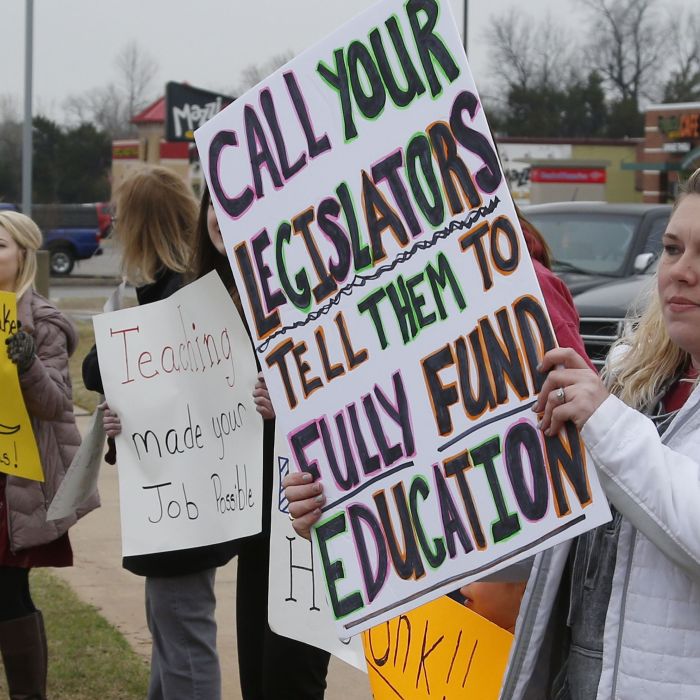
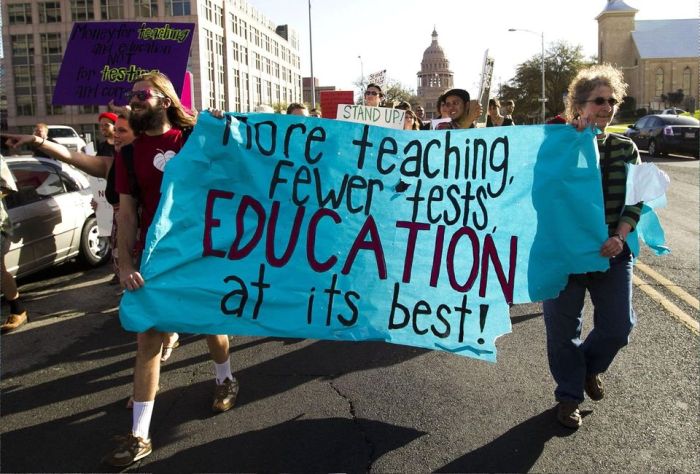
America’s teachers are taking to the streets by the thousands.
In West Virginia, Oklahoma, Kentucky and soon to be Arizona and Puerto Rico, educators are leaving the classroom and storming their state capitals.
Why?
Not because they’re greedy. Not because they don’t want to do their job. But because this country doesn’t care enough to provide them the resources they need to do it.
America only cares about middle class and wealthy kids, preferably if their skin has a melanin deficit.
Don’t believe me?
Just look at how much these states have cut education funding. Look at how the federal government has slashed financial assistance. Look at how districts are forced to increasingly rely on local tax revenues to pay for the kind of education their children receive.
For the dark and the destitute, this means larger class sizes, out of date text books, and narrowed curriculum. It means fewer tutors, reading specialists and librarians. It means being left to your own devices to deal with the effects of generational poverty which put them behind their wealthier, lighter peers before they even enter kindergarten. It means greater emotional disturbance, greater malnutrition, higher absences, more learning disabilities, and less help to deal with any of it.
On the other hand, for the economically privileged white kids, it means just the opposite – fewer social problems, and the best of everything to deal with whatever issues they have.
Don’t refuse us the money to get it done and then blame us for the results.
That’s why there was a 9-day teachers strike in West Virginia which won educators a 5% raise in February.
That’s why 30 districts closed in Kentucky this week after a statewide sick out inspired by the legislature’s plan to cut pension benefits.
That’s why thousands of teachers in Oklahoma walked out this week demanding higher wages and better school funding.
And it’s why educators in Arizona, Puerto Rico and other states and territories may be next.
When you deny teachers the basics necessary to do their jobs, you’re refusing your responsibilities toward children.
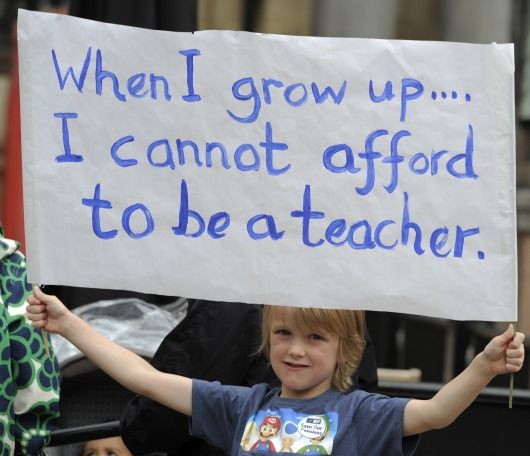
When you deny educators a fair wage, you’re discouraging young people from entering the profession and encouraging those already there to seek work elsewhere.
And that is what we’re talking about here – a fair wage. We’re not talking about teachers getting rich off the taxpayers dole. You’re asking us to get an advanced education and do a hard job – that requires a middle class income so we can pay off our student loans and support our families.
The same goes for pensions. When teachers took their jobs, a fair pension was part of the contract. You promised that after 30-some years, educators could retire and you’d take care of them. You can’t renege on that. And if you plan to offer less for those coming in to the field, you’re going to get fewer high quality teachers willing to take the job.
When you attack unions and union benefits, you’re really attacking students. A teacher who can be fired at the whim of an administrator or school director is not as affective at her job. She has less autonomy and freedom to do what is right for her given students. And she has less reason to take a chance on the profession in the first place.
This is why there’s a so-called teacher shortage in most states. As a society, we’ve become less-and-less willing to pay for teachers to do their jobs. We’ve become less-and-less willing to offer them the independence and respect necessary to get things done.
Why?
Because we’ve swallowed a pack of lies from the business community.
But only for the poor and minorities. The affluent and middle class white kids will still get the best money can buy. It’s only those other kids they’re willing to feed to the wolves of edu-profit.
THAT is what educators are fighting.
THAT is why teachers across the nation are striking.
We’re demanding this nation does right by its public school students.
The counselor just wanted me to be aware what was happening and to prepare my daughter for it so she wouldn’t be scared.
I thanked her for the call, and went in the other room to speak to my 9-year-old sweetie.
She was hunkered on the floor drawing pictures of her toys.
Mario and Luigi were chasing a purple Yoshi. Captain America was playing soccer with Wonder Woman. That kind of thing.
I opened my mouth — and my throat closed up.
I couldn’t do it. I didn’t want to do it.
What would I say? —-Hey, Honeybunches. You’re going to have a lockdown drill at school tomorrow. Your class is going to prepare in case a gunman breaks in and tries to murder you.
She was staring at me now, Mario’s hat half colored in.
So I put on my teacher’s cap and explained everything that would happen, but not why.
She was completely unfazed.
“That’s all? Can I go back to coloring now?” she asked.
I nodded.
I didn’t want to make a big deal of it, but I wondered how she’d react. This was a girl who in kindergarten had cried at the violence of a fire alarm.
So the next day came and went – no mention from her about what had happened at school.
She wasn’t traumatized. She was her usual self – frustrated at her homework, bargaining for a snack, writing an autobiography of her soccer career that would start next fall when she signs up.
I waited a week and then asked her about what had happened.
In the most matter of fact voice, she told me how her third grade class had stood away from the door, clustered in one corner of the room holding books.
“Why books?” I asked, thinking that maybe the drill had gone on too long so they had something to read.
She said they were to throw at a bad guy if he sneaked into the room.
I imagined a gunman in my daughter’s classroom trying to spray the children with bullets only to be met by a hail of tossed books – Dr. Seuss vs. Smith & Wesson.
“Don’t worry, Daddy,” she said. “No one broke in.”
As usual, children do better with this stuff than adults.
But the reason why is exceedingly troubling.
They are still forming their concept of normality.
When I went to school, we never had lockdown drills. We had monthly fire drills and the occasional severe weather drill. But we never prepared for crazed murderers and terrorists. That just wasn’t in our routine or even our conception of what a school should do.
Yet it is now routine for my daughter. It is typical for most children these days.
As a teacher in a neighboring district, I had to preside over my own first lockdown drill with my 7th graders a few weeks earlier.
We clustered in a corner on the floor – the door locked, the lights off.
My class of rambunctious teens who rarely seem able to do anything without a constant stream of words was nearly silent.
The worst part was how I felt trying to downplay what we were doing.
Nothing to see here, kids. Just an ordinary day pretending to hide in a corner so a killer would pass us by.
And now after the drill, I keep my classroom door locked at all times.
It’s a huge inconvenience having to stop what you’re doing and physically open the door anytime someone wants to come in. But it’s what we have to do to bolster our sense of security.
2) You say stealth testing has made the traditional standardized assessments irrelevant?
Okay. Competency Based Education is a real problem that threatens to make everyday test day – I’ll go with you there. In fact, schemes like Personalized Learning could transform every app into an opportunity to test kids without them even knowing it.
But that doesn’t mean the old fashioned high stakes tests have gone away!
Far from it. The federal government still requires all states to give these assessments to public school students in grades 3-8 and once in high school.
Let’s say the feds required teachers to give rich kids higher grades than poor children.
Or say the state commanded teachers to copy down sensitive information about students and give it to private corporations.
Imagine if the school board instructed teachers to put minority kids in slower classes than white kids.
If any of that happened, there would be wide scale revolt!
They are used to justify increased segregation within school buildings because implicit testing bias means white kids generally score higher than children of color. So the white kids get more advanced courses and the brown ones get test prep.
3) You say the Opt Out kids are just trying to get out of doing work. It’s just laziness.
First, of all, it is the parents who are opting their children out of standardized testing – not the students. Second, who are you to question their motives?
These tests are used to justify unfairly evaluating YOUR work, narrowing YOUR curriculum, repealing YOUR union protections, reducing YOUR autonomy, cutting YOUR funding, and ultimately laying YOU off.
Why are you standing up for THAT?
So why are some teachers wavering in their opposition to high stakes tests?
I think it has to do with who we are.
Most teachers are rule followers at heart. When we were in school, we were the obedient students. We were the people-pleasers. We got good grades, kept our heads down and didn’t make waves.
But the qualities that often make for the highest grades don’t often translate into action. That, alone, should tell you something about the limits of assessment which are only exacerbated by standardized test scores. When it comes to complex concepts, it’s hard to assess and even harder to determine if success on assessments is a predictor of future success.
Bottom line: Every teacher should be in favor of the Opt Out movement.
And I don’t mean quietly, secretly in favor. I mean publicly, vocally in favor.
Many teachers are parents, themselves, with children in the districts where they teach. Every educator should opt out their own children from the tests.
Next, we should force our unions to do the things that we can’t as safely do as individuals.
Call parents and ask them to opt IN!? We should be doing just the opposite, but that would put a target on our backs.
As a teacher, I can’t unilaterally call or send a letter home to my students’ parents explaining why they should opt their kids out. If I did that, I could find myself in administration’s cross hairs and face grave repercussions.
But isn’t that why we have a union? To stand up as a collective and do the necessary things we can’t do as individuals?
Imagine if the unions put pressure on the school boards to pass resolutions against testing and in favor of opt out! What effect would that have on state legislatures and the federal government?
How could the feds continue to demand we give high stakes tests when nearly every school board across the country objected and advised parents to refuse testing for their children?
Taken individually, these aren’t really all that difficult things to do.
They require a certain degree of moral courage, to be sure. And teachers have been beaten down by a society that devalues their work and begrudges them just about everything.
The tech moguls and the testing giants are salivating over the prospect of replacing us with apps and low-skilled, low paid babysitters to oversee students hunched over computers and tablets. (See? Told you Personalized Learning was poison.)
In it, the author attempts to explain why the Scholastic Aptitude Test (SAT) – though flawed – is a more unbiased way to select which students deserve college admissions than indicators like K-12 classroom grades.
It’s all convoluted poppycock made worse by a baroque series of far left think tank connections, intellectual bias and mental illness.
In short, DeBoer argues that our schools are unfair, so we should embrace unfair high stakes tests.
I know. That doesn’t make a lot of sense.
Let me slow it down a bit, premise by premise so you can see his point – or lack thereof.
Richer whiter kids often go to schools that are better funded than those that teach mostly impoverished minorities. Therefore, the privileged get smaller classes, wider curriculums, more extracurricular activities, more counselors, better nutrition, etc. – while the underprivileged… don’t.
Then DeBoer says that classroom grades are often dependent on the resources students receive. Richer whiter kids get more resources, so they often get better grades.
Still with you so far.
Therefore, he concludes, we need standardized tests like the SAT to help equalize the playing field. We need so-called “objective” assessments to counteract the “subjective” classroom grades.
But DeBoer admits standardized tests aren’t objective! They are also the result of resources – that’s why richer whiter kids tend to score better on them than poorer blacker kids!
The argument makes no logical sense.
Justifying one unfair system with another unfair system is beyond bonkers.
Plus DeBoer contends out of nowhere that classroom grades are more easily manipulated than the tests and thus the tests are more valid.
Wrong again.
Classroom grades are based on roughly 180 days of instruction a year for 12 plus years. The SAT is roughly one day. More if you retake it.
It is MORE difficult to influence 2,160 days worth of grading than 1 or 2 or 3. Not the other way round.
Whether students get good or bad grades generally doesn’t affect a given teacher. However, low test scores are actually beneficial to testing corporations because they allow the company to make additional money by retesting and selling remediation materials to the district.
If one group is more subject to bias, it is those grading the standardized tests, not the classroom teachers.
He has a point that getting rid of standardized testing won’t by itself eliminate inequality. But doubling down on it certainly won’t either.
Brigham devised the SAT in the early half of the 20th Century based on Yerkes’ and his own deeply racist eugenicist theories.
And when I say they were eugenicists, I’m not speaking in hyperbole. They truly believed that some races were just smarter, more moral and downright better than others.
“American education is declining and will proceed… with an accelerating rate as the racial mixture becomes more and more extensive,” wrote Brigham in his seminal A Study of American Intelligence.
“No citizen can afford to ignore the menace of race deterioration,” wrote Yerkes in 1922.
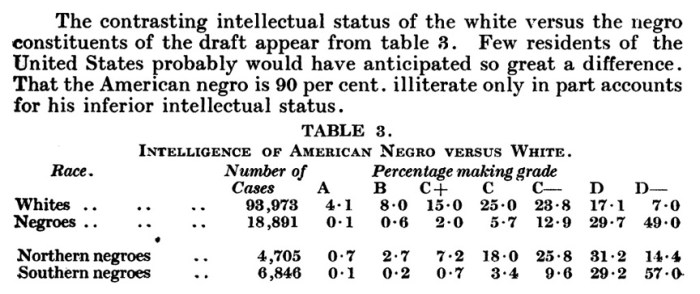
And this idea was the foundation of their application of standardized testing, as Yerkes noted a year later:
“The contrasting intellectual status of the white versus the negro constituents of the draft appear from table 3. Few residents of the United States probably would have anticipated so great a difference. That the negro is 90 per cent. [sic] illiterate only in part accounts for his inferior intellectual status.”
Brigham was basing his ideas on another test created by Yerkes, the Army Alpha and Beta tests.
People’s Policy Project (3P) is a left-leaning think tank created by another frequent Jacobin contributor, lawyer and policy analyst, Matt Bruenig.
You may recall Bruenig. In 2015, he criticized schools that provide more resources to impoverished children by dubbing them “welfare schools.” He saw the inclusion of free healthcare, free meals, free pre-K, and other wraparound services as increasing the welfare state and making children and families dependent on the government for survival.
And, yes, like DeBoer, this is a guy who claims to be a far left Democrat.
So when an organization with a history like CAP offers school policy proposals – even if they’re innocuous on the surface – a closer look often reveals something disturbing hiding just under the skin.
In any case, it’s worth taking a look at this new report to examine what’s helpful in these think tank proposals and in what ways they might hide dangers for students, teachers, parents and society.
THE BAD
CAP proposes we:
Provide a tutor for all students who are below grade level:
This includes both academic and emotional support. And it sounds great! Imagine what struggling students could do with more one-on-one help!
However, according to the report, CAP’s major problem with previous tutoring initiatives like those provided under the No Child Left Behind Act was that they weren’t “high-quality.” Moreover, “tutoring could grow at the local level, helped along by things like an AmeriCorps expansion.”
In addition, CAP is cognizant that this would have to be a local decision – it couldn’t be handed down at the federal level. They suggest encouraging the move with more Title I funding and other sweeteners.
However, this ignores the fact that U.S. kids already spend more time in class than their international peers. Few countries make their children suffer through an 8-hour day. In Finland, for example, where kids start later and are released earlier than U.S. children, students get a 15-minute break for every 45 minutes of class work.
This suggestion, coming as it does from test-obsessed partisans, could be just another way to try to increase the amount of work piled on students in order to raise test scores. I advise caution.
3) Pay teachers more
I’m certainly not against this one. CAP notes that teachers only take home about 60 percent of the salaries that employees with similar levels of education earn. They suggest a base salary of $50,000 – up from the current average of $38,000 for incoming educators.
“More-experienced educators with a track record of success should make at least $100,000,” the report suggests (emphasis mine). And THAT’S where I start to feel queasy. What exactly do they mean “track record of success”? Well, this is CAP, so that probably means teachers whose students score well on standardized tests.
I want a raise, believe me. I DESERVE a raise! But not if you’re going to make me sign a Faustian bargain first.
THE GOOD
CAP proposes we:
4) Offer free breakfast and lunch to all students, no matter what their parents income:
We have this at both my daughter’s school and the district where I teach in western Pennsylvania. It is a tremendous success. Making it a nationwide initiative is an excellent idea.
It’s hard to argue with this, even if the main justification is that better nutrition will lead to better academic outcomes (read: test scores). Plus this removes the stigma of a free meal because all students receive it, and once initiated it would be harder to take away.
5) Provide more opportunity for students going to college to get technical workplace experience:
Students should be able to get real world experience to help them decide if certain careers are for them. I’m struggling to see a downside.
6) Hire more social workers, counselors and school psychologists:
Heck to the yeah. I see no downside there.
7) Initiate a national infrastructure program to fix crumbling school facilities:
It’s about time! Schools in impoverished neighborhoods are falling apart. We need to bring them up to the same level as those in the upper middle class and wealthy communities. Obviously, we’ll need to audit these programs and make sure money isn’t being wasted or embezzled, but this is a worthy goal well past due.
AND THE OTHER SHOE DROPS
And that’s it.
Not a bad list, over all.
I do have some reservations as noted above. However, many of these proposals would be really positive…
The think tank doesn’t expect these policies to be introduced or enacted anytime soon, she says. And even if they were, Partelow understands they would probably go under significant legislative changes before becoming law.
“We’re really excited about this as a counter balance, as an answer to the ideas we’re seeing put forward by [U.S. Secretary of Education] Betsy DeVos and the Trump administration,” Partelow says.
So THAT’S their game!
CAP is playing the long con here. They are putting forward a bunch of puppy dog and teddy bear proposals to contrast with Trump and DeVos.
These aren’t policies as much as they are advertisements for the Democratic party. It’s the equivalent of saying, “We promise we’ll do good things like THESE if you elect Democrats – despite the fact that we mainly focused on standardization and privatization when we were in power.”
Look. Maybe I’m being too cynical.
Maybe the Democrats really, really are going to do a better job this time, cross their hearts and hope to die, if we give them just one more chance.
But words aren’t nearly enough.
I like many of these policy suggestions. But I just don’t trust the Democrats.
Compare that with the salaries of the people who make and distribute the state’s federally mandated standardized tests – employees at Data Recognition Corporation (DRC).
DRC publishes numerous assessments in various states. However, in the Keystone state, the corporation makes everything from the Pennsylvania System of School Assessments (PSSA) to the Keystone Exams in Algebra, Literature and Biology.
At its 14 locations across the country, the company has more than 750 full time employees and 5,000 seasonal ones used mainly to help grade the tests.
According to glassdoor.com, a site that showcases job listings, here are some openings at DRC and their associated salaries:
Meanwhile, the test makers sit in luxury office buildings taking home tens of thousands of dollars more just to make the tests that students take over the course of a few weeks.
And these corporate test employees DO work in luxury.
And keep in mind, both teachers and test makers are being paid with public tax dollars. YOU are funding the test makers on-the-job massage break just as you’re funding the public school teachers trip to the doctor for anti-anxiety meds.
That is your money funding the test makers workout facilities and flexible spending accounts. You pay for their walking trails, fitness classes, dry cleaning services and subsidized cafeterias.
Meanwhile, public school teachers – who do the bulk of the work educating children – are left struggling to make ends meet.
No one wants to hang out with you because of your bald head and your red suspenders and your commitment to the ideals of a defeated and disgraced totalitarian regime.
What are you to do?
REBRAND, son!
It’s simple.
No more National Socialist German Workers Party! That sounds too pinko!
You aren’t over-concerned with any one side of the political spectrum or other. You just strongly identify with whiteness — and by extension increasing the political power of white people at the expense of all others.
That’s all.
It should be obvious that this isn’t merely rebranding. It’s propaganda.
In today’s fast paced information age – where every fact is merely a Google away – that can be hard to get away with – UNLESS…
Unless you already have a readymade tool to protect propaganda from the kind of informed critical thought that can pop it like a bubble. Something to insolate the ignorance and keep out the enlightened analysis.
It was a bipartisan effort supported by the likes of Obama, the Clintons and Bill Gates on the left and Jeb Bush, Betsy DeVos and Bobby Jindal on the right.
After Obama’s success pushing them down our collective throats, many Republicans vocally decried the standards – often while quietly supporting them.
Okay, so what does this have to do with the Alt Right?
People like Steve Bannon and Donald Trump are engaged in redefining the conservative movement. Instead of circulating ideas with a merely racist and classist undertone, they want to make those subtleties more explicit.
Most aren’t about to hop out of the closet and declare themselves open Nazis or members of the Hitler fan club, but they want to make it clear exactly how wunderbar the Fuhrer’s ideals are with a wink and a smirk.
For instance, Trump’s campaign slogan: Make America Great Again.
When exactly was America great? When white people had unchallenged political and social power and minorities and people of color knew their place. That’s when.
This is obvious to some of us, but we face a real obstacle making it obvious to others.
“Do you know the two most popular forms of writing in the American high school today?…It is either the exposition of a personal opinion or the presentation of a personal matter. The only problem, forgive me for saying this so bluntly, the only problem with these two forms of writing is as you grow up in this world you realize people don’t really give a shit about what you feel or think… It is a rare working environment that someone says, “Johnson, I need a market analysis by Friday but before that I need a compelling account of your childhood.”
Later, he added:
“The most popular 3rd grade standard in American today…is what is the difference between a fable, a myth, a tale, and a legend? The only problem with that question is that no one knows what the difference is and no one probably cares what the difference is either.”
“This close reading approach forces students to rely exclusively on the text instead of privileging background knowledge, and levels the playing field for all students.”
However, Coleman was dead wrong on all counts.
What you think and feel IS important. The requirements of the corporate world ARE NOT the only reasons to teach something. Being able to distinguish between similar but different concepts IS important. And context is ABSOLUTELY ESSENTIAL to understanding!
For instance, today’s spin doctor Nazis soon realized that you can’t go goose stepping down main street blindly espousing how much better it is to be white — better than, say, being black or Jewish.
But you can hang up posters in college campuses that say the same sort of thing in a cutesy, passive aggressive way. For instance: “It’s okay to be white.”
If we look just at the text, as Coleman advises, we see a rather innocuous statement.
There’s nothing racist here. It’s just a simple statement that being white is also acceptable.
However, if we add back the context, we find an indirect racial undertone.
These posters weren’t put up willy nilly. They were hung on college campuses where white nationalists wearing MAGA hats were recruiting. They were pasted over Black Lives Matter posters, accompanying drawings of Donald Trump.
In context, then, this statement doesn’t just mean “It’s okay to be white.” It means “It’s okay to be pro-white supremacist, to be pro-white power.”
And that brings up two other examples.
MAGA – Make America Great Again.
Take it out of context and it’s innocuous. It just means to increase the abstract greatness of the country to what it was at some unspecified time in the past.
If we had ensured everyone in the country had access to the best possible education, this modern Nazi subculture wouldn’t be able to make as much headway as it has.
This is yet another way that our obsession with unrestrained capitalism, neoliberalism and plutocracy has put us on a road that may end in fascism.

















 gadflyonthewallblog