You Can’t Be Anti-Opt Out and Pro-Democracy

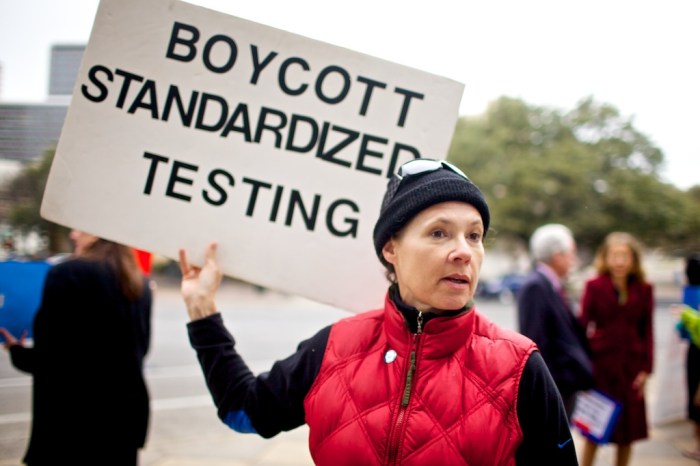
20130220-michels-edy-chamness-sign

Our lawmakers have a problem.

This summer they doubled down on one of the most anti-democratic mandates in the federal repertoire yet they claim they did so to protect states rights.

Here’s the problem.

Every year, hundreds of thousands of public school parents across the country opt their children out of standardized testing.

But Congress voted to keep mandating that 95% of students take the tests.

It all happened with the much celebrated bipartisan passage of the Every Student Succeeds Act (ESSA), the federal law that governs K-12 schools.

While lawmakers made changes here and there to let the states decide various education issues, they kept the mandate that students participate in annual testing.

They didn’t leave that to the states. Whether they were Republican or Democrat, almost all lawmakers thought it was just fine for the federal government to force our children to take standardized tests at least every year in 3-8th grades and once in high school.

If any school district, has more than 5% of students that don’t take the tests – for whatever reason – the federal government can deny that district funding.

Think about that for a moment.

Our lawmakers are supposedly acting in our interests. They’re our representatives. We’re their constituents. They get their power to pass laws because of our consent as the governed. Yet in this instance they chose to put their own judgement ahead of ours.

They could have made an exception for parents refusing the tests on behalf of their children. They just didn’t see the need to do so.

Why? Because they were worried about minority students.

It’s a laughable claim in so many ways.

It goes something like this – without standardized testing, we’ll have no way of knowing if public schools are educating students of color.

Let’s say for a moment that this were true. In that case, we can expect no parent of color would ever refuse standardized testing for his/her child.

First, this is demonstrably untrue. Black and brown parents may not be the most numerous in the opt out movement, but they do take part in it.

Second, in the majority of cases where white parents refuse testing, that would have no bearing on whether testing helps or hurts students of color. If the point is the data testing gives us on black kids, what white kids do on the test is irrelevant.

Third, even if opting out hurt students of color, one would assume that it is the parents prerogative whether they want to take part. If a black parent doesn’t want her black son to take a multiple choice exam, she should have the right to waive that exam and the responsibility would be on her head.

So there is absolutely no reason why lawmakers should have overstepped their bounds in this way and blocked all parents rights about what the schools do to their children.

It is a clear case of governmental overreach. And there are plenty of parents just waiting to bring it to the U.S. Supreme Court for the ultimate Constitutional test.

However, that probably won’t happen for the same reason it never happened through the 15 years of No Child Left Behind (NCLB) which also contained the annual testing rule.

The federal government has never withheld tax dollars based on students not taking standardized tests. officials at the U.S. Department of Education have made threats, but they have never devolved into action.

The bottom line is this: they know how Unconstitutional this mandate is, and they aren’t itching to have it tested in the highest court in the land.

It would open a whole can of worms about standardized testing. What is the federal government allowed to do and not allowed to do about education policy?

The ESSA is an attempt to reduce the federal role, but keeping the annual testing mandate was either a grievous mistake or the last vestiges of federal hubris.

But let’s return to the reasoning behind it – so-called civil rights fears.

Various groups including the NAACP asked for it to be included to protect minority students. Annual testing is the only way, they claimed, to make sure schools are teaching students of color.

It’s nonsense.

There are plenty of ways to determine if schools are meeting the needs of minority students – especially since most students of color go to segregated schools.

Even after Brown v. Board, we have schools that cater to black kids and schools that cater to white kids. We have schools for poor kids and rich kids.

It is obvious which schools get the most resources. Why isn’t that part of this “accountability” scheme? We can audit districts to see how much is spent per pupil on poor black kids vs rich white kids. We can determine which groups go to schools with larger class sizes, which groups have more access to tutoring and social services, which groups have expanded or narrowed curriculums, which groups have access to robust extra-curricular activities, which groups have the most highly trained and experienced teachers, etc.

In fact, THAT would tell us much more about how these two groups are being served by our public schools than standardized test scores. We’ve known for almost a century that these test scores are more highly correlated with parental income than academic knowledge. They’re culturally biased, subjectively scored and poorly put together. But they support a multibillion dollar industry. If we allow a back door for all that money to dry up, it will hurt lawmakers REAL constituents – big business.

So why were civil rights groups asking the testing mandate be kept in the bill? Because the testing industry is comprised of big donors.

Only a few months before passage of the ESSA, many of these same civil rights groups had signed declarations against standardized testing. Then suddenly they saw the light as their biggest donors threatened to drop out.

Make no mistake. Standardized testing doesn’t help poor minority children. It does them real harm. But the testing industry wrapped themselves up in this convenient excuse to give lawmakers a reason to stomp all over parental rights.

The conflict wasn’t between civil rights and parental rights. It was between parental rights and corporate rights. And our lawmakers sided with the corporations.

Let me be clear: legislators cannot be against opt out and in favor of individual rights.

The two are intimately connected.

Our schools have no business telling parents how to raise their kids. But our parents DO have a right to do the opposite. In fact, that’s how the system is supposed to work.

We, parents and citizens, control our schools – not you, our representatives. The principal can’t say you haven’t a right to opt out your kid. He’s just your representative. So is the teacher.

Everyone who works in the school is there to do what you want them to do for your child. Yes, they are well trained and have a world of knowledge and experience that we should draw on. And in most cases, they’re being forced to confront us by lawmakers who are tying their hands and directing them to do the dirty work.

We have common cause. We need to stand with our teachers and principals, our school boards and education professors. We need to stand together against lawmakers who think they know better.

In short, we don’t need lawmakers consent to opt out. They need our consent to stop us.

They get their power from us. They work for us.

And it’s time they get to work and rescind the annual testing mandate.

The Measure of Citizenship isn’t an Exit Exam – It’s Participating in Our Democracy

screen-shot-2016-09-28-at-10-08-57-pm

Pennsylvania legislators just flunked civics – big time.

Once again, instead of offering real solutions to eradicate the ignorance of the coming generation, they clothed themselves in their own.

A bi-partisan group of 47 state lawmakers is proposing forcing all public school students to pass a test on citizenship in order to qualify for a diploma.

House Bill 1858 would require all K-12 schools receiving tax dollars — including charters schools and cybercharters — to give their students the same 100-question test that immigrants seeking U.S. citizenship will have to pass starting in 2020. Any student who doesn’t get a sufficient score will not receive a diploma or GED equivalency.

While it is admirable that legislators are concerned that high school students don’t know enough about civics, it’s unfortunate that they think the solution is another standardized test.

After all, what does being a good citizen have to do with a multiple choice exam?

Citizenship is about political independence. It’s about exercising your rights, not memorizing them. It’s about engaging in the political process, not spitting back facts about what kind of tree George Washington chopped down. It’s about using the principals of self-determination to rise up to the level of personal and community involvement, of individual sovereignty and home rule.

This involves actually teaching civics, a subject that has been cut to the quick in our schools to make room for an increasing amount of test-prep in math and reading. It used to be common for American high schools to offer three civics and government courses. Two of them – “Civics” and “Problems of Democracy” – defined the role of a citizen in relation to current events and issues. However, in most districts now these have been condensed into one “American Government” course that spends hardly any time on how students can and should participate in their government. Moreover, this course isn’t even offered until junior or senior year – far too late to make much of a difference.

Maybe instead of  putting a metaphorical gun to kids heads and demanding they care about civics, you could actually provide some resources so teachers could… I don’t know… teach it!

How about actually funding our public schools? You well-meaning dunderheads slashed school budgets by almost $1 billion a year for the last six years, and your only solution to helping kids learn has been to put more hurdles in their way without offering anything to help them achieve.

That is a losing strategy. If you want to have a winning race horse, at some point you have to feed the freakin’ horse!

If lawmakers really want kids in the Keystone state to know something about civics, why not start by making it easier for schools to broaden the curriculum to include robust civics courses?

This means REDUCING the number of standardized tests, not increasing them. Inject some money into the system so schools can hire back some of the 25,000 teachers who have been furloughed. You want kids to learn how to be citizens? Provide them with excellent teachers who actually get to experience some meaningful professional development, teachers not overburdened with meaningless paperwork to justify their jobs at every turn, teachers encouraged with rewards for seeking National Board Certification, etc. And let’s reduce class size so kids actually have the chance to be heard by their teachers and might actually learn something.

Moreover, if you really want to assess if these lessons have been learned, assess whether students are actually participating in their Democracy.

That’s the thing about citizenship. It looks like a noun, but it’s really a verb. It only has meaning if you do it.

Have high school kids registered to vote? Have they volunteered to take part in the political process, to canvass or phone bank for a candidate they believe in? Have they attended a session of the state House or Senate? (Have you provided the funding for appropriate field trips?) Have they attended a rally or protest for a cause close to their hearts?

THESE are the measures of true citizenship. And there are things you can do to make it easier for students to take part.

But no one really wants that. Come on. This is still essentially the same legislature that passed a Voter ID bill a few years back to make it harder for people to participate in our Democracy. And it would still be on the books if the state Supreme Court hadn’t struck it down as Unconstitutional.

Citizenship!? This is the same legislature that redrew state districts to be so incredibly gerrymandered that the most radical factions of both parties are unchallenged each election cycle!

You know why children don’t know more about civics? Because they’re so disgusted and demoralized by the example you’ve shown them. When politics is nothing but a show, when hardly anything ever changes or actually gets accomplished in Harrisburg, you expect kids to get excited by citizenship!? HA!

All you know how to do is pretend. That’s what this is. Just throw another standardized test on the fire of our children’s education and you can act like you’ve done something.

May I remind you we’re still dealing with the last smoldering exit exam disaster you fostered on us – the Keystone Exams?

You spent $1.1 billion on these tests since 2008, and they’re a statewide joke! You required all students to pass these assessments in Literature, Algebra and Biology, but they’re so poorly constructed and confusing that only half of our students can pass all three. So you put them on hold for two years until you could decide what to do.

And before you even fix that mess, you actually have the gall to say, “Hey! Let’s make kids take ANOTHER test!?”

I know some of you mean well, but this suggestion is a disgrace.

It’s style over substance.

This isn’t a measure to reduce ignorance. It’s a measure conceived in ignorance that’s guaranteed to proliferate it.

The Child Predator We Invite into Our Schools

th

There is a good chance a predator is in the classroom with your child right now.

He is reading her homework assignments, quizzes and emails. He is timing how long it takes her to answer questions, noting her right and wrong answers. He’s even watching her body language to determine if she’s engaged in the lesson.

He has given her a full battery of psychological assessments, and she doesn’t even notice. He knows her academic strengths and weaknesses, when she’ll give up, when she’ll preserver, how she thinks.

And he’s not a teacher, counselor or even another student. In fact, your child can’t even see him – he’s on her computer or hand-held device.

It’s called data mining, and it’s one of the major revenue sources of ed-tech companies. These are for-profit business ventures that produce education software: programs to organize student information and help them learn. They make databases and classroom management tools as well as educational video games and test prep software.

As schools have relied more heavily on technology to enhance lessons, they’ve invited big business into a space that is supposed to be private.

The Family Educational Rights and Privacy Act (FERPA) protects student privacy, but it also gives school districts the right to share students’ personal information with private companies for educational reasons.

Companies are supposed to keep test scores, disciplinary history and other official records confidential. They’re not supposed to use them for their own ends. But the law was written in 1974 before the Internet went mainstream or many of these technologies were even conceived.

It’s unclear exactly who owns this data or whether FERPA protects it.

For every child utilizing these programs, there’s a good chance their data has been put into a portfolio with their name on it. That portfolio could be sold to advertisers and other business interests so they can better market their products to young consumers. With this information, these companies are turning children into guinea pigs so they can improve the profitability of their products.

Let me be clear. It’s not that technology is essentially evil. There are many ways in which it can be used to enhance student learning when provided under the supervision of a trained educator. But the current laws offer little protection for children and parents from rampant abuse by the ed-tech industry.

In most cases no one explicitly gives permission for student data to be shared. No one knew it was even happening.

This is an area that is almost completely unregulated. Hardly anyone is investigating it. After all, why should they? It’s just harmless big business. It’s just corporations we invited to the party; we may even have paid them to be there.

Individual school districts could write privacy protections into their contracts with ed-tech corporations, but few do.

According to a nationwide study by the Center on Law and Information Policy at Fordham University, just 7 percent of the contracts between districts and ed-tech corporations barred the companies from selling student data for profit.

Few contracts require companies to delete sensitive data when they are done with it. And just a quarter of companies clearly explain why they need personal student information in the first place, according to the same study.

To make matters worse, the publicly stated privacy policies of these corporations can be extremely dense and full of provisos. You may need a lawyer specializing in this field to truly understand what they’re promising to keep private and what might fall under a loophole.

For instance, even if a company promises not to share student information for nonacademic reasons, it can farm out some of its services to third party companies that have no such compunction about student privacy. These third party vendors or even the primary ed-tech company can put cookies on your child’s computer or device that continue to gather data on her and report back on it indefinitely. Moreover, even if the ed-tech company is diligent about protecting student privacy, that policy can change without notice and without parents being notified. For instance, many of these ed-tech companies are rag tag start-ups that are just hoping to be purchased by a bigger organization. In that case the privacy policy will almost certainly alter, possibly without notice.

Data mining isn’t exclusive to education software applications. If you’ve ever passed up a product on-line and then immediately saw an advertisement for that product on a different Website – congratulations – You’ve been data mined. Many of the applications adults use every day in their virtual lives practice this to some extent – Facebook, Google, Netflix, etc. However, there’s a difference between an adult user who enters into virtual relationships with eyes wide open and a child just completing the classwork her teacher assigned in school.

But even beyond the philosophical difference is the extent to which our children are being data mined. No where is it more pervasive than in our schools.

A really efficient ed-tech firm can collect as much as 10 million unique data points on each child, every day. That’s exponentially more than Facebook, Google or Netflix collect on their users.

Moreover, the ed-tech industry hungers for even more data on our children.

The Bill & Melinda Gates Foundation funded a $1.4 million research project to provide middle-school students with biometric sensors designed to detect how kids responded on a subconscious level to each minute of each lesson. Like Common Core State Standards – Gates’ attempt to force uniform academic standards on the nation’s public schools – data mining is all about turning real children into information. Intelligence and knowledge are reduced to numbers. Biological functions, heat indexes, even eye movements are tabulated as a function of a salable commodity – your child.

In the not too distant future, ed-tech companies could sell information about which prospective job applicants or college students have the proper aptitude to be successful. In some ways, this is just an extension of the ways standardized tests like the Scholastic Aptitude Test (SAT) are used to unfairly label students worthy or not of a post-secondary education. However, those tests are taken by high school juniors and seniors. The coming data mining boom would judge children based on their performance all the way back to kindergarten or even pre-kindergarten.

As usual the American Legislative Exchange Council (ALEC) is already planning for this dystopian nightmare. The conservative lobbying organization has drafted a model bill to make this a reality.  If picked up and offered in any state legislature, the bill would set up a central database for student records and allow colleges or businesses to browse them in search of potential recruits.

In addition, these student portfolios could allow corporate vultures to prey on customers vulnerable to particular sales pitches. For instance, young adults who had struggled at math in high school would make dandy targets for high-priced payday loans.

In the meantime, hedge fund managers and other investors are pouring money into the ed-tech market. More than $650 million flowed into technology firms serving K-12 and higher education each year for the past three years. That’s nearly double the $331 million invested in these markets in 2009. The national market for education software and digital content is nearly $8 billion, according to the Software & Information Industry Association.

Yet there is little evidence these applications are truly helpful in educating children. Even the technology-loving Gates Foundation, found in a national survey that only 54 percent of teachers thought the digital tools used most frequently by their students were effective.

Let’s get something straight: the reason most of these firms exist is not education. It is spying on children. It is stealing their valuable data for corporations’ own ends.

The ed-tech market is intimately entwined with the latest fad in education policy – Competency Based Education (CBE).

This has come to mean teaching and assessment conducted online, where students’ learning is continuously monitored, measured, and analyzed.

However, the goal seems to be replacing big end of the year standardized tests with daily stealth assessments. In this way, it would be more difficult for parents to refuse testing for their children. It would hide the ways in which a standardized curriculum narrowed student learning to the very basics. It would hide how children’s every tiniest action is being used to judge and evaluate their schools and teachers. And this information of dubious validity could be used to close public schools and replace them with shoddy but more profitable charter schools.

Education historian Diane Ravitch talks about a meeting in August of 2015 with The State Commissioner of Education in New York, Mary Ellen Elia, and several board members of New York State Allies for Public Education (NYSAPE), a highly successful state opt out organization.

She says:


“At one point, Commissioner Elia said that the annual tests would eventually be phased out and replaced by embedded assessment. When asked to explain, she said that students would do their school work online, and they would be continuously assessed. The computer could tell teachers what the students were able to do, minute by minute.”

The plan has been laid bare. Our students privacy has been compromised and is being used against them. If big business has its say, our children will be forever pawns in a system that reduces them to data and profit.

That’s not what public school should be about.

It should be a place centered on learning not earning.

It should be a place that values the student and not her data.

It should be a place of creativity, imagination and wonder.

But as long as we allow ed-tech companies to run unregulated in the shadows, it will always be susceptible to these dangers.

The only one who can stop these predators in your child’s classroom is you.

Racism Never Ended – It Just Keeps Evolving

screen-shot-2016-09-16-at-11-55-13-pm

“One of our founding principles as a nation [is] that Black lives and Black bodies don’t matter; you see that in all our headlines today. This original sin lingers on, that’s why we got to call it sin… Slavery never ended, it just evolved. Mass incarceration is the current evolution of slavery.”
Jim Wallis  
 
 
“Even the most casual student of our country’s legal system should know that racism hasn’t existed since 1964 when we passed the Civil Rights Act. So obviously there’s no possible way for my statement to be considered racist if racism hasn’t existed for fifty years! I mean come on, racism? It’s 2015 people, racism is over.”

Antonin Scalia
 

When does brutality end – when it stops being practiced or when its effects stop being felt?

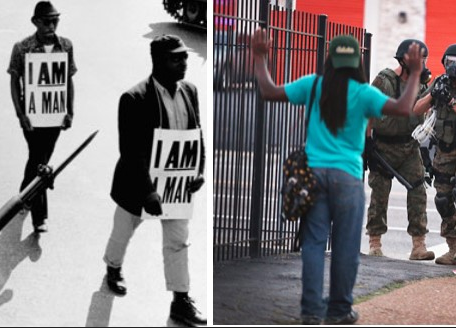
Neither condition has been met in the United States today. Black people still suffer under state-sanctioned barbarism just as the echoes of cruelty from years past continue to ring in our ears.

People of color – whether they be black, Latino, Hispanic, etc. – experience a much different reality than whites. They live under the constant threat of violence without justice. Their rights are continually being re-evaluated. They are subject to systems that wait for them to step out of line in even the most innocuous ways and then pounce.

And the white majority goes around blind to these perceptions while repeating the fairy tale that all wrongdoings were only in the past.

But it’s not in the past. Our history, written in blood, has never been allowed to dry on our forgotten chronicles of yesterday. When white eyes examine the facts, they often see a series of unrelated dots which they cannot – or will not – logically connect.

The Civil War is over, they say.

No. It’s not.

Slavery is over, they say.

No. It’s not.

Racism is over, they say.

No. It’s not.

We still are engaged in the struggle for basic human dignity. And the only way to even begin on that path is to recognize the truth staring us in the face.

Nothing has ended. It has only evolved.


THE CIVIL WAR


When did the American Civil War end?

This may seem a strange question to ask.

But when a country goes to war with itself, it may be difficult to discern when that conflict actually comes to completion.

History gives us many important dates to consider.

On April 9, 1865, commander of the Confederate armies General Robert E. Lee surrendered at Appomattox, Virginia. But there were still sizable Confederate troops left standing.

In fact, the bloodshed was far from over. President Abraham Lincoln was murdered a mere 5 days later by John Wilkes Booth, a Southern sympathizer. Andrew Johnson was sworn in as President on April 15, the next morning.

It wasn’t until April 26, that General Joseph E. Johnson surrendered nearly 90,000 Tennessee soldiers – the largest of a series of subsequent capitulations.

President Johnson declared the insurrection to be over on May 9. However, the last Confederate general didn’t surrender until June 23.

Which date shall we choose? Perhaps it doesn’t matter. The point is that the conflict clearly came to an end.

Clearly the Confederacy was defeated by the Union.

Wasn’t it?

The problem is how to tell.

The Southern states were brought back into the union. But the overwhelming reason behind their secession has not been settled.

Today partisans and talking heads will argue that slavery was but one of many reasons behind the split. But during the 1860s, there was no such confusion.

Four of the Southern states explicitly gave slavery as the impetus for the break.

But Alexander H. Stephens, the Vice President of the Confederacy, removed all doubt when he said:

“The new Constitution has put at rest forever all the agitating questions relating to our peculiar institutions–African slavery as it exists among us–the proper status of the negro in our form of civilization.

[…] The general opinion of the men of that day
[Revolutionary Period] was, that, somehow or other, in the order of Providence, the institution [slavery] would be evanescent and pass away.

[…] Our new Government is founded upon exactly the opposite ideas; its foundations are laid, its cornerstone rests, upon the great truth that the negro is not equal to the white man; that slavery, subordination to the superior race, is his natural and normal condition.”

So if the war was fought over the issue of slavery and the subjugation of black people, its end can be traced to the date at which slavery ended and black people were treated as equals with whites.

That day has not yet come.

Outright slavery came to an eventual end, but – as we shall see – it was replaced with another institution. Moreover, in the aftermath of Reconstruction, we were left with Jim Crow laws cementing white supremacy. Most newly “freed” blacks lived in squalid conditions with few rights, little pay and education. Their situation was only slightly different in fact from their state under slavery. These laws had to be struck down by the collective actions of the Civil Rights movement of the 1950s and ‘60s.

Only then were black people truly permitted to vote en mass. Only then were they permitted in the same public spaces and offered some actionable protections under the law. But social and economic change still lags behind.

Today, more than 150 years since the end of the war’s military conflicts, we’re left to ponder: have things really changed so much?

Certainly there are cosmetic differences. There are no open air slave markets, no rolling cotton plantations staffed by bare backed, lash marked, kidnapped Africans. But have black people really been put on an equal footing with whites? Do they enjoy the same freedoms and privileges? Are they truly free from bondage and oppression?

If we look with open eyes, the answer is no.


SLAVERY


Today no one is legally allowed to own another person. You can’t purchase human beings. You can’t deprive them of their liberty and rights. You can’t use them as a source of revenue for your own benefit.

At least, that’s what the law says. But it happens every day.

What is the modern prison industry if not a new form of slavery? No matter how you look at it, we lock up a higher percentage of our population than any other country in the world. The US represents 5% of the world’s population but has 25% of the world’s prisoners. And the majority of those inmates have brown skin.

Whether federal, state, or privately run, the result is a massive increase in incarceration for people of color. In fact, more black people are in prison today than were in bondage in 1865. That’s a higher percentage of the black population than South Africa locked up at the height of apartheid. Today one in three black males is likely to spend some time incarcerated. That’s not insignificant.

Technically no one owns these people, but they are deprived of their freedom. They are kept in prison and unable to leave. In lockup, they are forced to work and the profit from that cheap labor goes to the prison industry. Moreover, state and federal governments often farm out these prison services to private industry which then profits off that incarceration. In many cases, the government has a contract with these corporations to fill X number of beds or else be penalized with Y dollars. So the incentive is to provide a continual stream of persons bound to labor.

This looks a lot like slavery. It is a kind of plantation where big business is paid to keep people in chains.

However, one can anticipate the following objection: Slaves were born into their servitude. Prisoners are not. They are thrown behind bars because they freely broke the law.

This does represent a difference. But is it more than cosmetic?

People of color – especially black males – commit crimes at about the same rate as white people but are imprisoned nearly six times the rate of whites. They also get much harsher sentences than whites for the same crimes. They are often imprisoned for nonviolent drug violations. And once in the system, it’s hard to get out. To survive in prison, it is often necessary to become a criminal even if you weren’t much of one when you entered.

Even if you manage to get out, you now are a second-class citizen deprived of many of the rights and privileges of your neighbors. Spend any time in the system and you’ll increasingly be deprived of your right to vote and may find it difficult to achieve gainful employment. The chances of going back inside for someone who has already been there are huge.

That is not slavery. But it’s not far from it.

As Michelle Alexander writes in her landmark book The New Jim Crow: Mass Incarceration in the Age of Colorblindness:

“The genius of the current caste system, and what most distinguishes it from its predecessors, is that it appears voluntary. People choose to commit crimes, and that’s why they are locked up or locked out, we are told. This feature makes the politics of responsibility particularly tempting, as it appears the system can be avoided with good behavior. But herein lies the trap. All people make mistakes. All of us are sinners. All of us are criminals. All of us violate the law at some point in our lives. In fact, if the worst thing you have ever done is speed ten miles over the speed limit on the freeway, you have put yourself and others at more risk of harm than someone smoking marijuana in the privacy of his or her living room. Yet there are people in the United States serving life sentences for first-time drug offenses, something virtually unheard of anywhere else in the world.”


THE EVOLUTION OF RACISM


Even for those people of color who have never been incarcerated, there is the constant burden of living in a racist society.

It’s not so much that white individuals consciously practice bigotry and hate in their daily lives. It’s the systematic abuse that’s built into the very fabric of our governments and communities. No one has to decide to be racist. They just go along with the status quo without seeing how that status quo puts black people at risk.

And it doesn’t take much imagination to recognize how the realities of today grew from the prejudices of the past.


LYNCHING


Before the 1960s, it was common for black people – especially men – to be brutalized and murdered with little to no provocation. A look, a word, even the suspicion of violating unspoken social codes could earn a death sentence. Nor was the accused even given a chance to defend himself or explain. That generally doesn’t happen today. Southern trees no longer bare such ‘strange fruit.’

But the same cannot be said for our inner city streets, playgrounds and churches.

It doesn’t take much beyond suspicion of wrongdoing, a suspicion that only requires the sight of black skin to justify deadly force. People of color still are publicly executed with little to no provocation. Black people have been slaughtered in the last few years for the following offenses: buying Skittles and iced tea, driving with a broken tail light, being suspected of selling loose cigarettes, selling CDs in a parking lot, being scared and running the other way or even just attending a house of worship.

Instead of a white robe, a disturbing number of their executioners wear a badge and police blues. Many of these hits were conducted by the very law enforcement officers that are charged with the duty to protect and serve. And when these incidents come before a grand jury, they rarely go on to criminal court. In the eyes of the law, an unarmed black person killed by police rarely inspires any suspicion of wrongdoing on the officer’s part. To the courts, it’s not even conceivable that a crime may have been committed.

As Slate’s Chief Political Correspondent Jamelle Bouie put it:

“Our courts and juries aren’t impartial arbiters — they exist inside society, not outside of it — and they can only provide as much justice as society is willing to give.”

This phenomenon isn’t the same as the lynchings of old – but it’s awfully similar. In both cases, there is little provocation, no quarter given and no justice afterwards. In fact, the modern variety may be worse. US Police killed more black citizens in 2015 than were lynched at the height of segregation.


SEGREGATION


At first glance, one might assume segregation to be a thing of the past. There are no more separate lunch counters, separate bathrooms, separate schools, etc.

Brown vs. Board of Education made it illegal for public schools to be “separate but equal” because if they were separate, they were rarely equal.

Certainly progress was made in this regard during the 1960s, ‘70s and ‘80s. But as time has gone on, integrated schools just haven’t been a priority – even for the Obama Administration.

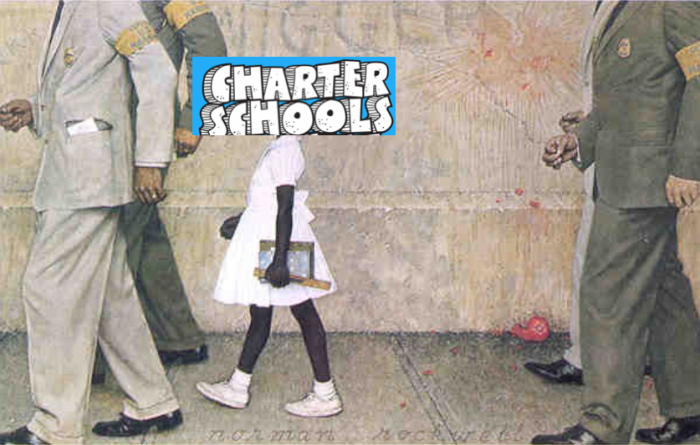
When you look at public schools today what you see is increasing segregation. Many districts are as segregated or worse than they were before the 1950s. So-called school choice initiatives have only made it worse with charter and voucher schools springing up that cater to one race at the expense of another. Cadillac charters open in otherwise economically diverse neighborhoods swooping in to provide white flight. Big corporations start cut-rate charters with empty promises for black kids while bleaching the student body at the neighborhood’s traditional public school.

But school choice isn’t the only problem. Economics plays a factor, too. Public schools often are funded based on local property taxes, so poor kids get much fewer resources for their schools than rich kids. And since most black students are poor, this provides a stealthy way to funnel more money and resources to the white kids than the black ones.

We don’t call it segregation because it doesn’t just affect minority children. It affects poor whites, too. Everyone agrees there’s a problem, but policymakers only propose measures that make it worse. Instead of fixing underlying inequalities, we punish under-resourced schools for the very academic problems they don’t have the resources to successfully eliminate. Instead of providing more and better equipped teachers, we hire lightly trained temps through Teach for America thereby reducing both the quality of education and the cost. Meanwhile private corporations line-up to start testing corporations, test prep publishers and for-profit charter schools at the expense of black and brown kids.

None of it would be possible without segregation. Our schools today are at least as separate and unequal as they’ve ever been. And no one in power cares.


VOTING RIGHTS


Perhaps the only progress we’ve made is in black people’s suffrage. At the time of the Civil War even in the North, blacks couldn’t cast a ballot or their vote was worth significantly less than that of white people. At least today people of color get the same say in the political arena as anyone else.

Or do they?

Since the Supreme Court gutted the Voting Rights Act, a plethora of states in both the North and the South have passed laws to make it harder for people of color to vote.

Voter ID laws have sprung up across the country requiring citizens to present photo identification at the polls. However, just any picture ID won’t do. These laws require exactly the types of identification black people are least likely to have. In addition, states pass restrictions on early voting making it difficult for black churches to help the majority of their congregations who don’t own cars to physically get to a ballot box. Likewise, polling places in black areas of town are closed forcing minorities to endure long lines to vote while people from white areas of town just waltz right in.

It’s not an outright ban on black voting. But it represents continued hurdles just as the Jim Crow laws of old required literacy tests, poll taxes and other forms of intimidation.


CONCLUSIONS


When we look closely at our society and how it treats blacks vs. whites, it becomes clear that something is terribly wrong.

There is deep inequality, deep inequity, deep assumptions about the relative worth of various peoples. In fact, our society creates and perpetuated these injustices. It’s baked into the system, taught to us in our unspoken assumptions, our prescriptions of right and wrong, propriety and norms.

If we step back and look at it from the long view, we can see exactly where this came from. It’s not new. It didn’t fall from the sky like a mysterious alien artifact.

The racism of today is merely the continuation of the racism of yesterday. We pride ourselves that we’re better than our forbears, but it’s only a slight matter of degree.

Black people still are subject to a form of slavery in our system of mass incarceration. They are lynched – often by law enforcement – with little to no consequences for their killers. They go to increasingly segregated schools. And they often endure severe obstacles in order to vote.

Therefore, the battles of the 1860s and 1960s have never fully been decided. The Civil War is not yet over. Slavery continues in a new form. And racism is entrenched in our nation, communities and people.

But if we recognize that, we’ve taken the first step to building a new and better world.

Former NFL Quarterback Supports Public Schools. That’s Right. PUBLIC Schools!

dictionary

So I’m in my classroom today, teaching, when I see something that stops me cold.

The door opens and in comes former Steelers backup quarterback Charlie Batch.

My mouth falls open. I don’t know what I was talking about. Vocabulary words or something.

The class of 8th graders falls silent, too. All eyes are on the two of us.

Batch looks me right in face with a big smile.

“Here you go,” he says and hands me a shopping bag full to bursting with school supplies and an extra-large tub of hand sanitizer.

By this time I’m probably blushing and grinning like my teeth are about to escape my face.

I hope I was able to mouth a “Thank you,” before he left, but I’m not really sure.

It all kind of happened in a daze.

He came. He gave me supplies. He left.

I guess I shouldn’t have been so taken by surprise.

Batch is a frequent face in my district. After all, he graduated from here, himself, before moving on to college and professional sports.

At the beginning of every year, Batch brings school supplies to every teacher in every building in the district. This was just the first time I was actually in the classroom when he dropped them off. Usually he sneaks in when I’m at lunch duty or in the computer lab. I find them in a neat pile on my desk with a note of thanks – to me!

It’s almost like he doesn’t want to draw attention to it. Almost like he doesn’t want to make us feel like we need to thank him.

It’s his quiet way of giving back to the community that made him.

In some ways it’s the most natural thing in the world. In others it’s truly amazing.

Lots of celebrities make charitable contributions to their communities. Many even put that money into their hometown. But how many invest in the public school system?

Most only seem to have eyes for charter schools. You know – those often cut rate, fly-by-night institutions that are privately managed and publicly funded. Schools that pop up in store fronts or in the mall with a celebrity name on the door and little else.

Rapper Pitbull has opened three of these dubious institutions. Pro-Football Hall-of-Famer Deion Sanders opened two – and closed them both last year. Tennis star Andre Agassi has founded a few and co-founded an organization that rents out properties to other charter schools at a profit. Former NBA players Jalen Rose and Kevin Johnson opened some, too, though Johnson is being investigated for misusing federal funds at his institutions. He likes the industry so much, he even married one of its chief advocates, former D.C. Schools chief Michelle Rhee.

But Charlie Batch? He hasn’t opened a single charter school.

There is no shiny building with his name on it. He hasn’t hired a corporate management team to increase his brand. He isn’t bragging in the newspaper about how he’s “Mr. Education” as Pitbull tried to rename himself.

No. He gives his money to the same public school from which he graduated. And then some!

He did start a charity called the Best of the Batch Foundation, which engages in several initiatives to help underprivileged children in the Pittsburgh region. The organization gives out free backpacks – or Batch Packs – to children in need. More than 7,500 have been distributed to date. About two thirds of my students have them. I can’t imagine what they’d do without them.

Batch also participates in Read Across America Day every March 2. The two-time Superbowl champ visits several western Pennsylvania schools to celebrate Dr. Seuss’ birthday while reading to children his favorite works by the author.

The project is sponsored by the National Education Association (NEA). That’s right. The largest teachers union in the nation. Batch isn’t throwing stones at teachers. He’s out there on the front lines helping us reach children.

In addition, every year Batch partners with the local Rotary Club to help promote literacy. He goes into the schools to read to third graders and give each one a free dictionary. Children also receive lessons how to use them and become word conscious. For some students, this is the only dictionary in their house, and it becomes a tool for all their brothers and sisters up through high school.

Batch also works with local business partners to provide 13 college scholarships to help defer the cost of higher education for needy children. Scholarships range from $1,000 to $8,000 per recipient.

Batch also knows the importance of pre-school. He works with local businesses to provide pre-kindergarten scholarships through the Educational Improvement Tax Credit (EITC) and Opportunity Scholarship Tax Credit (OSTC) programs.

And those bundles of school supplies that he hands out every year – each one contains more than $250 worth of pencils, paper, tissues, etc.

That’s not just a donation. It’s a pencil in the hand of a student who doesn’t have one. It’s notebook paper for a child whose parents are working three jobs just to make ends meet. It’s tissues and hand sanitizer so kids won’t get sick and miss class.

I can’t tell you how much it means to my students and me that Batch is there for us.

He knows what challenges we face because he’s there with us. He isn’t criticizing. He’s taking action.

If only more celebrities would value deeds more than words. If only more people would put themselves out there for our public schools.

If only more people were like Charlie Batch.


NOTE: Charlie Batch also donates school supplies to teachers at our local Propel Charter School. It’s a fact noted nowhere on the Batch Foundation Website. In fact, nowhere does he boast of all the schools he visits. In an age of philanthrocapitalists more concerned about controlling the fields where they donate, Batch is an anomaly. He is apolitical and pro-child.

Instead of Nixing the Keystone Exams, PDE Recommends a Cornucopia of Tests

frustrated-student-300x199

The answer is in.

After a summer of intense study, the Pennsylvania Department of Education (PDE) has a solution to our exit exam problem.

Last year we almost failed half of our high school seniors state wide because they couldn’t pass all three of our poorly constructed Keystone Exams. So we decided not to count the scores for two years in order to find a way to fix the problem.

And now PDE has a recommendation for the legislature.

Drop the Keystone Exams? Base graduation on the completion of high school classwork?

NOPE.

PDE still loves standardized testing. It just wants to give kids more choice about which standardized tests they can take.

Instead of having to pass the Keystone Exams in Algebra I, Literature and Biology, state policy-makers suggest a veritable Whitman’s Sampler of test-heavy paths to graduation.

Four choices.

Four paths to a diploma.

And they all involve lots and lots of multiple choice, sharpen-your-number-two-pencil, standardized tests.

PDE suggests that students can:

1)         Achieve scores on all three Keystone Exams that when averaged out produce a passing score. So maybe you fail the Biology test but your Algebra I and Literature scores are high enough to even out to a passing score.

2)         Achieve a passing score on some other standardized test approved by the state – SAT, ACT, etc. So maybe you take the Keystone Biology exam and the SAT for English and Math.

3)         For vocational students only – get passing grades in your high school classes, and pass a standardized assessment made for vocational students or otherwise provide evidence of success in that field of study.

4)         Get passing grades in your high school courses and provide at least three pieces of evidence of postsecondary success. More on what counts as evidence later.

PDE estimates these new alternative graduation requirements will be much more effective than the old ones.

The first option of allowing an average score on all three Keystone Exams, for instance, would mean that 72% of Pennsylvania students would thus be eligible for graduation vs. 51% under the old requirement.

The remaining 28% of high schoolers could then meet the graduation requirement by following one of the other three paths.

In most cases, this means more standardized testing – you just get to choose which test to take.

Under the fourth option, students only need to pass their courses and provide three pieces of evidence that they deserve to graduate. But what counts as evidence?
Please pick three from the following menu:

1)         Earn a passing grade in a dual enrollment course. In other words, pass a class in high school that will count as a college credit – maybe an advanced foreign language or math.

2)         Pass the Armed Services Vocational Aptitude Battery (ASVAB) – the entrance exam to qualify for military service. I don’t think you have to actually enlist, but you have to take and pass the test.

3)         Get a letter from an employer guaranteeing you have full-time employment after high school.

4)         Attain a high value industry credential.

5)         Get a certificate that you successfully  completed an internship related to your career goals.

6)         Pass a standardized test such as the PA Career Academic Work Standards assessment and/or SAT.

One notable absence from these choices is a Project Based Assessment (PBA).

Previous legislation allowed students who failed the Keystones to complete PBAs in place of one or more tests. Students would research a specific topic with a trained tutor who would evaluate students’ work and provide feedback. It was designed for students unable or unwilling to pass specific Keystone Exams.

However, this was extremely expensive.

Over the past year, approximately 6,700 students throughout the state completed 15,700 PBAs. In many cases, it took them more than 30 hours to finish each assessment. This put a tremendous burden on local school districts to hire additional staff and remediate students from missed coursework. It also cost the state more money to hire additional people to score the PBAs.

According to the report, an unnamed suburban southeastern district told PDE it had to hire nine specialists at a cost of $900,000. A large unnamed urban district estimated PBAs would cost it an additional $4.1 million. PDE, itself, would need an additional $7 million to grade these assessments.

There were also concerns of whether the PBAs could be completed in a secure fashion to make sure students weren’t cheating. However, the majority of concerns were financial.

As a result, PDE recommended doing away with PBAs.

This leaves the question of what to do with students whose parents opt them out of standardized testing. Under previous legislation, these kids could take PBAs. It is unclear what they could do now to achieve the graduation requirement since so many of the options suggested by PDE involve taking some form of standardized test.

It remains to be seen if lawmakers decide to trample on parents rights in this way.

So that’s it. Four paths to graduation.

There are many ways in which these alternatives are an improvement to the old pass-the-Keystones-or-else requirement.

First, the new plan acknowledges that students don’t need to be equally strong in all academic areas. Someone going into technical school has less reason to demonstrate skill in Biology than someone entering the medical field, for instance.

Also, this provides different options to qualify for a diploma instead of different kinds of diplomas. It had been suggested that students who don’t pass all tests might get a second tier diploma, perhaps even one of several tiers of diploma. So a blue diploma might mean you did pretty good, but not as good as a gold diploma, etc. We can be thankful PDE nixed that terrible idea.

Another positive is that PDE acknowledges standardized tests are not the only possible measure of success. Moreover, some measures of that success can be fairly determined at the district level.

Personally, I wish they went further with this. The authors of the report admit that colleges and employers rarely look at standardized test scores. Report card grades are a much better predictor of future success at both the college and career level. PDE cites three different peer-reviewed academic studies that come to this conclusion, but state education officials don’t have the bravery to likewise conclude that standardized assessments are unnecessary. Instead they play around at the edges, allow choice among standardized assessments and a complicated metric relying heavily on these assessments.

Moreover, as refreshing as it is to have state government admit that we can trust our local school districts to make some decisions about their students, why can’t we go one step further and say local districts can determine who deserves a diploma, in the first place? For centuries this is exactly what our schools did. In fact, the majority of people currently holding down jobs were determined to be ready for those jobs or their college experiences by just those same local school districts. Is America so incompetent that it needs standardized test corporations to bless everyone before being allowed to graduate? Would we be a better nation if everyone had to pass a standardized test to qualify for the workforce?

In short, the report from PDE certainly represents an improvement on the current Keystone Exam graduation requirement. However, it shows a real lack of courage and conviction by state functionaries.

There is no academic reason to have a graduation requirement beyond traditional coursework. It will only suppress the graduation rate as it has in other states in which it has been enacted. If we really wanted to increase the quality of high school graduates, we’d invest in them. We’d lower class size. We’d provide a wide curriculum. We’d provide equitable funding for children at different points on the socioeconomic scale. We’d provide services and tutoring for our most disadvantaged students.

Instead, we’re still just putting up more hurdles and demanding kids pull themselves up by their own bootstraps.

Something clearly must be done.

If the legislature doesn’t make changes, the requirement to pass all three Keystone Exams will apply to current high school freshman and sophomores.

There’s never been an exit exam like this in Pennsylvania before – in fact, almost the entire workforce, business community and state leadership somehow managed to get by without one. But whatever; these children today need to prove themselves.

Kids, passing your courses isn’t enough anymore. You’ve got to pass a test. Several of them in fact.

Never mind that you have to pass tests to succeed in your courses. THOSE tests are designed by teachers. You have to pass a real test – something designed by a corporation.

As big business continues to floods our lawmakers with campaign cash, somewhere along the way our representatives decided to spend a truckload of our tax dollars on big business – to make tests. Can’t imagine why.

In 2014, the legislature decided you’d have to pass a series of 10 Keystone Exams in core subjects. Fail even one of them and you’d get nothing but a certificate of attendance. So 12-13 years of schooling and you get this:

“Hey! Remember Paulie?”
 
 
“Yeah?”
 
 
“He was here.”

However, creating 10 brand new tests costs an awful lot of money. Pennsylvania shelled out more than $200 million before lawmakers said, “Okay, that’s enough,” and stopped with just the three we have. But before even these could be made permanent prerequisites of graduation, the scores came in.

It wasn’t good. About half of all students in both traditional public schools and charter schools couldn’t pass them all.

Why?

Well, the Common Core aligned tests were of dubious quality and zero validity based on actual educational research. Also, we cut off educational supports by slashing school budgets by almost $1 billion a year. Oh, and we spent way more money on rich students than poor students earning us the dubious distinction of having the most inequitable school funding in the nation.

Not exactly a recipe for success.

So what was the state to do – move forward and withhold diplomas for half of all students? Or Toss out the tests and move on?

Instead, lawmakers came up with a unanimous compromise – more time. The legislature decided to pause the Keystone requirement for two years in order to better study what could be done.

And now PDE has it’s test heavy solution to move forward.

People of conscience need to stand up and oppose any kind of additional exit exam in Pennsylvania. Parents, teachers and students need to band together. School board directors need to pass resolutions. Thoughtful lawmakers need to put forward progressive legislation.
The resistance has already begun.

State Senator: Get Ready to Sue the PA Department of Education Over Common Core Testing

20110831_inq_rrxsrc31z-a

Pennsylvania State Sen. Andrew Dinniman is mad as Hell and he’s not going to take it anymore.

The West Chester Democrat is furious at the state Department of Education (PDE) over the Keystone Exams.

In February, the legislature unanimously passed a law to delay for two years using the Keystones as a graduation requirement for public school students. The exams will still be given to high school students in Algebra I, Biology and English, but passing them is not necessary to receive a diploma. During this time, the legislature is supposed to investigate alternate assessments above and beyond standardized testing.

However, Dinniman sent out an email to supporters this week claiming PDE is “blatantly ignoring the law and issuing directives to local school districts to use the exam if they want to for graduation.”

This goes against the delay, says Dinniman. The legislature is unsure requiring the Keystone Exam is a good idea, yet the state Senator contends the current administration is advising districts to move forward anyway.

Under the old law that was put on hold by the delay, if parents decided to opt their children out of standardized testing, students had to complete a Project Based Assessment. However, even though there is no test-based graduation requirement for current seniors, Dinniman says PDE still is forcing these children to complete Project Based Assessments.

“It appears that PDE is forcing the children of parents who opted out to take the Project Based Assessment, whose use is currently suspended by the legislature,” he says.

“There seems to be no respect by PDE for the rights of parents concerning their own children.”

Dinniman, who also serves as minority chair of the Senate Education Committee, has long been a critic of the Keystone Exams. He lead the charge to delay their implementation.

Now that PDE seems committed to the project despite concerns by legislators, he is asking for parents and other concerned citizens to contact him about suing the organization.

“If you know parents or organizations who might want to take PDE to court or file amicus briefs, let me know…  This is a matter of great importance. A number of us have been working for years against excessive testing and have serious concerns about Common Core.”

He will hold an open meeting for those concerned about the issue on Monday, Sept. 12, at 7:30 pm in his district office along One North Church Street in West Chester.

One of the issues at stake is the exorbitant costs of the Keystone and Pennsylvania System of School Assessment (PSSA) tests. With education budgets shrinking at the federal, state and local level, this money diverted to huge testing corporations could be better spent elsewhere.

Since 2008, the Commonwealth has spent $1 billion to proctor, grade and create new versions of the PSSA and the new Common Core-aligned Keystone Exams. Of that figure, $741 million went to Data Recognition Corporation.

Dinniman included in his email an explanation of the Commonwealth’s contract with Data Recognition Corp., a chart showing how much has been paid to the company, a list of materials PDE requested from the company but that has not yet been provided and an article written by education historian Diane Ravitch published in the New York Times explaining why these tests are troublesome.

In 2013, the state Conference of NAACP Branches issued a statement condemning the Keystone graduation requirement in extremely strong terms.

The organization called it a “present day form of Eugenics”, “a human rights violation”, “a clandestine social movement that strips children of their dignity and self worth” and that it would deprive impoverished and minority students  “of decent income, decent food, decent homes, and hopeful prospects as well as the security of justice.”

The statement can be read in full here.

In the halls of state government, Dinniman has been one of the most vocal critics of high stakes testing and national academic standards.

“I have been fighting against the use of these standardized tests as the sole determinants of high school graduation since they were first proposed by the previous [Corbett] administration in 2012.”

“Strong standards and effective assessments are needed in our schools, but they must come with the necessary resources and support to be implemented in a way that does not negatively impact both students and taxpayers,” he says.

Chester County, where Dinniman is from, has been a hotbed of testing criticism. Located in the southeastern most part of the state, parents, teachers and students publicly spoke out against the exams. Almost all school boards in the county passed resolutions opposing the Keystones and 58 superintendents and Intermediate Unit Directors up through the Philadelphia suburbs also expressed opposition.

If the delay had not been approved, this year’s seniors would have been required to pass all three Keystone Exams in order to graduate. Now the exams won’t be a graduation requirement until the 2018-19 school year.

The federal government still requires the exams be given for evaluative purposes, but it was the Republican dominated Tom Corbett administration that went the extra step of making the exams necessary to receive a diploma.

The delay is supposed to provide additional time to resolve consequences of implementing the exams. This means investigating and reporting on the following:

    • Alternative methods for students to demonstrate proficiency for graduation in addition to the Keystone Exams and project-based assessments.
    • Improving and expediting the evaluation of the project-based assessments.
    • Ensuring that students are not prohibited from participating in vocational-technical education or elective courses or programs as a requirement of supplemental instruction.

Moreover, the newly passed federal K-12 education legislation, the Every Student Succeeds Act (ESSA), allows the Commonwealth even more leeway to implement fairer and more affective means of assessment, Dinniman says.

“Until now, education policy has been largely dominated by regulations implemented by the State Board of Education in accordance with the federal government. Some of these regulations seemed to be enacted with little to no consideration of fiscal impacts or educational value,” Dinniman said.

“However, the state legislature has a Constitutional duty and responsibility to oversee and provide for ‘a thorough and efficient system of public education.’ Going forward, I believe the legislature will be more aggressive in reasserting its role in the process.”

Dinniman can be reached by phone at 610-692-2112 (District Office) and 717-787-5709 (Harrisburg Office).

He can be reached by email here.

He is on Facebook and Twitter.

Below is the full text of Dinniman’s Email:


(Source: optoutpa.blogspot.com)


To Supporters of Ending Common Core Exams in Pennsylvania:

Despite Act 1 of 2016, which suspended any use of the Keystone exams or the Project Based Assessments for graduation purposes during the two year period of 2016-18, the Pennsylvania Department of Education (PDE) is blatantly ignoring the law and issuing directives to local school districts to use the exam if they want to for graduation.

It certainly appears that PDE has shown their solid commitment to the Common Core testing process and the continued collection of data.  They don’t seem to care about or respect the law.  This is not government by the elected legislature but government by the bureaucracy.

You will be interested to learn the taxpayers of Pennsylvania, since 2008, spent $1.1 billion on these Common Core tests, with $741 million of that going to one testing company, Data Recognition Corporation (DRC).

Please view the supporting material at the following links:
1. An explanation of the Data Recognition Corp. (DRC) contracts.

2. A chart showing the DRC contracts, which come to $741,158,039.60, and the total paid to date of $440,512,625.69.

3. A listing of material requested from PDE but, as of this date, not provided.
4. A column from the July 23, 2016 New York Times providing background on these Common Core Exams, which in Pennsylvania are the Pennsylvania System of School Assessment (PSSA) and Keystone Exams.

Additionally, it appears that PDE is forcing the children of parents who opted out to take the Project Based Assessment, whose use is currently suspended by the legislature.  There seems to be no respect by PDE for the rights of parents concerning their own children.

So the question now is “what will we do about this situation?”  If you know parents or organizations who might want to take PDE to court or file amicus briefs, let me know.

In the meantime, I am having a meeting for those concerned about PDE’s actions in my district office, One North Church Street, West Chester, on Monday, September 12th, 2016 at 7:30 p.m.

This is a matter of great importance.  A number of us have been working for years against excessive testing and have serious concerns about Common Core.  Please invite your friends to join in the September 12th meeting.

Respectfully,

Andrew E. Dinniman

State Senator, 19th District

What’s More Important – Fighting School Segregation or Protecting Charter School Profits?

Screen Shot 2016-08-31 at 4.12.13 PM


No one wants school segregation.


At least, no one champions it publicly.


As a matter of policy, it would be political suicide to say we need to divide up our school children by race and socio-economics.


But when you look at our public school system, this is exactly what you see. After the triumphs of the Civil Rights movement, we’ve let our schools fall back into old habits that shouldn’t be acceptable in the post-Jim Crow era.


When we elected Barack Obama, our first President of color, many observers thought he’d address the issue. Instead we got continued silence from the Oval Office coupled with an education policy that frankly made matters worse.


So one wonders if people still care.


Is educational apartheid really acceptable in this day and age? Is it still important to fight against school segregation?


Peter Cunningham isn’t so sure.


The former assistant Secretary of Education under Obama and prominent Democrat worries that fighting segregation may hurt an initiative he holds even more dear – charter schools.


Cunningham is executive director of the Education Post, a well-funded charter school public relations firm that packages its advertisements, propaganda and apologias as journalism.


Everywhere you look Democrats and Republicans are engaged in promoting various school choice schemes at the expense of the traditional public school system. Taxpayer money is funneled to private or religious schools, on the one hand, or privatized (and often for-profit) charter schools on the other.


One of the most heated debates about these schemes is whether dividing students up in this way – especially between privately run charter schools – makes them more segregated by race and socio-economic status.


Put simply – does it make segregation worse?


Civil Rights organizations like the NAACP and Black Lives Matter say it does. And there’s plenty of research to back them up.


But until recently, charter school apologists have contested these findings.


Cunningham breaks this mold by tacitly admitting that charter schools DO, in fact, increase segregation, but he questions whether that matters.


He says:


“Maybe the fight’s not worth it. It’s a good thing; we all think integration is good. But it’s been a long fight, we’ve had middling success. At the same time, we have lots and lots of schools filled with kids of one race, one background, that are doing great. It’s a good question.”


The schools he’s referring to are charter schools like the Knowledge is Power Program (KIPP) where mostly minority students are selected, but only those with the best grades and hardest work ethic. The children who are more difficult to teach are booted back to traditional public schools.


It’s a highly controversial model.


KIPP is famous for two things: draconian discipline and high attrition rates. Even those kids who do well there often don’t go on to graduate from college. Two thirds of KIPP students who passed the 8th grade still haven’t achieved a bachelor’s degree 10 years later.


Moreover, its methods aren’t reproducible elsewhere. The one time KIPP tried to take over an existing public school district and apply its approach without skimming the best and brightest off the top, it failed miserably – so much so that KIPP isn’t in the school turnaround business anymore.


These are the “lots and lots of schools” Cunningham is worried about disturbing if we tackle school segregation.


He first voiced this concern at a meeting with Democrats for Education Reform – a well-funded neoliberal organization bent on spreading school privatization. Even at such a gathering of like minds, some people might be embarrassed for saying such a thing. Is integration worth it? It sounds like something you’d expect to come out of Donald Trump’s mouth, not a supposedly prominent Democrat.


But Cunningham isn’t backing away from his remarks. He’s doubling down on them.


He even wrote an article published in US News and World Report called “Is Integration Necessary?”


Here’s the issue.


Segregation is bad.


But charter schools increase segregation.


So the obvious conclusion is that charter schools are bad.


BUT WE CAN’T DO THAT!


It would forever crash the gravy train that transforms public school budgets into private profits. It would forever kill the goose that turns Johnny’s school money into fancy trips, expense accounts and yachts for people like Cunningham.


This industry pays his salary. Of course he chooses it over the damage done by school segregation.


But the rest of us aren’t burdened by his bias.


His claims go counter to the entire history of the Civil Rights movement, the more than hundred year struggle for people of color to be treated equitably. That’s hard to ignore.


People didn’t march in the streets and submit to violent recriminations to gain something that just isn’t necessary. They weren’t sprayed by hoses and attacked by police dogs so they could gain an advantage for their children that isn’t essential to their rights. They weren’t beaten and murdered for an amenity at which their posterity should gaze with indifference and shrug.


We used to understand this. We used to know that allowing all the black kids to go to one school and all the white kids to go to another would also allow all the money to go to the white kids and the crumbs to fall to the black kids.


We knew it because that’s what happened. Before the landmark Brown vs. Board of Education, it’s a matter of historical fact. And today it’s an empirical one. As our schools have been allowed to fall back into segregation, resources have been allocated in increasingly unfair ways.


We have rich schools and poor schools. We have predominantly black schools and predominantly white schools. Where do you think the money goes?


But somehow Cunningham thinks charter schools will magically fix this problem.


Charters are so powerful they will somehow equalize school funding. Or maybe they’re so amazing they’ll make funding disparities irrelevant.


For believers, charter pedagogy wields just that kind of sorcery. Hocus Pocus and it won’t matter that black kids don’t have the books or extra-curriculars or arts and humanities or lower class sizes.


Unfortunately for Cunningham, the effects of school segregation have been studied for decades.


“Today, we know integration has a positive effect on almost every aspect of schooling that matters, and segregation the inverse,” says Derek Black, a professor of law at the University of South Carolina School of Law.


“We also know integration matters for all students. Both minorities and whites are disadvantaged by attending racially isolated schools, although in somewhat different ways.”


Minorities are harmed academically by being in segregated schools. Whites are harmed socially.


At predominantly minority schools, less money means less educational opportunities and less ability to maximize the opportunities that do exist. Likewise, at predominantly white schools, less exposure to minorities tends to make students more insular, xenophobic and, well, racist. If you don’t want little Billy and Sally to maybe one day become closeted Klan members, you may need to give them the opportunity to make some black friends. At very least they need to see black and brown people as people – not media stereotypes.


Even Richard D. Kahlenberg, a proponent of some types of charter schools and a senior fellow at the Century Foundation, thinks integration is vital to a successful school system.


“To my mind, it’s hugely significant,” says Kahlenberg, who has studied the impact of school segregation.


“If you think about the two fundamental purposes of public education, it’s to promote social mobility so that a child, no matter her circumstances, can, through a good education, go where her God-given talents would take her.  The second purpose is to strengthen our democracy by creating intelligent and open-minded citizens, and related to that, to build social cohesion.


Because we’re a nation where people come from all corners of the world, it’s important that the public schools be a place where children learn what it means to be an American, and learn the values of a democracy, one of which is that we’re all social equals. Segregation by race and by socioeconomic status significantly undercuts both of those goals.”


We used to know that public education wasn’t just about providing what’s best for one student. It was about providing the best for all students.


Public schools build the society of tomorrow. What kind of future are we trying to create? One where everyone looks out just for themselves or one where we succeed together as a single country, a unified people?


A system where everyone pays their own way through school and gets the best education they can afford works great for the rich. But it leaves the masses of humanity behind. It entrenches class and racial divides. In short, it’s not the kind of world where the majority of people would want their children to grow up.


More than half of public school students today live in poverty. Imagine if we could tap into that ever-expanding pool of humanity. How many more scientific breakthroughs, how many works of art, how much prosperity could we engender for everyone!?


That is the goal of integration – a better world.


But people like Cunningham only can see how it cuts into their individual bank accounts.


So is it important to fight school segregation?


That we’re even seriously asking the question tells more about the kind of society we live in today than anything else.

Common Core’s New New Math has the Same Problem as the Old New Math

little tired boy sitting at a desk and holding hands to head


Bad ideas are like unlucky pennies – they keep coming back again.

Take the New Math. Or maybe I should say the New New Math.

Common Core State Standards suggests we teach children a new way to do arithmetic. We should focus on multiple ways to reach an answer with an emphasis on understanding the concept behind the problem rather than just manipulating numbers.

It sounds fine in theory – until you think about it for five minutes.

When learning a new skill, it’s best to master a single, simple approach before being exposed to other more complex methods. Otherwise, you run the risk of confusion, frustration and ultimately not learning how to solve the problem.

Take directions.

If you’re lost and you ask for directions, you don’t want someone to tell you five ways to reach your destination. You want one, relatively simple way to get there – preferably with the least amount of turns and the highest number of landmarks.

Maybe later if you’re going to be traveling to this place frequently, you may want to learn alternate routes. But the first time, you’re more concerned about finding the destination (i.e. getting the answer) than understanding how the landscape would appear on a map.

This is the problem with Common Core math. It doesn’t merely ALLOW students to pursue alternate methods of solving problems. It REQUIRES them to know all the ways the problem can be solved and to be able to explain each method. Otherwise, it presumes to evaluate the student’s understanding as insufficient.

This is highly unfair to students. No wonder so many are failing.

Sadly there’s some history here that should have warned us about the perils of this approach.

Common Core isn’t the first new math approach to come along. In the 1960s we had a method actually called “The New Math.” And like Common Core, it was a dismal failure.

Like the Core, it proposed to focus more on conceptual understanding, but to do so it needlessly complicated matters at the grade school level.

It introduced set theory, forcing students to think of numbers as groups of objects rather than abstractions to be manipulated. In an advanced undergraduate mathematics course, this makes perfect sense. In first grade, it muddles the learning tremendously.

To make matters even more perplexing, it mandates students look at numbers with bases other than 10. This is incredibly confounding for elementary students who often resort to their fingers to help them understand early math.

Tom Lehrer wrote a very funny song about the new math which shows how confusing it can be. The methods used to solve the problem can be helpful but an emphasis on the conceptual underpinning at early ages perplexes more than it helps:

Popular culture is full of sly references to this old New Math. Charles Schultz wrote about it in several Peanuts comic strips in 1965. In one such strip, kindergartener Sally gets so frustrated trying to solve a New Math problem she cries, “All I want to know is, how much is two and two?” New Math even made an appearance in the 1973 movie “There’s No Time for Love, Charlie Brown,” in which the titular Brown asks “How do you do New Math problems with an old Math mind?”

Screen shot 2016-08-27 at 3.10.40 PM

In the 1992 episode of the Simpsons, “Dog of Death,” Principal Skinner is elated that an influx of school funding will allow him to purchase school improvements. In particular he wants to buy history books that reveal how the Korean War ended and “math books that don’t have that base six crap in them!”

So where did this idea for New Math come from?

In 1957, the Soviets launched Sputnik sending Americans into a panic that they were being left behind by these Communist supermen. As a result in 1958, President Dwight D. Eisenhower passed the National Defense Education Act which dramatically increased school budgets and sent academics racing for ways to reform old practices. One product of this burst of activity was the New Math.
A decade later, it was mostly gone from our public schools. Parents complained they couldn’t help their children with homework. Teachers complained they didn’t understand it and that it needlessly confused their students.

Fast forward to 1983 and President Ronald Reagan’s National Commission on Excellence in Education. The organization released a report called “A Nation at Risk” that purported to show that public schools were failing. As a result, numerous reforms were recommended such as increased standardization, privatization and competition.

It is hard to overemphasize how influential this report was in education circles. Even today after its claims have systematically and thoroughly been debunked by statisticians like those at Sandia National Laboratories, politicians, pundits and the media persist with this myth of failing public schools.

“A Nation at Risk” birthed our modern era of high stakes testing and, in 2009, Common Core.

In theory, each state would adopt the same set of academic standards thereby improving education nationally. However, they were written by the standardized testing corporations – not working educators and experts in childhood development. So they ignore key factors about how children learn – just like the New Math of old.

In short, we repeated the same mistake – or a very similar one.

Children are not computers. You can’t program their minds like you would a MacBook or iPhone. In many ways, including math instruction, Common Core ignores these facts.

And so we have the same result as the old New Math. Parents all over the country are complaining that they can’t help their children with their homework. Teachers are complaining that the Core unnecessarily confuses students.

In some ways, the Core is worse than the old New Math because of its close connection with high stakes testing. In the ‘60s if a child didn’t understand how to add, he failed math. Today, if a child does that, he fails the standardized test and if that happens to enough students, his school loses funding, his teacher may be fired and his school may be closed. As such, the pressure today’s children undergo is tremendous. They aren’t just responsible for their own learning. They’re responsible for the entire school community.

Those are unfair burdens for school children – especially when the decisions that make it easy or hard for him to learn are not made by the student but by politicians, pundits and policymakers.

But perhaps most telling is this: it doesn’t help children learn.

Isn’t that what this was all supposed to be about in the first place?

Perhaps we don’t need a new math. Perhaps we simply need policymakers willing to listen to education and childhood experts instead of business interests poised to profit off new reforms regardless of whether they actually work.

Shouldn’t Our Schools At Least be as Logical as Dental Floss?

  Girl-flossing1

All my life I assumed flossing was essential to dental health.


It was safe, it was sound, it was normal.


Every day after brushing, I would stand before the bathroom mirror and carefully thread a mint-flavored filament through my teeth – like a chump.


And when I got to the dentist, I’d comfort myself that I had done the best I could to prevent cavities.


The hygienist would remove plaque and germs while scraping and sawing at my teeth with a specialized hook, and all the while I’d think, “At least I flossed every day!”


Yet now the federal government tells us that flossing is ineffective at best!


What!? After all these years!?


It turns out, there just is no evidence that flossing actually helps – never has been. So this summer for the first time in decades the good folks who compile federal dietary guidelines decided not to recommend the practice.


A total of 25 studies have concluded that the evidence for flossing is “weak, very unreliable,” of “very low” quality, and carries “a moderate to large potential for bias,” according to the Associated Press.


“The majority of available studies fail to demonstrate that flossing is generally effective in plaque removal,” said one review conducted just last year. Another 2015 review cites “inconsistent/weak evidence” for flossing and a “lack of efficacy.”


So flossing is out.


It’s not evidence-based.


It’s actually kind of shocking to see the federal government acting so logically.


Where’s the politics? Why aren’t Republicans taking one side and Democrats the other? Why isn’t the dental floss lobby making massive contributions to our lawmakers to influence the decision?


But we get none of that in this instance. Instead, here’s the evidence. It doesn’t support this policy. So let’s discontinue that policy.


I wonder what the world would look like if every government stance was as susceptible to argument, cause and effect, and rationality.


As a public school teacher, I’ve become inured to our lawmakers doing exactly the opposite. They look at the evidence, see it DOESN’T support an education scheme and then… they proudly give it their full support.


As a result, education policy is full of unfounded, fallacious and unproven practices.


Our schools are struggling under the burden of illogical laws. Our teachers are pulling out their hair at a series of half-baked mandates that go counter to everything they’ve learned about childhood development. And our students suffer from procedures that don’t help them learn and in fact actually do much to prevent them from doing so.


Take standardized testing, Common Core and school choice.


Our legislators think standardized testing is the best way to measure learning. Are you freaking kidding me!? In colleges and universities across the country where this has been studied in-depth for centuries, it’s been disproven, ridiculed and considered an antiquated way of thinking about learning. It went out with phrenology and eugenics!


Multiple choice tests like these have consistently been shown to correlate more closely with socioeconomic status than intelligence, retention or understanding. Put simply: if you’re rich, you do well. If you’re poor, you don’t.


Standardized tests as we know them were developed in the Victorian Age to “prove” that wealthy people were just smarter than poor people. They were created to show the innate inferiority of black and brown people and the natural superiority of the white race.


Yet these kinds of assessments still are the backbone of the public school system.


Another fallacious policy championed by many lawmakers is Common Core State Standards. But like The Four Temperments, the Geocentric Universe, and the Flat Earth Theory, they aren’t backed up by evidence. In fact, each of these disproven scientific hypotheses has MORE EVIDENCE behind it than Common Core! Each of these ancient models was based on evidence but later refuted. By contrast, Common Core was never empirically based. In fact, it has never even been studied. Someone just pulled it out of their butt!


Let me say that again: there has never been any proof that Common Core will help children learn. In fact, far from showing any improvement, since its adoption, student outcomes have plummeted. But in many states it’s the law of the land.


In truth, Common Core is a series of academic standards developed by the testing and publishing industry as a way to sell more standardized tests and remediation materials. They were only adopted because state officials were blackmailed to accept them. Otherwise, they wouldn’t have enough money to continue running their state schools. In many cases, the standards weren’t even voted on by state legislators but instead by appointed boards of education.


Yet today these standards (or very similar ones) are required in public schools across 42 states.


Finally, we have the political darling, school choice. Many Republicans and Democrats champion some form of choice and competition in our schools. They all think it will help, despite the fact that there’s more evidence for UFOs, Bigfoot and the Loch Ness Monster!


Very few countries try to help students by increasing their choices without also trying to increase the quality of those choices. Nowhere has it ever been shown that having more schools to choose from is better than less schools to choose from – if you don’t improve the quality of those schools. Simply having more options and having those options compete doesn’t make them better. As John Oliver pointed out recently, the town with the most pizzerias doesn’t necessarily have the best pizza.


In fact, in countries that have initiated school choice policies, they’ve seen educational quality drop – not rise. Yet billionaires all across the US push for us to adopt these policies all the while investing in schemes to enrich themselves if such a policy shift occurred.


It makes no sense. These are misguided, unfounded, and downright insidious ideas.


Yet everyday pundits, policy-makers and politicians still advocate for them – somehow with a straight face. And when someone who actually works in the schools like me points to the evidence – or lack thereof – I’m ignored.


In the words of Frank Zappa, “Modern Americans behave as if intelligence were some sort of hideous deformity.” And our education policies are doing nothing to fix it.


The problem is the very banality of corporate school reform. After almost two decades of these strategies pushed on both sides of the aisle, they’ve become the status quo. It’s just the way we do things.


They’re as common as… well… dental floss.


The federal government saw through the vapidity of that practice. Isn’t it time the administration does the same for corporate school reform?