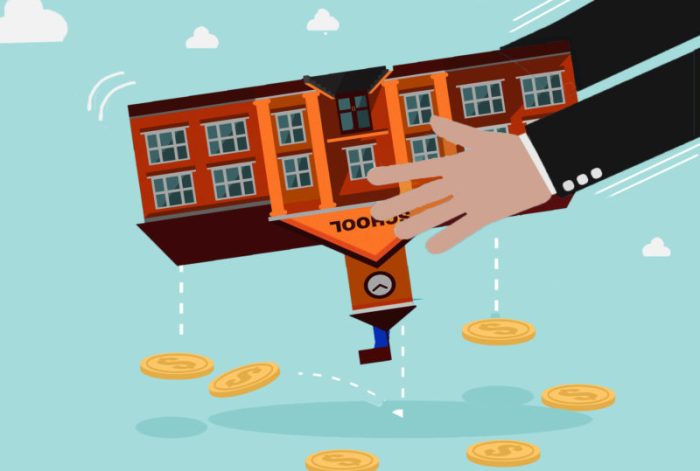
Testing Corporations Rake in Cash while Teachers Sell Plasma to Survive

Screen Shot 2018-03-26 at 3.34.02 PM


If you want to get rich in education, don’t become a teacher.


Open a charter school or take a job at a testing corporation.


Sure, charter schools are elaborate scams to make money off children while providing fewer services.


Sure, standardized tests are just corporate welfare that labels poor and minority kids failures and pretends that’s their fault.


And teachers? They’re just the people who do all the actual work of educating children. Yet there’s never enough money, never enough resources for the job they do.


According to the U.S. Bureau of Labor Statistics, the average salary of public school teachers in Pennsylvania is between $53,000 and $59,000 per year.


Compare that with the salaries of the people who make and distribute the state’s federally mandated standardized tests – employees at Data Recognition Corporation (DRC).


DRC publishes numerous assessments in various states. However, in the Keystone state, the corporation makes everything from the Pennsylvania System of School Assessments (PSSA) to the Keystone Exams in Algebra, Literature and Biology.


At its 14 locations across the country, the company has more than 750 full time employees and 5,000 seasonal ones used mainly to help grade the tests.


Screen Shot 2018-03-26 at 7.41.50 AM


According to glassdoor.com, a site that showcases job listings, here are some openings at DRC and their associated salaries:


Test Development Specialist – $68K-$86K


Quality Assurance Analyst – $77K-$83K


Technology Manager – $77K-$84K


Business Analyst – $81,856


Software Developer – $83,199


Psychometrician – $95,870


Senior Software Developer – $96,363


So teachers spend 180 days in overcrowded classrooms with fewer resources than they need – often forced to buy school supplies for their students out of pocket – to get their students ready to take the high stakes tests.


Meanwhile, the test makers sit in luxury office buildings taking home tens of thousands of dollars more just to make the tests that students take over the course of a few weeks.


And these corporate test employees DO work in luxury.


Here are some of the benefits they receive listed on DRC’s own Website:


“DRC offers a comprehensive benefits program that allows employees to make choices that best meet their current and future needs.

Key Benefits

  • Choice of medical plans
  • Choice of dental plans
  • Flexible spending accounts
  • HSA account
  • 401K savings plan
  • Profit sharing
  • Short- and long-term disability plans

Wellbeing Benefits

  • Paid vacation
  • Paid holidays
  • Personal time off
  • Workout facilities/locker rooms at select locations
  • Tuition reimbursement
  • Community service hours
  • Discount programs
  • Adoption assistance
  • Fitness classes
  • On-site massage
  • Walking paths

Convenience Benefits

  • Business casual attire

  • On-site subsidized cafeterias

  • Dry cleaning pick-up and delivery

  • Company store”


It’s funny. Some folks get all in a lather about the much less extravagant benefits given to teachers, but I’ve never heard anyone in a rage about these benefits being paid to corporate test makers.


And keep in mind, both teachers and test makers are being paid with public tax dollars. YOU are funding the test makers on-the-job massage break just as you’re funding the public school teachers trip to the doctor for anti-anxiety meds.


The Pennsylvania legislature has entered into three contracts with DRC through 6/30/21 for services related to standardized testing for a total of $741,158,039.60, according to State Sen. Andrew Dinniman (D-West Chester).


That is your money funding the test makers workout facilities and flexible spending accounts. You pay for their walking trails, fitness classes, dry cleaning services and subsidized cafeterias.


Meanwhile, public school teachers – who do the bulk of the work educating children – are left struggling to make ends meet.


According to estimates by the National Education Association (NEA), teaching salaries from Pittsburgh to Philadelphia have stagnated by 2.3% in the past 15 years.


But that’s way better than in most parts of the country.


In West Virginia, teachers across the state went on a 9-day strike to get a 5% pay raise.


Teachers in Arizona and Oklahoma are planning their own strike due to even worse neglect.


In Oklahoma, some educators have actually had to resort to selling plasma in order to survive.


KOCO News 5, in the Sooner State, reported on a fifth grade teacher at Newcastle Elementary school, Jay Thomas, who sells blood to supplement his income.


“I’ve got a permanent scar doing that. Just did it yesterday,” Thomas said.


“I’ve been doing it for a couple of years. I’ve given over 100 times. It’s twice a week.”


Though Thomas has been an Oklahoma teacher for 16 years, he makes less than $40,000 a year after taxes.


Selling plasma nets him about $65 a week.


And if you think Thomas is the anomaly, when this story was spread on Twitter, other teachers responded that they do the same, some even including pictures of themselves at the blood bank.


Screen Shot 2018-03-23 at 9.57.25 AM


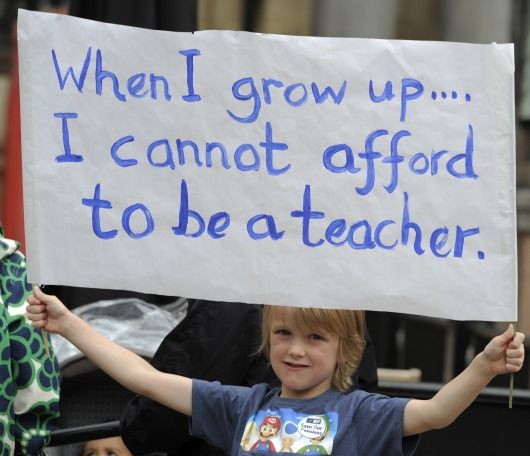
This is why there is a teacher shortage in many states. This is why fewer college students are entering the field. And it is why many of those educators who have stayed in the classroom are considering strikes.


We take teachers for granted. We value the work they do but not the people who do that work.


Meanwhile, we give extravagant rewards to the corporate vultures who provide very little for children but divert funding that should be going to educate students – the standardized testing corporations and the privatized school operators.


If we really want to improve our education system in this country, the first step is to value those who work in it.


We need to turn the money hose off for unnecessary expenses like standardized testing and allowing charter and voucher operators to pocket tax money as profit.


And we need to spend more on the people in the trenches day-in-day-out making sure our children get the quality education they deserve.


We need to give teachers the resources and respect they need to succeed and end the scams of high stakes testing and school privatization.
 

3f7ccd898a1d7e2ad178656da70f58b7--teaching-quotes-teaching-ideas


Like this post? I’ve written a book, “Gadfly on the Wall: A Public School Teacher Speaks Out on Racism and Reform,” now available from Garn Press. Ten percent of the proceeds go to the Badass Teachers Association. Check it out!
book-3

The Lone Voice of Dissent Against Standardized Testing

Businesswoman shouting through the megaphone in the open air.


Everybody wants to fight the good fight.


Until the battle begins.


Then many of us are all too ready to give in to what was intolerable just a moment before.


To paraphrase Thomas Paine:


These are the times that try men’s souls. The summer soldier and the sunshine patriot will, in times of crisis, shrink from service, but those who stand up in time of need deserve the love and thanks of every man and woman.


I see this almost every day in our schools.


Ask nearly any teacher what they think about high stakes standardized testing, and they’ll complain until they’re blue in the face.


They’ll give you gripes and grievances galore.


The tests take too long. They’re not valid assessments. They narrow the curriculum. They’re dumbing down the teaching profession and ripping away our autonomy.


To which I say – Amen, Sister!


Standardized tests more accurately measure economics than academics – poor kids generally fail and rich kids pass. They’re culturally biased, poorly put together, unscientifically graded and demonstrate a gobbsmacking conflict of interest.


Two conflicts of interest, actually.


First, the people who make the tests, grade the tests and thus have a financial interest in failing the most students possible because that means we have to buy more remediation material which they also conveniently sell.


Second, these test scores are used by the school privatization industry to unfairly label public schools failures so they can more easily sell fly-by-night charter and voucher schools.


So, yeah. Almost all of us agree standardized testing sucks.


But when there’s an administrator present, I too often find I’m the only one willing to speak that truth. My colleagues, who are pleased as punch to gripe in private, suddenly go quiet in the presence of their superiors.


What’s worse, some of them don’t just stay quiet – they offer arguments to support whatever nonsensical test-based solution our boss has in mind today.


Let’s say an administrator suggests we do something about the handful of students who opt out of standardized tests.


We could just respect the rights of parents who have handed in their written intention to opt their children out under a religious exemption – the only option in Pennsylvania. Or we could do as the administrator suggests and force kids who’ve been opted out to take a standardized look-a-like assessment.


I hear something like that, and I’m on my feet ready to fight.


But I find myself standing there alone.


“You can’t do that,” I say.


“It violates state law. In particular, Pennsylvania Code Title 22 Chapter 4, section 4.4.


(Okay, I had to look up the particulars later, but I made sure the administrator got them.)


Consider subsection (d) (4). And I quote:


If upon inspection of a State assessment parents or guardians find the assessment to be in conflict with their religious belief and wish their students to be excused from the assessment, the right of the parents or guardians will not be denied…”


Or how about subsection (d) (3):


“School entities shall adopt policies to assure that parents or guardians [have]… (3) The right to have their children excused from specific instruction that conflicts with their religious beliefs, upon receipt by the school entity of a written request from the parent or guardians.” (Emphasis mine)


In other words, parents have a right to excuse their children from the tests and/or instruction such as test look-a-likes.


If we go forward with requiring students who are opted out to take tests that are just like the ones their parents instructed us NOT to give, we will be violating parents’ rights under state law.”


That seems pretty airtight to me.


But the administrator disagrees.


And I look around at the assembled mass of workaday teachers for support.


Not a peep.


Instead I get this:


-We’re being evaluated on these standardized tests, we have to make sure kids take them seriously.


-I see where you’re coming from but we have to do something about these kids who are opting out just to get out of doing the work. They don’t have any real intellectual objection. They’re just lazy.


-We’ve got to do something about grade inflation.


Oh. Em. Gee.


Yet after the meeting, some of them cautiously walk up to me asking my opinion of what went down.


YOU DON’T WANT TO HEAR MY OPINION RIGHT NOW!


Take my word for it.


Tomorrow or the next day or the next week, they’ll be complaining again.


I’ve seen some of these people reduced to tears by administrators unfairly manipulating them based on their students’ test scores.


Yet none of them have the guts to stand up and be counted when the moment comes.


I say again – everyone wants to fight. But no one wants to do the fighting.


They want someone else to do it for them.


Does that make you angry?


It makes me furious.


But if you feel that way, you’ve got to do something about it.


You think teachers are too cowardly? What have YOU done to fight corporate education reform today?


You think too many administrators are quislings. You think the lawmakers are bought and sold. You think the public schools are under attack.


Well, get off your ass and do something.


I am tired of being the lone voice of dissent here.


All across the country there are people like me – people willing to stand up and fight.


But it’s a big country, and we’re usually spread pretty thin.


We need people willing to put their money where their mouths are – right here, in our hometowns.


Put up or shut up, America.


Do you want a school system that serves the needs of children?


You’ve got to make it happen.


I can’t do this all by myself.

Respecting Student Free Speech Was Hard for Adults During Today’s School Walkout

BN-XV995_WALKOU_M_20180314111108


The kids are all right. It’s the adults you have to watch.


The walkout planned nationwide to protest gun violence today on the one-month anniversary of the Parkland shooting came to my western Pennsylvania school – and we weren’t ready for it.


In fact, up until today no one had mentioned a thing about it.


I had asked teachers if they wanted to do something and was told it was up to the students to lead.


I had asked the high school student council if they were interested in participating, but there wasn’t much of a response.


Then this morning in the middle school where I teach, there was an impromptu two minute meeting where we were told some kids might walk out and that we should just let them go.


Their right to free speech would be respected and there wouldn’t be any penalty for participating.


However, as a teacher, I was instructed not to bring up the subject, not to allow discussion and only to attend if all of my students decided to go.


That’s a hard position to be in.


It’s like being put in a metaphorical straight jacket.


But I tried.


When my 7th grade kids came in, they were all a buzz about something and I couldn’t really ask why.


The suspense was broken with a sledge hammer during second period when one of my most rambunctious students asked if he could use the restroom at 10 am. That was over an hour away.


I told him he couldn’t reserve an appointment for a bathroom break but he could go now if he wanted.


Then he explained himself. At 10 am he was walking out.


The room exploded.


They had heard about the nationwide walkout at 10 – the time of the Parkland shooting. They knew kids all across the land were leaving class for 17 minutes – 60 seconds for each life lost in the shooting.


But that was pretty much it.


They didn’t know what it was that kids were protesting. They didn’t know why they were protesting. They just knew it was something being done and they wanted to do it.


It was at this point I took off my metaphorical straight jacket.


I couldn’t simply suppress the talk and try to move on with the lesson – on propaganda, wouldn’t you believe!


We talked about the limits of gun laws – how some people wanted background checks for people wishing to purchase guns. We talked about regulating guns for people with severe mental illnesses, criminal backgrounds or suspected terrorists. We talked about how there used to be a ban on assault weapons sales and how that was the gun of choice for school shooters.


We even talked about what students might do once they walked out of the building.


They couldn’t just mill around for all that time.


Since we were in the middle of a unit on poetry, someone suggested reading poems about guns and gun violence.


Students quickly went on-line and found a site stocked with student-written poetry on the issue – many by students who had survived school shootings.


I admit I should have checked the site better – but we had literally minutes before the walkout was scheduled to take place.


Some of the poems contained inappropriate language and swear words. But they were generally well written and honest. And the kids liked them.


I let them print a few that they wanted to read aloud at the demonstration.


They were actually huddled around their desks reading poetry and practicing.


They were really excited about the prospect of standing up and being counted – of letting the world know how they felt.


One student even wrote her own poem.


She said I could publish it anonymously, so here it is:


“Pop! Pop! Pop!


Everyone crying, calling their parents, saying their last goodbyes.


Screams echo throughout the building.

Blood painting the white tiles.

Bodies laying limp on the ground

Screams of pain

Bullets piercing our skin.


Yelling and sobbing increase.

We are escorted out.


‘Is this what you wanted?’”


I barely had time to read it before the time came.


Students stood up and were confused by the lack of an announcement.


But this was not a sanctioned school event. If they took part, they were on their own.


It was my smallest class and several kids were already absent.


They all left and were immediately met by the principal and security. To their credit, the adults didn’t stop them, but they told them not to put their coats on until they were outside and to otherwise quiet down.


I made sure to emphasize that anyone who wanted was welcome to stay in class. But no one did.


After the last child left, I grabbed my coat and followed.


When I got to the front of the building I was surprised by the lack of high school students. There were only a handful. But there were maybe 50 middle school kids.


When the principal saw all my students had decided to participate, he asked me to stay in the lobby. He said it wasn’t necessary for me to attend.


That was hard.


I wanted to be there, but I didn’t want to be insubordinate, either.


My students were expecting me to be there. They were expecting me to help guide them.


So I stood in the doorway and watched.


Students did as I feared; they pretty much milled around.


A few of my students held their poems in hand and read them quietly together but there were no leaders, no organization.


After about 5 minutes, the adults pounced.


The resource officer criticized them since their safety was more at risk outside the building than in class. Administrators chastised the collective group for having no plan, for only wishing to get out of class, for not knowing why they were there and for not doing anything together to recognize the tragedy or the issue. They said that if the students had really wanted to show respect to those killed in Florida they would have a moment of silence.


The kids immediately got quiet, but you can’t have a 17-minute moment of silence. Not in middle school.


I saw some of my kids wanting to read their poems aloud but too afraid to call the group’s attention to themselves.


And then it was over.


The whole thing had taken about 10 minutes.


Administration herded the kids back into the building early and back through the metal detectors.


I can’t help feeling this was a missed opportunity.


I get it, being an administrator is tough. A situation like today is hard to stomach. Kids taking matters into their own hands and holding a demonstration!?


We, adults, don’t like that. We like our children to be seen and not heard.


We want them to do only things that will show us in a better light. We don’t like them taking action to fix problems that we couldn’t be bothered to fix, ourselves.


But what right do we have to curate their demonstration?


If they wanted to mill around for 17 minutes, we should have let them.


Better yet, we could have helped them organize themselves and express what many of them truly were thinking and feeling.


If I had been allowed out of the building, I could have called the assembly to order and had my kids read their poems.


But doing so would have been exceedingly dangerous for me, personally.


I can’t actively defy my boss in that way. It just didn’t seem worth it.


If we had had warning that this might happen and planned better how to handle it, that also might have been an improvement.


Imagine if the school had sanctioned it. We could have held an assembly or sent a letter home.


The teachers could have been encouraged to plan something with their students.


Obviously if the students wanted to go in another direction, they should have been allowed to do so.


But these are middle school kids. They don’t know how to organize. They barely know how to effectively express themselves.


Regardless of how we, adults, feel about the issue, isn’t it our responsibility to help our student self actualize?


Isn’t it our responsibility to help them achieve their goals?


I don’t know. Maybe I’m just a crazy hippie.


Maybe I’m some radical anarchist.


But I’m proud of my students for taking a stand.


It was unorganized and a mess.


Yet they stood up and did something we, the adults, really weren’t that keen on them doing.


Their message was a muddle.


But they had something to say.


They just haven’t figure out how to say it yet.

Rick Saccone Hopes to Become Trump’s New Bobble Head in Western Pennsylvania


IMG_9488
Rick Saccone hard at work for the taxpayers of Pennsylvania.

Rick Saccone’s signature achievement in the Pennsylvania House was to get “In God We Trust” posted in every public school.


Actually, he didn’t even get that.


He wrote a successful bill that merely allowed public schools to post that – if they wanted.


To my knowledge not a single school in the Commonwealth has taken him up on it.


His second greatest hit was to authorize a state day of fasting.


I’m not kidding. And it’s all down hill from there.


Now he’s running for U.S. Senate!


Oh. Wait. His fundraising was terrible.


Excuse me. He’s running for U.S. House – because that’s an easier win!


Whatever. So long as he can get to Washington, DC. He’s had enough of this small potatoes Pennsylvania politics – even though he’s one of the smallest potatoes in the patch.


If you know what I mean.


He’s running against Democrat Conor Lamb in a special election to be held March 13 to fill Republican Tim Murphy’s seat.


You may recall Murphy. He made his name voting for anti-abortion legislation until his alleged mistress got pregnant and then he allegedly pushed for her to abort their love child.


You know. Family values stuff.


Is Saccone up to that level of hypocrisy?


Donald Trump thinks he is.


The least popular President in U.S. history with only a year under his bulging golf shorts thinks Saccone is his kind of guy.


Trump even came to western Pennsylvania to support Saccone tweeting:

Screen Shot 2018-01-29 at 3.13.20 PM

“Will be going to Pennsylvania today in order to give my total support to RICK SACCONE, running for Congress in a Special Election (March 13). Rick is a great guy. We need more Republicans to continue our already successful agenda!”


Of course, Trump immediately had to walk back this comment because his trip to the keystone state was being paid for with public tax dollars. He had to say that it was an official White House event and not (as he indicated in the tweet) that it was a campaign event.


You know, for once I agree with Trump.


Rick Saccone IS Trump’s kind of guy.

20180118smsTrump02-1

He has lots of experience as a Yes Man. That’s really all he’s done in Harrisburg.


We used to have our own version of Trump – a Republican Governor who had no idea how to do his job – Tom Corbett.


Of course, Corbett’s reign was short lived. Like the President, his popularity plummeted and he was voted out of office like yesterday’s garbage.


But he had his loyal bobble head Saccone backing him every step of the way.


In fact, he voted for Corbett’s initiatives 95% of the time giving him the nickname of Corbett’s “Mini-me.”


Even when Corbett proposed something deeply unpopular, like cutting almost $1 billion from the state’s poorest public schools, Saccone went out there to explain why our children, our future, just weren’t worth the investment.


The Swamp recognizes Saccone as one of their own.


That’s why big moneyed interests are pouring cash on the sycophantic lawmaker. That and the fact that the district in question went for Trump in the last election by 20 points.


The National Republican Congressional Committee has spent at least $1 million on ads for broadcast and cable TV stations to boost Saccone’s candidacy.


And that’s not all.


Congressional Leadership Fund has put aside at least $1.6 million for ads, not to mention funding from outsiders like the 45Committee and Ending Spending – a group founded by the mega-donor Ricketts family.


All this money just to serve out the remainder of Murphy’s term!


Whoever wins would be up for re-election in November to secure a full two-year term.


Moreover, now that the state Supreme Court has overturned the Commonwealth’s gerrymandered districts that unfairly favor Republicans, that November race is likely to include newly drawn legislative lines.


So this GOP wonderland that boosted Trump and Mitt Romney in 2012 will likely become more competitive.


In fact, it may already be.

SacconeFlagShirt
Saccone disrespecting the flag by wearing it as a shirt.

Some polls have Saccone up over Lamb by only a 3 point lead. This may be in part because of Trump’s steadily deflating support – even among Republicans. The President’s approval rating in the district has dropped to 49 percent – not far from the national picture where 47 percent disapprove of his job performance.


This is not good news for Saccone.


The SuperPACS supporting him are trying to paint Lamb, a former federal prosecutor, as a Nancy Pelosi puppet.


But Lamb has repeatedly criticized Pelosi, telling The Pittsburgh Post-Gazette that he would not support Pelosi as the Democratic leader. There is a “need [for] new leadership on both sides,” Lamb said.


Yet Saccone has done everything in his power to suck up to Trump.


Taking his cue from the Commander in Chief, Saccone took to twitter to express his feelings:

Screen Shot 2018-01-29 at 4.27.01 PM

“I’m humbled that @realDonaldTrump for President, Inc, has officially endorsed my campaign for Congress!”


I’m not sure why he wrote “President, Inc.”


Perhaps Saccone thinks the office belongs to a private company.


Perhaps he doesn’t understand that a politician’s job is to serve the needs of his or her constituents.


Judging by his less than stellar performance in state government, this would seem to be the case.


He’s come a long way from earnestly trying to legislate past the establishment clause of the first amendment to fighting to starve our schools to running for a position as Trump’s favorite puppet.


Or not.


That depends on voters this March.


Full Disclosure: I am not a Saccone fan. Along with teachers, parents and students from across western Pennsylvania, I’ve picketed outside of his offices demanding he do his job and provide for students. He was deaf to our cries. Do you hear me now, Rick?

062411_TEACH_4

2011-06-23_11-00-52_113

Stupid Ass School Voucher Bill Back for Pennsylvania Vote Tomorrow

Shake the world to make money


Close your eyes and imagine a school like the one where I teach.


The public middle school is right next door to a Catholic middle school.


Some of the wealthiest families send their kids to the religious school. The rest send their kids to the public school.


Now imagine that the state passes a school voucher bill.


Those wealthy families can now use public tax dollars to help fund their kids’ Catholic school tuition.


A truckload of taxpayer wealth would be redistributed away from the public school and into the religious one.


And this is for children who weren’t attending public school in the first place.


Imagine what an impact that would have on the two schools. At the Catholic middle school, not much would change. At most a few more kids might enroll. And wealthy parents would get to pay less in tuition.


At the public middle school, however, the results would be disastrous. It would have to survive on much less funding than it was already receiving. Services for the majority of students in the district would be degraded. Class sizes would balloon. Educational quality would take a nose dive.


So why wouldn’t more kids from the public school move to the Catholic one?


Well, first of all, few kids in the district are Catholic. Should they be forced to be indoctrinated in a faith in which they don’t believe?


Second, tuition at the Catholic school costs more than the price of the voucher. Parents would have to pay above and beyond what they’re paying now to make tuition at the Catholic school. And this is a mostly poor neighborhood. Parents simply can’t afford it.


THIS is the situation the Pennsylvania Education Committee will vote on tomorrow.


The committee will decide whether State Sen. John DiSanto’s school voucher bill should be voted on by the state Senate and House.


School vouchers are not popular at both the national and state level.


Around 70% of people across the country oppose school vouchers, according to the PDK-Gallup public opinion poll about U.S. education.


Moreover, Harrisburg wastepaper baskets are lined with school voucher bills that fail to pass despite being introduced every few years.


DiSanto’s bill is called Education Savings Accounts for Students in Underperforming Schools or SB 2.


And guess what!?


It’s almost exactly the same as a pile of similar bills offered by the American Legislative Exchange Council (ALEC).


The Special Needs Scholarship Program Act, The Foster Child Scholarship Program Act, “Opportunity Scholarships,” The Smart Start Scholarship Program – all ALEC bills that do almost the same thing.


They designate some group of at risk students and say, “Hey, you know what they need? School vouchers!”


Well, my goodness. I’m sure glad DiSanto didn’t stress himself out writing something new. I’m certain his constituents wanted him to plagiarize someone else’s bill and pretend like it was his own.


And how exactly will spending public tax dollars on non-public schools help these kids succeed? That’s never explained.


Fools like DiSanto just pretend that it will help as a matter of faith. And since the overwhelming majority of school vouchers go to religious school coffers, this makes sense.


It is a blatant violation of the separation of church and state. But privatization supporters don’t give a crap about that. They don’t care about the values on which this country where founded. Their only concern is doing what their rich donors demand.


SB 2 would target students living in districts with the most underfunded schools serving the most impoverished populations. You know – “failing schools.”


If passed, kids living in these neighborhoods would have whatever the district sets aside for each student put in a savings account to be spent in almost any way parents see fit so long as they could somehow justify it as educational.


Send your kids to a private or parochial school?


Sure!


Homeschool your child?


Yep!


Go on a trip to the life-sized replica of Noah’s Ark in Williamstown, Kentucky?


You betcha!


And the best part is there is hardly any accountability built in to the law, so we probably wouldn’t even know how this money was spent.


Your tax dollars at work. Somehow. Somewhere. Out of sight.


I guess that’s what Pennsylvania Republicans like DiSanto call fiscal conservatism.


If passed, the bill would affect 800 schools – the 15% lowest performing in the state – including mine.


Take a look at the list.


Every school serves mostly poor students. Every school is severely underfunded.


Pennsylvania ranks 45th out of 50 for school funding. There are only five states in the country where the state government pays less of the cost of educating students. The Commonwealth relies on local municipalities to make up the difference. That means local property taxes, so the richer an area you live in, the more money it can afford to pay to educate children. The poorer an area where you live, the less it can pay.


This is why Pennsylvania has the widest disparity between how much it spends on rich kids vs. poor ones. Wealthy children are cherished and coddled. Poor ones are left to fend for themselves.


This voucher bill would only exacerbate the situation.


It’s a giveaway to those who don’t need it at the expense of those who can least afford to pay.


If you live in the Commonwealth, please call and/or write your state Senator and Representative and ask them to oppose this bill.

PA High Court Says, “Yes, Schools CAN Sue State Over Unfair Funding, After All!”

rrxfund14-d


It’s back on!

Two years ago a group of plucky Pennsylvania public schools took the state legislature to court because the body wasn’t allocating funding to all districts fairly – some got too much, many got too little.

A lower court threw the challenge out saying it wasn’t the court’s job to tell the legislature how to legislate. But now the state Supreme Court has overturned that lower court decision.

In effect, justices are sayingHell, yes, that is the court’s job! That’s why it’s called a system of checks and balances, Baby!

Or something like that.

Before going any further, there are a few pertinent facts you have to understand about the Commonwealth.

1) No other state in the country has a bigger gap between what it spends on rich vs. poor students than Pennsylvania, according to the U.S. Department of Education.

untitled

2) The Pennsylvania legislature has been paying less and less of public schools’ budgets over the last four decades. The state used to contribute 54% of all public school costs in the early 1970s. Today it pays only 35% of the costs, leaving local taxpayers to take up the slack. Since districts are not equally wealthy, that increases the disparity of resources between rich and poor districts.


3) The state has only had a funding formula specifically legislating how to allocate money to its more than 500 districts for two years. Two years! For more than 15 years previous, the legislature just handed out money willy nilly based on political backroom deals that favored already rich districts and hurt the most impoverished ones.

4) The new funding formula still is not fair. Though it does take into account the poverty of a district, it doesn’t account for the years of systematic disinvestment the district suffered through previously. That’s like giving new sneakers to a racer who hasn’t been able to get out of the starting gate while others are already halfway to the finish line.

5) The legislature STILL hasn’t healed almost $1 billion in education cuts made under previous Republican Gov. Tom Corbett. Instead, under current Democratic Gov. Tom Wolf, it has reluctantly increased funding a bit at a time but failed to bring spending up to what it was four years ago. And even once the cuts are healed, spending will be behind inflationary and cost of business increases. Meanwhile the Republican controlled legislature plays games approving the state budget separately from allocating money to the programs – including schools – that it already approved!


6) Pennsylvania is one of seven states with a Constitution that specifically requires the state provide a “thorough and efficient” system of education. Some of these other states – like New Jersey – have used similar Constitutional requirements to force their legislatures to increase state funding to public schools.

So there you are.

Pennsylvania’s legislature is an absolute mess.

Hopelessly gerrymandered, controlled by the radical right, and opposed by a Democratic party nearly as beholden to big donors as their GOP counterparts and desperate for any area of bipartisanship so as to be able to claim they got anything done other than stop Republicans from burning the whole place to the ground.

That’s why today’s 5-2 Supreme Court ruling is a breath of fresh air.

It’s like someone finally called Mom and Dad to tell our bratty lawmakers to get back to work.

The case will now go back to Commonwealth Court.

Supreme Court Justice David Wecht wrote that the courts do have a responsibility to check the power of the legislature – both in regard to the requirements of the state Constitution and that poorer districts are being discriminated against.

“It remains for (the) petitioners to substantiate and elucidate the classification at issue and to establish the nature of the right to education, if any, to determine what standard of review the lower court must employ to evaluate their challenge,” Wecht wrote. “But (the) petitioners are entitled to do so.”

This may be a Herculean task for those suing the state. And it seems unlikely that Commonwealth Court will hear their arguments favorably.

Justices rarely have the courage to challenge other branches, and the history of Pennsylvania’s courts shows multiple times when the courts have simply refused to assert such power.

This is what happened back in the 1990s when the Philadelphia School District sued the state over the same issue – unfair funding.

Time and again, poor districts have asked for help from the courts when the legislature refused to do its job. And time and again the courts have refused.

But at least this ruling gets things moving again. It’s like a dose of Kaopectate for a constipated political system.

Another possible bit of good news comes from Common Core and high stakes standardized testing. Yes, that crap!

When Philadelphia sued the state, the courts refused to rule in the schools favor because it had no way of proving the state was hurting the quality of education students were receiving there through lack of funding. But that was before Pennsylvania adopted its new Common Core look-a-like standards, PA Core, and initiated aligned tests including the souped up Pennsylvania System of School Assessments (PSSA) and Keystone Exams.

Ironically, the same “accountability” measures used to “demonstrate” poor schools are failing could be used to prove the common sense notion that unfairly funding schools leads to poor academic results.

In any case, far right demagogues like House Speaker Mike Turzai, R-Allegheny, are already whining that the Supreme Court is legislating from the bench. However, as a defendant in the case, and one of the most partisan hacks in Harrisburg, that’s exactly what the Koch Brothers probably told him to say.

Unfortunately, Gov. Wolf seems to kinda agree with him. Though he has yet to make a statement about today’s ruling, he was against the suit when it was originally brought up in 2015. Though he supports increasing education funding and has consistently pushed for it with every budget proposal, he is leery of the courts butting in.

Sadly, his strategy of incremental education budget increases has been failing. Or, to be fair, it’s succeeding at such a slow rate that it would take decades for it to catch up.

The fact of the matter is that it is patently unfair for rich districts to spend $10,000 to $20,000 on each student, while poorer districts can barely pull together $5,000-$6,000.

In addition, impoverished students have greater needs than rich ones. They often don’t have books in the home or access to Pre-kindergarten. Poor students often suffer from food insecurity, malnutrition, a lack of neonatal care, worse attendance, are less well rested and have greater special needs and suffer greater traumas than wealthier students. Moreover, it is no accident that the group being privileged here is made up mostly of white students and those being underprivileged are mostly students of color.

The time is here when Pennsylvanians have to decide where they stand. Are they for a state that offers all children an equal start or do they prefer one where poor brown kids suffer so rich white ones can get ahead?

Today, the matter is in the court’s hands.

Pennsylvania Proposes Smaller Tests, Same High Stakes

Screen Shot 2017-08-14 at 4.04.51 PM


It’s not the size of the tests, it’s how you use them.


And that’s kind of the problem with Gov. Tom Wolf’s new proposal for Pennsylvania public schools.


Wolf wants to reduce the amount of time students are taking standardized tests, but he seems to have little problem using those tests to hold schools accountable for all kinds of things that are beyond their control.


The proposal released today applies only to the Pennsylvania System of School Assessment (PSSA) tests – those taken by students in grades 3-8. Keystone Exams taken by high school students are unaffected.


It would cut one of three reading sections and one of three math sections – two total. Wolf also wants to cut some questions from one of the science sections.


Such a move is estimated to eliminate 48 minutes from the math test, 45 minutes from the reading test and 22 minutes from the science test. However, judging from my own students, these times vary considerably depending on the individual taking the tests. I’ve had 8th grade students finish a PSSA section in as little as 5 minutes or as much as two hours.


Most schools give either a section a day or two in one day. Therefore, this proposal probably translates to 1 to 2 fewer days testing in most districts.


Um. Thanks?


Look I don’t want to seem ungrateful here, but these suggested modifications are little more than fiddling around the edges of a massive problem.


Yes, it will be helpful to reduce testing times, but this does very little to address the fundamental problems with test-based accountability in the Commonwealth.


At best, this proposal will allow students to spend two more days a year learning. Assuming most districts don’t use that extra time for test prep, that IS a good thing.


But tacitly committing students throughout the state to taking these tests almost guarantees that test prep is exactly how these additional days will be used.


The problem with standardized testing isn’t just the number of raw days it takes students to complete the tests. It is how the tests deform the entire year-long curriculum. Students don’t just learn anymore. They learn what’s on the test – and anything else is purely optional.


Regardless of the size of the assessments, they are still being used to sort and judge students, teachers and schools. Shortening their length does nothing to address the fundamental unfairness of the evaluations. Rich white kids still tend to have high scores and poor minority kids still tend to have low ones.


At best, they reveal structural funding disparities between poor and wealthy districts. At worst, the cultural bias inherent in the questions favor those from dominant, privileged ethnicities while punishing those who don’t fit the standard.


That’s what “standardized test” means after all – defining normal and punishing those who don’t fit the definition. Most questions don’t assess universals like the value of 2 and 2. They evaluate cultural and social norms required to understand the questions and easily find an answer that another “normal” student would choose. (Don’t believe me? Watch “Black Jeopardy” on Saturday Night Live.)


This is true whether the test takes one day or 100 days.


We should not be using standardized testing to meet federal accountability standards. Period.


The federal Every Student Succeeds Act (ESSA) contains provisions to circumvent them. States are supposed to be given leeway about testing. They may even be able to replace them with projects or other non-standardized assessments. THAT’S what Wolf and the Pennsylvania Department of Education should be exploring – not half measures.


To be fair, the state Department of Education is attempting reform based on the ESSA. This year, the department introduced Future Ready PA, a new way of using test scores and other measures to assess school success. To its credit, The Index does place additional emphasis on academic growth, evaluation of school climate, attendance, graduation rates, etc. However, for my money it still gives far too much importance to standardized testing and test prep.


Like reducing the size of the PSSAs, it’s a positive step but won’t do much to get us to our destination.


Neither measure will have much impact on the day-to-day operations of our public schools. Districts will still be pressured to emphasize test prep, test taking strategies, approaches to answering multiple choice questions, etc. Meanwhile, critical thinking, problem solving, and creativity will still be pushed to the side.


Moreover, since schools and teachers will be assessed as successful or not based largely on these test scores, districts will be under tremendous pressure to give countless practice tests throughout the year to gauge how well students are prepared for the PSSAs. The state will still be providing and encouraging the optional Classroom Diagnostics Tools (CDT) tests be taken several times in reading and math throughout the year. Trimming off two days from the PSSA will affect that not at all.


In addition, today’s proposal only applies to the PSSA. While that assessment is important, the Keystone Exams given to high school students are even more so. According to existing state law, passing the Keystones in Algebra I, Literature and Biology are required in order to qualify for a diploma. However, that condition has yet to go live. So far the legislature has continuously pushed back the date when passing scores become graduation requirements. The Governor and Department of Education should be proposing the elimination of this prerequisite before anything else. Other than education funding and perhaps charter school accountability, it is the most important education issue before Commonwealth lawmakers today.


Don’t get me wrong. The Democratic Governor is somewhat hamstrung by the Republican-controlled legislature. Partisan politics has stopped lawmakers from accepting Wolf’s more progressive education measures.


Though Wolf has gotten Republicans to increase education funding by hundreds of millions of dollars during his term, K-12 schools still receive less than they did before the previous GOP governor’s administration. Moreover, there have been absolutely zero inflationary increases to keep up with the rising cost of doing business. Pennsylvania schools receive less funding – whether you adjust for inflation or not – than they should, and that has a real world impact on our public schools. Moreover, how that money has been allocated by the legislature still – even with our new better funding formula in place – benefits wealthy districts more than poor ones.


If you want to talk about accountability, that’s where the majority of the issue belongs.


And primarily it’s out of Wolf’s hands. One can understand why he is proposing changes where he can and trying to do whatever good is possible given the political climate.


Shortening the PSSA tests would benefit our students. It is a step in a positive direction.


However, it is far from solving our many education problems.


The biggest roadblock to authentic school reform is a legislature that refuses to do anything but the absolute minimum for our neediest students.

Bring Your Gun to School – Courtesy of the Pennsylvania Senate


AB17380

Next school year, I may be able to bring my gun to class.


The Pennsylvania state Senate voted 28-22 today to allow school employees like me to start packing heat.


Hooray!


My class sizes will be larger because of almost $1 billion in budget cuts the legislature couldn’t be bothered to heal over the last seven years. I’ll have to teach more sections because my district is bleeding money from charter school vampires that the legislature couldn’t be bothered to regulate.


But now I can be fully armed.


Priorities.


Bullets over books, I guess.


As a more than 15 year veteran of the public school system, I can’t wait to get back in the classroom wondering which of my fellow teachers, principals, custodians or rent-a-cop security guards is fully locked and loaded. I can’t wait until my elementary school daughter is finally protected by being in an adult’s daily line of fire.


This is going to make us much safer.


At my school, we fired a security guard for slamming a student’s head into the table. I’m sure having these folks armed will have no negative effects at all.


And the extra stress from added responsibilities being piled on my back will just make me more vigilant in case I need to take out my piece in class and chase away Black Bart with my Red Ryder, carbine action, two-hundred shot range model… uh… rifle.


Maybe I can get one with a compass in the stock and a thingie that really tells time, too!


Seriously, it’s hard to believe that grown adults actually voted on this ridiculous farce of a law. The only positive thing is that it still needs to be passed by the House and signed by the Governor.


Bad news: state Representatives just might be as stupid as their Senate colleagues. Good news: the Governor isn’t. There is less than a snowball’s chance in Hell that Gov. Tom Wolf is going to sign this piece of crap.


This is what happens when you have a Republican-controlled legislature and a Democratic Governor. The kids say they want nothing but candy for dinner and Dad says “No.”


Now, with a reality TV star con man in our highest national office, GOP-controlled state legislatures like mine all over the country have become emboldened to pass even worse excrement knowing full well that it has zero chance of ever becoming law. But at least they’ll prove to their gerrymandered Republican voting districts not to primary them with even further right leaning Tea Party mental defectives.


It’s a game of chicken with our most vulnerable residents held hostage in the middle.


You know, if lawmakers think that guns are such a great idea in schools, why don’t they make them legal at the state capital?


You can’t go in that building without passing through a metal detector. If you try to bring a gun in there, the best thing you can hope for is to be refused entry.


The same thing at Commonwealth courts, military bases, mental hospitals, prisons and even the security checkpoint at the airport.


And it’s pretty similar in most states. Certainly at federal institutions. You can’t take a firearm with you to visit your Congressperson – or on a tour of the White House.


Heck! Guns aren’t even welcome at Donald Trump’s political rallies, or most of his hotels, golf courses or other properties. Same at conventions held by the National Rifle Association and the Conservative Political Action Conference.


Gee. Why are so-called conservatives so darn concerned with making sure teachers are armed, but they don’t want to offer the same “protection” to themselves in government, at their businesses, rallies and places of leisure?


Why? Because it’s bullshit.


That’s why.


Most of them don’t really want guns in schools. They know it’s a terrible idea. They just want to look like they support it. Their propaganda networks spew out all this nonsense that they have to pretend to believe.


When they let protesters enter the capital building open carrying automatic weapons, THEN I won’t doubt their sincerity.


When they let Black Lives Matter activists strapping rifles across their shoulders into their rallies among the angry and confused hillbillies, THEN I’ll know how serious they are.


And when the upper crust private and parochial schools where they send their own children start arming their teachers, THEN I’ll believe them.


Until that day, I call bullshit on this whole ridiculous endeavor.

Teachers Don’t Want All This Useless Data

26948475_l-too-much-data

One of the most frustrating things I’ve ever been forced to do as a teacher is to ignore my students and concentrate instead on the data.


I teach 8th grade Language Arts at a high poverty, mostly minority school in Western Pennsylvania. During my double period classes, I’m with these children for at least 80 minutes a day, five days a week.


During that time, we read together. We write together. We discuss important issues together. They take tests. They compose poems, stories and essays. They put on short skits, give presentations, draw pictures and even create iMovies.


I don’t need a spreadsheet to tell me whether these children can read, write or think. I know.


Anyone who had been in the room and had been paying attention would know.


But a week doesn’t go by without an administrator ambushing me at a staff meeting with a computer print out and a smile.


Look at this data set. See how your students are doing on this module. Look at the projected growth for this student during the first semester.


It’s enough to make you heave.


I always thought the purpose behind student data was to help the teacher teach. But it has become an end to itself.


It is the educational equivalent of navel gazing, of turning all your students into prospective students and trying to teach them from that remove – not as living, breathing beings, but as computer models.


It reminds me of this quote from Michael Lewis’ famous book Moneyball: The Art of Winning an Unfair Game:


“Intelligence about baseball statistics had become equated in the public mind with the ability to recite arcane baseball stats. What [Bill] James’s wider audience had failed to understand was that the statistics were beside the point. The point was understanding; the point was to make life on earth just a bit more intelligible; and that point, somehow, had been lost. ‘I wonder,’ James wrote, ‘if we haven’t become so numbed by all these numbers that we are no longer capable of truly assimilating any knowledge which might result from them.'”


The point is not the data. It is what the data reveals. However, some people have become so seduced by the cult of data that they’re blind to what’s right in front of their eyes.


You don’t need to give a child a standardized test to assess if he or she can read. You can just have them read. Nor does a child need to fill in multiple choice bubbles to indicate if he or she understands what’s been read. They can simply tell you. In fact, these would be better assessments. Doing otherwise, is like testing someone’s driving ability not by putting them behind the wheel but by making them play Mariocart.


The skill is no longer important. It is the assessment of the skill.


THAT’S what we use to measure success. It’s become the be-all, end-all. It’s the ultimate indicator of both student and teacher success. But it perverts authentic teaching. When the assessment is all that’s important, we lose sight of the actual skills we were supposed to be teaching in the first place.


The result is a never ending emphasis on test prep and poring over infinite pages of useless data and analytics.


As Scottish writer Andrew Lang put it, “He uses statistics as a drunken man uses lamp posts – for support rather than for illumination.”


Teachers like me have been pointing this out for years, but the only response we get from most lawmakers and administrators is to hysterically increase the sheer volume of data and use more sophisticated algorithms with which to interpret it.


Take the Pennsylvania Value Added Assessment System (PVAAS). This is the Commonwealth’s method of statistical analysis of students test scores on the Pennsylvania System of School Assessment (PSSA) and Keystone Exams, which students take in grades 3-8 and in high school, respectively.


It allows me to see:

  • Student scores on each test
  • Student scores broken down by subgroups (how many hit each 20 point marker)
  • Which subgroup is above, below or at the target for growth


But perhaps the most interesting piece of information is a prediction of where each student is expected to score next time they take the test.


How does it calculate this prediction? I have no idea.


That’s the kind of metric they don’t give to teachers. Or taxpayers, by the way. Pennsylvania has paid more than $1 billion for its standardized testing system in the last 8 years. You’d think lawmakers would have to justify that outlay of cash, especially when they’re cutting funding for just about everything else in our schools. But no. We’re supposed to just take that one on faith.


So much for empirical data.


Then we have the Classroom Diagnostic Tools (CDT). This is an optional computer-based test given three times a year in various core subjects.


If you’re lucky enough to have to give this to your students (and I am), you get a whole pile of data that’s supposed to be even more detailed than the PVAAS.


But it doesn’t really give you much more than the same information based on more data points.


I don’t gain much from looking at colorful graphs depicting where each of my students scored in various modules. Nor do I gain much by seeing this same material displayed for my entire class.


The biggest difference between the PVAAS and the CDT, though, is that it allows me to see examples of the kinds of questions individual students got wrong. So, in theory, I could print out a stack of look-a-like questions and have them practice endless skill and drills until they get them right.


And THAT’S education!


Imagine if a toddler stumbled walking down the hall, so you had her practice raising and lowering her left foot over-and-over again! I’m sure that would make her an expert walker in no time!


It’s ridiculous. This overreliance on data pretends that we’re engaged in programming robots and not teaching human beings.


Abstracted repetition is not generally the best tool to learning complex skills. If you’re teaching the times table, fine. But most concepts require us to engage students’ interests, to make something real, vital and important to them.


Otherwise, they’ll just go through the motions.


“If you torture the data long enough, it will confess,” wrote Economist Ronald Coase. That’s what we’re doing in our public schools. We’re prioritizing the data and making it say whatever we want.


The data justifies the use of data. And anyone who points out that circular logic is called a Luddite, a roadblock on the information superhighway.


Never mind that all this time I’m forced to pour over the scores and statistics is less time I have to actually teach the children.


Teachers don’t need more paperwork and schematics. We need those in power to actually listen to us. We need the respect and autonomy to be allowed to actually do our jobs.


Albert Einstein famously said, “Not everything that can be counted counts, and not everything that counts can be counted.”


Can we please put away the superfluous data and get back to teaching?

PA: Want to Get Rid of Keystone Exams? Then Let Us Evaluate Teachers More Unfairly

Screen Shot 2017-06-14 at 12.05.25 PM

It’s the classic Harrisburg switch.


Want something good passed by the legislature? Then let us pass something terrible – something you would never even consider unless something you cared about was on the table.


That appears to be the game being played by the Pennsylvania Senate Education Committee today as they consider SB 756.


On the one hand, the proposed bill would eliminate the state’s terrible Keystone Exams. On the other, it would force a new teacher evaluation system that is tremendously unfair.


Which one is more important?


The answer: both.


If lawmakers had any moral courage – and most don’t because they’re lawmakers after all – they would consider each of these measures one at a time on their own merits.


But if they did that, conservatives wouldn’t vote to help students by getting rid of unfair tests, and progressives wouldn’t vote to help corporations by installing unfair teacher evaluations. So they’ve apparently decided to compromise behind closed doors by putting both together in a huge omnibus bill.


Who knows what other treasures lurk in its pages!? Well if you have a limitless amount of time and energy, go ahead and read it!


THE GOOD


The bill would put an end to our costly, cruel and dishonest Keystone Exams. Not only would we no longer threaten to require these tests in Literature, Algebra and Biology as graduation requirements, but we would stop giving them altogether.


In their place to meet federal accountability regulations, the state would substitute the Scholastic Aptitude Tests (SAT), Preliminary Scholastic Aptitude Test (PSAT), armed forces exam, competency assessment or certificate for technical students, or Pennsylvania Alternative Assessment for students with special needs.


But perhaps the best part is that the bill makes explicit and generous provisions for parents to opt their children out of high school standardized tests altogether. In this case, students would NOT be required to take a substitute assessment.


Here is the exact language from the bill:


“A school entity’s governing board shall adopt a policy that provides that the parent or guardian of a student may request that the student be exempt from taking an assessment that is required for the purpose of Federal accountability as permitted under ESSA [Every Student Succeeds Act]. The policy shall provide that parents and guardians of students receive written notice of the option for a student to be exempt from taking the assessment and that the exemption shall be permitted upon the school entity’s receipt of a written request from the parent or guardian of the student. A substitute assessment or an alternative assessment, course or program may not be required of a student exempted under this section. Grounds for exemption in the school entity’s policy shall include, but not be limited to:
(1) Religious grounds.
(2) The basis of a strong moral or ethical conviction
similar to a religious belief.
(3) Philosophical grounds.
(4) Privacy concerns.
(5) Health concerns for the child, which may include stress and anxiety in preparation for the assessment.”


This is a huge improvement over our current opt out policy. At present, parents can opt out their children from the Keystone Exams but students must take an alternate assessment. This could include a project based assessment and not merely a standardized test. Also, it only allows these exemptions based on religious convictions. Parents needn’t explain these convictions in any detail, but this is the only option they are given with which to opt out.


The proposed legislation would go into effect during the 2018-19 school year, when the Keystone Exams would otherwise become a graduation requirement. Students would take the SAT or other assessment in 10th grade.


However, students in 3-8th grade would still be subjected to the Pennsylvania System of School Assessments (PSSA) tests. I assume parents could still opt out their children from these exams, but the wording is a bit murky there.


In addition, the law would require the state to establish a task force to reevaluate whether the Commonwealth should use the PSSA in the future and how to reduce the time it takes to give the assessment. If the task force concludes the PSSA is inappropriate, they must look for an alternative exam. They are required to issue a report in 6 months from passage of the bill.


This is particularly important since the PSSA has been rewritten to be closer to the Keystone Exam. It is Keystone Exam-lite. If the legislature is against the high school test, one would imagine they should be against a very similar test being given in elementary and middle school.


THE BAD


Despite all the good this proposed bill would do for our school children, it would drastically worsen the situation for our classroom teachers.


Half of a teacher’s current evaluation is based on classroom observations by district administrators. That just makes sense. The best way to tell if an educator is doing a good job is to observe what he/she is actually doing in the classroom.


This new system would reduce classroom observations to only 30% of a teacher’s annual score.


This would allow 10% to come from a “parental” score and 10% to come from “peer evaluation.” In a non-high stakes environment, input from both of these stakeholders is vital to a teacher’s success. But when you add that high stakes component, you pervert both relationships.


Having parents evaluate teachers puts them in kind of a touchy place. Teachers are required to push students to do their best. This requires them to often make calls home and ask for help from parents. If parents control a portion of a teacher’s evaluation, it incentivizes educators not to bother them with student misbehavior or failing grades. Instead teachers could be pressured to unfairly increase students grades or ignore misbehavior so as to better parental evaluations.


Moreover, peer observations can be extremely subjective when tied to teacher assessment. Administrators are discouraged from giving out distinguished evaluations to more than a handful of teachers. This incentivizes peers who are forced to compete for these few plum scores to unfairly suppress positive evaluations from their fellows.


But the worst is still to come.

The new evaluations require 50% of teachers’ evaluations to come from student growth and achievement measures. For math and English teachers, this largely means using standardized test scores to assess educators.


It’s a terrible practice that has been shown to be ineffective and downright damaging to student learning time and again. But it does help testing corporations by discouraging opt outs. Just imagine. If you have students who you think will score well on the tests but who may opt out, you are incentivized to discourage them from doing so. Otherwise, your teacher evaluation will drop.


This makes teachers the testing policemen. Learning doesn’t matter, only how well your students do on the tests. It dramatically tips the scale away from things the teacher has any control over. As such, it would cause serious harm to the quality of education students receive across the state.


CONCLUSION

We cannot support this bill in its present form. It should not go on to consideration by the full House and/or Senate. And if it somehow is passed by these Republican-controlled bodies, our Democratic Gov. Tom Wolf should not sign it.


This is unfortunate because there is much to like about it. However, you can’t save students from unfair assessments by forcing teachers to be evaluated by – drum roll please – unfair assessments.


This sets up an unsustainable and unfair relationship between students and teachers. It puts educators in the position of having to look out for their own interests and not those of their students. The interests of both should be interlinked, not separated. Teachers get into the profession to help kids learn – not to have to look out for an arbitrary score from their administrators that may require them to act against their students needs.


If legislators had any ethical fortitude, they would propose both of these measures in separate bills where they could be examined on merit. But I long ago gave up expecting such qualities from our politicians.


In my book, they almost all deserve a failing grade.