Common Core’s New New Math has the Same Problem as the Old New Math

little tired boy sitting at a desk and holding hands to head


Bad ideas are like unlucky pennies – they keep coming back again.

Take the New Math. Or maybe I should say the New New Math.

Common Core State Standards suggests we teach children a new way to do arithmetic. We should focus on multiple ways to reach an answer with an emphasis on understanding the concept behind the problem rather than just manipulating numbers.

It sounds fine in theory – until you think about it for five minutes.

When learning a new skill, it’s best to master a single, simple approach before being exposed to other more complex methods. Otherwise, you run the risk of confusion, frustration and ultimately not learning how to solve the problem.

Take directions.

If you’re lost and you ask for directions, you don’t want someone to tell you five ways to reach your destination. You want one, relatively simple way to get there – preferably with the least amount of turns and the highest number of landmarks.

Maybe later if you’re going to be traveling to this place frequently, you may want to learn alternate routes. But the first time, you’re more concerned about finding the destination (i.e. getting the answer) than understanding how the landscape would appear on a map.

This is the problem with Common Core math. It doesn’t merely ALLOW students to pursue alternate methods of solving problems. It REQUIRES them to know all the ways the problem can be solved and to be able to explain each method. Otherwise, it presumes to evaluate the student’s understanding as insufficient.

This is highly unfair to students. No wonder so many are failing.

Sadly there’s some history here that should have warned us about the perils of this approach.

Common Core isn’t the first new math approach to come along. In the 1960s we had a method actually called “The New Math.” And like Common Core, it was a dismal failure.

Like the Core, it proposed to focus more on conceptual understanding, but to do so it needlessly complicated matters at the grade school level.

It introduced set theory, forcing students to think of numbers as groups of objects rather than abstractions to be manipulated. In an advanced undergraduate mathematics course, this makes perfect sense. In first grade, it muddles the learning tremendously.

To make matters even more perplexing, it mandates students look at numbers with bases other than 10. This is incredibly confounding for elementary students who often resort to their fingers to help them understand early math.

Tom Lehrer wrote a very funny song about the new math which shows how confusing it can be. The methods used to solve the problem can be helpful but an emphasis on the conceptual underpinning at early ages perplexes more than it helps:

Popular culture is full of sly references to this old New Math. Charles Schultz wrote about it in several Peanuts comic strips in 1965. In one such strip, kindergartener Sally gets so frustrated trying to solve a New Math problem she cries, “All I want to know is, how much is two and two?” New Math even made an appearance in the 1973 movie “There’s No Time for Love, Charlie Brown,” in which the titular Brown asks “How do you do New Math problems with an old Math mind?”

Screen shot 2016-08-27 at 3.10.40 PM

In the 1992 episode of the Simpsons, “Dog of Death,” Principal Skinner is elated that an influx of school funding will allow him to purchase school improvements. In particular he wants to buy history books that reveal how the Korean War ended and “math books that don’t have that base six crap in them!”

So where did this idea for New Math come from?

In 1957, the Soviets launched Sputnik sending Americans into a panic that they were being left behind by these Communist supermen. As a result in 1958, President Dwight D. Eisenhower passed the National Defense Education Act which dramatically increased school budgets and sent academics racing for ways to reform old practices. One product of this burst of activity was the New Math.
A decade later, it was mostly gone from our public schools. Parents complained they couldn’t help their children with homework. Teachers complained they didn’t understand it and that it needlessly confused their students.

Fast forward to 1983 and President Ronald Reagan’s National Commission on Excellence in Education. The organization released a report called “A Nation at Risk” that purported to show that public schools were failing. As a result, numerous reforms were recommended such as increased standardization, privatization and competition.

It is hard to overemphasize how influential this report was in education circles. Even today after its claims have systematically and thoroughly been debunked by statisticians like those at Sandia National Laboratories, politicians, pundits and the media persist with this myth of failing public schools.

“A Nation at Risk” birthed our modern era of high stakes testing and, in 2009, Common Core.

In theory, each state would adopt the same set of academic standards thereby improving education nationally. However, they were written by the standardized testing corporations – not working educators and experts in childhood development. So they ignore key factors about how children learn – just like the New Math of old.

In short, we repeated the same mistake – or a very similar one.

Children are not computers. You can’t program their minds like you would a MacBook or iPhone. In many ways, including math instruction, Common Core ignores these facts.

And so we have the same result as the old New Math. Parents all over the country are complaining that they can’t help their children with their homework. Teachers are complaining that the Core unnecessarily confuses students.

In some ways, the Core is worse than the old New Math because of its close connection with high stakes testing. In the ‘60s if a child didn’t understand how to add, he failed math. Today, if a child does that, he fails the standardized test and if that happens to enough students, his school loses funding, his teacher may be fired and his school may be closed. As such, the pressure today’s children undergo is tremendous. They aren’t just responsible for their own learning. They’re responsible for the entire school community.

Those are unfair burdens for school children – especially when the decisions that make it easy or hard for him to learn are not made by the student but by politicians, pundits and policymakers.

But perhaps most telling is this: it doesn’t help children learn.

Isn’t that what this was all supposed to be about in the first place?

Perhaps we don’t need a new math. Perhaps we simply need policymakers willing to listen to education and childhood experts instead of business interests poised to profit off new reforms regardless of whether they actually work.


Shouldn’t Our Schools At Least be as Logical as Dental Floss?

  Girl-flossing1

All my life I assumed flossing was essential to dental health.


It was safe, it was sound, it was normal.


Every day after brushing, I would stand before the bathroom mirror and carefully thread a mint-flavored filament through my teeth – like a chump.


And when I got to the dentist, I’d comfort myself that I had done the best I could to prevent cavities.


The hygienist would remove plaque and germs while scraping and sawing at my teeth with a specialized hook, and all the while I’d think, “At least I flossed every day!”


Yet now the federal government tells us that flossing is ineffective at best!


What!? After all these years!?


It turns out, there just is no evidence that flossing actually helps – never has been. So this summer for the first time in decades the good folks who compile federal dietary guidelines decided not to recommend the practice.


A total of 25 studies have concluded that the evidence for flossing is “weak, very unreliable,” of “very low” quality, and carries “a moderate to large potential for bias,” according to the Associated Press.


“The majority of available studies fail to demonstrate that flossing is generally effective in plaque removal,” said one review conducted just last year. Another 2015 review cites “inconsistent/weak evidence” for flossing and a “lack of efficacy.”


So flossing is out.


It’s not evidence-based.


It’s actually kind of shocking to see the federal government acting so logically.


Where’s the politics? Why aren’t Republicans taking one side and Democrats the other? Why isn’t the dental floss lobby making massive contributions to our lawmakers to influence the decision?


But we get none of that in this instance. Instead, here’s the evidence. It doesn’t support this policy. So let’s discontinue that policy.


I wonder what the world would look like if every government stance was as susceptible to argument, cause and effect, and rationality.


As a public school teacher, I’ve become inured to our lawmakers doing exactly the opposite. They look at the evidence, see it DOESN’T support an education scheme and then… they proudly give it their full support.


As a result, education policy is full of unfounded, fallacious and unproven practices.


Our schools are struggling under the burden of illogical laws. Our teachers are pulling out their hair at a series of half-baked mandates that go counter to everything they’ve learned about childhood development. And our students suffer from procedures that don’t help them learn and in fact actually do much to prevent them from doing so.


Take standardized testing, Common Core and school choice.


Our legislators think standardized testing is the best way to measure learning. Are you freaking kidding me!? In colleges and universities across the country where this has been studied in-depth for centuries, it’s been disproven, ridiculed and considered an antiquated way of thinking about learning. It went out with phrenology and eugenics!


Multiple choice tests like these have consistently been shown to correlate more closely with socioeconomic status than intelligence, retention or understanding. Put simply: if you’re rich, you do well. If you’re poor, you don’t.


Standardized tests as we know them were developed in the Victorian Age to “prove” that wealthy people were just smarter than poor people. They were created to show the innate inferiority of black and brown people and the natural superiority of the white race.


Yet these kinds of assessments still are the backbone of the public school system.


Another fallacious policy championed by many lawmakers is Common Core State Standards. But like The Four Temperments, the Geocentric Universe, and the Flat Earth Theory, they aren’t backed up by evidence. In fact, each of these disproven scientific hypotheses has MORE EVIDENCE behind it than Common Core! Each of these ancient models was based on evidence but later refuted. By contrast, Common Core was never empirically based. In fact, it has never even been studied. Someone just pulled it out of their butt!


Let me say that again: there has never been any proof that Common Core will help children learn. In fact, far from showing any improvement, since its adoption, student outcomes have plummeted. But in many states it’s the law of the land.


In truth, Common Core is a series of academic standards developed by the testing and publishing industry as a way to sell more standardized tests and remediation materials. They were only adopted because state officials were blackmailed to accept them. Otherwise, they wouldn’t have enough money to continue running their state schools. In many cases, the standards weren’t even voted on by state legislators but instead by appointed boards of education.


Yet today these standards (or very similar ones) are required in public schools across 42 states.


Finally, we have the political darling, school choice. Many Republicans and Democrats champion some form of choice and competition in our schools. They all think it will help, despite the fact that there’s more evidence for UFOs, Bigfoot and the Loch Ness Monster!


Very few countries try to help students by increasing their choices without also trying to increase the quality of those choices. Nowhere has it ever been shown that having more schools to choose from is better than less schools to choose from – if you don’t improve the quality of those schools. Simply having more options and having those options compete doesn’t make them better. As John Oliver pointed out recently, the town with the most pizzerias doesn’t necessarily have the best pizza.


In fact, in countries that have initiated school choice policies, they’ve seen educational quality drop – not rise. Yet billionaires all across the US push for us to adopt these policies all the while investing in schemes to enrich themselves if such a policy shift occurred.


It makes no sense. These are misguided, unfounded, and downright insidious ideas.


Yet everyday pundits, policy-makers and politicians still advocate for them – somehow with a straight face. And when someone who actually works in the schools like me points to the evidence – or lack thereof – I’m ignored.


In the words of Frank Zappa, “Modern Americans behave as if intelligence were some sort of hideous deformity.” And our education policies are doing nothing to fix it.


The problem is the very banality of corporate school reform. After almost two decades of these strategies pushed on both sides of the aisle, they’ve become the status quo. It’s just the way we do things.


They’re as common as… well… dental floss.


The federal government saw through the vapidity of that practice. Isn’t it time the administration does the same for corporate school reform?

Why is Common Core Still Here?

oh-dear

Common Core has become a national joke.


In fact, the set of academic standards has inspired a new genre of grade school humor – Common Core comedy.


For instance:


One student turns to another and says, “Common Core is about making us college and career ready.”


The other student replies, “It’s working. It’s making me drink more everyday.”


Here’s another one:


Question: Why can’t mommy help you with your Common Core math homework?


Answer: She only has a four-year degree.


And finally:


Question: How many whiteboards does it take to show you how to screw in a light bulb?


Answer: One, but it takes dozens to explain 1+4 in Common Core.


Parents nationwide know the pain of Common Core by the looks on their children’s faces.


They see bright, curious youngsters go to school and come back hating education and thinking they’re stupid.


Parents get the same feeling trying to decipher their children’s homework.


Meanwhile the majority of teachers hate the standards – and as they become more familiar with it, that number grows every year.


So why do we keep using Common Core? Why haven’t our schools thrown this bad idea on the trash heap of failed education policies?


In short – because industry is making a lot of money off it.


Common Core was created by private industry.


It was not made by the states, nor was it written by the federal government.


It was created to sell a new generation of standardized tests and textbooks.


It’s raison d’etre is profit not education.


School children didn’t need a unified set of academic standards. Big business needed them to sell more books and tests.


The standards were written by Achieve, Inc., a Washington, D.C., organization formed in 1996 by corporate leaders and six state governors. The endeavor was funded by Bill Gates and other corporate interests. It was reviewed by individuals and organizations also funded by Gates.


Then the federal government stepped in to strongly encourage states to adopt the standards. Not because anyone actually thought they were necessary. They did it because that was what wealthy donors wanted.


Eventually the standards were adopted in 42 states, but not because legislatures voted on them. The standards were quietly approved by state boards of education, unelected state education chiefs and boards of education. Many lawmakers didn’t even know what Common Core was or that their state had implemented it until voters started calling and asking questions.


Moreover, at the time of their adoption, the standards weren’t even completed. They were enacted in many cases sight unseen.


How did the federal government get state officials to do this? Money and threats.


Public schools were strapped because of the great recession. So the Obama administration swooped in to help – on the condition that states enact a series of reforms including Common Core.


The Obama administration did not write Common Core, but it did everything it could to make sure states enacted these standards. In the 2009 stimulus package, there was $4.35 billion in discretionary funds given to the U.S. Department of Education to hand out as state grants. But in order to qualify for these grants, states had to adopt the Common Core. With education funding at a premium, bureaucrats were only too willing to bend over backwards to keep their state’s schools running.


And when the carrot wasn’t enough, the federal government used the stick.


Many states were applying to the federal government for waivers to the disastrous No Child Left Behind legislation. Adopting Common Core and several other corporate education reforms was made a pre-condition. If states didn’t adopt these standards, their schools would be labeled “failing” and lose even more federal funding.


Despite all this, the media still often misrepresents the facts.


It is an objective fact that the Core was written by private industry. So the media never asks that question. It asks if the Core was “state led.” That way there is room for spin.


Who led the effort to enact these standards? Since a handful of governors and other government officials were involved in their creation, media patsies are able to pretend the initiative started with the states. But don’t believe it. It started with private interests – people like David Coleman and Bill Gates – trying to influence government to do what they wanted for their own ends. As President of the College Board, Coleman stood to profit off new books and tests. As co-founder of Microsoft, Gates stood to profit from the new technology needed to run many of these new tests and materials. They led the initiative, not the states.


No government official was ever given a mandate by the voters or their empowered representatives to create or enact Common Core. Those that did so acted in their private capacities. Bribing a handful of governors doesn’t make something a state initiative.


Just because a government official does something doesn’t make it policy. When Chris Christie orders a footlong hoagie for lunch, it isn’t the start of a government program to feed people at Subway. He’s just ordering lunch.


Moreover, when government officials are coerced into adopting a policy because otherwise they won’t be able to fulfill their obligation to voters, that isn’t an endorsement of those policies. You can’t offer a starving child a sandwich on the condition that he shouts a swear word and then pretend it was all his idea. You can’t offer a glass of water to a man dying of thirst on the condition that he shave his head and then pretend that he likes being bald.


Common Core was not adopted by states because they liked it. It was adopted to keep schools running.


Special interests used the federal government’s power over the states to circumvent the legislative process.


The result is a set of poor quality standards that are developmentally inappropriate and don’t help students learn. This should be no surprise since they were written with minimal input from classroom teachers or child psychologists. Instead they were created by standardized test authors. But even if the standards had been good, the process of their adoption was highly undemocratic.


Sadly, this is how government works now.


Charter schools, Teach for America, standardized testing – Public education has been high jacked by business interests.


Once upon a time, the goal was to help students learn. Now the main objective is to help big business profit off students.


If you can make a buck off something – even if it doesn’t help or actually hurts school kids – do it.


Nowhere is this clearer than with the Common Core.


Unfortunately, our 2016 Presidential candidates don’t seem to get it.


Neither Hillary Clinton nor Donald Trump seems to understand the problems with Common Core.


Clinton thinks the only issue is the way the Core was implemented in schools – not federal coercion, not poor quality standards, etc. Schools didn’t implement them too quickly. The standards are badly written, unproven to help and increasingly shown to hurt.


Trump, on the other hand, thinks it’s all wrong, but he has no idea why or what he can do about it. Like too many Republicans, he acts as if the only problem with the standards is Obama’s participation. He ignores or omits the one-time advocacy of prominent members of his own party for the Core like Jeb Bush, Chris Christie, Bobby Jindal, and Mike Huckabee.


Neither candidate seems to understand that the new federal education law, the Every Student Succeeds Act (ESSA) bans the federal government from doing anything to promote Common Core, or any other set of education standards. This does not, unfortunately, repeal the standards. It emphasizes the states’ power to choose their own academic standards.


Each state legislature can keep, revise, or repeal Common Core. And in some cases, this has already begun. In Oklahoma, for example, Common Core was repealed entirely. In other states, like New Jersey, Common Core has been revised but largely left in place. In other states, the standards remain untouched.


Why hasn’t Common Core gone away? State legislatures haven’t acted.


No matter who wins the presidential race, whether it’s a candidate in favor or against Common Core, he or she has zero power to do anything about it. Hopefully, no one tries to exceed that authority by coercing states one way or another.


Meanwhile, state legislatures need to pay attention to the wishes of voters. If Common Core is repealed – and that’s what the majority of taxpayers want – we can only hope it’s done so in a more democratic fashion than it was approved. We can only hope it isn’t replaced with something worse.


Whatever happens it should be to benefit students, not corporations.


Or to put it another way:


Question: What if Common Core was created just to drive parents crazy?


Answer: Somebody must be making a fortune on crazy meds!!

Big Money Fails to Oust In-Coming Pittsburgh Schools Superintendent

DSC-4973-1

Democracy 1, Oligarchy 0.

That might be the score in the latest contest between corporate education reformers and the Pittsburgh Public School Board.

Special interest groups and the media had stirred up controversy for months over one line in newly hired superintendent Anthony Hamlet’s resume.

Last night the board voted to let the 46-year-old African American start his job as planned Friday morning.

The board voted 7-2 not to cancel his contract. He will be sworn in tomorrow to start a 5-year commitment in the city.

He had been unanimously hired May 18 from the Palm Beach County district in Florida where he had distinguished himself with an excellent record of leadership and enacting authentic reforms.

Though critics cited one line in his resume as too similar to a statement in a Washington Post article, the real reasons for the dispute are ideological.

Put simply, Hamlet favors reforms that have nothing to do with teaching to the test, charter school expansion, closing schools and other market driven policies.

This put him at odds with the usual gang of corporate sycophants:

1) The Campaign for Quality Schools Pittsburgh – a PAC recently formed to Make City Schools Great Again by promoting charter schools and other failed neoliberal reforms.

2) A+ Schools, an advocacy organization that used to champion the same kinds of authentic reforms school directors are trying to enact with Dr. Hamlet’s help. However, after getting a fat check from the Gates Foundation, the group has became a cheerleader for privatization and disaster capitalism.

3) Various foundations who immediately offered to pay for a new superintendent search if the district dismissed Dr. Hamlet – a measure that probably would have meant paying him at least a year’s salary to sit at home.

Why?

In short, they want a superintendent who thinks like them who they can control. They want to undermine our elected school board and community input process. They want to further THEIR agenda – not the education of our children.

Pittsburgh school directors are to be congratulated for not giving in to the monied interests.

Even the two directors who voted to remove Hamlet did so for good reasons. Though I thoroughly disagree with them, I think Terry Kennedy and Lynda Wrenn truly have the best interests of students at heart. They have always voted that way before.

It’s easy to write a blog about a district where you don’t live, as I do. They, however, are accountable to their constituents. I’m just a doofus with a WordPress account. They had a lot of information to process and made a tough decision. Thankfully, the other seven board members didn’t see it their way.

But that’s the beauty of it. This was democracy at work! At so many other urban districts throughout the country – even in similarly troubled Philadelphia – decision making “by and for the people” has become disbarred.

Many schools like Pittsburgh’s with a shrinking tax base, large pockets of crippling poverty and a history of state disinvestment are taken over by the state. Bureaucrats and flunkies make these decisions not members of a duly elected school board held accountable by the voters.

In fact, many calling for Hamlet’s dismissal were surely cheerleading just such a move in Pittsburgh. They were hoping to show that democracy doesn’t work in the Three Rivers community and must be replaced with … THEMSELVES.

The defeat of that position is the biggest victory here.

Now Hamlet and the board will get a chance to enact authentic reforms to help the children of Pittsburgh get the best possible education.

Now Hamlet will get to strengthen the restorative justice project already under way at 20 city schools. Instead of simply assigning detention or suspension for student misbehavior, administrators are encouraged to make students set things right after doing wrong.

In Florida Hamlet made a name for himself partnering with the criminology department at Florida Atlantic University on this same project.

It’s widely acknowledged in education circles that suspensions can have lasting impacts especially on black students making them more likely to enter the school-to-prison pipeline. Finding an approach to increase discipline without adversely affecting students’ prospects is imperative. This is especially true since Pittsburgh Public Schools have been known to suspend black students at a rate four times higher than white students.

Hamlet also will get to enact measures to transform Pittsburgh’s schools into a central part of the community and not apart from it. Like many on the board, he is an advocate for community schools. That means pushing for social services to help students and the community to make the schools the center of the neighborhood.

Hamlet has received support from all over the city including from the Pittsburgh Federation of Teachers.

However, in an unexpected move, some educators came out individually in favor of Dr. Hamlet even though doing so might mean putting targets of their backs from corporate forces.

High School teacher Jon Parker even wrote a blog about the issue where he pulled no punches:

“While the [Pittsburgh] Post-Gazette is complicit in this scheme to defame and destroy Dr. Hamlet, the real enemy here, as always, is A+ Schools. They simply cannot pursue their Gatesian agenda with a superintendent who believes in community schools. They need one who believes in firing teachers. They can’t pursue their agenda if the superintendent believes in collaboration rather than stacked ranking. And they can’t pursue their agenda of closing schools and turning them into charter profit factories if the narrative in our schools shifts away from “achievement” being measured by high stakes tests. Simply put, Anthony Hamlet is not their style, and they can’t stand that Pittsburgh’s community, through real grassroots activism and real community empowerment, elected a school board which genuinely engaged its community in a selection process that produced a once-in-a-lifetime superintendent selection.”


Erin P. Breault, a district teacher with three children who graduated from Pittsburgh Public, wrote to the Post Gazette to praise Dr. Hamlet:

“First, he will be a fine superintendent who will work to foster community schools, increase student learning outcomes and graduation rates. He will be an especially welcome breath of fresh air, not beholden to corporate “reformers” agenda. Second, I am especially alarmed about growing calls for his contract to be dissolved and if it is not, that our democratically elected school board be replaced by an appointed system.

This is outrageous. These attacks on Mr. Hamlet and on the process of the search need to be viewed in context. There are powerful interests including the Pittsburgh foundations, A+ Schools and Students First who are upset that their vision of privatization of our public schools has been challenged by our school district.

They have leapt into action, using their money, and political clout to engage into what amounts to character assassination.”


Kathy M. Newman, an associate professor of English at Carnegie Mellon University, wrote to the Post Gazette to school them on the definition of plagiarism:

“Mr. Hamlet’s resume is not a copyrighted work of art or nonfiction, such as a novel or a work of history. Nor is it a work of journalism. He was not trying to “pass off” (a legal term) the work of another artist or historian or journalist as his own.

…the outrage over Mr. Hamlet’s resume doesn’t acknowledge why it is that we demand citations from students and historians, or why artists might sue those who have appropriated their work. As the scholar Steven Dutch has argued, in an article called “Sense and Nonsense about Plagiarism,” citations “allow readers to check the accuracy of facts, gauge the credibility of the ideas being presented, know whether an idea is solidly established, controversial or hypothetical, and find further information.” When Mr. Hamlet borrowed a sentence from a Washington Post editorial to express his educational philosophy he did not, to use another phrase from Mr. Dutch, diminish the “credibility of the ideas being presented.”

Finally, the furor over Mr. Hamlet’s resume has had a tone of moral outrage so hysterical that I have been concerned about the toxic mixture of sanctimony and glee expressed by many people I otherwise like and respect. Again, according to Mr. Dutch, “the institutional hysteria over plagiarism [can become] a ‘witch-hunt.’ … Charges of plagiarism are fast becoming the blood sport of choice among academic bottom-feeders.”

Ouch. But perhaps the most incendiary remarks came from Churchill resident Lorraine Turner. In the Post Gazette, she accused the paper of outright racism in its criticism of Dr. Hamlet:

“As an African-American, we are taught this particular lesson many moons ago (along with the talk about police) growing up in, “Pittsburgh, Mississippi.” That lesson is: Black people must run twice as fast and jump twice as high as their white competitors. Black people must be exceptional with every “i” dotted and every “t” crossed. The comparison of President Barack Obama and Donald Trump will highlight this lesson…

…The editorial goes on using language to highlight nearly every antiquated, racist stereotype referencing black men: Mr. Hamlet made a “perfunctory apology” (he didn’t bow his head and say, “I’se so sorry), Mr. Hamlet “sounded like a nervous student” (just call him boy), then “a bad superintendent” (black is bad), “a good superintendent” (one approved by someone white), Mr. Hamlet “prefers recalcitrance to transparency’ (recalcitrance is when one is stubbornly resistant to authority or guidance — he thinks he’s actually going to have the power of the superintendent!)…

… I hope the board quotes a line from “The Wizard of Oz,” and tells your good ol’ boy editorial staff what the Good Witch of the East told the Bad Witch of West: “Go away, you have no power here!”

In the end, the power of the monied elites evaporated against the power of good ol’ fashioned democracy.

Because the fight against corporate education reform is a fight for representative government.

And the winners of today’s battle are as always our children, our grandchildren, our posterity.

Stop Treating Public Schools as Society’s Whipping Boy

Screen shot 2016-06-14 at 11.28.03 PM


The United States is no stranger to stupidity and ignorance.

A significant portion of the population doesn’t know basic science facts like that the Earth revolves around the sun.

We only learn history and geography by going to war or drone striking countries usually  filled with brown people.

And when it comes to basic math and English, just read the poorly spelled placards at our political conventions calling for more trickle down economics.

Heck! We’re the country that elected C-student George W. Bush President!

Twice!

And lest you think that was a fluke, Donald Trump, a xenophobic reality TV star with zero political experience, is the presumptive Republican candidate for the same office RIGHT NOW!

Yet whenever so-called intelligent people bring up these and countless other examples of American idiocy, they invariably simplify the blame.

We’re a country of more than 320 million people made up of various cultures, nationalities, ideologies, economic brackets and living in a wide range of geographic areas and circumstances. Yet we think the cause of our national ignorance somehow isn’t complex and multifaceted.

No. That would be too much for us to understand. Instead, we take the easy way out and put the blame squarely in one solitary place – public schools.

It’s always the school’s fault. That and those lazy, complacent teachers.

Some folks think the moon landing was a hoax. So apparently the schools aren’t doing their jobs.

Other people can’t tell you the month and year of the 9-11 terrorist attacks. Therefore, bad teachers.

Everything from believing you can catch AIDS from a toilet seat to thinking President Barack Obama is a secret Muslim – it all could have been rectified if the schools had just taught us better.

Nonsense.

If you need a legal warning that your McDonald’s coffee is hot, there’s not much your third grade teacher could have done to help.

If you think the solution to gun violence is strapping bullet proof backpacks to kindergarten children while arming their teachers, there’s little that could have been accomplished by further academic study.

Anti-intellectualism is in the very air we breathe in this country.

No one wants to appear smart. We want to be the jocks, not the nerds. But when we feel guilty for our ignorance who do we attack? The smart people! The teachers! The schools!

Sadly, it’s often really intelligent people doing it.

A few weeks ago, famed astrophysicist Neil DeGrasse Tyson got into a Twitter battle with rapper B. o. B. over whether the Earth is flat.

Yes, in America that is somehow still debatable.

And Dr. Tyson was understandably upset. “I don’t mind that people don’t know things,” he said in a Huffington Post interview. “But if you don’t know and you have the power of influence over others, that’s dangerous.”

Agreed, but then he became guilty of his own criticism by pointing his finger solely at the schools. “I blame the education system that can graduate someone into adulthood who cannot tell the difference between what is and is not true about this world,” he said.

Maybe this would be a more effective criticism if B. o. B. were an actual high school graduate and hadn’t, in fact, dropped out in 9th grade. Tyson has a masters in astronomy and a doctorate in astrophysics, but he couldn’t tell what is true about this world in relation to one rather famous rapper’s education. Therefore his alma maters of Princeton and Columbia must be pretty shitty schools?

Perhaps the problem isn’t that B. o. B. is ignorant, but that too many people are willing to accept him as an expert on the shape of the Earth instead of someone like Dr. Tyson. But that’s not a fault of the public school system. It’s because of our attitude toward schooling, knowledge and expertise. An attitude that Dr. Tyson perhaps unconsciously helped foster.

I don’t mean to pile on Dr. Tyson. He’s one of my heroes. I’m just disappointed that in this case he’s being so intellectually lazy.

He’s not the only one.

Unfairly blaming schools also came from columnist Andy Borowitz when describing the dangers of Trump’s candidacy.

“Stopping Trump is a short term solution,” he said. “The long term solution, and it will be more difficult, is fixing the education system that has created so many people ignorant enough to vote for Trump.”

To be fair, almost everything Borowitz says publicly is satirical, uttered with tongue buried deeply in cheek. But it still feeds into this scapegoating of public schools. The public schools didn’t create ignorance. They fight it and in some cases fail. I wonder why?

Whatever the reason, Trump, himself, isn’t decrying it. He’s celebrating it.

When he won the Nevada GOP primary, he made a point to thank all the dumb people who voted for him. “We won with poorly educated. I love the poorly educated,” Trump told a crowd to huge cheers.

Strangely he didn’t then go on to laud what a great job public schools are doing by providing him with so many brain dead supporters.

So what exactly is the problem? Isn’t it troubling that so many American’s hold stupid beliefs? And isn’t this at least partially the fault of our public schools?

The answer is yes and yes.

We live in an anti-intellectual age. And that is troublesome.

And yes, our public schools are struggling to adequately educate everyone.

But when you blame everything on public schools you (1) obscure other factors like our piss poor media, and (2) you aren’t helping improve our schools.

First of all, much of our modern ignorance is fueled by toxic mass media. Most of us aren’t in school anymore. Unless you’re younger than 21 or 18, you probably get most of your facts from the news, TV, movies, video games and/or the Internet – not textbooks or school teachers.

We used to have an independent press that could investigate stories and report the truth. Now almost all of our major news sources are owned by a handful of giant corporations.

We don’t get news anymore. We get corporate public relations. The reason most people believe this crap is because it’s reported as if it were truth.

The rise of Fox News has a lot to do with it, but that is not the only culprit. Even traditionally revered sources such as the Associated Press are guilty of corporate collusion and bad, bad reporting.

They have no problem conflating an anonymous poll of superdelegates with actual votes as if they were the same thing even if doing so unduly influences the election in favor of one candidate. They have no problem broadcasting a Playboy Playmate’s vaccination advice every day of the week while mostly ignoring what research scientists have to say on the subject.

Second, constantly ragging on public schools doesn’t help make them better.

It’s not as if doing so actually resulted in addressing the real problems we have with our school system. Instead it reinforces the idea that they can’t be saved. We should just give up on public schools.

If we actually focused on the real problems with schools instead of constant innuendo, defamation and vitriol, we might be able to enact real solutions. For instance, more than half of our public school students live below the poverty line. They go to schools that aren’t funded adequately. We’ve allowed them to be resegregated based on class so its easier to ensure rich kids get a Cadillac education and poor kids get the scraps.

Moreover, we’ve let corporate interest take precedence over the needs of children. Instead of letting the experts in the field make education policy, we’ve left that up to the businesses that profit off of it. Instead of letting teachers and professors decide what are best academic standards, we’ve let think tanks create and impose shoddy, untested and developmentally inappropriate Common Core Standards. Instead of letting students be evaluated based on data gathered in the classroom by teachers who are there day-in, day-out, we’ve insisted schools be judged based on crappy high-stakes standardized tests. Instead of giving educators respect for the difficulty of their jobs and providing them with the autonomy necessary to help kids, we’ve denigrated the profession and chipped away at union protections, pay and benefits.

These are some of the real problems with public schools. When people throw shade at our education system, they are never so specific. It’s the schools that are “failing.” It’s never that they’re under-resourced. It’s the teachers who aren’t doing their jobs. It’s never that they’re being forced to teach to the tests. In fact, the people responsible for eroding our public schools often do so with the same rallying cry – our public schools are failing so let us enact these terrible policies that will actually make them worse!

It’s time we stop the lazy practice of criticizing public schools without also educating ourselves about what’s actually wrong with them.

Dr. Tyson, I love you, but don’t just blame schools. Blame Common Core and toxic testing. Andy, it’s not our schools that produce ignorant citizens. It’s the unfair funding formulas that don’t provide poor children with new books and a broad curriculum.

Public schools in general – and public school teachers specifically – have become our easy scapegoats, our whipping boys.

It’s about time we realized that such criticisms aren’t helping. In fact, they’re being used by the same people who are destroying our schools as an excuse to destroy them further.

The so-called failure of public schools has been used to justify massive school closures especially in neighborhoods of color. It’s been used to create more privately run charter schools. It’s been used to excuse cutting school funding, and making it even less palatable to be a teacher.

Too many of us believe these are good ideas.

Americans believe a lot of stupid things, but perhaps THESE are the dumbest of them all!

School Accountability Without Standardized Testing

IMG_5312-cropped-proto-ccsa_root___topic_hero-thumb-640xauto-2188

Q: Is it possible to ensure educational accountability without giving standardized tests?


A: Not only is it possible, it is necessary.


In fact, we will never have accountability while we continue giving standardized tests.


This is the irony of modern education policy.


High stakes testing is seen as the only tool that can ensure schools operate correctly when in reality it is the very thing that blocks true responsibility.


Pundits and policymakers cry crocodile tears as they draw up elaborate ways to punish teachers and students for low test scores. Meanwhile they ignore some of the most basic facts about how education works.


FACT: Students and teachers are not the only factors.


FACT: Students and teachers don’t decide how much funding their schools get.


FACT: Students and teachers don’t get to decide education policy.


FACT: An education system is made up of a complex interplay of several interconnected factors that include parents, the community, the economy, culture, media, and local, state and federal governments.


FACT: High stakes testing ensures that teachers and students are held accountable for the entire education system including the vast majority of factors beyond their control.


So let’s stop pretending that standardized tests hold schools accountable. They don’t. They just point the finger without offering anything to help.


True accountability would be about diagnosing problems so we can fix them, not trying to fire your way to the top. When you break your arm, the doctor doesn’t immediately suggest you chop it off. He sets the bone and puts it in a cast and sling so it can heal.


When it comes to true accountability, we need to look beyond the school at all the factors involved. We also need to look to the legislature, the taxpayers, parents, the community, the media, and all stake holders.


However, this does not mean there are no ways to assess if schools, superintendents, administrators, teachers, and students are doing a good job.


In fact, it’s not even difficult to achieve. And we don’t need a single standardized test to do it.


We need a two-pronged approach. We must assess student learning, but we also must assess the adequacy of school funding, where it’s going and where it needs to go.


These measures are most often ignored in accountability discussions. When it comes to adequate funding, we usually blame the poor for being unable to provide for their children. And since many states allocate education funding based largely on local property taxes, we have rich schools with oodles of cash and poor schools that are falling over. True accountability would ensure all students – both rich and poor – start from an equal playing field. When society neglects this, it is society that is failing, not poor children.


When it comes to how funding is spent, we either throw up our hands that there’s no way to evaluate school funding or we pretend that school directors will be transparent just because. Both are untrue.


I still believe that local control is the best way to ensure true accountability. When school directors are not elected but appointed– as they are in charter schools – there is no reason to spend wisely. In fact, the laws are set up to shield charter school boards from having to show the community how they are spending taxpayer money. And since most are set up for-profit, there is an incentive to reduce services for students while keeping the saving as profit for themselves and their shareholders.


When school boards are elected and are required to hold deliberations in public, accountability is built in. Voters decide who gets to make decisions and if those decisions made in the light of day are in the best interests of their children. Moreover, elected school directors who come from the community have an incentive to make that community in which they live the best it can be and to provide the best quality education they can.


This isn’t to say that elected school boards are perfect. They are made up of human beings and are therefore fallible. You don’t have to go far to find local school directors who try to deliberate important decisions in private without notifying the public, circumvent the bidding process, make backroom deals, etc.


But there are ways to hold them and the community accountable for providing a quality education.


California has come up with an ingenious plan.


For the second year, the Golden State has been engaged in a bold experiment. Policymakers have initiated a new K-12 finance system: the Local Control Funding Formula (LCFF) and the Local Control Accountability Plans (LCAPs) that go with it.


Basically, California public schools use multiple-indicators to determine where funding needs to go and how to hold schools accountable for spending it wisely.


It’s not perfect. It certainly has some bugs in it, and I do NOT recommend we simply extend the program nationwide as is.


For instance, the program still uses standardized testing as one of many multiple measures of success. This is better than having testing be the sole measure or even the most important one. But – as you shall see – we can do better.


The law requires each district to identify specific goals and spending priorities in eight areas. I would modify them as follows:

  1. Basic services such as equipped classrooms, qualified teachers, textbooks and materials. It is essential to know if these needs are being met so we can budget accordingly. If funding is lacking, assessing the deficiency in this way helps make the argument for an increase of cash.


  1. Implementation of District Created Standards for all students, including English Learners (ELs). California specifically denotes Common Core standards here. I think that is a mistake. Accepting wholesale a set of unproven standards made by non-educators who have never been inside a district building or in front of a classroom is a recipe for disaster. Instead, teachers in each district should develop their own standards and then test whether they are achieving their goal. Many policymakers are in love with the idea of national standards but that’s like suggesting all restaurants must have some version of the McDonalds value menu. Standards should be locally developed to meet the needs of real students not idealized ones.


  1. Parental Involvement. This simply cannot be ignored. Schools need to know if parents are invested in the district, and if not, administrators and faculty need to work to find ways to bring them in. Schools can institute family game nights, community picnics, parent-teacher nights with food and babysitting services. No school can ever achieve greatness without parents. We must find ways to increase involvement where it is lacking and encourage increased involvement where it is present at all. We must work to make parents feel welcome and make them a part of the decision-making process for school activities and functions.


  1. Student Achievement as measured by district assessments, English Learner reclassification to fluency, and other criteria. California includes Common-core aligned standardized tests in this area. I think this is a mistake and that we can find better assessments here. I’ll return to this in a moment.


  1. Student Engagement determined by rates of attendance and absenteeism, dropout rates, and graduation. We must gauge how well students are buying in to what the school has to offer. And if it is lacking, we must take steps to improve it. Schools shouldn’t just provide a prepackaged product. They should actively engage students and provide classes and services suited to their needs. Student engagement is one way to determine if schools are successfully doing that.


  1. School Climate evident in rates of suspension and expulsion, as well as other locally-identified measures. Discipline is very important but must be conducted judiciously. It must be fair and not unduly harsh. It must serve the purpose of improving academic outcomes. Moreover, we need to make sure there are no racial or cultural biases at work – even if they are unconscious. We want to create an inviting atmosphere, not a stepping stone to the prison system.


  1. Access to a Broad Curriculum evident through student enrollment across grade levels and subject areas. We know high stakes testing narrows the curriculum. We must work to actively broaden the curriculum and offer students a wide range of classes to maximize their educational experience. This includes arts, music, foreign languages and extra curricular activities. If we don’t have the funds to make that happen, what better tool to help argue for an increase than a detailed account of what’s missing and why it’s important?


  1. Other Student Outcomes as identified locally, which may include locally chosen tests and assessments. This could include participation in AP exams, college courses, etc. No accountability system would be complete without an “Other” category. Districts should be free to customize to meet the needs of students, parents and the community.


Which brings us back to testing.


We’ve got to have it. There must be some way to assess student learning. But we needn’t resort to money-making corporate products.


Teachers have been creating tests since the beginning of time. No one ever thought there was anything wrong with that until giant corporations discovered they could make huge profits selling us their standardized assessments.


We need to trust teachers again to assess as they see fit. But we can do more than that. We can have district-wide assessments systems that are not standardized – that are personalized – yet comparable across the district.


Performance or portfolio-based assessments.

Schools around the country are incorporating direct demonstrations of student learning into their assessment programs. These include projects, individual and group presentations, reports, papers and portfolios of work collected over time. These provide much more accurate reflections of student learning than snapshot tests developed far from the classroom. Moreover, if properly coordinated by departments and administrators, these assessments are comparable across the district.


The New York Performance Standards Consortium is leading the way. It consists of 28 schools, including grades 6-12, throughout the state that rely on these teacher-created assessments to the exclusion of standardized tests.


And the results have been tremendous! These public schools have higher graduation rates and better college-retention rates, while serving a population similar to that of other urban schools. We say we’re looking for innovations that work. This is it!


Just imagine a school that used such an accountability system. It would have a plethora of data about what’s working, what isn’t working and what needs to be done to correct deficiencies.


We forget that accountability systems show our values. High stakes testing pretends that the only thing that matters is the results of a standardized test. Nothing could be farther from the truth.


A system like the one I’ve described would ensure every student receives a robust education that is assessed fairly. It would invigorate children, parents and the community. And when students graduate from such a school, they would be prepared for whatever comes next.


Moreover, there’s not a single standardized test necessary in the whole system!


Our policymakers need to start thinking along these lines. These aren’t pie in the sky suggestions. Most of these ideas already have been tested and proven effective.


We need to free our minds from a reliance on the testing industry. We need to think outside the bubble and free our children from corporate servitude as education policy – a system that ensures they won’t receive a quality education – all under the guise of “accountability.”


Can real accountability exist without standardized tests?


Yes. That’s the only way it can.

I Was a Radical Republican – For About a Week – And I Didn’t Change a Single Progressive View

Republican

I do not like Ronald Reagan.

I own no guns.

Back in high school I won a debate arguing for pro-choice.

Trickle Down sounds more to me like a bladder condition than an economic theory.

So why was it that last week so many right wingers were retweeting me on Twitter?

Did I say “retweeting”? They were taking my words and memes and sending them out to the Twitterverse as their own thoughts with a reference to my account.

I’m a little ashamed to admit it, but I think Michelle Malkin pushed down the new heart emoticon on something I wrote.

She may have retweeted me, too. Heck! I may have retweeted her back!

“What new Hell is this?” I thought. “Why am I getting so much love from people who – if they met me in person – would probably try to give me a wedgie and scream, “NERD”?

It turns out I was caught in a maelstrom of political events. And his name is John King.

President Barack Obama named the former New York Education Commissioner as his pick to replace Arne Duncan as US Secretary of Education.

As a public school teacher, this really pissed me off. It pissed off just about every public educator in the country.

Are you kidding, Obama!? John-Freaking-King!? The guy whose only previous experience was teaching for three years at a “no excuses” charter school!?

This is the guy who oversaw the systematic destruction of schools in one of the most populous states in the country all the while pointing his finger at teachers. He approved an obviously fraudulent charter school run by an obvious conman. He ignored and dismissed parents at various education forums. The people of New York hated him so much, he sparked the largest opt out movement in the nation.

And THIS is the guy you’re nominating as Secretary of Education!?

It’s not like he’s even pretended to change his stripes. After New Yorkers booted him out of their state, he was offered a job at the US Department of Education – a prime example of falling upward. Soon afterward, his wife took a job at a corporate education reform company, Bellwether Education Partners!

Isn’t that a conflict of interest? I mean – through her – Bellwether will have the ear of the highest education official in the land. And the rest of us will just be supplicants sending letters, making phone calls hoping for an audience with the King.

THIS was why I was upset. THIS was why I was writing angry blogs and pounding out my rage on Twitter.

And I wasn’t alone.

The usual gang of educators and far left progressives gave me the usual support.

But we were soon joined by a tsunami of social media activists from the other side of the aisle.

Very soon someone made a popular hashtag, #StopJohnKing, and I started seeing hundreds of retweets, restatements and messages of support.

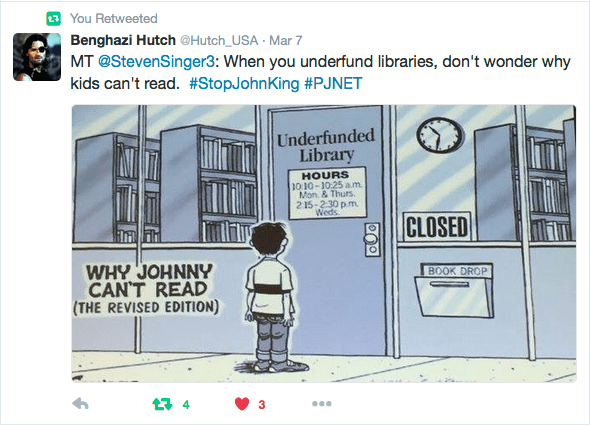
Two of my tweets were particularly popular: one about the conflict of interest of King’s wife working for Bellwhether, the other a seemingly unrelated message about the need to fund public libraries.

Screen shot 2016-03-16 at 11.06.15 PM

Screen shot 2016-03-16 at 11.06.40 PM


That’s when I started to notice the Twitter accounts of the people joining in. There were folks proclaiming their love for Ted Cruz and Donald Trump. They described themselves as libertarians and refused to speak to “libtards.” And the pictures on their Twitter accounts were often famous conservatives, racist cartoons of the President, pictures of themselves packing heat or just the darn guns, themselves.

“What the heck have I gotten myself into?” I thought.

That’s when I questioned why they were supporting me. For many of them I wondered if it had less to do with how terrible King would be as Education Secretary than with who nominated him in the first place.

Ever since Antonin Scalia died, many Republicans have sworn a blood oath not to approve any of Obama’s nominees – for the Supreme Court or ANY office.

For them this wasn’t about opposing a terrible Presidential pick. It was about blocking everything Obama did.

I had to face it. I had become a radical Republican, and I hadn’t even needed to change one of my positions to do it. The GOP came to me.

I have to admit, my right wing supporters were mostly very nice. I felt like I had a stronger group behind me than during most progressive campaigns.

There was some strain, however. A few times I could tell they were choking back anti-union rhetoric. “Why don’t we fund our libraries? Because unions,” apparently. “Who needs libraries – I home school.” That kind of thing.

And unfortunately, my progressive buddies were starting to notice the right wing support and take offense.

I got trolled by several lefties demanding I support Common Core.

“How can you be against it?” they’d ask. “Rand Paul hates Common Core. Do you agree with Rand Paul?”

I’d respond politely that even a broken clock is right twice a day.

Card-carrying Democrats refused to listen to any criticism of the Obama administration’s education policies. Little did these progressives realize, they were the exact opposite of the GOP activists they hated.

Many Republicans hate Common Core because Obama touched it. Many Democrats love it for the same reason.

The majority of teachers throughout the country hate it because we’ve read it, tried to use it and seen what a load of bullshit it is. We know it was developed with very little input from classroom teachers or child psychologists. We know it has no research behind it to show that it works. We see how it erodes our autonomy in the classroom and increases the amount and difficulty of high stakes tests for our students.

But my progressive friends refused to accept that anything Saint Hope and Change approved could be so terrible.

I’d turn to my newfound Republican posse only to find many of them hated Common Core beyond reason. It wasn’t just bad practice – it was going to turn our kids gay. It was a liberal plot to make children progressive atheists.

Oy vey.

The week just flew by. Eventually the Senate voted to approve King, both Democrats and Republicans – though the opposition was almost entirely in the GOP.

In my home state of Pennsylvania, the Senator I can usually count on to have my back (Bob Casey) stabbed me in the same place. And the Senator who usually only votes for things that are officially endorsed by Lord Satan, himself, (Pat Toomey) was my boy.

What kind of a topsy-turvy world am I living in!?

Elizabeth Warren – the liberal lion – said she wasn’t going to vote for King but ultimately gave in. Oh, Elizabeth. They got to you, too?

There were two points of light though. First, there was one Democrat who actually voted against him: Senator Kirsten Gillibrand from New York – the sight of King’s last catastrophe. Second, my Presidential candidate, Bernie Sanders, didn’t vote at all. Fwew! I can irrationally justify that – he was too busy, that’s all. Bernie would never have voted for King. Tee-hee!

So once again we see the two major parties as mirror images of each other. Where Republicans made the right choice for the wrong reason, Democrats made the wrong choice for the right one. Progressives were circling the wagons around the President. They were making a point that they weren’t going to let the evil GOP block his nominees – even if one of those nominees was an absolute pathetic failure.

This is politics in 2016, folks.

Decisions are rarely made because of logic, experience, or sound judgement. It’s all political maneuvering, personal gain or both. Meanwhile, the world goes to Hell.

After the vote, I got a smattering of conservative retweets and then… nothing. As quickly as they had come, they were gone.

My tiny caucus of teachers, academics and other ne’er-do-wells are still there. We shout our truths into the wind hoping someone will hear.

On days like today it seems impossible.

But perhaps there is a silver lining in there somewhere. If people from such opposite sides of the political spectrum can agree on something like how terrible John King is, maybe there’s hope. If we can shake hands over the fatuousness of Common Core, maybe we can find other points of agreement.

Maybe these brief moments of concord are opportunities for understanding. Sure my GOP compatriots supported me for the wrong reasons, but maybe some of them were exposed to the right ones.

I know I’ve learned from them. I consider myself an FDR Democrat with an abiding faith in a strong federal government. But even I can see how both the Bush and Obama administrations overstepped their power with No Child Left Behind and Race to the Top.

I don’t buy any of that baloney about Big Government vs. Small Government. But I do think that some things like education policy don’t belong at the federal level. The federal government should ensure public schools are funded properly and maybe regulate outright abuses, but local communities and districts should be deciding how to educate the children in their care.

If those ideas rubbed off on me, what rubbed off on my brief Twitter followers?

Will there come a day when we meet again, join hands and fight for our common good?

Can we overcome the blinders of party and politics to build a better world?

#IHopeSo

Hillary Clinton’s Campaign Manager is a Longtime Corporate Education Reformer

Clinton Gives Speech On American Global Leadership At Washington Conference


Meet John Podesta.


He’s a Washington lobbyist working hard to support high stakes tests, Common Core and charter schools.


He’s also Hillary Clinton’s campaign manager.


That’s right – the 2016 Democratic Presidential candidate who has been endorsed by the leaders of the national teachers unions has a corporate education reformer running her campaign.


Here are a few choice quotes from a speech Podesta gave in 2012 to the Foundation for Excellence in Education, a corporate education reform think tank established by Jeb Bush.


On Competition in Education:


“I think this emphasis that President Obama and Secretary Duncan have placed on competition – not just Race to the Top but competition throughout the system of education – is quite a good one, and I think the federal resources can be used to both support the development of new models and can force state experimentation in a way that’s quite healthy.”


On Using Student Test Scores to Evaluate teachers:


“In my view, [education] requires an accountability system that ensures students achieve at the highest levels… It requires a teacher and principal workforce that are rigorously trained, highly skilled and comprehensively evaluated.”


On Teachers Unions’ Resistance to Corporate Education Reform:


“I would argue that while there are clearly still strong rejectionist voices in unions, national union leadership has come a fair distance in recognizing that teacher effectiveness matters, and that evaluation systems need to include student outcomes… The majority of teachers have less than 10 years experience, and younger teachers know what counts. They’re more reform minded… So the question I think for reformers is how do you keep the pressure on unions to change, how do you keep the pressure on to put kids first without demonizing teachers in the process?”


On School Vouchers and charter schools:


“I think vouchers are an unneeded distraction. We should concentrate on PUBLIC school choice.”


On the Bipartisanship of Corporate Education Reform:


“In my opinion, the Obama administration has made its key priorities clear. The Republicans are pretty much in the same place…”


On the new frontier for Corporate Education Reform:


“Early childhood education is ripe for investment and reform.”


It’s all there on video. I strongly recommend you put aside 42 minutes and watch Podesta cozy up to Bush and Chester E. Finn, President of the ultra-reformy Thomas B. Fordham Institute.


Podesta is probably the single most effective person at destroying public education of which you’ve never heard.


You know Arne Duncan – the worst U. S. Secretary of Education of modern times. But did you know that Arne wasn’t President Barack Obama’s first choice?


Obama almost picked Linda Darling-Hammond – his education advisor during his 2007 campaign. Hammond is a former teacher turned Stanford education professor. She is also a vocal critic of Teach for America.


However, Podesta oversaw the transition committee that helped Obama make cabinet choices. Ultimately, the responsibility rests with the President, but it was Podesta who suggested and lobbied for Duncan, the know-nothing Chicago Schools CEO for U.S. Education Secretary. In fact, Duncan’s selection is an achievement of which Podesta is given gleeful responsibility by the privatization and standardization crowd.


And now guess whose ear he is whispering into?


Podesta has a long history with the Clintons. He was Bill’s Chief of Staff for three years during which time the President pushed hard for voluntary national standards – a school policy that has become known by another name – Common Core State Standards.


Podesta also founded the reform think tank Center for American Progress, a bastion for neoliberal thought. The organization routinely hires the crème de la crème of corporate education reformers who then push for test and punish policies in the media and on Capital Hill.


Podesta has already helped push Hillary closer to the dark side.


Remember when she shocked the neoliberal establishment by suggesting that some charter schools game the system by refusing to accept the most challenging students? (Which, by the way, is 100% factual.)


This really turned off some super-wealthy donors. According to the Wall Street Journal, after hearing the comment, one of Clinton’s longtime supporters, Eli Broad, turned off the money faucet.


Broad allegedly refused requests for contributions to a Clinton-friendly super PAC until Podesta personally assured him Hillary supports charter schools.


Also running interference on this issue was Clinton’s education adviser Ann O’Leary.


She wrote an op-ed calming charter fans because Hillary does, in fact, support charter schools – if they’re equitable and accountable.


Unfortunately, O’Leary has a strong corporate education reform streak, herself.


While an aide to Clinton in the Senate in 2001, O’Leary pushed Hillary to support No Child Left Behind (NCLB).


This was the bill that changed the federal role in education from ensuring equity to enacting an endless series of high stakes tests and expanded school privatization more than ever before. By it’s own measures of success, it was a terrible failure.


But O’Leary sees it differently.


“It was a really important moment,” O’Leary says. “When you look back at what happened, this was serious, bipartisan, constructive work. We were committed to high standards and helping states get there.”


O’Leary has somewhat stepped back her support of this bill. However, she blames the problems on implementation and not on the basic idea of high stakes testing.


She takes the same tack with Common Core. Implementation is the problem, not the policy.


And THIS is the woman advising Clinton on education!


By the way, she served with Podesta on the same Obama-Biden transition team that helped create our current disastrous U.S. Department of Education, though her focus was early childhood.


If Hillary Clinton really wants to forge a new path for U. S. schools, it’s surprising she’s surrounding herself with the same people responsible for the status quo.


Funded by wealthy privatizers, advised by standardization true believers, it is difficult to accept a second Clinton Administration would be anything more than a seamless continuation of the Testocracy.


Special thanks to Jake Jacobs who brought much of this to my attention.


Bernie Sanders is Right: We Should Federalize Public School Funding

Bernie_Sanders_by_Gage_Skidmore

Bernie Sanders just dropped a massive dose of truth on us Monday night.

No politician in my lifetime has ever said anything so dangerous, fraught with problems, unlikely, impractical, and absolutely on the nose right!

The Presidential candidate running for the Democratic nomination wants to make the federal government largely responsible for funding public schools. Right now districts are supported mostly by local and state taxes.

This is what he said:

“One of the things that I have always believed is that, in terms of education, we have to break our dependency on the property tax, because what happens is the wealthiest suburbs can in fact have great schools but poor, inner-city schools cannot. So I think we need equality in terms of how we fund education, and to make sure the federal government plays an active role to make sure that those schools who need it the most get the funds that they deserve.”


https://www.youtube.com/watch?v=vt3n7ugOj80&feature=youtu.be

(Find the quote above 17 minutes into this video.)


Wow! What a statement!

Don’t tell me that was focused grouped. Don’t tell me his campaign did a poll first. Don’t tell me he ran that by any big donors for approval.

Whether you agree with it or not, such an audacious remark has to come from a genuine belief. This is really what Bernie thinks, and it’s entirely consistent with the Democratic Socialism of his whole political career.

I don’t think his rival for the party’s nomination, Hillary Clinton, will be parroting THIS stance! If anything, she might criticize him for it. And she’d have a multitude of practical reasons to do so.

Lots of folks on both sides of the aisle are sick of federal intervention in our schools. No Child Left Behind was a disaster. Race to the Top was worse. And the just passed Every Student Succeeds Act (ESSA) amounts to a massive giveback of power to the states. Under the most popular interpretation, the reauthorization of the federal law governing K-12 schools makes the states responsible for filling in the details of education policy while limiting federal interventions.

And now Bernie is suggesting the Fed foot the bill!?

That is going against the political tide. Who would vote for such a thing? Probably not Hillary. Or any of the Republican candidates. Or more than a handful in Congress, either.

But it’s exactly the right thing to do.

The reason?

The biggest problem with America’s public school system isn’t test scores, lazy students, or teachers unions. It’s poverty, segregation and inequitable funding.

We have separate schools for the rich and separate schools for the poor. We have schools serving mostly black and brown populations and schools serving mostly whites. And the way we allocate money and resources to these schools both allows and perpetuates this system.

Nationwide, state and local governments spend 15 percent less per pupil on poor school districts. I see this first hand. My home state of Pennsylvania is the worst offender, providing the poorest districts an embarrassing 33.5 percent less per student. This means higher class sizes, less teachers, less arts and humanities, less electives, less nurses, guidance councilors and wrap around services. This is the reality in 23 states.

An additional 23 states do buck this trend with more progressive funding formulas. States like California and Florida actually provide MORE spending to poor districts. This helps heal the wounds of malnutrition, violence, family instability and a host of other problems that go hand-in-hand with generational poverty. It also offset the costs of greater numbers of special education students and English Language Learners you typically find in these districts.

You might say, then, that the states where poor children get shafted could simply follow the lead of their more enlightened neighbors. Good luck with that! Rich folks rarely volunteer to subsidize the poor. They got theirs, and they vote and donate more regularly to local politicians than their indigent brethren can afford to do.

The result is a funding system based on local wealth. Rich areas have Cadillac education systems. Poor areas have dilapidated ones. That’s demonstrably unfair and leads to worse academic outcomes for needy kids.

What’s worse, no one else runs their schools this way. The U.S. is one of the only countries in the world – if not probably the ONLY country – that funds schools based largely on local taxes. Other developed nations either equalize funding or provide extra money for kids in need. In the Netherlands, for example, national funding is provided to all schools based on the number of pupils enrolled. But for every guilder allocated to a middle-class Dutch child, 1.25 guilders are allocated for a lower-class child and 1.9 guilders for a minority child – exactly the opposite of the situation in the U.S.

Federalizing education funding could solve all these problems. It could set the groundwork for an even playing field. All students could get a fair start in life! That’s a goal worth shooting for! And that’s what Bernie is suggesting.

But it’s an incredibly dangerous proposal.

Our school system still suffers nationwide from the effects of corporate education reform. National policy has been and continues to be one of high stakes standardized testing, poorly conceived and untested academic standards, and a push to privatize struggling schools. Corporatists call this “Accountability.”

It goes something like this: raise your test scores or we’re closing your school and turning it into a for-profit charter. Adopt these academic standards written by the testing companies and we’ll give you a couple extra bucks. De-professionalize teachers with junk science evaluations and hiring under-trained Teach for America temps or else we’ll cut your funding.

THIS is the federal legacy in education, and Bernie is suggesting we give them MORE POWER!?

Yes, and no. I can’t speak for Bernie, but that’s certainly not how this has to go. We can increase the Fed’s responsibility for funding schools without increasing its power over education policy. In my view, education decisions should be made locally, and I don’t mean at the state legislature. Decisions about how best to run schools should be made at the district level by the experts – the teachers and parents.

Certainly there will be those who call for more federal power over policy as a condition of federalized funding. But that has to be a deal breaker. Equitable funding with inequitable policy would just be plugging one hole while making another.

In my view, equitable funding IS the role of the federal government in public education. When the Elementary and Secondary Education Act (ESEA) was first passed in 1965, it’s purpose was to make sure all schools were getting adequate resources. Under Bush and Obama, that became perverted to mean more standardized tests and philanthro-capitalist interventions. Bernie’s suggestion could be a step in returning to the original intent of the law.

Yes, the Fed should be engaged in accountability. It should make sure it’s funding schools properly. Maybe it should even be responsible to make sure those funds are being spent on things that broadly can be construed as education. I don’t mean that the fed should be able to withhold monies from districts with low test scores. But maybe it can prosecute administrators who use funding to lavishly redecorate their offices or who neglect the needs of students in their districts.

However, even if you agree – as I do – that this is a lofty goal, it is almost impossible to achieve. It’s like single-payer healthcare was in the ‘80s and ‘90s. This is what most of the world is doing but it was completely out of reach here politically. In fact, we still don’t have it, but look at how the landscape has changed. Obamacare is not-single payer, but it is a step in that direction. Bernie is even championing going that extra step and providing a medicare like system for all.

What seemed impossible decades ago, now seems within reach. The same may be true one day with federalized education funding.

To be honest, I doubt fixing our school funding system is high on Bernie’s list of things to do. Breaking up the big banks, overturning Citizens United, free college tuition, even healthcare probably come first. And maybe that’s not a bad thing. If any or all of these goals were realized, it would help the more than half of our public school children living in poverty. Moreover, just having equitable funding on the list with these other worthy goals puts it on the national agenda.

Right now, no one else is talking about this. It isn’t even a recognizable goal for most progressives. Frankly, I doubt many people have even thought about it. By bringing this up, Bernie is forcing us to do so.

When I first became an education activist, I thought I was doing it for my students. Then we had a daughter, and I thought I was doing it for her, too. But as the years have gone by, the landscape has changed only slightly. We’re still reaching a level of critical mass when the culture demands a major shift. We’re not there yet. So now I wonder if the people I’m really doing this for are my grandchildren.

One day we may have the courage to change the course of our education system. We may gain the nerve to actually accomplish our convictions. We might actually try to have a nation with liberty and justice for all.

That’s what I’m fighting to achieve. I think many of us are doing the same. But do we have the bravery to take Bernie at his word, to push this topic onto the national stage?

A Bernie Sanders presidency would do that. It might not achieve this lofty goal. Not now. The political winds aren’t favorable. But we can try, knowing full well the dangers and the improbability.

I wish Bernie would flesh out the details of his plan. I wish he’d exorcise the devil from the details. But the very fact that he has the intrepidity to offer this as a solution fills me with hope.

Is it hot in here or am I starting to Feel the Bern?

Does Bernie Sanders Offer Education Advocates Enough? Are We Feelin’ the Bern or Just Feelin’ Burned?

150430-berniesanders-editorial

You probably didn’t hear about this on the news.

To my knowledge no one covered it on TV, the newspaper or even on the blogosphere.

But Bernie Sanders may have made a reply to his Democratic Primary rival Hillary Clinton’s gaffe about closing public schools.

“I wouldn’t keep any school open that wasn’t doing a better than average job,” Clinton said at a campaign stop in Iowa on Dec. 22.

The media took this to mean Clinton is in favor of closing half the schools in the country. The comment has been much debated with calls for context and explanation by the Clinton campaign.

However, very quietly on Dec. 24, Sanders tweeted, “We should not be firing teachers. We should be hiring teachers. School teachers and educators are real American heroes.”

Screen shot 2015-12-26 at 8.06.51 PM

The @BernieSanders twitter account has more than 1 million followers, a little less than the @SenSanders account. But it does appear to be affiliated with the Bernie Sanders presidential campaign. If Sanders, himself, posted the tweet is unclear. The candidate used the same account to live tweet the Republican debates so he – at least sometimes – is personally responsible for the material that comes out of there.

Moreover, the comment can be connected directly to something he said on C-SPAN at a campaign stop in Cleveland, OH, on Nov. 16 – before Clinton’s gaffe. In a larger speech that touched on numerous issues he said, “We should not be firing teachers and childcare workers, we should be hiring teachers.” The line about teachers being American heroes is new.

Start the speech 56 minutes in to hear the comment.

So I think it’s fair to say that the sentiment is, in fact, Bernie’s. It’s only the timing that is in question.

Is this tweet an attempt to distinguish himself from Clinton? Is this his way of saying that he’s NOT interested in closing schools and firing teachers – instead he wants to invest in education and hire more educators?

Maybe.

It sure would be nice if he’d come out and tell us. Frankly, I’m getting tired of having to read the tea leaves to get a glimpse of Bernie’s K-12 education policy.

Don’t get me wrong. I love the guy.

He’s been one of my favorite politicians for years. As a U.S. Senator, he’s consistently worked against economic and social inequality for decades. He’s been a fearless critic of Wall Street and privatization, an advocate for single payer healthcare and fighting global climate change.

He champions historic investments in preschool and college – even vowing to make post secondary tuition free. But somehow when it comes to K-12 schools, he’s got very little to say.

Most notably, he voted against No Child Left Behind (NCLB) – the devastating schools bill passed with bipartisan support during the George W. Bush years. However, he also voted in favor of the Charter School Expansion Act of 1998 which further opened the nation’s piggy bank to for-profit school privatizers. He also opposed a bill in early 2015 that would have prohibited the federal government from imposing the terrible Common Core standards on the nation’s schools.

On the campaign trail, when asked about his stance on K-12 schools, Sanders has boasted he would end NCLB. That was just accomplished by Congress through a reauthorization of the bill now called the Every Student Succeeds Act (ESSA). As a member of the Health, Education, Labor and Pensions (HELP) Committee, Sanders was an active participant in that process.

When this legislation was still in the Senate, he – along with almost all Democrats – voted for a failed amendment that would have continued most of the worst aspects of NCLB. The bill eventually passed the chamber in a potentially more palatable form. Sanders eventually voted for that Senate version but was conspicuously absent from the final vote.

Though keeping a busy campaign schedule, Sanders is known for returning to Washington to vote for important legislation. He does this much more than most of the other sitting Congressional Presidential candidates.

So why was he absent for the final vote on the ESSA? Was that done on purpose, and if so why? Could it be an attempt to distance himself from this legislation? Or is it an attempt at plausible deniability – a way of justifying both his approval and disapproval of the same legislation?

Sanders hasn’t said much.

This puts would-be-supporters in an uncomfortable position. We like what Sanders has to say about the economy and poverty, but we have little to go on when it comes to K-12 education. Certainly if Sanders was elected President and came through with all of his other promises, that would help our public schools tremendously. And since Sanders has been fighting for these things his entire lengthy political career, it’s hard to doubt his sincerity. But why not include education as part of this platform? It seems to fit perfectly with everything else he believes.

On the other hand, there’s Clinton. She is making a real effort to clarify her education positions. In fact, last week’s gaffe was part of a much larger policy speech on K-12 schools. Sander’s reply – though better stated – was a one off. It was a sound-byte. It was an applause line. It didn’t have much substance behind it.

How are we to take it? Would Sanders hire more teachers as part of a nationwide education equity policy? If so, what exactly is that policy? Or is he – like Clinton – in favor of closing some struggling schools?

Certainly Clinton has a credibility problem. One of her first actions on the public scene as the First Lady of Arkansas in 1983 was to fight against the state teachers union to enact accountability-based school reform. Many of the billionaires and shady think tanks that are working so hard to destroy public schools have donated heavily to her campaign. Her endorsement by both major teachers unions – the National Education Association and American Federation of Teachers – were allegedly the result of leadership and not rank and file members.

But unlike Sanders, Clinton actually seems to care about getting the education vote. She is actively fighting for our advocacy. Bernie doesn’t seem to think he needs us.

The Democratic Primaries are about two months away. If Sanders is going to make a play for teachers, parents, students and education advocates, he still has a chance. But time is running out.

Personally I’d rather vote for him, and maybe I will. But if he finally came out swinging, if he actually made me feel like he’d strip away the high stakes testing, unproven or failing policies and put teachers in the drivers seat – he could get so much more.

There are tens of thousands of teachers and advocates standing on the sidelines looking to Bernie. If he gave us a major policy speech, he’d find his campaign offices flooded with new volunteers. Educators would take to the streets and phone banks. We’d lead the charge. We could help turn the tide in a Democratic primary where the margin of victory could well be razor thin.

We’re out there, Bernie. Just say the word and we’ll come running.

We want to Feel the Bern, but you’ve got to turn up the heat!


NOTE: This article also was published in Commondreams.org and the LA Progressive.