Making Puerto Rico the New New Orleans – Steal the Schools and Give Them to Big Business to Run For Profit

IMG_8574

Charter school backers can’t help it.


They see a bunch of black or brown kids displaced by a natural disaster and they have to swoop in to help…


Help themselves, that is.


They did it in 2005 to New Orleans schools after Hurricane Katrina. Now they want to do it again in Puerto Rico after Hurricane Maria.


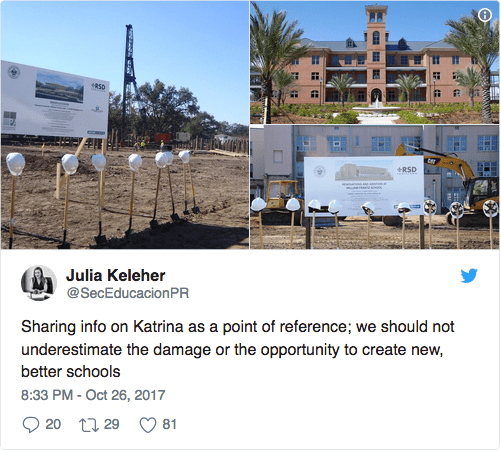
“This is a real opportunity to press the reset button,” said Puerto Rican Secretary of Education Julia Keleher.


“…this [is a] transformational opportunity for us to start to think fundamentally differently about what it is to be in school, and how one goes about getting an education.”

IMG_8573

A dozen years ago in Louisiana, that meant stealing almost the entire New Orleans public school system in the aftermath of Katrina. About 90 percent of the city’s 126 schools were given to the Louisiana Recovery School District, which turned them all into charter schools.


In effect, Louisiana state officials elected by the white majority stole control from local school boards elected by the city’s black majority. More than 7,000 teachers most of whom were people of color and had been displaced by the hurricane found themselves replaced by mostly white teachers brought in from other parts of the country.


Now, more than 10 years later, the New Orleans experiment has been shown to be a failure. Scores on standardized tests have improved (kinda), but the curriculum has narrowed, teacher turnover has doubled, disadvantaged and special education students have even fewer resources while schools fight over high achieving children, students spend hours being bused to schools far from their homes, communities have been erased, and parents have less control over how their own tax dollars are spent.


That is what Keleher and others want to repeat in Puerto Rico – wrest control away from the public and give it to big business all wrapped up in a bow.

Screen Shot 2017-11-09 at 12.34.02 PM

Why?


Public schools come with expensive perks like local control, transparent budgets and regulations to ensure all the money is being spent on students. It’s much cheaper to run these districts with unelected bureaucrats, closed-door budgets and the ability to grab as much of the cash as possible and stuff it into their own pockets.


It ’s not like anyone’s going to complain. These schools aren’t for rich white kids. They’re for poor brown ones.


It’s just colonialism, 2017 style!

IMG_8572

Jeanne Allen thinks that’s a great idea.

The founder and CEO of school privatization lobbying group, the Center For Education Reform, said that charterization is the best thing that could happen to Puerto Rican schools.


After dealing with the immediate effects of the hurricane, reformers “should be thinking about how to recreate the public education system in Puerto Rico.” And she should know. Allen was also involved in the New Orleans fiasco turning that system over to big business.


She added that charter school operators across the nation, including cyber charter school managers (whose schools often have even more wretched academic results), should be thinking about how to get involved in Puerto Rico post-Maria.


Keleher has already begun laying the groundwork.


Even though many Puerto Rican schools are only operational because of the work of teachers who have cleaned them up and have opened them despite being told not to by Keleher’s administration, the Education Secretary has pledged to lay off massive amounts of teachers and permanently close more schools – even schools that are structurally sound.


“Consolidating schools makes sense,” Keleher said in October. “They can go out and protest in the streets, but that doesn’t change the fact that we can’t go back to life being the same as it was before the hurricane.”


Puerto Rican teachers aren’t letting the vultures swoop in without protest.

IMG_8571

Just this week twenty-one teachers in the capitol of San Juan were arrested during a rally at the Education Department headquarters. They were demanding all structurally sound schools be opened immediately.


“Our schools have served students well and although we recognize that it can be expensive to repair some schools, what we are asking is that schools that are ready be opened,” said social worker Alba Toro just before the arrests.


Administration officials are claiming the teachers were taken into custody because they physically attacked the civil servants, but witnesses say the protest was entirely peaceful.

image

According to Education Safety Commissioner César González, the protesters assaulted at least three security employees and a public relations employee while inside the building.
However, protestors dispute this version of events. Eulalia Centeno, who was part of the group that went inside the building, but left before the arrests began, said that no violent acts were committed and that the protesters only demanded to see the secretary to request the opening of public schools.


Seven weeks after the hurricane, less than half of the island’s nearly 1,200 public schools are open in any capacity. Though many schools endured severe storm and flood damage, others were repaired and cleaned to shelter hurricane victims and are ready to take in students.

“Keleher is using the crisis as an opportunity to close hundreds of public schools, lay off senior teachers and privatize public education,” says Mercedes Martinez, President of the Federacion de Maestros of Puerto Rico, an island teachers union.

IMG_8570

Martinez was one of the teachers arrested during the protest.


When she was taken out of the building in handcuffs, her son was photographed leaning over a railing and patting his mother on the shoulder.


This is what real heroes do.


They refuse to back down despite the forces of prejudice and commerce stacked against them.


Will we let the charter school vampires suck Puerto Rico dry?

IMG_8574

Men Are Responsible For Stopping Sexual Assault. Not Women. MEN.

man-in-the-mirror

Enough bullshit.

Nearly 99% of sex offenders are men.

So stop blaming women for sexual assault.

It’s not the clothes they wear, the way they style their hair, the words they say, or how much skin they’re showing that cause men to sexually assault them.

It’s a choice made by men.

Males. Husbands. Sons. Boyfriends. Brothers. Nephews. Uncles. Co-workers. Coaches. Bosses. Total strangers with raging boners.

That’s the key factor – a penis.

So stop blaming the victim for being victimized. And stop letting men off the hook with every stupid ass excuse under the sun.

It’s time for men like me to take responsibility.

The mere possession of male genitalia does not make it impossible to resist sexual urges. Nor does enculturation as a male in a patriarchal society determine our decisions – even if it does influence them.

Sure. We live in a world of toxic masculinity. The “Boys will be boys” sentiment dominates the social landscape. But that’s not what actually does the raping and harassment.

It’s us. Individual men.

We’re responsible for our own actions.

And if seeing that in print makes you want to offer a kneejerk reaction against it, stop and take a breath.

Do you really want to argue that men aren’t responsible for themselves? Are we, as men, really such a weak, passive gender that we don’t qualify as agents in our own lives?

I’d like to propose that we’re better than that lame justification. Men are not one slim step above animals. We are thinking, feeling human beings who – when presented with an opportunity to engage in harassment or violence – have a choice in the matter.

Free will does not end with an erection.

There are lots of things we can do with it. Rape is just one of them.

I’ll let you in on a little secret.

You want to know the REAL reason so many men choose sexual violence?

Because we can.

Most sex offenders are white men – almost 6 in 10.

Most were not sexually or physically abused, themselves, as children.

They’re just guys taking advantage of a power trip that’s often consequence free.

In short, society lets us get away with it.

When men know that no one’s going to hold them accountable, some act accordingly.

The presence of alcohol and violent pornography increase the likelihood of sexual violence, but lack of repercussions is the number one consideration.

We figure victims won’t speak out, and if they do, they won’t be believed. The deck is stacked against the survivors of sexual violence and in favor of the perpetrators.

You don’t need a study by the National Sexual Violence Resource Center to prove that – but it’s there.

It just goes to show how much of a rational, reasoned action sexual violence is.

It’s not something done by an uncontrollable animal impulse. It’s the result of a cost-benefit analysis.

That’s why all these #MeToo stories are so powerful.

Women all over social media are coming forward and admitting that sexual violence has touched their lives. And we see most every woman in our lives is affected. For the first time, the scope of the problem is becoming visible.

The ground is shaking under the patriarchy. And as a man I am so fucking relieved.

It is absolutely disgusting to me that so many of my gender don’t give a shit about consent.

They act as if women’s bodies are theirs to do with as they want. Pinch them, grab them, grope them, discuss them as mere objects of our personal pleasure. It’s just a man’s right.

Fuck you, Dude.

Seriously.

I’m not a perfect person. I’ve certainly engaged in inappropriate behavior – especially as an adolescent – but I’ve always respected consent.

And if there’s any time when I’ve crossed a line, call me out on it. Hold me responsible. Treat me like a real person – not some overgrown child, an ape that can’t help but fling his own feces.

Yet we too often stop there. We dare women to name us in a venue where we have all the advantages. That needs to stop.

Stopping sexual assault can’t just be the responsibility of women anymore. In fact, it’s not their responsibility at all.

It’s ours. It’s men’s.

Moving forward, guys like me have to step out of the shadows and take our place at the forefront of this fight.

We caused this mess. It’s up to us to clean it up.

This means calling out sexism. No more yucking it up with the guys uncomfortably in public and then condemning it in private.

This means demanding equal treatment for women. Equal pay, childcare, reproductive healthcare. Easy access to contraception, mammograms, gynecologists, neo-natal care.

This means teaching our sons and daughters – but especially our sons – what consent is, why it’s important, and how to tell if you’ve got it.

And it means acknowledging that women are just as much sexual beings as men. No more double standards, no more defining women as a reflection of men and male desire.

It won’t happen overnight.

It will require commitment and strength.

But we can do it.

Why?

Because we’re men.

And if we try, we can be just as strong, just as responsible, just as human, as women.

There Are Very Few Bad Students, Bad Parents and Bad Teachers

parent-teacher-student


Maybe the problem with public schools is that people just aren’t trying hard enough.


There are too many bad students, bad parents, and bad teachers out there.


At least, that’s what the rich folks say.


They sit behind their mahogany desks, light a Cuban cigar with a thousand dollar bill and lament the kind of gumption that got them where they are today just isn’t present in the unwashed masses.


Never mind that they probably inherited their wealth. Never mind that the people they’re passing judgment on are most often poor and black. And never mind that struggling schools are almost always underfunded compared to those in wealthier neighborhoods and thus receive fewer resources and have larger class sizes.


Tax cuts feed the rich and starve the poor, but somehow the wealthy deserve all the breaks while OUR cries are always the fault of our own grumbling stomachs.


As a 15-year veteran teacher in the public school classroom, I can tell you I’ve seen very few people who aren’t trying.


I’ve seen plenty of struggling students but hardly any I’d simply write off as, “bad.” That’s a term I usually reserve for wilted fruit – not human beings.


I’ve seen plenty of parents or guardians striving to do the best with what they have, but few I’d honestly give up on. And I’ve seen lots of teachers endeavoring to do better every day, but hardly any that deserve that negative label.


In fact, if anything, I often see people trying their absolute hardest yet convinced that no matter what they do it won’t be enough.


“It’s not very good.”


That’s what I hear everyday.


Ask most students to share their writing and you’ll get that as preamble.


“I didn’t do a very good job.”


“This sucks.”


“It’s butt.”


“I can’t do this.”


“It’s grimy.”


“It’s trifling.”


Something to let you know that you should lower your expectations.


This piece of writing here is not worth your time as teacher, they imply. Why don’t you just ignore it? Ignore me.


But after all this time, I’ve learned a thing or two about student psychology.


I know that they’re really just afraid of being judged.


School probably always contained some level of labeling and sorting, distinguishing the excellent from the excreble. But that used to be a temporary state. You might not have done well today, but it was a step on the journey toward getting better.


However, these days when we allow students to be defined by their standardized test scores, the labels of Advanced, Proficient, Basic or Below are semi-permanent.


Students don’t often progress much one way or another. They’re stuck in place with a scarlet letter pinned to their chests, and we’re not even allowed to question what it really means or why we’re forced to assess them this way.


So I hear the cries of learned helplessness more often with each passing year.


And it’s my job to dispel it.


More than teaching new skills, I unteach the million lashes of an uncaring society first.


Then, sometimes, we get to grammar, reading comprehension, spelling and all that academic boogaloo.


“Mr. Singer, I don’t want you to read it. It’s not my best work.”


“Let me ask you something?” I say.


“What?”


“Did you write it?”


“Yeah.”


“Then I’m sure it’s excellent.”


And sometimes that’s enough. Sometimes not.


It’s all about trust, having an honest and respectful relationship. If you can’t do that, you can’t teach.


That’s why all this computer-based learning software crap will never adequately replace real live teachers. An avatar – a simulated person in a learning game package – can pretend to be enthusiastic or caring or a multitude of human emotions. But kids are very good at spotting lies, and that’s exactly what this is.


It’s a computer graphic pretending to care.


I actually do.


Which would you rather learn from?


When a student reads a piece of their own writing aloud, I always make sure to find something to praise.


Sometimes this is rather challenging. But often it’s not.


Most of my kids come to me because they’ve failed the government-mandated test, their grades didn’t set the world on fire, and/or they have special needs.


But I’ve been privileged to see and hear some of the most marvelous writing to come out of a middle school. Colorful adventures riding insects through a rainbow world, house parties with personal play-lists and famous friends, political discourses on the relative worth of the Roman Empire vs. African culture, and more real life crime dramas than every episode of every variation of Law and Order.


It’s just a matter of showing kids what makes them so special. And giving them the space to discover the exceptional in themselves and each other.


There’s a danger in my profession, though, of becoming bitter.


We’re under so much pressure to fix everything society has done to our children, and document every course of action, all while being shackled to a test-and-punish education policy handed down from lawmakers who don’t know a thing about education. We’re constantly threatened with being fired if test scores don’t improve – even for courses of study we don’t teach, even for kids we don’t have in our classes!


It can make the whole student-teacher relationship adversarial.


You didn’t turn in your homework!? Again! Why are you doing this to me!?


But it’s the wrong attitude. It’s understandable, but it’s wrong.


Every year I have a handful of students who don’t do their work. Or they do very little of it.


Sometimes it’s because they only attend school every third or fourth day. Sometimes it’s because when they are here, they’re high. Sometimes they’re too exhausted to stay awake, they can’t focus on anything for more than 30 seconds, they’re traumatized by violence, sickness or malnutrition. And sometimes they just don’t care.


But I don’t believe any of them are bad students.


Let me define that. They are bad at being students. But they aren’t bad students.


They aren’t doing what I’ve set up for them to demonstrate they’re learning.


They might do so if they altered behavior A, B or C. However, this isn’t happening.


Why?


It’s tempting to just blame the student.


They aren’t working hard enough. They lack rigor. They don’t care. They’re an active threat to this year’s teaching evaluation. They’re going to make me look bad.


But I rarely blame the student. Not in my heart.


Let me be clear. I firmly deny the pernicious postulation that teachers are ultimately responsible for their students’ learning.


I believe that the most responsible person for any individual student’s education is that student.


However, that isn’t to say the student is solely responsible. Their actions are necessary for success, but they aren’t always sufficient.


They’re just children, and most of them are dealing with things that would crush weaker people.


When I was young, I had a fairly stable household. I lived in a good neighborhood. I never suffered from food insecurity. I never experienced gun violence or drug abuse. And my parents were actively involved.


Not to mention the fact that I’m white and didn’t have to deal with all the societal bull crap that gets heaped on students of color. Security never followed my friends and I through the shopping mall. Police never hassled us because of the color of our skin. Moreover, I’m a csis male. Young boys love calling each other gay, but it never really bothered me because I wasn’t. And, as a man, I didn’t really have to worry about someone of an opposite gender twice my size trying to pressure me into sex, double standard gender roles or misogyny – you know, every day life for teenage girls.


So, no. I don’t believe in bad students. I believe in students who are struggling to fulfill their role as students. And I think it’s my job to try to help them out.


I pride myself in frequent success, but you never really know the result of your efforts because you only have these kids in your charge for about a year or two. And even then I will admit to some obvious failures.


If I know I’ve given it my best shot, that’s all I can do.


Which brings me to parents.


You often hear people criticizing parents for the difficulties their children experience.


That kid would do better if her parents cared more about her. She’d have better grades if her parents made sure she did her homework. She’d have less social anxiety if her folks just did A, B or C.


It’s one of those difficult things that’s both absolutely true and complete and total bullshit.


Yes, when you see a struggling student, it’s usually accompanied by some major disruption at home. In my experience, this is true 90% of the time.


However, there are cases where you have stable, committed parents and children who are an absolute mess. But it’s rare.


Children are a reflection of their home lives. When things aren’t going well there, it shows.


Does that mean parents are completely responsible for their children?


Yes and no.


They should do everything they can to help their young ones. And I think most do.


But who am I to sit in judgment over other human beings whose lives I really know nothing about?


Everyone is going through a struggle that no one else is privy to. Often I find my students parents aren’t able to be home as much as they’d like. They’re working two or more minimum wage jobs just to make ends meet. Or they work the night shift. Or they’re grandparents struggling to pick up the slack left by absentee moms and dads. Or they’re foster parents giving all they can to raise a bunch of abused and struggling children. Or they’re dealing with a plethora of their own problems – incarcerations, drugs, crime.


They’re trying. I know they are.


If you believe that most parents truly love their children – and I do believe that – it means they’re trying their best.


That may not be good enough. But it’s not my place to criticize them for that. Nor is it society’s.


Instead we should be offering help. We should have more social programs to help parents meet their responsibilities.


It may feel good to call parents names, but it does no good for the children.


So I don’t believe in bad parents, either. I just believe in parents who are struggling to do their jobs as parents.


And what about people like me – the teachers?


Are we any different?


To a degree – yes.


Students can’t help but be students. They have no choice in the matter. We require them to go to school and (hopefully) learn.


Parents have more choice. No one forced adults to procreate – but given our condemnation of birth control and abortion, we’ve kind of got our fingers on the scale. It’s hard to deny the siren song of sex and – without precautions or alternatives – that often means children.


But becoming a teacher? That’s no accident. It’s purposeful.


You have to go out and choose it.


And I think that’s significant, because no one freely chooses to do something they don’t want to do.


After the first five years, teachers know whether they’re any good at it or not. That’s why so many young teachers leave the profession in that time.


What you’re left with is an overwhelming majority of teachers who really want to teach. And if they’ve stayed that long, they’re probably at least halfway decent at it.


So, no, I don’t really believe in bad teachers either.


Certainly some are better than others. And when it comes to those just entering the profession, all bets are off. But in my experience, anyone who’s lasted is usually pretty okay.


All teachers can use improvement. We can benefit from more training, resources, encouragement, and help. Cutting class size would be particularly useful letting us fully engage all of or students on a more one-on-one basis. Wrap around services would be marvelous, too. More school psychologists, special education teachers, counselors, tutors, mentors, aides, after school programs, etc.


But bad teachers? No.


Most of the time, it’s a fiction, a fantasy.


The myths of the bad student, the bad parent and the bad teacher are connected.


They’re the stories we tell to level the blame. They’re the propaganda spread by the wealthy to stop us from demanding they pay their fair share.


We know something’s wrong with our public school system just as we know something’s wrong with our society.


But instead of criticizing our policies and our leaders, we criticize ourselves.


We’ve been told for so long to pick ourselves up by our own bootstraps, that when we can’t do it, we blame the boots, the straps and the hands that grab them.


We should be blaming the idiots who think you can raise someone up without offering any help.


We should be blaming the plutocrats waging class warfare and presenting us with the bill.


There may be few bad students, parents and teachers out there, but you don’t have to go far to find plenty of the privileged elite who are miserable failures at sharing the burdens of civil society.

Will the REAL Grassroots Activists Please Stand Up – Teachers or School Privatization Lobbyists?

Screen Shot 2017-10-11 at 5.07.37 PM


Everyone claims to be grassroots.


We’re the ordinary people – they say – the Hoi Polloi, the everyday Joes and Janes who make the world go round.


Which is to say we’re NOT the wealthy elite who get what they want simply by buying lawmakers and the political process.


You’d think the plutocrats wouldn’t even bother hiding. After all, it should be pretty obvious who is who.


One group has barrels full of cash. The other has numbers. However, our laws are written to obscure exactly how much money any one side has. And if you have money, you can use it to buy bodies to line up on your side and “prove” you have numbers.


So when it comes to the American education system, which side truly represents the grassroots – those supporting privatized schools like charter and voucher institutions or those supporting public schools?


It’s kind of a ridiculous question to ask, when you come to think of it.


One side actively lobbies for big business and huge corporations to take over local schools and districts. The other supports neighborhood schools.


One side pushes for schools to be striped of local control and instead to be managed by private equity firms and corporate officers. The other supports democratically elected school boards.


One side demands taxpayer dollars be available as profit that they can pocket and spend on mansions, yachts and jewelry. The other fights for transparency and for all taxpayer funds to be used in the service of educating children.


Which side do you THINK represents the little guy and which represents Goliath? Which side do you THINK represents the Rebel Alliance and which the Galactic Empire?


Come on now!


It’s the public school advocates who represent the common people. They are literally an extension of the masses struggle to reassert control over their lives and our society. Not those looking to raid our public services for fun and profit!


People get kind of upset when you try to do that. So when the villagers show up with torches and pitchforks, it does little good to argue that money equals speech. Better for the aristocrats to disguise themselves in peasant garb.


Enter Jeanne Allen.


She wants to convince you she’s the real underdog grassroots champion.


As Chief Executive Officer and Founder of the Center for Education Reform, she’s spent most of her career lobbying for public schools to be gobbled up by private enterprise.


So when the folks behind a new documentary about school privatization, “Backpack Full of Cash,” had the gall to cast her and her organization as the bad guy, she did what any grassroots activist would – she called the Hollywood Reporter.


Why would anyone be against charter and voucher schools, she whined. They just suck away necessary funds from the already underfunded neighborhood school so that businesspeople can play with your tax money. They just cut services for children and parents while miraculously transforming the savings into yummy profit.


I can’t imagine why anyone is calling her out. Can you?


But perhaps the most pernicious aspect of her argument is monetary.


Allen, the Center for Education Reform and the entire corporate education reform movement are the real grassroots, she says, because they are outspent by the opposition.


By which she means teachers unions. As if the overwhelming majority of parents, students, social scientists, civil rights activists and concerned citizens somehow didn’t count.


But oh well.


“The people praised in the film” (i.e. public school teachers) “get paid from taxpayer dollars,” Allen told the Hollywood Reporter, as if the people the film criticizes (charter and voucher operators) don’t also get paid from the same pot.


“The teachers unions spend $300 million a year on political races. We don’t have that kind of money.”


Is that true?


Are those pushing for corporate control of our schools really unable to match the monetary might of the big bad teachers unions?


Well, first let’s examine the number Allen bandies about as if it were fact.


$300 million. Do teachers unions actually spend that much annually on political races?


It’s doubtful. The entire operating budget for the National Education Association (NEA), the largest teachers union in the country, is only $367 million. And the union does an awful lot besides lobby lawmakers for pro-education public policy. It raises funds for scholarships, conducts professional development workshops, bargains contracts for school employees, files legal action on behalf of teachers to protect their rights, and partners with other education organizations to promote sound educational practices. Political lobbying is an important part of what unions do, but if they spent what they’re accused of spending on it – even if you include other unions like the American Federation of Teachers (AFT) – they couldn’t do the rest of what they do.


It turns out the figure Allen uses is a stale conservative talking point that Poltifact, a non-partisan fact checking Website, rated as false.


It’s based on a funding target the unions had for the 2008 election of which the unions fell short by almost a third. But now right-wingers and anti-labor trolls everywhere are married to that number and quote it as if it were fact.


In the real world, where Fox News talking points aren’t accepted without question, it’s increasingly difficult to determine exactly how much organizations spend on politics. But it’s incredibly doubtful teachers unions have the monetary might attributed to them by corporate school reformers.


And speaking of those who fight on behalf of poor beleaguered corporate America, how much do THEY have to spend fighting public schools?


Well, let’s just take two of their most famous backers – Charles and David Koch.


This duo runs one of the largest privately held companies in the United States: Koch Industries. It is involved in petroleum, chemicals, natural gas, plastics, paper and ranching. In 2013, Forbes said it had an annual revenue of $115 billion.


That’s an incredible amount of resources they can draw on every year when compared to teachers unions. The NEA would have to bring in more than three times its annual revenue to even come close to matching 1% of the Koch’s annual pay.


And do the Kochs spend on politics? You BET they do!


In 2012, alone, they spent at least $407 million on Mitt Romeny’s Presidential campaign! Yes, just that one campaign! They spent more on others! But even if we limit it there, that’s more than even the most absurd estimates of teacher’s unions political spending.


And they’re only two people!


We’re comparing about 3 million members of the NEA, and 1.5 million members of the AFT with two individual human beings.


Even if teachers unions spent $300 million, that only comes to less than $67 per member.


A quick look at Allen’s backers at the Center for Education Reform includes some of the richest people on Earth including: Bill and Melinda Gates, the Walton Family and Eli Broad.


And this woman has the nerve to cry poor in comparison to the big bad teachers!


Herself, she draws a six-figure salary as the organization’s President Emeritus – well more than the overwhelming majority of teachers.


But you’ll still find corporate reformers who contest this analysis with creative accounting. They’ll give you a spreadsheet with hundreds of millions of union dollars laid bare compared with a handful of poor billionaires who just can’t scrape together enough change in the couch cushions. And to do so, they’ll hide the super richs’ donations to super PACs or exclude dark money contributions, etc.


Look, I’m not saying our campaign finance system is perfect. In fact, it’s pretty messed up.


I am the first person to advocate for getting money out of politics. No more defining money as speech. One person, one vote.


But you must realize, the super wealthy don’t want that. More than anything else it would exponentially increase the power of the unions and the middle class from which they come. Not to mention their allies – the parents, students, child advocates, etc.


You really don’t need a detailed analysis of each group’s relative financial worth. You just have to look at who is in each group.


We’re talking the richest 1% of people on the planet backing charter and voucher schools versus teachers, parents, students, college professors, civil rights activists and concerned citizens backing public schools.


Which group do you think truly represents the grassroots?


Which group is an authentic demonstration of the will of the people?


And which is emblematic of the arrogant, hypocritical wealth class demanding we all bow down to the power of their pocketbooks?


You decide.

I Was Blocked From Facebook for Criticizing School Privatization

facebook


“Journalism is printing what someone else does not want printed: everything else is public relations.”
-George Orwell


I have had many strange experiences as an education blogger.

People have adapted my writing into a play.

People have written to express a sincere desire for my death.

I’ve had a teacher send me pictures of essays his composition students wrote in response to one of my articles.

 
And I’ve had people email my workplace demanding I be fired.

I guess Internet fame is a mixed bag.

But after more than three years of blogging about education and social justice issues while teaching in the public school system, there’s one thing I’ve never experienced before: censorship.

This is social media, after all.

I’ve got no advertisers to please, no editor breathing down my neck. I can write whatever I want.

That’s the benefit of being a blogger. No one can stop you from telling the truth.

Well, no one except Facebook, apparently.

For the first time in my blogging career, I was blocked from Mark Zuckerberg’s social networking platform because I had the audacity to post my blog to it.

Now keep in mind I’ve been doing just that every week since July, 2014.

Moreover, the article I posted was in no way different from my previous work.

The article is called “School Choice is a Lie. It Does Not Mean More Options. It Means Less.” You can read it HERE

But almost as soon as I posted it to the Facebook page I keep for my blog, Gadfly on the Wall, I got a message saying I was blocked for a week for “violating community standards.”

What community, exactly, is that?

My article contains no hate speech. For once I even managed to control my own potty mouth.

This is just an examination of why charter and voucher schools reduce options for parents and students – not increase them.

It’s an argument. I lay out my reasons with reference to facts and make numerous connections to other people’s work and articles.

I don’t understand how that “violates community standards.”

A blogger friend of mine tells me that someone probably saw my article and reported it to Facebook as spam. That’s happened to him multiple times, he says, especially when he criticizes groups like Teach for America.

Perhaps that’s what’s happened here.

Some folks get so furious when I criticize their charter and voucher schools.

Maybe they saw my latest piece and just wanted to silence me.

I don’t know.

I suppose another option is that it came from Zuckerberg, himself.

He’s a big fan of school privatization. Perhaps he changed Facebook guidelines to crack down on people like me who throw shade on his pet school reforms.
Or maybe my work was targeted because I’m critical of President Donald Trump. I did, after all, write an article this week called “Donald Trump is a Pathetic Excuse For a Human Being” that includes a picture of the chief executive as a poop emoji.


Or maybe it was the National Rifle Association (NRA). The article before the school privatization piece was called “Guns and Profit – Why We’ll Do Absolutely Nothing New After This Las Vegas Shooting.” It was picked up by Commondreams.org, the LA Progressive and other left-leaning sites. Perhaps the firearms lobby had had enough.

Who knows? I’ve pissed off a lot of people in three years.

But I find it hard to believe I was actively targeted. I mean, this is still America, right?

Right?

Another option might be a rogue algorithm.

Facebook is known to use various processes or sets of rules to govern calculations about what should and should not be allowed on the site. After all, they can’t leave all these decisions to living, breathing, human beings. That would cost too much money. Better to leave it to bots and computers.

Perhaps something in my article tripped their robotic alarm bells. (ROBOT VOICE: He’s against Competency Based Education! EXTERMINATE!)

I guess I’ll probably never know.

In the meantime, Twitter is still open for my business. I can still share links in 140 characters or less – with hastags. And, the best part is that Trump might see it!

But what about friends not on the Twitterverse?

How do I even let people know what happened to me? Send a million separate emails!? Pick up the phone and – yuck – talk to people!?

I sent a note to friends through Facebook Messenger about what happened, but that soon stopped working on me. I can’t message anyone else now. Still, the story seems to have leaked.

People who know what’s happened have been kind enough to share the article. It’s being read and appreciated.

I don’t know if my Facebook imprisonment has had a major effect on its distribution. But it’s probably had some dampening effect.

I have to admit, it’s kind of frustrating.

After all this time, many of us rely on Facebook for so much. I’m a member of the Badass Teachers Association, a group of more than 64,000 members who use the social media platform to discuss, plan and engage in various actions against corporate school reform. I’m also in United Opt Out National. It’s increasingly difficult for me to help plan our protest in Washington, DC, without Facebook.

It never really hit me before how much of our lives flow through this one network.

If someone wanted to disrupt political organizations dedicated to reforming the status quo, censoring people and posts on Facebook could be very effective.

I haven’t been silenced, but I’ve been effectively muted. Most of my readers see my work through Facebook. Without it, my writing is out there, but much fewer people probably are in contact with it.

So I suppose that brings me to you, intrepid reader.

Somehow you found this article.

Assuming Zuckerberg and his bots don’t change their minds, I probably won’t be able to post this article to Facebook. So if you saw it, you found it somewhere else. Or perhaps a friendly radical took a chance and posted it on Facebook, themselves, defiant in the possibility that the social media gestapo might crash down on them.

Will you please do the same?

Share my story.

Let the world know what happened to me today.

It’s not the most important thing that’s happened this week. And hopefully it will all be settled in seven interminable days. 168 hours. 10,080 minutes. But who’s counting?

Or – who knows – perhaps I’ll be cleared of all charges, write a new article and the same thing will happen when I try to post it.

I don’t know.

In the meantime, I’m going to spend some time off the computer.

Maybe I’ll open the doors and windows, let in some natural light and see what this “outside world” is like that people used to talk about.

See you in a week.

Live from Facebook Jail,

The Gadfly on the Wall

#FreeGadfly

Donald Trump is a Pathetic Excuse For a Human Being

5873c1771b00002c006e6638


I’m not going to pull any punches here.

Donald Trump is not just a bad President.

He’s a bad person.

No. That doesn’t go far enough.

He’s one of the worst people ever to hold public office in this country.

He’s a pathetic excuse for a person. A narcissistic and incurious fool.

Donald Trump is what happens when you spoil a child and he never has to prove his own worth.

He is the fruit of our worship of wealth and the ruling class. He is the lie of trickledown economics. He is what happens when you give someone all the rewards our society has to offer – just for showing up.

But he’s not a racist.

Not really. Not in the strictest sense. That would require some kind of commitment.

Nor is he a sexist. That would require ideology.

Trump doesn’t hate anyone. He doesn’t divide people up into categories. He just loves himself so much that his regard for anyone else seems lacking.

In Trumpland, there are only two personas – himself and everyone else.

And make no mistake – he sees the world as containing only one important personality – Donald J. Trump. Everyone else is subordinate. Even his own family is important only in so much as they reflect him and meet his expectations. (Tiffany Trump, anyone?)

Trump is the sole practitioner of a solitary religion where one individual can serve as both penitent and deity. He writes his own hymns and sings them to himself every morning during golden thrown Twitter church services.

And anyone who dares to deny the fact of his own exceptionality is not good. They’re Bad. Sad.

They get low ratings. Such low ratings. Fake news. Or whatever other nearly monosyllabic criticism his atrophied brain can defecate out of his sloppy mouth.

Other people’s suffering just doesn’t matter. Puerto Rico, NFL players, people of color unjustly targeted by police, the middle class – none of us matter to him.

 
Not black people.

Not Hispanics.

Not women.

No one. Literally no lives matter to Trump.

This is a fact borne out by his actions over decades in public life.

It’s no accident that Bret Easton Ellis made Trump the role model of Patrick Bateman, his fictional unhinged everyman businessman protagonist in “American Psycho.”

Trump may not be psychopathic, but he is clearly a solipsist, a sociopath. The outside world is not real to him, and we are not ends in ourselves. We are illusions who only merit if we increase his own self-worth.

Even from a conservative heteronormative viewpoint, men do not represent the possibility of friendship or camaraderie to Trump. They are pawns to be used or adversaries to be avoided.

Women do not represent the possibility of intimacy or understanding. They are pure shape, status and physicality – objects to be ordered, groped, controlled and tabulated.

Likewise, his constituents are important only to the degree that they support him. He has no reciprocal responsibilities toward them. He may have promised to “Make America Great Again,” but to this stunted individual, America, itself, is best represented by one thing – Trump.

He is the poster boy for all that is wrong with our society.

He is petty, unintelligent, and mean. Everything he has was handed to him. In fact, he’d have more if he just held onto it, but he had to try to prove he deserved this stuff so he lost more than what he was given.

And he doesn’t even know how to enjoy what he has.

His wife is a product he bought and modified to his liking. His children are indentured servants made to reflect his brand. He doesn’t even understand how to extract the best flavors from the expensive foods he eats.

He spends most of his time obsessively playing a game that requires wealth as a prerequisite, that isn’t particularly athletic but bestows a certain image on its practitioners. And somehow he must think hitting a little ball with a hooked stick proves – what? Something about him? Maybe it proves his physical prowess, his identity as a man of wealth and privilege?

He is the illusion Gatsby tried to portray to win Daisy – but the only love Trump covets is his own.

He both demonstrates the lie at the heart of the American Dream – that it is possible anymore for any of us to achieve – and that the dream has any inherent value.

Wealth does not make one happy. Look at Trump. He is a miserable son of a bitch. And he would be the first to tell you so if he had even a smidgen of self-reflection.

You can see it on his face in those candid moments when he isn’t talking and talking and talking.

This is a man begging to be told he is doing a good job, but the only opinion he trusts is his own, and that one not even so much.

He is a lost soul telling himself lies he only half believes. He’s an apparition, a ghost, a zombie that never was really alive in the first place.

And we, the people of the United States of America, are gathered here around him in an ever closing circle watching this tin pot dictator getting ever smaller by the hour.

One fine day he will simply disappear. And we’ll all be left staring at the space he left behind.

Perhaps this vanishing act will be accompanied by a “pop,” a “hiss” or just a silence deeper than background static.

And the only question that will remain will be if we’ll all be sucked into the maelstrom of his leaving.

Or if we’ll all shake our heads and wonder…

What the Hell had we just been looking at?

Anti Donald Trump Paiting Appears In Manhattan

‘Schools of the Future’ And Other Scams to Monetize Your Child

1963-jetsons-school


Do you feel it?

The future is coming.

There it is hovering just over the horizon.

You squint your eyes trying to get a quick peak before it arrives. But that rarely works. By the time it’s here, it’s never quite in the shape you expected.

Yet we always stop and listen to the prophets and prognosticators. Those google eyed figures, wearing trench coats and sandwich boards standing proudly on milk crates and cracking open their mouths to vociferously voice their “visions.”

They smell like B.O. There are insects in their hair. And their mouths spray halitosis as much as haloes.

Under normal circumstances, we wouldn’t trust them to park our cars, to give us directions, to do just about anything. But when it comes to “The Future” somehow we swallow their swill with conviction.

Through sheer force of charisma they convince us that their predictions will come to pass and if we’re smart we’ll invest in their brand of patented polished snake oil.

So we’ll be ready.

Just once I wish people would heed the skepticisms of the doubting Cassandras. But so it goes.

This week it’s “Schools of the Future.”

Everywhere you look it seems you’ll find some slickly produced inducement to “Rethink schools.” Some admonition to completely change public schools. Some empty promise in naked technology to save us all.

They’ll tell you that our public schools haven’t changed in a century. They’re set up for the agricultural past. Or schools are great for creating assembly line workers for the industrial revolution, but times have changed. And education needs to change with them.

Never mind that schools were never designed to supply any workforce. Their goal was – and is – to help the next generation become citizens capable of free thought.

But whatever.

This sales pitch about outmoded schools sounds really nice.

It resonates.

It makes us feel good.

Yes, I KNEW there was something wrong with my public school. That explains my own failures. I mean, I went through 12 plus years of public schooling and look at me! I’m not one of the handful of billionaires who own the world. It MUST have been the school’s fault!

Forget economic inequality, money in politics or any of that progressive crap! I could be sitting on top of the world with my boot firmly planted on the neck of everyone else – if only the public school had taught me right.

PLEASE!

But this is the comforting lie many folks tell themselves and one of the major reasons corporate school reformers get away with raiding public education. Their lies flatter white people’s vanity.

So billionaire Laurene Powell Jobs’ bought a four-network propaganda hour telling us to “rethink” high school while Education Secretary Betsy DeVos’ began her “Rethink Schools” publicity tour days later.

As if the thought never occurred to anyone else.

Rethink schools? What do you think classroom teachers do? We rethink every lesson every day!

It’s standard practice. We call it reflection. Some of us even keep reflection journals where we jot down things that worked and things that didn’t.

Haven’t these privileged fools ever logged on to the blogosphere? The Internet is fit to bursting with teacher blogs overflowing with ideas about how to change things up. This very blog has been pushing authentic reform after authentic reform – but the powers that be – people like DeVos and her billionaire philanthrocapitalist peers – aren’t listening.

You want to rethink schools? How about sitting down and shutting up?

Seriously.

Let the experts have a say for once.

Classroom teachers have much more experience than you do. We’re there every single day engaged in the actual practice of teaching children. You learn something about it by doing it for at least 180 days a year, for decades. And that’s not even counting the years of college preparation before even entering the classroom, the pedagogy, debate, and hard won wisdom of generations of teachers before us.

Meanwhile, all you have is a bank account.

You’ve hardly stepped foot in a public school to do more than spit on it. Nor did you likely experience it as a student or parent of students who go there.

You know nothing. And that’s no sin in itself.

Many people are ignorant of a great many things. I, for one, am completely ignorant of how to fly an airplane. That’s why I’d never dream of busting open the cockpit and preceding to tell the captain how to land the plane!

But you are not humble enough to admit your own ignorance. You think your money gives you the ability to do anything. After all, you DESERVE all those billions. It’s not an accident of birth or circumstances. You’re just that good, that special, that much better than the rest of us.

And what kind of brilliance do we get from these pampered prophets?

Here’s DeVos remarks to faculty and students at Woods Learning Center in Casper, Wyoming, from Sept. 12:

“…I’m issuing a bold challenge this week: it’s time to rethink school.

For far too many kids, this year’s first day back to school looks and feels a lot like last year’s first day back to school. And the year before that. And the generation before that. And the generation before that!

That means your parent’s parent’s parents!

Most students are starting a new school year that is all too familiar. Desks lined up in rows. Their teacher standing in front of the room, framed by a blackboard. They dive into a curriculum written for the “average” student. They follow the same schedule, the same routine—just waiting to be saved by the bell.”

All that money and the best you can come up with are that we should rearrange the desks!?

It just goes to show that you don’t know what goes on in real public schools.

My middle school classroom doesn’t have desks. We have tables that seat four.

Yes, those seats typically begin the day with students facing the teacher and the board. But you could say the same of seats at any auditorium since Plato’s day. I don’t hear anyone talking about rethinking that!

In any case, seats are mobile. I direct my students to move their seats all around the room. Just yesterday we had them in a circle. The day before, they were in small groups. And many days my students aren’t even in their seats – they’re wandering around the room doing some sort of task or project.

None of this is that revolutionary. Most middle school teachers do the same thing. You have to. Kids that age don’t have the attention span to sit in their seats in the same position for 40 plus minutes at a time.

Seats are often more stationary at the high school level, and they’re probably even less fixed at the elementary.

You would know this if you ever talked to a public school teacher. But, no. You know best because of your net worth.

Let me tell you something. Public schools today are much different than they were in the past.

For example, the way we teach special needs children is light years away from what it was just a few decades ago. We used to send these children to specialized facilities or classrooms in the basement well away from other students. Now, they’re mainstreamed and their educations are dramatically tailored to meet each student’s individual needs.

Schools used to just be about the three R’s – reading, writing and ‘rtithmetic. Today at wealthier districts, students have a wide range of courses to choose from. They have arts, music, foreign languages, vo-tech, extra-curriculars, computer science, robotics, drama, almost anything you can think of! I wish this were true at all schools, but that’s a funding issue, not a lack of innovation.

Many schools are less segregated today than they were before Brown v. Board. The courts have let us down in supporting this Supreme Court decision, instead permitting an awful lot of regression in some districts. But even at the most resegregated schools, they are rarely100% one race or another. We should do something to increase integration, but don’t tell me we haven’t made progress.

Let’s get one thing straight.

People like DeVos and Jobs only care about “rethinking” schools because they have a product to sell.

They’re promoting a problem so they can sell us the solution. They want us to buy more charter and voucher schools, more edutech competency based education B.S., more testing, more publisher and computer boondoggles.

You want real innovative reforms in our public schools?

Here’s what you do.

First step, give the reigns to public school teachers. We’ll tell you what needs to be done.

Here’s a short list:

-Stop privatizing and start supporting public schools.

-Give us equitable funding so that poor and minority students have the funding they need to learn.

Integrate schools again – both racially and economically – no more schools for rich white kids and schools for poor black kids.

Get rid of high stakes testing use funding allocation, spending decisions, principal classroom observations and student projects for accountability purposes, not scores on a limited and biased multiple choice test.

Repeal Common Core and let teachers write their own academic standards instead of being beholden to goals written by corporations to sell their own products and tests.

-Make a national commitment to reducing class size across the board, hire more teachers, increase their autonomy and salary.

Examine very closely every use of technology in the classroom to make sure student data isn’t being stolen by corporations, devices aren’t used for test prep or babysitting, and beware Trojan horse edutech applications like so-called personalized learning and competency based education.

Those are the kinds of reforms that would actually help improve our public schools.

But you can only learn that if you have the humility to listen to the experts – classroom teachers.

And people like DeVos and Jobs have proven they don’t have an ounce of humility.

Perhaps we don’t need to rethink schools. We just need to rethink our standards of expertise.

Small Class Size – A Reform We’re Just Too Cheap To Try

dreamstime_xl_38917155

Taken as a whole, the American people are an awfully cheap bunch.

We’ll spend trillions of dollars on guns and tanks to fight an overseas war, but if someone suggest we build a bridge or conduct a social program or anything that would help people actually live longer, happier lives, well, F- ‘em.

Tax cuts for the rich – WONDERFUL!

Feed the hungry – NOT ON MY DIME!

And it’s true even of our attitude toward little children.

Don’t believe me? Just look at our public schools.

Pristine Taj Mahal-like buildings for rich kids with broad curriculums and plenty of teachers to instruct privileged progeny one-on-one, and then across town on the other side of the tracks you’ll find dilapidated shacks for the poor forced to put up with narrow curriculums focused on standardized test prep and as many underprivileged children as they can fit in the room with one beleaguered teacher.

It doesn’t have to be this way.

We’re one of the richest countries in the world, yet we treat our own children – especially if they’re poor and brown – as if they were refugees from the third world.

Well, perhaps marginally better. To my knowledge no one is suggesting we send the unwashed masses back to Africa, Europe or wherever else they originally came from – at least those who can prove they were born here.

But we certainly aren’t bothering ourselves too much about taking care of them.

What would that look like? Nothing all that radical.

Imagine a classroom where students have the space to be individuals and not nameless cogs in the system.

Imagine ensuring students get consistent, individual feedback from the teacher on a minute-by-minute basis.

Imagine increasing the ability for the teacher to focus on learning and not on policing behaviors.

Imagine allowing students to concentrate on education and not various adolescent social issues?

All of these things are accomplished through reducing class size.

In education circles, small class size is the one universal constant. There is some debate about exactly how small classes should be (at least less than 20, maybe even closer to 10 or 15 students) and for which student groups it is most important, but the consensus in favor of small class size is overwhelming.

Study after study concludes that small class size increases academic performance. When compared with peers in larger classes, those in small settings end up being months ahead. They cover more material, with greater depth and achieve better comprehension in less time.

This is partly due to increased student engagement. Children are more interested in what’s being taught when they have a more personal relationship to it. In smaller classes, students are able to express themselves and participate more. Even children who don’t normally engage in such activities find themselves forced to do so. They can no longer hide behind the greater numbers of their peers. Everyone is visible, seen and heard.

As a result, students have better relationships with their peers and teachers. These better social interactions and trust often results in academic gains. This also can lead to less disruptive behaviors – even for students who typically act out in larger classroom environments. Previously troubled students end up spending less time in detention or suspension and more time in class learning.

As such, teachers are better able to see students as individuals and determine how best to differentiate instruction to meet every child’s needs.

The benefits go far beyond the classroom. Numerous studies concluded that reducing class size has long lasting effects on students throughout their lives. It increases earning potential, and citizenship while decreasing the likelihood students will need welfare assistance as adults or enter the criminal justice system. In short, cutting class size puts a stop to the school-to-prison pipeline.

It shouldn’t be surprising, then, that those students who benefit the most from this reform are the young, the poor and minorities.

Small class sizes in the elementary grades have long lasting effects even if class sizes increase in middle and high school. However, minority and impoverished students (child groups often experiencing significant overlap) benefit regardless of age. Small class sizes help combat the trauma and deprivations of living below the poverty line. Moreover, while small class size has a varying effect on different disciplines, it invariably helps increase writing instruction – even up to the college level. Schools that put a premium on writing would do best to reduce class sizes in all language arts classes, for instance.

However, students aren’t the only ones positively affected by small class size.

This also has an impact on teachers. Reducing class size increases teacher job satisfaction and retention. This is pretty important in a profession bleeding away practitioners. Fewer college students are entering education programs every year. Salaries are falling even as responsibilities and paperwork are increasing. A reform that helps counteract that while also helping students would appear to be just what the doctor ordered.

Unfortunately, administrators don’t seem to be getting the message. Instead of reducing class size for the most effective teachers, they often increase it. The main reason – test scores. Number crunching administrators think giving the best teachers more students means helping the most students. However, they aren’t taking into account the law of diminishing returns.

The biggest obstacle to reducing class size is financial.

Cutting class size often means hiring more staff. In the absence of state and federal legislators offering to fund such initiatives, district school directors invariably think it’s beyond them. They don’t want to do anything that might result in a tax increase.

However, in today’s dog-eat-dog public school environment, you either pay a little now or a lot later. Right or wrong, competition is our overarching education policy. Public schools have to fight for education dollars with charter and voucher schools. And smaller class size is the number one selling point for so-called choice schools over their traditional public school counterparts.

Sure, it’s expensive to cut class size, but it’s also expensive to continue funding the district when students leave due to smaller classes at the local charter school. Though the media over-reports the value of high test scores, parents rarely decide where to send their children on that basis. Class size is often their number one consideration. They don’t want their children to be lost in the crowd. They want their children to be valued as individuals and their education to be properly personalized.

According to “More Than Scores: An Analysis of How and Why Parents Choose Schools,” two of the top five reasons parents who choose private schools over public institutions specifically reference class size – 48.9% cite class size out right and 39.3% cite “more individual attention for my child.” And the other three reasons – better student discipline, better learning environment, and improved student safety – are all dramatically influenced by class size.

If public schools want to continue to compete, school directors may have to commit to investing in class size reduction.

Yet the trend of the last decade has been in exactly the opposite direction.

Today public schools employ 250,000 fewer people than before the recession of 2008–09. Meanwhile enrollment has increased by 800,000 students. Unsurprisingly, class sizes in many schools are at record highs.

Is this something we could really change?

Of course! It really wouldn’t be that hard.

We’ve accomplished much more difficult tasks as a nation. We beat back Hitler, became a global superpower and even put people on the moon!

After all that, we can’t find the will to hire more teachers and properly educate all of our native sons and daughters?

Yes, there are plenty of competing ideas for how to improve our schools. And most of them come from corporate think tanks and big business lobbyists more interested in enriching themselves on the public dime than helping students.
Corporate education reformers want us to pay private companies to educate the poor. They want us to invest in privatized schools and standardized test conglomerates. They want us to subsidize publishers and tech corporations with new, untried, unnecessary academic standards that require us to buy boatloads of crap that don’t help and we don’t need.

But the answer isn’t to hand over boatloads of additional monies to private industry. In large part it’s to hire an increased workforce to actually get in there and do the job of educating.

And before you cry about the cost, imagine the savings of cutting all the corporate education reform garbage! If we weren’t committed to corporate handouts as education reform, we might be able to increase the quality of our public education system and still save some money!

You see the answer to improving education for the poor isn’t corporate welfare. It starts with equitably funding schools dedicated to the poor and minorities. It starts with providing them with the money required to meet student needs. And a large part of that includes cutting class size.

There is a significant consensus behind it. Moreover, it has parental, student and teacher support.

It’s a no brainer.

All it takes is a change in priorities and the will to actually get up off our collective asses and do something to help America’s children.

Let’s cut the crap. Cut class size.

Top 10 Reasons Public Schools are the BEST Choice for Children, Parents & Communities

thumbsup


Everywhere you look today you’ll find profits prophets of doom bemoaning the quality of our public school system.


We’ve got too many failing schools, they say. The only thing to do is to invest in private and privatized institutions vouchers, charters, ANYTHING but public.


But as education professors Christopher and Sarah Lubienski wrote in their landmark book “The Public School Advantage: Why Public Schools Outperform Private Schoolsthere’s little evidence behind the hype. Public schools are far from perfect, but even given their deficiencies, they have benefits that far outweigh those of privatized schools. Indeed, market-based educational reform, wrote the Lubienskis, is “increasingly a belief system rather than a policy theory.”


Privatized schools are sometimes great at boosting standardized test scores, but when it comes to authentic indicators of student learning, they often fall well behind their traditional public school counterparts.


And when you stop to consider things like finances, accountability, self-governance, social justice and life-long learning, then public schools prove themselves to be a much better choice than any privatized system.


Clearly we’re speaking in generalities here. Every school – public or privatized – is different. But there is enough commonality to identify certain trends between each type of school to make general conclusions about each category. In short, despite any media or political propaganda to the contrary, public schools come out on top.


Here are the top 10 reasons public schools are the best choice for children, families and communities


1) Public Schools Attract the Best Teachers


When choosing a school for your children, you want them to have the best teachers possible. You want life-long, committed educators – people who entered the profession as a calling, who dedicate their lives to young people.


This is not the case at many charter or private schools. Their teachers often don’t have the same high level of education, experience, or commitment. In many states, they aren’t required to earn a 4-year degree from an accredited college, they routinely have less experience and higher turnover.


Compare that with public schools. With rare exceptions, teachers must have at least one bachelors degree in a specialized education field, and many have masters degrees or more. In addition, teacher turnover is much lower. This is partly because public school teachers usually earn a higher salary than those at privatized schools. (It’s still not comparable with professionals in other fields with similar levels of education, but it’s better than they get at privatized schools.) In addition they have higher job satisfaction because of increased union membership, which enables greater stability and helps create a safer workplace for teachers and their students.


Think about it. If you were one of the best teachers in the country, wouldn’t you want to work where you get the highest salary and benefits? Of course!


2) Public Schools Have a Greater Sense of Community


Most public schools have been around for a long time. They are the heart of the communities they serve. They do so much more than just teach children. They host continuing education courses for adults, extracurricular activities, sporting events, academic clubs, public swimming pools, open libraries, and invite the community for local events, concerts, seminars, etc.


This is rarely the case at privatized schools. Charters and private institutions are often fledgling startups. They’re located in rented office spaces, renovated store fronts and other locations chosen more for their cost benefits to investors and not for their efficacy as places of education or community outreach.


Public schools have histories that go back generations. Everyone in the community knows the teachers who work there. Parents often send their kids to the same educators who taught them when they were young. Sometimes this goes back to grandparents and even great grandparents. Older brothers can advise younger sisters what it was like to have this teacher or that principal. The kinds of relationships you get at public school just aren’t there at institutions that model themselves on big box stores like WalMart and Target.


3) Public Schools Increase Educational Choice


Privatizers often talk about charters and voucher schools as if they are the only places that offer parents and students choice. It’s simply untrue. Many public school districts offer a tremendous amount of alternatives for students living in their neighborhoods. Larger urban districts often have magnet or theme schools. But even beyond that, most schools offer a wide variety of classes and curriculum. Students can take foreign languages, vo-tech, arts and humanities, independent studies, and advanced placement or college credit courses. Students can take advantage of a plethora of services designed to personalize their academic experience to meet their individual needs with special and gifted education, even choosing which teachers are the best fit for their learning styles.

Obviously, these options increase with the degree of wealth in a community, but they prove that increasing choice doesn’t have to mean privatization. It means equitable funding.


4) Public Schools Have Greater Diversity


Students learn a lot more than reading, writing and arithmetic in school. They also learn how to deal with different kinds of people – they learn to share this world with other humans from various racial, ethnic, religious, and sexual backgrounds. The more diverse an environment they grow up in, the more well-adjusted they will be for the adult world, and the less racist, sexist and prejudiced they’ll probably become.


Public schools are often a sea of diversity. They are the best place to meet the entire spectrum of humanity. On the other hand, charter and voucher schools are routinely segregated and homogenous. Sometimes privatized schools make efforts to fight against this, but you can’t make much headway when your entire system is based on sorting out the underprivileged in favor of white, affluent children whose parents can afford tuition (private schools) or poor black but high achieving children (charter schools).


5) Public Schools Are More Fiscally Responsible


Public schools spend their money more wisely than privatized schools. They have to! Their records are an open book. All the spending decisions happen in public view. And the law requires that all expenses must relate to educating children.


Privatized schools rarely do this, and if they do, it’s by choice not necessity. They could close their books any day, make whatever decisions they like behind closed doors and layout bundles of cash for their CEOs or investors. Privatized schools are for-profit. Even when they aren’t explicitly labeled as such, they usually operate in the same way – cut student services to increase the bottom line. Their explicit goal is to make money off your child – not simply earn a middle class income like public schools. No, they want to get rich off of your dime.


Privatizers buy mansions and yachts with your money. Public school teachers pay off their mortgages. And in the rare instances where public school employees break the law and try to embezzle funds, they are much more likely to be caught because the books are right there for all to see.


6) Public Schools Are More Reliable


When you send your child to most privatized schools, you never really know if it’s going to be there tomorrow. Charter schools often close without a moments notice. Private schools declare bankruptcy.


If there’s one thing you can be reasonably sure of, it’s that your neighborhood public school will still be there. It’s been there for decades, sometimes hundreds of years. Charter and voucher schools are often fly-by-night affairs. Public schools are solid bedrock. If public schools close, it’s only after considerable public comment and a protracted political process. No one ever shows up to find the local public school chained shut. Not the same at charters or private schools.


7) Public Schools Have Greater Commitment to Students


Charter and vouchers schools don’t have to accept your child. Public schools do.


When you enroll in a privatized school, the choice is all up to administrators. Is your child a safe bet? Can they let your little one in without breaking the bank? Will he or she make the school look good with better test scores? Will he or she be easy to educate?


Public schools, on the other hand, have a commitment to educating every child who lives in the district. They even take homeless children. Only under the most extreme circumstances would they expel a young person. No matter who your offspring is, no matter how good or bad a student, public school operators have faith they can help the youngster succeed.


8) You Have Ownership of Public Schools


With privatized schools, you’re paying for a business to provide services. Public schools belong to you. In fact, you’re the boss.


Public schools are run by your friends, neighbors and co-workers. Privatized schools are most often run by appointed boards of directors who are not beholden to you but to the investors. As education blogger Peter Greene puts it, “The charter is a business, run by people who don’t ever have to let you into their board room.”


In addition, many public schools go beyond even this level of parental involvement. They more often have PTAs or PTOs. They have advisory councils where elected parents, teachers and community members can work together to advise the school board on important maters like hiring superintendents. If parents and the community want a voice, the public school system is overflowing with options. Ironically, the community rarely has any say over privatized schools and parents can only vote with their feet.


9) Public Schools Provide More Amenities


Public schools routinely offer so much more than privatized schools. At many charter and voucher schools, parents are required to buy supplies for the whole institution. Public schools accept donations and sometimes teachers ask for help, but if parents can’t (or won’t) send in pencils or tissues, the school provides it gratis. And even when the district is cheap in this regard, teachers often make up the difference from their own pockets. It’s not right that they have to do so, but they constantly step up for your children.

Moreover, public schools offer a much expanded range of services for your children than privatized schools. Special education and gifted programs are first rate at public schools while often intermittent or nonexistent at privatized schools. And the requirements put on parents at public schools are much lower – less restrictive dress codes, fewer demands on parents’ time and they take a greater responsibility for your children.

Heck, private schools rarely even pay for transportation. Public schools offer a free ride via the school bus from home and back again.


10) Public Schools Match or Outperform Privatized Schools


When it comes to academic performance, comparisons all come down to what data you think is indicative of student learning and which factors you exclude. You can find plenty of studies funded by privatizers that unsurprisingly conclude their backers business model is the best. However, when you look at peer reviewed and nonpartisan studies, the story changes.

The Lubienskis, in particular, paint an extremely compelling picture of public school superiority based on numerous complex statistical models including hierarchical linear modeling and multivariate regression. In short, the authors conclude that after accounting for the demographic differences among various school sector populations, traditional public school students outperform those at private schools over time. Students typically enter public schools with much greater degrees of poverty than those entering private schools. As such, public school students start with greater academic deficiencies. Even so, public schools are able to make up for these deficiencies over time more easily than privatized schools. And by fourth grade, public school students actually have greater academic success than their demographically similar peers at private or charter schools. The Lubienskis call it “The Public School Effect.”


With all these benefits, you’d think we’d be cheering on our public school system, not denigrating it. However, the failing schools narrative sells a lot of people on privatized alternatives. But it’s not fact. It’s marketing.


It’s time someone explicitly outlined the benefits of our public schools. We could be doing a lot more to help make them even better. But the first step is recognizing what an asset these schools already are.


Public schools, they’re what happens when we value children over profit.

XQ Live – Desperate School Choice Rebrand After Trump Touched It

IMG_8016

What do you do when your corporate brand has become repugnant to consumers?

You REBRAND, of course! And that’s exactly what uber-rich widow, Laurene Powell Jobs, paid a boatload of celebrities to do last night all over your TV.

The program was called XQ Superschools Live, and it took over four major networks.

It’s ironic really. Using an almost 100 year old medium to push “schools of the future.” They tweeted and Facebooked all over it, but the focus was on the old boob tube.

Why? Because the audience they wanted wasn’t so much the young. They wanted the old – those deep pocketed investors who might be startled by all the flash and bombast and ask their grandkids if this was “cool.”

It was the most pathetic display of desperation I have ever seen in my life.

If there is any justice, Tom Hanks, Yo-Yo Ma, Samuel L. Jackson, Jennifer Hudson and Common will have to spend the rest of their lives to regain even a fraction of street cred.


IMG_8017


They were nothing but a series of singing and dancing sell outs. This was a modern day minstrel show. A bunch of highly paid shills pretending to represent the common folk.

I’m talking raised fists at the end of dance numbers meant to evoke all the power of authentic activists like Black Lives Matter without really having any grassroots support or message.

To be honest, my overwhelming response was pity.

Did anyone really think this was going to connect with an audience?

And speaking of that audience, if you had no idea who XQ or corporate education reform was, you probably watched the screen in bemused confusion. What the heck was this crap? It was platitudes about improving high schools broken up by song and dance numbers. It made the MTV Video Music Awards seem like a college dissertation.

Yet, to the initiated, you could see the subtle nods to privatization and charter schools, the shade thrown on traditional public schools.

Rethink high school?

Sure! Let’s do that! Let’s rethink inequitably funding it. Let’s rethink high stakes standardized testing. Let’s rethink Common Core, stealing local control, teacher autonomy and a host of the kinds of top down bull crap XQ tried obscure while selling  an issue of Tiger Beat.

So now that it’s over, what have we learned?

1) Corporate education reformers are THAT desperate to distance themselves from Donald Trump.

His wholehearted endorsement of their agenda has done them serious life threatening damage. He has exposed their racist, privileged, corporatist policies for exactly what they are. No amount of celebrities will replace that in the public consciousness.

2) Rich people cannot set education policy.

Steve Jobs widow may be a very nice lady. But she has no freaking clue about public education. Nor is she honest enough to engage actual classroom teachers in the discussion to find out.

Instead of relying on the billionaires of the world, we should tax them. Then we can afford to fully fund our schools and let the people actually in the classroom decide what’s best for the students in their care. Let parents decide. Let school boards decide. Not a privileged tech philanthrocapitalist.

3) Celebrities will do anything for money.

The things these Hollywood elite prostitutes did last night to sell snake oil would make porn stars blush. I will never look at any of these people the same. Some of them I knew were true believers because of other projects. Heck! As much as I love Common’s new album, he does rap about Corey Booker – so warning there. Viola Davis is an amazing actress but she was in the parent trigger propaganda film “Won’t Back Down.”

Being famous doesn’t mean you know a damn thing. We recognize their faces. We associate them with past roles and characters we loved. We think their political stands are authentic when they are often just a pose. We’ve got to stop respecting these people just because they’re celebrities.

What will the long-term effect of last night’s propaganda be?

I don’t know.

I seriously doubt anyone really bought that. But you know what they say – no one ever went broke betting on the stupidity of the public.

And that’s what this was – a high stakes wager on American gullibility.