Make Tons of Money Doing a Terrible Job – Start a Cyber Charter School

Screen Shot 2016-05-05 at 3.18.27 PM

 If you’re a parent, you’d literally be better off having your child skip school altogether than sending her to a cyber charter.


LITERALLY!


But if you’re an investor, online charters are like a free money machine. Just press the button and print however much cash you want!


Ca-ching!


Nowhere else is the goal of corporate education reform as starkly clear as in the cyber charter industry. Nowhere else can such terrible academic results reap such tremendous financial gain.


Cyber charter schools are elementary and/or secondary institutions of learning where all or most lessons are given online via computer. Like brick and mortar charter schools, they are funded by taxes but are free from much of the regulations and oversight of which traditional public schools are subject. By every discernible report, the education provided by these online charters is truly execrable.


A recent nationwide study found that cyber charters provide 180 days less of math instruction than traditional public schools.


180 days!


There are only 180 days in an average school year. So cyber charters provide less math instruction than not going to school at all.


Amazing!


Ever watched an episode of Sesame Street? Then you got a better math education than an entire year at an online charter!


Dora the Explorer, Barney the purple dinosaur, Mr. Rodgers Neighborhood, the Teletubbies – all are more mathematically rigorous than cyber charters!


But what about reading?


When it comes to that essential skill, online charters come out much better. They only provide 72 days less instruction than traditional public schools.


That’s 40% of the school year!


So at a traditional public school you’d get a better education in reading if you simply took off at the end of February. You’d get more instruction if you only went slightly more than every other day!


The same study found that 88 percent of cyber charter schools have weaker academic growth than similar brick and mortar schools.


They have an “overwhelming negative impact” on students, according to researchers. Not only do they have fewer learning days in math and reading, they have a higher student-teacher ratio and much more limited opportunities for live-contact with teachers than brick and mortar schools.


For instance, student-to-teacher ratios average about 30:1 in online charters, compared to 20:1 for brick and mortar charters and 17:1 for traditional public schools.


And THIS is somehow a viable alternative to traditional public schools!?


Well caveat emptor, suckers! Thank goodness for the ignorance of the public!


But at least it’s easy to set up these failure factories.


Here’s all you have to do:


Give a child a computer with Internet access.


Buy a cheap, generic programmed package of study.


Then sit back and watch the money roll in.


From an education standpoint, the model is clearly unsound.


Here’s how a cyber charter teacher describes the reading curriculum at his school:


“Most cyber schools get their curriculum from K12, a company started by William Bennett, a former federal Secretary of Education. My school gets the majority of its high school material from a mail order company called Aventa.


When Aventa creates a course it is fairly bare bones. They choose a textbook from one of the major textbook companies, and cut it up into lessons. The lesson will contain a few paragraphs introducing the topic, they will have the students read a section of a chapter, they will ask the student to do a few problems from the book, and lastly, there will be some form of graded assessment, taken from textbook review problems. That is all.”


This is like giving out nothing but worksheets and expecting high academic performance. Here. Read the book, answer the questions at the back, and call it a day.


Even though it’s an online school, you do need a few flesh and blood “teachers” occasionally. Their job is to contact students every now and then, but – get this – in most states they don’t even have to be certified. In my home state of Pennsylvania, only 75 percent of cyber charter teachers need to be certified and even those are not subject to the same educator effectiveness accountability regulations as traditional public school teachers.


So you could have your cousin Vinnie calling students and asking how they’re doin’. It really doesn’t matter. Most times the kids won’t answer the phone anyway.


That’s about all it takes. And boy does it pay!


Nationwide there are about 200 online charter schools enrolling about 200,000 children. They raked in $426 million in 2013-14!


It’s almost like stealing, but it’s totally 100% legal!


Cyber charter operators pull in the same amount or more of tax revenues as traditional public schools – and here’s the best part – what they don’t spend on students is all bank for them and their shareholders!


Everything is set up to benefit online charter investors to the detriment of students and families. Take the very way online charters are paid.


They get money for each student enrolled. That money comes from the school district where the student lives.


However, in many states like Pennsylvania, each district spends a different amount of money per student. These expenditures reflect varying costs and available funding from the local tax base.


So cyber charters get whatever that local per-pupil expenditure is. It doesn’t matter if a district spends $8,000 on each student or $20,000. Whatever the amount, that goes to the cyber charter.


However, the cost of educating kids is drastically reduced online. Their programs are bare bones compared with what you get at a traditional public school. Most online charters don’t have tutors or teacher aides. They don’t offer band, chorus or extra-curricular activities. You don’t have to pay for any building costs, grounds, upkeep, large staff, etc. But funding formulas in most states ignore this completely. Cyber charters get to keep the difference – whatever it is. In fact, they have an incentive to keep as much as possible because they can do almost whatever they want with it. That includes putting it into operators’ pockets!


They just call it profit.


Even many online charters that claim to be non-profit do this.


For instance, take Pennsylvania’s Insight PA Cyber Charter School. On paper, it’s run by a nonprofit board of directors. However, the board gave over all day-to-day operations to a for-profit company, K12 Inc. On paper it’s one thing. In practice, it’s something else entirely.


And in some states when it comes to special education funding, it gets worse. In Pennsylvania, our funding formula is so out of whack that charters schools of all stripes including cyber charters often end up with more funding for students with special needs than traditional public schools. However, because of this loophole in the Commonwealth, Pennsylvania online charters have been increasing the number of special education students they enroll and even working to add that label to as many of their students as possible. The state Department of Education has been so underfunded it does not have the resources to oversee these changes.


Issues like these permit a bait-and-switch that sends an awful lot of tax dollars earmarked to help children into the maw of private industry.


Sure there’s a lot of turnover. Few students stay enrolled in online charters more than a year or two before realizing they’ve been had. But they are easily replaced.


And – get this – when they return to their traditional public school hopelessly behind their peers, who has to pay to remediate them? Answer: you do! That’s a problem for traditional public schools and the taxpayers that support them – not cyber charters.


With all these issues, why do online charters keep getting approved? Ask the your local state Department of Education.


Unlike brick and mortar charters, which require approval at the district level, in most states cyber charters are approved by the Department of Education. Admittedly the online charter boom has slowed somewhat after news of fraud and abuse has become an almost a weekly occurrence in the national media.


For instance, PA Cyber Charter founder Nicholas Trombetta allegedly stole at least $8 million in public dollars only a few years ago. He bought an airplane, a $900,000 condo, houses for his girlfriend and mother, and nearly $1 million in groceries and personal expenses, according to the grand jury. Trombetta allegedly set up numerous for-profit and nonprofit businesses to provide goods and services to the cyber charter. Federal investigators filed 11 fraud and tax conspiracy charges against him and indicted others in the case.


While Trombetta awaits trial, the school continues to do business awaiting a potential state audit.


Another cyber charter founder, June Brown, was also indicted for theft of $6.5 million. Brown and her executives were indicted on 62 counts of wire fraud, obstruction of justice and witness tampering. She was well known for student test scores and had a reputation for claiming large salaries and filing suits against parents who questioned her, the Philadelphia Inquirer reports.


Brown is also awaiting trial. She ran the Agora Cyber Charter School, which was part of the K12 Inc. empire of virtual charters.


With this kind of fraud and a record of academic failure, perhaps the most amazing thing about cyber charters is that taxpayers allow them to exist at all.


You hear educators say it’s all about the children. But not at online charters.


There it’s all about the Benjamins. Heck! The McKinleys! The Clevelands! The Madisons! The Chases! The Wilsons!
School Accountability Without Standardized Testing

IMG_5312-cropped-proto-ccsa_root___topic_hero-thumb-640xauto-2188

Q: Is it possible to ensure educational accountability without giving standardized tests?


A: Not only is it possible, it is necessary.


In fact, we will never have accountability while we continue giving standardized tests.


This is the irony of modern education policy.


High stakes testing is seen as the only tool that can ensure schools operate correctly when in reality it is the very thing that blocks true responsibility.


Pundits and policymakers cry crocodile tears as they draw up elaborate ways to punish teachers and students for low test scores. Meanwhile they ignore some of the most basic facts about how education works.


FACT: Students and teachers are not the only factors.


FACT: Students and teachers don’t decide how much funding their schools get.


FACT: Students and teachers don’t get to decide education policy.


FACT: An education system is made up of a complex interplay of several interconnected factors that include parents, the community, the economy, culture, media, and local, state and federal governments.


FACT: High stakes testing ensures that teachers and students are held accountable for the entire education system including the vast majority of factors beyond their control.


So let’s stop pretending that standardized tests hold schools accountable. They don’t. They just point the finger without offering anything to help.


True accountability would be about diagnosing problems so we can fix them, not trying to fire your way to the top. When you break your arm, the doctor doesn’t immediately suggest you chop it off. He sets the bone and puts it in a cast and sling so it can heal.


When it comes to true accountability, we need to look beyond the school at all the factors involved. We also need to look to the legislature, the taxpayers, parents, the community, the media, and all stake holders.


However, this does not mean there are no ways to assess if schools, superintendents, administrators, teachers, and students are doing a good job.


In fact, it’s not even difficult to achieve. And we don’t need a single standardized test to do it.


We need a two-pronged approach. We must assess student learning, but we also must assess the adequacy of school funding, where it’s going and where it needs to go.


These measures are most often ignored in accountability discussions. When it comes to adequate funding, we usually blame the poor for being unable to provide for their children. And since many states allocate education funding based largely on local property taxes, we have rich schools with oodles of cash and poor schools that are falling over. True accountability would ensure all students – both rich and poor – start from an equal playing field. When society neglects this, it is society that is failing, not poor children.


When it comes to how funding is spent, we either throw up our hands that there’s no way to evaluate school funding or we pretend that school directors will be transparent just because. Both are untrue.


I still believe that local control is the best way to ensure true accountability. When school directors are not elected but appointed– as they are in charter schools – there is no reason to spend wisely. In fact, the laws are set up to shield charter school boards from having to show the community how they are spending taxpayer money. And since most are set up for-profit, there is an incentive to reduce services for students while keeping the saving as profit for themselves and their shareholders.


When school boards are elected and are required to hold deliberations in public, accountability is built in. Voters decide who gets to make decisions and if those decisions made in the light of day are in the best interests of their children. Moreover, elected school directors who come from the community have an incentive to make that community in which they live the best it can be and to provide the best quality education they can.


This isn’t to say that elected school boards are perfect. They are made up of human beings and are therefore fallible. You don’t have to go far to find local school directors who try to deliberate important decisions in private without notifying the public, circumvent the bidding process, make backroom deals, etc.


But there are ways to hold them and the community accountable for providing a quality education.


California has come up with an ingenious plan.


For the second year, the Golden State has been engaged in a bold experiment. Policymakers have initiated a new K-12 finance system: the Local Control Funding Formula (LCFF) and the Local Control Accountability Plans (LCAPs) that go with it.


Basically, California public schools use multiple-indicators to determine where funding needs to go and how to hold schools accountable for spending it wisely.


It’s not perfect. It certainly has some bugs in it, and I do NOT recommend we simply extend the program nationwide as is.


For instance, the program still uses standardized testing as one of many multiple measures of success. This is better than having testing be the sole measure or even the most important one. But – as you shall see – we can do better.


The law requires each district to identify specific goals and spending priorities in eight areas. I would modify them as follows:

  1. Basic services such as equipped classrooms, qualified teachers, textbooks and materials. It is essential to know if these needs are being met so we can budget accordingly. If funding is lacking, assessing the deficiency in this way helps make the argument for an increase of cash.


  1. Implementation of District Created Standards for all students, including English Learners (ELs). California specifically denotes Common Core standards here. I think that is a mistake. Accepting wholesale a set of unproven standards made by non-educators who have never been inside a district building or in front of a classroom is a recipe for disaster. Instead, teachers in each district should develop their own standards and then test whether they are achieving their goal. Many policymakers are in love with the idea of national standards but that’s like suggesting all restaurants must have some version of the McDonalds value menu. Standards should be locally developed to meet the needs of real students not idealized ones.


  1. Parental Involvement. This simply cannot be ignored. Schools need to know if parents are invested in the district, and if not, administrators and faculty need to work to find ways to bring them in. Schools can institute family game nights, community picnics, parent-teacher nights with food and babysitting services. No school can ever achieve greatness without parents. We must find ways to increase involvement where it is lacking and encourage increased involvement where it is present at all. We must work to make parents feel welcome and make them a part of the decision-making process for school activities and functions.


  1. Student Achievement as measured by district assessments, English Learner reclassification to fluency, and other criteria. California includes Common-core aligned standardized tests in this area. I think this is a mistake and that we can find better assessments here. I’ll return to this in a moment.


  1. Student Engagement determined by rates of attendance and absenteeism, dropout rates, and graduation. We must gauge how well students are buying in to what the school has to offer. And if it is lacking, we must take steps to improve it. Schools shouldn’t just provide a prepackaged product. They should actively engage students and provide classes and services suited to their needs. Student engagement is one way to determine if schools are successfully doing that.


  1. School Climate evident in rates of suspension and expulsion, as well as other locally-identified measures. Discipline is very important but must be conducted judiciously. It must be fair and not unduly harsh. It must serve the purpose of improving academic outcomes. Moreover, we need to make sure there are no racial or cultural biases at work – even if they are unconscious. We want to create an inviting atmosphere, not a stepping stone to the prison system.


  1. Access to a Broad Curriculum evident through student enrollment across grade levels and subject areas. We know high stakes testing narrows the curriculum. We must work to actively broaden the curriculum and offer students a wide range of classes to maximize their educational experience. This includes arts, music, foreign languages and extra curricular activities. If we don’t have the funds to make that happen, what better tool to help argue for an increase than a detailed account of what’s missing and why it’s important?


  1. Other Student Outcomes as identified locally, which may include locally chosen tests and assessments. This could include participation in AP exams, college courses, etc. No accountability system would be complete without an “Other” category. Districts should be free to customize to meet the needs of students, parents and the community.


Which brings us back to testing.


We’ve got to have it. There must be some way to assess student learning. But we needn’t resort to money-making corporate products.


Teachers have been creating tests since the beginning of time. No one ever thought there was anything wrong with that until giant corporations discovered they could make huge profits selling us their standardized assessments.


We need to trust teachers again to assess as they see fit. But we can do more than that. We can have district-wide assessments systems that are not standardized – that are personalized – yet comparable across the district.


Performance or portfolio-based assessments.

Schools around the country are incorporating direct demonstrations of student learning into their assessment programs. These include projects, individual and group presentations, reports, papers and portfolios of work collected over time. These provide much more accurate reflections of student learning than snapshot tests developed far from the classroom. Moreover, if properly coordinated by departments and administrators, these assessments are comparable across the district.


The New York Performance Standards Consortium is leading the way. It consists of 28 schools, including grades 6-12, throughout the state that rely on these teacher-created assessments to the exclusion of standardized tests.


And the results have been tremendous! These public schools have higher graduation rates and better college-retention rates, while serving a population similar to that of other urban schools. We say we’re looking for innovations that work. This is it!


Just imagine a school that used such an accountability system. It would have a plethora of data about what’s working, what isn’t working and what needs to be done to correct deficiencies.


We forget that accountability systems show our values. High stakes testing pretends that the only thing that matters is the results of a standardized test. Nothing could be farther from the truth.


A system like the one I’ve described would ensure every student receives a robust education that is assessed fairly. It would invigorate children, parents and the community. And when students graduate from such a school, they would be prepared for whatever comes next.


Moreover, there’s not a single standardized test necessary in the whole system!


Our policymakers need to start thinking along these lines. These aren’t pie in the sky suggestions. Most of these ideas already have been tested and proven effective.


We need to free our minds from a reliance on the testing industry. We need to think outside the bubble and free our children from corporate servitude as education policy – a system that ensures they won’t receive a quality education – all under the guise of “accountability.”


Can real accountability exist without standardized tests?


Yes. That’s the only way it can.

Whiteness: The Lie Made True

a456ccf8db4592c7a80552986d7ac86d

“The discovery of a personal whiteness among the world’s peoples is a very modern thing,—a nineteenth and twentieth century matter, indeed.” – W. E. B. Du Bois


What color is your skin?


You don’t have to look. You know. It’s a bedrock fact of your existence like your name, religion or nationality.


But go ahead and take a look. Hold out your hand and take a good, long stare.


What do you see?


White? Black? Brown?


More than likely, you don’t see any of those colors.


You see some gradation, a hue somewhere in the middle, but in the back of your mind you label it black, white, brown, etc.


When I look, I see light peach with splotches of pink. But I know that I’m white, White, WHITE.


So where did this idea come from? If my skin isn’t actually white – it’s not the same white I’d find in a tube of paint, or on a piece of paper – why am I labeled white?


The answer isn’t scientific, cultural or economic.


It’s legal.


Yes, here in America we have a legal definition of whiteness.


It developed over time, but the earliest mention in our laws comes from the Naturalization Act of 1790.


Only 14 years after our Declaration of Independence proclaimed all people were created equal, we passed this law to define who exactly has the right to call him-or-herself an American citizen. It restricted citizenship to persons who resided in the United States for two years, who could establish their good character in court, and who were white – whatever that meant.


In 1896 this idea gained even more strength in the infamous U.S. Supreme Court decision Plessy v Ferguson. The case is known for setting the legal precedent justifying segregation as “separate but equal.” However, the particulars of the case revolve around the definition of whiteness.


Homer Plessy was kicked off the white section of a train car, and he sued – not because he thought there was anything wrong with segregation, but because he claimed he was actually white. The U.S. Supreme Court was asked to define what that means.


Notably the court took this charge very seriously, admitting how important it is to be able to distinguish between white and non-white. Justices claimed whiteness as a kind of property – very valuable property – the denial of which could incur legal sanction.


In it’s decision, the court said, “if he be a white man, and be assigned to the color coach, he may have his action for damages from the company, for being deprived of his so-called property. If he be a colored man and be so assigned, he has been deprived of no property, since he is not lawfully entitled to the reputation of being a white man.”


Plessy wasn’t the only one to seek legal action over this. Native Americans were going to court claiming that they, too, were white and should be treated as such. Much has been written about the struggle of various ethnic groups – Irish, Slovak, Polish, etc. – to be accepted under this term. No matter how you define it, most groups wanted it to include them and theirs.


However, it wasn’t until 1921 when a strong definition of white was written in the “Emergency Quota and Immigration Acts.” It states:


“A White person has been held to include an Armenian born in Asiatic Turkey, a person of but one-sixteenth Indian blood, and a Syrian, but not to include Afghans, American Indians, Chinese, Filipinos, Hawaiians, Hindus, Japanese, Koreans, negroes; nor does white person include a person having one fourth of African blood, a person in whom Malay blood predominates, a person whose father was a German and whose mother was a Japanese, a person whose father was a white Canadian and whose mother was an Indian woman, or a person whose mother was a Chinese and whose father was the son of a Portuguese father and a Chinese mother.”


So there you have it – whiteness – legally defined and enforceable as a property value.


It’s not a character trait. It’s certainly not a product of the color wheel. It’s a legal definition, something we made up. THIS is the norm. THAT is not.


Admitting that leads to the temptation to disregard whiteness, to deny its hold on society. But doing so would be to ignore an important facet of the social order. As Brian Jones writes, the artificiality of whiteness doesn’t make it any less real:


“It’s very real. It’s real in the same way that Wednesday is real. But it’s also made up in the same way that Wednesday is made up.”


You couldn’t go around saying, “I don’t believe in Wednesdays.” You wouldn’t be able to function in society. You could try to change the name, you could try to change the way we conceptualize the week, but you couldn’t ignore the way it is now.


And whiteness is still a prominent feature of America’s social structure.


Think about it. A range of skin colors have become the dominant identifier here in America. We don’t like to talk about it, but the shade of your epidermis still means an awful lot.


It often determines the ease with which you can get a good job, a bank loan or buy a house in a prosperous neighborhood. It determines the ease with which you can go to a well-resourced school, a district democratically controlled by the community and your access to advanced placement classes. And it determines the degree of safety you have when being confronted by the police.


But to have whiteness as a signifier of the good, the privileged, we must imply an opposite. It’s not a term disassociated from others. Whiteness implies blackness.


It’s no accident. Just as the concept of whiteness was invented to give certain people an advantage, the concept of blackness was invented to subjugate others. However, this idea goes back a bit further. We had a delineated idea of blackness long before we legalized its opposite.


The concept of blackness began in the Virginia colonies in the 1600s. European settlers were looking to get rich quick through growing tobacco. But that’s a labor-intensive process and before mechanization it frankly cost too much in salaries for landowners to make enough of a profit to ensure great wealth. Moreover, settlers weren’t looking to grow a modest amount of tobacco for use only in the colonies. They wanted to produce enough to supply the global market. That required mass production and a disregard for humanity.


So tobacco planters decided to reduce labor costs through slavery. They tried enslaving the indigenous population, but Native Americans knew the land too well and would escape quicker than they could be replaced.


Planters also tried using indentured servants – people who defaulted on their debts and had to sell themselves into slavery for a limited time. However, this caused a lot of bad feeling in communities. When husbands, sons and relations were forced into servitude while their friends and neighbors remained free, bosses faced social and economic recriminations from the general population. Moreover, when an indentured servant’s time was up, if he could raise the capital, he now had all the knowledge and experience to start his own tobacco plantation and compete with his former boss.


No. planters needed a more permanent solution. That’s where the idea came from to kidnap Africans and bring them to Virginia as slaves. This was generational servitude, no time limits, no competition, low cost.


It’s important to note that it took time for this kind of slavery to take root in the colonies. Part of this is due to various ideas about the nature of Africans. People at the time didn’t all have our modern prejudices. Also it took time for the price of importing human beings from another continent to became less than that of buying indentured servants.


The turning point was Bacon’s Rebellion in 1676. Hundreds of slaves and indentured servants came together and deposed the governor of Virginia, burned down plantations and defended themselves against planter militias for months afterwards. The significance of this event was not lost on the landowners of the time. What we now call “white” people and “black” people had banded together against the landowners. If things like this were to become more frequent, the tobacco industry would be ruined, or at very least much less profitable for the planters.


After the rebellion was put down, the landed gentry had to find a way to stop such large groups of people from ever joining in common cause again. The answer was the racial caste system we experience today.


The exact meaning of “white” and “black” (or “colored”) was mostly implied, but each group’s social mobility was rigidly defined for the first time. Laws were put in place to categorize people and provide benefits for some and deprivations for others. So white people were then allowed to own property, own guns, participate in juries, serve on militias, and do all kinds of things that were to be forever off-limits to black people. It’s important to understand that black people were not systematically barred from these things before.


Just imagine how effective this arrangement was. It gave white people a permanent, unearned social position above black people. No matter how hard things could get for impoverished whites, they could never sink below this level. They would always enjoy these privileges and by extension enjoy the deprivation of blacks as proof of their own white superiority. Not only did it stop whites from joining together with blacks in common cause, it gave whites a reason to support the status quo. Sound familiar? It should.


However, for black people the arrangement was devastating.


As Brian Jones puts it:


“For the first time in human history, the color of one’s skin had a political significance. It never had a political significance before. Now there was a reason to assign a political significance to dark skin — it’s an ingenious way to brand someone as a slave. It’s a brand that they can never wash off, that they can never erase, that they can never run away from. There’s no way out. That’s the ingeniousness of using skin color as a mark of degradation, as a mark of slavery.”


All that based on pigmentation.


Our political and social institutions have made this difference in appearance paramount in the social structure, but what causes it? What is the essential difference between white people and black people and can it in any way justify these social distinctions, privileges and deprivations?


Science tells us why human skin comes in different shades. It’s based on the amount of melanin we possess, a pigment that not only gives color but blocks the body from absorbing harmful ultraviolet radiation from the sun. Everyone has some melanin. Fair skinned people can even temporarily increase the amount they have by additional solar exposure – tanning.


If the body absorbs too many UV rays, it can cause cancers or produce birth defects in the next generation. That’s why groups of people who historically lived closer to the equator possess more melanin than those further from it. This provided an evolutionary advantage.


However, the human body needs vitamin D, which often comes from sunlight. Having a greater degree of melanin can stop the body from absorbing the necessary Vitamin D and – if another source isn’t found -health problems like Sickle-cell anemia can occur.


That’s why people living further from the equator developed lighter skin over time. Humanity originated in Africa, but as peoples migrated north they didn’t need the extra melanin since they received less direct sunlight. Likewise, they benefited from less melanin and therefore easier absorption of Vitamin D from the sunlight they did receive.


Map_of_Indigenous_Skin_Colors


That’s the major difference between people of different colors.


Contrary to the persistent beliefs of many Americans, skin color doesn’t determine work ethic, intelligence, honesty, strength, or any other character trait.

In the 19th through the 20th Centuries, we created a whole field of science called eugenics to prove otherwise. We tried to show that each race had dominant traits and some races were better than others.


However, modern science has disproven every scrap of it. Eugenics is now considered a pseudoscience. Everywhere in public we loudly proclaim that judgments like these based on race are unacceptable. Yet the pattern of positive consequences for light skinned people and negative consequences for dark skinned people persists. And few of us want to identify, discuss or – God forbid – confront it.


And that’s where we are today.


We in America live in a society that still subscribes to the essentially nonsensical definitions of the past. Both white and black people have been kept in their place because of them.


In each socio-economic bracket people have common cause that goes beyond skin color. But the ruling class has used a racial caste system to stop us from joining together against them.


This is obvious to most black people because they deal with the negative consequences of it every day. White people, however, are constantly bombarded by tiny benefits without noticing they’re present at all. White people take it as their due – this is what all people deserve. And, yes, it IS what all people deserve, but it is not what all people are receiving!


We are faced with a difficult task. We must somehow both understand that our ideas about race are man-made while taking arms against them. We must accept that whiteness and blackness are bogus terms and yet they dramatically affect our lives. We must preserve all that makes us who we are while fighting for the common humanity of all.


And we can’t do that by simply ignoring skin color. That kind of colorblindness only helps perpetuate the status quo. Instead, we must pay attention to inequalities based on the racial divide and actively work to counteract them.


In short, there are no white people and black people. There are only racists and anti-racists.


Which will you be?

New PAC Descends on Pittsburgh Public Schools to Charterize and Take Over School Board

Screen Shot 2016-04-11 at 11.39.31 AM

Prepare yourself, Pittsburgh.

A new Political Action Committee (PAC) has descended on the ‘Burgh to further privatize our public schools and wrest control away from parents who are in favor of school reforms that actually work.

It’s called Campaign for Quality Schools, but make no mistake. The wealthy special interests behind it don’t care about quality schools – they care about quality profits for their investors.

PACs are political committees organized for the purpose of raising and spending money to elect and defeat candidates. Unlike federal PACS which can only give up to $5,000 to a candidate per election, state PACs in Pennsylvania have no spending limits. In that way, they are like federal Super PACs which also have no limits on donation size.

Besides giving an unfair advantage to special interest groups, PACS also have notoriously been used for nefarious ends. For instance, former Republican U.S. Rep. John Doolittle’s leadership PAC paid 15% to a firm that only employed his wife. One Leadership PAC purchased $2,139 in gifts from the Bose Corporation. Former Republican U.S. Rep. Richard Pombo used his leadership PAC to pay almost $23,000 in hotel bills and buy $320 in baseball tickets for donors.

And now we’ve got one in Pittsburgh with its sights on city schools.

The moneyed interests behind it want to swipe control of even more Pittsburgh schools away from the community and give them to for-profit companies in the shape of charter schools. Since charter school boards are appointed, not democratically elected, this means the decisions about how these newly charterized schools operate would be made behind closed doors out of public view. The community would have no way to hold them accountable. Likewise, this means operators could spend taxpayer money however they want with little to no oversight. They would have nearly unlimited power to reduce student services and pocket the savings as profit.

THAT’S what they mean by “Quality” schools.

The PAC is run by the usual suspects of Pittsburgh corporate school reformers.

In 2015, four of the nine Pittsburgh School Director seats were up for grabs and voters sided in all cases against candidates running on a standardization and privatization platform. One of these losers is Kirk Burkley. He lost against Lynda Wrenn for school board and now is listed as chairman of the political action committee.

Though Burkley well outspent Wrenn, voters made it clear they didn’t want the lawyer specializing in bankruptcy, restructuring and creditors rights anywhere near our public schools. He only got 19% of the vote. Apparently Pittsburghers want candidates who support well-resourced community schools, positive discipline policies with supports, etc. But a host of wealthy investors behind this PAC must feel otherwise. They know better than you and me.

The PAC’s treasurer is Cate Reed, our own Teach for America (TFA) recruiter. Perhaps she took it personally when the newly elected school board overturned a decision by its predecessors to contract with TFA for three-years and pay $750,000. This is one of the few times – if not the only time –this has happened across the nation. Reed is also a Broad Center residency recipient. Established by billionaire Eli Broad, the Broad Center runs an unaccredited training program for school leaders, where candidates learn Broad’s philosophy of school management. Broad has no education experience. He is a self-proclaimed expert, a businessman who made his billions in home-building, mortgage lending, and insurance (AIG).

On the Broad alumni page, Reed speaks about making sure every child has an opportunity to succeed, especially students of color in low income communities.

“The Broad Residency affords me the opportunity to be a part of the change I wish to see—and to use my skills to pursue my wildest dream of educational equity,” she says.

The problem she identifies is real. However, her solution is ludicrous. You don’t provide better opportunities for poor black children by making the leaders of their schools unaccountable to the public. You don’t help poor black kids by removing qualified teachers from their classrooms and replacing them with lightly trained Teach for America recruits. You don’t help poor black kids by giving them an endless series of culturally and economically biased standardized tests and ignoring the fact that they receive substantially less resources than their richer, whiter peers.

Leigh Halvorson, one of the managers of the Heinz Endowment, gave the PAC a boost soliciting donations. She sent an email in early March asking for money. I’ll post the entire email below, but here is Halverson’s description of the PAC:

“I am proud to be part of a group that is launching Campaign for Quality Schools-Pittsburgh, a bi-partisan Political Action Committee that is committed to supporting candidates of any political party who (1) believe that all children, regardless of their background can succeed; (2) embrace policies that hasten the growth of high-performing schools that serve all children; and (3) have the courage to challenge the status quo and tackle this problem with fierce urgency and determination.”

In other words, she’s looking for folks willing to (1) pay lip service to helping kids while actively working to hurt them, (2) will work to privatize more Pittsburgh schools and (3) are willing to run for office counter to the emphatic will of Pittsburgh voters who soundly rejected the corporate school reform agenda in the last election.

Halvorson continued:

“Our kick-off event on March 2nd at 5:30 pm, at the home of Cate Reed and Doug Anderson, will feature State Representative Jake Wheatley, from District 19 here in Pittsburgh who embodies these principles.”

Wheatley, a Democrat, has been a longtime supporter of charter schools and an enemy of public school teachers. He is one of only two Democrats to vote a bill out of the House Education Committee that was meant to eliminate due process for teachers. The bill has been languishing in the legislature, but if approved, it would allow teachers to be fired for almost any reason. It would eliminate the provision that teachers cannot be furloughed for “economic reasons.” (NOTE: it could come up for a vote any day now.)

Wheatley also teamed up with Republican House Speaker Mike Turzai to hold a roundtable discussion praising charter schools and the need to increase them in the city. He joined Turzai again in January for a school choice rally in Harrisburg.

Halvorson closed her email like this:

“If you are unable to attend, but would like to donate, please see the attached invite for instructions how you can do that.”

The invite asked for donations of between $50 and $250 per person.

Reed and Halvorson are both on the board of A+ Schools – Pittsburgh Community Alliance for Public Education. The organization serves an advisory position to help improve city schools. Though the organization includes people on both sides of the standardization and privatization movement, it has been co-opted in recent years by a $1 million grant from the Gates Foundation given between 2011 and 2013. Since the grant, the organization went from issuing an annual “Report to the Community” on the state of city schools to pushing for corporate education reform measures such as doing away with teacher seniority. Many disillusioned volunteers now consider it to be a paid proxy for Gates to make it appear his pet projects are supported by communities.

Like most urban districts, Pittsburgh Public Schools is struggling because of lack of resources. If you live in a poor neighborhood, your school gets less money from local taxes to help kids learn. Moreover, the district has lost almost $1 billion annually in state funding for the last five years. Living in poverty increases the need for wraparound social services, tutoring, nutrition and counseling that isn’t present for more affluent kids. But there’s no money to help them, and it’s hard for students to concentrate on school when they’re experiencing food insecurity and post traumatic stress. Likewise, state and federal education policies are giving an increasing portion of our shrinking funding to charter schools while forcing the traditional public schools to give new and more difficult standardized tests and enact unproven and developmentally inappropriate academic standards. If these corporate education reformers actually wanted to improve Pittsburgh schools, they’d focus on the real problems – not make wild attempts to grab more money for charter schools, deprofessionalize our kids’ teachers and grab power for themselves.

It’s unclear how many people showed up to the PACs kickoff fundraising event and how much money the PAC took in. But one thing is certain – consider yourself on notice, Pittsburgh.

After being defeated for school board and after the board rejected Teach for America, the corporate education reformers are preparing to strike back.

They are gathering people and resources to take the five school board seats up for re-election in 2017.

Will we let them steamroll over us with their big money and political connections or will we continue to fight for reforms that actually help our children?

It’s up to you, n’at.


Halverson’s email:

Dear friends,

The single most important civil rights issue facing our country is the disparity in our education system. We have far too many children who are trapped in persistently failing schools, Here in Pittsburgh alone, 23 of the 52 PPS schools are performing in the bottom 15% in the state. It is unacceptable. We know we can do better because we’ve seen it — transformative school exists that are proving that poverty is not destiny- and we need more of them, right here in Pittsburgh. I am proud to be part of a group that is launching Campaign for Quality Schools-Pittsburgh, a bi-partisan Political Action Committee that is committed to supporting candidates of any political party who (1) believe that all children, regardless of their background can succeed; (2) embrace policies that hasten the growth of high-performing schools that serve all children; and (3) have the courage to challenge the status quo and tackle this problem with fierce urgency and determination. Our kick-off event on March 2nd at 5:30pm, at the home of Cate Reed and Doug Anderson, will feature State Representative Jake Wheatley, from District 19 here in Pittsburgh who embodies these principles. I know for some of you, political contributions or political action is unfamiliar, so if you have questions or just want to talk further about why we believe groups like this can make a real impact on the future of our city and on behalf of our little people, don’t hesitate to reach out. My cell phone is 503.320.2384. I hope you can join us in supporting policymakers that put students and families first. Please see the attached invitation for more details and drop Cate or I a quick email if you can attend. If you are unable to attend, but would like to donate, please see the attached invite for instructions how you can do that. If you know people that should be invited to this event, please share their emails with us ASAP. Any questions can be directed to campaignqualityschoolspgh@gmail.com. I hope to see you on March 2nd.

High Stakes Testing Holds The Most Powerful the Least Accountable

 High Stakes Testing Does Not Hold Schools Accountable. It Ensures That Those Most Responsible Escape Accountability


Screen Shot 2016-04-08 at 3.29.21 PM 

People should be accountable for their actions.


If you make a mess, you should have to clean it up. If you decide how things run, you should be responsible if it fails.


So why do we allow those most responsible for our public school system to escape from accountability? Why do we instead blame everything on teachers and students?


Public school policy at the federal, state and local level has been dominated by high stakes testing for the last 15 years. It has not improved educational outcomes for students. In fact, just the opposite. But we are doing NOTHING to change it.


It’s called test and punish. We give students standardized tests and if enough of them fail over time, we close their schools and/or fire their teachers. We force them to move to a new school or a charter school where they continue to struggle without a single additional resource to help them succeed.


No Child Left Behind (NCLB) installed most of these policies in 2001. This year we revised the federal law that governs K-12 schools into the Every Student Succeeds Act (ESSA). It does little more than continue these same policies while rearranging the deck chairs on our sinking system.


Kids aren’t failing because they’re lazy or dumb. Their teachers aren’t shirking their duties. Instead we have a nationwide epidemic of child poverty. And the effects of that lifestyle make it extremely hard to achieve academically. Kids aren’t focused on book learning when they’re physically and emotionally exhausted, experiencing post-traumatic stress and undernourished.


Why has nothing been done to help them?


The answer is accountability.


Not real accountability. Not holding people accountable for things under their control. Not going up to the people and institutions that actually cause the errors and malfeasance. Instead we push all the blame onto teachers and students and call that “Accountability.”


Make no mistake. When politicians and policymakers talk about “accountability” this is what they mean – scapegoating educators and children for things well beyond their control.


An education system is made up of a complex interplay of several interconnected factors that include parents, the community, the economy, culture, media, and local, state and federal governments. Students and teachers are only two such factors.


High stakes testing ensures that ONLY teachers and students are held accountable. They are responsible for the entire education system but have control of very little of it.


For instance, do students and teachers decide how much funding their schools get? No.


Do students and teachers decide which education policies are enacted? No.


So why are they being held responsible for these things?


When schools without adequate funding can’t provide the necessary resources for students to succeed, we pretend like it’s the teachers and students fault. When academic policies handed down by non-educators fail to help kids learn, we pretend like it’s the students and teachers fault.

It’s not.


As New York University Education Professor Pedro Noguera said:


“We’ve designed an accountability system that holds those with the most power the least accountable. The governors are not accountable, the state legislature is not accountable… You can’t hold kids and teachers accountable and not hold the people in control in the first place.”


It’s not a difficult concept – we test the kids and punish the teachers if they fail. And since the focus is firmly on only those two factors, all others become invisible. No one’s holding lawmakers accountable for providing equitable funding. No one’s holding policymakers and think tanks accountable for forcing inadequate and untested Common Core academic standards down our throats. No one’s holding billionaire philanthropists accountable for using our schools as their private playgrounds for whatever social engineering scheme they thought up in the Jacuzzi. No one’s holding privately run charter schools accountable for – just about anything – instead of letting them operate behind a curtain of deniability and unending profit.


This would be impossible without standardized testing. It frames the question. It defines the debate. It assumes that only teachers and students are relevant. Therefore, it ensures that none of the obscured factors will have to do anything to help the system improve. And so it ensures that our education system will fail many of our students – especially those most in need.


This is the irony of modern education policy. The apparatus that allegedly ensures accountability makes that very thing impossible.


That’s how the system is designed. And policymakers are terrified you’ll notice. So they have developed a scapegoat for their own failures – the public school teacher.


Students may score badly – and they’ll have to pay for that when their school is closed or charterized as a result – but it is the teachers who are the true enemy. After all, if teachers did a better job, pundits claim, students wouldn’t fail.


The idea goes like this:


Children won’t learn unless we force teachers to educate them.


Teachers don’t get into that profession because they care about children. They just want an easy job with summers off where they don’t have much to do but collect huge salaries.


This is the great lie, the diversion, smoke and mirrors to get you to stop paying attention to lawmakers, policy wonks, environmental and other factors. Instead look only to those lazy/evil teachers and their satanic labor unions.


THAT’S why they say we need standardized testing!


If we remove the testing, they say, no one will be responsible for making sure kids learn. After all, why would teachers teach unless we threaten their jobs first?


As if teachers can heroically control all the factors involved in student learning. (Spoiler alert: they can’t.) As if teachers get into their profession because they don’t want to practice it. (Spoiler alert: teachers become teachers because they want to teach!) As if earning a middle class income for providing a valuable societal resource were unreasonable. (Spoiler alert: it isn’t.) As if due process meant you can’t be fired for cause. (Spoiler alert: unionized teachers are fired for cause every day.) As if teachers were paid for summers off. (Spoiler alert: they aren’t though some have their salaries earned during 9 months paid out over 12.)


If we really wanted to improve public education, we’d look at ALL the factors involved. We’d throw back the assumptions that have mired us in this quagmire.


And the first assumption that has to go is that standardized testing is a valuable assessment tool.


Standardized tests are terrible assessments. We’ve known that for almost a century. Invariably they narrow the curriculum. They suck up countless hours of class time that could be better spent. They measure more the circumstances kids live in than any academic ability. They’re culturally, racially and economically biased.


But we keep giving them with no end in sight – not because they make teachers do a better job, but because they give cover to those actually responsible for harming our children’s education.


There is such a thing as accountability without standardized tests. It is possible to examine all the factors involved and make changes accordingly.


We can, for instance, make sure all schools receive the same basic services. We can make sure all classrooms are equipped with up-to-date books, materials, desks, etc. We can make sure no schools go without heat, have crumbling infrastructure and/or suffer from infestation of vermin, mold and filth. We can make sure all children have access to healthy food. We can make sure no children are drinking water poisoned with lead.


We can look at parental involvement. An overwhelming amount of research shows this is vital to academic success, but in our poorest neighborhoods parents are often the least involved in their children’s schooling. Why is that? Many of them are working three or more minimum wage jobs just to feed and clothe their children. There’s little time to help with homework when you’re working the night shift. So countermeasures such as raising the minimum wage and increasing the frequency, access and training for well-paying jobs would actually improve education as well as the economy.


We can look at school climate. What are the rates of suspensions and expulsions? What are the root causes? How can we improve student discipline without being overly punitive? How can we increase student engagement? How do we improve student attendance and graduation rates?


We can update our broken system of student assessment. This may come as a surprise to our policymakers, but there are many ways to assess student learning that have nothing to do with standardized tests. For example, we can institute performance or portfolio-based assessments. Instead of evaluating students based on a snapshot of their performance on a given day or week, we can base it on a grading period or even an entire school year. Assessments can include projects, individual and group presentations, reports and papers and portfolios of work collected over time. You don’t have to be an education expert to realize these would be better measurements of academic achievement than multiple choice tests – BUT IT HELPS! And we can do this without resorting to stealth assessments like competency based education.


Does this mean that teachers should escape accountability? Absolutely not. But we can ensure they’re evaluated fairly. Don’t judge them based on factors beyond their control. Judge them based on what they actually do. As the old adage goes, you can bring a horse to water, but you can’t make him drink. Evaluate teachers on whether they’ve brought their little ponies to water. Did they engage in best practices? Are they engaged in professional development? How do they treat their students? Are they grading fairly? In almost every profession, workers are evaluated based on observation from their superiors. Teaching should be no different.


It’s shocking that no one on the national stage is talking about this. Pundits and policymakers shake their heads at standardized test scores, they point their fingers and cry crocodile tears for the children. But hardly anyone is doing a thing to make positive change.


Our schools have been transformed into factories. We’ve let them become resegregated based on race and wealth. We’ve let the rich schools get Cadillac funding while the poor ones struggle to survive on the leftovers. We’ve let non-educators set the standards and curriculum. We’ve let the testing industry co-opt and bribe our lawmakers and social institutions. We’ve opened the door wide for privitizers to steal as much of the shrinking funding pie as possible and funnel it into their own bank accounts without producing any quality for the students they’re supposed to be serving.


In short, we’ve let those responsible for setting our public schools aflame get away scot-free!


They’re laughing all the way to the bank. And the tool that lets them get away with it is standardized testing.


Throw back the curtain and show them for what they truly are.


Fight back. Refuse the tests for your children. Join the Badass Teachers Association, United Opt Out and the Network for Public Education. Write your legislators. Write to the newspapers. Take to the streets. Make some noise.


Hold them accountable.

Proposed Pennsylvania School Code is Massive Giveaway to Charter Schools

money_gift_box4

Accountability.

Fiscal responsibility.

Every lawmaker says these things are extremely important – unless we’re talking about charter schools. Then they pass laws handing out stacks of cash with little to no oversight.

That’s exactly what the Pennsylvania School Code will do if the legislature passes it.

Schools in the Keystone State have had a rough year.

After a nine-month battle with the Republican controlled legislature, Democratic Gov. Tom Wolf let a woefully inadequate budget passed by the legislature become law without his signature. However, he vetoed the fiscal code, which includes public school’s funding formula – how state money will be distributed to the Commonwealth’s 500 public school districts. Wolf still holds out hope that almost $1 billion in school budget cuts made by the GOP can be healed before a new funding formula locks them in.

Everything else about how our public schools are to be run is included in the school code. It was approved by the Senate but remains in committee in the House.

Back in February, both Democrats and Republicans supported some terrible provisions in the school code as a compromise to pass a state budget that would have healed much more of the spending cuts than what has now become law. Since an inferior budget was passed, there’s no reason for Democrats to continue to support a school code that basically rings the dinner bell for the most nefarious charter school practices imaginable.

If approved, charter schools across the state could open new buildings, add new grades, and expand their enrollment with almost no limitations. In Philadelphia, where the district is already under state control and more than a third of students already attend charter schools, the proposed school code would force many schools to be controlled by a new state operator – the Pennsylvania Department of Education – and convert many of them into charter schools – all still without ensuring those schools have adequate funding.

The Senate-approved school code reads like a smorgasbord of dishes to empower and shield charter schools from accountability.

Currently, charter schools are only allowed to operate after having a contract approved by the local school district where they’re located. Elected school boards get to decide if charters can operate and under what conditions. The proposed school code would change that. It would allow charter schools to amend their own contracts without the permission of the local district. So existent charters could do whatever they liked regardless of what they promised local school boards they were going to do in order to be approved in the first place.

The proposed school code would also allow for uncontrolled charter expansion. It would permit charter schools to add as many new schools and students as they please without permission of the local district. This is in effect a license for charters to expand without any oversight. They could gobble up their parent district and there’s nothing anyone could do about it.

Moreover, the proposed school code would allow charter schools to expand beyond district boundaries into neighborhoods that never approved them in the first place. It would create new Multiple Charter School Organizations (MCSOs) that can cross school district boundaries and expand across the entire state, all without any criteria for revocation or accountability.

When disagreements occur with charter schools and local school districts, the matter goes before the state Charter Appeals Board. However, the proposed school code would stack the board with members in favor of charter schools and against local districts.

As it stands, new charter schools get five years before they are subject to any accountability measures at all. Once approved, they have that time to operate any way they want before anyone comes around to make sure they’re doing a good job. The proposed school code doubles that grace period to ten years. New charters – including notoriously fraudulent cyber charters – would have a decade of free reign before undergoing a thorough review of their performance by their authorizers.

And then we come to special education. Since at least 2013, the legislature has known the way the state determines special education funding at charter schools is broken. It’s skewed so that charters get more money for special needs children than local districts. Moreover, this allotment has nothing to do with how much charters spend on their special education students or the severity of the disabilities. For example, in Philadelphia, charter schools get $23,000 for each special education student while the traditional public schools get $5,000. A bipartisan bill was drafted to fix the inequality, but it was killed by charter school lobbyists.

The proposed school code – which could have fixed the problem – just continues it for another year. It explicitly exempts charter schools from the rational and fair special education funding formula used by school districts.

And speaking of funding, the proposed school code continues the perverse practice of ensuring cyber charter schools get paid before local school districts. It was this provision that made sure even with statewide education budget cuts cyber charters didn’t suffer the same loss of funding.

As bad as all that is, it’s nothing compared to what the proposed school code does to Philadelphia City Schools.

The Senate bill implements a “State Opportunity Schools” program that only applies to Philadelphia schools. It mandates that up to 15 city schools a year would go from one majority state-controlled entity – the School Reform Commission (SRC) – to a different entirely state-controlled entity – the Pennsylvania Department of Education (PDE). Moreover, at least six traditional city public schools would have to become charter schools in three years.

It’s a boneheaded move done for no reason other than to punish poor, black students living in Philly. For instance, the proposed school code doesn’t grant any additional authority to PDE that the SRC doesn’t already have – so why make the change? What will PDE be able to do differently? If the SRC is doing a terrible job (Spoiler alert: it is) then why not give control of the district back to residents? Why not reestablish local control?

Moreover, the proposed school code provides no additional resources or funding to any Philadelphia schools. That’s been the problem with the district from the beginning. When you force schools to rely heavily on local property taxes to run, poor communities suffer. The proposed school code continues the proud Pennsylvania tradition of ignoring reality and blaming black and brown children for their parents poverty.

Much of this nonsense came from negotiations between the Democrats and Republicans to ensure a better budget for schools across the state. Republicans demanded increasing charter school handouts, fewer accountability measures and sacrificing Philadelphia Schools. And Senate Democrats agreed – even those serving Philadelphia.

However, since the GOP reneged on that budget deal, there is no reason on Heaven or Earth why the Democrats should continue to support this proposed school code. Republicans can pass this turd without them. If the GOP wants to give away mountains of taxpayer money to the charter industry, let them own it. That’s been something they have been increasingly unwilling to do.

And if this terrible school code does somehow make it through the legislature, Wolf should do the same thing with this steaming pile of feces that he originally did with the budget and recently did with the fiscal code – veto it.

Pennsylvania lawmakers need to stop serving special interest groups and start representing the taxpayers. Giving away a larger portion of our shrinking education funding makes no sense.

It is not accountable. It is not fiscally responsible. It is dereliction of duty.

Pennsylvania Breathes Sigh of Relief As Crappy GOP Budget Becomes Law

Pennsylvania Budget

The majority won in Pennsylvania this week.

After 9 months of bipartisan bickering, the state finally has a 2015-16 budget.

And it’s almost exactly the same spending plan favored by the majority.

The majority of lawmakers, that is.

Voters, however, wanted something much different.

They wanted it to heal almost $1 billion in cuts to public schools. They wanted it to be balanced and not to spend more than it takes in. They wanted everyone to pay their fair share.

But lawmakers disagreed and took the entire Commonwealth on an extended game of chicken while schools had to scrimp and borrow just to stay open.

Like any public spectacle, the conflict centered around two teams: Republicans and Democrats.

The Republicans refused to raise taxes, even after they had previously reduced state revenue to a place where it could no longer provide the services taxpayers expect. The Democrats wanted to raise taxes on wealthy individuals and corporations who were getting away without paying their fair share, thereby increasing services to a point citizens have come to expect.

The result? Nine months of finger pointing.

The GOP-controlled legislature passed the same budget over-and-over again, while Gov. Tom Wolf (a Democrat) kept vetoing it.

There was a brief moment when they almost agreed on a compromise budget, but GOP lawmakers just couldn’t stomach a tax increase if it didn’t include an almost definitely Unconstitutional measure to shortchange state workers pensions.

This week Wolf agreed to let pretty much the same Republican budget become law without his signature. Otherwise, some of the state’s more than 500 school districts would have had to close. He said he hopes to focus on next year’s budget which is due at the end of June.

Wolf came into office on a tidal wave of support from across the state to unseat the previous Republican governor. The people couldn’t have been more clear – fairly fund education and get the fiscal ship in order. But since state legislative districts were redrawn under the previous administration to gerrymander lawmakers, voters were silenced.

Which brings us to the inescapable question: why are voters putting up with this?

“When the people fear their government, there is tyranny; when the government fears the people, there is liberty.”

The above quote, attributed to Thomas Jefferson, sums up the proper relationship between governors and governed.

Our lawmakers aren’t afraid of us. Are we afraid of them?

The budget passed this week does increase education by $200 million. but that’s still far below what Republicans cut five years ago. Apparently, they aren’t afraid voters will make them pay a price for this. They don’t think we have the guts to unseat them in their safe gerrymandered districts.

They figure that since most of the voters in their districts are registered Republicans, they won’t have to answer for shortchanging school children – especially those at poor districts which receive more state support.

They figure other Republicans like themselves don’t care about poor black kids. Are they right? You tell me, Pennsylvania!

Likewise, they think GOP constituents don’t care if the rich and corporations pay their fair share of taxes. They think we’ll buy the lie that business works kind of like getting pandas to mate at the zoo. We have to do everything we can to make them comfortable or else no little panda cubs.

So the rich and corporations get sweetheart deals while the rest of us – even Republicans – have to tighten our belts. What say you, Pennsylvania? You buying that?

While no one thinks the budget should be unbalanced, they are betting you will let them push the blame onto the other party. There is a $2 million deficit because Republicans didn’t want to raise taxes. Never mind that they opposed measures to fairly make up the difference. Never mind that they have no problem cutting services so that you don’t get your taxes worth from state government.

Well, Pennsylvania? Are you swallowing that whooper!?

We’ve become used to blaming our politicians. Both Democrats and Republicans love to rag on our elected officials.

But it’s not really their fault.

It’s ours.

We’ve let it get this way.

Sure, the odds are stacked against us. Corporate money floods legislators campaigns so they can buy endless ads convincing us to vote against our own interests. Legislative districts are drawn so that a minority of Pennsylvanians get a majority say.

But we still have the last vestiges of a functioning Democracy here. We still hold elections, and they still have consequences.

If lawmakers felt like they would be held accountable, it would change their actions. Why do you think they didn’t enact that terrible pension plan last year when the GOP controlled both the legislature and the governor’s mansion?

They were afraid of taking the blame. They were afraid voters of both parties wouldn’t put up with it. Republicans only had the guts to push it through if they could force Democrats to vote for it, too. That way, people would have no choice but to blame both parties and not just the GOP.

We need to make them feel that same fear for under-resourcing our schools. When Republican voters in gerrymandered districts show up to their legislators offices en mass and demand equitable school funding, that’s when things will change.

When Republican voters care as much about poor black kids as they do about rich white kids, that’s when things will change. When Tea Party citizens demand the rich pay as fair a share of the tax burden as they do, then things will change.

But so long as we pretend politics is a sporting event and you have to stand by your team, things will remain as they are.

Democrat. Republican. Tea Party. Progressive. These are nothing but labels that divide us. Throw them away.

Turn off the TV. Stop listening to talk radio. Crumble up the op-ed.

Go to the voting booth with the only thing that matters.

Vote with your heart.

I Was a Radical Republican – For About a Week – And I Didn’t Change a Single Progressive View

Republican

I do not like Ronald Reagan.

I own no guns.

Back in high school I won a debate arguing for pro-choice.

Trickle Down sounds more to me like a bladder condition than an economic theory.

So why was it that last week so many right wingers were retweeting me on Twitter?

Did I say “retweeting”? They were taking my words and memes and sending them out to the Twitterverse as their own thoughts with a reference to my account.

I’m a little ashamed to admit it, but I think Michelle Malkin pushed down the new heart emoticon on something I wrote.

She may have retweeted me, too. Heck! I may have retweeted her back!

“What new Hell is this?” I thought. “Why am I getting so much love from people who – if they met me in person – would probably try to give me a wedgie and scream, “NERD”?

It turns out I was caught in a maelstrom of political events. And his name is John King.

President Barack Obama named the former New York Education Commissioner as his pick to replace Arne Duncan as US Secretary of Education.

As a public school teacher, this really pissed me off. It pissed off just about every public educator in the country.

Are you kidding, Obama!? John-Freaking-King!? The guy whose only previous experience was teaching for three years at a “no excuses” charter school!?

This is the guy who oversaw the systematic destruction of schools in one of the most populous states in the country all the while pointing his finger at teachers. He approved an obviously fraudulent charter school run by an obvious conman. He ignored and dismissed parents at various education forums. The people of New York hated him so much, he sparked the largest opt out movement in the nation.

And THIS is the guy you’re nominating as Secretary of Education!?

It’s not like he’s even pretended to change his stripes. After New Yorkers booted him out of their state, he was offered a job at the US Department of Education – a prime example of falling upward. Soon afterward, his wife took a job at a corporate education reform company, Bellwether Education Partners!

Isn’t that a conflict of interest? I mean – through her – Bellwether will have the ear of the highest education official in the land. And the rest of us will just be supplicants sending letters, making phone calls hoping for an audience with the King.

THIS was why I was upset. THIS was why I was writing angry blogs and pounding out my rage on Twitter.

And I wasn’t alone.

The usual gang of educators and far left progressives gave me the usual support.

But we were soon joined by a tsunami of social media activists from the other side of the aisle.

Very soon someone made a popular hashtag, #StopJohnKing, and I started seeing hundreds of retweets, restatements and messages of support.

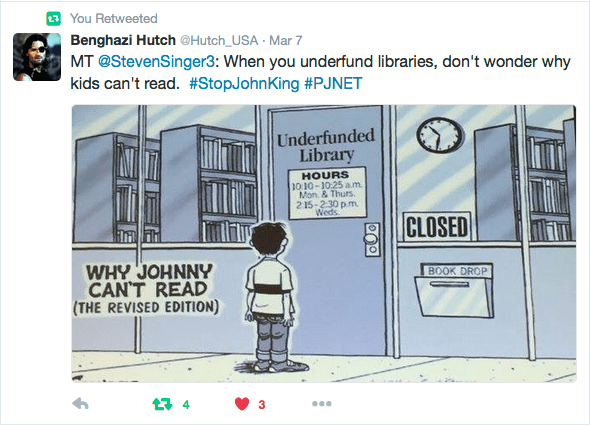
Two of my tweets were particularly popular: one about the conflict of interest of King’s wife working for Bellwhether, the other a seemingly unrelated message about the need to fund public libraries.

Screen shot 2016-03-16 at 11.06.15 PM

Screen shot 2016-03-16 at 11.06.40 PM


That’s when I started to notice the Twitter accounts of the people joining in. There were folks proclaiming their love for Ted Cruz and Donald Trump. They described themselves as libertarians and refused to speak to “libtards.” And the pictures on their Twitter accounts were often famous conservatives, racist cartoons of the President, pictures of themselves packing heat or just the darn guns, themselves.

“What the heck have I gotten myself into?” I thought.

That’s when I questioned why they were supporting me. For many of them I wondered if it had less to do with how terrible King would be as Education Secretary than with who nominated him in the first place.

Ever since Antonin Scalia died, many Republicans have sworn a blood oath not to approve any of Obama’s nominees – for the Supreme Court or ANY office.

For them this wasn’t about opposing a terrible Presidential pick. It was about blocking everything Obama did.

I had to face it. I had become a radical Republican, and I hadn’t even needed to change one of my positions to do it. The GOP came to me.

I have to admit, my right wing supporters were mostly very nice. I felt like I had a stronger group behind me than during most progressive campaigns.

There was some strain, however. A few times I could tell they were choking back anti-union rhetoric. “Why don’t we fund our libraries? Because unions,” apparently. “Who needs libraries – I home school.” That kind of thing.

And unfortunately, my progressive buddies were starting to notice the right wing support and take offense.

I got trolled by several lefties demanding I support Common Core.

“How can you be against it?” they’d ask. “Rand Paul hates Common Core. Do you agree with Rand Paul?”

I’d respond politely that even a broken clock is right twice a day.

Card-carrying Democrats refused to listen to any criticism of the Obama administration’s education policies. Little did these progressives realize, they were the exact opposite of the GOP activists they hated.

Many Republicans hate Common Core because Obama touched it. Many Democrats love it for the same reason.

The majority of teachers throughout the country hate it because we’ve read it, tried to use it and seen what a load of bullshit it is. We know it was developed with very little input from classroom teachers or child psychologists. We know it has no research behind it to show that it works. We see how it erodes our autonomy in the classroom and increases the amount and difficulty of high stakes tests for our students.

But my progressive friends refused to accept that anything Saint Hope and Change approved could be so terrible.

I’d turn to my newfound Republican posse only to find many of them hated Common Core beyond reason. It wasn’t just bad practice – it was going to turn our kids gay. It was a liberal plot to make children progressive atheists.

Oy vey.

The week just flew by. Eventually the Senate voted to approve King, both Democrats and Republicans – though the opposition was almost entirely in the GOP.

In my home state of Pennsylvania, the Senator I can usually count on to have my back (Bob Casey) stabbed me in the same place. And the Senator who usually only votes for things that are officially endorsed by Lord Satan, himself, (Pat Toomey) was my boy.

What kind of a topsy-turvy world am I living in!?

Elizabeth Warren – the liberal lion – said she wasn’t going to vote for King but ultimately gave in. Oh, Elizabeth. They got to you, too?

There were two points of light though. First, there was one Democrat who actually voted against him: Senator Kirsten Gillibrand from New York – the sight of King’s last catastrophe. Second, my Presidential candidate, Bernie Sanders, didn’t vote at all. Fwew! I can irrationally justify that – he was too busy, that’s all. Bernie would never have voted for King. Tee-hee!

So once again we see the two major parties as mirror images of each other. Where Republicans made the right choice for the wrong reason, Democrats made the wrong choice for the right one. Progressives were circling the wagons around the President. They were making a point that they weren’t going to let the evil GOP block his nominees – even if one of those nominees was an absolute pathetic failure.

This is politics in 2016, folks.

Decisions are rarely made because of logic, experience, or sound judgement. It’s all political maneuvering, personal gain or both. Meanwhile, the world goes to Hell.

After the vote, I got a smattering of conservative retweets and then… nothing. As quickly as they had come, they were gone.

My tiny caucus of teachers, academics and other ne’er-do-wells are still there. We shout our truths into the wind hoping someone will hear.

On days like today it seems impossible.

But perhaps there is a silver lining in there somewhere. If people from such opposite sides of the political spectrum can agree on something like how terrible John King is, maybe there’s hope. If we can shake hands over the fatuousness of Common Core, maybe we can find other points of agreement.

Maybe these brief moments of concord are opportunities for understanding. Sure my GOP compatriots supported me for the wrong reasons, but maybe some of them were exposed to the right ones.

I know I’ve learned from them. I consider myself an FDR Democrat with an abiding faith in a strong federal government. But even I can see how both the Bush and Obama administrations overstepped their power with No Child Left Behind and Race to the Top.

I don’t buy any of that baloney about Big Government vs. Small Government. But I do think that some things like education policy don’t belong at the federal level. The federal government should ensure public schools are funded properly and maybe regulate outright abuses, but local communities and districts should be deciding how to educate the children in their care.

If those ideas rubbed off on me, what rubbed off on my brief Twitter followers?

Will there come a day when we meet again, join hands and fight for our common good?

Can we overcome the blinders of party and politics to build a better world?

#IHopeSo

Less Resources, Harder Tests: Common Core in the Last Days of Obama

teaching_testing


The bell hadn’t even rung to begin class yet, but Ce Ce already had enough.


She saw the pile of standardized test look-a-like sheets on the front desk and immediately asked if she could go to in-school suspension.


I’m not kidding.


She’d prefer to spend the day in silence doing homework isolated from the rest of the class than practicing high stakes testing with her peers.


And she’s not alone. This happens every year now. As assessment season gets closer, administrators push teachers to do test prep. And students revolt.


I’m not exactly sure why. Test replicas are not my favorite things to do, either, but they’re not THAT bad. I don’t think it can be my teaching since the mutiny usually happens before I’ve even begun.


It’s the testing. Pure and simple. Some students are so demoralized by the very prospect of skill-and-drill that spending one more second reading passages and filling in bubbles seems a fate worse than death.


And I can’t really blame them.


In the last two years, Pennsylvania has modified its mandatory assessments until it’s almost impossible for my students to pass.


Bureaucrats call it “raising standards,” but it’s really just making the unlikely almost unthinkable.


Impoverished students have traditionally had a harder time scoring as well as their wealthier peers. But the policy response has been to make things MORE difficult. How does that help?


Consider this: If a malnourished runner couldn’t finish the 50 yard dash, forcing him to run 100 yards isn’t raising standards. It’s piling on.


Oh. Both your arms are broken? Here. Bench press 300 lbs.


Both your feet were chopped off in an accident? Go climb Mt. Everest.


That’s what’s happening in the Keystone State and across the country. We’re adding extra layers of complexity to each assessment without regard to whether they’re developmentally appropriate or even necessary and fair to gauge individual skills.


Where Common Core State Standards have been adopted (and Pennsylvania has its own version called PA Core), annual tests have become irrationally difficult. That’s why last year’s state tests – which were the first completely aligned to PA Core – saw a steep drop off in passing scores. Students flunked it in droves.


Where the previous tests were bad, the new ones are beyond inappropriate.


Take Text Dependent Analysis (TDA). It’s something we’ve always done in language arts classes, but it’s meaning has subtly changed thanks to PA Core.


Two years ago, it used to denote that students had to refer to the text when writing essays. Now it’s come to mean something more – referring to the text (or texts) with at least two degrees of complexity.


On the Reading section of the Pennsylvania System of School Assessment (PSSA) tests, students must peruse several passages and respond in writing.


Before PA Core, middle school students might have had to read one passage and then explain what its main idea was. This would require them to cite specific examples from the text. For instance, “This passage is mostly about bears because the author writes about hunting them in the Klondike, the ways in which their habitat is affected and their hibernation instinct.” Then students would have to go into more detail highlighting sections of text that support this.


Now students have to read TWO passages and write about something that pervades BOTH but is still tremendously complex. For instance, a 6th grade example released from the state has students read a poem and a folktale about people tricking others into sharing food. Then they have to write about the theme of both pieces and analyze how it is developed in each text using specific references.


The texts concern nothing most students would find interesting and are difficult to understand for children of that age. Moreover, properly developing an essay of this type should be done over the course of several classes. But middle schoolers are expected to do this in a single testing session.


Test proctors are instructed to put aside about 80 minutes for the essay and several related multiple choice questions though, technically, students can take as long as they’d like. They could be given extended time to write for several hours if they want. But most children at this age simply don’t have that kind of stamina. They are not physically and mentally prepared to sit and concentrate like that.


It’s a task many adults would find challenging, but we’re expecting 10- and 11-year-olds to do it!


Can middle school students (ages 10-14) handle this level of complexity, especially in such a short amount of time?


Honestly, it depends on the child. Everyone matures at a different rate. However, for most of the students I have taught in over a decade of middle school experience as a Nationally Board Certified teacher with a Masters Degree in Education, it is my professional opinion that this level of mastery is out of reach.


In fact, at an in-service training, administrators at my building had the entire teaching staff attempt this essay to show us what was expected from students. The general consensus was that it was unreasonable.


Requiring this level of difficulty simply ignores children’s basic humanity. Most of my students come to me not knowing how to write a good essay. If they were all computers, I could break up everything they needed to know into small bits, give it to them piecemeal over the course of the year, and they would learn. But they are not computers – they are children.


That’s why they rebel. We’re demanding more from them than they can give.


It might be different if we met them half way. It might be more reachable if higher expectations came with additional help.


If my students had any chance to achieve at this level so early in their cognitive development, we would need to bring in a team of writing specialists, a flurry of councilors, nutritionists, and wrap around social services. However, no resources have been added to help students meet these added testing hardships. In fact, Pennsylvania has slashed school budgets by almost $1 billion annually.


All the responsibility is thrown on the underfunded schools as if the few teachers who haven’t already been furloughed can somehow perform magic.


A surgeon can’t operate without tools. Nor is he expected to do the job of nurse and physical therapist as well.


It’s a matter of less resources and harder tests, then blame teachers when it doesn’t work.


It’s not just bad policy; it’s a denial of reality.


Add to that the social, cultural and economic aspects. Lawmakers pretend everyone is starting from the same point, but this is demonstrably untrue.


I teach mostly black and brown kids at a high poverty district. Many of my students only get a hot meal at school. They’re malnourished, violence-scarred, and under-equipped. They have few books in the home. Their parents aren’t around because the adults are working multiple jobs to support them. They live in violent neighborhoods where gunshots, drive-bys and premature death are commonplace. And you think they somehow have the same chances of scoring well on standardized assessments as children without these problems!? You expect them to prioritize standardized testing!?


And after years of being subjected to child abuse as education policy, the only thing they’ve learned from testing is that they’re not good at it and they might as well not try.


Is it any wonder some of them would rather sit in our school’s version of prison than stay in class and practice test taking strategies?


We’re running up against the nature of cognition and how young minds grow. We’re ignoring the social, cultural and economic conditions in which these children live. And we’re pretending this is somehow a fair and just accounting of children’s academic skills and their teachers’ effectiveness.


Children need to be engaged. They need to see how an assignment affects their lives. They need to care. They need intrinsic motivation, which is almost impossible to find for a test that is essentially extrinsic.


Our current education policy is the equivalent of holding a gun on children and demanding they perform almost impossible tasks.


It is time to stop the violence. It’s time to end the child abuse.


But is anyone listening?

If the PA Legislature Won’t Pass a Budget, Schools Shouldn’t Give High Stakes Tests

 1408571032000-Opt-out-01

No one gives a high stakes test because he or she thinks it helps kids learn.


Public schools give tests because they are threatened by the state: give this test or we’ll withhold your funding.


In Pennsylvania, the legislature can’t be bothered to pass a budget. So lawmakers have already withheld funding.


So WHY THE HECK ARE SCHOOLS GIVING THESE TERRIBLE TESTS!!?


Pause with me a moment for a smidgen of background.


It seems the Keystone State just can’t afford its public schools.


Not when there are natural gas drillers out there that need to make an obscene profit.


Not when rich folks need another tax cut so they can buy another yacht.


Not when legislative districts are so gerrymandered that lawmakers from rich localities serving a minority of the population will never be held accountable by the majority kept safely away from them in other districts.


Nope. The Commonwealth just can’t afford to educate everyone – especially those that are poor or black or brown.


That’s why the Republican-controlled legislature just can’t compromise with Democratic Gov. Tom Wolf on a budget.


Wolf wants the state to heal almost $1 billion in annual cuts to education made 5 years ago when the GOP also had control of the Governor’s mansion. Meanwhile, the Republicans just want to put another Band-Aid on it.


And this has been going on since July.


It’s time to make some hard decisions. We’ve got to make some cuts, and I have just the place to start: high stakes testing.


Since last year when we aligned our federally mandated assessments with the PA Core (i.e. Common Core lite), we’ve seen a huge spike in failure, test anxiety and public money going to for-profit testing corporations.


It cost taxpayers $30 million to administer the Pennsylvania System of School Assessment (PSSA) tests and $20 million for the Keystone exams last year, according to Department of Education representatives.


And when you add in the 164,500 students who failed and re-tested at least once, that’s an additional $4 million.


We simply can’t afford that kind of cost with no return on the investment.


These tests don’t make children more marketable. They don’t increase graduation rates (just the opposite). They don’t provide any opportunity for teachers to use them diagnostically and thereby increase educational outcomes. They have never been shown to help students in any way.


So why are we giving them?


Sure, the federal government decided in its infinite wisdom (after receiving mountains of cash from the standardization and privatization industry) that all public schools have to give annual assessments. However, the new federal Every Child Succeeds Act (ESSA) is supposed to allow states to decide what those assessments look like.


Students get teacher-created tests in school every week. Maybe our annual assessments look like that.


Heck! We’ve heard so much self-congratulation about how the new federal law gives power back to the states, it’s time to put that to the test. Cut this parasitic line item and move on to things that actually provide value for our students and their families.


And if the state government doesn’t have the guts to do this (spoiler: it doesn’t) then maybe our 500 public school districts do.


Why are school boards sitting back patiently waiting for their Constitutionally-mandated funding to come in?


The legislature is required by its own laws to have its books in order by July 1st. That was more than 270 days ago! If lawmakers can’t do that, why should our school districts listen to anything they say?


School directors should protest, and not just with angry letters. They should publicly proclaim they aren’t going to give their neighborhood children these tests.


The way I see it, that will do one of two things:


In either case, it’s a win.


People talk a lot about state vs. federal power when the real dichotomy is between local and everything else.


No one should be making decisions about how schools generally spend their budgets except for the people who actually live there. No one has the right to tell parents how to spend money on their families. Why should anyone have the right to tell communities how to educate their kids?


Sure, some communities may make bad decisions. And so do some parents. But it’s their decisions to make.


The contrast has never been so sharp.


While partisans in Harrisburg play games with the budget, our local public schools go wanting. They depend on state money to stay afloat. By December, many districts were planning to close their doors because of lack of funds.


Gov. Wolf unilaterally released $2.5 billion to keep them afloat but that’s less than half of last year’s expenditure. Meanwhile, Wolf has already proposed his spending plan for next year while the one for the current year still hasn’t been ratified!


Even under the best circumstances, public schools should stop giving standardized tests. The parents of more than 5,000 students refused testing for their children last year in Pennsylvania, and that number is expected to increase exponentially this year. Nationwide, the parents of hundreds of thousands of students opted out of testing last year. Parents are increasingly questioning the value of unproven assessments that do nothing but enrich for-profit corporations and unfairly label the hardest-working districts as failures.


The only carrot the state and federal government has to keep schools testing has been funding. In the absence of that, it is beyond ludicrous to continue the destructive practice. It would be tantamount to selling your soul to the Devil FOR FREE! Faustian bargains are generally not smart, but without remuneration, they’re idiotic!


So there is absolutely zero reason to follow the state testing mandate. The legislature has reneged on its side of the deal. Local school districts should be free to make whatever autonomous decisions their leaders can to keep them afloat and provide the best education possible for the students in their care.


That means if the state doesn’t pass a budget, local districts shouldn’t give standardized tests.