Would Democrats Really Do Better Than Betsy DeVos on Education?

Screen Shot 2018-03-28 at 4.32.52 PM


Everybody hates Betsy DeVos.


As Donald Trump’s Secretary of Education, she’s ignorant, unqualified and insincere.


But would the Democrats really do much better if they had control of the Executive Branch?


The Center for American Progress (CAP), a left leaning think tank, wants you to believe that they would.


The organization founded by John Podesta and deeply tied to both the Clinton and Obama administrations has come out with a list of seven policy goals if Democrats take back the House and/or Senate in the midterm elections this November.


On the face of it, many of these goals are smart and worthy ends to pursue.


But this is the Center for American Progress, after all! These are the same people who pushed charter schools down our throats, the same people who never met a standardized test they didn’t love, the same people who think Teach for America temps are just as good – if not better – than fully licensed, fully trained teachers with 4 or 5 year education degrees.


Frankly, I don’t trust a thing they say.


The last two Democratic administrations pushed almost the same education policies as the last three Republican ones. They often use different rhetoric and pretend to dislike policies that BOTH parties have championed for decades.


So when an organization with a history like CAP offers school policy proposals – even if they’re innocuous on the surface – a closer look often reveals something disturbing hiding just under the skin.


In any case, it’s worth taking a look at this new report to examine what’s helpful in these think tank proposals and in what ways they might hide dangers for students, teachers, parents and society.


THE BAD


Screen Shot 2018-03-29 at 1.45.45 PM


CAP proposes we:


  1. Provide a tutor for all students who are below grade level:


This includes both academic and emotional support. And it sounds great! Imagine what struggling students could do with more one-on-one help!


However, according to the report, CAP’s major problem with previous tutoring initiatives like those provided under the No Child Left Behind Act was that they weren’t “high-quality.” Moreover, “tutoring could grow at the local level, helped along by things like an AmeriCorps expansion.”


Oh great! “high-quality” is often used by think tanks as a euphemism for standardized testing. And AmeriCorp has helped push more Teach for America temps into positions that should be held by teaching professionals.


I would love for struggling students to have extra help, but this sounds too much like sending Teach for America to give poor and minority students test prep and skill drills for hours and hours after school.


2) Go to a 9-to-5 school day:


Child psychologists have been suggesting we start school later in the day for at least a decade to better suit growing bodies and brains. Students would be able to get more sleep and come to school more rested and ready to learn. It would also help parents if students didn’t get out of school up to two hours before most adults are home.


In addition, CAP is cognizant that this would have to be a local decision – it couldn’t be handed down at the federal level. They suggest encouraging the move with more Title I funding and other sweeteners.


However, this ignores the fact that U.S. kids already spend more time in class than their international peers. Few countries make their children suffer through an 8-hour day. In Finland, for example, where kids start later and are released earlier than U.S. children, students get a 15-minute break for every 45 minutes of class work.


This suggestion, coming as it does from test-obsessed partisans, could be just another way to try to increase the amount of work piled on students in order to raise test scores. I advise caution.


3) Pay teachers more


I’m certainly not against this one. CAP notes that teachers only take home about 60 percent of the salaries that employees with similar levels of education earn. They suggest a base salary of $50,000 – up from the current average of $38,000 for incoming educators.


“More-experienced educators with a track record of success should make at least $100,000,” the report suggests (emphasis mine). And THAT’S where I start to feel queasy. What exactly do they mean “track record of success”? Well, this is CAP, so that probably means teachers whose students score well on standardized tests.


So I’m guessing it’s a back door merit pay policy. In other words, they want to offer more money to teachers who clobber their students with the test prep club so they’ll magically score Advanced on high stakes tests. This is yet another attempt to bribe educators to narrow the curriculum, avoid collaboration and sideline students who don’t traditionally score well on these kinds of assessments – the poor and minorities.


I want a raise, believe me. I DESERVE a raise! But not if you’re going to make me sign a Faustian bargain first.


THE GOOD

 

Screen Shot 2018-03-29 at 1.46.06 PM


CAP proposes we:


4) Offer free breakfast and lunch to all students, no matter what their parents income:


We have this at both my daughter’s school and the district where I teach in western Pennsylvania. It is a tremendous success. Making it a nationwide initiative is an excellent idea.


It’s hard to argue with this, even if the main justification is that better nutrition will lead to better academic outcomes (read: test scores). Plus this removes the stigma of a free meal because all students receive it, and once initiated it would be harder to take away.


5) Provide more opportunity for students going to college to get technical workplace experience:


Students should be able to get real world experience to help them decide if certain careers are for them. I’m struggling to see a downside.


6) Hire more social workers, counselors and school psychologists:


Heck to the yeah. I see no downside there.


 7) Initiate a national infrastructure program to fix crumbling school facilities:


It’s about time! Schools in impoverished neighborhoods are falling apart. We need to bring them up to the same level as those in the upper middle class and wealthy communities. Obviously, we’ll need to audit these programs and make sure money isn’t being wasted or embezzled, but this is a worthy goal well past due.


AND THE OTHER SHOE DROPS


shoe_drop_small


And that’s it.


Not a bad list, over all.


I do have some reservations as noted above. However, many of these proposals would be really positive…


…until the other shoe drops.


Queue Lisette Partelow, CAP’s director of K-12 Strategic Initiatives and the lead author of the report. Pay careful attention to her remarks about the report in Education Week.


The think tank doesn’t expect these policies to be introduced or enacted anytime soon, she says. And even if they were, Partelow understands they would probably go under significant legislative changes before becoming law.


“We’re really excited about this as a counter balance, as an answer to the ideas we’re seeing put forward by [U.S. Secretary of Education] Betsy DeVos and the Trump administration,” Partelow says.


So THAT’S their game!


CAP is playing the long con here. They are putting forward a bunch of puppy dog and teddy bear proposals to contrast with Trump and DeVos.


These aren’t policies as much as they are advertisements for the Democratic party. It’s the equivalent of saying, “We promise we’ll do good things like THESE if you elect Democrats – despite the fact that we mainly focused on standardization and privatization when we were in power.”


Look. Maybe I’m being too cynical.


Maybe the Democrats really, really are going to do a better job this time, cross their hearts and hope to die, if we give them just one more chance.


But words aren’t nearly enough.


I like many of these policy suggestions. But I just don’t trust the Democrats.


The brand has been tainted for me by the Clinton and Obama administrations – by leadership from the same people who are making these suggestions.


In short – I’ll believe it when I see it.


Perhaps the greatest lesson organizations like CAP have taught is not to trust organizations like CAP and the faux progressives they’re selling.

6a00d8341d368753ef01b8d2bc84a9970c

For more, Read CAP’s Full report: HERE.


Like this post? I’ve written a book, “Gadfly on the Wall: A Public School Teacher Speaks Out on Racism and Reform,” now available from Garn Press. Ten percent of the proceeds go to the Badass Teachers Association. Check it out!
book-3

The Alt Right Has a Friend in Common Core


Andrew-Knight-holds-a-sign-of-Pepe-the-frog-unlikely-alt-right-icon.-JOSH-EDELSONAFPGetty-Images


Let’s say you’re a modern-day hipster Nazi.


You’re bummed out.


No one wants to hang out with you because of your bald head and your red suspenders and your commitment to the ideals of a defeated and disgraced totalitarian regime.


What are you to do?


REBRAND, son!


It’s simple.


No more National Socialist German Workers Party! That sounds too pinko!


Now you’re simply a member of the Alt Right!


It’s not racist! You’re just committed to traditional attitudes and values — if those traditional attitudes and values come from 1945 Berlin!


Heck, you don’t even have to call yourself Alt Right.


You can call yourself a White Identitarian.


You aren’t over-concerned with any one side of the political spectrum or other. You just strongly identify with whiteness — and by extension increasing the political power of white people at the expense of all others.


That’s all.


It should be obvious that this isn’t merely rebranding. It’s propaganda.


In today’s fast paced information age – where every fact is merely a Google away – that can be hard to get away with – UNLESS


Unless you already have a readymade tool to protect propaganda from the kind of informed critical thought that can pop it like a bubble. Something to insolate the ignorance and keep out the enlightened analysis.


I am, of course, talking about Common Core.


What!?


How does Common Core have anything to do with white nationalism?


Common Core is just a set of academic standards for what should be taught in public schools adopted by 42 of 50 states.


Academic standards aren’t political. Are they?


Actually, they are. Quite political.


Just take a look at how the standards came to be adopted in the first place.


The Obama administration bribed and coerced the states to adopt these standards before many of them were even done being written.


Hold your horses. The Obama administration!? That doesn’t sound exactly like a friend of the Third Reich.


And it wasn’t.


It was a friend to big business.


When first created, these standards weren’t the result of a real educational need, nor were they written by classroom educators and psychologists. They were written by the standardized testing industry as a ploy to get federal, state and local governments to recommit to standardized testing through buying new tests, new text books, new software and new remediation materials.


It was a bipartisan effort supported by the likes of Obama, the Clintons and Bill Gates on the left and Jeb Bush, Betsy DeVos and Bobby Jindal on the right.


After Obama’s success pushing them down our collective throats, many Republicans vocally decried the standards – often while quietly supporting them.


That’s why after all this time very few state legislatures have repealed them despite being controlled predominantly by Republicans.


Okay, so what does this have to do with the Alt Right?


People like Steve Bannon and Donald Trump are engaged in redefining the conservative movement. Instead of circulating ideas with a merely racist and classist undertone, they want to make those subtleties more explicit.


Most aren’t about to hop out of the closet and declare themselves open Nazis or members of the Hitler fan club, but they want to make it clear exactly how wunderbar the Fuhrer’s ideals are with a wink and a smirk.


For instance, Trump’s campaign slogan: Make America Great Again.


When exactly was America great? When white people had unchallenged political and social power and minorities and people of color knew their place. That’s when.


This is obvious to some of us, but we face a real obstacle making it obvious to others.


And that obstacle is Common Core.


A generation of Americans have been brought up with these shoddy academic standards that don’t develop critical thinking but actively suppress it.


For instance, take the absurd ravings of the Core’s chief writer – and current head of the College Board – David Coleman.


Going counter to the thinking of nearly every expert on literacy, he emphasized cold or close reading over reading text in context.


In particular, he said:


“Do you know the two most popular forms of writing in the American high school today?…It is either the exposition of a personal opinion or the presentation of a personal matter. The only problem, forgive me for saying this so bluntly, the only problem with these two forms of writing is as you grow up in this world you realize people don’t really give a shit about what you feel or think… It is a rare working environment that someone says, “Johnson, I need a market analysis by Friday but before that I need a compelling account of your childhood.”


Later, he added:


“The most popular 3rd grade standard in American today…is what is the difference between a fable, a myth, a tale, and a legend? The only problem with that question is that no one knows what the difference is and no one probably cares what the difference is either.”


And finally:


“This close reading approach forces students to rely exclusively on the text instead of privileging background knowledge, and levels the playing field for all students.”


However, Coleman was dead wrong on all counts.


What you think and feel IS important. The requirements of the corporate world ARE NOT the only reasons to teach something. Being able to distinguish between similar but different concepts IS important. And context is ABSOLUTELY ESSENTIAL to understanding!


For instance, today’s spin doctor Nazis soon realized that you can’t go goose stepping down main street blindly espousing how much better it is to be white — better than, say, being black or Jewish.


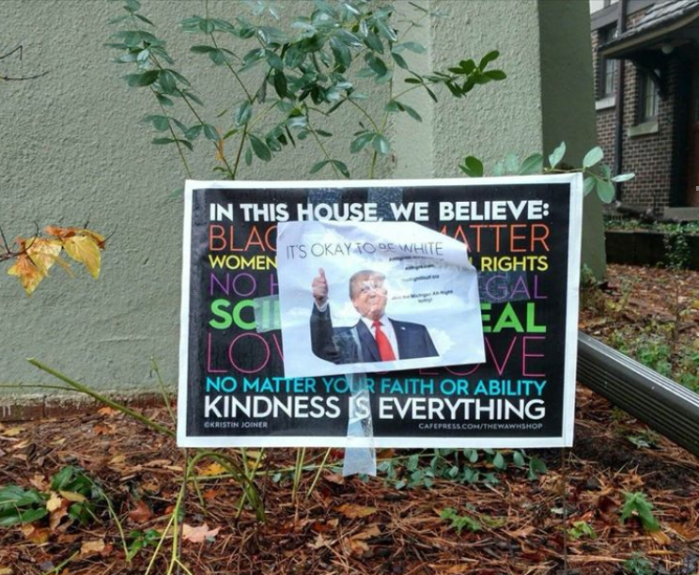
But you can hang up posters in college campuses that say the same sort of thing in a cutesy, passive aggressive way. For instance: “It’s okay to be white.”


If we look just at the text, as Coleman advises, we see a rather innocuous statement.


There’s nothing racist here. It’s just a simple statement that being white is also acceptable.


However, if we add back the context, we find an indirect racial undertone.


These posters weren’t put up willy nilly. They were hung on college campuses where white nationalists wearing MAGA hats were recruiting. They were pasted over Black Lives Matter posters, accompanying drawings of Donald Trump.


aposter1


In context, then, this statement doesn’t just mean “It’s okay to be white.” It means “It’s okay to be pro-white supremacist, to be pro-white power.”


And that brings up two other examples.


MAGA – Make America Great Again.


Take it out of context and it’s innocuous. It just means to increase the abstract greatness of the country to what it was at some unspecified time in the past.


However, if we put that statement in the context of the Trump campaign and its xenophobia, homophobia, Islamophobia, transphobia, etc. — then it’s meaning becomes clear. As noted above, it’s an ode to white power and nostalgia for greater white privilege.


And “Black Lives Matter”? Why do many of these same Identitarians take exception to that slogan and the movement behind it?


The Alt Right says BLM is reverse racist. They claim the name BLM means “ONLY black lives matter.”


Context tells us differently.


The BLM group was formed in response to the indiscriminate murder of people of color and those who committed these crimes not behind held accountable. Officer Darren Wilson not indicted for killing Michael Brown. Officer Daniel Pantaleo not indicted for killing Eric Garner. Officers Timothy Loehmann and Frank Garmback not indicted for killing Tamir Rice. And on and on.


Yet the Alt Right is allowed to mischaracterize a simple call for peace as if it identified a terrorist organization.


Why? Because context has been banished from the building.


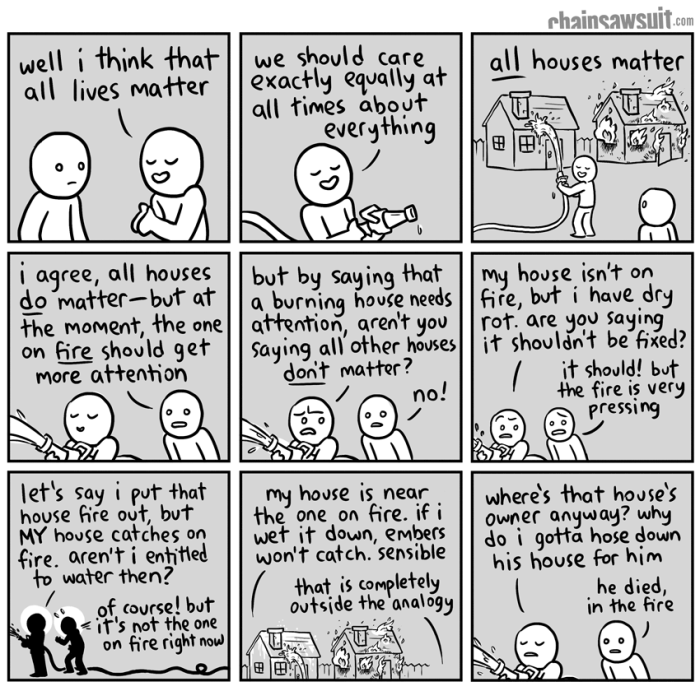
20160707_allhousesredux


I’m not saying that Common Core has caused these problems, but it has allowed them.


I doubt this is what Coleman, who is Jewish, intended.


But whenever you water down critical thinking – even if it’s for purely practical ends – you end up hurting everyone.


The best societies praise intellect and tolerance.


For all their faults, our founders knew this. That’s why they emphasized the importance of public education.


If we had ensured everyone in the country had access to the best possible education, this modern Nazi subculture wouldn’t be able to make as much headway as it has.


This is yet another way that our obsession with unrestrained capitalism, neoliberalism and plutocracy has put us on a road that may end in fascism.

Twenty-One Reasons People Hate, Hate, HATE Betsy DeVos

n7kdmgvgx13jmo6cvmpu


Lesley Stahl: Why have you become, people say, the most hated Cabinet secretary?


Betsy DeVos: I’m not sure exactly how that happened…

I’m more misunderstood than anything.


The above exchange from last night’s 60 Minutes interview highlights an important point about our Education Secretary.


She is deeply unpopular, but not because she’s misunderstood. If anything, she’s understood too well.


We know what she stands for and we don’t like it.


If she was really so misunderstood, why didn’t her answers in the interview veer away from the same usual canned responses she’s given time-and-time-again to the same type of questions?


What’s wrong with schools? NOT ENOUGH CHOICE.


How do we prevent school shootings? LET SCHOOLS ARM TEACHERS.


You didn’t really even need DeVos to show up to the interview to be able to guess with a high degree of accuracy what her answers would be.


In fact, many of her responses seemed to have been coached – as if someone had prepared her with talking points before the interview even took place.


So without further ado, here is my exhaustive list of all the reasons I can think of why people really, REALLY hate Betsy Devos. If I’ve left something out, please feel free to add it in a comment.


WHY PEOPLE HATE BETSY DEVOS:


1) She didn’t earn her position as Education Secretary. She bought it. And even then it took a tie breaking vote by Vice President Mike Pence to shove her down our throats.


2) She wants to spend tax dollars to boost privatized schools in which she has a financial stake.


3) She doesn’t mind taking funding away from public schools to do it.


4) She wants to destroy the entire system of public schools which enroll 90% of America’s children.


5) She doesn’t really know what public schools are, having never attended one or having never sent her children or grandchildren to one.


6) She wants to arm teachers not because it will protect kids from school shooters, but because that boosts her family’s investment portfolio. (i.e. her brother’s mercenary army for hire, Blackwater)


7) She won’t make charter and voucher schools give the same services to special education kids as those provided by traditional public schools.


8) She’s getting rid of students’ civil rights protections while adding protections for nefarious student loan providers and fly-by-night on-line schools.


9) She’s rescinded rules that protected trans students.


10) She’s considering rescinding rules that protect minority students from being unfairly and disproportionately disciplined by schools.


11) She’s made it harder for victims of sexual assault and harassment to report abuse and easier for those accused to avoid prosecution.


12) She talks about state’s rights to determine their own education systems while using the power of the federal government to coerce them to doing things her way.


13) She wastes public tax dollars. She is the only Cabinet member protected by Federal Marshals, which costs us nearly $1 million a month. Whether this is necessary or not, as a billionaire she could save the taxpayers money by taking on this cost, herself.


14) She doesn’t care if the public doesn’t want her at their school or event. She goes anyway and then pretends to be angry that protestors showed up. She doesn’t seem to understand that as a public servant she should serve at our pleasure – not the other way around.


15) She uses tragedy as a photo-op – as she did when she visited the Parkland school to promote arming teachers. She didn’t meet significantly with students or staff. She didn’t listen to their concerns. She even bailed on her own press conference there when the queries weren’t to her liking.


16) She has no problem whitewashing black history as she did when she claimed historic black colleges were pioneers of school choice. In reality they had no choice. For many African Americans at the time, it was create black colleges or forgo post-secondary education at all.


17) She is ignorant (purposefully or not) of the results of her own policies. Her advocacy of school choice in her home state of Michigan has weakened that state’s public schools, not strengthened them.


18) She’s out of touch with average Americans. She’s the richest member of Trump’s cabinet and often travels in her on super luxury yacht.


19) She’s rich not because she earned it, but because she was born into it and married into even more wealth. Moreover, much of her wealth is due to her family’s Amway fortune – basically it’s founded on rooking average people out of their hard earned money with what’s essentially a pyramid scheme.


20) She’s arrogant. She smiles vacantly at topics that don’t deserve a smile – they deserve serious regard.


21) She is extremely biased and partisan. She is supposed to serve the public interest, but her radical Christian Fundamentalism and anti-LGBT activism make her untrustworthy to serve in that capacity. Statements such as “There is enough philanthropic dollars in America to fund what is currently the need in education… Our desire is to confront the culture in ways that will continue to advance God’s kingdom,” do not help.


Okay. That’s all I can think of – though more may pop into mind as soon as I publish this. If I missed something please include it in the comments.


Hopefully this answers DeVos’ question about why she’s hated.

Rampant Ignorance of What a School Should Be

635880071969781625796021747_Ignorance


From politicians confusing a living wage with a handout—


To a white supremacist teacher podcast.


From a tone deaf government flunky using tragedy to do anything to stop gun violence except regulate firearms—


To a Bronx principal barring a black history lesson during Black History Month.


All-in-all, it’s been a crazy news cycle.


If one thing was made clear during the last seven plus days, it’s this:


Many people have no idea what a school should be.


Take West Virginia, the site of a recently resolved statewide teacher strike.


After years of watching the cost of living rise while wages remained stagnant, educators took to the streets to demand enough money that they wouldn’t have to quit their teaching jobs and look for work elsewhere.


It’s a reasonable request.


Imagine if we didn’t pay doctors enough to afford to practice medicine. Imagine if we didn’t pay lawyers enough to afford to practice law.


Teachers just wanted enough money so they could focus on educating the next generation and still get perks like food and shelter.


However, West Virginia is a self-confessed conservative state where self-identifying conservatives unashamedly explain that a full-throated expression of their conservative values includes the idea that you shouldn’t have to pay people a living wage for a hard day’s work.


Or as state Senator Lynne Arvone (R-Raleigh) put it:


“The teachers have to understand that West Virginia is a red state, and the free handouts are over.”


What, Sen. Arvone? Are you high?


A salary is not a “free handout.”


That’s redundant – there is no such thing as a free handout. Handouts are by definition free. That’s something you would have known had you paid more attention to your third grade language arts teacher. But, whatever.


Moreover, a salary is neither free nor a handout.


It is a fixed regular payment – often weekly or biweekly – made by an employer to an employee in exchange for doing a job.


West Virginia teachers are doing their job. State representatives like Arvone aren’t doing theirs.


They aren’t making teaching an attractive career and thus encouraging the best and brightest to become teachers. When you’ve already got a shortage of people willing to become educators, you have to invest. That’s economics 101! Basic supply and demand.


Admittedly, after 8 days of a state-wide strike, the legislature caved and gave teachers a 5% raise, but only moments before introducing a bill to reduce the requirements to become a West Virginia teacher in the future.


Boom.


It’s like lawmakers are saying: Oh. So you want your raise? Here you go. But the next generation of teachers hired in the state will be more ignorant, less experienced, more unskilled and less professional. In short, they won’t expect to be paid a living wage because we’ve made teaching right up there with being a WalMart greeter!


So there!


If passed, the academic quality of education provided by West Virginia will drop.


But so will the cost. And that seems to be the only thing lawmakers like Arvone and her “conservative” colleagues seem to care about.


You know, I don’t think they know what conservative means, either.


It’s certainly not what a public school should be.


Want another example?


Take Dayanna Volitich, a 25-year-old Florida teacher who allegedly ran a white supremacist podcast until non-Aryans heard it, put two-and-two together and removed her from class.


On a recent episode she bragged about spreading racist and prejudiced ideas to her students.


According to an article in the Huffington Post describing her latest podcast:


Volitich also agreed with her guest’s assertion that more white supremacists need to infiltrate public schools and become teachers. “They don’t have to be vocal about their views, but get in there!” her guest said. “Be more covert and just start taking over those places.”


“Right,” Volitich said. “I’m absolutely one of them.”


Great. Just what we need. An army of undercover white supremacists being encouraged to enter the teaching profession – taking those newly minted minimum wage jobs vacated by more expensive but less biased educators.


As a more than 15-year veteran of the public school classroom, I have some advice for white supremacists thinking about becoming teachers: Don’t.


We don’t want you here.


No one has the time for your warmed over master race lullabies.


We don’t need another generation of privileged white people who think the world owes them something just because of the color of their skin.


We need an America made up of people of all colors and creeds who believe in a meritocracy. You get what you work for, what you earn.


And we need lawmakers to actually create a system that supports this ideal.


We need political parties and grassroots movements to push for such an America.


Nazi propaganda belongs in one place only – the history books. It is not part of our future.


And on a personal note, let me just say that becoming a teacher often makes you more progressive than you were when you started.


I know it did me.


Especially if you work at a high poverty, high minority district like I do.


Your job is to serve students’ needs. You push them to think, you don’t tell them what to think.


If that’s not what you’re up for, you’re not up for being an educator.


Indoctrination is not what school should be.


And that brings me to Betsy DeVos, our billionaire Education Secretary who bought her government position with campaign contributions and political connections.


She went to Parkland, Florida, this week to visit with students, teachers and administrators who survived a school shooting a couple weeks ago.


Or at least that’s what it probably said on the press release.


It was really just a publicity stunt to push for arming teachers instead of sensible gun control.


Parkland students have been rocking it holding demonstrations and speaking truth to power demanding that we keep them safe from future violence by banning assault rifles, mandatory background checks on all gun sales and other common sense measures favored by almost 70% of the nation.


DeVos took about five questions before walking out of her own press conference.


She didn’t meet with students – didn’t even try.


She was just there for a photo op.


Well, time’s up, Betsy.


The next generation isn’t putting up with your tone deaf water carrying. With your own family ties to mercenary soldiers for hire, it’s no surprise you’d be against gun control and in favor of firearms to chase away all the Grizzlies attacking our public schools.


It won’t stop the bloodshed but an increase in gun sales will boost your portfolio.


Arming teachers is one of the dumbest things on an agenda full of real whoppers from this absurd Presidential administration.


Teachers touting guns, shooting it out with armed terrorists – no. That’s not what a school should be, either.


So finally we get to the Bronx, where some dimwit who somehow became a principal told an English teacher not to teach a unit on the Harlem Renaissance.


You know, the Harlem Renaissance – Langston Hughes, W.E.B. Du Bois, Louis Armstrong, Zora Neale Hurston, Duke Ellington… Nobodies like them.


And if that’s not bad enough, she did it in February during Black History Month.


This number crunching pedant thought it was inappropriate because the teacher wasn’t in the social studies department.


This is what happens when you try to put education in a box with things like Common Core. Don’t teach background information, just look at every text divorced from everything else around it – the author’s personal history, what was happening in the world at the time or even how the reader responds to it.


Administrators like this need to take a seat and get out of teachers ways.


This kind of subtly racist micromanaging isn’t a part of what schools should be either.


Schools should be places where dedicated professionals are prized and valued. They’re given the autonomy to teach what they know is important and they make these decisions informed by the empiricism of what their students need.


Schools should be places without prejudice or racism. They should be cultural melting pots free from segregation and preconceived notions. They should be about academic freedom and the joy of learning.


I wish more people understood it.


Maybe then we could work to make our schools and our country more like the ideals of the overwhelming majority of the people living here.


Instead of continually letting the rich and privileged set the agenda.

Economists Don’t Know Crap About Education

3c19197


I hate to be blunt here, but economists need to shut the heck up.


Never has there been a group more concerned about the value of everything that was more incapable of determining anything’s true worth.


They boil everything down to numbers and data and never realize that the essence has evaporated away.


I’m sorry but every human interaction isn’t reducible to a monetary transaction. Every relationship isn’t an equation.


Some things are just intrinsically valuable. And that’s not some mystical statement of faith – it’s just what it means to be human.


Take education.


Economists love to pontificate on every aspect of the student experience – what’s most effective – what kinds of schools, which methods of assessment, teaching, curriculum, technology, etc. Seen through that lens, every tiny aspect of schooling becomes a cost analysis.


And, stupid us, we listen to them as if they had some monopoly on truth.


But what do you expect from a society that worships wealth? Just as money is our god, the economists are our clergy.


How else can you explain something as monumentally stupid as Bryan Caplan’s article published in the LA Times “What Students Know That Experts Don’t: School is All About Signaling, Not Skill-Building”?


In it, Caplan, a professor of economics at George Mason University, theorizes why schooling is pointless and thus education spending is a waste of money.


It would be far better in Caplan’s view to use that money to buy things like… oh… his new book “The Case Against Education: Why the Education System Is a Waste of Time and Money.”


His argument goes something like this: the only value of an education is getting a job after graduation.


Businesses only care about school because they think it signifies whether prospective employees will be good or bad at their jobs. And students don’t care about learning – they only care about appearing to have learned something to lure prospective employers. Once you’re hired, if you don’t have the skills, employers have an incentive to give you on the job training. Getting an education is just about getting a foot in the door. It’s all just a charade.


Therefore, we should cut education funding and put kids to work in high school where they can learn how to do the jobs they’ll need to survive.


No wonder economics is sometimes called “The Dismal Science.” Can you imagine having such a dim view of the world where THAT load of crap makes sense?


We’re all just worker drones and education is the human equivalent of a mating dance or brilliant plumage – but instead of attracting the opposite sex, we’re attracting a new boss.


Bleh! I think I just threw up in my mouth a little bit.


This is what comes of listening to economists on a subject they know nothing about.


I’m a public school teacher. I am engaged in the act of learning on a daily basis. And let me tell you something – it’s not about merely signifying.


I teach 7th and 8th grade language arts. My students aren’t simply working to appear literate. They’re actually attempting to express themselves in words and language. Likewise, my students aren’t just working to appear as if they can comprehend written language. They’re actually trying to read and understand what the author is saying.


But that’s only the half of it.


Education isn’t even just the accumulation of skills. Students aren’t hard drives and we’re not simply downloading information and subroutines into their impressionable brains.


Students are engaged in the activity of becoming themselves.


Education isn’t a transaction – it’s a transformation.


When my students read “The Diary of Anne Frank” or To Kill a Mockingbird, for example, they become fundamentally different people. They gain deep understandings about what it means to be human, celebrating social differences and respecting human dignity.


When my students write poetry, short fiction and essays, they aren’t merely communicating. They’re compelled to think, to have an informed opinion, to become conscious citizens and fellow people.


They get grades – sure – but what we’re doing is about so much more than A-E, advanced, proficient, basic or below basic.


When the year is over, they KNOW they can read and understand complex novels, plays, essays and poems. The maelstrom of emotions swirling round in their heads has an outlet, can be shared, examined and changed.


Caplan is selling all of that short because he sees no value in it. He argues from the lowest common denominator – no, he argues from the lowest actions of the lowest common denominator to extrapolate a world where everything is neatly quantifiable.


It’s not hard to imagine why an economist would be seduced by such a vision. He’s turned the multi-color world into black and white hues that best suit his profession.


In a way, I can’t blame him for that. For a carpenter, I’m sure most problems look like a hammer and a nail. For a surgeon, everything looks like a scalpel and sutures.


But shame on us for letting one field’s myopia dominate the conversation.


No one seems all that interested in my economic theories about how to maximize gross domestic product. And why would they? I’m not an economist.


However, it’s just as absurd to privilege the ramblings of economists on education. They are just as ignorant – perhaps more so.


It is a symptom of our sick society.


We turn everything into numbers and pretend they can capture the reality around us.


This works great for measuring angles or determining the speed of a rocket. But it is laughably unequipped to measure interior states and statements of real human value.


That’s why standardized tests are inadequate.


It’s why value added teacher evaluations are absurd. It’s why Common Core is poppycock.


Use the right tool for the right job.


If you want to measure production and consumption or the transfer of wealth, call an economist.


If you want to understand education, call a teacher.

When Will It Happen Here?


classroom


It could happen at anytime in my classroom.


The thing we’ve all been dreading.


A hasty announcement of lock down. An unexpected fire alarm. The sounds of shouting, running feet and… gunshots.


The lights could go out. The door could burst in.


There’s really very little we could do.


My room has no windows. No closets. Nowhere to hide.


These are the thoughts going through my head as my students sit at their desks during homeroom this morning.


Jayden is taking off his hoodie before the principal catches him out of dress code.


Alaina is pestering me for a pass to the library.


Darnell is surreptitiously munching on a pixie stick stashed in his book bag.


It’s all so mundane, so subdued, so quiet.


A few kids are on the computers in the back, others at their desks reading books, writing papers, or listening to music on their iPads.


But there’s very little conversation.


The class of middle schoolers is restrained, thoughtful – which is unusual for children of 12 or 13.


I sit slumped at my desk – exhausted though I haven’t even taught my first class yet.


The news from last night still plays in my head.


Seventeen people killed by an expelled student at a high school in Parkland, Florida.


Or was it two killed in Kentucky?


How long was it since the last one?


And now here we are – back in the line of fire.


I can’t help but think about my daughter somewhere across town. She’s probably just entering her third grade classroom maybe munching on the remains of a candy heart from Valentine’s Day. Just like me and my students, she’s in the cross hairs.


But what can we do about it?


I can’t hold her out of school forever. I can’t quit my job and work from home. Even if I could, there’s absolutely nothing I can do for the twenty children quietly sitting at their desks in the room with me, abiding the rules of a society too broken to protect us.


After last night, it feels like things have changed somehow.


There have been 18 school shootings so far this year. And it’s only February. Most have resulted in zero injuries.


Of those where people were hurt, the person most in danger was the shooter. But I can’t stop thinking about those cases where a hunter came to school to kill children and teachers.


As an educator, I’ve been taught how to handle just about every situation.


If one of my children acts out, or doesn’t hand in her homework, or even throws up – I know what to do.


But none of my training has prepared me to out teach a semiautomatic weapon.


I can’t differentiate past a bullet.


There is no paperwork that will invalidate the gunpowder or slow the endless rounds through whatever they come into contact.


If someone comes to school with a gun and a will to kill, I will be little more than a target.


But don’t get me wrong.


This doesn’t mean society should gift me a handgun to keep in my desk next to the chalk.


I am not a law enforcement officer or an action hero. I’m a teacher.


You don’t want me returning fire at every mindless bureaucratic hitch in the schedule. You want me assigning essays and chapter readings. You don’t want me keeping a gun out of reach of curious youngsters always at my desk and in my personal space. You want me safeguarding student assignments and – heck – my cell phone that kids keep trying to snatch and look through my camera roll.


What we need is real gun control legislation.


We need an assault weapons ban.


We need to close the gun show loophole.


We need buyback programs to get the mountains of firearms off the streets and out of the arsenals of a handful of paranoid “survivalists”.


In short, we need lawmakers willing to make laws.


We need legislators who will represent the overwhelming majority of the public and take sensible action to protect the people of this country.


What we don’t need are the trolls who hijack every conversation arguing the semantics of the term “assault rifle” or “terrorist.”


We don’t need weak politicians cautioning against “politicizing” mass shootings because the violence is too fresh.


We don’t need anyone’s thoughts and prayers.


We need action.


And we need it yesterday.


Some people are calling on teachers to take action to force our lawmakers to finally do something.


They suggest a national teachers strike on May 1st – May Day – if Congress refuses to act.


That sounds like a good idea to me.


I’m game.


But we need more than that.


We need everyone who feels the same way to join in the fight.


Parents, children, grandparents, principals, police, firefighters, soldiers and nurses – the multitudinous faces of America must come together to fight this monstrosity as one.


I may sit in that classroom.


My students and my daughter may be in danger.


But America must be the shield.


America must rise up and protect our future.


WE must take charge.


Otherwise, it is not a case of can it happen here.


It is a case of when.

Study Suggests Bringing “No Excuses” Discipline Policies from Charter to Public Schools

no_excuses_charter


The teacher begins class by taking out her Glock.


She casually walks to the front of the room and shoots a misbehaving student in the head.


All the others immediately begin working on their assignment.


It sounds like something from a horror movie. But it’s actually not all that far away from what real researchers at the Brookings Institution and Princeton University are suggesting we do.


Sarah Cohodes has written a new report called “Charter Schools and the Achievement Gap” that praises “No Excuses” discipline policies at urban charter schools and suggests they be more widely implemented at traditional public schools serving the poor and students of color.


I wish I were kidding.


Let’s return to the hyperbolic situation with which I began this article.


The noise of a gunshot brings the principal racing to the classroom.


She notices the slumped bleeding body of the shot child and walks up to the teacher ready to physically disarm and arrest her. But then she notices all the rows of neatly placed desks and the children diligently doing their work.


She glances down at a paper here and there and notices that the children are getting most of their work correct.


So she turns to the teacher and says, “Carry on, Ms. C. You seem to have everything under control here.”


That’s perhaps the most immediate concern brought by Cohodes research – it proposes to evaluate a discipline model based solely on its academic results and completely ignores other aspects of the student experience. For instance, how does the model affect students’ social and emotional development? Is it harmful to students’ curiosity, self-motivation and psychological well-being?


Pardon me, but these are important issues.


I don’t care if my fictional teacher’s shoot first discipline policy gets students to do exceptional classwork. My daughter will not be enrolled in that class – nor do I expect anyone would want their child to learn in such an environment regardless of how well it maximized test scores.


Let me be clear. This is hyperbole, but with a point.


“No Excuses” discipline policies don’t result in any gunshot wounds or deaths (to my knowledge), but they do create environments that are not conducive to the flourishing of children.


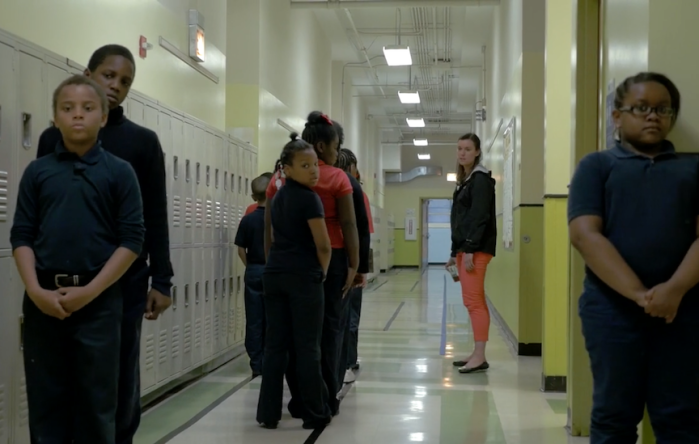
For instance, at a New Orleans charter school, students were punished for not standing straight, not sitting up straight, for putting their heads down, for closing their eyes for too long, for not tracking speakers correctly with their eyes! Between classes students had to walk single file between the wall and a line marked with orange tape. And they had strict dress codes.


This is not school. It is prison.


And it’s unsurprising that these sorts of discipline policies are found at urban charter schools like the KIPP network serving mostly poor and minority students.


Cohodes champions them because – in her view – they get results.


I say that she is missing the point.


Her view of what is important in school is far too narrow.


Moreover, it’s based on a misconception of what constitutes academic success.


Cohodes concludes “No Excuses” policies work solely because schools with such policies tend to have students who get higher test scores.


This is to make a few assumptions.


First, it assumes that the number of students weeded out by such discipline policies isn’t significant enough to wipe out the apparent increase in scores. The punishment for breaking the rules at these schools is often detention, suspension or expulsion. Every child who is enrolled at the beginning of the year isn’t there by testing time. How do we know that the school hasn’t lost so many students who couldn’t obey the rules that they wipe out any gains in testing?


Second, she is assuming standardized testing provide accurate assessments of knowledge and skills. This is far from an accepted premise. These tests have repeatedly been shown to be both economically and racially biased. Cohodes is assuming that since the students scoring better on the assessments are still poor and predominantly black, what they’re being tested on is fair.


Standardized tests are poor assessments. Multiple choice exams do not possess the flexibility to allow for creativity and depth of knowledge. They simply expect a “standard” student to think a certain way and reward dissimilar students for conforming to that standard.


“No Excuses” charter schools may be better at getting different children to act and think alike, but that is not necessarily an endorsement.


Cohodes concludes that these gains in test scores are ultimately beneficial because they will lead to success at college. However, numerous studies have shown that charter school students end up dropping out of college at higher rates than traditional public school students. They simply haven’t learned how to motivate themselves to learn without the rigid, military structures of the charter school environment. One can imagine similar outcomes for charter students (successful charter students) who immediately enter the workforce.


None of these considerations make it into Cohodes research.


She jumps from the brilliant standardized success of “No Excuses” charter schools to the need to include these policies in traditional public schools.


Cohodes worries that the charter school sector can never fully compete with traditional public schools, so we need to make traditional public schools more like charter schools.


However, I cannot imagine many parents would jump at the chance to have their children treated like prison inmates for the chance of higher test scores.


Unlike charter schools, public schools have school boards. They have to make their decisions in public and are accountable to voters who can come to the public meeting, protest and even run for a seat on the board themselves.


In short, this is a terrible idea.


It is somewhat staggering that a grown adult could look exclusively at the data and come to such a conclusion without considering what it means for flesh-and-blood students.


Not only that, but we’re talking about predominantly black and brown students. Is it somehow more acceptable because we’re talking about turning schools serving darker skinned students into Guantanamo Bay? Would it be as acceptable for rosy cheeked affluent white kids?


This is what happens when you let economists set public policy.


It is essential that we include parents, teachers, psychologist and even students in the processes. Otherwise, we’ll continue to get heartless number crunching offered as sincere solutions to our problems.

Wake Up, America! You Have a School Shooting Problem!

photos-century-poc


There have been 11 school shootings so far this year.


And January isn’t even over yet.


That makes about 50 for the academic year – roughly one a week.


Some involve no injuries. Some are suicide attempts. And some, like the latest in Kentucky, involve an active shooter hunting and killing children.


While gun violence is a problem throughout the country, it is especially virulent at educational institutions.


According to an FBI study that looked at incidents from 2000-2013, nearly one quarter of all U.S. shootings took place at schools. And they’re on the rise.


Yet this latest incident barely raised an eyebrow in the collective consciousness.


Hardly anyone even attempted to offer a solution.


The reason?


Since Sandy Hook, we’ve effectively given up.


In December of 2012 a gunman walked in to Sandy Hook Elementary School in Newtown, Connecticut, and killed 20 children and six adults, and we did nothing.


We stood by after the murder of elementary kids and couldn’t get up the collective energy to do one damn thing to stop things like this from happening again.


No new regulations.


No assault weapons ban.


No gun buyback programs.


NOTHING.


In fact, the only thing we did do was actually weaken gun laws to INCREASE the likelihood of more kindergarten kids dying by shot and shell.


In this country we have created a false dichotomy – it’s either children or guns — and we’ve chosen GUNS!


We’re told to buy bullet-proof backpacks, arm school teachers, and have gun wielding police patrol the buildings, but don’t do anything about the firearms, themselves.


America has 4.4 percent of the world’s population, but almost half of the civilian-owned guns in the world.

guns_per_capita

It’s no wonder, then, that our citizens are so much more likely to die at end of a barrel.


Since Sandy Hook, there have been more than 1,500 mass shootings (including those done at locations other than schools).

Screen Shot 2018-01-26 at 7.59.15 AM

According to the Gun Violence Archive, there have been at least 1,518 mass shootings, with at least 1,715 people killed and 6,089 wounded as of October 2017.


The database defines a mass shooting as one in which at least four people (not counting the shooter) were shot regardless of whether those wounds were fatal or not. And since some shootings go unreported, it’s likely only giving us the bare minimum.


But that’s just mass death and destruction.


The overwhelming majority of gun deaths are smaller scale – police brutality, domestic violence, suicides, accidents, etc. America’s total annual firearm deaths came to more than 33,000 in 2014.


This is patently absurd.


Other countries don’t have the same level of gun violence as we do, even per capita.


There are certain facts that we refuse to accept.


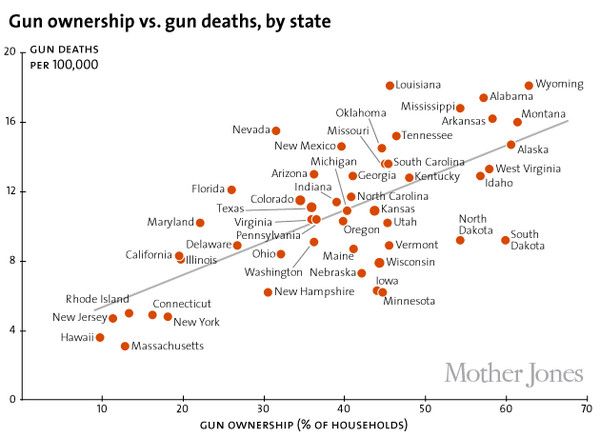
States with more guns have more gun deaths.

gun_ownership_states

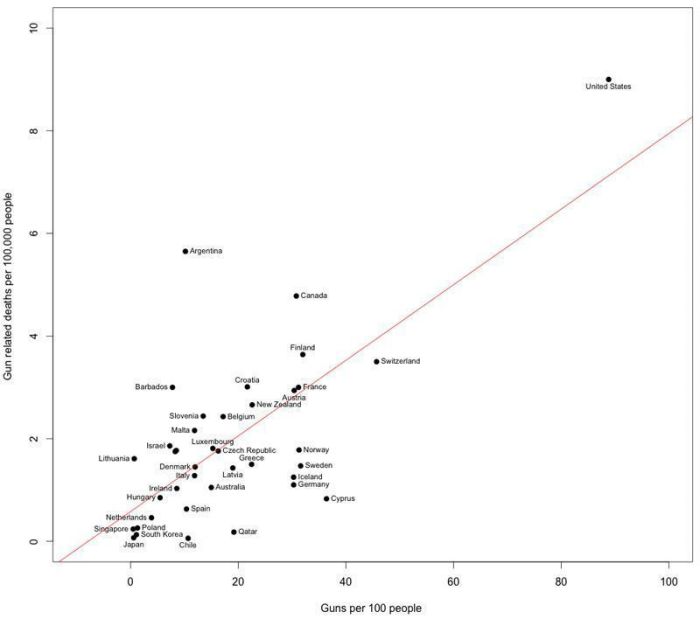
Countries with more guns likewise have more gun deaths.

guns_country

Meanwhile, states with tighter gun regulations have fewer gun-related deaths.

gun_control_vs_deaths

Countries with more rigorous gun control likewise have fewer gun related deaths.

(Don’t believe me? See Florida’s “The Geography of Gun Deaths,” and a 2016 review of 130 studies in 10 countries, published in Epidemiologic Reviews.)


Yet we’re told that gun control is useless because new laws will just be pieces of paper that criminals will ignore. However, by the same logic, why have any laws at all?


Congress should just pack it in, the courts should close up and the army should just all go home. Criminals will do what they please – there’s nothing we can do about it.


This kind of thinking is the triumph of business over sense.


The gun industry is making billions of dollars off this cycle of gun violence: mass shooting, fear of regulation, increase in sales. Repeat ad infinitum.


We may never be able to stop all gun violence, but we can take steps to make it more unlikely. We can at least make it more difficult for people to die by firearm.


And this doesn’t have to mean getting rid of all guns.


It just means sensible regulations.


According to the Pew Research Center, when you ask people about specific firearm regulations, the majority is in favor of most of them – both Republicans and Democrats.


We don’t want the mentally ill to be able to buy guns. We don’t want suspected terrorists to be able to purchase guns. We don’t want convicted criminals to be able to buy guns. We want mandatory background checks for private sales at gun shows.

guns_support

Yet our lawmakers stand by helpless whenever these tragedies occur because they are at the mercy of their donors.


The gun industry owns too many lawmakers.


Our continued gun violence problem is a symptom of our flagging democracy.


In a Republic like ours, our representatives are supposed to enact our will in the halls of power. Yet they don’t actually represent us. They represent business and the wealthy.


Until we regain control of our government, we will always be at the mercy of the dollar and the gun.


Our children will remain merely the most innocent victims of our heartless and unfair politics.


Gun violence is not an everyday occurrence at our schools. In fact, children are actually safer there than anywhere else. But everything is relative. Going to class to learn you’re ABC’s shouldn’t bring with it even a moderate chance of fiery death!


But that’s 2018 America. We live in a culture of death.


You need no further proof of that than the weekly report of which school got struck by the lightning of gun violence. Which children were mowed down by the consequences of an out of control plutocracy today?


Bang. Bang. Democracy is dead.

School Choice Week – Choosing Away Your Choice

Sleazy_Businessman


School Choice Week is one of the greatest scams in American history.


It is a well-funded, thoroughly organized attempt to trick parents into signing away their right to make educational choices about their children.


Seriously.


It goes like this:


Salesman: Would you like a choice?


Parent: Sure!


Salesman: Then just agree to never have another choice again.


That’s it in a nutshell.


Choose not to choose.


When you decide to send your child to a so-called choice school – a charter or voucher institution – you lose almost every other choice about what happens at your child’s school.


Sound impossible?


Let me count the decisions you lose by signing on the dotted line.


When you send your child to a school paid for with public money but run by a private organization, you lose:


AN ELECTED SCHOOL BOARD, so you have no say about what the school does.


OPEN DOCUMENTS, so you have no right to see budgets, spending agreements, bids, contracts, etc.


OPEN MEETINGS, so you have no public place to speak up to the people who run your school.


RIGHT TO SELF-GOVERNMENT, so you have no right to run for a leadership position on the school board. Instead you’re at the mercy of appointed flunkies.


THE RIGHT OF ENROLLMENT, so school operators get to choose whether your child gets to attend, unlike public schools which have to accept your child no matter what – so long as you live in the district.


QUALITY SERVICES, so school operators can cut services for your child and pocket the savings as profit or use it to advertise to get more paying butts in seats.


QUALITY TEACHERS, because most charter and voucher schools aren’t required to hire educators with 4-year degrees, and since they don’t pay as well as public schools and often refuse to let their teachers unionize, they attract less experienced and distinguished educators.


DIVERSE CLASSMATES, because charter and voucher schools increase segregation. Your children will be educated with more kids that look just like them. That’s healthy!


And that’s merely at MOST privatized schools. But that’s not all. At some privatized schools you can lose even more! You may also lose:


COMMON SENSE DISCIPLINE POLICIES, so your children will be held to a zero tolerance discipline policy where they may have to sit quietly, eyes forward, marching in line or else face aggressive public reprimands and harsh punishments.


AN UNBIASED SECULAR EDUCATION, so your children will be taught religion and politics as if they were fact all funded by public tax dollars! Hear that sound? That’s our Founders crying.


FREE TIME, so you’ll be required to volunteer at the school regardless of your ability to do so. Gotta’ work? Tough!


MONEY, so you’ll have to pay tuition, buy expensive uniforms, school supplies or other amenities.


And if your children are struggling academically, you may also lose:


ENROLLMENT, so your child is given the boot back to the public school because he or she is having difficulty learning, and thus costs too much to educate.


You lose all that if you decide to enroll your child in a charter or voucher school!


But that’s not all!


If you DON’T decide to send your child to a so-called choice school, you can still lose choice!


Why? Because of the rubes who were fooled into give up their choice. When they did that, they took some of your choices, too.


Because of them, you still lose:


-NECESSARY FUNDING, because your public school has to make up the money it lost to charter and voucher schools somewhere, and that means fewer resources and services for your child.


-LOWER CLASS SIZES, because your public school has to fire teachers and increase class size to make up for lost revenue.


-FAIR ASSESSMENTS, because the state and federal government require your child to take unfair high stakes tests to “prove” your public school is failing and thus justify replacing it with a charter or voucher schoolas if those have ever been proven to be better, but whatever! CA-CHING! CA-CHING!


This is what you get from School Choice Week.


It’s a uniquely American experience – selling the loss of choice — as choice.


And all the while they try to convince you that public schools are the ones that take away your alternatives.


Yet public schools are where you get all those things you lose at privatized schools.


You get elected school boards, open documents, open meetings, the right to self-government, the right of enrollment, quality services, quality teachers, diverse classmates, common sense discipline policies, an unbiased secular education, free time and money! That’s right! You actually get all that and more money in your pocket!


I’m not saying public schools are perfect. There are many ways they need to improve, but it’s difficult to do so when many of the people tasked with improving these schools are more concerned with sabotaging them to make room for privatized systems.


These are paid employees of the charter and voucher school movement who want to kill public schools – BUT THE KILLER IS ALREADY IN THE HOUSE!


Imagine if we dedicated ourselves to making our public school system better!


Imagine if we committed to giving parents and students more choices in the system and not trying to replace that system with one that gives all the benefits and choices away to corporate vultures!


So, yeah, School Choice Week is a scam.


But, hey, enjoy those yellow scarfs.


devosbetsey_011818gn7_lead

Few Kids in the World Can Pass America’s Common Core Tests, According to New Study

chinese-children-crush-americans-in-math-thanks-to-a-mindset-americans-only-display-in-one-place-sports


Could you jump through a hoop?


Probably if it were lying on the ground.


But what if it were held slightly higher? Let’s say waist high? Sure.


Shoulder height? Maybe with some practice.


How about if we raised the hoop to the rafters of a three story auditorium? Could you jump through THAT?


No. Of course not.


You could train with the world’s greatest coach, with the best equipment, 24-hours a day and you still couldn’t jump that high.


Yet that’s kind of what the U.S. has been expecting of its public school students – minus the resources.


We hold the hoop ridiculously out of reach and then blame them when they can’t jump through it.


But don’t take my word for it.


This is the conclusion of a new study that came out in January called “How High the Bar?” by the National Superintendents Roundtable and the Horace Mann League.


They found the benchmarks for passing the National Assessment of Educational Progress (NAEP) and American Common Core tests put success out of reach for most students the world over.


To do so, they linked the performance of foreign students on international tests of reading, mathematics, and science to the proficiency benchmarks of NAEP and thus Common Core aligned tests which use NAEP benchmarks to determine passing or failure.


The difference is the NAEP is only meant to compare how students in various states stack up against each other. Common Core tests, on the other hand, apply exclusively to kids within states.


No one’s actually expected to pass the NAEP. It’s only given to a sample of kids in each state and used to rank state education systems. The U.S. government, however, gives almost all its students Common Core tests and expects them all to pass – in fact, failure to do so could result in your public school being closed and replaced with a charter or voucher institution.


However, in both cases, the study concluded the score needed to meet the bare minimum of passing was absurdly too high – so much so that hardly any group of children in the entire world met it.


It’s important to note that these aren’t standardized testing skeptics.


They believe in the assessments. They even believe in Common Core. What they don’t believe in is the benchmarks we’re expecting our kids to meet to consider them having passed.


And this has massive consequences for the entire education system.


The media has uncritically repeated the lie that American public schools are failing based almost exclusively on test scores that show only one third of our students passing.


But if the same tests were given to students the world over with the same standard for success, even less would pass it, according to the study. If we drew the red line on international tests at the same place we draw it on the NAEP and  Common Core tests, almost every child in the world would be a dunce.


Kids from Singapore would fail. Kids from South Korea would fail. Kids from Japan would fail. You name a country where kids do nothing but study for high stakes standardized tests, and even they couldn’t meet our uniquely American criterion for passing.


In fact, the percentage of our students who do pass under these ridiculous benchmarks often exceeds that of other countries.


So when you hold kids up to impossible standards a few actually make it – and more of our kids do than our international peers.


That doesn’t mean the benchmarks are good. But it doesn’t mean the American education system is failing either. In fact, just the opposite.


We have a high stakes standardized testing system that not only does not assess kids fairly, but it actually hides their success!


In the words of the study’s authors, “…the analysis suggest the U.S. has established benchmarks that are neither useful nor credible.”


How did this happen?


It comes down to one word – proficient.


If you’re proficient, it’s thought you’re competent, you are able to do something. You might not be incredible at it, but you can get the job done.


Kind of like this:


Hey. Did you hear about my leaky faucet? The plumber fixed it after three tries because he’s proficient at his job.


Oh really? My plumber fixed my leaky faucet in only one try and didn’t even charge me because she’s advanced at her job.


That sort of thing.


There are only four scores you can achieve on most standardized assessments: Advanced, Proficient, Basic and Below Basic. The first two are considered passing and the last two are failing.


However, this doesn’t line up with the five general grades most public schools give in core subjects:


A – Excellent

B – Very good

C – Average

D – Poor

F – Failing


A-D is usually considered passing. Only F is failing.


So you might expect them to line up like this:


Advanced – A and B

Proficient – C

Basic – D

Below Basic – F


However, that’s not how they line up on NAEP. According to Diane Ravitch, who served on the National Assessment Governing Board, the federal agency that supervises NAEP, they line up like this:


Advanced – A+

Proficient – A

Basic – B and C

Below Basic – D and F


This is important, because saying someone scored a proficient on the NAEP doesn’t mean they’re just okay at it. It means they’re excellent but have room to improve.


The problem is that when developers of Common Core tests set their benchmarks, they used almost the same ones as the NAEP. Yet the NAEP benchmarks were never meant to be the same as grade level ones. Confounding the two puts mere passing out of reach for most students.


And that’s not just out of reach for most American students. It’s out of reach for international students!


In short, American students are doing B work on their Common Core tests and failing with a Basic. Yet in other countries, this would be passing with room to spare.


Moreover, when you hear that only one third of American students are Proficient or above, that means only one third are doing A or A+ work on their Common Core tests. That’s actually rather impressive!


According to the study:


“National judgments about student proficiency and many state Common 
Core judgments about “career and college readiness” are defective and misleading… 
According to NAEP officials, Proficient does not mean grade level performance. The misuse of the term confuses the public. The effects of this misuse are reflected in most Common Core assessments…


NAEP’s term “Proficient” does not even mean proficient. “Students who may be proficient in a subject, given the common usage of the term, might not satisfy the requirements for performance at the NAEP achievement level.”


The report even cites other independent analysts that have come to similar conclusions such as the U.S. General Accounting Office, the National Academy of Sciences, and the Brookings Institution.


In short:


“Advocates who push for school improvement on the grounds of questionable benchmarks are not strengthening education and advancing American interests, but undermining public schools and weakening the United States.”


Some specifics.


The study was conducted by comparing performance of foreign students on international tests of reading, mathematics, and science with the NAEP and American Common Core tests.


Very few foreign students were able to score high enough to meet what is considered proficiency on the NAEP and Common Core tests.


In fact, in 4th grade reading, not a single nation was able to meet the benchmark.


In 8th grade math, only three nations (Singapore, South Korea and Japan) had 50 percent or more students who could meet the criterion.


In 8th grade science, only one nation (Singapore) had 50 percent or more students meeting the benchmark.


But wait.


Even though the benchmarks are unfair and few nations children could meet them, the percentage of U.S. children who did meet them was higher than most other nations.


Take 4th grade reading.


Screen Shot 2018-01-22 at 8.48.54 AM


No one had 50% or more of its kids scoring a proficient or advanced. But 31% of U.S. kids actually met the benchmark, putting us fifth behind only Singapore, the Russian Federation, Finland, and England.


Only 31% of our kids could do it, but only four other nations out of 40 could do better.


That’s kind of impressive. Yet judging our scores in abstraction solely on this unrealistic proficiency standard, we’re failures. The whole process hides how well our kids actually do.


Bottom line, Common Core benchmarks are too high and paint an unfair picture of our education system, according to the study:


“When citizens read that “only one-third” or “less than half” of the students in their local schools are proficient in mathematics, science, or reading, they can rest assured that the same judgments can be applied to students throughout most of the world…


Globally, in just about every nation where it is possible to compare student performance with our national benchmarks, the vast majority of students cannot demonstrate their competence because the bars are set unreasonably high.”


Screen Shot 2018-01-22 at 8.47.29 AM


At very least, this invalidates the scores of the NAEP and every Common Core test yet given in this country. It demands we set new benchmarks that are in line with grade level performance.


At most, it casts doubt on the entire process of high stakes standardized testing.


It demonstrates how the data can be manipulated to show whatever testing corporations or other interested parties want.


Standardized testing is a gun, and we have been demanding schools shoot themselves in the foot with it.


Instead of trying to hold our schools to impossible standards, we should be holding our lawmakers to standards of common decency. We should concentrate on equitable funding, reintegration, and supporting our public school system and public school teachers. Not enriching private testing corporations so they’ll paint a misleading picture of student performance to justify pro-privatization schemes.


When will our policymakers rise to meet the benchmarks of honesty, empathy and caring about the well-being of children?


In the final analysis, that may be bar they are simply incapable of reaching.