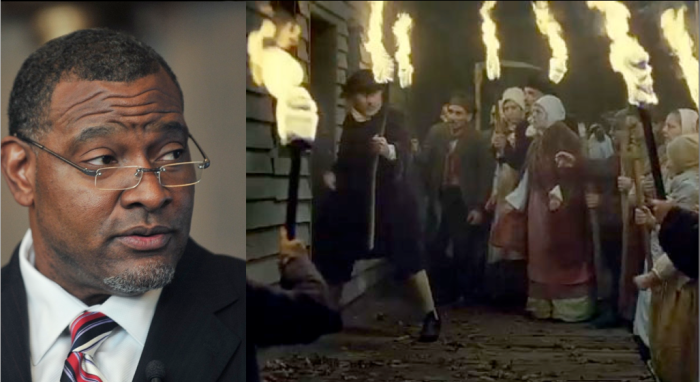
Witch Hunt Against Incoming Pittsburgh Public Schools Superintendent Escalates

Screen shot 2016-06-17 at 1.17.51 PM

To be or not to be.

That is the question for incoming Pittsburgh Public Schools Superintendent Anthony Hamlet.

He is set to takeover the district on July 1, but a well financed public smear campaign is trying to stop him before he even begins.

Big money interests oppose him. The public supports him.

Meanwhile the media helps fuel corporate attacks on the 47-year-old African American because of criticisms leveled by a Political Action Committee (PAC) formed to disband the duly-elected school board.

It’s ironic.

Corporate school reformers criticize Hamlet for allegedly plagiarizing a single statement in his resume. Meanwhile they have plagiarized their entire educational platform!

Mayoral or state takeover of the district? Check!

Close struggling schools? Check!

Open new charter schools to gobble up public tax dollars as profit? Check!

Hamlet represents a new direction away from corporate education reforms. The new school board who hired him has soundly rejected these policies of the old guard. Many of the same members are still on the board who first changed course in 2013 by tearing up a contract with Teach for America.

But the Empire strikes back with allegations of plagiarism and resume padding.

Yes, Hamlet used some of the same words from a Washington Post editorial in his resume. He wrote:

“A successful superintendent has to satisfy many constituencies, keeping high achievers in the system while devoting resources to those who need them most.”

The Post wrote:

“A successful superintendent has to satisfy many constituencies, keeping high achievers in the system even while devoting resources to those who need them most.” (Emphasis added)

These aren’t exactly the same words used by the Post. They don’t rise to the level of plagiarism, but he certainly should have attributed them or reworded the ideas.
On the other hand, his critics want to use the same policies that have failed again-and-again in Philadelphia, Newark, Little Rock, Memphis and elsewhere. They want to steal control of the district and give it to bureaucrats who will do what THEY say. They want to take money set aside to help all students and use it to enrich their friends and associates.

Sure, Hamlet used someone else’s words to describe a good idea of leadership. But his critics are using their own words to describe someone else’s terrible, failing educational platform.

Hamlet made a small forgivable error. His critics are seizing upon it to turn the tide in their favor and take away the community’s right to representative democracy.

Make no mistake. This is a witch hunt.

Critics are splitting hairs, disputing statistics and calling it fact.

Hamlet has a proven record as a principal in Palm Beach, Fl.

He says the schools he administered improved academically for various reasons. Critics point to Florida state records that show those improvements to be less dramatic.

So both sides agree those schools did well under Hamlet. What’s in dispute is the degree.

Hamlet counters that state data is inaccurate. He was there on the ground. He lists several factors not accounted for by the state that fully justify his statements.

For example, when he talks about school improvements, he counts the total number of student suspensions – if a student is suspended twice, he counts that as two suspensions. The state, however, ignores multiple suspensions. In this and other ways, Hamlet shows his data is more accurate than the state’s.

National data backs up Hamlet. Florida is infamous for being backward, regressive and untrustworthy in education circles, often spearheading some of the worst abuses of policy in recent history.

“This has been a hoopla,” said Valerie Allman, a Troy Hill parent and activist interviewed in the Pittsburgh Post Gazette. “And it’s taken the focus off what’s important: these kids. … We’re expecting him to climb this huge mountain at the same time we cut his legs out from under him.”

One of the reasons the board originally hired Hamlet is his background in “restorative justice.

Instead of simply punishing or suspending students who misbehave, the program calls for making students set things right.

At Palm Beach County Schools, Hamlet implemented this approach with help from Mara Schiff, a criminology professor from Florida Atlantic University. It’s “far tougher than sitting in detention,” Schiff said in the Post Gazette.

“You have to acknowledge what you’ve done … and take responsibility for the harm you’ve caused. It’s not a kumbaya approach.”

It’s widely acknowledged in education circles that suspensions can have lasting impacts especially on black students making them more likely to enter the school-to-prison pipeline. Finding an approach to increase discipline without adversely affecting students’ prospects is imperative. This is especially true since Pittsburgh Public Schools have been known to suspend black students at a rate four times higher than white students.

In fact, the district has already launched a restorative justice program at 20 schools.

“I have nothing but good things to say about Dr. Hamlet,” said Schiff. “He had a [restorative-justice] coordinator who was fabulous, and who Dr. Hamlet completely empowered.”

Another reason for Hamlet’s hire is his advocacy for community schools. Like many on the school board and in the district, he has pushed for social services to help students and the community to make the schools the center of the neighborhood.

“You can have the best teachers, the best curriculum, the best classrooms,” said Rev. Rodney Lyde, a Homewood pastor and president of the Pennsylvania Interfaith Impact Network. “But we need a place on-site that can comprehensively address the other impediments — like kids coming hungry, or from abusive situations.”

Despite community support, several well-financed organizations oppose Hamlet and the board’s authentic reforms.

Foremost among them is Campaign for Quality Schools Pittsburgh, a new PAC formed recently to make city schools great again – by doing the same failed crap that didn’t work before.

Also on the side of corporate education reform are the Pittsburgh Foundation and the Heinz Endowments. Representatives for both organizations have offered to pay for a new superintendent search if the district gives Hamlet his walking papers – a measure that probably would mean paying him at least a years salary without having him on the job.

This would also result in weakening the district’s ability to hire a new superintendent and increasing public mistrust of the electoral process. Such a move would pave the way for disbanding local control.

How generous of these philanthropies! I remember a time when giving meant providing the resources for organizations like public schools to fix themselves – not having the right to set public policy as a precondition for the donation. But in the age of Bill Gates and the philanthro-capitalists, this is what we’ve come to expect.

Even the editorial board of the Pittsburgh Post Gazette has drunk the Kool-aid. In a June 10 editorial, the paper published the following statement:

“The (school) board’s failure at this essential task calls its leadership into question, and will renew calls for legislation to dissolve the elected school board and move to an appointed system.”

Finally, we have A+ Schools – an advocacy organization that at one time championed the same kinds of reforms school directors are trying to enact. However, after a $1 million grant from the Gates Foundation, the group has become a cheerleader for weakening teachers unions, privatization and standardized testing.

Against these special interests stands a public school board and a community at the crossroads. Will they give in to public pressure and big money? Or will they allow Hamlet to do the job he was hired for and attempt to improve an urban district suffering from crippling poverty and state disinvestment?

This particularly tragedy has yet to find an ending.

To be or not to be?

Stop Treating Public Schools as Society’s Whipping Boy

Screen shot 2016-06-14 at 11.28.03 PM


The United States is no stranger to stupidity and ignorance.

A significant portion of the population doesn’t know basic science facts like that the Earth revolves around the sun.

We only learn history and geography by going to war or drone striking countries usually  filled with brown people.

And when it comes to basic math and English, just read the poorly spelled placards at our political conventions calling for more trickle down economics.

Heck! We’re the country that elected C-student George W. Bush President!

Twice!

And lest you think that was a fluke, Donald Trump, a xenophobic reality TV star with zero political experience, is the presumptive Republican candidate for the same office RIGHT NOW!

Yet whenever so-called intelligent people bring up these and countless other examples of American idiocy, they invariably simplify the blame.

We’re a country of more than 320 million people made up of various cultures, nationalities, ideologies, economic brackets and living in a wide range of geographic areas and circumstances. Yet we think the cause of our national ignorance somehow isn’t complex and multifaceted.

No. That would be too much for us to understand. Instead, we take the easy way out and put the blame squarely in one solitary place – public schools.

It’s always the school’s fault. That and those lazy, complacent teachers.

Some folks think the moon landing was a hoax. So apparently the schools aren’t doing their jobs.

Other people can’t tell you the month and year of the 9-11 terrorist attacks. Therefore, bad teachers.

Everything from believing you can catch AIDS from a toilet seat to thinking President Barack Obama is a secret Muslim – it all could have been rectified if the schools had just taught us better.

Nonsense.

If you need a legal warning that your McDonald’s coffee is hot, there’s not much your third grade teacher could have done to help.

If you think the solution to gun violence is strapping bullet proof backpacks to kindergarten children while arming their teachers, there’s little that could have been accomplished by further academic study.

Anti-intellectualism is in the very air we breathe in this country.

No one wants to appear smart. We want to be the jocks, not the nerds. But when we feel guilty for our ignorance who do we attack? The smart people! The teachers! The schools!

Sadly, it’s often really intelligent people doing it.

A few weeks ago, famed astrophysicist Neil DeGrasse Tyson got into a Twitter battle with rapper B. o. B. over whether the Earth is flat.

Yes, in America that is somehow still debatable.

And Dr. Tyson was understandably upset. “I don’t mind that people don’t know things,” he said in a Huffington Post interview. “But if you don’t know and you have the power of influence over others, that’s dangerous.”

Agreed, but then he became guilty of his own criticism by pointing his finger solely at the schools. “I blame the education system that can graduate someone into adulthood who cannot tell the difference between what is and is not true about this world,” he said.

Maybe this would be a more effective criticism if B. o. B. were an actual high school graduate and hadn’t, in fact, dropped out in 9th grade. Tyson has a masters in astronomy and a doctorate in astrophysics, but he couldn’t tell what is true about this world in relation to one rather famous rapper’s education. Therefore his alma maters of Princeton and Columbia must be pretty shitty schools?

Perhaps the problem isn’t that B. o. B. is ignorant, but that too many people are willing to accept him as an expert on the shape of the Earth instead of someone like Dr. Tyson. But that’s not a fault of the public school system. It’s because of our attitude toward schooling, knowledge and expertise. An attitude that Dr. Tyson perhaps unconsciously helped foster.

I don’t mean to pile on Dr. Tyson. He’s one of my heroes. I’m just disappointed that in this case he’s being so intellectually lazy.

He’s not the only one.

Unfairly blaming schools also came from columnist Andy Borowitz when describing the dangers of Trump’s candidacy.

“Stopping Trump is a short term solution,” he said. “The long term solution, and it will be more difficult, is fixing the education system that has created so many people ignorant enough to vote for Trump.”

To be fair, almost everything Borowitz says publicly is satirical, uttered with tongue buried deeply in cheek. But it still feeds into this scapegoating of public schools. The public schools didn’t create ignorance. They fight it and in some cases fail. I wonder why?

Whatever the reason, Trump, himself, isn’t decrying it. He’s celebrating it.

When he won the Nevada GOP primary, he made a point to thank all the dumb people who voted for him. “We won with poorly educated. I love the poorly educated,” Trump told a crowd to huge cheers.

Strangely he didn’t then go on to laud what a great job public schools are doing by providing him with so many brain dead supporters.

So what exactly is the problem? Isn’t it troubling that so many American’s hold stupid beliefs? And isn’t this at least partially the fault of our public schools?

The answer is yes and yes.

We live in an anti-intellectual age. And that is troublesome.

And yes, our public schools are struggling to adequately educate everyone.

But when you blame everything on public schools you (1) obscure other factors like our piss poor media, and (2) you aren’t helping improve our schools.

First of all, much of our modern ignorance is fueled by toxic mass media. Most of us aren’t in school anymore. Unless you’re younger than 21 or 18, you probably get most of your facts from the news, TV, movies, video games and/or the Internet – not textbooks or school teachers.

We used to have an independent press that could investigate stories and report the truth. Now almost all of our major news sources are owned by a handful of giant corporations.

We don’t get news anymore. We get corporate public relations. The reason most people believe this crap is because it’s reported as if it were truth.

The rise of Fox News has a lot to do with it, but that is not the only culprit. Even traditionally revered sources such as the Associated Press are guilty of corporate collusion and bad, bad reporting.

They have no problem conflating an anonymous poll of superdelegates with actual votes as if they were the same thing even if doing so unduly influences the election in favor of one candidate. They have no problem broadcasting a Playboy Playmate’s vaccination advice every day of the week while mostly ignoring what research scientists have to say on the subject.

Second, constantly ragging on public schools doesn’t help make them better.

It’s not as if doing so actually resulted in addressing the real problems we have with our school system. Instead it reinforces the idea that they can’t be saved. We should just give up on public schools.

If we actually focused on the real problems with schools instead of constant innuendo, defamation and vitriol, we might be able to enact real solutions. For instance, more than half of our public school students live below the poverty line. They go to schools that aren’t funded adequately. We’ve allowed them to be resegregated based on class so its easier to ensure rich kids get a Cadillac education and poor kids get the scraps.

Moreover, we’ve let corporate interest take precedence over the needs of children. Instead of letting the experts in the field make education policy, we’ve left that up to the businesses that profit off of it. Instead of letting teachers and professors decide what are best academic standards, we’ve let think tanks create and impose shoddy, untested and developmentally inappropriate Common Core Standards. Instead of letting students be evaluated based on data gathered in the classroom by teachers who are there day-in, day-out, we’ve insisted schools be judged based on crappy high-stakes standardized tests. Instead of giving educators respect for the difficulty of their jobs and providing them with the autonomy necessary to help kids, we’ve denigrated the profession and chipped away at union protections, pay and benefits.

These are some of the real problems with public schools. When people throw shade at our education system, they are never so specific. It’s the schools that are “failing.” It’s never that they’re under-resourced. It’s the teachers who aren’t doing their jobs. It’s never that they’re being forced to teach to the tests. In fact, the people responsible for eroding our public schools often do so with the same rallying cry – our public schools are failing so let us enact these terrible policies that will actually make them worse!

It’s time we stop the lazy practice of criticizing public schools without also educating ourselves about what’s actually wrong with them.

Dr. Tyson, I love you, but don’t just blame schools. Blame Common Core and toxic testing. Andy, it’s not our schools that produce ignorant citizens. It’s the unfair funding formulas that don’t provide poor children with new books and a broad curriculum.

Public schools in general – and public school teachers specifically – have become our easy scapegoats, our whipping boys.

It’s about time we realized that such criticisms aren’t helping. In fact, they’re being used by the same people who are destroying our schools as an excuse to destroy them further.

The so-called failure of public schools has been used to justify massive school closures especially in neighborhoods of color. It’s been used to create more privately run charter schools. It’s been used to excuse cutting school funding, and making it even less palatable to be a teacher.

Too many of us believe these are good ideas.

Americans believe a lot of stupid things, but perhaps THESE are the dumbest of them all!

The Charter School Swindle – Selling Segregation to Blacks and Latinos

Screen Shot 2016-05-31 at 4.22.46 PM


Segregation now!


Higher suspension rates for black students!


Lower quality schools for Latinos!


These may sound like the campaign cries of George Wallace or Ross Barnett. But this isn’t the 1960s and it isn’t Alabama or Mississippi.


These are the cries of modern day charter school advocates – or they could be.


School choice boosters rarely if ever couch their support in these terms, but when touting charter schools over traditional public schools, this is exactly what they’re advocating.


According to the Civil Right Project at UCLA, “The charter school movement has been a major political success, but it has been a civil rights failure.”


It’s choice over equity.


Advocates have become so blinded by the idea of choice that they can’t see the poor quality of what’s being offered.


Because charter schools DO increase segregation. They DO suspend children of color at higher rates than traditional public schools. And they DO achieve academic outcomes for their students that are generally either comparable to traditional public schools or – in many cases – much worse.


In Brown vs. Board of Education, the U.S. Supreme Court ruled that it is Unconstitutional to have “separate but equal” schools because when they’re separate, they’re rarely equal. Having two parallel systems of education makes it too easy to provide more resources to some kids and less to others.


Who would have ever thought that some minority parents would actually choose this outcome, themselves, for their own children!?


After Bloody Sunday, Freedom Rides, bus boycotts and countless other battles, a portion of minority people today somehow want more segregation!?


It’s hard to determine the extent of this odd phenomena. Charter advocates flood money into traditional civil rights organizations that until yesterday opposed school privatization. Meanwhile they hold up any examples of minority support as if it were the whole story. However, it is undeniable that large minority populations still oppose their school systems being charterized.


It’s especially troubling for civil rights advocates because black and brown charter supporters have been sold on an idea that could accurately be labeled Jim Crow. And they don’t even seem to know it.


The reason is two-fold: (1) the success of privatization propaganda and (2) the erosion of our public school system.


Charter schools are big business. Many of them are managed by huge corporations for a profit. They are run at taxpayer expense with little to no oversight. As you might expect, this often results in multi-million dollar financial scandals and worse outcomes for students. But these facts have not fazed some of the public. Propagandists know how to sell people on things that are bad for them: Fast food, miracle cures and charter schools.


They’ve marketed corporate McSchools as if these were mostly charitable institutions founded for the sole purpose of making children’s lives better. Meanwhile, funds that might actually help kids learn are funneled to hedge fund mangers and investors: Schools don’t open yet tax money disappears. Student services are reduced below that offered at comparable neighborhood public schools. Charter students are expelled for low test scores or special needs. Yet the public still buys the glossy full-color advertisement without bothering about the small print.


One thing corporate education reformers have over advocates of traditional public schools is their willingness to talk about race. They clothe their arguments in the terms of the Civil Rights movement. They talk about having high expectations for children of color. They talk about closing the achievement gap. They talk about understanding the needs of minority children.


It’s all bullshit.


Their “high expectations” are really just an excuse for treating brown and black kids as if they weren’t human. They put these children under intense pressure, berating them for wrong answers and kicking them out if they don’t perform.


Yet the academic results produced at charter schools are often less than stellar. Sometimes they’re downright abysmal. Instead of addressing the fundamental inequalities inherent in the achievement gap – economically and culturally biased high stakes testing, shoddy and developmentally inappropriate academic standards, etc. – they reinforce that status quo. It’s like instead of fighting a prohibition against sitting in the back of the bus, they berate black folks for not enjoying the ride.


I’m sorry. But when it comes to understanding the needs of black and Latino kids, I refuse to believe children of color need a second-class education system. (Just as I refuse to believe Teach for America’s claim that all black kids really need are less experienced, less educated and less committed teacher trainees.)


Perhaps if traditional public schools actually addressed these issues head on, privatizers wouldn’t appear to be saviors. There are real problems faced by children of color in our school systems. They have real needs that most of our schools – charter, traditional, private or parochial – just are not meeting. But while charter schools pay lip service to the problems without fixing them and in fact often making them worse, public schools pretend these problems don’t exist in the first place.


No wonder some minority parents choose charter schools. At least there they get the illusion that someone cares about their needs.


In fact, privatizers couldn’t sell their substandard products if it weren’t for what we’ve allowed to happen to our traditional public schools. Segregation is made worse in charter schools, but it is also prevalent at our traditional public schools – though often to a lesser degree.


We have allowed traditional public schools to be largely segregated based on parental income. We have schools for poor kids and schools for rich kids. Thus, we have schools for black kids and schools for white kids. And guess which ones are well-funded and which go lacking?


This is what people are really talking about when they mention “failing schools.” They pretend as if the teachers are failing, the principals are failing, the democratic process, itself, is failing. In reality, it is our state and federal lawmakers who are failing. They have failed to provide equitable resources that our nation’s children need.


Schools cost money. If you don’t provide the funding necessary to properly educate children, you will get an inferior result. Meanwhile, pundits play with numbers and make false comparisons to hide this basic fact – we aren’t providing all kids with the resources they need to succeed. Rich kids have enough. Poor kids don’t. But we look at national averages, add in unfunded legal mandates and pretend that tells the whole story.


How does this happen? Segregation. In fact, we’re allowing segregation of place to determine segregation of school. Instead of counteracting an unfair status quo, we’re letting the way things are today determine how things will be tomorrow.


Fact: people of different ethnicities tend to cluster together, like with like. Part of this is because people tend to self-segregate with people around whom they feel most comfortable. However, this is also a function of social planning. Banks tend to shy away from giving loans to families of color who want to move into white neighborhoods. Moreover, white homeowners are often reluctant to sell to families of color. The result is an America made up of black neighborhoods and white neighborhoods.


In organizing our public schools we could try to overcome these differences, but instead we amplify them. In many states we insist that schools be funded based on local property taxes. So poor brown and black people who happen to live clustered together get poorly funded schools for their kids. And rich white folks who live together in their gated communities get well-funded schools for their progeny.


Is it any wonder then that some people of color buy into the charter school lie? They’re offered the choice between an obviously under-resourced public school or a glossy new charter school that actually offers them less. But they don’t see that far. They’re tired of the indifference behind traditional public school funding and opt to try something different. Unfortunately, it’s just another lie and a more pernicious one for several reasons.


First, charter schools take an already segregated population and make it worse. Second, they weaken the already stumbling traditional public schools by siphoning off their dwindling funding. And finally, they obscure the fact that it’s often the same policymakers who champion charters that are responsible for eroding public schools in the first place.


People of color would be much better served by sticking with their traditional public schools and fighting to make them better. For all their faults, traditional public schools often provide a better quality education. They have more resources and less flexibility to take away those resources. They have more well-trained and experienced staff. And since they serve a more diverse population, they offer the chance for people of similar economic backgrounds but diverse cultures to join together in common cause.


Dividing people makes them weaker politically. When people band together, they have power. They can fight more effectively for what they deserve. Perhaps this is the greatest problem with charter schools – they destroy communities and rob neighborhoods of the collective power that is their due.


In many areas of the country, communities of color know this. Ask them in New Orleans what they think of their all-charter school district. Ask them in Chicago what they think of the city’s plan to close public schools and turn them into charters. Ask them in Philadelphia or any urban district taken over by the state.


They’ll tell you straight out how privatized education is cultural sabotage. They’ll tell you how it’s the new colonialism, another element of the new Jim Crow. They’ll tell you how important it is to fight for our system of public schools.


And when privatizers and propagandists try to paint all communities of color as if they support charter schools, these folks will loudly cry foul.


They aren’t buying the snake oil. The rest of us need to step up and help those who have been swindled to see the truth. Likewise we need to recognize their truth – that the struggle for civil rights is ongoing.


Because we can’t win the fight against privatization without them. And they can’t win the fight for equality without us.


We need each other.


Public school advocates need to recognize it’s not all about testing, Common Core and privatization. We can’t be so afraid to talk about race. We need to recognize that racism is not an unnecessary distraction, it’s at the center of our struggle.


We need communities of color.


We need our black and brown brothers and sisters.


Because only together shall we all overcome this madness.

Great Reading Must Be Felt, Not Standardized

black-history-month-featured-photo-520x345

I made my classes cry today.

That sounds terrible, but if I’m honest, I knew it would happen and meant to do it.

I teach in an urban district and most of my 8th grade students are African American and/or impoverished. We’re reading Harper Lee’s classic novel “To Kill a Mockingbird” together, and the kids were loving it.

Until today when we got to the verdict in the Tom Robinson trial.

Jaquan closed his book with wide eyes.

“What the heck happened?” he asked.

Other students in the room murmured their agreement.

“They found him guilty!? What the F!?”

“I hate this book.”

“This is so freakin’ racist.”

I let them go on for a moment.

Frankly, it was the reaction I had been expecting.

It happens every year around this time.

Until this moment, my kids were really into the book. They were enjoying the case and excited by how well the defense attorney, Atticus Finch, had proven that Tom, a black man in the 1930s South, is innocent of raping a white woman.

But even last night I knew what was coming. The next day – today – I’d have to go and break their hearts when they read what the jury actually decides. Some of them were bound to be crushed. And today they were.

For those who haven’t cracked this book open in decades, let me recap.

There is no physical evidence that the crime actually took place. Moreover, because of a crippling injury as a child, Tom is physically incapable of perpetrating the crime in the first place.

In a world where black males could be tortured and killed just for whistling at a white woman – like Emmett Till – it’s clear that Tom is the victim, not the aggressor.
It seems like a slam dunk case. Yet the all-white jury finds Tom guilty, and ultimately he is shot 17 times in prison after losing all hope and trying to escape.

It’s no wonder that when we read that cascade of Guilty’s from the jury’s mouths today, my kids couldn’t believe it.

Some of my best students closed the book or threw it away from them.

So I let them express their frustrations. Some talked about how the story hit too close to home. They have family members in jail or who have been killed in the streets by police. One girl even told us that she’s never met her own mother. The woman has been locked away since the child was an infant, and because of a missing birth certificate, my student hasn’t even been allowed to visit.

“Mr. Singer, when was this book written?” one of the girls in the back asked.

“The late 1950s,” I said.

“I thought you were going to say it just came out.”

And so we talked about what the book has to do with things happening today. We talked about Eric Garner. We talked about Michael Brown, Trayvon Martin, Sandra Bland, Tamir Rice and Freddie Gray.

At a certain point, conversation ceased.

My class of rowdy teenagers became quiet. We could hear people stomping in the hall, a movie being shown a few doors down.

There might have been a few tears.

I knew it would happen.

Last night I debated softening the blow, preparing them for what was about to take place. When we read “The Diary of Anne Frank” a month ago, I made sure they’d know from the very beginning that Anne dies. It should have been no surprise to them when Anne and her family are captured by the Nazis. It’s scary and upsetting but not entirely unexpected.

However, with “Mockingbird” I just let events unfold. And I stand by that decision.

It’s frustrating and painful, but my students need to feel that. It’s something I can’t shield them from.

It’s not that they have never felt this way before. Many of them have experienced racism and injustice in their everyday lives. But for this book to really have the desired impact, they need to FEEL what the author meant. And it needs to come from the book, itself.

A book isn’t just sheets of paper bound together with glue and cardboard. It’s a living entity that can bite. That’s the power of literature.

I can’t in good conscience shield them from that. They need to see it and experience it for themselves.

Writer Flannery O’Connor put it like this:

“I prefer to talk about the meaning in a story rather than the theme of a story. People talk about the theme of a story as if the theme were like the string that a sack of chicken feed is tied with. They think that if you can pick out the theme, the way you pick the right thread in the chicken-feed sack, you can rip the story open and feed the chickens. But this is not the way meaning works in fiction.

“When you can state the theme of a story, when you can separate it from the story itself, then you can be sure the story is not a very good one. The meaning of a story has to be embodied in it, has to be made concrete in it. A story is a way to say something that can’t be said any other way, and it takes every word in the story to say what the meaning is. You tell a story because a statement would be inadequate. When anybody asks what a story is about, the only proper thing is to tell him to read the story. The meaning of fiction is not abstract meaning but experienced meaning, and the purpose of making statements about the meaning of a story is only to help you experience that meaning more fully.”

This is what our policymakers either misunderstand or forget when they demand we assess understanding with standardized tests.

The meaning of a story is not expressable in discrete statements A, B, C, or D. We wouldn’t read them if it was.

Every person is unique. So is every reaction to literature.

You can’t identify the meaning of this story on a multiple choice test. You can’t express what it means to YOU. All you can do is anticipate the answer the test maker expects. And that’s not reading comprehension. It’s an exercise in sycophantry. It teaches good toadying skills – not good reading strategies.

Perhaps that’s why Common Core encourages us to shy away from complex texts like “Mockingbird.” We’re told to focus on short snippets of fiction and to increase our student’s diet of nonfiction. Moreover, we’re told to stay away from narratives like Anne Frank’s. Instead, we should have our children read from a greater variety of genres including instruction books, spreadsheets, recipes – just the facts – because as Common Core architect David Coleman famously said, “No one gives a shit what you think or feel.”

Frankly, we don’t do a whole lot of that in my class. We still read literature.

Today, even after the blowout, we kept reading “Mockingbird.”

My kids suffered along with Jem and Scout. They reveled in Atticus’s example. They feared where it was all going.

And when class was over, a few of them had come around.

“This is such a good book, Mr. Singer,” one girl told me on the way out.

“Is Atticus going to die?” another asked to which I smiled and shrugged.

Jaquan stayed after the bell to ask his own question.

“Do you think in a hundred years things will be any different?”

“How do you mean?”

“I mean do you think people will still do things like THIS?” he said holding up his book.

I looked at him and swallowed.

“I don’t know, Jaquan,” I said. “But things are better now than they were. We can hope.”

He nodded.

I clapped him on the back and wished him a good weekend.

You don’t get that kind of reaction from Common Core, and you can’t assess it on a standardized test.

Students can’t ask such questions to computer programs.

They need teachers with the freedom to teach and assess as they see fit.

Otherwise, it is not just Tom Robinson that suffers a miscarriage of justice.

We all do.

Hillary Clinton is Not as Bad as Donald Trump – She’s Worse

Screen shot 2016-05-15 at 8.21.59 PM

On the face of it, the title of this article is pure bull crap.

What do you mean Hillary Clinton is worse than Donald Trump!?

She’s not a reality TV star pretending to be Presidential.

She’s not a bigot, a demagogue and a fascist.

She’s not the top choice of racists and white supremacists everywhere.

And you’re right. She’s none of those things.

If I’m being honest, there are plenty of things Clinton has over Trump.

First of all, she’s immensely more qualified to be President. She has decades of experience in public service. Trump has none.

Moreover, she has been instrumental in pushing forward progressive policies. She championed healthcare reform when it was unpopular to do so. Without her work, it is doubtful we’d have the little reforms we have today. Trump, on the other hand, hasn’t lifted a finger to help the American people accomplish anything – unless you count ogling half naked women on the Miss Universe pageant or getting excited over which D-list celebrity he was going to “fire” on The Apprentice.

However, there is an area where both candidates have significant overlap.

If you remove the names and the personalities, if you ignore political affiliation and past history, Donald Trump and Hillary Clinton begin to look very similar.

Who does Trump represent? The 1%.

Who does Clinton represent? The 1%.

It’s really that clear.

In fact, in 2008 Trump famously donated to Clinton’s Presidential campaign. He is exactly the kind of person who wants someone like Clinton in the Oval Office. She would look out for his interests.

Her campaign is financed by Wall Street. Trump IS Wall Street. She was paid exorbitant fees to give private speeches to bankers and stock brokers. One would not be shocked to find Trump in the audience.

Yes, there are differences. One can’t imagine Clinton talking about women with as much arrogant deprecation as Trump. One can’t imagine her suggesting we deport millions of people, that we put all Muslim’s under surveillance, or that many Latinos are murderers and rapists.

But that is exactly what makes her worse. Trump looks like a little dictator (which he is.) Clinton does not.

She appears to be the middle ground. She appears to be the sane candidate – and in some ways she is. But in many of the most important ways that count for Americans living from paycheck-to-paycheck, she isn’t a compromise at all. She’s nearly the same thing.

Imagine two shelves holding poison in a child’s playroom. On one is a purple bottle sporting a skull and crossbones under the word “Poison.” On the other is a bright pink bottle with a smiley face under the word “Candy.” Which is worse?

You know what you’re getting with Trump. Clinton pretends to be something else.

In my opinion, this is why we desperately need Bernie Sanders in the race. He is an actual option between the corporatist campaigns of Trump and Clinton. He actually gives voters a choice.

In his decades in the House and Senate, Sanders worked tirelessly for the 99%. He voted against the Iraq War and the Patriot Act. He was an open critic of Alan Greenspan insisting the Federal Reserve Chairman was only represented “large and wealthy corporations.” He passed more amendments than any other congressperson getting through amazing amounts of legislation. He worked to overhaul the Veterans Administration and audit the Federal Reserve System.

And we’ve seen how energetically the Democratic establishment is fighting to keep Sanders off the ballot. During the primaries, they’ve tried every dirty trick in the book to suppress votes from their own party to ensure Clinton is the only choice in the general election.

It’s unprecedented. Voters like me who might have supported Clinton had she won the primaries fairly have been completely turned off by the Democrats. How can we support a candidate that we’re told we must vote for? Shouldn’t the Democrats be courting our votes, not forcing them?

This just goes to show the need for a third party. The Democrats have been largely overtaken by neoliberals – what we used to call Republicans. Likewise, the GOP has been overtaken by the worst extremists possible – fascist populists of which Trump is a clear representative.

Who is left for progressive voters? Can we really support a neoliberal like Clinton?

No. The only way for progressives to win is to keep Sanders in the race through the general election. Virtually every poll says he would trounce Trump. Many – but not all – polls likewise say Clinton would beat the Republican front runner, but is that even a contest? If both candidates represent the same constituency, it’s not really a choice.

Few things would be worse than a Trump presidency. He would immediately go after our brown-skinned brothers and sisters. He would make things much more difficult for our sisters, mothers and daughters. And he would crash the economy and engage us in disastrous wars of choice across the globe.

A Clinton presidency on the other hand would not be so obviously apocalyptic. She would continue and worsen neoliberal policies strangling our public institutions. She would continue to privatize our schools and enrich the testing and charter industries. She would continue to lock away the poor and minorities while enriching the private prison industry. She would bolster weak environmental regulations while opening back doors for oil and gas companies to rape our planet. And as the majority of people drown in debt, she would wag her finger and blame the poor for their circumstances without offering a lick of help.

In short, Trump would be a mega-nuclear explosion. Clinton would be nuclear radiation – a silent killer. That’s worse. One kills all at once. The other does so slowly by degrees.

This is not a choice any American should be forced to make.

Fight to keep Sanders in the race.

School Accountability Without Standardized Testing

IMG_5312-cropped-proto-ccsa_root___topic_hero-thumb-640xauto-2188

Q: Is it possible to ensure educational accountability without giving standardized tests?


A: Not only is it possible, it is necessary.


In fact, we will never have accountability while we continue giving standardized tests.


This is the irony of modern education policy.


High stakes testing is seen as the only tool that can ensure schools operate correctly when in reality it is the very thing that blocks true responsibility.


Pundits and policymakers cry crocodile tears as they draw up elaborate ways to punish teachers and students for low test scores. Meanwhile they ignore some of the most basic facts about how education works.


FACT: Students and teachers are not the only factors.


FACT: Students and teachers don’t decide how much funding their schools get.


FACT: Students and teachers don’t get to decide education policy.


FACT: An education system is made up of a complex interplay of several interconnected factors that include parents, the community, the economy, culture, media, and local, state and federal governments.


FACT: High stakes testing ensures that teachers and students are held accountable for the entire education system including the vast majority of factors beyond their control.


So let’s stop pretending that standardized tests hold schools accountable. They don’t. They just point the finger without offering anything to help.


True accountability would be about diagnosing problems so we can fix them, not trying to fire your way to the top. When you break your arm, the doctor doesn’t immediately suggest you chop it off. He sets the bone and puts it in a cast and sling so it can heal.


When it comes to true accountability, we need to look beyond the school at all the factors involved. We also need to look to the legislature, the taxpayers, parents, the community, the media, and all stake holders.


However, this does not mean there are no ways to assess if schools, superintendents, administrators, teachers, and students are doing a good job.


In fact, it’s not even difficult to achieve. And we don’t need a single standardized test to do it.


We need a two-pronged approach. We must assess student learning, but we also must assess the adequacy of school funding, where it’s going and where it needs to go.


These measures are most often ignored in accountability discussions. When it comes to adequate funding, we usually blame the poor for being unable to provide for their children. And since many states allocate education funding based largely on local property taxes, we have rich schools with oodles of cash and poor schools that are falling over. True accountability would ensure all students – both rich and poor – start from an equal playing field. When society neglects this, it is society that is failing, not poor children.


When it comes to how funding is spent, we either throw up our hands that there’s no way to evaluate school funding or we pretend that school directors will be transparent just because. Both are untrue.


I still believe that local control is the best way to ensure true accountability. When school directors are not elected but appointed– as they are in charter schools – there is no reason to spend wisely. In fact, the laws are set up to shield charter school boards from having to show the community how they are spending taxpayer money. And since most are set up for-profit, there is an incentive to reduce services for students while keeping the saving as profit for themselves and their shareholders.


When school boards are elected and are required to hold deliberations in public, accountability is built in. Voters decide who gets to make decisions and if those decisions made in the light of day are in the best interests of their children. Moreover, elected school directors who come from the community have an incentive to make that community in which they live the best it can be and to provide the best quality education they can.


This isn’t to say that elected school boards are perfect. They are made up of human beings and are therefore fallible. You don’t have to go far to find local school directors who try to deliberate important decisions in private without notifying the public, circumvent the bidding process, make backroom deals, etc.


But there are ways to hold them and the community accountable for providing a quality education.


California has come up with an ingenious plan.


For the second year, the Golden State has been engaged in a bold experiment. Policymakers have initiated a new K-12 finance system: the Local Control Funding Formula (LCFF) and the Local Control Accountability Plans (LCAPs) that go with it.


Basically, California public schools use multiple-indicators to determine where funding needs to go and how to hold schools accountable for spending it wisely.


It’s not perfect. It certainly has some bugs in it, and I do NOT recommend we simply extend the program nationwide as is.


For instance, the program still uses standardized testing as one of many multiple measures of success. This is better than having testing be the sole measure or even the most important one. But – as you shall see – we can do better.


The law requires each district to identify specific goals and spending priorities in eight areas. I would modify them as follows:

  1. Basic services such as equipped classrooms, qualified teachers, textbooks and materials. It is essential to know if these needs are being met so we can budget accordingly. If funding is lacking, assessing the deficiency in this way helps make the argument for an increase of cash.


  1. Implementation of District Created Standards for all students, including English Learners (ELs). California specifically denotes Common Core standards here. I think that is a mistake. Accepting wholesale a set of unproven standards made by non-educators who have never been inside a district building or in front of a classroom is a recipe for disaster. Instead, teachers in each district should develop their own standards and then test whether they are achieving their goal. Many policymakers are in love with the idea of national standards but that’s like suggesting all restaurants must have some version of the McDonalds value menu. Standards should be locally developed to meet the needs of real students not idealized ones.


  1. Parental Involvement. This simply cannot be ignored. Schools need to know if parents are invested in the district, and if not, administrators and faculty need to work to find ways to bring them in. Schools can institute family game nights, community picnics, parent-teacher nights with food and babysitting services. No school can ever achieve greatness without parents. We must find ways to increase involvement where it is lacking and encourage increased involvement where it is present at all. We must work to make parents feel welcome and make them a part of the decision-making process for school activities and functions.


  1. Student Achievement as measured by district assessments, English Learner reclassification to fluency, and other criteria. California includes Common-core aligned standardized tests in this area. I think this is a mistake and that we can find better assessments here. I’ll return to this in a moment.


  1. Student Engagement determined by rates of attendance and absenteeism, dropout rates, and graduation. We must gauge how well students are buying in to what the school has to offer. And if it is lacking, we must take steps to improve it. Schools shouldn’t just provide a prepackaged product. They should actively engage students and provide classes and services suited to their needs. Student engagement is one way to determine if schools are successfully doing that.


  1. School Climate evident in rates of suspension and expulsion, as well as other locally-identified measures. Discipline is very important but must be conducted judiciously. It must be fair and not unduly harsh. It must serve the purpose of improving academic outcomes. Moreover, we need to make sure there are no racial or cultural biases at work – even if they are unconscious. We want to create an inviting atmosphere, not a stepping stone to the prison system.


  1. Access to a Broad Curriculum evident through student enrollment across grade levels and subject areas. We know high stakes testing narrows the curriculum. We must work to actively broaden the curriculum and offer students a wide range of classes to maximize their educational experience. This includes arts, music, foreign languages and extra curricular activities. If we don’t have the funds to make that happen, what better tool to help argue for an increase than a detailed account of what’s missing and why it’s important?


  1. Other Student Outcomes as identified locally, which may include locally chosen tests and assessments. This could include participation in AP exams, college courses, etc. No accountability system would be complete without an “Other” category. Districts should be free to customize to meet the needs of students, parents and the community.


Which brings us back to testing.


We’ve got to have it. There must be some way to assess student learning. But we needn’t resort to money-making corporate products.


Teachers have been creating tests since the beginning of time. No one ever thought there was anything wrong with that until giant corporations discovered they could make huge profits selling us their standardized assessments.


We need to trust teachers again to assess as they see fit. But we can do more than that. We can have district-wide assessments systems that are not standardized – that are personalized – yet comparable across the district.


Performance or portfolio-based assessments.

Schools around the country are incorporating direct demonstrations of student learning into their assessment programs. These include projects, individual and group presentations, reports, papers and portfolios of work collected over time. These provide much more accurate reflections of student learning than snapshot tests developed far from the classroom. Moreover, if properly coordinated by departments and administrators, these assessments are comparable across the district.


The New York Performance Standards Consortium is leading the way. It consists of 28 schools, including grades 6-12, throughout the state that rely on these teacher-created assessments to the exclusion of standardized tests.


And the results have been tremendous! These public schools have higher graduation rates and better college-retention rates, while serving a population similar to that of other urban schools. We say we’re looking for innovations that work. This is it!


Just imagine a school that used such an accountability system. It would have a plethora of data about what’s working, what isn’t working and what needs to be done to correct deficiencies.


We forget that accountability systems show our values. High stakes testing pretends that the only thing that matters is the results of a standardized test. Nothing could be farther from the truth.


A system like the one I’ve described would ensure every student receives a robust education that is assessed fairly. It would invigorate children, parents and the community. And when students graduate from such a school, they would be prepared for whatever comes next.


Moreover, there’s not a single standardized test necessary in the whole system!


Our policymakers need to start thinking along these lines. These aren’t pie in the sky suggestions. Most of these ideas already have been tested and proven effective.


We need to free our minds from a reliance on the testing industry. We need to think outside the bubble and free our children from corporate servitude as education policy – a system that ensures they won’t receive a quality education – all under the guise of “accountability.”


Can real accountability exist without standardized tests?


Yes. That’s the only way it can.

Whiteness: The Lie Made True

a456ccf8db4592c7a80552986d7ac86d

“The discovery of a personal whiteness among the world’s peoples is a very modern thing,—a nineteenth and twentieth century matter, indeed.” – W. E. B. Du Bois


What color is your skin?


You don’t have to look. You know. It’s a bedrock fact of your existence like your name, religion or nationality.


But go ahead and take a look. Hold out your hand and take a good, long stare.


What do you see?


White? Black? Brown?


More than likely, you don’t see any of those colors.


You see some gradation, a hue somewhere in the middle, but in the back of your mind you label it black, white, brown, etc.


When I look, I see light peach with splotches of pink. But I know that I’m white, White, WHITE.


So where did this idea come from? If my skin isn’t actually white – it’s not the same white I’d find in a tube of paint, or on a piece of paper – why am I labeled white?


The answer isn’t scientific, cultural or economic.


It’s legal.


Yes, here in America we have a legal definition of whiteness.


It developed over time, but the earliest mention in our laws comes from the Naturalization Act of 1790.


Only 14 years after our Declaration of Independence proclaimed all people were created equal, we passed this law to define who exactly has the right to call him-or-herself an American citizen. It restricted citizenship to persons who resided in the United States for two years, who could establish their good character in court, and who were white – whatever that meant.


In 1896 this idea gained even more strength in the infamous U.S. Supreme Court decision Plessy v Ferguson. The case is known for setting the legal precedent justifying segregation as “separate but equal.” However, the particulars of the case revolve around the definition of whiteness.


Homer Plessy was kicked off the white section of a train car, and he sued – not because he thought there was anything wrong with segregation, but because he claimed he was actually white. The U.S. Supreme Court was asked to define what that means.


Notably the court took this charge very seriously, admitting how important it is to be able to distinguish between white and non-white. Justices claimed whiteness as a kind of property – very valuable property – the denial of which could incur legal sanction.


In it’s decision, the court said, “if he be a white man, and be assigned to the color coach, he may have his action for damages from the company, for being deprived of his so-called property. If he be a colored man and be so assigned, he has been deprived of no property, since he is not lawfully entitled to the reputation of being a white man.”


Plessy wasn’t the only one to seek legal action over this. Native Americans were going to court claiming that they, too, were white and should be treated as such. Much has been written about the struggle of various ethnic groups – Irish, Slovak, Polish, etc. – to be accepted under this term. No matter how you define it, most groups wanted it to include them and theirs.


However, it wasn’t until 1921 when a strong definition of white was written in the “Emergency Quota and Immigration Acts.” It states:


“A White person has been held to include an Armenian born in Asiatic Turkey, a person of but one-sixteenth Indian blood, and a Syrian, but not to include Afghans, American Indians, Chinese, Filipinos, Hawaiians, Hindus, Japanese, Koreans, negroes; nor does white person include a person having one fourth of African blood, a person in whom Malay blood predominates, a person whose father was a German and whose mother was a Japanese, a person whose father was a white Canadian and whose mother was an Indian woman, or a person whose mother was a Chinese and whose father was the son of a Portuguese father and a Chinese mother.”


So there you have it – whiteness – legally defined and enforceable as a property value.


It’s not a character trait. It’s certainly not a product of the color wheel. It’s a legal definition, something we made up. THIS is the norm. THAT is not.


Admitting that leads to the temptation to disregard whiteness, to deny its hold on society. But doing so would be to ignore an important facet of the social order. As Brian Jones writes, the artificiality of whiteness doesn’t make it any less real:


“It’s very real. It’s real in the same way that Wednesday is real. But it’s also made up in the same way that Wednesday is made up.”


You couldn’t go around saying, “I don’t believe in Wednesdays.” You wouldn’t be able to function in society. You could try to change the name, you could try to change the way we conceptualize the week, but you couldn’t ignore the way it is now.


And whiteness is still a prominent feature of America’s social structure.


Think about it. A range of skin colors have become the dominant identifier here in America. We don’t like to talk about it, but the shade of your epidermis still means an awful lot.


It often determines the ease with which you can get a good job, a bank loan or buy a house in a prosperous neighborhood. It determines the ease with which you can go to a well-resourced school, a district democratically controlled by the community and your access to advanced placement classes. And it determines the degree of safety you have when being confronted by the police.


But to have whiteness as a signifier of the good, the privileged, we must imply an opposite. It’s not a term disassociated from others. Whiteness implies blackness.


It’s no accident. Just as the concept of whiteness was invented to give certain people an advantage, the concept of blackness was invented to subjugate others. However, this idea goes back a bit further. We had a delineated idea of blackness long before we legalized its opposite.


The concept of blackness began in the Virginia colonies in the 1600s. European settlers were looking to get rich quick through growing tobacco. But that’s a labor-intensive process and before mechanization it frankly cost too much in salaries for landowners to make enough of a profit to ensure great wealth. Moreover, settlers weren’t looking to grow a modest amount of tobacco for use only in the colonies. They wanted to produce enough to supply the global market. That required mass production and a disregard for humanity.


So tobacco planters decided to reduce labor costs through slavery. They tried enslaving the indigenous population, but Native Americans knew the land too well and would escape quicker than they could be replaced.


Planters also tried using indentured servants – people who defaulted on their debts and had to sell themselves into slavery for a limited time. However, this caused a lot of bad feeling in communities. When husbands, sons and relations were forced into servitude while their friends and neighbors remained free, bosses faced social and economic recriminations from the general population. Moreover, when an indentured servant’s time was up, if he could raise the capital, he now had all the knowledge and experience to start his own tobacco plantation and compete with his former boss.


No. planters needed a more permanent solution. That’s where the idea came from to kidnap Africans and bring them to Virginia as slaves. This was generational servitude, no time limits, no competition, low cost.


It’s important to note that it took time for this kind of slavery to take root in the colonies. Part of this is due to various ideas about the nature of Africans. People at the time didn’t all have our modern prejudices. Also it took time for the price of importing human beings from another continent to became less than that of buying indentured servants.


The turning point was Bacon’s Rebellion in 1676. Hundreds of slaves and indentured servants came together and deposed the governor of Virginia, burned down plantations and defended themselves against planter militias for months afterwards. The significance of this event was not lost on the landowners of the time. What we now call “white” people and “black” people had banded together against the landowners. If things like this were to become more frequent, the tobacco industry would be ruined, or at very least much less profitable for the planters.


After the rebellion was put down, the landed gentry had to find a way to stop such large groups of people from ever joining in common cause again. The answer was the racial caste system we experience today.


The exact meaning of “white” and “black” (or “colored”) was mostly implied, but each group’s social mobility was rigidly defined for the first time. Laws were put in place to categorize people and provide benefits for some and deprivations for others. So white people were then allowed to own property, own guns, participate in juries, serve on militias, and do all kinds of things that were to be forever off-limits to black people. It’s important to understand that black people were not systematically barred from these things before.


Just imagine how effective this arrangement was. It gave white people a permanent, unearned social position above black people. No matter how hard things could get for impoverished whites, they could never sink below this level. They would always enjoy these privileges and by extension enjoy the deprivation of blacks as proof of their own white superiority. Not only did it stop whites from joining together with blacks in common cause, it gave whites a reason to support the status quo. Sound familiar? It should.


However, for black people the arrangement was devastating.


As Brian Jones puts it:


“For the first time in human history, the color of one’s skin had a political significance. It never had a political significance before. Now there was a reason to assign a political significance to dark skin — it’s an ingenious way to brand someone as a slave. It’s a brand that they can never wash off, that they can never erase, that they can never run away from. There’s no way out. That’s the ingeniousness of using skin color as a mark of degradation, as a mark of slavery.”


All that based on pigmentation.


Our political and social institutions have made this difference in appearance paramount in the social structure, but what causes it? What is the essential difference between white people and black people and can it in any way justify these social distinctions, privileges and deprivations?


Science tells us why human skin comes in different shades. It’s based on the amount of melanin we possess, a pigment that not only gives color but blocks the body from absorbing harmful ultraviolet radiation from the sun. Everyone has some melanin. Fair skinned people can even temporarily increase the amount they have by additional solar exposure – tanning.


If the body absorbs too many UV rays, it can cause cancers or produce birth defects in the next generation. That’s why groups of people who historically lived closer to the equator possess more melanin than those further from it. This provided an evolutionary advantage.


However, the human body needs vitamin D, which often comes from sunlight. Having a greater degree of melanin can stop the body from absorbing the necessary Vitamin D and – if another source isn’t found -health problems like Sickle-cell anemia can occur.


That’s why people living further from the equator developed lighter skin over time. Humanity originated in Africa, but as peoples migrated north they didn’t need the extra melanin since they received less direct sunlight. Likewise, they benefited from less melanin and therefore easier absorption of Vitamin D from the sunlight they did receive.


Map_of_Indigenous_Skin_Colors


That’s the major difference between people of different colors.


Contrary to the persistent beliefs of many Americans, skin color doesn’t determine work ethic, intelligence, honesty, strength, or any other character trait.

In the 19th through the 20th Centuries, we created a whole field of science called eugenics to prove otherwise. We tried to show that each race had dominant traits and some races were better than others.


However, modern science has disproven every scrap of it. Eugenics is now considered a pseudoscience. Everywhere in public we loudly proclaim that judgments like these based on race are unacceptable. Yet the pattern of positive consequences for light skinned people and negative consequences for dark skinned people persists. And few of us want to identify, discuss or – God forbid – confront it.


And that’s where we are today.


We in America live in a society that still subscribes to the essentially nonsensical definitions of the past. Both white and black people have been kept in their place because of them.


In each socio-economic bracket people have common cause that goes beyond skin color. But the ruling class has used a racial caste system to stop us from joining together against them.


This is obvious to most black people because they deal with the negative consequences of it every day. White people, however, are constantly bombarded by tiny benefits without noticing they’re present at all. White people take it as their due – this is what all people deserve. And, yes, it IS what all people deserve, but it is not what all people are receiving!


We are faced with a difficult task. We must somehow both understand that our ideas about race are man-made while taking arms against them. We must accept that whiteness and blackness are bogus terms and yet they dramatically affect our lives. We must preserve all that makes us who we are while fighting for the common humanity of all.


And we can’t do that by simply ignoring skin color. That kind of colorblindness only helps perpetuate the status quo. Instead, we must pay attention to inequalities based on the racial divide and actively work to counteract them.


In short, there are no white people and black people. There are only racists and anti-racists.


Which will you be?

New PAC Descends on Pittsburgh Public Schools to Charterize and Take Over School Board

Screen Shot 2016-04-11 at 11.39.31 AM

Prepare yourself, Pittsburgh.

A new Political Action Committee (PAC) has descended on the ‘Burgh to further privatize our public schools and wrest control away from parents who are in favor of school reforms that actually work.

It’s called Campaign for Quality Schools, but make no mistake. The wealthy special interests behind it don’t care about quality schools – they care about quality profits for their investors.

PACs are political committees organized for the purpose of raising and spending money to elect and defeat candidates. Unlike federal PACS which can only give up to $5,000 to a candidate per election, state PACs in Pennsylvania have no spending limits. In that way, they are like federal Super PACs which also have no limits on donation size.

Besides giving an unfair advantage to special interest groups, PACS also have notoriously been used for nefarious ends. For instance, former Republican U.S. Rep. John Doolittle’s leadership PAC paid 15% to a firm that only employed his wife. One Leadership PAC purchased $2,139 in gifts from the Bose Corporation. Former Republican U.S. Rep. Richard Pombo used his leadership PAC to pay almost $23,000 in hotel bills and buy $320 in baseball tickets for donors.

And now we’ve got one in Pittsburgh with its sights on city schools.

The moneyed interests behind it want to swipe control of even more Pittsburgh schools away from the community and give them to for-profit companies in the shape of charter schools. Since charter school boards are appointed, not democratically elected, this means the decisions about how these newly charterized schools operate would be made behind closed doors out of public view. The community would have no way to hold them accountable. Likewise, this means operators could spend taxpayer money however they want with little to no oversight. They would have nearly unlimited power to reduce student services and pocket the savings as profit.

THAT’S what they mean by “Quality” schools.

The PAC is run by the usual suspects of Pittsburgh corporate school reformers.

In 2015, four of the nine Pittsburgh School Director seats were up for grabs and voters sided in all cases against candidates running on a standardization and privatization platform. One of these losers is Kirk Burkley. He lost against Lynda Wrenn for school board and now is listed as chairman of the political action committee.

Though Burkley well outspent Wrenn, voters made it clear they didn’t want the lawyer specializing in bankruptcy, restructuring and creditors rights anywhere near our public schools. He only got 19% of the vote. Apparently Pittsburghers want candidates who support well-resourced community schools, positive discipline policies with supports, etc. But a host of wealthy investors behind this PAC must feel otherwise. They know better than you and me.

The PAC’s treasurer is Cate Reed, our own Teach for America (TFA) recruiter. Perhaps she took it personally when the newly elected school board overturned a decision by its predecessors to contract with TFA for three-years and pay $750,000. This is one of the few times – if not the only time –this has happened across the nation. Reed is also a Broad Center residency recipient. Established by billionaire Eli Broad, the Broad Center runs an unaccredited training program for school leaders, where candidates learn Broad’s philosophy of school management. Broad has no education experience. He is a self-proclaimed expert, a businessman who made his billions in home-building, mortgage lending, and insurance (AIG).

On the Broad alumni page, Reed speaks about making sure every child has an opportunity to succeed, especially students of color in low income communities.

“The Broad Residency affords me the opportunity to be a part of the change I wish to see—and to use my skills to pursue my wildest dream of educational equity,” she says.

The problem she identifies is real. However, her solution is ludicrous. You don’t provide better opportunities for poor black children by making the leaders of their schools unaccountable to the public. You don’t help poor black kids by removing qualified teachers from their classrooms and replacing them with lightly trained Teach for America recruits. You don’t help poor black kids by giving them an endless series of culturally and economically biased standardized tests and ignoring the fact that they receive substantially less resources than their richer, whiter peers.

Leigh Halvorson, one of the managers of the Heinz Endowment, gave the PAC a boost soliciting donations. She sent an email in early March asking for money. I’ll post the entire email below, but here is Halverson’s description of the PAC:

“I am proud to be part of a group that is launching Campaign for Quality Schools-Pittsburgh, a bi-partisan Political Action Committee that is committed to supporting candidates of any political party who (1) believe that all children, regardless of their background can succeed; (2) embrace policies that hasten the growth of high-performing schools that serve all children; and (3) have the courage to challenge the status quo and tackle this problem with fierce urgency and determination.”

In other words, she’s looking for folks willing to (1) pay lip service to helping kids while actively working to hurt them, (2) will work to privatize more Pittsburgh schools and (3) are willing to run for office counter to the emphatic will of Pittsburgh voters who soundly rejected the corporate school reform agenda in the last election.

Halvorson continued:

“Our kick-off event on March 2nd at 5:30 pm, at the home of Cate Reed and Doug Anderson, will feature State Representative Jake Wheatley, from District 19 here in Pittsburgh who embodies these principles.”

Wheatley, a Democrat, has been a longtime supporter of charter schools and an enemy of public school teachers. He is one of only two Democrats to vote a bill out of the House Education Committee that was meant to eliminate due process for teachers. The bill has been languishing in the legislature, but if approved, it would allow teachers to be fired for almost any reason. It would eliminate the provision that teachers cannot be furloughed for “economic reasons.” (NOTE: it could come up for a vote any day now.)

Wheatley also teamed up with Republican House Speaker Mike Turzai to hold a roundtable discussion praising charter schools and the need to increase them in the city. He joined Turzai again in January for a school choice rally in Harrisburg.

Halvorson closed her email like this:

“If you are unable to attend, but would like to donate, please see the attached invite for instructions how you can do that.”

The invite asked for donations of between $50 and $250 per person.

Reed and Halvorson are both on the board of A+ Schools – Pittsburgh Community Alliance for Public Education. The organization serves an advisory position to help improve city schools. Though the organization includes people on both sides of the standardization and privatization movement, it has been co-opted in recent years by a $1 million grant from the Gates Foundation given between 2011 and 2013. Since the grant, the organization went from issuing an annual “Report to the Community” on the state of city schools to pushing for corporate education reform measures such as doing away with teacher seniority. Many disillusioned volunteers now consider it to be a paid proxy for Gates to make it appear his pet projects are supported by communities.

Like most urban districts, Pittsburgh Public Schools is struggling because of lack of resources. If you live in a poor neighborhood, your school gets less money from local taxes to help kids learn. Moreover, the district has lost almost $1 billion annually in state funding for the last five years. Living in poverty increases the need for wraparound social services, tutoring, nutrition and counseling that isn’t present for more affluent kids. But there’s no money to help them, and it’s hard for students to concentrate on school when they’re experiencing food insecurity and post traumatic stress. Likewise, state and federal education policies are giving an increasing portion of our shrinking funding to charter schools while forcing the traditional public schools to give new and more difficult standardized tests and enact unproven and developmentally inappropriate academic standards. If these corporate education reformers actually wanted to improve Pittsburgh schools, they’d focus on the real problems – not make wild attempts to grab more money for charter schools, deprofessionalize our kids’ teachers and grab power for themselves.

It’s unclear how many people showed up to the PACs kickoff fundraising event and how much money the PAC took in. But one thing is certain – consider yourself on notice, Pittsburgh.

After being defeated for school board and after the board rejected Teach for America, the corporate education reformers are preparing to strike back.

They are gathering people and resources to take the five school board seats up for re-election in 2017.

Will we let them steamroll over us with their big money and political connections or will we continue to fight for reforms that actually help our children?

It’s up to you, n’at.


Halverson’s email:

Dear friends,

The single most important civil rights issue facing our country is the disparity in our education system. We have far too many children who are trapped in persistently failing schools, Here in Pittsburgh alone, 23 of the 52 PPS schools are performing in the bottom 15% in the state. It is unacceptable. We know we can do better because we’ve seen it — transformative school exists that are proving that poverty is not destiny- and we need more of them, right here in Pittsburgh. I am proud to be part of a group that is launching Campaign for Quality Schools-Pittsburgh, a bi-partisan Political Action Committee that is committed to supporting candidates of any political party who (1) believe that all children, regardless of their background can succeed; (2) embrace policies that hasten the growth of high-performing schools that serve all children; and (3) have the courage to challenge the status quo and tackle this problem with fierce urgency and determination. Our kick-off event on March 2nd at 5:30pm, at the home of Cate Reed and Doug Anderson, will feature State Representative Jake Wheatley, from District 19 here in Pittsburgh who embodies these principles. I know for some of you, political contributions or political action is unfamiliar, so if you have questions or just want to talk further about why we believe groups like this can make a real impact on the future of our city and on behalf of our little people, don’t hesitate to reach out. My cell phone is 503.320.2384. I hope you can join us in supporting policymakers that put students and families first. Please see the attached invitation for more details and drop Cate or I a quick email if you can attend. If you are unable to attend, but would like to donate, please see the attached invite for instructions how you can do that. If you know people that should be invited to this event, please share their emails with us ASAP. Any questions can be directed to campaignqualityschoolspgh@gmail.com. I hope to see you on March 2nd.

High Stakes Testing Holds The Most Powerful the Least Accountable

 High Stakes Testing Does Not Hold Schools Accountable. It Ensures That Those Most Responsible Escape Accountability


Screen Shot 2016-04-08 at 3.29.21 PM 

People should be accountable for their actions.


If you make a mess, you should have to clean it up. If you decide how things run, you should be responsible if it fails.


So why do we allow those most responsible for our public school system to escape from accountability? Why do we instead blame everything on teachers and students?


Public school policy at the federal, state and local level has been dominated by high stakes testing for the last 15 years. It has not improved educational outcomes for students. In fact, just the opposite. But we are doing NOTHING to change it.


It’s called test and punish. We give students standardized tests and if enough of them fail over time, we close their schools and/or fire their teachers. We force them to move to a new school or a charter school where they continue to struggle without a single additional resource to help them succeed.


No Child Left Behind (NCLB) installed most of these policies in 2001. This year we revised the federal law that governs K-12 schools into the Every Student Succeeds Act (ESSA). It does little more than continue these same policies while rearranging the deck chairs on our sinking system.


Kids aren’t failing because they’re lazy or dumb. Their teachers aren’t shirking their duties. Instead we have a nationwide epidemic of child poverty. And the effects of that lifestyle make it extremely hard to achieve academically. Kids aren’t focused on book learning when they’re physically and emotionally exhausted, experiencing post-traumatic stress and undernourished.


Why has nothing been done to help them?


The answer is accountability.


Not real accountability. Not holding people accountable for things under their control. Not going up to the people and institutions that actually cause the errors and malfeasance. Instead we push all the blame onto teachers and students and call that “Accountability.”


Make no mistake. When politicians and policymakers talk about “accountability” this is what they mean – scapegoating educators and children for things well beyond their control.


An education system is made up of a complex interplay of several interconnected factors that include parents, the community, the economy, culture, media, and local, state and federal governments. Students and teachers are only two such factors.


High stakes testing ensures that ONLY teachers and students are held accountable. They are responsible for the entire education system but have control of very little of it.


For instance, do students and teachers decide how much funding their schools get? No.


Do students and teachers decide which education policies are enacted? No.


So why are they being held responsible for these things?


When schools without adequate funding can’t provide the necessary resources for students to succeed, we pretend like it’s the teachers and students fault. When academic policies handed down by non-educators fail to help kids learn, we pretend like it’s the students and teachers fault.

It’s not.


As New York University Education Professor Pedro Noguera said:


“We’ve designed an accountability system that holds those with the most power the least accountable. The governors are not accountable, the state legislature is not accountable… You can’t hold kids and teachers accountable and not hold the people in control in the first place.”


It’s not a difficult concept – we test the kids and punish the teachers if they fail. And since the focus is firmly on only those two factors, all others become invisible. No one’s holding lawmakers accountable for providing equitable funding. No one’s holding policymakers and think tanks accountable for forcing inadequate and untested Common Core academic standards down our throats. No one’s holding billionaire philanthropists accountable for using our schools as their private playgrounds for whatever social engineering scheme they thought up in the Jacuzzi. No one’s holding privately run charter schools accountable for – just about anything – instead of letting them operate behind a curtain of deniability and unending profit.


This would be impossible without standardized testing. It frames the question. It defines the debate. It assumes that only teachers and students are relevant. Therefore, it ensures that none of the obscured factors will have to do anything to help the system improve. And so it ensures that our education system will fail many of our students – especially those most in need.


This is the irony of modern education policy. The apparatus that allegedly ensures accountability makes that very thing impossible.


That’s how the system is designed. And policymakers are terrified you’ll notice. So they have developed a scapegoat for their own failures – the public school teacher.


Students may score badly – and they’ll have to pay for that when their school is closed or charterized as a result – but it is the teachers who are the true enemy. After all, if teachers did a better job, pundits claim, students wouldn’t fail.


The idea goes like this:


Children won’t learn unless we force teachers to educate them.


Teachers don’t get into that profession because they care about children. They just want an easy job with summers off where they don’t have much to do but collect huge salaries.


This is the great lie, the diversion, smoke and mirrors to get you to stop paying attention to lawmakers, policy wonks, environmental and other factors. Instead look only to those lazy/evil teachers and their satanic labor unions.


THAT’S why they say we need standardized testing!


If we remove the testing, they say, no one will be responsible for making sure kids learn. After all, why would teachers teach unless we threaten their jobs first?


As if teachers can heroically control all the factors involved in student learning. (Spoiler alert: they can’t.) As if teachers get into their profession because they don’t want to practice it. (Spoiler alert: teachers become teachers because they want to teach!) As if earning a middle class income for providing a valuable societal resource were unreasonable. (Spoiler alert: it isn’t.) As if due process meant you can’t be fired for cause. (Spoiler alert: unionized teachers are fired for cause every day.) As if teachers were paid for summers off. (Spoiler alert: they aren’t though some have their salaries earned during 9 months paid out over 12.)


If we really wanted to improve public education, we’d look at ALL the factors involved. We’d throw back the assumptions that have mired us in this quagmire.


And the first assumption that has to go is that standardized testing is a valuable assessment tool.


Standardized tests are terrible assessments. We’ve known that for almost a century. Invariably they narrow the curriculum. They suck up countless hours of class time that could be better spent. They measure more the circumstances kids live in than any academic ability. They’re culturally, racially and economically biased.


But we keep giving them with no end in sight – not because they make teachers do a better job, but because they give cover to those actually responsible for harming our children’s education.


There is such a thing as accountability without standardized tests. It is possible to examine all the factors involved and make changes accordingly.


We can, for instance, make sure all schools receive the same basic services. We can make sure all classrooms are equipped with up-to-date books, materials, desks, etc. We can make sure no schools go without heat, have crumbling infrastructure and/or suffer from infestation of vermin, mold and filth. We can make sure all children have access to healthy food. We can make sure no children are drinking water poisoned with lead.


We can look at parental involvement. An overwhelming amount of research shows this is vital to academic success, but in our poorest neighborhoods parents are often the least involved in their children’s schooling. Why is that? Many of them are working three or more minimum wage jobs just to feed and clothe their children. There’s little time to help with homework when you’re working the night shift. So countermeasures such as raising the minimum wage and increasing the frequency, access and training for well-paying jobs would actually improve education as well as the economy.


We can look at school climate. What are the rates of suspensions and expulsions? What are the root causes? How can we improve student discipline without being overly punitive? How can we increase student engagement? How do we improve student attendance and graduation rates?


We can update our broken system of student assessment. This may come as a surprise to our policymakers, but there are many ways to assess student learning that have nothing to do with standardized tests. For example, we can institute performance or portfolio-based assessments. Instead of evaluating students based on a snapshot of their performance on a given day or week, we can base it on a grading period or even an entire school year. Assessments can include projects, individual and group presentations, reports and papers and portfolios of work collected over time. You don’t have to be an education expert to realize these would be better measurements of academic achievement than multiple choice tests – BUT IT HELPS! And we can do this without resorting to stealth assessments like competency based education.


Does this mean that teachers should escape accountability? Absolutely not. But we can ensure they’re evaluated fairly. Don’t judge them based on factors beyond their control. Judge them based on what they actually do. As the old adage goes, you can bring a horse to water, but you can’t make him drink. Evaluate teachers on whether they’ve brought their little ponies to water. Did they engage in best practices? Are they engaged in professional development? How do they treat their students? Are they grading fairly? In almost every profession, workers are evaluated based on observation from their superiors. Teaching should be no different.


It’s shocking that no one on the national stage is talking about this. Pundits and policymakers shake their heads at standardized test scores, they point their fingers and cry crocodile tears for the children. But hardly anyone is doing a thing to make positive change.


Our schools have been transformed into factories. We’ve let them become resegregated based on race and wealth. We’ve let the rich schools get Cadillac funding while the poor ones struggle to survive on the leftovers. We’ve let non-educators set the standards and curriculum. We’ve let the testing industry co-opt and bribe our lawmakers and social institutions. We’ve opened the door wide for privitizers to steal as much of the shrinking funding pie as possible and funnel it into their own bank accounts without producing any quality for the students they’re supposed to be serving.


In short, we’ve let those responsible for setting our public schools aflame get away scot-free!


They’re laughing all the way to the bank. And the tool that lets them get away with it is standardized testing.


Throw back the curtain and show them for what they truly are.


Fight back. Refuse the tests for your children. Join the Badass Teachers Association, United Opt Out and the Network for Public Education. Write your legislators. Write to the newspapers. Take to the streets. Make some noise.


Hold them accountable.

Standardized Tests Have Always Been About Keeping People in Their Place

 Screen shot 2016-04-04 at 8.25.53 PM


There are some things that can’t be unseen.


America’s history of standardized testing is one of them.


Today, critics from all sides of the political spectrum decry the overuse of high stakes tests while paradoxically championing them for accountability purposes – especially for schools serving minority students.


Civil rights organizations that last year opposed testing have suddenly come to demand itnot because testing ensures racial equity but for fear of losing wealthy donors tied to the assessment industry.


Yet one look at where these tests come from and how they have been used in the past shows their essentially classist and racist natures.


Make no mistake – standardized testing has been a tool of social control for the last century. And it remains one today.


Twisted statistics, made up math, nonexistent or biased research – these are the “scientific” supports for standardized testing. It has never been demonstrated that these kinds of tests can accurately assess either intelligence or knowledge, especially as that knowledge gets more complex. But there is an unspoken agreement in political circles to pretend that testing is rock solid and produces scores that can be relied on to make decisions that will have tremendous effects on the lives of students, teachers, parents and communities.


Our modern assessments are holdovers from the 1910s and ‘20s, an age when psychologists thought they could isolate the racial markers for intelligence and then improve human beings through selective breeding like you might with dogs or cats.


I’m not kidding.


It was called eugenics.


Psychologists like Carl Brigham, Robert Yerkes, and Lewis Terman were trying to find a way to justify the social order. Why is it that certain people are at the top and others at the bottom? What is the best way to decide who belongs where?


To answer these questions they appealed to a radical misreading of Gregor Mendel and Charles Darwin. They thought they had discovered something new about the human brain. Positive traits such as intelligence were widespread in Northwestern European races and almost nonexistent in others. Moreover, negative traits such as laziness and criminality were common in nonwhites and almost absent in those same Northwestern Europeans.


It was really just the same kind of racial prejudices that have been prevalent throughout Europe for centuries, but now American pseudoscientists had found a justification for believing them. In fact, they argued that these deductions weren’t prejudices at all. They were facts based on evidence. It was “science.”


To make such conclusions they had to blind themselves to the effects of wealth and social class. The rich tend to be more well-behaved and educated than the poor. These psychologists took this to mean that the rich were somehow genetically superior. And since the rich were mostly of Northwestern European ancestry, they concluded their genes produced a racially superior type of human. They ignored the fact that a privileged upbringing bestows certain benefits while an impoverished one inflicts life-altering wounds. Ultimately, their “science” was simply a justification for their prejudices.


They came to many of these “discoveries” during the First World War. Yerkes developed the U.S. Army Alpha and Beta Intelligence tests that were given to almost all American soldiers. Ostensibly, the assessments were used to determine where soldiers were best suited – support services, the trenches, the officer core, etc.


The rational was to ensure these assignments were being given more fairly and objectively. Before these tests, soldiers were assigned based on wealth and class. Now soldiers were assigned based on tests – that supported the exact same assignments based on wealth and class.


Until this point, I.Q. tests had to be given by one highly trained proctor to one person at a time. Yerkes’ advancement was to put it all on paper so that multiple people could take the tests at once.


However, the tests were deeply flawed. Yerkes claimed they showed a person’s natural intelligence. But the questions were clearly assessing knowledge of facts like a 1900s version of trivial pursuit.


For instance, here is Question 18 of the Alpha Test:
“Velvet Joe appears in advertisements of … (tooth powder)(dry goods)(tobacco)(soap).” The answer is tobacco. How you could know that without having seen period advertisements is beyond me. In any case, it gave good cover for positioning white, affluent men as officers while mostly darker complected and working class soldiers populated the trenches.


After the armistice, Yerkes and Brigham used the wartime test results to continue sorting and ranking Americans. They claimed that their assessments had shown a terrible danger for the human race: nearly half of the white draft (47.3%) was feeble-mind. The cause? Not enough exposure to print advertising? No. They were interbreeding with members of inferior genetic strains.


“No citizen can afford to ignore the menace of race deterioration,” wrote Yerkes in 1922 in the introduction to Brigham’s “A Study of American Intelligence”.


In that same book, one of Brigham’s most seminal, the author was even more specific:


“American education is declining and will proceed… with an accelerating rate as the racial mixture becomes more and more extensive.”


Something had to be done. Pure whites needed to be segregated from mongrel races. But how to do it without being accused of prejudice or bias? How to make it seem like science? Once again, the answer was standardized testing.


Brigham created a civilian test of intelligence that could be used to sort and rank students just as the Army Alpha and Beta tests had been used to sort soldiers. He called it the Scholastic Aptitude Test or S.A.T.


Yes, THAT SAT.


Though the test has been revised multiple times since Brigham created it, the purpose has remained the same – to distinguish the wheat from the chaff, to hold some students up as worthy of further educational investment and to keep others out. Moreover, the means by which the SAT makes this distinction was and remains culturally and economically biased. Researchers have been pointing out since Brigham’s day that the test favors students from wealthy, white backgrounds over those from poor minority homes. Yet today 2.1 million teenagers every year still must take the test to get into the college of their choice.


And so eugenics became education policy throughout the country from primary to post-secondary school.


Terman, who created the Stanford-Binet Intelligence Test to identify “slow” children for special education programs, went on to champion rigid academic tracking for all students in public schools based on standardized testing. The idea was to give the racially pure students extra resources and keep the mixed or lower races in classes more suited to their lower intellects and eventual menial stations in life.


It is sad that many of these ideas persist in our present-day schools. Even today, economically disadvantaged and minority students still make up the majority of remedial and academic classes while the children of the middle class and the wealthy (most of whom incidentally are white) disproportionately populate the honors classes. Today we write that off as merely accidental if we think about it at all. However, a peek at history shows quite clearly that it is exactly how the system has been designed to work.


From there eugenics became the dominant American policy of social organization. It was a required course of study for all education majors at colleges and universities. It was the justification for our isolationist foreign policy allowing thousands of immigrants to be turned away for fear of watering down the U.S. gene pool. Even inside our own borders, tens of thousands of Americans were subjected to mandatory sterilization to ensure degenerate genes were eradicated. In fact, it wasn’t until the end of WWII and the Nuremberg Trials when the eugenicist star began to fade.


We come to a difficult and painful chapter in American history. The word “Nazi” has become an overenthusiastic and easy pejorative for anything that critics wish to vilify. Godwin’s Law states that almost any argument on the Internet will eventually degrade to one side calling the other Adolph Hitler.


He has a point. We should be careful. Too often we wield the sledgehammer of Nazism to smash anything we don’t like. But we can’t let it silence the truth. Sometimes a policy really is Nazism. And if eugenics isn’t, I don’t know what is.


Here it is from Hitler’s Mein Kampf:
“There is today one state in which at least weak beginnings toward a better conception [of immigration] are noticeable. Of course, it is not our model German Republic, but the United States.”


Hitler proudly told his comrades just how closely he followed the progress of the American eugenics movement. “I have studied with great interest,” he told a fellow Nazi, “the laws of several American states concerning prevention of reproduction by people whose progeny would, in all probability, be of no value or be injurious to the racial stock.”


Hitler even wrote a fan letter to American eugenic leader Madison Grant calling his race-based eugenics book, The Passing of the Great Race his “bible.”


And lest we forget the U.S. based Rockefeller Foundation helped found the eugenics program in Germany and even funded the section that Josef Mengele worked in before he went to Auschwitz. By 1926, Rockefeller had donated some $410,000 – almost $4 million in 21st-Century money – to hundreds of German researchers. Without American funds, these programs could not have gotten off the ground.


Nazis even looked to the US Supreme Court for inspiration.
In 1927, the court decided in Buck v. Bell that mandatory sterilization of feeble-minded individuals was, in fact, Constitutional. The ruling, which has never been explicitly overturned, resulted in the forced sterilization of between 60,000 and 70,000 Americans.


Justice Oliver Wendell Holmes wrote, “It is better for all the world, if instead of waiting to execute degenerate offspring for crime, or to let them starve for their imbecility, society can prevent those who are manifestly unfit from continuing their kind…. Three generations of imbeciles are enough.”


The Nazis at the Nuremberg Trials repeatedly quoted Holmes’s words in their own defense.


This is what finally tainted the eugenics brand beyond repair. Psychologists and policymakers didn’t want to be associated with the horrors of the war. They didn’t want any of the blame though they clearly deserved a portion of it. They inspired it.


It took almost two additional decades for these ideas to largely dissipate. It wasn’t until the 1960s and the Civil Rights movement when Americans began to question the social order and the educational system that helped preserve it.


Schools changed. Students were increasingly desegregated both racially and academically. Less emphasis was put on testing and sorting and more on experimentation and self-discovery. Creativity and original thinking were prized above all else. Things weren’t perfect, but we had entered a new era that refused to put children into rigid boxes. They were all unique and valuable and should be treated as such. But it couldn’t last.


Flash forward to 1983. President Ronald Reagan’s National Commission on Excellence in Education put out a report called “A Nation at Risk.” Like the eugenicist work of the ‘10s and ‘20s, it purported to “prove” that our public schools were failing. Something must be done.


The answer was the same as that of the eugenicists. We needed more standardized tests. We needed to return to the practices of sorting and ranking students followed by rigid tracking.


It didn’t matter that “A Nation at Risk” was just as flawed and biased as Brigham’s WWI data.  It didn’t matter that this same policy hadn’t yielded superior academic results in the 1920s, ‘30s. and 40s. It didn’t matter that since we’d put an emphasis on desegregation and creativity, American education was producing unprecedented racial and economic equity. Politically, the only thing to do was return to testing and tracking.


And that’s what we did. It took time. There was opposition. But eventually, we passed No Child Left Behind, which changed the federal role in education from one of ensuring equity to one of rewards and punishment all based on a new generation of flawed and biased standardized testing.


It was a brave new world where all the evils of the past were revisited on our children. And it succeeded – and continues to succeed – because we don’t remember our history. We let policymakers rename the errors of our progenitors and never question their true purpose.


Both Republicans and Democrats have been in control. Both sides blame the other, but left and right wing are both complicit in what remains our national policy.


It is just as racist as that perpetrated by the eugenicists. The major difference is emphasis. In the 1920s, Terman would talk candidly about the racial order. Today, no one mentions it – not openly.


Instead, we get talk about the “racial proficiency gap.” Undeniably poor minority students don’t score as well on standardized tests. Instead of wondering if the problem is the assessments, themselves, we’re pushed to question what teachers and schools are doing wrong.


We wonder why schools serving impoverished students (who are disproportionately brown and black) apparently don’t teach kids as well as schools serving wealthier populations. And anyone who mentions the difference in resources between these schools is quickly silenced. Anyone who mentions the impact of an impoverished upbringing and environment is quickly escorted from the room.


Instead of doing anything to actually help these students, our policy is to close their schools and/or turn them into fly-by-night charter schools.


“We’ve been able to do things – for example, close schools for academic failure. It is hugely difficult, it’s hugely controversial and it’s absolutely the right thing to do,” said former US Education Secretary Arne Duncan.


Imagine if instead of “academic failure” he had said “racial and economic failure.” Because that is what it comes down to. Duncan was decrying low test scores. That’s why these schools were closed. But the test scores aren’t the root cause. That’s poverty. And it disproportionately affects minority students. But you can only see that if you admit the tests are inaccurate assessments of students’ abilities – as countless peer-reviewed academic studies continue to prove.


“I think the best thing that happened to the education system in New Orleans was Hurricane Katrina,” Duncan famously said.


Our highest education official in the country actually praised a natural disaster that killed between 1,200 and 1,800 people (mostly minorities) for destroying their public schools so they could be rebuilt as charters. Did it actually improve children’s academic outcomes? No.


This whole charter school push is another element of our modern educational pseudoscience. These types of schools have never been proven to help kids learn. In fact, the research shows they either do no better or often much worse than traditional public schools. It is an article of faith with our modern education policymakers that schools serving poor minority children should be run by private corporations and schools serving wealthy white students can be allowed to be run by the community.


None of this could happen without the false objectivity of standardized testing.


A hundred years ago, the eugenicists used their test scores to explain away a racist and classist social order. Today we use similarly flawed test scores to justify a similarly prejudicial social order.


Testing remains a way of keeping you in your place.


People are starting to notice. Hence the quick move by the testing industry to co-opt the largest and most well-funded Civil Rights organizations. Hence appointing John King to succeed Duncan as U.S. Secretary of Education – a brown face to silence racial complaints.


Are the people championing standardization and privatization racist? Honestly, I don’t know. I can’t see into their hearts. But it is undeniable that the results of their policies disproportionately hurt our black and brown children. Judging by effect – not necessarily intention – they are racist as well as classist.


Some may be true believers who actually think these policies will help children learn. I’m sure many of the eugenicists of the past felt the same way. Keeping “racially inferior” children in the slow class was purported to be for their own benefit, just as closing poor black schools is said to help them learn.


That’s why I’ve written this and other articles. It is essential that we understand the terrors and errors of past education policy.


If we hadn’t forgotten this dark page of American history, perhaps our children wouldn’t be forced to repeat it.