On the other hand, they don’t want to be sued by children, families or staff who get sick or die as a result of reckless reopening plans.
The National School Boards Association (NSBA) is behind a push at both the state and federal level for temporary, limited liability protections in case students or staff become infected with Covid-19.
The organization is asking state legislatures and US Congress to pass bills including such protections.
At the same time, the organization is pushing state governors and the President to pass the plan through executive orders.
None of which should fill residents with confidence.
After all, would you want to eat at a restaurant where the chef refuses responsibility if diners get sick?
Would you want to fly on an airline that doesn’t guarantee you’ll make it to your destination in one piece?
In Pennsylvania, this has lead to discussions of the reopening guidelines issued by Gov. Wolf.
“I keep hearing the expression, ‘We are simply giving guidance or recommendations,” state Sen. Andy Dinniman, D-Chester, said. “In the end, is it not true that what you say is a recommendation, ends up being a mandate because school districts are afraid of being sued and taxpayers losing millions of dollars?”
Dinniman – who I often agree with – seems to be saying that districts should be free to ignore safety guidelines. And they are.
But doing so should come with a price.
The guidelines – which are too lenient in my opinion – at least set up some benchmarks.
However, these guidelines miss a vital component of epidemiology. One week’s worth of data is insufficient to get an accurate picture of viral spread. Covid-19 symptoms take up to two weeks to show up.
You could have low numbers this week and decide to reopen school buildings to a hybrid model, but then next week have a surge. And those people would have been sick when you reopened – you just didn’t know because it took another week for their symptoms to develop.
We are acting like spoiled children who want to do what they want and refuse to be held accountable for their actions.
Sadly it is our children who will most often pay the price for adult recklessness.
Like this post? You might want to consider becoming a Patreon subscriber. This helps me continue to keep the blog going and get on with this difficult and challenging work.
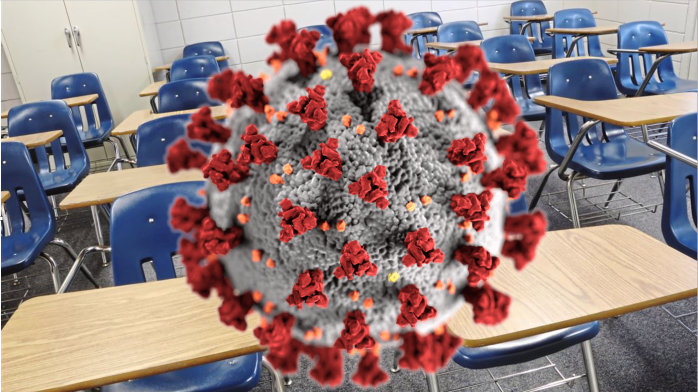
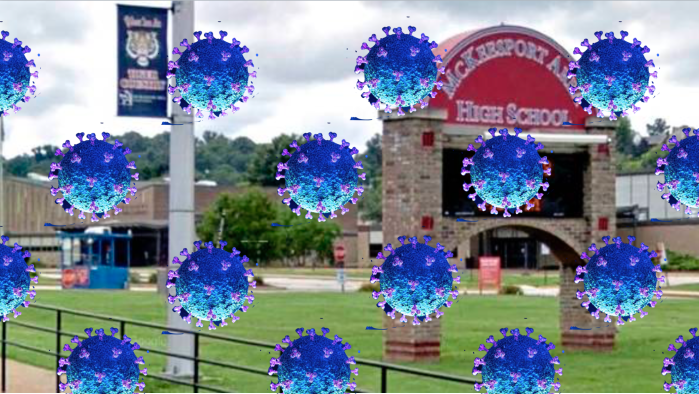
So it’s back to school time, and – let me tell you – am I ready to return to the classroom! Actually, I’m just bursting to pop onto campuses for the FIRSTtime this year.
When I came to these shores way back in March, some spoil sports decided to shut down the schools before I could really get in there.
You locked up your kids tight at home and did this distance learning thing online instead.
That really sucked. All I had was full grown bodies to infect.
I mean I wanted some nice young things to cuddle up to and bust my viral proteins through their ACE2 receptors. You know what I mean?
Kids are great! They’re not as fanatical about washing their hands as adults; if they get a runny nose, they wipe the mess on the back of their fingers; and they touch EVERYTHING!
Right now in most places I’m swirling around in aerosol plumes of nasal droplets in the occasional home, bar, and restaurant, but I’m kinda stuck.
There are only so many times I can infect the same people. And if they’re wearing masks properly and washing their hands, it’s just too much hassle.
If I really want to up my contagion game – and I do – I need someplace where I can mix with new hosts and then travel back to their cribs and just snuggle in.
No crowds at concerts or big sporting events – even the amusement parks and political rallies are drying up.
But now that you’re reopening schools, I can go exponential, baby!
Mark my words – September is going to be the season of the Coronavirus! We’re going to make the spring look like a mere dry run!
Second wave, third wave – and I have you to thank for it.
There are so many people out there I’m indebted to.
First of all, I’ve gotta acknowledge all the anti-science folks. If it weren’t for you guys, more playas might actually be taking precautions against me.
And the libertarian crowd! Wow! You guys are working overtime! No one can tell you to put human lives before a stunted adolescent definition of absolute freedom!
But of course, the first prize has to go to President Trump! He’s the trifecta! Science denial, me first, class warfare zealot! Not only did he disband the government’s pandemic task force, but he advised people to drink bleach – I mean BLEACH!– as a remedy to infection!
Sir, you truly deserve the title “honorary pathogen.” If we ever meet, I’m not sure if I’d infect you or you’d infect me.
Of course, it’s the everyday folks who really make the most difference.
The anti-maskers, the people holding house parties and cook outs, the families throwing care to the wind and going to amusement parks, the people who recklessly eat at crowded restaurants… and school board members opening up their buildings…
School directors, I would be no where without you.
Your steadfast determination to keep school buildings open despite any niggling facts or science or news… I just can’t tell you how much it means to me.
It doesn’t matter whether you’re opening up for full days or half days or alternate days. You’re giving me the chance to shine. I won’t forget it.
Where else in the animal kingdom would potential hosts try to shop their way out of an epidemic? I’ll tell ya, bats don’t act this way. Believe me. I know.
And, hey, that’s fine with me. If black lives don’t matter to you, I’ll take ‘em! I’ll burrow into the mucous membranes of anyone’s throat. It all kinda tastes like chicken.
Once your classrooms are splattered with respiratory droplets from ill-fitting, shared or discarded masks, once your hallways are infested with my slime and contagion, once your athletic fields and band rooms and teachers lounges are dripping with my love – just know this: I won’t ever forget you.
You have been truly great. Really.
Infectiously yours,
Coronavirus
Like this post? You might want to consider becoming a Patreon subscriber. This helps me continue to keep the blog going and get on with this difficult and challenging work.
For a moment there, I thought things might go differently.
With Covid-19 cases exponentially more numerous today than they were when schools closed in March, last night McKeesport Area School Directors voted whether to reopen buildings to half day in-person classes.
And it really looked like they might decide against it.
For about 10 seconds.
The first vote was from Jim Brown, and it was a “No.”
He has made no secret that he champions in-person reopening. Since no residents came before the board to praise the plan – either at tonight’s meeting or last week’s work session – he read aloud a letter he said he received from someone advocating for it.
But when the time came to vote, Donato stopped. He paused.
And for a moment things looked like they might come out right.
Then he voted in favor of the reopening plan.
The final vote was 7-2 in favor with Brown and Mindy Sturgess voting against.
Donato, Joseph Lopretto, Tom Filotei, Ivan Hampton, Steven Kondrosky, Jim Poston and Diane Elias voted in favor of it.
I was there at the meeting in my hometown western Pennsylvania district, one of four people who signed up to speak.
Also last week school directors didn’t enforce any time limit on public comments. This week, Donato started the meeting with a warning that anyone who spoke for more than 3 minutes would be stopped.
In both cases, there were only a handful of people who signed up to speak. And no one spoke at great length.
The first speaker tonight went over her time but was allowed to finish. The next was brief.
Then it came to me.
I knew my comments asking to start the school year remotely wouldn’t fit in a 3 minute time frame, but I was not about to be silenced.
I made my comments (which I reproduce in full below) and when the timer went off, I kept going.
Superintendent Dr. Mark Holtzman said, “Mr. Singer, your time is up.”
I responded, “I’m sorry. I thought my duly elected representatives would want to hear what I had to say. I’ll continue…”
When I was again challenged, it was Sturgess who came to my defense.
She was fearless the entire meeting with questions and comments about the reopening plan and how she thought it was ill considered.
When she spoke up asking for me to be allowed to finish, Lopretto became visibly upset.
“Mindy, why don’t you just take the president’s seat!?” he said.
Lopretto got into an argument with her about it, which ended when he gave up and allowed me to finish.
It’s surprising that even after such antagonism, board members like Donato later seemed to almost reconsider their votes when the time came.
If anything I said seemed to get through to them, it may have been how I concluded:
“If I’m wrong about this, maybe kids will get a slightly less effective academic experience than they would otherwise. But if you vote for in-person classes and you’re wrong, kids will get sick, teachers will get sick, family members will get sick and many will die.
I can live with the consequences of my decision.
Please consider all these things carefully before casting your vote. There are many lives depending on it.”
In the end, we lost.
The district will reopen to in-person classes.
Frankly, before the meeting I had thought it a lost cause.
But now that it’s over, I think if just a few more parents had come to the meeting and spoken against the plan, we might have won.
If the teachers union had been clearer about educators’ concerns and not allowed the superintendent to rhapsodize on the bravery of district employees putting their lives on the line for students, we might have won.
However, the parents I talked to were too frightened of speaking out, too scared of reprisals against their children, and too certain that they wouldn’t be heard anyway.
The teachers I talked to complained about their comments to administration being gas lit and pushed aside. Fear or reprisal, silencing and the good ol’ boys network.
To be honest, it was not easy to sign up to speak at all.
There was a link online to sign up last week, but I had great difficulty finding it, myself, just seven days later. And if you didn’t have your name down by 3 pm on the day before the meeting, you were told sign ups were closed.
These are not the actions of a school board that welcomes public comment.
If just a few more of us could have persevered, I think we could have changed directors’ minds.
But it was not to be.
All that’s left is to see after you and yours – and remember.
Remember the names of those who voted in favor of reopening. Write them down.
If the epidemic brings a tragedy down on McKeesport, we know who to blame.
MY COMMENTS:
“Thank you for allowing me to address this board for the second week in a row.
I am here again to ask you to reconsider administration’s school reopening plan. I think it is imperative physical classrooms remain closed and students begin the year with distance learning.
If it’s good enough for the rich kids in Mt. Lebanon, I think it’s good enough for McKeesport kids, too.
You have to face the facts.
In the last seven days, 311 new cases of COVID-19 were identified in Allegheny County. In the previous week it was 890 new cases.
That may fall under the bar of Gov. Wolf’s new guidelines for districts to mandate remote learning, but it comes awfully close to hopping over it. And it certainly puts online learning as a viable option for county districts.
McKeesport Area School District has been hit harder than most. According to the county Website, there have been 189 cases in McKeesport for a case rate of 95.8 per 10,000. There have been an additional 31 cases in White Oak for a case rate of 39.4 per 10,000.
That’s more than White Oak (0), North Versailles (2), Duquesne (2), West Mifflin (1), Glassport (0), Port Vue (0), Liberty (0), or Elizabeth Township (0).
Jefferson Hills and Baldwin come close with 5 deaths a piece. And Monroeville – which is much more populous than McKeesport – matches us with 7.
Last week, Dr. Mark Holtzman said “We’re very comfortable with the proposal that we’re making.” I don’t see how you can be comfortable with that kind of data.
To put that in context, out of more than 5 million people diagnosed with the virus in the US, approximately 338,000 are children.
And nearly a third of those cases have come as we’ve reopened schools and summer camps, as we’ve increasingly exposed kids to the virus.
Children typically had low infection rates because schools were closed in March and kids were quarantined before the virus had spread through most of the country.
Since June, there have been numerous outbreaks at summer schools. And with some schools now starting their academic year, outbreaks have been even more numerous.
The fact is – if we reopen schools to in-person classes, chances are good that kids will get sick. Staff will get sick. And they’ll bring it home to their families.
Last week, Dr. Holtzman told me I was welcome to utilize a virtual option for my daughter and that this personal parental choice is all that should matter.
I disagree for several reasons.
First, the virtual option on offer for parents at this time is not as effective as the online learning the district could provide if all classes were meeting remotely. As Dr. Holtzman outlined, if the buildings were closed, classroom teachers could conduct synchronous lessons online for all students. This would increase social interaction with real, live people and increase learning outcomes.
By contrast, the existent cyber program is asynchronous, do-at-your-own-pace and less socially interactive.
Obviously, in-person classes would be better academically. But (1) they put children at undue risk of death or permanent health problems as a result of complications from the virus, and (2) what is on offer is not traditional in-person schooling but rushed 20 minute classes behind face masks, plexiglass barriers and a cloud of well-earned fear and anxiety.
So if you insist on reopening the school buildings at this time, I will have to enroll my daughter in the cyber program.
However, a decision to have in-person classes will still affect me and my family.
There is Coronavirus in our community. If you have in-person classes – even on a half day basis – you would be inviting it into our schools where it could infect others and be brought back to their homes. You would effectively be increasing the amount of infection in our community – both in and out of the schools.
When I go to the local Giant Eagle to do my shopping, I would be more likely to become infected because of what you decide here tonight.
When I go to gas up my car, if I pick up take out, if I even go for a walk in my own neighborhood, I would be more likely to be exposed to a person infected with the Coronavirus and thus get sick, myself, because of your decision tonight.
Finally, let me speak for the staff because few others seem willing to do so.
The teachers, custodians, bus drivers, secretaries, support staff and others do not get to make a choice. They have to either accept the plan you’re voting on tonight or look for employment elsewhere. They have to decide whether to put – not just themselves – but their own children and families at risk just to continue receiving a paycheck.
They have done so much for us. They are the lifeblood of this district. Don’t they deserve more consideration than this?
I know administration has worked tirelessly on it. And that effort has not been wasted.
There will come a time to go to a hybrid reopening plan. But that time is not now.
When the spread has been contained, when everyone who wants to be tested can do so in a timely manner, when we can adequately contract trace infections, hopefully there will be a vaccine but even if not when Allegheny County has had close to zero new cases for two full weeks, then it will be time to start reopening buildings.
But let’s not jump the gun now. Let’s wait and see how things go. Wait until the new year and see what happens at other districts that are not so safety minded. At least wait 9-weeks.
If I’m wrong about this, maybe kids will get a slightly less effective academic experience than they would otherwise. But if you vote for in-person classes and you’re wrong, kids will get sick, teachers will get sick, family members will get sick and many will die.
I can live with the consequences of my decision.
Please consider all these things carefully before casting your vote. There are many lives depending on it.”
DR. HOLTZMAN’S RESPONSE:
“Mr. Singer, I’d like to address you with a few of my own statistics. Allegheny County at this particular point anyone under the age of 40 the mortality rate is zero. Anyone under the age of 50 there’s been two fatalities due to Covid. Currently reference to CDC. There’s a current study on the CDC Website right now that clearly states that children or young adults under the age of 19 are five times more likely to die from the flu than Covid-19. These are statistics that go along with the statistics you’re sharing that are often one-sided when you think about those processes.
I think when you talk about coming to a meeting tonight, going to the grocery store, getting take out, we’re putting ourselves at risk every day. It’s an unfortunate scenario. It’s an unfortunate situation. Many people are having people at their homes, they’re going to Kennywood, they’re playing sports out in the community, and that risk of spread is just as big of a risk without a reward. So I think in our case we’re looking for an opportunity to educate children that need desperately positive adults in their life and the opportunity to be educated. We’re not taking a risk for no reward as many do as they go on vacation this summer and consider the spread differently.
So I would take those as part of your comments about some of the things you shared with us so that we’re both on the same page. There’s no easy answers to this solution. And many districts are doing different things based on their community and their community needs. We’re just trying to do what’s best for children.
I appreciate your comment. I appreciate your continuing to blog about me on social media. I’m not a social media person, but it’s something that you do regularly, and we’re here to do what’s best for your children, my children and all the children in the school district. So thank you.”
Moreover, his assertion that “children or young adults under the age of 19 are five times more likely to die from the flu than Covid-19” is misleading because children have been mostly quarantined since March and many who do get infected with Coronavirus are asymptomatic. That’s why there have been fewer reported cases until recently. Former Food and Drug Commissioner Dr. Scott Gottlieb said, “The reality is that flu last year infected 11.8 million kids. We have not infected anywhere near that number of kids with Covid, and we don’t want to find out what it might look like if we did… We really do want to prevent outbreaks in the school setting.”
(My comments are at 29 minutes left in the video.
Holtzman’s response comes at 20 minutes left.
The vote takes place at 10 minutes left.)
Like this post? You might want to consider becoming a Patreon subscriber. This helps me continue to keep the blog going and get on with this difficult and challenging work.
At McKeesport Area School District (MASD), Dr. Mark Holtzman and administration propose unlocking the doors for half day in-person classes Mondays through Fridays.
Kids would be split into two groups – one attending in the mornings, the other in the afternoons. That way, with buildings at half capacity, there would be enough physical space for social distancing. The remainder of the time, kids would be learning online.
However, if you don’t approve, you can opt out.
Any parent who is uncomfortable with this plan could keep his or her children home and have them participate in the district’s existent cyber program.
The board hasn’t voted on the proposal yet. It won’t do so until Wednesday.
Which brings up the question – is parental choice enough?
Is the fact that I can choose for my daughter the only concern I should have?
Thankfully, no one is forcing me to subject my child to in-person classes. If I don’t think they’re safe, I can keep her away and still have access to an education for her through the Internet.
What else do I want?
Plenty.
First of all, the quality of education offered by the district cyber program is not the same as the district could provide if all students were enrolled in virtual classes.
Dr. Holtzman has outlined what that would look like if school buildings were shut down by the governor or the district were overcome with sick students, teachers and/or family.
Teachers would provide synchronous classes online through video platforms like Zoom. Students would get to interact virtually with each other and their teachers.
By contrast, the existent cyber program is asychronous. Students watch videos and do assignments at their own pace, but human contact and social interaction – even via the Internet – is much harder to come by.
Both cyber options are preferable because they avoid these problems. But one of them – the synchronous option with a dedicated class and a teacher behind the curriculum – is superior to the one being offered.
Is it selfish to want the better plan for my daughter?
Should I just be glad I have a choice at all? Should I put the individual good of my child aside for the good of others?
No. Because administration’s plan is not in the best interests of other children, either.
If we reopen schools to in-person classes, chances are good that kids will get sick.
Children typically had low infection rates because schools were closed in March and kids were quarantined before the virus had spread through most of the country.
If the virus is present in the community – as county health department data shows – opening the schools to students also opens them to Coronavirus.
But with the schools open, the virus will no longer be confined to just a few homes. It will come with kids to class and spread among students and staff before it’s brought to their homes as well.
That’s how epidemics work. Opening the schools will spread the virus throughout the entire community.
And that will affect me, too, regardless of whether I choose a cyber option for my daughter or not.
When I go to the local grocery store, gas up my car, even go for a walk – I will be more likely to come into contact with someone infected with the virus and get sick.
I can make the safe decision for my family but still suffer the consequences of the irresponsible decisions of others – especially school directors.
In fact, it doesn’t even have to be my own local school board. The decisions of school directors in neighboring districts affects me, too.
After all, in my part of the state, school districts are pretty small geographically – not nearly as large as most counties. There are 42 public districts in Allegheny County, alone. So it should be no surprise that I routinely travel through several different districts just running day-to-day errands.
MASD school directors can decide to keep buildings closed (and I hope they will) but if a district just one township or borough over decides differently, we will suffer the consequences in McKeesport, too.
Since I don’t live in more than one district, I don’t get a say in what school directors at neighboring districts decide. I just have a say in what happens in my tiny portion of the world. But the consequences are not nearly as respectful of our man-made borders.
For instance, I work as a teacher at a neighboring district. But since I do not live there, I am barred from speaking at the board meetings unless I am invited to speak as an employee of the district.
I can give a report as part of the safety commission if invited by administrators, but I can’t otherwise sign up to speak as an employee concerned about how district policies affects me, my students or their families.
I’m a believer in local control, but sometimes control can be too localized.
This is why you haven’t heard much from many educators. If they’re allowed to speak, they’re often afraid of how doing so will make them a target for reprisals. If they can get their union to back them, they can speak collectively that way, but otherwise, they have no pathway to being heard at all.
As a parent, I get a choice for my child in my district.
But what choice do teachers have – especially if they don’t live where they teach?
That concerns me even with my choices as a parent.
I’ve had some outstanding teachers. My daughter loves her teachers. Is it okay if I don’t want to see them get sick and their lives cut short? If I worry about my own chances of surviving the pandemic and the demands of my employer?
I think their lives matter. But as minorities and people subjected to systemic inequalities, they get less of a say in policy. Should decisions that disproportionately impact their health really be up to a committee? Doesn’t their right to life surpass the decisions making abilities of a handful of elected officials or even middle and upper class parents?
Don’t get me wrong. I’m thankful I have choices as a parent for how my daughter is educated.
School directors need to make reopening decisions that are in the best interests of everyone because we’re all in this together.
That’s what so many folks seem to be forgetting.
Yes, even from a completely selfish point of view, unsafe school reopening will affect each of us.
But epidemics spread through communities. Only communities can effectively combat them.
Dividing ourselves into smaller and smaller fiefdoms only empowers the virus. If we all try to fight Covid-19 individually, we will lose.
We have to understand that what’s good for our friends and neighbors is in our individual interest, too.
We have to care about our fellow human beings.
That’s why I will continue to fight these unsafe plans and ask school directors to reopen schools virtually.
That’s the path I’ve chosen.
Like this post? You might want to consider becoming a Patreon subscriber. This helps me continue to keep the blog going and get on with this difficult and challenging work.
So I gathered my thoughts, put on my mask and went to the work session meeting.
This is what I said:
“Thank you for allowing me to address you this evening. I appreciate all the time and effort you put forward to lead the McKeesport Area School District and do what’s best for students, staff, and families.
I am a life-long resident of this community. Most of my family graduated from this school as did my brother and I. Before I got a job as a teacher at a neighboring district, I subbed here in the high school for years. My daughter has attended the district for the past 6 years and has received a first rate education so far.
This is not a safe plan for students, staff and families. I ask you to reconsider and move to a reopening plan that begins with all students engaged in distance learning.
Safety has to be the primary consideration in reopening plans during a global pandemic. Maslow tells us kids cannot learn effectively unless their bedrock needs such as safety are met.
I appreciate Dr. Holtzman’s concerns about academic loss from distance learning – and under normal circumstances I would agree with him. However, these are not normal circumstances. The kind of academics he is proposing will not be as effective as he seems to believe.
Kids would have roughly 20 minute classes. As a classroom teacher, I know that little more will get done than taking role and getting kids ready to start. I am glad Dr. Holtzman reconsidered his original plan. which would have allowed students to forgo masks in the classroom and congregate only 3 feet apart. He is right to increase precautions with mandatory masks and 6 feet social distancing. But let’s be honest. If you think students will abide by them, you are engaged in magical thinking. Moreover, these precautions will inevitably have a negative effect on learning. Screen-to-screen instruction is less effective than face-to-face instruction, yes. But Mask-to-mask is NOT face-to-face. We may achieve more academically keeping kids online than trying to instruct through plague conditions.
But even if I’m wrong about that, it’s simply not worth it.
No academics is worth the death or debilitating illness of a child, family member or teacher.
Kids don’t learn well when their teachers are in quarantine. There are few accommodations made for special needs students on a ventilator. Childcare is the least of your worries if you survive the virus but are left with a lifelong disability as a result.
If we invite kids back into the classroom, we invite COVID-19 as well. If the virus is present in the community – as county data indicates – it will get into our schools where even the best precautions will not stop it from spreading and being brought home to families.
There is significant evidence that even the youngest kids can and do get sick. And those 10 or older are just as susceptible and can spread the disease at least as easily as adults.
Moreover, the CDC reports that African Americans and other people of color are hospitalized from COVID-19 four to five times more often than white people. What are we saying to our black and brown brothers and sisters if we value their health so cheaply. Don’t their lives matter?
And for those who respond that only a certain percentage of children and adults will die, which members of your family are you willing to sacrifice?
Whose lives are you willing to bet and do you really have the authority to play God?
We’re talking about human life here.
Speaking of which, let’s not forget our teachers and school staff.
Parents at least get a choice whether to send their kids to school in-person or opt for a cyber option. Dr. Holzman’s plan gives no such choice to staff. It does little to protect them from exposure to the virus. If you approve it, you are demanding staff decide between their employment and the possibility that they may take the Coronavirus home to their own children and families.
I have had some amazing teachers in this district who changed my life and made me the person I am today. My daughter loves her teachers. Approving this plan would be a slap in their faces.
Please do not approve Dr. Holtzman’s reopening plan. Instead have all remote instruction until there have been no new cases in the county for a full two weeks.
Only then will it be safe to reopen school buildings.
Thank you.”
Superintendent Dr. Mark Holtzman responded:
“I’d like to respond to a couple of those statements if you wouldn’t mind.
First of all, it’s not Mark Holtzman’s plan. It’s the McKeesport Area School District’s plan. I worked with my administration tirelessly to make those efforts happen. I’m very proud of the efforts that we made. The time and effort that our administration put in.
I think moving forward looking at the big picture there is a virtual option for families so you are welcome to utilize or exercise that opportunity.
Unfortunately we are commissioned to make a very difficult decision for what’s the betterment of all children and providing options for those families that choose to use virtual learning as a platform is available to yourself, your family and anybody else’s family that is interested.
To say that it’s not fair for one person such as yourself or myself to make a decision to totally not have school in-person, I don’t know is the right decision as well. So I think we’re in the middle of this discussion where I think the best decision is not always the easiest decision.
We’re very comfortable with the proposal that we’re making and we hope that you can find the decision that is within those couple options that is in the best interest of your family.”
(My comments begin at 16:27. The audio is a bit muffled because I kept my mask on while speaking.)
(Dr. Holtzman’s response begins at 23:13)
The school board is set to vote on the reopening plan next week at its meeting on Wednesday, Aug. 12, at 7:30 pm at the high school.
I still hope school directors vote to begin the year with virtual classes.
Like this post? You might want to consider becoming a Patreon subscriber. This helps me continue to keep the blog going and get on with this difficult and challenging work.
If we reopen schools, we invite COVID-19 into the classroom just as well as students.
So far as we know, the virus doesn’t care what your motivations are. It only infects as many people as it can leaving us to deal with the consequences.
Consider what the virus does to the human body.
According to the Center for Disease Control (CDC), exposure to the virus can result in mild symptoms to severe illness up to two weeks later. These include fever or chills, cough, shortness of breath or difficulty breathing, fatigue, muscle or body aches, loss of taste or smell, sore throat, nausea or vomiting and/or diarrhea.
People who are sick should stay home, monitor their symptoms and separate themselves from other members of the household.
You should seek immediate medical care if you experience trouble breathing, persistent pain or pressure in the chest, confusion, inability to stay awake and/or bluish lips or face.
Severe illness often requires hospitalization that attempts to relieve the most common complications. These are things like pneumonia, hypoxemic respiratory failure/ARDS, sepsis and septic shock, cardiomyopathy and arrhythmia, and acute kidney injury.
However, you also have to beware additional complications from prolonged hospitalization. These can include secondary bacterial infections, thromboembolism, gastrointestinal bleeding, and critical illness polyneuropathy/myopathy.
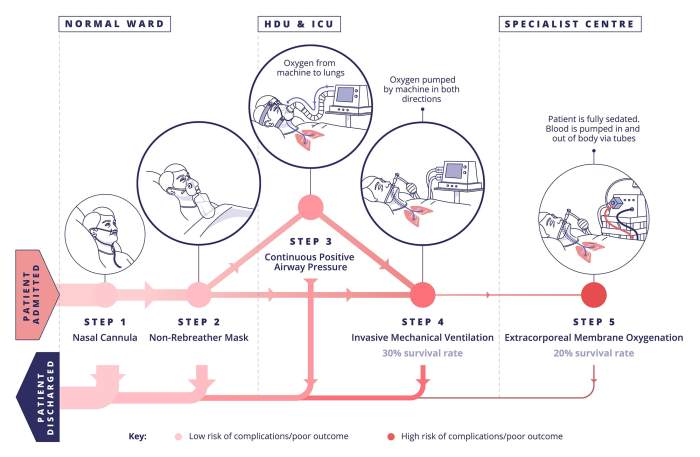
Managing blocked airways is a particular concern. This can be done in less severe cases with simple nasal cannula or oxygen rebreather masks. However, in more extreme cases, you may need continuous airway pressure provided through a machine or even invasive mechanical ventilation.
The chances of this happening to you or a loved one because your neighborhood school building was reopened and children were exposed to potentially sick classmates and staff is far from negligible.
These include inflammation of the heart, cardiovascular disease and strokes; lung inflammation including persistent shortness of breath; and neurological issues such as headaches, dizziness, trouble concentrating or recalling things and even hallucinations.
Teachers and classrooms provide necessary services way beyond simple education.
I’m talking about food, nutrition, healthcare, childcare, counseling, tutoring, socialization, self esteem, meeting special needs, protection from abuse and a whole lot more.
If we keep school buildings closed and go to distance learning as we did in March, many of these services will continue to be disrupted or completely severed.
While reopening school buildings is NOT a viable solution, there are other things we can do.
Food, nutrition and healthcare can all be met while conducting distance learning. In fact, most schools provided these services from March through June as classrooms across the country were closed.
Likewise, counseling, tutoring, socialization, and self esteem can be provided on-line. In most cases they won’t be as effective as they would be in a physical setting. However, given the precautions necessary to meet in-person – face masks, social distancing, etc. – they may be more effective screen-to-screen than they would be mask-to-mask.
Which brings me to the most difficult considerations – meeting special needs, protection from abuse, and childcare.
Special arrangements could be made for these students to come into the physical classroom on a part-time or full-time basis. This isn’t as safe as complete on-line learning, but if the numbers of students are small enough, precautions such a temperature screenings and social distancing were in place and exposure mitigated, this could be a viable option.
The same goes for protection from abuse. Some students live in unsafe home environments. It is observation by responsible adults who are mandated reporters like teachers that reduce the likelihood these children will be mistreated and provide a solution when abuse is reported. However, noticing the telltale signs of such mistreatment or even communicating with a teacher privately outside of the hearing of an adult in the home is more difficult on-line.
Special arrangements could be made for students who have already been identified as at risk. They could meet with counselors and psychologists in the school every week or so. Safety precautions would be necessary but the risk could be reduced enough to make it worth taking.
The biggest problem is probably the most widespread – childcare.
Having children at home to do their schoolwork on-line puts additional pressure on parents.
In short, the economy requires some kind of daycare for these children.
Many European countries that have best managed the Coronavirus have paid workers to stay home. This allows them to take care of their own children and reduce their own exposure to the virus.
However, our government has almost completely abrogated its responsibilities to working class people.
Parents with similar age children can create childcare networks where the same families take turns watching each others’ children. This reduces exposure to some degree.
Childcare centers also have been kept open in many communities to meet this need. However,there have been massive outbreaks at such centersacross the country that would only be worsened if we rely on them more. Any sane country would close them just as it closed schools.
Until our lawmakers get off their butts and do their jobs, we will have no good solution to this problem.
Reopening school buildings to serve as childcare centers certainly won’t solve anything except put a premium on respirators, coffins and graveyard plots.
We need to make it possible for parents to stay home with their children.
And we need to do it now.
Like this post? You might want to consider becoming a Patreon subscriber. This helps me continue to keep the blog going and get on with this difficult and challenging work.
It indicated that he didn’t pass the buck but accepted responsibility for the way the country was run.
What does it say on your desk, Gov. Tom Wolf?
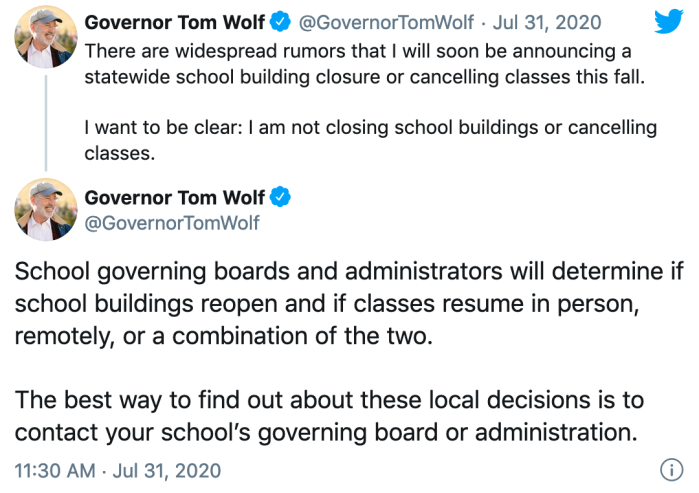
Your latest Tweets don’t fill Pennsylvania residents with confidence:
“There are widespread rumors that I will soon be announcing a statewide school building closure or cancelling classes this fall. I want to be clear: I am not closing school buildings or cancelling classes.”
“School governing boards and administrators will determine if school buildings reopen and if classes resume in person, remotely, or a combination of the two. The best way to find out about these local decisions is to contact your school’s governing board or administration.”
Well, that’s two things you now have in common with President Donald Trump.
“I don’t take responsibility at all,” Trump said when asked about his administration’s inability to test Americans for the Coronavirus during the outbreak.
Today in Allegheny County, where I live, the Health Department reported the second highest increase in new cases – 244.
That is the most new cases in the state. Philadelphia comes next with 130 new cases. Together, these two counties make up more than 38% of the state’s new COVID-19 cases.
And yet we have school directors looking at this same data and making different decisions.
As chief executive of the state, you had an obligation to do that.
It’s a crying shame that many in government have politicized every aspect of this disaster and the response to it.
I know you have taken a lot of criticism from Republicans trying to score points off your quick and sound judgement in this matter. They call you a tyrant because you did what every previous governor has done during a statewide disaster – you made decisions to safeguard lives.
Nothing has changed. If anything, there are significantly more cases reported every day now than in March.
If schools needed to be closed to in-person classes and education needed to be conducted on-line back then, that is still true today.
Perhaps this doesn’t have to be statewide. Perhaps it can be decided county-by-county. But you need to work collaboratively with county officials and school boards to coordinate the response to the virus.
A district that wisely decides to keep children 100% online will be susceptible to infections from residents in neighboring districts and bring those infections home.
This is not the responsibility of local school directors. It requires an authority that goes beyond the neighborhood and provincial decision making.
This is YOUR responsibility.
Frankly, the federal government, too, should be playing a larger role to help coordinate state responses. After all, the virus is not limited by state lines either.
If you refuse to make this decision, many more people will get sick from COVID-19 than would otherwise. Many more people will eventually die.
These are teachers, mothers, fathers, grandparents, and – yes – even children.
You can do something about that.
You have a responsibility to do something about it.
Do your duty.
Like this post? You might want to consider becoming a Patreon subscriber. This helps me continue to keep the blog going and get on with this difficult and challenging work.
(1) Open schools completely to in-person learning with safety precautions
(2) Keep classes entirely on-line as they were in April and May
(3) Offer some kind of hybrid of the two
Many schools are opting for this hybrid model.
This means reopening to in-person classes part of the time and on-line learning for the rest.
There are many ways to do this.
In my home district of McKeesport, this means having half of the students attend in the morning and the other half in the afternoon with the balance of their class work being done via the Internet.
In Steel Valley, the district where I work as a middle school teacher, this means half of the students attending full days on Mondays and Tuesdays, half on Thursdays and Fridays and the building is deep cleaned while students are taught completely on-line on Wednesdays.
In either case, parents can opt-in to an entirely virtual plan, but it’s expected that most adults would choose the hybrid model with its partial in-person classes for their children.
The hybrid model, then, is tantamount to putting children, teachers and families at risk for a reduced amount of time.
Why take the risk? On the premise that in-person instruction is more robust than on-line learning. Students learn more in the classroom from educators who are physically present than they do on the Internet.
There is significant evidence to back that up. However, this premise ignores the fact that invasive but necessary safety measures like wearing masks and practicing social distancing throughout the day will inevitably have negative effects on learning.
That is not an insignificant risk. We have an infection rate of nearly 10%. We have some of the highest numbers in the state.
I don’t know how anyone can look at those numbers and conclude anything except that the risk of infection is GREATER today than it was when we took more precautions against it.
Moreover, the situation is little better nationwide.
Moving into Phase 1 would require a “Downward trajectory or near-zero incidence of documented cases over a 14-day period.” Moving to Phase 2 would require a “Downward trajectory or near-zero incidence of documented cases for at least 14 days after entering Phase 1.”
No state has experienced a “downward trajectory” for COVID-19 cases for 28 straight days. In most states, cases are increasing.
That document suggested several expensive and difficult safety measures such as broad testing of students and faculty and contact tracing to find people exposed to an infected student or teacher – none of which is being done locally.
However, no matter how you look at it, reopening school buildings – even with a hybrid approach – increases risk significantly.
If school buildings are reopened with students and staff coming and going – even at a reduced rate through a hybrid plan – one would expect the virus already present in the community to gain access to our schools where it would be further spread to different segments of the community.
Schools are great meeting points. They are where local neighborhoods connect, learn, grow and share. Reopening them in a physical fashion allows for greater sharing of any easily communicable diseases in the area.
So exactly how communicable is COVID-19?
It’s often compared to influenza which infects millions of people every year yet these outbreaks rarely close schools.
Only about 0.1 percent of the people who got the flu in the US last year died of it, according to the CDC. Yet about 5.2 percent of those who came down with COVID-19 have died, based on the reported totals of cases and deaths.
During the 2018-19 flu season, about 34,000 people in the US died, according to the CDC. So far, 143,193 people have died of COVID-19 in the US, as of July 23.
Some say that even given such statistics, children are less susceptible than adults.
However, the virus was only discovered in 2019. So little is known about it – for instance, the low percentage of cases in children may be because schools were closed in April and May before many kids were exposed to it.
A recent South Korean study – the most in depth of its kind to examine how the virus affects children – found that it is especially active in older kids.
“For people who lived with parents between the ages of 10 and 19, 18.6% tested positive for the virus within about 10 days after the initial case was detected — the highest rate of transmission among the groups studied. Children younger than 10 spread the virus at the lowest rate, though researchers warned that could change when schools reopen,” wrote Stephen Stapczynski for Bloomberg News.
“So long as children are not just a complete dead end – incapable of passing the virus on, which does not seem to be the case – putting them together in schools, having them mix with teachers and other students will provide additional opportunities for the virus to move from person to person,” he said.
Do such facts represent an acceptable risk for opening schools – even with a hybrid model?
Education Secretary Betsy DeVos says it does.
She said, “there’s nothing in the data that suggests that kids being in school is in any way dangerous.”
However, if even .02% of public school students were likely to die if school buildings were reopened, that’s 11,320 children!
Are we willing to risk the lives of tens of thousands – perhaps more – children on the unproven promise of a slight improvement in academics?
And keep in mind that doesn’t even take into account the cost to adults.
According to a new report from the Kaiser Family Foundation (KFF), 1 in 4 teachers in the U.S. – roughly 1.5 million people – are at increased risk for complications if they become infected with the Coronavirus. This includes educators over the age of 65 and those – like myself – with a pre-existing health condition that makes them more vulnerable.
According to the CDC, death from COVID-19 is significantly more common in older adults. Though the median age of U.S. teachers is 42.4 years, nearly 19 percent of teachers are 55 and older, reports the National Center for Education Statistics.
Health conditions such as diabetes, cardiovascular disease and kidney disease also increase one’s risk for serious illness from the virus. The CDC warns that roughly 60 percent of American adults have at least one chronic medical condition, and about 40 percent have two or more.
The situation is even more dire when we look at parents and grandparents in students’ homes. The KFF issued a report in July concluding that 3.3 million adults 65 or older live in a household with school-age children.
And let’s not forget the racial component.
Most minorities are more susceptible to COVID-19 because of the higher rates of social inequality they are forced to live under.
According to the CDC, Native Americans and Black people are hospitalized from the Coronavirus five times more often than White people. Hispanic and Latino people are hospitalized four times more often than White people.
Physically reopening school buildings in communities that serve large populations of people of color, then, invites greater risk than in predominantly white communities.
In any case, though, reopening school buildings – even under a hybrid model – significantly increases the risk for all the people living there.
So in summary, it is clear that the three basic options for reopening schools each offer different levels of risk.
A full reopening of schools even with safety precautions brings the highest risk. However, the hybrid model also brings significant danger to students, teachers and families – even if somewhat less than full reopening.
Distance learning has the lowest risk of all. It keeps most children physically separate from each other and thus limits exposure to the virus to the greatest extent. Likewise, it limits jeopardy for educators and other adults because teachers would mostly come into contact with children through the internet and parents would not be further complicated through potential viral contacts of their children.
From an academic standpoint, distance learning certainly has its drawbacks compared with face-to-face learning. But compared with mask-to-mask learning, virtual instruction may actually be preferable.
In any case, increased risk of death or debilitating disease has a chilling effect on learning for all involved.
In most communities – perhaps all – a decision on school reopening that balances safety with academics would lean toward distance learning above anything else.
Even if on-line learning turns out to be less effective than that provided in the hybrid model, any deficiencies can be targeted and ameliorated once the pandemic ends.
As yet, death admits of no such remedies.
Like this post? You might want to consider becoming a Patreon subscriber. This helps me continue to keep the blog going and get on with this difficult and challenging work.
As the summer whittles down, my district has yet to release its reopening plan. Meanwhile, no communication from administrators or school directors, no public meetings, nothing.
The Sword of Damocles dangles over my head and the rope that keeps it in place looks more frayed with every pendulum swing.
For a person like me with at least two pre-existing conditions, an assignment in the school building during a global pandemic could be a death sentence.
Teaching has taken a huge toll on my body. I have heart disease and Crohn’s Disease. Not to mention that I’m certainly not getting any younger.
That’s at least twice the average risk of getting COVID-19 if my employer decides to assign me back in the building.
And it’s something my doctors made a point of mentioning.
From the middle of June to the middle of August, teachers like me try to take care of all our personal needs before the hectic classroom schedule begins.
That means renewing clearances, financial planning, medical visits, etc.
So when I went to a routine cardiologist appointment, I was somewhat taken aback as the doctor told me, “Remember, you can’t get sick.”
“I’m sorry? What?” I said.
He had just given me a clean bill of health.
“Remember, you can’t get sick. You simply cannot afford it,” he said.
Then he went on to complain about living in a country that put economics before science.
I heard much the same from my gastroenterologist.
They were both furious at how the pandemic is being handled but had no more advice on how I could protect myself.
“If they want you to go back to work, what else can you do?” one asked me.
Teaching has been one of the most meaningful experiences I’ve ever had. Every day I get to help kids become the people they want to be. I get to introduce them to a world of reading where voices long past get to speak to each of them individually. I get to show them how to participate in a conversation that’s been raging for millennia.
After 17 years in the classroom, years of helping kids learn how to read and write, years of listening to their needs and worries, years of helping them overcome their anxieties and fears, years of advice, counsel and friendship – is this all I’m worth to the community?
I chaperoned field trips with school directors and their children, I’ve taught board members kids and sat across from the adults at parent-teacher meetings regaling them with tales of mischief and academic triumphs. Will they now callously decide that I need to put my life at risk or else step down?
How many times did I joke and laugh with administrators, how many times did I try my best to do what they asked, how many times did I go above and beyond – and now have they no qualms about making my wife a widow and forcing my daughter to navigate the rest of her childhood without her daddy?
It doesn’t have to be this way.
A sane society wouldn’t reopen school buildings when Coronavirus cases are spiking. A rational country wouldn’t politicize safety precautions, undermine scientists and disparage facts. It would pay people to stay home, suspend rent payments, provide everyone with personal protective equipment (PPE) and universal healthcare.
Like this post? You might want to consider becoming a Patreon subscriber. This helps me continue to keep the blog going and get on with this difficult and challenging work.
I am extremely concerned about the reopening plan for the McKeesport Area School District you offered on video Tuesday.
As a parent of a child in the district and a teacher in a neighboring district, I find the plan you put forward to be absolutely terrifying. It is badly reasoned, based on unproven facts, and takes unnecessary risks with students and staff.
In short, you propose reducing social distancing by half, requiring students to wear masks only occasionally, having zero temperature screenings and keeping schools open when students, staff and/or family get sick.
This is unacceptable.
And given that you said all superintendents in Allegheny County are meeting weekly to discuss reopening, my concern about McKeesport’s plan extends to all other local districts working under similar miscalculations.
Be assured I will send my concerns to the email hotline you provided because it was impossible to have public meetings to discuss this matter. Which brings me to my first concern – how can it be unsafe to meet in-person with the public to discuss reopening schools yet still be safe to open them for our kids?
I am an alumni of McKeesport. So is my wife, my brother and most of the people in my family. I’ve lived here my whole life.
My daughter is set to enter 6th grade this year. Up to this point I have been extremely happy with the education she has received in the district.
I am thankful that you’ve decided to give parents the option of virtual learning for their kids if they do not feel it is safe for them to return to school buildings, but your reopening plan will have impacts far beyond our individual households. A spike in COVID-19 throughout the community due to a bad school reopening plan will not be in anyone’s interests.
You say you’re relying on facts as provided by the the Center for Disease Control (CDC), and health departments of Allegheny, Chester and Bucks County. However, almost everything you cite on the video is from one source – Bucks County.
Frankly, I do not feel comfortable basing almost our entire reopening plan on data provided by one county in the Commonwealth that may or may not have done a good job handling this pandemic.
We need to base our plan on county specific data from Western Pennsylvania and guidelines for the entire state.
In short, the plans provided by Bucks County are reckless and based on sketchy facts.
For instance, in the video you said people only get COVID-19 if they have been within 6 feet of someone not wearing a mask for 15 minutes consecutively. That or there has to be an exchange of fluid – someone sneezing, spraying spittle, etc.
I am extremely upset that you plan to reduce social distancing in district schools from 6 feet to between 3 and 4 feet.
You again cite Bucks County to justify the position.
“…SARS-CoV-2 is spread most commonly through large respiratory droplets when someone coughs or sneezes. A minimum three-foot distance is clearly associated with significant reductions in infection via respiratory droplets, as most droplets do not travel more than 3 feet due to gravity. This is the current standard used by the World Health Organization (WHO) successfully in many countries throughout the world today.”
While it is nice to be assured that respiratory droplets don’t travel beyond three feet, experience tells us otherwise. It shouldn’t take much imagination or memory to recall a time when one of your own droplets traveled further in a moment of excitement. As a classroom teacher, I can tell you this happens often. When kids get excited, teachers better back up.
Be honest. This has nothing to do with Bucks County. You let slip the real reason here:
“Our classrooms are not very large – to put children 6 feet apart in school buses, classrooms, hallways, cafeterias, will be next to impossible with the overall square footage of those particular areas.”
I get it. You’re probably right. But that’s not a reason to skimp on safety. There are other alternatives to in-person classes.
Then we get to temperature screenings – a precaution you say will not be taken when students enter our buildings at the beginning of the day.
This is highly imprudent.
It takes seconds to gauge someone’s temperature with an infrared thermometer – significantly less than getting through a metal detector – something we do routinely everyday at all district schools.
Yes, there is the problem of kids getting backed up in long lines, but that is not insurmountable. Staff can at least try to keep kids separated – perhaps having a staggered start for each grade would help.
Yes, I know the absence of a temperature does not guarantee someone is not infected. But any sense of safety is good. You know the metal detectors are not 100% accurate either.
You say it is up to the parents to make sure their kids don’t come to school with a raised temperature. Now that IS unreasonable. It is unfair to put the health concerns of an entire population on one or two parents who may not comply with the expectation.
I think the bigger concern is something you didn’t mention. What do you do with a child who has a temperature? How will you send him home? Who will see to him until a parent can come and get him? And will that person be at risk of getting sick?
These are hard questions to answer, but going in ignorance of a symptomatic student is worse.
Your position on masks is one of the most problematic in your entire reopening plan.
You propose to have children wear masks on buses but not in their classes. And the reason – because it’s just too hard to make kids wear them.
This is unfair to district children and the staff who serve them.
Look. I understand it would be incredibly difficult to get kids to wear masks. But if you cannot do it, pursue a different kind of schooling. Do not have in-person classes if you cannot do so safely.
Then we come to your position on what to do if someone gets sick.
First, it is telling that both you and your advisors in Bucks County are pretty sure this WILL eventually happen.
You do not think the precautions you’re taking will stop people from getting sick. You simply find it acceptable if the number of sick people is low.
“As COVID-19 will likely be with us for an extended period of time, and given that all school districts will almost certainly have cases, we want school districts to begin treating it similarly to the way we have successfully handled other communicable diseases in our schools, including pertussis (whooping cough), measles, strep throat, mumps, influenza, and meningitis. It is our strong intention to keep all classrooms, schools, and districts open, in the event of confirmed cases of COVID-19. One closure decision can lead to a potential crippling, and precedent setting domino effect of closures…”
Moreover, we cannot prioritize keeping schools open over public health and safety concerns. But that is what you are proposing here.
You said:
“We won’t close schools if someone gets infected. It takes 6-8 days to get an accurate result from a COVID test. So that disease will have passed through and will no longer exist on any surfaces, classroom areas, people, etc. in the school by the time the COVID is confirmed. Therefore, there’s no reason to close schools. We’ll clean every inch of our classrooms on a daily basis.”
This does not mean that the danger is any less. It means that the danger may have passed by the time we know about it. How many people may be sick by then?
Mark, this is a bad plan. Let me give you a better one.
Start school this year with universal distance learning.
You already mentioned how the district will make sure all students have a one-to-one iPad initiative. You mentioned how virtual learning will be revamped to include face-to-face instruction.
Take it a step further.
Have all teachers develop their own unique distance learning initiatives.
Kids will not learn to the best of their ability under the shadow of COVID-19. They will be scared and on edge – if they even show up.
We can go back and fix any academic deficits in the years to come. But no one can bring the dead back to life.
It’s much better to err on the side of safety.
I hope you’ll do that.
Our families deserve to be healthy. Your staff deserves to work without having to risk their lives. Our children deserve the chance at a future.
Yours,
Steven Singer
Dr. Holtzman’s full video:
Dr. Holtzman’s Slides on Reopening:
Like this post? You might want to consider becoming a Patreon subscriber. This helps me continue to keep the blog going and get on with this difficult and challenging work.












 gadflyonthewallblog