Dear Betsy DeVos, I Will NEVER Report My Students to ICE

4e78f0eb558f3.image 


Teachers fill a lot of roles in our public schools.


We’re mentors to kids in need.


We’re aides to students struggling with new concepts and skills.


We’re homework-givers, pencil-providers, idea-encouragers, lunch-buyers, scrape-bandagers, hand-holders, hug-givers, good listeners, counselors, caregivers and – yes – sometimes even butt-kickers.


It’s no wonder that we occasionally get mistaken for mothers and fathers.


But one thing we will never be is a snitch.


Secretary of Education Betsy DeVos recently intimated that principals and teachers could report their undocumented children to Immigration and Customs Enforcement (ICE).


She’s not going to say what we should do one way or another. She’s just saying that this is something we COULD do if we wanted.


If that results in those kids and their families being deported, well we are a nation of laws, after all.


It’s a remark that sounds so reasonable to some folks.


Luckily, I speak dog whistle.


So did the U.S. Supreme Court back in 1982 when justices ruled in Plyler v. Doe that schools cannot deny children their right to a free education based on immigration status.


When kids are afraid to learn because they or their parents or extended family may be undocumented, that has a smothering affect on the classroom.


When ICE raids a local business, we see a sudden drop in class attendance.


So if students thought their teachers or principals were scrutinizing them to determine their citizenship status, we’d be discouraging many with brown skin or extra-national credentials from ever coming back.


By suggesting that educators have a choice whether to obey established law or to become self-appointed border patrol officers, DeVos actually is prescribing how we should act.


Well, not this teacher, Betsy.


Not now. Not EVER.


No matter who you are – black, white or brown – a public school is a sanctuary. It is where kids of all different races and creeds come to escape from the ravages of poverty, violence and indifference.


Teachers are not the enforcers of our broken, bent and biased immigration policy. It is not our job to oblige xenophobia and bigotry.


It is our job to teach, to protect and inspire.


Sure, I’ve made my fair share of calls to parents, healthcare professionals and Child Protective Services.


I’ve reported abuse, addiction and mental illness.


But I did that to protect my kids. And I do think of them as my kids.


When these little people come toddling into my class, I take a kind of ownership of them.


For the time they’re here, we’re family. I take interest in their lives and they take interest in mine.


They know all about my wife and daughter, my parents and grandparents. And I know about theirs.


We don’t just learn grammar, reading and writing. We share our lives with each other.


We share a mutual trust and respect.


If I reported even a single student for a suspected immigration violation, I would lose that forever.


It’s sad how much things have changed in a little over year.


Hispanic names have become Anglicized. Angelo has becomes Angel. Julio has become Jules. Jorge is now George.


The dulcet melody of Spanish has been silenced. You’ll only hear it in muffled voices if you wander by a few lockers, but never in class.


My kids aren’t even 13 yet, but many of them have already learned to hide.


Don’t appear different. Don’t let anyone know your roots extend beyond national borders.


Be “normal.” Be homogenized, bland American.


That’s the world we’ve built and it’s the one that DeVos is encouraging with her tin pot nationalism.


Some things don’t change when you cross municipal lines – human decency is one of them.


So I won’t be reporting any of my students to ICE.


I won’t help the Gestapo separate parents and children based on citizenship status.


I won’t help set up ethnic checkpoints where armed guards get to ask “suspicious persons” for their papers.


White supremacy was bad enough before Trump was elected. I won’t help the unfortunately named Department of Homeland Security become the protector of a new white trash Fatherland.


I will defend my students. I will stand up for their safety and their rights.


That’s just what we do in public school. We look after our own.


Like this post? I’ve written a book, “Gadfly on the Wall: A Public School Teacher Speaks Out on Racism and Reform,” now available from Garn Press. Ten percent of the proceeds go to the Badass Teachers Association. Check it out!

WANT A SIGNED COPY?

Click here to order one directly from me to your door!
book-2

School Vouchers and Runaway EdTech Pave the Way for the Destruction of the Very Concept of School

andres


School is where you learn to learn.


A teacher with an advanced degree and decades of experience devotes her time to figuring out what helps you comprehend the world around you.


And, if she’s good, she imparts that lesson to you as well.


Imagine if we took that away.


Imagine a world where there are no schools – just free range children plopped in front of a computer or an iPad and told to go learn something.


No schools, no teachers, just gangs of students walking the streets, stopping along the way to thumb messages to each other on social media, play a video game or take an on-line test.


That’s the world many EdTech entrepreneurs are trying to build.


And school vouchers are helping them do it.


Take Education Savings Accounts (ESAs) and other market based privatization schemes.


Normally, the federal, state and local government collect taxes to fund an individual child’s education, which is then spent at a public or charter school.


At a public school all that money must be spent on the student. At a charter school some of that money can be pocketed as profit by the private company who runs the school.


Public schools provide a better alternative because the funding must be dedicated to the student, living within a district’s coverage area guarantees enrollment, the school must be managed by an elected school board with open meetings and a plethora of other amenities you won’t find at a privatized institution. But at least the charter school is a school!


However, an ESA or other voucher would allow that money to go elsewhere. It could go to funding the tuition at a private or parochial school where organizers can use it however they like – pocketing some and using the rest to help the child as you’ll find in most charter schools.


But as bad as that is, vulture capitalists want to add another destination for that money – let it pile up in the bank where it can be used for discrete education services provided by the EdTech industry.


It’s almost like homeschooling – without the loving parent being in charge.


It goes by many names – a learning ecosystem, personalized learning, competency based or individualized education.


But it’s really a single person cyber school with little to no guiding principles, management or oversight.


Education is reduced to a series of badges students can earn by completing certain tasks.


Reading a book or an article gives you a badge. Answering a series of multiple-choice questions on a reading earns you more badges. And if you’ve completed a certain task satisfactorily, you can even earn a badge by teaching that same material to others.


It’s the low wage gig economy applied to education. We just transform a crappy job market where workers bounce from a few hours of minimum wage labor here to a few hours of minimum wage toil there – all without benefits or union protections – into learning. Children bouncing from a few hours of Khan Academy videos here to a software package there and Voila! “Modern” education!


In short, it’s school without the school or teachers.


And make no mistake, it’s not about improving the quality of education. It’s about providing the cheapest possible alternative and selling it to rubes as innovation.


The wealthy will still get institutions of learning. They will still be educated by the most qualified teachers in the world. They will still learn how to learn.


The best path to becoming a truly educated person involves human interaction and mentorship. You need experienced professional educators who use the empirical evidence they see in the classroom about your child to tailor lessons to their needs. The wealthy would never dream of making their children learn from the academic equivalent of an automated check out aisle or telemarketer robocall.


It is only the poor and middle class who will be released like chickens into the pasture of a learning ecosystem.


And as an added benefit, the badge structure creates a market where investors can bet and profit off of who gains badges and to what degree on the model of crypto-currencies like Bitcoin! So all the stability of the pre-crash housing market! What could possibly go wrong!?


Let me be clear – this is the ultimate goal of the school privatization movement.


Charter and voucher schools are only the tip of the iceberg. They still require real human beings to act as teachers (though they need not be as well educated or have as much experience as public school teachers). They still require buildings and grounds.


But this depersonalized learning approach allows them to do away with all of that. They can just provide students with an Internet accessible device and some dubious on-line tracking and management system.


Then they can pocket all the rest of the money taxpayers put aside to educate children and call it profit.


And they can use the programs students access to “learn” as a way to gather valuable marketing data about our kids. Everything students do on the device is free market research – every word they input, every keystroke, every site visited down to the slightest eye movement.


This is the logical conclusion of the monetization of education and an economy that only sees value in others as human capital that can be bought, sold and exploited.


This is where the privatization movement is going. And they’re laying the groundwork in legislation being proposed in our state capitals today.


In Pennsylvania, for instance, Senate Bill 2 proposes the creation of just such ESAs. If approved, the immediate result would be to boost private and parochial schools.


However, given a few years to strengthen the technologies and systems needed for a full learning ecosystem, the same law would allow taxpayer money to be used in this way.


And it’s something hardly anyone is talking about.


We’re fighting the privatization systems of today as the plutocrats set up the privatization systems of tomorrow.


Even if school vouchers never take off to the degree necessary to scaffold the most robust learning ecosystems, EdTech lobbyists are trying to install as much of this garbage as they can into our existing schools.


They are using one-to-one iPad initiatives and grants to fund up-to-date computers, Wi-Fi networks and software packages to pave the way for this brave new world of digital exploitation. They are selling our test score obsessed bureaucrats software like iStation and IXL that bridge the gap between test prep and learning ecosystems lite.


You can walk into many schools today where students spend hours on-line earning digital badges for watching videos and taking stealth assessments.


Few people are sounding the alarm because few people understand what’s going on.


This is not conjecture. This is not a conspiracy theory. This is the goal the edtech entrepreneurs will gladly tell you all about hoping you’ll invest.


There are hours of videos, pages of documents, mountains of graphs, charts and graphics about how this scheme will pay off for investment bankers and venture capitalists. (See below)


The only true way to win this battle is a cultural shift away from dehumanizing runaway capitalism.


We need to stop thinking that the private sector is always better than the public good. We need to stop allowing big business and corporations to get away without paying their fair share. We need to increase the voice of citizens and decrease the megaphone of money and privilege.


Otherwise, the science fiction dystopias of books like “Ready Player One” will no longer be fiction.


They will become the reality for every school child in this country.


A reality where school, itself, is a thing of the past.


And education is reduced to the mercenary collection of discrete skills that add up to nothing of value for the students except their own enslavement.


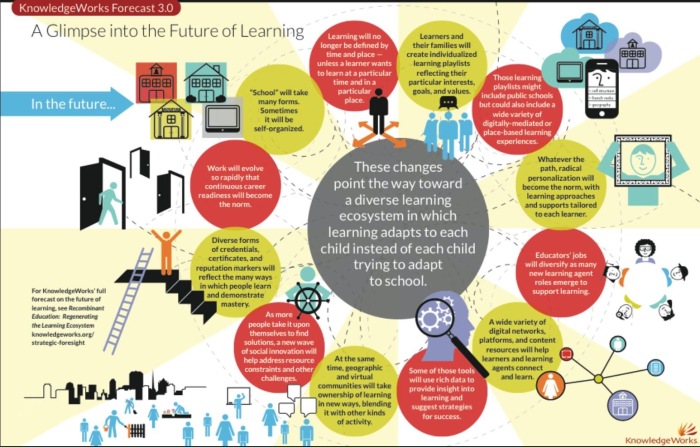
But don’t take my word for it. Here is the learning ecosystems model from the EdTech industry, itself, in corporate officers own words and graphics:

LEARNING IS EARNING – the scariest 6:58 video you’ll ever see.


KNOWLEDGEWORKS Vision for the Future of Education:

IMG_9654

Graphic as a PDF

More on KnowledgeWorks

Listing for PARENTS AS CONSUMERS Symposium

Read all about it here.


FIGHT BACK AGAINST SCHOOL PRIVATIZATION AND RUNAWAY EDTECH:

Like this post? I’ve written a book, “Gadfly on the Wall: A Public School Teacher Speaks Out on Racism and Reform,” now available from Garn Press. Ten percent of the proceeds go to the Badass Teachers Association. Check it out!

WANT A SIGNED COPY?

Click here to order one directly from me to your door!

book-2


The Best Charter School Cannot Hold a Candle to the Worst Public School

Screen Shot 2018-05-24 at 7.43.41 AM.png


There are good charter schools.


I admit that.


There are bad public schools.


I admit that, too.


But if one had to choose between the worst public school and the best charter school, you’d still be better off with the public school.


Does that sound crazy? Does it sound ideological, partisan, or close-minded.


I don’t think so.


Imagine if we said the same thing about tyrannies and democracies.


There are good tyrannies.


There are bad democracies.


Still, I’d prefer the worst democracy to the best tyranny.


Why?


Because even a badly run democracy is based on the principle of self rule. The government gets its right to make and enforce laws from the consent of the will of the governed.


Even if our representatives are corrupt and stupid, even if our federal, state and local agencies are mismanaged and disorganized – there is the potential for positive change.


In fact, the catalyst to that change is embedded in democracy, itself.  Egalitarian systems founded on the principle of one person, one vote tend toward fairness, equity and liberty much more than others.


Bad leaders will be replaced. Bad functionaries will be retrained or superseded. Bad agencies will be renovated, renewed, and made to serve the will of the people.


However, in a tyranny, none of this is true.


Even if you have a benevolent tyrant who does nothing all day but try to do whatever is best for his or her subjects, that is a worse state of affairs.


Eventually the tyrant will change. Absolute power will corrupt him or her absolutely. Or even if this bastion of human goodness is incorruptible, he or she will eventually be deposed, replaced or die.


And there is nothing – absolutely nothing – to ensure the next tyrant is likewise benevolent. In fact, the system is set up to increase the likelihood that the next ruler will be as selfish, greedy and malevolent as possible.


This is because it is the system of tyranny, itself, that is corrupt – even if those that fill its offices are not.


The same goes for good charter schools.


These are schools that are publicly funded but privately run.


As such, the overwhelming majority have no elected school board, their meetings are held in private, their documents are kept secret, they discriminate in enrollment and they take advantage of a plethora of legal loopholes and bad policy to embezzle funds, overcharge for nonexistent utilities and cut services for students while pocketing the “savings” as profit.


If you can find a charter school that does none of these things – congratulations! You have found a diamond in the rough! But it is a diamond that is more likely to turn to coal the second you turn away.


Let’s say you find the rare charter school run by an elected school board. THEY AREN’T REQUIRED TO DO THAT. Organizers could at any time revert to an appointed board. Community members could be making all the decisions when you send your child to school, but by dismissal time they could have all been replaced with flunkies appointed by the private business people who took out the charter from the state in the first place!


Let’s say your charter school has open meetings and public documents. They invite the public to their deliberations. They take public comment and share all their internal communications with taxpayers and the media.  THEY AREN’T REQUIRED TO DO THAT. They could close the doors any day they wanted. And there’s nothing you could do about it.


Why? Because that’s what a charter school is. Despite all the propaganda to the contrary, it is not fundamentally a public school. It is a private school at public expense.


All these things that are optional at a charter school are required at public schools. Not just some public schools – ALL OF THEM!


Public schools are required to have elected school boards (unless taken over by the state). They are required to have open meetings and public documents. They are essentially democratic, whereas even the best charter schools are only democracies because of someone’s goodwill. When the wind changes, so will their system of government.


But that’ not all.


Let’s say you find a charter school that has open enrollment. It accepts every student who applies from its coverage area. Or at least it does so until it runs out of room. If demand exceeds supply, it conducts a lottery to determine which students to let in and which it has to unfortunately turn away.


First of all, if the school doesn’t have open meetings and public documentation, you have no way of knowing whether these lotteries are fair and unbiased. Operators are often charged with cherry picking the best and brightest and denying students with disabilities or behavioral problems – they’ve even been known to discriminate based on race and class.


Second of all, even if your charter school is one of the magical few that just does the right thing with no oversight, THEY AREN’T REQUIRED TO DO THAT. Once they figure out how much money they can save by only accepting the cheapest students to educate, inclusive enrollment policies will be a thing of the past. And you’ll probably never even know the difference.


Public schools aren’t allowed to do that. They have to accept every student from their coverage area regardless of academic deficits, emotional needs, race, religion, class or creed. And if there isn’t enough space, they still can’t turn students away. They have to expand!


And what about the most salient feature of charter schools?


Unlike public schools where all the funding has to be spent on student services, most charter schools are run for profit. They are allowed to cut services for students and swipe the savings for their investors.


Some charter schools don’t do this. BUT THEY CAN! Any day now they could cut little Timmy’s gym class down to twice a week so a shady group of business people in a smoke filled room could stuff a bunch of bills in their own wallets.


Offering French AND Spanish? Adios muchachos. And bonjour to a fistful of dollars going directly into their bank accounts.


All of that is perfectly legal even though it’s your money they’re collecting – money you put aside to help your child learn – there’s not a thing you can do about it.


Sure, you can take your child out of the charter school. But the money funding the school isn’t just your child’s. You’re paying for every student enrolled there. Even if you don’t have kids, you’re footing the bill. And unlike the public school system where you get a voice in how that money is spent, here you don’t get to say a thing.


You just get to pay.


Call me crazy, but I think there’s something wrong with that.


I think that’s worse than even the most decrepit public school.


If a public school has a terrible school board, they can be replaced. In fact, they most certainly will be given time. With each bad policy and unpopular decision, bad school directors motivate taxpayers to vote them out.


This is the exact opposite of charter schools. There is more reason for a charter to replace an elected board with an appointed one so as to increase their autonomy and ability to make money.


Most of the problems with public schools aren’t located in the schools, themselves.


They are the result of strategic disinvestment – archaic funding formulas that allocate less to districts without a large tax base than those in richer neighborhoods. They are the result of segregation schemes that keep the poor and minorities in neighborhoods where they can be ignored and then blamed for their own underprivileged status. They are the result of national and state policies allowed to play the parasite on their budgets – high stakes testing, Common Core and – yes – charter schools.


So, no, I don’t think it’s unreasonable to be so positive about public schools and so negative about charter schools.


The problem with privatized education isn’t just specific to individual schools. It is a feature of the very kind of school we’re talking about in the first place.


Charter schools are at heart a less democratic system than public schools.


Therefore, public schools are always preferable.


I wouldn’t give up my country just because we have an idiot in the oval office. Nor would I give up my public school just because of inadequacies in my local district.


Democracy isn’t for wimps. You have to fight for it.


Those people who are telling you to switch teams are trying to pull the wool over your eyes.


Don’t fall for it.


Public school proud.


Today.


Tomorrow.


Always.


Like this post? I’ve written a book, “Gadfly on the Wall: A Public School Teacher Speaks Out on Racism and Reform,” now available from Garn Press. Ten percent of the proceeds go to the Badass Teachers Association. Check it out!

WANT A SIGNED COPY?

Click here to order one directly from me to your door!
book-4

Pennsylvania’s Zombie School Voucher Bill is Back! And It Wants Your Tax Dollars!

1526935669194

First, there was the horror of a School Voucher Bill.


No one wanted it.


It robbed kids of a quality education. It violated the Constitution. And raised taxes.


So it was soundly defeated.


Then there was Bride of the Voucher Bill.


And it likewise went down in flames.


This was soon followed by Son of the Voucher Bill.


Return of the Voucher Bill.


School Vouchers from the Black Lagoon.


Plan 9 from Voucher Space.


And a host of B-grade legislation straight from the desk of a billionaire think tank to Harrisburg.


All ended up in the same place – the legislative graveyard. Oooh! Scary!


Now we have the latest shambling zombie iteration of a voucher bill, called Senate Bill 2.


Yesterday, after years of false starts and political wheeling and dealing, it’s finally been voted out of the Education Committee.


Which means it will come to a vote by the state Senate and then the state House.


And who do we have to thank for yet another version of legislation billionaires insist we need but voters don’t want?
These guys:


  • Senator John Eichelberger, (R-Blair),
  • Senator Richard Alloway, (R-Franklin)
  • Senator Ryan Aument, (R-Lancaster),
  • Senator Pat Browne, (R-Lehigh),
  • Senator John DiSanto, (R-Dauphin)
  • Senator Mike Folmer, (R-Lebanon)
  • Senator Joe Scarnati, (R-Jefferson)


All Republicans. All bought and paid for by wealthy oligarchs. All convinced that we need to give School Vouchers yet another try in the Keystone state.


And who voted against letting the monster out once again? These guys:


  • Senator James Brewster (D-Allegheny)
  • Senator Andrew Dinniman (D-Chester)
  • Senator Daylin Leach (D-Montgomery)
  • Senator Robert Tomlinson (R-Bucks)
  • Senator Anthony Williams (D-Philadelphia)


This time the beast has a new look – something called Education Savings Accounts (ESAs).


It’s really just putting another horn on the same old rubber creature.


They say ESAs allow state money to pay for private school tuition of elementary and high school students in struggling public school districts.


Oh great. Another way to siphon off hundreds of millions of dollars in taxpayer money from the public schools serving 90% of the state’s students.


Just what we need. A boondoggle for private businesses and religious schools.


Will there be any way to make sure the money in these education savings accounts is going to the right place or is being used to help kids learn?


Nope.


These schools will be able to grab your tax money and use it just about however they please with little to no oversight.


Thanks a lot, so-called fiscal conservatives.


And guess who gets to pay the bill? YOU DO!


Watch property taxes increase to make up the shortfall in funding so your local public school can have the privilege of continuing to operate.


I wouldn’t mind more of my taxes going to public schools that are run democratically, are held accountable and teach things in the American mainstream.


But – call me crazy – I don’t want my money going to help indoctrinate the next generation of zealots who deny science, deny history, and deny the moral standards of our society.


When Evangelical Christians pretend the moral high ground by backing a President who pays off porn stars and belittles war heroes and the disabled, you can see why they need to demand government assistance to keep their pews filled.


Will not on my dime, Buster.


“Congress shall make no law respecting an establishment of religion, or prohibiting the free exercise thereof…”


Remember that?


It’s the establishment clause from the First Amendment. And if you need to wipe your ass with something, it certainly won’t be the U.S. Constitution!


Separation of church and state. Keep them separate.


This law would allow many of the rich kids who already attend private and religious schools to be subsidized by taxpayers.


It would rob us of hundreds of millions of dollars ($500 million at last estimate) that we need just to keep our public schools where they’re at!


Moreover, school vouchers are nothing new.


We’ve been trying this crap for years and they haven’t done a thing to help students learn.


Three out of the four most recent studies on voucher programs, which examined the nation’s largest and oldest voucher strategies in Washington DC, Indiana, Ohio and Louisiana, all show student performance getting worse or not improving at all with vouchers.


A 2017 report from the Economic Policy Institute concluded that extensive research on vouchers over the past quarter century demonstrates that gains in student achievement – if present at all – are at best small. Students show no significant improvement in reading or math. In addition, the report showed that the risks outweigh any insignificant gains in test scores.


Another report from June 2017 by the US Dept of ED found that students using a voucher had statistically significant lower performance in math compared to students who did not receive a voucher.


And THIS is what a gaggle of ideologues want to increase in the Commonwealth!?


Look. The problem with our public schools is poverty. Pure and simple.


Giving out vouchers to private and parochial schools won’t help. It just hides the problem and makes it worse.


Most of the lowest-performing schools are in high poverty districts that are already struggling financially and cannot afford even less funding.


Poverty has a significant impact in student achievement. The average acute poverty rate (% of children living in families with income less than 100% of federal poverty limits) in school districts with more than one low-achieving school was 33.3% – more than double the state average of 16.3%.


Higher poverty means lower standardized test scores.


On average, the proficiency rate for students in the highest poverty schools is 33% less than students in the wealthiest districts. Struggling schools need MORE resources – not less.


Yet, the highest poverty school districts receive more than $2,000 less per student than their wealthy counterparts. This means they are unable to make the investments necessary to overcome the barriers posed by being poor in America.


Diverting state subsidies from these school districts, to ESA vouchers reduce fair access to educational opportunities for these students.


Despite what voucher proponents think, this does not “Save Money.” It does not force struggling districts to do more with less. It forces them to do less – or get more.


Schools don’t budget or spend money on a per student basis. Fixed costs remain the same regardless of how many students are led away by the pied piper of school vouchers.


Costs such as building operations and maintenance, utilities, technology, food service, staff salaries and benefits, transportation including fuel and bus drivers, remain.


Vouchers result in no savings. They produce a greater financial burden for local taxpayers. With less in state funding to provide the same education, that money would have to be raised from other sources – namely, YOU and your local taxes!


I know this is all very tiresome.


It seems like any positive legislation is impossible to get through Harrisburg, but garbage like Senate Bill 2 is ubiquitous.


How many times have we defeated this voucher nonsense?


How many times have taxpayers made it clear they don’t want to fund this nonsense?


But it doesn’t matter. Like a spoiled child, ideologues keep bringing it up again and again in the hopes that this time they’ll wear us down and we’ll let this terrible legislation pass.


Vouchers can be defeated a hundred times. All it takes is one victory and it becomes law and much more difficult to expunge.


So please call, write and visit your state senator and representative.


Tell them you’re against the latest horror show voucher monstrosity.


And maybe when you’re at the polls remember the names of the tools who keep making you repeat yourself.


Give them an unequivocal answer by voting them out of office.


Only then do we stand a chance of nailing a stake through vouchers’ undead heart – for good.


Like this post? I’ve written a book, “Gadfly on the Wall: A Public School Teacher Speaks Out on Racism and Reform,” now available from Garn Press. Ten percent of the proceeds go to the Badass Teachers Association. Check it out!

WANT A SIGNED COPY?

Click here to order one directly from me to your door!

book-3

The State Penalized My School Because We Tried to Integrate

Screen Shot 2018-05-11 at 3.05.22 PM


The original sin of American education is segregation.


Yet in Pennsylvania, taking steps to integrate can result in a penalty from the state legislature.


That’s what happened to my school this year.


After years of innovation and academic growth, my school added a new program to bring in struggling students from another institution – and the state rewarded us by putting us on a list of “failing” schools and forcing us into a voucher program.


I teach in a racially diverse, high poverty district in the western part of the state, just outside of Pittsburgh.


Charter schools have been leeching off us for years.


But today was the first day school vouchers sunk their teeth into us, too.


It’s called the Opportunity Scholarship Tax Credit Program (OSTCP) – a ridiculous bit of legislation that allows children in struggling public schools to use public tax dollars to pay for tuition at a private or parochial school.


I’d say they could use that money at a participating public school, too, but in Pennsylvania the public schools taking part in the program can be counted on one hand with fingers to spare.


And why does my school now qualify for this dubious distinction? Because of our standardized test scores.


Not our test scores from this year. They won’t be released until at least June – more likely August or September.


This is based on test scores from last year – 2016-17.


Moreover, it’s not district wide. It’s just the middle school and one elementary school.


In previous years, the middle school was the district powerhouse. We had the highest test scores and the most innovation. So what happened?


In short, we integrated.


From a state-wide standpoint, my district is hugely segregated.


About 60% of our students are poor and/or minorities. Yet if you go a few miles north, south, east or west, you’ll find schools serving every flavor of white privilege. Beautiful big buildings with the best of everything and a tax base to pay for it. My district, on the other hand, is made to do the best it can with what we’ve got, which isn’t much.


To make matters worse, the structure within our district, inherited from decades of unenlightened social planning, doubles down on that segregation.


Though we only have one middle school and one high school where all our students rub shoulders, we have two elementary schools – one for the middle class white kids and one for the poorer black ones.


This has dramatic academic consequences. Kids at the better-resourced white school flourish scholastically more than kids from the crumbling black school. So the racial and economic skills gap becomes entrenched by the time kids move to the middle school in 6th grade.


If only we could integrate the elementaries.


However, we can’t bus kids from one neighborhood to the other because we can’t afford it. We have a walking district. Moreover, parents would revolt at the idea of elementary kids having to trudge long distances or take a city bus to school.


The only long-term solution is to create a new, centrally located elementary center serving both populations. However, that takes money we don’t have.


So last year we tried a partial solution – move the 5th grade up to the middle school. That way, we can at least integrate our students a year earlier.


Of course, this means taking kids from the black school with terrible test scores up to the middle school. This means adding more struggling students from the school that already is on the state’s bottom 15% list and making them the middle school’s responsibility. It means a new program, new trials and challenges.


You’d think we’d get praise or at least understanding for tackling such a problem. But no.


Taking on the 5th grade tipped the middle school’s test scores over the edge.


Now we’re in the bottom 15%, too. Now we have to let our students go to a private or parochial school with public tax dollars.


Why? Because we tried to right a wrong. We tried to correct a social and academic injustice. And the result was a kick in the gut.


Thanks, Harrisburg legislators! Way to support students of color!


This is just another way that school vouchers support white supremacy. They make it harder to battle segregation.


Why would anyone integrate if doing so could mean losing funding and looking like a failure in the press?


Moreover, forget all the junk you hear from the state about growth.


This penalty is based on whether we hit testing benchmarks – what percentage of students we have earning proficient or advanced on the tests. It doesn’t matter how much they’ve improved. It doesn’t matter if they’ve gone from the lowest of the low to scratching at the ceiling of proficient.


My 8th graders last year (the year we’re being penalized for) experienced tremendous growth just like my students this year are doing. From where they came in to where they’re leaving, the difference is phenomenal!


But apparently that doesn’t count in Pennsylvania.


A poor school serving mostly underprivileged minorities needs to meet the same benchmarks as schools with Cadillac resources serving kids who have everything money can buy. There’s certainly no need for the state or federal government to do anything about equitable resources (At least, not until the result of a lawsuit is handed down where local districts are suing the state over just such strategic disinvestment).


Instead, we’ve got to offer our student the “opportunity” to go to a private school on the public dime.


And what an opportunity it is!


The chance to send your child to a cooperating private or parochial school at public expense.


The opportunity to lose your duly-elected school board. The opportunity for decisions about how your money is spent being made behind closed doors with little to no input from you. The opportunity to send your child to a school with fewer resources and fewer certified teachers. The opportunity to send your child to (an often) religious school on the public dime.


Wow! I can’t imagine why so few parents take advantage of that opportunity! My district has had a few schools on the OSTCP list before, and families overwhelmingly opt to stay put.


Let’s not forget the justification for this “opportunity” is low test scores.


Wait a minute. These cooperating private and parochial schools don’t even take the same standardized tests, if they take any at all.


In our community, there is only one cooperating private school – a catholic school located right next door.


Students enrolled there don’t take the PSSA or Keystone Exams. I believe they take the Terra Nova test. And the school must do a great job because its Website is three years out of date about the results of those tests.


What a great way to improve test scores for our students – comparing apples-to-pears or, to be honest, actually making no comparison at all.


This OSTCP law is based on an unjustified assumption that private schools are always better than public ones. The reality is that if the resources both schools receive are similar, the public school usually greatly outperforms the private or parochial one.


I’ve seen this first hand. I’ve toured our next door Catholic institution. A few years ago, we relocated our students there temporarily during an emergency drill.


It’s a quaint school. Cobblestones and a shaded green campus.


But the buildings are crumbling – especially on the inside. Watermarks on the walls and dirt collecting in the corners.


It’s also much smaller than my school. They only have less than 300 students from K-8. We have about 1,500 from K-12.


I can see why parents who graduated from that school and have a history with it might want to send their kids there to continue that legacy. But anyone else would be giving up much better facilities, a much wider curriculum, much better trained and experienced teachers and even smaller classes!


The OSTCP bill has nothing to do with providing better opportunities for children and families.


It’s a public tax giveaway to private businesses.


The private/religious schools benefit and so do the businesses who “donate” their taxes to these programs.


In 17 states you can get substantial tax credits for contributing to this scam.


Louisiana, Oklahoma, Pennsylvania, Rhode Island, and Virginia, for example, all provide tax credits worth between $65 and $95 on every $100 donated. Alabama, Arizona, Georgia, Montana, and South Carolina go even further by reimbursing 100% of the donation. You read that right. Donate $100, get $100 back.


Oh, but it gets much worse. Since these are considered donations, you can also claim them as charitable deductions and get an additional 35% off your taxes. So you donate $100 and get back $135! Yes. You actually make money off this deal!


In Pennsylvania, investors can even “triple dip” receiving a state tax credit, a reduction in their state taxable income, and a reduction in their federal taxable income. And, yes, that means they sometimes get back more in tax breaks than they provide in contributions.


Meanwhile all of these “savings” come from money stolen from local public schools like mine. Businesses and individual investors are profiting off the industrial testing complex.


In the Keystone state, we have the OSTCP and the Educational Improvement Tax Credit (EITC).


This blatant swindle is championed on both sides of the political aisle.


We already waste $200 million in business taxes to these programs in the Commonwealth, yet both Democrats and Republicans keep trying to pass another bill to increase that sum by another $50 million.


In Allegheny County, where I teach, that includes Democratic State Reps. Dom Costa, Daniel J. Deasy, William C. Kortz II (who represents part of my school district) and Harry Readshaw.


Because of this bogus philanthropy, there will always be a bottom 15% of state schools – approximately 400 “failing schools” – that are ripe for the picking from private and parochial school vultures.


I’m sorry, but this just isn’t right.


That money should be going to public schools not private or religious institutions many of which espouse fundamentalist or racist teachings.


There is a reason our founders legislated a separation of church and state. We’d do best to remember it.


We could be using our resources to help solve our problems, alleviate segregation and increase equity.


Instead our lawmakers are too interested in giveaways to business and corporations even if that means stealing the money from our children.

Don’t Let School Lockdown Drills Become the New Normal

kidslockdown_0


I got an interesting phone call the other day from my daughter’s elementary school.


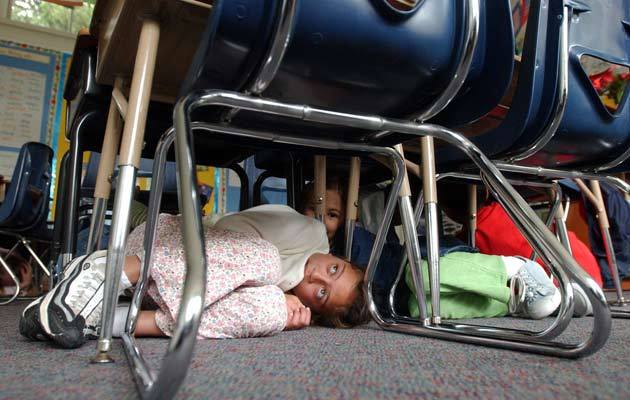
The counselor warned me that my little one’s class would conduct a lockdown drill – the first the kids had ever experienced.


With everything in the news about school shootings and the gun debate, the superintendent and principals thought they should prepare for the worst, even though they doubted anything like that would actually happen here.


The counselor just wanted me to be aware what was happening and to prepare my daughter for it so she wouldn’t be scared.


I thanked her for the call, and went in the other room to speak to my 9-year-old sweetie.


She was hunkered on the floor drawing pictures of her toys.


Mario and Luigi were chasing a purple Yoshi. Captain America was playing soccer with Wonder Woman. That kind of thing.


I opened my mouth — and my throat closed up.


I couldn’t do it. I didn’t want to do it.


What would I say? —-Hey, Honeybunches. You’re going to have a lockdown drill at school tomorrow. Your class is going to prepare in case a gunman breaks in and tries to murder you.


She was staring at me now, Mario’s hat half colored in.


So I put on my teacher’s cap and explained everything that would happen, but not why.


She was completely unfazed.


“That’s all? Can I go back to coloring now?” she asked.


I nodded.


I didn’t want to make a big deal of it, but I wondered how she’d react. This was a girl who in kindergarten had cried at the violence of a fire alarm.


So the next day came and went – no mention from her about what had happened at school.


She wasn’t traumatized. She was her usual self – frustrated at her homework, bargaining for a snack, writing an autobiography of her soccer career that would start next fall when she signs up.


I waited a week and then asked her about what had happened.


In the most matter of fact voice, she told me how her third grade class had stood away from the door, clustered in one corner of the room holding books.


“Why books?” I asked, thinking that maybe the drill had gone on too long so they had something to read.


She said they were to throw at a bad guy if he sneaked into the room.


I imagined a gunman in my daughter’s classroom trying to spray the children with bullets only to be met by a hail of tossed books – Dr. Seuss vs. Smith & Wesson.


Then I envisioned her teacher pulling out a revolver and returning fire through the swarm of terrified elementary school bodies darting back and forth.


The shock must have shown on my face.


“Don’t worry, Daddy,” she said. “No one broke in.”


As usual, children do better with this stuff than adults.


But the reason why is exceedingly troubling.


They are still forming their concept of normality.


When I went to school, we never had lockdown drills. We had monthly fire drills and the occasional severe weather drill. But we never prepared for crazed murderers and terrorists. That just wasn’t in our routine or even our conception of what a school should do.


Yet it is now routine for my daughter. It is typical for most children these days.


As a teacher in a neighboring district, I had to preside over my own first lockdown drill with my 7th graders a few weeks earlier.


We clustered in a corner on the floor – the door locked, the lights off.


My class of rambunctious teens who rarely seem able to do anything without a constant stream of words was nearly silent.


The worst part was how I felt trying to downplay what we were doing.


Nothing to see here, kids. Just an ordinary day pretending to hide in a corner so a killer would pass us by.


And now after the drill, I keep my classroom door locked at all times.


It’s a huge inconvenience having to stop what you’re doing and physically open the door anytime someone wants to come in. But it’s what we have to do to bolster our sense of security.


It’s our new normal.


And I don’t like it.


It just seems to me like another way my generation has failed our children.


We’ve always known our gun laws are insane. We knew there should be SOME sensible regulations on who can buy a gun and where and why. We knew there was no good reason to allow civilians to own automatic weapons.


But we did nothing.


Okay, a few of us spoke up now and again. It did no good. Our lawmakers just waited out our outrage and kept pocketing the money from the NRA and the gun lobby.


And now we’ve accepted that school shootings are just another part of getting an education.


It’s just something else to prepare for – like a grease fire in the cafeteria or a flooded gymnasium.


I’m sorry, but this is not normal.


I refuse to let this be just another possible disaster we feel compelled to add to our list of Might Happens.


Thankfully, protestors are still out there demanding action from our politicians. Thankfully, demonstrations and town halls are still in the works like the April 20th National School Walkout.


But our leaders still think they can wait us out. And these lockdown drills feel too much like an admission that they’re right.


What sense of urgency do we have if we’ve already incorporated shootings into the calendar?


I’ll accept that these drills are necessary. But I won’t accept them as permanent.


These are temporary measures at best.


However, that’s something that must be made explicit. Lockdown drills cannot become a tradition, common, conventional.


It shouldn’t be – “Time for the occasional lockdown drill.”


It should be – “Look what our cowardly politicians are forcing us to do because they haven’t enough spine to stand up to the NRA!”


We mustn’t lose our sense of outrage over this cultural shift. Because if we do, the necessary political change will not come.


We need sensible gun regulations – not another B.S. duck and cover exercise to engender a false sense of security and pop our civic resolve.


hero-gun-control_tcm7-223281


Like this post? I’ve written a book, “Gadfly on the Wall: A Public School Teacher Speaks Out on Racism and Reform,” now available from Garn Press. Ten percent of the proceeds go to the Badass Teachers Association. Check it out!

book-4

Respecting Student Free Speech Was Hard for Adults During Today’s School Walkout

BN-XV995_WALKOU_M_20180314111108


The kids are all right. It’s the adults you have to watch.


The walkout planned nationwide to protest gun violence today on the one-month anniversary of the Parkland shooting came to my western Pennsylvania school – and we weren’t ready for it.


In fact, up until today no one had mentioned a thing about it.


I had asked teachers if they wanted to do something and was told it was up to the students to lead.


I had asked the high school student council if they were interested in participating, but there wasn’t much of a response.


Then this morning in the middle school where I teach, there was an impromptu two minute meeting where we were told some kids might walk out and that we should just let them go.


Their right to free speech would be respected and there wouldn’t be any penalty for participating.


However, as a teacher, I was instructed not to bring up the subject, not to allow discussion and only to attend if all of my students decided to go.


That’s a hard position to be in.


It’s like being put in a metaphorical straight jacket.


But I tried.


When my 7th grade kids came in, they were all a buzz about something and I couldn’t really ask why.


The suspense was broken with a sledge hammer during second period when one of my most rambunctious students asked if he could use the restroom at 10 am. That was over an hour away.


I told him he couldn’t reserve an appointment for a bathroom break but he could go now if he wanted.


Then he explained himself. At 10 am he was walking out.


The room exploded.


They had heard about the nationwide walkout at 10 – the time of the Parkland shooting. They knew kids all across the land were leaving class for 17 minutes – 60 seconds for each life lost in the shooting.


But that was pretty much it.


They didn’t know what it was that kids were protesting. They didn’t know why they were protesting. They just knew it was something being done and they wanted to do it.


It was at this point I took off my metaphorical straight jacket.


I couldn’t simply suppress the talk and try to move on with the lesson – on propaganda, wouldn’t you believe!


We talked about the limits of gun laws – how some people wanted background checks for people wishing to purchase guns. We talked about regulating guns for people with severe mental illnesses, criminal backgrounds or suspected terrorists. We talked about how there used to be a ban on assault weapons sales and how that was the gun of choice for school shooters.


We even talked about what students might do once they walked out of the building.


They couldn’t just mill around for all that time.


Since we were in the middle of a unit on poetry, someone suggested reading poems about guns and gun violence.


Students quickly went on-line and found a site stocked with student-written poetry on the issue – many by students who had survived school shootings.


I admit I should have checked the site better – but we had literally minutes before the walkout was scheduled to take place.


Some of the poems contained inappropriate language and swear words. But they were generally well written and honest. And the kids liked them.


I let them print a few that they wanted to read aloud at the demonstration.


They were actually huddled around their desks reading poetry and practicing.


They were really excited about the prospect of standing up and being counted – of letting the world know how they felt.


One student even wrote her own poem.


She said I could publish it anonymously, so here it is:


“Pop! Pop! Pop!


Everyone crying, calling their parents, saying their last goodbyes.


Screams echo throughout the building.

Blood painting the white tiles.

Bodies laying limp on the ground

Screams of pain

Bullets piercing our skin.


Yelling and sobbing increase.

We are escorted out.


‘Is this what you wanted?’”


I barely had time to read it before the time came.


Students stood up and were confused by the lack of an announcement.


But this was not a sanctioned school event. If they took part, they were on their own.


It was my smallest class and several kids were already absent.


They all left and were immediately met by the principal and security. To their credit, the adults didn’t stop them, but they told them not to put their coats on until they were outside and to otherwise quiet down.


I made sure to emphasize that anyone who wanted was welcome to stay in class. But no one did.


After the last child left, I grabbed my coat and followed.


When I got to the front of the building I was surprised by the lack of high school students. There were only a handful. But there were maybe 50 middle school kids.


When the principal saw all my students had decided to participate, he asked me to stay in the lobby. He said it wasn’t necessary for me to attend.


That was hard.


I wanted to be there, but I didn’t want to be insubordinate, either.


My students were expecting me to be there. They were expecting me to help guide them.


So I stood in the doorway and watched.


Students did as I feared; they pretty much milled around.


A few of my students held their poems in hand and read them quietly together but there were no leaders, no organization.


After about 5 minutes, the adults pounced.


The resource officer criticized them since their safety was more at risk outside the building than in class. Administrators chastised the collective group for having no plan, for only wishing to get out of class, for not knowing why they were there and for not doing anything together to recognize the tragedy or the issue. They said that if the students had really wanted to show respect to those killed in Florida they would have a moment of silence.


The kids immediately got quiet, but you can’t have a 17-minute moment of silence. Not in middle school.


I saw some of my kids wanting to read their poems aloud but too afraid to call the group’s attention to themselves.


And then it was over.


The whole thing had taken about 10 minutes.


Administration herded the kids back into the building early and back through the metal detectors.


I can’t help feeling this was a missed opportunity.


I get it, being an administrator is tough. A situation like today is hard to stomach. Kids taking matters into their own hands and holding a demonstration!?


We, adults, don’t like that. We like our children to be seen and not heard.


We want them to do only things that will show us in a better light. We don’t like them taking action to fix problems that we couldn’t be bothered to fix, ourselves.


But what right do we have to curate their demonstration?


If they wanted to mill around for 17 minutes, we should have let them.


Better yet, we could have helped them organize themselves and express what many of them truly were thinking and feeling.


If I had been allowed out of the building, I could have called the assembly to order and had my kids read their poems.


But doing so would have been exceedingly dangerous for me, personally.


I can’t actively defy my boss in that way. It just didn’t seem worth it.


If we had had warning that this might happen and planned better how to handle it, that also might have been an improvement.


Imagine if the school had sanctioned it. We could have held an assembly or sent a letter home.


The teachers could have been encouraged to plan something with their students.


Obviously if the students wanted to go in another direction, they should have been allowed to do so.


But these are middle school kids. They don’t know how to organize. They barely know how to effectively express themselves.


Regardless of how we, adults, feel about the issue, isn’t it our responsibility to help our student self actualize?


Isn’t it our responsibility to help them achieve their goals?


I don’t know. Maybe I’m just a crazy hippie.


Maybe I’m some radical anarchist.


But I’m proud of my students for taking a stand.


It was unorganized and a mess.


Yet they stood up and did something we, the adults, really weren’t that keen on them doing.


Their message was a muddle.


But they had something to say.


They just haven’t figure out how to say it yet.

Twenty-One Reasons People Hate, Hate, HATE Betsy DeVos

n7kdmgvgx13jmo6cvmpu


Lesley Stahl: Why have you become, people say, the most hated Cabinet secretary?


Betsy DeVos: I’m not sure exactly how that happened…

I’m more misunderstood than anything.


The above exchange from last night’s 60 Minutes interview highlights an important point about our Education Secretary.


She is deeply unpopular, but not because she’s misunderstood. If anything, she’s understood too well.


We know what she stands for and we don’t like it.


If she was really so misunderstood, why didn’t her answers in the interview veer away from the same usual canned responses she’s given time-and-time-again to the same type of questions?


What’s wrong with schools? NOT ENOUGH CHOICE.


How do we prevent school shootings? LET SCHOOLS ARM TEACHERS.


You didn’t really even need DeVos to show up to the interview to be able to guess with a high degree of accuracy what her answers would be.


In fact, many of her responses seemed to have been coached – as if someone had prepared her with talking points before the interview even took place.


So without further ado, here is my exhaustive list of all the reasons I can think of why people really, REALLY hate Betsy Devos. If I’ve left something out, please feel free to add it in a comment.


WHY PEOPLE HATE BETSY DEVOS:


1) She didn’t earn her position as Education Secretary. She bought it. And even then it took a tie breaking vote by Vice President Mike Pence to shove her down our throats.


2) She wants to spend tax dollars to boost privatized schools in which she has a financial stake.


3) She doesn’t mind taking funding away from public schools to do it.


4) She wants to destroy the entire system of public schools which enroll 90% of America’s children.


5) She doesn’t really know what public schools are, having never attended one or having never sent her children or grandchildren to one.


6) She wants to arm teachers not because it will protect kids from school shooters, but because that boosts her family’s investment portfolio. (i.e. her brother’s mercenary army for hire, Blackwater)


7) She won’t make charter and voucher schools give the same services to special education kids as those provided by traditional public schools.


8) She’s getting rid of students’ civil rights protections while adding protections for nefarious student loan providers and fly-by-night on-line schools.


9) She’s rescinded rules that protected trans students.


10) She’s considering rescinding rules that protect minority students from being unfairly and disproportionately disciplined by schools.


11) She’s made it harder for victims of sexual assault and harassment to report abuse and easier for those accused to avoid prosecution.


12) She talks about state’s rights to determine their own education systems while using the power of the federal government to coerce them to doing things her way.


13) She wastes public tax dollars. She is the only Cabinet member protected by Federal Marshals, which costs us nearly $1 million a month. Whether this is necessary or not, as a billionaire she could save the taxpayers money by taking on this cost, herself.


14) She doesn’t care if the public doesn’t want her at their school or event. She goes anyway and then pretends to be angry that protestors showed up. She doesn’t seem to understand that as a public servant she should serve at our pleasure – not the other way around.


15) She uses tragedy as a photo-op – as she did when she visited the Parkland school to promote arming teachers. She didn’t meet significantly with students or staff. She didn’t listen to their concerns. She even bailed on her own press conference there when the queries weren’t to her liking.


16) She has no problem whitewashing black history as she did when she claimed historic black colleges were pioneers of school choice. In reality they had no choice. For many African Americans at the time, it was create black colleges or forgo post-secondary education at all.


17) She is ignorant (purposefully or not) of the results of her own policies. Her advocacy of school choice in her home state of Michigan has weakened that state’s public schools, not strengthened them.


18) She’s out of touch with average Americans. She’s the richest member of Trump’s cabinet and often travels in her on super luxury yacht.


19) She’s rich not because she earned it, but because she was born into it and married into even more wealth. Moreover, much of her wealth is due to her family’s Amway fortune – basically it’s founded on rooking average people out of their hard earned money with what’s essentially a pyramid scheme.


20) She’s arrogant. She smiles vacantly at topics that don’t deserve a smile – they deserve serious regard.


21) She is extremely biased and partisan. She is supposed to serve the public interest, but her radical Christian Fundamentalism and anti-LGBT activism make her untrustworthy to serve in that capacity. Statements such as “There is enough philanthropic dollars in America to fund what is currently the need in education… Our desire is to confront the culture in ways that will continue to advance God’s kingdom,” do not help.


Okay. That’s all I can think of – though more may pop into mind as soon as I publish this. If I missed something please include it in the comments.


Hopefully this answers DeVos’ question about why she’s hated.

When Students Stay Up All Night Playing Fortnite and You’ve got to Teach Them in the Morning

ne13feb40-ALL-addicted-to-video-games-L13FCA50-51A


There is something monstrously unfair about our teacher evaluation systems.


If your students fail because they were up all night playing video games, it’s your fault.


Seriously.


When students fail at academic tasks, there is no responsibility attributed to the students, no responsibility attributed to the parents and certainly no responsibility given to society.


It’s all just thrown on the teacher because, hey, someone’s got to be responsible. And it might as well be them.


I’ve written scores of articles about how standardized tests forced on students by the federal government are unfair.


They are developmentally inappropriate, culturally biased, and subject to a deep conflict of interest because the people making the tests get more money if test takers fail.


The tests drive the curriculum instead of the other way around. The scores needed to pass change from year-to-year invalidating annual comparisons. And many lawmakers pushing for these assessments are funded by the school privatization industry that uses failing test scores to sell its own fly-by-night brand of education.


These are real problems our education system faces every day.


But we mustn’t forget an even more fundamental one: we’re all responsible for student success or failure.


Not just teachers. EVERYONE.


Society, lawmakers, business people, parents – but those most responsible are the students, themselves.


Case and Point—


Over the last few months a word has entered my students’ vocabulary that hadn’t been there before: Fortnite.


It’s not that they’re so interested in an antiquated term for a two-week period. It’s the name of a popular multiplayer on-line shoot-em-up video game for PlayStation 4, Xbox One, Windows, and Mac. Players build forts with teammates to defend against other players or enemies.


Apparently, many of my students got it for Christmas. Or since there’s a free on-line version, they were turned on to it by others who had gotten the deluxe version as a present.


It started as an undercurrent of trash talk. “You suck at Fortnite.” “You can’t beat me on Fortnite.” “You just wish you could take me on Fortnite.”


And then it started to manifest physically.


Those same kids would come in to school with Fortnite Face – glassy red eyes, heads slumped on the table and the inability to stay awake for more than 10 minutes at a time.


It’s not all of my students, but it’s a significant percentage. Almost all boys. And almost all at a distinct learning disadvantage.


Teaching them is like teaching someone in a deep sea diver suit. They can’t really see or hear you very well. And any message you get back from them sounds like it’s coming from the bottom of the ocean.


When I noticed it, I cleared as much of my schedule as I could to call parents. It’s hard because administration decided not to fill positions in my department for teachers who retired last year – so all our classes are larger. And they gave me a new class I haven’t taught in years so the planning load is more cumbersome.


Plus I have as many special education students as legally allowed in every class, which requires mountains of extra paperwork and monitoring for each child.


And of course the phone in my room doesn’t call out and the cell reception is terrible, so I have to move to one of the few phones that will actually allow me to contact parents and try to communicate my concerns.


Most parents I talked to noticed the same things I had. Fortnite was taking over their children’s lives. Their kids were playing the game at every opportunity and ignoring most everything else.


However, most parents I couldn’t reach. Those cricket burner phones get disconnected quick. Others go straight to a voicemail box that’s so full it won’t accept new messages. Others allow me to leave a message that will never be returned.


But sometimes I did get through. And sometimes parents didn’t simply throw up their hands and say they don’t know what to do. Sometimes a parent actually laid down ground rules or took the game away.


However, if I’m being honest, contacting parents did not solve my problem.


I’m not blaming them. Most of my students live below the poverty line. That means their folks are working two or three jobs just to make ends meet. Or they’re grandparents raising their sons’ or daughters’ kids. Or they’re foster parents with a full house.


They’re doing the best they can. But it doesn’t end up stopping the addiction.


And – let’s be honest – it is an addiction.


For the first time in 2018, the World Health Organization recognized video game addiction as a real thing. Not every video game. Not every time someone sits down to play a video game. But video games can lead to addictive behavior.


That’s what I’m seeing in my students.


So after talking with as many parents as I could, I came to a mostly dead end.


My next step was to try to use student interests to influence instruction.


We were in the middle of a poetry writing unit. So I allowed students to write their poems about Fortnite.


That perked up a few heads.


Here’s a cinquain about Fortnite. Here’s an acrostic, a narrative, a concrete poem in the shape of a soldier or his gun.


To be honest, none of them were masterpieces.


They were just the normal trash talk and braggadocio written down in verse.


So I got an idea. Use the heightened competitive urge to push artistry.


We came to limericks – a difficult but fun type of poetry with five lines, a specific rhyme scheme and meter.


We read funny examples, we sang the rhythm together in chorus – da Dum da da Dum da da Dum – and then I set them the task of writing their own limericks.


With one twist. Whoever wrote the best limerick would get a homework pass.


That got them going like a shot.


All of my Fortniters perked up.


They wrote like I’d never seen.


Each wanted to one-up the others. And no one wrote about the game.


By the end of class, we had some pretty good poems. I wouldn’t say they are the best ever written, but they were miles better than where we were before.


So what does it all mean?


When we talk about video games these days, the conversation usually strays toward violence.


Pundits caution that video games will desensitize children and make them more prone to aggression and acting out. It might even contribute to the creation of school shooters.


Wrong.


In general, video games don’t make children more violent. Fortnite is a game where students shoot each other with guns all night long and it hasn’t made my students any more aggressive or violent than they already were.


Many cultures like the Japanese are much more into video games than ours and they have fewer violent incidents or school shootings.


However, video game addiction is a real thing and it impacts learning.


Some corporations want to try to harness this addiction to push learning. Hence the move to personalized or competency based education. That’s pure rubbish.


It’s a way to monetize education without paying attention to what’s best for kids. The same with gamification – using game theory to drive instruction.


And don’t think I’ve lost sight of my own use of competition in class. I haven’t.


Games and competition can be used to positive ends in moderation.


You can motivate reluctant kids to do things they wouldn’t normally do with competition. But it doesn’t work for everyone and it doesn’t work all the time.


It needs to be a novelty. Any tool can be overused.


Even video games aren’t bad in moderation. I used to be a gamer, myself.


The problem is when it becomes an addiction.


Our social structures can’t handle it.


Game corporations only care if it makes money. Parents are often stressed to the limit just to provide the basics.


The only group we require to be responsible is teachers.


And that’s just not going to work.


Video game addiction is another area where it becomes painfully clear how much work we all need to do to help our children succeed.

Arming Already Stressed Out Teachers Will Only Increase the Chance of School Shootings

1541539


It happened in Georgia yesterday.


A beloved social studies teacher locked himself in his classroom while his students stood outside the door.


When the principal came with the key, the teacher fired a handgun through an exterior window.


Students ran, one even twisting her ankle in the escape.


Thankfully, no one else appears to have been injured.


However, the incident brings into focus a vital component of the gun debate.


Teachers are already under tremendous stress.


Arming them won’t stop gun violence. All it does is add another potential shooter.


It’s only been about two weeks since a shooting at Stonemason Douglas High School in Florida left 17 dead.


That’s at least 19 school shootings so far in 2018 – and it’s only the beginning of March!


In that time, the national media and the Trump administration have focused on one specific solution to stopping such violence from happening again: giving teachers guns.


The latest incident in Georgia underlines why this is such a terrible idea.


Teachers are not super heroes.


Take it from me. I’m an almost 15 year veteran of the middle school classroom in western Pennsylvania.


We’re just human beings.


My colleagues and I have all the same human failings and weaknesses as everybody else.


We get tired and overworked and put upon and stressed and sometimes…


…Sometimes we don’t handle it well.


I know some people don’t want to hear it.


Society has piled all kinds of responsibilities and unreasonable expectations on our shoulders.


We’re no longer allowed to be just educators.


We’re parents, counselors, disciplinarians, doctors, psychologists, lawyers, nutritionists…. The list goes on-and-on.


And now politicians actually want us to add law enforcement to the job description?


We’re already under colossal pressure, and some folks want to add a gun to that situation?


That’s lighting a fuse.


But don’t just take my word for it.


Back in 2015, tens of thousands of educators filled out the Quality of Worklife Survey conducted by the American Federation of Teachers and the Badass Teachers Association.


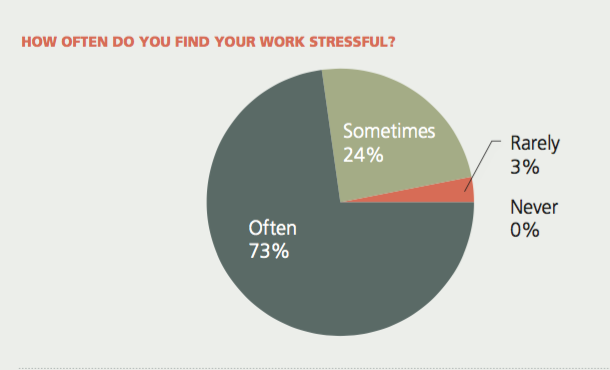
After responses from 91,000 school employees and 31,000 who completed the entire 80-question survey, a picture of the emotional landscape became clear.


A total 73% of respondents said they often feel stressed at work.

Screen Shot 2018-03-01 at 12.48.15 PM

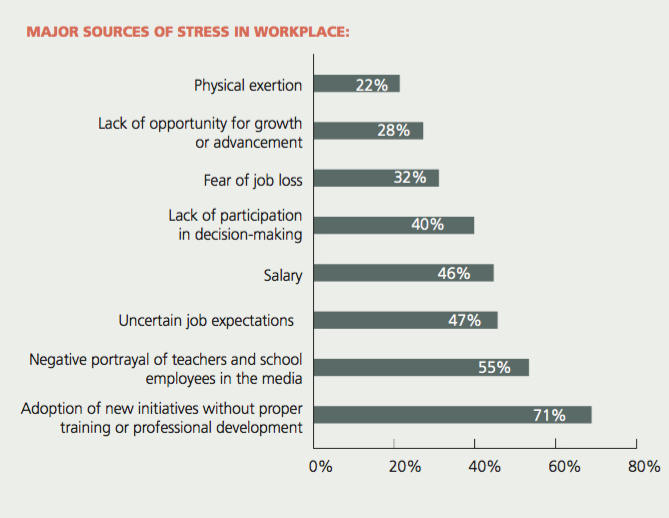
The reasons? Adoption of new initiatives without proper training or professional development (71%), negative portrayal of teachers and school employees in the media (55%), uncertain job expectations (47%) and salary (46%) were the most common responses.

Screen Shot 2018-03-01 at 12.48.58 PM

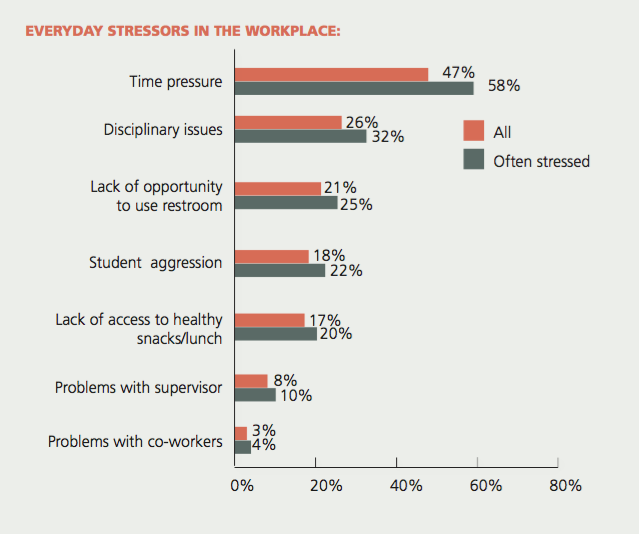
The survey identified the following as most common everyday stressors in the workplace – time pressures, disciplinary issues and even a lack of opportunity to use the bathroom.

Screen Shot 2018-03-01 at 12.49.11 PM

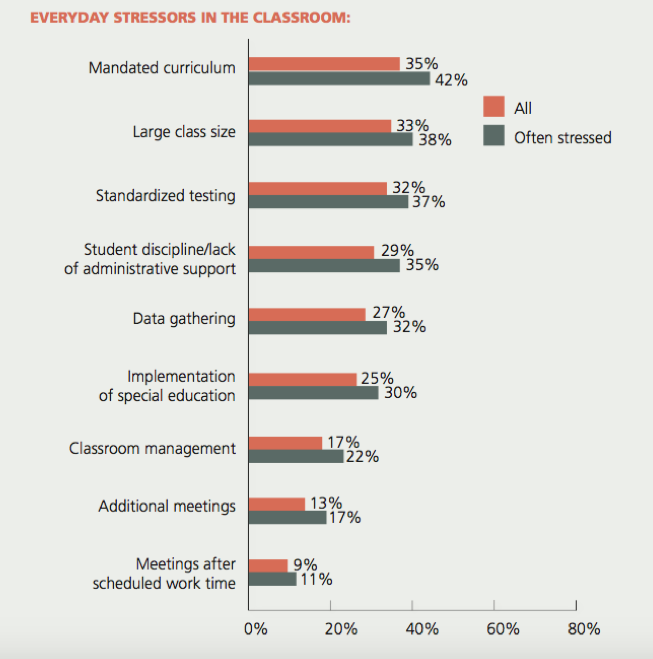
Focusing just on the classroom, top stressors were mandated curriculum, large class sizes and standardized testing.

Screen Shot 2018-03-01 at 12.49.35 PM

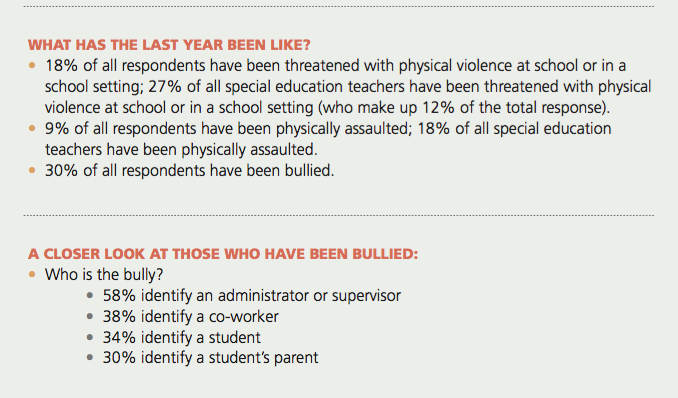
Many teachers claimed to be the victims of violence at school.


A total 18% of all respondents said they had been threatened with physical violence – though the percentage jumped to 27% when looking solely at special education teachers.


A total of 9% of all respondents claimed to have been physically assaulted at school. Again the percentage jumped to 18% of all special education teachers.


But it’s not just physical assault.


A total of 30% claim to have been bullied by administrators (58%), co-workers (38%), students (34%) and student’s parents (30%).

Screen Shot 2018-03-01 at 1.03.57 PM

This is the situation where policymakers want to throw firearms.


Most gun violence doesn’t involve a shooter doing harm to others. The great majority of gun deaths are self-inflicted.


Even without adding guns to the mix, several high profile teachers and administrators already have committed suicide.


In October of 2010, for example, a California elementary school teacher named Rigoberto Ruelas, Jr. took his own life after the Los Angeles Times published a report labeling him a “less effective teacher.” Despite the fact that students and parents praised Ruelas, who taught in one of poorest schools in his district and who also was born, raised and continued to live in area where his school was located, the Times targeted him among other so-called “less effective” teachers as part of a major propaganda campaign.


And this isn’t an isolated incident. In July of 2015, a New York City principal under investigation for altering Common Core test scores, killed herself by jumping in front of a subway car.


Adding guns to this situation will just mean more teachers taking their own lives with a bullet.


That may have been the intent of the Georgia teacher in yesterday’s shooting.


Local police said they didn’t think he was trying to injure anyone else. When he shot his gun out of the window, he appeared to be trying to get others to leave him alone.


Arming teachers is a terrible solution to school violence. It’s taking an already stifling room and turning up the heat.


We need sensible gun regulations to reduce the pressure, not increase it.


We need sensible school policies that treat teachers and students like human beings and not just cogs in the system.


But this requires us to break out of a dangerous pattern in how we deal with social problems.


When we see a problem, we generally just shrug and leave it up to public schools and teachers to solve.


Inadequate resources – leave it to teachers to buy school supplies out of pocket.


Inequitable funding – increase class size and leave it to teachers to somehow make up the difference.


We can’t do the same with gun violence. We can’t just toss teachers a gun and tell them to sort it out.


Teachers can’t solve all of society’s problems alone.


That’s going to take all of us.


And we’ll need more than disingenuous proposals like answering gun violence with more guns.