Does that sound crazy? Does it sound ideological, partisan, or close-minded.
I don’t think so.
Imagine if we said the same thing about tyrannies and democracies.
There are good tyrannies.
There are bad democracies.
Still, I’d prefer the worst democracy to the best tyranny.
Why?
Because even a badly run democracy is based on the principle of self rule. The government gets its right to make and enforce laws from the consent of the will of the governed.
Even if our representatives are corrupt and stupid, even if our federal, state and local agencies are mismanaged and disorganized – there is the potential for positive change.
In fact, the catalyst to that change is embedded in democracy, itself. Egalitarian systems founded on the principle of one person, one vote tend toward fairness, equity and liberty much more than others.
Bad leaders will be replaced. Bad functionaries will be retrained or superseded. Bad agencies will be renovated, renewed, and made to serve the will of the people.
However, in a tyranny, none of this is true.
Even if you have a benevolent tyrant who does nothing all day but try to do whatever is best for his or her subjects, that is a worse state of affairs.
Eventually the tyrant will change. Absolute power will corrupt him or her absolutely. Or even if this bastion of human goodness is incorruptible, he or she will eventually be deposed, replaced or die.
And there is nothing – absolutely nothing – to ensure the next tyrant is likewise benevolent. In fact, the system is set up to increase the likelihood that the next ruler will be as selfish, greedy and malevolent as possible.
This is because it is the system of tyranny, itself, that is corrupt – even if those that fill its offices are not.
If you can find a charter school that does none of these things – congratulations! You have found a diamond in the rough! But it is a diamond that is more likely to turn to coal the second you turn away.
Let’s say you find the rare charter school run by an elected school board. THEY AREN’T REQUIREDTO DO THAT. Organizers could at any time revert to an appointed board. Community members could be making all the decisions when you send your child to school, but by dismissal time they could have all been replaced with flunkies appointed by the private business people who took out the charter from the state in the first place!
Let’s say your charter school has open meetings and public documents. They invite the public to their deliberations. They take public comment and share all their internal communications with taxpayers and the media. THEY AREN’T REQUIREDTO DO THAT. They could close the doors any day they wanted. And there’s nothing you could do about it.
All these things that are optional at a charter school are required at public schools. Not just some public schools – ALL OF THEM!
Public schools are required to have elected school boards (unless taken over by the state). They are required to have open meetings and public documents. They are essentially democratic, whereas even the best charter schools are only democracies because of someone’s goodwill. When the wind changes, so will their system of government.
First of all, if the school doesn’t have open meetings and public documentation, you have no way of knowing whether these lotteries are fair and unbiased. Operators are often charged with cherry picking the best and brightest and denying students with disabilities or behavioral problems – they’ve even been known to discriminate based on race and class.
Second of all, even if your charter school is one of the magical few that just does the right thing with no oversight, THEY AREN’T REQUIREDTO DO THAT. Once they figure out how much money they can save by only accepting the cheapest students to educate, inclusive enrollment policies will be a thing of the past. And you’ll probably never even know the difference.
Offering French AND Spanish? Adios muchachos. And bonjour to a fistful of dollars going directly into their bank accounts.
All of that is perfectly legal even though it’s your money they’re collecting – money you put aside to help your child learn – there’s not a thing you can do about it.
Call me crazy, but I think there’s something wrong with that.
I think that’s worse than even the most decrepit public school.
If a public school has a terrible school board, they can be replaced. In fact, they most certainly will be given time. With each bad policy and unpopular decision, bad school directors motivate taxpayers to vote them out.
So, no, I don’t think it’s unreasonable to be so positive about public schools and so negative about charter schools.
The problem with privatized education isn’t just specific to individual schools. It is a feature of the very kind of school we’re talking about in the first place.
Charter schools are at heart a less democratic system than public schools.
It’s called the Opportunity Scholarship Tax Credit Program (OSTCP) – a ridiculous bit of legislation that allows children in struggling public schools to use public tax dollars to pay for tuition at a private or parochial school.
I’d say they could use that money at a participating public school, too, but in Pennsylvania the public schools taking part in the program can be counted on one hand with fingers to spare.
And why does my school now qualify for this dubious distinction? Because of our standardized test scores.
Not our test scores from this year. They won’t be released until at least June – more likely August or September.
This is based on test scores from last year – 2016-17.
Moreover, it’s not district wide. It’s just the middle school and one elementary school.
In previous years, the middle school was the district powerhouse. We had the highest test scores and the most innovation. So what happened?
About 60% of our students are poor and/or minorities. Yet if you go a few miles north, south, east or west, you’ll find schools serving every flavor of white privilege. Beautiful big buildings with the best of everything and a tax base to pay for it. My district, on the other hand, is made to do the best it can with what we’ve got, which isn’t much.
Though we only have one middle school and one high school where all our students rub shoulders, we have two elementary schools – one for the middle class white kids and one for the poorer black ones.
This has dramatic academic consequences. Kids at the better-resourced white school flourish scholastically more than kids from the crumbling black school. So the racial and economic skills gap becomes entrenched by the time kids move to the middle school in 6th grade.
If only we could integrate the elementaries.
However, we can’t bus kids from one neighborhood to the other because we can’t afford it. We have a walking district. Moreover, parents would revolt at the idea of elementary kids having to trudge long distances or take a city bus to school.
The only long-term solution is to create a new, centrally located elementary center serving both populations. However, that takes money we don’t have.
So last year we tried a partial solution – move the 5th grade up to the middle school. That way, we can at least integrate our students a year earlier.
Of course, this means taking kids from the black school with terrible test scores up to the middle school. This means adding more struggling students from the school that already is on the state’s bottom 15% list and making them the middle school’s responsibility. It means a new program, new trials and challenges.
You’d think we’d get praise or at least understanding for tackling such a problem. But no.
Taking on the 5th grade tipped the middle school’s test scores over the edge.
Now we’re in the bottom 15%, too. Now we have to let our students go to a private or parochial school with public tax dollars.
Why? Because we tried to right a wrong. We tried to correct a social and academic injustice. And the result was a kick in the gut.
Thanks, Harrisburg legislators! Way to support students of color!
Why would anyone integrate if doing so could mean losing funding and looking like a failure in the press?
Moreover, forget all the junk you hear from the state about growth.
This penalty is based on whether we hit testing benchmarks – what percentage of students we have earning proficient or advanced on the tests. It doesn’t matter how much they’ve improved. It doesn’t matter if they’ve gone from the lowest of the low to scratching at the ceiling of proficient.
My 8th graders last year (the year we’re being penalized for) experienced tremendous growth just like my students this year are doing. From where they came in to where they’re leaving, the difference is phenomenal!
But apparently that doesn’t count in Pennsylvania.
Wow! I can’t imagine why so few parents take advantage of that opportunity! My district has had a few schools on the OSTCP list before, and families overwhelmingly opt to stay put.
Let’s not forget the justification for this “opportunity” is low test scores.
Wait a minute. These cooperating private and parochial schools don’t even take the same standardized tests, if they take any at all.
In our community, there is only one cooperating private school – a catholic school located right next door.
What a great way to improve test scores for our students – comparing apples-to-pears or, to be honest, actually making no comparison at all.
This OSTCP law is based on an unjustified assumption that private schools are always better than public ones. The reality is that if the resources both schools receive are similar, the public school usually greatly outperforms the private or parochial one.
I’ve seen this first hand. I’ve toured our next door Catholic institution. A few years ago, we relocated our students there temporarily during an emergency drill.
It’s a quaint school. Cobblestones and a shaded green campus.
But the buildings are crumbling – especially on the inside. Watermarks on the walls and dirt collecting in the corners.
It’s also much smaller than my school. They only have less than 300 students from K-8. We have about 1,500 from K-12.
I can see why parents who graduated from that school and have a history with it might want to send their kids there to continue that legacy. But anyone else would be giving up much better facilities, a much wider curriculum, much better trained and experienced teachers and even smaller classes!
The OSTCP bill has nothing to do with providing better opportunities for children and families.
The private/religious schools benefit and so do the businesses who “donate” their taxes to these programs.
In 17 states you can get substantial tax credits for contributing to this scam.
Louisiana, Oklahoma, Pennsylvania, Rhode Island, and Virginia, for example, all provide tax credits worth between $65 and $95 on every $100 donated. Alabama, Arizona, Georgia, Montana, and South Carolina go even further by reimbursing 100% of the donation. You read that right. Donate $100, get $100 back.
Oh, but it gets much worse. Since these are considered donations, you can also claim them as charitable deductions and get an additional 35% off your taxes. So you donate $100 and get back $135! Yes. You actually make money off this deal!
In Pennsylvania, investors can even “triple dip” receiving a state tax credit, a reduction in their state taxable income, and a reduction in their federal taxable income. And, yes, that means they sometimes get back more in tax breaks than they provide in contributions.
Meanwhile all of these “savings” come from money stolen from local public schools like mine. Businesses and individual investors are profiting off the industrial testing complex.
In the Keystone state, we have the OSTCP and the Educational Improvement Tax Credit (EITC).
This blatant swindle is championed on both sides of the political aisle.
We already waste $200 million in business taxes to these programs in the Commonwealth, yet both Democrats and Republicans keep trying to pass another bill to increase that sum by another $50 million.
Because of this bogus philanthropy, there will always be a bottom 15% of state schools – approximately 400 “failing schools” – that are ripe for the picking from private and parochial school vultures.
When asked point blank, no one wants to admit to liking it.
To paraphrase Motown singer songwriter Edwin Starr:
“Segregation. Huh, Good God.
What is it good for?
Absolutely nothing.”
However, when it comes to supporting actual integration programs or even just education policies that don’t make segregation worse, no one in politics really gives a crap.
Both Republicans and Democrats are heavily invested in ways to divide up school students along racial and economic lines – whether they be charter and voucher schools or strategic disinvestment in the public schools that serve the poor and minorities and hording resources for wealthy whites.
Trump nominated the extremely partisan justice for a federal judgeship in Louisiana. Yet during a Senate hearing Wednesday, Vitter refused to answer a question from Sen. Richard Blumenthal (D-Conn.) about whether or not she believed the Supreme Court was right in its landmark 1954 decision, Brown v. Board of Education.
And Vitter couldn’t bring herself to affirm this ruling.
“If I start commenting on ‘I agree with this case’ or don’t agree with this case,’ I think we get into a slippery slope,” she said.
“I don’t mean to be coy, but I think I get into a difficult area when I start commenting on Supreme Court decisions which are correctly decided and which I may disagree with,” Vitter said.
She added that the ruling was “binding” and that she would uphold it if confirmed as a judge.
And there we have it, people.
That’s where the bar is set during the Trump administration.
You no longer need to pretend to be against school segregation.
On the one hand, it’s more honest than most people in the political arena.
On the other, how far have we sunk when you don’t even need to feign decency in order to expect having a chance of Congress confirming you?
Let me be clear. Vitter’s nomination should not be approved.
Congress should draw a line in the sand and say that it cannot accept people who do not share bedrock American values on the bench.
What actually happens to Vitter will probably be determined by the degree of backlash against her.
As of Thursday afternoon, the video clip of Vitter’s comments about Brown V. Board had more than 1.7 million views, and was retweeted over 13,000 times.
A few months ago, another Trump judicial nominee, Matthew Petersen, withdrew from consideration after a video in which he couldn’t answer basic legal questions went viral.
But even if this reprehensible person who has no right sitting in judgement over anything more taxing than a checkbook gets turned away from the bench, we’ll still be far from where we need to be on school segregation.
At most, you get a news story every anniversary of Brown v. Board about the increased segregation and a journalistic shrug. Well, we don’t know how to solve that one…
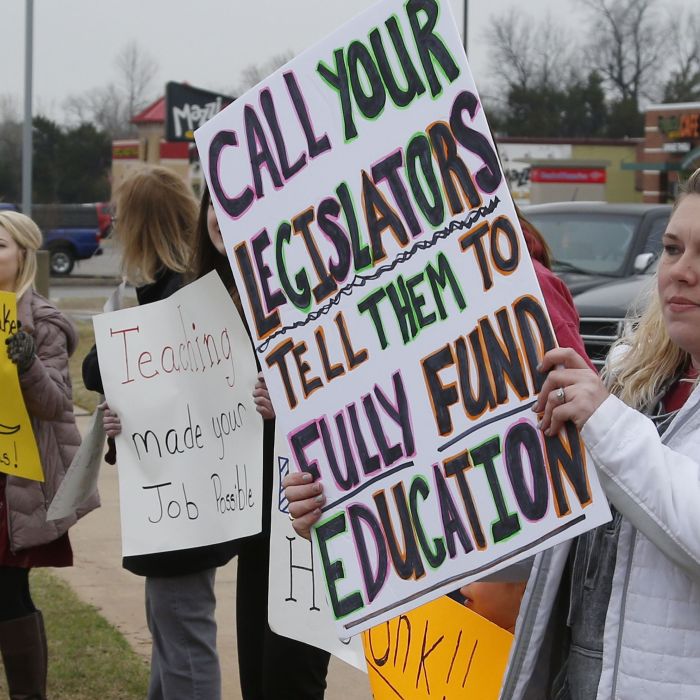
America’s teachers are taking to the streets by the thousands.
In West Virginia, Oklahoma, Kentucky and soon to be Arizona and Puerto Rico, educators are leaving the classroom and storming their state capitals.
Why?
Not because they’re greedy. Not because they don’t want to do their job. But because this country doesn’t care enough to provide them the resources they need to do it.
America only cares about middle class and wealthy kids, preferably if their skin has a melanin deficit.
Don’t believe me?
Just look at how much these states have cut education funding. Look at how the federal government has slashed financial assistance. Look at how districts are forced to increasingly rely on local tax revenues to pay for the kind of education their children receive.
For the dark and the destitute, this means larger class sizes, out of date text books, and narrowed curriculum. It means fewer tutors, reading specialists and librarians. It means being left to your own devices to deal with the effects of generational poverty which put them behind their wealthier, lighter peers before they even enter kindergarten. It means greater emotional disturbance, greater malnutrition, higher absences, more learning disabilities, and less help to deal with any of it.
On the other hand, for the economically privileged white kids, it means just the opposite – fewer social problems, and the best of everything to deal with whatever issues they have.
Don’t refuse us the money to get it done and then blame us for the results.
That’s why there was a 9-day teachers strike in West Virginia which won educators a 5% raise in February.
That’s why 30 districts closed in Kentucky this week after a statewide sick out inspired by the legislature’s plan to cut pension benefits.
That’s why thousands of teachers in Oklahoma walked out this week demanding higher wages and better school funding.
And it’s why educators in Arizona, Puerto Rico and other states and territories may be next.
When you deny teachers the basics necessary to do their jobs, you’re refusing your responsibilities toward children.
When you deny educators a fair wage, you’re discouraging young people from entering the profession and encouraging those already there to seek work elsewhere.
And that is what we’re talking about here – a fair wage. We’re not talking about teachers getting rich off the taxpayers dole. You’re asking us to get an advanced education and do a hard job – that requires a middle class income so we can pay off our student loans and support our families.
The same goes for pensions. When teachers took their jobs, a fair pension was part of the contract. You promised that after 30-some years, educators could retire and you’d take care of them. You can’t renege on that. And if you plan to offer less for those coming in to the field, you’re going to get fewer high quality teachers willing to take the job.
When you attack unions and union benefits, you’re really attacking students. A teacher who can be fired at the whim of an administrator or school director is not as affective at her job. She has less autonomy and freedom to do what is right for her given students. And she has less reason to take a chance on the profession in the first place.
This is why there’s a so-called teacher shortage in most states. As a society, we’ve become less-and-less willing to pay for teachers to do their jobs. We’ve become less-and-less willing to offer them the independence and respect necessary to get things done.
Why?
Because we’ve swallowed a pack of lies from the business community.
But only for the poor and minorities. The affluent and middle class white kids will still get the best money can buy. It’s only those other kids they’re willing to feed to the wolves of edu-profit.
THAT is what educators are fighting.
THAT is why teachers across the nation are striking.
We’re demanding this nation does right by its public school students.
Some things are just intrinsically valuable. And that’s not some mystical statement of faith – it’s just what it means to be human.
Take education.
Economists love to pontificate on every aspect of the student experience – what’s most effective – what kinds of schools, which methods of assessment, teaching, curriculum, technology, etc. Seen through that lens, every tiny aspect of schooling becomes a cost analysis.
In it, Caplan, a professor of economics at George Mason University, theorizes why schooling is pointless and thus education spending is a waste of money.
His argument goes something like this: the only value of an education is getting a job after graduation.
Businesses only care about school because they think it signifies whether prospective employees will be good or bad at their jobs. And students don’t care about learning – they only care about appearing to have learned something to lure prospective employers. Once you’re hired, if you don’t have the skills, employers have an incentive to give you on the job training. Getting an education is just about getting a foot in the door. It’s all just a charade.
No wonder economics is sometimes called “The Dismal Science.” Can you imagine having such a dim view of the world where THAT load of crap makes sense?
We’re all just worker drones and education is the human equivalent of a mating dance or brilliant plumage – but instead of attracting the opposite sex, we’re attracting a new boss.
Bleh! I think I just threw up in my mouth a little bit.
This is what comes of listening to economists on a subject they know nothing about.
I’m a public school teacher. I am engaged in the act of learning on a daily basis. And let me tell you something – it’s not about merely signifying.
I teach 7th and 8th grade language arts. My students aren’t simply working to appear literate. They’re actually attempting to express themselves in words and language. Likewise, my students aren’t just working to appear as if they can comprehend written language. They’re actually trying to read and understand what the author is saying.
Students are engaged in the activity of becoming themselves.
Education isn’t a transaction – it’s a transformation.
When my students read “The Diary of Anne Frank” or To Kill a Mockingbird, for example, they become fundamentally different people. They gain deep understandings about what it means to be human, celebrating social differences and respecting human dignity.
Caplan is selling all of that short because he sees no value in it. He argues from the lowest common denominator – no, he argues from the lowest actions of the lowest common denominator to extrapolate a world where everything is neatly quantifiable.
It’s not hard to imagine why an economist would be seduced by such a vision. He’s turned the multi-color world into black and white hues that best suit his profession.
In a way, I can’t blame him for that. For a carpenter, I’m sure most problems look like a hammer and a nail. For a surgeon, everything looks like a scalpel and sutures.
No one seems all that interested in my economic theories about how to maximize gross domestic product. And why would they? I’m not an economist.
However, it’s just as absurd to privilege the ramblings of economists on education. They are just as ignorant – perhaps more so.
It is a symptom of our sick society.
We turn everything into numbers and pretend they can capture the reality around us.
This works great for measuring angles or determining the speed of a rocket. But it is laughably unequipped to measure interior states and statements of real human value.
–THE RIGHT OF ENROLLMENT, so school operators get to choose whether your child gets to attend, unlike public schools which have to accept your child no matter what – so long as you live in the district.
–QUALITY TEACHERS, because most charter and voucher schools aren’t required to hire educators with 4-year degrees, and since they don’t pay as well as public schools and often refuse to let their teachers unionize, they attract less experienced and distinguished educators.
You get elected school boards, open documents, open meetings, the right to self-government, the right of enrollment, quality services, quality teachers, diverse classmates, common sense discipline policies, an unbiased secular education, free time and money! That’s right! You actually get all that and more money in your pocket!
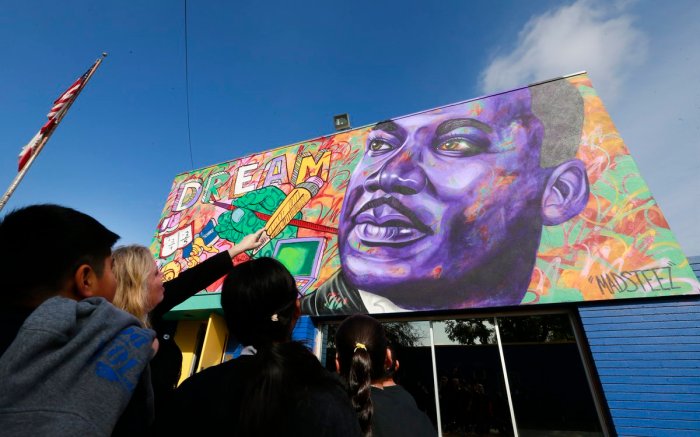
When we think of Dr. Martin Luther King, Jr., we usually think of the towering figure of the Civil Rights Movement who gave the “I have a dream” speech during the March on Washington in 1963.
However, as a teacher, I find myself turning to something he wrote in 1947 when he was just an 18-year-old student at Morehouse College.
While finishing his undergraduate studies in sociology, he published an essay in the student paper called “The Purpose of Education.”
Two sections immediately jump off the page. The first is this:
“We must remember that intelligence is not enough. Intelligence plus character–that is the goal of true education. The complete education gives one not only power of concentration, but worthy objectives upon which to concentrate. The broad education will, therefore, transmit to one not only the accumulated knowledge of the race but also the accumulated experience of social living.”
So for King it wasn’t enough for schools to teach facts. It wasn’t enough to teach skills, math, writing, reading, history and science. The schools are also responsible for teaching children character – how to be good people, how to get along with each other.
When King wrote, there were basically two kinds of school – public and private. Today there is a whole spectrum of public and private each with its own degree of self-governance, fiscal accountability and academic freedom.
So which schools today are best equipped to meet King’s ideal?
Private schools are by their very nature exclusionary. They attract and accept only certain students. These may be those with the highest academics, parental legacies, religious beliefs, or – most often – families that can afford the high tuition. As such, their student bodies are mostly white and affluent.
That is not King’s ideal. That is not the best environment to form character, the best environment in which to learn about people who are different than you and to develop mutual understanding.
Charter schools model themselves on private schools so they are likewise discriminatory. The businesses who run these institutions – often for a profit – don’t have to enroll whoever applies. Even though they are fully funded by public tax dollars, they can choose who to let in and who to turn away. Often this is done behind the cloak of a lottery, but with no transparency and no one checking to ensure it is done fairly, there is no reason to believe operators are doing anything but selecting the easiest (read: cheapest) students to educate.
Homeschooling is hard to generalize. There is such a wide variety of experiences that can be described under this moniker. However, they often include this feature – children are taught at home by their parent or parents. They may or may not interact with their academic peers and the degree to which they meet and understand different cultures is variable to say the least. They may meet King’s ideal, but frankly the majority of them probably do not.
So we’re left with traditional public schools. Do they instill “intelligence plus character”?
Answer: it depends.
There are many public schools where children of different races, nationalities, religions, and creeds meet, interact and learn together side-by-side.
Students wearing hajibs learn next to those wearing yarmulkes. Students with black skin and white skin partner with each other to complete class projects. Students with parents who emigrated to this country as refugees become friends with those whose parents can trace their ancestors back to the Revolutionary War.
We could integrate all public schools. We could never integrate our charter, voucher and private schools. That goes against their essential mission. They are schools made to discriminate. Public schools are meant to be all inclusive. Every one could meet King’s ideal, if we only cared enough to do it.
Which brings me to the second section of King’s early essay that pops off the page:
“The function of education, therefore, is to teach one to think intensively and to think critically. But education which stops with efficiency may prove the greatest menace to society. The most dangerous criminal may be the man gifted with reason, but with no morals.”
Seventy one years ago, King was warning us about the situation we suffer today.
When we allow academics to be distinct from character and understanding, we put ourselves at the mercy of leaders with “reason, but with no morals.”
Racism and privilege become the defining characteristics of a class without character, in King’s sense.
If we want to reclaim what it means to be an American, if we want to redefine ourselves as those who celebrate difference and defend civil rights, that begins with understanding the purpose of education.
It demands we defend public schools against privatization. And it demands that we transform our public schools into the integrated, equitable institutions we dreamed they could all be.
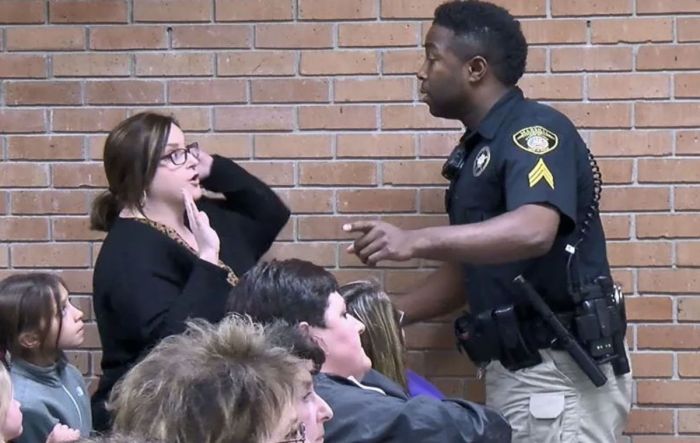
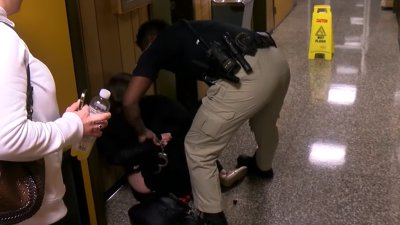
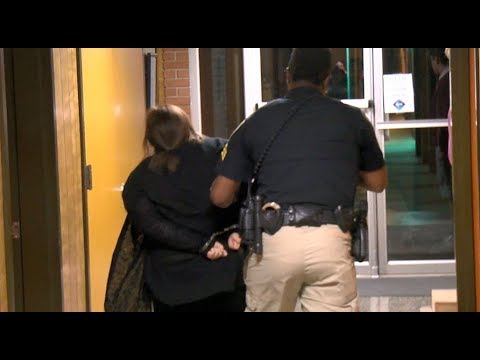
We’ve all seen the shocking video from Vermillion Parish in Louisiana this week where a teacher is tackled to the ground and arrested because she asked a question to the school board.
It’s a gross abuse of power that brings up many issues:
Public servants responding to the public with violence.
Elected representatives refusing to hear from their constituents and – in fact – taking action to silence them.
Leaders who are supposed to oversee children’s educations unconcerned with the lesson local kids will be taking home from the actions of adults who are supposed to set a better example.
The eight-member board had been deadlocked 4-4 on whether or not to give Superintendent Jerome Puyau a raise. Then one of the members died. Instead of his wife filling in until a new election could be held, board president Anthony Fontana , who was in favor of the raise, appointed a like-minded replacement and tried to force a vote.
So Deyshia Hargrave, a district teacher and parent, asked why the superintendent should get a raise while the teachers haven’t had one in several years.
It was a reasonable question, asked at the proper time, in a respectful tone, when comments were directed specifically at her.
However, Reggie Hilts, the Abbeville city marshal who also serves as a school resource officer, told her she was being disruptive and asked her to leave – which she did. When she got out in the hall, he forced her to the ground, put her in handcuffs and pushed her out of the building.
It was completely unjustified, a horrific violation of Hargrave’s rights and goes counter to the very purpose of public school.
It is the idea that district wide decisions about our children’s learning should be made by duly-elected members of the community in the full light of day. Except where doing so would violate an individual’s personal rights, all school documents are public. They are voted on in public. And they are subject to question and comment by the public.
If the taxpayers – the people who foot the bill for the majority of the district costs – don’t approve of what their representatives are doing, they can take steps to replace them.
Vermillion Parish School Board would do well to remember this.
The actions taken by City Marshall Hilts were either done at the behest of the board or certainly without any public dissent among the members.
They stomped on Hargrave’s First Amendment rights and ignored their responsibility to the community they serve.
If my description of how a public school is supposed to work sounds like a lecture, that’s intentional. These representatives could do with a lesson in how democracy works.
Our actions have consequences and those consequences only become more consequential when we become public servants. The board, the superintendent and certainly Hilts may very well have opened themselves up to legal action.
But beyond putting themselves in danger from having to pay punitive damages to Hargrave – that I hope they pay out of the superintendent’s bloated salary – they have betrayed a dangerous attitude toward the very concept of self-rule.
Whether they meant to or not, they have given the children of Vermillion Parish a lesson in government and community values.
Make no mistake. The children are watching. They get the TV news and status updates on Facebook and Twitter. They have access to YouTube. Doubtless, they have seen this video countless times. They have probably played it over and over again.
They saw their teacher brutally manhandled by a supposed law enforcement officer. And they heard the deafening silence from the school board about it.
They know now that this kind of behavior is deemed acceptable in Vermillion Parish. Beware the kind of behavior adults can expect from children who are given such a disgraceful example!
Moreover, these children are well aware of the matter in dispute.
The board is fighting to give the superintendent a $38,000 raise. Yet they refuse to give another penny to teachers – all while class sizes have jumped from 21 to 29 students, according to Hargrave.
That is not what leaders do who care about the well-being of students. It is a result of backroom deals and the good ol’ boys network.
The lesson is that hard work doesn’t matter. The only thing you should worry about is making a deal no matter whom it hurts. Just look out for numero uno.
After all, the board could give the teachers something – some token of appreciation to show that they value their continued commitment to the children of the community. But they don’t. Yet they fight tooth and nail to do so for one individual who has in no way proven himself indispensable.
Critics complain that teachers don’t deserve a raise because they already earn more money than the majority of the people who live in the community. (An argument which – by the way – would also apply to the superintendent.)
But even beyond basic logic, it’s a bogus line of reasoning!
Doctors attend patients in poor communities. They still earn high salaries – maybe not as high as they would serving the wealthy, but they have to be able to survive, to pay back the loans they took out to go through medical school, etc. So do lawyers, accountants and specialists of all kinds. That’s just capitalism. If you want someone to provide a good or service, you have to pay them a competitive wage. Otherwise, they’ll move on to greener pastures.
The kids see you pinching pennies. They know what that means – you don’t think they’re worth the investment.
The lessons of Vermillion Parish go far beyond Louisiana.
When Hilt wrestled a woman half his size to the ground and placed her under arrest for the crime of exercising her rights, he put the entire community in jail.
When the board directed him to act – or at very least neglected to stop him – they made themselves culpable in the crime.
In this article, I’m going to try to explain in the most simple terms I know the reality of segregation in our schools, how it got there and the various forms it takes.
I do this not because I am against public education. On the contrary, I am a public school teacher and consider myself a champion of what our system strives to be but has never yet realized. I do this because until we recognize what we are doing and what many in power are working hard to ensure we will continue doing and in fact exacerbate doing, we will never be able to rid ourselves of a racist, classist disease we are inflicting on ourselves and on our posterity.
America, the Segregated
It’s never been one monolithic program. It’s always been several co-existing parallel social structures functioning together in tandem that create the society in which we live.
I’m reminded of possibly the best description of American segregation on record, the words of the late great African American author James Baldwin who said the following on the Dick Cavett Show in 1968:
“I don’t know what most white people in this country feel. But I can only conclude what they feel from the state of their institutions. I don’t know if white Christians hate Negroes or not, but I know we have a Christian church that is white and a Christian church that is black. I know, as Malcolm X once put it, the most segregated hour in American life is high noon on Sunday.
That says a great deal for me about a Christian nation. It means I can’t afford to trust most white Christians, and I certainly cannot trust the Christian church.
“I don’t know whether the labor unions and their bosses really hate me — that doesn’t matter — but I know I’m not in their union. I don’t know whether the real estate lobby has anything against black people, but I know the real estate lobby is keeping me in the ghetto. I don’t know if the board of education hates black people, but I know the textbooks they give my children to read and the schools we have to go to.
“Now this is the evidence. You want me to make an act of faith, risking myself, my wife, my woman, my sister, my children on some idealism which you assure me exists in America, which I have never seen.”
As Baldwin states, there are many different ways to keep black people segregated. There are many different flavors of the same dish, many different strains of the same disease.
We can say we’re against it, but what we say doesn’t matter unless it is tied to action.
You can say you’re in favor of equity between black and white people all day long, but if the policies you support don’t accomplish these things, you might as well wear a white hood and burn a cross on a black person’s lawn. It would at least be more honest.
Segregated Schools
In terms of public education, which is the area I know most about and am most concerned with here, our schools are indeed set up to be segregated.
If there is one unstated axiom of our American Public School System it is this: the worst thing in the world would be black and white children learning together side-by-side.
They point to inequalities they, themselves, helped create and use them to push for a system that would create even worse inequality. They point to the segregation that they, themselves, helped install and use it as an excuse to push even more segregation.
And they do so by controlling the media and the narrative. They call themselves reformers when they’re really vandals and obstructionists looking to subvert the best in our system in order to maximize the worst.
School Segregation Today
Sure we don’t have very many all white or all black schools like we did before Brown v. Board. Instead we have schools that are just predominantly one race or another.
ALL kids are not divided by race. Just MOST of them.
White people and black people tend to live in different neighborhoods. Some of this is a choice. After a history of white oppression and racial strife, people on both sides of the divide would rather live among those with whom they identify.
Black people don’t want to deal with the possibility of further deprivations. White people fear retaliation.
However, white people generally enjoy a higher socio-economic status than black people, so there is some push back from black folks who can afford to live in whiter neighborhoods and thus enjoy the benefits of integration – bigger homes, less crowding, less crime, access to more green spaces, etc. But even when there is a desire, moving to a white neighborhood can be almost impossible.
State and federal laws, local ordinances, banking policies and persistent prejudice stand in the way.
In short, red lining still exists.
Real estate agents and landlords still divide up communities based on whom they’re willing to sell or rent to.
And this is just how white people want it.
They’re socialized to fear and despise blackness and to cherish a certain level of white privilege for themselves and their families.
And if we live apart, it follows that we learn apart.
The system is set up to make this easy. Yet it is not uncomplicated. There is more than one way to sort and separate children along racial and class lines in a school system.
There are several ways to accomplish school segregation. It comes in multiple varieties, a diversity of flavors, all of which achieve the same ends, just in different ways.
By my reckoning, there are at least three distinct paths to effectively segregate students. We shall look at each in turn:
Put the white neighborhoods in District A and the black ones in District B. It’s kind of like gerrymandering, but instead of hording political power for partisan lawmakers, you’re putting your finger on the scale to enable academic inequality.
However, sometimes you can’t do that. Sometimes you don’t have the power to determine the makeup for entire districts. Instead, you can do almost the same thing for schools within a single district.
That means the whiter districts get higher paid and more experienced teachers. It means they have broader curriculum, more extracurricular activities, a more robust library, more well-trained nursing staff, more advanced placement courses, etc.
Fewer funds mean fewer resources, fewer opportunities, more challenges to achieve at the same level that white students take for granted. A budget is often the strongest support for white supremacy in a given community or society as a whole. In fact, if you want to know how racist your community is, read its school budget. You want accountability? Start there.
The same holds even when segregation is instituted not at the district level but at the level of the school building.
It may sound ridiculous but this is exactly what happens much of the time. You have gorgeous new buildings with first class facilities in the suburban areas and run down crumbling facilities in the urban ones – even if the two are only separated geographically by a few miles.
Like any parasite, charter and voucher schools only survive in the proper environment. It usually looks like this.
Sometimes no matter how you draw the district lines or how you appropriate the buildings, you end up with a black majority and a white minority. That’s a situation white parents find simply intolerable.
White children must be kept separate and given all the best opportunities even if that means taking away the same for black children.
Once again, this creates the opportunity for a resource gap. The charter and voucher schools suck away needed funds from the public schools and then are subsidized even further by white parents.
The quality of education provided at these institutions is sometimes better – it’s often worse. But that’s beside the point. It’s not about quality. It’s about kind. It’s about keeping the white kids separate and privileged. It’s about saving them from the taint of black culture and too close of an association with black people.
Second, the situation can work in reverse. Instead of dividing the whites from the blacks, it divides the blacks from the whites.
This happens most often in districts where the divide is closer to equal – let’s say 60% one race and 40% another. Charter and voucher schools often end up gobbling up the minority students and leaving the white ones in the public school. So instead of white privatized and black public schools, you get the opposite.
And make no mistake – this is a precarious position for minority students to be in. Well meaning black parents looking to escape an underfunded public school system jump to an even more underfunded privatized system that is just waiting to prey on their children.
Unlike public schools, charter and voucher institutions are allowed to pocket some of their funding as profit. That means they can reduce services and spending on children anytime they like and to any degree. Moreover, as businesses, their motives are not student centered but economically driven. They cherry pick only the best and brightest students because they cost less to educate. They often enact zero tolerance discipline policies and run themselves more like prisons than schools. And at any time unscrupulous administrators who are under much less scrutiny than those at public schools can more easily steal student funding, close the school and run, leaving children with no where to turn but the public school they fled from in the first place and weakened by letting privatized schools gobble up the money.
The result is a public school system unnaturally bleached of color and a privatized system where minority parents are tricked into putting their children at the mercy of big business.
3) Tracking
But that’s not all. There is still another way to racially segregate children. Instead of putting them in different districts or different schools, you can just ensure they’ll be in different classes in the same school.
However, it most often results in further stratifying students socially, economically and racially.
Here’s how it works.
Often times when you have a large enough black minority in your school or district, the white majority does things to further horde resources even within an individual school building or academic department.
In such cases, the majority of the white population is miraculously given a “gifted” designation and enrolled in the advanced placement classes while the black children are left in the academic or remedial track.
It enables bleaching the advanced courses and melanin-izing the others. This means administration can justify giving more resources to white students than blacks – more field trips, more speakers, more STEAM programs, more extracurriculars, etc.
And if a white parent complains to the principal that her child has not been included in the gifted program, if her child has even a modicum of ability in the given subject, more often than not that white child is advanced forward to the preferential class.
CONCLUSIONS
Segregation is a deep problem in our public school system. But it cannot be solved by privatization.
In fact, privatization exacerbates it.
Nor is public education, itself, a panacea. Like any democratic practice, it requires participation and the economic and social mobility to be able to participate as equals.
Schools are the product of the societies that create them. An inequitable society will create inequitable schools.
Segregation has haunted us since before the foundation of our nation.
They don’t want their children to be educated among black students – maybe SOME black students, maybe the best of the best black students, but certainly not the average run of the mill brown-skinned child.
This has to stop.
There are plenty of benefits even for white students in an integrated education. It provides them a more accurate world-view and helps them become empathetic and prize difference.
Is anyone else left? Am I the only one still employed here?
Somedays it feels like it.
Somedays teaching in a public school is kind of like trying to run a resort hotel – ALL BY YOURSELF.
You’ve got to teach the classes and watch the lunch periods and cover the absences and monitor the halls and buy the pencils and tissues and fill out the lesson plans and conduct the staff meetings and…
Wouldn’t it be better if there were more people here?
So why did we let this happen? Why do we continue to let this happen?
First, you have to understand that there are two very different kinds of public school experience. There is the kind provided by the rich schools where the local tax base has enough money to give kids everything they need including small class sizes and hiring enough teachers to get things done efficiently. And there’s the poor schools where the majority of our kids get educated by the most dedicated put upon teachers who give 110% everyday but somehow can’t manage to keep all those plates spinning in the air at the same time so the media swoops in, wags its finger and proclaims them a “failure.”
Bull.
It’s not teachers who are failing. It’s a system that stacks the deck against them and anxiously anticipates them being unable to meet unfair and impossible expectations.
This is a chance to open a new market and scoop up buckets of juicy profit all for themselves and their donors.
It’s called privatized education. You know – charter schools and vouchers schools. Educational institutions not run by the public, not beholden to elected officials, but instead by bureaucrats who have the freedom to act in the shadows, cut student services and pocket the savings.
Those are people they have to pay a living wage. Those are people who know a thing or two and might complain about how the corporate scheme adversely affects the children in their care.
And to do that, the powers that be need to get rid of professional teachers.
People like me – folks with national board certification and a masters degree – they need to go.
THAT’S why class sizes are so large. That’s why so few young people are picking teaching as a major in college.
It’s exactly what the super-rich want.
And it doesn’t have to be some half mad Mr. Burns who makes the decisions. In my own district, the school board just decided to save money by cutting middle school math and language arts teachers – the core educators who teach the most important subjects on the standardized tests they pretend to value so much!
So number crunching administrators had a choice – straighten their backbones and fight, or suggest cutting flesh and bone to make the budget.
They chose the easier path.
As a result, middle school classes are noticeably larger, teachers have been moved to areas where they aren’t necessarily most prepared to teach and administrators actually have the gall to hold out their clipboards, show us the state test scores and cluck their tongues.
I actually heard an administrator this week claim that my subject, language arts, counts for double points on the state achievement rubric. I responded that this information should be presented to the school board as a reason to hire another language arts teacher, reduce class sizes and increase the chances of boosting test scores!
That went over like a lead balloon.
But it demonstrates why we’ve lost so much ground.
Everyone knows larger class sizes are bad – especially in core subjects, especially for younger students, especially for struggling students. Yet no one wants to do anything to cut class sizes.
Instead we’re warned that if we don’t somehow pull ourselves up by our bootstraps, they’ll close our school and give it to a private company to run – as if there were any evidence at all that this would help.
It’s a scam, ladies and gentlemen! And anyone who looks can see it.
But when you bring this up to administrators, they usually just nod and say that there’s nothing we can do about it. All we can do is keep trying to win the game – a game that’s rigged against us.
That’s exactly the attitude that’s gotten us where we are.
We can’t just keep doing it, keep appeasing the testing and privatization industry and their patsies in the media and government.
We must fight the system, itself, not go along with it.











 gadflyonthewallblog