It’s NOT Education Reform – It’s School Sabotage

sarah-ji_BOERallyMtg-7CROP-678x381


“Language is a weapon of politicians, but language is a weapon in much of human affairs.”

-Noam Chomsky


“Words are things. You must be careful, careful about calling people out of their names, using racial pejoratives and sexual pejoratives and all that ignorance. Don’t do that. Some day we’ll be able to measure the power of words. I think they are things. They get on the walls. They get in your wallpaper. They get in your rugs, in your upholstery, and your clothes, and finally in to you.”


Maya Angelou


Names matter.


What you call something becomes an intellectual shorthand.


Positive or negative connotations become baked in.


Hence the Colorado Democratic Party’s criticism of Democrats for Education Reform (DFER).


After impassioned debate, delegates demanded DFER remove “Democrat” from their name.


It just makes sense. DFER is a group of hedge fund managers pushing for school privatization – a policy the Colorado Democrats vocally oppose.


In fact, one of the organization’s key founders, hedge fund manager Whitney Tilson, was quoted in the film “A Right Denied,” thusly:

“The real problem, politically, was not the Republican party, it was the Democratic party. So it dawned on us, over the course of six months or a year, that it had to be an inside job. The main obstacle to education reform was moving the Democratic party, and it had to be Democrats who did it, it had to be an inside job. So that was the thesis behind the organization. And the name – and the name was critical – we get a lot of flack for the name. You know, “Why are you Democrats for education reform? That’s very exclusionary. I mean, certainly there are Republicans in favor of education reform.” And we said, “We agree.” In fact, our natural allies, in many cases, are Republicans on this crusade, but the problem is not Republicans. We don’t need to convert the Republican party to our point of view…”


So by a 2/3 vote, the Colorado Democrats passed a motion saying in part:


“We oppose making Colorado’s public schools private, or run by private corporations, or segregated again through lobbying and campaign efforts of the organization called Democrats for Education Reform and demand that they immediately stop using the Party’s name, I.e., “Democrat” in their name.”


To which I say “Hurrah!”


DFER definitely is a misnomer.


However, which is more inaccurate – the term “Democrat” or the word “Reform”?


Members of the nefarious school privatization propaganda squad are, in fact, Democrats.


They have registered as voting members of that political party.


However, they certainly aren’t progressives.


They don’t adhere to the traditional views normally associated with the party.


So the Colorado Dems motion is a positive move toward taking back what it means to be a Democrat. And in that spirit, it should be celebrated and emulated by every state and national party association.


The Democrats have always been a big tent party with lots of different ideas being accepted under that umbrella. But putting corporate profits over student needs does not belong there.


My point is that the larger verbal slight of hand isn’t with the organization’s party affiliation. It’s with the term “Reform,” itself.


DFER is not alone in calling what they advocate “Education Reform.”


My question is this – is what they’re proposing really reform at all?


And if so, what kind of reform is it? Who does it benefit? And what does it conceal?


The word “Reform” has positive associations. It’s always seen as a good.


We always want to be reforming something – turning it from bad to good. Or at very least improving it.


And when it comes to education, this is even more urgent.


No one really wants to be against education REFORM. The only reason to oppose it would be if you thought the way we teach was perfect. Then we would need no reform at all. But this is nearly impossible. Human society does not allow perfection because it is created by human beings, who are, in themselves, far from perfect.


However, the term “Education Reform” does not mean just any kind of change to improve teaching.


It has come to mean a very specific list of changes and policies.


It has come to mean standardization, privatization and profitization.


It means increasing the number, frequency and power of standardized assessments to drive curriculum and teaching – More high stakes tests, more teaching to the test, more evaluating teachers based on student test scores, more school closures based on low test scores.


It means reducing democratic local control of schools, reducing transparency of how public tax dollars are spent while increasing control by appointed boards, and increasing the autonomy of such boards at the expense of accountability to the community actually paying for their work.


It means transforming money that was put aside to educate children into potential profit for those in control. It means the freedom to reduce student services to save money that can then be pocketed by private individuals running the school.


If the goal of education is to teach students, “Education Reform” is not about reforming practices for their benefit. It is not, then, reform.


If the goal is to increase profits for private businesses and corporations, then it truly is reform. It will increase their market share and throw off any extraneous concerns about kids and the efficacy of teaching.


However, this is not the goal of education.


Education is not for the benefit of business. It is not corporate welfare.


Education is essentially about providing positive opportunities for students. It is about providing them with the best learning environment, about hiring the best teachers and empowering them with the skills, pay, protections and autonomy to do their jobs. It’s about providing adequate resources – books, computers, libraries, nurses, tutors, etc. – to learn. It’s about keeping kids safe and secure, well-nourished, and healthy.


In short, it’s about everything bogus “Education Reform” either perverts or ignores.


Calling the things advocated by groups like DFER “Education Reform” is pure propaganda.


We must stop doing that.


Even if we use the term to criticize the practice, we’re helping them do their work.


It’s just like the term “School Choice.”


Despite the name, the reality has nothing to do with providing alternatives to parents and students. It really means school privatization.


It’s about tricking parents and students into allowing businesses to swipe the money put aside to educate children while reducing services.


In short, it’s about increasing choices for charter and voucher school operators – not parents or students.


In that way, it is a more limited version of faux “Education Reform.”


So I propose we stop using these signifiers.


Henceforth, “Education Reform” shall be Education Sabotage – because that’s really what it is.


It is about deliberately obstructing goods and services that otherwise would help kids learn and repurposing them for corporate benefit.


Likewise, I propose we stop using the term “School choice.” Instead, call it what it is – School Privatization.


Anyone who uses the older terms is either misguided or an enemy of authentic education.


Perhaps this seems petty.


They’re only words, after all. What does it matter?


It matters a lot.


As Ludwig Wittgenstein wrote:


“The limits of my language mean the limits of my world.”


We cannot effectively fight the forces of segregation, standardization and privatization if we have to constantly define our terms.


We have to take back the meaning of our language, first. We have to stifle the unconscious propaganda that happens every time someone innocently uses these terms in ways that smuggle in positive connotations to corporatist ends.


To take back our schools, we must first take back our language.


To stop the sabotage, we must first stop repeating their lies.


Like this post? I’ve written a book, “Gadfly on the Wall: A Public School Teacher Speaks Out on Racism and Reform,” now available from Garn Press. Ten percent of the proceeds go to the Badass Teachers Association. Check it out!
book-2

I Stand With Striking Teachers Because I Stand for Underprivileged Children

teacherstrike


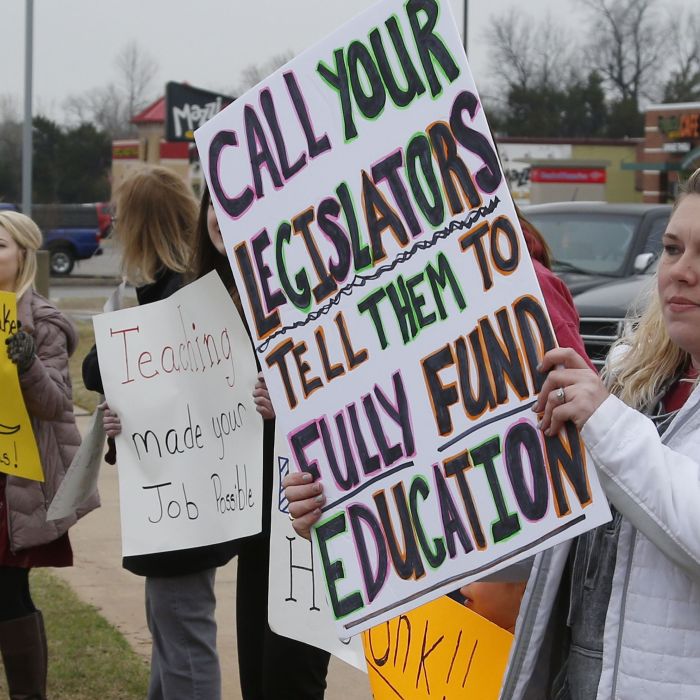
America’s teachers are taking to the streets by the thousands.


In West Virginia, Oklahoma, Kentucky and soon to be Arizona and Puerto Rico, educators are leaving the classroom and storming their state capitals.


Why?


Not because they’re greedy. Not because they don’t want to do their job. But because this country doesn’t care enough to provide them the resources they need to do it.


America doesn’t care about black and brown children.


America doesn’t care about poor white children.


America only cares about middle class and wealthy kids, preferably if their skin has a melanin deficit.


Don’t believe me?


Just look at how much these states have cut education funding. Look at how the federal government has slashed financial assistance. Look at how districts are forced to increasingly rely on local tax revenues to pay for the kind of education their children receive.


This means poor kids get poor resources. This means minority kids have to do without.


For the dark and the destitute, this means larger class sizes, out of date text books, and narrowed curriculum. It means fewer tutors, reading specialists and librarians. It means being left to your own devices to deal with the effects of generational poverty which put them behind their wealthier, lighter peers before they even enter kindergarten. It means greater emotional disturbance, greater malnutrition, higher absences, more learning disabilities, and less help to deal with any of it.


On the other hand, for the economically privileged white kids, it means just the opposite – fewer social problems, and the best of everything to deal with whatever issues they have.


It’s an unfair system, and teachers aren’t having it. We’ve been sounding the alarm for years, but it has fallen on deaf ears.


We don’t want to strike, but lawmakers are giving us no choice.


We’re saying, Enough! We’ve had it with the excuses.


Society hires us to do a job – let us do it.


Don’t refuse us the money to get it done and then blame us for the results.


That’s why there was a 9-day teachers strike in West Virginia which won educators a 5% raise in February.


That’s why 30 districts closed in Kentucky this week after a statewide sick out inspired by the legislature’s plan to cut pension benefits.


That’s why thousands of teachers in Oklahoma walked out this week demanding higher wages and better school funding.


And it’s why educators in Arizona, Puerto Rico and other states and territories may be next.


When you deny teachers the basics necessary to do their jobs, you’re refusing your responsibilities toward children.


When you deny educators a fair wage, you’re discouraging young people from entering the profession and encouraging those already there to seek work elsewhere.


And that is what we’re talking about here – a fair wage. We’re not talking about teachers getting rich off the taxpayers dole. You’re asking us to get an advanced education and do a hard job – that requires a middle class income so we can pay off our student loans and support our families.


The same goes for pensions. When teachers took their jobs, a fair pension was part of the contract. You promised that after 30-some years, educators could retire and you’d take care of them. You can’t renege on that. And if you plan to offer less for those coming in to the field, you’re going to get fewer high quality teachers willing to take the job.


When you attack unions and union benefits, you’re really attacking students. A teacher who can be fired at the whim of an administrator or school director is not as affective at her job. She has less autonomy and freedom to do what is right for her given students. And she has less reason to take a chance on the profession in the first place.


This doesn’t mean that after three years teachers should have a job for life. They don’t. It just means that if you’re going to fire a teacher for negligence, you should have to prove she’s negligent first.


This is why there’s a so-called teacher shortage in most states. As a society, we’ve become less-and-less willing to pay for teachers to do their jobs. We’ve become less-and-less willing to offer them the independence and respect necessary to get things done.


Why?


Because we’ve swallowed a pack of lies from the business community.


Many of them look at our public schools and see an opportunity for financial gain.


School funding may not be enough to give every one of the 50.7 million students in public school a first class education, but it’s more than enough to make a cabal of entrepreneurs and corporate officers rich.


That’s why they’re pushing charter schools and voucher schools and standardized tests and edtech software scams.


They want to get rid of democratic rule, get rid of teacher-based assessments and – ultimately – get rid of teachers. They want to replace us with minimum wage temps and leave the work of educating to computers that can provide test prep and standardized assessments.


But only for the poor and minorities. The affluent and middle class white kids will still get the best money can buy. It’s only those other kids they’re willing to feed to the wolves of edu-profit.


THAT is what educators are fighting.


THAT is why teachers across the nation are striking.


We’re demanding this nation does right by its public school students.


And that begins by supporting their teachers.

636581911709771782-AP-Teacher-Walkout-Taxes


Like this post? I’ve written a book, “Gadfly on the Wall: A Public School Teacher Speaks Out on Racism and Reform,” now available from Garn Press. Ten percent of the proceeds go to the Badass Teachers Association. Check it out!
book-3

Every Public School Teacher Should Support Opting Out of Standardized Tests

Education-not-testing-chicago-protest


Over the last few years, educators and parents have built up a wall of opposition to high stakes testing in the Opt Out movement.


But now it seems some teachers are starting to tear it down.


Not so long ago, tens of thousands of parents refused letting their children take the tests – with full support of their teachers.


Yet today you hear some educators question their involvement or even if they’re on the right side.


It’s almost like an anthropomorphic red pitcher smashed through the bricks and offered beat down educators a drink.


koolaidman1


And far from refusing that rancid brew, some are actually gulping it down.


“OHH YEAH!”


You hear things like these:


“Opt Out’s dead. Stealth assessment schemes like Personalized Learning and Competency Based Education have replaced the federally mandated tests.”


GLUG. GLUG. GLUG.


“The tests often take up fewer days now so there’s no reason to opt out.”


GLUG. GLUG. GLUG.


“The kids who opt out aren’t doing it for the right reasons. They just want to get out of work.”


GLUG. GLUG…


Blargh! I can’t drink any more of that artificially flavored propaganda crap!


I’ve even heard of some teachers in New York State agreeing to call families who have refused testing in the past and asking them to reconsider!


What the heck!? Have we all lost our minds!?


We’re educators!


If anyone knows the problems with standardized testing, it’s us.


We know in intimate detail how these assessments are biased and unscientific.


So let me counter some of this dangerous disinformation going around.


1) You say the tests take up less time?


Marginally, yes. There are fewer test days.


But we’re still being pressured to narrow the curriculum and teach to the test just about every other day!


2) You say stealth testing has made the traditional standardized assessments irrelevant?


Okay. Competency Based Education is a real problem that threatens to make everyday test day – I’ll go with you there. In fact, schemes like Personalized Learning could transform every app into an opportunity to test kids without them even knowing it.


But that doesn’t mean the old fashioned high stakes tests have gone away!


Far from it. The federal government still requires all states to give these assessments to public school students in grades 3-8 and once in high school.


Let’s say the feds required teachers to give rich kids higher grades than poor children.


Or say the state commanded teachers to copy down sensitive information about students and give it to private corporations.


Imagine if the school board instructed teachers to put minority kids in slower classes than white kids.


If any of that happened, there would be wide scale revolt!


Yet standardized tests do all of these things!


They dishonestly give higher scores to rich kids and lower scores to poor kids.


The apps used for preparation and remediation often steal student data and sell it to third parties.


They are used to justify increased segregation within school buildings because implicit testing bias means white kids generally score higher than children of color. So the white kids get more advanced courses and the brown ones get test prep.


3) You say the Opt Out kids are just trying to get out of doing work. It’s just laziness.


First, of all, it is the parents who are opting their children out of standardized testing – not the students. Second, who are you to question their motives?


We serve the parents and children of the community. If they say they don’t want their children tested in this way, we should listen to them.


Third, why are you defending these tests? They are used by charter and voucher schools as “proof” that the public schools are failing.


These tests are used to justify unfairly evaluating YOUR work, narrowing YOUR curriculum, repealing YOUR union protections, reducing YOUR autonomy, cutting YOUR funding, and ultimately laying YOU off.


Why are you standing up for THAT?


So why are some teachers wavering in their opposition to high stakes tests?


I think it has to do with who we are.


Most teachers are rule followers at heart. When we were in school, we were the obedient students. We were the people-pleasers. We got good grades, kept our heads down and didn’t make waves.


But the qualities that often make for the highest grades don’t often translate into action. That, alone, should tell you something about the limits of assessment which are only exacerbated by standardized test scores. When it comes to complex concepts, it’s hard to assess and even harder to determine if success on assessments is a predictor of future success.


Bottom line: Every teacher should be in favor of the Opt Out movement.


And I don’t mean quietly, secretly in favor. I mean publicly, vocally in favor.


Many teachers are parents, themselves, with children in the districts where they teach. Every educator should opt out their own children from the tests.


If we can’t at least do that and lead by example, what good are we?


Next, we should force our unions to do the things that we can’t as safely do as individuals.


Call parents and ask them to opt IN!? We should be doing just the opposite, but that would put a target on our backs.


As a teacher, I can’t unilaterally call or send a letter home to my students’ parents explaining why they should opt their kids out. If I did that, I could find myself in administration’s cross hairs and face grave repercussions.


But isn’t that why we have a union? To stand up as a collective and do the necessary things we can’t do as individuals?


Imagine if every teachers union in the country routinely sent open letters to all parents asking them to opt their kids out! What an impact that would make!


Imagine if the unions put pressure on the school boards to pass resolutions against testing and in favor of opt out! What effect would that have on state legislatures and the federal government?


How could the feds continue to demand we give high stakes tests when nearly every school board across the country objected and advised parents to refuse testing for their children?


Taken individually, these aren’t really all that difficult things to do.


They require a certain degree of moral courage, to be sure. And teachers have been beaten down by a society that devalues their work and begrudges them just about everything.


But what do we have to lose?


Our backs are already against the wall.


We are being slowly erased – our numbers dwindle more every year while policymakers shrug and point to a teacher shortage that they refuse to explain by reference to the way we’re treated.


The tech moguls and the testing giants are salivating over the prospect of replacing us with apps and low-skilled, low paid babysitters to oversee students hunched over computers and tablets. (See? Told you Personalized Learning was poison.)


We shouldn’t be helping them destroy our own profession by advocating for the same tests they’re using as a tool in our destruction.


It’s high time teachers get some backbone.


We may all end up on the unemployment line, but that’s where we’re headed already.


I’d rather go kicking and screaming.


Who’s with me?

Testing Corporations Rake in Cash while Teachers Sell Plasma to Survive

Screen Shot 2018-03-26 at 3.34.02 PM


If you want to get rich in education, don’t become a teacher.


Open a charter school or take a job at a testing corporation.


Sure, charter schools are elaborate scams to make money off children while providing fewer services.


Sure, standardized tests are just corporate welfare that labels poor and minority kids failures and pretends that’s their fault.


And teachers? They’re just the people who do all the actual work of educating children. Yet there’s never enough money, never enough resources for the job they do.


According to the U.S. Bureau of Labor Statistics, the average salary of public school teachers in Pennsylvania is between $53,000 and $59,000 per year.


Compare that with the salaries of the people who make and distribute the state’s federally mandated standardized tests – employees at Data Recognition Corporation (DRC).


DRC publishes numerous assessments in various states. However, in the Keystone state, the corporation makes everything from the Pennsylvania System of School Assessments (PSSA) to the Keystone Exams in Algebra, Literature and Biology.


At its 14 locations across the country, the company has more than 750 full time employees and 5,000 seasonal ones used mainly to help grade the tests.


Screen Shot 2018-03-26 at 7.41.50 AM


According to glassdoor.com, a site that showcases job listings, here are some openings at DRC and their associated salaries:


Test Development Specialist – $68K-$86K


Quality Assurance Analyst – $77K-$83K


Technology Manager – $77K-$84K


Business Analyst – $81,856


Software Developer – $83,199


Psychometrician – $95,870


Senior Software Developer – $96,363


So teachers spend 180 days in overcrowded classrooms with fewer resources than they need – often forced to buy school supplies for their students out of pocket – to get their students ready to take the high stakes tests.


Meanwhile, the test makers sit in luxury office buildings taking home tens of thousands of dollars more just to make the tests that students take over the course of a few weeks.


And these corporate test employees DO work in luxury.


Here are some of the benefits they receive listed on DRC’s own Website:


“DRC offers a comprehensive benefits program that allows employees to make choices that best meet their current and future needs.

Key Benefits

  • Choice of medical plans
  • Choice of dental plans
  • Flexible spending accounts
  • HSA account
  • 401K savings plan
  • Profit sharing
  • Short- and long-term disability plans

Wellbeing Benefits

  • Paid vacation
  • Paid holidays
  • Personal time off
  • Workout facilities/locker rooms at select locations
  • Tuition reimbursement
  • Community service hours
  • Discount programs
  • Adoption assistance
  • Fitness classes
  • On-site massage
  • Walking paths

Convenience Benefits

  • Business casual attire

  • On-site subsidized cafeterias

  • Dry cleaning pick-up and delivery

  • Company store”


It’s funny. Some folks get all in a lather about the much less extravagant benefits given to teachers, but I’ve never heard anyone in a rage about these benefits being paid to corporate test makers.


And keep in mind, both teachers and test makers are being paid with public tax dollars. YOU are funding the test makers on-the-job massage break just as you’re funding the public school teachers trip to the doctor for anti-anxiety meds.


The Pennsylvania legislature has entered into three contracts with DRC through 6/30/21 for services related to standardized testing for a total of $741,158,039.60, according to State Sen. Andrew Dinniman (D-West Chester).


That is your money funding the test makers workout facilities and flexible spending accounts. You pay for their walking trails, fitness classes, dry cleaning services and subsidized cafeterias.


Meanwhile, public school teachers – who do the bulk of the work educating children – are left struggling to make ends meet.


According to estimates by the National Education Association (NEA), teaching salaries from Pittsburgh to Philadelphia have stagnated by 2.3% in the past 15 years.


But that’s way better than in most parts of the country.


In West Virginia, teachers across the state went on a 9-day strike to get a 5% pay raise.


Teachers in Arizona and Oklahoma are planning their own strike due to even worse neglect.


In Oklahoma, some educators have actually had to resort to selling plasma in order to survive.


KOCO News 5, in the Sooner State, reported on a fifth grade teacher at Newcastle Elementary school, Jay Thomas, who sells blood to supplement his income.


“I’ve got a permanent scar doing that. Just did it yesterday,” Thomas said.


“I’ve been doing it for a couple of years. I’ve given over 100 times. It’s twice a week.”


Though Thomas has been an Oklahoma teacher for 16 years, he makes less than $40,000 a year after taxes.


Selling plasma nets him about $65 a week.


And if you think Thomas is the anomaly, when this story was spread on Twitter, other teachers responded that they do the same, some even including pictures of themselves at the blood bank.


Screen Shot 2018-03-23 at 9.57.25 AM


This is why there is a teacher shortage in many states. This is why fewer college students are entering the field. And it is why many of those educators who have stayed in the classroom are considering strikes.


We take teachers for granted. We value the work they do but not the people who do that work.


Meanwhile, we give extravagant rewards to the corporate vultures who provide very little for children but divert funding that should be going to educate students – the standardized testing corporations and the privatized school operators.


If we really want to improve our education system in this country, the first step is to value those who work in it.


We need to turn the money hose off for unnecessary expenses like standardized testing and allowing charter and voucher operators to pocket tax money as profit.


And we need to spend more on the people in the trenches day-in-day-out making sure our children get the quality education they deserve.


We need to give teachers the resources and respect they need to succeed and end the scams of high stakes testing and school privatization.


3f7ccd898a1d7e2ad178656da70f58b7--teaching-quotes-teaching-ideas


Like this post? I’ve written a book, “Gadfly on the Wall: A Public School Teacher Speaks Out on Racism and Reform,” now available from Garn Press. Ten percent of the proceeds go to the Badass Teachers Association. Check it out!
book-3

The Lone Voice of Dissent Against Standardized Testing

Businesswoman shouting through the megaphone in the open air.


Everybody wants to fight the good fight.


Until the battle begins.


Then many of us are all too ready to give in to what was intolerable just a moment before.


To paraphrase Thomas Paine:


These are the times that try men’s souls. The summer soldier and the sunshine patriot will, in times of crisis, shrink from service, but those who stand up in time of need deserve the love and thanks of every man and woman.


I see this almost every day in our schools.


Ask nearly any teacher what they think about high stakes standardized testing, and they’ll complain until they’re blue in the face.


They’ll give you gripes and grievances galore.


The tests take too long. They’re not valid assessments. They narrow the curriculum. They’re dumbing down the teaching profession and ripping away our autonomy.


To which I say – Amen, Sister!


Standardized tests more accurately measure economics than academics – poor kids generally fail and rich kids pass. They’re culturally biased, poorly put together, unscientifically graded and demonstrate a gobbsmacking conflict of interest.


Two conflicts of interest, actually.


First, the people who make the tests, grade the tests and thus have a financial interest in failing the most students possible because that means we have to buy more remediation material which they also conveniently sell.


Second, these test scores are used by the school privatization industry to unfairly label public schools failures so they can more easily sell fly-by-night charter and voucher schools.


So, yeah. Almost all of us agree standardized testing sucks.


But when there’s an administrator present, I too often find I’m the only one willing to speak that truth. My colleagues, who are pleased as punch to gripe in private, suddenly go quiet in the presence of their superiors.


What’s worse, some of them don’t just stay quiet – they offer arguments to support whatever nonsensical test-based solution our boss has in mind today.


Let’s say an administrator suggests we do something about the handful of students who opt out of standardized tests.


We could just respect the rights of parents who have handed in their written intention to opt their children out under a religious exemption – the only option in Pennsylvania. Or we could do as the administrator suggests and force kids who’ve been opted out to take a standardized look-a-like assessment.


I hear something like that, and I’m on my feet ready to fight.


But I find myself standing there alone.


“You can’t do that,” I say.


“It violates state law. In particular, Pennsylvania Code Title 22 Chapter 4, section 4.4.


(Okay, I had to look up the particulars later, but I made sure the administrator got them.)


Consider subsection (d) (4). And I quote:


If upon inspection of a State assessment parents or guardians find the assessment to be in conflict with their religious belief and wish their students to be excused from the assessment, the right of the parents or guardians will not be denied…”


Or how about subsection (d) (3):


“School entities shall adopt policies to assure that parents or guardians [have]… (3) The right to have their children excused from specific instruction that conflicts with their religious beliefs, upon receipt by the school entity of a written request from the parent or guardians.” (Emphasis mine)


In other words, parents have a right to excuse their children from the tests and/or instruction such as test look-a-likes.


If we go forward with requiring students who are opted out to take tests that are just like the ones their parents instructed us NOT to give, we will be violating parents’ rights under state law.”


That seems pretty airtight to me.


But the administrator disagrees.


And I look around at the assembled mass of workaday teachers for support.


Not a peep.


Instead I get this:


-We’re being evaluated on these standardized tests, we have to make sure kids take them seriously.


-I see where you’re coming from but we have to do something about these kids who are opting out just to get out of doing the work. They don’t have any real intellectual objection. They’re just lazy.


-We’ve got to do something about grade inflation.


Oh. Em. Gee.


Yet after the meeting, some of them cautiously walk up to me asking my opinion of what went down.


YOU DON’T WANT TO HEAR MY OPINION RIGHT NOW!


Take my word for it.


Tomorrow or the next day or the next week, they’ll be complaining again.


I’ve seen some of these people reduced to tears by administrators unfairly manipulating them based on their students’ test scores.


Yet none of them have the guts to stand up and be counted when the moment comes.


I say again – everyone wants to fight. But no one wants to do the fighting.


They want someone else to do it for them.


Does that make you angry?


It makes me furious.


But if you feel that way, you’ve got to do something about it.


You think teachers are too cowardly? What have YOU done to fight corporate education reform today?


You think too many administrators are quislings. You think the lawmakers are bought and sold. You think the public schools are under attack.


Well, get off your ass and do something.


I am tired of being the lone voice of dissent here.


All across the country there are people like me – people willing to stand up and fight.


But it’s a big country, and we’re usually spread pretty thin.


We need people willing to put their money where their mouths are – right here, in our hometowns.


Put up or shut up, America.


Do you want a school system that serves the needs of children?


You’ve got to make it happen.


I can’t do this all by myself.

Respecting Student Free Speech Was Hard for Adults During Today’s School Walkout

BN-XV995_WALKOU_M_20180314111108


The kids are all right. It’s the adults you have to watch.


The walkout planned nationwide to protest gun violence today on the one-month anniversary of the Parkland shooting came to my western Pennsylvania school – and we weren’t ready for it.


In fact, up until today no one had mentioned a thing about it.


I had asked teachers if they wanted to do something and was told it was up to the students to lead.


I had asked the high school student council if they were interested in participating, but there wasn’t much of a response.


Then this morning in the middle school where I teach, there was an impromptu two minute meeting where we were told some kids might walk out and that we should just let them go.


Their right to free speech would be respected and there wouldn’t be any penalty for participating.


However, as a teacher, I was instructed not to bring up the subject, not to allow discussion and only to attend if all of my students decided to go.


That’s a hard position to be in.


It’s like being put in a metaphorical straight jacket.


But I tried.


When my 7th grade kids came in, they were all a buzz about something and I couldn’t really ask why.


The suspense was broken with a sledge hammer during second period when one of my most rambunctious students asked if he could use the restroom at 10 am. That was over an hour away.


I told him he couldn’t reserve an appointment for a bathroom break but he could go now if he wanted.


Then he explained himself. At 10 am he was walking out.


The room exploded.


They had heard about the nationwide walkout at 10 – the time of the Parkland shooting. They knew kids all across the land were leaving class for 17 minutes – 60 seconds for each life lost in the shooting.


But that was pretty much it.


They didn’t know what it was that kids were protesting. They didn’t know why they were protesting. They just knew it was something being done and they wanted to do it.


It was at this point I took off my metaphorical straight jacket.


I couldn’t simply suppress the talk and try to move on with the lesson – on propaganda, wouldn’t you believe!


We talked about the limits of gun laws – how some people wanted background checks for people wishing to purchase guns. We talked about regulating guns for people with severe mental illnesses, criminal backgrounds or suspected terrorists. We talked about how there used to be a ban on assault weapons sales and how that was the gun of choice for school shooters.


We even talked about what students might do once they walked out of the building.


They couldn’t just mill around for all that time.


Since we were in the middle of a unit on poetry, someone suggested reading poems about guns and gun violence.


Students quickly went on-line and found a site stocked with student-written poetry on the issue – many by students who had survived school shootings.


I admit I should have checked the site better – but we had literally minutes before the walkout was scheduled to take place.


Some of the poems contained inappropriate language and swear words. But they were generally well written and honest. And the kids liked them.


I let them print a few that they wanted to read aloud at the demonstration.


They were actually huddled around their desks reading poetry and practicing.


They were really excited about the prospect of standing up and being counted – of letting the world know how they felt.


One student even wrote her own poem.


She said I could publish it anonymously, so here it is:


“Pop! Pop! Pop!


Everyone crying, calling their parents, saying their last goodbyes.


Screams echo throughout the building.

Blood painting the white tiles.

Bodies laying limp on the ground

Screams of pain

Bullets piercing our skin.


Yelling and sobbing increase.

We are escorted out.


‘Is this what you wanted?’”


I barely had time to read it before the time came.


Students stood up and were confused by the lack of an announcement.


But this was not a sanctioned school event. If they took part, they were on their own.


It was my smallest class and several kids were already absent.


They all left and were immediately met by the principal and security. To their credit, the adults didn’t stop them, but they told them not to put their coats on until they were outside and to otherwise quiet down.


I made sure to emphasize that anyone who wanted was welcome to stay in class. But no one did.


After the last child left, I grabbed my coat and followed.


When I got to the front of the building I was surprised by the lack of high school students. There were only a handful. But there were maybe 50 middle school kids.


When the principal saw all my students had decided to participate, he asked me to stay in the lobby. He said it wasn’t necessary for me to attend.


That was hard.


I wanted to be there, but I didn’t want to be insubordinate, either.


My students were expecting me to be there. They were expecting me to help guide them.


So I stood in the doorway and watched.


Students did as I feared; they pretty much milled around.


A few of my students held their poems in hand and read them quietly together but there were no leaders, no organization.


After about 5 minutes, the adults pounced.


The resource officer criticized them since their safety was more at risk outside the building than in class. Administrators chastised the collective group for having no plan, for only wishing to get out of class, for not knowing why they were there and for not doing anything together to recognize the tragedy or the issue. They said that if the students had really wanted to show respect to those killed in Florida they would have a moment of silence.


The kids immediately got quiet, but you can’t have a 17-minute moment of silence. Not in middle school.


I saw some of my kids wanting to read their poems aloud but too afraid to call the group’s attention to themselves.


And then it was over.


The whole thing had taken about 10 minutes.


Administration herded the kids back into the building early and back through the metal detectors.


I can’t help feeling this was a missed opportunity.


I get it, being an administrator is tough. A situation like today is hard to stomach. Kids taking matters into their own hands and holding a demonstration!?


We, adults, don’t like that. We like our children to be seen and not heard.


We want them to do only things that will show us in a better light. We don’t like them taking action to fix problems that we couldn’t be bothered to fix, ourselves.


But what right do we have to curate their demonstration?


If they wanted to mill around for 17 minutes, we should have let them.


Better yet, we could have helped them organize themselves and express what many of them truly were thinking and feeling.


If I had been allowed out of the building, I could have called the assembly to order and had my kids read their poems.


But doing so would have been exceedingly dangerous for me, personally.


I can’t actively defy my boss in that way. It just didn’t seem worth it.


If we had had warning that this might happen and planned better how to handle it, that also might have been an improvement.


Imagine if the school had sanctioned it. We could have held an assembly or sent a letter home.


The teachers could have been encouraged to plan something with their students.


Obviously if the students wanted to go in another direction, they should have been allowed to do so.


But these are middle school kids. They don’t know how to organize. They barely know how to effectively express themselves.


Regardless of how we, adults, feel about the issue, isn’t it our responsibility to help our student self actualize?


Isn’t it our responsibility to help them achieve their goals?


I don’t know. Maybe I’m just a crazy hippie.


Maybe I’m some radical anarchist.


But I’m proud of my students for taking a stand.


It was unorganized and a mess.


Yet they stood up and did something we, the adults, really weren’t that keen on them doing.


Their message was a muddle.


But they had something to say.


They just haven’t figure out how to say it yet.

Rampant Ignorance of What a School Should Be

635880071969781625796021747_Ignorance


From politicians confusing a living wage with a handout—


To a white supremacist teacher podcast.


From a tone deaf government flunky using tragedy to do anything to stop gun violence except regulate firearms—


To a Bronx principal barring a black history lesson during Black History Month.


All-in-all, it’s been a crazy news cycle.


If one thing was made clear during the last seven plus days, it’s this:


Many people have no idea what a school should be.


Take West Virginia, the site of a recently resolved statewide teacher strike.


After years of watching the cost of living rise while wages remained stagnant, educators took to the streets to demand enough money that they wouldn’t have to quit their teaching jobs and look for work elsewhere.


It’s a reasonable request.


Imagine if we didn’t pay doctors enough to afford to practice medicine. Imagine if we didn’t pay lawyers enough to afford to practice law.


Teachers just wanted enough money so they could focus on educating the next generation and still get perks like food and shelter.


However, West Virginia is a self-confessed conservative state where self-identifying conservatives unashamedly explain that a full-throated expression of their conservative values includes the idea that you shouldn’t have to pay people a living wage for a hard day’s work.


Or as state Senator Lynne Arvone (R-Raleigh) put it:


“The teachers have to understand that West Virginia is a red state, and the free handouts are over.”


What, Sen. Arvone? Are you high?


A salary is not a “free handout.”


That’s redundant – there is no such thing as a free handout. Handouts are by definition free. That’s something you would have known had you paid more attention to your third grade language arts teacher. But, whatever.


Moreover, a salary is neither free nor a handout.


It is a fixed regular payment – often weekly or biweekly – made by an employer to an employee in exchange for doing a job.


West Virginia teachers are doing their job. State representatives like Arvone aren’t doing theirs.


They aren’t making teaching an attractive career and thus encouraging the best and brightest to become teachers. When you’ve already got a shortage of people willing to become educators, you have to invest. That’s economics 101! Basic supply and demand.


Admittedly, after 8 days of a state-wide strike, the legislature caved and gave teachers a 5% raise, but only moments before introducing a bill to reduce the requirements to become a West Virginia teacher in the future.


Boom.


It’s like lawmakers are saying: Oh. So you want your raise? Here you go. But the next generation of teachers hired in the state will be more ignorant, less experienced, more unskilled and less professional. In short, they won’t expect to be paid a living wage because we’ve made teaching right up there with being a WalMart greeter!


So there!


If passed, the academic quality of education provided by West Virginia will drop.


But so will the cost. And that seems to be the only thing lawmakers like Arvone and her “conservative” colleagues seem to care about.


You know, I don’t think they know what conservative means, either.


It’s certainly not what a public school should be.


Want another example?


Take Dayanna Volitich, a 25-year-old Florida teacher who allegedly ran a white supremacist podcast until non-Aryans heard it, put two-and-two together and removed her from class.


On a recent episode she bragged about spreading racist and prejudiced ideas to her students.


According to an article in the Huffington Post describing her latest podcast:


Volitich also agreed with her guest’s assertion that more white supremacists need to infiltrate public schools and become teachers. “They don’t have to be vocal about their views, but get in there!” her guest said. “Be more covert and just start taking over those places.”


“Right,” Volitich said. “I’m absolutely one of them.”


Great. Just what we need. An army of undercover white supremacists being encouraged to enter the teaching profession – taking those newly minted minimum wage jobs vacated by more expensive but less biased educators.


As a more than 15-year veteran of the public school classroom, I have some advice for white supremacists thinking about becoming teachers: Don’t.


We don’t want you here.


No one has the time for your warmed over master race lullabies.


We don’t need another generation of privileged white people who think the world owes them something just because of the color of their skin.


We need an America made up of people of all colors and creeds who believe in a meritocracy. You get what you work for, what you earn.


And we need lawmakers to actually create a system that supports this ideal.


We need political parties and grassroots movements to push for such an America.


Nazi propaganda belongs in one place only – the history books. It is not part of our future.


And on a personal note, let me just say that becoming a teacher often makes you more progressive than you were when you started.


I know it did me.


Especially if you work at a high poverty, high minority district like I do.


Your job is to serve students’ needs. You push them to think, you don’t tell them what to think.


If that’s not what you’re up for, you’re not up for being an educator.


Indoctrination is not what school should be.


And that brings me to Betsy DeVos, our billionaire Education Secretary who bought her government position with campaign contributions and political connections.


She went to Parkland, Florida, this week to visit with students, teachers and administrators who survived a school shooting a couple weeks ago.


Or at least that’s what it probably said on the press release.


It was really just a publicity stunt to push for arming teachers instead of sensible gun control.


Parkland students have been rocking it holding demonstrations and speaking truth to power demanding that we keep them safe from future violence by banning assault rifles, mandatory background checks on all gun sales and other common sense measures favored by almost 70% of the nation.


DeVos took about five questions before walking out of her own press conference.


She didn’t meet with students – didn’t even try.


She was just there for a photo op.


Well, time’s up, Betsy.


The next generation isn’t putting up with your tone deaf water carrying. With your own family ties to mercenary soldiers for hire, it’s no surprise you’d be against gun control and in favor of firearms to chase away all the Grizzlies attacking our public schools.


It won’t stop the bloodshed but an increase in gun sales will boost your portfolio.


Arming teachers is one of the dumbest things on an agenda full of real whoppers from this absurd Presidential administration.


Teachers touting guns, shooting it out with armed terrorists – no. That’s not what a school should be, either.


So finally we get to the Bronx, where some dimwit who somehow became a principal told an English teacher not to teach a unit on the Harlem Renaissance.


You know, the Harlem Renaissance – Langston Hughes, W.E.B. Du Bois, Louis Armstrong, Zora Neale Hurston, Duke Ellington… Nobodies like them.


And if that’s not bad enough, she did it in February during Black History Month.


This number crunching pedant thought it was inappropriate because the teacher wasn’t in the social studies department.


This is what happens when you try to put education in a box with things like Common Core. Don’t teach background information, just look at every text divorced from everything else around it – the author’s personal history, what was happening in the world at the time or even how the reader responds to it.


Administrators like this need to take a seat and get out of teachers ways.


This kind of subtly racist micromanaging isn’t a part of what schools should be either.


Schools should be places where dedicated professionals are prized and valued. They’re given the autonomy to teach what they know is important and they make these decisions informed by the empiricism of what their students need.


Schools should be places without prejudice or racism. They should be cultural melting pots free from segregation and preconceived notions. They should be about academic freedom and the joy of learning.


I wish more people understood it.


Maybe then we could work to make our schools and our country more like the ideals of the overwhelming majority of the people living here.


Instead of continually letting the rich and privileged set the agenda.

When Students Stay Up All Night Playing Fortnite and You’ve got to Teach Them in the Morning

ne13feb40-ALL-addicted-to-video-games-L13FCA50-51A


There is something monstrously unfair about our teacher evaluation systems.


If your students fail because they were up all night playing video games, it’s your fault.


Seriously.


When students fail at academic tasks, there is no responsibility attributed to the students, no responsibility attributed to the parents and certainly no responsibility given to society.


It’s all just thrown on the teacher because, hey, someone’s got to be responsible. And it might as well be them.


I’ve written scores of articles about how standardized tests forced on students by the federal government are unfair.


They are developmentally inappropriate, culturally biased, and subject to a deep conflict of interest because the people making the tests get more money if test takers fail.


The tests drive the curriculum instead of the other way around. The scores needed to pass change from year-to-year invalidating annual comparisons. And many lawmakers pushing for these assessments are funded by the school privatization industry that uses failing test scores to sell its own fly-by-night brand of education.


These are real problems our education system faces every day.


But we mustn’t forget an even more fundamental one: we’re all responsible for student success or failure.


Not just teachers. EVERYONE.


Society, lawmakers, business people, parents – but those most responsible are the students, themselves.


Case and Point—


Over the last few months a word has entered my students’ vocabulary that hadn’t been there before: Fortnite.


It’s not that they’re so interested in an antiquated term for a two-week period. It’s the name of a popular multiplayer on-line shoot-em-up video game for PlayStation 4, Xbox One, Windows, and Mac. Players build forts with teammates to defend against other players or enemies.


Apparently, many of my students got it for Christmas. Or since there’s a free on-line version, they were turned on to it by others who had gotten the deluxe version as a present.


It started as an undercurrent of trash talk. “You suck at Fortnite.” “You can’t beat me on Fortnite.” “You just wish you could take me on Fortnite.”


And then it started to manifest physically.


Those same kids would come in to school with Fortnite Face – glassy red eyes, heads slumped on the table and the inability to stay awake for more than 10 minutes at a time.


It’s not all of my students, but it’s a significant percentage. Almost all boys. And almost all at a distinct learning disadvantage.


Teaching them is like teaching someone in a deep sea diver suit. They can’t really see or hear you very well. And any message you get back from them sounds like it’s coming from the bottom of the ocean.


When I noticed it, I cleared as much of my schedule as I could to call parents. It’s hard because administration decided not to fill positions in my department for teachers who retired last year – so all our classes are larger. And they gave me a new class I haven’t taught in years so the planning load is more cumbersome.


Plus I have as many special education students as legally allowed in every class, which requires mountains of extra paperwork and monitoring for each child.


And of course the phone in my room doesn’t call out and the cell reception is terrible, so I have to move to one of the few phones that will actually allow me to contact parents and try to communicate my concerns.


Most parents I talked to noticed the same things I had. Fortnite was taking over their children’s lives. Their kids were playing the game at every opportunity and ignoring most everything else.


However, most parents I couldn’t reach. Those cricket burner phones get disconnected quick. Others go straight to a voicemail box that’s so full it won’t accept new messages. Others allow me to leave a message that will never be returned.


But sometimes I did get through. And sometimes parents didn’t simply throw up their hands and say they don’t know what to do. Sometimes a parent actually laid down ground rules or took the game away.


However, if I’m being honest, contacting parents did not solve my problem.


I’m not blaming them. Most of my students live below the poverty line. That means their folks are working two or three jobs just to make ends meet. Or they’re grandparents raising their sons’ or daughters’ kids. Or they’re foster parents with a full house.


They’re doing the best they can. But it doesn’t end up stopping the addiction.


And – let’s be honest – it is an addiction.


For the first time in 2018, the World Health Organization recognized video game addiction as a real thing. Not every video game. Not every time someone sits down to play a video game. But video games can lead to addictive behavior.


That’s what I’m seeing in my students.


So after talking with as many parents as I could, I came to a mostly dead end.


My next step was to try to use student interests to influence instruction.


We were in the middle of a poetry writing unit. So I allowed students to write their poems about Fortnite.


That perked up a few heads.


Here’s a cinquain about Fortnite. Here’s an acrostic, a narrative, a concrete poem in the shape of a soldier or his gun.


To be honest, none of them were masterpieces.


They were just the normal trash talk and braggadocio written down in verse.


So I got an idea. Use the heightened competitive urge to push artistry.


We came to limericks – a difficult but fun type of poetry with five lines, a specific rhyme scheme and meter.


We read funny examples, we sang the rhythm together in chorus – da Dum da da Dum da da Dum – and then I set them the task of writing their own limericks.


With one twist. Whoever wrote the best limerick would get a homework pass.


That got them going like a shot.


All of my Fortniters perked up.


They wrote like I’d never seen.


Each wanted to one-up the others. And no one wrote about the game.


By the end of class, we had some pretty good poems. I wouldn’t say they are the best ever written, but they were miles better than where we were before.


So what does it all mean?


When we talk about video games these days, the conversation usually strays toward violence.


Pundits caution that video games will desensitize children and make them more prone to aggression and acting out. It might even contribute to the creation of school shooters.


Wrong.


In general, video games don’t make children more violent. Fortnite is a game where students shoot each other with guns all night long and it hasn’t made my students any more aggressive or violent than they already were.


Many cultures like the Japanese are much more into video games than ours and they have fewer violent incidents or school shootings.


However, video game addiction is a real thing and it impacts learning.


Some corporations want to try to harness this addiction to push learning. Hence the move to personalized or competency based education. That’s pure rubbish.


It’s a way to monetize education without paying attention to what’s best for kids. The same with gamification – using game theory to drive instruction.


And don’t think I’ve lost sight of my own use of competition in class. I haven’t.


Games and competition can be used to positive ends in moderation.


You can motivate reluctant kids to do things they wouldn’t normally do with competition. But it doesn’t work for everyone and it doesn’t work all the time.


It needs to be a novelty. Any tool can be overused.


Even video games aren’t bad in moderation. I used to be a gamer, myself.


The problem is when it becomes an addiction.


Our social structures can’t handle it.


Game corporations only care if it makes money. Parents are often stressed to the limit just to provide the basics.


The only group we require to be responsible is teachers.


And that’s just not going to work.


Video game addiction is another area where it becomes painfully clear how much work we all need to do to help our children succeed.

Arming Already Stressed Out Teachers Will Only Increase the Chance of School Shootings

1541539


It happened in Georgia yesterday.


A beloved social studies teacher locked himself in his classroom while his students stood outside the door.


When the principal came with the key, the teacher fired a handgun through an exterior window.


Students ran, one even twisting her ankle in the escape.


Thankfully, no one else appears to have been injured.


However, the incident brings into focus a vital component of the gun debate.


Teachers are already under tremendous stress.


Arming them won’t stop gun violence. All it does is add another potential shooter.


It’s only been about two weeks since a shooting at Stonemason Douglas High School in Florida left 17 dead.


That’s at least 19 school shootings so far in 2018 – and it’s only the beginning of March!


In that time, the national media and the Trump administration have focused on one specific solution to stopping such violence from happening again: giving teachers guns.


The latest incident in Georgia underlines why this is such a terrible idea.


Teachers are not super heroes.


Take it from me. I’m an almost 15 year veteran of the middle school classroom in western Pennsylvania.


We’re just human beings.


My colleagues and I have all the same human failings and weaknesses as everybody else.


We get tired and overworked and put upon and stressed and sometimes…


…Sometimes we don’t handle it well.


I know some people don’t want to hear it.


Society has piled all kinds of responsibilities and unreasonable expectations on our shoulders.


We’re no longer allowed to be just educators.


We’re parents, counselors, disciplinarians, doctors, psychologists, lawyers, nutritionists…. The list goes on-and-on.


And now politicians actually want us to add law enforcement to the job description?


We’re already under colossal pressure, and some folks want to add a gun to that situation?


That’s lighting a fuse.


But don’t just take my word for it.


Back in 2015, tens of thousands of educators filled out the Quality of Worklife Survey conducted by the American Federation of Teachers and the Badass Teachers Association.


After responses from 91,000 school employees and 31,000 who completed the entire 80-question survey, a picture of the emotional landscape became clear.


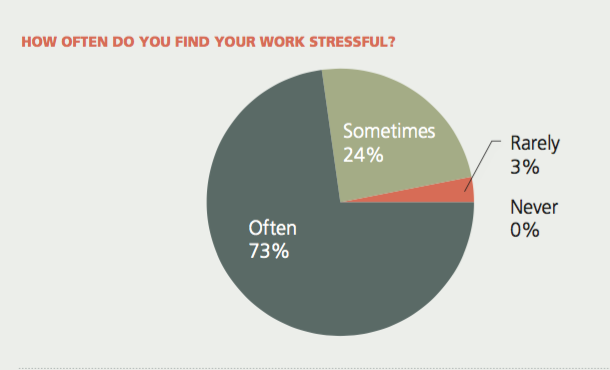
A total 73% of respondents said they often feel stressed at work.

Screen Shot 2018-03-01 at 12.48.15 PM

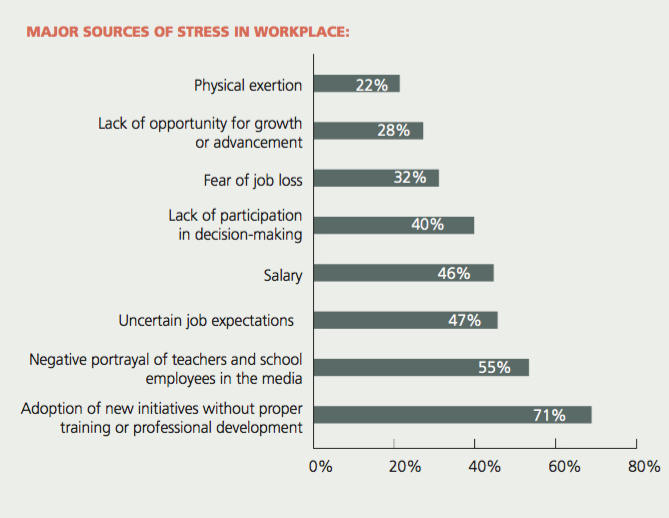
The reasons? Adoption of new initiatives without proper training or professional development (71%), negative portrayal of teachers and school employees in the media (55%), uncertain job expectations (47%) and salary (46%) were the most common responses.

Screen Shot 2018-03-01 at 12.48.58 PM

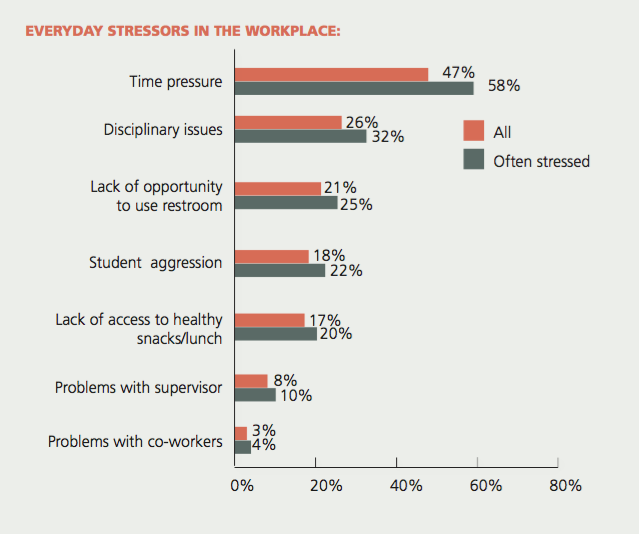
The survey identified the following as most common everyday stressors in the workplace – time pressures, disciplinary issues and even a lack of opportunity to use the bathroom.

Screen Shot 2018-03-01 at 12.49.11 PM

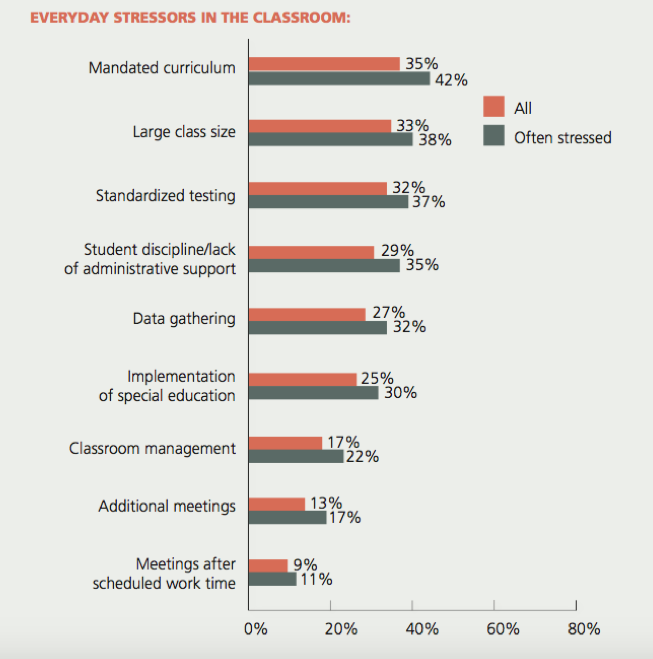
Focusing just on the classroom, top stressors were mandated curriculum, large class sizes and standardized testing.

Screen Shot 2018-03-01 at 12.49.35 PM

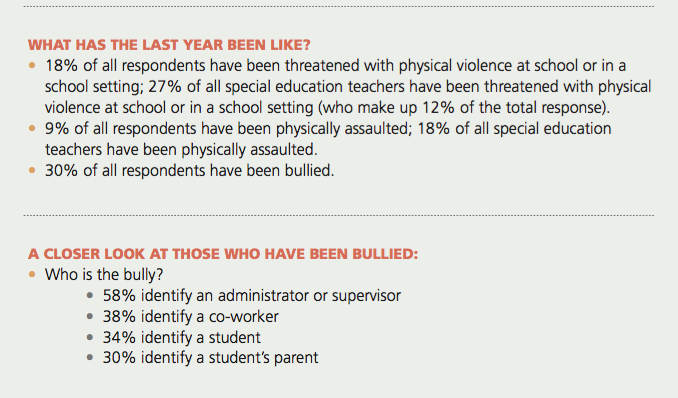
Many teachers claimed to be the victims of violence at school.


A total 18% of all respondents said they had been threatened with physical violence – though the percentage jumped to 27% when looking solely at special education teachers.


A total of 9% of all respondents claimed to have been physically assaulted at school. Again the percentage jumped to 18% of all special education teachers.


But it’s not just physical assault.


A total of 30% claim to have been bullied by administrators (58%), co-workers (38%), students (34%) and student’s parents (30%).

Screen Shot 2018-03-01 at 1.03.57 PM

This is the situation where policymakers want to throw firearms.


Most gun violence doesn’t involve a shooter doing harm to others. The great majority of gun deaths are self-inflicted.


Even without adding guns to the mix, several high profile teachers and administrators already have committed suicide.


In October of 2010, for example, a California elementary school teacher named Rigoberto Ruelas, Jr. took his own life after the Los Angeles Times published a report labeling him a “less effective teacher.” Despite the fact that students and parents praised Ruelas, who taught in one of poorest schools in his district and who also was born, raised and continued to live in area where his school was located, the Times targeted him among other so-called “less effective” teachers as part of a major propaganda campaign.


And this isn’t an isolated incident. In July of 2015, a New York City principal under investigation for altering Common Core test scores, killed herself by jumping in front of a subway car.


Adding guns to this situation will just mean more teachers taking their own lives with a bullet.


That may have been the intent of the Georgia teacher in yesterday’s shooting.


Local police said they didn’t think he was trying to injure anyone else. When he shot his gun out of the window, he appeared to be trying to get others to leave him alone.


Arming teachers is a terrible solution to school violence. It’s taking an already stifling room and turning up the heat.


We need sensible gun regulations to reduce the pressure, not increase it.


We need sensible school policies that treat teachers and students like human beings and not just cogs in the system.


But this requires us to break out of a dangerous pattern in how we deal with social problems.


When we see a problem, we generally just shrug and leave it up to public schools and teachers to solve.


Inadequate resources – leave it to teachers to buy school supplies out of pocket.


Inequitable funding – increase class size and leave it to teachers to somehow make up the difference.


We can’t do the same with gun violence. We can’t just toss teachers a gun and tell them to sort it out.


Teachers can’t solve all of society’s problems alone.


That’s going to take all of us.


And we’ll need more than disingenuous proposals like answering gun violence with more guns.

Gamification – The Hottest New Trend to Monetize Education

Screen Shot 2018-02-26 at 3.14.37 PM


When I was a kid, Super Mario Bros. was my jam.


After school, I couldn’t wait to take on the role of plucky plumber Mario or his brother Luigi. I’d jump on a few turtle shells, bounce over a bottomless pit and smash just the right secret brick to get my flashing star power up and wipe the floor with endless levels of Koopa Troopas.


But through it all, I never really learned anything.


With the possible exception of a few Italian stereotypes, the only knowledge I gained was where the warp zones were, which blocks to hit and the muscle memory necessary to defeat the next bad guy.


However, now-a-days that’s all changed.


Someone in marketing and accounting has decided that the same techniques I used to save Princess Toadstool would make an exceptional method of pedagogy.


They call it gamification, the process of making academic lessons, courses and objectives look more like video games.


Sure, the process has applications in the business world and advertising, but its biggest market has been education.


In fact, the Gamification industry is worth $2 billion worldwide and some estimate it to jump to $22 billion by 2022.


Want to teach grammar? Welcome to the good ship Verb sailing on the seas of Nouns and Pronouns. Interjections, A-hoy!


Wish your students knew fractions? Let them blast away the wrong numbers so only the correct numerator matches with the correct denominator.


That kind of thing.


It’s incredibly popular in some circles.


Advocates claim it increases student engagement and enthusiasm, provides instant feedback and the opportunity for social interactions.


Critics say it reduces students’ attention spans, narrows the curriculum and replaces human interaction with canned interfaces.


But when something is bringing in this kind of cash for big business, it’s kind of beside the point whether it works or not.


It’s the latest form of snake oil out of the cobra factory, and your teacher may be forced to pour it into your children’s brains.


That’s just Education 2018. Under the old model, the hucksters would have to approach each teacher one-at-a-time and convince them to try the shinny new toy in the box. But when you remove teacher autonomy, that frees all the used car salesmen to go right to the one person in your district – often the technology coordinator or academic coach – who controls the purse strings and convince him or her to buy what they’re selling.


In short, I’m not a fan.


In fact, I think gamification is one of the dumbest fads to hit public schools since standardized testing.


Don’t get me wrong.


Games can have limited use in the classroom.


My students love reviewing already mastered material in teams or competing against each other individually.


But there’s a big difference between playing Jeopardy or Kahoot with soon-to-be-tested material and plopping kids on an app or software package that pretends to teach them the concept.

There’s a world of difference between a 10-minute detour and an entire curriculum structured around game theory.


The biggest problem seems to be this.


Games are not intrinsically valuable.


They are good or bad based on the amount of fun they provide the user.


Be honest. No one really cares if Link puts together the Tri-force. No one is losing any sleep over rampaging Metroids on the loose. No one is putting out an Amber Alert the next time Princess Peach is inevitably kidnapped by Bowser. The only thing that matters is if meeting these objectives and countering these fictional bad guys is fun and exciting.


However, the same is not true for the ends of education.


People care whether you can read and write. You may lose sleep over being unable to add, subtract, multiple and divide. Co-workers will be alerted if you don’t comprehend the basics of science and history.


And the higher the skill we’re aiming for, the greater the degree of importance.


Gamification divorces these two ends. It turns education from an intrinsic activity into an extrinsic one.


This is a big deal.


Students shouldn’t struggle through a reading passage so they’ll get a score or a badge. They should actually care about what they’re reading.


My students and I just finished reading Lois Lowry’s “The Giver,” and they loved it.


After the first few chapters, they weren’t reading for a grade or to please me, their teacher. They truly wanted to know what would happen next. And to fully understand that, they had to exercise and refine their reading skills.


Look at it like this.


When I was playing Super Mario Bros., I often took a few warp zones to the last board so I could beat Bowser quickly and win the game. But that means I skipped over most of the first seven boards.


This didn’t matter because the only reason to play was to win. But if those first boards had included something important to the experience, skipping them would have greatly diminished my experience.


Gamification reduces learning until its meaningless. Why would anyone want to know something unless it carried with it a video game like reward?


And that’s merely the worst part.


In practice, most of the applications and software being pushed on kids to increase enthusiasm and motivation aren’t really very much fun at all. After a few times through, there isn’t much reason to plow through exposition heavy content with little to do. This material doesn’t connect to students’ lives, it doesn’t foster authentic competition, it doesn’t stoke their sense of wonder – it’s just a boring set of hoops to jump through to satisfy the instructor.


Admittedly, it does provide instant feedback, but that doesn’t matter if students don’t care about the matter at hand.


Social interactions are possible here but rarely have I seen this opportunity explored. A good group project will get students more engaged socially than messaging back and forth about the software challenge du jour.


Education can be so much more than this.


Students are being robbed of authentic interactions, authentic instruction and authentic learning.


Not all things should be turned into a game.


Gamification is another example of trying too hard to market something to people who won’t actually be using it in the hopes that they won’t notice it doesn’t actually work that well.


The consumer isn’t the gamer – it’s the administrator who buys the program. And the people best suited to assess the program’s success – teachers and students – aren’t even part of the equation.


It’s about monetization, not education.


Mario may grab a bunch of coins on his way to save the princess, but it is the corporations who are getting rich off this sad fad.


All that glitters is not gold, just as all that is new and technological is not cutting edge.


Can we stop letting big business drive the field and let education be determined by educators?


Otherwise, it will be game over for an entire generation of kids duped into accepting crap for curriculum.