Decolonizing Through Dialogue: Authentic Teaching in the Age of Testing and Common Core

waitingsuperman3023


If you’re not careful, being a public school teacher can become an act of colonization.


This is especially true if you’re a white teacher like me with classes of mostly black students. But it’s not the only case. As an educator, no matter who you are or whom you teach, you’re a symbol of authority and you get that power from the dominant structures in our society.


Believe it or not, our schools are social institutions, so one of their chief functions is to help recreate the social order. Students enter as malleable lumps of clay and exit mainly in the shapes we decide upon. Therefore, as an educator, it’s hard not to fall into the habit of molding young minds into the shapes society has decided are appropriate.


In some ways this is inevitable. In others, it’s even desirable. But it also runs against the best potential of education.


In short, this isn’t what a teacher should be. My job in front of the classroom isn’t to make my students into anything. It’s to give them the opportunity, to generate the spark that turns them into their best selves. And the people who ultimately should be the most empowered in this process are the students, themselves.


But it’s easier said than done.


The danger is best expressed in that essential book for any teacher, “Pedagogy of the Oppressed,” where Paulo Freire writes:


“Worse yet, it turns them (the students) into ‘containers,’ into ‘receptacles’ to be filed by the teacher. The more completely she fills the receptacles, the better a teacher she is. The more meekly the receptacles permit themselves to be filled, the better students they are.”


In most cases this means Eurocentrism – a kind of worship of all things white and denigration of all things black, brown and all pigments between.


We take the status quo and find every blind justification for it. In fact, this can become the curriculum, itself. Every counter-narrative, every criticism of the power structure then naturally becomes a danger. Revisionist history becomes history. European philosophy becomes the only accepted definition of rationality. Ideologies of empire become obvious and inescapable. White becomes the norm and racism, misogyny, homophobia, xenophobia all become hidden and internalized.


You’ve heard the criticism of curriculums focusing exclusively on dead white males. This is why.


And not only does it silence minority voices, it reinforces a false view of the world. Folk singer Tom Paxton made that clear in this classic song:

What Did You Learn In School Today?”

What did you learn in school today,
Dear little boy of mine?
What did you learn in school today,
Dear little boy of mine?

I learned that Washington never told a lie,
I learned that soldiers seldom die,
I learned that everybody’s free,
And that’s what the teacher said to me,
And that’s what I learned in school today,
that’s what I learned in school.

What did you learn in school today,
Dear little boy of mine?
What did you learn in school today,
Dear little boy of mine?

I learned the policemen are my friends,
I learned that justice never ends,
I learned that murderers pay for their crimes,
Even if we make a mistake sometimes,
And that’s what I learned in school today,
That’s what I learned in school

What did you learn in school today,
Dear little boy of mine?
What did you learn in school today,
Dear little boy of mine?

I learned that war is not so bad,
I learned about the great ones we’ve had.
We fought in Germany and in France
And some day I might get my chance.
And that’s what I learned in school today,
That’s what I learned in school

What did you learn in school today,
Dear little boy of mine?
What did you learn in school today,
Dear little boy of mine?

I learned our government must be strong;
It’s always right and never wrong!
Our leaders are the finest men
And we elect them again and again,
And that’s what I learned in school today,
That’s what I learned in school


We can see why this kind of teaching is valued. It reinforces the status quo. But at its core education is essentially subversive. It supports new ways of thinking. It is by definition revolutionary. When you encourage students to think for themselves, some may come to conclusions that differ from the norm. This is entirely healthy and the only way societies can grow and change. But it’s inimical to the people in power who often are in charge of the educational system. They don’t want new ideas if those ideas will challenge their hold on the reigns of power. Socrates wasn’t forced to drink hemlock, after all, because his lessons supported the Athenian elite.


So we’re left with a real quandary. How do teachers remain free to inspire while being a part of a system that doesn’t value inspiration?


The natural forces of society work against authentic teaching like gravity pulling at a rocket. Unless you’re actively pushing against the ground, the most natural thing in the world is to just go with the flow. The textbook says this is the way. Teacher training programs often agree. Cooperating teachers who have been in the classroom for decades back it up. This is the best method. Just keep it up.


But it’s not. And you shouldn’t. There is another way even though it’s hard to see. And THAT’S often what you need to be doing for your students.


Let me pause at this point to make one thing clear: I don’t have all the answers.


I am no expert in how to do this. I have fallen victim to it, myself, more often than I’d like to admit. It may be next to impossible to avoid the accepted route much of the time. But if we want to be good teachers, we need to try.


If we really want to provide the best service to our students, their parents and the community, we have to break out of the mold. We have to allow our students the chance of seeing the world and not just our version of it.


The best ways I’ve found to do this are through selection of texts, use of Socratic Seminars and allowing as much choice as possible in assignments.


When selecting texts, you want to be as inclusive as possible. Provide students with the widest possible range of authors and opinions. In Language Arts, this means purposeful multiculturalism. It means authors of color being prized equally with the European cannon. It means women and transgender authors. It means authors subscribing to a wide range of beliefs and skepticisms. And it means accepting genres and forms that are often devalued like song lyrics, rap, Manga, graphic novels and anything that can be considered deep, substantial texts.


Finding such sources can be exhausting, but it’s also exhilarating. Unfortunately, not all schools permit teachers to do this to the same degree. Some districts mandate teachers only use certain texts already approved by the school board. Others provide a list of approved texts from which teachers can pick.


Each educator will have to find ways to navigate the system. It’s best if you can find support from administrators and in the community for what you want to do and go from there. But this can be a challenging road especially in our era of high stakes testing and Common Core which values authentic teaching not at all.


Another essential tool is class discussion. You may or may not be able to broaden the texts being discussed, but you can usually provide space for students to discuss those texts in class.


My 8th graders and I use the Socratic Seminar method of discussion extensively.


With almost every piece of literature, I write guided open-ended questions for the students to consider. The questions come out of the text, but I try to focus on queries that will get students thinking about how the text relates to their lives, gender and economic issues, questions of theme, race and opportunities to make connections of every type. Eventually, I even allow students to begin writing these questions, themselves.


The way I see it, my role is essentially an opportunity maker. It isn’t about finding an answer that will please me, the teacher. It’s about exploring the subject. It’s not about what I think. It’s about what students think. And that makes all the difference.


Finally, I’ve found it beneficial to allow students choice in their assignments.


There are many ways for students to demonstrate knowledge. They can write essays, take a test, create a collage, design a power point presentation, make an iMovie, act out a scene, etc. I try to expose students to multiple formats the first half of the year and then give them increased choice in how they’d like to express themselves in the second half.


Not only does this free students to think, it encourages the deepest kind of learning. It makes the lesson vital, important and intrinsic.


All of these approaches share a common feature: dialogue. They put the student, teacher and the author in a vital relationship. They take steps to equalize that relationship so that one isn’t more important than the others. It’s not just what the author, teacher or student thinks – it’s the interrelationship of the three.


Ultimately, it’s up to the student to decide the relative value of the results. Sure, they get grades. Sure, the system will judge students based on those grades. But the value of those grades isn’t as important as the resultant learning and the value students place on the experience.


To me, that’s the best kind of learning. And it’s the result of authentic teaching and dialogue.


It is the most inimical thing to colonization. Students are not enslaved to a system. They aren’t in servitude to a prepackaged group of ideas and norms.


They are valued and empowered.


Isn’t that what we’re supposed to be doing for them?
Congress Frees Public Schools From Federal Test & Punish – Where’s the Catch?

Trump+Selection+Education+Secretary+Betsy+kBaA0SDAd_tx

Let’s say you were kidnapped and kept in a small basement room where you were routinely beaten and starved.

Then after years of this treatment, your captors brought in a massage table and offered you a filet mignon after your spa treatment.

You’d be more than a little bit confused.

That’s the position of parents, students and teachers today.

After almost two decades of punishing public schools and their students for low test scores, Congress suddenly decides to step back and leave it to the states!?

Until now the federal government had mandated increasing high stakes standardized tests and forcing schools that don’t meet a certain threshold to be stripped of their school boards, turned into charters or simply closed. Until now, the federal government coerced states to enact every fly-by-night corporate education reform from Common Core to Teach for America to evaluating teachers based on student test scores.

But now the feds are just walking away!?

First, in 2015 lawmakers passed the Every Student Succeeds Act (ESSA), a reauthorization of federal K-12 education policy that (depending on how you interpret it) limited federal power over public schools. However, the Obama administration offered guidelines that put much of that federal power back in place.

Now both the House and Senate have voted to repeal those Obama administration guidelines in favor of… well… some other interpretation.

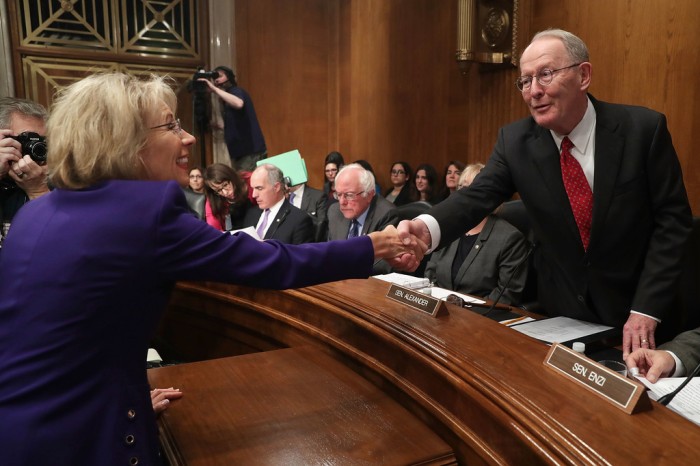
Sen. Lamar Alexander (R-Tennessee), chairman of the Health, Education, Labor and Pensions committee and one of the architects of the ESSA, says states can just follow what’s written in the law. But this is a 1,061 page document full of legalese, meandering bipartisan compromises and – frankly – contradictory language. Even the most simple legislation needs interpretation, and in this case it needs extensive interpretation.

Education Secretary Betsy DeVos is expected to offer her take on what all this means by Monday. So buckle up for that one. I’m sure the nation’s Grizzlies are so upset they can barely finish their picnic baskets.

As for the rest of us, it’s hard to know what this all will mean.

Alexander offered a detailed explanation that anyone interested in this issue should read.

I’m no fan of the Senator’s. I think he’s a blatant opportunist, an unapologetic partisan and out to protect only one person – numero uno.

But he makes some excellent points about federal overreach in the Department of Education under the previous two administrations.

Moreover, unlike DeVos, the supremely unqualified Education Secretary he helped ram through Congress over bipartisan objections, he knows something about schools. He was Secretary of Education, himself, from 1991-93 under President George H. W. Bush.

First, the ESSA still mandates annual testing. Even without the Obama guidelines, students will still be tested in grades 3-8 and once in high school.

Second, Alexander says the law still requires each state to hold its public schools accountable. Each state must submit a plan detailing how it intends to do that by September of 2017. There is plenty of latitude on exactly how states will do this, but whatever they decide, this new accountability system must be implemented by next school year (2017-2018).

Moreover, he says, states have to identify and provide support to at least the lowest performing 5% of their schools. This must be done by the beginning of the 2018-2019 school year.

They also must use academic and English language proficiency indicators in their accountability systems. Which indicators? Standardized testing? Maybe – maybe not.

Many accountability provisions, such as the requirement that educators measure reading scores, math scores, and graduation rates, are specifically mentioned in the ESSA.

Still, many questions remain.

For instance: if the Department of Education isn’t allowed to tell states what to do, how is it supposed to help them comply with the law?

Alexander cites “Non-regulatory guidance; Dear Colleague letters; Frequently-Asked-Questions documents; Webinars, phone calls, and in-person conferences.”

Alexander stresses that repealing the Obama regulations does not open to door for the Department of Education to mandate a nationwide school voucher plan – unfortunately.

He writes, “A school choice program cannot be unilaterally created by the Department of Education. Only Congress could create a voucher program, and, unfortunately, Congress has rejected doing that.”

However, the Trump administration and DeVos have already made their intentions known about school vouchers. They intend to use Title I dollars – money usually earmarked for the most impoverished students – as federal bribes to enact vouchers. It’s basically the same thing Obama did with Race to the Top – promising federal money to states if their schools do what the feds want them to do.

For all his talk about states rights, Alexander appears to have no problems with this same kind of Obama-style coercion.

But he does appear to be correct about the transfer of power.

Apparently, the states really will regain control over their public schools.

This could be a very positive thing. And it’s not the only one.

In addition to repealing Obama’s accountability regulations, Congress scrapped Obama’s teacher preparation rules.

This change was less controversial. Eight Democrats joined Republicans in voting to repeal the teacher preparation regulations. By comparison, no Democrats voted to dismantle the accountability rules and one Republican joined them in opposition.

The teacher preparation rules were released in October after years of delay.

The main point of contention was the requirement that states develop a rating system aimed at evaluating the success of their teacher preparation programs. This would have included how programs’ teachers perform based on a measure of student academic achievement. Though the final version gained some flexibility with how to determine student academic success beyond just test scores, it remained a hot mess.

Any programs that didn’t perform well on the state’s rating system would have lost access to federal grants aimed at supporting teachers who work in high-need certification areas and in low-income schools (or TEACH grants). In effect, it would have pushed for a new generation of teachers dedicated to test prep and Common Core.

And these repeals of Obama regulations – these seeming improvements just waiting for Donald Trump’s signature – are brought to us by the same people who support removing protections for trans students. These are the same legislators who gave us an unexperienced mega-donor as Education Secretary.

Frankly, I’m having trouble believing it.

I hope I’m wrong, but I’m waiting for the other shoe to drop.

Perhaps the standardized testing industry has consolidated so much support at the various Republican controlled state legislatures that it no longer needs support in Washington. Perhaps our ridiculously gerrymandered state legislative districts will make any resistance even more difficult. Perhaps a completely toothless Department of Education will embolden the most racist state legislators to dramatically increase segregation and civil rights abuses for the poor and minorities.

Or perhaps Republicans actually got one right?

The Blinders of Partisanship: How Republicans and Democrats Miss the Point – We’re All Being Screwed

impact-blinders-300x199

Perhaps the biggest disappointment of this election cycle wasn’t Donald Trump’s victory.

It’s how quickly many of our allies on the right gave up their beliefs to fall in line.

Under President Barack Obama, those on the left and right were united against Common Core.

We both realized it was a terrible policy – though sometimes for different reasons. Never-the-less, we put aside politics to fight Bill Gates, David Coleman, Eli Broad and other privileged left-leaning elites.

And through this common struggle we came closer ideologically. I’m a New Deal FDR Democrat, but even I could see how the Obama administration overstepped its federal authority pushing charter schools, standardized testing and the Core down our throats.

But as soon as Trump ascended to the Oval Office, many conservatives gave up their objections to this same kind of federal overreach.

Apparently Obama was wrong to push charters, but Trump is just fine pushing school vouchers. Obama was wrong to require high stakes testing, but Trump is just fine requiring the same thing. Obama was wrong to push Common Core, but all these Republican-controlled state houses that could eliminate Common Core tomorrow are right to leave it in place unchallenged.

This is incredibly hypocritical. Yet it’s not just with this one issue.

We see the same thing with healthcare. What we now call Obamacare was invented by a far right think tank, the Heritage Foundation. It was first implemented by Mitt Romney as Governor of Massachusetts. But as soon as Obama took up essentially the same policy, conservatives put forward hysterical opposition. And now the Trump administration is Hell-bent on repealing Obamacare – a far right solution to healthcare – simply because a black Democrat touched it.

The same thing happens on the left.

Corporate Democrats advocate hard for public tax dollars to be used to fund essentially private schools.  That’s what charter schools are – schools run by private interests but labeled public only because that’s where the money comes from. Yet when Republicans advocate giving tax dollars to private schools without the “charter” label, corporate Democrats pretend like it’s the largest ideological divide since the Cold War. It’s not. There is very little difference between charter schools and school vouchers – both are terrible policies that fund essentially private schools with public money, but Democrats pretend like one is the silver bullet to all our education problems and the other is death personified.

It’s disgusting, but it works.

This kind of sophistry fools a lot of voters.

People still think politics is a football game. There are two teams. You pick one and stick with it no matter what.

However, it’s just a con. Both sides are out to screw you over. If there is a difference at all, it’s that Democrats are out to destroy the world at a slower rate. Republicans want to burn it all down right now.

Both parties are out only for the richest of the rich. They both support policies that back up the wealth class and degrade any protections for the middle class or poor. It’s Rome all over again – support a bloated military and the patricians while offering the plebs nothing but propaganda and false promises.

Yet we fall for it. Still.

And it’s not like there isn’t a sizable resistance to the plutocracy of both parties.

The Women’s March, the Fight for 15, the struggle against the TPP and the Dakota Access Pipeline – Millions of people have taken to the streets to protest the regressive policies of the Trump and Obama administrations. It’s just that when it comes to voting, we suddenly become either very timid or very apathetic.

Left-leaning pundits blame the tiny fraction of third party voters for Trump’s victory, but that’s not just wrong. It’s gas lighting. It’s not that too many people voted for Jill Stein. It’s that not enough did.

Millions of people are already out there doing the hard work of resistance. We need to have the courage of our convictions and unify under a single political banner.

Some hope that this could be a rejuvenated, renewed Democratic party. And it could, but the party elites have done everything they can to stop this from happening. Time and again, they take steps to keep the party powerless yet in their power.

Just look at the back room deals and last minute maneuvering that installed Tom Perez as party chair. He wasn’t even in the running until it looked like progressive Keith Ellison would win. So Obama, leader of the corporatists, pushed for Perez. Sure they gave Ellison a title with no power, but that’s not progress. It’s pretend.

The time will come very soon when the resistance has to wrench control away from the corporatist and fake progressives who silence any criticism with fake cries for unity behind their impotent banner. Or we will have to rise up as one with the courage to create a new party, a people’s party that truly represents our movement.

We have to get beyond these silly labels – Republicans and Democrats. We need to base our politics on ideas and what’s really best for everyone. We need to shut out any pundit getting rich off telling us what to think. And we need to find a way to listen to each other again, to see each other as people first and not representations of the other team.

In short, we need to see clearly our common cause and unify.

It’s easier said than done, but the first step is removing our partisan blinders and looking at each other with fresh eyes.

Most of us don’t live at Trump Tower or vacation at Mar-a-Lago. Most of us don’t play golf with the Obamas and Richard Branson. Most of us have the same wants and needs. It’s time we go about satisfying them and to Hell with all the corporate elites!

It’s time to be Americans first.

It’s time to rise up.

Koch Bros Funded Publication Criticizes – ME – on School Choice!

who-me2

You know you’ve made it when the Koch Brothers are funding a critique of your work.

Most of the time I just toil in obscurity.

I sit behind my computer furiously pounding away at the keys sending my little blog entries out onto the Interwebs never expecting much of a reply.

Sure I get fervent wishes for my death.

And the occasional racist diatribe that only tangentially has anything to do with what I wrote.

But a response from a conservative Web magazine funded by the world’s most famous billionaire brothers!?

I guess this is what the big time feels like!

The article appeared in The Federalist, an Internet publication mostly known for anti-LGBT diatribes and climate change denial. But I had the audacity to write something called “Top 10 Reasons School Choice is No Choice.”

I had to be taken down.

And they had just the person to do it – far right religious author Mary C. Tillotson.

You may remember her from such hard hitting pieces as “How Praying a Novena Helped Me Process This Election,” “Sometimes, Holiness is Boring,” and “Why It’s Idiotic to Blame Christians for the Orlando Attack.”
This week her article is called “Top 10 Reasons HuffPo Doesn’t Get School Choice.”

Which is kinda’ wrong from the get-go.

Yes, I published my article in the Huffington Post, but it is not exactly indicative of the editorial slant of that publication. Sure, HuffPo leans left, but it routinely published articles that are extremely favorable to school choice. Heck! Michelle Rhee is a freakin’ contributor!

So I don’t think it’s fair to blame HuffPo for my ideas on school choice. A better title might have been “Top 10 Reasons Singer Doesn’t Get School Choice,” but who the Heck is Singer and why should anyone care!?

Then she gives a quick summary of how my whole piece is just plain wrong: “Steven Singer of The Huffington Post would have you believe that when parents have more choices, they have fewer choices.”

That’s like writing “Steven Singer of Consumer Reports would have you believe buying a used car means you may not be able to get anywhere.”

I stand by that statement. They’re both scams, Mary. The perpetrators of school choice want to convince you to choose a school that gives you fewer choices than public schools do. Just like a used car salesmen may try to convince you to buy a clunker that won’t get you from point A to B.

Claim 1: ‘Voucher programs almost never provide students with full tuition.’

She says I’m wrong because I’m right. She basically admits most vouchers won’t pay the full tuition but that it’s still a help.

Okay. But parents have already paid for a full K-12 public school education that they will not have to supplement at all. That’s a much better value.

Moreover, Mary, you pretend that the cost of the voucher is going to pay for at least 2/3 of private school tuition. This isn’t true. Most of Donald Trump’s kids went to the Hill School in Pennsylvania for more than $55,000 a year. A thousand or two isn’t going to help much.

But Mary disagrees. Most rich folks aren’t eligible for voucher programs, she says, so the hyper elite academies are off the table.

It’s true that most vouchers are given to poor students, but that’s only temporary. The goal is to increase them to middle and upper class students. It’s the first thing they do after initially limiting vouchers to the poor. And she knows this. She’s read Milton Friedman, the conservative nutjob who thought up this scheme to destroy public schools. “The ideal way would be to abolish the public school system…” he said. How? “Privately conducted schools… can develop exclusively white schools, exclusively colored schools and mixed schools,” Friedman wrote.

What a brave new world you’re defending, Mary!

Claim 2: Choice schools don’t have to accept everyone.

She writes, “Singer would have you believe that charter schools and private schools receiving voucher money are cherry-picking the best students to stoke their egos and stats. This isn’t true, and even if it were, it would still provide more choices.”

Um. Okay. So you admit this could be true but it doesn’t matter. Choice is all that matters. Very telling.

Then she goes on to talk about schools that actually do pick their own students, and she argues that it’s okay.

It’s not, Mary. Schools that accept tax dollars should have to accept all students. Otherwise, you’re just guessing that somewhere out there is a school for all kids, but you’re doing nothing to ensure this is true.

Children and families from places destroyed by vouchers and underfunding of public schools such as Detroit have been complaining of this very thing. They go from school to school never able to find one that meets their needs. It’s not that this is a failure of the system either – this IS the system working properly! This IS school choice – a system that only ensures choice but never quality or excellence. It is predicated on the semi-religious belief that the market will take care of everything.

It doesn’t. Ask Dannah Wilson about it.

Claim 3: Charter schools are notorious for kicking out hard-to-teach students.

She acknowledges the point and then changes the subject. She says there are great charters out there like KIPP. Yes, KIPP – a system that does exactly what I just said it does! Look at the huge numbers of students KIPP schools kick out. Look at the very few who make it to graduation. This is a terrible model for your school. I guess Mary lives in a universe of alternative facts where terrible equals great.

I’m kind of embarrassed for you. Let’s just move on, shall we?

Claim 4: Choice schools actually give parents less choice than traditional public schools.

Mary says that every parent should have the right to vote with their feet? Why? I’m not sure. Maybe this explains her position:

“Singer writes, “If you don’t like what your public school is doing, you can organize, vote for new leadership or even take a leadership role, yourself.” But seriously, who has time for that? Some people, yes, but not the single mom working two jobs to make ends meet. It’s a lot easier—and a lot faster, which matters in the life of a child—to enroll a child in a different school than to slog through the political process.”

So it’s a lot easier to have fewer options? Mary, you just argued AGAINST choice. You just said choice is too much work. No one has time for choice? Make up your mind.

That is ridiculous. But moreover it’s untrue. Do you really believe parents have the time to go shopping for new schools every week? That single mom doesn’t have time to go to board meetings but she has the time to enter these charter school lotteries and hope her kids get in? And if they don’t, she has time to trudge across town to another school and when it closes suddenly, she has time to start the process all over again? And again? THIS is the time saving process!? When she could actually be building something as part of her community?

Claim 5: Charter schools don’t perform better than traditional public schools.

She just says both can be good or bad. This sidesteps exactly how bad charter schools can be. Charter operators can take all the money and run. Charters can close without warning. Cyber charters have been found to actually provide less education in math and reading than not going to school at all.

Traditional public schools can struggle, and when they do it’s almost always because they’re underfunded. Yet, they NEVER provide an education that is as bad as the worst charter schools. And most traditional public schools do the best they can with what they have. The problem is strategic disinvestment. We could make almost every traditional public school excellent if we just funded them fairly. But unfortunately billionaires like the Kochs are paying for people like Mary to convince us otherwise.

Claim 6: Charters and vouchers increase segregation.

She basically offers a defense of white parents who want their kids schooled separately from black ones. That’s just choice, baby, and choice is always good.
No, it’s not. We’ve seen that it is better for everyone if children are educated with diverse people. It helps them understand people unlike themselves. It builds a more tolerant and just America.

Yes, our traditional public schools have become more segregated because of the way district lines are drawn. But that doesn’t mean we should double down on segregation. It means we should fight to reverse it.

Then she tells a fairytale about Obama attacking choice schools in Louisiana. He CREATED that system! He was a booster of the all-charter system! He was not an enemy of school choice. Corporate Democrats are not the enemy of school choice! They love it! They are the allies of your own corporate masters, Mary. Do some research.

Claim 7: Charter and voucher schools take away funding from traditional schools.

She basically agrees with me and then says public schools should find a way to deal with it. That’s what private schools do.

But public schools can’t operate like private schools and they shouldn’t for many of the reasons already enumerated here. They accept everyone. They don’t intentionally segregate. Etc.

Moreover, instability is a terrible basis for a school. You want to ensure it will be there for children when they need it. You don’t want schools competing with each other for resources like businesses. Most businesses fail. You don’t want that for schools. You need them to succeed. That means artificially ensuring their success with a steady, reliable stream of funding just like you give to the military. You wouldn’t suggest the Army, Navy, Air Force and Marines compete for funding. Why do that to our public schools?

Claim 8: Funding a variety of schools would be wasteful and expensive.

She says I’m thinking “bureaucratically, considering ‘school systems’ instead of the actual children who are the reason schools exist in the first place.”

Uh, these systems serve children. You need to be able to run them FOR THOSE STUDENTS.

Claim 9: School choice distracts from the real problems: poverty and funding equity.

She agrees that poverty is important. Then she pulls the old “throwing money at problems is a terrible idea” card. Public schools just need to find ways to cut costs. They spend too much. Blah, blah, blah.

She ignores the facts. Public schools spend dramatically different sums on students depending on whether they’re rich or poor. We need equitable school funding. That means spending more on poor children and not complaining about “throwing money” at the problem. No one complains about that at the rich schools where they spend so much more than the poor schools. No one calls it “throwing money” when it’s your own child. That’s “investing in children.” It’s only when it’s THOSE kids that it’s “throwing money” at the problem. It betrays a class conscious prejudice against the poor and – most likely – children of color.

She then goes on to complain about the increase in administrative costs at public schools. This is laughable! Charter schools spend so much more on administrative costs than traditional public schools! A study by Michigan State University and the University of Utah found that charter schools spend on average $774 more per student on administration and $1,140 less on instruction than do traditional public schools.

And then she talks about student achievement not increasing at public schools. Actually, it depends on how you measure it. Standardized testing is a poor measure of achievement. And when you adjust for poverty, our schools are some of the best in the world.

Claim 10: School choice is supported by billionaires, not the grassroots.

Here she just talks about all the events planned during school choice week.

Mary, these are attended by private and parochial schools during the school day. The staff is literally paid to be there. The school children are literally forced to be there because their schools are closed and they are bused in to these events.

That’s not grassroots. That’s the definition of astroturf.

Do some people support school choice? Yes. Less than 10 percent of America’s students attend these schools. But the overwhelming majority of Americans support public schools.

Mary goes on about all the people applying for vouchers but she ignores a much more pertinent fact. Whenever school vouchers have been put to a referendum, voters have always turned it down. This despite who-knows-how-many-millions of dollars in advertising and propaganda to influence voters to support it!

No matter what the position, you can find someone to support it. But the majority of school choice proponents are billionaires and corporatists trying to fool regular people into doing what’s not it their own best interests.

Just ask your editors at the Federalist, Mary. You and your article are a case in point.

But thank you so much for critiquing my article. I’m just a public school teacher. I so rarely get corporate employees writing responses to my work.

Frankly, I didn’t find your piece very convincing, but what do I know? I’m a union thug with an advanced degree, a masters and a national certification. I don’t represent Trump’s America like you do.

I just represent the majority who may one day wake up and take it all back.

Allowing Guns in Schools is a Bad Idea

guns-in-school

Guns were not allowed at Donald Trump’s inauguration.


They were not allowed at his speech to the National Rifle Association (NRA).


Nor were they allowed at the Conservative Political Action Conference (CPAC) or at most of his hotels, golf courses and other properties.


But he wants them to be allowed at our public schools.


He promised to eliminate gun free zones at schools around the country on day one of his presidency.


With all the tweeting about crowd size, he didn’t get around to it. But he may – soon.


Press Secretary Sean Spicer promised in February that the President has an executive order in the works to address the issue.


Before running for Chief Executive, Trump had been much more moderate on guns. But since then he has echoed the NRA’s official position several times, saying that there are fewer shootings in areas where guns are permitted and that killers target areas prohibiting them.


However, it’s not true. From 2000 to 2013, only one shooting was stopped by an armed civilian. However, during that time, 21 shootings were stopped by unarmed bystanders. Moreover, from January 2009 to July 2015, only 13 percent of mass shootings took place in gun-free zones.


The law prohibiting guns in schools (with the exception of mostly law enforcement officers) was signed by Republican President George H. W. Bush in 1990. The law was upheld in 1995 by the U.S. Supreme Court.


So for now, it is illegal for unauthorized people to posses firearms inside or around a school.


Trump’s Education Secretary Betsy DeVos may have given everyone a good laugh suggesting schools need guns to protect from bear attacks, but Republicans are working to make this a reality – with or without the President. In January, Rep. Thomas Massie (R-Ky.) introduced a bill to repeal this legislation.


The question remains, are guns in school a good or bad idea? In a country of 350 million people and more than 310 million guns, would our schools really be safer if those firearms ended up in our classrooms?


F- NO!


Here are five reasons why:


1) Kids Will Get Ahold of Them


Kids get their hands on everything. As a parent, it’s exceedingly difficult to put anything down without your children ending up with it. And that’s only with one or two kids! Imagine it with a classroom of 20-30!


Look at how many times teachers’ cell phones unintentionally end up in student hands. It’s human nature. If kids know a teacher is packing, some of her students may go through her desk, her bag or otherwise find it.


Moreover, teachers often have to break up fights between students. Having a gun within reach of angry adolescents bent on doing each other harm is a recipe for disaster.


Unfortunately, children are not strangers to gun violence. According to FBI homicide data, of the 1,448 children who died as a result of gun violence in 2010, 165 of those deaths were at the hands of other children.


In most cases, trained teachers will keep firearms out of reach, but having them present in the classroom increases the chances of tragedy.


This is backed up by social science. The Journal of Pediatrics conducted a study in 2001 where twenty-nine groups of two to three boys, most of whom were around ten-years-old, had to wait for fifteen minutes in a room with a one-way mirror.  Two water pistols and a real handgun were partially hidden in various locations throughout the room.  If students found the handgun and pulled the trigger, it was rigged to make a firing sound and kickback realistically.


The result: 48 out the 64 boys found the handgun.  Of those, 30 handled the gun and 16 pulled the trigger. Approximately half of the boys who found the gun said they thought it was a toy or were unsure if it was real.  A full 90% of the boys who handled the gun or pulled the trigger had received some sort of gun safety education previously.


Make no mistake. Having guns within reach of children is an invitation for them to use them.


2) Schools Don’t Want Them


Most schools don’t want this responsibility.


Back in 2012, Michigan Republicans floated a bill to allow guns in schools. Superintendents throughout the state sent letters to Gov. Rick Snyder asking him to veto it (which he did). The American Federation of Teachers (AFT), one of the largest labor unions in the country with more than 1.5 million members, also wrote to Snyder, saying, “We should be doing everything we can to reduce the possibility of any gunfire in schools and concentrate on ways to keep all guns off school property.”


They know that guns in school will increase problems – not decrease them. Survivors of school shootings certainly aren’t coming forward demanding more guns. We should listen to them.


3) Teachers Will Misuse Them


Teachers are highly trained and have years of experience helping kids learn. They aren’t necessarily knowledgeable with how to safely use, store and operate firearms. Nor would some of them be suited to such training.


Everyone’s known those teachers who are lovably absentminded. Do you want them leaving their gun in an unlocked classroom? Just because you can help a student read and write, doesn’t mean you’re good in a gunfight.


I love teachers. I admire most of the educators in my building. I would not feel safe if they were all armed.


4) Kids Will Be Scared


Having a gun in class does not put people at ease. It does just the opposite. A gun is a threat of future violence. If students completely trust their teacher, they may be comforted, but students rarely feel that level of comfort with every teacher in the building.


Imagine the chilling effect a firearm can have on class discussion, on any sort of disagreement. Some students are victims of abuse at home and don’t fully trust adults. At present, the worst a teacher can do is just fail them. How would these children feel living with the threat of imminent death? In most states, teachers aren’t even allowed to paddle students anymore. Now we’re going to give them the power of life and death!?


How would parents feel? I love my daughter’s teachers, but I must admit I don’t want them strapped.


5) They Won’t Stop School Shootings


Most school shooters don’t pay much attention to whether they will survive their attack. In fact, they plan for just the opposite. The presence of guns will not deter them. It may even attract them.


Sometimes violence is a cry for help. Children act out not to achieve their aim but to be stopped by an adult. Having guns in school may make students feel safer about initiating a shooting because they think they’ll be apprehended.


Moreover, it makes the job of police responding to a shooting that much more difficult. How can they tell the difference between an armed perpetrator and an armed victim? Plus there’s the issue of friendly fire. When you have two people shooting at each other, bystanders get caught in the crossfire. This is not a good environment for children.


Critics will say it’s better than just the perpetrator being armed, but that’s the point. It’s better that NO ONE be armed at school.


Instead of increasing firearms around children, we should decrease and control them. But that’s a policy driven by rationality and not the profits of gun manufacturers.


This entire debate has been driven by what’s economically beneficial for one industry over everything else. Money has trumped science, reason and empathy.


If Republicans think guns are so vital, maybe they should pass laws to allow them at their own gatherings before forcing them on our public schools.


Children deserve a safe environment in which to learn. Adding guns to our already overburdened public schools is throwing a match at an already explosive situation.

How to Get Trump to Support Public Education: A Military Proposal

trump-toy-soldiers

Donald Trump is dead set on destroying public education.


He and his mega-donor Education Secretary Betsy DeVos want to flood the market with vouchers to divert tax dollars to private and parochial schools thereby starving traditional public schools into closing.


But watching the orange one speaking to Congress last night, I got an idea. I know how to get this dimwitted blowhard to support public schools. And every conservative lawmaker will back him up.


Sound impossible? Not really. But the best part is we don’t need the Democrats to do a darn thing. As if they could. Their thumbs are planted so firmly up their own asses it would take an army of proctologists to save the party.


We don’t need them. All we need is language. Just rename things.


It’s the same tactic Nazis have used to take over the Republican Party. They’re no longer called Nazis. Now they’re “white nationalists,” or just members of the “Alt-Right.”


So we can use the same ploy: Conservatives won’t support “public schools” so let’s call them something else – something they will support no matter what.


Here’s the plan: Trump wants to increase military spending by $54 billion. So we reclassify education as a branch of the military.


Defense spending already tops $600 billion a year. Federal education spending is only about $70 billion.


We could combine them and call it an increase in the military!


I know what you’re thinking. If we do that, the armed forces are going to gobble up school funding. Not necessarily.


They can’t spend all the money they get now! The waste, fraud and abuse in the military is legendary. Piles of money – literally piles of cash – simply go missing and no one knows where they went or is held responsible.


But you’re right. We need a reason to prioritize some of that military spending for school kids.


And there’s a simple solution: disaster capitalism.


It’s the same way testing corporations and book publishers got the Bush and Obama administrations to invest in high stakes testing and Common Core. We simply make up a problem and then offer a solution that requires all this federal spending.


I propose we start the following: A WAR ON IGNORANCE!


Every red-blooded Republican can get behind a new war. It’s their white, Christian duty to protect the country. And if they don’t, we can call them “soft on war” or “snowflakes” or “cucks” or some other euphemism for having a small penis.


Think of it.


Our country is under attack from ignorance. We can’t let our children get left behind so we need to invest in the Education Forces. We need an army of teachers equipped with brand new military bases (formerly schools) that will protect us from foreign illiteracy. ISIS hates our science and math. Russia is jealous of our reading comprehension and historical acumen. China despises us for our creativity and scholarship.


If we look at it as a military problem, we’ll be bound to find workable solutions. Do you think the armed forces would allow some military bases serving black and brown soldiers to be underfunded and lacking in guns and tanks? Do you think the Joint Chiefs would permit white military bases to be stocked with missiles and grenades while black bases go wanting? In fact, do you think they’d put up with segregated bases at all!?


NO WAY.


If Education was considered a matter of national security, these problems would go away in a matter of weeks. Each Educational Fortress would be stocked with everything it needs.


And just to make extra sure – let’s change the name of these resources. No more books, computers, desks, etc. We’ll call them knowledge pistols – because pistols are protected by the Second Amendment. No Republican would dare block schools from arming students with Brain Guns that shoot information into their sage skulls. No conservative would stop kids from “Open Carrying” a stack of neatly bound scholar cannons.


Imagine what this would do for teachers. They would no longer be agents of the “government-run” “socialist” system. They would be soldiers, majors, lieutenants, generals in the military. No serious right-winger could bring themselves to criticizing a four star intellectual brigadier general. He’d have to support the troops!


Terrible programs like Teach for America would come to an abrupt end, too. The military wouldn’t let you send a lightly trained trooper into the harshest war zones to do battle. So no more lightly trained teacher temps dropped into our urban schools for a year or two before entering the business world. We only want educator commandos who have gone through rigorous training programs and received full degrees at our university citadels.


And no more evaluating Cranium Commanders with standardized test scores. Value added measures have been proven to be ineffective. The Army, Navy, Air Force or Marines wouldn’t put up with that – so neither should our Grey Matter Training Centers.


Since we’re at it, no more standardized testing for students either. The military doesn’t use a multiple choice test as the ultimate assessment of battle readiness. They use multiple measures especially the recommendation of commanders and drill sergeants.


Wait a minute. What about school choice? The Trump administration has already committed itself to this policy. He of the billion dollar comb over will never allow such a change in policy. It would look – WEAK!


So don’t change it. Just redefine it.


We can still have school choice. Lots of choice. Great choice. Better choice than anyone ever dreamed. Believe me.


All you do is define exactly which schools are eligible to receive these vouchers.


First, they must accept everyone. That eliminates the majority of private, parochial and charter schools.


Second, they must have an elected school board, open meetings where they discuss how public funding is being spent. Also they must teach only secular curriculum – we can’t risk getting left behind other secular nations in science, math, etc. And the voucher must cover the entire cost for the student.


When you’re done with these and other stipulations, either choice schools will have to become what used to be called public schools or else they’ll have to forgo the vouchers entirely.


How could Trump and his Tea Party followers possibly object?


This is a good plan! A great plan! The best plan anyone ever thought of anywhere in the history of this great country!


This is an increase in the military!


This is in the interest of national security!


We can’t afford NOT to do it!


Come on, Conservative America! Support the WAR ON IGNORANCE!


It’s one protracted, never-ending battle that everyone should be able to get behind.


God bless, America!


(Or we could just prioritize knowledge and children more than guns and death. We could acknowledge an obligation to the next generation that goes beyond mere birth. And we could scrap everything corporate-controlled Republicans and Democrats have been pushing for the last several decades and listen to classroom teachers and other experts! —But no! That’s too radical! Better to enact this modest proposal!)

I’m a Public School teacher. Hands Off My Trans Students!

ct-transgender-students-met-20150425

I’m a public school teacher.

I have a lot of different girls and boys in my classes.

In fact, some of them are neither girls nor boys.

Does that mean they should be discriminated against? Does it mean we should judge them, tell them they’re somehow less valuable than the other kids? Tell them who they are by telling them where to pee?

Heck, No!

Some kids don’t feel comfortable with a traditional gender identity. And it’s more common than you’d think.

It’s certainly more widespread than I ever would have thought until a little girl taught me a lesson… well, not a little girl, really.

A few months ago, I would have said she’s the cutest little girl in the lunch line.

Bright, vivacious, always a friendly smile and a kind word.

But she’s not a little girl.

And I didn’t know until she told me.

As a teacher given the unenviable role of line monitor, I have to find the bright spots where I can.

Letting only two hungry 5th graders in to get their lunch at a time and making the rest wait does not make you popular.

“Aaaargh! Why you always stopping me!?” They often say.

“Because you were third,” I reply.

“But why?” They often insist.

“It’s not personal. It’s numerical.”

And I let them through to continue the game tomorrow.

It goes on like that for about a half hour with little variation – until she gets to the front of the line.

“Hey, Mr. Singer!” Big smile and a wave.

And we’d be off on a conversation. She’d ask me how my day was, what I was teaching my students, how my daughter was. I’d ask how her day was so far, about pets, homework.

She’s actually not in my class. I only see her at lunch, but she always brightens my day.

For months, it went like clockwork. Until a few weeks ago when she appeared at the front of the line with her long hair chopped off into a bob.

“Nice haircut,” I said encouragingly.

“Thanks,” she replied. “You want to know why I got it?”

“Sure. Why?”

“I’m agender.”

“Oh,” I responded cluelessly. “What’s that?”

And she proceeded to explain that she didn’t feel comfortable identifying as male or female.

I nodded and then it was time to let her get her lunch.

I’ll admit it was unsettling. Here was this cute little thing and I didn’t even know what to call her now.

But the next day things progressed as usual. Ze came through the line with the same big smile. We had the same innocuous conversation and ze went to eat.

It made me think.

I’ve been teaching for more than a decade. Ze was probably not the first transgender student I’ve met. And when I thought back to all the children who’ve come through my classes over the years, faces started to pop up and hit me.

Gender is not black and white. (Come to think of it, neither is race.) No one is 100% male or female. I mean, sure people have a fixed range of sexual parts, but gender identity is more than that.

We each feel comfortable acting and identifying certain ways, and if you think about it, some of those ways don’t always line up with our cultural gender designation.

For instance, I cry my eyes out at certain movies. My daughter – who’s 8 – heard the song “Boys Don’t Cry,” the other day and said, “Well that isn’t true. Daddy cries all the time.”

Moreover, my wife loves football, basketball and hockey. Me? I could take them or leave them. If she wants me to watch the game with her, she’s got to beg or promise or put out the right snacks.

Wouldn’t it just make sense that some people are much further to one side or other of the gender spectrum than others? Wouldn’t it just make sense that sometimes your identity and your physical parts don’t match? Or maybe you’re so in the middle that it makes no sense to take a side?

I say again, I teach in a public school. We don’t push any kids away. We take everyone. And that means taking those kids who aren’t so easy to label.

I teach middle school. Transgenderism doesn’t come up too often.

Last year when bathroom bills were all the rage, some of my 8th graders brought it up during our Socratic Seminar discussion groups. And I let them talk about it.

We talked about why some people might think this is a good idea, why some might oppose it, etc. There were some boys who were hysterically against trans students using the bathroom with them, but most of my kids had zero problem with it. In fact, they knew that it had already happened.

Trans students are everywhere. You just rarely hear about them.

I don’t know which bathroom my lunchline buddy uses. I wouldn’t presume to ask. But it hurts me that there are people out there who want to limit hir.

These children have rights. They are little sweethearts. They’re full of life and joy. We should respect their humanity.

And to those who say letting them use a bathroom that corresponds with their identity will lead to kids being molested, let me ask – has that ever really happened?

The way I see it, the problem is people – any people – molesting others, no matter what room they do it in, no matter if they’re transgender or not.

Frankly, it doesn’t happen a lot at school, nor is it more pronounced with trans kids.

This has nothing to do with children. It has to do with old men and women who refuse to broaden their views about the world. It’s about the ancient making the young do as they say regardless of how doing so may trample on their right to be themselves.

Well, I won’t be a part of it.

You want to attack my trans students? You’ll have to do it through me.

I’m a guardian of kid’s rights. I’m a defender of children from whoever wants to do them harm.

I’m a public school teacher. That’s just what we do.

Republicans Suggest Federal Role in Education Be Limited to Bribery

imrs

Hey! Let’s repeal the Elementary and Secondary Education Act of 1965!

Let’s hobble the Department of Education!

Let’s make the federal role just handing out bundles of cash to private and parochial schools!

That’s apparently how you improve public education. You make it private.

And you completely eliminate any protections for students’ civil rights.

THIS is the brave new world of Trumpian education policy. It’s called HR 610 and was introduced by Republican Congressman Steve King of Iowa.

You may Remember King. He introduced an amendment in the U.S. House that would have prevented Harriet Tubman from replacing President Andrew Jackson on the front of the $20 bill. Sure she was an abolitionist, women’s suffragist and hero who rescued scores of black people from slavery in the Underground Railroad. Why would we want her to replace a former slave trader and architect of the Indian Removal Act and Trail of Tears!?

His new piece of wonderful legislation – not at all written by the American Legislative Exchange Council (ALEC) – would turn the U.S. Department of Education into merely an authorizer of block grants to qualified states to participate in a nationwide voucher program.

The department would give out money to local districts to give to parents to home school or send their children to private schools.

In effect, the federal government would become a booster for private and parochial schools. Uncle Sam would be offering free cash to private interests, corporations, entrepreneurs and business people if they can just convince parents to choose them over the public school system.

Which brings up the question – what about that public school system? Would it still receive the federal help it currently does? Would there still be Title I Grants to schools serving impoverished students? What would happen to Pell Grants? Who would make sure states are doing their jobs? Where could we go to find accurate data about how our schools are doing nationally and not just state-by-state?

These are questions that have not fully been answered. It’s possible some of these services could fall back on other governmental departments as they did before the creation of the Department of Education in 1980. However, more likely this would be a redistribution of billions of dollars that used to go to public schools now going to private hands.

Moreover, abuses against students on the grounds of civil rights, gender, special education, etc. would skyrocket with little to no recourse. And we would be in the dark about how well we were educating our nation’s children.

Oh! And the bill also would reduce nutrition standards for school lunches and breakfasts.

I’m not kidding.

King apparently is troubled that kids are eating too many fruits and vegetables, whole grains, and drinking low-fat or fat free milk. He is against reducing salt, saturated fat, and trans fat in school meals. And he doesn’t think children’s nutritional needs should be met within their caloric requirements.

I’m sure this has nothing to do with the fact that these regulations were proposed by the Obama administration. It has nothing to do with undoing legislation from our first black President. It’s all about the children.

King’s bill, HR 610, is not to be confused with a similar bill by Kentucky Rep. Thomas Massie that would simply dismantle the Department of Education in one year.

Massie, who introduced his one page, one sentence bill on the same day DeVos was confirmed, is a Tea Party Republican Libertarian. He supports disbanding the Environmental Protection Agency (EPA) and allowing guns at the nation’s schools.

He is a hardcore Trump believer. During the election cycle after revelations about the candidate’s admitted sexual molestation of women surfaced, Massie famously said, “Trump is better than 90 percent of the congressmen I serve with.”

His bill, HR 899, reads in total:

“The Department of Education shall terminate on December 31, 2018.”

As crazy as it sounds, Massie’s motivations are comprehensible. He wants to return complete control of education to the states.

It must be admitted that the Department of Education has overstepped the bounds of its authority during the last two administrations. When it was formed three decades ago, it was supposed to be a tool to support public schools, ensure student’s rights weren’t being violated and giving a boost to the poor. However, President George W. Bush made it all about standardized testing and giving slush money to charter schools. Obama was supposed to right these wrongs but, being a corporate Democrat, he only increased and administered them more efficiently.

The Department of Education is a tool, and like any tool, it can be misused. That doesn’t mean it should be disbanded. Republicans wouldn’t ban all guns because of instances of gun violence. Why disband the Department of Education because administrations of both parties misused it? Put it in check with proper regulations…

Oops. I think I’ve lost them.

Anyway, despite Massie’s slavish devotion for all things Trump, the President appears to be siding with King.

Trump and his mega-donor Education Secretary, Betsy DeVos, have already shown their commitment to King’s voucher legislation.

On Tuesday, they invited ten parents and teachers to Washington, D.C., to talk about their education agenda.

Who did they invite? One was a public school teacher. One was a public school principal for a building specializing in special education. One was a public school parent who also had children in private school.  The rest were homeschoolers, charter school parents or private school representatives.

So 70-80% of the people they invited were not associated with public schools. The Trump administration has made it clear that they are not interested in serving public school students. They are primarily concerned with children going to private and parochial schools who currently make up less than 10 percent of the country’s students.

During the meeting, Trump even praised a “Nevada charter school” that he had visited.  This school is a religious school where students pledged allegiance to the Bible for the former Reality TV star. (Don’t believe me? Watch the video by clicking here.) Like many private or parochial schools, the one Trump praised is notorious for regularly excluding students with disabilities.

The Trump administration is apparently not very concerned with special education students. DeVos refused to commit herself to defending these students during her confirmation hearing (and still was confirmed by Republican legislators!). Moreover, one of the first things the Department did after DeVos took over was to shut down its Webpage for students with disabilities and direct users to another page with fewer resources.

Currently, Republicans control both houses of Congress. They could easily ram through this legislation and Trump would almost certainly sign it. Moreover, there are numerous corporate Democrats like Sen. Cory Booker of New Jersey who may be overjoyed that the ideology they have pushed for their entire careers have finally been proposed by Trump.

The only thing standing in the way of this wrecking ball bill is parents and teachers.

We flooded our lawmakers phones, emails and town halls during the DeVos confirmation. We demanded a qualified candidate with a commitment to public education. But because she and her family have paid more than $200 million to these same GOP lawmakers, they voted for her anyway.

Will they continue to override their constituents? Only time will tell.

As the Trump administration continues to unravel and public support plummets for him and his corporate agenda, resistance will become more politically possible.

All we can do is keep up the pressure. Keep calling. Keep emailing. Keep showing up at lawmakers offices. Keep marching in the streets.

Eventually, these people will have to listen to us – or else we’ll stop them at the voting booth.

But will public schools last that long?


You can email your U.S. Representative about HR 610 by clicking HERE.

America’s Founding Fathers Were Against School Choice

3551131_f520


One of the founding principles of the United States is public education.


We fought a bloody revolution against England for many reasons, but chief among them was to create a society where all people could be educated.


Certainly we had disagreements about who counted as a person. Women? Probably not. Black people? Doubtful. But the ideal of providing a quality education for all was a central part of our fledgling Democracy regardless of how well we actually lived up to it.


In fact, without it, our system of self-government just wouldn’t work. A functioning Democracy, it was thought, couldn’t exist in a nation where the common person was ignorant. We needed everyone to be knowledgeable and enlightened.


That’s why we have public schools – so that an educated citizenry will lead to a good government.


Our founders didn’t want a system of private schools each teaching students various things about the world coloring their minds with religious dogma. They didn’t want a system of schools run like businesses that were only concerned with pumping out students to be good cogs in the machinery of the marketplace.


No. They wanted one public system created for the good of all, paid for at public expense, and democratically governed by the taxpayers, themselves.


Don’t believe me?


Just look at what the founders, themselves, had to say about it.


More than any other fathers of the Revolution, Thomas Jefferson preached the Gospel of education and its necessity for free governance.


As he wrote in a letter to Dr. Price (1789), “Whenever the people are well-informed, they can be trusted with their own government.”


He expanded on it in a letter to C. Yancy (1816), “If a nation expects to be ignorant and free, in a state of civilization, it expects what never was and never will be.”


James Madison agreed. As the author of the Second Amendment, he is often credited with giving gun rights primary importance. However, he clearly thought education similarly indispensable. In a letter to W. T. Barry (1822), he wrote:

“A popular Government, without popular information, or the means of acquiring it, is but a Prologue to a Farce or a Tragedy; or, perhaps both. Knowledge will forever govern ignorance: And a people who mean to be their own Governors, must arm themselves with the power which knowledge gives.”


Our first President, George Washington, saw this to mean that the goal of education should be knowledge of good government. He wrote in Maxims (1854):

“And a primary object of such an Institution [Public Education], should be the education of our youth in the SCIENCE OF GOVERNMENT. In a Republic what species of knowledge can be equally important? And what duty is more pressing on its legislature, than to patronize a plan, for communicating it to those who are to be the future guardians of the liberties of the country?”


For his part, Jefferson had even more egalitarian ends in mind. For him, the most important aspect of public schooling was that it should be open to all social strata of society.


He wrote in his response to the American Philosophical Society, (1808), “I feel … an ardent desire to see knowledge so disseminated through the mass of mankind that it may, at length, reach even the extremes of society: beggars and kings.”


In short, Jefferson envisioned a public school system that educated everyone regardless of social class or wealth.


This is very different from 18th Century education in the United Kingdom. Rich children went to grammar schools with vastly different curriculums for boys and girls. But the poor were left to their own devices. Though many English towns had established charity schools – sometimes called Blue Coat Schools because of the color of children’s uniforms – there was no general law guaranteeing an education to the poor. Moreover, most schools included religious instruction, usually that of the Church of England. Children who belonged to other denominations often went to their own academies. In many cases, a formal education was eschewed altogether in favor of a 7-year apprenticeship for a trade or working at home.

So what Jefferson and others were proposing – free, secular education for all – was revolutionary.


Moreover, it would be essentially public, not private. Jefferson’s immediate predecessor as President, John Adams, famously said in Defense of Constitutions (1787):


“The whole people must take upon themselves the education of the whole people and be willing to bear the expenses of it. There should not be a district of one mile square, without a school in it, not founded by a charitable individual, but maintained at the public expense of the people themselves.”


The result of such a national commitment to public education was immediately felt. Schools were built quickly throughout the country but especially in the more urban North. By 1800, the literacy rate exceeded 90 percent in some regions – extraordinary for the time period.


Data from indentured servant contracts of German immigrant children in Pennsylvania show that the number of children receiving an education increased from 33.3% in 1771–1773 to 69% in 1787–1804.


By 1900, there were 34 states with compulsory schooling laws; four of which were in the South. Thirty of those states even required attendance until age 14 or higher. As a result, by 1910, a full 72 percent of American children attended school. By 1918, every state required students to complete at least elementary school.


And these schools became increasingly public. Though the Colonial period was marked by more private schools than public, by the close of the 19th century, public secondary schools began to outnumber private ones. This was just as Jefferson had foreseen.


He believed there was a place for private enterprise, but education wasn’t it. In his sixth Annual Message (1806) as President, Jefferson wrote:


“Education is here placed among the articles of public care, not that it would be proposed to take its ordinary branches out of the hands of private enterprise, which manages so much better all the concerns to which it is equal; but a public institution can alone supply those sciences which, though rarely called for, are yet necessary to complete the circle, all the parts of which contribute to the improvement of the country, and some of them to its preservation.”


In other words, Jefferson saw room for some aspects of schooling to be private such as selling books, supplies, etc. Some things are accomplished better by private enterprise, but not all. Only the “ordinary branches” of schooling can be best served by “private enterprise.” The roots of the tree, however, must be public. It just makes sense, after all. You wouldn’t run a business like a school. Why would you want to run a school like a business?


He stressed that only an institution focused on the public good, only a public school system, can provide the best education. And he again stressed its necessity for the health of the entire country.


In Notes on Virginia (1782), Jefferson wrote:


“An amendment of our constitution must here come in aid of the public education. The influence over government must be shared among all the people. If every individual which composes their mass participates of the ultimate authority, the government will be safe; because the corrupting the whole mass will exceed any private resources of wealth: and public ones cannot be provided but by levies on the people. In this case every man would have to pay his own price. The government of Great-Britain has been corrupted, because but one man in ten has a right to vote for members of parliament. The sellers of the government therefore get nine-tenths of their price clear. It has been thought that corruption is restrained by confining the right of suffrage to a few of the wealthier of the people: but it would be more effectually restrained by an extension of that right to such numbers as would bid defiance to the means of corruption.”


Truly, the founders saw public education as a way of stopping their new nation from becoming as corrupt as England. By spreading the vote to more people, it was necessary to increase the education of the citizenry. That way, it would be difficult for special interests to sway the government unless what they were proposing was for the good of all.


Chief among the corrupting influences of English education was religion. It wasn’t that our founders were irreligious. They were skeptical of dogma, of the close relationship between church and state in the United Kingdom and how the one was used to enforce the other.


As Madison wrote in a letter to Edward Livingston (1822), “Religion and Government will both exist in greater purity, the less they are mixed together.”


Jefferson made this clear in his letter to Thomas Cooper (1822):


“After stating the constitutional reasons against a public establishment of any religious instruction, we suggest the expediency of encouraging the different religious sects to establish, each for itself, a professorship of their own tenets on the confines of the university, so near as that their students may attend the lectures there and have the free use of our library and every other accommodation we can give them; preserving, however, their independence of us and of each other. This fills the chasm objected to ours, as a defect in an institution professing to give instruction in all useful sciences… And by bringing the sects together, and mixing them with the mass of other students, we shall soften their asperities, liberalize and neutralize their prejudices, and make the general religion a religion of peace, reason, and morality.”


In other words, Jefferson desired those interested in religious matters to broaden their knowledge beyond their own belief system. It was essential that American minds were not closed by strict canonical religious instruction. He saw this as necessary to the exercise of free government.


One can only imagine at what horror he would regard the modern voucher system, where tax dollars are used to fund parochial schools teaching just this same primacy of doctrine in the formation of students’ worldviews. He wanted Americans with open minds full of competing ideas, not mentalities instructed in the one “right” way to act and think.


And the cost of providing such an education – though considerable – was worth it.


Ben Franklin (as later quoted in Exercises in English Grammar (1909) by M. A. Morse) allegedly said:

“If a man empties his purse into his head no man can take it from him. An investment in knowledge pays the best interest.”


Adams concurred in his 1776 Papers:


“Laws for the liberal education of youth, especially of the lower class of people, are so extremely wise and useful, that, to a humane and generous mind, no expense for this purpose would be thought extravagant.”


And Jefferson in a letter to Joseph C. Cabell (1816) wrote, “If the children are untaught, their ignorance and vices will in future life cost us much dearer in their consequences than it would have done in their correction by a good education.”


Moreover, as a man of wealth, himself, Jefferson had no problem bearing the burden of the cost of a robust public school system. In his Autobiography (1821), he wrote, “The expenses of [the elementary] schools should be borne by the inhabitants of the county, every one in proportion to his general tax-rate. This would throw on wealth the education of the poor.”


How far we have strayed from these ideals.


Our current policymakers are doing just the opposite of the founders. They skimp on education, slashing budgets especially for the poor. They seem to champion both private schools and ignorance. Education is not a necessary public good – it is something to be hidden and kept away from the masses.


Today’s policymakers and politicians seem to actually want voters to be uninformed so they’ll vote for ignorant lawmakers and bad policies. They’ll vote against their own interests.


This goes against everything our founders stood for. It is counter to the ideals of the American Revolution. It is un-American.


There is nothing more representative of the ideals of our nation than the public school system. And anyone who attacks it attacks the heart of the nation.

Why Are So Many Democrats Behind Backdoor School Voucher Expansion in Pennsylvania?

 democrats_neoliberalism


Democrats are supposed to be liberals, progressives.


That means upholding the Constitution and the Separation of Church and State.


So why are so many Pennsylvania Democrats sponsoring an expansion of the state’s de facto school voucher bill?


A total of 11 out of 84 sponsors of HB 250 are Democrats. The bill would expand the Educational Improvement Tax Credit (EITC) and Opportunity Scholarship Tax Credit (OSTC) programs.


The Commonwealth already diverts $200 million of business taxes to private and parochial schools. That’s money that should be going to support our struggling public school system.


The new bill would add $50 million to each program for a total of $100 million more flushed down the drain.


Pennsylvania has a budget deficit. We’ve cut almost $1 billion a year from public schools. We can’t afford to burn an additional $300 million on private and church schools.


We expect Republicans to support this regressive nonsense. Especially in gerrymandered Pennsylvania, they’ve gone further and further right to please their Tea Party base and avoid being primaried.


But the few Democrats left in the House and Senate are likewise in districts that would never vote Republican. You’d expect them to get more and more progressive. Instead, even here we see them taking steps to the right!


Democratic sponsors of the bill are almost exclusively from the state’s urban centers – Philadelphia and Pittsburgh.


They are:


Vanessa Lowery Brown (Philadelphia County)

Donna Bullock (Philadelphia County)

Dom Costa (Allegheny County)

Daniel J. Deasy (Allegheny County)

Michael J. Driscoll (Philadelphia County)

Jordan A. Harris (Philadelphia County)

William F. Keller (Philadelphia County)

William C. Kortz II (Allegheny County)

Joanna E. McClinton (Delaware & Philadelphia County)

Harry Readshaw (Allegheny County)

Mark Rozzi (Berks County)


These corporate tax giveaways are based on the premise that our public schools are failures and that students must be rescued from them. The Commonwealth has developed a list of approximately 400 “failing schools” and created a voucher-like system allowing students living near them to take public taxpayer money to go to private and religious schools. Students can also go to another public school in a different district, if they will accept them. However, few public schools take part in the program because school boards know it’s just another attempt to weaken their districts.


How does the state define a “failing school”?


Partially it’s based on standardized test scores. Districts with the bottom 15% of reading and math scores on the Pennsylvania System of School Assessments (PSSA) and Keystone tests are supposed to earn this label. However, the state has been notorious for including districts that actually are making academic progress.


Since low test scores are highly correlated with poverty, that’s the real indicator. If you live in a poor enough district, you’re probably eligible.


What about charter schools?


It’s funny you asked. Though they often have subpar test scores, they rarely are included on the state’s list of “failing schools.” They even exclude most of the state’s execrable cyber charter schools. The Center for Research on Education Outcomes (CREDO) at Stanford University found that students in every single Pennsylvania cyber charter school performed “significantly worse” in reading and math than their peers in conventional public schools. But somehow that’s generally not failing enough to earn you a voucher-like tax credit.


How can we tell that students at private and parochial schools are doing better than those in public schools?


We can’t.


The scholarship organizations have no auditing requirements and almost no reporting requirements. Moreover, private and parochial schools don’t have to take the federally-mandated standardized tests! So there’s no way to do an apples-to-apples comparison!


But here’s the best part. The EITC law prohibits state administrators from requesting any information related to academic achievement. You’re not even allowed to ask!


However, the law goes out of its way to remove regulations on how these tax dollars are spent. For instance, schools taking these tax credits can spend as much as 20% of the money to cover pure administrative costs.


Yet the public schools are still responsible for many of the costs of students living in their attendance areas but who use these de facto vouchers. For instance, there’s no limit to how far away an EITC student can go with their publicly-subsidized scholarship. But the student’s home district is legally obligated to provide transportation for up to ten miles.


Vouchers have been repeatedly defeated on every referendum held on the subject in the entire country. One of the reasons people have been up in arms against Donald Trump’s nomination of Betsy DeVos as U.S. Education Secretary has been her support of vouchers.


What do voters have to do to tell legislators that they don’t want school vouchers – no matter what you call them? What do voters have to do to show that they support our public school system – a system that despite being underfunded and weighed down with corporate education reforms remains one of the best in the world?


And when will Pennsylvania’s Democrats start acting like Democrats on the subject?