Less Resources, Harder Tests: Common Core in the Last Days of Obama

teaching_testing


The bell hadn’t even rung to begin class yet, but Ce Ce already had enough.


She saw the pile of standardized test look-a-like sheets on the front desk and immediately asked if she could go to in-school suspension.


I’m not kidding.


She’d prefer to spend the day in silence doing homework isolated from the rest of the class than practicing high stakes testing with her peers.


And she’s not alone. This happens every year now. As assessment season gets closer, administrators push teachers to do test prep. And students revolt.


I’m not exactly sure why. Test replicas are not my favorite things to do, either, but they’re not THAT bad. I don’t think it can be my teaching since the mutiny usually happens before I’ve even begun.


It’s the testing. Pure and simple. Some students are so demoralized by the very prospect of skill-and-drill that spending one more second reading passages and filling in bubbles seems a fate worse than death.


And I can’t really blame them.


In the last two years, Pennsylvania has modified its mandatory assessments until it’s almost impossible for my students to pass.


Bureaucrats call it “raising standards,” but it’s really just making the unlikely almost unthinkable.


Impoverished students have traditionally had a harder time scoring as well as their wealthier peers. But the policy response has been to make things MORE difficult. How does that help?


Consider this: If a malnourished runner couldn’t finish the 50 yard dash, forcing him to run 100 yards isn’t raising standards. It’s piling on.


Oh. Both your arms are broken? Here. Bench press 300 lbs.


Both your feet were chopped off in an accident? Go climb Mt. Everest.


That’s what’s happening in the Keystone State and across the country. We’re adding extra layers of complexity to each assessment without regard to whether they’re developmentally appropriate or even necessary and fair to gauge individual skills.


Where Common Core State Standards have been adopted (and Pennsylvania has its own version called PA Core), annual tests have become irrationally difficult. That’s why last year’s state tests – which were the first completely aligned to PA Core – saw a steep drop off in passing scores. Students flunked it in droves.


Where the previous tests were bad, the new ones are beyond inappropriate.


Take Text Dependent Analysis (TDA). It’s something we’ve always done in language arts classes, but it’s meaning has subtly changed thanks to PA Core.


Two years ago, it used to denote that students had to refer to the text when writing essays. Now it’s come to mean something more – referring to the text (or texts) with at least two degrees of complexity.


On the Reading section of the Pennsylvania System of School Assessment (PSSA) tests, students must peruse several passages and respond in writing.


Before PA Core, middle school students might have had to read one passage and then explain what its main idea was. This would require them to cite specific examples from the text. For instance, “This passage is mostly about bears because the author writes about hunting them in the Klondike, the ways in which their habitat is affected and their hibernation instinct.” Then students would have to go into more detail highlighting sections of text that support this.


Now students have to read TWO passages and write about something that pervades BOTH but is still tremendously complex. For instance, a 6th grade example released from the state has students read a poem and a folktale about people tricking others into sharing food. Then they have to write about the theme of both pieces and analyze how it is developed in each text using specific references.


The texts concern nothing most students would find interesting and are difficult to understand for children of that age. Moreover, properly developing an essay of this type should be done over the course of several classes. But middle schoolers are expected to do this in a single testing session.


Test proctors are instructed to put aside about 80 minutes for the essay and several related multiple choice questions though, technically, students can take as long as they’d like. They could be given extended time to write for several hours if they want. But most children at this age simply don’t have that kind of stamina. They are not physically and mentally prepared to sit and concentrate like that.


It’s a task many adults would find challenging, but we’re expecting 10- and 11-year-olds to do it!


Can middle school students (ages 10-14) handle this level of complexity, especially in such a short amount of time?


Honestly, it depends on the child. Everyone matures at a different rate. However, for most of the students I have taught in over a decade of middle school experience as a Nationally Board Certified teacher with a Masters Degree in Education, it is my professional opinion that this level of mastery is out of reach.


In fact, at an in-service training, administrators at my building had the entire teaching staff attempt this essay to show us what was expected from students. The general consensus was that it was unreasonable.


Requiring this level of difficulty simply ignores children’s basic humanity. Most of my students come to me not knowing how to write a good essay. If they were all computers, I could break up everything they needed to know into small bits, give it to them piecemeal over the course of the year, and they would learn. But they are not computers – they are children.


That’s why they rebel. We’re demanding more from them than they can give.


It might be different if we met them half way. It might be more reachable if higher expectations came with additional help.


If my students had any chance to achieve at this level so early in their cognitive development, we would need to bring in a team of writing specialists, a flurry of councilors, nutritionists, and wrap around social services. However, no resources have been added to help students meet these added testing hardships. In fact, Pennsylvania has slashed school budgets by almost $1 billion annually.


All the responsibility is thrown on the underfunded schools as if the few teachers who haven’t already been furloughed can somehow perform magic.


A surgeon can’t operate without tools. Nor is he expected to do the job of nurse and physical therapist as well.


It’s a matter of less resources and harder tests, then blame teachers when it doesn’t work.


It’s not just bad policy; it’s a denial of reality.


Add to that the social, cultural and economic aspects. Lawmakers pretend everyone is starting from the same point, but this is demonstrably untrue.


I teach mostly black and brown kids at a high poverty district. Many of my students only get a hot meal at school. They’re malnourished, violence-scarred, and under-equipped. They have few books in the home. Their parents aren’t around because the adults are working multiple jobs to support them. They live in violent neighborhoods where gunshots, drive-bys and premature death are commonplace. And you think they somehow have the same chances of scoring well on standardized assessments as children without these problems!? You expect them to prioritize standardized testing!?


And after years of being subjected to child abuse as education policy, the only thing they’ve learned from testing is that they’re not good at it and they might as well not try.


Is it any wonder some of them would rather sit in our school’s version of prison than stay in class and practice test taking strategies?


We’re running up against the nature of cognition and how young minds grow. We’re ignoring the social, cultural and economic conditions in which these children live. And we’re pretending this is somehow a fair and just accounting of children’s academic skills and their teachers’ effectiveness.


Children need to be engaged. They need to see how an assignment affects their lives. They need to care. They need intrinsic motivation, which is almost impossible to find for a test that is essentially extrinsic.


Our current education policy is the equivalent of holding a gun on children and demanding they perform almost impossible tasks.


It is time to stop the violence. It’s time to end the child abuse.


But is anyone listening?

Hillary Clinton’s Campaign Manager is a Longtime Corporate Education Reformer

Clinton Gives Speech On American Global Leadership At Washington Conference


Meet John Podesta.


He’s a Washington lobbyist working hard to support high stakes tests, Common Core and charter schools.


He’s also Hillary Clinton’s campaign manager.


That’s right – the 2016 Democratic Presidential candidate who has been endorsed by the leaders of the national teachers unions has a corporate education reformer running her campaign.


Here are a few choice quotes from a speech Podesta gave in 2012 to the Foundation for Excellence in Education, a corporate education reform think tank established by Jeb Bush.


On Competition in Education:


“I think this emphasis that President Obama and Secretary Duncan have placed on competition – not just Race to the Top but competition throughout the system of education – is quite a good one, and I think the federal resources can be used to both support the development of new models and can force state experimentation in a way that’s quite healthy.”


On Using Student Test Scores to Evaluate teachers:


“In my view, [education] requires an accountability system that ensures students achieve at the highest levels… It requires a teacher and principal workforce that are rigorously trained, highly skilled and comprehensively evaluated.”


On Teachers Unions’ Resistance to Corporate Education Reform:


“I would argue that while there are clearly still strong rejectionist voices in unions, national union leadership has come a fair distance in recognizing that teacher effectiveness matters, and that evaluation systems need to include student outcomes… The majority of teachers have less than 10 years experience, and younger teachers know what counts. They’re more reform minded… So the question I think for reformers is how do you keep the pressure on unions to change, how do you keep the pressure on to put kids first without demonizing teachers in the process?”


On School Vouchers and charter schools:


“I think vouchers are an unneeded distraction. We should concentrate on PUBLIC school choice.”


On the Bipartisanship of Corporate Education Reform:


“In my opinion, the Obama administration has made its key priorities clear. The Republicans are pretty much in the same place…”


On the new frontier for Corporate Education Reform:


“Early childhood education is ripe for investment and reform.”


It’s all there on video. I strongly recommend you put aside 42 minutes and watch Podesta cozy up to Bush and Chester E. Finn, President of the ultra-reformy Thomas B. Fordham Institute.


Podesta is probably the single most effective person at destroying public education of which you’ve never heard.


You know Arne Duncan – the worst U. S. Secretary of Education of modern times. But did you know that Arne wasn’t President Barack Obama’s first choice?


Obama almost picked Linda Darling-Hammond – his education advisor during his 2007 campaign. Hammond is a former teacher turned Stanford education professor. She is also a vocal critic of Teach for America.


However, Podesta oversaw the transition committee that helped Obama make cabinet choices. Ultimately, the responsibility rests with the President, but it was Podesta who suggested and lobbied for Duncan, the know-nothing Chicago Schools CEO for U.S. Education Secretary. In fact, Duncan’s selection is an achievement of which Podesta is given gleeful responsibility by the privatization and standardization crowd.


And now guess whose ear he is whispering into?


Podesta has a long history with the Clintons. He was Bill’s Chief of Staff for three years during which time the President pushed hard for voluntary national standards – a school policy that has become known by another name – Common Core State Standards.


Podesta also founded the reform think tank Center for American Progress, a bastion for neoliberal thought. The organization routinely hires the crème de la crème of corporate education reformers who then push for test and punish policies in the media and on Capital Hill.


Podesta has already helped push Hillary closer to the dark side.


Remember when she shocked the neoliberal establishment by suggesting that some charter schools game the system by refusing to accept the most challenging students? (Which, by the way, is 100% factual.)


This really turned off some super-wealthy donors. According to the Wall Street Journal, after hearing the comment, one of Clinton’s longtime supporters, Eli Broad, turned off the money faucet.


Broad allegedly refused requests for contributions to a Clinton-friendly super PAC until Podesta personally assured him Hillary supports charter schools.


Also running interference on this issue was Clinton’s education adviser Ann O’Leary.


She wrote an op-ed calming charter fans because Hillary does, in fact, support charter schools – if they’re equitable and accountable.


Unfortunately, O’Leary has a strong corporate education reform streak, herself.


While an aide to Clinton in the Senate in 2001, O’Leary pushed Hillary to support No Child Left Behind (NCLB).


This was the bill that changed the federal role in education from ensuring equity to enacting an endless series of high stakes tests and expanded school privatization more than ever before. By it’s own measures of success, it was a terrible failure.


But O’Leary sees it differently.


“It was a really important moment,” O’Leary says. “When you look back at what happened, this was serious, bipartisan, constructive work. We were committed to high standards and helping states get there.”


O’Leary has somewhat stepped back her support of this bill. However, she blames the problems on implementation and not on the basic idea of high stakes testing.


She takes the same tack with Common Core. Implementation is the problem, not the policy.


And THIS is the woman advising Clinton on education!


By the way, she served with Podesta on the same Obama-Biden transition team that helped create our current disastrous U.S. Department of Education, though her focus was early childhood.


If Hillary Clinton really wants to forge a new path for U. S. schools, it’s surprising she’s surrounding herself with the same people responsible for the status quo.


Funded by wealthy privatizers, advised by standardization true believers, it is difficult to accept a second Clinton Administration would be anything more than a seamless continuation of the Testocracy.


Special thanks to Jake Jacobs who brought much of this to my attention.


Dr. Jill Stein is the Best 2016 Presidential Candidate, But Can She Win?


GetAttachmentThumbnail

In 2008, I shook Barack Obama’s hand.


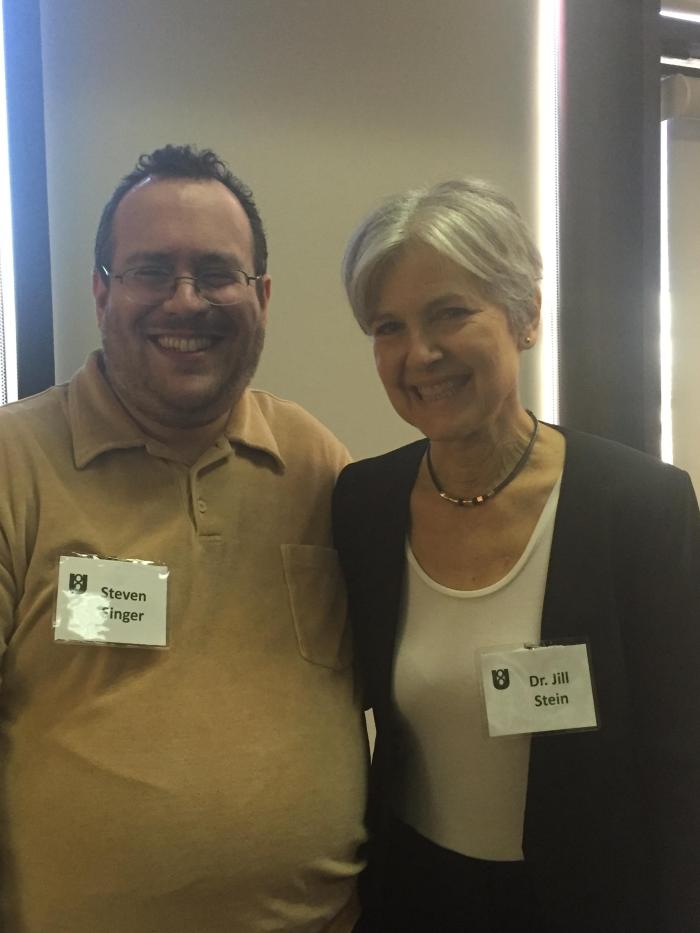
Yesterday Dr. Jill Stein gave me a hug.


Eight years ago, I was so inspired by Obama’s campaign speech in my hometown of Pittsburgh that I rushed forward along with the crowd to grab his hand. It was soft but firm with a tinge of moisturizer. Now I look at his incredibly regressive education policies and feel the need to scrub my palm.


This weekend in Philadelphia, I was at the United Opt Out Conference and saw Stein sitting in the audience.


I walked past the Green Party Presidential candidate the first time thinking I must be mistaken. Then her name tag removed all doubt.


“You’re Jill Stein!” I stuttered.


She smiled warmly, stood up and said, “You’re Steven Singer!”


I want to believe she knew who I was, but I was wearing a name tag, too.


We talked for a moment about what most of us were here for – education policy. She reaffirmed that she wanted to end all high stakes testing and school privatization.


Think of it – a presidential candidate speaking in specifics. Not “We test too much.” Not “Some charter schools are bad.” But I want to end these two perverse school policies!


And to top it all off, before she hurried off to tidy up as the time approached for her campaign speech, she game me a warm, tight hug.


Compare that to Hillary Clinton or Bernie Sanders.


As part of the Badass Teachers Association, we reached out to all the Democratic and Republican candidates on these exact same issues. The Republicans ignored us entirely, but both Democrats gave us phone calls by campaign aides.


Even then, the Democratic response was far from convivial. It mostly came down to something like “Education is important.” Well, duh.


In Sanders’ case, we had to conduct an impromptu sit-in at the Senator’s Washington office before anyone would talk to us about policy. And Hillary only started to speak in measured tones about public schools after our national teachers unions voted to endorse her – well, the leaders of those unions voted. No one ever really asked us, rank-and-file.


Moreover, when Sanders voted for the horrible Murphy Amendment of what became the Every Child Succeeds Act, several teachers including myself wrote him an open letter asking him to explain his apparent support for a Test and Punish education provision. One of his aides sent us a replysome nonsense about accountability.


And Jill Stein just gave me a hug.

The difference is huge!


When activists were holding this conference centering on the movement to Opt Out of Standardized testing, Sanders and Clinton didn’t even send campaign literature. Stein came in person and even gave a keynote address!


Don’t get me wrong. Hillary is far preferable to any Republican candidate seeking the office. I just wish her Presidential bid wasn’t funded by the very people we’re fighting against.


I love Bernie, too. I’ve even got the t-shirt to prove it. I just wish he loved us as much by throwing out a few more specifics. The general thrust of his campaign seems tailor-made to support test resistance and a fight against corporate education reform, but he rarely connects the dots with anything that we could hold him accountable for saying.


And then you have Stein, perhaps the most human politician I’ve ever met.


One look at her platform and it’s obvious she’s the best candidate for President in 2016. But is she electable?


Think about that for a moment.


What does it say about our country?


Design an excellent platform that benefits the most people, organize a movement to get your message out there, draw on the experience of experts in various fields… and you’re an incredible long shot to win the office.


The media says the same thing about Sanders as he speaks to overcapacity crowds and struggles against party politics seemingly written to hobble any populist campaign like his.


Yet Stein has no giant crowds. She has no adoring fans, no comedian on Saturday Night Live giving her friendly jibes.


She’s almost completely ignored by the media. Yet her actual policies make even a progressive like Sanders look like… well… Hillary Clinton!


For instance, Sanders wants to make college free to everyone. Stein wants to do that, too, AND erase all existing student debt.


Sanders is (kind of) against for-profit charter schools but has been vaguely supportive of Test and Punish school accountability practices. Stein is unequivocally against all forms of school privatization and high stakes standardized testing.


Sanders wants single-payer healthcare paid for by raising taxes (but net savings over all). Stein wants single-payer healthcare paid for by cutting our bloated military budget with no raise in taxes.


In fact, while Sanders is against unnecessary military action and an increase in military spending, he is in favor of keeping the $1 trillion military budget mostly intact. Stein wants to cut it by 50%, stop selling weapons to Saudi Arabia, stop giving weapons to Israel, freeze terrorist-funder’s bank accounts, end the War on Terror and engage in a policy of peace.


Moreover, Stein wants the savings from slashing our biggest federal expenditure to be used to fund a New Green Deal, creating full employment and a living wage all while transitioning to 100% clean energy by 2030!


Correct me if I’m wrong, but all of Stein’s policies sound rather sane and measured. Yet she is the one the media labels a radical and out-of-touch – if they talk about her at all.


It’s a testament to how perverted our politics have become: Sanity looks like the exact opposite. Logic and intelligence are revolutionary concepts.


And only the activists and intellectuals seem to know this is happening.


When Stein was done speaking, someone asked her the inevitable question about Ralph Nader. Wouldn’t casting a ballot for her just divide the Democratic vote and give the race to the Republicans as it did in 2000?


Her response was a bit evasive – the only time, in fact, where she seemed a bit uncomfortable.


She said that Nader wasn’t a member of the Green Party, where she is. She is engaged in building the party and the movement even beyond 2016.


On the one hand, it sounded like she was suggesting that even if she loses, it will bring real progressive issues into the limelight. However, this is not what happened when Nader lost as a third party candidate against Bush and Gore.


On the other hand, she stressed that she actually could win. About 43 million people are trapped by student debt, which she wants to unilaterally eliminate, she said. That’s a large enough chunk of the population that if they all voted for her, she would win.


It’s time for a Hail Mary moment, she said. We have to take a chance to vote for the best policies and not continue to compromise by supporting the lesser evil. Concession is the road to what we have now – continued oligarchy and global hegemony.


We need a functioning world for our children. If we don’t do something about Climate Change, the Earth may not be habitable in as little as five decades.


It’s now or never, she said.


I offer all this not as an endorsement of Stein. Nor of Sanders or Clinton (though seriously stay away from the Republicans, they’re freaking crazy).


I offer this only as food for thought.


Stein is offering us the best platform, bar none. But can we afford to vote for her? Can we afford not to?

United Opt Out Conference Highlights Dual Role of Technology in Education

FullSizeRender


Technology is the most powerful weapon we have against corporate education reform.


It is also our greatest foe.


Such were the remarks of Dr. Stephen Krashen at the United Opt Out Conference on Friday.


The linguist, educational researcher and activist gave the opening keynote address to hundreds of people who traveled to Philadelphia for the conference.


Krashen, who is known for his work on second language acquisition and bilingual education, has been a strong critic of the test and punish policies of the Barack Obama administration.


He warned the assembly of parents, students, teachers, professors and activists about the dangers of Competency Based Education (CBE), the next big thing in the movement to dumb down public schools.


CBE is touted as a way to reduce high stakes standardized testing by allowing students to work at their own pace while on various computer programs. However, Krashen sees this is an increase in testing.


In effect, it’s testing everyday. The computer programs used in CBE are little more than the same kinds of questions you’d see on a standardized test. An emphasis on CBE would replace a robust school curriculum with never-ending test preparation and multiple-choice assessment.


In the hands of a classroom teacher, technology can be an excellent tool to help kids learn. However, top-down policies like CBE only take away educators’ autonomy and turn them into mere facilitators of prepackaged materials of dubious quality.


He noted that the National Governors Association – an organization promoting CBE and Common Core State Standards – admits that there is no research supporting this new policy. But they’re suggesting we do it anyway. In fact, provisions to increase CBE are embedded in the new federal education law – the Every Child Succeeds Act (ESSA).


He sees this as a massive boondoggle to swipe the $600 billion we spend on technology in schools. After all, CBE will require increasingly newer computers at every school that will need to be constantly replaced as they become obsolete.


Krashen quoted Gerald Bracey: “There’s a growing technology of testing that permits us now to do in nanoseconds things we shouldn’t be doing at all.”


There is light at the end of the tunnel though.


The same technology that is being used to pervert the education system can be used to help save it.


Krashen advised activists to use the power of social media to spread the word about CBE and other Trojan Horse reforms – policies that look like they’re helping children while actually hurting them.


“The Internet is our underground,” he said, “Facebook and Twitter are our weapons.”


Though policymakers and journalists rarely listen to experts like classroom teachers, the Internet allows us to spread our message. We don’t need anyone’s permission to speak up. We are all free to do so and should do it more often.


I know many people are scared to speak up, he said, but we can all educate ourselves about what’s happening and then share it and retweet it. We need to do more of this. We need to reach a critical mass. We need to show the world the truth and that it can’t be ignored and buried under the dominant media and political narrative being sold to the public as if it were truth.


These policies, while dangerous in and of themselves, also overshadow the real needs of our school children – namely devastating, generational poverty.


When Congress passes No Child Left Unfed, No Child Without Healthcare, and No Child Left Homeless, then when can talk about No Child Left Behind and Every Child Succeeds, he said.


Dr. Martin Luther King spoke about this issue, claiming that solving poverty would in turn solve any problems with education.


Krashen’s keynote was an exciting beginning to a conference that promises to be eye-opening, exciting and energizing to the community of people fighting to take back our schools from the oligarchy.


Photo Gallery:


How to Get Rich From Public Schools (Without Actually Educating)

Get-Rich


Gold!


There’s gold in them thar schools!


Don’t believe me?


When you drive by an inner city school, it doesn’t exactly look like the Taj Mahal. Does it? Even relatively upscale suburban schools wouldn’t be mistaken for a house on MTV Cribs. And some of those fly-by night charter schools look more like prisons than Shangri-La.


But I’ve got it on good authority that there’s $1.3 trillion available for someone who knows how to take it.


That someone is Harold Levy, an expert on how to get rich through school privatization.


The former chancellor of the New York City School System has begun a second career managing an investment company.


“For-profit education is one of the largest U.S. investment markets, currently topping $1.3 trillion in value,” according to the Website for one of his master classes for rich investors.


Wooo-weee! That’s a lot of money!


To put it in context, that’s more than 10 times the amount the federal government spends on education per year. And it’s all yummy profit!


So how do you get your hands on some of those delicious taxpayer greenbacks?


You gotta’ invest.


No! I don’t mean increase education budgets for traditional public schools that can barely make ends meet! I mean invest in shiny new charter schools.


Here’s how it works.


Lend money to a for-profit company to build a new charter school. If you do it just right, you’re almost guaranteed to double or triple your money in seven years.


You’ll want to take advantage of the New Markets Tax Credit (NMTC), which began in 2000 at the end of President Bill Clinton’s administration. This will give you a whooping 39 percent tax credit. But here’s the best part, since it’s money you’re lending, you also get interest on it! And if that weren’t enough, you can piggyback all kinds of additional federal tax credits on top of that – things like historic preservation or job creation or Brownfield’s credits.


That doesn’t sound legal, does it? But it is!


In case that has you feeling queasy, you can hide what you’re doing by funneling the whole thing through a large non-profit organization like the Gates Foundation. They’ll be more than happy to help. They’ve done it for so many before you anyway.


However, make sure you whisk this money through something called a Community Development Entity (CDE). The federal website explains this can be either a “domestic corporation or partnership.” And it must have “a primary mission of serving LICs [Low Income Communities].” (Snicker!)


Here’s the best part. A CDE isn’t required to release information about who its donors are or how much they’re spending. So on paper the CDE – not you – gives the money to the non-profit, which, in turn, loans the money to a charter management organization. It’s like money laundering. No one can tell where the funds came from and thus it’s easy to escape from federal regulations or any appearance of wrongdoing.


There is a catch, however. You’re probably going to need a substantial amount of capital to put forward – at least a million bucks or so. No bank’s going to waste its time with only a few hundred thou.


This method is perfect for those who are already wealthy and want to increase their wealth or hedge fund managers out to boost their clients’ portfolios.


But maybe you just aren’t into the whole hedge fund game. Maybe you’re not the banking and investing type.


You can still make oodles of cash off public schools through real estate.


Here’s what you do – buy up cheap inner city properties that can be renovated or repurposed for charter schools. Then when a school privatization firm wants to set up shop in an impoverished city like Philadelphia, Chicago or Detroit, it needs someone like you to open the door.


You’ll get to charge the charter corporation rent and – get this – that’s not price capped! You can charge whatever you want! As long as you’ve got a good spot and no one else is trying to beat you to it, charter corporations are willing to pay bookoo bucks to get their money-making enterprises rolling!


A good rule of thumb comes from privatization expert Charter Schools USA, which recommends rental costs not exceed 20 percent of a school’s budget. However, there are plenty of examples of charter schools paying 25, 30 even up to 43 percent of their money just on rental costs! Ca-Ching!


And if you really want to boost the bottom line, open a charter school, yourself! That way you can both rent out the real estate and pay for it!


Think about it. Who sets the rental price? You do. Who pays the rental price? You do. So you can pay yourself WHATEVER YOU WANT! And where does the money come from? The taxpayers!


Doesn’t sound legal does it? But it is!


According to the Miami Herald, which conducted an in-depth investigation into these practices, many of the highest rents are charged by landlords with ties to the management companies running the schools. Property records show at least 56 charter schools in Miami-Dade and Broward counties sitting on land whose owners are tied to management companies.


Of course there are so many other ways to set things up like this with a charter school. Unlike most traditional public schools, charters contract with for-profit companies for everything from curriculum development to construction. So there are many opportunities for creative investors to figure out how to both set the price and pay it TO THEMSELVES!


Moreover, every state has different laws about charter schools so check for loopholes. You’ll find ‘em!


Just don’t forget to set up that CDE to hide your shady dealings from the public. After all, if taxpayers could easily see how you’re sucking up their hard-earned money that they thought was going to help school children (Tee-hee!) they wouldn’t be happy.


And if you’re reading this from somewhere outside of the USA, don’t despair. You, too, can make a ton of money off school privatization in the United States. It’s like the Statue of Liberty says – wealthy foreign nationals welcome! (Or something like that.)


Since the Immigration Act of 1990, investors have been allowed to purchase visas for their families by investing in U.S. corporations. Just stash some cash into a hotel, ski resort or charter school and – voilà! – Move directly to GO and collect way more than $200!


It’s called the EB-5 visa for Immigrant Investors. For the low price of at least $1 million -or $500,000 to a rural or high unemployment neighborhood — you can get visas for the whole family.


Sounds like some crazy new loophole – right? It isn’t. It’s been around for decades. Every year, the federal government hands out 10,000 of these visas. So while Syrian refugee children drown seeking asylum, wealthy foreign nationals get an express ticket to the US of A.


You might be thinking, ‘That gets me into the country, but where do I cash in?’ Easy. You now have a stake in a U.S. charter school and have access to all the same easy money as native-born investors.


It’s an incredibly lucrative model even for those more interested in the Prophet than profit.


Just look at Gulen charter schools. It’s the largest single charter school network in the country. More than 150 schools in Texas, Ohio, Illinois and other cities are funded by Turkish investors following an Islamic nationalist named Fetullaf Gülen. These schools are part of a “worldwide religious, social and nationalistic movement in his name,” according to the New York Times.


Be warned. Many of these schools are under investigation for using U.S. taxpayer dollars meant to educate U.S. children in non-educational or otherwise shady ways. Some of this tax revenue has allegedly been spent on political and religious causes championed by the Prophet Gülen. Other funds have gone to controversial educational practices. For instance, instead of hiring local teachers, the chain is infamous for shipping in Turkish educators to the United States. As if it wouldn’t be cheaper to hire locals! And guess where the money comes from to pay for these Turkish teachers’ visas? That’s right – from the charter school’s funding!


Still. Even with a few setbacks, there’s never been a better time to invest in the privatization of public education. Sure there are financial, behavioral and educational scandals at charter schools throughout the country being discovered everyday. But fortune favors the brave!


Money is just hanging on the tree waiting to be plucked. It’s hard to walk into a charter school and not come out with pockets fit to bursting with cold, hard cash.


In fact, the only folks not making bank in this whole scheme are the teachers!


Don’t be one of them.


Teachers at charter schools – where unionizing is often prohibited – take home even less than those working at traditional public schools. And those traditional educators aren’t getting rich, either.


A new report by the Center for American Progress argues that U.S. teachers usually have bad starting pay and are unlikely to see major salary gains even after several years of teaching.


Growth in teacher salaries is especially bad when comparing the U.S. to other developed countries:

Screen Shot 2016-02-23 at 7.48.08 AM

“The bottom line is that mid- and late-career teachers are not earning what they deserve, nor are they able to gain the salaries that support a middle-class existence,” the report concluded.


There appears to be a golden rule in education: the less you actually help students learn, the more money you get to take home.


Perhaps if public schools were kept out of private hands where profit is the overwhelming motivation for everything you do, things would be different. But thank goodness that isn’t happening!


Someday people may wake up and demand more for their tax dollars and for their children. But until then…


There’s gold in them thar schools!


Don’t be a sap. Don’t be a teacher. Don’t help children. Invest in a fly-by-night charter school and get rich!


NOTE: This article also was published in Commondreams.org.


Should Teachers Have Strong Opinions?

istock_000013919699_490x356


I am an opinionated person. I am also a public school teacher.


Those two things should not be mutually exclusive.


You should not have to give up the one to be able to do the other.


Teachers should not have to relinquish their judgment in order to run an effective classroom. In fact, you might expect good judgment to be a prerequisite to doing the job well.


Yet it seems many people disagree. They like their teachers tame, docile and opinion-free.


That’s just not me.


Now don’t get me wrong. I’m not saying teachers should instruct their students to think just like them. I’m not saying they should indoctrinate or unduly influence the young people in their care.


Just the opposite. They should spur their students to think for themselves. They should teach the young how to entertain an idea without immediately accepting it.


But they have no business telling students, “This is what I believe.” They have no business misusing their authority to make their views seem normative.


So I agree that teachers should be careful about expressing their opinions in the classroom. The problem comes after the school day is through.


When a teacher goes home, all bets are off. When a teacher is not in front of a class of impressionable children, he or she should be afforded the same rights and privileges of any other citizen – and that includes the right to form an opinion and express it publicly.


I am an educator. Hear me roar.


That’s why – like many people in my field – I write an education blog.


I’m sick of the media reporting on K-12 schools but never asking classroom teachers their opinions.


Almost all major education policy in our country is made with little-to-no input from teachers: Common Core, high-stakes testing, value added measures, charter schools, Teach for America, school funding – the list goes on and on.


No one asks us what we think so many teachers scribble down their private musings and send them adrift on the Nile of the Internet.


This makes some people very angry.


These folks often respond: How dare they!? No one asked their opinion!


EXACTLY.


Some of us, teachers, even dare to address issues that don’t directly affect the classroom: racism, sexism, police brutality, the prison system, parenting – Heaven forbid – POLITICS!


Those who criticize us for commenting on such disparate matters have a very narrow view of relevance. Just because a subject doesn’t include the word “school” doesn’t make it irrelevant to the classroom. Most of my students are impoverished and minorities. You think racism doesn’t impact their lives? You think I see nothing of the effects of poverty? You think I have nothing to say about my children’s relationship with the police?


Still, few things upset some readers as much as the knowledge that I both teach and think.


“I’m glad my child doesn’t have a teacher like you,” some of them say. Or “No one who feels the way you do should be allowed in a classroom.” Or “This is why I homeschool.”


It’s funny. You never hear people speak this way of any other profession. Only teachers. We are demanded to pass a purity test from which even the priesthood is exempt.


The clergy are rarely instructed to keep their noses out of politics. They’re even invited to do so from the pulpit. But teachers? No way! Not even on our off hours.


It’s almost as if some folks think teachers are incapable of forming an opinion and not blurting it out in class. “Stop coloring, children! I must regale you with the inadequacies of former Supreme Court Justice Antonin Scalia!”


It’s ridiculous. But it makes me wonder. How much of this restraint do these critics practice in their own homes?


Do these same people who fear a teacher’s opinion stop themselves from influencing the views of their own children? Do they let their little ones make up their own minds about the world or do they tell them what to think?


It’s not surprising that most people hold the same religion as their parents. Do we all start with an unbiased view of faith and just magically find the beliefs of our fathers the most suited to our own lives? Or do most parents stack the deck? Don’t most of us actively teach our children THIS is the way to believe?


I wonder if these critics of teachers are really just afraid educators will disrupt their own work. How many parents want their own children to believe the same way they do? How many are afraid the schools will allow children to come to different conclusions? How many are afraid of being alienated from their own progeny?


I’ll let you in on a little secret. I’m a parent, too.


And, yes, I say things to my own child that I would not tell my students. If she asks a question, I give her a full answer including what I think about it. That’s a parent’s prerogative.


However, I don’t insist she believe as I do. My daughter knows I want her to make up her own mind. I appreciate our differences and love her even more because of them.


I don’t want her to be a carbon copy of me. Nor do I want that of my students or my readers.


I just want a fair hearing.


Hello, World! This is what I think! This is why I think it!


And I wait for the world to answer back.
I send my little message in a bottle onto the waves of the Interwebs.


I just wish it sometimes didn’t return with a note telling me to shut up because I’m a teacher.


NOTE: This article was also discussed on Diane Ravitch’s blog.


‘Pay Our Special Education Teachers Before Vulture Capitalists’ Demand Puerto Rican Protesters

GetFileAttachment-4

Every student with special needs in the United States is guaranteed a Free and Appropriate Public Education under national law.


So why has the U.S. territory of Puerto Rico stopped paying its special education teachers?


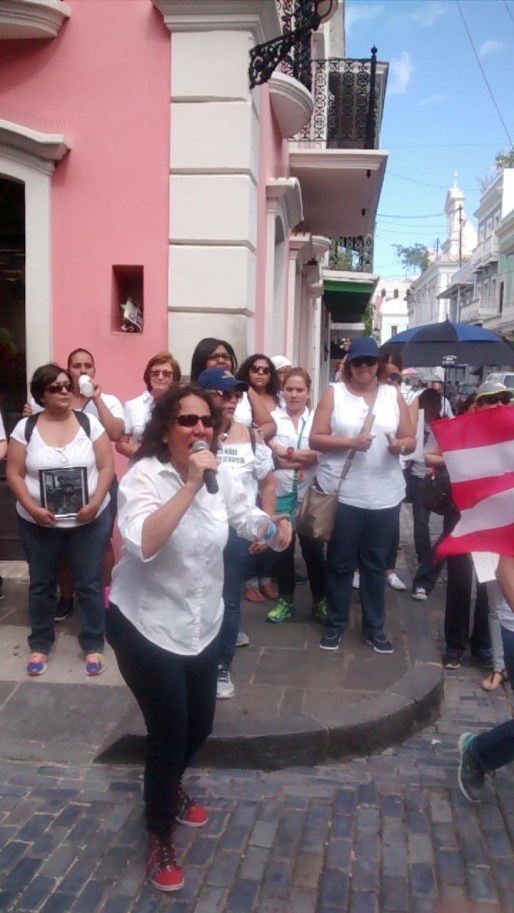
More than 100 parents, therapists, psychologist, occupational therapists, students and teachers marched on Monday to the capital in San Juan to find out.


The rally began in front of the legislature at 9 before protesters marched to the governor’s mansion at 10:30 am. Demonstrators then met with representatives of Governor Alejandro García-Padilla.

GetFileAttachment-3

The answer may be a crippling $72 billion debt. Puerto Rico is besieged by vulture capitalists encouraging damaging rewrites to the tax code while buying and selling the territory’s debt.


The Commonwealth government has been prioritizing payments to American private equity moguls instead of services for communities such as public schools.


“Our Children Before Vulture Capitalists,” proclaims one protestor’s sign.

GetFileAttachment-6

Jinnette Morales agrees with the sentiment. Morales organized the protest.


“No credit line would back up this lack of payment,” says the mother of a child with Down Syndrome.


“These therapists have been working for months without pay and if Secretary of Education Rafael Román says that he has paid them, I want to hear him say that when we take him to court.”


GetFileAttachment-5

Though the Commonwealth Department of Education hasn’t paid these professionals in up to six months, students still have been receiving services. Special education employees have been working without pay. However, that can’t continue indefinitely.


The therapists, psychologists and teachers have had enough. They simply can’t continue without an income.


So starting this week, roughly 1,200 students are without services they are guaranteed by law.

IMG_4819

“We are talking about children’s humans rights to receive an appropriate and quality education,” says Mercedes Martinez, president of the Federación de Maestros de Puerto Rico (FMPR) – the teachers union.


“Children need these therapies to progress in their development. Therefore, we stand with the workers, parents, and students and demand action from the governor of our country.”


Protesters are demanding special education employees be paid immediately so child services can continue with as little interruption as possible.


After arriving at the governor’s mansion, activists met with the governor’s attorneys.


They were told the government will eventually pay the special education teachers, says Martinez. In the meantime, officials suggested improving billing for services. Instead of having all invoices be digitized and go through corporate channels, special education teachers can provide manual bills. This will shorten the amount of time between billing and payment.


Protesters are scheduled to meet again with government officials on Thursday to pin down an exact date when payments will begin.


Until then, many demonstrators are camping out in front of the governor’s mansion vowing not to leave until the government makes good on its fiscal responsibilities to teachers and students.

GetFileAttachment

“The government needs to pay the debt with these professionals before our country’s debt,” says Martinez.


“Our children should come first.”


This monetary crisis is imported from the mainland. Legislation is being manipulated by corporate interests profiting off the chaos. Moreover, hundreds of American bankers and entrepreneurs are using the Commonwealth as a tax haven.


As a result, tax revenues are drying up while the super rich rake in profits.


Officials warn the government may be out of money to pay its bills sometime this year. Over the next five years, it may have to close nearly 600 more schools – almost half of the remaining facilities!


Of the 135 schools closed in just the last two years, Román had originally proposed shuttering 200. The remaining 65 were only kept alive because communities occupied the buildings and refused to let the government step in.


Despite Wall Street manipulation, Puerto Rican communities aren’t letting their government sell their children short. The fight goes on.


MORE ON PUERTO RICO:

Hundreds Gather in Puerto Rico on Martin Luther King Day Demanding Arts Education


Puerto Rico Teachers Plan One-Day Strike to Protest Corporate Education Reform


In Puerto Rico, Students Go On Strike to Stop Teacher Relocations


Parents and Children Occupy Puerto Rican School Refusing to Let Corporate Vultures Raid Its Contents

Unions Can’t Just Be About What We’re Allowed to Do: Social Justice Unionism

7983807401_6b0075f742_b.sm_a

If labor unions were an animal, they’d be an old hound dog napping on the porch.

They’re slow to get up and chase away burglars but they do like to howl at night.

Most of the time you don’t even know they’re around until the dinner bell rings. Then that ancient mutt is first to bolt into the kitchen to find a place at the table.

It’s kind of sad really. That faithful old dog used to be really something in his youth.

He was fierce! He’d bark at trespassers even tearing them apart if they threatened his patch of land.

Old Uncle Sam used to yell at him and even threaten the pooch with a rolled up newspaper, but that dog didn’t care. He had a sense of right and wrong, and he didn’t mind getting into deep trouble fighting for what he thought was fair.

Today, however, the only thing that really riles him is if you threaten to take away his ratty old bone.

Let’s face it. Unions have become kind of tame. They’re housebroken and not much of a threat to those people waiting in the shadows to rob us blind.

Some people say we’d be better off without them. But I don’t agree. Even a decrepit canine can act as a deterrent, and thieves sure are frightened of dogs.

Think about all unions have given us: the weekend, child labor laws, vacation time, pensions, lunch breaks, healthcare, the 8-hour day, maternity leave, safety measures, due process, sick leave and free speech protections on the job!

They didn’t get us all that by sitting politely at the table with their hands crossed. They didn’t do all that by contributing modest sums to political campaigns. They didn’t do it by obsessively protecting collective bargaining at the expense of all else.

Unions used to take to the streets. They took over the job site. They marched with signs and placards. They exercised people power.

And the government was scared of them. The President called out the army to get them back to work. Lawmakers hired mercenaries to break strikes with clubs and guns. But eventually Congress passed laws to placate them.

Unfortunately, That was a long time ago.

For decades the pendulum has been swinging against us. Federal and state laws have become increasingly restrictive. They want to tell us when we can strike and how long. They want to tell us when and if we can collect dues. And – frankly – they want to tell us to just disperse and do whatever the bosses want – because the business class has already bought and paid for our politicians.

For decades we’ve heard to their propaganda on TV, the radio and the print media. Well-paid shills have poured their poison in our ears about the evils of the labor movement. They’ve spoken these lies so often lots of people believe them.

Workers used to fight to make sure everyone got a fair deal. Now the working man has been brainwashed to focus instead on making sure no one else gets more than him. And the bosses are laughing all the way to the bank.

Union membership is at the lowest it’s been in a century. So are wages adjusted for inflation. A family of four used to be able to get by comfortably on one salary. Now it can barely make ends meet with two.

Yes. There’s no doubt about it. We need unions today more than ever.

But for unions to survive, they must change. They have to become a reflection of the membership and not just of the leaders.

During this presidential election cycle, we’ve seen our largest national unions – the National Education Association (NEA) and American Federation of Teachers (AFT) endorsing a candidate without bothering to actively poll their members. We’ve seen them speak for us on policy decisions without asking our opinions. We’ve seen them act just like the corrupt politicians who we should be fighting against.

Yes, it is time for a change. No longer can our unions be run from the top down. They must be run from the bottom up. They shouldn’t tell us what to do. We, the membership, should be giving orders to them.

Moreover, we need to stop obsessing about collective bargaining. I’m not saying that’s unimportant. But it can’t be the only thing we do.

Our unions used to be in the midst of larger social movements. We were part of the Civil Rights movement. We were part of the push for desegragation. We were part of the fight to protect children and provide them a decent education.

We need to continue that today. And in some places we are already doing that! Look to Chicago, Detroit and Philadelphia. Teachers unions in those urban areas are fighting not just for better pay and benefits but for the communities they serve. Detroit teachers en mass are calling off sick to protest horrible conditions in the schools. Chicago teachers are marching in the streets with the community to demand indictments for police murdering their black and brown students. Philadelphia teachers are supporting students who walk out of class to protest state disinvestment and toxic testing.

THIS is what unions should be doing. We should be fighting for social justice. We should be a central part of the struggle to turn the tide against corporatization, privatization and standardization of our country’s public goods. We should be marching hand-in-hand with BlackLivesMatter activists. We should be in the front lines of the fight to save our environment and replace fossil fuels with renewable energy.

We must be part of the community and not apart from it. We must share in the struggles and goals of those we serve. We must be an example of the old truism that a rising tide raises all ships. After all, the word “union” literally means together. By definition we must all be in this together or else we’re not even really a union.

And to do this we have to stop being so concerned with what they tell us we can do.

We live in a democratic society. The government gets its power from us, from our consent. That means that if there are enough of us, we trump their corrupt laws. They only get to make those laws because we say so. And court decisions – even Supreme Court decisions – mean nothing next to the court of public opinion.

The bosses buy the politicians and tell them to legislate us into a box. It’s time to break out of that box. We can’t be afraid to take our power back. We shouldn’t be afraid of our government. Our government should be afraid of us.

How do we do it? Organize.

If you belong to a union, roll up your sleeves and get active. Run for office. Convince like-minded folks to join you. Take over your local. Spread to your national.

If you don’t belong to a union, start one at your job. Talk to your co-workers. Talk about the benefits for each of you and your neighborhoods. Fight for your rights.

I know. It’s a whole lot easier to complain. Real change, though, takes real work.

We used to know these things. Somewhere along the line we forgot.

So wake up, you yeller cur dog, and get off the porch. Take to the streets.

Because the surest way to take back our country is to take back our unions.

Top 10 Reasons School Choice is No Choice

LittleKidThumbsDown

On the surface of it, school choice sounds like a great idea.

Parents will get to shop for schools and pick the one that best suits their children.

Oh! Look, Honey! This one has an exceptional music program! That one excels in math and science! The drama program at this one is first in the state!

But that’s not at all what school choice actually is.

In reality, it’s just a scam to make private schools cheaper for rich people, further erode the public school system and allow for-profit corporations to gobble up education dollars meant to help children succeed.

Here’s why:

1) Voucher programs almost never provide students with full tuition.

Voucher programs are all the rage especially among conservatives. Legislation has been proposed throughout the country taking a portion of tax dollars that would normally go to a public school and allowing parents to put it toward tuition at a private or parochial school. However, the cost of going to these schools is much higher than going to public schools. So even with your tax dollars in hand, you don’t have the money to go to these schools. For the majority of impoverished students attending public schools, vouchers don’t help. Parents still have to find more money somewhere to make this happen. Poor folks just can’t afford it. But rich folks can so let’s reduce their bill!? They thank you for letting them buy another Ferrari with money that should have gone to give poor and middle class kids get an education.

2) Charter and voucher schools don’t have to accept everyone

When you choose to go to one of these schools, they don’t have to choose to accept you. In fact, the choice is really all up to them. Does your child make good grades? Is he or she well-behaved, in the special education program, learning disabled, etc.? If they don’t like your answers, they won’t accept you. They have all the power. It has nothing to do with providing a good education for your child. It’s all about whether your child will make them look good. By contrast, public schools take everyone and often achieve amazing results with the resources they have.

3) Charter Schools are notorious for kicking out hard to teach students

Charter schools like to tout how well they help kids learn. But they also like to brag that they accept diverse students. So they end up accepting lots of children with special needs at the beginning of the year and then giving them the boot before standardized test season. That way, these students’ low scores won’t count against the charter school’s record. They can keep bragging about their high test scores without actually having to expend all the time and energy of actually teaching difficult students. Only public schools take everyone and give everyone their all.

4) Voucher and charter schools actually give parents less choice than traditional public schools

Public schools are governed by different rules than charter and voucher schools. Most public schools are run by a school board made up of duly-elected members from the community. The school board is accountable to that community. Residents have the right to be present at votes and debates, have a right to access public documents about how tax money is being spent, etc. None of this is true at most charter or voucher schools. They are run by executive boards or committees that are not accountable to parents. If you don’t like what your public school is doing, you can organize, vote for new leadership or even take a leadership role, yourself. If you don’t like what your charter or voucher school is doing, your only choice is to withdraw your child. See ya.

5) Charter Schools do no better and often much worse than traditional public schools

Pundits and profiteers love to spout euphoric about how well charter schools teach kids. But there is zero evidence behind it. That is nothing but a marketing ploy. It’s like when you’re in a bad neighborhood and walk past a dive that claims to have the best cup of coffee in the city. Yuck. Surely, some charter schools do exceptionally well. However, most charters and almost all cyber charters do worse than their public school counterparts. Fact.

6) Charters and voucher schools increase segregation

Since the 1950s and ’60s, we used to understand there was no such thing as separate but equal education. Before then we had Cadillac schools for white kids and broken down schools for black kids. The Supreme Court ruled that unconstitutional. But today we have Cadillac schools for rich and middle class kids (most of whom are white) and broken down schools for the poor (most of whom are black or brown.) After making tremendous strides to integrate schools and provide an excellent education for everyone, our public schools have been resegregated. Charter and voucher schools only make this problem worse. They either aid in white flight or leach away minority students. This just makes it easier to give some kids a leg up while keeping others down.

7) Charter and voucher schools take away funding at traditional public schools

It costs almost the same amount of money to run a school building of a given size regardless of the number of kids in it. When students leave the public schools for charter or voucher schools, the public school loses valuable resources. It now has less revenue but the same overhead. So even if you found an excellent charter or voucher school to send your child, you would be hurting the chances of every other student in the public school of having their own excellent education. This is what happens when you make schools compete for resources. Someone ends up losing out on an education.

8) Properly funding parallel school systems would be incredibly wasteful and expensive

We could fix this problem by providing adequate funding for all levels of the school system – traditional public schools, charters, voucher schools, etc. However, this would be exorbitantly expensive. We don’t adequately fund our schools now. Adding additional layers like this would mean increasing national spending exponentially – maybe by three or four times the current level. And much of that money would go to waste. Why have three fully stocked school buildings in one community when one fully stocked building would do the job? I don’t imagine residents would relish the tax hike this would require.

9) School choice takes away attention from the real problems in our public schools – poverty and funding equity

We have real problems. More than half of public school students live below the poverty line. They are already several grade levels behind their non-impoverished peers before they even enter kindergarten. They need help – tutoring, counseling, wraparound services, nutrition, etc. The predicament is even more complicated by the way we fund our schools. Throughout the country, poor districts get less money than wealthy or middle class ones. The students who go to these schools are systematically being cheated out of resources and opportunities. And instead of helping them, we’re playing a shell game with charter and voucher schools. The problem isn’t that parents don’t have several excellent choices. If they’re poor, they often don’t have one.

10) School choice is not supported by a grass roots movement. It is supported by billionaires.

The proponents of school choice will tell you that they are only doing the will of the people. This is what parents want, they say. Baloney. While there are individuals who support school choice, the overwhelming majority of money behind this movement comes from conservative billionaires actively trying to dismantle the public education system. They want to steal the public system and replace it with a private one. They don’t care about your child. They just want to steal the hundreds of billions of tax dollars we pay to educate our children. This is not philanthropy. It is a business transaction meant to screw you and your child out of your rights.

If we really want to ensure every child in this country gets an excellent education, the answer isn’t school choice. Instead, we need to commit to supporting our public school system. We all need to be in this together. Yes, our schools should look at the needs of each child and tailor education to fit appropriately. But that shouldn’t be done in parallel school systems. It should be done under the same umbrella. That way, you can’t defund and defraud one without hurting all. It can’t just be about your child. It has to be about all children.

That’s the only choice worth making.


NOTE: This article was given a shout out on Diane Ravitch’s blog and published on the Badass Teachers Association blog.


Who’s Your Favorite Gadfly? Top 10 Blog Posts (By Me) That Enlightened, Entertained and Enraged in 2015

Screen shot 2015-12-30 at 12.57.49 AM

“Pennsylvania educator and public school advocate Steven Singer is one of the most powerful voices in the nation when it comes to speaking out for students, parents, teachers and our public schools.”
Jonathan Pelto, founder of the Education Bloggers Network


“Steven Singer wrote these five terrific posts last year. I didn’t see them when they appeared. Probably you didn’t either. You should.”
Diane Ravitch, education historian


“Your name should be Sweet Steven Singer. You are a delight.”
Karen Lewis, President of the Chicago Teachers Union

11206058_10152940020833860_7943827034975790194_n


Hello. My name is Steven Singer, and I am a gadfly.

I make no apologies for that. It’s what I set out to do when I started this blog in July of 2014.

I told myself that people were too complacent. There was no curiosity. People were too darn sure about things – especially education policy and social issues.

They knew, for instance, that standardized testing was good for children. Why? Because Obama said so. And he’s such a nice man. It’s too bad all those mean Republicans keep making him do all this bad stuff.

They also knew racism was over. After all… Obama! Right? Black President, therefore, the hundreds of years of struggle – finished! Move along. Nothing to see here.

Yet all this “knowledge” went against everything I saw daily as a public school teacher.

Standardized tests are good for children? Tell that to more than half of public school kids now living below the poverty line who don’t have the same resources as middle class or wealthy kids yet are expected to magically ace their assessments. Tell that to the kids who get hives, get sick, or throw up on test day. Tell it to the black and brown students who for some unexplainable reason almost always score lower than their white peers.

Racism is over? Tell that to all my minority students who are afraid to walk home from school because they might get followed, jumped, beaten or killed… by the police! Tell it to their parents who can’t get a home loan and have to move from one rental property to another. Tell it to the advertising executives and marketing gurus who shower my kids with images of successful white people and only represent them as criminals, thugs, athletes or rappers.

So when I started this blog, I consciously set out to piss people off. But with a purpose. To quote the original historical gadfly, Socrates, my role is, “to sting people and whip them into a fury, all in the service of truth.” It seems well suited to a school teacher. After all, Socrates was accused of “corruption of the youth.”

It’s been quite a year. When I went to the Network for Public Education conference in Chicago last April, some folks actually seemed to know who I was. “Don’t you write that Gadfly blog?” was a common question.

When I met NEA President Lily Eskelsen Garcia and AFT President Randi Weingarten, they both said, “I read your blog.” And then they looked me up and down suspiciously as if they were thinking, “THIS is the guy who writes all that stuff!? THIS is the guy giving me such a hard time!?”

Of course, I am human, too. One can’t sting and bite every day. Sometimes the things I write are met with love and approbation. Some weeks even Lily and Randi like me. Sometimes.

Education historian Diane Ravitch has given me tremendous moral support. I can’t tell you how gratifying it is to have one of your heroes appreciate your work! Her book “The Death and Life of the Great American School System” really woke me up as a new teacher. I’m also on the steering committee of the Badass Teachers Association, an organization that has changed my life for the better. The more than 56,000 people  there are my support. I would never have had the courage to start a blog or do half of the crazy things I do without their love and encouragement.

And there are so many more people I could thank: my fellow bloggers Jonathan Pelto, Peter Greene, Russ Walsh, Nancy Flanagan, Mitchell Robinson, and Yohuru Williams. Also the good people at the LA Progressive and Commondreams.org. The incredible and tireless radio host Rick Smith.

There are just too many to name. But no list of acknowledgment would be even close to completion without mentioning my most important supporter – you, my readers. Whether you’re one of the 9,190 people who get every new post delivered by email or if you otherwise contribute to the 486,000 hits my site has received so far, THANK YOU.

So in celebration of my first full year of blogging, I present to you an end of the year tradition – a Top 10 list. Out of the 90 posts I wrote in 2015, these are the ones that got the most attention. Often they incensed people into a fury. Sometimes they melted hearts. I just hope – whether you ended up agreeing with me or not – these posts made you think.

Feel free to share with family, friends, co-workers, etc. After all, I’m an equal opportunity gadfly. I always cherish the chance to buzz around a few new heads!


10) The Democrats May Have Just Aligned Themselves With Test and Punish – We Are Doomed

sanders_warren-620x412

Published: July 17, 2015
Views: 7,122

Description: It hit me like a slap in the face that almost all Senate Democrats voted to make the reauthorization of the federal law governing K-12 public schools a direct continuation of the same failing policies of the Bush and Obama years. Heroes like Bernie Sanders and Elizabeth Warren seemed to be turning their back on teachers, parents and school children. And they were stopped in their efforts by… Republicans!

Fun Fact: This story had some legs. It inspired a bunch of education advocates like myself who are also Bernie Sanders supporters to write the candidate an open letter asking him to explain his vote. His campaign eventually responded that it was about accountability!?


9) Punching Teachers in the Face – New Low in Presidential Politics

cc-600x400

Published: Aug. 3
Views: 14,735

Description: New Jersey Governor Chris Christie thought he’d run for the Republican nomination for President. He thought threatening to metaphorically punch teachers unions in the face would get him votes. It didn’t.

Fun Fact: This new low in Presidential politics came just after Donald Trump had announced he was running. Christie’s new low now seems almost quaint after Trump’s calls to tag all Muslims and monitor their Mosques. How innocent we were back in… August.


8) This Article May Be Illegal – Lifting the Veil of Silence on Standardized Testing

whistle
Published: April 18
Views: 15,818

Description: Teachers and students may be legally restrained from telling you what’s on federally mandated standardized tests, but we’re not restrained from telling you THAT we’re restrained. Is this just protecting intellectual property or direct legal intimidation of educators and children?

Fun Fact: I have not yet been arrested for writing this piece.


7) Stories about Teachers Union Endorsements of Hillary Clinton

Did the AFT Rank and File REALLY Endorse Hillary Clinton for President? If So, Release the Raw Data

(July 12 – 4,448 hits)


The NEA May Be About to Endorse Hillary Clinton Without Input From Majority of Members

(Sept. 21 – 3,873 hits)

A Handful of NEA Leaders Have Taken Another Step Toward Endorsing Hillary Clinton Despite Member Outcry

(Oct. 2 – 739 hits)

Teachers Told They’re Endorsing Hillary Clinton by NEA Leadership, Member Opinions Unnecessary

(Oct. 4 – 7,074 hits)

Screen shot 2015-09-21 at 12.23.19 AM

Published: July 12 – Oct. 4
Views: 16,134 TOTAL

Description: You expect your union to have your back. Unfortunately it seems our teachers unions were more interested in telling us who we’d be endorsing than asking us who the organizations representing us should endorse.

Fun Fact: I broke this story pretty much nationwide. News organizations like Politico were calling me to find out the scoop.


6) Why We Should Have ZERO Standardized Tests in Public Schools

Screen shot 2015-01-30 at 4.35.10 PM

Published: Jan. 30
Views: 16,443

Description: Someone had to say it. We don’t need any standardized tests. We need teacher-created tests. And that’s not nearly as crazy as some people think.

Fun Fact: This was written back when the Elementary and Secondary Education Act (ESEA) was being rewritten and naïve fools like me thought we might actually get a reduction in high stakes testing. Spoiler alert: we didn’t.


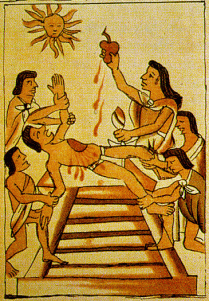
5) Atlanta Teacher RICO Conviction is Blood Sacrifice to the Testocracy

aztecshumansacrifice

Published: April 3
Views: 18,187

Description: There is something terribly wrong when we’re using laws created to stop organized crime as a means to convict  teachers cheating on standardized tests. I’m not saying cheating is right, but the mafia kills people. These were just teachers trying to keep their jobs in a system that rewards results and refuses to balance the scales, listen to research or the opinions of anyone not in the pockets of the testing and privatization industries.

Fun Fact: Watching all those seasons of “The Wire” finally came in handy.


4) Not My Daughter – One Dad’s Journey to Protect His Little Girl From Toxic Testing

FATHERS-AND-DAUGHTERS
Published: March 20
Views: 26,420

Description: How I went to my daughter’s school and demanded she not be subjected to high stakes testing in Kindergarten.

Fun Fact: They were very nice and did everything I asked. If you haven’t already, you should try it!


3) I Am Racist and (If You’re White) You Probably Are, Too

Screen shot 2015-06-02 at 1.42.34 PM

Published: June 2
Views: 28,906

Description: White folks often can’t see white privilege. This is my attempt to slap some sense into all of us. If you benefit from the system, you’re responsible to change it.

Fun Fact: Oh! The hate mail! I still get it almost every day! But I regret nothing! A black friend told me I was brave to write this. I disagreed. Anytime I want I can hide behind my complexion. She can’t.


2) I Am A Public School Teacher. Give Me All the Refugees You’ve Got

syrian_refugee_schools

Published: Nov. 19
Views: 45,196

Description: Our public schools are already places of refuge for our nation’s school children. Send me more. I’ll take them all. I’d rather they end up in my classroom than drowned by the side of a river.

Fun Fact: I got equal love and hate for this one. Some folks were afraid of terrorists. Others didn’t think we could afford it. But many told me my heart was in the right place. Lily and the folks at the NEA were especially supportive.


1) White People Need to Stop Snickering at Black Names

baby-and-parents

Published: Sept. 6
Views: 96,351

Description: Maybe we should stop laughing at black people’s names. Maybe we should try to understand why they are sometimes different.

Fun Fact: You’d have thought I threatened some people’s lives with this one! How dare I suggest people should stop mocking other people’s names! If you want to know how strong white fragility is in our country, read some of the comments! But many people thanked me for bringing up something that had bothered them for years but that they had been too polite to talk about, themselves. This is easily my most popular piece yet.