Testing Corporations Rake in Cash while Teachers Sell Plasma to Survive

Screen Shot 2018-03-26 at 3.34.02 PM


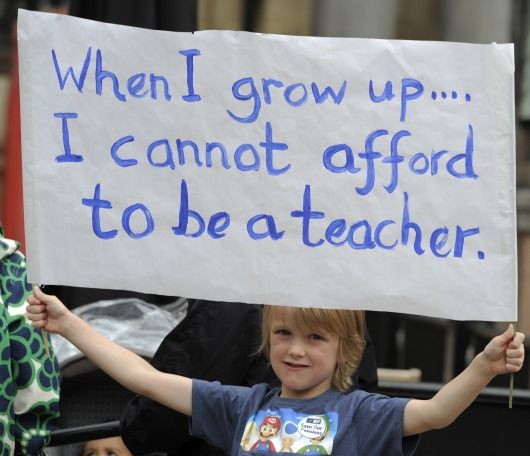
If you want to get rich in education, don’t become a teacher.


Open a charter school or take a job at a testing corporation.


Sure, charter schools are elaborate scams to make money off children while providing fewer services.


Sure, standardized tests are just corporate welfare that labels poor and minority kids failures and pretends that’s their fault.


And teachers? They’re just the people who do all the actual work of educating children. Yet there’s never enough money, never enough resources for the job they do.


According to the U.S. Bureau of Labor Statistics, the average salary of public school teachers in Pennsylvania is between $53,000 and $59,000 per year.


Compare that with the salaries of the people who make and distribute the state’s federally mandated standardized tests – employees at Data Recognition Corporation (DRC).


DRC publishes numerous assessments in various states. However, in the Keystone state, the corporation makes everything from the Pennsylvania System of School Assessments (PSSA) to the Keystone Exams in Algebra, Literature and Biology.


At its 14 locations across the country, the company has more than 750 full time employees and 5,000 seasonal ones used mainly to help grade the tests.


Screen Shot 2018-03-26 at 7.41.50 AM


According to glassdoor.com, a site that showcases job listings, here are some openings at DRC and their associated salaries:


Test Development Specialist – $68K-$86K


Quality Assurance Analyst – $77K-$83K


Technology Manager – $77K-$84K


Business Analyst – $81,856


Software Developer – $83,199


Psychometrician – $95,870


Senior Software Developer – $96,363


So teachers spend 180 days in overcrowded classrooms with fewer resources than they need – often forced to buy school supplies for their students out of pocket – to get their students ready to take the high stakes tests.


Meanwhile, the test makers sit in luxury office buildings taking home tens of thousands of dollars more just to make the tests that students take over the course of a few weeks.


And these corporate test employees DO work in luxury.


Here are some of the benefits they receive listed on DRC’s own Website:


“DRC offers a comprehensive benefits program that allows employees to make choices that best meet their current and future needs.

Key Benefits

  • Choice of medical plans
  • Choice of dental plans
  • Flexible spending accounts
  • HSA account
  • 401K savings plan
  • Profit sharing
  • Short- and long-term disability plans

Wellbeing Benefits

  • Paid vacation
  • Paid holidays
  • Personal time off
  • Workout facilities/locker rooms at select locations
  • Tuition reimbursement
  • Community service hours
  • Discount programs
  • Adoption assistance
  • Fitness classes
  • On-site massage
  • Walking paths

Convenience Benefits

  • Business casual attire

  • On-site subsidized cafeterias

  • Dry cleaning pick-up and delivery

  • Company store”


It’s funny. Some folks get all in a lather about the much less extravagant benefits given to teachers, but I’ve never heard anyone in a rage about these benefits being paid to corporate test makers.


And keep in mind, both teachers and test makers are being paid with public tax dollars. YOU are funding the test makers on-the-job massage break just as you’re funding the public school teachers trip to the doctor for anti-anxiety meds.


The Pennsylvania legislature has entered into three contracts with DRC through 6/30/21 for services related to standardized testing for a total of $741,158,039.60, according to State Sen. Andrew Dinniman (D-West Chester).


That is your money funding the test makers workout facilities and flexible spending accounts. You pay for their walking trails, fitness classes, dry cleaning services and subsidized cafeterias.


Meanwhile, public school teachers – who do the bulk of the work educating children – are left struggling to make ends meet.


According to estimates by the National Education Association (NEA), teaching salaries from Pittsburgh to Philadelphia have stagnated by 2.3% in the past 15 years.


But that’s way better than in most parts of the country.


In West Virginia, teachers across the state went on a 9-day strike to get a 5% pay raise.


Teachers in Arizona and Oklahoma are planning their own strike due to even worse neglect.


In Oklahoma, some educators have actually had to resort to selling plasma in order to survive.


KOCO News 5, in the Sooner State, reported on a fifth grade teacher at Newcastle Elementary school, Jay Thomas, who sells blood to supplement his income.


“I’ve got a permanent scar doing that. Just did it yesterday,” Thomas said.


“I’ve been doing it for a couple of years. I’ve given over 100 times. It’s twice a week.”


Though Thomas has been an Oklahoma teacher for 16 years, he makes less than $40,000 a year after taxes.


Selling plasma nets him about $65 a week.


And if you think Thomas is the anomaly, when this story was spread on Twitter, other teachers responded that they do the same, some even including pictures of themselves at the blood bank.


Screen Shot 2018-03-23 at 9.57.25 AM


This is why there is a teacher shortage in many states. This is why fewer college students are entering the field. And it is why many of those educators who have stayed in the classroom are considering strikes.


We take teachers for granted. We value the work they do but not the people who do that work.


Meanwhile, we give extravagant rewards to the corporate vultures who provide very little for children but divert funding that should be going to educate students – the standardized testing corporations and the privatized school operators.


If we really want to improve our education system in this country, the first step is to value those who work in it.


We need to turn the money hose off for unnecessary expenses like standardized testing and allowing charter and voucher operators to pocket tax money as profit.


And we need to spend more on the people in the trenches day-in-day-out making sure our children get the quality education they deserve.


We need to give teachers the resources and respect they need to succeed and end the scams of high stakes testing and school privatization.


3f7ccd898a1d7e2ad178656da70f58b7--teaching-quotes-teaching-ideas


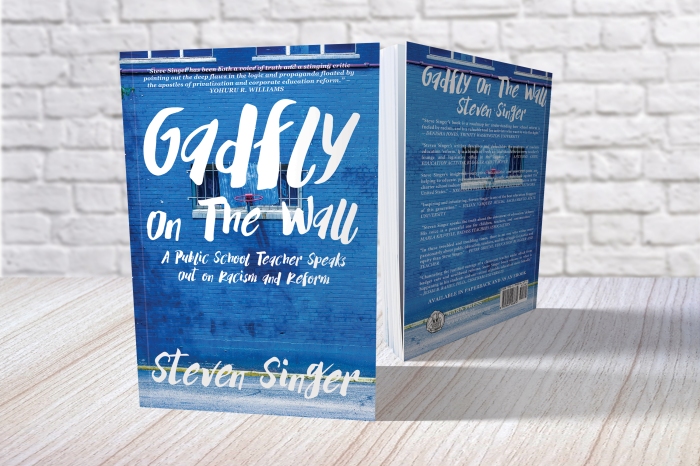
Like this post? I’ve written a book, “Gadfly on the Wall: A Public School Teacher Speaks Out on Racism and Reform,” now available from Garn Press. Ten percent of the proceeds go to the Badass Teachers Association. Check it out!

book-3

Twenty-One Reasons People Hate, Hate, HATE Betsy DeVos

n7kdmgvgx13jmo6cvmpu


Lesley Stahl: Why have you become, people say, the most hated Cabinet secretary?


Betsy DeVos: I’m not sure exactly how that happened…

I’m more misunderstood than anything.


The above exchange from last night’s 60 Minutes interview highlights an important point about our Education Secretary.


She is deeply unpopular, but not because she’s misunderstood. If anything, she’s understood too well.


We know what she stands for and we don’t like it.


If she was really so misunderstood, why didn’t her answers in the interview veer away from the same usual canned responses she’s given time-and-time-again to the same type of questions?


What’s wrong with schools? NOT ENOUGH CHOICE.


How do we prevent school shootings? LET SCHOOLS ARM TEACHERS.


You didn’t really even need DeVos to show up to the interview to be able to guess with a high degree of accuracy what her answers would be.


In fact, many of her responses seemed to have been coached – as if someone had prepared her with talking points before the interview even took place.


So without further ado, here is my exhaustive list of all the reasons I can think of why people really, REALLY hate Betsy Devos. If I’ve left something out, please feel free to add it in a comment.


WHY PEOPLE HATE BETSY DEVOS:


1) She didn’t earn her position as Education Secretary. She bought it. And even then it took a tie breaking vote by Vice President Mike Pence to shove her down our throats.


2) She wants to spend tax dollars to boost privatized schools in which she has a financial stake.


3) She doesn’t mind taking funding away from public schools to do it.


4) She wants to destroy the entire system of public schools which enroll 90% of America’s children.


5) She doesn’t really know what public schools are, having never attended one or having never sent her children or grandchildren to one.


6) She wants to arm teachers not because it will protect kids from school shooters, but because that boosts her family’s investment portfolio. (i.e. her brother’s mercenary army for hire, Blackwater)


7) She won’t make charter and voucher schools give the same services to special education kids as those provided by traditional public schools.


8) She’s getting rid of students’ civil rights protections while adding protections for nefarious student loan providers and fly-by-night on-line schools.


9) She’s rescinded rules that protected trans students.


10) She’s considering rescinding rules that protect minority students from being unfairly and disproportionately disciplined by schools.


11) She’s made it harder for victims of sexual assault and harassment to report abuse and easier for those accused to avoid prosecution.


12) She talks about state’s rights to determine their own education systems while using the power of the federal government to coerce them to doing things her way.


13) She wastes public tax dollars. She is the only Cabinet member protected by Federal Marshals, which costs us nearly $1 million a month. Whether this is necessary or not, as a billionaire she could save the taxpayers money by taking on this cost, herself.


14) She doesn’t care if the public doesn’t want her at their school or event. She goes anyway and then pretends to be angry that protestors showed up. She doesn’t seem to understand that as a public servant she should serve at our pleasure – not the other way around.


15) She uses tragedy as a photo-op – as she did when she visited the Parkland school to promote arming teachers. She didn’t meet significantly with students or staff. She didn’t listen to their concerns. She even bailed on her own press conference there when the queries weren’t to her liking.


16) She has no problem whitewashing black history as she did when she claimed historic black colleges were pioneers of school choice. In reality they had no choice. For many African Americans at the time, it was create black colleges or forgo post-secondary education at all.


17) She is ignorant (purposefully or not) of the results of her own policies. Her advocacy of school choice in her home state of Michigan has weakened that state’s public schools, not strengthened them.


18) She’s out of touch with average Americans. She’s the richest member of Trump’s cabinet and often travels in her on super luxury yacht.


19) She’s rich not because she earned it, but because she was born into it and married into even more wealth. Moreover, much of her wealth is due to her family’s Amway fortune – basically it’s founded on rooking average people out of their hard earned money with what’s essentially a pyramid scheme.


20) She’s arrogant. She smiles vacantly at topics that don’t deserve a smile – they deserve serious regard.


21) She is extremely biased and partisan. She is supposed to serve the public interest, but her radical Christian Fundamentalism and anti-LGBT activism make her untrustworthy to serve in that capacity. Statements such as “There is enough philanthropic dollars in America to fund what is currently the need in education… Our desire is to confront the culture in ways that will continue to advance God’s kingdom,” do not help.


Okay. That’s all I can think of – though more may pop into mind as soon as I publish this. If I missed something please include it in the comments.


Hopefully this answers DeVos’ question about why she’s hated.

Gadfly on the Road – Reflections on My First Book Signing

28056398_10155659682963860_9112619102652029542_n


So there I was standing at a podium in Barnes and Noble before an audience of 25 people who had come to hear me talk about my book.


Speech uploaded to my iPad – check.


Cough drop – check.


Fear that no one would take me seriously – Oh, double, triple check!


Let me just say there is a big difference between sitting behind a keyboard pounding out your thoughts for consumption on the Internet, and being somewhere – anywhere – in person.


I’ve spoken at rallies. I’ve spoken at school board meetings. I’ve spoken in private with lawmakers and news people.


But none of that is quite like being the center of attention at your own invitation, asking people to take time out of their busy lives and drag their physical selves to some prearranged place at some prearranged time just to hear whatever it is you’ve got to say.


I had been practicing my remarks for weeks after school.


I had a 15-20 minute speech ready to go – a distillation of the main themes in my book, “Gadfly on the Wall: A Public School Teacher Speaks Out on Racism and Reform.”


Would people hear what I had to say?


I surveyed the audience. A few people I didn’t know. But there was my mom and dad, a bit more grey haired than I remembered yet doing their parental duty. There were a few colleagues from work – teachers, aides and substitutes. There were a few students standing in the back with their parents. One of my old high school buddies even showed up though he lived about a half hour away.


And there in the second row was my daughter.


For a moment, the whole world seemed to be nothing but her 9-year-old face – a mix of emotions – curiosity, nervousness, boredom.


In that moment, everything else disappeared. I had an audience of one.


I began.


It was surreal.


I spoke the words I had written weeks before, pausing to look up at the audience when I could.


Somehow I was both more and less nervous. I stumbled over parts that had caused no problems when alone. And I hit other points with more passion and purpose than ever before.


At certain points I found myself getting angry at the people behind the standardization and privatization of public education.


I rebuke these greedy saboteurs just about every week on my blog. But there was something different about putting the words on my tongue in public and letting the vibrations beat a rhythm on the ear drums of those assembled before me.


It was like reciting a spell, an incantation. And the effect was visible on the faces of those in front of me.


I glanced at my daughter, expecting her to be nagging her Pap to take her to the children’s section, but she was as entranced as the others.


And was I kidding myself or was there another emotion there? Pride?


I finished my remarks, getting a few laughs here and there. Anger and mirth in equal measure.


I thanked everyone for coming and took questions.


There were quite a bit.


Which aspect of corporate education reform was the worst?


Is there any way for parents to protect their children from standardized testing?


How has the gun debate impacted the move to privatization?


My mother even asked what alternative methods of assessment were preferable to standardized testing.


It went back and forth for a while.


When it seemed to die down, I thanked everyone for coming and said I would be there for as long as anyone would like to talk one-on-one and sign any books if people would like.


I had a line.


Thankfully, my wife brought me the nicest sharpie marker just before I got up there.


I tried to personalize as much as I could but everything seemed to be a variation on “Thanks for Coming.”


Students came up to me with huge grins. Parents asked more questions about their children. Lots of handshaking and hugs.


Teachers came up to tell me I had done a great job. Many introduced me to their kids – most itty bitty toddlers.


A former student who had already graduated got really serious and said, “It was about time someone said that.”


And it was over.


The store manager told me how many books we sold. I had no idea if that was good or bad, but he seemed well satisfied.


I packed everything up in my car and then went looking for my family.


I found them in the children’s section.


They had picked out a few books Mommy was purchasing. A really nice one about Harriet Tubman among them.


My daughter was sitting alone by a toy train set. She was worn out. It had been a long day.


“Daddy!” she said when she saw me. “You were amazing!”


And that was it.


That was all I’d needed.


She asked me about this or that from the speech. Obviously she didn’t understand the ins and outs of what I had said, but some of it had penetrated.


We talked about racism and why that was bad. We talked about what we could do to help stop it.


The rest of the time she held my hand and took me on a tour of the store.


I have hope for a better world, but if I’m honest, I’m not sure if writing this book or my activism or any of it will ever actually achieve its goal.


As ethicist Reinhold Niebuhr wrote, “Nothing that is worth doing can be achieved in our lifetime.”


But I’ve shown my daughter where I stand.


I’ve shown her where I think it’s appropriate to stand.


I’ve shown the same to my students, my family, my community.


They’ll do with that what they will.


I just hope that one day when I’m gone, my daughter will remember what I taught her.


She’ll remember and feel my presence though I’m long gone.


Photos:


Videos of the majority of my speech:

Part 1:

Part 2:

Part 3:


Study Suggests Bringing “No Excuses” Discipline Policies from Charter to Public Schools

no_excuses_charter


The teacher begins class by taking out her Glock.


She casually walks to the front of the room and shoots a misbehaving student in the head.


All the others immediately begin working on their assignment.


It sounds like something from a horror movie. But it’s actually not all that far away from what real researchers at the Brookings Institution and Princeton University are suggesting we do.


Sarah Cohodes has written a new report called “Charter Schools and the Achievement Gap” that praises “No Excuses” discipline policies at urban charter schools and suggests they be more widely implemented at traditional public schools serving the poor and students of color.


I wish I were kidding.


Let’s return to the hyperbolic situation with which I began this article.


The noise of a gunshot brings the principal racing to the classroom.


She notices the slumped bleeding body of the shot child and walks up to the teacher ready to physically disarm and arrest her. But then she notices all the rows of neatly placed desks and the children diligently doing their work.


She glances down at a paper here and there and notices that the children are getting most of their work correct.


So she turns to the teacher and says, “Carry on, Ms. C. You seem to have everything under control here.”


That’s perhaps the most immediate concern brought by Cohodes research – it proposes to evaluate a discipline model based solely on its academic results and completely ignores other aspects of the student experience. For instance, how does the model affect students’ social and emotional development? Is it harmful to students’ curiosity, self-motivation and psychological well-being?


Pardon me, but these are important issues.


I don’t care if my fictional teacher’s shoot first discipline policy gets students to do exceptional classwork. My daughter will not be enrolled in that class – nor do I expect anyone would want their child to learn in such an environment regardless of how well it maximized test scores.


Let me be clear. This is hyperbole, but with a point.


“No Excuses” discipline policies don’t result in any gunshot wounds or deaths (to my knowledge), but they do create environments that are not conducive to the flourishing of children.


https://www.youtube.com/watch?v=AzWicLyDTkw


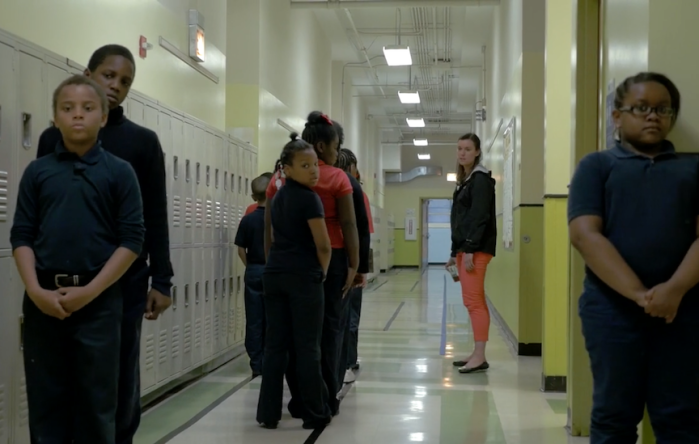
For instance, at a New Orleans charter school, students were punished for not standing straight, not sitting up straight, for putting their heads down, for closing their eyes for too long, for not tracking speakers correctly with their eyes! Between classes students had to walk single file between the wall and a line marked with orange tape. And they had strict dress codes.


This is not school. It is prison.


And it’s unsurprising that these sorts of discipline policies are found at urban charter schools like the KIPP network serving mostly poor and minority students.


Cohodes champions them because – in her view – they get results.


I say that she is missing the point.


Her view of what is important in school is far too narrow.


Moreover, it’s based on a misconception of what constitutes academic success.


Cohodes concludes “No Excuses” policies work solely because schools with such policies tend to have students who get higher test scores.


This is to make a few assumptions.


First, it assumes that the number of students weeded out by such discipline policies isn’t significant enough to wipe out the apparent increase in scores. The punishment for breaking the rules at these schools is often detention, suspension or expulsion. Every child who is enrolled at the beginning of the year isn’t there by testing time. How do we know that the school hasn’t lost so many students who couldn’t obey the rules that they wipe out any gains in testing?


Second, she is assuming standardized testing provide accurate assessments of knowledge and skills. This is far from an accepted premise. These tests have repeatedly been shown to be both economically and racially biased. Cohodes is assuming that since the students scoring better on the assessments are still poor and predominantly black, what they’re being tested on is fair.


Standardized tests are poor assessments. Multiple choice exams do not possess the flexibility to allow for creativity and depth of knowledge. They simply expect a “standard” student to think a certain way and reward dissimilar students for conforming to that standard.


“No Excuses” charter schools may be better at getting different children to act and think alike, but that is not necessarily an endorsement.


Cohodes concludes that these gains in test scores are ultimately beneficial because they will lead to success at college. However, numerous studies have shown that charter school students end up dropping out of college at higher rates than traditional public school students. They simply haven’t learned how to motivate themselves to learn without the rigid, military structures of the charter school environment. One can imagine similar outcomes for charter students (successful charter students) who immediately enter the workforce.


None of these considerations make it into Cohodes research.


She jumps from the brilliant standardized success of “No Excuses” charter schools to the need to include these policies in traditional public schools.


Cohodes worries that the charter school sector can never fully compete with traditional public schools, so we need to make traditional public schools more like charter schools.


However, I cannot imagine many parents would jump at the chance to have their children treated like prison inmates for the chance of higher test scores.


Unlike charter schools, public schools have school boards. They have to make their decisions in public and are accountable to voters who can come to the public meeting, protest and even run for a seat on the board themselves.


In short, this is a terrible idea.


It is somewhat staggering that a grown adult could look exclusively at the data and come to such a conclusion without considering what it means for flesh-and-blood students.


Not only that, but we’re talking about predominantly black and brown students. Is it somehow more acceptable because we’re talking about turning schools serving darker skinned students into Guantanamo Bay? Would it be as acceptable for rosy cheeked affluent white kids?


This is what happens when you let economists set public policy.


It is essential that we include parents, teachers, psychologist and even students in the processes. Otherwise, we’ll continue to get heartless number crunching offered as sincere solutions to our problems.

Nationwide Charter School Expansion Slowing Down

woman tired from running.jpg.838x0_q67_crop-smart


Charter schools used to be seen as the hot new concept in education.


But that fad seems to have jumped the shark.


For two decades since the first charter school law was passed in Minnesota, they’ve grown at about 6 to 7 percent nationally.


But for the last three years, that growth has dropped each year – from 7 to 5 to 2 percent.


170216-blog-chart-growth-declining


Even states that historically boasted the most growth are falling behind. Of charter powerhouses Texas, Florida, Ohio and California – only Texas has shown a significant upward trend.


170217-blog-graph-big-four


So what happened?


How did the hippest new thing to hit education since the chalk board suddenly hit such a wall? After all, it wasn’t so long ago that every celebrity from Magic Johnson to Andre Agassi to Deion Sanders to Sean “Puffy” Combs to Pitt Bull had their own charter school. Even Oprah Winfrey, the queen of multimedia, donated millions to charter networks in Louisiana, California, Pennsylvania, Colorado, Texas and her home state of Illinois.


How could something with so much high profile support be running out of gas?


The Center on Reinventing Public Education (CRPE) has a theory.


The charter school funded think tank (read: propaganda network) released a report boiling the issue down to three factors: real estate costs, a teacher shortage and political backlash.


Real estate costs? Yes, few public schools want to offer you public property to put your privately run school that will inevitably gobble up a good portion of its funding and turn a portion of that into profit for private investors.


Teacher shortage? Yes, when you pay your educators the least, don’t allow your employees to unionize, and demand high hours without remuneration, you tend to find it harder than most educational institutions to find people willing to work for you.


Political backlash? DING! DING! DING!


Of course, most people who aren’t paid by the charter school industry – as those working for CRPE are – would simply call this a charter school backlash – not political, at all.


This isn’t one political party seeking advantage over another. It’s concerned citizens from both sides of the aisle worried about the practices of the charter school industry.


The general public is starting to understand exactly what charter schools are and why they are a bad idea for children and society.


For instance:
-Charter schools are rarely controlled by elected school boards – they’re run by appointed bureaucrats.


-They are often run for profit –which means they can reduce services for students and pocket the savings.


-They cherry pick which students to enroll and how long to keep them enrolled – they only let in the easiest to teach and give the boot to any that are struggling before standardized testing time.


-And they very often close unexpectedly and/or are the site of monetary scandals where unscrupulous charter school operators take the money and run.


Moreover, it’s no accident that much of the criticism of charter schools comes from people of color. About one quarter of all charter school students are black, whereas black students make up only 15 percent of enrollment at traditional public schools.


To put that in perspective, approximately 837,000 black students were enrolled at charter schools during the 2016-17 school year. Yet civil rights organizations are concerned that this over-representation is having negative consequences on students of color.


The National Association for the Advancement of Colored People (NAACP) has issued numerous criticisms of charter schools most recently calling for a moratorium on them. So has the Movement for Black Lives and the Journey for Justice Alliance.


In addition to the concerns already mentioned, civil rights advocates are concerned with the tendency of charter schools to increase racial segregation.


Seventy percent of black charter school students have few white classmates, according to a study by the Civil Rights Project at UCLA.


But some charters are even worse. More than 1,000 of the nation’s 6,747 charter schools had student bodies made up of at least 99% minority students, according to an Associated Press analysis from three years ago. And it’s getting worse!


Certainly increasing segregation is a problem even at traditional public schools, but nothing like the numbers we’re seeing in the charter school sector.


Civil rights leaders know that “separate but equal” schools don’t work because when they’re separate, they’re rarely equal.


For instance, charter schools suspend students at a much higher rate than traditional public schools. Some charters suspend more than 70% of those enrolled, according to an analysis from the Center for Civil Rights Remedies at the University of California, Los Angeles.


Researchers found the situation is even more dire for minorities. Black students are four times more likely to be suspended than white students, and students with disabilities are twice as likely to be suspended as non-disabled students.


With all these problems dogging their heels, it’s no wonder that the charter school juggernaut is starting to lose momentum.


Instead of concentrating solely on why these schools are losing popularity, we should also ask what set them shooting off into the stratosphere in the first place.


After all, no one was really crying out for private schools run with public money.


No one, that is, except big business and greedy investors looking for a quick buck.


Since the Clinton administration, charter school investments get automatic tax credits that allow investors to double their money in as little as 7 years. Lobbying at the state and federal level by charter schools and their investors and contractors have enabled a monetary scam to enrich private industry at public expense.


Put simply, charters are not subject to the same instructional, operational, fiscal, accounting or conflict of interest rules as traditional public schools. Therefore, in most states it’s perfectly legal for a charter school operator to give his brother the instructional contract, his sister the maintenance contract and his uncle the textbook contract. He can replace the teachers with computer programs and apps, while his own privately held company rents and leases the school building at a hefty markup – all with public money.


And somehow that’s still called a “public” school.


We have to face this simple fact: Charters took off not because they were a good idea to help kids learn, but because they were an excellent way to make a lot of money off of the government. It was a way to steal money meant to help children.


What we’re seeing in terms of a backlash is just a more common realization of the motives behind charter schools echoed in the negative consequences these schools leave behind.


And in the Trump era, charter schools can’t hide behind a friendly face like Barack Obama.


The neoliberal agenda is as fervently being pushed by the right wing as the left – more so.


This slowdown may signal that people have gone beyond politics.


We don’t care what the left and the right wish to sell us. We’re not willing to buy the charter school boloney anymore. If our policymakers want to continue getting our votes, they may need to give in to what the people actually want and stop trying to lead us over the cliff and feed us to the sharks.

School Choice Week – Choosing Away Your Choice

Sleazy_Businessman


School Choice Week is one of the greatest scams in American history.


It is a well-funded, thoroughly organized attempt to trick parents into signing away their right to make educational choices about their children.


Seriously.


It goes like this:


Salesman: Would you like a choice?


Parent: Sure!


Salesman: Then just agree to never have another choice again.


That’s it in a nutshell.


Choose not to choose.


When you decide to send your child to a so-called choice school – a charter or voucher institution – you lose almost every other choice about what happens at your child’s school.


Sound impossible?


Let me count the decisions you lose by signing on the dotted line.


When you send your child to a school paid for with public money but run by a private organization, you lose:


AN ELECTED SCHOOL BOARD, so you have no say about what the school does.


OPEN DOCUMENTS, so you have no right to see budgets, spending agreements, bids, contracts, etc.


OPEN MEETINGS, so you have no public place to speak up to the people who run your school.


RIGHT TO SELF-GOVERNMENT, so you have no right to run for a leadership position on the school board. Instead you’re at the mercy of appointed flunkies.


THE RIGHT OF ENROLLMENT, so school operators get to choose whether your child gets to attend, unlike public schools which have to accept your child no matter what – so long as you live in the district.


QUALITY SERVICES, so school operators can cut services for your child and pocket the savings as profit or use it to advertise to get more paying butts in seats.


QUALITY TEACHERS, because most charter and voucher schools aren’t required to hire educators with 4-year degrees, and since they don’t pay as well as public schools and often refuse to let their teachers unionize, they attract less experienced and distinguished educators.


DIVERSE CLASSMATES, because charter and voucher schools increase segregation. Your children will be educated with more kids that look just like them. That’s healthy!


And that’s merely at MOST privatized schools. But that’s not all. At some privatized schools you can lose even more! You may also lose:


COMMON SENSE DISCIPLINE POLICIES, so your children will be held to a zero tolerance discipline policy where they may have to sit quietly, eyes forward, marching in line or else face aggressive public reprimands and harsh punishments.


AN UNBIASED SECULAR EDUCATION, so your children will be taught religion and politics as if they were fact all funded by public tax dollars! Hear that sound? That’s our Founders crying.


FREE TIME, so you’ll be required to volunteer at the school regardless of your ability to do so. Gotta’ work? Tough!


MONEY, so you’ll have to pay tuition, buy expensive uniforms, school supplies or other amenities.


And if your children are struggling academically, you may also lose:


ENROLLMENT, so your child is given the boot back to the public school because he or she is having difficulty learning, and thus costs too much to educate.


You lose all that if you decide to enroll your child in a charter or voucher school!


But that’s not all!


If you DON’T decide to send your child to a so-called choice school, you can still lose choice!


Why? Because of the rubes who were fooled into give up their choice. When they did that, they took some of your choices, too.


Because of them, you still lose:


-NECESSARY FUNDING, because your public school has to make up the money it lost to charter and voucher schools somewhere, and that means fewer resources and services for your child.


-LOWER CLASS SIZES, because your public school has to fire teachers and increase class size to make up for lost revenue.


-FAIR ASSESSMENTS, because the state and federal government require your child to take unfair high stakes tests to “prove” your public school is failing and thus justify replacing it with a charter or voucher schoolas if those have ever been proven to be better, but whatever! CA-CHING! CA-CHING!


This is what you get from School Choice Week.


It’s a uniquely American experience – selling the loss of choice — as choice.


And all the while they try to convince you that public schools are the ones that take away your alternatives.


Yet public schools are where you get all those things you lose at privatized schools.


You get elected school boards, open documents, open meetings, the right to self-government, the right of enrollment, quality services, quality teachers, diverse classmates, common sense discipline policies, an unbiased secular education, free time and money! That’s right! You actually get all that and more money in your pocket!


I’m not saying public schools are perfect. There are many ways they need to improve, but it’s difficult to do so when many of the people tasked with improving these schools are more concerned with sabotaging them to make room for privatized systems.


These are paid employees of the charter and voucher school movement who want to kill public schools – BUT THE KILLER IS ALREADY IN THE HOUSE!


Imagine if we dedicated ourselves to making our public school system better!


Imagine if we committed to giving parents and students more choices in the system and not trying to replace that system with one that gives all the benefits and choices away to corporate vultures!


So, yeah, School Choice Week is a scam.


But, hey, enjoy those yellow scarfs.


devosbetsey_011818gn7_lead

The Further You Get From Public Schools, the Greater the Chance of Child Abuse

nn_mal_house_of_horrors_180118_1920x1080.nbcnews-ux-1080-600


A California home-school where parents shackled, starved and abused their children is a symptom of a larger disease.


And that disease is privatization.


David Allen Turpin and his wife, Louise Anna Turpin, were arrested after police found the couple’s 13 children living in deplorable conditions in their Perris, California, home.


Some of the children were actually young adults but were so malnourished investigators at first mistook them for minors.


It is a situation that just could not have happened had those children been in the public school system.


Someone would have seen something and reported it to Child Protective Services. But school privatization shields child predators from the light and enables a system where minors become the means to every adult end imaginable.


Let me be clear. Privatization is defined as the transfer of a service from public to private ownership and control.


In education circles, that means home-schools, charter schools and voucher schools – all educational providers that operate without adequate accountability.


We are taking our most precious population – our children – and allowing them to be educated behind closed doors, out of sight from those tasked with ensuring they are getting the best opportunities to learn and are free from abuse.


And since home-schooling operates with almost zero oversight, it is the most susceptible to child neglect and mistreatment.


Children who in traditional public schools would have a whole plethora of people from teachers to counselors to principals to cafeteria workers who can observe the danger signs of abuse are completely removed from the home-school environment.


Home-schooled children receive their educations almost exclusively from parents.


While most moms and dads would never dream of abusing their kids, home-schooling provides the perfect cover for abusers like the Turpins to isolate children and mistreat them with impunity.


It is a situation that at least demands additional oversight. And at most it requires we rethink the entire enterprise as dangerous and wrongheaded.


Charter and voucher schools at least utilize whole staffs of people to educate children. The chances of something like this happening at these institutions is much smaller. However, both types of school also are much less accountable for their actions than traditional public schools.


And that is the common factor – responsibility. Who is being held answerable when things go wrong? At traditional public schools, there is a whole chain of adults who are culpable for children. At these other institutions, the number of people in the hot seat shrinks to zero.


Much of that has to do with the regulations each state puts on privatized schools.


Just look at the regulations governing home-schooling.


In 14 states including Delaware, California and Wisconsin, parents don’t have to do anything but let the school district know they’re home-schooling. That’s it! And in 10 states including Texas, Illinois and New Jersey, you don’t even have to do that!


Kids just disappear without a trace. If no one reports them missing, we assume they’re being home-schooled.


But even in states that appear to be more exacting on paper, the reality is a virtual free-for-all.


Take my home state of Pennsylvania. To begin home-schooling, parents must notify the superintendent, have obtained a high school degree themselves, provide at least 180 days of instruction in certain subjects and maintain a portfolio of their child’s test results and academic records.


That sounds impressive. However, this doesn’t really amount to much in practice because these regulations have few teeth. Hardly anyone ever checks up to make sure these regulations are being met – and they’re only allowed to check up under certain circumstances and only in certain ways and at certain times!


Even when it comes to charter and voucher schools, most states, including Pennsylvania, go little further than that.  


Frankly, most of the time we don’t know what happens in charter and voucher schools, because few state governments insist on audits, unscheduled visits or reports.


For instance, though few charter or voucher schools starve, lock up or torture students, many have zero tolerance discipline policies. Few would claim even these controversial behavior management systems sink to the level of some home-school parents who have allegedly withheld food and bound children’s hands with zip ties. But adolescents being forced to sit silently with their eyes looking forward, hands on the table or else receive loud rebukes – as they are in many charter or voucher schools – may qualify as another kind of abuse.


Moreover, all privatized schools can withhold providing a proper education. Home-school parents can refuse to teach their children not just truths about science and history but the basics of reading, writing and math. Likewise, charter and voucher schools can cut student services and pocket the savings as profit. And no one is the wiser because the state has abrogated its responsibility to check up on students or even require they be taught much of anything at all.


Meanwhile, none of this is possible in the traditional public school setting because it must operate in the light of day. It is fully accountable to the public. Its documents are public record. Decisions about how it should be run and how tax dollars are spent are made at open meetings by duly-elected members of the community.


Some, including myself, would argue that the regulations required of public schools by the state and federal government are sometimes too onerous, unnecessary or even just plain dumb. But that doesn’t change the fact that regulations are necessary. It just leaves open the question of which ones.


The bottom line is this: Public school is the equivalent of teaching children in an open room with qualified educators that have proven and continue to prove they have no criminal record and are able and ready to educate.


Privatized schools are the equivalent of teaching children in a closed room with educators who may not deserve the name and may or may not have deplorable criminal pasts.


Looked at in the abstract, no one in their right mind would conceivably suggest the latter is a better educational environment than the former. However, we have been subjected to an expensive propaganda campaign to make us think otherwise.


Look. I’m not saying public schools are perfect. Certainly students can be abused there, too. The media salaciously reports every doe-eyed teacher who stupidly has a sexual relationship with a student – whether it be at a public or privatized school. But in comparison with the worst that can and often does happen at privatized schools, these incidents at public schools are extremely rare (1 in 800,000) and of much less severity.


Though both are bad, there is a world of difference between the infinitesimal chance of being propositioned by your high school teacher and the much more likely outcome of being treated like a prison inmate at 13 by the charter school corporation or being starved, shackled and beaten by your parents!


Human beings aren’t going to stop being human anytime soon. Wouldn’t it be better to entrust our children to an environment with regulations and accountability than letting them go off in some locked room and just trusting that everything will be alright?


Our posterity deserves better than privatization.


They deserve the best we can give them – and that means fully responsible, fully regulated, fully accountable public schools.

Public Schools Best Fulfill Dr. King’s “Purpose of Education”

CZCqp_RUkAE-ZHI


What is the purpose of education?


Is it to train the next generation of workers?


Or is it to empower the next generation of citizens?


Is it to give children the skills necessary to meet the needs of business and industry?


Or is it to provide them the tools to self-actualize and become the best people they can be?


In today’s world, our leaders continue to insist that the answer to the question is the former corporate training model. Knowledge is only valuable if it translates to a job and thus a salary.


But we didn’t always think that way.


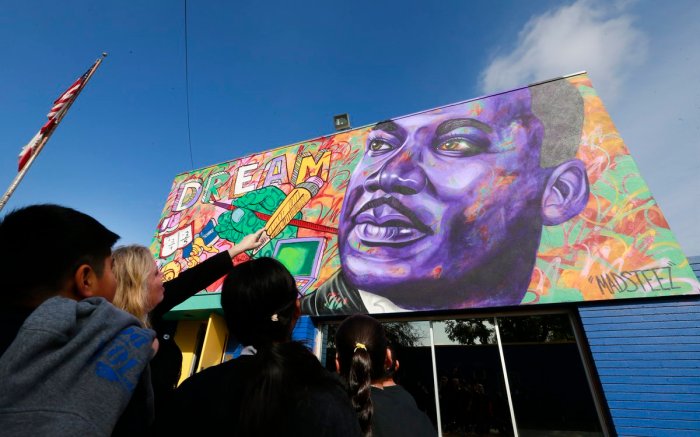
As another Martin Luther King Day is about to dawn this week, I’m reminded of the man behind the myth, a person who clearly would deny this materialistic view of learning.


When we think of Dr. Martin Luther King, Jr., we usually think of the towering figure of the Civil Rights Movement who gave the “I have a dream” speech during the March on Washington in 1963.


However, as a teacher, I find myself turning to something he wrote in 1947 when he was just an 18-year-old student at Morehouse College.


While finishing his undergraduate studies in sociology, he published an essay in the student paper called “The Purpose of Education.”


Two sections immediately jump off the page. The first is this:


“We must remember that intelligence is not enough. Intelligence plus character–that is the goal of true education. The complete education gives one not only power of concentration, but worthy objectives upon which to concentrate. The broad education will, therefore, transmit to one not only the accumulated knowledge of the race but also the accumulated experience of social living.”


So for King it wasn’t enough for schools to teach facts. It wasn’t enough to teach skills, math, writing, reading, history and science. The schools are also responsible for teaching children character – how to be good people, how to get along with each other.


It’s a worthy goal.


But 2018 contains a far different educational landscape than 1947.


When King wrote, there were basically two kinds of school – public and private. Today there is a whole spectrum of public and private each with its own degree of self-governance, fiscal accountability and academic freedom.


On the one side we have traditional public schools. On the other we have fully private schools. And in the middle we have charter, voucher and home schools.


So which schools today are best equipped to meet King’s ideal?


Private schools are by their very nature exclusionary. They attract and accept only certain students. These may be those with the highest academics, parental legacies, religious beliefs, or – most often – families that can afford the high tuition. As such, their student bodies are mostly white and affluent.


That is not King’s ideal. That is not the best environment to form character, the best environment in which to learn about people who are different than you and to develop mutual understanding.


Voucher schools are the same. They are, in fact, nothing but private schools that are subsidized in part by public tax dollars.


Charter schools model themselves on private schools so they are likewise discriminatory. The businesses who run these institutions – often for a profit – don’t have to enroll whoever applies. Even though they are fully funded by public tax dollars, they can choose who to let in and who to turn away. Often this is done behind the cloak of a lottery, but with no transparency and no one checking to ensure it is done fairly, there is no reason to believe operators are doing anything but selecting the easiest (read: cheapest) students to educate.


Charter schools have been shown to increase segregation having student bodies that are more monochrome than those districts from which they cherry pick students. This is clearly not King’s ideal.


Homeschooling is hard to generalize. There is such a wide variety of experiences that can be described under this moniker. However, they often include this feature – children are taught at home by their parent or parents. They may or may not interact with their academic peers and the degree to which they meet and understand different cultures is variable to say the least. They may meet King’s ideal, but frankly the majority of them probably do not.


So we’re left with traditional public schools. Do they instill “intelligence plus character”?


Answer: it depends.


There are many public schools where children of different races, nationalities, religions, and creeds meet, interact and learn together side-by-side.


Students wearing hajibs learn next to those wearing yarmulkes. Students with black skin and white skin partner with each other to complete class projects. Students with parents who emigrated to this country as refugees become friends with those whose parents can trace their ancestors back to the Revolutionary War.


These schools are true melting pots where children learn to become adults who value each other because of their differences not fear each other due to them. These are children who not only learn their academics as well – if not often better – than those at competing kinds of schools, but they also learn the true face of America and they learn to cherish it.


This is the true purpose of education. This is the realization of King’s academic ideal and his civil rights dream.


However, this is not the case at every public school.


While there are many like this, there are too many that are increasingly segregated. In fact, in some areas our schools today are more segregated than they were at the time of Dr. King’s assassination.


These are schools that get the lion’s share of resources, that have the newest facilities, the widest curriculum, the most affluent clientele.


So, no, not even all public schools meet this ideal. But those that don’t at least contain the possibility of change.


We could integrate all public schools. We could never integrate our charter, voucher and private schools. That goes against their essential mission. They are schools made to discriminate. Public schools are meant to be all inclusive. Every one could meet King’s ideal, if we only cared enough to do it.


Which brings me to the second section of King’s early essay that pops off the page:


“The function of education, therefore, is to teach one to think intensively and to think critically. But education which stops with efficiency may prove the greatest menace to society. The most dangerous criminal may be the man gifted with reason, but with no morals.”


Seventy one years ago, King was warning us about the situation we suffer today.


When we allow academics to be distinct from character and understanding, we put ourselves at the mercy of leaders with “reason, but with no morals.”


We put ourselves and our posterity in the hands of those like President Donald Trump, the fruit of a fully private education.


Racism and privilege become the defining characteristics of a class without character, in King’s sense.


If we want to reclaim what it means to be an American, if we want to redefine ourselves as those who celebrate difference and defend civil rights, that begins with understanding the purpose of education.


It demands we defend public schools against privatization. And it demands that we transform our public schools into the integrated, equitable institutions we dreamed they could all be.

The Different Flavors of School Segregation

lollipop-flavor


The most salient feature of the United States Public School System – both yesterday and today – is naked, unapologetic segregation.


Whether it be in 1954 when the Supreme Court with Brown v. Board made it illegal in word or today when our schools have continued to practice it in deed. In many places, our schools at this very moment are more segregated than they were before the Civil Rights movement.


That’s just a fact.


But what’s worse is that we don’t seem to care.


And what’s worse than that is we just finished two terms under our first African American President – and HE didn’t care. Barack Obama didn’t make desegregation a priority. In fact, he supported legislation to make it worse.


Charter schools, voucher schools, high stakes standardized testing, strategic disinvestment – all go hand-in-hand to keep America Separate and Unequal.


In this article, I’m going to try to explain in the most simple terms I know the reality of segregation in our schools, how it got there and the various forms it takes.


I do this not because I am against public education. On the contrary, I am a public school teacher and consider myself a champion of what our system strives to be but has never yet realized. I do this because until we recognize what we are doing and what many in power are working hard to ensure we will continue doing and in fact exacerbate doing, we will never be able to rid ourselves of a racist, classist disease we are inflicting on ourselves and on our posterity.


America, the Segregated


It’s never been one monolithic program. It’s always been several co-existing parallel social structures functioning together in tandem that create the society in which we live.


Social segregation leads to institutional segregation which leads to generational, systematic white supremacy.


This is as true today as it was 50 years ago.


I’m reminded of possibly the best description of American segregation on record, the words of the late great African American author James Baldwin who said the following on the Dick Cavett Show in 1968:


“I don’t know what most white people in this country feel. But I can only conclude what they feel from the state of their institutions. I don’t know if white Christians hate Negroes or not, but I know we have a Christian church that is white and a Christian church that is black. I know, as Malcolm X once put it, the most segregated hour in American life is high noon on Sunday.


That says a great deal for me about a Christian nation. It means I can’t afford to trust most white Christians, and I certainly cannot trust the Christian church.


“I don’t know whether the labor unions and their bosses really hate me — that doesn’t matter — but I know I’m not in their union. I don’t know whether the real estate lobby has anything against black people, but I know the real estate lobby is keeping me in the ghetto. I don’t know if the board of education hates black people, but I know the textbooks they give my children to read and the schools we have to go to.


“Now this is the evidence. You want me to make an act of faith, risking myself, my wife, my woman, my sister, my children on some idealism which you assure me exists in America, which I have never seen.”


As Baldwin states, there are many different ways to keep black people segregated. There are many different flavors of the same dish, many different strains of the same disease.


We can say we’re against it, but what we say doesn’t matter unless it is tied to action.


You can say you’re in favor of equity between black and white people all day long, but if the policies you support don’t accomplish these things, you might as well wear a white hood and burn a cross on a black person’s lawn. It would at least be more honest.


Segregated Schools


In terms of public education, which is the area I know most about and am most concerned with here, our schools are indeed set up to be segregated.


If there is one unstated axiom of our American Public School System it is this: the worst thing in the world would be black and white children learning together side-by-side.


I’m not saying that anyone goes around saying this. As Baldwin might say, it doesn’t matter. What matters is how we act, and judging by our laws and practices, this is the evidence.


The sentiment seems to be: Black kids should learn here, white kids should learn there, and never the two should meet.


Our laws are explicitly structured to allow such practices. And that’s exactly what we do in almost every instance.


It’s just who we are.


So, you may ask, how can a public school teacher like myself support such a system.


The answer is that I don’t.


I support the ideals behind the system. I support the idea of a public system that treats everyone equitably.


That’s what it means to have a public system and not a private one. And that’s an ideal we would be wise to keep – even if we’ve never yet lived up to it.


Many people today are trying to destroy those ideals by attacking what exists. And they’re trying to do it, by acts of sabotage.


They point to inequalities they, themselves, helped create and use them to push for a system that would create even worse inequality. They point to the segregation that they, themselves, helped install and use it as an excuse to push even more segregation.


And they do so by controlling the media and the narrative. They call themselves reformers when they’re really vandals and obstructionists looking to subvert the best in our system in order to maximize the worst.


School Segregation Today


Sure we don’t have very many all white or all black schools like we did before Brown v. Board. Instead we have schools that are just predominantly one race or another.


ALL kids are not divided by race. Just MOST of them.


The reason?


Legally and morally absolute segregation has become repugnant and impracticable. We can’t say segregation is the law of the land and then segregate. But we can set up the dominoes that spell S-E-G-R-E-G-A-T-I-O-N and then shrug when that just happens to be the result.


Partially it has to do with housing.


White people and black people tend to live in different neighborhoods. Some of this is a choice. After a history of white oppression and racial strife, people on both sides of the divide would rather live among those with whom they identify.


Black people don’t want to deal with the possibility of further deprivations. White people fear retaliation.


However, white people generally enjoy a higher socio-economic status than black people, so there is some push back from black folks who can afford to live in whiter neighborhoods and thus enjoy the benefits of integration – bigger homes, less crowding, less crime, access to more green spaces, etc. But even when there is a desire, moving to a white neighborhood can be almost impossible.


State and federal laws, local ordinances, banking policies and persistent prejudice stand in the way.


In short, red lining still exists.


Real estate agents and landlords still divide up communities based on whom they’re willing to sell or rent to.


And this is just how white people want it.


They’re socialized to fear and despise blackness and to cherish a certain level of white privilege for themselves and their families.


And if we live apart, it follows that we learn apart.


The system is set up to make this easy. Yet it is not uncomplicated. There is more than one way to sort and separate children along racial and class lines in a school system.


There are several ways to accomplish school segregation. It comes in multiple varieties, a diversity of flavors, all of which achieve the same ends, just in different ways.


By my reckoning, there are at least three distinct paths to effectively segregate students. We shall look at each in turn:


1) Segregated Districts and Schools


When you draw district lines, you have the power to determine their racial makeup.


Put the white neighborhoods in District A and the black ones in District B. It’s kind of like gerrymandering, but instead of hording political power for partisan lawmakers, you’re putting your finger on the scale to enable academic inequality.


However, sometimes you can’t do that. Sometimes you don’t have the power to determine the makeup for entire districts. Instead, you can do almost the same thing for schools within a single district.


You just send most of the black kids to School A and most of the white kids to School B. This is easy to justify if they’re already stratified by neighborhood. In this way, geographical segregation becomes the determination for the academic variety.


In fact, this is what we usually think of when we think of school segregation. And it has certain benefits for white students and costs for black ones.


Foremost, it allows white students to horde resources.


In the first case where you have segregated districts, legislation including explicit funding formulas can be devised to make sure the whiter districts get more financial support than the blacker ones. The state provides more support and the higher socio-economics of the whiter neighborhoods provides a more robust tax base to meet the needs of white children.


That means the whiter districts get higher paid and more experienced teachers. It means they have broader curriculum, more extracurricular activities, a more robust library, more well-trained nursing staff, more advanced placement courses, etc.


And – this is important – the blacker districts don’t.


Fewer funds mean fewer resources, fewer opportunities, more challenges to achieve at the same level that white students take for granted. A budget is often the strongest support for white supremacy in a given community or society as a whole. In fact, if you want to know how racist your community is, read its school budget. You want accountability? Start there.


The same holds even when segregation is instituted not at the district level but at the level of the school building.


When the people making the decisions are mostly white, they tend to steer resources to their own kids at the expense of others. Appointed state recovery bureaucrats, school boards, and administrators can provide more resources to the white schools than the black ones.


It may sound ridiculous but this is exactly what happens much of the time. You have gorgeous new buildings with first class facilities in the suburban areas and run down crumbling facilities in the urban ones – even if the two are only separated geographically by a few miles.


This is not accidental. It’s by choice.


2) Charter and Voucher Schools


And speaking of choice, we come to one of the most pernicious euphemisms in the public school arena – school choice.


It’s not really about academics or options. It’s about permitting racism.


It’s funny. When schools are properly funded and include an overabundance of resources, few people want another alternative. But when schools are underfunded and there is a black majority, that’s when white parents look for an escape for their children.


Like any parasite, charter and voucher schools only survive in the proper environment. It usually looks like this.


Sometimes no matter how you draw the district lines or how you appropriate the buildings, you end up with a black majority and a white minority. That’s a situation white parents find simply intolerable.


White children must be kept separate and given all the best opportunities even if that means taking away the same for black children.


That’s where “school choice” comes in.


It’s not a pedagogical philosophy of how to best provide an education. It’s big business meeting the demand for parental prejudice and white supremacy.


In summary, charter and voucher schools are the mechanisms of white flight. Period.


This is why the National Association for the Advancement of Colored People (NAACP) and the Movement for Black Lives have condemned school privatization. It is racism as a business model. It increases segregation and destroys even the possibility of integration.


This works in two ways.


First, it allows white kids to enter new learning environments where they can be in the majority and get all the resources they need.


White parents look for any opportunity to remove their children from the black majority public school. This creates a market for charter or voucher schools to suck up the white kids and leave the black kids in their neighborhood schools.


Once again, this creates the opportunity for a resource gap. The charter and voucher schools suck away needed funds from the public schools and then are subsidized even further by white parents.


The quality of education provided at these institutions is sometimes better – it’s often worse. But that’s beside the point. It’s not about quality. It’s about kind. It’s about keeping the white kids separate and privileged. It’s about saving them from the taint of black culture and too close of an association with black people.


Second, the situation can work in reverse. Instead of dividing the whites from the blacks, it divides the blacks from the whites.


This happens most often in districts where the divide is closer to equal – let’s say 60% one race and 40% another. Charter and voucher schools often end up gobbling up the minority students and leaving the white ones in the public school. So instead of white privatized and black public schools, you get the opposite.


And make no mistake – this is a precarious position for minority students to be in. Well meaning black parents looking to escape an underfunded public school system jump to an even more underfunded privatized system that is just waiting to prey on their children.


Unlike public schools, charter and voucher institutions are allowed to pocket some of their funding as profit. That means they can reduce services and spending on children anytime they like and to any degree. Moreover, as businesses, their motives are not student centered but economically driven. They cherry pick only the best and brightest students because they cost less to educate. They often enact zero tolerance discipline policies and run themselves more like prisons than schools. And at any time unscrupulous administrators who are under much less scrutiny than those at public schools can more easily steal student funding, close the school and run, leaving children with no where to turn but the public school they fled from in the first place and weakened by letting privatized schools gobble up the money.


The result is a public school system unnaturally bleached of color and a privatized system where minority parents are tricked into putting their children at the mercy of big business.


3) Tracking


But that’s not all. There is still another way to racially segregate children. Instead of putting them in different districts or different schools, you can just ensure they’ll be in different classes in the same school.


It’s called tracking – a controversial pedagogical practice of separating the highest achieving students from the lowest so that teachers can better meet their needs.


However, it most often results in further stratifying students socially, economically and racially.


Here’s how it works.


Often times when you have a large enough black minority in your school or district, the white majority does things to further horde resources even within an individual school building or academic department.


In such cases, the majority of the white population is miraculously given a “gifted” designation and enrolled in the advanced placement classes while the black children are left in the academic or remedial track.


This is not because of any inherent academic deficit among black students, nor is it because of a racial intellectual superiority among white students. It’s because the game has been rigged to favor white students over black ones.


Often the excuse given is test scores. Standardized tests have always been biased assessments that tend to select white and affluent students over poor black ones. Using them as the basis for class placement increases segregation in school buildings.


It enables bleaching the advanced courses and melanin-izing the others. This means administration can justify giving more resources to white students than blacks – more field trips, more speakers, more STEAM programs, more extracurriculars, etc.


And if a white parent complains to the principal that her child has not been included in the gifted program, if her child has even a modicum of ability in the given subject, more often than not that white child is advanced forward to the preferential class.


CONCLUSIONS


Segregation is a deep problem in our public school system. But it cannot be solved by privatization.


In fact, privatization exacerbates it.


Nor is public education, itself, a panacea. Like any democratic practice, it requires participation and the economic and social mobility to be able to participate as equals.


Schools are the product of the societies that create them. An inequitable society will create inequitable schools.


Segregation has haunted us since before the foundation of our nation.


The only way to solve it is by first calling it out and recognizing it in all its forms. Then white people have to own their role in spreading it and take steps to end it.


Segregation doesn’t just happen. It exists because white people – especially white parents – want it to exist.


They don’t want their children to be educated among black students – maybe SOME black students, maybe the best of the best black students, but certainly not the average run of the mill brown-skinned child.


This has to stop.


There are plenty of benefits even for white students in an integrated education. It provides them a more accurate world-view and helps them become empathetic and prize difference.


Moreover, nothing helps inoculate a child against racism more than a truly integrated education.


If we want our children to be better people, we should provide them with this kind of school environment.


But instead, too many of us would rather give them an unfair edge so they can do better than those around them.


Racism is not just ideological; it is economic. In a dog-eat-dog-world, we want our kids to be the wolves with their teeth in the weaker pups necks.


We need to dispel this ideal.


Our society does not need to be a zero-sum game.


We can all flourish together. We can achieve a better world for all our children when we not only realize that but prize it.


As Baldwin put it in 1989’s “The Price of a Ticket”:


“It is not a romantic matter. It is the unutterable truth: all men are brothers. That’s the bottom line.”


When that becomes a shared vision of our best selves, only then will segregation be completely vanquished.

There Has Never Been a Better Chance to Defeat Neoliberals and Neofascists: Hopes for 2018

Demonstration against G8 Summit in Le Havre


As 2017 chugs and sputters to a well-deserved end, I find myself surprised at the pessimism around me.


Yes, I know. Donald Trump is still President.


The plutocrats have stolen trillions of dollars from the majority in unnecessary tax cuts that threaten our ability to function as a nation.


A slim majority of their sniveling creatures at the FCC have repealed Net Neutrality gifting our free expression to huge corporations.


And big business continues to sack and burn our public schools only to replace them with charter and voucher swindles.


This is all true.


But it does not make me lose heart.


These defeats may be fleeting, momentary as political and legal challenges mount against them. As far as the tide has pulled back, a wave is gathering strength at sea, such a prodigious burst of water as to create a new ocean once it hits land.


Yes, we endured many scars from the year that was. But we have gained something truly amazing – something that we probably could not have grasped without our sexual predator in chief, a reality TV show conman posing as a political leader.


People.


Are.


Awake.


They see the undeniable destruction, the naked power grabs, how our lawmakers are owned by the super-rich and the outright denial of democratic principles.


They see and they understand.


It is no longer debatable that we have lost control of our government.


It is no longer a question whether our lawmakers have our best interests at heart.


It is no longer at all uncertain that business interests and public interests are not the same.


Everyone knows.


Everyone sees.


The question is “What will we do about it?”


I’m reminded of the ending of John Carpenter’s cult classic “They Live.”


In the movie, Earth is conquered by aliens but no one noticed. The aliens took over the media and government using a transmitter to hide their ugly faces so that people couldn’t see what they truly look like. These intergalactic shepherds used the media and advertising to herd us human sheep to focus on naked consumerism and ignore how we’re being consumed by the powers that be.

At the end of the movie, the hero – played by Roddy Piper – sacrifices himself to destroy the transmitter so everyone finally can see the hideous aliens among us.


I remember watching the film the first time back in the ‘80s and wondering what people would do once they could see the truth.


Would they fight? Or would they try to convince themselves that they weren’t seeing the evidence of their own eyes?


(WARNING: The video below is NSFW, contains nudity and sexual situations.)

 

We’re in a similar situation today.


Trump did not cause all of this. He certainly made it worse, but the groundwork was laid by years of neoliberals from Bill Clinton to Barack Obama.


Reagan and both Bushes started us rolling down into the pit, but it was the Clintons and the Obamas who convinced so many of us that we weren’t headed into oblivion, it was merely a trick of the mind, this was the direction we wanted to go and that if anyone got left behind it was merely their own darn fault.


But now the truth is right there before our faces.


And that’s thanks to the blunt, unrepentant greed of Donald J. Trump.


He steals from us and doesn’t even pretend he’s doing anything else.


He hordes our money. He destroys our laws and disregards our values. He raises racists and bigots to respectability while appointing unqualified sycophants with the expressed purpose to run our government into the ground. And if anyone dares proclaim the emperor has no clothes, all he can say is “Fake News.”


And though I thoroughly despise him for everything he’s done and continues to do bringing our world to the brink of annihilation – I also have to thank him.


There is no longer any denying the truth.


It is merely a question of how we fight.


Opportunities abound for victory, and on a scale we could not previously have dreamed.


It would take such a little push to topple this pathetic toy dictator’s regime.


Merely a whisper out of all our mouths could bring it down.


The slightest flick of the smallest finger on all our hands could send a shock wave causing this pitiful empire to crumble.


If we merely took to the streets at the same time, these dollar store monsters would dissolve in our wake.


And in their place – imagine the world we could create.


All the socialist ideals of Roosevelt’s New Deal could be realized. We could enact a NEW New Deal where everyone truly had a fair shot at flourishing.


As the Rev William Barber says, we could bring about a Third Reconstruction so that our future was firmly built on the foundation of equity and understanding for people of all races, genders, nationalities, religions and creeds.


We could forever banish money from the halls of power and force the plutocrats to pay for all they have stolen from us – with interest.


We could do all this with the merest flexing of our muscles. Because the conquering power is so weak, so disorganized, so pathetic.


And the status quo false flag opposition is just as weak and powerless.


There is but one puissant force left in this country of ours, and it is us. The people.


We were there at the beginning and we are here still at what might be our end.


We, the People.


We can take this country back from the sick and stunted and powerful.


We can take this country back from the frail and the deranged and prejudiced.


We can make America great – if not again then perhaps for the first time. We can make America truly great.


That is the promise of the future.


As our darkest hour dawns, our brightest light may yet shine.


Here’s to igniting that spark.


Here’s to a brighter tomorrow.