Standardized Tests Have Always Been About Keeping People in Their Place

 Screen shot 2016-04-04 at 8.25.53 PM


There are some things that can’t be unseen.


America’s history of standardized testing is one of them.


Today, critics from all sides of the political spectrum decry the overuse of high stakes tests while paradoxically championing them for accountability purposes – especially for schools serving minority students.


Civil rights organizations that last year opposed testing have suddenly come to demand itnot because testing ensures racial equity but for fear of losing wealthy donors tied to the assessment industry.


Yet one look at where these tests come from and how they have been used in the past shows their essentially classist and racist natures.


Make no mistake – standardized testing has been a tool of social control for the last century. And it remains one today.


Twisted statistics, made up math, nonexistent or biased research – these are the “scientific” supports for standardized testing. It has never been demonstrated that these kinds of tests can accurately assess either intelligence or knowledge, especially as that knowledge gets more complex. But there is an unspoken agreement in political circles to pretend that testing is rock solid and produces scores that can be relied on to make decisions that will have tremendous effects on the lives of students, teachers, parents and communities.


Our modern assessments are holdovers from the 1910s and ‘20s, an age when psychologists thought they could isolate the racial markers for intelligence and then improve human beings through selective breeding like you might with dogs or cats.


I’m not kidding.


It was called eugenics.


Psychologists like Carl Brigham, Robert Yerkes, and Lewis Terman were trying to find a way to justify the social order. Why is it that certain people are at the top and others at the bottom? What is the best way to decide who belongs where?


To answer these questions they appealed to a radical misreading of Gregor Mendel and Charles Darwin. They thought they had discovered something new about the human brain. Positive traits such as intelligence were widespread in Northwestern European races and almost nonexistent in others. Moreover, negative traits such as laziness and criminality were common in nonwhites and almost absent in those same Northwestern Europeans.


It was really just the same kind of racial prejudices that have been prevalent throughout Europe for centuries, but now American pseudoscientists had found a justification for believing them. In fact, they argued that these deductions weren’t prejudices at all. They were facts based on evidence. It was “science.”


To make such conclusions they had to blind themselves to the effects of wealth and social class. The rich tend to be more well-behaved and educated than the poor. These psychologists took this to mean that the rich were somehow genetically superior. And since the rich were mostly of Northwestern European ancestry, they concluded their genes produced a racially superior type of human. They ignored the fact that a privileged upbringing bestows certain benefits while an impoverished one inflicts life-altering wounds. Ultimately, their “science” was simply a justification for their prejudices.


They came to many of these “discoveries” during the First World War. Yerkes developed the U.S. Army Alpha and Beta Intelligence tests that were given to almost all American soldiers. Ostensibly, the assessments were used to determine where soldiers were best suited – support services, the trenches, the officer core, etc.


The rational was to ensure these assignments were being given more fairly and objectively. Before these tests, soldiers were assigned based on wealth and class. Now soldiers were assigned based on tests – that supported the exact same assignments based on wealth and class.


Until this point, I.Q. tests had to be given by one highly trained proctor to one person at a time. Yerkes’ advancement was to put it all on paper so that multiple people could take the tests at once.


However, the tests were deeply flawed. Yerkes claimed they showed a person’s natural intelligence. But the questions were clearly assessing knowledge of facts like a 1900s version of trivial pursuit.


For instance, here is Question 18 of the Alpha Test:
“Velvet Joe appears in advertisements of … (tooth powder)(dry goods)(tobacco)(soap).” The answer is tobacco. How you could know that without having seen period advertisements is beyond me. In any case, it gave good cover for positioning white, affluent men as officers while mostly darker complected and working class soldiers populated the trenches.


After the armistice, Yerkes and Brigham used the wartime test results to continue sorting and ranking Americans. They claimed that their assessments had shown a terrible danger for the human race: nearly half of the white draft (47.3%) was feeble-mind. The cause? Not enough exposure to print advertising? No. They were interbreeding with members of inferior genetic strains.


“No citizen can afford to ignore the menace of race deterioration,” wrote Yerkes in 1922 in the introduction to Brigham’s “A Study of American Intelligence”.


In that same book, one of Brigham’s most seminal, the author was even more specific:


“American education is declining and will proceed… with an accelerating rate as the racial mixture becomes more and more extensive.”


Something had to be done. Pure whites needed to be segregated from mongrel races. But how to do it without being accused of prejudice or bias? How to make it seem like science? Once again, the answer was standardized testing.


Brigham created a civilian test of intelligence that could be used to sort and rank students just as the Army Alpha and Beta tests had been used to sort soldiers. He called it the Scholastic Aptitude Test or S.A.T.


Yes, THAT SAT.


Though the test has been revised multiple times since Brigham created it, the purpose has remained the same – to distinguish the wheat from the chaff, to hold some students up as worthy of further educational investment and to keep others out. Moreover, the means by which the SAT makes this distinction was and remains culturally and economically biased. Researchers have been pointing out since Brigham’s day that the test favors students from wealthy, white backgrounds over those from poor minority homes. Yet today 2.1 million teenagers every year still must take the test to get into the college of their choice.


And so eugenics became education policy throughout the country from primary to post-secondary school.


Terman, who created the Stanford-Binet Intelligence Test to identify “slow” children for special education programs, went on to champion rigid academic tracking for all students in public schools based on standardized testing. The idea was to give the racially pure students extra resources and keep the mixed or lower races in classes more suited to their lower intellects and eventual menial stations in life.


It is sad that many of these ideas persist in our present-day schools. Even today, economically disadvantaged and minority students still make up the majority of remedial and academic classes while the children of the middle class and the wealthy (most of whom incidentally are white) disproportionately populate the honors classes. Today we write that off as merely accidental if we think about it at all. However, a peek at history shows quite clearly that it is exactly how the system has been designed to work.


From there eugenics became the dominant American policy of social organization. It was a required course of study for all education majors at colleges and universities. It was the justification for our isolationist foreign policy allowing thousands of immigrants to be turned away for fear of watering down the U.S. gene pool. Even inside our own borders, tens of thousands of Americans were subjected to mandatory sterilization to ensure degenerate genes were eradicated. In fact, it wasn’t until the end of WWII and the Nuremberg Trials when the eugenicist star began to fade.


We come to a difficult and painful chapter in American history. The word “Nazi” has become an overenthusiastic and easy pejorative for anything that critics wish to vilify. Godwin’s Law states that almost any argument on the Internet will eventually degrade to one side calling the other Adolph Hitler.


He has a point. We should be careful. Too often we wield the sledgehammer of Nazism to smash anything we don’t like. But we can’t let it silence the truth. Sometimes a policy really is Nazism. And if eugenics isn’t, I don’t know what is.


Here it is from Hitler’s Mein Kampf:
“There is today one state in which at least weak beginnings toward a better conception [of immigration] are noticeable. Of course, it is not our model German Republic, but the United States.”


Hitler proudly told his comrades just how closely he followed the progress of the American eugenics movement. “I have studied with great interest,” he told a fellow Nazi, “the laws of several American states concerning prevention of reproduction by people whose progeny would, in all probability, be of no value or be injurious to the racial stock.”


Hitler even wrote a fan letter to American eugenic leader Madison Grant calling his race-based eugenics book, The Passing of the Great Race his “bible.”


And lest we forget the U.S. based Rockefeller Foundation helped found the eugenics program in Germany and even funded the section that Josef Mengele worked in before he went to Auschwitz. By 1926, Rockefeller had donated some $410,000 – almost $4 million in 21st-Century money – to hundreds of German researchers. Without American funds, these programs could not have gotten off the ground.


Nazis even looked to the US Supreme Court for inspiration.
In 1927, the court decided in Buck v. Bell that mandatory sterilization of feeble-minded individuals was, in fact, Constitutional. The ruling, which has never been explicitly overturned, resulted in the forced sterilization of between 60,000 and 70,000 Americans.


Justice Oliver Wendell Holmes wrote, “It is better for all the world, if instead of waiting to execute degenerate offspring for crime, or to let them starve for their imbecility, society can prevent those who are manifestly unfit from continuing their kind…. Three generations of imbeciles are enough.”


The Nazis at the Nuremberg Trials repeatedly quoted Holmes’s words in their own defense.


This is what finally tainted the eugenics brand beyond repair. Psychologists and policymakers didn’t want to be associated with the horrors of the war. They didn’t want any of the blame though they clearly deserved a portion of it. They inspired it.


It took almost two additional decades for these ideas to largely dissipate. It wasn’t until the 1960s and the Civil Rights movement when Americans began to question the social order and the educational system that helped preserve it.


Schools changed. Students were increasingly desegregated both racially and academically. Less emphasis was put on testing and sorting and more on experimentation and self-discovery. Creativity and original thinking were prized above all else. Things weren’t perfect, but we had entered a new era that refused to put children into rigid boxes. They were all unique and valuable and should be treated as such. But it couldn’t last.


Flash forward to 1983. President Ronald Reagan’s National Commission on Excellence in Education put out a report called “A Nation at Risk.” Like the eugenicist work of the ‘10s and ‘20s, it purported to “prove” that our public schools were failing. Something must be done.


The answer was the same as that of the eugenicists. We needed more standardized tests. We needed to return to the practices of sorting and ranking students followed by rigid tracking.


It didn’t matter that “A Nation at Risk” was just as flawed and biased as Brigham’s WWI data.  It didn’t matter that this same policy hadn’t yielded superior academic results in the 1920s, ‘30s. and 40s. It didn’t matter that since we’d put an emphasis on desegregation and creativity, American education was producing unprecedented racial and economic equity. Politically, the only thing to do was return to testing and tracking.


And that’s what we did. It took time. There was opposition. But eventually, we passed No Child Left Behind, which changed the federal role in education from one of ensuring equity to one of rewards and punishment all based on a new generation of flawed and biased standardized testing.


It was a brave new world where all the evils of the past were revisited on our children. And it succeeded – and continues to succeed – because we don’t remember our history. We let policymakers rename the errors of our progenitors and never question their true purpose.


Both Republicans and Democrats have been in control. Both sides blame the other, but left and right wing are both complicit in what remains our national policy.


It is just as racist as that perpetrated by the eugenicists. The major difference is emphasis. In the 1920s, Terman would talk candidly about the racial order. Today, no one mentions it – not openly.


Instead, we get talk about the “racial proficiency gap.” Undeniably poor minority students don’t score as well on standardized tests. Instead of wondering if the problem is the assessments, themselves, we’re pushed to question what teachers and schools are doing wrong.


We wonder why schools serving impoverished students (who are disproportionately brown and black) apparently don’t teach kids as well as schools serving wealthier populations. And anyone who mentions the difference in resources between these schools is quickly silenced. Anyone who mentions the impact of an impoverished upbringing and environment is quickly escorted from the room.


Instead of doing anything to actually help these students, our policy is to close their schools and/or turn them into fly-by-night charter schools.


“We’ve been able to do things – for example, close schools for academic failure. It is hugely difficult, it’s hugely controversial and it’s absolutely the right thing to do,” said former US Education Secretary Arne Duncan.


Imagine if instead of “academic failure” he had said “racial and economic failure.” Because that is what it comes down to. Duncan was decrying low test scores. That’s why these schools were closed. But the test scores aren’t the root cause. That’s poverty. And it disproportionately affects minority students. But you can only see that if you admit the tests are inaccurate assessments of students’ abilities – as countless peer-reviewed academic studies continue to prove.


“I think the best thing that happened to the education system in New Orleans was Hurricane Katrina,” Duncan famously said.


Our highest education official in the country actually praised a natural disaster that killed between 1,200 and 1,800 people (mostly minorities) for destroying their public schools so they could be rebuilt as charters. Did it actually improve children’s academic outcomes? No.


This whole charter school push is another element of our modern educational pseudoscience. These types of schools have never been proven to help kids learn. In fact, the research shows they either do no better or often much worse than traditional public schools. It is an article of faith with our modern education policymakers that schools serving poor minority children should be run by private corporations and schools serving wealthy white students can be allowed to be run by the community.


None of this could happen without the false objectivity of standardized testing.


A hundred years ago, the eugenicists used their test scores to explain away a racist and classist social order. Today we use similarly flawed test scores to justify a similarly prejudicial social order.


Testing remains a way of keeping you in your place.


People are starting to notice. Hence the quick move by the testing industry to co-opt the largest and most well-funded Civil Rights organizations. Hence appointing John King to succeed Duncan as U.S. Secretary of Education – a brown face to silence racial complaints.


Are the people championing standardization and privatization racist? Honestly, I don’t know. I can’t see into their hearts. But it is undeniable that the results of their policies disproportionately hurt our black and brown children. Judging by effect – not necessarily intention – they are racist as well as classist.


Some may be true believers who actually think these policies will help children learn. I’m sure many of the eugenicists of the past felt the same way. Keeping “racially inferior” children in the slow class was purported to be for their own benefit, just as closing poor black schools is said to help them learn.


That’s why I’ve written this and other articles. It is essential that we understand the terrors and errors of past education policy.


If we hadn’t forgotten this dark page of American history, perhaps our children wouldn’t be forced to repeat it.

 

How to Get Rich From Public Schools (Without Actually Educating)

Get-Rich


Gold!


There’s gold in them thar schools!


Don’t believe me?


When you drive by an inner city school, it doesn’t exactly look like the Taj Mahal. Does it? Even relatively upscale suburban schools wouldn’t be mistaken for a house on MTV Cribs. And some of those fly-by night charter schools look more like prisons than Shangri-La.


But I’ve got it on good authority that there’s $1.3 trillion available for someone who knows how to take it.


That someone is Harold Levy, an expert on how to get rich through school privatization.


The former chancellor of the New York City School System has begun a second career managing an investment company.


“For-profit education is one of the largest U.S. investment markets, currently topping $1.3 trillion in value,” according to the Website for one of his master classes for rich investors.


Wooo-weee! That’s a lot of money!


To put it in context, that’s more than 10 times the amount the federal government spends on education per year. And it’s all yummy profit!


So how do you get your hands on some of those delicious taxpayer greenbacks?


You gotta’ invest.


No! I don’t mean increase education budgets for traditional public schools that can barely make ends meet! I mean invest in shiny new charter schools.


Here’s how it works.


Lend money to a for-profit company to build a new charter school. If you do it just right, you’re almost guaranteed to double or triple your money in seven years.


You’ll want to take advantage of the New Markets Tax Credit (NMTC), which began in 2000 at the end of President Bill Clinton’s administration. This will give you a whooping 39 percent tax credit. But here’s the best part, since it’s money you’re lending, you also get interest on it! And if that weren’t enough, you can piggyback all kinds of additional federal tax credits on top of that – things like historic preservation or job creation or Brownfield’s credits.


That doesn’t sound legal, does it? But it is!


In case that has you feeling queasy, you can hide what you’re doing by funneling the whole thing through a large non-profit organization like the Gates Foundation. They’ll be more than happy to help. They’ve done it for so many before you anyway.


However, make sure you whisk this money through something called a Community Development Entity (CDE). The federal website explains this can be either a “domestic corporation or partnership.” And it must have “a primary mission of serving LICs [Low Income Communities].” (Snicker!)


Here’s the best part. A CDE isn’t required to release information about who its donors are or how much they’re spending. So on paper the CDE – not you – gives the money to the non-profit, which, in turn, loans the money to a charter management organization. It’s like money laundering. No one can tell where the funds came from and thus it’s easy to escape from federal regulations or any appearance of wrongdoing.


There is a catch, however. You’re probably going to need a substantial amount of capital to put forward – at least a million bucks or so. No bank’s going to waste its time with only a few hundred thou.


This method is perfect for those who are already wealthy and want to increase their wealth or hedge fund managers out to boost their clients’ portfolios.


But maybe you just aren’t into the whole hedge fund game. Maybe you’re not the banking and investing type.


You can still make oodles of cash off public schools through real estate.


Here’s what you do – buy up cheap inner city properties that can be renovated or repurposed for charter schools. Then when a school privatization firm wants to set up shop in an impoverished city like Philadelphia, Chicago or Detroit, it needs someone like you to open the door.


You’ll get to charge the charter corporation rent and – get this – that’s not price capped! You can charge whatever you want! As long as you’ve got a good spot and no one else is trying to beat you to it, charter corporations are willing to pay bookoo bucks to get their money-making enterprises rolling!


A good rule of thumb comes from privatization expert Charter Schools USA, which recommends rental costs not exceed 20 percent of a school’s budget. However, there are plenty of examples of charter schools paying 25, 30 even up to 43 percent of their money just on rental costs! Ca-Ching!


And if you really want to boost the bottom line, open a charter school, yourself! That way you can both rent out the real estate and pay for it!


Think about it. Who sets the rental price? You do. Who pays the rental price? You do. So you can pay yourself WHATEVER YOU WANT! And where does the money come from? The taxpayers!


Doesn’t sound legal does it? But it is!


According to the Miami Herald, which conducted an in-depth investigation into these practices, many of the highest rents are charged by landlords with ties to the management companies running the schools. Property records show at least 56 charter schools in Miami-Dade and Broward counties sitting on land whose owners are tied to management companies.


Of course there are so many other ways to set things up like this with a charter school. Unlike most traditional public schools, charters contract with for-profit companies for everything from curriculum development to construction. So there are many opportunities for creative investors to figure out how to both set the price and pay it TO THEMSELVES!


Moreover, every state has different laws about charter schools so check for loopholes. You’ll find ‘em!


Just don’t forget to set up that CDE to hide your shady dealings from the public. After all, if taxpayers could easily see how you’re sucking up their hard-earned money that they thought was going to help school children (Tee-hee!) they wouldn’t be happy.


And if you’re reading this from somewhere outside of the USA, don’t despair. You, too, can make a ton of money off school privatization in the United States. It’s like the Statue of Liberty says – wealthy foreign nationals welcome! (Or something like that.)


Since the Immigration Act of 1990, investors have been allowed to purchase visas for their families by investing in U.S. corporations. Just stash some cash into a hotel, ski resort or charter school and – voilà! – Move directly to GO and collect way more than $200!


It’s called the EB-5 visa for Immigrant Investors. For the low price of at least $1 million -or $500,000 to a rural or high unemployment neighborhood — you can get visas for the whole family.


Sounds like some crazy new loophole – right? It isn’t. It’s been around for decades. Every year, the federal government hands out 10,000 of these visas. So while Syrian refugee children drown seeking asylum, wealthy foreign nationals get an express ticket to the US of A.


You might be thinking, ‘That gets me into the country, but where do I cash in?’ Easy. You now have a stake in a U.S. charter school and have access to all the same easy money as native-born investors.


It’s an incredibly lucrative model even for those more interested in the Prophet than profit.


Just look at Gulen charter schools. It’s the largest single charter school network in the country. More than 150 schools in Texas, Ohio, Illinois and other cities are funded by Turkish investors following an Islamic nationalist named Fetullaf Gülen. These schools are part of a “worldwide religious, social and nationalistic movement in his name,” according to the New York Times.


Be warned. Many of these schools are under investigation for using U.S. taxpayer dollars meant to educate U.S. children in non-educational or otherwise shady ways. Some of this tax revenue has allegedly been spent on political and religious causes championed by the Prophet Gülen. Other funds have gone to controversial educational practices. For instance, instead of hiring local teachers, the chain is infamous for shipping in Turkish educators to the United States. As if it wouldn’t be cheaper to hire locals! And guess where the money comes from to pay for these Turkish teachers’ visas? That’s right – from the charter school’s funding!


Still. Even with a few setbacks, there’s never been a better time to invest in the privatization of public education. Sure there are financial, behavioral and educational scandals at charter schools throughout the country being discovered everyday. But fortune favors the brave!


Money is just hanging on the tree waiting to be plucked. It’s hard to walk into a charter school and not come out with pockets fit to bursting with cold, hard cash.


In fact, the only folks not making bank in this whole scheme are the teachers!


Don’t be one of them.


Teachers at charter schools – where unionizing is often prohibited – take home even less than those working at traditional public schools. And those traditional educators aren’t getting rich, either.


A new report by the Center for American Progress argues that U.S. teachers usually have bad starting pay and are unlikely to see major salary gains even after several years of teaching.


Growth in teacher salaries is especially bad when comparing the U.S. to other developed countries:

Screen Shot 2016-02-23 at 7.48.08 AM

“The bottom line is that mid- and late-career teachers are not earning what they deserve, nor are they able to gain the salaries that support a middle-class existence,” the report concluded.


There appears to be a golden rule in education: the less you actually help students learn, the more money you get to take home.


Perhaps if public schools were kept out of private hands where profit is the overwhelming motivation for everything you do, things would be different. But thank goodness that isn’t happening!


Someday people may wake up and demand more for their tax dollars and for their children. But until then…


There’s gold in them thar schools!


Don’t be a sap. Don’t be a teacher. Don’t help children. Invest in a fly-by-night charter school and get rich!


NOTE: This article also was published in Commondreams.org.


Most Charter Schools are Public Schools in Name ONLY

charterart

Charter schools are public schools.

But are they?

Really?

They don’t look like a duck. They don’t quack like a duck. Do you really want to serve them confit with a nice orange sauce?

Sure, charters are funded by tax dollars. However, that’s usually where the similarities end.

They don’t teach like public schools, they don’t spend their money like public schools, they don’t treat students or parents like public schools – in fact, that’s the very reason they exist – to be as unlike public schools as possible.

Advocates claim charters exist as laboratory schools. They are free to experiment and find new, better ways of doing things. Once they’ve proven their successes, these improved practices will eventually trickle down to our more traditional houses of learning.

At least, that’s the ideal behind them. But to my knowledge it’s never happened.

As a public school teacher, I can never recall being at a training where charter operators taught us how to do things better with these time-tested strategies. I do, however, recall watching excellent co-workers furloughed because my district had to meet the rising costs of payments to our local charters.

Moreover, if the freedom to experiment is so important, why not give that privilege to all public schools, not just a subset?

The reality is much different than the ideal. In the overwhelming majority of cases, charter schools are vastly inferior to their more traditional brethren. To understand why, we need to see the differences between these two kinds of learning institutions and why in every case the advantage goes to our much-maligned, long suffering traditional public schools:

1) Charters Don’t Accept all Students

Charter schools are choosey. They don’t take just any old students. They only accept the ones they want. And the ones they want are usually easy and less expensive to teach.

The process is called “Creaming” because they only pick the cream of the crop. Then when these students who are already doing well continue to do well at a charter, the administrators take all the credit. It’s as if they were saying – Look how well we teach. All these former A-students continue to get A’s here at our school. It’s really quite an achievement. (Not.)

However, sometimes the bait-and-switch isn’t so obvious. Occasionally, charters actually do accept special needs and/or difficult students – for a few months. Then when the big standardized test is coming up, they quietly give these kids the boot. That way they can claim they accept everyone but still get excellent standardized test scores.

Ironically, that’s what they mean by “School Choice.” It’s usually touted as a way of giving alternatives to parents and students. In reality, the choice only goes to administrators. Not “Which school do YOU want to attend?” but “Which students do WE want to accept to make our charter look good?”

Keep in mind, this situation is allowed by law. Charters are legally permitted to discriminate against whichever students they want.

By contrast, traditional public schools accept all students who live within the district. It doesn’t matter if children have special needs and therefore cost more to educate. If a child lives within district boarders, your neighborhood public school will take him or her in and provide the best experience possible.

Bean counters complain about poor test scores, but traditional public schools aren’t gaming the system. They aren’t weeding out difficult students. They take everyone. Administrators have no choice. This is dictated by law. Public schools are equal opportunity educators.

2) Charters Have No Transparency

Have you ever been to a school board meeting? Ever listened to school directors debate the merits of one course of action versus another? Ever looked over public documents detailing district finances and how money is spent? Ever read over bids vendors provide for services? Ever spoken at a public meeting to school directors about what you think is the best way to proceed in a given situation? Ever had a school director or two disappoint and then worked to vote him or her out of office?

At traditional public schools, you can do all of this – even if you don’t have any children in the school system! At a charter school, you’re out of luck.

Charters rarely have to tell you how they spend their money, rarely debate management decisions in public, rarely invite or even permit you a seat in the audience. Heck! They don’t have to!

Charters survive on public money, but once that money goes in those charter doors, the public never sees it again. If you don’t like how the charter is treating your child, you can remove the little dear from the school. But if a non-parent doesn’t like how they suspect the charter is spending his or her tax money, there is absolutely no recourse. You are taxed without any representation. Wars have been fought over such things. It’s hard to imagine how that can be Constitutional.

In sum, traditional public schools are like most other government organizations. They are required by law to be transparent to the public. Charter schools, however, are money pits and what goes down those gaping holes is lost forever from public view.

3) Charters Advertise

Have you ever seen those huge billboards by the side of the road trying to convince motorists to send their children to a charter chain? Ever hear a radio advertisement about how happy little kiddos are at Brand X Charter School?

Those advertisements cost money. Your money, to be exact. You paid for those commercials. And what’s more, every penny spent on those glossy advertisements is one less that actually goes to educate your child.

By contrast, traditional public schools are not allowed to advertise. All their budget dollars have to be spent on things broadly educational. They have to spend on books, teachers, building upkeep, etc.

Not only are charters allowed to keep quiet about how they spend their money, even if they told you, it doesn’t all have to be spent on the children in their care. What could possibly go wrong with that?

4) Charters Defraud the Public

Despite all their best efforts at secrecy, charter school operators have been caught in countless financial scandals in recent years. According to Integrity in Education$200 million in taxpayer money was lost, misused, or wasted in just 15 of the 42 states that have charter schools.

These aren’t mere allegations. These abuses are well documented. The report states: “Charter operators have used school funds illegally to buy personal luxuries for themselves, support their other businesses, and more.”

Mountains of evidence demonstrate fraud throughout the country: Schoolchildren defrauded in Pennsylvania; “out-of-control” charters in Michigan and Florida; rampant misspending in Ohio; bribes and kickbacks, also in Ohio; revenues directed to a for-profit company in Buffalo, NY; subpoenas for mismanaged charters in Connecticut. Heck! In California alone, $100 million in fraud losses were expected just last year.

And that’s just the fraud we can see!

I’m not saying our traditional public schools are scandal free, but nothing like this level of malfeasance has been revealed. Traditional schools are under much stricter regulations. People are actually watching to make sure nothing like these charter scandals happen at our time-tested neighborhood schools. They are much better value for your money.

5) Charters Often Get Worse Results

It all comes down to teaching and learning. When we compare the results at charters versus traditional public schools, who does better?

Bottom line: the research shows that the overwhelming majority of charter schools are no better – and often much worse than traditional public schools. This is true even of studies backed by the charter school industry, itself!

For example, a recent study by charter-friendly CREDO found that in comparison to traditional public schools “students in Ohio charter schools perform worse in both reading and mathematics.”

In a study of Chicago’s public schools, the University of Minnesota Law School found that “Sadly the charter schools, which on average score lower that the Chicago public schools, have not improved the Chicago school system, but perhaps made it even weaker.”

Another report from Data First – part of the Center for Public Education – says, “the majority of charter schools do no better or worse than traditional public schools.”

However, there is plenty of evidence of charter schools producing dismal academic results for students. For instance, a Brookings report showed low performance in Arizona’s charter schools. A District of Columbia researcher for In the Public Interest group, “could not provide a single instance in which its strategy of transferring a low-performing school to a charter management organization had resulted in academic gains for the students.” The Minnesota Star Tribune reported that “Students in most Minnesota charter schools are failing to hit learning targets and are not achieving adequate academic growth.” Over 85 percent of Ohio’s charter students were in schools graded D or F in 2012–2013. In the celebrated New Orleans charter experiment, the Investigative Fund found that “eight years after Hurricane Katrina…seventy-nine percent of RSD charters are still rated D or F by the Louisiana Department of Education.”

That’s not exactly a record of success!

Meanwhile, our traditional public schools often do a much better job.

The National Assessment of Educational Progress (NAEP) reports that U.S. math and reading skills have improved for all levels of public school students since the 1970s, with the greatest gains among minority and disadvantaged students. Other results indicate that our schools achieve even greater success when properly funded.

The facts seem pretty clear. Charter schools are not like traditional public schools at all.

Most charter schools are a losing prospect for our children and our Democracy. Yet well-funded corporate lobbying interests continue to push charters as a public policy solution while instigating the closure of an increasing number of traditional public schools.

This is like closing hospitals and opening clinics on the power of crystals, snake oil and phrenology.

We need a national moratorium on new charter schools. We need to investigate every existent charter to determine if each are providing a quality service to students and not just the charter’s corporate share holders.

We know what works, and it isn’t charter schools. Support your friendly, neighborhood, traditional public school.

Unions Can’t Just Be About What We’re Allowed to Do: Social Justice Unionism

7983807401_6b0075f742_b.sm_a

If labor unions were an animal, they’d be an old hound dog napping on the porch.

They’re slow to get up and chase away burglars but they do like to howl at night.

Most of the time you don’t even know they’re around until the dinner bell rings. Then that ancient mutt is first to bolt into the kitchen to find a place at the table.

It’s kind of sad really. That faithful old dog used to be really something in his youth.

He was fierce! He’d bark at trespassers even tearing them apart if they threatened his patch of land.

Old Uncle Sam used to yell at him and even threaten the pooch with a rolled up newspaper, but that dog didn’t care. He had a sense of right and wrong, and he didn’t mind getting into deep trouble fighting for what he thought was fair.

Today, however, the only thing that really riles him is if you threaten to take away his ratty old bone.

Let’s face it. Unions have become kind of tame. They’re housebroken and not much of a threat to those people waiting in the shadows to rob us blind.

Some people say we’d be better off without them. But I don’t agree. Even a decrepit canine can act as a deterrent, and thieves sure are frightened of dogs.

Think about all unions have given us: the weekend, child labor laws, vacation time, pensions, lunch breaks, healthcare, the 8-hour day, maternity leave, safety measures, due process, sick leave and free speech protections on the job!

They didn’t get us all that by sitting politely at the table with their hands crossed. They didn’t do all that by contributing modest sums to political campaigns. They didn’t do it by obsessively protecting collective bargaining at the expense of all else.

Unions used to take to the streets. They took over the job site. They marched with signs and placards. They exercised people power.

And the government was scared of them. The President called out the army to get them back to work. Lawmakers hired mercenaries to break strikes with clubs and guns. But eventually Congress passed laws to placate them.

Unfortunately, That was a long time ago.

For decades the pendulum has been swinging against us. Federal and state laws have become increasingly restrictive. They want to tell us when we can strike and how long. They want to tell us when and if we can collect dues. And – frankly – they want to tell us to just disperse and do whatever the bosses want – because the business class has already bought and paid for our politicians.

For decades we’ve heard to their propaganda on TV, the radio and the print media. Well-paid shills have poured their poison in our ears about the evils of the labor movement. They’ve spoken these lies so often lots of people believe them.

Workers used to fight to make sure everyone got a fair deal. Now the working man has been brainwashed to focus instead on making sure no one else gets more than him. And the bosses are laughing all the way to the bank.

Union membership is at the lowest it’s been in a century. So are wages adjusted for inflation. A family of four used to be able to get by comfortably on one salary. Now it can barely make ends meet with two.

Yes. There’s no doubt about it. We need unions today more than ever.

But for unions to survive, they must change. They have to become a reflection of the membership and not just of the leaders.

During this presidential election cycle, we’ve seen our largest national unions – the National Education Association (NEA) and American Federation of Teachers (AFT) endorsing a candidate without bothering to actively poll their members. We’ve seen them speak for us on policy decisions without asking our opinions. We’ve seen them act just like the corrupt politicians who we should be fighting against.

Yes, it is time for a change. No longer can our unions be run from the top down. They must be run from the bottom up. They shouldn’t tell us what to do. We, the membership, should be giving orders to them.

Moreover, we need to stop obsessing about collective bargaining. I’m not saying that’s unimportant. But it can’t be the only thing we do.

Our unions used to be in the midst of larger social movements. We were part of the Civil Rights movement. We were part of the push for desegragation. We were part of the fight to protect children and provide them a decent education.

We need to continue that today. And in some places we are already doing that! Look to Chicago, Detroit and Philadelphia. Teachers unions in those urban areas are fighting not just for better pay and benefits but for the communities they serve. Detroit teachers en mass are calling off sick to protest horrible conditions in the schools. Chicago teachers are marching in the streets with the community to demand indictments for police murdering their black and brown students. Philadelphia teachers are supporting students who walk out of class to protest state disinvestment and toxic testing.

THIS is what unions should be doing. We should be fighting for social justice. We should be a central part of the struggle to turn the tide against corporatization, privatization and standardization of our country’s public goods. We should be marching hand-in-hand with BlackLivesMatter activists. We should be in the front lines of the fight to save our environment and replace fossil fuels with renewable energy.

We must be part of the community and not apart from it. We must share in the struggles and goals of those we serve. We must be an example of the old truism that a rising tide raises all ships. After all, the word “union” literally means together. By definition we must all be in this together or else we’re not even really a union.

And to do this we have to stop being so concerned with what they tell us we can do.

We live in a democratic society. The government gets its power from us, from our consent. That means that if there are enough of us, we trump their corrupt laws. They only get to make those laws because we say so. And court decisions – even Supreme Court decisions – mean nothing next to the court of public opinion.

The bosses buy the politicians and tell them to legislate us into a box. It’s time to break out of that box. We can’t be afraid to take our power back. We shouldn’t be afraid of our government. Our government should be afraid of us.

How do we do it? Organize.

If you belong to a union, roll up your sleeves and get active. Run for office. Convince like-minded folks to join you. Take over your local. Spread to your national.

If you don’t belong to a union, start one at your job. Talk to your co-workers. Talk about the benefits for each of you and your neighborhoods. Fight for your rights.

I know. It’s a whole lot easier to complain. Real change, though, takes real work.

We used to know these things. Somewhere along the line we forgot.

So wake up, you yeller cur dog, and get off the porch. Take to the streets.

Because the surest way to take back our country is to take back our unions.

Top 10 Reasons School Choice is No Choice

LittleKidThumbsDown

On the surface of it, school choice sounds like a great idea.

Parents will get to shop for schools and pick the one that best suits their children.

Oh! Look, Honey! This one has an exceptional music program! That one excels in math and science! The drama program at this one is first in the state!

But that’s not at all what school choice actually is.

In reality, it’s just a scam to make private schools cheaper for rich people, further erode the public school system and allow for-profit corporations to gobble up education dollars meant to help children succeed.

Here’s why:

1) Voucher programs almost never provide students with full tuition.

Voucher programs are all the rage especially among conservatives. Legislation has been proposed throughout the country taking a portion of tax dollars that would normally go to a public school and allowing parents to put it toward tuition at a private or parochial school. However, the cost of going to these schools is much higher than going to public schools. So even with your tax dollars in hand, you don’t have the money to go to these schools. For the majority of impoverished students attending public schools, vouchers don’t help. Parents still have to find more money somewhere to make this happen. Poor folks just can’t afford it. But rich folks can so let’s reduce their bill!? They thank you for letting them buy another Ferrari with money that should have gone to give poor and middle class kids get an education.

2) Charter and voucher schools don’t have to accept everyone

When you choose to go to one of these schools, they don’t have to choose to accept you. In fact, the choice is really all up to them. Does your child make good grades? Is he or she well-behaved, in the special education program, learning disabled, etc.? If they don’t like your answers, they won’t accept you. They have all the power. It has nothing to do with providing a good education for your child. It’s all about whether your child will make them look good. By contrast, public schools take everyone and often achieve amazing results with the resources they have.

3) Charter Schools are notorious for kicking out hard to teach students

Charter schools like to tout how well they help kids learn. But they also like to brag that they accept diverse students. So they end up accepting lots of children with special needs at the beginning of the year and then giving them the boot before standardized test season. That way, these students’ low scores won’t count against the charter school’s record. They can keep bragging about their high test scores without actually having to expend all the time and energy of actually teaching difficult students. Only public schools take everyone and give everyone their all.

4) Voucher and charter schools actually give parents less choice than traditional public schools

Public schools are governed by different rules than charter and voucher schools. Most public schools are run by a school board made up of duly-elected members from the community. The school board is accountable to that community. Residents have the right to be present at votes and debates, have a right to access public documents about how tax money is being spent, etc. None of this is true at most charter or voucher schools. They are run by executive boards or committees that are not accountable to parents. If you don’t like what your public school is doing, you can organize, vote for new leadership or even take a leadership role, yourself. If you don’t like what your charter or voucher school is doing, your only choice is to withdraw your child. See ya.

5) Charter Schools do no better and often much worse than traditional public schools

Pundits and profiteers love to spout euphoric about how well charter schools teach kids. But there is zero evidence behind it. That is nothing but a marketing ploy. It’s like when you’re in a bad neighborhood and walk past a dive that claims to have the best cup of coffee in the city. Yuck. Surely, some charter schools do exceptionally well. However, most charters and almost all cyber charters do worse than their public school counterparts. Fact.

6) Charters and voucher schools increase segregation

Since the 1950s and ’60s, we used to understand there was no such thing as separate but equal education. Before then we had Cadillac schools for white kids and broken down schools for black kids. The Supreme Court ruled that unconstitutional. But today we have Cadillac schools for rich and middle class kids (most of whom are white) and broken down schools for the poor (most of whom are black or brown.) After making tremendous strides to integrate schools and provide an excellent education for everyone, our public schools have been resegregated. Charter and voucher schools only make this problem worse. They either aid in white flight or leach away minority students. This just makes it easier to give some kids a leg up while keeping others down.

7) Charter and voucher schools take away funding at traditional public schools

It costs almost the same amount of money to run a school building of a given size regardless of the number of kids in it. When students leave the public schools for charter or voucher schools, the public school loses valuable resources. It now has less revenue but the same overhead. So even if you found an excellent charter or voucher school to send your child, you would be hurting the chances of every other student in the public school of having their own excellent education. This is what happens when you make schools compete for resources. Someone ends up losing out on an education.

8) Properly funding parallel school systems would be incredibly wasteful and expensive

We could fix this problem by providing adequate funding for all levels of the school system – traditional public schools, charters, voucher schools, etc. However, this would be exorbitantly expensive. We don’t adequately fund our schools now. Adding additional layers like this would mean increasing national spending exponentially – maybe by three or four times the current level. And much of that money would go to waste. Why have three fully stocked school buildings in one community when one fully stocked building would do the job? I don’t imagine residents would relish the tax hike this would require.

9) School choice takes away attention from the real problems in our public schools – poverty and funding equity

We have real problems. More than half of public school students live below the poverty line. They are already several grade levels behind their non-impoverished peers before they even enter kindergarten. They need help – tutoring, counseling, wraparound services, nutrition, etc. The predicament is even more complicated by the way we fund our schools. Throughout the country, poor districts get less money than wealthy or middle class ones. The students who go to these schools are systematically being cheated out of resources and opportunities. And instead of helping them, we’re playing a shell game with charter and voucher schools. The problem isn’t that parents don’t have several excellent choices. If they’re poor, they often don’t have one.

10) School choice is not supported by a grass roots movement. It is supported by billionaires.

The proponents of school choice will tell you that they are only doing the will of the people. This is what parents want, they say. Baloney. While there are individuals who support school choice, the overwhelming majority of money behind this movement comes from conservative billionaires actively trying to dismantle the public education system. They want to steal the public system and replace it with a private one. They don’t care about your child. They just want to steal the hundreds of billions of tax dollars we pay to educate our children. This is not philanthropy. It is a business transaction meant to screw you and your child out of your rights.

If we really want to ensure every child in this country gets an excellent education, the answer isn’t school choice. Instead, we need to commit to supporting our public school system. We all need to be in this together. Yes, our schools should look at the needs of each child and tailor education to fit appropriately. But that shouldn’t be done in parallel school systems. It should be done under the same umbrella. That way, you can’t defund and defraud one without hurting all. It can’t just be about your child. It has to be about all children.

That’s the only choice worth making.


NOTE: This article was given a shout out on Diane Ravitch’s blog and published on the Badass Teachers Association blog.


Taking Back Your Name – The Pros and Cons of Political Correctness

introduction


“What I think the political correctness debate is really about is the power to be able to define. The definers want the power to name. And the defined are now taking that power away from them.”
Toni Morrison

“Never trust anyone who says they do not see color. This means to them, you are invisible.”
Nayhyirah Waheed


Call me Steve.

Not Steven. Not Stephen. Certainly not Steveareno.

It’s a preference. My preference. My choice. And if people want to be in my good graces, they’ll comply with my wishes.

There’s nothing strange or unreasonable about this. We do it all the time – usually when we’re being introduced to someone.

“Hi. I’m Steve.”

“Nice to meet you, Steve. I’m Elisha.”

“Elisha? What a beautiful name!”

“Thank you, Steven.”

“Please. Call me Steve.”

Is there anything wrong with that? Does that stifle conversation? Does it stop people from talking freely to each other?

No. Certainly some names are hard to pronounce or – in my case – remember. But overcoming those hurdles is just common decency. It’s not too much to ask – especially if you’re going to be dealing with this person for an extended length of time.

The idea that allowing people to define themselves somehow shuts down conversation is rather strange. But it’s the essence of opposition to political correctness.

“Political correctness is tyranny with manners,” said conservative icon Charlton Heston.

I wonder if he would have felt the same if we’d called him Charlie Hessywessytone.

A more fleshed out criticism comes from President George H. W. Bush who said, “The notion of political correctness declares certain topics, certain expressions, even certain gestures off-limits. What began as a crusade for civility has soured into a cause of conflict and even censorship.”

Is that true? Is political correctness really censorship? That’s the conflation made by many conservatives and even some liberals. After all, popular Left-wing comedian Bill Maher sarcastically calls his HBO show “Politically Incorrect,” and he often rails against the practice.

There’s a kernel of truth to it. We are asked to change the way we speak. We’re asked to self-censor, but we already do this frequently without wailing against a loss of free speech.

Human beings are subject to various impulses, but as adults, we learn which ones we can act on and which we shouldn’t. I may think it would be hilarious to run into a crowded movie theater and yell, “FIRE!” However, I know that doing so – while possibly funny to a certain kind of person – would result in injuries and trauma as moviegoers stampede out of the theater. So I don’t do it. Is that censorship? Maybe. But it’s censorship with a small c.

The Hestons, Bushes and Mahers of the world seem to think political correctness is more like Capital C Censorship. But this is demonstrably false.

That kind of Censorship is the act of officials, possibly agents of the government, a corporation or some other formal bureaucracy. But political correctness has nothing to do with officials. There are no censors. There are only people who ask to be named a certain way.

A censor looks at a news report of military operations in Iraq and deletes material that would give away the army’s location. Political correctness is nothing like that. It involves someone asking others to refer to themselves THIS WAY and not THAT WAY.

The penalties for violating Censorship are official. Ask Chelsea Manning who is serving a 35-year prison sentence for doing just that. The penalties for violating political correctness are social. You may be criticized, condemned or disliked.

If you criticize Manning for releasing classified documents to Wikileaks, you’re not violating political correctness. That’s your opinion, and you’re entitled to it. However, Manning is a trans woman who is going through hormone replacement therapy. If you refer to her as “him” you are violating political correctness. You’re naming her in a way that violates her wishes. The penalty is not a prison sentence. It’s a sour look.

So political correctness is not Censorship. In some ways, the confusion comes from the term “political correctness,” itself.

Though its origins are hard to pin down, it appears to have been coined by the Soviets to mean judging “the degree of compatibility of one’s ideas or political analysis with the official party line in Moscow.” At least that’s what the International Encyclopedia of Social Studies says.

The term came to prominence in the United States in conservative writer Dinesh D’Souza’s book “Illiberal Education.” He disparaged affirmative action as a kind of political correctness that gave preference to (what he saw as) unqualified minority students over whites in college admissions.

So the first mention of the term in the USA was simply to disparage liberal political policies. It was a ham-handed way of comparing the Left with the Soviets. Yet somehow this term has become the handle by which we know simple civility. It’s kind of hard to feel positively about a concept that begins with a mountain of unearned negative connotations.

Conservatives know the power of getting to name something. It’s their go-to propaganda tactic and lets them control much of the debate. For instance, that’s why the Right loves to call Social Security an “entitlement.” There’s truth to it because you’re entitled to getting back the money you pay in, but it’s full of unearned negative connotations as if these people were somehow demanding things they don’t deserve.

In essence, political correctness shouldn’t be political at all. It’s just kindness. It’s just being a decent human being. Don’t purposefully call someone by a name they wouldn’t appreciate. Respect a person’s ownership of their own identity.

And for some people that’s hard to do. Their conceptions of things like gender, sexuality, race and religion are extremely rigid. The only way to be a man is THIS WAY. The only way to be spiritual is THAT WAY. But if they give voice to these ideas in the public square – especially in the presence of people who think differently – they will be frowned upon.

But is this really so dissimilar to the crowded movie theater? Refusing to acknowledge someone else’s identity is harmful to that person. It tramples the soul similarly to the way their body would be trampled in a stampeded exit. So you shouldn’t do it.

The result is an apparently much more tolerant society. It’s no longer okay to use racial, cultural, gender and sexual stereotypes in public. You’re forced to give other people consideration – or else face the consequences of being disliked. And on the surface, that’s a much more inviting world to live in.

However, there is a glaring problem. In some ways, this has made public discourse more antiseptic. People don’t always say what they mean in the public square. It’s not that they’ve changed the way they think about the world. They’ve just learned to keep it to themselves until they’re around like-minded individuals. They reserve their racist, classist, sexist language for use behind closed doors.

This is why when I’m at a party peopled exclusively by white folks, some partygoers may let racial epithets slip out. And we all laugh nervously to be polite. Or maybe it’s more than politeness. Maybe for some it’s to relieve the tension of such refreshing candor like taking off a girdle. Fwew! Here, at least, I can say what I really think without having to worry about people looking down on me for it!

Since such reactions occur mostly in homogeneous groups, it makes the world look much more enlightened than it really is. Pundits and policymakers look around and cheer the end of these social ills when they haven’t ended at all. They’ve merely gone underground.

And so we have an epidemic of colorblind white people who can’t see racism because of the gains of political correctness. Somehow they forget those unguarded moments. Somehow they haven’t the courage to examine their own souls. Or perhaps they don’t care.

And so we have the conundrum: which is better – to live in a world where all individuals have the right to name themselves or to live in a world where our most basic prejudices are on display for all to see?

Personally, I pick political correctness, and here’s why.

Words are important. We think in words. We use them to put together our thoughts. If we continue to respect individuals’ names in word, eventually we’ll begin to do so in thought and deed.

This isn’t mind control. It’s habit. It’s recognizing an ideal and working toward it. As Aristotle taught, the way to become a good person is to act like one. Eventually, your preferences will catch up with your habits.

I think that’s what’s happening today. Look at the children. They’re so much less prejudiced and racist than we, adults. This is because they’ve learned political correctness first. They didn’t have to unlearn some archaic white-cisgender-centrism. This is normal to them, and I think that’s a good thing.

Obviously some people will balk at this idea. They will look at this ideal as reprehensible. They want to return to a world where women were little more than property, a world where black people knew their place, where sexual identity was as simple as A or B.

But I think most of us recognize that this is not a world where we’d want to live. Modern society can be scary and confusing but trying to respect everyone as a person isn’t a bad thing. It’s consideration, concern, warmth.

Perhaps the best way to love your fellow humans is to call them by their proper names.

F is for Friedrichs… and Freeloader: A Supreme Court Nightmare

Screen shot 2016-01-11 at 9.50.07 PM
Say you’re on an airplane flying high over the Rockies.

The plane is going down.

You need a parachute.

Luckily, before you took off, all the passengers got together and pooled their money to buy them.

There’s enough for everyone. We’re all going to make it out of this alive.

People line up at the doors getting ready to jump.

Right in front of you is a lady with a sour look on her face.

“I can’t believe they’re making us pay for these parachutes,” she says.

“Really?” you reply. “Don’t you want one?”

“Sure I do!” she says. “I just don’t think I should be forced to pay for it.”

You give her a look. You can’t help it.

“But how else can they buy the parachutes?” you say.

She puts her hands on her hips and says, “There are some people on other airplanes that don’t have parachutes. I don’t think it’s fair that I get a parachute when they don’t have one.”

“You could just leave your parachute here on the plane and jump without it,” you offer helpfully.

She makes a face looking down at the parachute she’s been provided. “Will you look at this?” she says. “Mine’s blue.”

“So what?” you say. “So is mine.”

“I hate blue. I don’t want my money going to buy blue parachutes.”

“Um. At least you’ll have a soft landing.”

“A soft BLUE landing without my Constitutional rights.”

Just then a hole breaks open in the back of the plane sending air whooshing through the cabin. Oxygen masks fall from the ceiling. The plane shudders back and forth before the hole is plugged and cabin pressure returns.

A man with a similar sour expression comes forward to both of you. He is wearing a military police uniform and has a whistle in his mouth. He blows it.

“Did I hear right!?” he bellows. “Is this woman being forced to pay for her parachute!?”

“Yes,” you say after a moment. “She wants one.”

They both look at you like a third arm is growing out of your forehead.

“That’s beside the point,” the military man spits. “She can’t be FORCED to pay for it!”

By this time, a woman makes her way to the three of you from the front of the plane. She is wearing a beret and an armband.

“What’s the problem back here?” she asks.

“The problem is that this woman is being forced to pay for her parachute!” the MP says.

“Do you want a parachute?” beret woman asks the sour jumper.

“Of course,” the woman says.

“Then why shouldn’t you pay for it?”

“Because it’s blue,” she says.

“Are you kidding me?” beret woman asks. “Of course it’s blue. We got those on sale. The only way we could afford parachutes for everyone was if we bought in bulk and bought blue.”

“I don’t care,” the jumper says. “I shouldn’t be forced to buy a blue parachute if I don’t want one.”

“But you DO want one,” you say.

“Not a blue one,” she responds.

“Just give it back,” you say.

“No,” she replies stubbornly.

“That’s it,” the MP says drawing his gun. “Both of you, give me your parachutes.”

“What!?” you say.

“You heard me, Flyboy!” he says opening a huge rucksack. “Everyone on this plane! Put your parachutes in this bag!”

Everyone groans but does as he commands. After all, he’s holding a gun.

“Now what?” the sour jumper says once all the parachutes have been collected.

“Now I’m going to return all of these to the store,” he says.

“Huh!?” you say.

“It’s the only fair thing to do. You’ll each have to come back to the store and pay for your own ‘chutes.”

“But we’re on a plane plummeting out of the sky!” you say.

He turns to the sour jumper. “You’re welcome,” he says. “My job here is done.”

You turn to beret lady. “Isn’t there something you can do?” you ask.

“I’m afraid not,” she says. “Even if we could go back to the store, we can’t afford to buy everyone a parachute unless everyone pitches in. And even then only the blue ones are on sale.”

The military man salutes and jumps out of the plane. After he falls an appreciable depth he pulls his own rip cord. You can see his parachute balloon open. It’s bright red.

You turn to beret girl. “Who was that guy?” you ask.

Air Marshal Alito,” she says before making her way back to the front of the plane.

The nose of the cabin dips down. The sound of rushing wind is intense.

You turn to the sour jumper. “Are you satisfied now?” you say. “We’re all going to die.”

She slumps to the ground. Her head falls off. She’s hollow. She was just a mannequin.

You sit back in your seat stunned.

You put on your belt.

“I don’t want to pay for any seat belts,” comes whining from the mannequin’s head rolling on the floor.

You kick it out of the plane.

And smile.

Before you crash.

And experience a fiery death.


Meanwhile on the ground, Air Marshall Alito is shaking a man’s hand. The man is from Wall Street. He just made a small fortune betting the plane would crash. His name is Koch.

He gives Alito a suitcase full of greenbacks. He turns to another man, the owner of Friedrichs’ Mannequin Manufacturing. He gives him another similar suitcase.

These suitcases contain just a fraction of the money Koch has won betting on the demise of the airplane passengers.

He is laughing.

On the suitcases it says, “Right to Fly.”

He laughs harder.

He laughs and laughs and laughs.

EPILOGUE:

You’re still dead.


MORALS:

Should workers be permitted to benefit from collective bargaining without paying union dues? No. Pay for what you get or turn down the benefit.

Is collective bargaining essentially political? No. It’s negotiating fair treatment. Ebay isn’t political. Neither is this.

Is Friedrichs v. California Teachers Association a trumped-up case tailor-made for the five conservative Supreme Court justices to overturn existing law simply because they wanna? HELL YEAH!


Screen shot 2016-01-12 at 2.15.19 PM


Screen shot 2016-01-10 at 6.35.02 PM


Screen shot 2016-01-10 at 11.58.53 AM


Screen shot 2016-01-11 at 10.10.01 PM


NOTE: This article was featured on Diane Ravitch’s blog.


My Daughter is Not a Widget

Father Holding Daughter's Hand

“I’m not sure public schools understand that we’re their customer—that we, the business community, are your customer. What they don’t understand is they are producing a product at the end of that high school graduation. Now is that product in a form that we, the customer, can use it? Or is it defective, and we’re not interested? American schools have got to step up the performance level—or they’re basically turning out defective products that have no future. Unfortunately, the defective products are human beings. So it’s really serious. It’s tragic. But that’s where we find ourselves today.”
Rex Tillerson, ExxonMobil CEO

My daughter just turned seven during this holiday season.

She loves to draw. She’ll take over the dinning room table and call it her office. Over the course of a single hour, she can render a complete story with full color images supporting a handwritten plot.

These narratives usually star super heroes, cartoon characters and sometimes her mommy and daddy. In these flights of fantasy, I’ve traveled to worlds lit by distant suns, been a contestant on a Food Network cooking show, and even been a karate pupil to a Teenage Mutant Ninja Turtle sensei.

That little girl is my pride and joy. I love her more than anything else in this world.

Make no mistake – She is not anyone’s product.

She is not a cog to fit into your machine. She is not merchandise, a commodity, a widget for you to judge valuable or not. She is not some THING for you to import or export. She is not a device, a gadget, a doodad, a doohickey or a dingus. She is not an implement, a utensil, a tool, or an artifact.

Her value is not extrinsic. It is intrinsic.

She is a person with a head full of ideas, a heart full of creativity and passion. She has likes and dislikes. She loves, she lives, she dreams.

And somehow Tillerson, this engineer turned CEO, thinks she’s nothing more than a commercial resource to be consumed by Big Business. He thinks her entire worth as a human being can be reduced to her market value. It doesn’t matter what she desires for herself. It only matters if she fills a very narrow need set by corporate America.

But what else should we expect from the man in charge of ExxonMobil? The corporation has a history of scandal, corruption and malfeasance going back decades.

Since the 1980s the company has been suppressing its own incredibly accurate data on climate change because that science would adversely affect the bottom line of a business that earns its money burning fossil fuels. Moreover, the company funds climate change denial groups. A study by the US Union of Concerned Scientists reports that ExxonMobil funded 29 climate change denial groups in 2004 alone. Since 1990, the report says, the company has spent more than $19 million funding groups that promote their views through publications and Web sites that are not peer reviewed by the scientific community. Need we even mention the corporation’s long history with the American Legislative Exchange Council (ALEC)?

Tillerson and Exxon have also been major boosters of the fracking industry pushing for deregulation as health concerns mount. Most recently, the organization was ordered to pay a $100,000 Environmental Protection Agency civil penalty for an illegal discharge of fluids from a Marcellus Shale natural gas well site in Lycoming County, Pennsylvania.

It’s all about profit at Exxon. The corporation’s cost cutting measures also resulted in the largest oil spill in US waters to date. Environmental impacts are still being felt in Alaska’s Prince William Sound from the 11 million gallons of oil the Exxon Valdez supertanker unintentionally poured into the ocean, coasts and forests in 1989. Subsequent spills have occurred in Brooklyn (2007), the Yellowstone River (2011), Baton Rouge (2012), and Arkansas (2013). But why should that matter? The corporation was listed as the second most profitable in the world on the Fortune 500 in 2014.

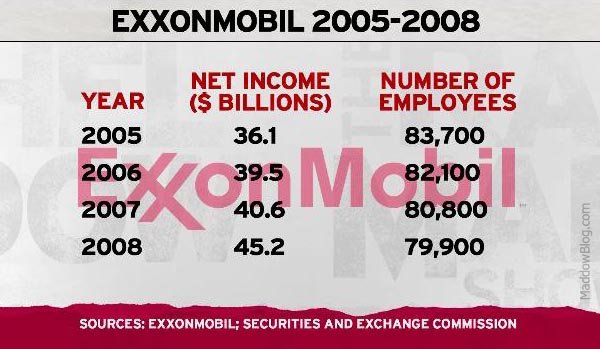
Yet Tillerson is somehow worried about American workers being up to snuff? Why? The corporation outsources a steadily increasing share of its jobs overseas. Those that it does keep in the continental US have been subject to massive downsizing efforts. As employees have decreased, corporate profits have increased. And Tillerson expects anyone to think he’s concerned about the well-being of the American worker!? Give me a break!


Exxon_Income_vs_Employment


I suppose it’s not that surprising though that someone who makes $40 million a year, himself, would expect a paycheck to be the ultimate display of personal significance. After all, he probably thinks his exorbitant salary proves that he’s very important.

Albert Einstein never made that kind of money. Heck! Neither did William Shakespeare, Dr. Martin Luther King, Marie Curie, or Abraham Lincoln. So by Tillerson’s ethos, all of these people were defective products unfit for the corporate world. Or at the very least our estimation of them is flawed.

After all, what need have we of Shakespeare’s poetry in the exercise of buying and selling? Perhaps the greatest author ever to write in the English language might find merit in the advertising department. Likewise, Dr. King’s ethic of equality might be useful in human resources. Marie Curie? She’d find gainful employment in research and development but any patents she generated would undoubtedly be held in the corporate interest. And Mr. Lincoln? Perhaps he could be useful as a low level administrator but, no, such iconoclasm as he possessed would probably not be a good fit. He’d end up freeing the wage slaves or other such unprofitable nonsense.

Is this really the American Dream? Find an occupation producing monetary wealth or else lose all claims to value? If so, how loud must history be laughing at us?

The post-Impressionist artist Van Gogh created 900 paintings and 1,100 drawings and sketches. Many of these works now adorn museums around the globe and have forever changed the way we see the world. But during his lifetime, he sold only one painting. So by Tillerman’s logic, he was a defective product, a failure.

This is the sickness of the profiteer – to be forever appraising worth but unable to see true value. It is the disease eating away at the soul of our country. It’s the same mindset that justifies anything in the name of short-term gain – credit default swaps, the housing bubble, charter schools and Common Core.

After all, Tillerson’s notorious quote above comes from an infamous article in Fortune magazine in which the CEO threatened the former governor of Pennsylvania that he’d pull ExxonMobil out of the state if the legislature didn’t adopt some form of Common Core. And so the state gave in to the whim of one man with no experience, knowledge or wisdom about how children learn. And students in more than 500 public school districts are thus constrained by this legal economic blackmail.

I am but a simple man. I don’t bring in a six-figure salary. I’m a teacher in that same public school system. I’m also the father of an elementary student. I am a man of no monetary means and thus little merit. But I say this: the Tillersons of this world are wrong. Our children are worth more than these tiny bean counter brains realize. The purpose of education is not to provide more resources for their pointless game of Monopoly.

My daughter has a life, and her education is a tool to enrich that life. It is her vehicle of understanding the world around her. It is a process to invigorate her sense of wonder. It is a method of understanding how things work and where she fits in the universe.

Yes, she will one day need to seek employment. But what she chooses as her occupation will be up to her. SHE will decide where she fits in, Mr. Tillerson, not you. SHE will decide what is valuable in her life. SHE will decide if she wants to spend her hours in the pursuit of profits or less tangible enterprises.

As such, she needs literature – not standardized tests. She needs mysteries to solve – not Common Core. She needs equitable resourcesnot charter schools. She needs teachers with advanced degrees and dedication to their jobs – not Teach for America temps.

Don’t you dare try to justify all that with some narrow economic view of monetary value. Some things have no price. My daughter is one of them.


NOTE: This article also was featured on Diane Ravitch’s blog, I did an interview about it on the Rick Smith Show, and was quoted in an article about the issue in the Washington Post.


Who’s Your Favorite Gadfly? Top 10 Blog Posts (By Me) That Enlightened, Entertained and Enraged in 2015

Screen shot 2015-12-30 at 12.57.49 AM

“Pennsylvania educator and public school advocate Steven Singer is one of the most powerful voices in the nation when it comes to speaking out for students, parents, teachers and our public schools.”
Jonathan Pelto, founder of the Education Bloggers Network


“Steven Singer wrote these five terrific posts last year. I didn’t see them when they appeared. Probably you didn’t either. You should.”
Diane Ravitch, education historian


“Your name should be Sweet Steven Singer. You are a delight.”
Karen Lewis, President of the Chicago Teachers Union

11206058_10152940020833860_7943827034975790194_n


Hello. My name is Steven Singer, and I am a gadfly.

I make no apologies for that. It’s what I set out to do when I started this blog in July of 2014.

I told myself that people were too complacent. There was no curiosity. People were too darn sure about things – especially education policy and social issues.

They knew, for instance, that standardized testing was good for children. Why? Because Obama said so. And he’s such a nice man. It’s too bad all those mean Republicans keep making him do all this bad stuff.

They also knew racism was over. After all… Obama! Right? Black President, therefore, the hundreds of years of struggle – finished! Move along. Nothing to see here.

Yet all this “knowledge” went against everything I saw daily as a public school teacher.

Standardized tests are good for children? Tell that to more than half of public school kids now living below the poverty line who don’t have the same resources as middle class or wealthy kids yet are expected to magically ace their assessments. Tell that to the kids who get hives, get sick, or throw up on test day. Tell it to the black and brown students who for some unexplainable reason almost always score lower than their white peers.

Racism is over? Tell that to all my minority students who are afraid to walk home from school because they might get followed, jumped, beaten or killed… by the police! Tell it to their parents who can’t get a home loan and have to move from one rental property to another. Tell it to the advertising executives and marketing gurus who shower my kids with images of successful white people and only represent them as criminals, thugs, athletes or rappers.

So when I started this blog, I consciously set out to piss people off. But with a purpose. To quote the original historical gadfly, Socrates, my role is, “to sting people and whip them into a fury, all in the service of truth.” It seems well suited to a school teacher. After all, Socrates was accused of “corruption of the youth.”

It’s been quite a year. When I went to the Network for Public Education conference in Chicago last April, some folks actually seemed to know who I was. “Don’t you write that Gadfly blog?” was a common question.

When I met NEA President Lily Eskelsen Garcia and AFT President Randi Weingarten, they both said, “I read your blog.” And then they looked me up and down suspiciously as if they were thinking, “THIS is the guy who writes all that stuff!? THIS is the guy giving me such a hard time!?”

Of course, I am human, too. One can’t sting and bite every day. Sometimes the things I write are met with love and approbation. Some weeks even Lily and Randi like me. Sometimes.

Education historian Diane Ravitch has given me tremendous moral support. I can’t tell you how gratifying it is to have one of your heroes appreciate your work! Her book “The Death and Life of the Great American School System” really woke me up as a new teacher. I’m also on the steering committee of the Badass Teachers Association, an organization that has changed my life for the better. The more than 56,000 people  there are my support. I would never have had the courage to start a blog or do half of the crazy things I do without their love and encouragement.

And there are so many more people I could thank: my fellow bloggers Jonathan Pelto, Peter Greene, Russ Walsh, Nancy Flanagan, Mitchell Robinson, and Yohuru Williams. Also the good people at the LA Progressive and Commondreams.org. The incredible and tireless radio host Rick Smith.

There are just too many to name. But no list of acknowledgment would be even close to completion without mentioning my most important supporter – you, my readers. Whether you’re one of the 9,190 people who get every new post delivered by email or if you otherwise contribute to the 486,000 hits my site has received so far, THANK YOU.

So in celebration of my first full year of blogging, I present to you an end of the year tradition – a Top 10 list. Out of the 90 posts I wrote in 2015, these are the ones that got the most attention. Often they incensed people into a fury. Sometimes they melted hearts. I just hope – whether you ended up agreeing with me or not – these posts made you think.

Feel free to share with family, friends, co-workers, etc. After all, I’m an equal opportunity gadfly. I always cherish the chance to buzz around a few new heads!


10) The Democrats May Have Just Aligned Themselves With Test and Punish – We Are Doomed

sanders_warren-620x412

Published: July 17, 2015
Views: 7,122

Description: It hit me like a slap in the face that almost all Senate Democrats voted to make the reauthorization of the federal law governing K-12 public schools a direct continuation of the same failing policies of the Bush and Obama years. Heroes like Bernie Sanders and Elizabeth Warren seemed to be turning their back on teachers, parents and school children. And they were stopped in their efforts by… Republicans!

Fun Fact: This story had some legs. It inspired a bunch of education advocates like myself who are also Bernie Sanders supporters to write the candidate an open letter asking him to explain his vote. His campaign eventually responded that it was about accountability!?


9) Punching Teachers in the Face – New Low in Presidential Politics

cc-600x400

Published: Aug. 3
Views: 14,735

Description: New Jersey Governor Chris Christie thought he’d run for the Republican nomination for President. He thought threatening to metaphorically punch teachers unions in the face would get him votes. It didn’t.

Fun Fact: This new low in Presidential politics came just after Donald Trump had announced he was running. Christie’s new low now seems almost quaint after Trump’s calls to tag all Muslims and monitor their Mosques. How innocent we were back in… August.


8) This Article May Be Illegal – Lifting the Veil of Silence on Standardized Testing

whistle
Published: April 18
Views: 15,818

Description: Teachers and students may be legally restrained from telling you what’s on federally mandated standardized tests, but we’re not restrained from telling you THAT we’re restrained. Is this just protecting intellectual property or direct legal intimidation of educators and children?

Fun Fact: I have not yet been arrested for writing this piece.


7) Stories about Teachers Union Endorsements of Hillary Clinton

Did the AFT Rank and File REALLY Endorse Hillary Clinton for President? If So, Release the Raw Data

(July 12 – 4,448 hits)


The NEA May Be About to Endorse Hillary Clinton Without Input From Majority of Members

(Sept. 21 – 3,873 hits)

A Handful of NEA Leaders Have Taken Another Step Toward Endorsing Hillary Clinton Despite Member Outcry

(Oct. 2 – 739 hits)

Teachers Told They’re Endorsing Hillary Clinton by NEA Leadership, Member Opinions Unnecessary

(Oct. 4 – 7,074 hits)

Screen shot 2015-09-21 at 12.23.19 AM

Published: July 12 – Oct. 4
Views: 16,134 TOTAL

Description: You expect your union to have your back. Unfortunately it seems our teachers unions were more interested in telling us who we’d be endorsing than asking us who the organizations representing us should endorse.

Fun Fact: I broke this story pretty much nationwide. News organizations like Politico were calling me to find out the scoop.


6) Why We Should Have ZERO Standardized Tests in Public Schools

Screen shot 2015-01-30 at 4.35.10 PM

Published: Jan. 30
Views: 16,443

Description: Someone had to say it. We don’t need any standardized tests. We need teacher-created tests. And that’s not nearly as crazy as some people think.

Fun Fact: This was written back when the Elementary and Secondary Education Act (ESEA) was being rewritten and naïve fools like me thought we might actually get a reduction in high stakes testing. Spoiler alert: we didn’t.


5) Atlanta Teacher RICO Conviction is Blood Sacrifice to the Testocracy

aztecshumansacrifice

Published: April 3
Views: 18,187

Description: There is something terribly wrong when we’re using laws created to stop organized crime as a means to convict  teachers cheating on standardized tests. I’m not saying cheating is right, but the mafia kills people. These were just teachers trying to keep their jobs in a system that rewards results and refuses to balance the scales, listen to research or the opinions of anyone not in the pockets of the testing and privatization industries.

Fun Fact: Watching all those seasons of “The Wire” finally came in handy.


4) Not My Daughter – One Dad’s Journey to Protect His Little Girl From Toxic Testing

FATHERS-AND-DAUGHTERS
Published: March 20
Views: 26,420

Description: How I went to my daughter’s school and demanded she not be subjected to high stakes testing in Kindergarten.

Fun Fact: They were very nice and did everything I asked. If you haven’t already, you should try it!


3) I Am Racist and (If You’re White) You Probably Are, Too

Screen shot 2015-06-02 at 1.42.34 PM

Published: June 2
Views: 28,906

Description: White folks often can’t see white privilege. This is my attempt to slap some sense into all of us. If you benefit from the system, you’re responsible to change it.

Fun Fact: Oh! The hate mail! I still get it almost every day! But I regret nothing! A black friend told me I was brave to write this. I disagreed. Anytime I want I can hide behind my complexion. She can’t.


2) I Am A Public School Teacher. Give Me All the Refugees You’ve Got

syrian_refugee_schools

Published: Nov. 19
Views: 45,196

Description: Our public schools are already places of refuge for our nation’s school children. Send me more. I’ll take them all. I’d rather they end up in my classroom than drowned by the side of a river.

Fun Fact: I got equal love and hate for this one. Some folks were afraid of terrorists. Others didn’t think we could afford it. But many told me my heart was in the right place. Lily and the folks at the NEA were especially supportive.


1) White People Need to Stop Snickering at Black Names

baby-and-parents

Published: Sept. 6
Views: 96,351

Description: Maybe we should stop laughing at black people’s names. Maybe we should try to understand why they are sometimes different.

Fun Fact: You’d have thought I threatened some people’s lives with this one! How dare I suggest people should stop mocking other people’s names! If you want to know how strong white fragility is in our country, read some of the comments! But many people thanked me for bringing up something that had bothered them for years but that they had been too polite to talk about, themselves. This is easily my most popular piece yet.


A Real Solution to the Infinitesimal Cases of Child Predators in Our Schools

110401_toomey_ap_605

Pat Toomey is obsessed with child predators in our public schools.

When I came to Washington, D.C., this summer to visit 
the U.S. Senator from Pennsylvania, he was lobbying to get his “Passing the Trash” bill included in the Elementary and Secondary Education Act (ESEA).

His proposed legislation – now part of the Senate version of the ESEA – would ban school districts from helping known pedophiles from finding teaching jobs at different schools. Toomey is hopeful the provision will remain in the final version of the law that eventually will reach President Obama’s desk.

I met with his education aide who cheerily told me her job was to comb through the nation’s newspapers everyday and count the number of teachers accused of acting inappropriately with children. I’d mention issues like inequitable funding, standardized testing and Common Core. She’d solemnly quote back the number she’d found in her research.

There was definitely a disconnect between our priorities. After all, I’m a public school teacher. I work in our school system everyday. She and her boss only know about our schools through what they read in the newspaper. And according to the media every school in American houses child predators. They lurk behind every corner protected by administrators, superintendents and unions.

However, the facts do not back this up.

The Associated Press held a landmark investigation in 2007 to discover the extent of the problem. Reporters sought disciplinary records in all 50 states and the District of Columbia over a 5 year period. The investigation found 2,570 educators whose teaching credentials were revoked, denied, surrendered or sanctioned following allegations of sexual misconduct. About 70% of those cases involved children being victimized.

There is no glossing over it. The number is disgusting and startling. However, it is far from the national epidemic the media and Toomey are touting.

There are more than 3 million teachers in this country. This report found that 1 in 800,000 may be a child predator. That’s .00083%.

In other words, your child is more likely to be struck by lightning than be the victim of a child predator at school (1 in 134,906).

Other things more likely to happen include dying in an airplane crash (1 in 7,178), death on the job (1 in 48,000), and being murdered (1 in 18,000).

I don’t mean to be glib. One teacher betraying a young person’s trust in this way is one too many.

I’m glad Toomey is pursuing this legislation. I even support it.

However, I don’t like the slander and libel against the great majority of teachers. I don’t like how we’re all being painted with the same brush – even when it is done in the cause of making it more difficult for child predators.

I’ve been a public school teacher for almost 15 years. In that time, I have never met a single teacher who I would be uncomfortable letting babysit my 6-year-old daughter. Even when I was a student, myself, back in the 1980s and 90s, I never had a teacher who I was afraid would molest me or my classmates.

Compare this to the sex scandals in the Roman Catholic Church. A review by American Catholic bishops found about 4,400 of 110,000 priests were accused of molesting minors from 1950 through 2002. That’s .04% or 1 in 400. Sure the timescale involved is much longer than the AP study of educators, but the pool of priests is also much smaller. It would seem children are more in danger in houses of worship than houses of learning.

However, none of this helps people like Toomey pass legislation. You can’t say this doesn’t happen much, but we need to stop it. No one would vote for it. There would be no sense of urgency.

It’s just that in dramatizing the situation the Senator and his ilk are defaming the majority of teachers who would never even consider hurting a child.

The truth is not politically expedient. Child predation in schools is not a quantitative issue. It’s a qualitative one.

You don’t need large numbers of children to be hurt in this way for us to take the problem seriously. Even a small number, even a single instance, is enough to require action. No child should ever feel unsafe in school. No child should ever be victimized in these hallowed halls – especially by the very people who have devoted their lives to help them.

So I think Toomey’s right. We should pass his legislation. We should take steps to stop this kind of thing from ever happening in our schools.

And if we’re really serious, I have a solution that no one seems to be talking about: Let’s hire more teachers.

Stay with me here. Child predators almost always act alone. This sort of crime requires the perpetrator to have time undisturbed with the victim. Yet what do we have in our public schools? We’ve slashed and burned school budgets until there are fewer teachers and more students than ever. Class sizes have ballooned. It’s not uncommon for teachers to have upwards of 20, 30 even 40 children in one classroom.

This is the perfect breeding ground for child predators. They are more unsupervised than ever. They can do as they please and no one will catch them until it’s too late. Even principals and other administrators have less time to observe what goes on in the classroom because they’re unduly burdened with ridiculous amounts of paper work required to ensure every teacher gets a junk science value-added evaluation.

But if we hired more teachers, we could reduce this problem. We could even take the majority of these new teachers and put them together in the classroom. We could initiate a nationwide co-teaching initiative.

There would be challenges. You’d have to be careful to pair educators together that are compatible and can work well together. However, it would be worth it.

Few teachers would be alone with a class of students. There would almost always be another adult in the room. If another teacher was doing something fishy, it would be observed and probably reported. Moreover, the mere presence of another educator would be a huge deterrent to even trying something funny.

And this would solve our class size conundrum. You might still have larger classes, but the ratio between teacher and student would be halved. Educational outcomes would increase. Students would get more individual attention. They’d learn more. Teachers would be less stressed having someone else to shoulder the burden. And having an influx of new middle class jobs would boost our flagging economy.

This is a win-win.

Of course, it would cost some major bucks. It would require a lot of work from our nations lawmakers and policy wonks. But how could they really say ‘no’? After all, it’s being done to protect children!

From an economic standpoint, we already spend 54% of our federal budget on wars and the military. Only 6% is spent on education. It seems astoundingly unlikely that we can’t afford adding these jobs, increasing children’s educational outcomes, boosting the economy and protecting children – all in one sweep!

So, Senator Toomey, after your measure gets adopted in the final ESEA, I suggest you spearhead this new mission. After all, your bill will help, but co-teaching will almost eliminate the problem. Even if we had all children take classes exclusively on-line, it wouldn’t stop child predators from getting to them. (Heck! Predators thrive on the Web!) But co-teaching could make a real appreciative difference.

If we really want to stop students from being victimized in school, we need more teachers.


NOTE: This article was also published in the LA Progressive.