What’s More Important – Fighting School Segregation or Protecting Charter School Profits?

Screen Shot 2016-08-31 at 4.12.13 PM


No one wants school segregation.


At least, no one champions it publicly.


As a matter of policy, it would be political suicide to say we need to divide up our school children by race and socio-economics.


But when you look at our public school system, this is exactly what you see. After the triumphs of the Civil Rights movement, we’ve let our schools fall back into old habits that shouldn’t be acceptable in the post-Jim Crow era.


When we elected Barack Obama, our first President of color, many observers thought he’d address the issue. Instead we got continued silence from the Oval Office coupled with an education policy that frankly made matters worse.


So one wonders if people still care.


Is educational apartheid really acceptable in this day and age? Is it still important to fight against school segregation?


Peter Cunningham isn’t so sure.


The former assistant Secretary of Education under Obama and prominent Democrat worries that fighting segregation may hurt an initiative he holds even more dear – charter schools.


Cunningham is executive director of the Education Post, a well-funded charter school public relations firm that packages its advertisements, propaganda and apologias as journalism.


Everywhere you look Democrats and Republicans are engaged in promoting various school choice schemes at the expense of the traditional public school system. Taxpayer money is funneled to private or religious schools, on the one hand, or privatized (and often for-profit) charter schools on the other.


One of the most heated debates about these schemes is whether dividing students up in this way – especially between privately run charter schools – makes them more segregated by race and socio-economic status.


Put simply – does it make segregation worse?


Civil Rights organizations like the NAACP and Black Lives Matter say it does. And there’s plenty of research to back them up.


But until recently, charter school apologists have contested these findings.


Cunningham breaks this mold by tacitly admitting that charter schools DO, in fact, increase segregation, but he questions whether that matters.


He says:


“Maybe the fight’s not worth it. It’s a good thing; we all think integration is good. But it’s been a long fight, we’ve had middling success. At the same time, we have lots and lots of schools filled with kids of one race, one background, that are doing great. It’s a good question.”


The schools he’s referring to are charter schools like the Knowledge is Power Program (KIPP) where mostly minority students are selected, but only those with the best grades and hardest work ethic. The children who are more difficult to teach are booted back to traditional public schools.


It’s a highly controversial model.


KIPP is famous for two things: draconian discipline and high attrition rates. Even those kids who do well there often don’t go on to graduate from college. Two thirds of KIPP students who passed the 8th grade still haven’t achieved a bachelor’s degree 10 years later.


Moreover, its methods aren’t reproducible elsewhere. The one time KIPP tried to take over an existing public school district and apply its approach without skimming the best and brightest off the top, it failed miserably – so much so that KIPP isn’t in the school turnaround business anymore.


These are the “lots and lots of schools” Cunningham is worried about disturbing if we tackle school segregation.


He first voiced this concern at a meeting with Democrats for Education Reform – a well-funded neoliberal organization bent on spreading school privatization. Even at such a gathering of like minds, some people might be embarrassed for saying such a thing. Is integration worth it? It sounds like something you’d expect to come out of Donald Trump’s mouth, not a supposedly prominent Democrat.


But Cunningham isn’t backing away from his remarks. He’s doubling down on them.


He even wrote an article published in US News and World Report called “Is Integration Necessary?”


Here’s the issue.


Segregation is bad.


But charter schools increase segregation.


So the obvious conclusion is that charter schools are bad.


BUT WE CAN’T DO THAT!


It would forever crash the gravy train that transforms public school budgets into private profits. It would forever kill the goose that turns Johnny’s school money into fancy trips, expense accounts and yachts for people like Cunningham.


This industry pays his salary. Of course he chooses it over the damage done by school segregation.


But the rest of us aren’t burdened by his bias.


His claims go counter to the entire history of the Civil Rights movement, the more than hundred year struggle for people of color to be treated equitably. That’s hard to ignore.


People didn’t march in the streets and submit to violent recriminations to gain something that just isn’t necessary. They weren’t sprayed by hoses and attacked by police dogs so they could gain an advantage for their children that isn’t essential to their rights. They weren’t beaten and murdered for an amenity at which their posterity should gaze with indifference and shrug.


We used to understand this. We used to know that allowing all the black kids to go to one school and all the white kids to go to another would also allow all the money to go to the white kids and the crumbs to fall to the black kids.


We knew it because that’s what happened. Before the landmark Brown vs. Board of Education, it’s a matter of historical fact. And today it’s an empirical one. As our schools have been allowed to fall back into segregation, resources have been allocated in increasingly unfair ways.


We have rich schools and poor schools. We have predominantly black schools and predominantly white schools. Where do you think the money goes?


But somehow Cunningham thinks charter schools will magically fix this problem.


Charters are so powerful they will somehow equalize school funding. Or maybe they’re so amazing they’ll make funding disparities irrelevant.


For believers, charter pedagogy wields just that kind of sorcery. Hocus Pocus and it won’t matter that black kids don’t have the books or extra-curriculars or arts and humanities or lower class sizes.


Unfortunately for Cunningham, the effects of school segregation have been studied for decades.


“Today, we know integration has a positive effect on almost every aspect of schooling that matters, and segregation the inverse,” says Derek Black, a professor of law at the University of South Carolina School of Law.


“We also know integration matters for all students. Both minorities and whites are disadvantaged by attending racially isolated schools, although in somewhat different ways.”


Minorities are harmed academically by being in segregated schools. Whites are harmed socially.


At predominantly minority schools, less money means less educational opportunities and less ability to maximize the opportunities that do exist. Likewise, at predominantly white schools, less exposure to minorities tends to make students more insular, xenophobic and, well, racist. If you don’t want little Billy and Sally to maybe one day become closeted Klan members, you may need to give them the opportunity to make some black friends. At very least they need to see black and brown people as people – not media stereotypes.


Even Richard D. Kahlenberg, a proponent of some types of charter schools and a senior fellow at the Century Foundation, thinks integration is vital to a successful school system.


“To my mind, it’s hugely significant,” says Kahlenberg, who has studied the impact of school segregation.


“If you think about the two fundamental purposes of public education, it’s to promote social mobility so that a child, no matter her circumstances, can, through a good education, go where her God-given talents would take her.  The second purpose is to strengthen our democracy by creating intelligent and open-minded citizens, and related to that, to build social cohesion.


Because we’re a nation where people come from all corners of the world, it’s important that the public schools be a place where children learn what it means to be an American, and learn the values of a democracy, one of which is that we’re all social equals. Segregation by race and by socioeconomic status significantly undercuts both of those goals.”


We used to know that public education wasn’t just about providing what’s best for one student. It was about providing the best for all students.


Public schools build the society of tomorrow. What kind of future are we trying to create? One where everyone looks out just for themselves or one where we succeed together as a single country, a unified people?


A system where everyone pays their own way through school and gets the best education they can afford works great for the rich. But it leaves the masses of humanity behind. It entrenches class and racial divides. In short, it’s not the kind of world where the majority of people would want their children to grow up.


More than half of public school students today live in poverty. Imagine if we could tap into that ever-expanding pool of humanity. How many more scientific breakthroughs, how many works of art, how much prosperity could we engender for everyone!?


That is the goal of integration – a better world.


But people like Cunningham only can see how it cuts into their individual bank accounts.


So is it important to fight school segregation?


That we’re even seriously asking the question tells more about the kind of society we live in today than anything else.


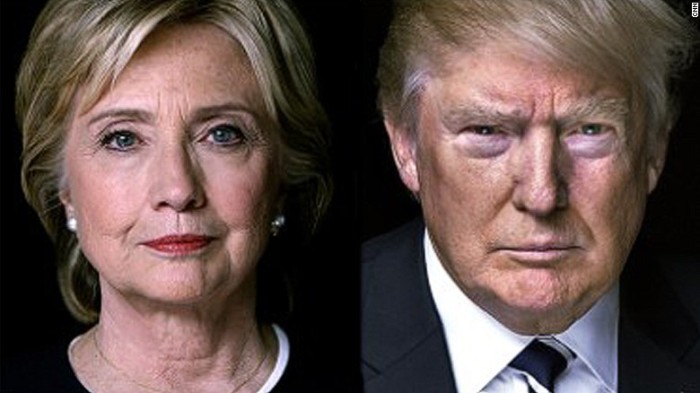
If Trump Drops Out, Will There Be Any Reason to Vote For Clinton?

hillary-clinton-donald-trump-getty-images-640x480

Rumor has it Donald Trump may be dropping out of the Presidential race.

We’ve heard these speculations before, but after kicking a crying baby out of one of his rallies, even his staunchest supporters are scratching their heads.

Does this guy even want to be President of the United States?

Only a few weeks ago a story was circulating that Donald Jr. was calling up potential Republican running mates asking if they wanted to run both domestic and foreign policy while his dad handled “Making America Great Again.”

From the very beginning of this unlikely Presidential run, people have questioned all kinds of things about the Trump campaign – chief among them was this: Is he serious!?

Donald Trump is the Republican standard barer – Isn’t he more of a Democrat? Isn’t he actually friends with his supposed Democratic challenger, Hillary Clinton? Didn’t he actually donate money to her first Presidential bid in 2008? Is he just a false flag for Clinton – someone so odious he’ll rally people to vote FOR HER rather than for him?

I have no idea whether this will actually come to pass. Win the nomination and then drop out? Anything is possible when you’re running a reality TV star for the highest office in the land. But it begs the question – what happens if he really does it? What happens if Trump drops out?

Certainly the Republicans will find SOMEONE to run in his stead. Maybe it will be his running mate, Mike Pence. Maybe the party elders will pick one of the usual suspects – Paul Ryan, Mitt Romney or Jeb Bush.

But in such a situation, what happens to the Democratic nominee?

Hillary Clinton is not popular on her own.

Her Presidential crusade is built on one thing: she’s not Trump.

For the most part, she isn’t running on what she’d do as commander in chief. Sure, she’s pulled out a bunch of progressive platitudes mostly cribbed from the Bernie Sanders campaign. But no one with any memory of the Clintons actually expects her to abide by them. If you don’t think the first thing she’ll do in office is approve the TPP, I’ve got a bridge to sell you in Brooklyn.

Hillary Clinton will say what she has to say to get elected. If you doubt that, please recall that when she went on one of the most popular black radio programs, they asked her what’s one thing she always keeps in her purse. She said, “Hot Sauce!” They incredulously asked if she was just saying that to get black votes, and she jokingly asked, “Is it working?”

Without Trump, why would anyone vote for Hillary Clinton?

She needs him to get elected. She needs the fire and brimstone of his campaign. She needs to be able to point to him and portray how terrible a Trump Presidency would be.

For example, take the Hitler analogies.

During the primaries, pundits cautiously feared breaking Godwin’s Law when it came to Trump. Sure, he has certain similarities with the National Socialist German Workers Party candidate of yore, but few were willing to conflate the two.

Now that Trump has miraculously earned his party’s unequivocal nomination, the gloves are off. Talking heads across the nation equate Trump and Hitler as if it were somehow axiomatic. And, yes, Trump is racist, sexist, xenophobic, etc. He feeds off these qualities in others. He uses them to propel his campaign. But he doesn’t have control of the military like the Nazis did in Germany – they hate him. He doesn’t have the groundwork of a party explicitly founded on the theory of racial purity. He hasn’t weakened the entire political system to the degree that it is willing to bow down before him and do whatever he wants.

A president, even a Trump president, can’t do whatever he likes. There are checks and balances. But the Clinton fear machine has us all convinced that the second he gets into office he’ll be launching nukes, rounding up undesirables and opening concentration camps.

Make no mistake – Trump would clearly be a terrible President. I do not dispute it. Very few people do. But the force of Clinton’s candidacy is based on Trump’s existence. Her campaign has talked up how he would bring forth a combination of the Holocaust and Armageddon. Without him in the game, the voting public loses it’s best reason to come to the polls for her.

She’s a war hawk. As President, her husband with her full support increased the prison industrial complex more than any other chief executive in history. She’s in favor of public school privatization, endless standardized testing and Common Core. She supports the same Wall Street friendly policies that helped crash the economy and evaporated jobs.

But she’s not Donald Trump.

If the Republicans put forth a milquetoast candidate, who’s to say if he’ll get much support from the base. The Trump faithful will still vote for the Donald, whether he’s officially on the ballot or not. The GOP vote would be fractured between Trump and Republican No. 2. And it’s hard to say who Independents, who make up the largest voting block in the country, will support. More likely than not, they’ll do what the usually do – stay home.

Unless…

Independents strongly favored Clinton’s Democratic challenger Bernie Sanders in the primaries. If Trump drops out, it provides an opening for a true progressive third party candidate, someone to get the Independents to the polls.

The only thing stopping some people from voting third party now is fear of Trump. They can’t accept letting him win. But if Clinton has no robust Republican challenger, it frees former Bernie supporters to back someone like Green Party candidate Jill Stein.

Stein is Bernie on steroids. She wants to boost the economy by forgiving all student debt. She wants single payer healthcare. She wants a Green New Deal – to reduce the size of the military while investing in environmentally friendly jobs at home. She’s against public school privatization, testing and Common Core. She makes Hillary Clinton look… well, like Donald Trump.

But she has a hard road ahead of her. She may not be on every state ballot. Not since George Washington has a third party candidate won the Presidency. Even Ralph Nader – who is erroneously blamed for turning the 2000 election in favor of George W. Bush – didn’t get enough votes to win a single district or electoral vote.

But in the political chaos following a Trump flame out, a chance opens up. Everything would be up for grabs.

Why vote for a neoliberal like Clinton without the fear of a neofascist like Trump? If too few people vote for a third party, Clinton wins. Nothing lost there. Meanwhile, it’s doubtful Republicans could pull off a victory without independents. But if Independents and almost half of the Democrats who voted for Bernie pull together behind Stein, there is a real chance of victory.

So keep your eyes on the flaming zeppelin that is the Trump campaign. The one person with more at stake than The Donald is Hillary Clinton.

Why is Common Core Still Here?

oh-dear

Common Core has become a national joke.


In fact, the set of academic standards has inspired a new genre of grade school humor – Common Core comedy.


For instance:


One student turns to another and says, “Common Core is about making us college and career ready.”


The other student replies, “It’s working. It’s making me drink more everyday.”


Here’s another one:


Question: Why can’t mommy help you with your Common Core math homework?


Answer: She only has a four-year degree.


And finally:


Question: How many whiteboards does it take to show you how to screw in a light bulb?


Answer: One, but it takes dozens to explain 1+4 in Common Core.


Parents nationwide know the pain of Common Core by the looks on their children’s faces.


They see bright, curious youngsters go to school and come back hating education and thinking they’re stupid.


Parents get the same feeling trying to decipher their children’s homework.


Meanwhile the majority of teachers hate the standards – and as they become more familiar with it, that number grows every year.


So why do we keep using Common Core? Why haven’t our schools thrown this bad idea on the trash heap of failed education policies?


In short – because industry is making a lot of money off it.


Common Core was created by private industry.


It was not made by the states, nor was it written by the federal government.


It was created to sell a new generation of standardized tests and textbooks.


It’s raison d’etre is profit not education.


School children didn’t need a unified set of academic standards. Big business needed them to sell more books and tests.


The standards were written by Achieve, Inc., a Washington, D.C., organization formed in 1996 by corporate leaders and six state governors. The endeavor was funded by Bill Gates and other corporate interests. It was reviewed by individuals and organizations also funded by Gates.


Then the federal government stepped in to strongly encourage states to adopt the standards. Not because anyone actually thought they were necessary. They did it because that was what wealthy donors wanted.


Eventually the standards were adopted in 42 states, but not because legislatures voted on them. The standards were quietly approved by state boards of education, unelected state education chiefs and boards of education. Many lawmakers didn’t even know what Common Core was or that their state had implemented it until voters started calling and asking questions.


Moreover, at the time of their adoption, the standards weren’t even completed. They were enacted in many cases sight unseen.


How did the federal government get state officials to do this? Money and threats.


Public schools were strapped because of the great recession. So the Obama administration swooped in to help – on the condition that states enact a series of reforms including Common Core.


The Obama administration did not write Common Core, but it did everything it could to make sure states enacted these standards. In the 2009 stimulus package, there was $4.35 billion in discretionary funds given to the U.S. Department of Education to hand out as state grants. But in order to qualify for these grants, states had to adopt the Common Core. With education funding at a premium, bureaucrats were only too willing to bend over backwards to keep their state’s schools running.


And when the carrot wasn’t enough, the federal government used the stick.


Many states were applying to the federal government for waivers to the disastrous No Child Left Behind legislation. Adopting Common Core and several other corporate education reforms was made a pre-condition. If states didn’t adopt these standards, their schools would be labeled “failing” and lose even more federal funding.


Despite all this, the media still often misrepresents the facts.


It is an objective fact that the Core was written by private industry. So the media never asks that question. It asks if the Core was “state led.” That way there is room for spin.


Who led the effort to enact these standards? Since a handful of governors and other government officials were involved in their creation, media patsies are able to pretend the initiative started with the states. But don’t believe it. It started with private interests – people like David Coleman and Bill Gates – trying to influence government to do what they wanted for their own ends. As President of the College Board, Coleman stood to profit off new books and tests. As co-founder of Microsoft, Gates stood to profit from the new technology needed to run many of these new tests and materials. They led the initiative, not the states.


No government official was ever given a mandate by the voters or their empowered representatives to create or enact Common Core. Those that did so acted in their private capacities. Bribing a handful of governors doesn’t make something a state initiative.


Just because a government official does something doesn’t make it policy. When Chris Christie orders a footlong hoagie for lunch, it isn’t the start of a government program to feed people at Subway. He’s just ordering lunch.


Moreover, when government officials are coerced into adopting a policy because otherwise they won’t be able to fulfill their obligation to voters, that isn’t an endorsement of those policies. You can’t offer a starving child a sandwich on the condition that he shouts a swear word and then pretend it was all his idea. You can’t offer a glass of water to a man dying of thirst on the condition that he shave his head and then pretend that he likes being bald.


Common Core was not adopted by states because they liked it. It was adopted to keep schools running.


Special interests used the federal government’s power over the states to circumvent the legislative process.


The result is a set of poor quality standards that are developmentally inappropriate and don’t help students learn. This should be no surprise since they were written with minimal input from classroom teachers or child psychologists. Instead they were created by standardized test authors. But even if the standards had been good, the process of their adoption was highly undemocratic.


Sadly, this is how government works now.


Charter schools, Teach for America, standardized testing – Public education has been high jacked by business interests.


Once upon a time, the goal was to help students learn. Now the main objective is to help big business profit off students.


If you can make a buck off something – even if it doesn’t help or actually hurts school kids – do it.


Nowhere is this clearer than with the Common Core.


Unfortunately, our 2016 Presidential candidates don’t seem to get it.


Neither Hillary Clinton nor Donald Trump seems to understand the problems with Common Core.


Clinton thinks the only issue is the way the Core was implemented in schools – not federal coercion, not poor quality standards, etc. Schools didn’t implement them too quickly. The standards are badly written, unproven to help and increasingly shown to hurt.


Trump, on the other hand, thinks it’s all wrong, but he has no idea why or what he can do about it. Like too many Republicans, he acts as if the only problem with the standards is Obama’s participation. He ignores or omits the one-time advocacy of prominent members of his own party for the Core like Jeb Bush, Chris Christie, Bobby Jindal, and Mike Huckabee.


Neither candidate seems to understand that the new federal education law, the Every Student Succeeds Act (ESSA) bans the federal government from doing anything to promote Common Core, or any other set of education standards. This does not, unfortunately, repeal the standards. It emphasizes the states’ power to choose their own academic standards.


Each state legislature can keep, revise, or repeal Common Core. And in some cases, this has already begun. In Oklahoma, for example, Common Core was repealed entirely. In other states, like New Jersey, Common Core has been revised but largely left in place. In other states, the standards remain untouched.


Why hasn’t Common Core gone away? State legislatures haven’t acted.


No matter who wins the presidential race, whether it’s a candidate in favor or against Common Core, he or she has zero power to do anything about it. Hopefully, no one tries to exceed that authority by coercing states one way or another.


Meanwhile, state legislatures need to pay attention to the wishes of voters. If Common Core is repealed – and that’s what the majority of taxpayers want – we can only hope it’s done so in a more democratic fashion than it was approved. We can only hope it isn’t replaced with something worse.


Whatever happens it should be to benefit students, not corporations.


Or to put it another way:


Question: What if Common Core was created just to drive parents crazy?


Answer: Somebody must be making a fortune on crazy meds!!

The DNC is Giving Trump the Greatest Gift of All – a Weak Opponent

Donald-Trump-Hillary-Clinton

The latest polls have Donald Trump beating Hillary Clinton by 15 points.

No, not a Fox News poll.

This is from Nate Silver, the FiveThirtyEight numbers wizard who correctly called both the 2008 and 2012 elections. He says if the race were held today, Trump would win the swing states of Florida, Pennsylvania, Ohio, North Carolina, Iowa, Nevada, and New Hampshire, thereby assuring an easy victory.

Some will say this is just an inevitable boost in the numbers coming as it does right after the Republican National Convention. But need I remind you that the convention was chaos? The speaking roster was dominated by Trump’s family and a never-ending cavalcade of D-list celebrities. It reads more like the cast of the next Celebrity Apprentice than the best and brightest of one of our nation’s two major political parties.

And don’t forget Trump’s own acceptance speech. They’re coming to get you and only I can save you! Trump 2016!

THAT’S what you’re saying gave the Republican nominee a boost!? It should have hurt not helped him!

But let’s put that aside for a moment. Clinton has never polled well against Trump.

Occasionally she has topped him in polls in the past, but rarely more than the margin of error! Usually Trump comes out on top.

No. Hillary Clinton is a terrible challenger in this match-up.

Why?

There is one common factor during this election season that goes beyond political affiliation. People want change.

It’s one of the reasons Barack Obama won. He was seen as the change candidate. Heck! It was his campaign slogan! Hope and Change!

Unfortunately, he didn’t really deliver. Instead of a revolution, he gave us fiddling around the margins. Whatever the reasons for that – Republican obstructionism, his own centrism – it only frustrated the electorate further.

The economy stinks. There are endless wars. Yet the rich get richer while the poor get poorer. People are so starving for change today they are even willing to vote for fascism to get it. Because that’s what Trump offers. It’s change alright. Not good change. Not positive change. But at least things will be different under President Trump. The status quo will alter. America will be “great again” just as Germany became great again in the 1930s by doing a lot of the same xenophobic, racist, sexist and homophobic things Trump champions.

You can see a similar thirst for revolution with the Democrats. We, too, have a change candidate but it’s not Hillary Clinton. It’s Bernie Sanders.

He offered voters a return to the New Deal of FDR. He offered the kind of Democratic Socialism that saved our country from the Great Depression, gave us the strength to win WWII and became the greatest super power the world has ever known.

How does this poll against Trump? It’s devastating. Bernie beats Trump in almost every poll. He always has.

Why does Bernie do so well while Hillary doesn’t? Clinton is not seen as a change agent. She is the status quo. She is politics as usual. She is at best like Obama – fiddling at the margins. At worst she’s a neoliberal hawk that will make things worse – though probably not as bad as Trump.

So what can we do? Democratic Primary voters chose her over Bernie.

Or did they?

The recent leak of private emails from the DNC paints a picture of favoritism. The party unequivocally worked with the media against Sanders. (And, no, it doesn’t matter so much who leaked these emails and why, if they’re authentic.)

Add to that the widespread allegations of voter suppression in the primary match-up between Clinton and Sanders. In districts that leaned Bernie, voters had to face long lines. Voters registrations were mysteriously changed or they were purged from the rolls so they couldn’t vote for him. Bernie rallies were held in over-packed stadiums while Hillary’s were in much smaller venues – yet the results in these areas somehow favored Clinton. Exit polls consistently showed Bernie winning but the actual votes somehow went to Hillary. Meanwhile the media falsely painted the picture of Clinton inevitability even calling the election for her before all the votes were in.

It is hard to prove that all this subterfuge was enough to sway the election against Bernie. Maybe it was, maybe it wasn’t. However, it is naive to think it didn’t help Hillary to some extent. Maybe quite a lot.

So what we have is a presumptive nominee who can claim no legitimacy. Sure Bernie has done the classy thing and endorsed her. But it’s easy to see why his supporters have a hard time accepting that Clinton will do even a fraction of the things Bernie would as president.

So we’re left with a very weak Democratic nominee against Trump.

And this is not voters fault. This is not because Bernie supporters are just stubborn or should just get over it.

In our capitalist system, presidential candidates are products. We are the consumers. And the Democrats have floated an inferior product. It’s not enough that Trump is worse. Because there are other choices.

No one wants to take third party candidates seriously. We ignore the Green Party and the Libertarians because we say these interlopers can’t win. And there are plenty of good reasons why that may be so. However, the existence of these other options in light of a weak challenger on both the Democratic and Republican side all but guarantee each will get significant support.

It doesn’t matter if Jill Stein and Gary Johnson have little chance of winning. They will serve as spoilers for the major parties. Who will take the most?

Well, hard-core conservatives can find much to like in Hillary Clinton. Many of them are lining up to join her ranks. However, Bernie supporters find little to recommend them on Trump’s side. He is the antipathy of everything Bernie stands for. However, Jill Stein is very inviting. If anything, she’s more progressive than he is.

As such, look for the third party option to hurt Democrats more than Republicans. In fact, had Sanders been the nominee, the Democrats could have looked forward to many independents joining the ranks. They overwhelmingly favor Sanders but not Clinton. And there are more independents than either Republicans or Democrats.

So here we are.

There is next to no chance at this point that the Democrats won’t nominate Clinton. She will almost definitely be the standard barer against Trump.

And it leaves him with a huge advantage.

If he wins, it won’t be the fault of disaffected Bernie voters. It will be because of the cynical hubris of Democratic Party leaders.

The seeds of the Trump Reich have been sown right here.

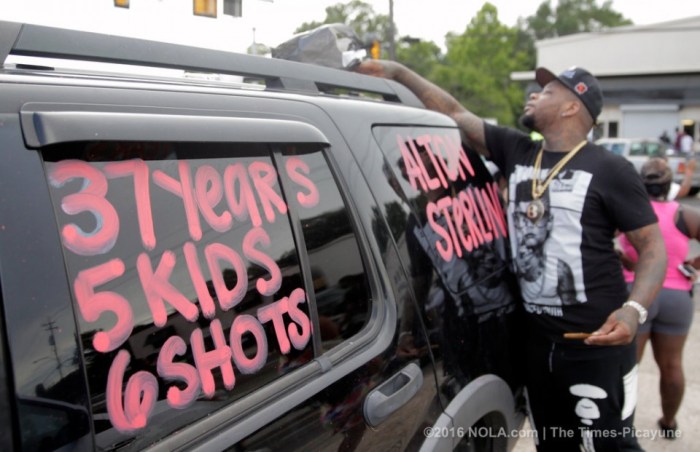
Racism is Just One of Two Things Shown in Alton Sterling Killing

-1dd3afa605e6bc1d

Americans are notoriously bad at holding two thoughts in our heads at the same time.

We look at the police shooting of Alton Sterling and can’t decide whether it was racist or if the 37-year-old black man just had it coming.

But we’re missing the point. Sometimes twice.

Baton Rouge Police shot and killed the father of five on July 5th.

The 37-year-old man was killed outside a convenience store in Louisiana because police allegedly got a tip someone was selling CDs and was armed. In the resulting scuffle, Sterling was shot and killed.

If the whole thing weren’t caught on a cell phone video, it probably wouldn’t be more than a sad headline. Just another black dude killed by police.

But the resulting attention has made his name a hashtag and his death a source of outrage – for good reason.

On the video, police tackle Sterling to the ground before gunshots are heard.

One of the officers shouts “gun” before shooting, but store owner Abdullah Mulfahi told the media that Sterling’s hand was not near any weapon and the alleged gun later recovered from his pocket was not visible.

People watch the video (or not) and immediately take sides.

Who is to blame – the police or Sterling?

Was the black man armed? Maybe – though Louisiana is an open carry state so he would be within his rights to do so.

What should he have done when confronted by police? What actions of his might have resulted in police not shooting him dead?

Did he have a record? Is that even relevant since police had no access to that information at the time?

Typically people come to conclusions based on their convictions and not based on the evidence. If you think black people are being victimized by police, then you’re probably on Sterling’s side. If you think black people are naturally violent and police rarely do any wrong, you’re probably on the side of law enforcement.

But what both sides are ignoring is a sense of context.

This was the 15th American killed by police so far in July alone.

Not the 15th black person. The 15th person. Period.

There’s some dispute over exactly how many people have been killed by police so far this year, but the number is surprisingly high. You’d think that would be something the federal government would keep track of, but no. The FBI’s Uniform Crime Reporting Program tabulates every criminal statistic imaginable – except homicide by law enforcement. Alarmingly, it leaves this to the private sector – almost as if it had something to hide.

Much of this is done by the news media, both in and out of the country. The Washington Post puts the number of Americans killed by police this year at 505 people. The Guardian puts it at 560. An open sourced database called Killed by Police puts the number at 580.

Any way you look at it, no matter which tally you go with, 2016 is turning out to be one of the deadliest years for police shootings since people have been counting.

It’s a problem for everyone. Police should not be killing such high numbers of civilians. In fact, in other countries, they don’t. Police kill more people in the U.S. in days than they do in other countries in years.

For instance, U.S. police killed 59 people in 24 days last year. In England and Wales, 55 people were killed by police in 24 YEARS!

And the numbers aren’t that high solely because the United States has a larger population. The entire nation of Canada has about as many people as the entire state of California, yet Canadian police killed 25 people last year to 72 by California law enforcement.

That may be due in part to a lack of accountability.

Despite such high body counts in this country, not a single police officer has served jail time for it in the last few years. Several officers went to trial in 2016, but none were convicted, according to the Wall Street Journal.

Last year had the highest number of officers being charged for shooting civilians in a decade. That number? 12. And none of them – not one – was convicted of murder or manslaughter.

We have a real problem here. American police kill far too many people.

However, this doesn’t mean that racism isn’t a motive in many of these police shootings. In fact, the numbers back that up.

Though more white people are killed by law enforcement in this country, it is black people who are killed at a disproportionately high rate. They only make up 13.2% of the population, yet they are twice as likely to be killed by police as whites. Nearly a quarter of all police homicides this year resulted in dead black folks.

What’s going on here?

First, we live in a police state. Officers often kill suspects with impunity and face little to no consequences. Not all police, certainly, but far too many.

Second, black folks are killed more regularly by police than whites. In fact, if all things were equal, you’d expect MORE white people to be killed than already are. Whites make up 77.7% of the population, yet they account for only half of the victims of police shootings.

This isn’t because black people are so much more violent than whites. According to the Center on Disease Control’s annual Youth Risk Behavior Survey, they engage in violent behavior at similar rates to whites.

For instance, they carry a weapon (whites 17.9% to African Americans 15.2%) and carry guns (whites 5.5% to African Americans 6.5%) at about the same rates. However, blacks are twice as likely to be arrested for weapons possession.

The same holds for assaults. African Americans report being in physical fights at similar rates (36.5% versus 32.5% for whites) but are three times more likely to be arrested for aggravated assault.

It should come as no surprise then that black people are more likely to be killed by police. This holds with everything else we know. When it comes to the criminal justice system, black people are penalized more often and that includes being shot and killed by law enforcement.

Why? Because they’re black. Because of societal attitudes, fears, phobias and prejudices.

For many of us, when we see Sterling’s last moments enacted on that cell phone video, we’re confronted with that fact. We put ourselves in his position. What could he have done differently? Whether he was guilty of a crime or not, what action on his part would have assured that he got out of this situation alive?

Eric Garner was choked to death by police while repeatedly saying, “I can’t breathe!” Tamir Rice was shot by police in two seconds. What exactly could a black person do to avoid being shot if law enforcement already perceives him or her to be a threat?

These are important questions. But they aren’t the only ones.

America has a problem with police violence. In fact, it has two problems. And we can’t solve one without solving the other.

We have to come to terms with this. It is not a case of racism or a police state. It is a case of BOTH.

Big Money Fails to Oust In-Coming Pittsburgh Schools Superintendent

DSC-4973-1

Democracy 1, Oligarchy 0.

That might be the score in the latest contest between corporate education reformers and the Pittsburgh Public School Board.

Special interest groups and the media had stirred up controversy for months over one line in newly hired superintendent Anthony Hamlet’s resume.

Last night the board voted to let the 46-year-old African American start his job as planned Friday morning.

The board voted 7-2 not to cancel his contract. He will be sworn in tomorrow to start a 5-year commitment in the city.

He had been unanimously hired May 18 from the Palm Beach County district in Florida where he had distinguished himself with an excellent record of leadership and enacting authentic reforms.

Though critics cited one line in his resume as too similar to a statement in a Washington Post article, the real reasons for the dispute are ideological.

Put simply, Hamlet favors reforms that have nothing to do with teaching to the test, charter school expansion, closing schools and other market driven policies.

This put him at odds with the usual gang of corporate sycophants:

1) The Campaign for Quality Schools Pittsburgh – a PAC recently formed to Make City Schools Great Again by promoting charter schools and other failed neoliberal reforms.

2) A+ Schools, an advocacy organization that used to champion the same kinds of authentic reforms school directors are trying to enact with Dr. Hamlet’s help. However, after getting a fat check from the Gates Foundation, the group has became a cheerleader for privatization and disaster capitalism.

3) Various foundations who immediately offered to pay for a new superintendent search if the district dismissed Dr. Hamlet – a measure that probably would have meant paying him at least a year’s salary to sit at home.

Why?

In short, they want a superintendent who thinks like them who they can control. They want to undermine our elected school board and community input process. They want to further THEIR agenda – not the education of our children.

Pittsburgh school directors are to be congratulated for not giving in to the monied interests.

Even the two directors who voted to remove Hamlet did so for good reasons. Though I thoroughly disagree with them, I think Terry Kennedy and Lynda Wrenn truly have the best interests of students at heart. They have always voted that way before.

It’s easy to write a blog about a district where you don’t live, as I do. They, however, are accountable to their constituents. I’m just a doofus with a WordPress account. They had a lot of information to process and made a tough decision. Thankfully, the other seven board members didn’t see it their way.

But that’s the beauty of it. This was democracy at work! At so many other urban districts throughout the country – even in similarly troubled Philadelphia – decision making “by and for the people” has become disbarred.

Many schools like Pittsburgh’s with a shrinking tax base, large pockets of crippling poverty and a history of state disinvestment are taken over by the state. Bureaucrats and flunkies make these decisions not members of a duly elected school board held accountable by the voters.

In fact, many calling for Hamlet’s dismissal were surely cheerleading just such a move in Pittsburgh. They were hoping to show that democracy doesn’t work in the Three Rivers community and must be replaced with … THEMSELVES.

The defeat of that position is the biggest victory here.

Now Hamlet and the board will get a chance to enact authentic reforms to help the children of Pittsburgh get the best possible education.

Now Hamlet will get to strengthen the restorative justice project already under way at 20 city schools. Instead of simply assigning detention or suspension for student misbehavior, administrators are encouraged to make students set things right after doing wrong.

In Florida Hamlet made a name for himself partnering with the criminology department at Florida Atlantic University on this same project.

It’s widely acknowledged in education circles that suspensions can have lasting impacts especially on black students making them more likely to enter the school-to-prison pipeline. Finding an approach to increase discipline without adversely affecting students’ prospects is imperative. This is especially true since Pittsburgh Public Schools have been known to suspend black students at a rate four times higher than white students.

Hamlet also will get to enact measures to transform Pittsburgh’s schools into a central part of the community and not apart from it. Like many on the board, he is an advocate for community schools. That means pushing for social services to help students and the community to make the schools the center of the neighborhood.

Hamlet has received support from all over the city including from the Pittsburgh Federation of Teachers.

However, in an unexpected move, some educators came out individually in favor of Dr. Hamlet even though doing so might mean putting targets of their backs from corporate forces.

High School teacher Jon Parker even wrote a blog about the issue where he pulled no punches:

“While the [Pittsburgh] Post-Gazette is complicit in this scheme to defame and destroy Dr. Hamlet, the real enemy here, as always, is A+ Schools. They simply cannot pursue their Gatesian agenda with a superintendent who believes in community schools. They need one who believes in firing teachers. They can’t pursue their agenda if the superintendent believes in collaboration rather than stacked ranking. And they can’t pursue their agenda of closing schools and turning them into charter profit factories if the narrative in our schools shifts away from “achievement” being measured by high stakes tests. Simply put, Anthony Hamlet is not their style, and they can’t stand that Pittsburgh’s community, through real grassroots activism and real community empowerment, elected a school board which genuinely engaged its community in a selection process that produced a once-in-a-lifetime superintendent selection.”


Erin P. Breault, a district teacher with three children who graduated from Pittsburgh Public, wrote to the Post Gazette to praise Dr. Hamlet:

“First, he will be a fine superintendent who will work to foster community schools, increase student learning outcomes and graduation rates. He will be an especially welcome breath of fresh air, not beholden to corporate “reformers” agenda. Second, I am especially alarmed about growing calls for his contract to be dissolved and if it is not, that our democratically elected school board be replaced by an appointed system.

This is outrageous. These attacks on Mr. Hamlet and on the process of the search need to be viewed in context. There are powerful interests including the Pittsburgh foundations, A+ Schools and Students First who are upset that their vision of privatization of our public schools has been challenged by our school district.

They have leapt into action, using their money, and political clout to engage into what amounts to character assassination.”


Kathy M. Newman, an associate professor of English at Carnegie Mellon University, wrote to the Post Gazette to school them on the definition of plagiarism:

“Mr. Hamlet’s resume is not a copyrighted work of art or nonfiction, such as a novel or a work of history. Nor is it a work of journalism. He was not trying to “pass off” (a legal term) the work of another artist or historian or journalist as his own.

…the outrage over Mr. Hamlet’s resume doesn’t acknowledge why it is that we demand citations from students and historians, or why artists might sue those who have appropriated their work. As the scholar Steven Dutch has argued, in an article called “Sense and Nonsense about Plagiarism,” citations “allow readers to check the accuracy of facts, gauge the credibility of the ideas being presented, know whether an idea is solidly established, controversial or hypothetical, and find further information.” When Mr. Hamlet borrowed a sentence from a Washington Post editorial to express his educational philosophy he did not, to use another phrase from Mr. Dutch, diminish the “credibility of the ideas being presented.”

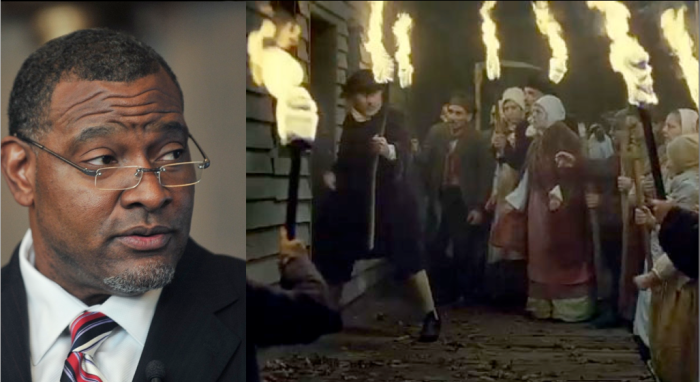
Finally, the furor over Mr. Hamlet’s resume has had a tone of moral outrage so hysterical that I have been concerned about the toxic mixture of sanctimony and glee expressed by many people I otherwise like and respect. Again, according to Mr. Dutch, “the institutional hysteria over plagiarism [can become] a ‘witch-hunt.’ … Charges of plagiarism are fast becoming the blood sport of choice among academic bottom-feeders.”

Ouch. But perhaps the most incendiary remarks came from Churchill resident Lorraine Turner. In the Post Gazette, she accused the paper of outright racism in its criticism of Dr. Hamlet:

“As an African-American, we are taught this particular lesson many moons ago (along with the talk about police) growing up in, “Pittsburgh, Mississippi.” That lesson is: Black people must run twice as fast and jump twice as high as their white competitors. Black people must be exceptional with every “i” dotted and every “t” crossed. The comparison of President Barack Obama and Donald Trump will highlight this lesson…

…The editorial goes on using language to highlight nearly every antiquated, racist stereotype referencing black men: Mr. Hamlet made a “perfunctory apology” (he didn’t bow his head and say, “I’se so sorry), Mr. Hamlet “sounded like a nervous student” (just call him boy), then “a bad superintendent” (black is bad), “a good superintendent” (one approved by someone white), Mr. Hamlet “prefers recalcitrance to transparency’ (recalcitrance is when one is stubbornly resistant to authority or guidance — he thinks he’s actually going to have the power of the superintendent!)…

… I hope the board quotes a line from “The Wizard of Oz,” and tells your good ol’ boy editorial staff what the Good Witch of the East told the Bad Witch of West: “Go away, you have no power here!”

In the end, the power of the monied elites evaporated against the power of good ol’ fashioned democracy.

Because the fight against corporate education reform is a fight for representative government.

And the winners of today’s battle are as always our children, our grandchildren, our posterity.

Witch Hunt Against Incoming Pittsburgh Public Schools Superintendent Escalates

Screen shot 2016-06-17 at 1.17.51 PM

To be or not to be.

That is the question for incoming Pittsburgh Public Schools Superintendent Anthony Hamlet.

He is set to takeover the district on July 1, but a well financed public smear campaign is trying to stop him before he even begins.

Big money interests oppose him. The public supports him.

Meanwhile the media helps fuel corporate attacks on the 47-year-old African American because of criticisms leveled by a Political Action Committee (PAC) formed to disband the duly-elected school board.

It’s ironic.

Corporate school reformers criticize Hamlet for allegedly plagiarizing a single statement in his resume. Meanwhile they have plagiarized their entire educational platform!

Mayoral or state takeover of the district? Check!

Close struggling schools? Check!

Open new charter schools to gobble up public tax dollars as profit? Check!

Hamlet represents a new direction away from corporate education reforms. The new school board who hired him has soundly rejected these policies of the old guard. Many of the same members are still on the board who first changed course in 2013 by tearing up a contract with Teach for America.

But the Empire strikes back with allegations of plagiarism and resume padding.

Yes, Hamlet used some of the same words from a Washington Post editorial in his resume. He wrote:

“A successful superintendent has to satisfy many constituencies, keeping high achievers in the system while devoting resources to those who need them most.”

The Post wrote:

“A successful superintendent has to satisfy many constituencies, keeping high achievers in the system even while devoting resources to those who need them most.” (Emphasis added)

These aren’t exactly the same words used by the Post. They don’t rise to the level of plagiarism, but he certainly should have attributed them or reworded the ideas.
On the other hand, his critics want to use the same policies that have failed again-and-again in Philadelphia, Newark, Little Rock, Memphis and elsewhere. They want to steal control of the district and give it to bureaucrats who will do what THEY say. They want to take money set aside to help all students and use it to enrich their friends and associates.

Sure, Hamlet used someone else’s words to describe a good idea of leadership. But his critics are using their own words to describe someone else’s terrible, failing educational platform.

Hamlet made a small forgivable error. His critics are seizing upon it to turn the tide in their favor and take away the community’s right to representative democracy.

Make no mistake. This is a witch hunt.

Critics are splitting hairs, disputing statistics and calling it fact.

Hamlet has a proven record as a principal in Palm Beach, Fl.

He says the schools he administered improved academically for various reasons. Critics point to Florida state records that show those improvements to be less dramatic.

So both sides agree those schools did well under Hamlet. What’s in dispute is the degree.

Hamlet counters that state data is inaccurate. He was there on the ground. He lists several factors not accounted for by the state that fully justify his statements.

For example, when he talks about school improvements, he counts the total number of student suspensions – if a student is suspended twice, he counts that as two suspensions. The state, however, ignores multiple suspensions. In this and other ways, Hamlet shows his data is more accurate than the state’s.

National data backs up Hamlet. Florida is infamous for being backward, regressive and untrustworthy in education circles, often spearheading some of the worst abuses of policy in recent history.

“This has been a hoopla,” said Valerie Allman, a Troy Hill parent and activist interviewed in the Pittsburgh Post Gazette. “And it’s taken the focus off what’s important: these kids. … We’re expecting him to climb this huge mountain at the same time we cut his legs out from under him.”

One of the reasons the board originally hired Hamlet is his background in “restorative justice.

Instead of simply punishing or suspending students who misbehave, the program calls for making students set things right.

At Palm Beach County Schools, Hamlet implemented this approach with help from Mara Schiff, a criminology professor from Florida Atlantic University. It’s “far tougher than sitting in detention,” Schiff said in the Post Gazette.

“You have to acknowledge what you’ve done … and take responsibility for the harm you’ve caused. It’s not a kumbaya approach.”

It’s widely acknowledged in education circles that suspensions can have lasting impacts especially on black students making them more likely to enter the school-to-prison pipeline. Finding an approach to increase discipline without adversely affecting students’ prospects is imperative. This is especially true since Pittsburgh Public Schools have been known to suspend black students at a rate four times higher than white students.

In fact, the district has already launched a restorative justice program at 20 schools.

“I have nothing but good things to say about Dr. Hamlet,” said Schiff. “He had a [restorative-justice] coordinator who was fabulous, and who Dr. Hamlet completely empowered.”

Another reason for Hamlet’s hire is his advocacy for community schools. Like many on the school board and in the district, he has pushed for social services to help students and the community to make the schools the center of the neighborhood.

“You can have the best teachers, the best curriculum, the best classrooms,” said Rev. Rodney Lyde, a Homewood pastor and president of the Pennsylvania Interfaith Impact Network. “But we need a place on-site that can comprehensively address the other impediments — like kids coming hungry, or from abusive situations.”

Despite community support, several well-financed organizations oppose Hamlet and the board’s authentic reforms.

Foremost among them is Campaign for Quality Schools Pittsburgh, a new PAC formed recently to make city schools great again – by doing the same failed crap that didn’t work before.

Also on the side of corporate education reform are the Pittsburgh Foundation and the Heinz Endowments. Representatives for both organizations have offered to pay for a new superintendent search if the district gives Hamlet his walking papers – a measure that probably would mean paying him at least a years salary without having him on the job.

This would also result in weakening the district’s ability to hire a new superintendent and increasing public mistrust of the electoral process. Such a move would pave the way for disbanding local control.

How generous of these philanthropies! I remember a time when giving meant providing the resources for organizations like public schools to fix themselves – not having the right to set public policy as a precondition for the donation. But in the age of Bill Gates and the philanthro-capitalists, this is what we’ve come to expect.

Even the editorial board of the Pittsburgh Post Gazette has drunk the Kool-aid. In a June 10 editorial, the paper published the following statement:

“The (school) board’s failure at this essential task calls its leadership into question, and will renew calls for legislation to dissolve the elected school board and move to an appointed system.”

Finally, we have A+ Schools – an advocacy organization that at one time championed the same kinds of reforms school directors are trying to enact. However, after a $1 million grant from the Gates Foundation, the group has become a cheerleader for weakening teachers unions, privatization and standardized testing.

Against these special interests stands a public school board and a community at the crossroads. Will they give in to public pressure and big money? Or will they allow Hamlet to do the job he was hired for and attempt to improve an urban district suffering from crippling poverty and state disinvestment?

This particularly tragedy has yet to find an ending.

To be or not to be?

Stop Treating Public Schools as Society’s Whipping Boy

Screen shot 2016-06-14 at 11.28.03 PM


The United States is no stranger to stupidity and ignorance.

A significant portion of the population doesn’t know basic science facts like that the Earth revolves around the sun.

We only learn history and geography by going to war or drone striking countries usually  filled with brown people.

And when it comes to basic math and English, just read the poorly spelled placards at our political conventions calling for more trickle down economics.

Heck! We’re the country that elected C-student George W. Bush President!

Twice!

And lest you think that was a fluke, Donald Trump, a xenophobic reality TV star with zero political experience, is the presumptive Republican candidate for the same office RIGHT NOW!

Yet whenever so-called intelligent people bring up these and countless other examples of American idiocy, they invariably simplify the blame.

We’re a country of more than 320 million people made up of various cultures, nationalities, ideologies, economic brackets and living in a wide range of geographic areas and circumstances. Yet we think the cause of our national ignorance somehow isn’t complex and multifaceted.

No. That would be too much for us to understand. Instead, we take the easy way out and put the blame squarely in one solitary place – public schools.

It’s always the school’s fault. That and those lazy, complacent teachers.

Some folks think the moon landing was a hoax. So apparently the schools aren’t doing their jobs.

Other people can’t tell you the month and year of the 9-11 terrorist attacks. Therefore, bad teachers.

Everything from believing you can catch AIDS from a toilet seat to thinking President Barack Obama is a secret Muslim – it all could have been rectified if the schools had just taught us better.

Nonsense.

If you need a legal warning that your McDonald’s coffee is hot, there’s not much your third grade teacher could have done to help.

If you think the solution to gun violence is strapping bullet proof backpacks to kindergarten children while arming their teachers, there’s little that could have been accomplished by further academic study.

Anti-intellectualism is in the very air we breathe in this country.

No one wants to appear smart. We want to be the jocks, not the nerds. But when we feel guilty for our ignorance who do we attack? The smart people! The teachers! The schools!

Sadly, it’s often really intelligent people doing it.

A few weeks ago, famed astrophysicist Neil DeGrasse Tyson got into a Twitter battle with rapper B. o. B. over whether the Earth is flat.

Yes, in America that is somehow still debatable.

And Dr. Tyson was understandably upset. “I don’t mind that people don’t know things,” he said in a Huffington Post interview. “But if you don’t know and you have the power of influence over others, that’s dangerous.”

Agreed, but then he became guilty of his own criticism by pointing his finger solely at the schools. “I blame the education system that can graduate someone into adulthood who cannot tell the difference between what is and is not true about this world,” he said.

Maybe this would be a more effective criticism if B. o. B. were an actual high school graduate and hadn’t, in fact, dropped out in 9th grade. Tyson has a masters in astronomy and a doctorate in astrophysics, but he couldn’t tell what is true about this world in relation to one rather famous rapper’s education. Therefore his alma maters of Princeton and Columbia must be pretty shitty schools?

Perhaps the problem isn’t that B. o. B. is ignorant, but that too many people are willing to accept him as an expert on the shape of the Earth instead of someone like Dr. Tyson. But that’s not a fault of the public school system. It’s because of our attitude toward schooling, knowledge and expertise. An attitude that Dr. Tyson perhaps unconsciously helped foster.

I don’t mean to pile on Dr. Tyson. He’s one of my heroes. I’m just disappointed that in this case he’s being so intellectually lazy.

He’s not the only one.

Unfairly blaming schools also came from columnist Andy Borowitz when describing the dangers of Trump’s candidacy.

“Stopping Trump is a short term solution,” he said. “The long term solution, and it will be more difficult, is fixing the education system that has created so many people ignorant enough to vote for Trump.”

To be fair, almost everything Borowitz says publicly is satirical, uttered with tongue buried deeply in cheek. But it still feeds into this scapegoating of public schools. The public schools didn’t create ignorance. They fight it and in some cases fail. I wonder why?

Whatever the reason, Trump, himself, isn’t decrying it. He’s celebrating it.

When he won the Nevada GOP primary, he made a point to thank all the dumb people who voted for him. “We won with poorly educated. I love the poorly educated,” Trump told a crowd to huge cheers.

Strangely he didn’t then go on to laud what a great job public schools are doing by providing him with so many brain dead supporters.

So what exactly is the problem? Isn’t it troubling that so many American’s hold stupid beliefs? And isn’t this at least partially the fault of our public schools?

The answer is yes and yes.

We live in an anti-intellectual age. And that is troublesome.

And yes, our public schools are struggling to adequately educate everyone.

But when you blame everything on public schools you (1) obscure other factors like our piss poor media, and (2) you aren’t helping improve our schools.

First of all, much of our modern ignorance is fueled by toxic mass media. Most of us aren’t in school anymore. Unless you’re younger than 21 or 18, you probably get most of your facts from the news, TV, movies, video games and/or the Internet – not textbooks or school teachers.

We used to have an independent press that could investigate stories and report the truth. Now almost all of our major news sources are owned by a handful of giant corporations.

We don’t get news anymore. We get corporate public relations. The reason most people believe this crap is because it’s reported as if it were truth.

The rise of Fox News has a lot to do with it, but that is not the only culprit. Even traditionally revered sources such as the Associated Press are guilty of corporate collusion and bad, bad reporting.

They have no problem conflating an anonymous poll of superdelegates with actual votes as if they were the same thing even if doing so unduly influences the election in favor of one candidate. They have no problem broadcasting a Playboy Playmate’s vaccination advice every day of the week while mostly ignoring what research scientists have to say on the subject.

Second, constantly ragging on public schools doesn’t help make them better.

It’s not as if doing so actually resulted in addressing the real problems we have with our school system. Instead it reinforces the idea that they can’t be saved. We should just give up on public schools.

If we actually focused on the real problems with schools instead of constant innuendo, defamation and vitriol, we might be able to enact real solutions. For instance, more than half of our public school students live below the poverty line. They go to schools that aren’t funded adequately. We’ve allowed them to be resegregated based on class so its easier to ensure rich kids get a Cadillac education and poor kids get the scraps.

Moreover, we’ve let corporate interest take precedence over the needs of children. Instead of letting the experts in the field make education policy, we’ve left that up to the businesses that profit off of it. Instead of letting teachers and professors decide what are best academic standards, we’ve let think tanks create and impose shoddy, untested and developmentally inappropriate Common Core Standards. Instead of letting students be evaluated based on data gathered in the classroom by teachers who are there day-in, day-out, we’ve insisted schools be judged based on crappy high-stakes standardized tests. Instead of giving educators respect for the difficulty of their jobs and providing them with the autonomy necessary to help kids, we’ve denigrated the profession and chipped away at union protections, pay and benefits.

These are some of the real problems with public schools. When people throw shade at our education system, they are never so specific. It’s the schools that are “failing.” It’s never that they’re under-resourced. It’s the teachers who aren’t doing their jobs. It’s never that they’re being forced to teach to the tests. In fact, the people responsible for eroding our public schools often do so with the same rallying cry – our public schools are failing so let us enact these terrible policies that will actually make them worse!

It’s time we stop the lazy practice of criticizing public schools without also educating ourselves about what’s actually wrong with them.

Dr. Tyson, I love you, but don’t just blame schools. Blame Common Core and toxic testing. Andy, it’s not our schools that produce ignorant citizens. It’s the unfair funding formulas that don’t provide poor children with new books and a broad curriculum.

Public schools in general – and public school teachers specifically – have become our easy scapegoats, our whipping boys.

It’s about time we realized that such criticisms aren’t helping. In fact, they’re being used by the same people who are destroying our schools as an excuse to destroy them further.

The so-called failure of public schools has been used to justify massive school closures especially in neighborhoods of color. It’s been used to create more privately run charter schools. It’s been used to excuse cutting school funding, and making it even less palatable to be a teacher.

Too many of us believe these are good ideas.

Americans believe a lot of stupid things, but perhaps THESE are the dumbest of them all!

Disenfranchised Berners Need to Push for Election Reform NOW!

sanders-minorities2.jpg.size.custom.crop.1086x731

So we lost the Democratic primary.

Bernie Sanders is out and Hillary Clinton is in. She will almost definitely face Donald Trump in the general election for President.

If you’re like me, you’re still in shock.

She drew crowds of hundreds. He drew crowd of tens of thousands.

Exit polls consistently showed him winning, but when the votes were counted, he ended up losing.

There have been consistent reports of rampant tampering with voter registration resulting in hundreds of thousands of voters being removed from the rolls; party affiliations being changed without voter consent so they cannot cast a ballot; polling places being reduced significantly so voters have to wait for hours resulting in voters leaving before casting a ballot. And that’s not even counting the mainstream media’s portrayal of Clinton as inevitable by conflating superdelegate votes (which at this point are only non-binding polls of how these party insiders MIGHT vote in July) with actual votes that are already tallied and unchangable.

Really it shouldn’t be so shocking.

Our democracy has been a smoking shell of itself for a long time now.

In 2008 when Barack Obama beat John McCain, we saw some of these same shenanigans. We had language barriers, invented rules, long lines sometimes hours long, and, in some cases, voting machines that changed people’s votes.

By the end of election night, hours after victory was declared, Obama said to supporters in Chicago, “I want to thank every American who participated in this election. Whether you voted for the first time or waited in line for a very long time.” As the crowd roared, Obama declared: “By the way, we have to fix that.”

And now eight years later, we’ve done absolutely nothing to “fix that.”

If anything, the situation is much worse. While Obama voters met hardships, just as Al Gore supporters did in 2000, those were extra-party elections. They were examples of Republicans disenfranchising Democrats. But now we have something new – Democrats suppressing other Democrats!

From the beginning Sanders has said that his campaign was not about himself, it was about starting a real progressive movement. “Not me, us,” the slogan goes.

Now is the time to start cashing in on that idealism.

While Hillary supporters call for unity, we, Berners, must push the terms.

I don’t know if there is truly anything Clinton can do to get my vote short of stepping down. Like many Berners, the very idea of supporting someone so opposed to my views is repugnant. But if Clinton is going to have any shot, she and her supporters need to agree to finally fulfill Obama’s promise.

Let’s fix that. Let’s fix our broken and moldering election system.

It’s not like it’s any big secret how to do so.

Robert Steele, Jim Turner, Ralph Nader, Christina Tobin, Howard Zinn and a host of others have had available a series of common sense reforms for almost two decades. It’s time we push the Democrats to get behind them:

1) Open Ballot Access. Historically, third party candidates have had a harder time getting on the ballot than Democrats and Republicans. Even the popular Green Party Presidential candidate Dr. Jill Stein isn’t on the ballot in every state.

Open ballot access means that no matter what party a candidate represents, he/she has to do the same things to get on the ballot. No more can we accept only Democrats and Republicans to be on the ballot in every state. Ballot access requirements should be the same for every candidate, irrespective of party affiliation. This should also apply to initiatives and referenda, as well as primary and general elections.

2) Holiday Voting. Voter turnout in the land of the free is a disgrace. Much of that has to do with the fact that people are working too hard and too long to easily get to the polls. Election Day should be a national holiday. This way every voter should be able to vote easily and won’t have to worry about missing work and/or transportation issues. In addition, Early Voting should be universally available. No long lines. Vote at your leisure and even spend some time getting involved in the political process.

3) Paper Trail. ALL ballots must either be on paper or otherwise subject to physical re-count. It is too easy for votes to be miscalculated without any reliable recourse for reasonable challenges and/or recounts if there is no paper trail. Too many voting machines in use do not meet this standard. If voting machines are used, each vote must produce a physical paper footprint subject to recount. If there is any attempt at voter suppression, it should be easily provable and remedied.

4) Honest Open Debates. Americans demand choice in almost everything in their lives except politics. Go to the grocery store and there are 20 different kinds of frosted flakes, but go to the polls and you only have the choice of Dems or Repubs. Another way to end the current monopoly of the major parties is to mandate debates include all political parties – even third, fourth, and fifth parties.

5) Tightly-Drawn Districts. We must end the corrupt practice of gerrymandering, replacing it with compact computer drawn districts determined by independent non-partisan commissions. And we should expressly prohibited any voting district to be drawn to favor or disfavor an incumbent or political party.

6) Full Public Funding of Diverse Candidates. Get the money out of politics. Eliminate all corporate financing of campaigns, and all political action committees. No more PACS, Super PACS, Citizens United, all of it! Instead all state and national campaigns should only be publicly funded.

7) No Legislation Without Consultation. The most frustrating things for voters is when politicians pass legislation without reading it first. The next most frustrating thing is that this legislation isn’t easily available or accessible to their constituents. We can eliminate special interest dominance of the legislative process, by ending the practice of passing legislation such as the Patriot Act without its actually being read. Moreover, end all earmarks. All legislation without exception should be published on line with an easy to understand one-page summary, one week prior to its coming to a vote, to include explicit geospatial pointers for all “earmarks” each of which must be publicly announced and offered for amendment to the voters in the relevant district at least one week prior to the passage of national, state, or county legislation affecting them. Similarly, no public privileges should be granted to any corporation or other entity without full public consultation and public polling or balloting.

8) End the Electoral College, Superdelegates and every representative voting system where possible. When you go to vote for something that should be it. You’re not voting for someone else to vote for you. You’re voting for that candidate outright. Yes, our system of Republican government essentially involves people voting for us. But we don’t need to add extra levels of distance between us and our representatives. Eliminate the middleman. Eliminate the possibility of further disenfranchisement.

There are certainly other reforms we can add to this list. I do not mean it to be exhaustive. But I do think it represents a good start.

And we mustn’t wait. We need to push for it NOW!

Millions of people have just had their votes stolen from them. Clinton and the Democrats are calling out for unity.

Okay. If you want even the possibility of it, prove you’re on our side. Work with us to ensure that people like you can never again gain power in the manner that you just did.

If you want my vote, respect it.

Otherwise, I’ll just give it to someone else.

Dr. Stein, are you with me?

The Arrogant Ignorance of Campbell Brown: Education Journalism in Decline

campbell-brown

Apparently facts don’t matter much to Campbell Brown.


Though her latest “fact” about public schools has once again been shown to be more truthiness than truth, she refuses to retract it.


During an interview published in Slate where she gave advice to the next president, she said:


“Two out of three eighth graders in this country cannot read or do math at grade level. We are not preparing our kids for what the future holds.”


It’s a scary statistic. The problem is it’s completely unsupported by evidence.


And when education experts called her out on it, she complained that SHE was being attacked.


When pressed, Brown admitted she got this figure from the National Assessment of Educational Progress (NAEP) a test given to random samples of students in fourth and eighth grades every two years.


However, Brown either misunderstands or misinterprets the scores. If one were to interpret the data in the way Brown suggests, the highest scoring countries in the world would be full of children who can’t read at grade level. Hardly anyone in the world would be literate or could add and subtract. It’s beyond absurd.


And when she was notified of her error by authorities in the field including Carol Burris, Tom Loveless and Diane Ravitch – who, by the way, served on the NAEP Governing Board for seven years – Brown responded by likening her critics to Donald Trump.


She wrote:


“That the people who disagree with my characterization would react by attacking me personally… speaks volumes. Those feigning outrage over the difference between “grade level” and “grade level proficiency” are the people who profit off the system’s failure and feel compelled to defend it at all costs. Sadly, in the age of Donald Trump and Diane Ravitch, this is what constitutes discourse.”


I especially like the bit where she attacks experts, teachers, and PhDs because they “profit off the system’s failure.” It’s pretty rich stuff coming from Brown who makes a pretty penny retelling the fairytale of “failing public schools.”


Once upon a time, Brown was a respected reported for NBC and anchorperson for CNN.


Now she’s a paid Internet troll.


I’m sorry if that sounds harsh, but it’s true.


She co-founded and edits a Website called The Seventy Four – a reference to the 74 million children across the country who are 18 or younger.


It might be more honest to call it The Four, instead, for the $4 million she receives annually from the mega-rich backers of school privatization to bankroll the endeavor.


She claims her site is “nonpartisan.” Funny. I guess that explains why she continually backs every cause and campaign championed by her donors.


Change all public schools to private charter schools? Check.


Block teachers unions from collectively bargaining? Check.


Ignore the overwhelming preponderance of stories about charter schools cheating the public and their students? Check.


When called out on her bias, she proudly proclaimed, “I have learned that not every story has two sides… Is The Seventy Four journalism or advocacy? For 74 million reasons, we are both.”


Pithy. Yet it remains unclear exactly how the nation’s school children will benefit from Bill Gates and the Walton Family having an even larger say in education policy.


Brown has sold her image and rep as a journalist so it can be used to purposefully mislead the public into thinking she is still dedicated to those endeavors. She’s not. What she’s offering these days is not News. It’s bought-and-paid-for public relations meant to destroy our nation’s public schools.


If anyone thought Brown retained even a shred of journalistic integrity left, she should have removed it when she called herself, “a soldier in Eva’s army.” This is a reference to Eva Moskowitz, the founder and CEO of a New York City charter school chain – Success Academy – where children are put under such pressure they wet themselves during testing and kids in first grade are shamed and berated for math mistakes.


As a public school teacher, myself, this makes me sad.


John Merrow, one of the elder statesmen of education journalism, recently proclaimed that we live in the “golden age of education reporting.”


I must respectfully disagree.


Yes, there is more being written about education policy and public schools than ever before.


But most of it is just paid advertisements from the standardization and privatization industry.


Look who’s funding these stories.


TV Networks such as NBC, MSNBC and Telemundo have broadcast various education segments on “Nightly News” and “Today” underwritten by Bill Gates and Eli Broad.


The Education Writers Association – which boasts more than 3,00 members – receives money from Gates and Walton. The L.A. Times receives funds from Broad for its Education Matters Digital initiative.


On-line publications also have been infiltrated. The Education Post took $12 million in start-up funds provided by Broad, Bloomberg and the Waltons. The site focuses on “K-12 academic standards, high-quality charter schools and how best to hold teachers and schools accountable for educating students,” according to the Washington Post.


Even well-respected education blogs including Chalkbeat and Education Week are funded in part by the Waltons (in the latter case, specifically for “coverage of school choice and [so-called] parent-empowerment issues.”) Education Week even tweets out paid advertisements for Teach for America as if they were news stories!


We’ve all seen “Waiting for Superman,” the infamous union bashing, charter loving propaganda film packaged as a documentary. Its popularity was helped with outreach and engagement funds by the Waltons and a host of other privatizers. It’s far from the only effort by market-driven billionaires to infiltrate popular culture with corporate education reform. They tried to sell the parent trigger law with “Won’t Back Down,” but no one was buying. Efforts continue in Marvel Studios television shows.


A plethora of teachers, academics and other grassroots bloggers have taken to the Internet to correct the record. But they are often ignored or drowned out by the white noise of the same corporate education reform narratives being told again-and-again without any firm footing in reality. In fact, after blogger and former teacher Anthony Cody won first prize from the Education Writers Association in 2014 for his criticism of Gates, the organization banned bloggers from subsequent consideration.


We bloggers are almost completely unpaid. We do it because we care about our profession. Meanwhile the so-called “news” sources are funded by corporate special interests, yet it is bloggers that are looked at as if they were somehow reprehensibly compromised and biased.


Education journalism is not going through a golden age. It’s a sham, a farce.


When we allow our news to be funded by private interests, we lose all objectivity. The stories are spun to meet the demands of the big foundations, the billionaires bankrolling them. And the real experts in the field are either not consulted or left to quixotically do whatever they can on their own time.


Education journalism isn’t about what’s best for children. It’s about how best to monetize the system to wring as many taxpayer dollars out of our schools as possible for corporate interests.


It goes something like this: reduce the quality to reduce the cost and swallow the savings as profit. But it’s sold to the public in propaganda that we call journalism.


As famed cartoonist and counter-culture figure Robert Crumb wrote in 2015:


“You don’t have journalists [in America] anymore. What they have is public relations people. Two-hundred and fifty thousand people in public relations. And a dwindling number of actual reporters and journalists.”


Nowhere is this as obvious as with Brown.


Just as Broad was initiating a plan in February to double the number of charter schools in the Los Angeles Unified School District, Brown’s site, the Seventy Four, was given control of the LA School Report, an on-line news site focusing on the second largest district in the country. Brown was expected to run interference for the takeover. She was running the propaganda arm of the privatization push.


And that’s really what’s happening with our education journalism.


I’m not saying there aren’t actual journalists out there trying to tell unbiased stories. But they are few and far between. They are beset by corporate interests. And anyone who wants to tell the truth is silenced or marginalized.


As we’ve seen, when you actually try to point out errors like Brown’s ridiculous assertions about eighth grade students, the media treats it as a he-said-she-said.


They say, “Wow! Teachers really hate Brown.” Shrug.


Meanwhile the truth is left murdered on the floor as our schools are pillaged and sacked.