After Hurricane Harvey, Will Houston Public Schools be Charterized?

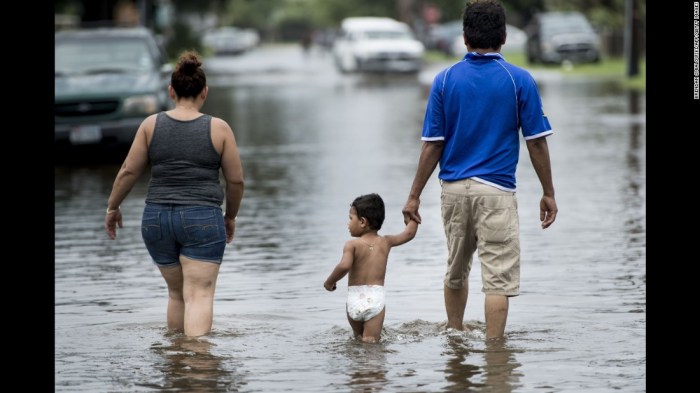
170826155218-47-hurricane-harvey-0826-super-169

It’s an all too familiar scene in America.

A natural disaster devastates a major metropolitan city.

And then the forces of profit and privatization use the chaos and uncertainty as cover to steal public services and turn them into mechanisms to increase their own bottom line.

That’s what happened to New Orleans in the wake of Hurricane Katrina in 2005. And, if Houston residents aren’t careful, it’s what could happen there in the wake of Hurricane Harvey, which struck this weekend.

Right now the immediate danger is the weather.

The storm has already affected about a quarter of the Texas population, or 6.8 million people in 18 counties. It’s been blamed for at least 8 deaths so far.

Thousands of people have evacuated to rooftops as rushing waters flooded streets and neighborhoods. Many roadways are only navigable by boat, and emergency services are so overtaxed that civilian volunteers have stepped up to help rescue stranded residents. By the time the weather system passes through, Houston could get as much as 50 inches of rain – the highest amount ever recorded in Texas.

U.S. Education Secretary Betsy DeVos was so overwhelmed by the news that she took to Twitter, saying, “Our prayers are with all those in the path of #HurricaneHarvey. @usedgov stands ready to assist impacted schools.”


thumbnail_Screenshot2017-08-28at8.57.04PM.jpg

To which noted liberal commentator Keith Olbermann responded, “The hurricane is going to do less damage to schools than you are, Motherfucker.”
thumbnail_Screenshot2017-08-28at8.57.15PM.jpg
And, if history is any guide, he may not be wrong.

In the aftermath of Katrina, New Orleans lost almost its entire public school system. About 90 percent of the city’s 126 schools were given to the Louisiana Recovery School District, which turned them all into charter schools.

For those uninitiated into the mysteries of corporate education reform, charter schools differ from traditional public schools because they are financed by tax dollars but privately operated. They often are controlled by appointed boards with little to no transparency, and are rife with opportunities for investors to profit through fraud and neglect – opportunities that just aren’t present at traditional districts.

So, in effect, Louisiana state officials elected by the white majority stole control from local school boards elected by the city’s black majority. More than 7,000 teachers most of whom were people of color and had been displaced by the hurricane found themselves replaced by mostly white teachers brought in from other parts of the country.

Now, more than 10 years later, the New Orleans experiment has been shown to be a failure. Scores on standardized tests have improved (kinda), but the curriculum has narrowed, teacher turnover has doubled, disadvantaged and special education students have even fewer resources while schools fight over high achieving children, students spend hours being bused to schools far from their homes, communities have been erased, and parents have less control over how their own tax dollars are spent.

This could be the future for the Houston Independent School District (HISD).

After all, Houston is where the infamous Knowledge is Power Program (KIPP) charter school network got its start.

KIPP is known for two things: draconian discipline and high attrition rates. Even those kids who do well there often don’t go on to graduate from college. Two thirds of KIPP students who passed the 8th grade still haven’t achieved a bachelor’s degree 10 years later.

Moreover, its methods aren’t reproducible elsewhere. The one time KIPP tried to take over an existing public school district and apply its approach without skimming the best and brightest off the top, it failed miserably – so much so that KIPP isn’t in the school turnaround business anymore.

Yet, the charter network, one of the largest such chains with 209 schools nationwide, has one of the best propaganda departments in the industry. They pass off inhumanity to children as “rigor” and gloss over inability to teach difficult students as “high standards.”


Will Texas lawmakers be swayed by powerful charter operators to use the current catastrophe as a business opportunity to gobble up the existing school system?

 
Perhaps. But there are some significant differences between Houston and New Orleans.

 
For instance, the students served by the New Orleans system a dozen years ago were almost all living below the poverty line. By contrast, Houston has high and low poverty areas. In fact, many neighborhoods cater to upper middle class children.

 
It’s doubtful that parents from more affluent neighborhoods would put up with losing local control and all that goes with it. Their political and economic power would probably stop any wholesale charterization of the district. That’s why KIPP schools – and in fact most charter schools – are nearly nonexistent in wealthy neighborhoods.

 
However, there are plenty of community schools serving high poverty populations suffering from systemic disinvestment and neglect that could be in danger of just such “reforms.” In fact, many of those are exactly the ones that have been worst hit by flooding and weather damage. At least 10 consistently struggling schools could find themselves targeted for the New Orleans treatment. The state and federal government could withhold relief funding on the condition these schools give up their elected school boards and embrace the kind of Wild West, laissez-faire, free market deregulation that charter schools bring.

 
The Republican controlled state legislature already has a law on the books to swipe local control from struggling districts and turn them into charters. It’s a blatant threat to takeover entire districts like HISD if certain schools within the district don’t improve standardized test scores and other measures favored by corporate education reformers.


Hurricane damage could become a pretext to empowering state lawmakers to expedite this process. Perhaps they might even ask local school boards to give up control of their struggling schools in exchange for leaving alone the more affluent white schools.

I had the pleasure of visiting Houston a year ago for the United Opt Out Education and Civil Rights Summit. There I met with parents, students, concerned community members and representatives of the local teachers union – the Houston Federation of Teachers.

They helped me understand that Texas has a unique perspective on school choice.

For instance, they aren’t generally too fond of school vouchers.

This session a Tea Party favored voucher initiative was squashed by more moderate Republicans. In fact, in Texas even religious leaders don’t like vouchers. This is surprising because the program usually allows tax dollars to be used at private or parochial schools. An organization, Pastors for Texas Children, has been particularly vocal about supporting public education over BOTH vouchers and charters.

However, this is the land of former Gov. George W. Bush, one of the biggest charter cheerleaders in the country. His party broadly supports charter schools, yet the Texas legislature has struggled to increase them.

Last year, Gov. Greg Abbott and Lieutenant Gov. Dan Patrick made a big push to increase charter schools across the state. In an unusual move, state House Speaker Joe Straus refused to bring the bill to the floor for a vote. Straus held the issue hostage because he couldn’t get support for a new school funding formula.

It should be noted that all of these players are Republicans. Democrats are a minority with the ability to impact policy almost not at all.

DeVos and the Trump administration are unquestionably supportive of voucher and charter school expansion.

It’s still too early to tell if the state and/or federal government will take a page from the Shock Doctrine playbook and use Harvey as a distraction to embolden their agenda.

One can only hope that voters have learned the lessons from Katrina and Louisiana.

Otherwise, over time a manmade disaster could once again eclipse the damage done by a natural one.


Special Thanks to Zakary Rodriguez for help navigating the Texas education scene.

Why Won’t Republicans Repeal Common Core?

277661_5_


It was a constant refrain from Donald Trump on the stump.


He was going to repeal Common Core. How did we know? He kept repeating it over-and-over.


“We’re cutting Common Core. We’re getting rid of Common Core,” he said during a debate in Detroit.


“Common Core is a total disaster. We can’t let it continue,” he said in a campaign ad.


But then, he did a complete 180:


“We are going to do some things special. Okay. Are you ready? Common Core we’re going to keep.”


What!?


It didn’t go down so well with his supporters. He was literally booed. So he took to Twitter with the following:


“I was referring to the fact that Jeb Bush wants to keep common core.”


Screen Shot 2017-08-11 at 11.41.06 PM

Uh, okay?


So what’s his position now? Someone asked him about it in New Hampshire. His response:


“I didn’t know Common Core was so complicated. Isn’t this ridiculous?”


On that we can agree.


But it really doesn’t matter.


POWER TO THE STATES


Whether Trump supports Common Core or not, he’s actually kind of powerless to do anything about it.


Republicans have been arguing for years that the federal government can’t tell the states what they should be teaching. That’s the crux of opposition, and the newly reauthorized federal law governing K-12 schools, the Every Student Succeeds Act (ESSA), underlines it.


The power is unequivocally in the hands of governors and state legislatures.


The states control which academic standards their public schools are supposed to subscribe to or not. And since the beginning of 2017, the states are overwhelmingly in Republican control.


There are 98 partisan state legislative chambers in the United States. Republicans dominate 67 of them. In fact, the GOP controls both legislative chambers in 32 states – the most it has in the party’s history! And in 24 of those states, Republicans also run the show in the Governor’s mansion – the trifecta!


In short, despite any limits on Presidential power, the GOP has never been in a better position to get rid of Common Core.


If Republicans truly wanted to repeal it, they could do so tomorrow, and there’s zero Democrats could do about it in almost half of the country.


Yet, Republicans don’t.


They haven’t.


And they don’t seem in any rush to put it on their agenda in the future.


Which brings me to a serious question any critic of Common Core has to answer: WHY!?


Republicans say they hate Common Core.


They have the power to get rid of it.


Why don’t they do it?


THE STATE OF COMMON CORE


Despite any comments to the contrary, any blathering talking head nonsense from media pundits, the facts remain the same.


Common Core is still the law of the land in 36 states and the District of Columbia.

Screen Shot 2017-08-11 at 11.46.51 PM

Sure, some legislatures have changed the name and made nominal revisions (Hello, Pennsylvania!) but they’re still essentially the same standards applied in the same way. The Common Core’s own Website doesn’t distinguish between states that have the standards outright and those where they have been slightly revised or renamed.


Specifically, nine states have announced plans to rewrite or replace the standards, but in the majority of these cases, they have resulted merely in slight revisions. Only Missouri, Oklahoma, and Tennessee appear to have created significantly different standards, according to Education Week.


So what’s the hold up?


MAIN OBJECTIONS TO THE CORE


Full disclosure: I am not a Republican. I am the farthest thing you could find to a Republican. But on this one issue we agree.


No, I don’t think Common Core will make your child gay or indoctrinate kids into a far left worldview or any of a number of bizarre, crackpot criticisms you might hear from mentally ill pundits being exploited by far right media conglomerates. Nor am I opposed simply to undo any signature legislative achievements of our first black President.


But I do think there are several rational reasons to be against Common Core. The standards were written almost exclusively by representatives of the standardized testing industry with input from very few practicing classroom teachers and zero child psychologists. They have never been tested and proven effective. In many cases, they are developmentally inappropriate. They were adopted non-democratically. And – perhaps worst of all – they commit schools to the failed educational management technique of test-and-punish.


THAT’S why I’m against Common Core.


But it really doesn’t matter.


Even if people like Glenn Beck and I disagree on the reasons why, we both agree on the course of action – repeal Common Core.


Yet the incumbent batch of GOP lawmakers across the country are letting us both down.


If one has to be beaten by Republicans, at least let them accomplish the things that have bipartisan support. That includes repealing Common Core.


Though the media likes to characterize this as a conservative issue, it’s not just Republicans who want to get rid of the Core. Regardless of politics, most people dislike the standards. They aren’t popular with adults. They aren’t popular with children. And most tellingly, they aren’t popular with classroom teachers.


According to the most recent Education Next poll, less than half of all Americans, 49%, favor the policy. In partisan terms, that’s 37% of Republicans and 57% of Democrats. And that support has been steadily dropping every year – by 20 points for Republicans and seven for Democrats since 2013.


And among teachers, the drop is even more dramatic. Only 40% now favor the Core. That’s a drop of 36 points among those who know the standards best!


POLITICAL PARALLELS


So let’s get rid of them.


For once I’m with Trump.


But the legislatures just won’t do it.


In some ways, this shares parallels with the healthcare debate.


Before going forward, let me just say that I am NOT in favor of repealing Obamacare and going back to the previous system. Nor am I in favor of repealing without a replacement or any of the so-called “skinny” plans put forth by the GOP.


I think we need single payer healthcare. Medicare for all.


But be that as it may. The debate offers us a similar example from the federal level.


Republicans say they hate Obamacare yet despite the fact that Democrats can do nothing to stop them, they refuse to repeal it.


In this case, the reason is obvious – they have nothing with which to replace it.


After all these years, they can’t come up with a plan that will improve upon the one already in place.


But this isn’t the case at the state level when it comes to Common Core.


Each and every state had a set of academic standards before Common Core. In most cases, these standards were actually far superior.


All the legislatures would have to do is reinstate them.


Pennsylvania’s standards were particularly reasonable, flexible yet grade appropriate and comprehensive.


We could go back to them tomorrow.


But we don’t.


Why?


It’s that same question again.


What is holding us back?


STANDARDIZED TESTING


Here’s my theory: it’s the testing.


One of the most frustrating things for Common Core critics is when apologists say they hate standardized testing but love Common Core.


The two are inextricably interlinked. You can’t have Common Core without the testing. That is the whole point of the standards – to tell districts what to focus on because those things will be on the federally mandated high stakes standardized tests.


If states repeal Common Core, what happens to these tests?


Before adopting the Core, each state had a test aligned to its own specific standards. Even where some states had the same tests, their standards were significantly similar to allow this. In any case, most states that have adopted the Core have had to buy new, more difficult tests.


Sure, we could all go back to the tests we used to give, but this would present certain problems.


First, many states were taking tests that were already being aligned with Common Core before they officially adopted it. If they got rid of the standards, they couldn’t go back to the old tests because they’re already Common Core specific.


In theory, they could ask to reinstate older versions of the test that aren’t Common Core aligned. However, in practice for some states, this might necessitate the creation of yet another batch of new tests.


However, in many states like Pennsylvania, this wouldn’t be an issue. Before the Core, they had their own tests based on state specific standards. There’s really no reason why they couldn’t dust off these old tests and put them back into circulation.


The problem is that this would require politicians to justify the millions of dollars (at least $7 billion nationally) they wasted on the new tests, new workbooks, new textbooks, etc.


Lawmakers would have to own their mistakes.


They’d have to say, “My bad!”


And most of them aren’t about to do that.


Of course, there is a third option: they could undo the high stakes testing altogether. They could characterize this not as a misstep but a reform.


According to the ESSA, all states have to give federally mandated standardized tests from grades 3-8 and once in high school.


But what exactly those tests look like is debatable.


The federal government is supposed to give them leeway in this matter. What better way for the Trump administration and Betsy DeVos to demonstrate their commitment to local control than by approving accountability plans that don’t include standardized testing?


States could substitute student projects, classroom grades, internships, even community service for this mandate.


I’m sure if lawmakers were really serious about getting rid of Common Core, they could figure out a way to make this work. It would just require a commitment to patching up the massive hole in our school funding system where the standardized testing industry has been sucking away tax dollars that could be better used elsewhere – like in the actual act of teaching students!


THE CYNICAL INTERPRETATION


Which brings me to perhaps the most cynical interpretation of the data.


Republicans may be avoiding the Common Core issue because their opposition up to now was simply disingenuous partisan infighting. They could be craven servants to the testing industry. Or – and this is the worst case scenario – they could have another endgame in mind entirely.


Whenever the issue is brought up these days – whenever ANY educational issue is brought up – the Trump administration almost always pivots to school choice.


For instance, here’s Trump adviser Kellyanne Conway during an interview with Jake Tapper on CNN.


Education Secretary Betsy DeVos “will get on with the business of executing on the president’s vision for education,” Conway said. “He’s made very clear all throughout the campaign and as president he wants to repeal Common Core, he doesn’t think that federal standards are better than local and parental control…And that children should not be restricted in terms of education opportunities just by their ZIP code, just by where they live. We’ve got to look at homeschooling, and charter schools, and school choice and other alternatives for certain students.”


It’s possible that today’s Republicans at both the state and federal level aren’t concerned with repealing Common Core because it’s irrelevant to their ultimate goal – repealing the very notion of public education.


If every school or almost every school was a charter, voucher or homeschool, Common Core would be a moot point.


After all, choice schools don’t have to follow most regulations. That could include using the Core.


This is especially true at voucher schools and homeschools. They can do pretty much whatever they please in most states. If they don’t want to use Common Core, the states have little power (as yet) to force them to do so. Of course accepting tax-payer funding does open them up to being regulated in the future if the political winds change.


On the other hand, charter schools often allegedly do use Common Core, but regulations are so lax with so few measures to hold them accountable for anything in most states that whether they’re actually using the standards and to what extent is anyone’s guess. Unscrupulous charter operators could conceivably forgo the standards regardless of state mandates with little fear of being found out or contradicted.


This may be the ultimate selling point for school choice. Almost anything goes. It could certainly allow schools to circumvent Common Core, just as it allows them to circumvent civil rights protections, fiscal responsibility, democratic local control – really any kind of protections to ensure taxpayer money is being spent responsibly and kids are actually being educated.


In short, it hammers a nail with a bazooka. Yet conservative lawmakers may only be concerned with who’s selling the bazooka and not who gets hit by the shrapnel.


For a long time now, education policy has been about where the money is, and that is unequivocally behind school choice. What these policies lack in public support they make up for in sugar daddies. Billionaires on both sides of the aisle have been pouring cash into these efforts for years.


Just imagine! Anyone with the backing can start a school and pocket as much of the tax dollars originally meant to educate kids but now transformed into sweet, sweet profit!


In fact, the point behind high stakes testing was primarily to undercut support for public schools. It was to “prove” our schools were failing and needed to be replaced with charter and voucher schools. But once we’ve gotten rid of public schools, the testing won’t be as necessary.


It will become just another revenue stream in a multitudinous school system where education only has meaning in how much it can profitize students and enrich investors.


That may be the true endgame for policymakers.


Common Core is just one of a number of schemes they’re pushing to take advantage of the country’s fastest growing revenue stream: our children.


CONCLUSIONS


THIS is why lawmakers – both Republican and Democrat – won’t get rid of Common Core.


They are bought and sold employees of Wall Street and Corporate America.


Too many people are making a fortune off the backs of our children – charter and voucher school investors, book publishers, software companies, test manufacturers, private prison corporations! They aren’t about to let their profits take a nosedive by allowing their paid agents in the legislature to turn off the gravy train.


THAT’S why Republicans haven’t ended Common Core.


That’s why they never will.

Florida Looks to Hide Minority Students with Accountability Waiver

broom2


What do you do with minority students?


The state of Florida is looking to hide them under the rug.


The state is seeking a waiver from the U.S. Department of Education for certain provisions of the Every Student Succeeds Act (ESSA) – a move that has some civil rights groups alarmed.


The request goes something like this:


Federal Government: How are your English Language Learners doing?


Florida: Dunno. We lumped them in with everyone else.


Fed: Are there any big discrepancies between white students and poor, black or Latino students?


Florida: Dunno. We don’t look at that.


Fed: Do you at least allow English Language Learners to take tests in their native language?


Florida: Nope. They need to speak English or fail.


Aaaaand scene.


The waiver hasn’t even been fully drafted yet and submitted to the federal Department of Education.


However, civil rights groups such as The Leadership Conference on Civil and Human Rights, The League of United Latin American Citizens (LULAC), and several local activists are asking that the state reconsider sending it and/or the federal government categorically deny it.


These organizations are worried that such measures, if approved, would allow Florida to ignore the needs of minority students.


In fact, lumping minority students’ test scores in with the majority white population would obscure whether they were struggling at all. So would explicitly ignoring any achievement gaps between the majority and minority populations.


And forcing students to take tests in a language with which they aren’t even proficient yet is just plain cruel.


But it highlights several conflicts at the forefront of the public education debate.


First, there’s the question of who controls our schools – the state, local or federal government.


Second, there’s the question of what is the best way to ensure every child is getting a quality education.


The first question is at the heart of a disagreement between many on the political left and right. Democrats generally favor more federal intervention, while Republicans favor more state control.


Which side will end up victorious is hard to say. In situations like this, it’s even hard to say who SHOULD be victorious.


In general, local control is better than administration from a far. But it’s kind of hard to stand up for a state legislature that has no problem segregating minorities, under funding their schools and then trying to hush it all up.


It’s kind of like parenting. It’s better that children stay with their parents, but if their mom and dad are abusive jerks, perhaps all bets are off.


Secondly, we have the question of accountability. What is the best measure of whether a school is providing a quality education?


Like the No Child Left Behind legislation before it, the ESSA specifically uses standardized test scores for this purpose.


However, test scores are terrible at determining accountability. They’re economically and culturally biased. Rich kids tend to pass and poor kids tend to fail. At best, they show which students have been the most economically privileged and which have not.


But we don’t need test scores to see that. We can simply look at students’ socio-economic status. We can look at whether they’re living below the poverty line or not. We can look at their nutrition and health. We can look at whether they belong to a group that has historically been selected against in this country or not.


And once we find that out, we shouldn’t punish the school for having the audacity to teach poor and minority children. We should give them extra funding and resources to meet those students’ needs. But the current test-based accountability system doesn’t do that. Instead it cuts off funding to schools that need it most while pushing public schools to be closed and replaced with charter and voucher institutions that have a worse record of success.


In short, accountability is vital in our public schools, but the way we determine who needs help and what we consider help are drastically out of step with student needs.


These are two issues that desperately need resolution, and we’re putting them on the desk of the one Education Secretary in our nation’s history least equipped to deal with them – Betsy DeVos.


Fed vs. states? She’s for whichever pushes school privatization.


Test scores? She loves them!


Civil rights? Her administration is infamous for expressing doubts that such things even exist.


But at the same time, some on the corporate left may use her dunderheaded opposition to justify test-based accountability.


“See?” They’ll say. “We need standardized tests to protect minority children!”


Um. No. You don’t.


Likewise, some on the right might try to characterize Florida’s attempted waiver as an act of defiance against test-based accountability.


It’s not. Officials in the Sunshine State aren’t concerned with undoing the testocracy. They’re perfectly fine with high stakes testing – so long as they don’t have to do anything special to help black and brown kids.


It’s a situation where blatant self-interest can easily be hidden under a fake concern for children.


On balance, civil rights groups’ concerns are justified in relation to Florida’s drafted ESSA waiver. But they’re wrong if they think test-based accountability is in the best interests of the minorities they serve.


If you’re going to use standardized tests to hold schools accountable for providing a quality education – and that’s a Big IF – it’s unfair to obscure data about minority students and possible achievement gaps. Moreover, it’s reprehensible that you wouldn’t even bother to test them fairly by letting them take these assessments in their native languages.


However, it would be even better to dispense with test-based accountability in the first place. It would be better to see student needs directly and not as a reflection of test scores. That would more easily allow help to reach the students and not the vulture industries circling above our public schools waiting to pick them apart in the name of accountability.

Pity the Corporate School Reformers

bigstock-baby-crying-in-the-crib-80871221


It’s gotta’ be tough to be a corporate school reformer these days.


Betsy DeVos is Education Secretary. Donald Trump is President. Their entire Koch Brothers-funded, ALEC-written agenda is national policy.


But their stripes are showing – big time.


The NAACP has turned against their school privatization schemes. The Journey for Justice Alliance is having none of it. The Movement for Black Lives is skeptical. Even their trusty neoliberal Democratic allies are seeking to put some distance between them.


And it’s making them look… sad.


You’d think they’d have much to celebrate. Their policies are right up there with voter disenfranchisement, the Muslim ban and building a wall.


Charter schools – YES! Voucher schools – YES! Public schools – NO.


High stakes testing is going gangbusters pushed by the federal government with little interference from the states.


Common Core is in almost every school while the most state legislatures do about it is consider giving it a name change.


And in every district serving students of color and the poor, budgets are being slashed to pieces to make room for another juicy tax cut for the rich.


They’ve taken George W. Bush’s education vision – which neoliberal Barack Obama increased – and somehow found a way to double-triple down on it!


They should be dancing in the streets. But somehow they just don’t feel like dancing.


What’s wrong, Michelle Rhee and Campbell Brown? Is that a tear I see in Peter Cunningham’s eye?


Perhaps they’ve seen the error of their ways. Maybe after all this time, they’ve finally realized all children deserve a robust, authentic education, not just the market-driven chance of – maybe – a quality education.


But no.


It’s not that.


It’s the way the Trump administration is going about it.


You see, he’s being – gulp – honest.


He’s actually saying what he means. He’s throwing back the curtain exposing all the racist, classist, capitalist motivations behind corporate education reform.


Even when he lies – which is often – he’s no good at it. His real motives are plain as the weave on his head.


Under Obama, they could do almost the same things, but at least Barack would apologize for it. He’d clothe it in the language of civil rights and make it sound all noble. He’d excuse systemic inequality as the deserved results of competition.


But Trump!? He’s championing all their favorite causes while tweeting skepticism about the very concept of civil rights, ignoring poverty as fake news and just making an all out ass of himself and everyone with whom he associates.


That’s YOU, corporate education reformers.


That’s you. And you’re being forced to own it.


I almost pity you.


What a dark world you must inhabit. To take these sinister schemes that brutalize children and actually believe in them!


Take charter schools.


Imagine sincerely believing that poor black kids deserve to go to schools that aren’t controlled by school boards but instead by unelected bureaucrats. Imagine thinking the color of your skin should determine whether you have a say in your child’s education. White folks get to elect the people running their schools, but not black folks. And you know what, it’s for their own good, say the reformers!


Imagine thinking that the amount of melanin in your skin should determine whether your schools are transparent or not – whether they’re required to have open records, open meetings, even whether they have to follow the same safety protocols and regulations as traditional public schools!


WHITE SCHOOLS – not for profit, spend the budget all on the students. BLACK SCHOOLS – CA-CHING! CA-CHING!


And when it comes to voucher schools, imagine selling a tax cut to a wealthy family as if it somehow benefited poor folks. Letting the Walton’s pocket a few thousand from their kids exclusive private school tuition doesn’t help Ma and Pa Six Pack. Nor does offering a discount to the kind of parochial schools that brainwash kids into thinking that evolution is evil, climate change is a Chinese conspiracy, and slavery was just God’s will.


It’s the difference between trying to sell a glossy fraud like KIPP’s charter school network and an obvious one like the President’s Trump University.


But now everyone sees they’re essentially the same.


No wonder these faux reformers look so down.


Imagine pushing standardized tests as if they were a technological breakthrough. They’ve been around since at least China’s Han Dynasty (206 BC – 220 AD). If that’s cutting edge, I think you’ll like my new APP. It’s called The Wheel!


In America, standardized tests have been around since the 1910s where they were a leading feature of the eugenicist movement. They were a tool to “prove” the racial imperfection of black and brown people and the superiority of whites. Imagine demanding something like that as a civil right!


I couldn’t do it with a straight face. But they did!


And it worked! For a little while.


Now their whole pyramid scheme is just too damn clear. Make the kids take unfair, biased tests that will show how few resources poor black kids get and then use that as a justification for giving them fewer resources, closing their schools and privatizing them. No one’s even tried a scam that blatant since Bernie Madoff went to prison!


What do they have to gain by all this? Money.


Standardized testing is a multi-billion dollar industry. School privatization is a multi-billion dollar industry. If you can find a way to suck up federal, state and local tax dollars meant to educate children and divert that into your private bank account, well you’ve just struck it rich!


Racism pays, folks! Prejudice pays! Because the majority doesn’t mind so much when you take advantage of the underprivileged. That’s why they’re underprivileged in the first place!


And when people like me speak out against them, the best they can do are Ad hominem attacks – you’re too white to question policy affecting black people, or your friends are black but (somehow) not black enough. Today I actually read a response to an article I wrote that came down to these insightful criticisms – Nu-uh! And How dare you! Which we can add to their response to criticisms that charter schools increase segregation – I know you are but what am I?


The folks at the Education Post, a propaganda network passing off most of this nonsense as if it were legitimate news and funded by $12 million from the Broads, the Waltons and other usual suspects, they must really be desperate.


They’ve sold their souls to the Devil and may not even get a good return on the investment.


You see, they’re betting that by the time the Trump zeppelin explodes, their policies will be irreversible.


The problem is that he’s been extremely ineffective. He’s pushing their agenda, but isn’t getting much done.


And with multiple new scandals everyday and increasing calls for impeachment, time is running out.


It’s enough to stoke pity in the hardest of hearts.


Sure these folks have sold out our children for thirty pieces of silver, but they’re still people, after all.


They deserve our empathy, kindness, pity.


Well almost.

Charter School Lobby Panics as NAACP Rejects For-Profit Schools

 Man-Freaking-Out


White America has a history of freaking out at perfectly reasonable suggestions by the black community.


Hey, maybe black people shouldn’t be slaves.


SOUTHERN STATES SECEDE! THE CIVIL WAR BEGINS!


Hey, maybe black lives should matter as much as white ones.


BLUE LIVES MATTER! MAGA! TRUMP!


Hey, maybe we shouldn’t be making money off of children’s educations?


PANIC!


That’s what seems to be happening at think tanks and school privatization lobbying firms across the country after a new report by the National Association for the Advancement of Colored People (NAACP) this week.


Some news sources are characterizing the report as “radical” or “controversial.”


However, the report, titled “Quality Education for All: One School at a Time,” basically says nothing more revolutionary than that all public schools should be transparent and accountable.


That includes charter schools.


“Public schools must be public,” the report states. “They must serve all children equitably and well. To the extent that they are part of our public education system, charter schools must be designed to serve these ends.”


And why shouldn’t they?


More than 3 million students attend charter schools across the country. Approximately 837,000 of them are black. Don’t they deserve the same kinds of democratically controlled schools and fiscal responsibility as their counterparts in traditional public schools?


Somehow your local public school is able to teach kids while still keeping a record of how it’s spending its money – your money. And if you don’t like what’s being done, you can go to a school board meeting and speak up or even run for a leadership position.


How does getting rid of that help kids learn? How does operating in secret in the shadows benefit children?


The report also recommends that local communities should have more control over whether to open charter schools in their districts and calls for an end to for-profit charter schools, altogether.


Not exactly the musings of anarchist provocateurs.


Charter school cheerleaders like Education Secretary Betsy DeVos call their movement School Choice. Shouldn’t communities get to choose whether they want them there in the first place? If the program is based on the free market, let them make their case to the community before setting up shop. They shouldn’t get to make a backroom deal with your congressman and then start peddling their wares wherever they want.


Moreover, if charter schools are, indeed, public schools, why should they be allowed to operate at a profit? They are supported by tax dollars. That money should go to educating children, not lining the pockets of venture capitalists and hedge fund managers.


The authors were very specific on this point:


“No federal, state, or local taxpayer dollars should be used to fund for-profit charter schools, nor should public funding be sent from nonprofit charters to for-profit charter management companies.”


But that’s not all.


The author’s also call out charters infamous enrollment and hiring practices. Specifically, these kinds of privatized schools are known to cherry pick the best and brightest students during admissions, and to kick out those who are difficult to teach or with learning disabilities before standardized testing season. The report called for charters to admit all students who apply and to work harder to keep difficult students – both hallmarks of traditional public schools.


In addition, the report suggests charters no longer try to save money by hiring uncertified teachers. If charters are going to accept public money, they should provide the same kind of qualified educators as their traditional public school counterparts.


However, even if such reforms are made, the report is doubtful that privatized education could ever be as effective and equitable as traditional public schools. In perhaps the most damning statement in the report, the authors wrote:


“While high-quality, accountable, and accessible charters can contribute to educational opportunity, by themselves, even the best charters are not a substitute for more stable, adequate and equitable investments in public education.”


The report was written by the 12-member NAACP Task Force on Quality Education after a set of intensive hearings or “listening sessions” across the country in cities such as New Haven, Memphis, Orlando, Los Angeles, Detroit, New Orleans and New York. The final product is the result of the input they received during these meetings.


This is only the latest in a growing movement of skepticism toward privatized education of all sorts – especially in relation to its impact on students of color.


Less than a year ago, the NAACP, the oldest civil rights organization in the country, called for a moratorium on any new charter schools. This week’s report takes that caution to the next level.


Despite a truly controversial record, over the past decade, the number of students in charter schools has nearly tripled. In terms of pure numbers, black students only make up more than a quarter of charter school enrollment. However, that’s a disproportionately high number since they make up only 15 percent of total public school enrollment. To put it another way, one in eight black students in the United States today attends a charter school.


The NAACP isn’t the only civil rights organization critical of charter schools. Groups such as the Journey for Justice Alliance, a coalition of grassroots community, youth, and parent-led organizations, and the Movement for Black Lives, a conglomeration of the nation’s youngest national civil rights organizations, have also expressed concern over the uses and abuses of students of color in charter schools.


However, this week’s report wasn’t focused solely on privatization. It also addressed the central issue at traditional public schools – funding disparities.


The report identifies severe inequalities between rich vs. poor communities as the cause of so-called failing schools. The report argues that “to solve the quality education problems that are at the root of many of the issues, school finance reform is essential to ensure that resources are allocated according to student needs.”


Closing the achievement gap requires specific investment in low-performing schools, not punitive measures. There should be more federal, state, and local policies to attract and retain fully qualified educators, improve instructional quality, and provide wraparound services for young people.


The report suggests states model their funding formulas on those of Massachusetts and California and that the federal government should fully enforce the funding-equity provisions in the Every Student Succeeds Act (ESSA).


It would be difficult to find more rational and reasonable solutions to the education problems in today’s schools.


But pay attention to the response it’s getting.


Corporate reformers are running scared with their hair on fire as someone finally has the guts to point out that the emperor is walking around stark naked!

Where Did All The Integrated Schools Go? Why Segregation is Still Bad

 Screen Shot 2017-07-05 at 2.22.58 AM

School segregation is bad.


Still.


It is shocking to me that in 2017 making this argument remains necessary.


But everywhere you look in the education debate you’ll find people clinging to their segregated charter schools, pushing for more segregated school vouchers, and lobbying to increase segregation at our traditional public schools.


You might be forgiven for thinking that the issue was resolved way back in 1954 when the US Supreme Court ruled in the landmark Brown vs. Board of Education case.


Justices decided that it was unconstitutional to have substandard schools for black and minority students while also maintaining pristine schools for white children, as was the practice in most parts of the country at the time.


They struck down the previous justification of “separate but equal” because when you have separate schools, they are rarely equal.


You might think that’s just common sense. When you have schools just for blacks and schools just for whites, the resources aren’t going to be divided fairly or evenly. One group will always get the upper hand. Better to mix the two groups so it’s harder to select against one or the other.


And this is true of almost every cultural division you can think of: race, gender, class, religion, etc. The only way to protect everyone is to make it harder to hurt one group without hurting them all.


Everyone should already know that. But it still strikes some as news.


What may be less well known is the long, racist history of resistance to this ruling. In fact, what we now call “school choice” was invented during this time as an explicit attempt to avoid desegregation. “Charter Schools” and “School Vouchers” are modern terms that could almost as easily be used to describe the multifarious discriminatory attempts to stop racial mixing by reference to “choice.”


Take vouchers – allocating tax dollars to parents so they could “choose” to send their kids to private schools that won’t accept minorities – they tried it.


Or charters – setting up schools that are privately run but publicly funded so parents can “choose” to send their kids to schools allowed to discriminate against minorities during enrollment – they tried it.


And they’re still trying it and getting away with it.


It took decades for Brown v. Board to truly be enforced nationwide, and even after it became unavoidable, the fight to undermine it never truly died.


Betsy DeVos probably doesn’t consider herself a segregationist. Barack Obama probably doesn’t consider himself an advocate of “apartheid education”. But that’s what the policies each of them support actually accomplish. Both major political parties have been complicit – and are still complicit – in keeping our public schools separated by race and class.


There’s big bucks in it. Privatization means reducing accountability and transparency for how tax dollars are spent, which means unscrupulous corporations can pocket public money with no questions asked.


But it’s not just the charter and voucher industry that increase segregation. Our traditional public schools have also become separate and unequal.


After initial progress, our traditional public schools have been allowed to slip back into segregation. In many parts of the country, they are actually more segregated today than they were at the height of the civil rights movement in the 1960s.


According to a report from the U.S. Government Accountability Office, from 2000 to 2014, school segregation has more than doubled nationwide. That’s twice the number of schools comprised almost entirely of students living in high poverty and/or students of color.


The number went from 7,009 to 15,089 schools. And that’s just the worst offenders – schools with more than three quarters of students from only one race or class. Throughout the country there are thousands more schools not as extreme but still serving mostly poor and/or minority students, and thus receiving fewer resources, more teacher layoffs, dealing with larger classes and crumbling infrastructure.


It wasn’t always like this.


Classrooms were the most diverse from the 1970s through the early 1990s. At peak integration, four out of 10 black southern students attended a white school, while less than a third of all black students attended majority black schools.


What went wrong? The Supreme Court.


The highest court in the land laid down a series of decisions, starting with Milliken vs. Bradley in 1974, that effectively put the breaks on school integration. In fact, that first case is often criticized as “one of the worst Supreme Court decisions” ever.


It dealt with Detroit’s plan to integrate students by busing them from the inner city to the suburbs. The court ruled that such a plan was unconstitutional, because black students only had the right to attend integrated schools WITHIN THEIR OWN SCHOOL DISTRICT. If few white people lived there, well oh well.


And thus, de facto segregation was born.


If black and white people didn’t live together in the same neighborhoods – and they rarely do – then they wouldn’t be forced to go to school together. Forget that banks and insurance companies often refuse or limit loans, mortgages, and insurance to people of color for properties within specific geographical areas – a practice known as red lining. There was nothing municipal or school officials from minority jurisdictions could do to force integration across these artificial borders.


Between 1991 and 1995, the Court made matters even worse in three additional rulings. Justices decided that integration was merely a temporary federal policy and once the imbalance was righted, school districts should be released from any desegregation orders.


The results can be seen in almost every traditional public school in the country. There are rich schools and poor schools. There are black schools and white schools. And our federal and state education policies take advantage of the separation making sure that privileged schools get the lions share of resources while the others have to make do with less.


It is the key issue holding back our system of public education. Almost every school where students have low test scores has a disproportionately high level of poverty and students of color. If our schools were truly integrated, there would be none labeled “failing.” There would only be students who need extra help though they would be equally distributed throughout and thus not stigmatized. Unfortunately, re-segregation has allowed an easy scapegoat, and this, in turn, has been an excuse to build more charter schools and pass more school vouchers that drastically increase that same segregation.


Some people look at this situation and claim that it means we should abandon traditional public schools. If they’re already segregated, they argue, we should just invest in the choice schools.


However, doing so would not solve any of our problems. It would only exacerbate them. The solution to smoking is not more cigarettes. It’s quitting.


School segregation is terrible. That’s true at charter, voucher and traditional public schools.


The presence of segregation is no reason to abandon public education. It just means we need to fix it.


We need to overturn these destructive and short-sighted Supreme Court decisions. We need federal and state policies that recommit us to integration. At very least, we need a moratorium on new charter and voucher programs.


We need to value all children, not just those who resemble us racially, socially and/or economically.


That’s why school segregation is so bad.


It divides our children into discrete groups. It sets up the social structure and ensures the privileged will continue to be prized and the underprivileged will continue to be devalued. It teaches children to trust those like themselves and to distrust those who are different.


School segregation is the mother of racism and prejudice. And until we, adults, have the courage to tackle it, the next generation will grow up just like us – selfish, racist and blind.


John Oliver recently reported on the same issue (Warning: vulgarity):


Report: Charter School Vampires Drain Traditional PA Districts Dry

o-VAMPIRE-FANGS-facebook

If you ever needed proof that charter schools harm traditional public school districts, look no further.

A new report by Pennsylvania’s Legislative Budget and Finance Committee concludes that these privately run but publicly financed schools often drain traditional public districts of funding.

The report conducted at the behest of the state House and Senate found that charter schools have attached themselves in some way to almost every district in the Commonwealth, but not equally. Half of the state’s traditional public schools suffer from 80% of the state’s charter parasites.

Moreover, 40% of traditional districts with “significant” charter enrollment are struggling to make ends meet. The reason: unfair state mandates about how traditional districts must pay their charter school hangers-on.

The report is based on interviews with 36 superintendents. A total of 29 of these leaders said charter schools hurt their districts. Only four superintendents mentioned any positive impacts at all.

Much of the damage comes from Pennsylvania’s insistence on funding charter schools out of traditional public school budgets. Instead of charter school money coming directly from the state, much of it comes from the traditional district where it has set up shop.

In effect, it’s like a leach sucking away money that could be going to traditional public school students. We’re one of only 13 states that does this.

It leads to many problems.

Chief among them are the state’s special education laws. Local districts are required to pay their charters extra money for special education students. But this additional funding isn’t based on the number of special needs students actually present in the charter school. It’s based on an arbitrary 16%. Local districts pay charters as if these schools had 16% special education students whether they do or not. This incentivizes charters to enroll less than 16% and pocket the difference.

It’s a system so corrupt that only one other state – Massachusetts – uses it.

We’ve always known the system allows for fraud. We just couldn’t prove it was actually taking place – until now. According to the Pennsylvania Department of Education (PDE), in the 2014-2015 school year alone, local districts gave roughly $294.8 million in special ed supplements to charter schools. However, actual charter expenditures on special ed were only $193.1 million.

That’s $101.7 million in profit for charter operators! Ca-ching!

It’s also more than $100 million set aside to educate children that’s not being used for that purpose!

But that’s not the only way charter schools are sucking out local districts’ finances.
Times are tough. Money is hard to come by. If a district struggles to pay its charter schools, the state steps in and withholds the amount of money due to the charter schools from the state funding it would normally send the district – and sends that money directly to the charters instead.

In effect, the state ensures charters are fully funded, while local districts are left to struggle.

And to make matters worse, when charters file a complaint, the state doesn’t even verify if it’s true. The state doesn’t check to see if the district actually did pay its charters or not. It just withholds whatever money charter operators say they’re owed.

Local districts can appeal overpayments to charters. Right now there are 317 general appeals pending for a total of nearly $30 million in disputed funding – half of which is from Philadelphia, alone!

Nor is this the only area where charters are given preferential treatment. When a charter school attaches itself to a traditional public school, that traditional district must pay to transport kids to the charter school – but it is not required to provide transportation to its own students.

Pennsylvania is one of only 11 states to require transportation to charter schools.

But that’s not the worst of it.

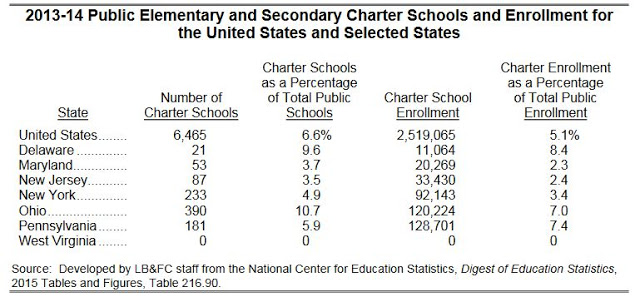
PA charter report

Now we come to cyber charter schools – the Count Draculas of the charter world.

The report estimates an additional $100 million in overpayments to cyber charters because of state law that overestimates their expenses. They are collecting much more money than they need to operate. They don’t have the same costs as brick-and-mortar institutions.

Cyber charter school students are given a computer and internet access. That’s about it. No costly building to run. Students usually do their lessons at home. Even when taking into account cyber charter staff, expenses are much lower than at other kinds of schools yet they are calculated without consideration of these differences.

Once again, state tax dollars that could be used to educate students become pure profit for charter operators. It is businessmen who win and students who lose.

The legislature used to acknowledge the burden charter schools put on local districts. The state budget used to include a line item reimbursing local districts for a percentage of their payments to charters. In 2010-11, that was $225 million. However, this money disappeared during the Gov. Tom Corbett administration when Republicans gained control of the legislature and prioritized tax cuts over charter school relief.

Though Corbett was defeated by Democrat Tom Wolf for the governorship, the legislature is still controlled by Republicans and the charter school reimbursement remains a distant memory.

But perhaps this new report signals a change in policy.

It contains several suggestions to fix Pennsylvania’s broken charter school laws. These include:

  • Permitting school districts to negotiate charter per pupil payment rates and methods.
  • Eliminating mandates for transportation that are inconsistent with services offered for district-operated schools.
  • Requiring the state to check with local districts when charter schools complain of underpayment.
  • Requiring greater transparency and fiscal accountability addressing problems like shell ownership, leasing, state payments, and conflict of interest policies.
  • Allowing audits of charter school funds.
  • Prohibiting the guaranteeing of loans where there is no direct school involvement.
  • Requiring charters to submit financial records for the district to review.
  • Requiring parents who place students in charters to first register with the local school district and then notify the district of changes in status.
  • Eliminating public school districts’ responsibility for charter school compliance with compulsory attendance requirements.

However, perhaps the biggest game changer is how charters set up shop in the first place.

Right now when charter operators want to open a school in a local district, the local school board gets to say yea or nay. However, school directors aren’t allowed to consider how this will financially impact the district. The report suggests this be changed; Districts should be allowed to approve or deny charters based on dollars and cents.

Currently local school directors are forced to approve charters that they know will hurt their students. This change would require charters to be equal partners with traditional districts or else be blocked. In effect, it would transform them from parasites to symbiotic organisms.

And as luck would have it, there are already two separate but similar bills that have been introduced that propose many of these changes.

One (Senate Bill 670) was introduced by Sen. Jim Brewster (D-McKeesport). The other (Senate Bill 198) was introduced by Sen. Vincent Hughes (D-Philadelphia). Brewster’s bill would “realign and redefine how local school districts, charter schools, students and taxpayers interact.” Hughes’ legislation would “provide local school boards with the tools to better oversee charter schools in their school districts.”

Charter school reform is something that members of both parties have expressed interest in. However, until recently Republican efforts at it have been light on reform and heavy on destructive means to further deregulate an already dangerously unregulated industry, thus worsening the problem.

Charter support has been strongly bipartisan. Champions of this new report claim that these suggested reforms aren’t anti-charter. They’re an effort to make both charters and traditional public schools work together instead of against each other.

Time will tell whether lawmakers are willing to do so.

Given the large donations received from the charter industry to lawmakers on both sides of the aisle, true reform may be difficult.

But at least we now have a state-sanctioned report to point to when referencing the multitude of problems associated with the industry.

Charters have been officially recognized by the state as parasites.

Will lawmakers do something to stop that unending sucking sound?

Teacher Appreciation Week is a Pathetic Joke!

Screen Shot 2017-05-10 at 3.38.28 PM

It’s Teacher Appreciation Week, America!

All over the country, millions of educators can look forward to a free burrito. Or maybe an Arby’s sandwich. Or a complimentary donut.

Because we REALLY appreciate teachers here.

What a pathetic joke!

I don’t mean to seem ungrateful.

I’ll redeem my coupon at Chipotle. I’ll take that Roast Beef Classic. I’ll grab that Dunkin’ Cruller.

But let’s be honest. These cheesy buy-one-get-one coupons don’t demonstrate appreciation. They’re guilt.

They’re a manifestation of the feeling that we SHOULD appreciate teachers, but don’t. Not really.

Not for one week, not for one day!

Why else would we begrudge them a middle class income? Why else would we provide them with so few resources and so much responsibility? Why else would we bar them from making any meaningful decisions about how their students should be taught yet hold them accountable for everything their students do?

Appreciate teachers? We don’t LISTEN to them. We don’t RESPECT them. Many of us don’t even LIKE them.

The only time we value teachers is when a maniac enters a school with a gun. Then – when they protect our children with their very lives – then we praise them as heroes!

On that day and that day only. But every other day – not so much.

We won’t do anything to keep guns out of the hands of school shooters. At most we want to arm teachersGreat! Something else to be responsible for on top of education, counseling and children’s all around well-being. But otherwise, we won’t do anything to help teachers do their jobs. And we certainly won’t listen to their professional opinions on anything!

That would be living in a culture of life. But we live in a culture of death.

We do the barest minimum for children – especially poor and minority kids. Instead we invest in parasitic business interests that provide zero value for students and parents.

We’ve got nothing for teachers or proven educational practices but we throw public money at charter, private and parochial schools that only accept the cream of the crop and turn down everyone else – yet still rarely do better than inclusive public schools. We defund public schools until they can no longer operate – and then we close them as failures. We promote lightly trained Teach for America temps to the same status as authentic educators with a 4-5 year degree and decades of experience. And we do everything we can to bust their unions and take away collective bargaining rights.

Yet everywhere I look I see people congratulating themselves for donating to some teacher’s GoFundMe project. This may come as a shock to you, but we shouldn’t be resorting to charity to fund our public schools! That should be a given!

In almost every classroom in America, teachers reach into their own pockets to make up the difference when our federal, state and local governments come up short. When kids don’t have pencils, we provide them. When kids don’t have books, we buy them. When kids come to school hungry, we even feed them.

Yet you’re getting excited that anonymous folks on the Internet put a few virtual coins in the cup!

I’ve been a public school teacher for almost 15 years. Next year I can look forward to another increase in class size. And I’ll probably have to teach an additional grade level or two. No extra resources to help me do it. No extra salary. Just more of a drain on my time to get the job done. And if I somehow stumble and fall, it will be my fault.

It won’t be the federal government’s fault even though they keep providing less financial help and more standardized testing, Common Core, and so-called school choice policies that rob my district of necessary funding.

It won’t be the state’s fault as they refuse to heal years worth of budget cuts in order to lower taxes on the wealthy, a scheme that, by the way, did nothing to boost the economy – in fact, it actually stalled business development. Nor will it be the state’s fault as they continue to blame me for the high cost of pensions they forgot to pay years ago while both my district and I paid on time. Nor will it be the state’s fault as they try to strip me of sick days, preserve loopholes that benefit charter schools at my district’s expense and experiment with a new funding scheme that further drains my district’s coffers.

It won’t be my local school board or administration’s fault, either, as they make cuts to core educational resources so they can preserve the state champion football team and less vital faculty office and administrative staff who are only working there because of nepotism and/or politics.

It’ll be MY fault. Mine and mine alone. That’s how much we appreciate teachers.

And none of it is even close to changing. No one is even considering altering the tiniest fraction of it. Democrats, Republicans, Independents, men, women, black people, white people, gay people, straight people, the young, the old – no one is doing anything about it!

And why should we? We’ve already got a scapegoat. We’ve already got someone to blame.

Well, look in the mirror, America. Because you’re the one to blame – each and every star-spangled banner and amber wave of grain.

We’ve made it like this. All of us.

I don’t mean to be so negative, but all these Pollyanna platitudes about that one special teacher obscure a basic truth. As individuals, we sometimes appreciate teachers – often when we’re years beyond graduation, or sometimes only when we’re parents, ourselves, and see what they do for our children. But that’s personal. That’s individuals.

When we think about the nations teachers, when we think about the profession in general, we don’t appreciate them one bit.
Because if we did, we’d act much differently.

If we really appreciated teachers, we’d hire more of them. We wouldn’t demand they do more with less. When we were deciding school policy at any level – federal, state or local – we’d include them in the process – in fact, they’d be the deciding factor!

If we really appreciated teachers, we wouldn’t wait – as many folks do – until they call us to find out how our children are doing in school. We’d be proactive. And if our kids aren’t doing well, we wouldn’t blame the teacher. We’d hold our own kids responsible and look for solutions.

If we really appreciated teachers, we wouldn’t blame them for their summer breaks. We’d understand that they aren’t paid for this time yet they often take professional development courses on their own dime or work retail just to make ends meet.

If we really appreciated teachers, we’d respect them as professionals, and we’d pay them accordingly. We’d respect their rights to a positive working environment both for themselves and for our own children.

So seriously – you can stuff your ridiculous Teacher Appreciation Week.

A free cookie just isn’t going to do it.

Don’t Trash the Department of Education. Fix It.

thumbnail_Screen Shot 2017-04-26 at 2.52.28 PM

How do you get people to refuse a helping hand?

Answer: Prove to them that it’s not helping.

That’s the strategy of the Trump administration in regard to his cabinet of billionaires. The Reality TV star turned President has nominated a series of out-of-touch and unqualified one percenters to head various federal government agencies.

Rex Tillerson, Rick Perry, Ben Carson – Each of these silver spooned numbskulls was put in place to “prove” to the American public how inane and useless the federal government is – by making the federal government inane and useless.

Nowhere is this more obvious than the Department of Education with its Republican mega-donor turned Education Secretary, Betsy DeVos.

DeVos has spent her entire adult life buying off mostly Republican lawmakers throughout the country to destroy public schools and replace them with charter, private and parochial schools.

She is a self-inflicted cancer on the system, a know-nothing religious zealot who spouts more factually challenged whoopers than Sean Spicer and Donald Trump combined.

But the endgame for putting a person who barely ever walked into a public school in charge of nationwide public school policy is clear – she’s there to demonstrate why the department should be disbanded.

With every idiotic statement, every Unconstitutional policy suggestion – she’s a corporate sponsored demo of why we need to trash this cabinet position altogether.

This has been the conservative dream since President Ronald Reagan. How dare his Democratic predecessor Jimmy Carter create a Department of Education, in the first place! Not only did Ronnie, the B-movie actor turned chief executive, have to defeat Carter, he needed to erase all of his predecessor’s policies. (Sound familiar? [Cough!] [Obamacare!] [Cough!])

And with Betsy DeVos’ help, Trump may finally get to realize Reagan’s dream.

To be fair, President George W. Bush did his fair share to make the department unpalatable. And so did Barack Obama!

Under Carter, the department was an extension of the Elementary and Secondary Education Act (ESEA) of 1965, which tried to bring equity to America’s public schools. However, Bush transformed it into No Child Left Behind, a blatant federal power grab changing the focus to high stakes standardized testing and punishing schools that taught poor children.

Obama took this terrible legislation to its inevitable conclusion and transformed the Department of Education into a bribe factory, dangling federal help before impoverished schools only if these schools would spend it on test prep, edutech software and Common Core. Never mind that these “reforms” don’t actually help children. It was all about helping the corporations behind them.

Much of the modern zeitgeist behind the continued movement to disband the department comes from authentic bipartisan opposition to these changes. The modern Department of Education hasn’t been much of a helping hand for almost two decades. It’s been a cruel taskmaster and a money laundering service for the publishing and testing industry. And it’s overstepped its federal authority coercing states to do as Washington bureaucrats (or at least their wealthy donors) demand.

Add to that the new wrinkle of DeVos – a representative who is all of those things but also transparently self-serving and – frankly – stupid.

No wonder people want to disband the department!

It’s a rallying cry that’s not hard to get behind. Unless you think about it for two minutes.

Because it’s not the Department of Education that’s the problem. It’s what we’ve done to it.

The department has a vital and important role to play in making sure our system of public education serves everyone. Speaking in broad terms, the department should be dedicated to these three things: ensuring public schools are being properly funded, student and parent civil rights are not being violated and to be a repository for national data and research.

These are incredibly important. Right now we have one of the most inequitable school funding systems in the world. The majority of public education funding comes not from the federal government or the states, but from individual communities. If you live in a poor neighborhood, your kids get less education funding. If you live in a rich neighborhood, your kids get more. This is why the nearly 50% of all public school children living in poverty are struggling academically – we aren’t providing them with the resources to succeed.

The state and federal government could be doing something about that. At the federal level, the department of education oversees billions of dollars in grants to poor schools. Admittedly much of that money is tied to standardized testing and other corporate education reforms. We should cut those ties. We should provide help for proven, authentic education practices freely chosen by these districts. That’s something that could have a huge impact on student success. And it’s a project we should expand, not destroy under draconian budget cuts or the closure of the department.

Second, we have to admit that parents’ and students’ civil rights are often in jeopardy. This means special education students seeking an appropriate learning environment and modifications. This means students being discriminated against because of their religious beliefs or lack thereof. This means minority students facing disproportionate discipline policies, unfair grading and/or lack of opportunities offered to other racial or ethnic groups. This means women and transgender students suffering discriminatory dress codes or bathroom policies. In short, it means that someone needs to be the moderator and protector of student and parent rights.

And finally, there needs to be a repository of national student data. This has gotten a negative connotation lately because of Bush and Obama’s incredibly permissive policies allowing edutech companies to collect a horde of student data for economic purposes. Let me be clear: The department shouldn’t be doing that at all. Student privacy should be respected. Computer programs and apps should not collect sensitive information about individual students to be sold to advertisers or used to market products to them.

But there is an incredible amount of aggregate information about student groups collected by the federal government that could be used to help improve the lives of students. This includes information on the racial proficiency gap and the amount of resources provided by states and municipalities. Moreover, we need an impartial entity to fund educational research about which reforms actually help students learn. Relying on corporations to fund research that “proves” the efficacy of their own products is not good science.

In short, disbanding the Department of Education would be a disaster. What would happen to Pell Grants, for instance? What would happen to the bundles of federal money that boost our public schools? Who would make sure states are doing their jobs? Where could we go to find accurate data about how our schools are doing nationally and not just state-by-state?

If we got rid of the department, at best these jobs would fall back on other government agencies that haven’t the funding, staff or ability to accomplish them. More likely, it would result in the elimination of billions of education dollars that the states simply couldn’t (or wouldn’t) replace. Abuses against students on the grounds of civil rights, gender, special education, etc. would skyrocket with little to no recourse. And we would be in the dark about how well we were educating our nation’s children.

I sympathize with those who wish to make government more efficient, but the Department of Education is not a place to make cuts. If you really wanted to close an unnecessary federal department, start with the most recent one – the Department of Homeland Security. Nowhere else is there a more obvious duplication of services and waste of tax dollars to provide a service that was already being provided. But you never hear anyone suggest we close this department because (1) it was proposed by a Republican, and (2) as a nation, we have a broad, bipartisan priority on the safety of our citizens.

If only we had the same for public education!

But we don’t. In fact, many conservatives scoff at the very idea of public schools on the grounds that it’s “socialism” – as if social security, Medicare and a standing military were not!

Too many people have bought into the lie that there is something unAmerican about public school. On the contrary, our system is implicit in our very form of government and the flower of our founding fathers’ thoughts.

The rich and powerful don’t want a robust system of public education because it goes against their interests. An informed, thinking public is harder to control. They especially don’t want minorities or the poor to be well-educated because once people realize how much they’re being exploited, they won’t continue to submit to the status quo.

In short, the Department of Education needs to change. It needs to be revitalized from the ground up. And DeVos is not the person to do it.

However, we shouldn’t let her incompetence make us throw it all away. We need to find ways to agitate, resist and survive the Trump administration while preserving as much as we can of our Democracy – and our sanity – in the process. We need to find and support prospective lawmakers and public servants who will actually represent us, the people, instead of Trump’s billionaire buddies. We need a robust, grassroots movement to take back our government.

And then we can begin the hard work of making our government work for us again. Part of that will involve the Department of Education.

Trump Can’t Limit Federal Role in Public Schools AND Push School Vouchers

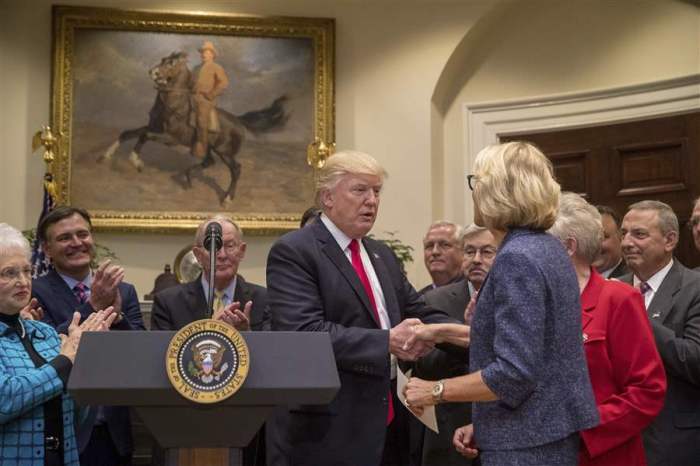
Trump-5-2

Donald Trump is talking out of both sides of his mouth.

Again.

This time he’s signing an executive order demanding the Department of Education study how the federal government oversteps its legal authority with regard to K-12 schools.

Yet he still proposes bribing states with $20 billion in federal funds to enact school vouchers.

Well which is it, Oh Orange One?

Are you for limiting the federal role in education or for coercing states to do your bidding?

Because you can’t be for both.

Either states and local districts determine the bulk of their school policies or not. You can’t barge into our state capitals promising billions of dollars in federal tax money if and only if we enact your chosen reforms.

That’s one of the primary reasons many conservatives (and even a sizable number of progressives) oppose Common Core. The Obama administration promised billions of dollars in Race to the Top grants if and only if states adopted these new, untried academic standards.

How is Trump’s voucher scheme any different?

In both cases, the proposed education reform has not been proven to work, and it’s not being requested by the education community or voters. In fact, when it comes to vouchers, voters have repeatedly turned them down in referendum after referendum.

So if Trump wants to investigate federal overreach, he should start with his own campaign speeches on vouchers.

So why is the former Realty TV star doing this?

Well, his first hundred days are almost up, and he has next to nothing to show for it. Other than uniting the American people against him, President Con Man hasn’t achieved much. One can imagine why he might want to hurry up and toss off yet another executive order so he could put something – anything – in the achievement column.
But there’s a more insidious reason why the founder of Trump University took out his signing pen.

His administration – especially his Department of Education – is particularly inimical to civil rights.

Just look at the brain trust he has running it.

Secretary Betsy DeVos isn’t sure the department should be in the business of protecting special education students. Nor is she willing to take a stand to protect transgender kids.

Latest hire Deputy Assistant Secretary Candice Jackson has repeatedly expressed skepticism about the very existence of civil rights. The 39-year-old attorney is anti-women’s rights, anti-distributive justice and possibly even anti-compulsory education and anti-Civil Rights Act of 1964!

In college, she thought she, herself, was being persecuted because a tutoring group set up for minorities wouldn’t serve her as a white person – despite the fact that she could probably afford to pay for her own damn tutoring.

So this latest “study” into federal overreach is probably an attempt by the Trump administration to justify doing nothing to protect the civil rights of students across the country.

Under President Bad Hair Day, special education students can be denied services with impunity. It’s not the federal government’s job to step in. THAT would be overreach.

And if black and brown students don’t receive the same resources and opportunities as their white counterparts, there’s just nothing the Trump administration can do. They don’t want to step over the line.

It’s not that The Donald doesn’t sympathize with transgender students denied access to bathrooms that correspond with their gender. Ivanka even gave him a stern talking to. It’s just that his tiny little hands are tied. Thems the limits of federal authority, Son.

If you ask me, that’s truly the impetus behind this executive order.

He’s just setting up his next excuse for giving us, the American people, zero return on our tax dollars.

That way he can just shrug and offer more tax cuts to the rich.

Sadly, there is truth to the claim that the Department of Education has overstepped its authority. Both Presidents George W. Bush and Barack Obama frequently usurped states and communities local control. No one was crying out for high stakes testing, more test prep material, and unregulated charter expansion. But that’s what we got!

If you’re looking to Trump to balance the scales, look somewhere else!

He has given no indication that he will be any different. He’ll still push his own agenda on us, but he’ll pretend like we asked for it.

Now that’s the Donald Trump we know best!