Always Be Testing – The Sales Pitch for Corporate Education Reform

Screen Shot 2017-03-15 at 10.31.13 AM

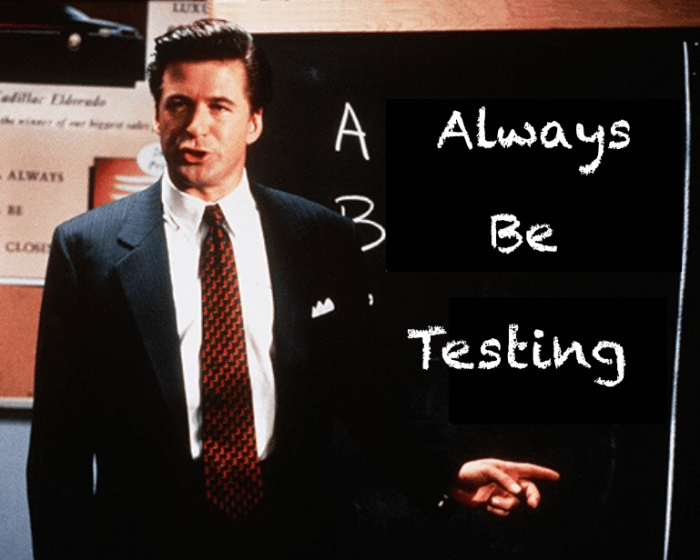
(After the “Brass Balls” speech in “Glengarry Glen Ross,” by David Mamet.)


(Rated PG-13 for language)


(Interior: a public school classroom during an after school staff meeting. Teachers are seated at student desks including Singer, Moss and Aaronow. Williamson, a middle school principal, stands in front of the room flanked by Blake, a motivational speaker brought in by the state. Singer is furiously grading papers. The other teachers are pleasantly chatting about trifles before Blake calls the gathering to attention.)


[Blake]
Let me have your attention for a moment! So you’re talking about what? You’re talking about that kid you failed, some son of a bitch who doesn’t want to pass, some snot-nosed brat you’re trying to remediate and so forth. Let’s talk about something important. Are they all here?


[Williamson]
All but one.


[Blake]
Well, I’m going anyway. Let’s talk about something important! (to Singer) Put that colored marker down!


[Singer]

But I’m grading papers…


(Blake)

I said Put that marker down! Markers are for testers only.


(Singer scoffs)


[Blake]

Do you think I’m fucking with you? I am not fucking with you. I’m here from downtown. I’m here from the Governor and the Legislature. And I’m here on a mission of mercy. Your name’s Singer?


[Singer]
Yeah. Mister Singer, actually.


[Blake]
You call yourself a teacher, you son of a bitch?


[Moss]

I don’t have to listen to this.

 
[Blake]
You certainly don’t, Madam. Cause the good news is – you’re fired. The bad news is you’ve got, all you got, just one week to regain your jobs, starting today. Starting with today’s meeting.


[Moss]

What!? The union contract doesn’t allow you to just fire us all without cause.


[Blake]

Union!? There ain’t no more union! This is a Right to Work state now, Bitch. And that means you have the right to work – for less – until I fire your sorry ass.


(Assorted grumbling)


[Blake]

Oh, have I got your attention now? Good. Cause we’re adding a little something to this month’s merit pay. As you all know, the teacher whose students get the highest test scores gets a bonus. First prize is a thousand bucks. Anyone want to see second prize? Second prize is a box of pencils. Third prize is you’re fired. You get the picture? You’re laughing now?


[Singer]

That’s ridiculous. Mrs. Moss teaches the advanced kids. All her students get high test scores.


[Blake]

What? And your kids are in the general track? They don’t get high test scores? Then step it up, Singer! You want to get a paycheck in this district, you’ve got to earn a paycheck. You got test prep manuals. The school board paid good money for them. Get those workbooks so your kids can pass the test!


[Singer]

Workbooks!? That’s not learning?


[Blake]

That’s where you’re wrong. Workbooks are the only learning that counts! Kids take the tests that show whether you’re doing your fucking jobs! You want to keep working here? You want to keep sucking at the public tit? You get those kids to pass the motherfucking tests. And those workbooks do that. They teach kids how to pass the motherfucking tests!


[Singer]

But my kids are all from poor homes. They’re malnourished. They don’t get the same medical care. There are no books in their homes. Many of them suffer from PTSD from abuse or exposure to violence….


[Blake]

And you think they deserve some kind of entitlement? A medal? Fuck them and fuck you! Let me make one thing perfectly clear – If you can’t get your students to pass shit, you ARE shit, hit the bricks, Pal, and beat it cause you are going out!


[Singer]

Are you kidding me right now? You want my students to pass these tests. The tests are unfair. They’re economically and culturally biased. The connection between the tests and learning is weak.


[Blake]
The fucking tests are weak? You’re weak. I’ve been in this business for fifteen weeks.


[Moss]
Fifteen weeks? Try thirty years.


[Blake]

Anyone who’s still a teacher after thirty years should be put to sleep. All you need is a year or two. That’s what I’m doing. Teach for America. Five weeks training, two year commitment, then move on to Washington where you can advise lawmakers on what schools need.


[Moss]

What’s your name?


[Blake]

Fuck you, that’s my name! You know why, Missy? Cause you drove a Hyundai to get to work. I drove an eighty thousand BMW. That’s my name.


[Singer]

I took the bus.


[Blake]

(To Singer) And your name is “you’re wanting.” You can’t play in a man’s game. You can’t teach them. (at a near whisper) And you go home and tell your wife your troubles.

(to everyone again) Because only one thing counts in this life! Get them to score above basic. Get them to demonstrate the minimum skills necessary!


[Singer]

What about what they think and feel?


[Blake]

No one gives a shit about what they think and feel. You hear me, you fucking faggots?


(Blake flips over a blackboard which has two sets of letters on it: ABT, and AITP.)


[Blake]

A-B-T. A- Always, B-be, T-testing. Always be testing! Always be testing!! A-I-T-P. Attention, interest, testing, passing. Attention — do I have your attention? Interest — are you interested? I know you are because it’s fuck or walk. Your kids pass or you hit the bricks! Testing – you will test those students by Christ!! And passing. A-I-T-P; get out there!! You got the students comin’ in; you think they came in to get out of the rain?


[Singer]

Actually, many of my students live in public housing down there by the railroad tracks. You know those slums? Roofs leak in half those units…


[Moss]

And for a lot of kids school is the only structure they get all day. Their parents are out working two to three jobs. They have to take care of themselves and often younger siblings.


[Singer]

And food. Don’t forget food. If it wasn’t for the free breakfast and lunch program, many of my kids wouldn’t eat…


[Blake]

Bullshit. A kid doesn’t walk into this school unless he wants to pass. That’s why they’re here! They want to learn! They’re sitting out there waiting to be told what to do. Are you gonna’ tell ‘em? Are you man enough to tell them?


[Moss]

I’m a woman. Most of us are women.


[Blake]

(to Moss) What’s the problem, Pal?


[Moss]

You think you’re such a hero, you’re so rich. Why are you coming down here and wasting your time on a bunch of bums?


(Blake sits and takes off his gold watch)


[Blake]
You see this watch? You see this watch?


[Moss]
Yeah.


[Blake]

That watch cost more than your SMART Board. (Takes off his shoe) You see this shoe? Italian. It costs more than your entire salary. (slicks back his hair) You see this haircut?


[Moss]

I get it.


[Blake]

Do you? Because I do. I made 26 million dollars last year. How much do you make? You see, Pal, that’s who I am. And you’re nothing. Nice person? I don’t give a shit. Good mother? Fuck you – go home and play with your kids!! (to everyone) You wanna work here? Test!! (to Aaronow) You think this is abuse? You think this is abuse, you cocksucker? You can’t take this — how can you take the abuse you get in a classroom?! You don’t like it — leave. I can go out there tomorrow with the materials you got, make myself a thousand dollars in merit pay! Tomorrow! In one class! Can you? Can you? Go and do likewise! A-I-T-P!! Get mad! You sons of bitches! Get mad!!


[Singer]

Oh, I’m mad. I’m mad that a shallow schmuck like you thinks he can come in here and tell us how to do our jobs. School is about so much more than test scores. You can’t reduce it all to a multiple choice assessment. These kids need a broad curriculum, not just reading and math. They need science, art, social studies, foreign language, recess – all the stuff the rich kids get at the $50,000 a year private schools. And all you want to give them are standardized tests!


[Blake]

You know what it takes to teach public school?


(He pulls something out of his briefcase. He’s holding up a hammer and a plastic model of a one-room schoolhouse. He puts the model down on Aaronow’s desk and then smashes it to pieces with the hammer.)


[Blake]
It takes school choice to teach in a public school. It takes charter and voucher schools, schools run like a business – not this mamby, pamby, commie, socialist shit!


[Moss]

Choice? Is that what you call letting private interests suck up public tax dollars without the same transparency and regulations as public schools? You mean schools not run by an elected school board, who meet in private and do almost whatever they please with our tax dollars? You mean schools that can turn away the hardest to teach children – unlike public schools that take everyone?


[Blake]
I’m talking about schools with balls!
(He puts the hammer over his crotch,– he puts it away after a pause)


[Blake]
You want a paycheck? Do like the choice schools do — Go and do likewise, folks. The money’s out there, you pick it up, it’s yours. You don’t–I have no sympathy for you. You wanna go into your classes tomorrow and test and get your kids to pass, it’s yours. If not you’re going to be shining my shoes. Bunch of losers sitting around in a bar. (in a mocking weak voice) “Oh yeah, I used to be a teacher, it’s a tough racket.” (he takes out a software package from his briefcase) This is the new Common Core aligned diagnostic system. It’s like the MAP, Study Island, iReady and iStation – only better.


[Singer]

Those programs suck.


[Blake]

This is better. With it, your students will sit behind a computer screen for several hours every day taking stealth assessments.


[Singer]

You mean mini-tests?


[Blake]

No. Not mini-tests. They’ll run through the program and get instruction on every Common Core standard and their answers will show how much they’ve learned.


[Singer]

They’re tests. Standardized tests. Every day.


[Blake]

This is the Pearson leads. And to you, it’s gold. And you don’t get it. Why? Because to give it to you is just throwing it away. (he hands the software to Williamson) It’s for testers. (sneeringly) Not teachers.


I’d wish you good luck but you wouldn’t know what to do with it if you got it. (to Moss as he puts on his watch again) And to answer your question, Pal: why am I here? I came here because the Governor and Legislature are paying me to be here. They’re paying me a lot more than you. But I don’t have to take their money. I can make that tying my shoes. They asked me for a favor. I said, the real favor, follow my advice and fire your fucking ass because a loser is a loser.


(He stares at Moss for a sec, and then picking up his briefcase, he leaves the room with Williamson)


[Singer]

What an asshole.


[Moss]

He may be an asshole but he’s got the state on his side.


[Aaronow]

This isn’t what I signed up for. This isn’t why I became a teacher.


[Moss]

What did you sign up for?


[Aaronow]

TO TEACH! Not to be some… some… glorified real estate agent!


[Singer]

It’s funny. We know how crazy all this testing, Common Core, and charter school crap is, but no one wants to hear us.


[Moss]

And now without collective bargaining, we can’t even speak up without fear of being fired.


[Aaronow]

Fear!? If we don’t push all this teaching to the test nonsense, they’re going to fire us. And if we do, they can replace us with computer programs. We’re damned if we do, damned if we don’t.


[Singer]

Not if people wake up. (Moss and Aaronow scoff) Not if the public takes a stand, if parents and teachers opt their kids out of the tests…


[Aaronow]

Didn’t you hear the man!? They’re putting the kids on computer programs to test them every day!


[Singer]

Then we fight every day. We protest every day. We get parents together and other concerned citizens and we go to the capital and we fight. Call your representative. Go to your Senator’s office. Stage a sit in. Hold a mock trial. Write a blog parodying a scene from a famous movie. Get public attention. Make some noise.


[Aaronow]

And you think people will care? You think people will know?


[Singer]

We’ll teach them. We’ll show them. That’s what we do.


[Moss]

We have no other choice.


[Aaronow]

Always be testing?


[Singer]

Always be teaching.


(Curtain)


The Original Scene from GlenGarry Glen Ross:

I’m a Public School teacher. Hands Off My Trans Students!

ct-transgender-students-met-20150425

I’m a public school teacher.

I have a lot of different girls and boys in my classes.

In fact, some of them are neither girls nor boys.

Does that mean they should be discriminated against? Does it mean we should judge them, tell them they’re somehow less valuable than the other kids? Tell them who they are by telling them where to pee?

Heck, No!

Some kids don’t feel comfortable with a traditional gender identity. And it’s more common than you’d think.

It’s certainly more widespread than I ever would have thought until a little girl taught me a lesson… well, not a little girl, really.

A few months ago, I would have said she’s the cutest little girl in the lunch line.

Bright, vivacious, always a friendly smile and a kind word.

But she’s not a little girl.

And I didn’t know until she told me.

As a teacher given the unenviable role of line monitor, I have to find the bright spots where I can.

Letting only two hungry 5th graders in to get their lunch at a time and making the rest wait does not make you popular.

“Aaaargh! Why you always stopping me!?” They often say.

“Because you were third,” I reply.

“But why?” They often insist.

“It’s not personal. It’s numerical.”

And I let them through to continue the game tomorrow.

It goes on like that for about a half hour with little variation – until she gets to the front of the line.

“Hey, Mr. Singer!” Big smile and a wave.

And we’d be off on a conversation. She’d ask me how my day was, what I was teaching my students, how my daughter was. I’d ask how her day was so far, about pets, homework.

She’s actually not in my class. I only see her at lunch, but she always brightens my day.

For months, it went like clockwork. Until a few weeks ago when she appeared at the front of the line with her long hair chopped off into a bob.

“Nice haircut,” I said encouragingly.

“Thanks,” she replied. “You want to know why I got it?”

“Sure. Why?”

“I’m agender.”

“Oh,” I responded cluelessly. “What’s that?”

And she proceeded to explain that she didn’t feel comfortable identifying as male or female.

I nodded and then it was time to let her get her lunch.

I’ll admit it was unsettling. Here was this cute little thing and I didn’t even know what to call her now.

But the next day things progressed as usual. Ze came through the line with the same big smile. We had the same innocuous conversation and ze went to eat.

It made me think.

I’ve been teaching for more than a decade. Ze was probably not the first transgender student I’ve met. And when I thought back to all the children who’ve come through my classes over the years, faces started to pop up and hit me.

Gender is not black and white. (Come to think of it, neither is race.) No one is 100% male or female. I mean, sure people have a fixed range of sexual parts, but gender identity is more than that.

We each feel comfortable acting and identifying certain ways, and if you think about it, some of those ways don’t always line up with our cultural gender designation.

For instance, I cry my eyes out at certain movies. My daughter – who’s 8 – heard the song “Boys Don’t Cry,” the other day and said, “Well that isn’t true. Daddy cries all the time.”

Moreover, my wife loves football, basketball and hockey. Me? I could take them or leave them. If she wants me to watch the game with her, she’s got to beg or promise or put out the right snacks.

Wouldn’t it just make sense that some people are much further to one side or other of the gender spectrum than others? Wouldn’t it just make sense that sometimes your identity and your physical parts don’t match? Or maybe you’re so in the middle that it makes no sense to take a side?

I say again, I teach in a public school. We don’t push any kids away. We take everyone. And that means taking those kids who aren’t so easy to label.

I teach middle school. Transgenderism doesn’t come up too often.

Last year when bathroom bills were all the rage, some of my 8th graders brought it up during our Socratic Seminar discussion groups. And I let them talk about it.

We talked about why some people might think this is a good idea, why some might oppose it, etc. There were some boys who were hysterically against trans students using the bathroom with them, but most of my kids had zero problem with it. In fact, they knew that it had already happened.

Trans students are everywhere. You just rarely hear about them.

I don’t know which bathroom my lunchline buddy uses. I wouldn’t presume to ask. But it hurts me that there are people out there who want to limit hir.

These children have rights. They are little sweethearts. They’re full of life and joy. We should respect their humanity.

And to those who say letting them use a bathroom that corresponds with their identity will lead to kids being molested, let me ask – has that ever really happened?

The way I see it, the problem is people – any people – molesting others, no matter what room they do it in, no matter if they’re transgender or not.

Frankly, it doesn’t happen a lot at school, nor is it more pronounced with trans kids.

This has nothing to do with children. It has to do with old men and women who refuse to broaden their views about the world. It’s about the ancient making the young do as they say regardless of how doing so may trample on their right to be themselves.

Well, I won’t be a part of it.

You want to attack my trans students? You’ll have to do it through me.

I’m a guardian of kid’s rights. I’m a defender of children from whoever wants to do them harm.

I’m a public school teacher. That’s just what we do.

Civil Rights Aren’t Just for Minorities – They’re For Everyone

civil-right-museum-mural


“Injustice anywhere is a threat to justice everywhere.”

-Martin Luther King, Jr.


It’s still shocking to me that so many white people seem to think civil rights are just a black issue.


As if they’re something that only concerns people of color.


White people can’t be the victims of discrimination? We can’t be mistreated on the basis of gender, religion, sexuality, or age?


Of course we can! And many of us are. But we are rarely discriminated against on the basis of our race. And somehow accepting that fact seems to turn us against the very idea of civil rights.


We act as if talking about civil rights is code for black issues. Many of us refuse to even admit that black people have legitimate grievances in this area, that they’re just needlessly complaining and looking for sympathy, that they’re trying to get something for free or get one over on us.


It’s pure bullshit. Black people are authentically aggrieved. They are the victims of a systemic racism that rarely even becomes visible to white eyes. And that same system either ignores whiteness or even privileges it.


The criminal justice system, alone, is rife with examples including racial profiling, stop-and-frisk policies, police brutality and the failed War on Drugs. Add to that voter ID laws, redlining, and credit scores. Add to that the use of bigoted and prejudiced textbooks, punishing non-white students more harshly than white students, underfunding public schools, and closing them down if they’re attended mostly by students of color.


Yet that doesn’t mean white people are impervious to civil rights violations. It just means that people of color are targeted much more often and are in much greater need of help than we are.


Yet many of us refuse to admit it. We refuse even though doing so actually puts ourselves at greater risk.


Think about it. If we ignore the civil rights concerns of those most victimized, who will be there for us when we’re targeted?


Take police brutality.

According to the Guardian’s The Counted, 1,092 Americans were killed by police in 2016. If we look at it proportionately, a much higher percentage of minorities were killed than white people. Specifically, Native Americans were killed at 10.13 per million, black people at 6.66 per million, while Hispanics and Latinos were killed at 3.23 per million. By comparison, white people were only killed at 2.9 per million.


So minorities were killed at much higher rates than whites given their smaller percentages of the population. However, if we look at the raw numbers, more white people were killed than any other group. Specifically, the police killed 574 whites, 266 blacks, 183 Hispanics/Latinos and 24 Native Americans.


So, yes, the African American community is right to be angry that they’re being disproportionately targeted by police. However, more than 500 white people were killed by law enforcement, too. That’s a troubling figure all by itself. Why are American police killing so many of us? Why is law enforcement so trigger happy in the USA?


It’s a problem for everyone. Police should not be killing such high numbers of civilians. In fact, in other countries, they don’t. Police kill more people in the U.S. in days than they do in other countries in years. Yet very few police officers actually serve jail time. Several officers went to trial in 2016, but only a handful were convicted.


This is a real problem, yet many white people dismiss it as a black issue – and an illegitimate one at that. As a country, we have a real concern with the way police are trained, protocol for when deadly force is allowed and how officers are held accountable. But we’re letting this issue fall through the cracks because it’s being delegitimized as a “mere” civil rights complaint.


Things have really changed in this country.


In 1963, when the all black 16th Street Baptist Church in Birmingham, Alabama, was bombed by four members of the Ku Klux Klan, the entire society took notice. Even whites who had been unsympathetic to the civil rights struggles of African Americans up to this point were disturbed at the murder of four children and the injury of 22 others. Dr. Martin Luther King, Jr., called it “one of the most vicious and tragic crimes ever perpetrated against humanity,” and it marked a turning point in our history. The fight for civil rights became a multi-racial, multi-ethnic, American struggle to secure equality for our brother and sister African Americans.


However, just two years ago when Dylann Roof was inspired by white supremacist Websites to kill nine people at all black Charleston Church in South Carolina, the response was… meh. Though it has been categorized as a hate crime, it has done nothing to wake up the society at large to the realities of modern day American racism. At most, it’s dismissed as an isolated event.


However, it’s not. White supremacists have long targeted African American churches as objects of their hatred. In 1991 it took a series of 154 suspicious church burnings for Congress five year later to pass the Church Arson Prevention Act, making it a federal crime to damage religious property because of its “racial or ethnic character.” More recently, a black church in Massachusetts was burned down the day after President Barack Obama was inaugurated in 2009.


For some reason, these continuing hate crimes fail to rouse the public at large. Perhaps the Internet culture and the perpetuation of so-called news sources that only support partisan confirmation bias has something to do with it. But it’s harmful to all of us.


When white people ignore the legitimate claims of black people, they make it easier for everyone to be mistreated. Often white people have acted as if prejudice could never be perpetrated against them, and when it’s cropped up, we’ve defined it narrowly to fit only the immediate group targeted. That’s an LGBT issue. That’s a Jewish issue. That’s an issue for people with disabilities. We rarely see them as they are – human issues.


In the age of Trump, violations of individual rights are popping up every day: journalists receiving felony charges for covering unrest at the inauguration, a Louisiana bill that makes resisting arrest a hate crime punishable by 10 years in prison, proposed laws in 10 states to criminalize peaceful protects – and on and on.


Nor is it partisan. Here are a list of human rights violations under Obama: drone strikes outside active war zones, ongoing use of massive civilian surveillance programs, failure to close Guantanamo Bay, harsh penalties for whistle blowers and no accountability for those they expose.


We live in an age where our rights are being eroded by ignorance, indifference, and the uncritical acceptance of prepacked political narratives. The powers that be use racism and prejudice to keep us divided so we’ll never mount an effective opposition.


Today as ever we need each other. We need to be there for our brothers and sisters in humanity. That starts with white people waking up to the harsh realities of black life in America.

Trump says our schools are “Flush with Cash!?” They’re Falling Apart!

img_6296

Donald Trump lies.

If you haven’t learned that yet, America, you’ve got four more cringe-inducing years to do so.

Even in his inaugural address, he couldn’t help but let loose a whooper about US public schools.

“Americans want great schools for their children, safe neighborhoods for their families and good jobs for themselves,” he said. “But for too many of our citizens, a different reality exists. … An education system flush with cash but which leaves our young and beautiful students deprived of all knowledge.”

To which nearly every poor, nonwhite public school parent, student and teacher in the country replied, “What’s that heck did he just say now!?”

Los Angeles Unified School district routinely has broken desks and chairs, missing ceiling tiles, damaged flooring, broken sprinklers, damaged lunch tables and broken toilet paper dispensers.

They’re flush with cash!?

New York City public schools removed more than 160 toxic light fixtures containing polychlorinated biphenyls, a cancer causing agent that also hinders cognitive and neurological development. Yet many schools are still waiting on a fix, especially those serving minority students.

They’re flush with cash!?

At Charles L. Spain school in Detroit, the air vents are so warped and moldy, turning on the heat brings a rancid stench. Water drips from a leaky roof into the gym, warping the floor tiles. Cockroaches literally scurry around some children’s classrooms until they are squashed by student volunteers.

They’re flush with freakin cash!?

Are you serious, Donald Trump!?

And this same picture is repeated at thousands of public schools across the nation especially in impoverished neighborhoods. Especially in communities serving a disproportionate number of black, Latino or other minority students.

In predominantly white, upper class neighborhoods, the schools often ARE “flush with cash.” Olympic size swimming pools, pristine bathrooms – heck – air conditioning! But in another America across the tracks, schools are defunded, ignored and left to rot.

A full 35 states provide less overall state funding for education today than they did in 2008, according to the Center on Budget and Policy Priorities, which focuses on reducing poverty and inequality. Most states still haven’t recovered from George W. Bush’s Great Recession and the subsequent state and local budget cuts it caused. In fact, over the same period, per pupil funding fell in 27 states and still hasn’t recovered.

And the federal government has done little to help alleviate the situation. Since 2011, spending on major K-12 programs – including Title I grants for underprivileged students and special education – has been basically flat.

The problem is further exacerbated by the incredibly backward way we allocate funding at the local level which bears the majority of the cost of education.

While most advanced countries divide their school dollars evenly between students, the United States does not. Some students get more, some get less. It all depends on local wealth.

The average per pupil expenditure for U.S. secondary students is $12,731. But that figure is deceiving. It is an average. Some kids get much more. Many get much less. It all depends on where you live. If your home is in a rich neighborhood, more money is spent on your education than if you live in a poor neighborhood.

The U.S. is one of the only countries in the world – if not probably the ONLY country – that funds schools based largely on local taxes. Other developed nations either equalize funding or provide extra money for kids in need. In the Netherlands, for example, national funding is provided to all schools based on the number of pupils enrolled. But for every guilder allocated to a middle-class Dutch child, 1.25 guilders are allocated for a lower-class child and 1.9 guilders for a minority child – exactly the opposite of the situation in the U.S.

So, no. Our schools are not “flush with cash.” Just the opposite in many cases.
But what about Trump’s other claim – the much touted narrative of failing schools?

Trump says our schools “leave… our young and beautiful students deprived of all knowledge.”

Not true.

Graduation rates are at an all-time high of 83.2 percent. Moreover, for the first time minority students are catching up with their white counterparts.

It’s only international comparisons of standardized test scores that support this popular myth of academic failure. And, frankly, even that is based on a warped and unfair reading of those results.

It depends on how you interpret the data.

Raw data shows US children far from the top of the scale. It puts us somewhere in the middle – where we’ve always been for all the decades since they’ve been making these comparisons. Our schools have not gotten worse. They have stayed the same.

However, this ignores a critical factor – poverty. We’ve known for decades that standardized tests are poor measures of academic success. Bubble tests can assess simple things but nothing complex. After all, they’re scored based on answers to multiple choice questions. In fact, the only thing they seem to measure with any degree of accuracy is the parental income of the test-taker. Kids from rich families score well, and poor kids score badly.

Virtually all of the top scoring countries taking these exams have much less child poverty than the U.S. If they had the same percentage of poor students that we do, their scores would be lower than ours. Likewise, if we had the same percentage of poor students that they do, our scores would go through the roof! We would have the best scores in the world!

Moreover, the U.S. education system does something that many international systems do not. We educate everyone! Foreign systems often weed children out by high school. They don’t let every child get 13 years of grade school (counting kindergarten). They only school their highest achievers.

So when we compare ourselves to these countries, we’re comparing ALL of our students to only SOME of theirs – their best academic pupils, to be exact. Yet we still hold our own given these handicaps!

This suggests that the majority of problems with our public schools aren’t bad teachers, or a lack of charter schools and school choice. It’s money, pure and simple.

We invest the majority of our education funding in rich white kids. The poor and minorities are left to fend for themselves.

This won’t be solved by Trump’s pick for Education Secretary, Betsy DeVos and her school choice schemes. In fact, that’s exactly what’s weakened public schools across the country by leaching away what meager funding these districts have left. Nor will it be solved by a demagogue telling fairy tales to Washington’s credulous and ignorant.

We need to make a real investment in our public schools. We need to make a commitment to funding poor black kids as fairly as we do rich white kids.

Otherwise, the only thing flushed will be children’s future.

Four Practical and Four Moral Reasons to Make Your City a Sanctuary City

140702141351-immigration-boy-american-flag-story-top

There’s an entire underclass of people living among us.

These are people like you or me who have no choice but to do the most menial jobs for meager pay under the table. And when reality-TV-stars-turned-politicians like Donald Trump come around offering to solve all our problems with magic, you know who they blame for everything? THEM!

They’re illegal immigrants. They had the gumption to flee countries with worse economies than ours for the privilege of being our construction workers, housekeepers, gardeners and janitors. They are the fruit and vegetable pickers and the restaurant workers putting food on our tables.

They don’t collect social security, they don’t have health benefits or retirement plans and employers can pay them less than minimum wage. Heck! We can do almost whatever we want to them because who are they going to complain to – the police? If they do anything to get noticed by the law, they could be deported. So they keep a low profile doing the work no one else wants while the rest of us allow ourselves to be fooled into accepting them as easy scapegoats for all our ills.

What we need are sensible immigration laws that offer these people a path to citizenship, a way for them to climb out of perpetual servitude and fear. But that would cost us too much money, so it will never happen.

The least we can do – literally the least – is allow them some moderate amount of safety. We can let them partake in the minimum advantages of our society – protection from crime, a safe place to live, schools for their children, and an end to the fear that at any moment they could be kidnapped and taken away.

It’s called being a sanctuary city and more than 300 urban centers across the country have officially or unofficially adopted it as their local policy.

Though there’s no clear legal definition of sanctuary cities, in places like New York, Philadelphia, San Francisco and Houston, it goes something like this – if someone questions a person’s immigration status, local police don’t investigate it. You arrest someone for a non-violent crime, he does his time, then you let him free. If he has a long rap sheet, all bets are off, but in general you don’t hold him past his sentence for the feds to come and drag him away unless he’s got a substantial criminal record.

These sanctuary policies came under fire after the July 2015 death of Kate Steinle, a woman who was shot and killed in San Francisco, allegedly by an undocumented immigrant and repeat felon who had been deported five times to Mexico. He was being held by police but was released when drug charges were dropped. Police clearly made a mistake. Most law enforcement – even in sanctuary cities – would have contacted Homeland Security about someone like Lopez Sanchez. Moreover, deportation isn’t an answer either because Sanchez had already been given the boot multiple times. Unfortunately, the case has become the poster child for everything that’s supposedly wrong with these policies.

Trump became President on the backs of a promise to deport up to 3 million illegal immigrants because he said they are more violent and sanctuary cities result in increased crime. However, as are most things that come out of his mouth, it’s simply not true. These people are less likely to commit serious crimes than those born in the U.S. They can’t attract attention to themselves. Even in sanctuary cities, going on a crime spree is a sure way to get yourself deported.

On average, between 2011 and 2013 immigration courts ordered about 414,650 people removed from the country. Adding to those numbers won’t solve the problem, but there is something we can do.

If you live in a sanctuary city, protect that status. If you don’t, lobby to make your city a place of sanctuary. There are plenty of good reasons to do this – some practical, some moral. Here are four examples of each:


Practical

1) Holding Suspected Illegal Immigrants Drains Resources

Local and state police departments are not made of money. Like most public services these days, law enforcement agencies are cash-strapped. They only have so much funding to spend protecting and serving communities. Holding people in jail who are suspected of being in the country illegally costs money -money we don’t have to waste.

Moreover, the Department of Homeland Security has refused to even prioritize deporting convicted illegal immigrants. Suspects can spend days, weeks or longer in lock up waiting for the feds to get in gear.

It has become increasingly common for law enforcement to let these people go instead of taking responsibility for what is, after all, a federal job. Between January 2014 and September 2015, local and state law enforcement agencies declined 18,646 Immigration and Customs Enforcement (ICE) detainers, the Texas Tribune found. The majority were from California, where the notion of sanctuary cities first took root.


2) Holding Suspects Without a Warrant Can Get Your City Sued

Not all sanctuary cities lean left like Los Angeles. Many are deep in the red states and deeply conservative. In 2014, sheriff’s departments across the country announced that they would no longer honor detainer requests from the federal government. Instead, they would require ICE to get a formal warrant or court order before they would jail someone longer than they would otherwise.

The reason explicitly laid out in policy memos and press releases in places like rural Oregon, eastern Washington, and Kansas was to avoid expensive lawsuits. Federal courts in Pennsylvania and Oregon ruled in 2014 that detainer requests are not legally binding. In other words, counties jailing people based solely on those detainers could be violating individuals’ rights.

So these cities are trying to shield taxpayers from potential lawsuits. Residents may not consider themselves to be in sanctuary cities. Officials and sheriffs in these areas may even object to the label, but they are effectively doing the same thing.


3) Complying with the Feds Infringes on Local Autonomy

No one likes to be told how to do their job – especially police. Some law enforcement experts claim that the federal government is overstepping its authority by demanding state and local police to comply with requests for detention.

When Louisiana was considering a state law banning sanctuary cities, Jefferson Parish Sheriff Newell Normand, a Republican, gave legislators an earful at a senate hearing on the matter: “Don’t come down here with some overarching bullshit Republican philosophy from Washington, DC…. and tell me how to do my business!” he said. “This bill goes down to discretion of a frontline officer and usurps my authority as a manager in how I’m going to deal with my officers… Give me a break!”


4) Holding Detainees Makes Law Enforcement’s Job Harder

Being a police officer is hard enough. If the people in the community you’re trying to protect and serve are afraid you’ll detain them for suspicion about their immigration status, they’ll be less likely to co-operate in the everyday business of policing.

People will flee from police on sight because they’re afraid some minor incident is going to get them deported. This is exactly what happened in North Carolina after the state passed a law requiring officers to fully comply with ICE, according to Jose Lopez, the Durham police chief.

Some agencies say it leads to mistrust between the community and the police, because victims and potential witnesses don’t come forward to report crimes. The fear of being deported is too strong. That is a real threat to public safety.


Moral

1) Violations of Human Rights/Unconstitutional

Detaining a person in jail for unspecified periods of time simply on suspicion of being an illegal immigrant is certainly of dubious legality, but it may also be immoral.

It certainly creates a situation ripe for corruption and graft. From 2004 – 2012, it was common for law enforcement agencies to enter into agreements to help federal authorities with immigration enforcement. These agreements allowed local jails to house undocumented immigrants after they had served time on state charges and then bill the federal government for this service.

Unfortunately, this turned detainees from suspects into sources of revenue and profit. The program was widely criticized because it incentivized detentions in the same way that for-profit prisons incentivize convictions. Local jails made money from detaining suspected illegal immigrants, so detentions skyrocketed. Suddenly every brown skinned person walking the streets was a potential payday.

People disappeared without warning, explanation or recourse. Inmates sometimes were passed along to jails in other municipalities without any formal notice to family members, then into the immigration court system for an expedited removal hearing. In some cases, people were returned to their home countries in weeks. Detainees were unable to communicate with embassy officials from their countries of origin or notify family members of their arrests. They were simply gone.

At very least, it was a potential violation of international human rights accords. Civil liberties groups called it a vehicle for racial and ethnic profiling. One Tennessee sheriff said it allowed him to “stack these violators like cordwood.” The system was out of control. More than one analysis of who was deported and what happened during that process showed that most were people initially arrested for minor traffic violations and who had no criminal record.

This is not how you should treat people no matter how they may or may not have entered the country. Disappearing people is the mark of a fascist state, not the land of the free, home of the brave.


2) Historical/ Biblical Precedent

Offering sanctuary has a long and respected history.

The concept derives from the ancient imperative to provide hospitality to strangers. In Greek cities, slaves and thieves took sanctuary at the shrines of the gods. In Biblical times, people who committed accidental murder could escape to sanctuary cities where they could remain in safety. These cities of refuge were places for wrongdoers who did not merit the fullest sanction of the law but were instead supposed to be kept separate from the community for a certain period.

In the Middle Ages, accused felons were allowed to seek sanctuary in any church. They could stay there, fed by neighbors for up to 40 days. When they emerged, they could confess, give up all their belongings and go into exile. This delayed prosecution so the community could cool off and not make judgements in haste. It gave the community time to determine the facts and come to a fair sentence.

Even in America, sanctuary is not a new concept. Though we have been criticized for not doing more, we have continually offered safe harbor to thousands of refugees fleeing violence in other parts of the world from Central America to Africa to central Europe. This is why some municipalities use the term “sanctuary city,” – to connect with this long history. Their morality demands they protect immigrants.


3) Immigration Law is Broken, Unfair and Unjust

Sanctuary cities aren’t the problem. Our immigration laws are. Allowing rampant deportation does nothing to solve the very real issues we have with citizenship. We are, after all, a country of immigrants. It makes little sense to kick out people many of whom have longer ancestral ties to these shores than the white majority. This is our land? Actually, many illegal immigrants could make a stronger case for ownership.

In addition, illegal immigration is a breach of civil law, not criminal. Therefore, violators don’t deserve to be deported. They deserve a chance to make things right, to become full citizens. Our laws don’t adequately protect the needs of the strangers who, for the most part, have crossed the border to take work that is eagerly offered them. Deportation is purely a bureaucratic enforcement system, which can include long detainment and judgment without judge or jury. It’s an arbitrary prejudicial policy, not just law.


4) Deportation can be a Death Sentence

Some asylum seekers don’t come to this country just to find work. They’re fleeing incredible violence in their home countries. If we simply deport them, we may be sending them to their deaths.

Officially, asylum is limited to individuals who can provide evidence that they have faced persecution or might be killed if they return to their home country. And U.S. law says that most people caught inside the United States should be given a chance to prove those claims in an immigration court. However, there are more than 445,000 people awaiting immigration hearings. Most of these people cannot make a successful asylum claim but might have some other legal defense such as proof of a U.S. citizen parent or grandparent.

Even so, mistakes have been made. Expediting deportation, holding hearings in secret, etc. increase the potential that we’ll have blood on our hands. Many would rather err on the side of caution especially when the stakes are this high.


As we see, there are many reasons to make your city a sanctuary city. It’s a bipartisan decision that’s being politicized. The Trump administration is using the worst kind of racist dog whistles and proto-facist propaganda to convince the public that deportations must increase and sanctuary cities must be abolished.

However, there are plenty of practical and moral reasons to think otherwise.

The best argument against sanctuary cities is Trump’s threats to use the federal government against states and local municipalities.


Losing Federal Funding?

Trump has threatened to take away federal tax dollars from sanctuary cities. Last year, a proposal to defund sanctuary cities, introduced by Sen. Pat Toomey (R-PA), was blocked by Senate Democrats. Yet at least 18 states, including Iowa, Kansas, New Jersey, Oklahoma, and Pennsylvania, have considered comparable bills.

If these measures pass, they could cost municipalities billions of dollars.

But doing so would have drastic consequences for the federal government as well. It would be tantamount to declaring war on states and local governments. These monies that they’re threatening to withhold come from taxes. It’s our money!

The political fallout of such a decision would be disastrous for any administration foolhardy enough to go through with it. At very least it would destroy the Republican brand as being against federal intrusion and for states rights. Libertarians, alone, could flee the party in droves. And when the next election cycle came, the administration would find itself quickly out of office.


Becoming a sanctuary city is not without risk. However, it is the right thing to do. It protects your community financially, legally and morally. And it forces us to confront the real issue that no one wants to face – we need rational immigration policy. We can’t continue to live as a society with an underclass.

If we really want to make America great, that may be the first thing to do.

Does Eating a Free School Lunch Give Kids “an Empty Soul?”

children-eating-school-lunch

Just about everyone admits the importance of eating lunch – especially for growing kids in school.

But if you get that lunch for free, does it leave you with “a full stomach and an empty soul”?

Speaker of the U.S. House of Representatives Paul Ryan thinks so.

He famously made these remarks at the 2014 Conservative Political Action Conference:

“Take Obamacare—not literally, but figuratively here OK? We now know that this law will discourage millions of people from working. The Left thinks this is a good thing. They say, ‘hey, this is a new freedom—the freedom not to work.’ But I don’t think the problem is too many people are working — I think the problem is not enough people can find work. And if people leave the workforce, our economy will shrink—there will be less opportunity, not more. So the Left is making a big mistake here. What they’re offering people is a full stomach—and an empty soul. The American people want more than that.”

So, for Ryan, having affordable healthcare somehow has discouraged people from working. He seems to think there are millions of poor people out there who could get a job but have decided not to because their medical bills are too low.

It’s preposterous. Most poor people are working several minimum wage jobs just to get by. Very few people are sitting at home on the public dole, and those that are need help to find jobs, as he admits. They need help finding better jobs that pay higher wages. They need help getting the skills and training necessary to get those jobs. And they need for those jobs to actually exist! They don’t need condemnation or starvation to motivate them.

If Republicans like Ryan had offered a single jobs bill, perhaps such remarks would be excusable. If they had offered an alternative to Obamacare, likewise it might be excusable. In the absence of those things, his comments seem to be nothing more than a thinly veiled excuse for doing nothing to help the less fortunate.

But Ryan goes on:

“This reminds me of a story I heard from Eloise Anderson. She serves in the cabinet of my friend Governor Scott Walker. She once met a young boy from a poor family. And every day at school, he would get a free lunch from a government program. But he told Eloise he didn’t want a free lunch. He wanted his own lunch—one in a brown-paper bag just like the other kids’. He wanted one, he said, because he knew a kid with a brown-paper bag had someone who cared for him.”

There are several problems with these remarks. First of all, Anderson later admitted that it never happened. She never met a boy who said this. She got the whole thing from “The Invisible Thread,” by Laura Schroff, either from the book, itself, or a TV interview about the book.

Second, Anderson’s cherry picking this example from the book goes completely against what the author was trying to say. The book is the true story of a business executive and an 11-year-old homeless boy who partnered together with an organization called No Kid Hungry to fight child hunger. One key part of the program is connecting hungry kids with federal programs such as school lunches and food stamps. The group also opposed Ryan’s 2013 budget for its proposed reductions in the food stamp program. In short, Schroff was trying to show how important it was to provide free lunches to students – not that we should let them go hungry. Using Schroff’s book to justify cutting school lunch programs is like using Nelson Mandela’s autobiography as a justification for apartheid.

Getting a free lunch doesn’t mean no one cares for you. On the contrary, it means that everyone does, that your community has pitched in to make sure you are fed.

Many politicians and media talking heads refuse to see the realities of modern American life. Deregulation of the banking and corporate sector along with outsourcing and rampant union busting have resulted in an economy where most of the good paying jobs are gone. This puts a tremendous strain on our education system. As a result, more than half of public school students live below the poverty line. But how to meet their needs without stigmatizing kids for circumstances beyond their control?

Many communities around the country including my own, have stepped up with a solution. For the last two years, hundreds of districts throughout my state of Pennsylvania and throughout the nation have offered free lunches to all of their students regardless of family income. Rich kids, poor kids, all kids eat for free. Though students can still bring a lunch from home, having the option to eat at school removes the dichotomy of brown bags vs. cafeteria lunches. All are the same.

The program, called the Community Eligibility Provision, is available nationwide as part of the Healthy, Hunger-Free Kids Act passed in 2010. Its goal is to provide healthy lunches and breakfasts to millions of students nationwide, according to the U.S. Department of Agriculture.

Previously only low-income students or students from families receiving federal assistance received free breakfasts and lunches.

Now, only 40 percent of a single school or an entire district’s population must come from families receiving federal assistance through the Supplemental Nutrition Assistance Program (SNAP) and/or Temporary Assistance for Needy Families (TANF). They may also be homeless or come from foster homes. Once that 40 percent threshold is reached, all students receive free lunch and breakfast. Districts are compensated by the state and federal government.

Before this program, providing school lunches, even at cost, was a losing proposition. Most districts end the year with students owing them large sums for lunches. For instance, two years ago, $25,000 of debt remained with Pittsburgh schools because some students didn’t pay for their meals.

Districts could stop letting these children eat the school lunch, but no one wants to refuse a child a meal. Under the previous system, the extra cost for unpaid lunches and the cost to complete mountains of paperwork involved in collecting the money was put on the backs of local taxpayers. Under this new program, all of this disappears. Moreover, we create a community of children who are better fed and thus better ready for the demands of school.

And mark my words, this IS helping kids become better prepared for class.

As a teacher, I used to have to buy snacks and meals for my students. I had a drawer full of Ramen noodles for children who came to me hungry. Many kids suffer from food insecurity but don’t qualify for SNAP. This program solves that problem.

My own second grade daughter has never known anything else but this system. Though I can afford to pay or pack her a lunch, she prefers to eat what her friends are eating. My wife and I are often baffled that she’ll try new foods at school that she would never give a chance had we made them at home.

And the food is actually pretty good. It’s not gourmet, but it’s better than what you’d get at most fast food restaurants. I even eat it, myself, from time-to-time. I have to pay two bucks, but it’s still a bargain. I particularly like the baked chicken.

People complain about new federal guidelines that have made school lunches healthier, but what they’ve really done is made them better. Whole grain bread and buns taste pretty much the same and are better for you. Using less salt and grease is better all around.

I’ve even noticed the kids learning new things about food from the increased menu. When all this began, I remember many of the middle schoolers expressing disgust at the chicken because it was in whole pieces. They had only seen chicken in nugget form.

Now kids will walk up to the cafeteria ladies and ask to try this or that. Many times they discover something new that they like. It’s really cool to see. Even their manners have improved.

Just today little 5th graders were remarking at how soft and delicious the croissant was on the breakfast sandwich. They had never seen a bun like that before. I literally heard comments like “delicious” and “mouth-watering.”

That’s incredibly high praise for children. Sure some of them still find the food is disgusting, but they are in the minority.

Do the kids who eat these lunches have “an empty soul”?

No, that’s just Paul Ryan.

Truth Bomb: Democrats Need to Embrace Progressivism or Else Move Out of the Way

screen-shot-2016-12-03-at-12-15-35-am

“Democrats: Are we the party of the donor class or the working class? This is value clarification time. It’s now or never!”

Nina Turner, former OH State Senator

Democrats, liberals and progressives of every stripe – you’re not going to want to hear this, but hear it you must.

We’ve gone around for too long thinking we’ve got all the answers, but obviously we don’t.

Hillary Clinton lost. Donald Trump won. There’s something seriously wrong with what we’ve been doing to get that kind of result.

There are some hard truths we’ve got to understand, that we’ve got to learn from. Hearing them may be painful. Many of us will fight against it. But we can’t keep fooling ourselves anymore. All that “hope” and “change” we’ve been waiting for – it has to start with us, first.
We’re stuck in a loop and we’ve got to break ourselves out of it. And the only way to get there is to break the track wide open.

It’s time to stop mourning.

Trump is President-elect.

Yeah, that sucks. Hard.

He’s going to protect us by enacting policies to hurt brown people. He’s going to make it harder to get healthcare. He’s going to trample the Constitution. He’s going to offer up our schools to private companies to do with as they please in secret using our tax dollars. He’s going to legitimize white nationalism and embolden racists, bigots, sexist, xenophobes, homophobes and every kind of hate group imaginable. He’s going to hand out tax cuts to his megarich campaign contributors and tax us with the loss of government services. He’s going to use the office as an opportunity to enrich himself and his billionaire buddies and then go on social media and tweet about how he’s fighting for working people.

I don’t like it any better than you. But it’s time to face it.

Sure, Clinton won the popular vote. Sure, there’s a recount going on in Michigan, Pennsylvania and Wisconsin. I’d love for it to overturn Trump’s victory. But I have zero confidence that it will. And I refuse to let it blind me to the urgent need for change.

The first thing we have to do is own up to one essential thing: Hillary Clinton was a bad candidate.

The people were crying out for a populist champion. We had one in Bernie Sanders. He would have destroyed Trump, but we blew it.

I’m not going to rehash it all again, but there’s no way you can honestly say the Democratic primary process was fair. Party leaders were clearly in the bag for Clinton. They ignored her negatives and what their constituency were trying to tell them.

This loss belongs squarely on the shoulders of establishment Democrats. It’s not the fault of the electorate. It was the party’s job to convince people to vote for their candidate. They didn’t do that. Instead they told people who to vote for – or more accurately who NOT to vote for. It was clearly a losing strategy. It lost us the Presidency, Congress and the Supreme Court. Own it.

Next we have to acknowledge that this problem is not new. The Democrats haven’t been what they were or what they could be for a long time.

Since at least President Bill Clinton, many Democrats have traded in their progressive principles for neoliberal ones. They have sold out their concern for social justice, labor and equity in favor of slavish devotion to the same market-driven principles that used to characterize the other side.

Bill Clinton approved NAFTA. He deregulated Wall Street paving the way for the economic implosion. He expanded the failing war on drugs, increased the use of the death penalty, used the Lincoln bedroom as a fundraising condo, ignored the genocide in Rwanda while escalating conflicts abroad in Russia and the middle east. He dramatically and unfairly increased the prison population. He pushed poor families off welfare and into permanent minimum wage jobs. And when people had clearly had enough of it and wanted a change, we gave them Al Gore a.k.a. Bill Clinton part 2.

THAT’S why an idiot like George W. Bush won in 2000. It wasn’t because of Green Party challenger Ralph Nader. It was because people were sick of the Democrats not being real progressives.

But we clearly didn’t learn that lesson, because we did the same damn thing in 2016.

President Barack Obama is just as neoliberal as Bill. He gets credit for bringing back 16 million jobs lost under Bush. But we haven’t forgotten that they’re mostly minimum wage jobs. He gets credit for reducing unemployment to only 4.7%. But we haven’t forgotten that nearly 50 million Americans aren’t included in those statistics because they haven’t been able to find a job in two years and have given up even looking for one.

Obama rolled back legal protections that used to stop the government from spying on civilians, that used to stop the military from being used as a police force against civilians, that used to stop the military from assassinating U.S. citizens, that used to protect whisteblowers, that guaranteed free speech everywhere in the country not just in designated “free speech zones.” Not only did he fail to close Guantanamo Bay, his administration opened new black sites inside the U.S. to torture citizens.

Obama continued the endless wars in the middle east. Sure, he had fewer boots on the ground, but infinite drone strikes are still a continuation of Bush’s counterproductive and unethical War on Terror.

And when it comes to our schools, Obama continued the same corporate education reform policies of Bush – even increasing them. He pushed for more standardized testing, more Common Core, more privatization, more attacks on unions, more hiring unqualified Teach for America temps instead of authentic educators.

Voters clearly wanted a change. We wanted a real progressive champion who would roll back these neoliberal policies. Instead we got Hillary Clinton a.k.a. Obama part 2.

The Democrats didn’t learn a thing from 2000. We just repeated the same damn mistake. And some of us still want to blame third party candidates like Jill Stein.

It wasn’t her fault, and it wasn’t voters faults. It was the Democratic establishment that refused to listen to their constituency.

So here’s the question: will we do it again? Will we let party insiders continue in the same neoliberal direction or will we change course?

Re-electing Nancy Pelosi to House Democratic leadership isn’t a good sign. She represents the same failed administration. But we’ve kept her in place for another term, repeating our mistakes.

Maybe we’ll make a change with U.S. Rep Keith Ellison as DNC chair. It would certainly be a good start to put a real progressive in charge of the party. What better way to challenge Trump’s anti-Muslim propaganda than by promoting the only Muslim representative in the House to the head of our movement! That’s a sure way of showing that Democrats include all peoples, creeds and religions in contrast to the Republicans insularity. But there’s no guarantee we’re going to do it, and even if we did, it would only be a start.

It’s time to clean house.

We need to take back what it means to be a Democrat. We can’t have organizations funded by hedge fund managers and the wealthy elite pretending to be in our camp while espousing all the beliefs of Republicans. We can’t have Democrats for Education Reform, a group promoting the policies of George W. Bush, the economics of Milton Friedman and prescribing laws crafted by the American Legislative Exchange council. We don’t need Cory Booker going on Meet the Press to defend Mitt Romney against income inequality and then pretending to champion working people while taking in contributions from the financial sector. The brand needs to mean something again.

The party needs to move in an authentic progressive direction. So we need to get rid of all the neoliberals. They can go become Republicans. All it would take is exchanging in their blue ties for red ones. They’re functional Republicans already.

We’ve got leaders who can take their place. We’ve got longtime progressives like Bernie and sometime progressives like Elizabeth Warren. We’ve got younger statesmen like Nina Turner, Tulsi Gabbard, Jeff Merkley, John Fetterman, and Jesus “Chuy” Garcia, to name a few. But we need new blood.

Of course none of this matters if we don’t take steps to secure the validity of our elections in the first place.

We need to reform our entire electoral process. Ancient and hackable voting machines, voter suppression laws and efforts, rampant gerrymandering and, yes, that stupid relic of the slave states, the Electoral College – all of it must go. We’ve got to ensure that people can vote, people do vote and it actually counts. And if something goes wrong, we need a way to double check. Recounts in close races should be standard and automatic.

We’ve got to fight Citizens United and other Supreme Court rulings equating money with speech. We’ve got to run people-powered campaigns like Sanders did so our politicians aren’t so beholden to corporate and wealthy interests. We’ve got to make it easier for third parties to be part of the process, to include their candidates in debates, etc.

These are some of the many challenges ahead.

Sure, we have to fight Trump. But the best way to do that is to reinvent ourselves.

If the Democrats aren’t willing to do that, many of us will go elsewhere. The party cannot continue to exists if it continually ignores its base. It’s not enough to give us a charismatic leader to latch onto – we need real progressive policies.

The next four years are going to be hard. Trump is going to make things very difficult for the people we love. But in a way that’s a blessing.

We have a real opportunity to create an authentic resistance. People will be untied in their dissatisfaction and anger at what Trump is doing to the country. They’ll be looking for somewhere to turn, for a revolutionary movement to lead them through it.

We can give them another fake insurgency as we did against Bush. Or we can learn the lessons of history.

We can move forward. We can change. We can become a party of real progressives.

Or if we need – we can start a new one from the ground up.

The Essential Selfishness of School Choice

img_5992

Say your friend Sheila invites you over to her house.

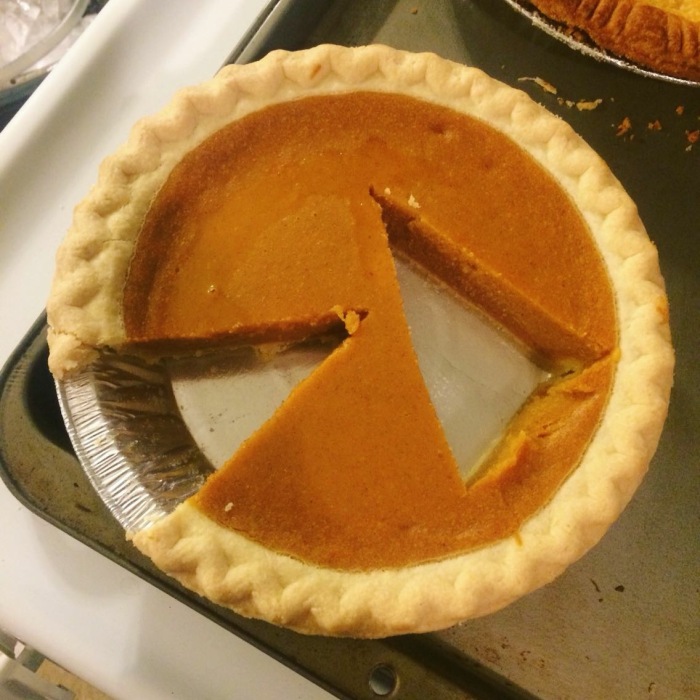
Sheila has just made a fresh pumpkin pie.

She offers you a slice.

You politely refuse, but she insists. She hands you the knife so you can take as big a piece as you like.

You start to cut and then ask, “Does it matter where I cut from?”

Sheila says, “No. Take whatever you want.”

You don’t like crust, so you cut a perfect triangle piece from the middle of the pie.

Sheila’s face reddens.

This wasn’t exactly what she meant, but what is she going to do? You took your slice, and now the rest of the pie is ruined. No one else can take a whole piece. Your choice has limited everyone else’s.

That’s what school choice does to public education.

It privileges the choice of some and limits the choices of others.

Advocates say parents should be able to choose the school their children attend.

And parents today do have many choices. About 90% send their kids to traditional public schools. Others home school, pay for private schools or opt for charter or voucher schools.

The problem comes with these last two options. In both cases, tax money meant to help all children is siphoned off for just one child. In the case of vouchers, tax money goes to pay part of the tuition at a private or parochial school. In the case of charters, we’re diverting tax money to a school that’s public in name but privately run.

That means less money for traditional public schools and more money for privately run institutions. That’s really what school choice is – a way to further privatize public schools.

Why is that bad?

3075829749_0ef3a3692c_z

First, it increases the cost and reduces the services for everyone.


Public schools pool all the funding for a given community in one place. By doing so, they can reduce the cost and maximize the services provided. One building costs less than two. The same goes for one staff, one electric bill, one infrastructure, etc.

When you start adding additional layers of parallel schools, you increase the costs even if you somehow divided the children evenly between the two systems (which hardly ever happens). You buy less with the same money. That translates to fewer services for the same kids, larger class sizes, narrowed curriculum, etc. Why? So that parents could choose School A or School B. So that privatizers get a bigger slice of the pie – right from the middle.

3075829749_0ef3a3692c_z
Second, each type of school has different goals.


Public schools are designed to educate. Corporate schools are designed to profit. Those are their very reasons for existing. It’s built into their DNA and is reflected in the way they’re administrated.

By law, public schools are not for-profit. They pay for goods and services, but at the end of the day, they aren’t beholden to shareholders or investors. They don’t need to bring in more money than they spend. All they have to do is educate children, and if they somehow end up with extra money at the end of that process, that money is bound by law to be reinvested as savings for next year.

Charter and voucher schools are not so constrained. Their reason for being is not education – it is profit. Where they can, they will cut services for children and reduce quality so that they can increase the bottom line. Even a casual glance at the news will show you a plethora of charter and voucher school scandals where privateers have stolen millions of dollars of taxpayer money instead of educating. To return to the dessert metaphor, they don’t care what their slice does to everyone else – they only care about the size of the slice.

3075829749_0ef3a3692c_z

Third, charter and voucher schools aren’t as accountable as traditional public schools.


Each type of school is supported by tax money. Therefore, each school should be held accountable for spending that money wisely. But the rules are radically different for public schools vs. choice schools.

Public schools have elected school boards made up of taxpayers from the community. Choice schools often do not. They are run by appointed boards who are only accountable to investors. Public schools are required to be transparent. Their documentation, budgets and meetings must be available to the media and community for review. This is not true of privatized choice schools.

If taxpayers are unhappy with the way a traditional public school is being run, they have multiple options for changing it. With choice schools, their only option is to withdraw their child. And in the case of taxpayers who do not have children in the system at all, they have no recourse at all. This is fiscally irresponsible and amounts to taxation without representation. This alone should be enough to make any true conservative withdraw support – however ideology has trumped logic and reason. Not only do they ruin the pie, they get to do so in secret.

3075829749_0ef3a3692c_z

Fourth, school vouchers rarely cover the entire cost of attending private schools.


They end up subsidizing costs for rich and upper middle class students while keeping away the poor. As such they create a system of cultural and racial education segregation. They create tiers of schools – the public schools being only for the poor, cheaper private schools for the middle class and expensive private schools for the rich.

This is not the best way to educate children. It is not the best way to organize a society. It entrenches social and class differences and builds in entitlements and racism for the wealthy. Surely our public schools have become more segregated even without vouchers, but that is no reason to make the situation exponentially worse. The size and placement of one’s slice shouldn’t depend on the color of your skin or the size of your bank account.

3075829749_0ef3a3692c_z

Fifth, all schools are not equally successful.


Though the media would have you believe otherwise, traditional public schools do a much better job of educating children than charter or voucher schools. Some choice schools have better outcomes, but the majority do no better and often much worse than traditional public schools. Moreover, children who continually move from school-to-school regardless of its type almost always suffer academically.

So when parents engage in these choice schemes, they often end up hurting their own children. The chances of children benefiting from charter or voucher schools is minimal. You can cut a slice from the center of the pie, but it’s likely to fall apart before you get it on a plate.

our-best-traditional-pumpkin-pie-ss

So in summary, school choice is essentially selfish. Even in cases where kids do benefit from choice, they have weakened the chances of everyone else in the public school system. They have increased the expense and lowered the services of children at both types of school. They have allowed unscrupulous profiteers to make away with taxpayer money while taxpayers and fiscal watchdogs are blindfolded. And when students return to their traditional public school after having lost years of academic progress at a substandard privatized institution, it is up to the taxpayers to pay for remediation to get these kids back up to speed.

Choice advocates talk about children being trapped in failing schools, but they never examine what it is about them that is failing.

Almost all public schools that are struggling serve impoverished students. That’s not a coincidence. It’s the cause. Schools have difficulty educating the poorest children. Impoverished children have greater needs. We should be adding tutoring, counseling and mentor programs. We should be helping their parents find jobs, providing daycare, healthcare and giving these struggling people a helping hand to get them back on their feet.

But instead we’re abandoning them. Most impoverished schools serving poor children receive less funding than those serving middle class or wealthy populations. In other western countries, it’s just the opposite. They provide more funding and resources for poor students to meet their greater needs.

School choice ignores all of this. If I may momentarily switch metaphors, instead of fixing the leak in our public school system, advocates prescribe running for the lifeboats. We could all be sailing on a strong central cruise-liner able to meet the demands of a sometimes harsh and uncaring ocean together. Instead we’re told to get into often leaky escape craft that even under the best of circumstances aren’t as strong as the system we’re abandoning.

And the reason is profits.

Have you ever noticed that the overwhelming majority of school choice proponents are rich white people?

Many of them own charter school companies or otherwise invest in the field. They aren’t advocating a policy to help children learn. They’re enriching themselves at public expense. Sure they point their fingers at union teachers making a middle class wage. Meanwhile these choice advocates rake in public money to buy yachts, condos and jewelry.

Make no mistake – school choice is essentially about selfishness. At every level it’s about securing something for yourself at the expense of others. Advocates call that competition, but it’s really just grift.

Public education is essentially the opposite. It’s about ensuring that every child gets the best education possible. Yes, it’s not perfect, and there are things we could be doing to improve it. But it is inherently an altruistic endeavor coming from the best of what it means to be an American.

We’ve all got choices in life. The question is what kind of person do you want to be? A person who takes only for his or herself? Or someone who tries to find an option that helps everyone?

pumpkin-pie

Former NFL Quarterback Supports Public Schools. That’s Right. PUBLIC Schools!

dictionary

So I’m in my classroom today, teaching, when I see something that stops me cold.

The door opens and in comes former Steelers backup quarterback Charlie Batch.

My mouth falls open. I don’t know what I was talking about. Vocabulary words or something.

The class of 8th graders falls silent, too. All eyes are on the two of us.

Batch looks me right in face with a big smile.

“Here you go,” he says and hands me a shopping bag full to bursting with school supplies and an extra-large tub of hand sanitizer.

By this time I’m probably blushing and grinning like my teeth are about to escape my face.

I hope I was able to mouth a “Thank you,” before he left, but I’m not really sure.

It all kind of happened in a daze.

He came. He gave me supplies. He left.

I guess I shouldn’t have been so taken by surprise.

Batch is a frequent face in my district. After all, he graduated from here, himself, before moving on to college and professional sports.

At the beginning of every year, Batch brings school supplies to every teacher in every building in the district. This was just the first time I was actually in the classroom when he dropped them off. Usually he sneaks in when I’m at lunch duty or in the computer lab. I find them in a neat pile on my desk with a note of thanks – to me!

It’s almost like he doesn’t want to draw attention to it. Almost like he doesn’t want to make us feel like we need to thank him.

It’s his quiet way of giving back to the community that made him.

In some ways it’s the most natural thing in the world. In others it’s truly amazing.

Lots of celebrities make charitable contributions to their communities. Many even put that money into their hometown. But how many invest in the public school system?

Most only seem to have eyes for charter schools. You know – those often cut rate, fly-by-night institutions that are privately managed and publicly funded. Schools that pop up in store fronts or in the mall with a celebrity name on the door and little else.

Rapper Pitbull has opened three of these dubious institutions. Pro-Football Hall-of-Famer Deion Sanders opened two – and closed them both last year. Tennis star Andre Agassi has founded a few and co-founded an organization that rents out properties to other charter schools at a profit. Former NBA players Jalen Rose and Kevin Johnson opened some, too, though Johnson is being investigated for misusing federal funds at his institutions. He likes the industry so much, he even married one of its chief advocates, former D.C. Schools chief Michelle Rhee.

But Charlie Batch? He hasn’t opened a single charter school.

There is no shiny building with his name on it. He hasn’t hired a corporate management team to increase his brand. He isn’t bragging in the newspaper about how he’s “Mr. Education” as Pitbull tried to rename himself.

No. He gives his money to the same public school from which he graduated. And then some!

He did start a charity called the Best of the Batch Foundation, which engages in several initiatives to help underprivileged children in the Pittsburgh region. The organization gives out free backpacks – or Batch Packs – to children in need. More than 7,500 have been distributed to date. About two thirds of my students have them. I can’t imagine what they’d do without them.

Batch also participates in Read Across America Day every March 2. The two-time Superbowl champ visits several western Pennsylvania schools to celebrate Dr. Seuss’ birthday while reading to children his favorite works by the author.

The project is sponsored by the National Education Association (NEA). That’s right. The largest teachers union in the nation. Batch isn’t throwing stones at teachers. He’s out there on the front lines helping us reach children.

In addition, every year Batch partners with the local Rotary Club to help promote literacy. He goes into the schools to read to third graders and give each one a free dictionary. Children also receive lessons how to use them and become word conscious. For some students, this is the only dictionary in their house, and it becomes a tool for all their brothers and sisters up through high school.

Batch also works with local business partners to provide 13 college scholarships to help defer the cost of higher education for needy children. Scholarships range from $1,000 to $8,000 per recipient.

Batch also knows the importance of pre-school. He works with local businesses to provide pre-kindergarten scholarships through the Educational Improvement Tax Credit (EITC) and Opportunity Scholarship Tax Credit (OSTC) programs.

And those bundles of school supplies that he hands out every year – each one contains more than $250 worth of pencils, paper, tissues, etc.

That’s not just a donation. It’s a pencil in the hand of a student who doesn’t have one. It’s notebook paper for a child whose parents are working three jobs just to make ends meet. It’s tissues and hand sanitizer so kids won’t get sick and miss class.

I can’t tell you how much it means to my students and me that Batch is there for us.

He knows what challenges we face because he’s there with us. He isn’t criticizing. He’s taking action.

If only more celebrities would value deeds more than words. If only more people would put themselves out there for our public schools.

If only more people were like Charlie Batch.


NOTE: Charlie Batch also donates school supplies to teachers at our local Propel Charter School. It’s a fact noted nowhere on the Batch Foundation Website. In fact, nowhere does he boast of all the schools he visits. In an age of philanthrocapitalists more concerned about controlling the fields where they donate, Batch is an anomaly. He is apolitical and pro-child.

What My Black Student Taught Me, His White Teacher, About Black Lives

student_081910-thumb-640xauto-704

I can’t tell you how many times Darnell was in detention.

After a while, it didn’t feel right if he wasn’t staying at least an hour after school.

Darnell was late to class.

Darnell swore at another student.

Darnell copied someone’s paper.

Darnell did just about everything and anything that came to his mind. And it earned him time after school with me, his newly-minted 8th grade language arts teacher.

In a class full of mostly brown and black students, many living in an impoverished high crime Pittsburgh suburb, Darnell was the standout. Or at least his misbehavior was.

At first, he complained, but I had his mom on speed dial, and she fully supported my holding him accountable.

He wanted to do his homework during this time, but I made him do busy work instead. The way I looked at it as a young teacher just starting out, if I gave him time to do his school work, it would be a reward, not a punishment.

So I made him copy down dictionary definitions, clean the tables or put up the chairs.

And once he realized there was no way out, he did it all uncomplainingly.

But an hour is a long time, so after a while I let him work on his homework, too.

I had an awful lot of work to do, myself, during these times – piles of papers to grade and lessons to plan – so whatever would keep him quiet would be okay with me.

Unfortunately, Darnell didn’t work that way. He had questions. So many questions.

I had no time, but what else was I gonna’ do?

I answered him. With frustration at first while sitting at my desk.

Then I found myself walking over to him and standing at his table. Then I sat down next to him. And pretty soon we were doing the homework together.

But an hour is a long time, so sometimes he’d finish early. I offered to let him go.

He didn’t want to.

He’d stay and talk: “Did you see the football game, Mr. Singer?”

Or “Did you hear the new Beyoncé album, Mr. Singer?”

Or “How many kids do you have at home, Mr. Singer?”

One day I remember the last bell ringing and looking up to see Darnell at his desk doing homework. I looked back at my stack of papers before I realized – Darnell didn’t have detention today.

I laughed. “You can go home, Buddy,” I said.

“I know,” he replied. “Is it okay if I stay and get this done?”

I shouldn’t have been so surprised. But I was.

I nodded, and he stayed.

I won’t say Darnell ever became a perfect student. He just didn’t have the patience for detailed work. He was more of a big picture guy.

But after months of never turning in homework – years, really – he began to turn all of it in. And I mean all of it!

He wasn’t a great speller, but he started ending all of his sentences with punctuation. And he started all of his sentences with a capitalized word.

He wasn’t a great reader, but he did crack open a few books. Nothing too difficult or complex, but it was more than any teacher I talked to had ever seen him read previously.

At the end of the year, I remember pausing by his desk and praising him.

“Darnell, that’s some mighty fine work you did in here this year,” I said.

And he got this big ol’ grin on his face like he used to get before he was about to engage in some random act of mischief.

“Thanks, Mr. Singer. You’re a really good teacher.”

I smiled and said, “No, Darnell. You’re a good student.”

I remember looking him in the eye to emphasize it. This was a kid with a reputation. I’ll bet few teachers had ever commended him on his school work before.

Then the year ended, and he was gone.

He went on to 9th grade and did even better than in my class. The same in 10th, 11th and 12th.

Oh, sure. He was still a handful and got himself in trouble lots of times. But he did his work and didn’t fail his classes.

I kept an eye on him like I do all my students when they leave me. I try to keep tabs, but there’s always a new bunch just waiting for you at the beginning of the year.

You remember anytime you think about it, which isn’t much.

So it was years later when I heard the news.

Teachers were shaking their heads in the faculty room. The principal held a meeting to tell us about it in case any of our current students were upset, in case any of us had Darnell’s cousins, brothers, sisters, or friends.

He was only 18 when he was murdered.

Shot down in the streets from a passing car.

Police still don’t know whether he was the shooter’s target or if he was just at the wrong place at the wrong time.

The high school teachers, who knew Darnell best, said he had really straightened up his act. He had gotten into community college, wanted to be an engineer.

And they shook their heads. What else was there to say?

I walked back to my classroom and opened a file cabinet.

Inside was a bunch of dusty manila folders – one for each child I had ever made serve a detention.

It didn’t take long to spot Darnell’s. It was one of the thickest.

I opened it up and took out the stack of papers inside.

There were doodles of monsters and basketball players. There were lists of badly spelled vocabulary words in his adolescent handwriting. And there were these halting paragraphs about what he’d done to get detention and how he’d never do it again.

“I’m sorry I wuz late 2 class. I will ask to use bathrom before going.”

“i will not copy LaRonns paper. i will do it myself.”

I read through them all. Every one. I read them again and again until long after everyone else but the janitors had left the building.

I had spent so much time with Darnell.

I had poured my soul into that kid.

But what had it truly accomplished?

He is dead. A victim of his environment. Nothing but a number, a statistic, a footnote.

Just not to me.

By all accounts he had been trying to do good, trying to make something of himself. But it wasn’t enough. Bullets don’t discriminate between the hardworking and the lazy. They just do what they do.

In my mind I tried to see him walking home, a stack of books weighing him down, making him slow. I saw him walking past those ramshackle apartments and slums, that shady park with the broken benches, the street corners where you could buy heroin or pills or weed.

If he was white, would it have been different? If he was white and didn’t live in the “bad neighborhood,” would it have mattered?

If his mom didn’t have to work two or three jobs, would it have helped? If he had someone at home to watch him instead of a bunch of younger siblings and cousins to watch, would things be different?

I don’t know.

But I DO know that there is a list of dead children in my community – some of them my former students – and almost all of them are black.

Darnell wasn’t killed by a policeman, but I’m sure they knew his name. He used to tell me how the cops would often follow him and his friends into the grocery store. “Why they always be doin’ that?” he’d ask me. And I’d just shrug thinking about all the times he’d wait until I wasn’t looking before slapping another child on the neck.

But if Darnell had been white, would we have had different expectations of him? Would we have given him the benefit of the doubt to begin with – like we do white kids?

I wasn’t a very good teacher to Darnell. Every scrap of respect I gave him he had to earn. Why didn’t I give him that respect at the start? Why didn’t I expect the best and then change my expectations as the situation dictated? Why did I instead expect the worst and alter my expectations from there?

I never questioned if or why Darnell was seeking my attention. I just thought of his bad behavior. It was something I wanted to change, so here’s a punishment.

I never offered Darnell my help. I offered help to the class as a whole but not to Darnell individually. Not until he wore me down. Not until helping him was easier than arguing with him.

I never thought about Darnell’s needs. I thought about MY needs of Darnell. I need him to behave so I can teach. Never Darnell’s needs to behave so he can learn.

And there are so many other kids out there like him. I’ve taught so many other little Darnells.

I approach them differently now. It’s a lesson he taught me.

I may have bestowed upon him some spelling and grammar. He taught me humanity. Who is the better teacher?

He taught me to look at black children in a different way.

He taught me to come to them on their terms. To begin anew with an expectation that they will do well no matter what they’ve done in the past. He taught me to look beyond their behaviors and see them as little people. It’s a lesson I’ve never forgotten, and it informs my teaching to this day.

As I sat there with that stack of dusty folders, I realized it doesn’t end at the classroom door.

I used to think being a parent, myself, I had an interest in the future. But that’s not entirely true. Being a parent is one of the most rewarding things you can do, but it isn’t selfless. It only means you care about your child. Not all children.

And that’s where being a teacher is different. After a while, you can’t be selfish anymore. You can’t care for only some people’s futures. You are essentially invested in a future for all, for everyone.

You can try to draw a line in the sand and say “I only care about THESE kids,” but it doesn’t work. You find yourself caring about all of them, all of the children who will become our world when we crumble to dust.

That’s how it should be for everyone.

As a human being, it is my responsibility to fight to make this world a better place for people like Darnell. It’s my responsibility to make sure they all have a future.

But it goes beyond even that. I’m not just any person. I’m a white person.

All the things stacked against a kid like Darnell were stacked in my favor. I lived in a good neighborhood. Police never followed me anywhere. No matter how much I misbehaved, it was always expected I wouldn’t cause any trouble – unless I did.

So it’s my responsibility as a white person to fight my privileged place in society. It’s my responsibility to ensure that black people aren’t held back by entitlements I have not earned and handicaps they do not deserve.

As a white teacher, it is my responsibility to see the best in my children – in ALL of my children. It is my responsibility to meet them where they are and give them support and nurturing and love.

To do so I must see beyond the walls of invisible prejudice. I must see the hurdles, the traps, the maze so I can help them overcome it.

Because Darnell never got to go to college. He never got to become an engineer.

But his life mattered.