This Fathers Day Let’s Be Worthy of Our Children

Fathers-Day-Gifts-for-Kids-to-Make


My daughter wrote me a card for Father’s Day.


It had a heart on the front and the following message on the back:


“Happy Fathers Day! Dad, you are my superstar. You help me when I’m sad. And I love everything you do for me. That is why I wish you a Happy Fathers Day.”


It was a sweet token of affection from a 9-year-old to her sleepy daddy sitting at the kitchen table.


But it got me thinking.


All over this country fathers are probably receiving something similar from their children.


Hawaiian shirts, blotchy neckties and more finger paintings than you could fit in the Louvre.


But the sentiment is probably the same.


Thank you for being there for me.


But are we there for America’s children?


We may be there for our own kids, but where genetics end, are we there for others?


Our government has separated approximately 2,000 children from their parents at the border, according to the Department of Homeland Security.


Two thousand children forcibly separated from their parents in our name and we dare to celebrate Father’s Day?


From April through May, the policy has separated 1,995 minors from 1,940 adults traveling with them who said they were the children’s guardians.


A country that doesn’t respect the rights of parents – even if those parents aren’t documented US citizens – has no right to pretend it values fatherhood or motherhood.


At best, we value WHITE parenthood, and that, my friends, is not good enough.


Look at what we subject our own children to in the public school system.


We segregate our schools by race and class so we can horde resources for wealthy and middle class white kids while providing the bare minimum to the poor and children of color.


In the name of accountability we bestow upon them high stakes standardized tests to “prove” even those meager funds are wasted – yet we ignore the financial disparity, the social problems, the health issues and a host of other obstacles the underprivileged face.


The only help we’re willing to offer is privatized schools that can pocket a portion of their funding and reduce resources for these kids. We demand local control and democratically elected school boards for rich white kids, but expect the poor brown ones at charter and voucher schools to get along with appointed boards where their parents have no choice except to take it or leave it.


Does a society that routinely treats its children this way deserve a thank you card? I think not.


Last month, the CDC released a report indicating that the U.S. birth rate ― the number of babies born nationwide ― is the lowest it’s been in 30 years and is below the “replacement” rate needed to sustain the population.


Various media sources were quick to blame women nationwide. Women put off having kids because they want to focus on careers. They aren’t sexy or submissive enough.


Yet few look at the responsibilities of men in this equation.


Who is it behind the salary gap between men and women? Who conflates women’s healthcare with abortion and communism? Who makes it easier to get a gun in this country than proper maternity leave, childcare or any adequate resources to make having a family sustainable?


Answer: men.


We’re grossly over-represented in government, business and management.


We don’t even support men who want to have families. Men make more money than women, but salaries are down for them as well. If there’s little support for pregnant women, there’s little support for the fathers who impregnated them.


We pretend family values are the bedrock of our society but we don’t do much to support families.


And when we look to the future, it doesn’t appear to be getting any better.


Big business and huge corporations are salivating all over the prospect of further monetizing our children.


They’re piloting scores of so-called personalized learning programs, apps and devices to spy on children and monitor every aspect of their learning.


Not only are they asking kids whether they feel excited or bored by canned test prep lessons provided on-line, they’re focusing cameras on children’s faces, monitoring their breathing and heart rate. They’re collecting mountains of data with little accountability, privacy or even the promise of these things.


Investment bankers and hedge fund managers are funding these programs and more to create a priceless database on each individual child that can be used for lifelong marketing, job placement, even profiling by law enforcement.


These are not practices that are done in the best interest of children. They are in the best interest of investors and free market privateers.


No wonder fewer people are having children! They don’t want their kids to become helpless victims to a society that cares less and less about our humanity and more and more about our marketability.


It is us vs. them – where the us is significantly limited by race, economics and class.


So this Fathers Day, we need to do more than accept a congratulatory pat on the back.


We need to accept our responsibility for the status quo.


If we don’t like the way things are, we need to commit ourselves to doing something about it.


Call and/or write your Senators and Representatives about the policy of separating undocumented parents and children. Visit your lawmakers’ offices and demand fair funding and an end to school segregation, high stakes testing and school privatization. Get active in your local school district going to meetings and making your voice heard. Do everything you can to educate the powers that be on the coming Ed Tech scandal and remove or block it from your district.


We’re not just fathers on Fathers Day.


We’re fathers all year long.


Let’s do something more to deserve it.


Like this post? I’ve written a book, “Gadfly on the Wall: A Public School Teacher Speaks Out on Racism and Reform,” now available from Garn Press. Ten percent of the proceeds go to the Badass Teachers Association. Check it out!

WANT A SIGNED COPY?

Click here to order one directly from me to your door!

book-3

“He Was Kind” – My Students Describe What I’m Like as a Teacher

13-your-childs-teacher-stundet-hug


What’s the most important attribute of a good teacher?


Some might say intelligence.


You want a teacher who knows the subject matter and can convey it clearly to students.


Others might say classroom management.


You want a teacher who keeps things organized and gets kids to behave.


But for me the most important thing a teacher can be is kind.


I’m not saying intelligence, classroom management and a host of other qualities are unimportant, but if you approach your students with good will in your heart, the rest seems to fall into place.


This isn’t a long-held pedagogical belief I could have articulated for you at the beginning of the school year.


It came to me – as did so much else – from my students.


At the end of the year as my 7th graders are finishing up their final projects and we’re tidying up the room, I always give them a little survey about their experience in the class.


“I’ve been grading you all year,” I say. “Now’s your turn to grade me.”


The surveys can be anonymous – kids needn’t put down their names, and whatever they write has no impact on their grades.


Yet the results are always enlightening.


I wrote in detail two years ago about the survey and the kinds of responses I often get.


But this year it was one of the simplest comments that really got me thinking.


“He was kind.”


IMG_9669


That’s what one of my students told me that I had done especially well during the year.


“He was kind.” That’s all.


It was a response that was echoed by many of my students.


Another child wrote:


“He was kind (and awesome). One of the best teachers.”


IMG_9668


And another:


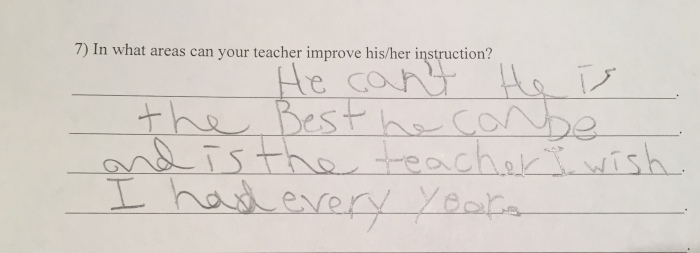
“He can’t [improve]. He is the best he can be and is the teacher I wish I had every year.”


IMG_9674


This is all very flattering, but what exactly did all this niceness mean?


How did being a kind teacher help me do my job? What did I do that helped students learn?


They had an answer for that, too:


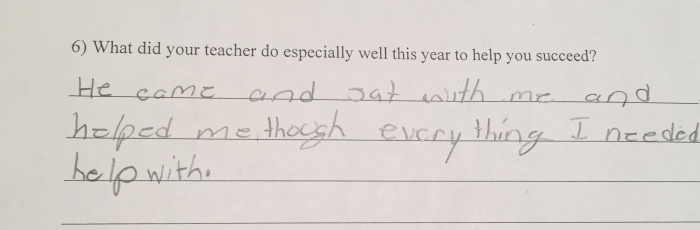
“He came and sat with me and helped me through everything I needed help with.”


IMG_9675


***


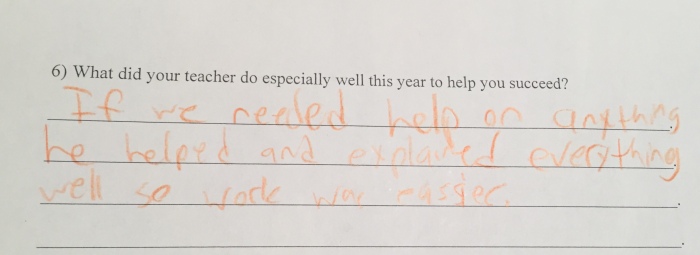
“If we needed help on anything he helped and explained everything well so work was easier.”


IMG_9662


***


“What my teacher did to help me succeed was that he made me feel motivated to do the work in class and not giving us so much work at once.”


IMG_9664


***


“[He] taught me how to write essays, indent on papers and showed me a lot of useful things.”


IMG_9677


Another particularly enlightening comment was this one:


“I don’t know [how he could improve], but in this class you grew with us. So uh yeah.”


IMG_9667


And I do try to change and grow with my students. When your mandate is to individualize instruction to fit each particular child, I don’t know how you can do otherwise.


This means opening yourself up and letting students know who you are and what you stand for.


I try not to inflict my political, religious or philosophical beliefs on my classes. However, I think some core values come through.


For instance, my students knew I was going to Connecticut to give a TED Talk on the current state of public schools.


They knew my thoughts on standardized testing and school privatization – perhaps not in detail but the general shape of them, certainly. They knew my firm conviction against racism, sexism and prejudice of any kind.


Perhaps that’s why one of them wrote this:


“You’re not only a good teacher. You’re a good friend, and man.”


IMG_9673


***


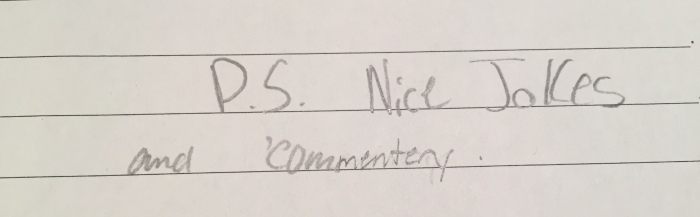
“P.S. – Nice jokes and commentary.”


IMG_9671


Of course there were dissenting opinions. One child thought I was too nice:


“He is way too nice for me and you give way too much essays for people to handle. But overall grade 94%. He doesn’t like Tom Brady so yeah. And he likes the Steelers.”


IMG_9679


I guess no one’s perfect. But how interesting she thought either she deserved a stronger hand or would have been more motivated by fear and consequences. Yet I have to take her with a few grains of salt because this student identified herself on her response and had a friendly rivalry with me about football. She said I was too nice but then referenced our interpersonal rapport.


Another student highlighted how I wasn’t excessively permissive:


[He was good at] “Helping me with instructions and keeping me on task.”


IMG_9670


Most comments were unbridled approbation:


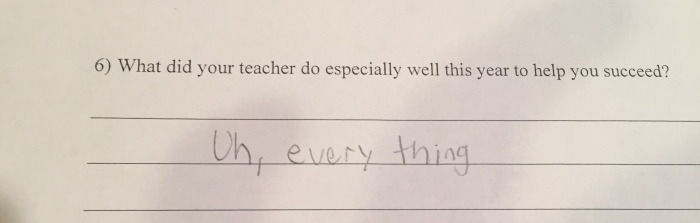
What did your teacher do especially well this year to help you succeed? – “Uh, everything.”


IMG_9666


***


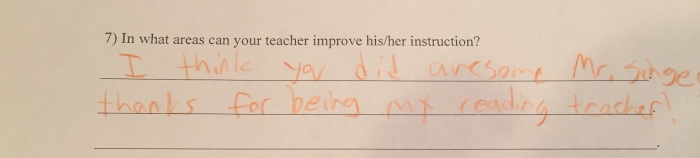
In what areas can your teacher improve his/her instruction? – “I’m not sure. That’s how good a teacher he was.”


IMG_9676


***


“I think you did awesome, Mr. Singer. Thanks for being my reading teacher!”


IMG_9663


***


“I don’t think my teacher needs to improve. He’s already a great teacher.”


IMG_9665


And so another school year comes to an end.


I’ll miss this class. It was the first year I taught exclusively 7th grade. I’d taught one or two sections of that grade before, but never only that grade.


I’m more used to 8th grade. You wouldn’t think there’d be a world of difference between the two. And who knows? Perhaps if I teach the same grade level next year things will be even more unexpected because the kids will be different.


But when that final bell chimed, I was surprised that so many kids came up to me with hugs and tears.


They really didn’t want to see me go, and, frankly, I don’t want to see them go, either.


If I could follow them next year, I would.


I gave them everything I had to give.


I gave them my heart. I shared with them my life.


And I got back so much more.


That’s what non-teachers don’t understand.


Education is created through often reciprocal relationships.


Learner and teacher are tied together in a positive feedback loop. Sometimes it’s hard to tell which is which and sometimes there is no difference at all.


Thank you so much, last year’s students.


Thank you for letting me be your teacher.


Thank you for bringing out the best in me as I tried to do the same for you.


Like this post? I’ve written a book, “Gadfly on the Wall: A Public School Teacher Speaks Out on Racism and Reform,” now available from Garn Press. Ten percent of the proceeds go to the Badass Teachers Association. Check it out!

WANT A SIGNED COPY?

Click here to order one directly from me to your door!

book-2

Don’t Worry About Grade Inflation. Worry About Grading Fairly.

your-childs-grades-go-down-1494627682


Hard work should be rewarded.


If you earn an A in a given class, you should get an A on your report card.


And this is true no matter how many of your classmates work just as hard as you do.


If everyone in class gives it their best shot, they should all get A’s. It is not the teacher’s job to split hairs and sort kids into arbitrary categories in order to preserve a monetary myth about grades’ value based on a model of scarcity.


Those who demand otherwise are under the spell of one of the oldest myths in academia – grade inflation.


It goes like this: You can’t give all your students excellent marks! That would devalue what it means to get an A!


To which I reply: Bullshit.


Almost every plane that leaves an airport lands safely. Does that devalue what it means to travel? When you arrive at your destination, are you upset that everyone else has arrived safely or would you feel better if some of the planes crashed?


According to the American Journal of Public Health, 93% of New York City restaurants earn an “A” from the health department. Does that shake your faith in the food service industry? Would you feel better if more restaurants were unsanitary? Would your food digest more efficiently if there were more people going home with stomach pain and food poisoning?


Of course not! In fact, these stats actually reassure us about both industries. We’re glad air travel and eating out is so safe. Why would we feel any different about academia?


The idea of grade inflation is a simple imposition of the concept of economic value onto learning. It has no meaning in the field of academics, psychology or ethics. It is just some fools who worship money imaging that the whole world works the same way – and if it doesn’t, it should.


It’s nothing new.


Conservatives have been whining about grade inflation for at least a century. It’s not that the quality of teachers has declined and they’re letting all their students pass without doing the work. It’s that certain types of curmudgeons want to justify their own intelligence by denying others the same privilege.


It’s the “I’ve Got Mine” philosophy.


We see the same thing with Baby Boomers who grew up in the counter culture and pushed for progressive values in their youth. Once they got everything they wanted for themselves, they became conservatives in their old age and worked to deny the same things for subsequent generations.


It’s the very definition of Age scoffing at Youth – a pathology that goes back at least to Hesiod if not further. (Golden age of man, my foot!)


Moreover, there is no authentic way to prove grade inflation is actually happening. Grades are a subjective measure of student learning. They are human beings’ attempt to gauge an invisible mental process. At best they are frail approximations of a complex neural process that is not even bounded temporally or causally. If a student doesn’t know something now, they may come to know it later even without further academic stimulus. Moreover, isolating the stimulus that produced the learning is also nearly impossible.


The important thing is not grade inflation. It is ensuring that grades are given fairly.


If students work hard, they should be rewarded.


I am very upfront with my students about this. And doing so seems to have a positive and motivating effect on them.


This year, I had students who told me they had never read a book from cover-to-cover before my class. I’ve had students look at their report cards in shock saying they’ve never received such high marks in Language Arts before. And doing so makes them want to try all the harder next year to repeat the results.


They leave me excited about learning. They feel empowered and ready to give academics their all. Because the greatest lesson a teacher can instill is that the student is capable of learning.


Don’t get me wrong. I don’t just hand out these grades. Students have to earn them. They have to demonstrate that they have actually learned something.


Everyone rarely measures up to the challenge. But that’s not the point. Everyone COULD. There is nothing in my design that prohibits that outcome. I don’t start with the assumption that I’ll only have 3 A’s, 4 B’s, 10 C’s, etc.


In fact, it is THAT scarcity model that dumbs down academics. If I grade on a curve like that, I have to give out a certain number of high marks regardless of achievement. I’m committed to giving out those 3 A’s regardless of whether that trio of students deserve it or not. However, in my abundance model, I give exactly the number of A’s that are deserved. If that’s zero, no one gets an A. If that’s everyone, then everyone gets an A. It all depends on what students actually deserve, not some preconceived notion about how the world works.


To do this, I give very few tests. I just don’t find them to be very helpful assessments.


A test is a snapshot of student learning. It has its place, but the information it gives you is very limited.


Most of my grades are based on projects, homework, essays, class discussion, creative writing, journaling, poetry, etc. Give me a string of data points from which I can extrapolate a fair grade – not just one high stakes data point.


This may work to some degree because of the subject I teach. Language arts is an exceptionally subjective subject, after all. It may be more challenging to do this in math or science. However, it is certainly attainable because it is not really that hard to determine whether students have given you their best work.


Good teaching practices lend themselves to good assessment.


You get to know your students. You watch them work. You help them when they struggle. By the time they hand in their final product, you barely need to read it. You know exactly what it says because you were there for its construction.


For me, this doesn’t mean I have no students who fail. Almost every year I have a few who don’t achieve. This is usually because of attendance issues, lack of sleep, lack of nutrition, home issues or simple laziness.


I only have control over what happens in the classroom, after all. I can call home and try to work with parents, but if those parents are – themselves – absent, unavailable or unwilling to work with me, there’s little I can do.


And before you start on about standardized testing and the utopia of “objectivity” it can bring, let me tell you about one such student I had who was not even trying in my class.


He never turned in homework, never tried his best on assignments, rarely attended and sleepwalked through the year. However, he knew his only chance was the state mandated reading test – so for three days he was present and awake. The resulting test score was the only reason he moved on to the next grade.


Was he smart? Yes. Did he deserve to go on to the next grade not having learned the important lessons of his classmates? No. But your so-called “objective” measure valued three days of effort over 180.


The problem is that we are in love with certain academic myths.


MYTH 1: Grading must be objective.


WRONG! Grading will never be objective because it is done by subjective humans. These standardized tests you’re so in love with are deeply biased on economic and racial lines. Whether you pass or fail is determined by a cut score and a grading curve that changes from year-to-year making them essentially useless for comparisons and as valid assessments. They’re just a tool for big business to make money off the academic process.


MYTH 2: Learning is Economics.


WRONG! Grades are not money. They don’t function in any way like currency or capital. They aren’t something to be bought and sold. They are an approximate indication of academic success. Treating them as a commodity only degrades their value and the value of students and learning, itself.


Treating grades economically actually represses the desire to learn, dispels curiosity and eliminates the intrinsic value of education.


So go ahead – inflate the “value” of your grades.


Give A’s to every student who deserves it.


That’s how you promote learning and fairly assess it.


Like this post? I’ve written a book, “Gadfly on the Wall: A Public School Teacher Speaks Out on Racism and Reform,” now available from Garn Press. Ten percent of the proceeds go to the Badass Teachers Association. Check it out!

WANT A SIGNED COPY?

Click here to order one directly from me to your door!

book-1

Dear Betsy DeVos, I Will NEVER Report My Students to ICE

4e78f0eb558f3.image 


Teachers fill a lot of roles in our public schools.


We’re mentors to kids in need.


We’re aides to students struggling with new concepts and skills.


We’re homework-givers, pencil-providers, idea-encouragers, lunch-buyers, scrape-bandagers, hand-holders, hug-givers, good listeners, counselors, caregivers and – yes – sometimes even butt-kickers.


It’s no wonder that we occasionally get mistaken for mothers and fathers.


But one thing we will never be is a snitch.


Secretary of Education Betsy DeVos recently intimated that principals and teachers could report their undocumented children to Immigration and Customs Enforcement (ICE).


She’s not going to say what we should do one way or another. She’s just saying that this is something we COULD do if we wanted.


If that results in those kids and their families being deported, well we are a nation of laws, after all.


It’s a remark that sounds so reasonable to some folks.


Luckily, I speak dog whistle.


So did the U.S. Supreme Court back in 1982 when justices ruled in Plyler v. Doe that schools cannot deny children their right to a free education based on immigration status.


When kids are afraid to learn because they or their parents or extended family may be undocumented, that has a smothering affect on the classroom.


When ICE raids a local business, we see a sudden drop in class attendance.


So if students thought their teachers or principals were scrutinizing them to determine their citizenship status, we’d be discouraging many with brown skin or extra-national credentials from ever coming back.


By suggesting that educators have a choice whether to obey established law or to become self-appointed border patrol officers, DeVos actually is prescribing how we should act.


Well, not this teacher, Betsy.


Not now. Not EVER.


No matter who you are – black, white or brown – a public school is a sanctuary. It is where kids of all different races and creeds come to escape from the ravages of poverty, violence and indifference.


Teachers are not the enforcers of our broken, bent and biased immigration policy. It is not our job to oblige xenophobia and bigotry.


It is our job to teach, to protect and inspire.


Sure, I’ve made my fair share of calls to parents, healthcare professionals and Child Protective Services.


I’ve reported abuse, addiction and mental illness.


But I did that to protect my kids. And I do think of them as my kids.


When these little people come toddling into my class, I take a kind of ownership of them.


For the time they’re here, we’re family. I take interest in their lives and they take interest in mine.


They know all about my wife and daughter, my parents and grandparents. And I know about theirs.


We don’t just learn grammar, reading and writing. We share our lives with each other.


We share a mutual trust and respect.


If I reported even a single student for a suspected immigration violation, I would lose that forever.


It’s sad how much things have changed in a little over year.


Hispanic names have become Anglicized. Angelo has becomes Angel. Julio has become Jules. Jorge is now George.


The dulcet melody of Spanish has been silenced. You’ll only hear it in muffled voices if you wander by a few lockers, but never in class.


My kids aren’t even 13 yet, but many of them have already learned to hide.


Don’t appear different. Don’t let anyone know your roots extend beyond national borders.


Be “normal.” Be homogenized, bland American.


That’s the world we’ve built and it’s the one that DeVos is encouraging with her tin pot nationalism.


Some things don’t change when you cross municipal lines – human decency is one of them.


So I won’t be reporting any of my students to ICE.


I won’t help the Gestapo separate parents and children based on citizenship status.


I won’t help set up ethnic checkpoints where armed guards get to ask “suspicious persons” for their papers.


White supremacy was bad enough before Trump was elected. I won’t help the unfortunately named Department of Homeland Security become the protector of a new white trash Fatherland.


I will defend my students. I will stand up for their safety and their rights.


That’s just what we do in public school. We look after our own.


Like this post? I’ve written a book, “Gadfly on the Wall: A Public School Teacher Speaks Out on Racism and Reform,” now available from Garn Press. Ten percent of the proceeds go to the Badass Teachers Association. Check it out!

WANT A SIGNED COPY?

Click here to order one directly from me to your door!

book-2

Modernizing Education Starts With Questioning Our Assumptions

iStock_000040220958_Small-685x485


When it comes to education, we take an awful lot for granted.


For example, we look at learning almost entirely from a behavioral standpoint.


Teachers provide inputs. Students give outputs. And those outputs demonstrate the intended learning.


Yet this framework was developed in the early 1900s. Using it today is to ignore a century of subsequent psychological advancements. It glosses over the impact of the unconscious, the social nature of understanding, physical differences, even the mediating thought processes between stimulus and response such as memory and problem solving.


Instead, we force students into inauthentic laboratory conditions (i.e. the classroom) upon which they are passive actors to be molded and shaped by expert educators.


Every time we post our learning objectives on the board or when we write our lesson plans beginning with the old chestnut – Students Will Be Able To (SWBAT) – we are hearkening back to early 20th Century thinking a hundred years out of date.


We are enshrining a host of assumptions long past their fresh by date:

-Learning is observable.


-It happens immediately.


-It is measurable.


-Once you learn something it never goes away.


-Most problems with learning are attributable to inputs provided by the teacher.


None of these assumptions have been proven.


In fact, there is considerable evidence against each and every one of these premises, yet our entire system of corporate education is based on them like a house built on a foundation.


If we are truly to create a 21st Century school system, the only place to begin is here. Recognize our bedrock beliefs are mere speculation and question whether we should really support everything else that’s been built on such shaky ground.


WHAT IS LEARNING?


It is an empirical fact that human beings are capable of learning. It’s something we do every day. But what exactly does it consist of? What happens when a person learns?


Perhaps it’s best to start with a definition. We generally characterize learning as the acquisition of knowledge; the possession of facts, information or skills.


But how does one gain knowledge? How does one possess the intangible?


It seems that learning always involves thoughts – usually conscious impressions but sometimes unconscious ones, as well. However, not all thoughts qualify, only thoughts of a certain kind.


The notion must be true of the world. And often it is an idea that has surfaced before but that now can be recalled at will and used to create new concepts.


Perhaps I’m wrong, but it seems that no matter how you flesh it out, we’re talking about internal mind states.


Learning takes place in and of the brain. And this has consequences for our education system – an apparatus designed to make these brain states more frequent along certain prescribed lines.


IS LEARNING OBSERVABLE?


That depends. Can we lop off the top of students’ heads and peer at the gelatinous mass inside?


Not really. And even if we could, we wouldn’t understand what we were seeing.


Even if learning may be reducible to a complex set of on-and-off switches among synapses, that does not make it generally observable – certainly not without greater knowledge of how the brain works and advanced neural imaging equipment.


As such, the idea that learning is directly perceptible is not necessarily true. It may be evident in some second hand manner, but this is not the same as first hand experience. At best, what we see is a pale shadow of what’s actually going on in students’ gray matter.


That alone should send shock waves through the edifice of modern corporate education. We’ve built an entire apparatus to label and sort kids based on observing students. If those observations are inadequate to give us the full picture of these internal learning states, our system is likewise inadequate.

WHAT IS THE ROLE OF TEACHER INPUT?


To answer this question we must start further back – when and why does learning takes place.


A student experiences a new neural state that constitutes the acquisition of knowledge. Why?


Does it happen because of the input made by a teacher? Is it the result of experience? Is it the result of some other input – reading, interacting, writing, doing something? Or is it the result of something even the student him- or herself cannot easily identify or explain?


All of these are possible. All of these (and more) are the catalyst to learning at various times.


Thus we lose another premise – that teacher input is the essential cause of inadequate learning. If we cannot place a primacy on the teacher, we cannot wholly place blame there either.


Certainly teachers are important. They can have a tremendous impact on their students. But they are not strictly necessary. They are not even the prime cause of learning. They facilitate learning in the way a doctor facilitates healing. The surgeon may set the broken bone, but it is the body that actually does the healing. And in the case of learning, the action is not entirely involuntary. It is much more active and intentional.


In short, teachers can call students attention to something that sparks learning. They can bring about optimal conditions for learning to take place. But they are not by themselves sufficient for that learning. They cannot make it happen. Insofar as it is voluntary at all, it is up to the student. To give teachers sole reward or blame for student learning is absurd.


IS LEARNING IMMEDIATE?


Learning may be a response to stimulus of some kind. But when does that response take place? Is it immediate?


There is no evidence that it must be so. Certainly there are times when one has learned something immediately. When a child first puts her finger in the flame, she quickly learns to remove it. However, there are some lessons that we don’t learn until many years after that stimulus. For instance, that our parents’ advice was often more sage than we initially gave it credit.


Thus, again it is inadequate to place reward or blame on teachers for their students’ learning. You can judge a teacher for what he or she did to help, but not what you take to be the result. Just because the teacher’s input may not have sparked learning in the student now, that doesn’t mean that the same input might not engender learning at a later date, given time.


IS LEARNING PERMANENT?


Which brings up another question – once you learn something, does it remain yours forever or is it susceptible to degradation?


If learning is an internal state – if it is the result of neural connections like any thought or memory – it is susceptible to fading. It can be lost or degraded.


Therefore, when students enter a class without prerequisite knowledge, it is not necessarily the fault of their previous teachers. Like any skill, memory or thought – recall is enhanced through repetition. Using the knowledge often results in greater retention.


If we want a more intellectual society, we should habitualize critical thinking and reward intelligence in our public interactions. Not the exact opposite.


CAN LEARNING BE MEASURED?


And finally, we are brought to perhaps the most vital question in the field of education – measurement.


What did students grasp and to what degree was it mastered?


There is an entire industry based on providing accurate accounting of learning.


There are corporations making billions of dollars based on providing this service. Moreover, the school privatization industry is almost completely predicated on the “failure” of public schools as shown by the measurements of these testing corporations.


As such, there is a tremendous amount of economic pressure to keep this premise that learning can be accurately measured. However, when looked at logically, it cannot be supported.


When we measure learning, what are we measuring? And how are we quantifying it?


If learning is an internal state, how do we calculate that? Possibly at some point in the future, we’ll be able to look at real time pictures of the brain and be able to tell which information has been learned and to what degree. But we are not at that point now. Perhaps we will never be.


Even if we were, what exactly would we be measuring? What units would we be using? Volts? Amps? Some new element susceptible to subdivision?


The fact that we can’t give a definitive answer to that simple question illustrates how vast our ignorance is of learning. We do not understand what goes on in our own heads that constitutes understanding expect in the broadest possible terms.


Yet how much importance we put on these crude attempts to measure the ineffable!


Grades and test scores are but the rudest approximations of the real phenomena hidden inside our skulls. Yet we sort and rank students on the pedagogical equivalent of cave paintings.


“It is easier to measure the number of semicolons used correctly in an essay than the wonderful ideas contained within it,” said Alfie Kohn. “The more focused you are on measurable outcomes, the more trivial your teaching tends to become.”


Or as Linda McNeil of Rice University famously observed, “Measurable outcomes may be the least significant results of learning.”


Kohn has repeatedly suggested that McNeil’s statement ought to be printed out in “36-point Helvetica, framed, and tacked to the wall of every school administrator’s office in the country” for these same reasons.


When we talk about knowledge and learning, we don’t know what we’re talking about.


CONSEQUENCES


That should make us reluctant to say anything definitive about learning beyond our own ignorance of it.


Yet, as in so much of human affairs, when has ignorance ever stopped us?


We have to go about the business of educating. We have a society to run, markets to establish and consumers to exploit.


Imagine if, instead, we approached learning like explorers or scientists, mapping the shores of our ignorance and determining what helps us comprehend more and better.


There are so many tantalizing clues about what helps students learn, ways to foster the spark of inspiration, creativity and critical thinking.


I wish we were invested in that activity instead of a capitalist sham of education. We talk much about the skills gap between white and black kids without doing anything constructive about it – a chasm predicated on the fact that one category is predominantly poor and the other privileged.


Perhaps we would do better to talk about the ignorance gap of our own understanding of what it means to understand.


Perhaps then we wouldn’t be so bold as to monetize that which is fallacious and foolhardy.


Perhaps then we would be more curious, thoughtful and kind.


Perhaps then we could build a truly modern system of education that values students and not just how they can be transformed into profit.


Like this post? I’ve written a book, “Gadfly on the Wall: A Public School Teacher Speaks Out on Racism and Reform,” now available from Garn Press. Ten percent of the proceeds go to the Badass Teachers Association. Check it out!

WANT A SIGNED COPY?

Click here to order one directly from me to your door!
book-2

Grades and Test Scores Don’t Matter. A Love of Learning Does.

Screen Shot 2018-05-04 at 8.28.42 AM


My daughter probably would be shocked to discover what I truly think about grades.


They don’t matter all that much.


The other day she brought home a pop quiz on sloths from her third grade class. It had a 40% F emblazoned on the top in red ink.


I grabbed the paper from her book bag and asked her to explain what had happened.


She smiled nervously and admitted that she had rushed through the assignment.


I told her I knew she could do better and was very disappointed.


Then we reread the article in her weekly reader and found the right answers to the questions she’d missed.


But if my little girl would be stunned, my students would probably be even more gobsmacked!


As a 7th grade Language Arts teacher, it’s my job to hand out grades. And I don’t give my students too much slack.


Just this morning, I turned to one of my kiddos placidly drawing a Spider-Man doodle in homeroom and asked if he had given me yesterday’s homework.


He wasn’t sure, so I pulled up the gradebook and surprise, surprise, surprise – no homework.


So he took out the half-completed packet, promised to get it done by the end of the day and promptly began working on it.


Don’t get me wrong. No one would ever confuse me for a teacher obsessed with grades and test scores.


I’m way too laid back for that. But my students know I will penalize them if they don’t hand in their assignments. And if it isn’t their best work, I’ll call them out on it.


The way I see it, grades and test scores offer an approximation of how well a student tries to achieve academic goals.


In Language Arts classes like mine, that’s reading, writing and communicating.


After a year of study, I want my students to leave me with an increased ability to read and understand what they’ve read. I want them to form a thoughtful opinion on it and be able to communicate that in multiple ways including verbally and in writing.


An overreliance on testing and grading can actually get in the way of achieving that goal.


According to a University of Michigan study from 2002, a total of 80% of students base their self worth on grades. The lower the grades, the lower their self-esteem.


Common Core fanatics like Bill Gates and David Coleman probably would say that’s a good thing. It provides incentive for children to take school seriously.


However, I think it transforms a self-directed, authentic pursuit of knowledge into grade grubbing. It makes an intrinsic activity purely extrinsic.


Learning no longer becomes about satisfying your curiosity. It becomes a chase after approval and acceptance.


We already know that measuring a phenomena fundamentally changes that phenomena. With a constant emphasis on measurement, children become less creative and less willing to take risks on having a wrong answer.


That’s one of the reasons I prefer teaching the academic track students to the honors kids. They aren’t used to getting all A’s, so they are free to answer a question based on their actual thoughts and feelings. If they get a question wrong, it’s not the end of the world. It hasn’t ruined a perfect GPA and put valedictorian forever out of reach.


Too much rigor (God! I hate that word!) creates academic robots who have lost the will to learn. Their only concern is the grade or the test score.


It also increases the motivation to cheat.


According to a national survey of 24,000 students from 70 high schools, 64% admitted to cheating on a test.


But if the goal is authentic learning, cheating doesn’t help. You can’t cheat to understand better. You can only fool the teacher or the test. You can’t fool your own comprehension.


If you find a novel way of realizing something, that’s not cheating – it’s a learning strategy.


I know this is heresy to some people.


Even some of my colleagues believe that grading, in general, and standardized testing, in particular, are essential to a quality education.


After all, without an objective measure of learning, how can we predict whether students will do well once they move on to college or careers?


Of course, some of us realize standardized testing doesn’t provide an objective measurement. It’s culturally and racially biased. Those test scores don’t just correlate with race and class. They are BASED on factors inextricably linked with those characteristics.


When the standard is wealth and whiteness, it should come as no surprise that poor students of color don’t make the grade. It’s no accident, for example, that American standardized testing sprung out of the eugenics movement.


Yet you don’t need to crack open a book on history or pedagogy to see the uselessness of testing.


High stakes assessments like the SAT do NOT accurately predict future academic success.


Kids with perfect scores on the SAT or ACT tests don’t do better than kids who got lower scores or never took the tests in the first place.


Numerous studies have shown this to be true. The most recent one I’ve seen was from 2014.


Researchers followed more than 123,000 students who attended universities that don’t require applicants to take these tests as a prerequisite for admission. They concluded that SAT and ACT test scores do not correlate with how well a student does in college.


However, classroom grades do have predictive value – especially when compared to standardized tests. Students with high grades in high school but middling test scores do better in college than students with higher test scores and lower grades.


Why? Because grades are based on something other than the ability to take one test. They demonstrate a daily commitment to work hard. They are based on 180 days (in Pennsylvania) of classroom endeavors, whereas standardized tests are based on the labor of an afternoon or a few days.


Yet even classroom grades have their limits.


I remember my high school graduation – sitting on the bleachers in my cap and gown listening to our valedictorian and salutatorian give speeches about the glorious future ahead of us.


Yet for each of those individuals, the future wasn’t quite so bright. Oh, neither of them burned out, but they didn’t exactly set the world on fire, either.


In fact, when I went to college, I found a lot of the highest achievers in high school struggled or had to drop out because they couldn’t adjust. The new freedom of college was too much – they partied and passed out. Yet a middle-of-the-road student like me (Okay, I was really good in English) did much better. I ended up in the honors college with a double major, a masters degree and graduating magna cum laude.


And it’s not just my own experience. The research backs this up.


A Boston College study tracked more than 80 valedictorians over 14 years. These high school high achievers all became well-adjusted professional adults. But none of them made major discoveries, lead their fields or were trailblazers.


For that, you need someone willing to take risks.


The folks the researchers followed admitted that this wasn’t them. Many confessed that they weren’t the smartest people in their classes. They just worked really hard and gave teachers exactly what they thought they wanted.


So what’s the point?


Some people will read this and think I’m against all testing and grading.


Wrong.


I give tests. I calculate grades. And I would do this even if I had the freedom to do whatever I wanted. (Though I would throw every standardized test right in the garbage.)


I think grades and testing have their place. But they aren’t the end, they are a means to an end.


They are crude estimations of learning. They’re an educated guess. That’s all.


We need to move beyond them if we are to modernize our public schools.


Don’t get rid of grades and testing, just change the emphasis. Put a premium on curiosity and creativity. Reward academic risk taking, innovation and imagination. And recognize that most of the time there may be several right answers to the same question.


Heck other countries like Finland already do this.


For the first six years of school, Finnish children are subjected to zero measurement of their abilities. The only standardized test is a final given at the end of senior year in high school.


As a result, their kids have some of the highest test scores in the world. By not focusing on standards and assessments, they counterintuitively top the charts with these very things.


There’s a lesson here for American education policy analysts.


And that lesson is the title of this article.


Like this post? I’ve written a book, “Gadfly on the Wall: A Public School Teacher Speaks Out on Racism and Reform,” now available from Garn Press. Ten percent of the proceeds go to the Badass Teachers Association. Check it out!

book-3


In Trump’s America, You No Longer Need to Pretend to be Against School Segregation

34f90d59-7c40-4530-84dc-bddbcc1c652d-9624969d


School segregation is kind of like war.


When asked point blank, no one wants to admit to liking it.


To paraphrase Motown singer songwriter Edwin Starr:


“Segregation. Huh, Good God.


What is it good for?


Absolutely nothing.”


However, when it comes to supporting actual integration programs or even just education policies that don’t make segregation worse, no one in politics really gives a crap.


Both Republicans and Democrats are heavily invested in ways to divide up school students along racial and economic lines – whether they be charter and voucher schools or strategic disinvestment in the public schools that serve the poor and minorities and hording resources for wealthy whites.


That’s why it’s somewhat shocking to hear the outrage over Trump judicial nominee Wendy Vitter.


Trump nominated the extremely partisan justice for a federal judgeship in Louisiana. Yet during a Senate hearing Wednesday, Vitter refused to answer a question from Sen. Richard Blumenthal (D-Conn.) about whether or not she believed the Supreme Court was right in its landmark 1954 decision, Brown v. Board of Education.


The decision overturned the excuse that we could educate white and black people in different facilities so long as they were “separate but equal.” In effect, it said that when we educate the races separately, their schools will never be equal.


And Vitter couldn’t bring herself to affirm this ruling.


“If I start commenting on ‘I agree with this case’ or don’t agree with this case,’ I think we get into a slippery slope,” she said.


“I don’t mean to be coy, but I think I get into a difficult area when I start commenting on Supreme Court decisions which are correctly decided and which I may disagree with,” Vitter said.


She added that the ruling was “binding” and that she would uphold it if confirmed as a judge.


And there we have it, people.


That’s where the bar is set during the Trump administration.


You no longer need to pretend to be against school segregation.


On the one hand, it’s more honest than most people in the political arena.


On the other, how far have we sunk when you don’t even need to feign decency in order to expect having a chance of Congress confirming you?


Let me be clear. Vitter’s nomination should not be approved.


Congress should draw a line in the sand and say that it cannot accept people who do not share bedrock American values on the bench.


If you aren’t in favor of integration, you have no place making decisions about race, class and education.


And that is the barest minimum.


That is merely decorum.


It’s like having the decency to condemn Nazis – something else Trump can’t bring himself to do.


What actually happens to Vitter will probably be determined by the degree of backlash against her.


As of Thursday afternoon, the video clip of Vitter’s comments about Brown V. Board had more than 1.7 million views, and was retweeted over 13,000 times.


A few months ago, another Trump judicial nominee, Matthew Petersen, withdrew from consideration after a video in which he couldn’t answer basic legal questions went viral.


But even if this reprehensible person who has no right sitting in judgement over anything more taxing than a checkbook gets turned away from the bench, we’ll still be far from where we need to be on school segregation.


Despite Brown vs. Board, many of our schools today are more segregated – not less – than they were in the 1960s.


And instead of putting on our big boy pants and tackling the issue, we’ve gone in the opposite direction.


On both sides of the aisle, lawmakers support charter schools. Republicans and a few Democrats support school vouchers. And just about everyone is fine with the fact that our public schools serve vastly disproportionate racial and economic populations yet rely on local tax revenues for funding and thus are inequitably resourced.


In every case, these policies make segregation worse. Yet hardly anyone in the halls of power or in the media even admits it is happening.


At most, you get a news story every anniversary of Brown v. Board about the increased segregation and a journalistic shrug. Well, we don’t know how to solve that one…


Yes, we do!


We need to integrate – not segregate.


We need to end school privatization.


We need to redraw district boundaries.


We need to audit school policies that keep the races apart within districts by building or by class.


And we need robust, equitable funding that can’t be manipulated to favor wealthy white kids.


That will take a lot more moral courage than partisan outrage against Vitter.


Oh, she deserves outrage, but because of her lack of morality, not her political party.


This can no longer be about if your political football team is in power or not.


It has to be about what’s right and wrong.


Caring about integration should be part of what it means to be an American – like freedom, justice and apple pie.


If it isn’t, we have a lot worse problems than one reprehensible would-be judge.


Like this post? I’ve written a book, “Gadfly on the Wall: A Public School Teacher Speaks Out on Racism and Reform,” now available from Garn Press. Ten percent of the proceeds go to the Badass Teachers Association. Check it out!

book-4

How to Oppose White Supremacists Without Becoming a Monster, Yourself

Men-Hug-Rally


There is a danger in opposing white supremacists.


In confronting such an odious set of beliefs, you can justify suspending your own strongest held moral convictions as a necessary end to defeating their prejudices.


It’s easy to see how this might happen.


When hearing an ignorant troll like Richard Spencer arrogantly spouting warmed over Nazi propaganda, it is quite natural to wish to issue a rebuttal in the form of your fist.


You can follow the logic all the way from your heart to your knuckles.


Your thought process might go something like this:


This fool is so enamored with violence, let him suffer the consequences of it.


But that is conceding the point.


That is giving the white supremacist his due. It’s entering his world and playing by his rules.


Oh, I’m sure it’s satisfying, but it’s the wrong way to respond.


However, on the other hand one can’t simply smile and nod during Spencer’s tirade and then expect to reciprocate with an academic treatise.


No cogent, logical, professorial come back is going to counter the purely emotional arguments made by white supremacists.


They are stoking fear and hatred. Logic is useless here.


So what are anti-racist anti-facists like ourselves supposed to do when confronted with people like this?


We have to walk a razor’s edge between two poles.


On the one hand, we can’t tolerate intolerance.


I know that’s paradoxical. But it’s true.


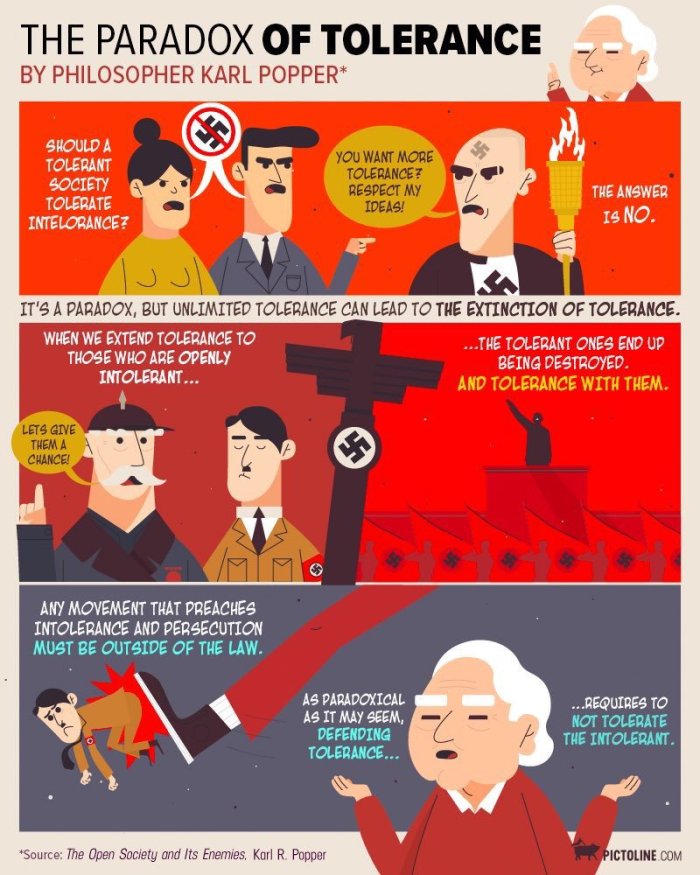
As Vienna-born philosopher Karl Popper put it in The Open Society and Its Enemies, unlimited tolerance leads to the destruction of tolerance.


If we tolerate the intolerant, if we give them equal time to offer their point of view and don’t aggressively counter their views, they will inevitably resort to violence and wipe our side out.


This doesn’t mean immediately punching them in the face or violently attacking them. For Popper, we should let rationality run its course, let them have their say and usually their ideas will be rejected and ignored.


However, if this doesn’t happen and these ideas start to take root as they did in Nazi Germany (or perhaps even today in Trump’s America), then Popper says we must stop them by “fists or pistols.”


In short, Popper writes:


“We should therefore claim, in the name of tolerance, the right not to tolerate the intolerant. We should claim that any movement preaching intolerance places itself outside the law, and we should consider incitement to intolerance and persecution as criminal, in the same way as we should consider incitement to murder, or to kidnapping, or to the revival of the slave trade, as criminal.”


Popper believed in the free expression of ideas, but when one of those ideas leads to violence, it is no longer to be tolerated. Then it is outside the law and must be destroyed.


DHtG6mmUwAAEYm6


What then do we do with our commitment to nonviolence?


Do we reluctantly agree to push this constraint to the side if push comes to shove?


No. This is the other pole we must navigate between.


On the second to last day of his life, April 3, 1968, Dr. Martin Luther King, Jr., gave a speech stating his unequivocal commitment to the principal of nonviolence:


“It is no longer a choice between violence and nonviolence in this world; it’s nonviolence or nonexistence. That is where we are today.”


The next day he was shot to death. These are among the last words he spoke in public.


That King was to be martyred in the cause of justice would not have surprised him.


He had already received several death threats and attempts on his life.


He knew that his continued efforts to fight for human dignity would probably result in the premature ending of his life someday. He knew all that yet he still prescribed nonviolence.


There was simply no other way for him to exist.


Mahatma Gandhi, who influenced Dr. King and our American fight for civil rights with his own nonviolent revolution in India, went even further.


At the start of WWII, he wrote that the British should lay down their arms and let the Nazis invade the United Kingdom without offering any violent resistance. They should even let themselves be slaughtered if it came to it. He made similar remarks to Jews facing the Holocaust.


That’s pretty extreme.


But can you imagine its effect?


No one followed Gandhi’s advice. We fought the Germans in WWII and won. We crushed their pathetic thousand year Reich and threw their prejudiced ideals on the trash heap of history.


And yet here we are today. In Charlottesville. In Portland. In Washington, DC.


The scared and ignorant have rooted through the trash and recycled those same odious ideals.


The war ended, but the battle goes on.


Would that have happened had we met violence with nonviolence?


I don’t know the answer. No one does.


But it respects an important point – we can’t ultimately fight our way to peace. Not without killing everyone else. And then why would the solitary survivor wish to live?


There is an inherent flaw in humanity that continually incites us to kill each other.


We can never have true peace unless we find a way to stamp out that flaw.


Nonviolence is the closest we’ve ever come to finding a solution.


So there you have it, the Scylla and Charybdis of our current dilemma.


We must try to navigate between them.


We must not tolerate the intolerance of the white supremacists. But we must also not allow our opposition of them to change us into that which we hate.


I know it sounds impossible. And I certainly don’t have all the answers about how we do it.


To start with, when white supremacists advocate violence of any kind, we must seek legal action. We must use every tool of the law, the courts, and law enforcement to counter them.


This requires political power. We must organize and keep them politically marginalized and weak.


We must take every opportunity to speak out against white supremacy. We must continue to make their ideal socially and culturally repugnant. At the same time, we must also reach out to them in the spirit of healing and love. We can’t give up on them, because they, too, are our brothers and sisters.


Yet if they resort to violence, we can feel justified in protecting ourselves and those they wish to victimize.


But the keyword here is “protect.”


We should go no further. We should not attack.


I know that is a hard line to walk.


Maybe it’s not even possible. Still, we must try.


It might feel satisfying to punch a Nazi. Heck! I’m sure it would. But we cannot allow ourselves to become like them.


Because the real enemy is not them.


It is their fear and ignorance.


And if we’re honest, we hold the same disease deep inside our own hearts.


We cannot defeat racism and prejudice unless we overcome our own flawed humanity.

Arming Already Stressed Out Teachers Will Only Increase the Chance of School Shootings

1541539


It happened in Georgia yesterday.


A beloved social studies teacher locked himself in his classroom while his students stood outside the door.


When the principal came with the key, the teacher fired a handgun through an exterior window.


Students ran, one even twisting her ankle in the escape.


Thankfully, no one else appears to have been injured.


However, the incident brings into focus a vital component of the gun debate.


Teachers are already under tremendous stress.


Arming them won’t stop gun violence. All it does is add another potential shooter.


It’s only been about two weeks since a shooting at Stonemason Douglas High School in Florida left 17 dead.


That’s at least 19 school shootings so far in 2018 – and it’s only the beginning of March!


In that time, the national media and the Trump administration have focused on one specific solution to stopping such violence from happening again: giving teachers guns.


The latest incident in Georgia underlines why this is such a terrible idea.


Teachers are not super heroes.


Take it from me. I’m an almost 15 year veteran of the middle school classroom in western Pennsylvania.


We’re just human beings.


My colleagues and I have all the same human failings and weaknesses as everybody else.


We get tired and overworked and put upon and stressed and sometimes…


…Sometimes we don’t handle it well.


I know some people don’t want to hear it.


Society has piled all kinds of responsibilities and unreasonable expectations on our shoulders.


We’re no longer allowed to be just educators.


We’re parents, counselors, disciplinarians, doctors, psychologists, lawyers, nutritionists…. The list goes on-and-on.


And now politicians actually want us to add law enforcement to the job description?


We’re already under colossal pressure, and some folks want to add a gun to that situation?


That’s lighting a fuse.


But don’t just take my word for it.


Back in 2015, tens of thousands of educators filled out the Quality of Worklife Survey conducted by the American Federation of Teachers and the Badass Teachers Association.


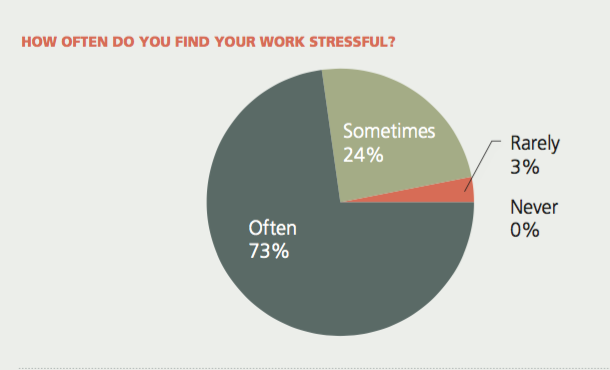
After responses from 91,000 school employees and 31,000 who completed the entire 80-question survey, a picture of the emotional landscape became clear.


A total 73% of respondents said they often feel stressed at work.

Screen Shot 2018-03-01 at 12.48.15 PM

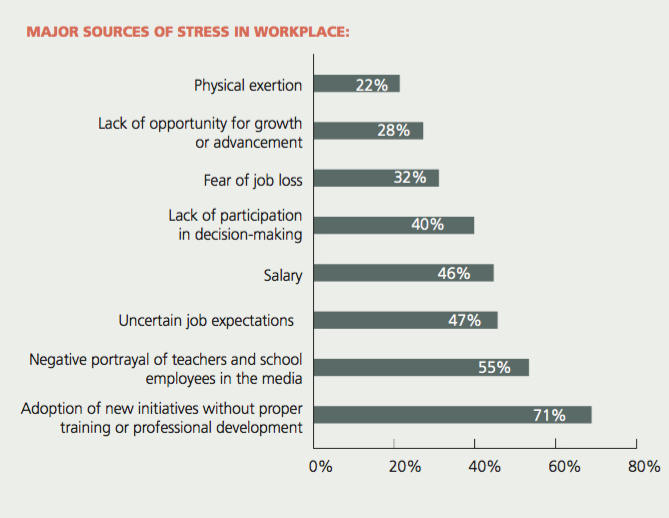
The reasons? Adoption of new initiatives without proper training or professional development (71%), negative portrayal of teachers and school employees in the media (55%), uncertain job expectations (47%) and salary (46%) were the most common responses.

Screen Shot 2018-03-01 at 12.48.58 PM

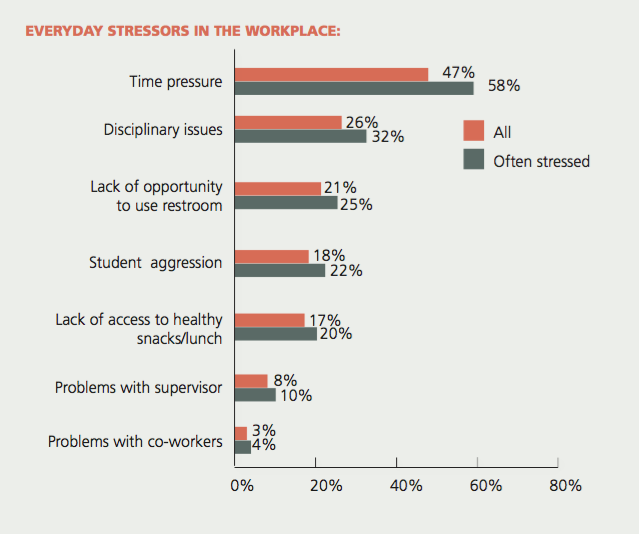
The survey identified the following as most common everyday stressors in the workplace – time pressures, disciplinary issues and even a lack of opportunity to use the bathroom.

Screen Shot 2018-03-01 at 12.49.11 PM

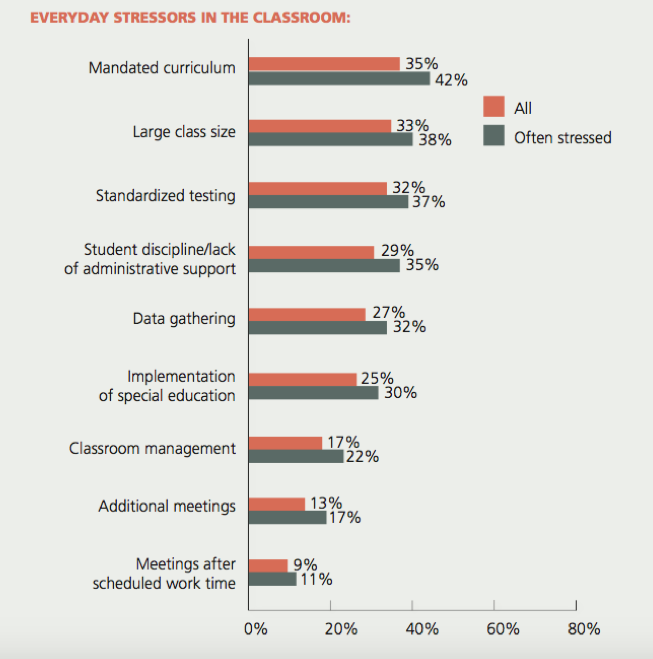
Focusing just on the classroom, top stressors were mandated curriculum, large class sizes and standardized testing.

Screen Shot 2018-03-01 at 12.49.35 PM

Many teachers claimed to be the victims of violence at school.


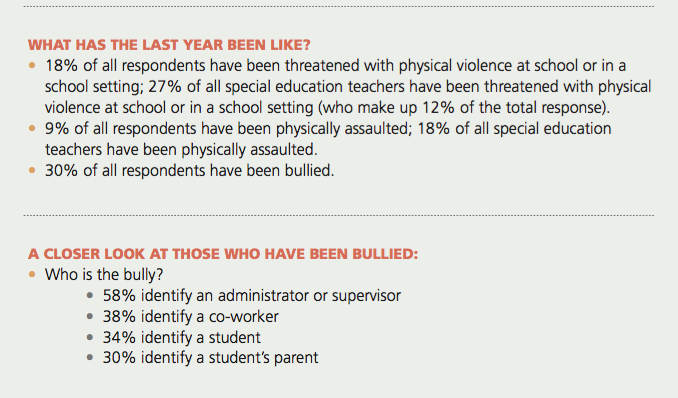
A total 18% of all respondents said they had been threatened with physical violence – though the percentage jumped to 27% when looking solely at special education teachers.


A total of 9% of all respondents claimed to have been physically assaulted at school. Again the percentage jumped to 18% of all special education teachers.


But it’s not just physical assault.


A total of 30% claim to have been bullied by administrators (58%), co-workers (38%), students (34%) and student’s parents (30%).

Screen Shot 2018-03-01 at 1.03.57 PM

This is the situation where policymakers want to throw firearms.


Most gun violence doesn’t involve a shooter doing harm to others. The great majority of gun deaths are self-inflicted.


Even without adding guns to the mix, several high profile teachers and administrators already have committed suicide.


In October of 2010, for example, a California elementary school teacher named Rigoberto Ruelas, Jr. took his own life after the Los Angeles Times published a report labeling him a “less effective teacher.” Despite the fact that students and parents praised Ruelas, who taught in one of poorest schools in his district and who also was born, raised and continued to live in area where his school was located, the Times targeted him among other so-called “less effective” teachers as part of a major propaganda campaign.


And this isn’t an isolated incident. In July of 2015, a New York City principal under investigation for altering Common Core test scores, killed herself by jumping in front of a subway car.


Adding guns to this situation will just mean more teachers taking their own lives with a bullet.


That may have been the intent of the Georgia teacher in yesterday’s shooting.


Local police said they didn’t think he was trying to injure anyone else. When he shot his gun out of the window, he appeared to be trying to get others to leave him alone.


Arming teachers is a terrible solution to school violence. It’s taking an already stifling room and turning up the heat.


We need sensible gun regulations to reduce the pressure, not increase it.


We need sensible school policies that treat teachers and students like human beings and not just cogs in the system.


But this requires us to break out of a dangerous pattern in how we deal with social problems.


When we see a problem, we generally just shrug and leave it up to public schools and teachers to solve.


Inadequate resources – leave it to teachers to buy school supplies out of pocket.


Inequitable funding – increase class size and leave it to teachers to somehow make up the difference.


We can’t do the same with gun violence. We can’t just toss teachers a gun and tell them to sort it out.


Teachers can’t solve all of society’s problems alone.


That’s going to take all of us.


And we’ll need more than disingenuous proposals like answering gun violence with more guns.

Rick Saccone Hopes to Become Trump’s New Bobble Head in Western Pennsylvania


IMG_9488
Rick Saccone hard at work for the taxpayers of Pennsylvania.

Rick Saccone’s signature achievement in the Pennsylvania House was to get “In God We Trust” posted in every public school.


Actually, he didn’t even get that.


He wrote a successful bill that merely allowed public schools to post that – if they wanted.


To my knowledge not a single school in the Commonwealth has taken him up on it.


His second greatest hit was to authorize a state day of fasting.


I’m not kidding. And it’s all down hill from there.


Now he’s running for U.S. Senate!


Oh. Wait. His fundraising was terrible.


Excuse me. He’s running for U.S. House – because that’s an easier win!


Whatever. So long as he can get to Washington, DC. He’s had enough of this small potatoes Pennsylvania politics – even though he’s one of the smallest potatoes in the patch.


If you know what I mean.


He’s running against Democrat Conor Lamb in a special election to be held March 13 to fill Republican Tim Murphy’s seat.


You may recall Murphy. He made his name voting for anti-abortion legislation until his alleged mistress got pregnant and then he allegedly pushed for her to abort their love child.


You know. Family values stuff.


Is Saccone up to that level of hypocrisy?


Donald Trump thinks he is.


The least popular President in U.S. history with only a year under his bulging golf shorts thinks Saccone is his kind of guy.


Trump even came to western Pennsylvania to support Saccone tweeting:

Screen Shot 2018-01-29 at 3.13.20 PM

“Will be going to Pennsylvania today in order to give my total support to RICK SACCONE, running for Congress in a Special Election (March 13). Rick is a great guy. We need more Republicans to continue our already successful agenda!”


Of course, Trump immediately had to walk back this comment because his trip to the keystone state was being paid for with public tax dollars. He had to say that it was an official White House event and not (as he indicated in the tweet) that it was a campaign event.


You know, for once I agree with Trump.


Rick Saccone IS Trump’s kind of guy.

20180118smsTrump02-1

He has lots of experience as a Yes Man. That’s really all he’s done in Harrisburg.


We used to have our own version of Trump – a Republican Governor who had no idea how to do his job – Tom Corbett.


Of course, Corbett’s reign was short lived. Like the President, his popularity plummeted and he was voted out of office like yesterday’s garbage.


But he had his loyal bobble head Saccone backing him every step of the way.


In fact, he voted for Corbett’s initiatives 95% of the time giving him the nickname of Corbett’s “Mini-me.”


Even when Corbett proposed something deeply unpopular, like cutting almost $1 billion from the state’s poorest public schools, Saccone went out there to explain why our children, our future, just weren’t worth the investment.


The Swamp recognizes Saccone as one of their own.


That’s why big moneyed interests are pouring cash on the sycophantic lawmaker. That and the fact that the district in question went for Trump in the last election by 20 points.


The National Republican Congressional Committee has spent at least $1 million on ads for broadcast and cable TV stations to boost Saccone’s candidacy.


And that’s not all.


Congressional Leadership Fund has put aside at least $1.6 million for ads, not to mention funding from outsiders like the 45Committee and Ending Spending – a group founded by the mega-donor Ricketts family.


All this money just to serve out the remainder of Murphy’s term!


Whoever wins would be up for re-election in November to secure a full two-year term.


Moreover, now that the state Supreme Court has overturned the Commonwealth’s gerrymandered districts that unfairly favor Republicans, that November race is likely to include newly drawn legislative lines.


So this GOP wonderland that boosted Trump and Mitt Romney in 2012 will likely become more competitive.


In fact, it may already be.

SacconeFlagShirt
Saccone disrespecting the flag by wearing it as a shirt.

Some polls have Saccone up over Lamb by only a 3 point lead. This may be in part because of Trump’s steadily deflating support – even among Republicans. The President’s approval rating in the district has dropped to 49 percent – not far from the national picture where 47 percent disapprove of his job performance.


This is not good news for Saccone.


The SuperPACS supporting him are trying to paint Lamb, a former federal prosecutor, as a Nancy Pelosi puppet.


But Lamb has repeatedly criticized Pelosi, telling The Pittsburgh Post-Gazette that he would not support Pelosi as the Democratic leader. There is a “need [for] new leadership on both sides,” Lamb said.


Yet Saccone has done everything in his power to suck up to Trump.


Taking his cue from the Commander in Chief, Saccone took to twitter to express his feelings:

Screen Shot 2018-01-29 at 4.27.01 PM

“I’m humbled that @realDonaldTrump for President, Inc, has officially endorsed my campaign for Congress!”


I’m not sure why he wrote “President, Inc.”


Perhaps Saccone thinks the office belongs to a private company.


Perhaps he doesn’t understand that a politician’s job is to serve the needs of his or her constituents.


Judging by his less than stellar performance in state government, this would seem to be the case.


He’s come a long way from earnestly trying to legislate past the establishment clause of the first amendment to fighting to starve our schools to running for a position as Trump’s favorite puppet.


Or not.


That depends on voters this March.


Full Disclosure: I am not a Saccone fan. Along with teachers, parents and students from across western Pennsylvania, I’ve picketed outside of his offices demanding he do his job and provide for students. He was deaf to our cries. Do you hear me now, Rick?

062411_TEACH_4

2011-06-23_11-00-52_113