The western Pennsylvania district located southeast of Pittsburgh reopened on a hybrid schedule on Sept. 2 with about a third of parents opting to keep their children out of the buildings and in the district-run cyber program.
Since then, finding concrete information about Coronavirus infections at our public schools – MASD or others – has not been an easy task.
MASD school district issues alerts on its Website, but they do not stay up for long.
On Sunday, the Website noted:
“Across two of our buildings, Twin Rivers Elementary and the High School, we have had three positive cases of COVID-19 in teachers, and two positive results in students.”
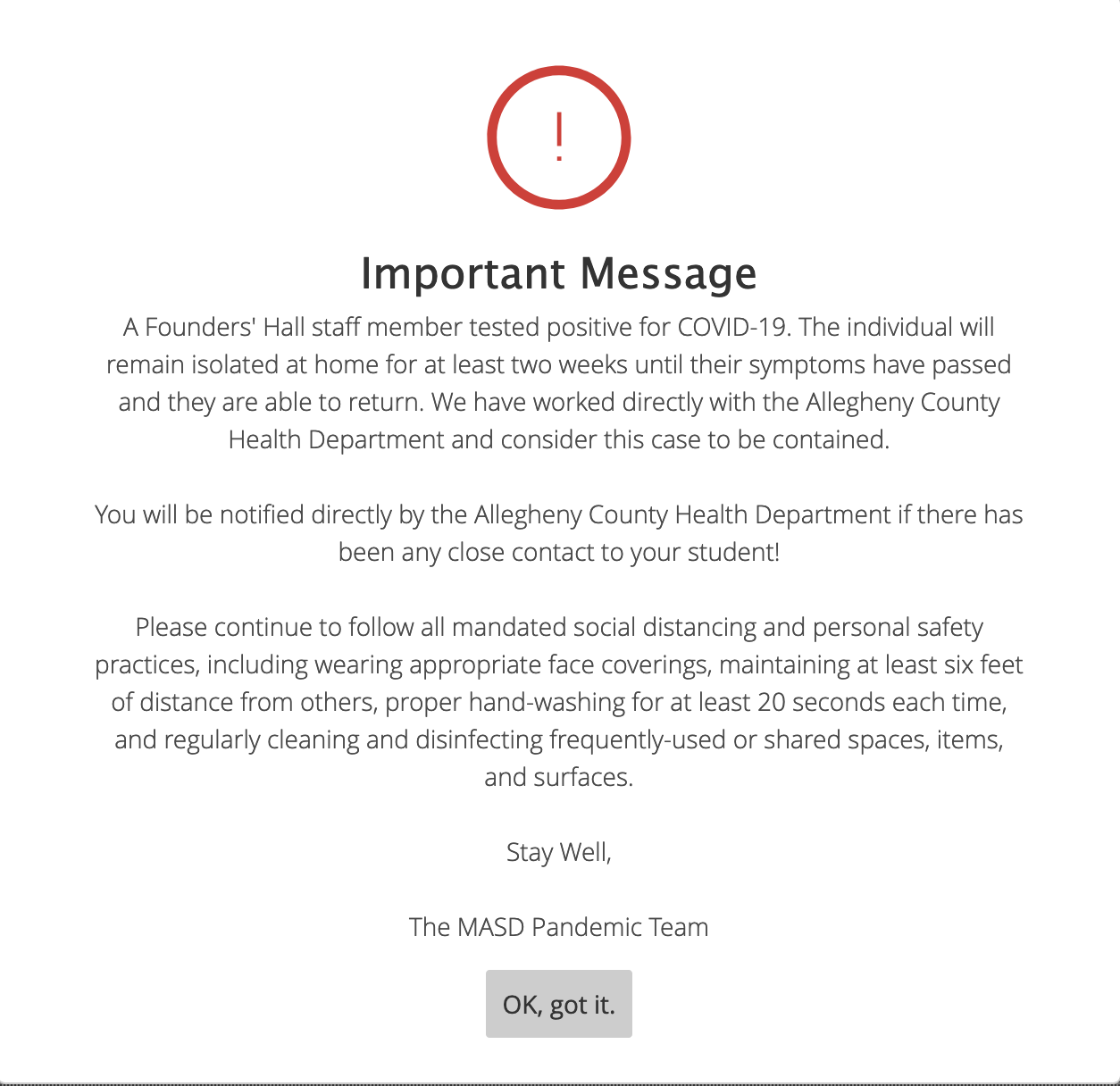
“A Founders’ Hall staff member tested positive for COVID-19.”
So that’s one case at Founders Hall and five spread out between the High School and Twin Rivers Elementary School.
Though in both cases, the district Website claimed, “We have worked directly with the Allegheny County Health Department and consider this case to be contained,” it is telling that the district obfuscated about exactly how many cases were from each building.
On September 15, a letter was sent home to parents saying that a Founders’ Hall Middle School student tested positive for COVID-19.
The letter further stated that the student would quarantine for two weeks.
District spokeswoman Kristen James said there would not be any closures of school facilities as a result of the incident.
“Our buildings are being deep cleaned each and every day and throughout each day,” she said.
COVID-19 has also plagued nearby Serra Catholic School.
The parochial school serving students from many of the same communities as MASD has suspended football practice and closed its doors twice before for COVID outbreaks.
On Oct. 12, a “person involved with the [football] team” tested positive, and 40 athletes and football staff were quarantined.
Just a month earlier, on Sept. 10, two Serra students tested positive, resulting in temporary suspension of the sports program and building closures.
However, buildings were opened just twice to students – both times for transition days. And both times, a staff member tested positive for COVID-19 soon after.
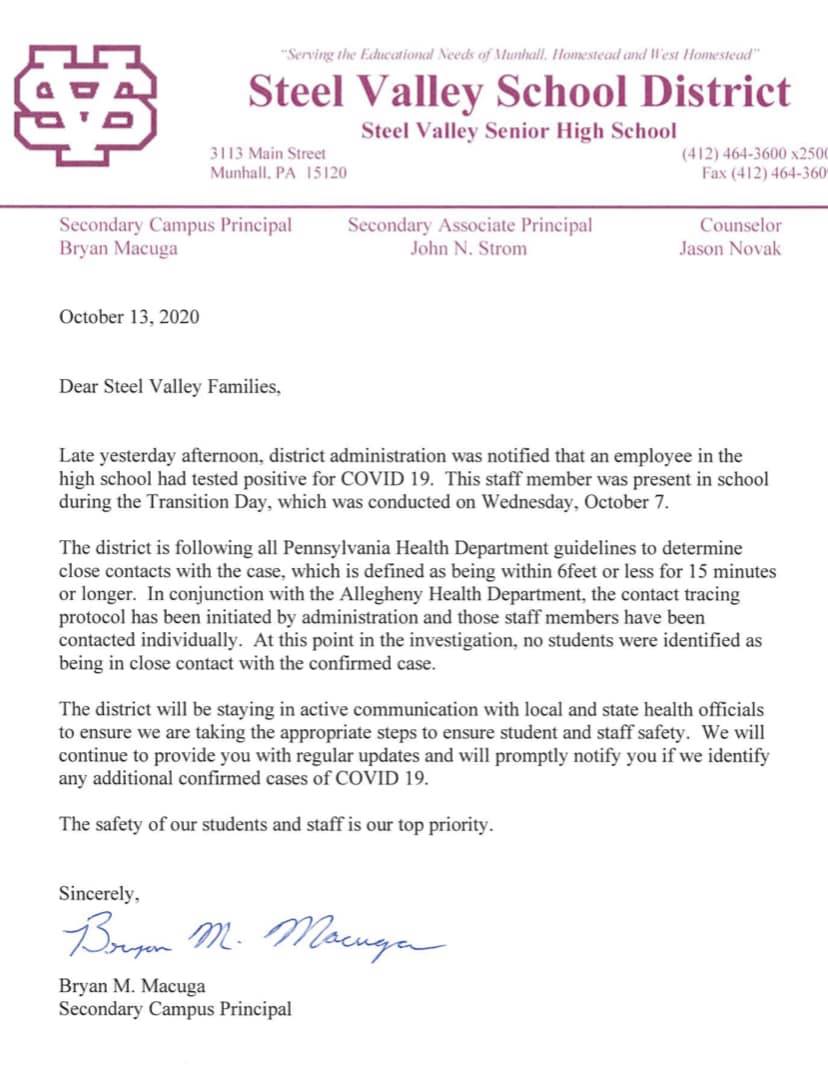
On Oct 7, a letter issued by Bryan Macuga, Secondary Campus Principal, said that a high school teacher tested positive. The day before, the district had students in grades 5 and 9 in the middle school-high school complex for a half day schedule to test the district’s wi-fi.
Though the teacher had participated in the program, he had not been within 6 feet of students for 15 minutes at a time – PDE’s definition of close contact.
On Sept 8, students in the same grades were in the same building for a half day transition program, and a middle school teacher who had participated in the program tested positive for COVID a day later.
School directors are actively considering moving from the virtual schedule – where no one has gotten sick – to a hybrid schedule in November.
But shouldn’t we be making decisions with a priority on student and staff safety?
If people die or contract lingering life-long complications as a result of COVID-19, they will not thank you for keeping buildings open longer than was advisable.
It’s time for decision makers to take off the rose colored glasses and make the tough decisions in everybody’s interests.
It’s something we can all accomplish if we and our representatives just have the courage to do it.
Like this post? You might want to consider becoming a Patreon subscriber. This helps me continue to keep the blog going and get on with this difficult and challenging work.
Only in the most sparsely populated, secluded or reckless areas have schools been allowed to reopen 100% without safety precautions.
For many districts trying to juggle both in-person and virtual classes, the online component has been left to ed tech companies like Edmentum often specializing in credit recovery.
Along with students whose input and experiences should not be ignored, it is our collective educator core who have been thrust into this strange experiment. But unlike children, they have the knowledge, maturity, skills and life experience to evaluate it best. And being one of those intrepid individuals, I here offer my thoughts.
After more than four months teaching this way, I’d say these are the top 5 pros and cons of virtual instruction:
Pros
1) There is Less Pressure Day-to-Day
Right off the bat there is something to be said for virtual instruction – it feels more low stakes.
You sleep longer, can more easily access amenities, the bathroom, food and drink.
For one, you sure can’t beat the commute.
Some students admit that they roll out of bed each morning and onto the computer. This is not always optimal for learning in that the mind needs time to wake up and focus itself. However, the fact that one has more choice over how to prepare for school, what to wear, more leeway about breaks and whether to eat or drink in class – all that leads to an increased casual feeling to the day.
Though I certainly don’t roll from my bed to class, the extra sleep I get from not having to drive to the building and the reduced stress of forgoing a commute, traffic, bad weather, etc. are extremely positive.
It helps me be more relaxed and ready to meet my students needs. It makes me a better teacher.
True, a dedicated disruptor can find a way to cause a ruckus. He or she can try to use the chat or even the video camera. They may even have each others cell phone numbers and communicate back and forth that way.
However, few students are aggravated enough to take such measures. I haven’t noticed much beyond simple teasing.
Some of my students put pictures of each other as the backgrounds on their camera screens – but these have always been friends trying to get a laugh. A comment from me and it stops.
If worse comes to worse, I can still remove them from the Zoom meeting and alert the principal or dean of students for disciplinary action.
But I haven’t had to do that yet. I’ll bet disciplinary referrals have dropped to record lows. And without them, virtual learning may have all but dismantled the school-to-prison pipeline.
3) It’s Easier to Communicate with Parents and Students Individually
There are many reasons for this.
In the physical classroom, the most common form of communication is verbal. But digital spaces allow for several other methods.
You can email individual students messages, work, assignments, grades, etc. You can utilize the chat feature to send a private message. You can simply talk to them in the Zoom meeting. You can set up an individual Zoom meeting like office hours to answer questions. You can ask or answer questions about assignments in the stream function of Google Classroom.
All these options allow for students to talk with their teacher one-on-one more easily than in the physical classroom.
Consider this: let’s say a student has a question about the homework after class. In the physical classroom environment, there may be little they can do but wait until the next day. Before last March, I’d had students send me emails, but I never checked them as regularly as I need to now.
In the digital world, students can easily send a message through email or stream at any time. This certainly puts a strain on educators but most questions I receive are during school hours and easily answerable in a timely fashion.
I find that in the virtual classroom, I have the time to communicate with every parent at least once a week – or at least I try. Even in the digital world, some parents are incommunicado.
4) It’s Easier to Read a Text Together
As a language arts teacher, this is really important to me.
For more than 15 years, I’ve read texts aloud with my students and asked them to follow along. I tell them to take their index fingers, put them in the text and move along with where we are in the passage.
Few actually do it, and there’s really nothing I can do to make them. Except beg.
In the virtual classroom, I can easily put the text on all their screens, place the cursor under the words and follow with the reader or the audio recording.
Students can try to ignore it, but that’s harder than just following along. It also allows me to point to specific parts of the text.
If a student is reading and struggling with a word, I can point to prefixes, suffixes, roots, etc. to help them. And I’ve honestly seen improvements in some struggling readers fluency.
5) It’s Easier for Students to Work at Their Own Pace
This isn’t really a core value of the physical classroom.
Teachers give assignments, set due dates and students have to get things done in the time frame.
Online it isn’t such a straight line.
Teachers instruct in a Zoom meeting, but students are not required to attend. They can catch up with a video of the meeting if they need or prefer.
And since we all anticipate students may have issues throughout the day with connectivity, the technology, home responsibilities, distractions, etc. teachers haven’t been so firm on those due dates.
I freely give extensions and tell my students that assignments can still be made up for full credit well past the deadline. It’s about getting the work done, not so much about when.
I find myself explaining assignments more often than usual, but it’s somehow not as annoying as it sometimes is in the physical classroom.
We’ve created a culture of care and understanding. I think that’s a positive thing even if it doesn’t emphasize due dates and time frames as much.
Cons
1) Student Absences
No matter how you look at it, there are an alarming number of students absent throughout the day.
For my own classes, this was much worse in the spring when we first went online. Starting in September, more students have been attending regularly.
However, there are two important points to be made.
First, there are some students who do not attend the live Zoom meetings but instead watch the videos and do the assignments. Their work is not worse than those who attend – in fact, it is sometimes much better.
I suppose it’s possible students in the Zoom meetings could feed information to those not attending, but with the videos and the ability to communicate with me at will, it’s almost more work to cheat.
In my classes, about 20% are regularly absent. Of those, 10-15% are not participating much at all.
That’s about the same as I would expect to see in the physical classroom.
We need to identify these students and provide them with the resources necessary to succeed. But that’s always been true.
2) The Camera Conundrum
To turn your camera off or not? That is the question.
Zoom meetings can be an awfully lonely place for teachers when every student has their camera off.
The general consensus is that we should allow them this freedom. It encourages them to attend the Zoom meetings on their own terms and avoid the stress of seeing themselves constantly on their own screens. It allows them to avoid the fear of being judged for their surroundings.
Allowing them this latitude certainly does increase attendance and create a more positive attitude. But the teacher is in a worse position to monitor student engagement.
Most days I feel like a medium at a seance asking if so-and-so is here. Give me a sign.
I try to pose questions to get students involved – even more than I would in the physical classroom – and sometimes it works and sometimes it doesn’t.
There are times when I yearn just to be able to look at my students again and see what they’re doing. Because I know some of them are not paying attention.
Some are texting on their cell phones. Some are playing video games on another screen. Some are talking with brothers, sisters, friends or parents in their house.
There’s not much I can do except try to keep my classes as engaging as possible. Most of the time, I think it works.
But not always.
3) It’s Harder to Monitor/Push Students with Special Needs
This is nearly impossible for a student with his or her camera off. I can try verbal queues, but students don’t always answer. I can ask them to turn on their cameras if that has been added to their IEPs, but they rarely comply. And if they do, they just point the camera at the ceiling or otherwise away from their faces.
The human contact of actually being present in a physical space has many advantages – especially for students with special needs.
I try my hardest and do everything I can to help them. But I feel that some of them are falling through the cracks – at least more than they would be in a physical classroom.
4) Technological Issues
Even under the best of circumstances, there are always technological issues.
Students do their assignments and their devices don’t save the work. Their batteries run low. They haven’t downloaded the proper apps. They’re using the wrong emails to access a google form.
The list is endless.
Thankfully, my district has a help desk students can access. But teachers need to be aware and permissive about technology issues. We have to air on the side of letting them get away with something rather than being too strict.
And the technology issues aren’t limited to the students.
One Friday I found the wi/fi in my home was down. I had class in 30 minutes and had to find someway to connect online to teach.
For whatever reason my Mac laptop could not connect to the Internet. I had a barely functional PC that for reasons I cannot explain was able to connect.
So that’s what I did. I connected with the PC and taught my classes. The connection was still spotty and I got kicked out of my own Zoom meeting once.
When I got back on moments later, the students were terrified. But we got on with it and managed.
I don’t know why, but the issue seemed to fix itself about 2 hours later and I was able to get onto my laptop and experienced no further problems.
I suppose the point is that we have to realize technology issues will crop up. We need contingency plans. Lots and lots of contingency plans. For ourselves, as teachers, and for our students.
Charter and private schools are packed with students these days. This is partially because their smaller size and greater resources allows them to more easily meet in-person safety standards. Where public schools have recklessly reopened, cyber schools have swooped in to provide a safer option, too.
It’s the wild west out there and no one can really tell how this will all affect what the future of education will be.
If the pandemic ended tomorrow, I would like to return to the physical classroom. But I can’t say I’d willingly leave every innovation of virtual instruction on the cutting room floor.
I like giving tests through Google Forms.
I like giving paperless assignments on Google Classroom.
I like being free to contact parents and students easily and not being tied to duties more suited to school security officers.
I like being able to pee whenever I need.
But I don’t want to lose the best aspects of the physical classroom.
I don’t want ridiculously large class sizes justified by a digital space.
I don’t want to have to teach live on-line and in-person at the same time, curating and managing the virtual space and the physical classroom.
I don’t want to be under constant digital surveillance.
These are all dangers of the new normal.
I don’t know what the future will be, but I know it will not be what it was before all this started.
That’s equal parts scary and exciting.
But right now teachers really can’t afford to worry about it too much.
We’re too busy trying to get through the current crisis.
Like this post? You might want to consider becoming a Patreon subscriber. This helps me continue to keep the blog going and get on with this difficult and challenging work.
After all, there is more than one way to do remote learning.
We could ask the district’s classroom teachers to design instruction tailor made to their students but merely delivered online.
Or we could use a prepackaged platform to deliver that instruction.
To me, it’s obvious which is better.
One maximizes academic outcomes by making the virtual experience as much like the in-person experience as possible with multiple daily interactions between teachers and students. The other delegates the responsibility of educating to a corporation with minimal social interaction between students and educators.
The teacher led option is the way to go, but it only works at most districts if they give up the myth that they can make in-person instruction feasible during a pandemic that has already infected more than 7 million people in this country and killed 200,000 and counting.
So they’re committed to giving people a choice – just not THAT choice.
If they can only choose between canned cyber curriculum or fresh but dangerous in-person models, they’re betting parents will choose the latter.
And in many cases they are. But a significant number are not.
In the McKeesport Area School District (MASD), where I’ve lived most of my life, nearly a third of the parents have chosen distance learning for their children instead of a half day hybrid model. One would think that would free up enough classroom teachers to offer synchronous, authentic instruction. Students could have lessons from a certified district employee with years of experience instructing children of that age, grade and subject matter. Kids and teachers could develop trusting and caring relationships and work together to create the best possible learning environment.
The platform is Calvert Learning, a product of the ed tech giant Edmentum.
This multi-million dollar global company (it was sold for $143 million in 2010) is best known for creating Study Island and other standardized test prep based learning platforms.
The problem is it was never meant to be used as the sole provider of coursework for thousands of students in a single district.
It was created for K-8th grade, but when added to Edmentum’s Coursework platform, the company claims to be able to offer credit recovery – I mean academic classes – for K-12 and beyond.
As a parent who has spent countless hours helping his daughter navigate it, let me tell you – it’s a mess.
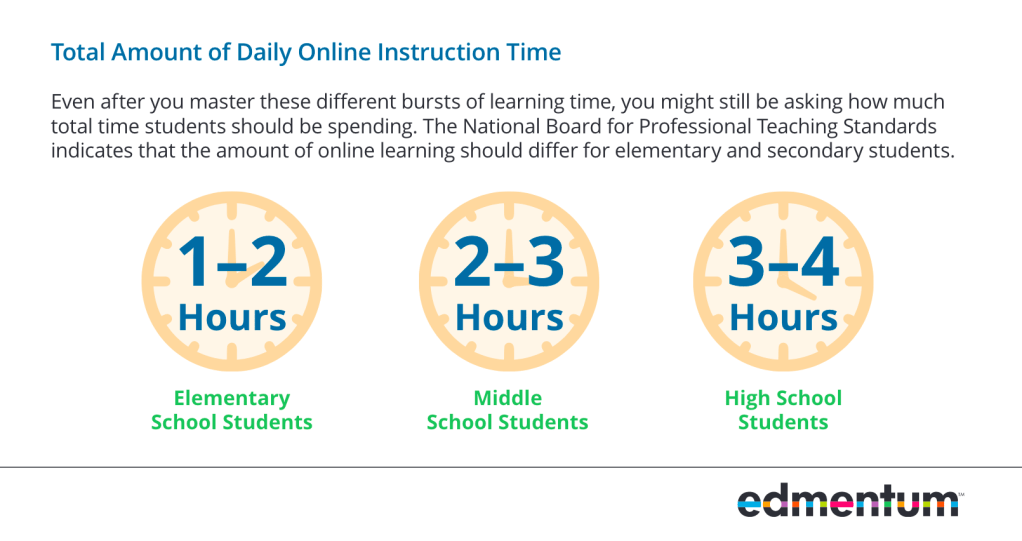
The instruction and assignments it provides are developmentally inappropriate, assesses things it hasn’t taught, and are filled with grammatical and spelling errors. Moreover, the pace it prescribes violates the guidelines Edmentum gives to parents about how much time students should spend on-line.
According to “A Parent Guide: Supporting Your Child During Virtual Learning,” provided by Edmentum, cyber students should limit their time online. Elementary students should spend not more than 1-2 hours a day, middle school students 2-3 hours, and high school students 3-4 hours.
My 6th grade daughter typically spends 7-8 hours a day just to barely get things done – and that’s not counting 2-3 hours on the weekends.
I’ve seen her struggle through passages that are written far above her reading level.
For example, she completed a unit on characterization where she was required to read O. Henry’s “The Ransom of Red Chief.”
I know the story well, because as a middle school teacher, I’ve taught it to my 7th grade students from time-to-time. However, the version I’ve used is not the original that O. Henry wrote. It is brought down to the level of a middle schooler and unnecessary attitudes of the time are downplayed.
In the original, one of the characters, Sam, uses big words to show how smart he is. The version I use still has him do that but reduces its frequency so that middle schoolers can understand him. After all, 6th graders shouldn’t have to wrestle with “philoprogenitiveness,” “chawbacon” and “whiskerando” just to grasp a pretty basic plot.
Moreover, the story was published in 1907. The original text throws out numerous instances of casual racism against Native Americans that serve no point in the story. Does my daughter really need to be subjected to dehumanizing native peoples as mere “red skins” just to get a lesson on characterization?
Clearly this unit was not developed with child psychologists, practicing middle school Language Arts teachers or even people of color in the room.
If that weren’t bad enough, the questions are full of grammatical errors and typos.
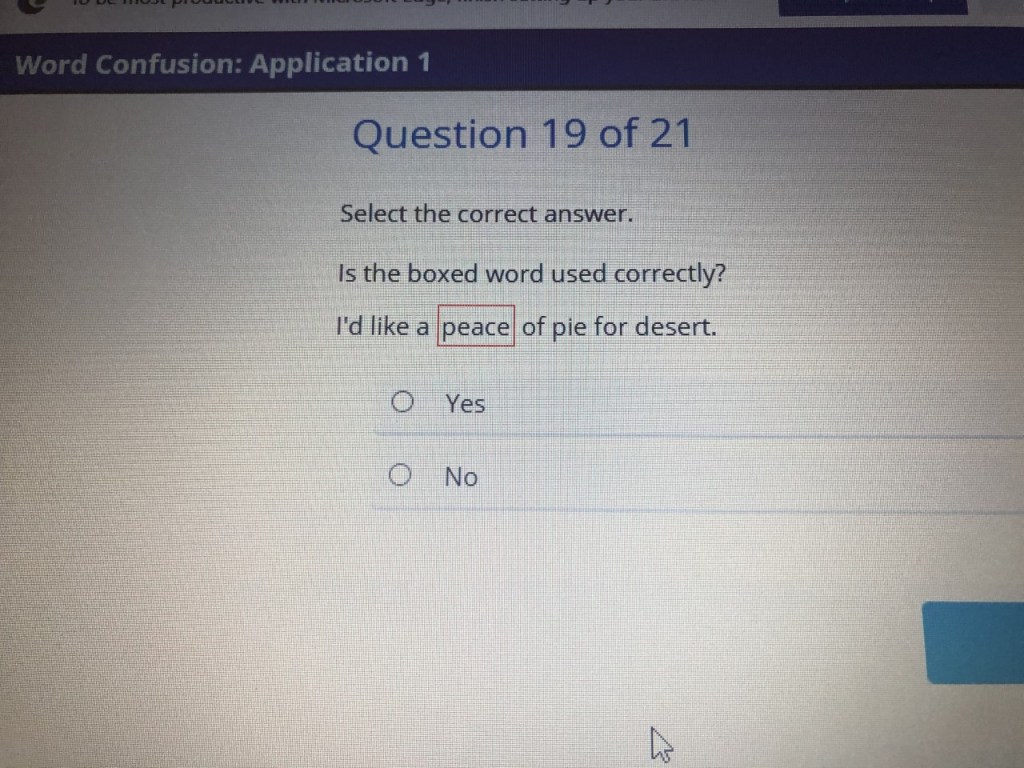
One question about homophones asks students to consider this sentence:
“Select the correct answer.
Is the boxed word used correctly?
I’d like a PEACE of pie for desert?”
Students were asked if “PEACE” is correct – Yes or No. They should know that PIECE is actually the right word.
However, the question made no mention of the misuse of “desert” when the authors clearly meant “dessert.”
That’s the kind of thing that really confuses a student trying to make her way through a program all by herself.
On many assessments, she is asked things that were never taught in the section that was meant to be assessed. I know this is status quo on standardized tests, but is it fair to ask this of a child navigating an online program without even a living teacher to offer support and guidance?
In a social studies assessment on Neolithic peoples, many of the questions had nothing to do with the subject matter. They asked students to infer something based on a passage and none of the multiple choices were entirely correct. You had to pick the option that was least incorrect.
This is some crappy academics being pawned off on parents and students.
And it’s not cheap.
MASD paid $146,302.25 for 40 licenses to Calvert, Exact Path K-5, Courseware for 6-12 and other online services. When hundreds of additional parents asked for their students to be put on the cyber program, the district purchased 500 more licenses from Calvert for a bundled rate of $112,500. That’s $225 per license. Normally they are $450 per license.
Imagine if we put our tax dollars and our teachers to educating these students instead of seeding our responsibility to a corporation for hire.
And we could do it, too.
I work at Steel Valley School District.
Unlike MASD, we began the year with a 100% virtual program for all students. We conduct fully synchronous classes online designed entirely by the classroom teachers. And we post materials on Google Classroom so that students who miss the live Zoom meetings can watch videos of the lesson and do the work.
I’m not saying it hasn’t been difficult or that it’s without problems. Nor is such an endeavor better than in-person learning in a safe environment.
But the teacher-led remote model is the best that can be provided under the circumstances.
They should face the realities of the world we live in.
If Coronavirus infections are significant in your county, you should not be offering in-person schooling. You should be offering the best remote option available – and that’s the teacher-led cyber option.
If only my home district knew it.
Meanwhile, my daughter has to struggle through with the cold comfort that at least she won’t get sick jumping through the hoops her school board is too partisan to eliminate for her.
I’m right next to her at the dining room table feeling guilty for putting her through this.
But what else could I do?
Like this post? You might want to consider becoming a Patreon subscriber. This helps me continue to keep the blog going and get on with this difficult and challenging work.
Thursday would have been the first day of in-person classes for hundreds of students at Steel Valley Schools.
But instead, district buildings will be closed and classes will be 100% virtual for all students.
The Western Pennsylvania district just south of Pittsburgh had planned to reopen with a hybrid model during the COVID-19 pandemic.
However, as the start date rapidly approached, it became clear that the district would not have the safety supplies necessary to protect students and staff. So administrators and school directors agreed to start the year with fully remote classes for at least the first month.
“…due to factors beyond the district’s control, efforts to upgrade systems at our buildings are not yet complete. In an effort to ensure we are proving the safest possible learning environment for students and staff, the administration – in consultation with the district’s board of directors – has decided to begin the school year with four full weeks of remote synchronous instruction. Students will still begin on schedule, but all classes for students will be held virtually for the first four weeks of the school year until October 5th.”
The original plan had students attending classes in one of three ways: enrolled in the district’s existent cyber program, doing 100% virtual assignments from the regular classroom teacher or a mixture of both virtual and in-person instruction.
Those who would have attended in-person were further divided into two groups – one of which would have attended in-person on Mondays and Tuesdays, and the other on Thursdays and Fridays. Students would have done virtual lessons when not in the classroom and on Wednesdays while buildings were being deep cleaned.
And this is the plan administrators hope to return to in October if they can install plexiglass barriers, fine tune a new HVAC system to better circulate airflow and other safety measures.
“The choice to move all classes fully online was a very difficult decision to make, and we sincerely apologize for any inconvenience this change may cause,” Macuga wrote in his letter to parents.
“The safety of our students and staff is our highest priority, and we make this decision out of an abundance of caution.”
The institute, whose previous forecasts have been cited by the White House and state officials, estimates the best case death toll with universal masking and tight safety precautions at more than 288,000, and a worst case death toll throwing care to the wind at more than 620,000.
People of color are most at risk of becoming part of that statistic.
At a meeting of the Allegheny County Health Department on Wednesday, board member Joylette Portlock noted this susceptibility gap between Black and White residents throughout the Pittsburgh region. During the last two major spikes in COVID-19 cases, Black residents were much more susceptible than White residents. In April, local Black residents tested positive for the virus twice as often as White residents. But the July outbreak was even worse. Black residents tested positive three times more for the disease than White residents.
West Homestead is populated by mostly white people, but the neighborhood has a high incidence of poverty – another factor linked to susceptibility. Munhall has the highest socioeconomic status and lowest minority population, thus the lowest infection rate.
County Health Department Director Dr. Debra Bogen cautioned how quickly the virus can be spread – especially by children. The health department had been tracking an infection from a teenager who spread COVID-19 to family members, who subsequently spread it to coworkers, who spread it to other teens, etc.
“It spread to over 40 people from this one outbreak in just two weeks,” Dr. Bogen said.
Some try to downplay the danger, likening it to the flu.
But there have been 22 times as many COVID-19 deaths this year in Allegheny County, compared to the flu.
Dr. Bogen broke it down like this: There were 330 deaths in Allegheny County from COVID-19 compared to about 15 typically experienced because of influenza. Statewide, there were 7,673 deaths from COVID compared to 102 typical from the flu. Nationwide, there were 183,563 COVID deaths, and between 24,000 – 62,000 from the flu.
And it’s not just restaurants. Several board members complained that they had seen mask infractions at healthcare organizations, salons and other retail establishments.
Though Wolf does not exclude a hybrid model as possible with this level of infection, it seems to me that “an effort to ensure we are proving the safest possible learning environment for students and staff” would be to go with the more cautious approach prescribed by Wolf – to remain in fully remote instruction until county infections decrease to a low level for at least two consecutive weeks.
However, I am thankful that district administrators and school directors have remained consistent in their plans and seem to be doing what they believe is in the best interests of everyone involved.
Hopefully when safety measures are ready to be implemented district wide, the level of infection throughout the county will have decreased as well.
But I’d rather none of us get sick or die even more.
Macuga will be conducting a community Zoom meeting on Wednesday, Sept. 9, at 6 pm to answer questions about the change from hybrid to full remote learning.
Like this post? You might want to consider becoming a Patreon subscriber. This helps me continue to keep the blog going and get on with this difficult and challenging work.
Your parents dress you in your best new outfit – maybe a nice pink jumper with a unicorn on it.
They help you tie your new sneakers – that’s right, two loops and a knot.
Then they put a surgical mask snugly over your mouth and nose, adhere a clear plastic face shield from your forehead down and snap some latex gloves on your hands.
“Off to school, Honey!”
“Don’t forget your antibacterial soap and Clorox wipes!”
What do you suppose would be going through your mind?
Would you feel safe? Would you feel loved? Would you feel valued?
Or maybe they do care enough but have no other choice. They’re “essential workers” and have to go to a series of minimum wage jobs to keep you fed, clothed and sheltered.
How would you feel about the people who own those jobs? The society that prioritizes keeping those jobs going instead of paying your parents to stay home with you?
Isn’t it just a big game of Monopoly? Players keep rolling the dice and landing on each others’ properties and having to pay rent. Hoping this turn you’ll make it past GO and collect $200.
With the exception of food, there’s nothing you really need outside of your home. If your parents didn’t have to worry about rent or utilities, they wouldn’t have to work. Yes, they’d need to go out to get food but the government could pay them to do that, too.
After all, it’s just Monopoly money. It’s just decorated pieces of paper. It has no inherent value… not like human lives.
I mean we’re living through a pandemic here. Leaving the house means exposure to the virus, and the longer you have to go out, the more people you’re exposed to, the greater the chances that you’ll get sick and/or bring the thing back home with you.
How would you feel about the school board members who compromise and say you only have to be put at risk for half the day or just so many days a week? Would that make it all better?
How would you feel when time-after-time the grown ups show you exactly how they feel about you, how little you actually matter, how much everything else is worth and how little they really care about you?
How would you feel if you were a little school kid getting ready for her first day of class this morning?
Would you feel safe, valued, loved?
What lesson would you take from everything happening all around you?
Some people are very worried that you won’t learn anything much this school year.
I’m afraid you’ll learn far too much.
Like this post? You might want to consider becoming a Patreon subscriber. This helps me continue to keep the blog going and get on with this difficult and challenging work.
On the other hand, they don’t want to be sued by children, families or staff who get sick or die as a result of reckless reopening plans.
The National School Boards Association (NSBA) is behind a push at both the state and federal level for temporary, limited liability protections in case students or staff become infected with Covid-19.
The organization is asking state legislatures and US Congress to pass bills including such protections.
At the same time, the organization is pushing state governors and the President to pass the plan through executive orders.
None of which should fill residents with confidence.
After all, would you want to eat at a restaurant where the chef refuses responsibility if diners get sick?
Would you want to fly on an airline that doesn’t guarantee you’ll make it to your destination in one piece?
In Pennsylvania, this has lead to discussions of the reopening guidelines issued by Gov. Wolf.
“I keep hearing the expression, ‘We are simply giving guidance or recommendations,” state Sen. Andy Dinniman, D-Chester, said. “In the end, is it not true that what you say is a recommendation, ends up being a mandate because school districts are afraid of being sued and taxpayers losing millions of dollars?”
Dinniman – who I often agree with – seems to be saying that districts should be free to ignore safety guidelines. And they are.
But doing so should come with a price.
The guidelines – which are too lenient in my opinion – at least set up some benchmarks.
However, these guidelines miss a vital component of epidemiology. One week’s worth of data is insufficient to get an accurate picture of viral spread. Covid-19 symptoms take up to two weeks to show up.
You could have low numbers this week and decide to reopen school buildings to a hybrid model, but then next week have a surge. And those people would have been sick when you reopened – you just didn’t know because it took another week for their symptoms to develop.
We are acting like spoiled children who want to do what they want and refuse to be held accountable for their actions.
Sadly it is our children who will most often pay the price for adult recklessness.
Like this post? You might want to consider becoming a Patreon subscriber. This helps me continue to keep the blog going and get on with this difficult and challenging work.
So it’s back to school time, and – let me tell you – am I ready to return to the classroom! Actually, I’m just bursting to pop onto campuses for the FIRSTtime this year.
When I came to these shores way back in March, some spoil sports decided to shut down the schools before I could really get in there.
You locked up your kids tight at home and did this distance learning thing online instead.
That really sucked. All I had was full grown bodies to infect.
I mean I wanted some nice young things to cuddle up to and bust my viral proteins through their ACE2 receptors. You know what I mean?
Kids are great! They’re not as fanatical about washing their hands as adults; if they get a runny nose, they wipe the mess on the back of their fingers; and they touch EVERYTHING!
Right now in most places I’m swirling around in aerosol plumes of nasal droplets in the occasional home, bar, and restaurant, but I’m kinda stuck.
There are only so many times I can infect the same people. And if they’re wearing masks properly and washing their hands, it’s just too much hassle.
If I really want to up my contagion game – and I do – I need someplace where I can mix with new hosts and then travel back to their cribs and just snuggle in.
No crowds at concerts or big sporting events – even the amusement parks and political rallies are drying up.
But now that you’re reopening schools, I can go exponential, baby!
Mark my words – September is going to be the season of the Coronavirus! We’re going to make the spring look like a mere dry run!
Second wave, third wave – and I have you to thank for it.
There are so many people out there I’m indebted to.
First of all, I’ve gotta acknowledge all the anti-science folks. If it weren’t for you guys, more playas might actually be taking precautions against me.
And the libertarian crowd! Wow! You guys are working overtime! No one can tell you to put human lives before a stunted adolescent definition of absolute freedom!
But of course, the first prize has to go to President Trump! He’s the trifecta! Science denial, me first, class warfare zealot! Not only did he disband the government’s pandemic task force, but he advised people to drink bleach – I mean BLEACH!– as a remedy to infection!
Sir, you truly deserve the title “honorary pathogen.” If we ever meet, I’m not sure if I’d infect you or you’d infect me.
Of course, it’s the everyday folks who really make the most difference.
The anti-maskers, the people holding house parties and cook outs, the families throwing care to the wind and going to amusement parks, the people who recklessly eat at crowded restaurants… and school board members opening up their buildings…
School directors, I would be no where without you.
Your steadfast determination to keep school buildings open despite any niggling facts or science or news… I just can’t tell you how much it means to me.
It doesn’t matter whether you’re opening up for full days or half days or alternate days. You’re giving me the chance to shine. I won’t forget it.
Where else in the animal kingdom would potential hosts try to shop their way out of an epidemic? I’ll tell ya, bats don’t act this way. Believe me. I know.
And, hey, that’s fine with me. If black lives don’t matter to you, I’ll take ‘em! I’ll burrow into the mucous membranes of anyone’s throat. It all kinda tastes like chicken.
Once your classrooms are splattered with respiratory droplets from ill-fitting, shared or discarded masks, once your hallways are infested with my slime and contagion, once your athletic fields and band rooms and teachers lounges are dripping with my love – just know this: I won’t ever forget you.
You have been truly great. Really.
Infectiously yours,
Coronavirus
Like this post? You might want to consider becoming a Patreon subscriber. This helps me continue to keep the blog going and get on with this difficult and challenging work.
For a moment there, I thought things might go differently.
With Covid-19 cases exponentially more numerous today than they were when schools closed in March, last night McKeesport Area School Directors voted whether to reopen buildings to half day in-person classes.
And it really looked like they might decide against it.
For about 10 seconds.
The first vote was from Jim Brown, and it was a “No.”
He has made no secret that he champions in-person reopening. Since no residents came before the board to praise the plan – either at tonight’s meeting or last week’s work session – he read aloud a letter he said he received from someone advocating for it.
But when the time came to vote, Donato stopped. He paused.
And for a moment things looked like they might come out right.
Then he voted in favor of the reopening plan.
The final vote was 7-2 in favor with Brown and Mindy Sturgess voting against.
Donato, Joseph Lopretto, Tom Filotei, Ivan Hampton, Steven Kondrosky, Jim Poston and Diane Elias voted in favor of it.
I was there at the meeting in my hometown western Pennsylvania district, one of four people who signed up to speak.
Also last week school directors didn’t enforce any time limit on public comments. This week, Donato started the meeting with a warning that anyone who spoke for more than 3 minutes would be stopped.
In both cases, there were only a handful of people who signed up to speak. And no one spoke at great length.
The first speaker tonight went over her time but was allowed to finish. The next was brief.
Then it came to me.
I knew my comments asking to start the school year remotely wouldn’t fit in a 3 minute time frame, but I was not about to be silenced.
I made my comments (which I reproduce in full below) and when the timer went off, I kept going.
Superintendent Dr. Mark Holtzman said, “Mr. Singer, your time is up.”
I responded, “I’m sorry. I thought my duly elected representatives would want to hear what I had to say. I’ll continue…”
When I was again challenged, it was Sturgess who came to my defense.
She was fearless the entire meeting with questions and comments about the reopening plan and how she thought it was ill considered.
When she spoke up asking for me to be allowed to finish, Lopretto became visibly upset.
“Mindy, why don’t you just take the president’s seat!?” he said.
Lopretto got into an argument with her about it, which ended when he gave up and allowed me to finish.
It’s surprising that even after such antagonism, board members like Donato later seemed to almost reconsider their votes when the time came.
If anything I said seemed to get through to them, it may have been how I concluded:
“If I’m wrong about this, maybe kids will get a slightly less effective academic experience than they would otherwise. But if you vote for in-person classes and you’re wrong, kids will get sick, teachers will get sick, family members will get sick and many will die.
I can live with the consequences of my decision.
Please consider all these things carefully before casting your vote. There are many lives depending on it.”
In the end, we lost.
The district will reopen to in-person classes.
Frankly, before the meeting I had thought it a lost cause.
But now that it’s over, I think if just a few more parents had come to the meeting and spoken against the plan, we might have won.
If the teachers union had been clearer about educators’ concerns and not allowed the superintendent to rhapsodize on the bravery of district employees putting their lives on the line for students, we might have won.
However, the parents I talked to were too frightened of speaking out, too scared of reprisals against their children, and too certain that they wouldn’t be heard anyway.
The teachers I talked to complained about their comments to administration being gas lit and pushed aside. Fear or reprisal, silencing and the good ol’ boys network.
To be honest, it was not easy to sign up to speak at all.
There was a link online to sign up last week, but I had great difficulty finding it, myself, just seven days later. And if you didn’t have your name down by 3 pm on the day before the meeting, you were told sign ups were closed.
These are not the actions of a school board that welcomes public comment.
If just a few more of us could have persevered, I think we could have changed directors’ minds.
But it was not to be.
All that’s left is to see after you and yours – and remember.
Remember the names of those who voted in favor of reopening. Write them down.
If the epidemic brings a tragedy down on McKeesport, we know who to blame.
MY COMMENTS:
“Thank you for allowing me to address this board for the second week in a row.
I am here again to ask you to reconsider administration’s school reopening plan. I think it is imperative physical classrooms remain closed and students begin the year with distance learning.
If it’s good enough for the rich kids in Mt. Lebanon, I think it’s good enough for McKeesport kids, too.
You have to face the facts.
In the last seven days, 311 new cases of COVID-19 were identified in Allegheny County. In the previous week it was 890 new cases.
That may fall under the bar of Gov. Wolf’s new guidelines for districts to mandate remote learning, but it comes awfully close to hopping over it. And it certainly puts online learning as a viable option for county districts.
McKeesport Area School District has been hit harder than most. According to the county Website, there have been 189 cases in McKeesport for a case rate of 95.8 per 10,000. There have been an additional 31 cases in White Oak for a case rate of 39.4 per 10,000.
That’s more than White Oak (0), North Versailles (2), Duquesne (2), West Mifflin (1), Glassport (0), Port Vue (0), Liberty (0), or Elizabeth Township (0).
Jefferson Hills and Baldwin come close with 5 deaths a piece. And Monroeville – which is much more populous than McKeesport – matches us with 7.
Last week, Dr. Mark Holtzman said “We’re very comfortable with the proposal that we’re making.” I don’t see how you can be comfortable with that kind of data.
To put that in context, out of more than 5 million people diagnosed with the virus in the US, approximately 338,000 are children.
And nearly a third of those cases have come as we’ve reopened schools and summer camps, as we’ve increasingly exposed kids to the virus.
Children typically had low infection rates because schools were closed in March and kids were quarantined before the virus had spread through most of the country.
Since June, there have been numerous outbreaks at summer schools. And with some schools now starting their academic year, outbreaks have been even more numerous.
The fact is – if we reopen schools to in-person classes, chances are good that kids will get sick. Staff will get sick. And they’ll bring it home to their families.
Last week, Dr. Holtzman told me I was welcome to utilize a virtual option for my daughter and that this personal parental choice is all that should matter.
I disagree for several reasons.
First, the virtual option on offer for parents at this time is not as effective as the online learning the district could provide if all classes were meeting remotely. As Dr. Holtzman outlined, if the buildings were closed, classroom teachers could conduct synchronous lessons online for all students. This would increase social interaction with real, live people and increase learning outcomes.
By contrast, the existent cyber program is asynchronous, do-at-your-own-pace and less socially interactive.
Obviously, in-person classes would be better academically. But (1) they put children at undue risk of death or permanent health problems as a result of complications from the virus, and (2) what is on offer is not traditional in-person schooling but rushed 20 minute classes behind face masks, plexiglass barriers and a cloud of well-earned fear and anxiety.
So if you insist on reopening the school buildings at this time, I will have to enroll my daughter in the cyber program.
However, a decision to have in-person classes will still affect me and my family.
There is Coronavirus in our community. If you have in-person classes – even on a half day basis – you would be inviting it into our schools where it could infect others and be brought back to their homes. You would effectively be increasing the amount of infection in our community – both in and out of the schools.
When I go to the local Giant Eagle to do my shopping, I would be more likely to become infected because of what you decide here tonight.
When I go to gas up my car, if I pick up take out, if I even go for a walk in my own neighborhood, I would be more likely to be exposed to a person infected with the Coronavirus and thus get sick, myself, because of your decision tonight.
Finally, let me speak for the staff because few others seem willing to do so.
The teachers, custodians, bus drivers, secretaries, support staff and others do not get to make a choice. They have to either accept the plan you’re voting on tonight or look for employment elsewhere. They have to decide whether to put – not just themselves – but their own children and families at risk just to continue receiving a paycheck.
They have done so much for us. They are the lifeblood of this district. Don’t they deserve more consideration than this?
I know administration has worked tirelessly on it. And that effort has not been wasted.
There will come a time to go to a hybrid reopening plan. But that time is not now.
When the spread has been contained, when everyone who wants to be tested can do so in a timely manner, when we can adequately contract trace infections, hopefully there will be a vaccine but even if not when Allegheny County has had close to zero new cases for two full weeks, then it will be time to start reopening buildings.
But let’s not jump the gun now. Let’s wait and see how things go. Wait until the new year and see what happens at other districts that are not so safety minded. At least wait 9-weeks.
If I’m wrong about this, maybe kids will get a slightly less effective academic experience than they would otherwise. But if you vote for in-person classes and you’re wrong, kids will get sick, teachers will get sick, family members will get sick and many will die.
I can live with the consequences of my decision.
Please consider all these things carefully before casting your vote. There are many lives depending on it.”
DR. HOLTZMAN’S RESPONSE:
“Mr. Singer, I’d like to address you with a few of my own statistics. Allegheny County at this particular point anyone under the age of 40 the mortality rate is zero. Anyone under the age of 50 there’s been two fatalities due to Covid. Currently reference to CDC. There’s a current study on the CDC Website right now that clearly states that children or young adults under the age of 19 are five times more likely to die from the flu than Covid-19. These are statistics that go along with the statistics you’re sharing that are often one-sided when you think about those processes.
I think when you talk about coming to a meeting tonight, going to the grocery store, getting take out, we’re putting ourselves at risk every day. It’s an unfortunate scenario. It’s an unfortunate situation. Many people are having people at their homes, they’re going to Kennywood, they’re playing sports out in the community, and that risk of spread is just as big of a risk without a reward. So I think in our case we’re looking for an opportunity to educate children that need desperately positive adults in their life and the opportunity to be educated. We’re not taking a risk for no reward as many do as they go on vacation this summer and consider the spread differently.
So I would take those as part of your comments about some of the things you shared with us so that we’re both on the same page. There’s no easy answers to this solution. And many districts are doing different things based on their community and their community needs. We’re just trying to do what’s best for children.
I appreciate your comment. I appreciate your continuing to blog about me on social media. I’m not a social media person, but it’s something that you do regularly, and we’re here to do what’s best for your children, my children and all the children in the school district. So thank you.”
Moreover, his assertion that “children or young adults under the age of 19 are five times more likely to die from the flu than Covid-19” is misleading because children have been mostly quarantined since March and many who do get infected with Coronavirus are asymptomatic. That’s why there have been fewer reported cases until recently. Former Food and Drug Commissioner Dr. Scott Gottlieb said, “The reality is that flu last year infected 11.8 million kids. We have not infected anywhere near that number of kids with Covid, and we don’t want to find out what it might look like if we did… We really do want to prevent outbreaks in the school setting.”
(My comments are at 29 minutes left in the video.
Holtzman’s response comes at 20 minutes left.
The vote takes place at 10 minutes left.)
Like this post? You might want to consider becoming a Patreon subscriber. This helps me continue to keep the blog going and get on with this difficult and challenging work.
At McKeesport Area School District (MASD), Dr. Mark Holtzman and administration propose unlocking the doors for half day in-person classes Mondays through Fridays.
Kids would be split into two groups – one attending in the mornings, the other in the afternoons. That way, with buildings at half capacity, there would be enough physical space for social distancing. The remainder of the time, kids would be learning online.
However, if you don’t approve, you can opt out.
Any parent who is uncomfortable with this plan could keep his or her children home and have them participate in the district’s existent cyber program.
The board hasn’t voted on the proposal yet. It won’t do so until Wednesday.
Which brings up the question – is parental choice enough?
Is the fact that I can choose for my daughter the only concern I should have?
Thankfully, no one is forcing me to subject my child to in-person classes. If I don’t think they’re safe, I can keep her away and still have access to an education for her through the Internet.
What else do I want?
Plenty.
First of all, the quality of education offered by the district cyber program is not the same as the district could provide if all students were enrolled in virtual classes.
Dr. Holtzman has outlined what that would look like if school buildings were shut down by the governor or the district were overcome with sick students, teachers and/or family.
Teachers would provide synchronous classes online through video platforms like Zoom. Students would get to interact virtually with each other and their teachers.
By contrast, the existent cyber program is asychronous. Students watch videos and do assignments at their own pace, but human contact and social interaction – even via the Internet – is much harder to come by.
Both cyber options are preferable because they avoid these problems. But one of them – the synchronous option with a dedicated class and a teacher behind the curriculum – is superior to the one being offered.
Is it selfish to want the better plan for my daughter?
Should I just be glad I have a choice at all? Should I put the individual good of my child aside for the good of others?
No. Because administration’s plan is not in the best interests of other children, either.
If we reopen schools to in-person classes, chances are good that kids will get sick.
Children typically had low infection rates because schools were closed in March and kids were quarantined before the virus had spread through most of the country.
If the virus is present in the community – as county health department data shows – opening the schools to students also opens them to Coronavirus.
But with the schools open, the virus will no longer be confined to just a few homes. It will come with kids to class and spread among students and staff before it’s brought to their homes as well.
That’s how epidemics work. Opening the schools will spread the virus throughout the entire community.
And that will affect me, too, regardless of whether I choose a cyber option for my daughter or not.
When I go to the local grocery store, gas up my car, even go for a walk – I will be more likely to come into contact with someone infected with the virus and get sick.
I can make the safe decision for my family but still suffer the consequences of the irresponsible decisions of others – especially school directors.
In fact, it doesn’t even have to be my own local school board. The decisions of school directors in neighboring districts affects me, too.
After all, in my part of the state, school districts are pretty small geographically – not nearly as large as most counties. There are 42 public districts in Allegheny County, alone. So it should be no surprise that I routinely travel through several different districts just running day-to-day errands.
MASD school directors can decide to keep buildings closed (and I hope they will) but if a district just one township or borough over decides differently, we will suffer the consequences in McKeesport, too.
Since I don’t live in more than one district, I don’t get a say in what school directors at neighboring districts decide. I just have a say in what happens in my tiny portion of the world. But the consequences are not nearly as respectful of our man-made borders.
For instance, I work as a teacher at a neighboring district. But since I do not live there, I am barred from speaking at the board meetings unless I am invited to speak as an employee of the district.
I can give a report as part of the safety commission if invited by administrators, but I can’t otherwise sign up to speak as an employee concerned about how district policies affects me, my students or their families.
I’m a believer in local control, but sometimes control can be too localized.
This is why you haven’t heard much from many educators. If they’re allowed to speak, they’re often afraid of how doing so will make them a target for reprisals. If they can get their union to back them, they can speak collectively that way, but otherwise, they have no pathway to being heard at all.
As a parent, I get a choice for my child in my district.
But what choice do teachers have – especially if they don’t live where they teach?
That concerns me even with my choices as a parent.
I’ve had some outstanding teachers. My daughter loves her teachers. Is it okay if I don’t want to see them get sick and their lives cut short? If I worry about my own chances of surviving the pandemic and the demands of my employer?
I think their lives matter. But as minorities and people subjected to systemic inequalities, they get less of a say in policy. Should decisions that disproportionately impact their health really be up to a committee? Doesn’t their right to life surpass the decisions making abilities of a handful of elected officials or even middle and upper class parents?
Don’t get me wrong. I’m thankful I have choices as a parent for how my daughter is educated.
School directors need to make reopening decisions that are in the best interests of everyone because we’re all in this together.
That’s what so many folks seem to be forgetting.
Yes, even from a completely selfish point of view, unsafe school reopening will affect each of us.
But epidemics spread through communities. Only communities can effectively combat them.
Dividing ourselves into smaller and smaller fiefdoms only empowers the virus. If we all try to fight Covid-19 individually, we will lose.
We have to understand that what’s good for our friends and neighbors is in our individual interest, too.
We have to care about our fellow human beings.
That’s why I will continue to fight these unsafe plans and ask school directors to reopen schools virtually.
That’s the path I’ve chosen.
Like this post? You might want to consider becoming a Patreon subscriber. This helps me continue to keep the blog going and get on with this difficult and challenging work.
If we reopen schools, we invite COVID-19 into the classroom just as well as students.
So far as we know, the virus doesn’t care what your motivations are. It only infects as many people as it can leaving us to deal with the consequences.
Consider what the virus does to the human body.
According to the Center for Disease Control (CDC), exposure to the virus can result in mild symptoms to severe illness up to two weeks later. These include fever or chills, cough, shortness of breath or difficulty breathing, fatigue, muscle or body aches, loss of taste or smell, sore throat, nausea or vomiting and/or diarrhea.
People who are sick should stay home, monitor their symptoms and separate themselves from other members of the household.
You should seek immediate medical care if you experience trouble breathing, persistent pain or pressure in the chest, confusion, inability to stay awake and/or bluish lips or face.
Severe illness often requires hospitalization that attempts to relieve the most common complications. These are things like pneumonia, hypoxemic respiratory failure/ARDS, sepsis and septic shock, cardiomyopathy and arrhythmia, and acute kidney injury.
However, you also have to beware additional complications from prolonged hospitalization. These can include secondary bacterial infections, thromboembolism, gastrointestinal bleeding, and critical illness polyneuropathy/myopathy.
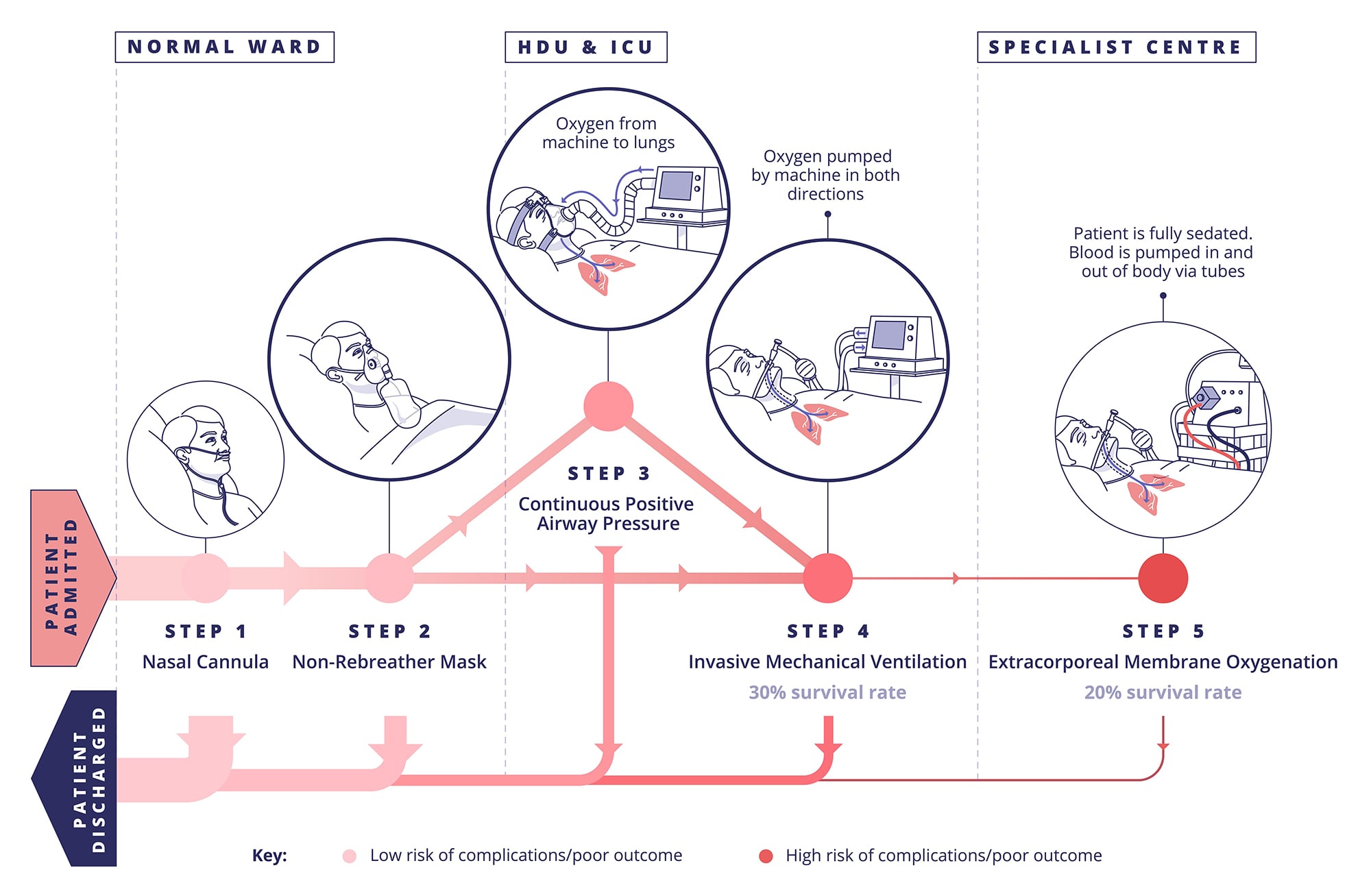
Managing blocked airways is a particular concern. This can be done in less severe cases with simple nasal cannula or oxygen rebreather masks. However, in more extreme cases, you may need continuous airway pressure provided through a machine or even invasive mechanical ventilation.
The chances of this happening to you or a loved one because your neighborhood school building was reopened and children were exposed to potentially sick classmates and staff is far from negligible.
These include inflammation of the heart, cardiovascular disease and strokes; lung inflammation including persistent shortness of breath; and neurological issues such as headaches, dizziness, trouble concentrating or recalling things and even hallucinations.
Teachers and classrooms provide necessary services way beyond simple education.
I’m talking about food, nutrition, healthcare, childcare, counseling, tutoring, socialization, self esteem, meeting special needs, protection from abuse and a whole lot more.
If we keep school buildings closed and go to distance learning as we did in March, many of these services will continue to be disrupted or completely severed.
While reopening school buildings is NOT a viable solution, there are other things we can do.
Food, nutrition and healthcare can all be met while conducting distance learning. In fact, most schools provided these services from March through June as classrooms across the country were closed.
Likewise, counseling, tutoring, socialization, and self esteem can be provided on-line. In most cases they won’t be as effective as they would be in a physical setting. However, given the precautions necessary to meet in-person – face masks, social distancing, etc. – they may be more effective screen-to-screen than they would be mask-to-mask.
Which brings me to the most difficult considerations – meeting special needs, protection from abuse, and childcare.
Special arrangements could be made for these students to come into the physical classroom on a part-time or full-time basis. This isn’t as safe as complete on-line learning, but if the numbers of students are small enough, precautions such a temperature screenings and social distancing were in place and exposure mitigated, this could be a viable option.
The same goes for protection from abuse. Some students live in unsafe home environments. It is observation by responsible adults who are mandated reporters like teachers that reduce the likelihood these children will be mistreated and provide a solution when abuse is reported. However, noticing the telltale signs of such mistreatment or even communicating with a teacher privately outside of the hearing of an adult in the home is more difficult on-line.
Special arrangements could be made for students who have already been identified as at risk. They could meet with counselors and psychologists in the school every week or so. Safety precautions would be necessary but the risk could be reduced enough to make it worth taking.
The biggest problem is probably the most widespread – childcare.
Having children at home to do their schoolwork on-line puts additional pressure on parents.
In short, the economy requires some kind of daycare for these children.
Many European countries that have best managed the Coronavirus have paid workers to stay home. This allows them to take care of their own children and reduce their own exposure to the virus.
However, our government has almost completely abrogated its responsibilities to working class people.
Parents with similar age children can create childcare networks where the same families take turns watching each others’ children. This reduces exposure to some degree.
Childcare centers also have been kept open in many communities to meet this need. However,there have been massive outbreaks at such centersacross the country that would only be worsened if we rely on them more. Any sane country would close them just as it closed schools.
Until our lawmakers get off their butts and do their jobs, we will have no good solution to this problem.
Reopening school buildings to serve as childcare centers certainly won’t solve anything except put a premium on respirators, coffins and graveyard plots.
We need to make it possible for parents to stay home with their children.
And we need to do it now.
Like this post? You might want to consider becoming a Patreon subscriber. This helps me continue to keep the blog going and get on with this difficult and challenging work.










 gadflyonthewallblog