School Voucher Industry Strikes Back: We’re Segregated!? No, You’re Segregated!

144447167


In what must count as another new low in American discourse, the school voucher industry is striking back against claims that their products lead to greater segregation of students.


Randi Weingarten, President of the American Federation of Teachers (AFT), had the audacity to voice the truth:


“Make no mistake: This use of privatization, coupled with disinvestment are only slightly more polite cousins of segregation,” she said a week ago during a speech at the AFT’s yearly convention.


To which school privatization mouthpieces quickly countered with the truth:


“If vouchers are the polite cousins of segregation, then most urban school districts are segregation’s direct descendants. The vast majority of our urban public school districts are segregated because of white flight and neighborhood neglect.”


This was from a statement by Kevin Chavous, founding board member of the American Federation for Children, the school privatization advocacy group that Secretary of Education Betsy DeVos used to lead.


So there you have it.


A nation of more than 325 million people, with a more than 241-year history reduced to – I Know You Are But What Am I?


The sad fact is that they’re both right.


School vouchers do lead to increased segregation (and so do charter schools, by the way, the method preferred by corporate Democrats). But many traditional public schools are, in fact, deeply segregated both racially and economically.


Does that mean that both systems – privatized and public – are equally at fault? Does it mean that both somehow get a pass for reprehensible behavior?


No and no.


First, we must explain why segregation is bad.


Peter Cunningham, former assistant secretary for communications and outreach at the Education Department under Obama, wagged his finger at Weingarten on the privatization propaganda Website, the 74.


He called out Weingarten’s hypocrisy, which takes some cojones for a man who only last year pondered aloud and in public whether segregation was really such a bad thing.


He had this to say last September:


“Maybe the fight’s not worth it. It’s a good thing; we all think integration is good. But it’s been a long fight, we’ve had middling success. At the same time, we have lots and lots of schools filled with kids of one race, one background, that are doing great. It’s a good question.”


Funny, isn’t it?


He calls out Weingarten because of public school segregation but defends charter schools because their segregation is somehow just swell.


Keep in mind. Cunningham is the executive director of the Education Post, a well-funded charter school public relations firm that packages its advertisements, propaganda and apologias as journalism. And he’s not about to poop where he eats.


So, yes, Mr. Cunningham, segregation is worth fighting.


When you have schools made up mostly of minority and/or economically disadvantaged students, it makes it easier to provide fewer resources and less funding to those children while sending the lion’s share to the white and wealthy.


That’s why in Brown v. Board the U.S. Supreme Court struck down “Separate but Equal” – because when races are kept separate, their schools are rarely equal.


This game of excusing one system based on the deficiencies of the other is pure sophistry.


You can’t defend voucher and charter schools from being segregated by reference to public school segregation. Nor can you ignore public school segregation by reference to the same at privatized schools.


They’re both bad, and they both need fixing.


To be fair, Weingarten seems to tacitly admit this about public schools.


She acknowledges the disinvestment in public education, how public schools have been systemically undermined by politicians and lobbyists, many of them advocating for privatized schools, so that they could use this disinvestment as an excuse for their own for-profit education schemes.


“…no amount of facts or evidence will sway voucher proponents from their agenda to starve public schools to the breaking point, then criticize their deficiencies and let the market handle the rest, all in the name of choice,” she said in a statement.


The fact of the matter is this: public schools have become more segregated not because teachers or administrators want it, but because of local, state and federal law; a series of subsequent Supreme Court decisions allowing it within district boundaries; the continuation of racist redlining in the loan and insurance industry; and the xenophobia of wealthy and middle class whites who prefer their kids be educated separately from those they consider undesirable.


These policies could be changed. The system could be fixed. All it would take is the will to do it.


Charter and vouchers schools, on the other hand, will never solve the problem of segregation, because they have turned that problem into a “solution.”


Schools serving poor and minority students aren’t getting the proper resources. So they propose further segregating them.


That’s a terrible idea. It’s like escaping from a leaky cruise ship by jumping into a leaky lifeboat. You’ll sink in both, but the lifeboat will sink quicker.


Yes, our public schools are segregated by race and class and therefore poor and minority students receive inequitable funding and resources. Charters and vouchers cannot possibly remedy that. They will always make it worse. Only a robust and integrated public school system can be truly equitable. A system that deifies choice cannot combat racism if it is freely chosen.


What Weingarten is getting at is this: if we want to help the nation’s children – all of the nation’s children – we must support and reform public schools.


We must also acknowledge that many of the problems of systemic disinvestment are caused by those who want to privatize in the first place.


We have let the wolf write our education policy. It should be no shock that his solution isn’t to build more houses of bricks but to process our little piggies into bacon.


Full disclosure: I am no fan of Weingarten.


I recently called for both her and National Education Association (NEA) President Lily Eskelsen Garcia to voluntarily step down because of undemocratic practices and mismanagement in both teachers unions.


However, I’ll stand up for her when she’s right, and in this instance, she is.


If anything, maybe she should have included charter schools in her criticism. I laid into her in June for writing an op-ed with Jonah Edelman, an anti-union activist, specifically praising charter schools over vouchers.


But I get it. Now that some charter school teachers have unionized and joined the AFT, she’s stuck between a rock and a hard place.


Frankly, it makes her ineffective in speaking out on this matter. I have nothing against charter school teachers. I know, personally, several very good educators who work at charter schools. In this job market, sometimes you have to take what you can get. However, the sad fact of the matter is that by their very structure, charter schools are inferior to public schools. They are less democratic, less transparent, less accountable and more easily subject to fraud and abuse of children. That’s not to say all charters are guilty of this, but just by being a charter school and being subject to the deregulated rules governing them, they are more susceptible to these errors than their traditional public school brethren.


But, of course, the same can be said of voucher schools. It’s just that you can’t criticize one privatization scheme without also criticizing the other.


Perhaps the biggest mistake Weingarten made was in glossing over the worst abuses of public schools. If she was going to call out the segregation at voucher schools, she also should have explicitly called it out at public schools.


But that’s something even our first black President Barack Obama refused to do. You’d think he’d make that a priority for his administration, but instead he favored the same school privatization schemes that just made it worse.


Currently, you’ll find no political party that actively champions integration. Democrats will give it more lip service than Republicans, but both parties either ignore it in practice or actively work against it.


The only use they have for it is as a club with which to hit the other side when issues like this come up.


You’re segregated!


No, YOU’RE segregated!


And so we are all lead over the cliff by partisans and fools.

The One Reform We Never Try: Increase Teacher Salary


Screen Shot 2017-07-20 at 4.10.21 PM


There are many suggestions for improving America’s public schools:


More standardized tests.


New academic standards.


Increase charter schools and/or allow kids to attend private schools with public money.


But one reform you hardly ever hear about is this: pay teachers more.


Isn’t that funny?


We’re willing to try almost everything else but that.


Sure, some folks want to tie teachers’ salaries to test scores, but that’s not increasing pay. That’s just doubling down on standardized testing.


Isn’t it shocking that no one is willing to invest more money into the actual act of educating children?


Consider this: full-time employees making minimum wage earn between $15,000-$20,000 a year. (Some states have voluntarily raised the minimum wage above the federally mandated $7.25 to as much as $10 an hour.)


Compare that to a teacher’s starting salary.


According to the National Association of Colleges and Employers (NACE), the low end for teachers entering the field is around $30,000. That’s a mere $10,000 above the most generous minimum wage.


There are places in this country where going into debt earning a four year degree in education, serving an (often unpaid) internship in the classroom and agreeing to teach the next generation gets you a few notches above fry chefs and WalMart greeters.


This isn’t to disparage burger cooks or grocery clerks. I, too, love a crispy French fried potato and a sincere greeting. But which profession is more important to our future as a nation? The quality of our service industries or the education of every single child in the country – all our future doctors, lawyers, politicians and… well… EVERYTHING!


Average starting salary for teachers nationwide is only $37,000, according to NACE.


Compare that to other professions.


Computer programmers start at $65,000. Engineers start at $61,000. Accountants (mathematics and statistics majors) start at $54,000. Even philosophers and priests (philosophy and religious studies majors) start at $45,000.


Are they more important than teachers? Do they provide more value for society?


I humbly suggest that they do not.


Who taught the programmers how to program? Who taught the engineers and accountants how to add and subtract? Who taught the philosophers how to think logically? Who taught the priests how to write their sermons?


TEACHERS. That’s who.


Yet if we judge purely by starting salary, we certainly don’t value their services much.


To be specific, they make 14 percent less than those from professions that require similar levels of education, according to the Economic Policy Institute.


Sadly, it only gets worse as time goes on.


Teacher salary starts low, and grows even more slowly.


original


According to a report by the Center for American Progress, the average base salary for a teacher with 10 years of experience and a bachelor’s degree is $45,000. That’s a mere $800 annual raise. No wonder more than 16 percent of teachers have a second or third job outside of the school system. They simply can’t survive on the salary.


They can’t buy a home or even rent an apartment in most metropolitan areas. They can’t afford to marry, raise children, or eke out a middle class existence.


What effect does this have on students?


Well, for one, it often leaves them with inexperienced or exhausted teachers.


Nationwide, 46 percent of educators quit before reaching the five year mark. And it’s worse in urban districts, where 20 percent quit every single year!


That translates to more students learning from educators who are, themselves, just learning how to teach. If we took pains to keep them in the profession, think of what a positive impact that would have on the quality of education the nation’s students  receive – Teachers learning from experience and improving their practice every year instead of a continual flux of novices just trying to figure out the basics and survive!


But it’s not all intangibles. It costs bookoo bucks to constantly find and train new teachers – roughly $7.34 billion a year, to be exact. Imagine if we could invest that money into salaries instead.


This is exactly what they do in many other countries.


We’re always comparing ourselves with nations in Europe and Asia where students average higher standardized test scores. Yet we rarely enact the policies that got them these results.


Many of these countries recruit the top graduates to become teachers. How? By offering sweeteners and incentives to become a life-long educator.


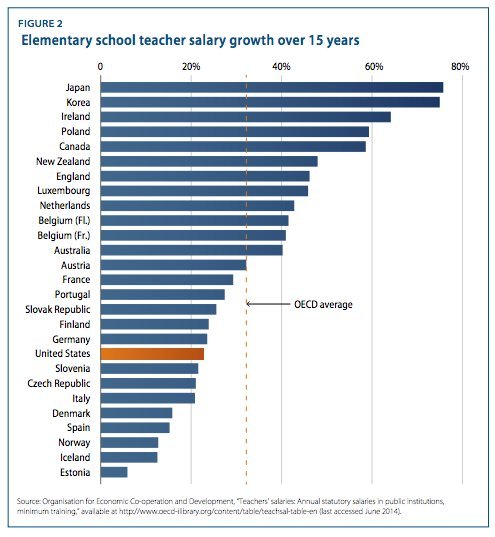
In Singapore and Finland, for example, they actually cover the cost of the college coursework needed to become a teacher. And when it comes to salary, they leave us in the dust. In South Korea, they pay educators an average of 250 percent more than we do!


For many people, education is a calling. You feel drawn toward the job because it holds meaning to you. But how many people ignore that calling because of simple economics? There are plenty of things you can do with your life; If you can’t earn a living doing one thing, you may opt for something else.


How many more excellent teachers would we have in this country if we prized and rewarded those practitioners we already have?


It doesn’t take a deep dive into the news to see how teachers are treated in American society far beyond the low pay.


Everything that goes wrong in our public schools is laid at their feet whether they have any control over it or not. Child poverty, inequitable and inadequate resources, regressive and nepotistic policy, backward education legislation – it’s all somehow the teacher’s fault.


Imagine if we saw teachers as part of the solution! What effect would that have on teacher turnover?


Look no further than our foreign counterparts. In South Korea, turnover is only 1 percent per year. In Finland, it’s 2 percent. In Singapore, it’s 3 percent.


It’s certainly worth a try.


As reforms go, this is one with more evidence behind it than 90 percent of the garbage that comes floating out of partisan think tanks.


Pay teachers more.


Starting salary should be at least $65,000. End pay after 30 years should be at least $150,000.


THAT would boost educational outcomes.


And, please, don’t give me any nonsense about summer break, teacher tenure, the power of unions or whatever else you heard on talk radio or the corporate news media. Teachers average 53 hours a week August through June – making up for any downtime in the summer, tenure doesn’t mean a job for life – it means due process, and unions aren’t evil – they just ensure workers more rights than the bosses would like.


Moreover, don’t tell me we can’t afford it. We spend more on the military than the next 8 nations combined.


Imagine if we put a priority on raising our own children instead of guns and missiles. Imagine if we spent more on life than death.


Imagine if we tried the one reform left in the box – increase teacher pay.


Test-Based Accountability – Smokescreen for Cowardly Politicians and Unscrupulous Corporations

Screen Shot 2017-07-16 at 9.28.59 AM

There is no single education policy more harmful than test-based accountability.


The idea goes like this: We need to make sure public schools actually teach children, and the best way to do that is with high stakes standardized testing.


It starts from the assumption that the problems with our school system are all service-based. Individual schools or districts are not providing quality services. Teachers and administrators are either screwing up or don’t care enough to do the job.


But this is untrue. In reality, most of our problems are resource-based. From the get-go, schools and districts get inequitable resources with which to work.


This is not a guess. This is not a theory. It is demonstrable. It has been demonstrated. It is a fact.


No one even disputes it.


What is in question is its importance.


However, any lack of intention or ability on the part of schools to actually teach is, in fact, pure conjecture. It is a presumption, an excuse by those responsible for allocating resources (i.e. lawmakers) from doing their jobs.


Any time you hear senators or representatives at the state or federal level talking about test-based accountability, they are ignoring their own duties to properly provide for our public school children and pushing everything onto the schools, themselves.


That is the foundation of the concept. It’s hard to imagine more unstable ground from which to base national education policy.


But it gets worse.


With our eyes closed and this assumption swallowed like a poison pill, we are asked to accept further toxic premises.


Next comes the concept of trustworthiness.


We are being asked to question the trustworthiness of teachers. Instead, we are pushed to trust corporations – corporations that manufacture standardized tests.


I have no idea why anyone would think that big business is inherently moral or ethical. The history of the world demonstrates this lie. Nor do I understand why anyone would start from the proposition that teachers are inherently untrustworthy. Like any other group of human beings, educators include individuals that are more or less honest, but the profession is not motivated by a creed that specifically prescribes lying if it maximizes profit.


Business is.


Test manufacturers are motivated by profit. They will do that which maximizes the corporate bottom line. And student failure does just that.


Most of these companies don’t just manufacturer tests. They also provide the books, workbooks, software and other materials schools use to get students ready to take the tests. They produce the remediation materials for students who fail the tests. And they provide and grade the tests in the first place.


When students fail their tests, it means more money for the corporation. More money to give and grade the retests. More money to provide additional remediation materials. And it justifies the need for tests to begin with.


Is it any wonder then that so many kids fail? That’s what’s profitable.


There was a time when classroom teachers were not so motivated.


They were not paid based on how many of their students passed the test. Their evaluations were not based on student test scores. Their effectiveness used to be judged based on what they actually did in the classroom. If they could demonstrate to their administrators that they were actually making good faith efforts to teach kids, they were considered effective. If not, they were ineffective. It was a system that was both empirical and fair – and one to which we should return.


In fact, it was so fair that it demonstrated the partisanship of the corporations. Laws were changed to bring teacher motivation more in line with those of big business. Their evaluations became based on student test scores. Their salaries were increasingly tied to student success on these tests. And when some teachers inevitably felt the pressure to cheat on the tests, they were scapegoated and fired. There is no mechanism available to even determine if testing corporations cheat less than penalties for it.


After all, what is cheating for a testing corporation when they determine the cut score for passing and failing?


Yet this is a major premise behind test-based accountability – the untrustworthiness of teachers compared to the dependable, credibility of corporations.


Next, come the scores, themselves.


Time-after-time, standardized test scores show a striking correspondence: poor and minority students often do badly while middle class and wealthy white students do well.


Why is that?


Well, it could mean, as we’ve already mentioned, that poor and minority students aren’t receiving the proper resources. Or it could mean that teachers are neglecting these children.


There is a mountain of evidenceundisputed evidence – to support the former. There is nothing to support the later.


I’m not saying that there aren’t individual teachers out there who may be doing a bad job educating poor and minority children. There certainly are some. But there is no evidence of a systemic conspiracy by teachers to educate the rich white kids and ignore all others. However, there IS an unquestionable, proven system of disinvestment in these exact same kids by lawmakers.


If we used standardized tests to shine a light on the funding inequalities of the system, perhaps they would be doing some good. But this is not how we interpret the data.


Finally comes the evidence of history.


Standardized testing is not new. It is a practice with a past that is entirely uncomplimentary.


These kinds of assessments are poor indicators of understanding complex processes. Answering multiple choice questions is not the best way to determine comprehension.


Moreover, this process is tainted by the eugenicist movement from which it originates. Standardized testing is a product of the belief that some races are better than others. It is a product of white supremacy. It was designed by racist psychologists who used it to justify the social structure of past generations and roundly praised and emulated by literal Nazis.


It is therefore not surprising that test scores show privileged white kids as superior to underprivileged students of color. That is how the system was designed.


Why any educated person would unquestionably accept these scores as valid assessments of student learning is beyond me.


Yet these are the assumptions and premises upon which the house of test-based accountability is built.


It is a smokescreen to protect politicians from having to provide adequate, equitable, sustainable resources for all children. It likewise protects unscrupulous business people so they can continue to cash in on the school system without providing any real value for students.


We must no longer allow policymakers to hide behind this blatant and immoral lie.


Not only should voters refrain from re-electing any lawmakers whose constituents children are receiving inequitable school resources, they should not be eligible for re-election.


Not only should corporations not be trusted more than teachers, they should be barred from determining success or failure while also profiting off of that same failure.


In short, we need to stop worshipping at the altar of test-based accountability.


Schools can and should be held accountable. But it cannot be done with standardized tests.


Moreover, we must stop ignoring the role of policymakers and business in this system. They must also be responsible. We are allowing them to get away with murder.


It’s time to wake up and make them answer for what they’ve done to our nation’s children.

The Problem With Public Schools Isn’t Low Test Scores. It’s Strategic Disinvestment

We-Shall-Overcome-School-Closings

Imagine you’re settling in to enjoy an article on-line or in your favorite print newspaper and you come across this headline:


U.S. Schools Ranked Low Internationally!


Or


Out of X Countries, U.S. Places Far From the Top in Math!


You feel embarrassed.


Soon that embarrassment turns to anger.


Sweat starts to break out on your brow.


And then you start to grasp for a solution to the problem – something major, something to disrupt the current system and bring us back to our proper place in the lead.


TWEEEEEEEET!


That was me blowing a gym teacher’s whistle. I’ll do it again:


TWWEEEEEEEEEEEEEEEEEEEEEEEEEEET!


Hold it right there, consumer of corporate media. You’ve just been had by one of the oldest tricks in the book.


It’s the old manipulate-the-data-to-make-it-look-like-there’s-a-crisis-that-can-only-be-solved-by-drastic-measures-that-you-would-never-approve-of-normally.


We also call it disaster capitalism or the shock doctrine.


It’s been used to get people to agree to terrible solutions like preemptive wars of choice, warrantless wiretapping of civilians, torturing prisoners, defunding public health programs and scientific research – just about everything the Koch Brothers, the Waltons, the Broads, Gateses and other billionaire hegemonists have on their fire sale wish list.


In the case of the American educational system, it’s the impetus behind high stakes standardized testing, Common Core, Teach for America, and charter and voucher schools.


And they’re all justified by misinformation about student test scores.


The argument goes like this: Our Kids Are Failing!? Quick! Standardize and Privatize Their Schools!


First, education isn’t a race.


There is no best education system followed by a second best, etc. There are only countries that meet their students needs better than others.


And if you really wanted to determine if our country was meeting student needs, you wouldn’t appeal to test scores. You’d look at specific needs and assess them individually.


But you rarely see that. You rarely see an article with the headline:


U.S. Schools More Segregated Than Any In The Industrialized World!


Or


Out of X Countries, U.S. Spends Most on Rich Students and Least on Poor Ones!


Second, we need to ask ourselves if standardized test scores are really the best way to assess (1) student learning and (2) the education system as a whole.


Multiple choice tests are written by large corporations that profit more off of student failure than success. That’s not exactly an objective measure.

Students are considered passing or failing based on an arbitrary cut score that changes every year. That’s not exactly unbiased.


Moreover, standardized tests are always graded on a curve. That means no matter how well students do, some will always be considered failing. We cannot have No Child Left Behind when our assessments are designed to do just the opposite – it’s logically impossible.


But whenever the media turns to these international rankings, they ignore these facts.


They pretend it’s a horse race and we’re losing.


I kind of expect this from the corporate media. But when so-called progressive writers fall into this trap, I have to wonder if they’re just lazy or ignorant.


At best, these test scores are a second hand indication of structural inequalities in our public education system. It’s no accident that student from wealthy families generally score higher than those from poor ones. Nor is it pure misadventure that minority children also tend to score lower than their white counterparts.


These tests are economically, racially and culturally biased. They are completely unhelpful in determining root causes.


Thankfully, they’re unnecessary. It doesn’t take a standardized test to determine which students are receiving the least funding. Nor does it take a corporate intermediary to show us which schools have the largest class sizes and lowest resources.


The sad fact is that there are an awful lot of poor children attending public school. The U.S. has one of the highest child poverty rates in the industrialized world. And despite spending a lot on our middle class and wealthy students, we’re doing next to nothing to actually help our neediest children.


A large portion of U.S. public schools have been left to their own devices for decades. What’s worse, when they struggle to meet students’ needs, we don’t swoop in with help. We level blame. We fire teachers, close buildings and privatize.


There’s absolutely zero proof that changing a public school to a charter school will help, but we do it anyway. There’s not a scrap of evidence that sending poor kids to a low end private school with a tax-funded voucher will help, but we do it anyway.


Think about it: why would getting rid of duly-elected school boards help kids learn? Why would allowing schools to spend money behind close doors with zero public accountability boost children’s ability to learn?


Yet our policymakers continue to push for these measures because they have no intention of helping poor and minority public school students. They just want to enrich their friends in the school privatization industry. They just want to divert public money to testing corporations and book publishers.


THAT is the problem with America’s education system.


Not test scores.


It’s time our nation’s journalists give up this old canard.


We must be honest about why our public schools struggle. That’s the only way to find real solutions.


We must acknowledge the increasing segregation – both racially and economically. We must acknowledge the blatant funding disparities. And we must acknowledge how the majority of education policy at the federal, state and local level has done little to help alleviate these problems – in fact it has exacerbated them.


We need to stop testing and start investing in our schools. We need to stop privatizing and start participating in our neighborhood schools.


And most of all, we need to stop the lies and disinformation.

Where Did All The Integrated Schools Go? Why Segregation is Still Bad

 Screen Shot 2017-07-05 at 2.22.58 AM

School segregation is bad.


Still.


It is shocking to me that in 2017 making this argument remains necessary.


But everywhere you look in the education debate you’ll find people clinging to their segregated charter schools, pushing for more segregated school vouchers, and lobbying to increase segregation at our traditional public schools.


You might be forgiven for thinking that the issue was resolved way back in 1954 when the US Supreme Court ruled in the landmark Brown vs. Board of Education case.


Justices decided that it was unconstitutional to have substandard schools for black and minority students while also maintaining pristine schools for white children, as was the practice in most parts of the country at the time.


They struck down the previous justification of “separate but equal” because when you have separate schools, they are rarely equal.


You might think that’s just common sense. When you have schools just for blacks and schools just for whites, the resources aren’t going to be divided fairly or evenly. One group will always get the upper hand. Better to mix the two groups so it’s harder to select against one or the other.


And this is true of almost every cultural division you can think of: race, gender, class, religion, etc. The only way to protect everyone is to make it harder to hurt one group without hurting them all.


Everyone should already know that. But it still strikes some as news.


What may be less well known is the long, racist history of resistance to this ruling. In fact, what we now call “school choice” was invented during this time as an explicit attempt to avoid desegregation. “Charter Schools” and “School Vouchers” are modern terms that could almost as easily be used to describe the multifarious discriminatory attempts to stop racial mixing by reference to “choice.”


Take vouchers – allocating tax dollars to parents so they could “choose” to send their kids to private schools that won’t accept minorities – they tried it.


Or charters – setting up schools that are privately run but publicly funded so parents can “choose” to send their kids to schools allowed to discriminate against minorities during enrollment – they tried it.


And they’re still trying it and getting away with it.


It took decades for Brown v. Board to truly be enforced nationwide, and even after it became unavoidable, the fight to undermine it never truly died.


Betsy DeVos probably doesn’t consider herself a segregationist. Barack Obama probably doesn’t consider himself an advocate of “apartheid education”. But that’s what the policies each of them support actually accomplish. Both major political parties have been complicit – and are still complicit – in keeping our public schools separated by race and class.


There’s big bucks in it. Privatization means reducing accountability and transparency for how tax dollars are spent, which means unscrupulous corporations can pocket public money with no questions asked.


But it’s not just the charter and voucher industry that increase segregation. Our traditional public schools have also become separate and unequal.


After initial progress, our traditional public schools have been allowed to slip back into segregation. In many parts of the country, they are actually more segregated today than they were at the height of the civil rights movement in the 1960s.


According to a report from the U.S. Government Accountability Office, from 2000 to 2014, school segregation has more than doubled nationwide. That’s twice the number of schools comprised almost entirely of students living in high poverty and/or students of color.


The number went from 7,009 to 15,089 schools. And that’s just the worst offenders – schools with more than three quarters of students from only one race or class. Throughout the country there are thousands more schools not as extreme but still serving mostly poor and/or minority students, and thus receiving fewer resources, more teacher layoffs, dealing with larger classes and crumbling infrastructure.


It wasn’t always like this.


Classrooms were the most diverse from the 1970s through the early 1990s. At peak integration, four out of 10 black southern students attended a white school, while less than a third of all black students attended majority black schools.


What went wrong? The Supreme Court.


The highest court in the land laid down a series of decisions, starting with Milliken vs. Bradley in 1974, that effectively put the breaks on school integration. In fact, that first case is often criticized as “one of the worst Supreme Court decisions” ever.


It dealt with Detroit’s plan to integrate students by busing them from the inner city to the suburbs. The court ruled that such a plan was unconstitutional, because black students only had the right to attend integrated schools WITHIN THEIR OWN SCHOOL DISTRICT. If few white people lived there, well oh well.


And thus, de facto segregation was born.


If black and white people didn’t live together in the same neighborhoods – and they rarely do – then they wouldn’t be forced to go to school together. Forget that banks and insurance companies often refuse or limit loans, mortgages, and insurance to people of color for properties within specific geographical areas – a practice known as red lining. There was nothing municipal or school officials from minority jurisdictions could do to force integration across these artificial borders.


Between 1991 and 1995, the Court made matters even worse in three additional rulings. Justices decided that integration was merely a temporary federal policy and once the imbalance was righted, school districts should be released from any desegregation orders.


The results can be seen in almost every traditional public school in the country. There are rich schools and poor schools. There are black schools and white schools. And our federal and state education policies take advantage of the separation making sure that privileged schools get the lions share of resources while the others have to make do with less.


It is the key issue holding back our system of public education. Almost every school where students have low test scores has a disproportionately high level of poverty and students of color. If our schools were truly integrated, there would be none labeled “failing.” There would only be students who need extra help though they would be equally distributed throughout and thus not stigmatized. Unfortunately, re-segregation has allowed an easy scapegoat, and this, in turn, has been an excuse to build more charter schools and pass more school vouchers that drastically increase that same segregation.


Some people look at this situation and claim that it means we should abandon traditional public schools. If they’re already segregated, they argue, we should just invest in the choice schools.


However, doing so would not solve any of our problems. It would only exacerbate them. The solution to smoking is not more cigarettes. It’s quitting.


School segregation is terrible. That’s true at charter, voucher and traditional public schools.


The presence of segregation is no reason to abandon public education. It just means we need to fix it.


We need to overturn these destructive and short-sighted Supreme Court decisions. We need federal and state policies that recommit us to integration. At very least, we need a moratorium on new charter and voucher programs.


We need to value all children, not just those who resemble us racially, socially and/or economically.


That’s why school segregation is so bad.


It divides our children into discrete groups. It sets up the social structure and ensures the privileged will continue to be prized and the underprivileged will continue to be devalued. It teaches children to trust those like themselves and to distrust those who are different.


School segregation is the mother of racism and prejudice. And until we, adults, have the courage to tackle it, the next generation will grow up just like us – selfish, racist and blind.


John Oliver recently reported on the same issue (Warning: vulgarity):


Here’s an Idea: Guarantee Every Child an Excellent Education

Little African Girl At Wooden Fence With Thumbs Up.

Let’s get one thing straight: there are plenty of things wrong with America’s school system. But they almost all stem from one major error.

We don’t guarantee every child an excellent education.

Instead, we strive to guarantee every child THE CHANCE at an excellent education. In other words, we’ll provide a bunch of different options that parents and children can choose from – public schools, charter schools, cyber schools, voucher schools, etc.

Some of these options will be great. Some will be terrible. It’s up to the consumer (i.e. parents and children) to decide which one to bet on.

In many places this results in children bouncing from school-to-school. One school is woefully deficient, they enroll in another one. One school closes suddenly, they start over again at another.

It’s terribly inefficient and does very little good for most children.

But that’s because it’s not designed with them in mind. It does not put the child first. It puts the education provider first.

It is a distinctly privatized system. As such, the most important element in this system is the corporation, business, administrator or entrepreneurial entity that provides an education.

We guarantee the businessperson a potential client. We guarantee the investor a market. We guarantee the hedge fund manager a path to increased equity. We guarantee the entrepreneur a chance to exploit the system for a profit.

What we do NOT guarantee is anything for the students. Caveat emptor – “Let the buyer beware.”

Imagine if, instead, we started from this proposition: every child in America will be provided with an excellent education.

Sound impossible? Maybe. But it’s certainly a better goal than the one we’re using.

And even if we somehow managed to do it – even if every school was excellent – that doesn’t mean every child would become a genius. You can only provide the basis for an excellent education; it is up to the individual learner – with help from parents, teachers, and other stakeholders – to take advantage of what is put before him or her.

That is not a crazy goal to have. Nor does it mean that education would necessarily become stagnated.

It doesn’t matter what kind of school students go to – it matters that each and every school that receives public funding must be excellent.

That doesn’t mean they each must be excellent in the same ways. One wouldn’t expect them to be carbon copies of each other. Students have different needs. One would expect each classroom and each teacher to be doing different things at different times.

However, there are some things that are universal. There are some principles that are just better than others. Here are four:

First, it is better for schools receiving public funding to have to spend that money openly. They shouldn’t be able to spend that money behind closed doors without any public scrutiny or accountability.

Second, it’s better that the majority of the decisions made about how the school is run are made in public by duly-elected school board members drawn from the community, itself. That is much more preferable to political appointees who are not accountable to the parents and community.

Third, it is better if a school cannot deny a student enrollment based on that student’s special needs, race, religion, creed, sexual orientation, academic record or other factors. If the school receives public funds, it should not be allowed to turn anyone away.

Finally, it is better if a school teaches material that is academically appropriate, generally accepted as mainstream core concepts of the subject and Constitutional. Schools funded with tax money should not teach religious concepts like Creationism. They should not teach history and science from a Biblical point of view. They should not teach racial, sexual and religious discrimination.

None of these four principles should really be controversial. But each of them is violated by our current education system.

Some voucher schools violate the latter proposition. The other three are often violated by charter, cyber and voucher schools.

The only type of school that does not routinely violate these propositions is traditional public schools. Yet that is also the type of school being consistently undermined by most of our current educational policies.

So if we start from the idea that every student should get an excellent education, we start with the proposition to support and renew our public schools.

In doing so, we would need a national commitment to bringing every public school up to snuff.

Many of them already are – Hint: they’re found in rich neighborhoods. The ones that struggle are almost always found in poorer neighborhoods, and that’s no accident. It’s the result of savage funding inequalities.

What we’d need to do is ensure schools serving impoverished students receive equitable funding compared with schools serving the middle class and wealthy kids. Impoverished students must by necessity receive as much funding as the privileged ones. In fact, given the deprivations and increased needs of impoverished students, they should actually receive more funding. Middle class and rich kids have academic advantages over poor kids before they even enter kindergarten. They have more books in the home, more educated parents, better nutrition, better neonatal care, and often more stable home environments. If we really committed ourselves to making sure even these kids got the best possible education, we’d need to start spending more money on them.

Next, we’d need to do something about school segregation. Our public school system is now almost as segregated – and in some places even more segregated – than it was before the landmark Brown vs. Board decision 50 years ago. The only way to guarantee everyone an excellent education is to make it increasingly difficult to hurt some students without hurting all. There is no separate but equal. When we keep students apart by race or class, we ensure inequality among them.

And perhaps most important is this: we must remove the profit principle from education. We cannot allow decisions to be made based on what is best for corporations. Academic decisions about how to teach, how to assess student learning and how to assess teaching should be made by professional classroom educators.

This means no more high stakes standardized testing. No more Common Core. No more depersonalized computer-based learning. No more value added measures used to evaluated teachers. No more union busting. No more Teach for America.

We need to start valuing teachers and teaching again. And we need to pay and treat them as one of the most valuable parts of our society.

These measures would not be easy to accomplish, but they would have an immense impact on our schools.

This would require a substantial outlay of additional funding. We could save money by discontinuing costly practices that don’t benefit children (i.e. testing, charter and voucher funding, etc.). But make no mistake, it would cost money. However, we’re one of the richest countries in the world. We spend a ridiculous amount already on the military. You’re telling me we can’t find the money to spend on our children? If we’re not willing to spend on our future, we don’t deserve to have one.

It requires only a change in focus, a reevaluation of our priorities and goals.

Education should not be market driven. It should be student driven.

We should no longer guarantee business a class of consumers.

Instead, every student in this country no matter if they are rich or poor, black or white, male or female, gay or straight, religious or not – every student should be guaranteed an excellent education.

It’s really that simple.

Betsy’s Choice: School Privatization Over Kids’ Civil Rights

Betsy DeVos attends education meeting at the White House in Washington


Betsy DeVos seems to be confused about her job.


As U.S. Secretary of Education, she is responsible for upholding the civil rights of all U.S. students.


She is NOT a paid lobbyist for the school privatization industry.


Yet when asked point blank by Sen. Jeff Merkley (D-Ore.) whether her department would ensure that private schools receiving federal school vouchers don’t discriminate against lesbian, gay, bisexual, transgender and queer (LGBTQ) students, she refused to give a straight answer.


She said that the these schools would be required to follow all federal antidiscrimination laws but her department would not issue any clarifications or directives about exactly how they should be doing it.


“On areas where the law is unsettled, this department is not going to be issuing decrees. That is a matter for Congress and the courts to settle,” DeVos said at a hearing before the Senate Appropriations Subcommittee on Labor, Health and Human Services, and Education yesterday.


“I think you just said where it’s unsettled, such discrimination will continue to be allowed under your program. If that’s incorrect, please correct it for the record,” Merkley replied.


DeVos did not correct him.


Instead she simply repeated, “Schools that receive federal funds will follow federal law, period.”


Merkley said she was dodging the question.

“I think that’s very important for the public to know, that today, the secretary of education, before this committee, refused to affirm that she would put forward a program that would ban discrimination based on LGBTQ status of students or would ban discrimination based on religion,” he said.


“Discrimination in any form is wrong. I don’t support discrimination in any form,” DeVos replied.


But that doesn’t mean she’ll fight against it.


She held firm to her position that it is not her job as Secretary of Education to fight for students’ civil rights. That is the responsibility of Congress and the courts.


But she’s wrong.


The Office for Civil Rights (OCR) is part of the Department of Education.


According to the department’s own Website, the “OCR’s mission is to ensure equal access to education and to promote educational excellence through vigorous enforcement of civil rights in our nation’s schools.”


There is nothing “unsettled” about that at all. What IS unsettled is how and if the U.S. Constitution allows federal funds to be spent on private schools in any manner whatsoever.


At very least, it has been argued that giving tax dollars to parochial schools violates the establishment clause of the First Amendment guaranteeing a separation of church and state. Moreover, the degree to which voucher schools that don’t explicitly teach religion would have to abide by federal laws about what they can and should do is likewise “unsettled.”


Yet DeVos has no problem advocating for the school privatization industry. In fact, it has been her lifelong calling. As a billionaire Republican mega-donor, that’s exactly what she’s done for years – shoving bundles of cash at candidates and lawmakers to support school vouchers and charter schools.


Someone needs to remind her that that is no longer her role. In her official capacity as Secretary of Education, her job is not to advocate for school choice. But it IS her job to protect students’ civil rights – regardless of the type of school those students attend.


If a school is at all public, she is responsible for ensuring those students’ rights. And receiving public funds makes a school public.


Specifically, she is responsible for ensuring no child is discriminated against on the basis of race, color and national origin, according to Title VI of the Civil Rights Act of 1964.  This includes protecting children who are being treated unfairly due to limited understanding of the English language or who are still learning to speak the language. This includes children experiencing bigotry as a result of their shared ancestry, ethnicity or religion such as Muslims, Sikhs or Jews.


It is also her job to protect children from sexual discrimination as per Title IX of the Education Amendments of 1972.  No matter her own personal conservative views, she must protect pregnant teens or teen parents. And to speak toward Merkley’s point, according to the Department’s Website, this explicitly includes, “…sex stereotypes (such as treating persons differently because they do not conform to sex-role expectations or because they are attracted to or are in relationships with persons of the same sex); and gender identity or transgender status.”


She is also required to be a champion of students with disabilities as per Section 504 of the Rehabilitation Act of 1973 and Title II of the Americans with Disabilities Act of 1990. Moreover, Title II explicitly forbids public entities – whether or not they receive federal funds – from demonstrating any partiality against students with disabilities.


And that’s just the tip of the iceberg. She has to protect against age discrimination per the Age Discrimination Act of 1975 and enforce the Boy Scouts of America Equal Access Act. She is responsible for investigating complaints about equal access to youth groups conducting meetings at public schools and/or that receive federal funding.


To quote the Website, one more time:


“These civil rights laws extend to all state education agencies, elementary and secondary school systems, colleges and universities, vocational schools, proprietary schools, state vocational rehabilitation agencies, libraries and museums that receive federal financial assistance from ED [the Education Department].”


I’m not so sure DeVos understand this – at all.


Nor do I expect her to get much help from the political ideologues she’s using to staff the department.


Take her choice for Assistant Secretary in the Office for Civil Rights, Candice Jackson.


She’s an ANTI-Civil Rights activist. She literally doesn’t believe in the office she’s running.


The 39-year-old attorney is anti-women’s rights, anti-distributive justice and possibly even anti-compulsory education and anti-Civil Rights Act of 1964!


She once filed a complaint against her prestigious college, Stanford University, for discriminating against her rights as a rich, white person by refusing to allow her access to free minority tutoring.


For all its faults, the Barack Obama administration took civil rights seriously. So much so that conservatives often criticized the Democratic organization as being overzealous in the execution of its duties.


The Obama era Education Department issued so many clarifications of the law that it received a record number of civil rights complaints. This required hundreds of additional lawyers and investigators and increasing the civil rights division by 30 percent.


Complaints went from more than six thousand in 2009 to almost ten thousand in 2015. Of these, the largest increase was in complaints of sex discrimination.


However, President Donald Trump has recommended the Department be downsized in his budget proposal.


The Reality TV star would cut the Department’s budget by 13 percent, or $9 billion, eliminating after-school and summer programming for kids and professional development for teachers.  Instead, he would invest $250 million in a school voucher incentive program and an additional $168 million for charter schools.


Also, getting a boost is personal security for DeVos, herself. She is spending an additional $1 million a month for U.S. Marshalls to guard her against protesters.


It should come as no surprise that Trump and DeVos don’t support the mission of the Department of Education. Both have expressed interest in disbanding the office altogether.


In a February magazine interview, DeVos said, “It would be fine with me to have myself worked out of a job. But I’m not sure that – I’m not sure that there will be a champion movement in Congress to do that.”


Likewise, Trump wrote in his 2015 book “Great Again: How to Fix Our Crippled America” that “if we don’t eliminate [the department] completely, we certainly need to cut its power and reach.”


That is exactly what DeVos is doing.


Under Presidents George W. Bush and Obama, it could be argued the Department was guilty of overreach. But Trump and DeVos are going in the opposite extreme.


Someone has to look out for students’ civil rights. That someone has traditionally been the Department of Education. With DeVos abdicating her responsibilities and continuing her role as a school privatization cheerleader, it is anyone’s guess who – if anyone – will step into the void.

Report: Charter School Vampires Drain Traditional PA Districts Dry

o-VAMPIRE-FANGS-facebook

If you ever needed proof that charter schools harm traditional public school districts, look no further.

A new report by Pennsylvania’s Legislative Budget and Finance Committee concludes that these privately run but publicly financed schools often drain traditional public districts of funding.

The report conducted at the behest of the state House and Senate found that charter schools have attached themselves in some way to almost every district in the Commonwealth, but not equally. Half of the state’s traditional public schools suffer from 80% of the state’s charter parasites.

Moreover, 40% of traditional districts with “significant” charter enrollment are struggling to make ends meet. The reason: unfair state mandates about how traditional districts must pay their charter school hangers-on.

The report is based on interviews with 36 superintendents. A total of 29 of these leaders said charter schools hurt their districts. Only four superintendents mentioned any positive impacts at all.

Much of the damage comes from Pennsylvania’s insistence on funding charter schools out of traditional public school budgets. Instead of charter school money coming directly from the state, much of it comes from the traditional district where it has set up shop.

In effect, it’s like a leach sucking away money that could be going to traditional public school students. We’re one of only 13 states that does this.

It leads to many problems.

Chief among them are the state’s special education laws. Local districts are required to pay their charters extra money for special education students. But this additional funding isn’t based on the number of special needs students actually present in the charter school. It’s based on an arbitrary 16%. Local districts pay charters as if these schools had 16% special education students whether they do or not. This incentivizes charters to enroll less than 16% and pocket the difference.

It’s a system so corrupt that only one other state – Massachusetts – uses it.

We’ve always known the system allows for fraud. We just couldn’t prove it was actually taking place – until now. According to the Pennsylvania Department of Education (PDE), in the 2014-2015 school year alone, local districts gave roughly $294.8 million in special ed supplements to charter schools. However, actual charter expenditures on special ed were only $193.1 million.

That’s $101.7 million in profit for charter operators! Ca-ching!

It’s also more than $100 million set aside to educate children that’s not being used for that purpose!

But that’s not the only way charter schools are sucking out local districts’ finances.
Times are tough. Money is hard to come by. If a district struggles to pay its charter schools, the state steps in and withholds the amount of money due to the charter schools from the state funding it would normally send the district – and sends that money directly to the charters instead.

In effect, the state ensures charters are fully funded, while local districts are left to struggle.

And to make matters worse, when charters file a complaint, the state doesn’t even verify if it’s true. The state doesn’t check to see if the district actually did pay its charters or not. It just withholds whatever money charter operators say they’re owed.

Local districts can appeal overpayments to charters. Right now there are 317 general appeals pending for a total of nearly $30 million in disputed funding – half of which is from Philadelphia, alone!

Nor is this the only area where charters are given preferential treatment. When a charter school attaches itself to a traditional public school, that traditional district must pay to transport kids to the charter school – but it is not required to provide transportation to its own students.

Pennsylvania is one of only 11 states to require transportation to charter schools.

But that’s not the worst of it.

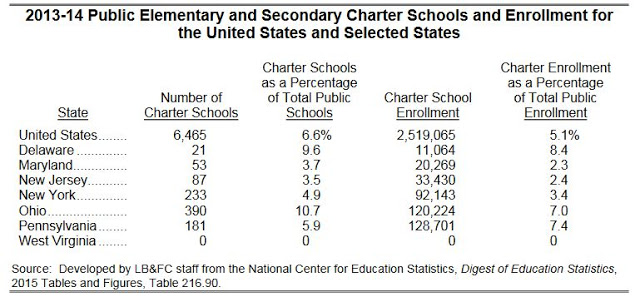
PA charter report

Now we come to cyber charter schools – the Count Draculas of the charter world.

The report estimates an additional $100 million in overpayments to cyber charters because of state law that overestimates their expenses. They are collecting much more money than they need to operate. They don’t have the same costs as brick-and-mortar institutions.

Cyber charter school students are given a computer and internet access. That’s about it. No costly building to run. Students usually do their lessons at home. Even when taking into account cyber charter staff, expenses are much lower than at other kinds of schools yet they are calculated without consideration of these differences.

Once again, state tax dollars that could be used to educate students become pure profit for charter operators. It is businessmen who win and students who lose.

The legislature used to acknowledge the burden charter schools put on local districts. The state budget used to include a line item reimbursing local districts for a percentage of their payments to charters. In 2010-11, that was $225 million. However, this money disappeared during the Gov. Tom Corbett administration when Republicans gained control of the legislature and prioritized tax cuts over charter school relief.

Though Corbett was defeated by Democrat Tom Wolf for the governorship, the legislature is still controlled by Republicans and the charter school reimbursement remains a distant memory.

But perhaps this new report signals a change in policy.

It contains several suggestions to fix Pennsylvania’s broken charter school laws. These include:

  • Permitting school districts to negotiate charter per pupil payment rates and methods.
  • Eliminating mandates for transportation that are inconsistent with services offered for district-operated schools.
  • Requiring the state to check with local districts when charter schools complain of underpayment.
  • Requiring greater transparency and fiscal accountability addressing problems like shell ownership, leasing, state payments, and conflict of interest policies.
  • Allowing audits of charter school funds.
  • Prohibiting the guaranteeing of loans where there is no direct school involvement.
  • Requiring charters to submit financial records for the district to review.
  • Requiring parents who place students in charters to first register with the local school district and then notify the district of changes in status.
  • Eliminating public school districts’ responsibility for charter school compliance with compulsory attendance requirements.

However, perhaps the biggest game changer is how charters set up shop in the first place.

Right now when charter operators want to open a school in a local district, the local school board gets to say yea or nay. However, school directors aren’t allowed to consider how this will financially impact the district. The report suggests this be changed; Districts should be allowed to approve or deny charters based on dollars and cents.

Currently local school directors are forced to approve charters that they know will hurt their students. This change would require charters to be equal partners with traditional districts or else be blocked. In effect, it would transform them from parasites to symbiotic organisms.

And as luck would have it, there are already two separate but similar bills that have been introduced that propose many of these changes.

One (Senate Bill 670) was introduced by Sen. Jim Brewster (D-McKeesport). The other (Senate Bill 198) was introduced by Sen. Vincent Hughes (D-Philadelphia). Brewster’s bill would “realign and redefine how local school districts, charter schools, students and taxpayers interact.” Hughes’ legislation would “provide local school boards with the tools to better oversee charter schools in their school districts.”

Charter school reform is something that members of both parties have expressed interest in. However, until recently Republican efforts at it have been light on reform and heavy on destructive means to further deregulate an already dangerously unregulated industry, thus worsening the problem.

Charter support has been strongly bipartisan. Champions of this new report claim that these suggested reforms aren’t anti-charter. They’re an effort to make both charters and traditional public schools work together instead of against each other.

Time will tell whether lawmakers are willing to do so.

Given the large donations received from the charter industry to lawmakers on both sides of the aisle, true reform may be difficult.

But at least we now have a state-sanctioned report to point to when referencing the multitude of problems associated with the industry.

Charters have been officially recognized by the state as parasites.

Will lawmakers do something to stop that unending sucking sound?

Charter Schools and Voucher Schools are Virtually Identical

Screen shot 2017-05-17 at 8.30.20 PM

The stark orange monolith that was Donald Trump is starting to crumble.

And with it so are the dreams of corporate education reformers everywhere.

Where in previous administrations they could pass off their policies as Democratic or Republican depending on whichever way the wind blows, today their brand has been so damaged by Trump’s advocacy, they fear it may never recover.

Under Presidents George W. Bush and Barack Obama, they could champion both charter schools and school vouchers with impunity. But now the privatizers and profiteers hiding in progressive clothing are trying desperately to rebrand.

Not only is Trump’s voucher plan deeply unpopular, but the public has already begun to associate any kind of school privatization with a doomed President.

So like cockroaches, neoliberals have begun to skitter to one type of privatization over another. Fake Democrats hide beneath unfettered charter school expansion. Bought-and-sold Republicans cling to the idea that we should spend taxpayer dollars on private and parochial schools.

But is there a real substantial difference between each of these so-called “choice” schemes? Or are they both just scams when compared with traditional public schools?

THE DIFFERENCES

Charter Schools and Private Schools are basically the same thing.

The biggest difference between the two is funding.

Charter schools are completely funded by tax dollars. Private schools – even when school vouchers are used – often need to be subsidized by parents. For instance, many private schools charge tuition of $30,000 – $40,000 a year. Vouchers rarely provide more than $6,000. So at best they bring the cost down but still make it impossible for most students to attend private schools.

Sure they may start as an effort to allow only impoverished children to use tax dollars towards private and parochial school tuition. But they soon grow to include middle class and wealthy children, thus partially subsidizing attendance at the most exclusive schools in the country for those families who can already afford it.

Parochial schools, meanwhile, are exactly the same except for one meaningful difference. They teach religion.

Their entire curriculum comes from a distinctly religious point of view. They indoctrinate youth into a way of seeing the world that is distinctly non-secular.

Progressives complain that using tax dollars to pay for student tuition at such schools – even only partial tuition – violates a foundational principal of our nation.

Using public money to pay for religious teaching has historically been interpreted as a violation of the establishment clause of the first Amendment to the Constitution – namely, “Congress shall make no law respecting an establishment of religion, or prohibiting the free exercise thereof…” Thomas Jefferson called it “a wall of separation between Church and State.”

This is further exacerbated in many parochial schools where religious teaching includes a blatant political bias toward conservatism. Children at many of these schools are taught that supply side economics, voter disenfranchisement and prejudice are normative bedrock truths.

These are the main distinctions between voucher and charter schools.

In short, they’re not all exactly the same. And corporate reform apologist are trying to rebuild their brand on these split hairs.

But the similarities between these types of school are much more striking.

THE SIMILARITIES

The biggest commonality between these types of educational institutions is how they’re run. Unlike traditional public schools – which are governed by duly-elected school boards – charter, private and parochial schools are overseen by private interests. They are administered by independent management firms. They rarely have elected school boards. Their operators rarely make decisions in public, and their budgets and other documents are not open to review by taxpayers. This is true despite the fact that they are funded to varying degrees by public tax dollars.

So in all three cases, these schools are run privately, but taxpayers pick up the tab.

It’s ironic. Sending kids to charters, private and parochial schools with public money is called school choice. However, each of these types of schools gives taxpayers much less choice about how their money is being spent.

The community funds the school, but almost all decisions are made by people outside of the community – people appointed, in fact, by bureaucrats or business managers.

To be sure, parents can express their displeasure of administrative decisions by disenrolling their children in the school. But beyond this nuclear option, they are powerless. Even more troubling, taxpayers without children or with children who do not attend these schools have no say whatsoever about how their money is spent.

And to add insult to injury, it doesn’t even really allow the parents to choose which schools their children attend. They can put in a request for their kids to attend a choice school, but enrollment decisions are made by these same private equity managers. In short, administrators make the ultimate choice – not parents.

If the religious school doesn’t want to accept your child for whatever reason including operators’ disapproval of your religious beliefs, they don’t have to accept him. If the private school doesn’t want to accept your child based on race, gender or nationality, they don’t have to accept him. If the charter school doesn’t want to accept your child because of bad grades or troublesome behaviors, they don’t have to accept him.

The traditional public school, however, cannot refuse a child who lives in district borders for any of these reasons. In effect, school choice really isn’t about parental choice. It’s about increasing choice for the operators of privatized schools – letting them choose their students and how to spend your money without any meaningful input from you.

And it’s true at all three types of school!

Those are pretty considerable similarities. Moreover, they highlight major differences between these so-called choice schools and traditional public schools.

This is important because we don’t even have to get into the academic records of individual schools. The way each type of school is structured shows the clear inferiority of choice schools compared to traditional public schools.

By their very structure, public schools give parents and taxpayers much more agency in children’s education and how taxpayer money is spent.

Second, the latitude for school administrators to perpetrate fraud on the public is maximized in so-called choice schools and minimized in public schools. This doesn’t mean public schools are perfect, but it is much better to have a school under public scrutiny and local control than otherwise. This is demonstrated by the huge numbers of charter school scandals popping up in the news every day, where charters close suddenly, money is misspent on luxury items for operators that have nothing to do with education, and – especially in cyber charters – the quality of education students receive is literally lower than having no formal education at all.

Finally, if public schools struggle, it is almost always due to a lack of equitable funding and a surplus of impoverished students. It is no accident that poor students receive less resources and larger class sizes than middle class or wealthy ones. Nor is it an accident that we judge the effectiveness of schools primarily on standardized tests which are so good at highlighting the results of lack of resources rather than any academic deficiency.

If we spent our education dollars ensuring equitable resources instead of funneling tax dollars to charter, private and parochial schools, we would better increase the quality of children’s education. But for the last few decades that has not been the goal of education policy. It has instead been to enrich these same privatized school managers and investors – the corporate education reform industry. Nor is it a coincidence that this industry and its subsidiaries counts itself as major donors to both political parties.

Before she was elevated to Education Secretary, Betsy DeVos was exactly that – a billionaire mega-donor pushing school privatization while getting richer off investments in the same. Now that she’s driving school vouchers off a cliff in the Trump train, her co-conspirators are getting nervous.

Neoliberal Democrats may try to save the movement by claiming charter schools are completely different. But they aren’t. They are fundamentally the same.

The public sees the clear similarities between these kinds of schools. And much of that is thanks to the incompetent boobery of Donald J. Trump.

Tax Cuts Are Theft.

TAX


Ben Franklin famously said that nothing is certain in this world except death and taxes.


But in our modern age, that might have to be amended to read, “death and tax cuts.”


These days, lawmakers on both sides of the aisle can’t figure out how to govern without continually cutting taxes – and invariably the beneficiaries of such largess are the rich.


No one likes paying taxes.


You do a job, earn money and have to give a portion of it to the government.


But no one likes going to the dentist, either. Yet it’s something most adults do because we understand its necessity. We know that ignoring basic dental hygiene and avoiding regular dental check-ups will most likely result in halitosis, mouth pain and the eventual decay of our teeth.


There are similar societal problems with tax avoidance, but we’ve been tricked into willful ignorance.


The rich have paid for an army of economists, libertarians and other would-be thinkers to come up with justifications for avoiding taxation as much as possible.


It’s completely disingenuous. This is prostitution as philosophy. It’s whoring out one’s mental faculties to come up with a smoke screen behind which the wealthy can get away without paying their fair share.


The idea basically comes down to this: taxation is theft.


The government has no right to tax its citizens because it only gets rights from the consent of the governed. People can only give the government rights they already posses. Since they don’t already have the right to tax each other, they can’t give that right to the government.


It’s pure sophistry.


It imagines a mythical world without government and then tells a story about how that government got its power. But few of us have ever lived in a world without government. Neither did our parents or grandparents back through the mists of prehistory. In fact, it is hard to conceive of a time when people existed with no social structure at all from which individuals could then cede rights to a collective group.


And once government exists, each individual citizen owes it a debt. We owe it for all the public institutions from which we benefit. If we went to public school, for instance, we owe it for our education. Even if we were educated privately, we owe it for being able to live in a society where most people are educated since the great majority of those people received that education from public school.


It only takes a moment of reflection to see the complex web of benefits every person receives from society that come from some public services. Think of the inventions funded at least in part by government investment. Think of the safety we enjoy due to law enforcement and the military. Think of the roads and infrastructure that allow us to live at a high standard.


These are all provided by government, and no matter how rich or poor you are, you have benefited tremendously from being a part of it.


As such, you owe that society a certain portion of your income to help support this system.


It’s not exactly complicated. But certain economists make it complicated in a cynical shell game while their masters getaway without paying their debts.


And when they do, who has to make up the difference? You do!


It’s not taxation that’s theft. It’s tax avoidance and – often – tax cuts.


No one gets rich because they’re inherently better than others.


A person worth $500 million is not 500 million times better than a person worth $1. They are both people and equally as valuable. Nor does income equate to how hard someone works. Many billionaires spend their days lounging around the pool drinking piña coladas. Many poor people spend their days scrubbing floors and toilets. The biggest difference between the two is luck.


The wealthy most often are rich merely because they won the lottery of birth or their business ventures succeeded due to pure chance. And even in the rare instances when people made a lot of money because of their intelligence or savvy, that doesn’t justify them being so unequally rewarded by our society compared to those of us without such talents.


If you judge a person solely on his/her bank account, you misjudge the majority of the population.


Some policymakers will acknowledge these points but still insist on tax cuts based on misconceptions and/or lies about how economies work.


They’ll say the United States already has some of the highest taxes in the world. We need to cut taxes to be competitive.


However, this is not true.


In 2014, total US tax revenue equaled 26 percent of gross domestic product (GDP) – well below the 34 percent average for developed countries, according to the Organization for Economic Co-operation and Development (OECD).


Screen Shot 2017-05-12 at 10.08.40 AM


Of all OECD countries, only Korea, Chile and Mexico collected less than the United States as a percentage of GDP. In many European countries, taxes exceeded 40 percent of GDP. But those countries generally provide more extensive government services than the United States.


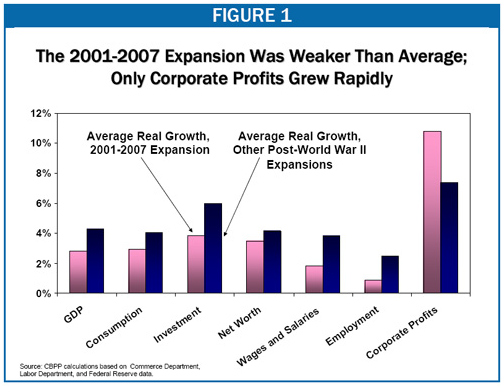
Some will argue that tax cuts are necessary to boost the economy. However, we have countless counterexamples to this popular fabrication. For instance, when President George W. Bush cut taxes from 2001 – 2007, the average annual growth rate was far below the average growth rate for any other period after World War II. In fact, only corporate profits experienced rapid growth. Over all, this expansion was among the weakest since World War II.


Screen Shot 2017-05-12 at 4.11.54 PM


In short, the US is doing a terrible job providing every citizen with the benefits of our society. We are disproportionately rewarding the rich while forcing the rest of us to pay for the services from which we all gain. Moreover, other countries provide even more bang for that buck.


Now this doesn’t mean that the government should tax us all into the ground.

Nor does it mean that the government should spend our tax dollars willy-nilly.


Taxation needs to be fair and spending needs to be regulated.


But constantly cutting rich people’s taxes is immoral. It is unfair to the majority of people making up the difference and struggling to survive when government services lag behind need.


Screen Shot 2017-05-12 at 10.34.01 AM


Our public schools are suffering under strategic disinvestment. Especially in poor neighborhoods that often disproportionately serve people of color, public schools cannot keep up with children’s needs. They aren’t providing an equitable level of service with those schools in richer, whiter neighborhoods.


Our policymakers try to solve the problem with charter schools, vouchers, standardized tests and Common Core. And the results have only been a worsening situation.


The real solution is simple – increased funding through fair increases in taxes on the wealthy.


Tax cuts are popular, but every time we let the rich get away with paying less, we have to either take more from the poor or take the knife to public services.


This affects the poor immediately in the form of reduced services, but it affects the rich, too. They have to live in a world where the majority has less – this means increased crime, increased drug abuse, increased ignorance, etc.


As a society, we must get beyond the selfish urge to look out only for what seems best for ourselves and our immediate friends and families. We must look out for our entire society. We must look out for the needs of everyone in it.


Otherwise, when we fall for these economic fallacies, we’re only stealing from ourselves.