New PAC Descends on Pittsburgh Public Schools to Charterize and Take Over School Board

Screen Shot 2016-04-11 at 11.39.31 AM

Prepare yourself, Pittsburgh.

A new Political Action Committee (PAC) has descended on the ‘Burgh to further privatize our public schools and wrest control away from parents who are in favor of school reforms that actually work.

It’s called Campaign for Quality Schools, but make no mistake. The wealthy special interests behind it don’t care about quality schools – they care about quality profits for their investors.

PACs are political committees organized for the purpose of raising and spending money to elect and defeat candidates. Unlike federal PACS which can only give up to $5,000 to a candidate per election, state PACs in Pennsylvania have no spending limits. In that way, they are like federal Super PACs which also have no limits on donation size.

Besides giving an unfair advantage to special interest groups, PACS also have notoriously been used for nefarious ends. For instance, former Republican U.S. Rep. John Doolittle’s leadership PAC paid 15% to a firm that only employed his wife. One Leadership PAC purchased $2,139 in gifts from the Bose Corporation. Former Republican U.S. Rep. Richard Pombo used his leadership PAC to pay almost $23,000 in hotel bills and buy $320 in baseball tickets for donors.

And now we’ve got one in Pittsburgh with its sights on city schools.

The moneyed interests behind it want to swipe control of even more Pittsburgh schools away from the community and give them to for-profit companies in the shape of charter schools. Since charter school boards are appointed, not democratically elected, this means the decisions about how these newly charterized schools operate would be made behind closed doors out of public view. The community would have no way to hold them accountable. Likewise, this means operators could spend taxpayer money however they want with little to no oversight. They would have nearly unlimited power to reduce student services and pocket the savings as profit.

THAT’S what they mean by “Quality” schools.

The PAC is run by the usual suspects of Pittsburgh corporate school reformers.

In 2015, four of the nine Pittsburgh School Director seats were up for grabs and voters sided in all cases against candidates running on a standardization and privatization platform. One of these losers is Kirk Burkley. He lost against Lynda Wrenn for school board and now is listed as chairman of the political action committee.

Though Burkley well outspent Wrenn, voters made it clear they didn’t want the lawyer specializing in bankruptcy, restructuring and creditors rights anywhere near our public schools. He only got 19% of the vote. Apparently Pittsburghers want candidates who support well-resourced community schools, positive discipline policies with supports, etc. But a host of wealthy investors behind this PAC must feel otherwise. They know better than you and me.

The PAC’s treasurer is Cate Reed, our own Teach for America (TFA) recruiter. Perhaps she took it personally when the newly elected school board overturned a decision by its predecessors to contract with TFA for three-years and pay $750,000. This is one of the few times – if not the only time –this has happened across the nation. Reed is also a Broad Center residency recipient. Established by billionaire Eli Broad, the Broad Center runs an unaccredited training program for school leaders, where candidates learn Broad’s philosophy of school management. Broad has no education experience. He is a self-proclaimed expert, a businessman who made his billions in home-building, mortgage lending, and insurance (AIG).

On the Broad alumni page, Reed speaks about making sure every child has an opportunity to succeed, especially students of color in low income communities.

“The Broad Residency affords me the opportunity to be a part of the change I wish to see—and to use my skills to pursue my wildest dream of educational equity,” she says.

The problem she identifies is real. However, her solution is ludicrous. You don’t provide better opportunities for poor black children by making the leaders of their schools unaccountable to the public. You don’t help poor black kids by removing qualified teachers from their classrooms and replacing them with lightly trained Teach for America recruits. You don’t help poor black kids by giving them an endless series of culturally and economically biased standardized tests and ignoring the fact that they receive substantially less resources than their richer, whiter peers.

Leigh Halvorson, one of the managers of the Heinz Endowment, gave the PAC a boost soliciting donations. She sent an email in early March asking for money. I’ll post the entire email below, but here is Halverson’s description of the PAC:

“I am proud to be part of a group that is launching Campaign for Quality Schools-Pittsburgh, a bi-partisan Political Action Committee that is committed to supporting candidates of any political party who (1) believe that all children, regardless of their background can succeed; (2) embrace policies that hasten the growth of high-performing schools that serve all children; and (3) have the courage to challenge the status quo and tackle this problem with fierce urgency and determination.”

In other words, she’s looking for folks willing to (1) pay lip service to helping kids while actively working to hurt them, (2) will work to privatize more Pittsburgh schools and (3) are willing to run for office counter to the emphatic will of Pittsburgh voters who soundly rejected the corporate school reform agenda in the last election.

Halvorson continued:

“Our kick-off event on March 2nd at 5:30 pm, at the home of Cate Reed and Doug Anderson, will feature State Representative Jake Wheatley, from District 19 here in Pittsburgh who embodies these principles.”

Wheatley, a Democrat, has been a longtime supporter of charter schools and an enemy of public school teachers. He is one of only two Democrats to vote a bill out of the House Education Committee that was meant to eliminate due process for teachers. The bill has been languishing in the legislature, but if approved, it would allow teachers to be fired for almost any reason. It would eliminate the provision that teachers cannot be furloughed for “economic reasons.” (NOTE: it could come up for a vote any day now.)

Wheatley also teamed up with Republican House Speaker Mike Turzai to hold a roundtable discussion praising charter schools and the need to increase them in the city. He joined Turzai again in January for a school choice rally in Harrisburg.

Halvorson closed her email like this:

“If you are unable to attend, but would like to donate, please see the attached invite for instructions how you can do that.”

The invite asked for donations of between $50 and $250 per person.

Reed and Halvorson are both on the board of A+ Schools – Pittsburgh Community Alliance for Public Education. The organization serves an advisory position to help improve city schools. Though the organization includes people on both sides of the standardization and privatization movement, it has been co-opted in recent years by a $1 million grant from the Gates Foundation given between 2011 and 2013. Since the grant, the organization went from issuing an annual “Report to the Community” on the state of city schools to pushing for corporate education reform measures such as doing away with teacher seniority. Many disillusioned volunteers now consider it to be a paid proxy for Gates to make it appear his pet projects are supported by communities.

Like most urban districts, Pittsburgh Public Schools is struggling because of lack of resources. If you live in a poor neighborhood, your school gets less money from local taxes to help kids learn. Moreover, the district has lost almost $1 billion annually in state funding for the last five years. Living in poverty increases the need for wraparound social services, tutoring, nutrition and counseling that isn’t present for more affluent kids. But there’s no money to help them, and it’s hard for students to concentrate on school when they’re experiencing food insecurity and post traumatic stress. Likewise, state and federal education policies are giving an increasing portion of our shrinking funding to charter schools while forcing the traditional public schools to give new and more difficult standardized tests and enact unproven and developmentally inappropriate academic standards. If these corporate education reformers actually wanted to improve Pittsburgh schools, they’d focus on the real problems – not make wild attempts to grab more money for charter schools, deprofessionalize our kids’ teachers and grab power for themselves.

It’s unclear how many people showed up to the PACs kickoff fundraising event and how much money the PAC took in. But one thing is certain – consider yourself on notice, Pittsburgh.

After being defeated for school board and after the board rejected Teach for America, the corporate education reformers are preparing to strike back.

They are gathering people and resources to take the five school board seats up for re-election in 2017.

Will we let them steamroll over us with their big money and political connections or will we continue to fight for reforms that actually help our children?

It’s up to you, n’at.


Halverson’s email:

Dear friends,

The single most important civil rights issue facing our country is the disparity in our education system. We have far too many children who are trapped in persistently failing schools, Here in Pittsburgh alone, 23 of the 52 PPS schools are performing in the bottom 15% in the state. It is unacceptable. We know we can do better because we’ve seen it — transformative school exists that are proving that poverty is not destiny- and we need more of them, right here in Pittsburgh. I am proud to be part of a group that is launching Campaign for Quality Schools-Pittsburgh, a bi-partisan Political Action Committee that is committed to supporting candidates of any political party who (1) believe that all children, regardless of their background can succeed; (2) embrace policies that hasten the growth of high-performing schools that serve all children; and (3) have the courage to challenge the status quo and tackle this problem with fierce urgency and determination. Our kick-off event on March 2nd at 5:30pm, at the home of Cate Reed and Doug Anderson, will feature State Representative Jake Wheatley, from District 19 here in Pittsburgh who embodies these principles. I know for some of you, political contributions or political action is unfamiliar, so if you have questions or just want to talk further about why we believe groups like this can make a real impact on the future of our city and on behalf of our little people, don’t hesitate to reach out. My cell phone is 503.320.2384. I hope you can join us in supporting policymakers that put students and families first. Please see the attached invitation for more details and drop Cate or I a quick email if you can attend. If you are unable to attend, but would like to donate, please see the attached invite for instructions how you can do that. If you know people that should be invited to this event, please share their emails with us ASAP. Any questions can be directed to campaignqualityschoolspgh@gmail.com. I hope to see you on March 2nd.


Proposed Pennsylvania School Code is Massive Giveaway to Charter Schools

money_gift_box4

Accountability.

Fiscal responsibility.

Every lawmaker says these things are extremely important – unless we’re talking about charter schools. Then they pass laws handing out stacks of cash with little to no oversight.

That’s exactly what the Pennsylvania School Code will do if the legislature passes it.

Schools in the Keystone State have had a rough year.

After a nine-month battle with the Republican controlled legislature, Democratic Gov. Tom Wolf let a woefully inadequate budget passed by the legislature become law without his signature. However, he vetoed the fiscal code, which includes public school’s funding formula – how state money will be distributed to the Commonwealth’s 500 public school districts. Wolf still holds out hope that almost $1 billion in school budget cuts made by the GOP can be healed before a new funding formula locks them in.

Everything else about how our public schools are to be run is included in the school code. It was approved by the Senate but remains in committee in the House.

Back in February, both Democrats and Republicans supported some terrible provisions in the school code as a compromise to pass a state budget that would have healed much more of the spending cuts than what has now become law. Since an inferior budget was passed, there’s no reason for Democrats to continue to support a school code that basically rings the dinner bell for the most nefarious charter school practices imaginable.

If approved, charter schools across the state could open new buildings, add new grades, and expand their enrollment with almost no limitations. In Philadelphia, where the district is already under state control and more than a third of students already attend charter schools, the proposed school code would force many schools to be controlled by a new state operator – the Pennsylvania Department of Education – and convert many of them into charter schools – all still without ensuring those schools have adequate funding.

The Senate-approved school code reads like a smorgasbord of dishes to empower and shield charter schools from accountability.

Currently, charter schools are only allowed to operate after having a contract approved by the local school district where they’re located. Elected school boards get to decide if charters can operate and under what conditions. The proposed school code would change that. It would allow charter schools to amend their own contracts without the permission of the local district. So existent charters could do whatever they liked regardless of what they promised local school boards they were going to do in order to be approved in the first place.

The proposed school code would also allow for uncontrolled charter expansion. It would permit charter schools to add as many new schools and students as they please without permission of the local district. This is in effect a license for charters to expand without any oversight. They could gobble up their parent district and there’s nothing anyone could do about it.

Moreover, the proposed school code would allow charter schools to expand beyond district boundaries into neighborhoods that never approved them in the first place. It would create new Multiple Charter School Organizations (MCSOs) that can cross school district boundaries and expand across the entire state, all without any criteria for revocation or accountability.

When disagreements occur with charter schools and local school districts, the matter goes before the state Charter Appeals Board. However, the proposed school code would stack the board with members in favor of charter schools and against local districts.

As it stands, new charter schools get five years before they are subject to any accountability measures at all. Once approved, they have that time to operate any way they want before anyone comes around to make sure they’re doing a good job. The proposed school code doubles that grace period to ten years. New charters – including notoriously fraudulent cyber charters – would have a decade of free reign before undergoing a thorough review of their performance by their authorizers.

And then we come to special education. Since at least 2013, the legislature has known the way the state determines special education funding at charter schools is broken. It’s skewed so that charters get more money for special needs children than local districts. Moreover, this allotment has nothing to do with how much charters spend on their special education students or the severity of the disabilities. For example, in Philadelphia, charter schools get $23,000 for each special education student while the traditional public schools get $5,000. A bipartisan bill was drafted to fix the inequality, but it was killed by charter school lobbyists.

The proposed school code – which could have fixed the problem – just continues it for another year. It explicitly exempts charter schools from the rational and fair special education funding formula used by school districts.

And speaking of funding, the proposed school code continues the perverse practice of ensuring cyber charter schools get paid before local school districts. It was this provision that made sure even with statewide education budget cuts cyber charters didn’t suffer the same loss of funding.

As bad as all that is, it’s nothing compared to what the proposed school code does to Philadelphia City Schools.

The Senate bill implements a “State Opportunity Schools” program that only applies to Philadelphia schools. It mandates that up to 15 city schools a year would go from one majority state-controlled entity – the School Reform Commission (SRC) – to a different entirely state-controlled entity – the Pennsylvania Department of Education (PDE). Moreover, at least six traditional city public schools would have to become charter schools in three years.

It’s a boneheaded move done for no reason other than to punish poor, black students living in Philly. For instance, the proposed school code doesn’t grant any additional authority to PDE that the SRC doesn’t already have – so why make the change? What will PDE be able to do differently? If the SRC is doing a terrible job (Spoiler alert: it is) then why not give control of the district back to residents? Why not reestablish local control?

Moreover, the proposed school code provides no additional resources or funding to any Philadelphia schools. That’s been the problem with the district from the beginning. When you force schools to rely heavily on local property taxes to run, poor communities suffer. The proposed school code continues the proud Pennsylvania tradition of ignoring reality and blaming black and brown children for their parents poverty.

Much of this nonsense came from negotiations between the Democrats and Republicans to ensure a better budget for schools across the state. Republicans demanded increasing charter school handouts, fewer accountability measures and sacrificing Philadelphia Schools. And Senate Democrats agreed – even those serving Philadelphia.

However, since the GOP reneged on that budget deal, there is no reason on Heaven or Earth why the Democrats should continue to support this proposed school code. Republicans can pass this turd without them. If the GOP wants to give away mountains of taxpayer money to the charter industry, let them own it. That’s been something they have been increasingly unwilling to do.

And if this terrible school code does somehow make it through the legislature, Wolf should do the same thing with this steaming pile of feces that he originally did with the budget and recently did with the fiscal code – veto it.

Pennsylvania lawmakers need to stop serving special interest groups and start representing the taxpayers. Giving away a larger portion of our shrinking education funding makes no sense.

It is not accountable. It is not fiscally responsible. It is dereliction of duty.

Bernie Sanders is Right: We Should Federalize Public School Funding

Bernie_Sanders_by_Gage_Skidmore

Bernie Sanders just dropped a massive dose of truth on us Monday night.

No politician in my lifetime has ever said anything so dangerous, fraught with problems, unlikely, impractical, and absolutely on the nose right!

The Presidential candidate running for the Democratic nomination wants to make the federal government largely responsible for funding public schools. Right now districts are supported mostly by local and state taxes.

This is what he said:

“One of the things that I have always believed is that, in terms of education, we have to break our dependency on the property tax, because what happens is the wealthiest suburbs can in fact have great schools but poor, inner-city schools cannot. So I think we need equality in terms of how we fund education, and to make sure the federal government plays an active role to make sure that those schools who need it the most get the funds that they deserve.”


(Find the quote above 17 minutes into this video.)


Wow! What a statement!

Don’t tell me that was focused grouped. Don’t tell me his campaign did a poll first. Don’t tell me he ran that by any big donors for approval.

Whether you agree with it or not, such an audacious remark has to come from a genuine belief. This is really what Bernie thinks, and it’s entirely consistent with the Democratic Socialism of his whole political career.

I don’t think his rival for the party’s nomination, Hillary Clinton, will be parroting THIS stance! If anything, she might criticize him for it. And she’d have a multitude of practical reasons to do so.

Lots of folks on both sides of the aisle are sick of federal intervention in our schools. No Child Left Behind was a disaster. Race to the Top was worse. And the just passed Every Student Succeeds Act (ESSA) amounts to a massive giveback of power to the states. Under the most popular interpretation, the reauthorization of the federal law governing K-12 schools makes the states responsible for filling in the details of education policy while limiting federal interventions.

And now Bernie is suggesting the Fed foot the bill!?

That is going against the political tide. Who would vote for such a thing? Probably not Hillary. Or any of the Republican candidates. Or more than a handful in Congress, either.

But it’s exactly the right thing to do.

The reason?

The biggest problem with America’s public school system isn’t test scores, lazy students, or teachers unions. It’s poverty, segregation and inequitable funding.

We have separate schools for the rich and separate schools for the poor. We have schools serving mostly black and brown populations and schools serving mostly whites. And the way we allocate money and resources to these schools both allows and perpetuates this system.

Nationwide, state and local governments spend 15 percent less per pupil on poor school districts. I see this first hand. My home state of Pennsylvania is the worst offender, providing the poorest districts an embarrassing 33.5 percent less per student. This means higher class sizes, less teachers, less arts and humanities, less electives, less nurses, guidance councilors and wrap around services. This is the reality in 23 states.

An additional 23 states do buck this trend with more progressive funding formulas. States like California and Florida actually provide MORE spending to poor districts. This helps heal the wounds of malnutrition, violence, family instability and a host of other problems that go hand-in-hand with generational poverty. It also offset the costs of greater numbers of special education students and English Language Learners you typically find in these districts.

You might say, then, that the states where poor children get shafted could simply follow the lead of their more enlightened neighbors. Good luck with that! Rich folks rarely volunteer to subsidize the poor. They got theirs, and they vote and donate more regularly to local politicians than their indigent brethren can afford to do.

The result is a funding system based on local wealth. Rich areas have Cadillac education systems. Poor areas have dilapidated ones. That’s demonstrably unfair and leads to worse academic outcomes for needy kids.

What’s worse, no one else runs their schools this way. The U.S. is one of the only countries in the world – if not probably the ONLY country – that funds schools based largely on local taxes. Other developed nations either equalize funding or provide extra money for kids in need. In the Netherlands, for example, national funding is provided to all schools based on the number of pupils enrolled. But for every guilder allocated to a middle-class Dutch child, 1.25 guilders are allocated for a lower-class child and 1.9 guilders for a minority child – exactly the opposite of the situation in the U.S.

Federalizing education funding could solve all these problems. It could set the groundwork for an even playing field. All students could get a fair start in life! That’s a goal worth shooting for! And that’s what Bernie is suggesting.

But it’s an incredibly dangerous proposal.

Our school system still suffers nationwide from the effects of corporate education reform. National policy has been and continues to be one of high stakes standardized testing, poorly conceived and untested academic standards, and a push to privatize struggling schools. Corporatists call this “Accountability.”

It goes something like this: raise your test scores or we’re closing your school and turning it into a for-profit charter. Adopt these academic standards written by the testing companies and we’ll give you a couple extra bucks. De-professionalize teachers with junk science evaluations and hiring under-trained Teach for America temps or else we’ll cut your funding.

THIS is the federal legacy in education, and Bernie is suggesting we give them MORE POWER!?

Yes, and no. I can’t speak for Bernie, but that’s certainly not how this has to go. We can increase the Fed’s responsibility for funding schools without increasing its power over education policy. In my view, education decisions should be made locally, and I don’t mean at the state legislature. Decisions about how best to run schools should be made at the district level by the experts – the teachers and parents.

Certainly there will be those who call for more federal power over policy as a condition of federalized funding. But that has to be a deal breaker. Equitable funding with inequitable policy would just be plugging one hole while making another.

In my view, equitable funding IS the role of the federal government in public education. When the Elementary and Secondary Education Act (ESEA) was first passed in 1965, it’s purpose was to make sure all schools were getting adequate resources. Under Bush and Obama, that became perverted to mean more standardized tests and philanthro-capitalist interventions. Bernie’s suggestion could be a step in returning to the original intent of the law.

Yes, the Fed should be engaged in accountability. It should make sure it’s funding schools properly. Maybe it should even be responsible to make sure those funds are being spent on things that broadly can be construed as education. I don’t mean that the fed should be able to withhold monies from districts with low test scores. But maybe it can prosecute administrators who use funding to lavishly redecorate their offices or who neglect the needs of students in their districts.

However, even if you agree – as I do – that this is a lofty goal, it is almost impossible to achieve. It’s like single-payer healthcare was in the ‘80s and ‘90s. This is what most of the world is doing but it was completely out of reach here politically. In fact, we still don’t have it, but look at how the landscape has changed. Obamacare is not-single payer, but it is a step in that direction. Bernie is even championing going that extra step and providing a medicare like system for all.

What seemed impossible decades ago, now seems within reach. The same may be true one day with federalized education funding.

To be honest, I doubt fixing our school funding system is high on Bernie’s list of things to do. Breaking up the big banks, overturning Citizens United, free college tuition, even healthcare probably come first. And maybe that’s not a bad thing. If any or all of these goals were realized, it would help the more than half of our public school children living in poverty. Moreover, just having equitable funding on the list with these other worthy goals puts it on the national agenda.

Right now, no one else is talking about this. It isn’t even a recognizable goal for most progressives. Frankly, I doubt many people have even thought about it. By bringing this up, Bernie is forcing us to do so.

When I first became an education activist, I thought I was doing it for my students. Then we had a daughter, and I thought I was doing it for her, too. But as the years have gone by, the landscape has changed only slightly. We’re still reaching a level of critical mass when the culture demands a major shift. We’re not there yet. So now I wonder if the people I’m really doing this for are my grandchildren.

One day we may have the courage to change the course of our education system. We may gain the nerve to actually accomplish our convictions. We might actually try to have a nation with liberty and justice for all.

That’s what I’m fighting to achieve. I think many of us are doing the same. But do we have the bravery to take Bernie at his word, to push this topic onto the national stage?

A Bernie Sanders presidency would do that. It might not achieve this lofty goal. Not now. The political winds aren’t favorable. But we can try, knowing full well the dangers and the improbability.

I wish Bernie would flesh out the details of his plan. I wish he’d exorcise the devil from the details. But the very fact that he has the intrepidity to offer this as a solution fills me with hope.

Is it hot in here or am I starting to Feel the Bern?

Gadfly’s Choice – Top 5 Blogs (By Me) You May Have Missed from 2015

Screen shot 2016-01-02 at 11.01.09 PM

There are an awful lot of great blogs out there.

Especially if you’re into education. But many are telling the same story.

You don’t hear much about it in the mass media, yet our public schools are being systematically starved to death. They’re being set up to fail while the vultures of privatization and free enterprise drool over the corpse.

Phony philanthropists offer schools fake donations with more strings attached than Pinocchio and noses twice as long. To secure these financial “gifts,” schools are forced to pay out more than they receive for reforms that ultimately benefit the benefactor more than the beneficiary.

And even when these philanthro-capitalists are absent, our government is pretending to hold schools accountable by forcing them to enact these same unproven, disproven or counter-factual policies that actually make things worse. Then when these schemes fail, lawmakers use that as a justification to close schools and gift them to for-profit companies who squeeze every ounce of profit they can from what’s left while further cheating students out of resources.

It’s a scam, a heist, a racket – and you’re paying for it with your tax dollars.

But if you’ve been reading the plethora of excellent edu-blogs out there, you already know this.

Who writes about this public school shakedown? Often it’s the same teachers, parents, professors and bonafide education experts whom policymakers have excluded from the conversation.

As a public school teacher, myself, with more than a decade in the classroom, a masters degree and a national board certification, my empiricism and experience is not valued. So like many folks burdened with real-world knowledge, I write a blog.

In only a year and a half, I’ve had more than 487,000 hits and 9, 208 followers. In my last post I listed my 10 most popular articles from 2015.

Today I propose to continue a tradition I stole from fellow blogger Russ Walsh. I present not my most popular work, but 5 articles that deserve another look. Most of these didn’t receive massive public attention, but perhaps they should.

Please enjoy your humble gadfly’s choice.


5) Prejudice of Poverty: Why Americans Hate the Poor and Worship the Rich

2children

Published: Nov. 18

Views: 5,005

Description: America is rife with myths about the poor – mainly that the impoverished deserve their poverty. If they just worked harder, they wouldn’t be poor. Moreover, it’s a scam. The rest of us pick up the slack while they lounge around at home living better than we do. These are pernicious lies told with the certainty of truths. This article is my attempt to dispel these myths with facts.

Fun Fact: In my experience, often people are afraid to say certain things because they don’t want to appear racist. However, no such fear exists about sounding prejudiced against the poor, because few realize such bigotry even exists. It does. Big time.


4) Stories about Puerto Rican Resistance to Corporate Education Reform

Parents and Children Occupy Puerto Rican School Refusing to Let Corporate Vultures Raid Its Contents

(Aug. 22 – 1,551 hits)

In Puerto Rico, Students Go On Strike to Stop Teacher Relocations

(Sept. 25 – 1,211 hits)

Puerto Rico Teachers Plan One-Day Strike to Protest Corporate Education Reform

(Nov. 15 – 634 hits)

12050457_10153301043793152_183452142_o

Published: Aug. – Nov.

Views: 3,396 TOTAL

Description: The US territory of Puerto Rico is besieged by vulture capitalists encouraging damaging rewrites to the tax code while buying and selling island debt. Meanwhile hundreds of American private equity moguls and entrepreneurs are using the Commonwealth as a tax haven. As a result, tax revenues to fund public goods like education are drying up and hundreds of schools are being closed. However, the citizenry is putting up one of the most aggressive and successful resistance campaigns against corporate education reform in this hemisphere.

Fun Fact: For a while, few people on the mainland were talking about this – certainly not in the media. That appears to be slowly changing. There is so much we can all learn from Puerto Rico. We need each other.


3) Education Does Not Cure Poverty – It Cures Ignorance

Screen shot 2015-10-17 at 11.36.22 PM

Published: Oct. 18

Views: 3,080

Description: One of the biggest lies told by our national education policymakers is that schools alone can cure poverty. We don’t need an anti-poverty campaign. We just need to ensure people get a good education. This is baloney. The purpose of learning has never been to gain wealth or even teach how to gain wealth. It is and always has been about eradicating ignorance.

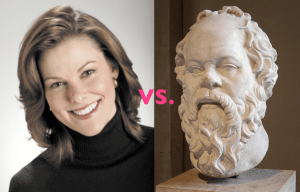
Fun Fact: If more people knew this, there would be no more high stakes testing, Common Core, etc. Also I’m kind of  partial to this article because of the image I made to go along with it. Campell Brown vs. Socrates!? That always makes me smile!


2) Do Americans “Throw Money” At Their Schools? A Fair Funding Primer

Screen shot 2015-07-06 at 11.05.59 PM

Published: July 9

Views: 1,372

Description: How many times have you heard someone complain about all the money we throw at our schools? It’s dismissive nonsense. We aren’t throwing anything. We INVEST in children. That money is not a waste. In fact, it is far from adequate for the job. This post is my attempt to explain the facts behind school funding. Please share.

Fun Fact: It is so nice to have all of this information in one place. I have tweeted, emailed, and posted this article to blowhards and ignoramuses more times than I can remember. Feel free to do the same.


1) We Shall Overcome… Our Lack of Standardized Tests!?

Screen shot 2015-07-19 at 12.34.34 AM

Published: July 19

Views: 628

Description: This is the newest myth being spread about standardized testing. Somehow high stakes assessments ensure that minorities civil rights don’t get violated!? It is exactly the opposite of the truth. Yet many of the more well-funded civil rights organizations suddenly began singing this tune over the summer. My article tries to explain why.

Fun Fact: Make no mistake. Many civil rights organizations still vehemently oppose high stakes testing. If we really want to stand up for our black and brown brothers and sisters, we need to stand with them and counter this AstroTurf narrative at every turn. Testing violates their rights, not protects them.

Puerto Rico Teachers Plan One-Day Strike to Protest Corporate Education Reform

11214329_10153183230456981_1552435887463960982_n

Welcome to sunny Puerto Rico.

The ocean is a gorgeous cerulean blue. Palm trees wave gently in the salty breeze. And in the distance you can hear percussion, horns and singing.

The protest has begun.

12242864_10153398609583152_567773654_o

Residents of this United States territory have been fighting freshman Governor Alejandro García Padilla’s efforts to close public schools, privatize those left and shackle teachers to the same corporate education reform schemes that are crippling schools on the mainland.

This Tuesday island educators are asking parents not to send their children to school. Teachers plan to conduct a one-day strike to protest legislation that could be passed the same day to further cripple the Commonwealth’s public education system.

“On November 17th we’ll be giving our lesson’s outside our classrooms,” says Mercedes Martinez, president of the Federación de Maestros de Puerto Rico, the teachers union.

“We’ll be in front of our schools early in the morning and at 10:00 a.m. will march from Congress to the Governor’s Mansion in San Juan. This is one of many activities that we’ll perform in defense of public education. We will not accept these precarious impositions and will fight back.”

12212114_10153398609843152_2007230691_n

The protest is in response to Project 1456 which would close more than 380 public schools. The government has already closed 150 schools in the past 5 years.

This would force many students into even more overcrowded classrooms. Thousands of children would have to be relocated to schools far from their homes.

But that’s not all.

The proposed legislation would also privatize 15% of those schools left standing. Unlike the mainland, Puerto Rico has no charter schools. Teachers went on a 10-day strike in 2008 which only ended after the island Secretary of Education Rafael Aragunde signed an agreement promising not to open any charters.

12226476_10153398609693152_1059022729_n

If privatized schools opened on the island, parents might have to pay an additional fee for services they now enjoy for free. Amenities like lunches and even tuition may have to be subsidized by parents out of pocket.

Moreover, it would collapse the teachers retirement system, Martinez says. Charter schools would not deduct employees payments to the pension system so it might not be able to remain solvent.

Project 1456 would harm teachers in another way, too. It would enact a punitive evaluation system where 20% of educators value would be based on students standardized test scores. Any teacher with a 79% or less would have two years to improve or be fired.

“Teachers will have no rights,” Martinez says.

12231352_10153398610428152_1685357633_n

The proposed legislation has already been approved by the Commonwealth Senate. It’s main author Sen. Eduardo Bhatia is pushing for the House to fast track it for approval.

Discussions began in the House last week.

Protesters were there on Wednesday. They stood up in the government chamber and walked out en mass when it was brought up for discussion. Eighteen of them wore white T-shirts spelling out the message “Our Schools Are Not For Sale.”

12095142_10153786665063035_3426408204355682730_o

Inside the House, presidents of private universities testified in favor of the measure.

“Obviously they want to become administrators of charter schools on our island,” Martinez says.

Outside the building, protesters held their own emblematic hearing on the matter. Community members, teachers and parents testified in the open air about how this legislation would hurt children. They ended with a symbolic vote against it.

12233087_10153398610653152_624717262_n
Puerto Ricans are not alone in this fight.

Jitu Brown, a community organizer from Chicago and Director of Journey for Justice Alliance traveled there to stand in solidarity with those fighting for their schools. Brown participated in a 34-day hunger strike in his hometown a month ago to protest Mayor Rahm Emanuel’s plan to close the last open enrollment school in his neighborhood.

“This beautiful, breathtaking place is marred by ugly U.S colonialism and privatization of public services on steroids!” says Brown of Puerto Rico.

“I was blessed to spend time with powerful people fighting for a better world. Big ups to your warrior spirit, discipline and hospitality! Where we struggle, we can win! If we don’t struggle, we are guaranteed to lose.”

12243064_10153183230516981_9040874307608479627_n

The plight of Puerto Rican communities also inspired support from the Badass Teachers Association, a group of more than 56,000 educators, parents, students and activists.

“The Badass Teachers Association stands in strong solidarity with our brothers and sisters in Puerto Rico who are fighting for the very foundation of their democracy – the survival of their public school system which is under assault by the 1% who seek to close it up and deny Puerto Rican children a right to an education,” says Executive Director Marla Kilfoyle.

Protesters are getting the word out. They’ve already handed out thousands of fliers. Today they plan to drive in a large caravan across the island.

“We’ve got a bunch of cars with sound equipment,” Martinez says.

“We will go to all the communities near our schools in different regions asking parents to support the strike on the 17th.”

12233347_10153398610098152_2099123130_n

Much of the the island’s financial woes are imported from the mainland. Puerto Rico is besieged by vulture capitalists encouraging damaging rewrites to the tax code while buying and selling the territory’s debt.

Hundreds of American private equity moguls and entrepreneurs are using the Commonwealth as a tax haven.

As a result, tax revenues to fund public goods like education are drying up while the super rich rake in profits.

Officials warn the government may be out of money to pay its bills by as early as 2016. Over the next five years, it may have to close nearly 600 more schools – almost half of the remaining facilities!

12208352_10153183230836981_3863947130415132926_n

“That’s why the Teacher’s Federation and other teacher unions allied together to fight back against the attack on our education system,” Martinez says.

“As you can see, we’ve been busy.”

If Project 1456 is passed by the House, the union is considering a general strike.

12268501_10153398610318152_1824591574_o

Of the 135 schools closed in just the last two years, Commonwealth Secretary of Education Rafael Román had originally proposed shuttering 200. The remaining 65 were only kept alive because communities occupied the buildings and refused to let the government step in.

Protesters stormed the Senate in October when Bhatia first introduced Project 1456.

“Senators decided to approve it without discussion because they did not want to listen to teachers chants and indignation,” says Martinez.

“Senator Bhatia has become the symbol for privatization under this administration. He has never been in a public School. He has no bond with it. He’s a demagogue.”


NOTE: This article also was published on the Badass Teachers Association blog.


The Most Important Election You’ll Probably Skip

t1larg.voter.jan10

The future prosperity of your state may be decided this November.

Will your public schools receive adequate, equitable and sustainable funding?

Will you be permitted to choose medical marijuana to treat certain ailments?

Will your state enact sensible gun reforms to keep firearms out of the hands of the criminally insane?

Will your voice be heard in future elections?

All this and more is on the table and YOU get to cast the deciding vote.

But more likely than not, you won’t show up.

Why? You’re too busy worrying about the upcoming Presidential election.

With both Democratic and Republican Presidential Primaries approaching in February through June, 2016, most people just don’t have the energy for another general election before the end of 2015.

However, most states will ask residents to cast a ballot on Nov. 3 for all kinds of important initiatives. There will be municipal, school board, gubernatorial and state legislative elections in a few states; as well as numerous citizen initiatives, and a variety of other local offices on the ballot.

Yet if history is any guide, most people will stay home while vastly important decisions are being made by the few who trudge to the polls. On the one hand, that means the results are bound to be unrepresentative. On the other, it means if you show up, your vote will have more weight than ever!

Either way, the course for the future of your state will be quietly and discreetly set for years to come.

Take my home state of Pennsylvania.

We’re holding a historic election with three state Supreme Court seats up for grabs. The last time this many seats were open on our highest court in the same year was 1704, and the body was still called the Provincial Appellate Court.

This is huge because it will determine who gets the final say on a plethora of contentious political issues.

For instance, four years ago, Republicans controlled every branch of Commonwealth government and redrew the state’s legislative districts to gerrymander in a GOP majority. They redrew district lines to ensure that conservatives got elected to public office by making boundaries around areas that have pockets of people who generally lean Republican.

With that foundation in place, the GOP ran the state into the ground. While most taxpayers didn’t agree with the corporate tax giveaways and draconian budget cuts to public services like children’s schools, there wasn’t much we could do about it. The redrawn district boundaries were such that legislators were free to do whatever they wanted without fear of reprisals from constituents.

Voters gave the GOP Governor the boot, but almost all of his good soldier legislators stayed in place. This was only possible because Republicans controlled the state Supreme Court. When those gerrymandered districts were challenged, the court backed the legislature. So, in practice, continued Republican control of state Senate and House districts was due not to voters but to the state Supreme Court.

Currently, Republicans hold the balance of power in the highest Commonwealth court by 3-2 with two vacancies. This election could rewrite that balance of power.

If Democrats win two or more seats in this Supreme Court election – thereby replacing two Republicans and one Democrat – it could change everything! Democrats would have a majority.

When redistricting comes up again in 2022, if Democrats want to re-draw the lines more fairly (or in their favor), a Democratic-controlled Supreme Court could make that possible.

Moreover, the new court would almost certainly rule on cases that will have a dramatic impact on the lives of everyday Pennsylvanians.

Perhaps the most hot button issue in the state is education funding. Republicans have been waging all out war on poor Commonwealth schools. For the past 4 years, the legislature slashed public school funding by almost $1 billion – an ideological divide that still rages between the newly elected Democratic governor and the legislature where Republicans remain in control.

Several lawsuits demanding more equitable school funding are winding their way through the state court system. These cases are bound to end up in the state Supreme Court. So if voters still care about making sure all Pennsylvania children have a fair shake at an education, voting for Democrats to retake the court may be the surest option! If recent history is any guide, Republicans sure won’t do it!

Other issues such as the death penalty and gun laws are likely to appear on the docket. Moreover, without opposition, it’s feared a GOP court could easily allow Tea Party legislators to enact so-called Right to Work and other union busting initiatives. A Democratic court could stop such shenanigans cold.

For decades, Pennsylvania politics have been like a game of tennis – power going almost exclusively from one party to another. Neither major party has held the governor’s office for more than two terms since 1955. Democrats broke the Republican Party’s hold on the state House in 2006 only to give back the chamber during the 2010 elections. So the Supreme Court remains the ultimate arbiter.

Voters will have the choice of 3 of the following candidates for Supreme Court Justice: Democrats Christine Donohue, Kevin M. Dougherty and David N. Wecht; Republicans Anne Covey, Michael A. George and Judith F. Olson; and independent candidate Paul P. Panepinto.

In my opinion, the Democrats are the strongest candidates – especially Wecht who is vowing to ban gifts for judges, tighten anti-nepotism policies, and broadcast court proceedings on television. Dougherty has strong union ties and clearly respects collective bargaining rights. Donohue is a strong supporter of personal rights including holding corporations accountable for fraudulent behavior and eliminating bias against LGBTs.

Of the Republicans, Covey is the most reasonable and has shown a willingness to reach across the aisle. The others are your typical extreme right Tea Party conservatives. Panepinto may be running as an independent, but I see little to distinguish him from the GOP candidates.

Choose carefully, Pennsylvania. Whoever you decide to support in the Supreme Court race, it will have a long-term impact. State Supreme Court justices hold 10-year terms! And three more justices will be replaced by 2018.

Whether you live in Pennsylvania or anywhere else in the US, it is vital that you get off your duff on Nov. 3 and vote. Focusing exclusively on Hillary vs. Bernie is not just myopic, it’s dangerous. Even if your candidate wins the presidency and does a fabulous job, the forces of stagnation and corporate greed could net tremendous gains in these other elections.

Unless we turn up.

Unless we vote.


NOTE: This article also was published on the Badass Teachers Association blog.


If School Computer Use Reduces Standardized Test Scores, Doesn’t That Prove the Tests are Inadequate?

ipad-kids

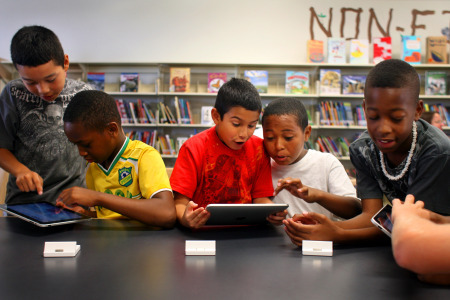
Melvin’s hand is up.

He’s a 13-year-old African American with too much energy and not enough self-control.

He’s often angry and out of his seat. He’s usually in trouble. But today he’s sitting forward in his chair with his hand raised high and a look on his face like he’ll explode if I don’t pick him right this second.

So I do.

“Mr. Singer! Can I show my imovie now!?”

This is a first. He hasn’t turned in a lick of homework all month.

“Wow! You’re really excited about this, aren’t you?” I say.

“Yeah,” he responds. “I was up all night finishing it.”

I start to doubt this, but he does look awfully tired underneath that urgent need to share.

Airdrop it to me from your ipad,” I say, “and I’ll put it up on the SMART Board.”

This takes a few minutes.

Let’s face it.

We live in a world of high technology.

Our cell phones have more computing power than the Apollo missions to the moon.

The best, high paying jobs opening up on the world stage require increasing levels of computer literacy.

Yet according to a new study, America’s students don’t succeed as well academically if they have access to computers at school.

How can this be?

How can exposure to new technologies cause a nation of young people to fail at a system supposedly designed to prepare them for the jobs of the future?

Doesn’t real world experience usually make you better prepared?

A future chef would be helped by more time in the kitchen.

A future doctor would be helped by more access to dissection.

But a future computer-user is hurt by more time at a computer!?

Something is very wrong here.

But according to a new study by the Organization for Economic Cooperation and Development (OECD), students who use computers more at school earn both lower reading and math scores on the Program for International Student Assessment (PISA).

The organization studied 15-year-olds across 31 nations and regions from 2012. The study just released in September even controlled for income and race.

Yet here in my classroom I see the exact opposite. Computer use increases my students test scores – on my teacher-created tests.

Melvin’s movie was ready. He had been tasked with explaining the differences between external and internal conflict. I pressed play.

High adrenaline music poured from the speakers. Pictures flashed across the screen of boxers and football players.

“This is external conflict,” came rushing forward followed by a brief definition. Then an image of Homer Simpson with an angel and devil on his shoulders. “This is internal conflict,” came zooming by our eyes.

The film might not win any Academy Awards, but it was pretty impressive work for 40 minutes of class time and however long Melvin decided to spend at home.

It’s the kind of thing my students never could have done before they each had ipads. And when they took my test, few of them got the questions wrong about conflict.

Yet according to the OECD, I was somehow hurting my students academically!?

Even in my high poverty district, students have always had access to technology. But the nature of that technology and how we use it has changed dramatically this school year.

I used to have eight computers in my classroom, but they were slowly becoming obsolete and inoperable. Some days they functioned best as extra illumination if we shut out the overhead light to show a movie.

Still, I tried to incorporate technology into my lessons. I used to have my students make their own Webpages, but reserving time in the computer lab became almost impossible. And even then, the district couldn’t afford to keep the devices in the lab updated enough to run anything but the most rudimentary software.

The one lab in the building that had new devices was reserved almost exclusively for a drill and kill test prep program we had received a state grant to operate. THIS was the apex of school technology – answering multiple choice look-a-like questions. It bored students to tears and didn’t even accomplish the stipulated goal of increasing standardized test scores. Yet we were blackmailed by the state government into initiating the program so we could gain additional funding to keep the school operational.

THIS is the kind of technology use you’ll find at most poor schools like mine. And it’s one of the reasons the authors of the OECD study came to their conclusion. It’s also one of the reasons why teachers like me have been skeptical of technological initiatives offered to impoverished districts.

However, the best use of technology is something quite different.

This year my district received a gift of ipads for all the students, and it’s changed everything. No longer do I have to beg and plead to get computer lab time for real high tech lessons. I don’t need it. The technology is already in the classroom in the palm of their hands.

But policymakers clutching their pearls because of this study have already began to make changes to international school curriculum. Schools in Asia have begun cutting back on student computer time. Should America follow suit?

Absolutely not.

The problem clearly is not computers. It’s the antiquated method we use to measure success.

Standardized testing has been around since 206 BC as an assessment for civil servants in ancient China. The same process spread to England in the 19th Century and then to the United States during WWI. Through all that time, the main process of rewarding rote learning through multiple choice questioning has remained the same.

But the world hasn’t. We’ve moved on a bit since the Han Dynasty. We no longer live in a medieval society of peasants and noblemen where the height of technology is an abacus. We live in an ever-changing interconnected global community where a simple search engine provides more information than could be stored in a thousand Libraries at Alexandria.

How can we possibly hope to rely on the same assessments as the ancients? Heck! Even as far back as 970 AD, standardized testing was criticized as being inadequate.

But a global multi-billion dollar industry relies on these primitive assessments. It’s the basis of an exceedingly lucrative business model.

So it shouldn’t be surprising that the same people who promise standardized testing and Common Core will best prepare students to be college and career ready are passing the blame.

They claim this report isn’t an indictment of their cash cow industry. It’s a warning against over-reliance on computers. And, yes, they’re right that technology is not a panacea. The mere presence of a computer won’t make a child smarter. Likewise, the mere presence of a book won’t make a person wiser. One must know how to use said computer and book.

But what I’m seeing in my classroom primarily is an opportunity – not a danger. Students like Melvin are more engaged and willing to take chances. They have greater freedom, intrinsic motivation and excitement about learning.

Many times when sharing Keynote presentations, after one or two, students ask to have their work back so they can improve them. That doesn’t happen with test prep.

They often elect to take ipad assignments to lunch and work on them between bites. That doesn’t happen with Pearson worksheets.

I’m not saying it’s easy. It’s up to me, my colleagues and administration to ensure technology is used to its full potential. Never should these devices be time fillers or babysitters. Nor can they ever replace the guidance of a thoughtful, creative educator to determine their best use. Teachers need to create and assign lessons that promote creativity and critical thinking skills.

Education professionals are constantly advised to individualize their lessons to meet the needs of diverse learners. Technology allows them a unique opportunity to do so. With district ipads I can talk to an English Language Learner in his own language. A struggling reader can have the device read test questions aloud. A student with poor motor control can type journal responses and have his writing be understood.

And these opportunities for enrichment don’t even need to be planned ahead of time. For instance, when discussing a short story about a character that was exceedingly proud, one of my students brought up the Seven Deadly Sins. She wasn’t exactly sure what they were or how exactly they related to pride, but one of her classmates quickly looked it up on her ipad. Then another found a medieval woodcarving to which someone else found a related manga text. The subsequent discussion was much deeper and relevant to these children’s lives than it would have been otherwise. And none of it was pre-packed, planned or standardized. It was individualized.

This is really no surprise. Administrators in charter or private schools aren’t asking themselves if they should close their computer labs and put their devices on ebay. They know the value technology can provide in the classroom, but they aren’t constrained by high stakes testing.

Even rich public schools don’t have to worry to the same degree because their students already score well on federally mandated assessments – after all, standardized tests are designed to favor children with wealthy parents over those from impoverished or minority backgrounds. It’s only in poor school districts where technology is either second hand or a charitable donation that administrators and school directors are being pressured to cut back.

As usual, best practices for the privileged become questionable when applied to the poor and minorities. You want technology? Prove it will boost your test scores!

It’s nonsense.

Think about it. Even the best use of computers won’t boost standardized scores. Computer skills aren’t on the tests.

Nor could these things ever be assessed effectively in this manner.

Yet such skills are exactly what education researchers tell us demonstrate the deepest levels of understanding and an ability to meet the demands of the best jobs of the future.

I wonder what Bill Gates thinks of this report. The Microsoft co-founder is also one of the biggest advocates for school standardization. If he had to pick between his two favorite children, which would he choose – laptops or Common Core tests? Maybe we needn’t wonder. His own children go to a private school with no standardization and a plethora of technology.

There comes a time when you have to admit the truth staring you in the face: standardized tests are poor measures of academic achievement. They are suitable only for turning our children into factory drones. They are for pawns, patsies and robots.

If we really want to prepare the next generation for the jobs of the future, we need to scrap high stakes testing. We need to invest in MORE technology, not less. We need to ensure technological lessons are being overseen by trained educators and the devices aren’t used as a babysitting tool. As such, we need to provide teachers with support and professional development so they can best take advantage of the technology they have.

America can prepare its children for the world’s high level management and administrative positions or we can prepare them to do only menial work that will soon by replaced by machines.

Computers do the former. Tests the latter.

Choose.


NOTE: This article also was published on the Badass Teachers Association blog.


Stopgap Budget a 4-inch Crap Sandwich for Pennsylvanians Who Rejected a Footlong

4026174118_390de03813_z

If you won’t pass 12 months of our crappy budget, pass 4 months of it.

That’s the plan of Pennsylvania Republicans to swindle voters into accepting lower expectations out of state government.

While Governor Wolf talks compromise, GOP lawmakers stamp their feet, cross their arms and pretend that’s somehow doing their jobs.

Three months passed the deadline for a year-long state spending plan, Republicans in both the House and Senate pushed through a stopgap budget along party lines that could only see the light of day because of their numerical majority.

Gov. Wolf vetoed their year-long budget in June because it failed to fix the damage of four years of budget cuts to essential public services like education. Now Republicans are demanding he accept four months of the same and we’ll talk about the rest later.

Wolf is expected to veto this stopgap measure on Monday.

But this doesn’t mean the newly-elected Democratic governor is unwilling to compromise. That’s all he’s been trying to do for the passed 90 days! He’s offered major concessions to the GOP including proposals for private management of the state liquor system and limits to traditional pensions for future state and public school workers.

The response? Nothing.

I guess Republicans don’t get how compromise is supposed to work. One side gives up something and then the other side does the same until both parties can meet in the middle. But in Harrisburg it’s been all give from the governor and nothing from the Republican legislature.

‘Give us everything we want for 4 months’ is not a compromise!

This is what happens when you let billionaires buy our government. You get a state of gerrymandered districts. The majority of residents voted for Wolf because he promised to overturn these Republican policies, but with the state chopped up into voting districts along party lines, the GOP gains a majority in the legislature though they do not have a numerical one of residents. And this Republican majority relies on the votes of Tea Party ideologues who will accept no discussion, no bargaining, no give-and-take.

That’s exactly what the 1% funding these stubborn legislators want. The super rich lounging behind their thick walls and glittering gates want the rest of us to become fed up with our government. They want us to give up on Democratic process as a way to ensure public goods. They are sabotaging our oldest and most revered institutions to prove to us how badly they work.

You see, they don’t care about public goods because these things don’t directly impact them. Why should they care if our public schools are dying of starvation? Their kids don’t go to public schools.

Moreover, if we actually go with Gov. Wolf’s proposed budget and fund elementary, middle and high schools, the rich will have to help pay for it. They’ll have to pay their fair share. That’s something these leeches will never do willingly.

For four years under the previous Republican governor our public schools had been put on a starvation diet cutting almost $1 billion a year from a system that already was one of the least equitable in the country.

Public schools are funded mostly by state and local governments. If you ranked all 50 states in the country by which ones shoulders the highest burden of education costs, Pennsylvania comes in 45th. The Commonwealth only pays 36.1% of the bill – far below the national average of 45.5%. Wolf wants to bring that up to 50%, but when it comes to doing right by children, Republicans apparently are fine with being below average.

But exactly how low can you go?

Not only does the Commonwealth skimp on all its children, it gives up on the poor. The money train makes long luxurious stops at rich districts but barely even comes to a halt at poor ones before chugging on down the line.

We spend less on our poor students compared to our rich ones than ANY OTHER STATE! When it comes to cheating impoverished kids out of an education, we’re number one!

Nationwide, rich schools already spend on average 15.6% more than high poverty schools. But in Pennsylvania, the difference is 33%!

We are systematically short-changing our neediest children year-after-year, and instead of fixing that, Republicans demand another 4 months of neglect!

But as lawmakers bicker, without a state budget, schools aren’t getting the funding they had expected. From Philadelphia to Pittsburgh, poor schools are forced to dip into their reserves to keep their doors open.

Districts were required by law to complete their spending plans months ago making educated guesses how much they’d get from the state. Without that money coming in, they’re surviving on their rainy day funds – and as usual storm clouds are pouring on our schools.

Districts serving poor communities often don’t have much left over to continue running while Harrisburg plays political games. If something isn’t done soon, poor districts might not be able to continue functioning.

And that’s just what Republicans are expecting.

Look at all the damage the Democrats are doing by not accepting our stopgap budget, they say. Sure! Our spending plan shortchanges these kids, but at least it gives them something! Can you really be so hard hearted that you’ll deny them anything at all!?

So our state politics has come down to a desperate game of chicken. Can our schools hold out while the Democrats try to bargain for a better deal? Will the public realize it’s really Republicans who are being unreasonable?

Does anyone care anymore? Has everyone just checked out because the whole situation is too ugly to watch?

I mean you can eat a crap sandwich if you don’t have to see yourself doing it.

In Puerto Rico, Students Go On Strike to Stop Teacher Relocations

12050457_10153301043793152_183452142_o

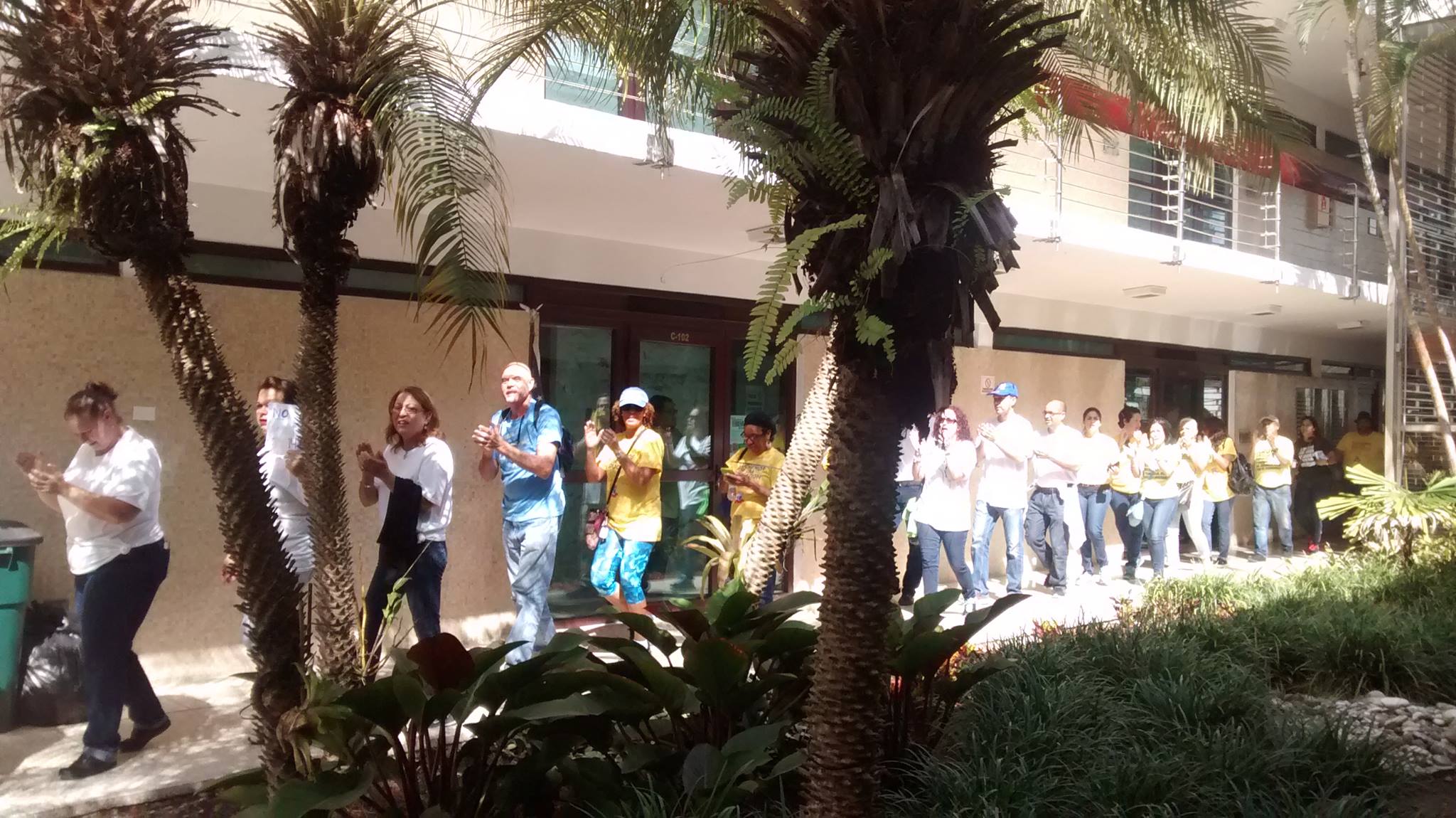
Students streamed out of their classrooms chanting in unison in the mountainous Utuado region of Puerto Rico earlier this month.

They took over the halls and doorways of Luis Muñoz Rivera High School on Thursday, Sept. 10, locking their arms together to create a human chain.

They paralyzed their school, shut it down, and allowed no one in or out.

The reason? Not too much homework. Not lack of choice in the cafeteria. Not an unfair dress code.

These roughly 100 teenagers were protesting the loss of their teachers. And they vowed to occupy their own school until the government gave them back.

Six educators had been ordered to other schools, which would have ballooned classes at the Rivera School to 35-40 students per classroom.

Government officials claimed the high school had too few students to justify the cost. However, with more than 500 young people enrolled, the school has more than double the island average.

“These teachers provide education to almost 140 students,” said Sharymel Montalvo Vélez, a senior at the school. “Do you think this is not enough (to justify the) tuition?”

“Those teachers are excellent. I was their student. I learned with them. I’m grateful for it. Their teaching quality is amazing. I can prove that.”

The students including Vélez, 17, called an assembly to discuss the situation where they voted unanimously to take action. They blocked two gates and wrote a document demanding the Puerto Rican Department of Education revoke the decision to remove their teachers.

Later that day, Sonia González, a representative of the Secretary of Education, met with students and signed the document promising to keep the teachers at the Rivera School. Three parents and one student also signed.

11998478_10153281370523152_505102187_n

The affected teachers are Alex Natal, a 10th grade physical education instructor; Naixa Maldonado, an 11th grade Math educator; José Cruz, a 10th and 11th grade History teacher; María Medina, a 12th grade Physics instructor; Damaris Figueroa, an 11th grade Spanish educator; and an 11th grade English teacher.

Vélez said she’s surprised the government agreed to students’ demands. “ I was willing to keep the strike all the time necessary to solve our problem and get our teachers back,” she said.

“I experienced a large class size some years back, and it was hard on both teacher and students. It’s not that easy to make 30 students understand something and go explaining it chair by chair. Every student likes to show his/her ideas and in a large class there is not enough time for everyone.”

What happened in the Rivera School is not an isolated incident. All across the island, communities are fighting government mandates to relocate teachers, increase class size and shutter more schools.

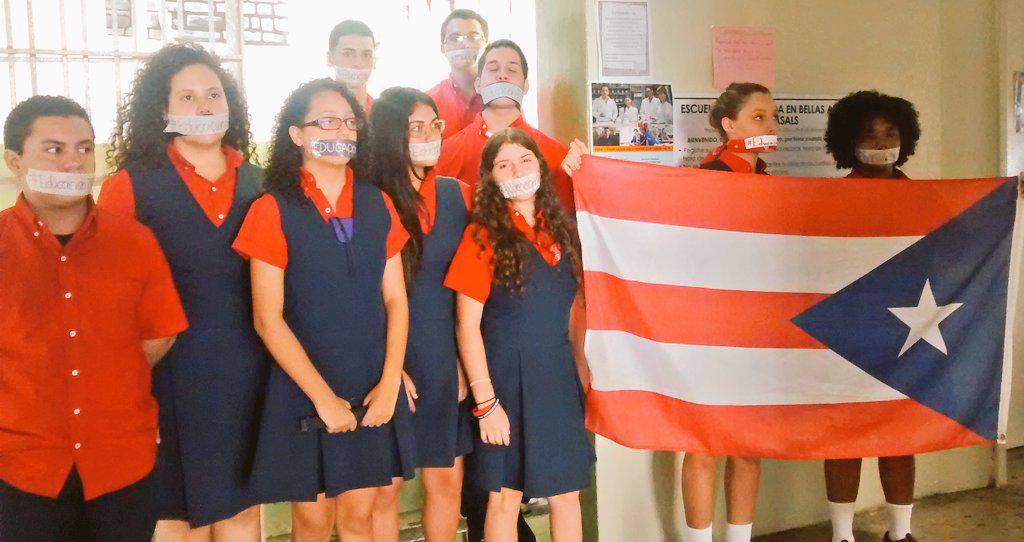
This Tuesday at Pablo Casals School, an arts institution in Bayamon along the north coast, students protested the government decision to relocate their theater teacher, Heyda Salaman.

About 100 students hung the Puerto Rican flag upside down and taped their mouths shut to represent the state of the government and the silence officials expect from the community.

Young people at the specialized arts school which offers visual arts, theater, music and dance as well as academic classes, protested with music and chants of “injustice!”

Just like in the case of the Rivera School, the government eventually relented and agreed to keep the teacher with her students.

The teachers union – the Federación de Maestros de Puerto Rico (FMPR) – has supported student protesters throughout the island.

“The Teachers Federation from Puerto Rico is proud of the actions these students performed,” said union president Mercedes Martinez about student actions at both facilities.

“Schools belong to our communities according to the law, so the communities have every right to fight for the school they deserve. No more cutting funds to create over-sized classrooms.”

Vélez echoes that statement.

“We have a good education and excellent teachers but the administration is failing their workers,” she said.

“The government is cutting rights and benefits to the teachers and employees and soon there will be no teachers. Maybe our schools get privatized and then only people with money will send their children to (public) school.”

11997060_10153278954588152_587899672_n

The Commonwealth government has closed 150 schools in the past 5 years in the U.S. Territory.

Officials warn the government may be out of money to pay its bills by as early as 2016. Over the next five years, it may have to close nearly 600 more schools – almost half of the remaining facilities!

The island is besieged by vulture capitalists encouraging damaging rewrites to the tax code while buying and selling Puerto Rican debt.

Hundreds of American private equity moguls and entrepreneurs are using the Commonwealth as a tax haven.

As a result, tax revenues to fund public goods like education are drying up while the super rich rake in profits.

The indigenous population has suffered at the hands of western conquerors since Columbus, but the newest fruit of Colonialism may be these corporate education reform policies.

Young people like Vélez aren’t revolutionaries. They look just like any ordinary teenage boys and girls wearing t-shirts and blue jeans, baseball caps turned backwards, backpacks slung across their shoulders.

But they have had enough. They aren’t going to accept the low expectations of the corporate world about what constitutes a fair education.

Viva Puerto Rico!


NOTE: This article also was quoted extensively on Diane Ravitch’s blog and published in full on the Badass Teachers Association blog.

You Can’t Win a Rigged Game – Standardized Tests as “Proof” of Failure

Kids_playing_video_games

One of my dearest high school friends was a bit of a doofus.

Who am I kidding? So was I!

One of our favorite things to do after school was plop on the coach and play shoot ‘em up video games. “Smash TV” was a particular favorite.

We’d bob and weave while clutching controllers and rapidly jamming our thumbs on the buttons.

And at such times, we‘d talk.

No great philosophical problems were solved during these mid-afternoon gaming sessions. We’d talk trash, dissing each other’s gaming skills, bragging about our own, and occasionally quizzing each other with trivia on a shared topic of interest.

We both loved movies, so my buddy used to shout out cinematic quotations and ask me to name where they came from.

“Frankly, my dear, I don’t give a damn.”

“Luke, I am your father!”

“Go ahead, punk. Make my day!”

None of these famous quotes made my buddy’s list. He preferred lines like these:

“Run!”

“Look out!”

“Holy S&*t!”

As you can imagine, I rarely got any of them right.

I’d laugh, punch him in the arm good-naturedly and go on shooting virtual enemies.

It was good dumb fun. But now – more than two decades later – my students are forced to take my buddy’s quiz – and if they don’t pass, the government is threatening to shut down their schools and fire me, their teacher.

No, learners don’t have to identify impossible movie quotes. Instead, they’re forced to answer impossibly bad multiple choice questions. But the results are pretty much the same.

In my home state, the Pennsylvania System of School Assessment (PSSA) and the Keystone Exams are high stakes versions of my buddy’s moronic quiz. The purpose isn’t to fairly assess: it’s to stump as many kids as possible.

And it’s working. For the fourth year in a row, student test scores have declined statewide. Previously, students had been doing relatively well. Why the change?

It began with budget cuts. The legislature slashed almost $1 billion every year in school funding. That means higher class sizes, less teachers, fewer electives, tutoring, nurses, services, etc. And districts like mine weren’t exactly drowning in money to begin with.

Students now have less resources, therefore they can’t prepare as well for the tests.

So what did the legislature do? Did our lawmakers fix the problem by putting back the money they had repurposed as gifts to the natural gas industry?

Heck no! They made the tests even more unnecessarily difficult.

As a result, the steady decline in test scores this year fell off a cliff!

After all, this was the first year in which the Commonwealth fully aligned every question of its mandatory testing with the Pennsylvania Core Standards – which are similar, but not identical to the Common Core standards adopted in other states.

Proficiency rates in grades 3 through 8 dropped by an average of 35.4 percent in math and 9.4 percent in English language arts on the PSSA. Nearly half of all seventh and eighth graders dropped an entire proficiency level in math in just one year.

If I made up a test like this in my own classroom, gave it to my students and got results like these, my first assumption would be that there was something horribly wrong with the test. I must have messed something up to fail so many students! Teachers are always on the lookout for unclear or bad questions on their self-created exams. The for-profit corporations that create our state-mandated tests? Not so much.

Though state Department of Education officials acknowledge the continued decline in scores, they insist problems will work themselves out in subsequent years – as if a 4-year trend is just an anomaly. Move along. Nothing to see here, folks.

My students used to make impressive gains on the tests. My principal stopped by today to give me the scores for my current students and those I taught last year. No surprise. Very few passed.

Are my students now lazier and less intelligent than those I taught four years ago? No. Students who scored well before the budget cuts, often score badly now.

Am I a worse teacher? Absolutely not. I have the same skills I did then. I spend the same amount of time at school – maybe more.

So what changed in my classroom? Lack of reconnaissance.

Teachers like myself used to know exactly what was expected of students on these assessments. We had plenty of materials with which to prepare them. Now the exams change every year – and I don’t mean just the individual questions, I mean what is tested!

Back in the day, when my buddy first shouted out, “Run!” and asked me which movie it came from, I had no idea. But after he did it long enough, I’d start to anticipate him. I’d learn that he was thinking of James Cameron’s “The Terminator.”

That’s how the PSSA’s used to be. Teachers knew how the test makers wanted kids to answer. And we could prepare them to do so. The tests didn’t accurately assess student learning even then. It was a game, but at least it was more fair.

Let’s be honest. These tests have never been particularly good. You can’t honestly expect to assess higher order thinking skills on a multiple choice test. Basic skills, maybe. But anything complex simply cannot be measured in this manner. We’ve known that for over a century!

It’s like my buddy’s movie quiz. I have little doubt that someone really did shout “Run!” in “The Terminator.” However, that same line probably appears in at least a dozen more action movies. There’s no way to determine a single correct answer. And shouting out a different quote instead like “Look out!” doesn’t help either.

So please stop the talk about “Rigor.” We’re not raising standards. We’re changing them. My buddy found a new bunch of movies from which to shout out impossible quotes. That’s all.

Anyone who wants to argue validity to these new test questions has to leap a host of hurdles to accomplish his goal.

First, one would have to prove PA Core – and by extension Common Core – Standards actually improve student learning. Good luck. It’s never been done and all the evidence is against you.

Second, one would have to gain access to an individual year’s worth of test questions. Again, good luck. They’re corporate property. The public is not allowed to see the questions. If a principal, student or teacher were to copy a question or snap a photo of a test, they could be subject to prosecution in a court of law.

Such a lack of transparency in government is a sure sign of malfeasance.

It’s almost impossible to avoid certain conclusions about this whole process. Standardized testing is designed to fail students – just like my buddy’s movie quiz was designed to stump me.

These tests constitute fake proof of inadequacy. They attempt to “prove” our public schools are failing and should, therefore, be replaced by private corporations – maybe even by subsidiaries of the same for-profit companies that make and grade these tests!

When my buddy unfairly stumped me, we both knew it was a joke. We’d laugh and play another video game.

But there’s nothing funny about this when it’s perpetrated by the state and federal government.

Pennsylvania’s standardized test scores are a farce just like the scores in every state and territory throughout the country. They’re lies told by corporations, permitted and supported by lawmakers, and swallowed whole by the media and far too much of the public.

We always seem on the verge of waking up. Tomorrow we will stop the state-sanctioned abuse of children by the testing industry. Tomorrow we’ll take responsibility for this sick system we allow.

But when will tomorrow come? I’m tired of waiting.


NOTE: This article also was quoted extensively on Diane Ravitch’s blog and published in full on the Badass Teachers Association blog.