What’s More Important – Fighting School Segregation or Protecting Charter School Profits?

Screen Shot 2016-08-31 at 4.12.13 PM


No one wants school segregation.


At least, no one champions it publicly.


As a matter of policy, it would be political suicide to say we need to divide up our school children by race and socio-economics.


But when you look at our public school system, this is exactly what you see. After the triumphs of the Civil Rights movement, we’ve let our schools fall back into old habits that shouldn’t be acceptable in the post-Jim Crow era.


When we elected Barack Obama, our first President of color, many observers thought he’d address the issue. Instead we got continued silence from the Oval Office coupled with an education policy that frankly made matters worse.


So one wonders if people still care.


Is educational apartheid really acceptable in this day and age? Is it still important to fight against school segregation?


Peter Cunningham isn’t so sure.


The former assistant Secretary of Education under Obama and prominent Democrat worries that fighting segregation may hurt an initiative he holds even more dear – charter schools.


Cunningham is executive director of the Education Post, a well-funded charter school public relations firm that packages its advertisements, propaganda and apologias as journalism.


Everywhere you look Democrats and Republicans are engaged in promoting various school choice schemes at the expense of the traditional public school system. Taxpayer money is funneled to private or religious schools, on the one hand, or privatized (and often for-profit) charter schools on the other.


One of the most heated debates about these schemes is whether dividing students up in this way – especially between privately run charter schools – makes them more segregated by race and socio-economic status.


Put simply – does it make segregation worse?


Civil Rights organizations like the NAACP and Black Lives Matter say it does. And there’s plenty of research to back them up.


But until recently, charter school apologists have contested these findings.


Cunningham breaks this mold by tacitly admitting that charter schools DO, in fact, increase segregation, but he questions whether that matters.


He says:


“Maybe the fight’s not worth it. It’s a good thing; we all think integration is good. But it’s been a long fight, we’ve had middling success. At the same time, we have lots and lots of schools filled with kids of one race, one background, that are doing great. It’s a good question.”


The schools he’s referring to are charter schools like the Knowledge is Power Program (KIPP) where mostly minority students are selected, but only those with the best grades and hardest work ethic. The children who are more difficult to teach are booted back to traditional public schools.


It’s a highly controversial model.


KIPP is famous for two things: draconian discipline and high attrition rates. Even those kids who do well there often don’t go on to graduate from college. Two thirds of KIPP students who passed the 8th grade still haven’t achieved a bachelor’s degree 10 years later.


Moreover, its methods aren’t reproducible elsewhere. The one time KIPP tried to take over an existing public school district and apply its approach without skimming the best and brightest off the top, it failed miserably – so much so that KIPP isn’t in the school turnaround business anymore.


These are the “lots and lots of schools” Cunningham is worried about disturbing if we tackle school segregation.


He first voiced this concern at a meeting with Democrats for Education Reform – a well-funded neoliberal organization bent on spreading school privatization. Even at such a gathering of like minds, some people might be embarrassed for saying such a thing. Is integration worth it? It sounds like something you’d expect to come out of Donald Trump’s mouth, not a supposedly prominent Democrat.


But Cunningham isn’t backing away from his remarks. He’s doubling down on them.


He even wrote an article published in US News and World Report called “Is Integration Necessary?”


Here’s the issue.


Segregation is bad.


But charter schools increase segregation.


So the obvious conclusion is that charter schools are bad.


BUT WE CAN’T DO THAT!


It would forever crash the gravy train that transforms public school budgets into private profits. It would forever kill the goose that turns Johnny’s school money into fancy trips, expense accounts and yachts for people like Cunningham.


This industry pays his salary. Of course he chooses it over the damage done by school segregation.


But the rest of us aren’t burdened by his bias.


His claims go counter to the entire history of the Civil Rights movement, the more than hundred year struggle for people of color to be treated equitably. That’s hard to ignore.


People didn’t march in the streets and submit to violent recriminations to gain something that just isn’t necessary. They weren’t sprayed by hoses and attacked by police dogs so they could gain an advantage for their children that isn’t essential to their rights. They weren’t beaten and murdered for an amenity at which their posterity should gaze with indifference and shrug.


We used to understand this. We used to know that allowing all the black kids to go to one school and all the white kids to go to another would also allow all the money to go to the white kids and the crumbs to fall to the black kids.


We knew it because that’s what happened. Before the landmark Brown vs. Board of Education, it’s a matter of historical fact. And today it’s an empirical one. As our schools have been allowed to fall back into segregation, resources have been allocated in increasingly unfair ways.


We have rich schools and poor schools. We have predominantly black schools and predominantly white schools. Where do you think the money goes?


But somehow Cunningham thinks charter schools will magically fix this problem.


Charters are so powerful they will somehow equalize school funding. Or maybe they’re so amazing they’ll make funding disparities irrelevant.


For believers, charter pedagogy wields just that kind of sorcery. Hocus Pocus and it won’t matter that black kids don’t have the books or extra-curriculars or arts and humanities or lower class sizes.


Unfortunately for Cunningham, the effects of school segregation have been studied for decades.


“Today, we know integration has a positive effect on almost every aspect of schooling that matters, and segregation the inverse,” says Derek Black, a professor of law at the University of South Carolina School of Law.


“We also know integration matters for all students. Both minorities and whites are disadvantaged by attending racially isolated schools, although in somewhat different ways.”


Minorities are harmed academically by being in segregated schools. Whites are harmed socially.


At predominantly minority schools, less money means less educational opportunities and less ability to maximize the opportunities that do exist. Likewise, at predominantly white schools, less exposure to minorities tends to make students more insular, xenophobic and, well, racist. If you don’t want little Billy and Sally to maybe one day become closeted Klan members, you may need to give them the opportunity to make some black friends. At very least they need to see black and brown people as people – not media stereotypes.


Even Richard D. Kahlenberg, a proponent of some types of charter schools and a senior fellow at the Century Foundation, thinks integration is vital to a successful school system.


“To my mind, it’s hugely significant,” says Kahlenberg, who has studied the impact of school segregation.


“If you think about the two fundamental purposes of public education, it’s to promote social mobility so that a child, no matter her circumstances, can, through a good education, go where her God-given talents would take her.  The second purpose is to strengthen our democracy by creating intelligent and open-minded citizens, and related to that, to build social cohesion.


Because we’re a nation where people come from all corners of the world, it’s important that the public schools be a place where children learn what it means to be an American, and learn the values of a democracy, one of which is that we’re all social equals. Segregation by race and by socioeconomic status significantly undercuts both of those goals.”


We used to know that public education wasn’t just about providing what’s best for one student. It was about providing the best for all students.


Public schools build the society of tomorrow. What kind of future are we trying to create? One where everyone looks out just for themselves or one where we succeed together as a single country, a unified people?


A system where everyone pays their own way through school and gets the best education they can afford works great for the rich. But it leaves the masses of humanity behind. It entrenches class and racial divides. In short, it’s not the kind of world where the majority of people would want their children to grow up.


More than half of public school students today live in poverty. Imagine if we could tap into that ever-expanding pool of humanity. How many more scientific breakthroughs, how many works of art, how much prosperity could we engender for everyone!?


That is the goal of integration – a better world.


But people like Cunningham only can see how it cuts into their individual bank accounts.


So is it important to fight school segregation?


That we’re even seriously asking the question tells more about the kind of society we live in today than anything else.

We Are All Chicago Schools – More Layoffs, Less Help for Other People’s Kids

ct-rahm-emanuel-forrest-claypool-private-schools-20160505


“Fuck those kids.”


Mayor Rahm Emanuel couldn’t have been clearer if he’d said the above.


Chicago Schools Chief Executive Forrest Claypool couldn’t have made his priorities clearer if he’d given Chicago’s parents the bird and told them to “Kiss my ass.”


The Chicago Board of Education – made up of members all of whom are appointed by the mayor – decided to layoff 1,000 teachers and staff at the city’s public schools just a month before opening day. Sure, some may keep their jobs through reassignment, but hundreds will be unemployed.


This after a recent history of closing more than 80 schools and slashing thousands of jobs. Just last February, the district laid off 62 employees, including 17 teachers. In January, it laid off 227 staff members.


This begs several questions: How many teachers and support staff can Chicago Public Schools afford to lose? What exactly is this doing to its students? How is it affecting their future prospects to be taught by a skeleton crew?


The city’s leaders don’t give a shit.


And why should they? These aren’t their kids!


Emanuel’s children attend University of Chicago’s Laboratory Schools, a private institution. Claypool’s kids go to Francis W. Parker, a private school in Lincoln Park. Even Gov. Bruce Rauner’s six kids don’t go to public school. They’re all grown.


So this doesn’t affect them. Nor does it affect any charter school kids. Not a single one of these 1,000 cuts will occur at a city charter school.


It’s just the traditional public schools, those schools where approximately 85% of students are Latino or African-American. Just those schools where 87% of the children come from low-income homes. Just those schools where 12% of kids are reported to have limited English proficiency.


Yeah. Fuck those kids.


And the worst part is that it’s not necessary. Chicago doesn’t have to continue to abandon its neediest children.


When you’re in a family, you make sacrifices for your kids. If funds are tight, you make cuts elsewhere or maybe you even take another job. Anything to make sure you’re providing your children with the best.


But Chicago’s leaders aren’t interested in doing any of that for these kids because they just don’t care.


Otherwise they could find the money. The teachers union suggests declaring a TIF surplus and reinstating a corporate head tax. The city isn’t exactly a wasteland. Wealthy developers are looking to build yet Emanuel has no intention of inconveniencing them by making them pay a fair share of taxes. Instead, the full burden falls on the city’s working families. And he calls himself a Democrat!


There’s always enough money for projects leaders care about. For instance, there was no problem finding $250,000 to pay a law firm where Claypool and his handpicked general counsel, Ron Marmer, both formerly worked. Marmer still has financial ties to the firm! So cut a check to Jenner & Block LLP? YES! Ensure kids have all the teachers they need? HECK NO!


Strangely there’s $27 million hiding in the seat cushions to open a new charter school for the University of Chicago. The Woodlawn Campus of the University of Chicago Charter School will be part of the development around the newly-planned Obama Library. It’s a fitting symbol of the President’s legacy – a brand new privatized educational facility while a few blocks away traditional public schools molder in ruin.


Meanwhile, Gov. Rauner holds the state education budget hostage. Illinois lawmakers could only agree on a 6-month state budget in June. Republicans expressed concern about the state being responsible for bailing out Chicago Schools. It’s not our problem, they seem to think. Well of course not. These aren’t your kids.


It’s the same swindle we see throughout the country. Refuse to pay for public schools – especially the schools serving poor brown kids, and then shrug. “Look at the impasse,” they shout, hoping voters are too stupid to realize it’s an impasse created by these lawmakers, themselves! It’s a textbook disaster capitalism move, approved by the American Legislative Exchange Council (ALEC) and other conservative think tanks. But Rauner can at least be forgiven for being a proud Republican. This is, after all, the behavior progressives expect from GOP lawmakers.


What about Democrats like Emanuel? This isn’t the way progressives are supposed to act. They aren’t supposed to favor privatization over public schools. They aren’t supposed to fawn on big business and promise tax cuts, tax shelters, and every other kind of tax avoidance.


Some might say it’s just Emanuel. After all, for a Democrat he sure pals around with a lot of conservatives. He and Rauner are best buddies. When Emanuel earned his fortune, he was an investment banker, and one of his best clients was Rauner. They go out to dinner and even spend vacations together. Sure they occasionally criticize each other in public, but behind closed doors the ideological differences just melt away.


What about the rest of the Democrats? Surely they don’t agree with Emanuel’s tactics. They made sure to keep him away from the Democratic National Convention – out of sight, out of mind.


But if the party is really so opposed to these policies, where is the condemnation from party leaders?


I haven’t heard a peep from the Democratic nominee for President, Hillary Clinton, about these layoffs. Have you? She’s the de facto leader of the party and she’s got nothing to say about this. What does that tell you about her priorities?


Sure she’s cozied up to the two biggest national teachers unions who liked her so much they didn’t even need to consult the rank and file before endorsing her in the primary. Ronald Reagan had the support of the Professional Air Traffic Controllers Organization (PATCO) right up until he declared their strike illegal and demanded they return to work. Will Clinton, too, turn against union teachers once she’s used them for their vote in November?


But you know what? Forget Hillary. Where’s Bill? Where’s Tim Kaine? Where’s Barack and Michelle Obama? Where’s Joe Biden? Where’s Al Franken? Where’s Cory Booker?


We have to get beyond labels like Republicans and Democrats, liberals and conservatives. Almost all of them are neoliberals. They all believe essentially the same things.


And as proof I offer the deafening silence offered against Emanuel in Chicago.


He’s hurting school children.


But no one in power gives a fuck.

If Trump Drops Out, Will There Be Any Reason to Vote For Clinton?

hillary-clinton-donald-trump-getty-images-640x480

Rumor has it Donald Trump may be dropping out of the Presidential race.

We’ve heard these speculations before, but after kicking a crying baby out of one of his rallies, even his staunchest supporters are scratching their heads.

Does this guy even want to be President of the United States?

Only a few weeks ago a story was circulating that Donald Jr. was calling up potential Republican running mates asking if they wanted to run both domestic and foreign policy while his dad handled “Making America Great Again.”

From the very beginning of this unlikely Presidential run, people have questioned all kinds of things about the Trump campaign – chief among them was this: Is he serious!?

Donald Trump is the Republican standard barer – Isn’t he more of a Democrat? Isn’t he actually friends with his supposed Democratic challenger, Hillary Clinton? Didn’t he actually donate money to her first Presidential bid in 2008? Is he just a false flag for Clinton – someone so odious he’ll rally people to vote FOR HER rather than for him?

I have no idea whether this will actually come to pass. Win the nomination and then drop out? Anything is possible when you’re running a reality TV star for the highest office in the land. But it begs the question – what happens if he really does it? What happens if Trump drops out?

Certainly the Republicans will find SOMEONE to run in his stead. Maybe it will be his running mate, Mike Pence. Maybe the party elders will pick one of the usual suspects – Paul Ryan, Mitt Romney or Jeb Bush.

But in such a situation, what happens to the Democratic nominee?

Hillary Clinton is not popular on her own.

Her Presidential crusade is built on one thing: she’s not Trump.

For the most part, she isn’t running on what she’d do as commander in chief. Sure, she’s pulled out a bunch of progressive platitudes mostly cribbed from the Bernie Sanders campaign. But no one with any memory of the Clintons actually expects her to abide by them. If you don’t think the first thing she’ll do in office is approve the TPP, I’ve got a bridge to sell you in Brooklyn.

Hillary Clinton will say what she has to say to get elected. If you doubt that, please recall that when she went on one of the most popular black radio programs, they asked her what’s one thing she always keeps in her purse. She said, “Hot Sauce!” They incredulously asked if she was just saying that to get black votes, and she jokingly asked, “Is it working?”

Without Trump, why would anyone vote for Hillary Clinton?

She needs him to get elected. She needs the fire and brimstone of his campaign. She needs to be able to point to him and portray how terrible a Trump Presidency would be.

For example, take the Hitler analogies.

During the primaries, pundits cautiously feared breaking Godwin’s Law when it came to Trump. Sure, he has certain similarities with the National Socialist German Workers Party candidate of yore, but few were willing to conflate the two.

Now that Trump has miraculously earned his party’s unequivocal nomination, the gloves are off. Talking heads across the nation equate Trump and Hitler as if it were somehow axiomatic. And, yes, Trump is racist, sexist, xenophobic, etc. He feeds off these qualities in others. He uses them to propel his campaign. But he doesn’t have control of the military like the Nazis did in Germany – they hate him. He doesn’t have the groundwork of a party explicitly founded on the theory of racial purity. He hasn’t weakened the entire political system to the degree that it is willing to bow down before him and do whatever he wants.

A president, even a Trump president, can’t do whatever he likes. There are checks and balances. But the Clinton fear machine has us all convinced that the second he gets into office he’ll be launching nukes, rounding up undesirables and opening concentration camps.

Make no mistake – Trump would clearly be a terrible President. I do not dispute it. Very few people do. But the force of Clinton’s candidacy is based on Trump’s existence. Her campaign has talked up how he would bring forth a combination of the Holocaust and Armageddon. Without him in the game, the voting public loses it’s best reason to come to the polls for her.

She’s a war hawk. As President, her husband with her full support increased the prison industrial complex more than any other chief executive in history. She’s in favor of public school privatization, endless standardized testing and Common Core. She supports the same Wall Street friendly policies that helped crash the economy and evaporated jobs.

But she’s not Donald Trump.

If the Republicans put forth a milquetoast candidate, who’s to say if he’ll get much support from the base. The Trump faithful will still vote for the Donald, whether he’s officially on the ballot or not. The GOP vote would be fractured between Trump and Republican No. 2. And it’s hard to say who Independents, who make up the largest voting block in the country, will support. More likely than not, they’ll do what the usually do – stay home.

Unless…

Independents strongly favored Clinton’s Democratic challenger Bernie Sanders in the primaries. If Trump drops out, it provides an opening for a true progressive third party candidate, someone to get the Independents to the polls.

The only thing stopping some people from voting third party now is fear of Trump. They can’t accept letting him win. But if Clinton has no robust Republican challenger, it frees former Bernie supporters to back someone like Green Party candidate Jill Stein.

Stein is Bernie on steroids. She wants to boost the economy by forgiving all student debt. She wants single payer healthcare. She wants a Green New Deal – to reduce the size of the military while investing in environmentally friendly jobs at home. She’s against public school privatization, testing and Common Core. She makes Hillary Clinton look… well, like Donald Trump.

But she has a hard road ahead of her. She may not be on every state ballot. Not since George Washington has a third party candidate won the Presidency. Even Ralph Nader – who is erroneously blamed for turning the 2000 election in favor of George W. Bush – didn’t get enough votes to win a single district or electoral vote.

But in the political chaos following a Trump flame out, a chance opens up. Everything would be up for grabs.

Why vote for a neoliberal like Clinton without the fear of a neofascist like Trump? If too few people vote for a third party, Clinton wins. Nothing lost there. Meanwhile, it’s doubtful Republicans could pull off a victory without independents. But if Independents and almost half of the Democrats who voted for Bernie pull together behind Stein, there is a real chance of victory.

So keep your eyes on the flaming zeppelin that is the Trump campaign. The one person with more at stake than The Donald is Hillary Clinton.

Why the Rich Need Racists: Prejudice as Social Control

Screen Shot 2016-07-17 at 1.55.00 AM

HELP WANTED: RACISTS
Anywhere, USA

-Must have an irrational fear and hatred of all things African American.

-Must honestly believe black people get all the breaks, have it easier than whites.

-Must believe black people are naturally inferior to whites, lazy, prone to criminality, less intelligent, etc.

-Must believe racism ended with either (1) the civil rights movement or (2) slavery.

But must hide these beliefs under a thin veneer of civility. For instance:

-must never use the N-word (in public)

-must never beat or kill a black person (unless on the police force)

-must never light a burning cross on a black person’s lawn (and get caught)

-must never tweet or express these views publicly in a way that can be traced back to you.

Enjoyment of rap music, black culture or black sexual partners optional. Fox News viewership preferred.

Bonus pay if racism is unrecognized by the applicant.

No experience necessary. Apply within.”


If you saw an advertisement like the above posted in your local shop window, it really wouldn’t be so surprising. Would it?


Well maybe because of its bluntness. But it’s not really that different from campaign fliers for Republican Presidential candidate Donald Trump vowing to “Make America Great Again!”


Throughout its history, when exactly was America great for black and brown people who have been denied equal rights? When was it great for women or LGBTs or a host of other non-cis/non-male/non-white people?


A pledge to make America great again is just a pledge to make America white again – or at least to propel male whiteness back to the center of normativity.


(In fact, much of what I’m going to say about racism here could also be said of all kinds of prejudice. But for the interest of clarity, I’ll try to contain myself to focusing on racism, though I acknowledge the high degree of intersectionality of the phenomena.)


Yep. A lot of folks are riled up because the flower of white male privilege is wilting, and they think too many are suggesting we let it die.


What can they do? White people’s only remaining claim on supremacy is based on a fleeting numerical majority that is fast coming to an end. Soon they’ll be outnumbered.


They’re so mad about even an incremental loss of white power, they’re willing to blind themselves to obvious injustices against people of color.


For instance, black people are killed by the police at twice the rate of white people. Unarmed black people are killed at five times the rate. Yet somehow it’s black folk’s own doggone fault.


What if he has a legal weapon, but it’s not anywhere in use? HIS FAULT.


What if he has no weapon? HIS FAULT.


What if he’s just a child? HIS FAULT.


What if it’s a woman mysteriously found hanged in her prison cell with no possible motive for suicide? HER FAULT.


What if he’s screaming in pain from an injury sustained in the police encounter? HIS FAULT.


What if he’s complaining on video that police are choking him and he dies as a result of those injuries? HIS FAULT.


I mean come on, people! How does a brotha’ got to die before white folks will admit to some culpability by police?

 
And that’s just one type of example. Consider: There are more black people in prison today than were slaves before the Emancipation Proclamation. Black people get harsher prison sentences than whites for the exact same crimes. Black people are segregated into poor communities with underfunded schools. People with black-sounding names are less likely to get a job than white counterparts with the same experience.


And on-and-on-and-on.


Yet you’ll find white apologists everywhere who will see no evil, hear no evil, and speak no evil of the racial caste system under which their black brothers and sisters are forced to live. They refuse to acknowledge it, get angry when you bring it up and will actively support it at the polls.


That’s racism, people.


It’s 2016. Legal slavery ended more than 150 years ago in this country. The civil rights movement ended more than 60 years ago. Why do we still have systematic racism baked into the fabric of America?


In 1963, the African American writer James Baldwin asked the same question. He said:


“The future of the Negro in this country is precisely as bright or as dark as the future of the country. It is entirely up to the American people, and our representatives, it is entirely up to the American people whether or not they’re going to face and deal with and embrace the stranger who they’ve maligned for so long. What white people have to do is try to find out in their own hearts why it was necessary to have the n****r in the first place. I am not a n****r. I am a man. But if you think I’m a n****r, it means you need it… You, the white people, invented him, and you have to find out why. And the future of the country depends on that.”


Why do white people need racism?


Today we have an answer. The short version would be this: because it’s useful.


It serves a function in society.


When people conceptualize each other into these highly dubious and unjustifiable categories of black and white, it provides a valuable service to the status quo. In fact, we couldn’t have the status quo without it.


When historians look back at the ancient Spartan empire of 900 -192 BC, there is little confusion why their society was so highly militarized. Few historians wonder why such a small population organized themselves into a military state. They needed to control the vast network of slaves dispersed throughout their community. The conquerors were massively outnumbered by the conquered so they resorted to militarized fear to keep their social structure intact. They weren’t afraid of invaders from without. They were afraid of invaders from within.


Likewise, if humanity survives our current moment in time, historians of the future will undoubtedly be in agreement about the reasons for American racism. It’s the same reason found in ancient Sparta. We need it to keep our society together.

 
In America today, the top one percent own more than the bottom 90 percent. The richest 85 people have as much wealth as the bottom half of the country. And it’s only getting worse.


A country with such vast wealth inequality cannot survive without a scapegoat – black people. The majority of the population would not let the top one percent gorge themselves on our riches unless they had distracted us with something.


Don’t pay any attention to the Wall Street bailout. Look at those welfare queens, which is code for black people sucking away our wealth.


Don’t pay attention to the overt militarization of the police force. Look at those violent black criminals they have to deal with by pulling their service pistols and shooting them into submission.


Don’t pay attention to the inequitable distribution of education funding to your public schools. Look at how these black kids don’t pull up their pants, and if they manage to graduate, they’re given undeserved preference over more qualified white people through affirmative action.


Think about it. Why do we have a sizable black population in the first place?


Slavery. The very presence of a substantial black population is attributable to market forces. We needed a cheap workforce for our agricultural industry – especially tobacco and cotton. It was a labor intensive process and the only way to make a substantial profit at it was immoral thrift. And you can’t get much cheaper than forced, generational servitude.


Why weren’t black people treated equally after the Civil War?


We still needed that cheap workforce. The wealth of our nation depended on it. We needed legal ways to keep them subjugated. We needed to keep them on the farm or in prison so the economic engine of agriculture could continue unabated. If they all had the right to vote or could protest their conditions, that would hurt the bottom line. They’d gain freedom, but we’d lose money. Not gonna’ happen.


Why didn’t equality come after the civil rights movement?


Agricultural mechanization had decreased the need for cheap labor, but having an underclass is profitable for whoever can take advantage of them. The invisible hand of the market will preserve human subjugation for as long as it can and as long as it turns a profit.


Moreover, throughout the entire history of this country, the rich have needed something to keep white labor in check, too. Fair wages, overtime pay, child labor laws, vacation pay, workplace safety – all of these rights had to be fought for tooth and nail – usually by the most demonized of social institutions, the labor unions. We needed something to stop the rising tide of economic fairness. Giving white workers someone to kick around made them more satisfied with their own lot in life and less willing to fight for a larger share of the pie.


It went something like this: You may have to work in the factory all day, but at least you aren’t one of THEM. You might be bone tired while the bosses get rich off of your labor, but at least you can feel proud of your race.


What an amazing swindle! The rich have actually convinced many hard-working white people to feel proud of the pigmentation of their skin! No. Not their cultural heritage. Not the struggle of their moms and dads, their ties to a homeland across the sea, their religion or ethnicity. No. The color of their skins!


If intelligent aliens ever crossed light years of space and time to investigate the intellect of human beings, that one fact would have them rushing back home shaking their tentacles and multiple heads in disbelief!


Just look at how racism has been used to justify the actions of the wealthy throughout history!


Europeans discover a New World in 1492 full of riches to plunder and exploit. But how do you justify doing that when it’s already populated? How can you do that morally? After all, doesn’t our God command we love our neighbors as ourselves? Isn’t murder and theft a… gulp… sin?


Well obviously the indigenous peoples don’t count. They’re not like us. They’re not Christians. They’re heathens.


But wait a minute! The church is forcing them to adopt our religion. This justification has a sell-by date. It won’t last long enough for us to suck every drop of wealth out of the Americas.


So we came up with a new way to dehumanize people – racism. It’s not just that they’re heathens. They’re subhuman, too. FWEW! Problem solved.


Then comes 1776. The American colonies revolt and write up some high minded language about all men being equal. If we actually believed that, it would necessitate a new social order. Much easier to find new justifications for the old one.


Well we already agreed the Native Americans are naturally inferior. These African slaves we stole are likewise beneath our high ideals. The same with women. And the poor. And immigrants. And homosexuals. And whoever else we need to subjugate. They just don’t count.


When idealism and capitalism have come into conflict, the rich have invariably chosen capitalism. And when the rest of us choose racism, prejudice, sexism, xenophobia and homophobia, we’re doing them a favor. We’re backing up their interests.


Stop being such chumps, white people!


A racist is invariably a traitor to his own class. A sexist is a sycophant to the smart set. A xenophobe is a diversion to the hands buried in your pocket robbing you blind.
Your interests have much more in common with all those people you’ve been taught to hate. You could be coming together in common cause with all those black and brown people. You could be rising up and demanding your due. We could join together and demand a fair shake, an equitable piece of our gross national product.


But instead we are content to protect an ever shrinking share of our national wealth if we can just keep that ridiculous and childish pride in our lack of melanin.


During the same interview, Baldwin was asked if he thought there was any hope America would change it’s ways. He said:


“I can’t be a pessimist because I’m alive. To be a pessimist means that you have agreed that human life is an academic matter, so I’m forced to be an optimist. I’m forced to believe that we can survive whatever we must survive.”


I agree.


It’s all up to us, white people.


Racism doesn’t serve us. It subjugates us just like it does everyone else.


They throw us a bone and we jealously guard it like its a prime cut of steak.


When are we going to wake up? When are we going to put away hate and choose love?


When are we going to join our brothers and sisters in the struggle and demand what’s ours?


The rich may need racists, but we don’t.

What My Black Student Taught Me, His White Teacher, About Black Lives

student_081910-thumb-640xauto-704

I can’t tell you how many times Darnell was in detention.

After a while, it didn’t feel right if he wasn’t staying at least an hour after school.

Darnell was late to class.

Darnell swore at another student.

Darnell copied someone’s paper.

Darnell did just about everything and anything that came to his mind. And it earned him time after school with me, his newly-minted 8th grade language arts teacher.

In a class full of mostly brown and black students, many living in an impoverished high crime Pittsburgh suburb, Darnell was the standout. Or at least his misbehavior was.

At first, he complained, but I had his mom on speed dial, and she fully supported my holding him accountable.

He wanted to do his homework during this time, but I made him do busy work instead. The way I looked at it as a young teacher just starting out, if I gave him time to do his school work, it would be a reward, not a punishment.

So I made him copy down dictionary definitions, clean the tables or put up the chairs.

And once he realized there was no way out, he did it all uncomplainingly.

But an hour is a long time, so after a while I let him work on his homework, too.

I had an awful lot of work to do, myself, during these times – piles of papers to grade and lessons to plan – so whatever would keep him quiet would be okay with me.

Unfortunately, Darnell didn’t work that way. He had questions. So many questions.

I had no time, but what else was I gonna’ do?

I answered him. With frustration at first while sitting at my desk.

Then I found myself walking over to him and standing at his table. Then I sat down next to him. And pretty soon we were doing the homework together.

But an hour is a long time, so sometimes he’d finish early. I offered to let him go.

He didn’t want to.

He’d stay and talk: “Did you see the football game, Mr. Singer?”

Or “Did you hear the new Beyoncé album, Mr. Singer?”

Or “How many kids do you have at home, Mr. Singer?”

One day I remember the last bell ringing and looking up to see Darnell at his desk doing homework. I looked back at my stack of papers before I realized – Darnell didn’t have detention today.

I laughed. “You can go home, Buddy,” I said.

“I know,” he replied. “Is it okay if I stay and get this done?”

I shouldn’t have been so surprised. But I was.

I nodded, and he stayed.

I won’t say Darnell ever became a perfect student. He just didn’t have the patience for detailed work. He was more of a big picture guy.

But after months of never turning in homework – years, really – he began to turn all of it in. And I mean all of it!

He wasn’t a great speller, but he started ending all of his sentences with punctuation. And he started all of his sentences with a capitalized word.

He wasn’t a great reader, but he did crack open a few books. Nothing too difficult or complex, but it was more than any teacher I talked to had ever seen him read previously.

At the end of the year, I remember pausing by his desk and praising him.

“Darnell, that’s some mighty fine work you did in here this year,” I said.

And he got this big ol’ grin on his face like he used to get before he was about to engage in some random act of mischief.

“Thanks, Mr. Singer. You’re a really good teacher.”

I smiled and said, “No, Darnell. You’re a good student.”

I remember looking him in the eye to emphasize it. This was a kid with a reputation. I’ll bet few teachers had ever commended him on his school work before.

Then the year ended, and he was gone.

He went on to 9th grade and did even better than in my class. The same in 10th, 11th and 12th.

Oh, sure. He was still a handful and got himself in trouble lots of times. But he did his work and didn’t fail his classes.

I kept an eye on him like I do all my students when they leave me. I try to keep tabs, but there’s always a new bunch just waiting for you at the beginning of the year.

You remember anytime you think about it, which isn’t much.

So it was years later when I heard the news.

Teachers were shaking their heads in the faculty room. The principal held a meeting to tell us about it in case any of our current students were upset, in case any of us had Darnell’s cousins, brothers, sisters, or friends.

He was only 18 when he was murdered.

Shot down in the streets from a passing car.

Police still don’t know whether he was the shooter’s target or if he was just at the wrong place at the wrong time.

The high school teachers, who knew Darnell best, said he had really straightened up his act. He had gotten into community college, wanted to be an engineer.

And they shook their heads. What else was there to say?

I walked back to my classroom and opened a file cabinet.

Inside was a bunch of dusty manila folders – one for each child I had ever made serve a detention.

It didn’t take long to spot Darnell’s. It was one of the thickest.

I opened it up and took out the stack of papers inside.

There were doodles of monsters and basketball players. There were lists of badly spelled vocabulary words in his adolescent handwriting. And there were these halting paragraphs about what he’d done to get detention and how he’d never do it again.

“I’m sorry I wuz late 2 class. I will ask to use bathrom before going.”

“i will not copy LaRonns paper. i will do it myself.”

I read through them all. Every one. I read them again and again until long after everyone else but the janitors had left the building.

I had spent so much time with Darnell.

I had poured my soul into that kid.

But what had it truly accomplished?

He is dead. A victim of his environment. Nothing but a number, a statistic, a footnote.

Just not to me.

By all accounts he had been trying to do good, trying to make something of himself. But it wasn’t enough. Bullets don’t discriminate between the hardworking and the lazy. They just do what they do.

In my mind I tried to see him walking home, a stack of books weighing him down, making him slow. I saw him walking past those ramshackle apartments and slums, that shady park with the broken benches, the street corners where you could buy heroin or pills or weed.

If he was white, would it have been different? If he was white and didn’t live in the “bad neighborhood,” would it have mattered?

If his mom didn’t have to work two or three jobs, would it have helped? If he had someone at home to watch him instead of a bunch of younger siblings and cousins to watch, would things be different?

I don’t know.

But I DO know that there is a list of dead children in my community – some of them my former students – and almost all of them are black.

Darnell wasn’t killed by a policeman, but I’m sure they knew his name. He used to tell me how the cops would often follow him and his friends into the grocery store. “Why they always be doin’ that?” he’d ask me. And I’d just shrug thinking about all the times he’d wait until I wasn’t looking before slapping another child on the neck.

But if Darnell had been white, would we have had different expectations of him? Would we have given him the benefit of the doubt to begin with – like we do white kids?

I wasn’t a very good teacher to Darnell. Every scrap of respect I gave him he had to earn. Why didn’t I give him that respect at the start? Why didn’t I expect the best and then change my expectations as the situation dictated? Why did I instead expect the worst and alter my expectations from there?

I never questioned if or why Darnell was seeking my attention. I just thought of his bad behavior. It was something I wanted to change, so here’s a punishment.

I never offered Darnell my help. I offered help to the class as a whole but not to Darnell individually. Not until he wore me down. Not until helping him was easier than arguing with him.

I never thought about Darnell’s needs. I thought about MY needs of Darnell. I need him to behave so I can teach. Never Darnell’s needs to behave so he can learn.

And there are so many other kids out there like him. I’ve taught so many other little Darnells.

I approach them differently now. It’s a lesson he taught me.

I may have bestowed upon him some spelling and grammar. He taught me humanity. Who is the better teacher?

He taught me to look at black children in a different way.

He taught me to come to them on their terms. To begin anew with an expectation that they will do well no matter what they’ve done in the past. He taught me to look beyond their behaviors and see them as little people. It’s a lesson I’ve never forgotten, and it informs my teaching to this day.

As I sat there with that stack of dusty folders, I realized it doesn’t end at the classroom door.

I used to think being a parent, myself, I had an interest in the future. But that’s not entirely true. Being a parent is one of the most rewarding things you can do, but it isn’t selfless. It only means you care about your child. Not all children.

And that’s where being a teacher is different. After a while, you can’t be selfish anymore. You can’t care for only some people’s futures. You are essentially invested in a future for all, for everyone.

You can try to draw a line in the sand and say “I only care about THESE kids,” but it doesn’t work. You find yourself caring about all of them, all of the children who will become our world when we crumble to dust.

That’s how it should be for everyone.

As a human being, it is my responsibility to fight to make this world a better place for people like Darnell. It’s my responsibility to make sure they all have a future.

But it goes beyond even that. I’m not just any person. I’m a white person.

All the things stacked against a kid like Darnell were stacked in my favor. I lived in a good neighborhood. Police never followed me anywhere. No matter how much I misbehaved, it was always expected I wouldn’t cause any trouble – unless I did.

So it’s my responsibility as a white person to fight my privileged place in society. It’s my responsibility to ensure that black people aren’t held back by entitlements I have not earned and handicaps they do not deserve.

As a white teacher, it is my responsibility to see the best in my children – in ALL of my children. It is my responsibility to meet them where they are and give them support and nurturing and love.

To do so I must see beyond the walls of invisible prejudice. I must see the hurdles, the traps, the maze so I can help them overcome it.

Because Darnell never got to go to college. He never got to become an engineer.

But his life mattered.

Racism is Just One of Two Things Shown in Alton Sterling Killing

-1dd3afa605e6bc1d

Americans are notoriously bad at holding two thoughts in our heads at the same time.

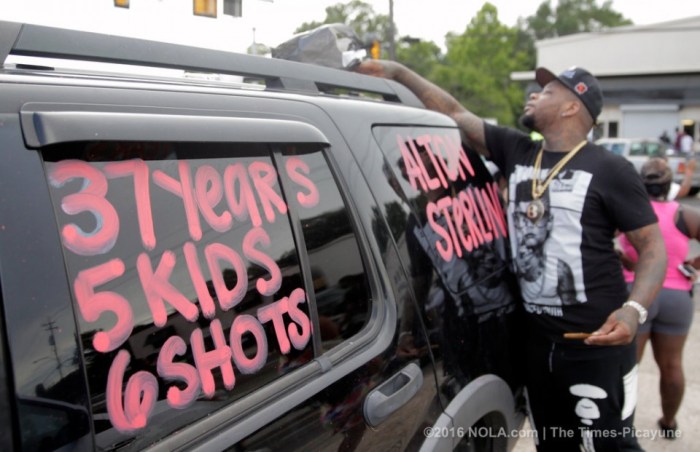
We look at the police shooting of Alton Sterling and can’t decide whether it was racist or if the 37-year-old black man just had it coming.

But we’re missing the point. Sometimes twice.

Baton Rouge Police shot and killed the father of five on July 5th.

The 37-year-old man was killed outside a convenience store in Louisiana because police allegedly got a tip someone was selling CDs and was armed. In the resulting scuffle, Sterling was shot and killed.

If the whole thing weren’t caught on a cell phone video, it probably wouldn’t be more than a sad headline. Just another black dude killed by police.

But the resulting attention has made his name a hashtag and his death a source of outrage – for good reason.

On the video, police tackle Sterling to the ground before gunshots are heard.

One of the officers shouts “gun” before shooting, but store owner Abdullah Mulfahi told the media that Sterling’s hand was not near any weapon and the alleged gun later recovered from his pocket was not visible.

People watch the video (or not) and immediately take sides.

Who is to blame – the police or Sterling?

Was the black man armed? Maybe – though Louisiana is an open carry state so he would be within his rights to do so.

What should he have done when confronted by police? What actions of his might have resulted in police not shooting him dead?

Did he have a record? Is that even relevant since police had no access to that information at the time?

Typically people come to conclusions based on their convictions and not based on the evidence. If you think black people are being victimized by police, then you’re probably on Sterling’s side. If you think black people are naturally violent and police rarely do any wrong, you’re probably on the side of law enforcement.

But what both sides are ignoring is a sense of context.

This was the 15th American killed by police so far in July alone.

Not the 15th black person. The 15th person. Period.

There’s some dispute over exactly how many people have been killed by police so far this year, but the number is surprisingly high. You’d think that would be something the federal government would keep track of, but no. The FBI’s Uniform Crime Reporting Program tabulates every criminal statistic imaginable – except homicide by law enforcement. Alarmingly, it leaves this to the private sector – almost as if it had something to hide.

Much of this is done by the news media, both in and out of the country. The Washington Post puts the number of Americans killed by police this year at 505 people. The Guardian puts it at 560. An open sourced database called Killed by Police puts the number at 580.

Any way you look at it, no matter which tally you go with, 2016 is turning out to be one of the deadliest years for police shootings since people have been counting.

It’s a problem for everyone. Police should not be killing such high numbers of civilians. In fact, in other countries, they don’t. Police kill more people in the U.S. in days than they do in other countries in years.

For instance, U.S. police killed 59 people in 24 days last year. In England and Wales, 55 people were killed by police in 24 YEARS!

And the numbers aren’t that high solely because the United States has a larger population. The entire nation of Canada has about as many people as the entire state of California, yet Canadian police killed 25 people last year to 72 by California law enforcement.

That may be due in part to a lack of accountability.

Despite such high body counts in this country, not a single police officer has served jail time for it in the last few years. Several officers went to trial in 2016, but none were convicted, according to the Wall Street Journal.

Last year had the highest number of officers being charged for shooting civilians in a decade. That number? 12. And none of them – not one – was convicted of murder or manslaughter.

We have a real problem here. American police kill far too many people.

However, this doesn’t mean that racism isn’t a motive in many of these police shootings. In fact, the numbers back that up.

Though more white people are killed by law enforcement in this country, it is black people who are killed at a disproportionately high rate. They only make up 13.2% of the population, yet they are twice as likely to be killed by police as whites. Nearly a quarter of all police homicides this year resulted in dead black folks.

What’s going on here?

First, we live in a police state. Officers often kill suspects with impunity and face little to no consequences. Not all police, certainly, but far too many.

Second, black folks are killed more regularly by police than whites. In fact, if all things were equal, you’d expect MORE white people to be killed than already are. Whites make up 77.7% of the population, yet they account for only half of the victims of police shootings.

This isn’t because black people are so much more violent than whites. According to the Center on Disease Control’s annual Youth Risk Behavior Survey, they engage in violent behavior at similar rates to whites.

For instance, they carry a weapon (whites 17.9% to African Americans 15.2%) and carry guns (whites 5.5% to African Americans 6.5%) at about the same rates. However, blacks are twice as likely to be arrested for weapons possession.

The same holds for assaults. African Americans report being in physical fights at similar rates (36.5% versus 32.5% for whites) but are three times more likely to be arrested for aggravated assault.

It should come as no surprise then that black people are more likely to be killed by police. This holds with everything else we know. When it comes to the criminal justice system, black people are penalized more often and that includes being shot and killed by law enforcement.

Why? Because they’re black. Because of societal attitudes, fears, phobias and prejudices.

For many of us, when we see Sterling’s last moments enacted on that cell phone video, we’re confronted with that fact. We put ourselves in his position. What could he have done differently? Whether he was guilty of a crime or not, what action on his part would have assured that he got out of this situation alive?

Eric Garner was choked to death by police while repeatedly saying, “I can’t breathe!” Tamir Rice was shot by police in two seconds. What exactly could a black person do to avoid being shot if law enforcement already perceives him or her to be a threat?

These are important questions. But they aren’t the only ones.

America has a problem with police violence. In fact, it has two problems. And we can’t solve one without solving the other.

We have to come to terms with this. It is not a case of racism or a police state. It is a case of BOTH.

Without Black Culture There Would Be No American Culture

Screen shot 2016-06-28 at 12.10.37 AM

“We’ve been floating this country on credit for centuries, and we’re done watching and waiting while this invention called whiteness uses and abuses us, burying black people out of sight and out of mind while extracting our culture, our dollars, our entertainment like oil – black gold, ghettoizing and demeaning our creations then stealing them, gentrifying our genius and then trying us on like costumes before discarding our bodies like rinds of strange fruit.”

With these words, Jesse Williams absolutely floored the crowd at the BET Awards Sunday night.

His acceptance speech for the Humanitarian Award was jaw dropping.

Here was a black actor on “Grey’s Anatomy” just telling it like it is on national TV.

He wasn’t afraid a business dominated by white people would take offense (and some white people did). Or if he was, he wasn’t going to let it stop him.

The activist who recently produced a documentary “Stay Woke: the Black Lives Matter Movement” said, “The burden of the brutalized is not to comfort the bystander… If you have a critique for the resistance… then you better have an established record of critique of our oppression.”

No more tone policing. No white fragility. Just if you’re with us, stand up – otherwise, sit down and shut up.

It was beautiful. And it got me thinking.

There are so many obvious truths about our country’s relationship with race that hardly anyone ever gives voice to – especially a white person like me.

So I’m going to add my voice to Jesse’s. I’m just going to say it.

It’s past time we admit it, white people.

American culture would not exist without black culture.

I don’t mean to say that white people are incapable of culture or that if black people had never been kidnapped and brought to our shores as slaves that white people wouldn’t have been able to devise a unique national character.

But if that had happened, it would have been a very different character than what we have today.

It might be America, but it would not be our America. It would be some other thing. I will leave it to speculative fiction to attempt to determine what that might have been like.

However, we need not resort to fantasy to see all the incredible things black people have given us. They’re everywhere, in everything – though usually staring back at us through a white face, heard from a white voice and monetized by a white industry.

The hundreds of years of struggle from slavery through Jim Crow through the modern prison state have given black people plenty of fertile ground with which to build our national culture. Traditionally white people have served as both oppressors and appreciators of the fruits of that oppression.

The most obvious example is music.

There is very little American music not based on black traditions. Even if it is performed by white musicians, even if it is written by white musicians – almost all American music owes an overwhelming debt to black people.

Take rock n’ roll, a style usually associated with white people. The majority of rock musicians are white. The majority of rock stars are white. The majority of rock listeners are white.

But it couldn’t exist without black music – specifically blues and jazz.

Rock n’ roll was invented during the second great migration, when black people from the southern United States came into contact with large groups of whites in big cities such as New York, Chicago, Cleveland, Buffalo, etc. It was the first time many white people heard black music like blues, work songs, etc. It was also the first time many black people heard European instrumentation. The resulting cultural collision was extremely fruitful.

Rhythm and blues (sometimes called “race music”) evolved into distinct new styles – country, jazz, gospel, folk and rock. In many ways the different styles had less to do with actual differences in the music than in rebranding black music for a white audience. When a black musician became known for a particular kind of music, the fledgling music industry tried to monetize it by finding a white musician who could do something similar and thus reach a larger audience.

They figured if X number of white people will listen to this music played by a black musician, X plus thousands more will listen to it if played by a white one. And they were right.

Black musician Chuck Berry was one of the first to play what we’d recognize as rock n’ roll. He took standard jump blues and played the two-note lead line on his guitar that until then was typically performed on piano. He put guitar at the center of the sound, amplified it, electrified it and rock was born.

The genre developed organically with many black musicians taking the lead – Fats Domino, Sister Rosetta Tharp, Goree Carter, Jimmy Preston, Bo Diddley, Little Richard, Joe Hill Louis, Guitar Slim, Howlin’ Wolf and many others.

However, the first certified rock hit “Rock Around the Clock,” was recorded in 1954 by an all white band, Bill Haley and His Comets. With this recording, the die was cast. The music was invented and developed mostly by black musicians, but it wasn’t a major success until it was recorded by white musicians.

The same thing can be seen with Elvis Presley, the so-called “King of Rock n’ Roll.” He wasn’t breaking any new ground. He was just the first white person who could sing like the black blues musicians who came before him. They toiled in obscurity. He cashed in.

This isn’t to say that no black musicians succeeded playing rock n’ roll. But it was predominantly white musicians who popularized the style that their black forebears had created.

To understand this, perhaps it is best to turn to the insight of Amiri Baraka (formerly known as LeRoi Jones). In his classic book “Blues People,” he dissects the complex American relationship of race and music through the 1960s.

Baraka writes that white and black America have different value structures. As such it is a very different thing for a black American and a white American to play the same music.

When a black musician like Louis Armstrong played jazz music – another invention of black culture – he was fulfilling the ideals of his culture. By contrast, when a white musician like Bix Beiderbecke played jazz music, he was rebelling against his.

There is something jarring and revolutionary when white musicians play black music, Baraka writes. In doing so, the music becomes devoid of race. It is no longer black music. It is just music.

However, the musicians who created it are not likewise freed from the ghetto. They’re still black even if their music no longer is.

So what are black musicians left to do but create new music that they can call their own?

This may explain why so few black performers play rock music anymore. It was taken from them. They had to move on.

Even so, their fingerprints are all over everything that came after. The Beatles, Rolling Stones, Led Zeppelin, Metallica, all the way through the White Stripes and Black Keys. Ask any hardcore fan to name the best rock guitarist who ever lived, and the answer is bound to come back – Jimi Hendrix. Yet, Eddie Van Halen made an awful lot more money.

Perhaps the most incredible thing is that black musicians have continued to develop new and more creative music after every appropriation. Funk, Rap, Pop, Hip Hop, modern R&B. One can see all of it as a progression of gentrification and subsequent creation.

It makes me wonder: why do we love black culture so much but not black people?

As Williams said to end his speech this weekend, “…just because we’re magic doesn’t mean we’re not real.”

Black people have achieved amazing things in America. But white people rarely give them their due.

For instance, people generally think of rap as a black thing. But the largest audience for the genre is us, white folks.

There’s something jarring about white teenagers singing along with every n-word in the lyrics of a black rapper’s song as if these kids had the right. We don’t, people.

As Baraka might say, it’s a very different thing when we say it. But it’s more than just rebellion.

Too often white people turn to music that is characterized as black as a way to mock that culture. We demand black culture be commodified in a way that makes sense to our vision of what black people are. And when someone like Williams comes forward to call us out on it, we resent it.

Look around, white folks.

We love our culture, but we’re ignorant of our history.

We enjoy living vicariously through a marketed vision of black struggle but we don’t do anything about the actual struggle before our eyes.

Our black brothers and sisters are crying out in pain. And we’re the cause.

No, we probably didn’t light any crosses afire on anyone’s lawn, but what about our attitudes? What do we say when race comes up? Do we indulge in gut reactions of colorblindness or do we actually listen to what black people have to say? Do we do anything but shrug?

This isn’t about white hate or white guilt. It’s about accepting our responsibilities.

We owe black people much of our very idea of what it is to be an American. Isn’t it time we started paying it back with love and action?

Florida Shooter’s Strongest Ally Was The American Gun Lobby

os-orlando-shooting-pulse-nightclub

“America is absolutely awash with easily obtainable firearms. You can go down to a gun show at the local convention center and come away with a fully automatic assault rifle, without a background check, and most likely without having to show an identification card. So what are you waiting for?”

-American-born al-Qaeda spokesmen Adam Yahiye Gadahn


Omar Mateen considered himself a terrorist.


He wanted to make that clear to posterity before ending a shooting rampage he initiated in Florida yesterday that left 50 dead and dozens more injured – the worst mass shooting in U.S. history (so far).


During the carnage at an Orlando gay nightclub, he allegedly called 911 to pledge his allegiance to ISIS. He just wanted us to know that.


Now that the shooter’s gone, just as he would have wished, pundits are making a lot of this phone call. Though his family claims he wasn’t particularly religious, media talking heads are seizing upon this one action by an unhinged young man in order to denigrate all American Muslims.


ISIS is a militant organization. Islam is a religion.


By contrast, the KKK is a militant organization. Christianity is a religion.


But never mind that. In Mateen’s case, an entire religion is somehow responsible for the actions of one man. If he had been a white Christian – as most mass shooters are – we probably wouldn’t be seizing on his race or creed. But even though Mateen was born in this country, his family is from Afghanistan, his skin is brown, he was one of THEM.


However, there is no evidence that anyone in the Islamic community helped Mateen conduct his reign of terror. He allegedly saw two men kissing several months earlier, became enraged and planned accordingly.


But we can pinpoint one American institution that gave the self-proclaimed terrorist much aide and comfort in his scheme – the American gun lobby.


In fact, firearm powerbrokers are helping terrorists kill civilians all over the country.


No. I don’t meant to say they are working hand-in-hand with international terrorist organizations like al-Qaeda and ISIS.


But they might as well be.


Our lax gun laws are the direct result of the lobbying efforts of the National Rifle Association (NRA) and other organizations closely associated with the gun industry. Those laws are being exploited by individuals like Mateen bent on murdering as many American civilians as possible.


Before Mateen opened fire, he had been on a terrorist watch list. In fact, the FBI had monitored his past activities.


You might think someone like that would not have been permitted to buy a gun in the first place. But you’d be wrong.


Just six months ago, the U.S. Senate had considered a law to restrict suspected terrorists from buying firearms and explosives, but it was defeated largely by Republican lawmakers accepting huge campaign contributions from the gun industry.


Mateen might have found it much more difficult to carry out this terrorist attack without the help he received from the NRA and so-called conservative lawmakers.


But don’t take my word for it.


Gadahn (quoted above) was killed in a drone strike in 2015, but he was not the only terrorist praising the efforts of the American gun lobby.


A six-page recruiting pamphlet found in terrorist safe houses in Kabul, Afghanistan, called “How Can I Train Myself for Jihad” instructs would-be terrorists “on the advantages the United States offers for firearms training and advises readers on how to exploit them.”


Maybe that’s why a measure like that recently defeated in the Senate to stop suspected terrorists from accessing guns was strongly supported by the George W. Bush administration.


It’s strange. Bush pushed the PATRIOT Act as an invaluable tool to keep America safe from terrorism despite the concerns that it trampled civil liberties. If lawmakers on both sides of the aisle are willing to weaken the 4th amendment’s provisions against unreasonable search and seizures in order to stop terrorism, then why do they oppose much more reasonable restrictions on the 2nd? What makes the right to bear arms so much more important than other privileges enumerated in the Bill of Rights?


In truth, it’s not a philosophical debate. It’s an economic one.


There is simply too much money being made by gun manufacturers – and thus being funneled into political campaigns – to allow for sane firearm policy.


Take the AR-15, one of two firearms used by Mateen yesterday. The same semi-automatic model he used was illegally modified and used to kill 14 and wound 21 in the San Bernardino shootings in late 2015. In 2012, it was also used in the murder of 20 children and six adults at Sandy Hook elementary school in Newtown, Connecticut.


It’s the most popular rifle in the country, and the weapon of choice for mass shooters.


As such, there have been calls to reinstitute the federal assault weapons ban from 1994 – 2004. Some claim that the ban was ineffective, allowing too many loopholes. Others say despite weaknesses it resulted in less people being killed by these types of weapons during the time of the ban.


Though several attempts have been made to reinstitute the ban, it has been stalled by the gun industry largely because of wordplay and minutiae.


They claim the term “assault weapons” is inaccurate at best and propaganda at worst. (Never mind that it was coined by the gun manufacturers, themselves, to increase sales.)

 
Rifles designated as “assault weapons” are not easily distinguishable from other kinds of rifles, they say, so banning them would lead to a slippery slope of banning all guns.


The most basic difference is the firearm’s ability to expel multiple rounds quickly. Because of this, the rifles included under assault weapons bans are usually semiautomatic – a new round is automatically reloaded into the chamber but is not fired until the trigger is squeezed again. The weapons also have detachable magazines, allowing them to fire 10, 20, 30 rounds or more without the need to reload.


However, bans often include “military style” rifles that are not necessarily semiautomatic. Gun advocates claim these rifles are similar to firearms excluded from bans except for cosmetic features to make them appear more militaristic.


Those could include features like a pistol grip, designed to allow a weapon to be fired from the hip; a collapsible or folding stock, which allows the weapon to be shortened and concealed; a flash suppressor, which keeps the shooter from being blinded by muzzle flashes; a muzzle brake, which helps decrease recoil; and a threaded barrel, which can accept a silencer or a suppressor. Bayonet lugs or grenade launchers are also sometimes included.


But are these features truly just cosmetic? Or do they actually make these rifles much more dangerous? No one needs a grenade launcher to hunt for game or protect their home.


When people call for gun regulations, they aren’t necessarily calling for a ban on all guns.


People want a degree of safety in public spaces. They don’t want to be cut down by one or two gunmen causing exponential carnage in seconds.


That seems a reasonable expectation.


Gun industry surrogates claim safety is best assured if everyone is packing heat – an endless stalemate.


In point of fact, there was an armed police officer working security yesterday at the gay club when Mateen sprayed the crowd with bullets. Though he traded fire with Mateen, he was unable to stop the carnage.


It’s absurd. The people who initiate mass shootings rarely survive them. They don’t care about being killed. They only care about spreading death and terror.


Moreover, adding more guns to public spaces only increases the chances of more shootings, many of which would probably be accidental.


The rest of the world has figured this out. There really is no argument to be made here. Polls show that most of the public wants some kind of gun control.


But it won’t happen so long as the gun industry is allowed to buy our lawmakers.


It won’t happen so long as we allow gun industry trolls to drown out all reasonable discussion with their circular zombie arguments.


Mateen couldn’t stand the sight of two men publically expressing their love for each other.


The gun lobby can’t stand the idea of reduced profits.


And together those two aims make up the twin pillars sheltering American terrorists everywhere.

The Charter School Swindle – Selling Segregation to Blacks and Latinos

Screen Shot 2016-05-31 at 4.22.46 PM


Segregation now!


Higher suspension rates for black students!


Lower quality schools for Latinos!


These may sound like the campaign cries of George Wallace or Ross Barnett. But this isn’t the 1960s and it isn’t Alabama or Mississippi.


These are the cries of modern day charter school advocates – or they could be.


School choice boosters rarely if ever couch their support in these terms, but when touting charter schools over traditional public schools, this is exactly what they’re advocating.


According to the Civil Right Project at UCLA, “The charter school movement has been a major political success, but it has been a civil rights failure.”


It’s choice over equity.


Advocates have become so blinded by the idea of choice that they can’t see the poor quality of what’s being offered.


Because charter schools DO increase segregation. They DO suspend children of color at higher rates than traditional public schools. And they DO achieve academic outcomes for their students that are generally either comparable to traditional public schools or – in many cases – much worse.


In Brown vs. Board of Education, the U.S. Supreme Court ruled that it is Unconstitutional to have “separate but equal” schools because when they’re separate, they’re rarely equal. Having two parallel systems of education makes it too easy to provide more resources to some kids and less to others.


Who would have ever thought that some minority parents would actually choose this outcome, themselves, for their own children!?


After Bloody Sunday, Freedom Rides, bus boycotts and countless other battles, a portion of minority people today somehow want more segregation!?


It’s hard to determine the extent of this odd phenomena. Charter advocates flood money into traditional civil rights organizations that until yesterday opposed school privatization. Meanwhile they hold up any examples of minority support as if it were the whole story. However, it is undeniable that large minority populations still oppose their school systems being charterized.


It’s especially troubling for civil rights advocates because black and brown charter supporters have been sold on an idea that could accurately be labeled Jim Crow. And they don’t even seem to know it.


The reason is two-fold: (1) the success of privatization propaganda and (2) the erosion of our public school system.


Charter schools are big business. Many of them are managed by huge corporations for a profit. They are run at taxpayer expense with little to no oversight. As you might expect, this often results in multi-million dollar financial scandals and worse outcomes for students. But these facts have not fazed some of the public. Propagandists know how to sell people on things that are bad for them: Fast food, miracle cures and charter schools.


They’ve marketed corporate McSchools as if these were mostly charitable institutions founded for the sole purpose of making children’s lives better. Meanwhile, funds that might actually help kids learn are funneled to hedge fund mangers and investors: Schools don’t open yet tax money disappears. Student services are reduced below that offered at comparable neighborhood public schools. Charter students are expelled for low test scores or special needs. Yet the public still buys the glossy full-color advertisement without bothering about the small print.


One thing corporate education reformers have over advocates of traditional public schools is their willingness to talk about race. They clothe their arguments in the terms of the Civil Rights movement. They talk about having high expectations for children of color. They talk about closing the achievement gap. They talk about understanding the needs of minority children.


It’s all bullshit.


Their “high expectations” are really just an excuse for treating brown and black kids as if they weren’t human. They put these children under intense pressure, berating them for wrong answers and kicking them out if they don’t perform.


Yet the academic results produced at charter schools are often less than stellar. Sometimes they’re downright abysmal. Instead of addressing the fundamental inequalities inherent in the achievement gap – economically and culturally biased high stakes testing, shoddy and developmentally inappropriate academic standards, etc. – they reinforce that status quo. It’s like instead of fighting a prohibition against sitting in the back of the bus, they berate black folks for not enjoying the ride.


I’m sorry. But when it comes to understanding the needs of black and Latino kids, I refuse to believe children of color need a second-class education system. (Just as I refuse to believe Teach for America’s claim that all black kids really need are less experienced, less educated and less committed teacher trainees.)


Perhaps if traditional public schools actually addressed these issues head on, privatizers wouldn’t appear to be saviors. There are real problems faced by children of color in our school systems. They have real needs that most of our schools – charter, traditional, private or parochial – just are not meeting. But while charter schools pay lip service to the problems without fixing them and in fact often making them worse, public schools pretend these problems don’t exist in the first place.


No wonder some minority parents choose charter schools. At least there they get the illusion that someone cares about their needs.


In fact, privatizers couldn’t sell their substandard products if it weren’t for what we’ve allowed to happen to our traditional public schools. Segregation is made worse in charter schools, but it is also prevalent at our traditional public schools – though often to a lesser degree.


We have allowed traditional public schools to be largely segregated based on parental income. We have schools for poor kids and schools for rich kids. Thus, we have schools for black kids and schools for white kids. And guess which ones are well-funded and which go lacking?


This is what people are really talking about when they mention “failing schools.” They pretend as if the teachers are failing, the principals are failing, the democratic process, itself, is failing. In reality, it is our state and federal lawmakers who are failing. They have failed to provide equitable resources that our nation’s children need.


Schools cost money. If you don’t provide the funding necessary to properly educate children, you will get an inferior result. Meanwhile, pundits play with numbers and make false comparisons to hide this basic fact – we aren’t providing all kids with the resources they need to succeed. Rich kids have enough. Poor kids don’t. But we look at national averages, add in unfunded legal mandates and pretend that tells the whole story.


How does this happen? Segregation. In fact, we’re allowing segregation of place to determine segregation of school. Instead of counteracting an unfair status quo, we’re letting the way things are today determine how things will be tomorrow.


Fact: people of different ethnicities tend to cluster together, like with like. Part of this is because people tend to self-segregate with people around whom they feel most comfortable. However, this is also a function of social planning. Banks tend to shy away from giving loans to families of color who want to move into white neighborhoods. Moreover, white homeowners are often reluctant to sell to families of color. The result is an America made up of black neighborhoods and white neighborhoods.


In organizing our public schools we could try to overcome these differences, but instead we amplify them. In many states we insist that schools be funded based on local property taxes. So poor brown and black people who happen to live clustered together get poorly funded schools for their kids. And rich white folks who live together in their gated communities get well-funded schools for their progeny.


Is it any wonder then that some people of color buy into the charter school lie? They’re offered the choice between an obviously under-resourced public school or a glossy new charter school that actually offers them less. But they don’t see that far. They’re tired of the indifference behind traditional public school funding and opt to try something different. Unfortunately, it’s just another lie and a more pernicious one for several reasons.


First, charter schools take an already segregated population and make it worse. Second, they weaken the already stumbling traditional public schools by siphoning off their dwindling funding. And finally, they obscure the fact that it’s often the same policymakers who champion charters that are responsible for eroding public schools in the first place.


People of color would be much better served by sticking with their traditional public schools and fighting to make them better. For all their faults, traditional public schools often provide a better quality education. They have more resources and less flexibility to take away those resources. They have more well-trained and experienced staff. And since they serve a more diverse population, they offer the chance for people of similar economic backgrounds but diverse cultures to join together in common cause.


Dividing people makes them weaker politically. When people band together, they have power. They can fight more effectively for what they deserve. Perhaps this is the greatest problem with charter schools – they destroy communities and rob neighborhoods of the collective power that is their due.


In many areas of the country, communities of color know this. Ask them in New Orleans what they think of their all-charter school district. Ask them in Chicago what they think of the city’s plan to close public schools and turn them into charters. Ask them in Philadelphia or any urban district taken over by the state.


They’ll tell you straight out how privatized education is cultural sabotage. They’ll tell you how it’s the new colonialism, another element of the new Jim Crow. They’ll tell you how important it is to fight for our system of public schools.


And when privatizers and propagandists try to paint all communities of color as if they support charter schools, these folks will loudly cry foul.


They aren’t buying the snake oil. The rest of us need to step up and help those who have been swindled to see the truth. Likewise we need to recognize their truth – that the struggle for civil rights is ongoing.


Because we can’t win the fight against privatization without them. And they can’t win the fight for equality without us.


We need each other.


Public school advocates need to recognize it’s not all about testing, Common Core and privatization. We can’t be so afraid to talk about race. We need to recognize that racism is not an unnecessary distraction, it’s at the center of our struggle.


We need communities of color.


We need our black and brown brothers and sisters.


Because only together shall we all overcome this madness.

White Teacher: We Need More Teachers of Color in Public Schools

BlackMaleTeacher

Black students relate to black teachers.

White students relate to white teachers.

It’s just human nature. We identify most with people like us.

It doesn’t mean kids can only be taught by teachers of their own race. That’s silly.

But it’s just as ridiculous to pretend like this doesn’t matter at all.

Fact: Roughly 48% of our nation’s public school children are children of color.

Fact: Only 18% of our nation’s teachers are persons of color.

We’re missing a tremendous opportunity!

I am a white teacher with classes made up mostly of African Americans. The suburban Western Pennsylvania district where I teach has a smattering of Hispanics, Asians and other nationalities, but most of the students are white, black or multiracial.

I love all of my kids and try to relate to them. But I’d be fooling myself if I thought my culture and complexion didn’t sometimes stand between us.

When I walk down the halls of my school, I see the African American principal fist bumping kids and talking to them in ways I never could.

It doesn’t mean he’s a better educator then I am. It just means he’s different.

When I give a fist bump, it’s funny. We he does, it’s authentic. It’s not that I haven’t tried to bridge the divide. Kids understand and appreciate the effort. But there is a divide.

For example, I saw him collar a black student the other day and ask about the child’s misbehavior in class.

“What’s up with Mrs. Johnson’s class?” he asked.

And the student looked down at the ground embarrassed that he had let the principal down. He’d let down a strong black man in a bow tie and ascot cap, someone from his own community, someone who might look like his dad, grandpap or uncle.

They have a relationship, a connection that – as a white teacher – I’ll never have. Sometimes black kids want to impress me, too, but as you’d impress an outsider, as you’d make inroads into a world outside your comfort zone.

That doesn’t threaten me.

In fact, it makes me feel good. They have the option to seek role models both within and without their usual frame of reference.

Black children in our district have a role model in our principal. These kids see him as a possibility. Yes, black people can be authority figures. Yes, our school is the kind of place that includes African Americans in the way it functions. And, yes, blackness is a part of the school community and not something apart from it.

Moreover, I can serve as a positive example of a white authority figure. In the very act of trying to understand my students and attempting to be a fair educator, I’m demonstrating one way in which different people can relate with each other. And I offer them a safe opportunity to relate to someone with a host of different experiences and backgrounds.

That’s the benefit of having racially diverse teachers in any school. It isn’t just good for the black kids. It’s good for all of them – even the white children.

One of the biggest obstacles to racial harmony is segregation. So often we don’t know each other personally. All we know is second hand. Many white people get their knowledge about black folks from the police blotter, rap lyrics, and racially tinged anecdotes.

If that’s all white folks know about black people, it’s no wonder our conceptions of them can be skewed. Even the brief personal interactions we have can become somehow emblematic of our prejudicesTHAT black person was loudly singing on the subway so all black people must be annoying. THAT black person hit me with her shopping cart, therefore all black people are absentminded or mean.

But if we get to know all kinds of different people as children in school, we become less prone to this kind of prejudice. We get to see people for who they really are instead of as mere representatives of their entire race. So for students – of any race – to experience black teachers and administrators has tremendous benefits for everyone.

I’d be lying if I said it was easy.

There are roadblocks at every step of the way.

In my district, even with our new black principal, people of color make up less than 10% of the staff. There are no other black teachers in the middle school, two black teachers in the high school and maybe as many in our two elementary schools. Yet about half of our students are African American.

People of color often don’t go into teaching. In fact, there is a nationwide teacher shortage irrespective of race. Constant attacks by lawmakers and media pundits and reductions in benefits and pay have made the profession increasingly unattractive to college students looking for a career.

This is even more so for people of color. Why would individuals from a group that is already marginalized and scapegoated want a job where they can be doubly marginalized and scapegoated?

Even when racially diverse people become teachers, they face more obstacles than the rest of us. The same expectations and prejudices outside the school walls are present in the faculty room, conference center, office and classrooms.

I’ve seen it, myself, multiple times: black teachers getting the worst schedules with the most difficult children and the least time to prepare; black teachers being questioned more frequently about their use of technology, pedagogy and rationale; black teachers snickered about behind closed doors because they aren’t perfect and white staff unwilling to give them the benefit of the doubt.

I don’t think the white folks I’ve observed doing these things are purposefully trying to be racist. But the results are the same. Schools can be as unwelcoming a place for black staff as they can be for black students.

That’s why it’s imperative that we take steps to change.

If we want to improve public schools for all our students – including our students of color – we need to encourage more adults of color to take charge. We need to have incentives at the college level to increase the number of black and brown education majors. (And white ones, too, for that matter.) When positions open up, school directors and administrators need to prioritize filling them with people of color whenever possible. Administrators need to be more cognizant of treating black educators fairly, not assuming they’re only suited to the lowest academic tracks, etc. And white staff needs to be more understanding, less hyper critical of everything black teachers do.

There are a lot of white educators out there who really care about their minority students and colleagues. I’m one of them. But I know there’s more we can do.

We can demand more cultural competence training. If I were asked to teach a class full of Syrian refugees, I’d want extra training. If one of my co-workers only spoke sign language, I’d want help to communicate with her. White teachers need to admit that we could use that, too, when teaching children of color.

That’s one of the drawbacks of having so few black colleagues. Where do we turn for help in understanding our African American students? Who is there to point out potential hazards and help us better meet our minority students’ needs?

But the biggest challenge will be the first one – admitting that we have a problem in the first place.

Admitting that when we look around at all the white faces at the staff meeting and the faculty room, there is something missing.

Admitting that our black and brown students deserve to have teachers who look like them whom they can turn to from time-to-time.

Admitting the absence of our black brothers and sisters – and welcoming them to join us.