Sarah Cohodes has written a new report called “Charter Schools and the Achievement Gap” that praises “No Excuses” discipline policies at urban charter schools and suggests they be more widely implemented at traditional public schools serving the poor and students of color.
I wish I were kidding.
Let’s return to the hyperbolic situation with which I began this article.
The noise of a gunshot brings the principal racing to the classroom.
She notices the slumped bleeding body of the shot child and walks up to the teacher ready to physically disarm and arrest her. But then she notices all the rows of neatly placed desks and the children diligently doing their work.
She glances down at a paper here and there and notices that the children are getting most of their work correct.
So she turns to the teacher and says, “Carry on, Ms. C. You seem to have everything under control here.”
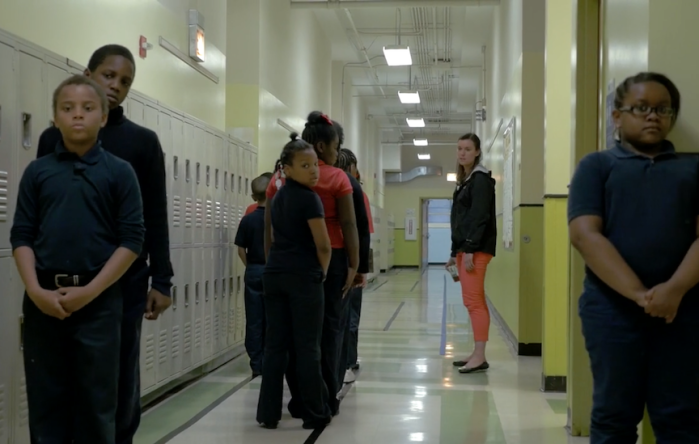
For instance, at a New Orleans charter school, students were punished for not standing straight, not sitting up straight, for putting their heads down, for closing their eyes for too long, for not tracking speakers correctly with their eyes! Between classes students had to walk single file between the wall and a line marked with orange tape. And they had strict dress codes.
Second, she is assuming standardized testing provide accurate assessments of knowledge and skills. This is far from an accepted premise. These tests have repeatedly been shown to be both economically and racially biased. Cohodes is assuming that since the students scoring better on the assessments are still poor and predominantly black, what they’re being tested on is fair.
However, I cannot imagine many parents would jump at the chance to have their children treated like prison inmates for the chance of higher test scores.
It is somewhat staggering that a grown adult could look exclusively at the data and come to such a conclusion without considering what it means for flesh-and-blood students.
This is what happens when you let economists set public policy.
It is essential that we include parents, teachers, psychologist and even students in the processes. Otherwise, we’ll continue to get heartless number crunching offered as sincere solutions to our problems.
Roughly 25,000 students are leaving with that number expected to swell to 54,000 in four years. And that’s after an 11-year recession already sent 78,000 students seeking refuge elsewhere.
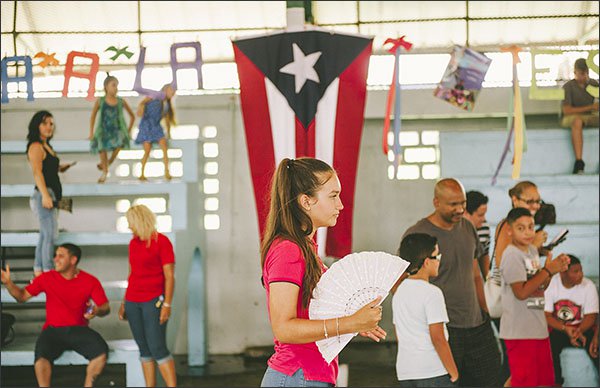
So what do you do to stop the flow of refugees fleeing the island? What do you do to fix your storm damaged schools? What do you do to ensure all your precious children are safe and have the opportunity to learn?
And it means fewer choices for children who will have to apply at schools all over the island and hope one accepts them. Unlike public schools, charter and voucher schools pick and choose whom to enroll.
The results have been an abysmal academic record, the loss of black teachers, black neighborhoods, cultural heritage and in its place support for a status quo that just doesn’t care to provide the proper resources to students of color.
If the Governor and his wealthy backers have their way, Puerto Rico will be yet another ghettoized colony gobbled up by industry.
However, the people aren’t going to let this happen without a fight.
Mercedes Martinez, President of the Federacion de Maestros of Puerto Rico, an island teacher’s union, released the following statement:
“Dear comrades in the diaspora, now more than ever we need your unconditional solidarity.
Governor Roselló just announced his plan to shut down 307 schools, implement charter schools and vouchers. Disaster capitalism at its best. Added to the announcement of the privatization of PREPA. [Puerto Rico Electric Power Authority]
The way to victory is already paved, organized and militant resistance, concrete proposals to improve the public goods that we have, unity and organization. Be our voice in the states and let the world know that corporate reformers want to make PR the next New Orleans as they did after Katrina.
The hurricane has been the perfect storm and excuse for them to advance their plans. Today the so called “educational reform” will be sent to the legislature.
We will give the hardest fight of our lives, and we will triumph. Send letters and videos of support with our struggle. Teachers United, will never be defeated!
Lucha sí”
I don’t know about you, but I stand with these brave teachers, parents and their students.
I may live in Pennsylvania, my skin may be white, but I do not support the theft of Puerto Rico’s schools.
They deserve the choice to guide their own destinies.
Teachers’ opposition to the move comes even though the Governor is proposing a $1,500 raise for all educators. Martinez says it could come to a general strike.
Their cause has hope on its side – especially in blocking the proposed school vouchers.
The Governor’s voucher proposal wouldn’t go into effect until the 2019-20 school year. However, the Puerto Rico Supreme Court struck down a similar program in 1994 when the current governor’s father, Pedro Rossello – himself a former governor – tried to push it through. The court ruled the island’s constitution forbids public money being used to fund privately run schools.
From this day forward, let us always remember what they did to New Orleans. Let us remember what they are trying to do to Puerto Rico.
Corporate school reform is not about making better schools. If it was, you would see plans like this being proposed in Beverly Hills and rich white neighborhoods across the country.
Even states that historically boasted the most growth are falling behind. Of charter powerhouses Texas, Florida, Ohio and California – only Texas has shown a significant upward trend.
So what happened?
How did the hippest new thing to hit education since the chalk board suddenly hit such a wall? After all, it wasn’t so long ago that every celebrity from Magic Johnson to Andre Agassi to Deion Sanders to Sean “Puffy” Combs to Pitt Bull had their own charter school. Even Oprah Winfrey, the queen of multimedia, donated millions to charter networks in Louisiana, California, Pennsylvania, Colorado, Texas and her home state of Illinois.
How could something with so much high profile support be running out of gas?
The charter school funded think tank (read: propaganda network) released a report boiling the issue down to three factors: real estate costs, a teacher shortage and political backlash.
Real estate costs? Yes, few public schools want to offer you public property to put your privately run school that will inevitably gobble up a good portion of its funding and turn a portion of that into profit for private investors.
Teacher shortage? Yes, when you pay your educators the least, don’t allow your employees to unionize, and demand high hours without remuneration, you tend to find it harder than most educational institutions to find people willing to work for you.
Political backlash? DING! DING! DING!
Of course, most people who aren’t paid by the charter school industry – as those working for CRPE are – would simply call this a charter school backlash – not political, at all.
This isn’t one political party seeking advantage over another. It’s concerned citizens from both sides of the aisle worried about the practices of the charter school industry.
The general public is starting to understand exactly what charter schools are and why they are a bad idea for children and society.
-They cherry pick which students to enroll and how long to keep them enrolled – they only let in the easiest to teach and give the boot to any that are struggling before standardized testing time.
-And they very often close unexpectedly and/or are the site of monetary scandals where unscrupulous charter school operators take the money and run.
Moreover, it’s no accident that much of the criticism of charter schools comes from people of color. About one quarter of all charter school students are black, whereas black students make up only 15 percent of enrollment at traditional public schools.
To put that in perspective, approximately 837,000 black students were enrolled at charter schools during the 2016-17 school year. Yet civil rights organizations are concerned that this over-representation is having negative consequences on students of color.
Seventy percent of black charter school students have few white classmates, according to a study by the Civil Rights Project at UCLA.
But some charters are even worse. More than 1,000 of the nation’s 6,747 charter schools had student bodies made up of at least 99% minority students, according to an Associated Press analysis from three years ago. And it’s getting worse!
Researchers found the situation is even more dire for minorities. Black students are four times more likely to be suspended than white students, and students with disabilities are twice as likely to be suspended as non-disabled students.
With all these problems dogging their heels, it’s no wonder that the charter school juggernaut is starting to lose momentum.
Instead of concentrating solely on why these schools are losing popularity, we should also ask what set them shooting off into the stratosphere in the first place.
After all, no one was really crying out for private schools run with public money.
No one, that is, except big business and greedy investors looking for a quick buck.
Since the Clinton administration, charter school investments get automatic tax credits that allow investors to double their money in as little as 7 years. Lobbying at the state and federal level by charter schools and their investors and contractors have enabled a monetary scam to enrich private industry at public expense.
Put simply, charters are not subject to the same instructional, operational, fiscal, accounting or conflict of interest rules as traditional public schools. Therefore, in most states it’s perfectly legal for a charter school operator to give his brother the instructional contract, his sister the maintenance contract and his uncle the textbook contract. He can replace the teachers with computer programs and apps, while his own privately held company rents and leases the school building at a hefty markup – all with public money.
What we’re seeing in terms of a backlash is just a more common realization of the motives behind charter schools echoed in the negative consequences these schools leave behind.
The neoliberal agenda is as fervently being pushed by the right wing as the left – more so.
This slowdown may signal that people have gone beyond politics.
We don’t care what the left and the right wish to sell us. We’re not willing to buy the charter school boloney anymore. If our policymakers want to continue getting our votes, they may need to give in to what the people actually want and stop trying to lead us over the cliff and feed us to the sharks.
–THE RIGHT OF ENROLLMENT, so school operators get to choose whether your child gets to attend, unlike public schools which have to accept your child no matter what – so long as you live in the district.
–QUALITY TEACHERS, because most charter and voucher schools aren’t required to hire educators with 4-year degrees, and since they don’t pay as well as public schools and often refuse to let their teachers unionize, they attract less experienced and distinguished educators.
You get elected school boards, open documents, open meetings, the right to self-government, the right of enrollment, quality services, quality teachers, diverse classmates, common sense discipline policies, an unbiased secular education, free time and money! That’s right! You actually get all that and more money in your pocket!
And since home-schooling operates with almost zero oversight, it is the most susceptible to child neglect and mistreatment.
Children who in traditional public schools would have a whole plethora of people from teachers to counselors to principals to cafeteria workers who can observe the danger signs of abuse are completely removed from the home-school environment.
Home-schooled children receive their educations almost exclusively from parents.
It is a situation that at least demands additional oversight. And at most it requires we rethink the entire enterprise as dangerous and wrongheaded.
Charter and voucher schools at least utilize whole staffs of people to educate children. The chances of something like this happening at these institutions is much smaller. However, both types of school also are much less accountable for their actions than traditional public schools.
And that is the common factor – responsibility. Who is being held answerable when things go wrong? At traditional public schools, there is a whole chain of adults who are culpable for children. At these other institutions, the number of people in the hot seat shrinks to zero.
Much of that has to do with the regulations each state puts on privatized schools.
In 14 states including Delaware, California and Wisconsin, parents don’t have to do anything but let the school district know they’re home-schooling. That’s it! And in 10 states including Texas, Illinois and New Jersey, you don’t even have to do that!
Kids just disappear without a trace. If no one reports them missing, we assume they’re being home-schooled.
But even in states that appear to be more exacting on paper, the reality is a virtual free-for-all.
Take my home state of Pennsylvania. To begin home-schooling, parents must notify the superintendent, have obtained a high school degree themselves, provide at least 180 days of instruction in certain subjects and maintain a portfolio of their child’s test results and academic records.
That sounds impressive. However, this doesn’t really amount to much in practice because these regulations have few teeth. Hardly anyone ever checks up to make sure these regulations are being met – and they’re only allowed to check up under certain circumstances and only in certain ways and at certain times!
Frankly, most of the time we don’t know what happens in charter and voucher schools, because few state governments insist on audits, unscheduled visits or reports.
Moreover, all privatized schools can withhold providing a proper education. Home-school parents can refuse to teach their children not just truths about science and history but the basics of reading, writing and math. Likewise, charter and voucher schools can cut student services and pocket the savings as profit. And no one is the wiser because the state has abrogated its responsibility to check up on students or even require they be taught much of anything at all.
Some, including myself, would argue that the regulations required of public schools by the state and federal government are sometimes too onerous, unnecessary or even just plain dumb. But that doesn’t change the fact that regulations are necessary. It just leaves open the question of which ones.
Looked at in the abstract, no one in their right mind would conceivably suggest the latter is a better educational environment than the former. However, we have been subjected to an expensive propaganda campaign to make us think otherwise.
Look. I’m not saying public schools are perfect. Certainly students can be abused there, too. The media salaciously reports every doe-eyed teacher who stupidly has a sexual relationship with a student – whether it be at a public or privatized school. But in comparison with the worst that can and often does happen at privatized schools, these incidents at public schools are extremely rare (1 in 800,000) and of much less severity.
Though both are bad, there is a world of difference between the infinitesimal chance of being propositioned by your high school teacher and the much more likely outcome of being treated like a prison inmate at 13 by the charter school corporation or being starved, shackled and beaten by your parents!
Human beings aren’t going to stop being human anytime soon. Wouldn’t it be better to entrust our children to an environment with regulations and accountability than letting them go off in some locked room and just trusting that everything will be alright?
Our posterity deserves better than privatization.
They deserve the best we can give them – and that means fully responsible, fully regulated, fully accountable public schools.
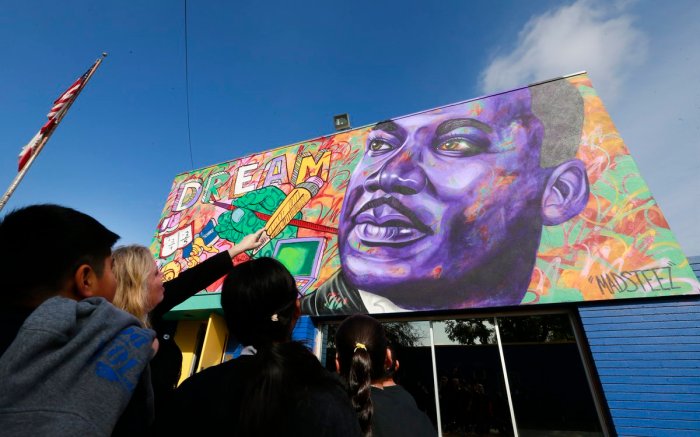
When we think of Dr. Martin Luther King, Jr., we usually think of the towering figure of the Civil Rights Movement who gave the “I have a dream” speech during the March on Washington in 1963.
However, as a teacher, I find myself turning to something he wrote in 1947 when he was just an 18-year-old student at Morehouse College.
While finishing his undergraduate studies in sociology, he published an essay in the student paper called “The Purpose of Education.”
Two sections immediately jump off the page. The first is this:
“We must remember that intelligence is not enough. Intelligence plus character–that is the goal of true education. The complete education gives one not only power of concentration, but worthy objectives upon which to concentrate. The broad education will, therefore, transmit to one not only the accumulated knowledge of the race but also the accumulated experience of social living.”
So for King it wasn’t enough for schools to teach facts. It wasn’t enough to teach skills, math, writing, reading, history and science. The schools are also responsible for teaching children character – how to be good people, how to get along with each other.
When King wrote, there were basically two kinds of school – public and private. Today there is a whole spectrum of public and private each with its own degree of self-governance, fiscal accountability and academic freedom.
So which schools today are best equipped to meet King’s ideal?
Private schools are by their very nature exclusionary. They attract and accept only certain students. These may be those with the highest academics, parental legacies, religious beliefs, or – most often – families that can afford the high tuition. As such, their student bodies are mostly white and affluent.
That is not King’s ideal. That is not the best environment to form character, the best environment in which to learn about people who are different than you and to develop mutual understanding.
Charter schools model themselves on private schools so they are likewise discriminatory. The businesses who run these institutions – often for a profit – don’t have to enroll whoever applies. Even though they are fully funded by public tax dollars, they can choose who to let in and who to turn away. Often this is done behind the cloak of a lottery, but with no transparency and no one checking to ensure it is done fairly, there is no reason to believe operators are doing anything but selecting the easiest (read: cheapest) students to educate.
Homeschooling is hard to generalize. There is such a wide variety of experiences that can be described under this moniker. However, they often include this feature – children are taught at home by their parent or parents. They may or may not interact with their academic peers and the degree to which they meet and understand different cultures is variable to say the least. They may meet King’s ideal, but frankly the majority of them probably do not.
So we’re left with traditional public schools. Do they instill “intelligence plus character”?
Answer: it depends.
There are many public schools where children of different races, nationalities, religions, and creeds meet, interact and learn together side-by-side.
Students wearing hajibs learn next to those wearing yarmulkes. Students with black skin and white skin partner with each other to complete class projects. Students with parents who emigrated to this country as refugees become friends with those whose parents can trace their ancestors back to the Revolutionary War.
We could integrate all public schools. We could never integrate our charter, voucher and private schools. That goes against their essential mission. They are schools made to discriminate. Public schools are meant to be all inclusive. Every one could meet King’s ideal, if we only cared enough to do it.
Which brings me to the second section of King’s early essay that pops off the page:
“The function of education, therefore, is to teach one to think intensively and to think critically. But education which stops with efficiency may prove the greatest menace to society. The most dangerous criminal may be the man gifted with reason, but with no morals.”
Seventy one years ago, King was warning us about the situation we suffer today.
When we allow academics to be distinct from character and understanding, we put ourselves at the mercy of leaders with “reason, but with no morals.”
Racism and privilege become the defining characteristics of a class without character, in King’s sense.
If we want to reclaim what it means to be an American, if we want to redefine ourselves as those who celebrate difference and defend civil rights, that begins with understanding the purpose of education.
It demands we defend public schools against privatization. And it demands that we transform our public schools into the integrated, equitable institutions we dreamed they could all be.
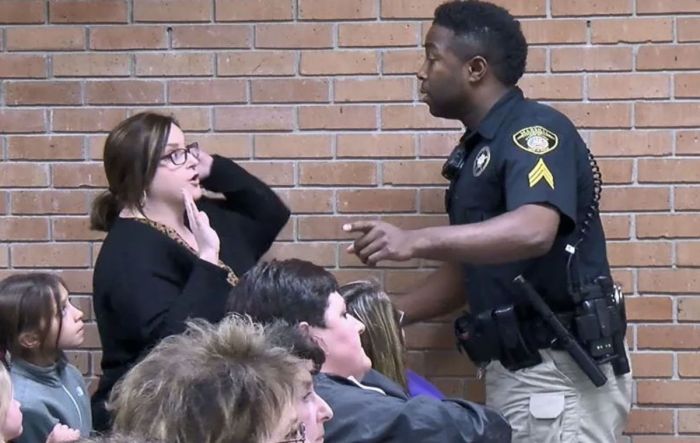
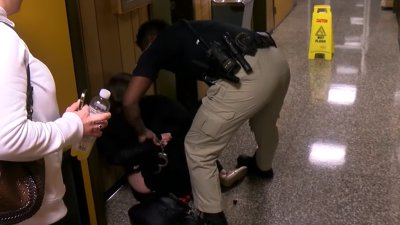
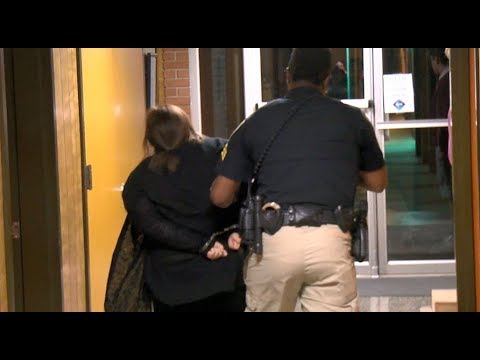
We’ve all seen the shocking video from Vermillion Parish in Louisiana this week where a teacher is tackled to the ground and arrested because she asked a question to the school board.
It’s a gross abuse of power that brings up many issues:
Public servants responding to the public with violence.
Elected representatives refusing to hear from their constituents and – in fact – taking action to silence them.
Leaders who are supposed to oversee children’s educations unconcerned with the lesson local kids will be taking home from the actions of adults who are supposed to set a better example.
The eight-member board had been deadlocked 4-4 on whether or not to give Superintendent Jerome Puyau a raise. Then one of the members died. Instead of his wife filling in until a new election could be held, board president Anthony Fontana , who was in favor of the raise, appointed a like-minded replacement and tried to force a vote.
So Deyshia Hargrave, a district teacher and parent, asked why the superintendent should get a raise while the teachers haven’t had one in several years.
It was a reasonable question, asked at the proper time, in a respectful tone, when comments were directed specifically at her.
However, Reggie Hilts, the Abbeville city marshal who also serves as a school resource officer, told her she was being disruptive and asked her to leave – which she did. When she got out in the hall, he forced her to the ground, put her in handcuffs and pushed her out of the building.
It was completely unjustified, a horrific violation of Hargrave’s rights and goes counter to the very purpose of public school.
It is the idea that district wide decisions about our children’s learning should be made by duly-elected members of the community in the full light of day. Except where doing so would violate an individual’s personal rights, all school documents are public. They are voted on in public. And they are subject to question and comment by the public.
If the taxpayers – the people who foot the bill for the majority of the district costs – don’t approve of what their representatives are doing, they can take steps to replace them.
Vermillion Parish School Board would do well to remember this.
The actions taken by City Marshall Hilts were either done at the behest of the board or certainly without any public dissent among the members.
They stomped on Hargrave’s First Amendment rights and ignored their responsibility to the community they serve.
If my description of how a public school is supposed to work sounds like a lecture, that’s intentional. These representatives could do with a lesson in how democracy works.
Our actions have consequences and those consequences only become more consequential when we become public servants. The board, the superintendent and certainly Hilts may very well have opened themselves up to legal action.
But beyond putting themselves in danger from having to pay punitive damages to Hargrave – that I hope they pay out of the superintendent’s bloated salary – they have betrayed a dangerous attitude toward the very concept of self-rule.
Whether they meant to or not, they have given the children of Vermillion Parish a lesson in government and community values.
Make no mistake. The children are watching. They get the TV news and status updates on Facebook and Twitter. They have access to YouTube. Doubtless, they have seen this video countless times. They have probably played it over and over again.
They saw their teacher brutally manhandled by a supposed law enforcement officer. And they heard the deafening silence from the school board about it.
They know now that this kind of behavior is deemed acceptable in Vermillion Parish. Beware the kind of behavior adults can expect from children who are given such a disgraceful example!
Moreover, these children are well aware of the matter in dispute.
The board is fighting to give the superintendent a $38,000 raise. Yet they refuse to give another penny to teachers – all while class sizes have jumped from 21 to 29 students, according to Hargrave.
That is not what leaders do who care about the well-being of students. It is a result of backroom deals and the good ol’ boys network.
The lesson is that hard work doesn’t matter. The only thing you should worry about is making a deal no matter whom it hurts. Just look out for numero uno.
After all, the board could give the teachers something – some token of appreciation to show that they value their continued commitment to the children of the community. But they don’t. Yet they fight tooth and nail to do so for one individual who has in no way proven himself indispensable.
Critics complain that teachers don’t deserve a raise because they already earn more money than the majority of the people who live in the community. (An argument which – by the way – would also apply to the superintendent.)
But even beyond basic logic, it’s a bogus line of reasoning!
Doctors attend patients in poor communities. They still earn high salaries – maybe not as high as they would serving the wealthy, but they have to be able to survive, to pay back the loans they took out to go through medical school, etc. So do lawyers, accountants and specialists of all kinds. That’s just capitalism. If you want someone to provide a good or service, you have to pay them a competitive wage. Otherwise, they’ll move on to greener pastures.
The kids see you pinching pennies. They know what that means – you don’t think they’re worth the investment.
The lessons of Vermillion Parish go far beyond Louisiana.
When Hilt wrestled a woman half his size to the ground and placed her under arrest for the crime of exercising her rights, he put the entire community in jail.
When the board directed him to act – or at very least neglected to stop him – they made themselves culpable in the crime.
In this article, I’m going to try to explain in the most simple terms I know the reality of segregation in our schools, how it got there and the various forms it takes.
I do this not because I am against public education. On the contrary, I am a public school teacher and consider myself a champion of what our system strives to be but has never yet realized. I do this because until we recognize what we are doing and what many in power are working hard to ensure we will continue doing and in fact exacerbate doing, we will never be able to rid ourselves of a racist, classist disease we are inflicting on ourselves and on our posterity.
America, the Segregated
It’s never been one monolithic program. It’s always been several co-existing parallel social structures functioning together in tandem that create the society in which we live.
I’m reminded of possibly the best description of American segregation on record, the words of the late great African American author James Baldwin who said the following on the Dick Cavett Show in 1968:
“I don’t know what most white people in this country feel. But I can only conclude what they feel from the state of their institutions. I don’t know if white Christians hate Negroes or not, but I know we have a Christian church that is white and a Christian church that is black. I know, as Malcolm X once put it, the most segregated hour in American life is high noon on Sunday.
That says a great deal for me about a Christian nation. It means I can’t afford to trust most white Christians, and I certainly cannot trust the Christian church.
“I don’t know whether the labor unions and their bosses really hate me — that doesn’t matter — but I know I’m not in their union. I don’t know whether the real estate lobby has anything against black people, but I know the real estate lobby is keeping me in the ghetto. I don’t know if the board of education hates black people, but I know the textbooks they give my children to read and the schools we have to go to.
“Now this is the evidence. You want me to make an act of faith, risking myself, my wife, my woman, my sister, my children on some idealism which you assure me exists in America, which I have never seen.”
As Baldwin states, there are many different ways to keep black people segregated. There are many different flavors of the same dish, many different strains of the same disease.
We can say we’re against it, but what we say doesn’t matter unless it is tied to action.
You can say you’re in favor of equity between black and white people all day long, but if the policies you support don’t accomplish these things, you might as well wear a white hood and burn a cross on a black person’s lawn. It would at least be more honest.
Segregated Schools
In terms of public education, which is the area I know most about and am most concerned with here, our schools are indeed set up to be segregated.
If there is one unstated axiom of our American Public School System it is this: the worst thing in the world would be black and white children learning together side-by-side.
They point to inequalities they, themselves, helped create and use them to push for a system that would create even worse inequality. They point to the segregation that they, themselves, helped install and use it as an excuse to push even more segregation.
And they do so by controlling the media and the narrative. They call themselves reformers when they’re really vandals and obstructionists looking to subvert the best in our system in order to maximize the worst.
School Segregation Today
Sure we don’t have very many all white or all black schools like we did before Brown v. Board. Instead we have schools that are just predominantly one race or another.
ALL kids are not divided by race. Just MOST of them.
White people and black people tend to live in different neighborhoods. Some of this is a choice. After a history of white oppression and racial strife, people on both sides of the divide would rather live among those with whom they identify.
Black people don’t want to deal with the possibility of further deprivations. White people fear retaliation.
However, white people generally enjoy a higher socio-economic status than black people, so there is some push back from black folks who can afford to live in whiter neighborhoods and thus enjoy the benefits of integration – bigger homes, less crowding, less crime, access to more green spaces, etc. But even when there is a desire, moving to a white neighborhood can be almost impossible.
State and federal laws, local ordinances, banking policies and persistent prejudice stand in the way.
In short, red lining still exists.
Real estate agents and landlords still divide up communities based on whom they’re willing to sell or rent to.
And this is just how white people want it.
They’re socialized to fear and despise blackness and to cherish a certain level of white privilege for themselves and their families.
And if we live apart, it follows that we learn apart.
The system is set up to make this easy. Yet it is not uncomplicated. There is more than one way to sort and separate children along racial and class lines in a school system.
There are several ways to accomplish school segregation. It comes in multiple varieties, a diversity of flavors, all of which achieve the same ends, just in different ways.
By my reckoning, there are at least three distinct paths to effectively segregate students. We shall look at each in turn:
Put the white neighborhoods in District A and the black ones in District B. It’s kind of like gerrymandering, but instead of hording political power for partisan lawmakers, you’re putting your finger on the scale to enable academic inequality.
However, sometimes you can’t do that. Sometimes you don’t have the power to determine the makeup for entire districts. Instead, you can do almost the same thing for schools within a single district.
That means the whiter districts get higher paid and more experienced teachers. It means they have broader curriculum, more extracurricular activities, a more robust library, more well-trained nursing staff, more advanced placement courses, etc.
Fewer funds mean fewer resources, fewer opportunities, more challenges to achieve at the same level that white students take for granted. A budget is often the strongest support for white supremacy in a given community or society as a whole. In fact, if you want to know how racist your community is, read its school budget. You want accountability? Start there.
The same holds even when segregation is instituted not at the district level but at the level of the school building.
It may sound ridiculous but this is exactly what happens much of the time. You have gorgeous new buildings with first class facilities in the suburban areas and run down crumbling facilities in the urban ones – even if the two are only separated geographically by a few miles.
Like any parasite, charter and voucher schools only survive in the proper environment. It usually looks like this.
Sometimes no matter how you draw the district lines or how you appropriate the buildings, you end up with a black majority and a white minority. That’s a situation white parents find simply intolerable.
White children must be kept separate and given all the best opportunities even if that means taking away the same for black children.
Once again, this creates the opportunity for a resource gap. The charter and voucher schools suck away needed funds from the public schools and then are subsidized even further by white parents.
The quality of education provided at these institutions is sometimes better – it’s often worse. But that’s beside the point. It’s not about quality. It’s about kind. It’s about keeping the white kids separate and privileged. It’s about saving them from the taint of black culture and too close of an association with black people.
Second, the situation can work in reverse. Instead of dividing the whites from the blacks, it divides the blacks from the whites.
This happens most often in districts where the divide is closer to equal – let’s say 60% one race and 40% another. Charter and voucher schools often end up gobbling up the minority students and leaving the white ones in the public school. So instead of white privatized and black public schools, you get the opposite.
And make no mistake – this is a precarious position for minority students to be in. Well meaning black parents looking to escape an underfunded public school system jump to an even more underfunded privatized system that is just waiting to prey on their children.
Unlike public schools, charter and voucher institutions are allowed to pocket some of their funding as profit. That means they can reduce services and spending on children anytime they like and to any degree. Moreover, as businesses, their motives are not student centered but economically driven. They cherry pick only the best and brightest students because they cost less to educate. They often enact zero tolerance discipline policies and run themselves more like prisons than schools. And at any time unscrupulous administrators who are under much less scrutiny than those at public schools can more easily steal student funding, close the school and run, leaving children with no where to turn but the public school they fled from in the first place and weakened by letting privatized schools gobble up the money.
The result is a public school system unnaturally bleached of color and a privatized system where minority parents are tricked into putting their children at the mercy of big business.
3) Tracking
But that’s not all. There is still another way to racially segregate children. Instead of putting them in different districts or different schools, you can just ensure they’ll be in different classes in the same school.
However, it most often results in further stratifying students socially, economically and racially.
Here’s how it works.
Often times when you have a large enough black minority in your school or district, the white majority does things to further horde resources even within an individual school building or academic department.
In such cases, the majority of the white population is miraculously given a “gifted” designation and enrolled in the advanced placement classes while the black children are left in the academic or remedial track.
It enables bleaching the advanced courses and melanin-izing the others. This means administration can justify giving more resources to white students than blacks – more field trips, more speakers, more STEAM programs, more extracurriculars, etc.
And if a white parent complains to the principal that her child has not been included in the gifted program, if her child has even a modicum of ability in the given subject, more often than not that white child is advanced forward to the preferential class.
CONCLUSIONS
Segregation is a deep problem in our public school system. But it cannot be solved by privatization.
In fact, privatization exacerbates it.
Nor is public education, itself, a panacea. Like any democratic practice, it requires participation and the economic and social mobility to be able to participate as equals.
Schools are the product of the societies that create them. An inequitable society will create inequitable schools.
Segregation has haunted us since before the foundation of our nation.
They don’t want their children to be educated among black students – maybe SOME black students, maybe the best of the best black students, but certainly not the average run of the mill brown-skinned child.
This has to stop.
There are plenty of benefits even for white students in an integrated education. It provides them a more accurate world-view and helps them become empathetic and prize difference.
It was a year that frankly I wasn’t sure I’d survive.
But I did. We did. Together.
I think if there’s any lesson from the last 365 days, it’s that: We can endure anything if we stay united.
We’ve taken down titans of industry simply by acts of belief. When women came forward with credible tales of abuse, for the first time we – as a society – actually believed them.
We’ve taken down the most morally repugnant child abusers with designs on national office simply by supporting the black vote. And no matter how much power tried to disenfranchise our brothers and sisters of color, we stood by them and made sure their voices were heard.
These are the kinds of things we need more of in the New Year.
If you take all the “minorities” in this country – minorities of gender, race, sexuality, creed, religion, etc. – if you add us all together, we actually are the majority!
When you add white people of conscience with black people, Latinos and Hispanics, LGBTs, women, Muslims, and every other historically disenfranchised group, we have the upper hand. And when you compare economic disparities of the 99% vs the 1% or poor vs rich, it’s not even close!
And I’m not talking about some time in the future. I’m talking about right now!
All we need to do is stand together and fight for each other.
So as 2018 is about to dawn, I am filled with hope for the future. A truly amazing year may be about to dawn. It’s all up to us.
In the meantime, I take my last look over my shoulder at the year that was.
As an education blogger, I write an awful lot of articles, 119 articles so far this year. In fact, this piece – which will probably be my last of the year – brings me to 120!
I’ve already published a countdown of my most popular articles. If you missed it, you can still read it here.
However, as is my custom, I like to do one final sweep of my annual output counting down honorable mentions. These are the top five articles that maybe didn’t get as many readers, but that I think deserve a second look.
I hope you enjoy my top 5 hidden gems before I place them in the Gadfly vault and begin the hard work of making 2018 a better tomorrow:
Description: Standardized testing is often championed by people who claim to be free market capitalists. Yet it struck me that there was nothing free about the market being perpetrated on public schools when it comes to high stakes tests. Schools don’t give these tests because anyone in these districts actually thinks they help students learn. We do it because we’re forced by federal and state governments. It’s a racket, and in this article I explain exactly how and why.
“When I read this post by Steven Singer, I was so excited that I thought about devoting an entire day to it. Like posting it and posting nothing else for the entire day. Or posting this piece over and over all day to make sure you read it. It is that important.
Steven’s post explains two different phenomena. First, why is standardized testing so ubiquitous? What does it have a death grip on public education?
Second, in the late 1990s, when I was often in D.C., I noticed that the big testing companies had ever-present lobbyists to represent their interests. Why? Wasn’t the adoption of tests a state and local matter? NCLB changed all that, Race to the Top made testing even more consequential, and the new ESSA keeps up the mandate to test every child every year from grades 3-8. No other country does this? Why do we?”
Description: According to landmark research by Dan Goldhaber and James Coleman, only about 9 percent of student achievement is attributable to teachers. The entire school experience only accounts for 20%. By far, the largest variable is out of school factors, which accounts for 60% of a student’s success. Yet we insist on holding teachers accountable for nearly 100% of it. We demand our teachers be superhuman, give them next to zero support, and then get indignant when they can’t do it all alone. Sorry, folks, I’m just a human being.
Fun Fact: Our expectations for teachers are ridiculous. We want them to do everything and then we blame them for acting like saviors. I think it’s vital that people acknowledge this impossible situation we put educators in and start to take more social responsibility. Your schools won’t get better until you do something about it. Stop complaining and get to work. That means voting for lawmakers who support public education. That means attending school board meetings. That means holding the decision makers responsible. Not just taking advantage of an easy scapegoat.
Description: What does a teacher think about when he or she is forced to give a standardized test? This article is my attempt to capture the no-win situation that our society forces on teachers every year. Apparently we must choose between doing things that we know are harmful to our students or taking a stand and possibly losing our jobs. You become a teacher to help children and then find that harming them is in the job description. Is this really what society wants of us?
Fun Fact: This article resonated deeply with some readers. In fact, a theater group in Ithaca, NY, Civic Ensemble, was so inspired by it that they used my article as the basis for a scene in a play made up of teacher’s real life stories about the profession. The play was called “The Class Divide.” You can watch a video of a practice performance of my scene here.
Description: A lot has been written about why charter and voucher schools are bad for parents, students and society. Less has been written about the ways that public schools do better than privatized education. This was my attempt to illuminate the ways public schools are better. They attract better teachers, have a more robust sense of community, have more educational options, have greater diversity, are more fiscally responsible – and that’s just the first five!
Fun Fact: When you list all the ways public schools are better than privatized ones, it becomes hard to imagine why they’re struggling. Public schools are clearly the best choice. The fact that they are being sabotaged by the privatization industry and their creatures in government is inescapable.
Description: When you ask racists why they oppose racial equity, the number one reason they give is the feeling that equity is a zero sum game. If black people are put on an equal footing with white people, then white people will ultimately lose out. This is patently untrue. White people will lose supremacy over other races, but they need not become subservient or lose their own rights. We can champion fairness for all without doing ourselves harm.
Fun Fact: This article kind of died on the vine, but I’m still proud of it. I think it is one of my best this year expressing my own thoughts and feelings about antiracism. I just wish more people had read it, because it sounds like this is an idea that more white people need to hear. We can only build a better world hand-in-hand.
This wasn’t the first year I’ve done a countdown of the year’s greatest hits. I usually write one counting down my most popular articles (like the one you just read from 2017) and one listing articles that I thought deserved a second look. Here are all my end of the year articles since I began this crazy journey in 2014:
I took that opinion and wrote about it. I backed it up with facts, analogies, literary references and examples from my own experience as a classroom teacher in public school.
I had hoped that that first time was just a fluke or that by now I had since sufficiently proven myself to be a human being and not some nefarious bot.
But no such luck.
After posting my latest article a few times on Monday, I got this message:
“ACTION BLOCKED
You have been temporarily blocked from performing this action.”
And I got a choice of clicking on:
“This is a mistake”
Or
“OK”
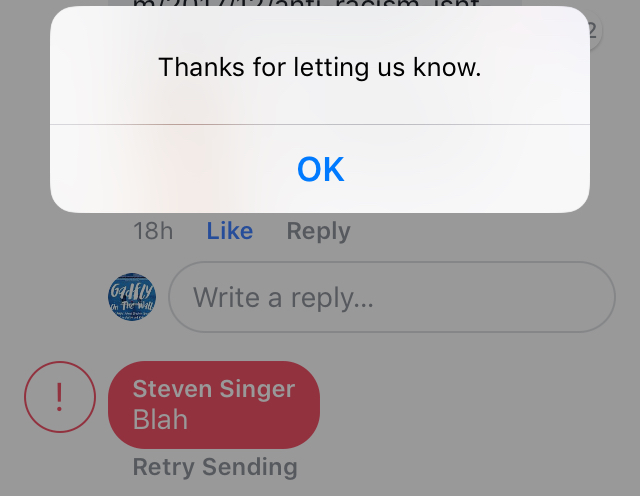
So I clicked on “This is a mistake,” and got the following:
“Thanks for letting us know.”
My only choice was to click “OK.”
At some point I got a message telling me that I was blocked until Dec. 11 – a full week from my offense.
And now I have limited use of the social media platform.
I can still see posts.
I can like posts.
For some reason, I can even post and comment on my own page. But I can’t comment or post on other pages without getting the same error message.
At least I can’t do it consistently.
I’ve experimented and found that sometimes I can share posts to different pages. Sometimes I can’t.
It’s a bizarre, wonky system.
And it gets in the way of my work as an education blogger.
Brown, a school privatization lobbyist and former NBC and CNN personality, heads Facebook’s News Partnership Team.
The newly created position was part of Zuckerberg’s attempt to limit fake news on his social media platform while prioritizing information in the mainstream media.
What exactly is fake news? Whatever Campbell Brown says it is.
This is quite a lot of power to give one person, especially someone who has a reputation for partisanship.
Let’s just say we’ve gotten into a few Twitter skirmishes.
When she became the face of a New York lawsuit attacking teacher tenure in 2014, she received a tidal wave of public backlash. So she went on the Colbert Report to complain about how those fighting for workplace protections for themselves and their students were “silencing the debate” on how best to reform public education.
She responded by cherry picking her rudest critics and tweeting “Sorry Steve but sadly this is not what I characterize as debate,” as if I had had anything to do with these comments.
As if any movement should be judged by its most extreme elements.
As if attacking someone’s job, someone’s kids and their future was fine so long as you did so with a smile and a polite comeback.
I don’t condone personal attacks, but I certainly understand them. In any case, Brown used the extreme fringes of her critics to condemn us all and conveniently refused to engage us – even those who had been unceasingly polite.
That lawsuit eventually failed, but Brown somehow landed on her feet.
Now she’s the one who gets to choose truth and falsity on Facebook.
Could she be actively working against people like me?
Yes.
Could she be directing Facebook’s programmers to select against posts that are negative to her pet projects?
Yes.
But there’s no way to know if she’s actually doing it.
Which brings me to my second theory.
Perhaps mindless Facebook algorithms are targeting me because of how I post.
I do, after all, try to post my articles on as many pages as I can.
They’re mostly pages focused on education and education policy with a few political and anti-racism sites thrown in, too.
Maybe I’m posting too quickly.
I might be triggering one of Zuckerberg’s bots to think I’m a bot, too, spamming up the works with advertising.
However, there’s a few problems with this theory.
Let’s say it’s true.
Why would that, alone, be reason to block me?
I’m not posting advertisements. I’m not asking for money. My blog doesn’t sell adds other than those WordPress puts on there, itself, so I can keep the page for free.
If an algorithm is stopping me because it thinks I’m unfairly selling something, it’s the result of some badly written code, indeed.
When programmers write code, that’s not impartial. It betrays their values. It betrays certain decisions about what’s acceptable and what isn’t.
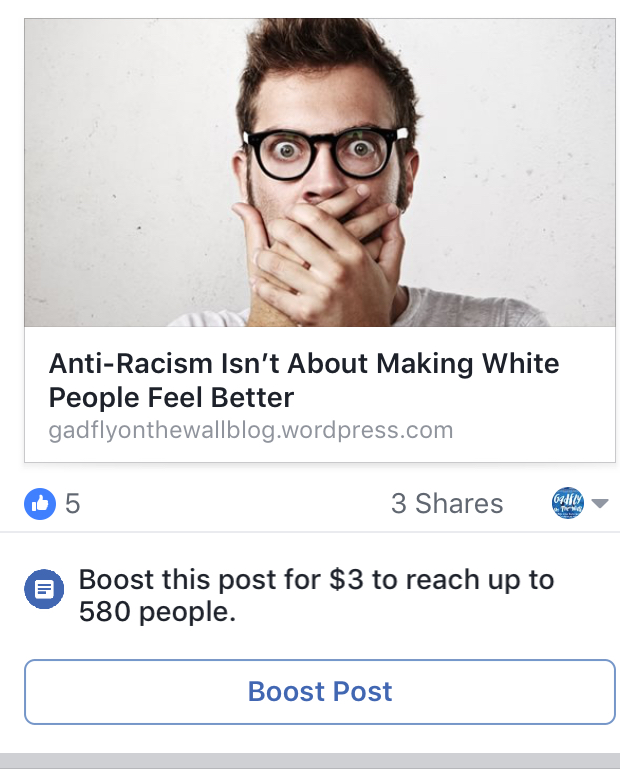
For instance, I keep getting advertisements from Facebook asking me to pay money to the social media network so that they’ll post my articles on other people’s site for me.
I get reminders like “Boost this post for $3 to reach up to 580 people.”
Oh, really?
So I’m blocked because I posted my own writing to sites that have accepted me as a member and whose membership includes many I consider friends and colleagues. But for a fee, Facebook will post that same article to various sites filled with people I’d consider to be complete strangers.
Somehow that doesn’t “violate community standards” – the reason they said they blocked me in October.
This is very telling.
It seems to indicate that there is nothing wrong with what I’m doing, per se. It’s just that Facebook wants to encourage me to let them do it for me – so they can monetize my account.
They’re stopping me from doing this on my own, because they think I’m a sucker who should pay them for the right to communicate with others.
And that’s a very real possibility.
These blockages may not be political. They may be a simple marketing strategy.
So what can I do about it?
Well, first I need to wait a week until my account is unfrozen and I get back all the features Facebook users usually enjoy.
Then I can try to go back to the way things were posting my articles at all my favorite virtual watering holes.
Only slowly.
Much more slowly.
I figure if I only post once every five minutes or so, I can have my article at all the places that seem to like having them in about the course of an evening.
But I have a life, damn it!
I can’t spend the twilight hours posting and waiting and posting and waiting.
I guess another alternative is to rely on friends to post for me.
Spread the love.
Have others circulate my articles far and wide.
And that’s a great strategy. It’s very hard for Facebook to do anything about it.
But it requires me to impose on others. I don’t like doing it.
My readers, friends and supporters have lives, too.
They have more important things to do than post my writing all over the Internet.
So where does that leave me?
I’m not sure.
If I continue as I have, I’m bound to be blocked and thrown in Facebook Jail again.
Even if I don’t, I’m at the mercy of the wealthy elites who control the network.


















 gadflyonthewallblog