The majority of teachers and principals in Pennsylvania hate standardized tests.
An increasing number of parents are refusing to allow their kids to take the tests.
And there may be better alternatives to the state’s Keystone Exams.
These were just some of the key findings of a blockbuster report from June 2019 by the state General Assembly’s Legislative Budget and Finance Committee.
However, now that things are returning to some semblance of normalcy, it seems that bureaucrats from the state Department of Education (PDE) are taking the wrong lessons from the report while the legislature seems to have forgotten it entirely.
The report was conducted because of legislation written by state Sen. Ryan P. Aument (R-Lancaster County). It directed the Legislative Budget and Finance Committee to “study the effectiveness of standardized testing, including the Keystone Exams and SATs, and their use as indicators of student academic achievement, school building performance, and educator effectiveness.”
The key findings are as follows:
1)The majority of principals and teachers disapprove of the state’s standardized tests – both the Pennsylvania System of School Assessment (PSSA) tests given in grades 3-8 and Keystone Exams given in high school. They think these tests are ineffective, expensive and harmful to district curriculum and students.
2) State law allows parents to opt their children out of testing for one reason only – religious grounds. Parents are using this religious exemption in increasing numbers. This puts districts in danger of violating federal participation and accountability standards.
3) It has been suggested that the state allow two additional reasons for parents to opt their children out of testing – philosophical grounds and health concerns. It is unclear whether doing so would increase overall opt outs or not.
4) The federal Every Student Succeeds Act (ESSA) passed in 2015 allows the use of the SAT and/or ACT test to take the place of high school standardized testing. It has been suggested the Commonwealth replace the Keystone Exams with these tests. The report finds the ACT and/or SAT would successfully determine college readiness and reduce the overall amount of standardized testing. However, this would not allow other uses of current state tests like evaluating teacher effectiveness and school building performance.This may not matter though because the report also casts doubt on whether the current tests (PSSA and Keystone Exams) do an adequate job of assessing teacher or building performance now or even if student tests can be accurately used to evaluate teachers and schools.
There’s a lot of information here. Let’s look at each finding in turn.
1) PA Educators Hate Standardized Tests
When it comes to the PSSAs, 67% of principals and 76% of teachers said the tests were ineffective indicators of student achievement.
There was slightly more support for the Keystone Exams. This time 45% of principals said the test was an ineffective indicator of student achievement (with 27% saying the tests were effective). Meanwhile, 60% of teachers said the test was ineffective.
Both principals and teachers said their curriculum had been narrowed to prepare students for PSSAs and Keystone Exams. Instead of going into more depth on regular classwork or learning new skills, the focus shifts to teaching to the tests.
Most principals (approximately 80-90%) said that students are taught test-taking skills, and their schools administered practice tests, bench-mark tests, and/or diagnostic tests to prepare students for the PSSA exams. This held for teachers, too, with 81-88% saying they teach test-taking skills and administer practice tests. Principals also said the costs of this additional test prep varied from $200 to more than $100,000.
Taking the tests also eats up valuable class time. Administering the assessments takes between 5.7 to 8 days for each kind of test – the PSSA and the Keystone Exams, according to Principals.
In addition, the report details the cost of giving these tests. In fiscal year 2017-2018, PDE paid $42.17 million for these tests. This is part of a national trend:
“Standardized tests and test preparation have subsequently become big business and that multibillion dollar business continued to grow since the enactment of NCLB and the subsequent enactment of ESSA. According to the Pew Center on the States, annual state spending on standardized tests increased from $423 million before the NCLB (enacted in 2002) to upwards of $1.1 billion in 2008 (to put this in perspective this reflects a 160 percent increase compared to a 19.22 percent increase in inflation during the same time period). A more recent study by the Brown Center on Education Policy at Brooking put the cost at upwards of $1.7 billion in 2011 related to state spending on standardized tests.”
2) Opt Outs on the Rise
Many states allow parents to opt their children out of standardized testing. Some do so in cases of a physical disability, medical reasons, or emergencies. A few allow opt-outs based on religious objection – like Pennsylvania. Some states allow opt-outs for any reason whatsoever.
The religious exemption is not used widespread throughout the state and most schools meet the 95% participation rate required by the federal government. However, use of the religious exemption is definitely on the rise – enough so that the authors of the report find it alarming:
“Meanwhile, as previously indicated in this section, schools throughout the country are experiencing and grappling with an increase in the number of parents seeking to have their children opt-out of standardized testing now that new state assessments have been implemented pursuant to the federal requirements. Pennsylvania is no exception to this trend and is also experiencing an increase in the number of parents utilizing the religious opt-out.”
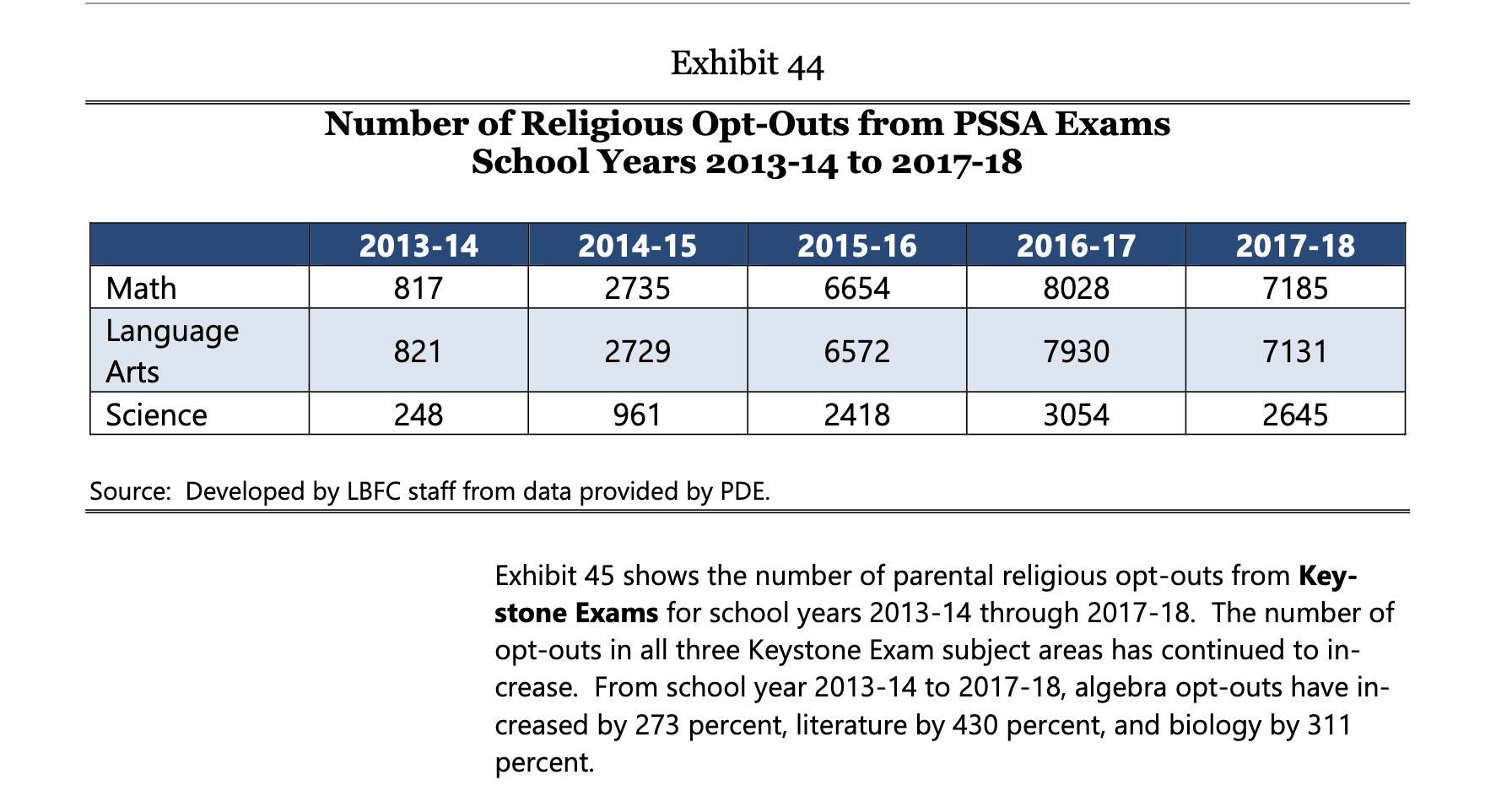
For the PSSA tests, opt outs increased from 2013-14 to 2016-17. However, total numbers in school year 2017-18 decreased sightly.
Opt outs went from 1,886 to 6,425 to 15,644 to 19,012 to 16,961.
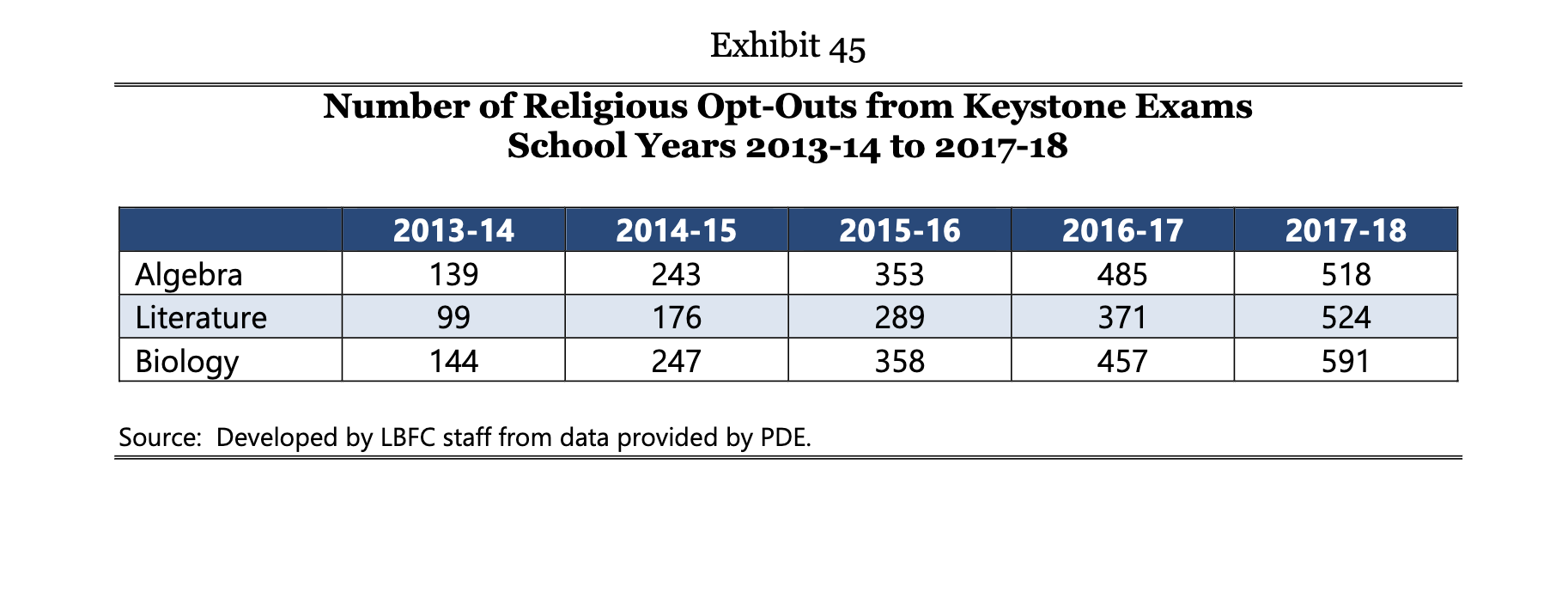
During the same time period for the Keystone Exams, opt outs steadily increased each year but were at lower overall rates.
For the high school test, opt outs went from 382 to 666 to 1,000 to 1,313 to 1,633.
These are vitally important figures because opt out data is rarely tabulated and released to the public. Many media accounts actually state the opposite of the data in this report – in particular that opting out has decreased since Congress passed the ESSA in 2015. Apparently the media got this one wrong.
Though the religious opt-out is the only reason specifically allowed in state Chapter 4 regulations, PDE reports there are five additional ways that students end up not taking the tests:
1) Other Parental Request – parents simply refusing to let their kids participate but not objecting based on specifically religious reasons.
2) No Attempt and No Exclusion Marked – students who are given the test but do not answer enough questions to receive a score.
3) No Test – no test record on file for unknown reasons.
4) Extended Absence – a student missed the testing and make-up window due to absences.
5) Other – does not fit any of the other categories.
Federal law – in particular No Child Left Behind (NCLB) and subsequent reauthorizations of that legislation – requires states to use student participation in standardized testing as a factor in a state’s accountability system. According to the report, any district with less than 95% of students taking the test should be “addressed.”
The report does not go into any further detail about what this means, other than to say that falling under 95% can:
“…ultimately result in a reduced achievement/proficiency measure… If the student participation rate falls below 95 percent, states are required to calculate student achievement/proficiency by dividing the number of students scoring proficiently by no less than 95 percent of the total students (which effectively assigns a score of “0” to all nonparticipants once the participation rate has fallen below 95 percent).”
In effect, the district gets a bad mark on a piece of paper. So what?
Under NCLB, schools with poor performance could receive sanctions like state takeover or lower funding. However, this is extremely unlikely – especially since the passing of ESSA. This newest reauthorization of the law gives states leeway in designing their accountability systems. It leaves the enforcement of this 95% participation rate up to the states, requiring them to develop an accountability plan in the event that a school or district fails to meet this standard.
So a school would only be punished if the state decided to do so. If a state legislature decided to allow parents to opt their children out for any reason at all, they would not have to take any punitive measures. Since the ESSA, the buck stops at the state house door on this one. California, for example, takes note of low participation rates but these rates are not factored into a school’s rating. On the other hand, Florida mandates direct intervention from the state’s Department of Education until participation rates are met.
3) Impact of New Reasons to Opt Out
This is where things get a bit sticky.
The report mentions the idea of expanding the options for opting-out of statewide assessments (e.g., PSSA and Keystone Exams) to include objections based on philosophical grounds or due to health issues.
On the one hand, the authors write “The impact of adding opt-out categories may be minimal.” They don’t know if more people would use the expanded options or if the same numbers who use the religious exemption today might simply divide themselves up among all three options.
The authors worry, however, that new pathways to opt out may increase the total number of people refusing the tests for their children and would reduce Pennsylvania’s participation rate in standardized testing.
This is a particularly troubling paragraph:
“The existence of opt-outs (religious or otherwise) has the potential to negatively impact a state’s participation rates and may potentially impact a state’s [Local Education Agency (LEAs)] and schools achievement/proficiency rate and ultimately the ability of a state to be in compliance with federally required assessments and accountability measures. Furthermore, providing opt-outs and giving parents notice of such has the potential to conflict with the message about the importance of standardized testing. Ultimately placing the state departments of education and local school districts in the potentially awkward position of having to explain why it is important for students to participate in testing (given the federal requirements), while also giving and notifying parents of the opt-out options for their children. In 2015, US Department of Education sent out letters to a dozen states flagging their low participation rates (statewide, or at the district or subgroup level) on the 2014-15 school year assessments and indicated that they needed to create a plan to reduce opt-outs due to low participation rates.”
This seems to be the order of the day at PDE. It’s why earlier this year, school administrators were advised by state officials to crack down on parents opting their children out of standardized tests.
And all of it is based on a cowardly and incomplete understanding of federal law. If Commonwealth schools fall below 95% participation in the test and get a bad mark on a worthless metric, it doest have to matter. No matter how many letters the federal government sends to the state legislature or PDE, the law is clear. The state is in charge here. Our legislature can choose to side with taxpayers, residents, and citizens or with civil servants and strongly worded letters.
4) Replacing the Keystone Exams
There’s not much more to add to this than the initial finding.
The authors of the report say there would be no problem with replacing the Keystone Exams with the ACT or SAT because these national tests would properly assess students’ college and career readiness.
The report is actually pretty shoddy in this regard not really examining the claims of the College Board which makes both tests. The authors just pretty much accepted the College Board’s word wholesale. Nor was their any evaluation of what teachers and principals thought about these tests like there had been for the PSSA and Keystone Exams.
However, the report does make a good point about test reduction. Many students already take the SAT or ACT test, so eliminating the Keystones would reduce the over all amount of tests they had to take.
Also the authors deserve credit for writing about how using student test scores to evaluate teachers and schools is seriously bad practice.
According to the report, 77 percent of principals and 93 percent of teachers said PSSA tests were not effective indicators for teacher evaluations, with similar figures for the Keystone Exams and building performance evaluations.
While everything in the report may not be 100% accurate, it includes important information that should be wider known.
In addition, the report has trustworthy data about opt outs throughout the Commonwealth. Unlike what has been reported in the media, opting out is not on the decline, it is on the rise.
The Keystone Exams should be thrown in the trash, because that’s what they are – trash. At very least they should be replaced with the SAT or ACT. Even better to remove any requirement for standardized tests wholesale – and that includes the PSSA.
The ESSA allows states a lot of leeway about how and what accountability system they use. There is no need to worry about some imperial federal power invading Pennsylvania to force our hand with standardized testing. We should call their bluff on this. I’ll bet that if we did so, many other states would do the same.
Standardized testing is another failed education policy. Our legislators would do good to read this report and make up their own minds about it.
Though a few years and disasters have happened since its publication, it doesn’t deserve to be forgotten by the very people who ordered it to be written in the first place.
Like this post? You might want to consider becoming a Patreon subscriber. This helps me continue to keep the blog going and get on with this difficult and challenging work.
Pennsylvania officials are scandalized that the Commonwealth is wasting more than $100 million on unnecessary and unfair Keystone Exams.
They’d rather the state spend slightly less on biased college entrance exams.
State Auditor General Eugene DePasquale and State Sen. Andy Dinniman held a joint press conference last week to introduce a new report compiled by DePasquale’s office on the subject which concludes with this recommendation.
Replacing bad with bad will somehow equal good?
Under the proposal, elementary and middle school students would still take the Pennsylvania System of School Assessment (PSSA) tests. However, instead of requiring all high school students to take the Keystone Exams in Algebra I, Literature and Science, the report proposes the same students be required to take the SAT or ACT test at state expense.
This is certainly an improvement over what the state demands now, but it’s really just replacing one faulty test with another – albeit at about a $1 million annual cost savings to taxpayers.
From 2008 to 2019, the state already paid Minnesota-based Data Recognition Corp. more than $426 million for the PSSAs, Keystone Exams and Classroom Diagnostic Tools (an optional pretesting program). The federal government paid the company more than an additional $106 million. Officials wonder if this money couldn’t have been better spent elsewhere, like in helping students actually learn.
“When the federal law changed in 2015, why didn’t Pennsylvania begin to phase out Keystone Exams? I could understand if they use them for a short period of time after that, but it’s been four years, and will cost taxpayers nearly $100 million by the end of the contract for tests our students do not even need to take.”
The federal government dropped its mandate four years ago and the state legislature did the same last year.
“The Department of Education itself said they [the Keystone Exams] are not an accurate or adequate indicator of career or academic readiness,” Dinniman said. “So what I’m always surprised about is, they said it and then they continue to use it. These tests have faced opposition from almost every educational organization that exists. And when we got rid of the requirement and put in [more] pathways to graduation, this was passed unanimously by both the Senate and the House.”
The federal government also changed its testing mandate. It used to require all public school students to take state-specific assessments in grades 3-8 and once in high school.
When Congress reauthorized the federal law overseeing education in 2015, it offered states more flexibility in this regard. Elementary and middle school students still have to take a state-specific test. But now the high school portion can be fulfilled with college admissions tests – and, in fact, a dozen other states legislate just such a requirement.
Given what we know about the limits and biases of these assessments, policymakers should remove that hurdle altogether. But until the federal government gets its act together, one could argue that DePasquale and Dinniman’s policy suggestion may be the best available.
When you can’t do right, maybe it’s best to do less wrong.
Accountability – the typical reason given behind these assessments – should be determined by the resources provided to students, not a highly dubious score given by a corporation making a profit off of its testing, test prep and ed tech enterprises.
The most we can expect from DePasquale and Dinniman’s program if it is even considered by the legislature is a band-aid on a gaping wound.
I’m way too laid back for that. But my students know I will penalize them if they don’t hand in their assignments. And if it isn’t their best work, I’ll call them out on it.
The way I see it, grades and test scores offer an approximation of how well a student tries to achieve academic goals.
However, I think it transforms a self-directed, authentic pursuit of knowledge into grade grubbing. It makes an intrinsic activity purely extrinsic.
Learning no longer becomes about satisfying your curiosity. It becomes a chase after approval and acceptance.
We already know that measuring a phenomena fundamentally changes that phenomena. With a constant emphasis on measurement, children become less creative and less willing to take risks on having a wrong answer.
That’s one of the reasons I prefer teaching the academic track students to the honors kids. They aren’t used to getting all A’s, so they are free to answer a question based on their actual thoughts and feelings. If they get a question wrong, it’s not the end of the world. It hasn’t ruined a perfect GPA and put valedictorian forever out of reach.
Too much rigor (God! I hate that word!) creates academic robots who have lost the will to learn. Their only concern is the grade or the test score.
But if the goal is authentic learning, cheating doesn’t help. You can’t cheat to understand better. You can only fool the teacher or the test. You can’t fool your own comprehension.
If you find a novel way of realizing something, that’s not cheating – it’s a learning strategy.
However, classroom grades do have predictive value – especially when compared to standardized tests. Students with high grades in high school but middling test scores do better in college than students with higher test scores and lower grades.
Why? Because grades are based on something other than the ability to take one test. They demonstrate a daily commitment to work hard. They are based on 180 days (in Pennsylvania) of classroom endeavors, whereas standardized tests are based on the labor of an afternoon or a few days.
Yet even classroom grades have their limits.
I remember my high school graduation – sitting on the bleachers in my cap and gown listening to our valedictorian and salutatorian give speeches about the glorious future ahead of us.
Yet for each of those individuals, the future wasn’t quite so bright. Oh, neither of them burned out, but they didn’t exactly set the world on fire, either.
In fact, when I went to college, I found a lot of the highest achievers in high school struggled or had to drop out because they couldn’t adjust. The new freedom of college was too much – they partied and passed out. Yet a middle-of-the-road student like me (Okay, I was really good in English) did much better. I ended up in the honors college with a double major, a masters degree and graduating magna cum laude.
And it’s not just my own experience. The research backs this up.
The folks the researchers followed admitted that this wasn’t them. Many confessed that they weren’t the smartest people in their classes. They just worked really hard and gave teachers exactly what they thought they wanted.
So what’s the point?
Some people will read this and think I’m against all testing and grading.
Don’t get rid of grades and testing, just change the emphasis. Put a premium on curiosity and creativity. Reward academic risk taking, innovation and imagination. And recognize that most of the time there may be several right answers to the same question.
Heck other countries like Finland already do this.
As a result, their kids have some of the highest test scores in the world. By not focusing on standards and assessments, they counterintuitively top the charts with these very things.
There’s a lesson here for American education policy analysts.








 gadflyonthewallblog