Racism Never Ended – It Just Keeps Evolving

screen-shot-2016-09-16-at-11-55-13-pm

“One of our founding principles as a nation [is] that Black lives and Black bodies don’t matter; you see that in all our headlines today. This original sin lingers on, that’s why we got to call it sin… Slavery never ended, it just evolved. Mass incarceration is the current evolution of slavery.”
Jim Wallis  
 
 
“Even the most casual student of our country’s legal system should know that racism hasn’t existed since 1964 when we passed the Civil Rights Act. So obviously there’s no possible way for my statement to be considered racist if racism hasn’t existed for fifty years! I mean come on, racism? It’s 2015 people, racism is over.”

Antonin Scalia
 

When does brutality end – when it stops being practiced or when its effects stop being felt?

Neither condition has been met in the United States today. Black people still suffer under state-sanctioned barbarism just as the echoes of cruelty from years past continue to ring in our ears.

People of color – whether they be black, Latino, Hispanic, etc. – experience a much different reality than whites. They live under the constant threat of violence without justice. Their rights are continually being re-evaluated. They are subject to systems that wait for them to step out of line in even the most innocuous ways and then pounce.

And the white majority goes around blind to these perceptions while repeating the fairy tale that all wrongdoings were only in the past.

But it’s not in the past. Our history, written in blood, has never been allowed to dry on our forgotten chronicles of yesterday. When white eyes examine the facts, they often see a series of unrelated dots which they cannot – or will not – logically connect.

The Civil War is over, they say.

No. It’s not.

Slavery is over, they say.

No. It’s not.

Racism is over, they say.

No. It’s not.

We still are engaged in the struggle for basic human dignity. And the only way to even begin on that path is to recognize the truth staring us in the face.

Nothing has ended. It has only evolved.


THE CIVIL WAR


When did the American Civil War end?

This may seem a strange question to ask.

But when a country goes to war with itself, it may be difficult to discern when that conflict actually comes to completion.

History gives us many important dates to consider.

On April 9, 1865, commander of the Confederate armies General Robert E. Lee surrendered at Appomattox, Virginia. But there were still sizable Confederate troops left standing.

In fact, the bloodshed was far from over. President Abraham Lincoln was murdered a mere 5 days later by John Wilkes Booth, a Southern sympathizer. Andrew Johnson was sworn in as President on April 15, the next morning.

It wasn’t until April 26, that General Joseph E. Johnson surrendered nearly 90,000 Tennessee soldiers – the largest of a series of subsequent capitulations.

President Johnson declared the insurrection to be over on May 9. However, the last Confederate general didn’t surrender until June 23.

Which date shall we choose? Perhaps it doesn’t matter. The point is that the conflict clearly came to an end.

Clearly the Confederacy was defeated by the Union.

Wasn’t it?

The problem is how to tell.

The Southern states were brought back into the union. But the overwhelming reason behind their secession has not been settled.

Today partisans and talking heads will argue that slavery was but one of many reasons behind the split. But during the 1860s, there was no such confusion.

Four of the Southern states explicitly gave slavery as the impetus for the break.

But Alexander H. Stephens, the Vice President of the Confederacy, removed all doubt when he said:

“The new Constitution has put at rest forever all the agitating questions relating to our peculiar institutions–African slavery as it exists among us–the proper status of the negro in our form of civilization.

[…] The general opinion of the men of that day
[Revolutionary Period] was, that, somehow or other, in the order of Providence, the institution [slavery] would be evanescent and pass away.

[…] Our new Government is founded upon exactly the opposite ideas; its foundations are laid, its cornerstone rests, upon the great truth that the negro is not equal to the white man; that slavery, subordination to the superior race, is his natural and normal condition.”

So if the war was fought over the issue of slavery and the subjugation of black people, its end can be traced to the date at which slavery ended and black people were treated as equals with whites.

That day has not yet come.

Outright slavery came to an eventual end, but – as we shall see – it was replaced with another institution. Moreover, in the aftermath of Reconstruction, we were left with Jim Crow laws cementing white supremacy. Most newly “freed” blacks lived in squalid conditions with few rights, little pay and education. Their situation was only slightly different in fact from their state under slavery. These laws had to be struck down by the collective actions of the Civil Rights movement of the 1950s and ‘60s.

Only then were black people truly permitted to vote en mass. Only then were they permitted in the same public spaces and offered some actionable protections under the law. But social and economic change still lags behind.

Today, more than 150 years since the end of the war’s military conflicts, we’re left to ponder: have things really changed so much?

Certainly there are cosmetic differences. There are no open air slave markets, no rolling cotton plantations staffed by bare backed, lash marked, kidnapped Africans. But have black people really been put on an equal footing with whites? Do they enjoy the same freedoms and privileges? Are they truly free from bondage and oppression?

If we look with open eyes, the answer is no.


SLAVERY


Today no one is legally allowed to own another person. You can’t purchase human beings. You can’t deprive them of their liberty and rights. You can’t use them as a source of revenue for your own benefit.

At least, that’s what the law says. But it happens every day.

What is the modern prison industry if not a new form of slavery? No matter how you look at it, we lock up a higher percentage of our population than any other country in the world. The US represents 5% of the world’s population but has 25% of the world’s prisoners. And the majority of those inmates have brown skin.

Whether federal, state, or privately run, the result is a massive increase in incarceration for people of color. In fact, more black people are in prison today than were in bondage in 1865. That’s a higher percentage of the black population than South Africa locked up at the height of apartheid. Today one in three black males is likely to spend some time incarcerated. That’s not insignificant.

Technically no one owns these people, but they are deprived of their freedom. They are kept in prison and unable to leave. In lockup, they are forced to work and the profit from that cheap labor goes to the prison industry. Moreover, state and federal governments often farm out these prison services to private industry which then profits off that incarceration. In many cases, the government has a contract with these corporations to fill X number of beds or else be penalized with Y dollars. So the incentive is to provide a continual stream of persons bound to labor.

This looks a lot like slavery. It is a kind of plantation where big business is paid to keep people in chains.

However, one can anticipate the following objection: Slaves were born into their servitude. Prisoners are not. They are thrown behind bars because they freely broke the law.

This does represent a difference. But is it more than cosmetic?

People of color – especially black males – commit crimes at about the same rate as white people but are imprisoned nearly six times the rate of whites. They also get much harsher sentences than whites for the same crimes. They are often imprisoned for nonviolent drug violations. And once in the system, it’s hard to get out. To survive in prison, it is often necessary to become a criminal even if you weren’t much of one when you entered.

Even if you manage to get out, you now are a second-class citizen deprived of many of the rights and privileges of your neighbors. Spend any time in the system and you’ll increasingly be deprived of your right to vote and may find it difficult to achieve gainful employment. The chances of going back inside for someone who has already been there are huge.

That is not slavery. But it’s not far from it.

As Michelle Alexander writes in her landmark book The New Jim Crow: Mass Incarceration in the Age of Colorblindness:

“The genius of the current caste system, and what most distinguishes it from its predecessors, is that it appears voluntary. People choose to commit crimes, and that’s why they are locked up or locked out, we are told. This feature makes the politics of responsibility particularly tempting, as it appears the system can be avoided with good behavior. But herein lies the trap. All people make mistakes. All of us are sinners. All of us are criminals. All of us violate the law at some point in our lives. In fact, if the worst thing you have ever done is speed ten miles over the speed limit on the freeway, you have put yourself and others at more risk of harm than someone smoking marijuana in the privacy of his or her living room. Yet there are people in the United States serving life sentences for first-time drug offenses, something virtually unheard of anywhere else in the world.”


THE EVOLUTION OF RACISM


Even for those people of color who have never been incarcerated, there is the constant burden of living in a racist society.

It’s not so much that white individuals consciously practice bigotry and hate in their daily lives. It’s the systematic abuse that’s built into the very fabric of our governments and communities. No one has to decide to be racist. They just go along with the status quo without seeing how that status quo puts black people at risk.

And it doesn’t take much imagination to recognize how the realities of today grew from the prejudices of the past.


LYNCHING


Before the 1960s, it was common for black people – especially men – to be brutalized and murdered with little to no provocation. A look, a word, even the suspicion of violating unspoken social codes could earn a death sentence. Nor was the accused even given a chance to defend himself or explain. That generally doesn’t happen today. Southern trees no longer bare such ‘strange fruit.’

But the same cannot be said for our inner city streets, playgrounds and churches.

It doesn’t take much beyond suspicion of wrongdoing, a suspicion that only requires the sight of black skin to justify deadly force. People of color still are publicly executed with little to no provocation. Black people have been slaughtered in the last few years for the following offenses: buying Skittles and iced tea, driving with a broken tail light, being suspected of selling loose cigarettes, selling CDs in a parking lot, being scared and running the other way or even just attending a house of worship.

Instead of a white robe, a disturbing number of their executioners wear a badge and police blues. Many of these hits were conducted by the very law enforcement officers that are charged with the duty to protect and serve. And when these incidents come before a grand jury, they rarely go on to criminal court. In the eyes of the law, an unarmed black person killed by police rarely inspires any suspicion of wrongdoing on the officer’s part. To the courts, it’s not even conceivable that a crime may have been committed.

As Slate’s Chief Political Correspondent Jamelle Bouie put it:

“Our courts and juries aren’t impartial arbiters — they exist inside society, not outside of it — and they can only provide as much justice as society is willing to give.”

This phenomenon isn’t the same as the lynchings of old – but it’s awfully similar. In both cases, there is little provocation, no quarter given and no justice afterwards. In fact, the modern variety may be worse. US Police killed more black citizens in 2015 than were lynched at the height of segregation.


SEGREGATION


At first glance, one might assume segregation to be a thing of the past. There are no more separate lunch counters, separate bathrooms, separate schools, etc.

Brown vs. Board of Education made it illegal for public schools to be “separate but equal” because if they were separate, they were rarely equal.

Certainly progress was made in this regard during the 1960s, ‘70s and ‘80s. But as time has gone on, integrated schools just haven’t been a priority – even for the Obama Administration.

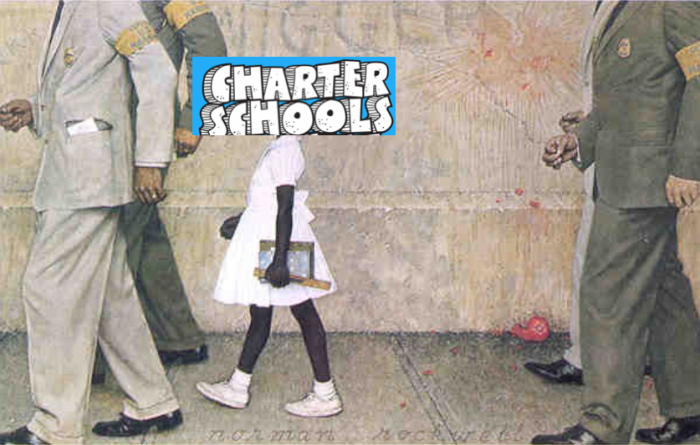
When you look at public schools today what you see is increasing segregation. Many districts are as segregated or worse than they were before the 1950s. So-called school choice initiatives have only made it worse with charter and voucher schools springing up that cater to one race at the expense of another. Cadillac charters open in otherwise economically diverse neighborhoods swooping in to provide white flight. Big corporations start cut-rate charters with empty promises for black kids while bleaching the student body at the neighborhood’s traditional public school.

But school choice isn’t the only problem. Economics plays a factor, too. Public schools often are funded based on local property taxes, so poor kids get much fewer resources for their schools than rich kids. And since most black students are poor, this provides a stealthy way to funnel more money and resources to the white kids than the black ones.

We don’t call it segregation because it doesn’t just affect minority children. It affects poor whites, too. Everyone agrees there’s a problem, but policymakers only propose measures that make it worse. Instead of fixing underlying inequalities, we punish under-resourced schools for the very academic problems they don’t have the resources to successfully eliminate. Instead of providing more and better equipped teachers, we hire lightly trained temps through Teach for America thereby reducing both the quality of education and the cost. Meanwhile private corporations line-up to start testing corporations, test prep publishers and for-profit charter schools at the expense of black and brown kids.

None of it would be possible without segregation. Our schools today are at least as separate and unequal as they’ve ever been. And no one in power cares.


VOTING RIGHTS


Perhaps the only progress we’ve made is in black people’s suffrage. At the time of the Civil War even in the North, blacks couldn’t cast a ballot or their vote was worth significantly less than that of white people. At least today people of color get the same say in the political arena as anyone else.

Or do they?

Since the Supreme Court gutted the Voting Rights Act, a plethora of states in both the North and the South have passed laws to make it harder for people of color to vote.

Voter ID laws have sprung up across the country requiring citizens to present photo identification at the polls. However, just any picture ID won’t do. These laws require exactly the types of identification black people are least likely to have. In addition, states pass restrictions on early voting making it difficult for black churches to help the majority of their congregations who don’t own cars to physically get to a ballot box. Likewise, polling places in black areas of town are closed forcing minorities to endure long lines to vote while people from white areas of town just waltz right in.

It’s not an outright ban on black voting. But it represents continued hurdles just as the Jim Crow laws of old required literacy tests, poll taxes and other forms of intimidation.


CONCLUSIONS


When we look closely at our society and how it treats blacks vs. whites, it becomes clear that something is terribly wrong.

There is deep inequality, deep inequity, deep assumptions about the relative worth of various peoples. In fact, our society creates and perpetuated these injustices. It’s baked into the system, taught to us in our unspoken assumptions, our prescriptions of right and wrong, propriety and norms.

If we step back and look at it from the long view, we can see exactly where this came from. It’s not new. It didn’t fall from the sky like a mysterious alien artifact.

The racism of today is merely the continuation of the racism of yesterday. We pride ourselves that we’re better than our forbears, but it’s only a slight matter of degree.

Black people still are subject to a form of slavery in our system of mass incarceration. They are lynched – often by law enforcement – with little to no consequences for their killers. They go to increasingly segregated schools. And they often endure severe obstacles in order to vote.

Therefore, the battles of the 1860s and 1960s have never fully been decided. The Civil War is not yet over. Slavery continues in a new form. And racism is entrenched in our nation, communities and people.

But if we recognize that, we’ve taken the first step to building a new and better world.
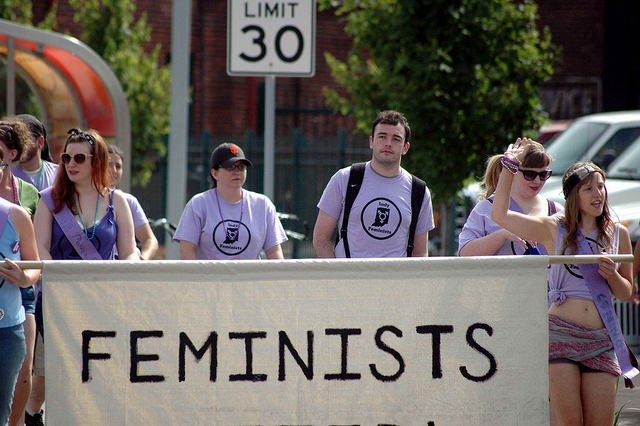
If You’re Not a Feminist – What the Hell is Wrong with You!!?

feminist-man

I am a male human being.

And you’d better believe I’m a feminist.

I wear that label proudly.

The other day a friend of mine heard one of my articles was published in Everyday Feminism. And he said, “Kind of a backhanded compliment. Isn’t it?”

Hell no!

What does that mean? Would someone suppose that a man being considered a feminist somehow made him less of a man?

On the contrary. I think it makes him more of one. It makes him a decent freakin’ person.

I just don’t understand this ridicule and fear of being called a feminist. I see it in both men and women.

The other day a co-worker said she’s all for the idea that men and women deserve equal pay for the same job, but she doesn’t consider herself a feminist.

Why the Hell not? That is a distinctly feminist point of view.

There seems to be this stigma about the term as if being a feminist was tantamount to being some sort of radical troublemaker. Some folks seem to think that feminists essentially hate men and seek them grievous harm.

It’s ridiculous.

A feminist is just someone who thinks men and women should have the same rights and opportunities.

That’s it. You can add more complicated terms, talk about economic, social and political rights, but it’s the same darn thing.

Being a feminist just means you’re not an asshole. That’s not a gender-specific value. Nor should it depend on your political affiliation, sexual preference or spirituality.

If you think all people, regardless of what they’ve got between their legs, deserve to be treated fairly, then SURPRISE! You’re feminist!

In the words of activist and academic Cheris Kramarae, feminism is “the radical notion that women are people.”

Some folks try to convince you otherwise. They play a card from the racist playbook. It goes like this:

Stop saying ‘Feminism.’ Women don’t deserve equal rights. All people do.

It’s the same passive aggressive trick of the closeted white supremacists who attack Black Lives Matter activists because “All Lives Matter!”

Listen, skeezicks, no one said “ONLY Black Lives Matter” just like no one said “ONLY women’s rights matter.” What you’re complaining about is pure baloney – a way to shut down the conversation and stop people from talking about inequalities that actually exist for women and people of color.

And don’t assume I’m excluding transgender people, either. LGBTs are just as deserving of fair treatment as cisgender folks, heterosexuals or anyone else.

Yes, feminism calls attention to the plight of women. It deserves that attention. We have a lot of work to do making that right. Why should I feel guilty about bringing that up?

I am perfectly comfortable being called a feminist. I have a mother, and I love her. I have two grandmothers, an aunt, a wife, a daughter. Most of us, whether we’re women or not, have important relationships with someone of the female persuasion. I can’t imagine why anyone would want to deny those loved ones equal treatment.

But you don’t have to know or care about a single woman. You could have sprung from the ground like a mushroom and lived in a dark corner without meeting anyone all your life. Why would you want to deny half of the human race fair treatment?

It’s a deep seated psychosis. Like so much else, the current Presidential election has brought it even more to the forefront.

For the first time in American history, a woman tops the ticket of a major political party. (She’s not even the only one. The Green Party has an impressive female candidate, too!) And just like in 2008 when Barack Obama became the our first President of color, the crazies are coming out of the woodwork.

I even had a female acquaintance tell me she couldn’t support Hillary Clinton because she didn’t feel comfortable with a woman in the Oval Office. She thought a woman would be too emotional to make those kinds of life-and-death decisions.

What a pile of crap!

It doesn’t matter if you support Clinton or not. Being a woman does not disqualify her from the Presidency. Women make life-and-death decisions every day. In fact, given that many women have the very machinery of life embedded in their own bodies, they may be MORE suited to these decisions than men. After all, they are empowered to decide whether new life comes into the world. They literally give birth to the future.

Men can be important parts of the process. But it’s not biologically required to the same degree.

Being the father of a daughter is the most important relationship in my life.

And I’ll admit it made me think about gender issues more deeply.

All parents see the world anew through their children’s eyes, and what I see from my little one’s point of view doesn’t fill me with confidence.

I see everywhere women have to prove themselves just to get in the door while men are assumed to be worthy of a shot just by virtue of their masculinity.

People listen to men more seriously than they do women. People expect men to take the lead. They expect women to follow. Men have much higher representation in almost all valued professions – doctors, lawyers, politicians.

It’s no wonder school teachers get no respect. They’re mostly women. As one of the few males in front of the classroom, I see this first hand on a daily basis.

So I try to do what I can to protect my daughter from ingesting these cultural stereotypes and sick ways of thinking.

Just the other day, we were listening to a Joan Jett song, and my little one asked if there were many good women rock stars. I responded by making her a playlist on my iPod filled with nothing but female fronted music groups. It’s full of artists like No Doubt, Cyndi Lauper, the Pretenders, Heart, Lauryn Hill, Patti LaBelle and Fiona Apple.

My daughter loves it. When we ride around in the car she invariably asks for “The Girl Album,” and I get it. She likes hearing people like her in that role. She likes seeing that it’s a possibility, that girls don’t have to take a backseat. They can lead. They’re just as important as boys any day.

That’s what being a feminist means.

It’s challenging your own patriarchal ways of thinking. It’s continually asking ‘Is this fair?” It’s having the courage to challenge the status quo and siding with the oppressed against the oppressor – even if the oppressor looks like you.

So Hell Yeah I’m a feminist. And if you’re not – really – what is wrong with you!!?

What’s More Important – Fighting School Segregation or Protecting Charter School Profits?

Screen Shot 2016-08-31 at 4.12.13 PM


No one wants school segregation.


At least, no one champions it publicly.


As a matter of policy, it would be political suicide to say we need to divide up our school children by race and socio-economics.


But when you look at our public school system, this is exactly what you see. After the triumphs of the Civil Rights movement, we’ve let our schools fall back into old habits that shouldn’t be acceptable in the post-Jim Crow era.


When we elected Barack Obama, our first President of color, many observers thought he’d address the issue. Instead we got continued silence from the Oval Office coupled with an education policy that frankly made matters worse.


So one wonders if people still care.


Is educational apartheid really acceptable in this day and age? Is it still important to fight against school segregation?


Peter Cunningham isn’t so sure.


The former assistant Secretary of Education under Obama and prominent Democrat worries that fighting segregation may hurt an initiative he holds even more dear – charter schools.


Cunningham is executive director of the Education Post, a well-funded charter school public relations firm that packages its advertisements, propaganda and apologias as journalism.


Everywhere you look Democrats and Republicans are engaged in promoting various school choice schemes at the expense of the traditional public school system. Taxpayer money is funneled to private or religious schools, on the one hand, or privatized (and often for-profit) charter schools on the other.


One of the most heated debates about these schemes is whether dividing students up in this way – especially between privately run charter schools – makes them more segregated by race and socio-economic status.


Put simply – does it make segregation worse?


Civil Rights organizations like the NAACP and Black Lives Matter say it does. And there’s plenty of research to back them up.


But until recently, charter school apologists have contested these findings.


Cunningham breaks this mold by tacitly admitting that charter schools DO, in fact, increase segregation, but he questions whether that matters.


He says:


“Maybe the fight’s not worth it. It’s a good thing; we all think integration is good. But it’s been a long fight, we’ve had middling success. At the same time, we have lots and lots of schools filled with kids of one race, one background, that are doing great. It’s a good question.”


The schools he’s referring to are charter schools like the Knowledge is Power Program (KIPP) where mostly minority students are selected, but only those with the best grades and hardest work ethic. The children who are more difficult to teach are booted back to traditional public schools.


It’s a highly controversial model.


KIPP is famous for two things: draconian discipline and high attrition rates. Even those kids who do well there often don’t go on to graduate from college. Two thirds of KIPP students who passed the 8th grade still haven’t achieved a bachelor’s degree 10 years later.


Moreover, its methods aren’t reproducible elsewhere. The one time KIPP tried to take over an existing public school district and apply its approach without skimming the best and brightest off the top, it failed miserably – so much so that KIPP isn’t in the school turnaround business anymore.


These are the “lots and lots of schools” Cunningham is worried about disturbing if we tackle school segregation.


He first voiced this concern at a meeting with Democrats for Education Reform – a well-funded neoliberal organization bent on spreading school privatization. Even at such a gathering of like minds, some people might be embarrassed for saying such a thing. Is integration worth it? It sounds like something you’d expect to come out of Donald Trump’s mouth, not a supposedly prominent Democrat.


But Cunningham isn’t backing away from his remarks. He’s doubling down on them.


He even wrote an article published in US News and World Report called “Is Integration Necessary?”


Here’s the issue.


Segregation is bad.


But charter schools increase segregation.


So the obvious conclusion is that charter schools are bad.


BUT WE CAN’T DO THAT!


It would forever crash the gravy train that transforms public school budgets into private profits. It would forever kill the goose that turns Johnny’s school money into fancy trips, expense accounts and yachts for people like Cunningham.


This industry pays his salary. Of course he chooses it over the damage done by school segregation.


But the rest of us aren’t burdened by his bias.


His claims go counter to the entire history of the Civil Rights movement, the more than hundred year struggle for people of color to be treated equitably. That’s hard to ignore.


People didn’t march in the streets and submit to violent recriminations to gain something that just isn’t necessary. They weren’t sprayed by hoses and attacked by police dogs so they could gain an advantage for their children that isn’t essential to their rights. They weren’t beaten and murdered for an amenity at which their posterity should gaze with indifference and shrug.


We used to understand this. We used to know that allowing all the black kids to go to one school and all the white kids to go to another would also allow all the money to go to the white kids and the crumbs to fall to the black kids.


We knew it because that’s what happened. Before the landmark Brown vs. Board of Education, it’s a matter of historical fact. And today it’s an empirical one. As our schools have been allowed to fall back into segregation, resources have been allocated in increasingly unfair ways.


We have rich schools and poor schools. We have predominantly black schools and predominantly white schools. Where do you think the money goes?


But somehow Cunningham thinks charter schools will magically fix this problem.


Charters are so powerful they will somehow equalize school funding. Or maybe they’re so amazing they’ll make funding disparities irrelevant.


For believers, charter pedagogy wields just that kind of sorcery. Hocus Pocus and it won’t matter that black kids don’t have the books or extra-curriculars or arts and humanities or lower class sizes.


Unfortunately for Cunningham, the effects of school segregation have been studied for decades.


“Today, we know integration has a positive effect on almost every aspect of schooling that matters, and segregation the inverse,” says Derek Black, a professor of law at the University of South Carolina School of Law.


“We also know integration matters for all students. Both minorities and whites are disadvantaged by attending racially isolated schools, although in somewhat different ways.”


Minorities are harmed academically by being in segregated schools. Whites are harmed socially.


At predominantly minority schools, less money means less educational opportunities and less ability to maximize the opportunities that do exist. Likewise, at predominantly white schools, less exposure to minorities tends to make students more insular, xenophobic and, well, racist. If you don’t want little Billy and Sally to maybe one day become closeted Klan members, you may need to give them the opportunity to make some black friends. At very least they need to see black and brown people as people – not media stereotypes.


Even Richard D. Kahlenberg, a proponent of some types of charter schools and a senior fellow at the Century Foundation, thinks integration is vital to a successful school system.


“To my mind, it’s hugely significant,” says Kahlenberg, who has studied the impact of school segregation.


“If you think about the two fundamental purposes of public education, it’s to promote social mobility so that a child, no matter her circumstances, can, through a good education, go where her God-given talents would take her.  The second purpose is to strengthen our democracy by creating intelligent and open-minded citizens, and related to that, to build social cohesion.


Because we’re a nation where people come from all corners of the world, it’s important that the public schools be a place where children learn what it means to be an American, and learn the values of a democracy, one of which is that we’re all social equals. Segregation by race and by socioeconomic status significantly undercuts both of those goals.”


We used to know that public education wasn’t just about providing what’s best for one student. It was about providing the best for all students.


Public schools build the society of tomorrow. What kind of future are we trying to create? One where everyone looks out just for themselves or one where we succeed together as a single country, a unified people?


A system where everyone pays their own way through school and gets the best education they can afford works great for the rich. But it leaves the masses of humanity behind. It entrenches class and racial divides. In short, it’s not the kind of world where the majority of people would want their children to grow up.


More than half of public school students today live in poverty. Imagine if we could tap into that ever-expanding pool of humanity. How many more scientific breakthroughs, how many works of art, how much prosperity could we engender for everyone!?


That is the goal of integration – a better world.


But people like Cunningham only can see how it cuts into their individual bank accounts.


So is it important to fight school segregation?


That we’re even seriously asking the question tells more about the kind of society we live in today than anything else.

Shouldn’t Our Schools At Least be as Logical as Dental Floss?

  Girl-flossing1

All my life I assumed flossing was essential to dental health.


It was safe, it was sound, it was normal.


Every day after brushing, I would stand before the bathroom mirror and carefully thread a mint-flavored filament through my teeth – like a chump.


And when I got to the dentist, I’d comfort myself that I had done the best I could to prevent cavities.


The hygienist would remove plaque and germs while scraping and sawing at my teeth with a specialized hook, and all the while I’d think, “At least I flossed every day!”


Yet now the federal government tells us that flossing is ineffective at best!


What!? After all these years!?


It turns out, there just is no evidence that flossing actually helps – never has been. So this summer for the first time in decades the good folks who compile federal dietary guidelines decided not to recommend the practice.


A total of 25 studies have concluded that the evidence for flossing is “weak, very unreliable,” of “very low” quality, and carries “a moderate to large potential for bias,” according to the Associated Press.


“The majority of available studies fail to demonstrate that flossing is generally effective in plaque removal,” said one review conducted just last year. Another 2015 review cites “inconsistent/weak evidence” for flossing and a “lack of efficacy.”


So flossing is out.


It’s not evidence-based.


It’s actually kind of shocking to see the federal government acting so logically.


Where’s the politics? Why aren’t Republicans taking one side and Democrats the other? Why isn’t the dental floss lobby making massive contributions to our lawmakers to influence the decision?


But we get none of that in this instance. Instead, here’s the evidence. It doesn’t support this policy. So let’s discontinue that policy.


I wonder what the world would look like if every government stance was as susceptible to argument, cause and effect, and rationality.


As a public school teacher, I’ve become inured to our lawmakers doing exactly the opposite. They look at the evidence, see it DOESN’T support an education scheme and then… they proudly give it their full support.


As a result, education policy is full of unfounded, fallacious and unproven practices.


Our schools are struggling under the burden of illogical laws. Our teachers are pulling out their hair at a series of half-baked mandates that go counter to everything they’ve learned about childhood development. And our students suffer from procedures that don’t help them learn and in fact actually do much to prevent them from doing so.


Take standardized testing, Common Core and school choice.


Our legislators think standardized testing is the best way to measure learning. Are you freaking kidding me!? In colleges and universities across the country where this has been studied in-depth for centuries, it’s been disproven, ridiculed and considered an antiquated way of thinking about learning. It went out with phrenology and eugenics!


Multiple choice tests like these have consistently been shown to correlate more closely with socioeconomic status than intelligence, retention or understanding. Put simply: if you’re rich, you do well. If you’re poor, you don’t.


Standardized tests as we know them were developed in the Victorian Age to “prove” that wealthy people were just smarter than poor people. They were created to show the innate inferiority of black and brown people and the natural superiority of the white race.


Yet these kinds of assessments still are the backbone of the public school system.


Another fallacious policy championed by many lawmakers is Common Core State Standards. But like The Four Temperments, the Geocentric Universe, and the Flat Earth Theory, they aren’t backed up by evidence. In fact, each of these disproven scientific hypotheses has MORE EVIDENCE behind it than Common Core! Each of these ancient models was based on evidence but later refuted. By contrast, Common Core was never empirically based. In fact, it has never even been studied. Someone just pulled it out of their butt!


Let me say that again: there has never been any proof that Common Core will help children learn. In fact, far from showing any improvement, since its adoption, student outcomes have plummeted. But in many states it’s the law of the land.


In truth, Common Core is a series of academic standards developed by the testing and publishing industry as a way to sell more standardized tests and remediation materials. They were only adopted because state officials were blackmailed to accept them. Otherwise, they wouldn’t have enough money to continue running their state schools. In many cases, the standards weren’t even voted on by state legislators but instead by appointed boards of education.


Yet today these standards (or very similar ones) are required in public schools across 42 states.


Finally, we have the political darling, school choice. Many Republicans and Democrats champion some form of choice and competition in our schools. They all think it will help, despite the fact that there’s more evidence for UFOs, Bigfoot and the Loch Ness Monster!


Very few countries try to help students by increasing their choices without also trying to increase the quality of those choices. Nowhere has it ever been shown that having more schools to choose from is better than less schools to choose from – if you don’t improve the quality of those schools. Simply having more options and having those options compete doesn’t make them better. As John Oliver pointed out recently, the town with the most pizzerias doesn’t necessarily have the best pizza.


In fact, in countries that have initiated school choice policies, they’ve seen educational quality drop – not rise. Yet billionaires all across the US push for us to adopt these policies all the while investing in schemes to enrich themselves if such a policy shift occurred.


It makes no sense. These are misguided, unfounded, and downright insidious ideas.


Yet everyday pundits, policy-makers and politicians still advocate for them – somehow with a straight face. And when someone who actually works in the schools like me points to the evidence – or lack thereof – I’m ignored.


In the words of Frank Zappa, “Modern Americans behave as if intelligence were some sort of hideous deformity.” And our education policies are doing nothing to fix it.


The problem is the very banality of corporate school reform. After almost two decades of these strategies pushed on both sides of the aisle, they’ve become the status quo. It’s just the way we do things.


They’re as common as… well… dental floss.


The federal government saw through the vapidity of that practice. Isn’t it time the administration does the same for corporate school reform?

No New Charter Schools – NAACP Draws Line in the Sand

Line in sand


In the education market, charter schools are often sold as a way to help black and brown children.


But The National Association for the Advancement of Colored People (NAACP) isn’t buying it.


In fact, the organization is calling for a halt on any new charter schools across the nation.


Delegates from across the country passed a resolution at the NAACP’s national convention in Cincinnati last week calling for a moratorium on new charters schools. Approval of the new resolution will not be official until the national board meeting later this year.


This resolution isn’t a change in policy. But it strengthens the organization’s stance from 2010 and 2014 against charters.


Specifically, the resolution states:


“…the NAACP opposes the privatization of public schools and/or public subsidizing or funding of for-profit or charter schools…”


“…the NAACP calls for full funding and support of high quality free public education for all children…”


The resolution goes on to oppose tax breaks to support charter schools and calls for new legislation to increase charter school transparency. Moreover, charters should not be allowed to kick students out for disciplinary reasons.


This goes against the well-funded narrative of charter schools as vehicles to ensure civil rights.


The pro-charter story has been told by deep pocketed investors such as the Koch Brothers and the Walton Family Foundation. But the idea that a separate parallel school system would somehow benefit black and brown children goes against history and common sense.


The Supreme Court, after all, ruled separate but equal to be Unconstitutional in Brown vs. Board of Education. Yet somehow these wealthy “philanthropists” know better.


People of color know that when your children are separated from the white and rich kids, they often don’t get the same resources, funding and proper education. You want your children to be integrated not segregated. You want them to be where the rich white kids are. That way it’s harder for them to be excluded from the excellent education being provided to their lighter skinned and more economically advantaged peers.


Julian Vasquez Heilig, education chair of the California and Hawaiian NAACP chapter which proposed the new resolution, says its ironic charter schools are marketed as school choice.


The endgame, says Heilig, is to replace the current public schools with privatized charter schools. This is exactly what’s been proposed in the US territory of Puerto Rico.


It’s not about giving parents more choices. It’s about eliminating one option and replacing it with another. It’s about reducing the cost to educate poor and minority children while also reducing the quality of services provided. Meanwhile, public tax dollars earmarked to help students learn become profit for wealthy corporations running charter schools.


As the Presidential election heats up, it will be interesting to see how Hillary Clinton and Donald Trump address the issue. Already school choice policies have been wholeheartedly embraced by the Republican nominee. Not only does he favor charter schools, he also supports school vouchers and other schemes to privatize public tax money. This shouldn’t be a surprise since he ran his own private education scam – Trump University.


Clinton, on the other hand, has been more measured in her support, even criticizing some aspects of charter schools. However, her campaign has issued statements saying she supports only “high quality charter schools” – whatever those are.


Moreover, just this week at the Democratic National Convention, Clinton staffers met with hedge fund mangers from Democrats for Education Reform (DFER).


According to Molly Knefel who covered the meeting for Truthout, the mood was not positive toward ending corporate education reform strategies.


She reported that moderator Jonathan Alter worried about the argument becoming based on social justice.


“If it becomes a social justice movement, doesn’t that in some ways let, for lack of a better word or expression, Diane Ravitch’s argument win?” asked Alter. “Which is, ‘don’t blame any of us, don’t focus on schools; if we don’t solve poverty, nothing is going to get better.’ Isn’t there a danger of falling away from the focus on at least some responsibility on schools?”


Apparently Alter is falling back on the old chestnut that under-funded schools should be blamed and shut down if they can’t help the neediest children to the same degree as well-resourced schools. And any attempt to focus on underlying inequalities would somehow give teachers a free pass? I suppose Alter believes a fire company that can’t afford a fire truck should be just as effective as one with three new ones.


Meanwhile, longtime corporate education reformer Peter Cunningham was asked specifically if school integration was important. He responded tellingly:


“Maybe the fight’s not worth it. It’s a good thing; we all think integration is good. But it’s been a long fight, we’ve had middling success. At the same time, we have lots and lots of schools filled with kids of one race, one background, that are doing great. It’s a good question.”


The number of segregated schools where students “are doing great” is certainly in question. Perhaps he’s referring to well-resourced all-white private schools for the children of the rich and powerful. Or maybe he means the all-black charter schools where administrators handpick the best and brightest students and refuse to educate those most in need.


One hopes Clinton will continue to fight alongside the NAACP and other civil rights organizations like Journey for Justice and the Rev. William Barber’s Moral Mondays to defend public schools against the failed education policies of the George W. Bush and Barack Obama administrations.


Two weeks ago DFER President Shavar Jeffries criticized the finalized Democratic education platform for turning against corporate education reform. This transformation away from school privatization and standardized testing was the result of education activists Chuck Pascal of Pittsburgh, Troy LaRaviere of Chicago and Christine Kramar of Nevada who worked hard to ensure the platform – though non-binding – would at least set forth a positive vision of what our public schools should look like.


Make no mistake, the tide is turning. It is becoming increasingly difficult for charter supporters to claim their products boost minority children’s civil rights.


Too many people have seen how they actually violate them.

Why the Rich Need Racists: Prejudice as Social Control

Screen Shot 2016-07-17 at 1.55.00 AM

HELP WANTED: RACISTS
Anywhere, USA

-Must have an irrational fear and hatred of all things African American.

-Must honestly believe black people get all the breaks, have it easier than whites.

-Must believe black people are naturally inferior to whites, lazy, prone to criminality, less intelligent, etc.

-Must believe racism ended with either (1) the civil rights movement or (2) slavery.

But must hide these beliefs under a thin veneer of civility. For instance:

-must never use the N-word (in public)

-must never beat or kill a black person (unless on the police force)

-must never light a burning cross on a black person’s lawn (and get caught)

-must never tweet or express these views publicly in a way that can be traced back to you.

Enjoyment of rap music, black culture or black sexual partners optional. Fox News viewership preferred.

Bonus pay if racism is unrecognized by the applicant.

No experience necessary. Apply within.”


If you saw an advertisement like the above posted in your local shop window, it really wouldn’t be so surprising. Would it?


Well maybe because of its bluntness. But it’s not really that different from campaign fliers for Republican Presidential candidate Donald Trump vowing to “Make America Great Again!”


Throughout its history, when exactly was America great for black and brown people who have been denied equal rights? When was it great for women or LGBTs or a host of other non-cis/non-male/non-white people?


A pledge to make America great again is just a pledge to make America white again – or at least to propel male whiteness back to the center of normativity.


(In fact, much of what I’m going to say about racism here could also be said of all kinds of prejudice. But for the interest of clarity, I’ll try to contain myself to focusing on racism, though I acknowledge the high degree of intersectionality of the phenomena.)


Yep. A lot of folks are riled up because the flower of white male privilege is wilting, and they think too many are suggesting we let it die.


What can they do? White people’s only remaining claim on supremacy is based on a fleeting numerical majority that is fast coming to an end. Soon they’ll be outnumbered.


They’re so mad about even an incremental loss of white power, they’re willing to blind themselves to obvious injustices against people of color.


For instance, black people are killed by the police at twice the rate of white people. Unarmed black people are killed at five times the rate. Yet somehow it’s black folk’s own doggone fault.


What if he has a legal weapon, but it’s not anywhere in use? HIS FAULT.


What if he has no weapon? HIS FAULT.


What if he’s just a child? HIS FAULT.


What if it’s a woman mysteriously found hanged in her prison cell with no possible motive for suicide? HER FAULT.


What if he’s screaming in pain from an injury sustained in the police encounter? HIS FAULT.


What if he’s complaining on video that police are choking him and he dies as a result of those injuries? HIS FAULT.


I mean come on, people! How does a brotha’ got to die before white folks will admit to some culpability by police?

 
And that’s just one type of example. Consider: There are more black people in prison today than were slaves before the Emancipation Proclamation. Black people get harsher prison sentences than whites for the exact same crimes. Black people are segregated into poor communities with underfunded schools. People with black-sounding names are less likely to get a job than white counterparts with the same experience.


And on-and-on-and-on.


Yet you’ll find white apologists everywhere who will see no evil, hear no evil, and speak no evil of the racial caste system under which their black brothers and sisters are forced to live. They refuse to acknowledge it, get angry when you bring it up and will actively support it at the polls.


That’s racism, people.


It’s 2016. Legal slavery ended more than 150 years ago in this country. The civil rights movement ended more than 60 years ago. Why do we still have systematic racism baked into the fabric of America?


In 1963, the African American writer James Baldwin asked the same question. He said:


“The future of the Negro in this country is precisely as bright or as dark as the future of the country. It is entirely up to the American people, and our representatives, it is entirely up to the American people whether or not they’re going to face and deal with and embrace the stranger who they’ve maligned for so long. What white people have to do is try to find out in their own hearts why it was necessary to have the n****r in the first place. I am not a n****r. I am a man. But if you think I’m a n****r, it means you need it… You, the white people, invented him, and you have to find out why. And the future of the country depends on that.”


Why do white people need racism?


Today we have an answer. The short version would be this: because it’s useful.


It serves a function in society.


When people conceptualize each other into these highly dubious and unjustifiable categories of black and white, it provides a valuable service to the status quo. In fact, we couldn’t have the status quo without it.


When historians look back at the ancient Spartan empire of 900 -192 BC, there is little confusion why their society was so highly militarized. Few historians wonder why such a small population organized themselves into a military state. They needed to control the vast network of slaves dispersed throughout their community. The conquerors were massively outnumbered by the conquered so they resorted to militarized fear to keep their social structure intact. They weren’t afraid of invaders from without. They were afraid of invaders from within.


Likewise, if humanity survives our current moment in time, historians of the future will undoubtedly be in agreement about the reasons for American racism. It’s the same reason found in ancient Sparta. We need it to keep our society together.

 
In America today, the top one percent own more than the bottom 90 percent. The richest 85 people have as much wealth as the bottom half of the country. And it’s only getting worse.


A country with such vast wealth inequality cannot survive without a scapegoat – black people. The majority of the population would not let the top one percent gorge themselves on our riches unless they had distracted us with something.


Don’t pay any attention to the Wall Street bailout. Look at those welfare queens, which is code for black people sucking away our wealth.


Don’t pay attention to the overt militarization of the police force. Look at those violent black criminals they have to deal with by pulling their service pistols and shooting them into submission.


Don’t pay attention to the inequitable distribution of education funding to your public schools. Look at how these black kids don’t pull up their pants, and if they manage to graduate, they’re given undeserved preference over more qualified white people through affirmative action.


Think about it. Why do we have a sizable black population in the first place?


Slavery. The very presence of a substantial black population is attributable to market forces. We needed a cheap workforce for our agricultural industry – especially tobacco and cotton. It was a labor intensive process and the only way to make a substantial profit at it was immoral thrift. And you can’t get much cheaper than forced, generational servitude.


Why weren’t black people treated equally after the Civil War?


We still needed that cheap workforce. The wealth of our nation depended on it. We needed legal ways to keep them subjugated. We needed to keep them on the farm or in prison so the economic engine of agriculture could continue unabated. If they all had the right to vote or could protest their conditions, that would hurt the bottom line. They’d gain freedom, but we’d lose money. Not gonna’ happen.


Why didn’t equality come after the civil rights movement?


Agricultural mechanization had decreased the need for cheap labor, but having an underclass is profitable for whoever can take advantage of them. The invisible hand of the market will preserve human subjugation for as long as it can and as long as it turns a profit.


Moreover, throughout the entire history of this country, the rich have needed something to keep white labor in check, too. Fair wages, overtime pay, child labor laws, vacation pay, workplace safety – all of these rights had to be fought for tooth and nail – usually by the most demonized of social institutions, the labor unions. We needed something to stop the rising tide of economic fairness. Giving white workers someone to kick around made them more satisfied with their own lot in life and less willing to fight for a larger share of the pie.


It went something like this: You may have to work in the factory all day, but at least you aren’t one of THEM. You might be bone tired while the bosses get rich off of your labor, but at least you can feel proud of your race.


What an amazing swindle! The rich have actually convinced many hard-working white people to feel proud of the pigmentation of their skin! No. Not their cultural heritage. Not the struggle of their moms and dads, their ties to a homeland across the sea, their religion or ethnicity. No. The color of their skins!


If intelligent aliens ever crossed light years of space and time to investigate the intellect of human beings, that one fact would have them rushing back home shaking their tentacles and multiple heads in disbelief!


Just look at how racism has been used to justify the actions of the wealthy throughout history!


Europeans discover a New World in 1492 full of riches to plunder and exploit. But how do you justify doing that when it’s already populated? How can you do that morally? After all, doesn’t our God command we love our neighbors as ourselves? Isn’t murder and theft a… gulp… sin?


Well obviously the indigenous peoples don’t count. They’re not like us. They’re not Christians. They’re heathens.


But wait a minute! The church is forcing them to adopt our religion. This justification has a sell-by date. It won’t last long enough for us to suck every drop of wealth out of the Americas.


So we came up with a new way to dehumanize people – racism. It’s not just that they’re heathens. They’re subhuman, too. FWEW! Problem solved.


Then comes 1776. The American colonies revolt and write up some high minded language about all men being equal. If we actually believed that, it would necessitate a new social order. Much easier to find new justifications for the old one.


Well we already agreed the Native Americans are naturally inferior. These African slaves we stole are likewise beneath our high ideals. The same with women. And the poor. And immigrants. And homosexuals. And whoever else we need to subjugate. They just don’t count.


When idealism and capitalism have come into conflict, the rich have invariably chosen capitalism. And when the rest of us choose racism, prejudice, sexism, xenophobia and homophobia, we’re doing them a favor. We’re backing up their interests.


Stop being such chumps, white people!


A racist is invariably a traitor to his own class. A sexist is a sycophant to the smart set. A xenophobe is a diversion to the hands buried in your pocket robbing you blind.
Your interests have much more in common with all those people you’ve been taught to hate. You could be coming together in common cause with all those black and brown people. You could be rising up and demanding your due. We could join together and demand a fair shake, an equitable piece of our gross national product.


But instead we are content to protect an ever shrinking share of our national wealth if we can just keep that ridiculous and childish pride in our lack of melanin.


During the same interview, Baldwin was asked if he thought there was any hope America would change it’s ways. He said:


“I can’t be a pessimist because I’m alive. To be a pessimist means that you have agreed that human life is an academic matter, so I’m forced to be an optimist. I’m forced to believe that we can survive whatever we must survive.”


I agree.


It’s all up to us, white people.


Racism doesn’t serve us. It subjugates us just like it does everyone else.


They throw us a bone and we jealously guard it like its a prime cut of steak.


When are we going to wake up? When are we going to put away hate and choose love?


When are we going to join our brothers and sisters in the struggle and demand what’s ours?


The rich may need racists, but we don’t.

What My Black Student Taught Me, His White Teacher, About Black Lives

student_081910-thumb-640xauto-704

I can’t tell you how many times Darnell was in detention.

After a while, it didn’t feel right if he wasn’t staying at least an hour after school.

Darnell was late to class.

Darnell swore at another student.

Darnell copied someone’s paper.

Darnell did just about everything and anything that came to his mind. And it earned him time after school with me, his newly-minted 8th grade language arts teacher.

In a class full of mostly brown and black students, many living in an impoverished high crime Pittsburgh suburb, Darnell was the standout. Or at least his misbehavior was.

At first, he complained, but I had his mom on speed dial, and she fully supported my holding him accountable.

He wanted to do his homework during this time, but I made him do busy work instead. The way I looked at it as a young teacher just starting out, if I gave him time to do his school work, it would be a reward, not a punishment.

So I made him copy down dictionary definitions, clean the tables or put up the chairs.

And once he realized there was no way out, he did it all uncomplainingly.

But an hour is a long time, so after a while I let him work on his homework, too.

I had an awful lot of work to do, myself, during these times – piles of papers to grade and lessons to plan – so whatever would keep him quiet would be okay with me.

Unfortunately, Darnell didn’t work that way. He had questions. So many questions.

I had no time, but what else was I gonna’ do?

I answered him. With frustration at first while sitting at my desk.

Then I found myself walking over to him and standing at his table. Then I sat down next to him. And pretty soon we were doing the homework together.

But an hour is a long time, so sometimes he’d finish early. I offered to let him go.

He didn’t want to.

He’d stay and talk: “Did you see the football game, Mr. Singer?”

Or “Did you hear the new Beyoncé album, Mr. Singer?”

Or “How many kids do you have at home, Mr. Singer?”

One day I remember the last bell ringing and looking up to see Darnell at his desk doing homework. I looked back at my stack of papers before I realized – Darnell didn’t have detention today.

I laughed. “You can go home, Buddy,” I said.

“I know,” he replied. “Is it okay if I stay and get this done?”

I shouldn’t have been so surprised. But I was.

I nodded, and he stayed.

I won’t say Darnell ever became a perfect student. He just didn’t have the patience for detailed work. He was more of a big picture guy.

But after months of never turning in homework – years, really – he began to turn all of it in. And I mean all of it!

He wasn’t a great speller, but he started ending all of his sentences with punctuation. And he started all of his sentences with a capitalized word.

He wasn’t a great reader, but he did crack open a few books. Nothing too difficult or complex, but it was more than any teacher I talked to had ever seen him read previously.

At the end of the year, I remember pausing by his desk and praising him.

“Darnell, that’s some mighty fine work you did in here this year,” I said.

And he got this big ol’ grin on his face like he used to get before he was about to engage in some random act of mischief.

“Thanks, Mr. Singer. You’re a really good teacher.”

I smiled and said, “No, Darnell. You’re a good student.”

I remember looking him in the eye to emphasize it. This was a kid with a reputation. I’ll bet few teachers had ever commended him on his school work before.

Then the year ended, and he was gone.

He went on to 9th grade and did even better than in my class. The same in 10th, 11th and 12th.

Oh, sure. He was still a handful and got himself in trouble lots of times. But he did his work and didn’t fail his classes.

I kept an eye on him like I do all my students when they leave me. I try to keep tabs, but there’s always a new bunch just waiting for you at the beginning of the year.

You remember anytime you think about it, which isn’t much.

So it was years later when I heard the news.

Teachers were shaking their heads in the faculty room. The principal held a meeting to tell us about it in case any of our current students were upset, in case any of us had Darnell’s cousins, brothers, sisters, or friends.

He was only 18 when he was murdered.

Shot down in the streets from a passing car.

Police still don’t know whether he was the shooter’s target or if he was just at the wrong place at the wrong time.

The high school teachers, who knew Darnell best, said he had really straightened up his act. He had gotten into community college, wanted to be an engineer.

And they shook their heads. What else was there to say?

I walked back to my classroom and opened a file cabinet.

Inside was a bunch of dusty manila folders – one for each child I had ever made serve a detention.

It didn’t take long to spot Darnell’s. It was one of the thickest.

I opened it up and took out the stack of papers inside.

There were doodles of monsters and basketball players. There were lists of badly spelled vocabulary words in his adolescent handwriting. And there were these halting paragraphs about what he’d done to get detention and how he’d never do it again.

“I’m sorry I wuz late 2 class. I will ask to use bathrom before going.”

“i will not copy LaRonns paper. i will do it myself.”

I read through them all. Every one. I read them again and again until long after everyone else but the janitors had left the building.

I had spent so much time with Darnell.

I had poured my soul into that kid.

But what had it truly accomplished?

He is dead. A victim of his environment. Nothing but a number, a statistic, a footnote.

Just not to me.

By all accounts he had been trying to do good, trying to make something of himself. But it wasn’t enough. Bullets don’t discriminate between the hardworking and the lazy. They just do what they do.

In my mind I tried to see him walking home, a stack of books weighing him down, making him slow. I saw him walking past those ramshackle apartments and slums, that shady park with the broken benches, the street corners where you could buy heroin or pills or weed.

If he was white, would it have been different? If he was white and didn’t live in the “bad neighborhood,” would it have mattered?

If his mom didn’t have to work two or three jobs, would it have helped? If he had someone at home to watch him instead of a bunch of younger siblings and cousins to watch, would things be different?

I don’t know.

But I DO know that there is a list of dead children in my community – some of them my former students – and almost all of them are black.

Darnell wasn’t killed by a policeman, but I’m sure they knew his name. He used to tell me how the cops would often follow him and his friends into the grocery store. “Why they always be doin’ that?” he’d ask me. And I’d just shrug thinking about all the times he’d wait until I wasn’t looking before slapping another child on the neck.

But if Darnell had been white, would we have had different expectations of him? Would we have given him the benefit of the doubt to begin with – like we do white kids?

I wasn’t a very good teacher to Darnell. Every scrap of respect I gave him he had to earn. Why didn’t I give him that respect at the start? Why didn’t I expect the best and then change my expectations as the situation dictated? Why did I instead expect the worst and alter my expectations from there?

I never questioned if or why Darnell was seeking my attention. I just thought of his bad behavior. It was something I wanted to change, so here’s a punishment.

I never offered Darnell my help. I offered help to the class as a whole but not to Darnell individually. Not until he wore me down. Not until helping him was easier than arguing with him.

I never thought about Darnell’s needs. I thought about MY needs of Darnell. I need him to behave so I can teach. Never Darnell’s needs to behave so he can learn.

And there are so many other kids out there like him. I’ve taught so many other little Darnells.

I approach them differently now. It’s a lesson he taught me.

I may have bestowed upon him some spelling and grammar. He taught me humanity. Who is the better teacher?

He taught me to look at black children in a different way.

He taught me to come to them on their terms. To begin anew with an expectation that they will do well no matter what they’ve done in the past. He taught me to look beyond their behaviors and see them as little people. It’s a lesson I’ve never forgotten, and it informs my teaching to this day.

As I sat there with that stack of dusty folders, I realized it doesn’t end at the classroom door.

I used to think being a parent, myself, I had an interest in the future. But that’s not entirely true. Being a parent is one of the most rewarding things you can do, but it isn’t selfless. It only means you care about your child. Not all children.

And that’s where being a teacher is different. After a while, you can’t be selfish anymore. You can’t care for only some people’s futures. You are essentially invested in a future for all, for everyone.

You can try to draw a line in the sand and say “I only care about THESE kids,” but it doesn’t work. You find yourself caring about all of them, all of the children who will become our world when we crumble to dust.

That’s how it should be for everyone.

As a human being, it is my responsibility to fight to make this world a better place for people like Darnell. It’s my responsibility to make sure they all have a future.

But it goes beyond even that. I’m not just any person. I’m a white person.

All the things stacked against a kid like Darnell were stacked in my favor. I lived in a good neighborhood. Police never followed me anywhere. No matter how much I misbehaved, it was always expected I wouldn’t cause any trouble – unless I did.

So it’s my responsibility as a white person to fight my privileged place in society. It’s my responsibility to ensure that black people aren’t held back by entitlements I have not earned and handicaps they do not deserve.

As a white teacher, it is my responsibility to see the best in my children – in ALL of my children. It is my responsibility to meet them where they are and give them support and nurturing and love.

To do so I must see beyond the walls of invisible prejudice. I must see the hurdles, the traps, the maze so I can help them overcome it.

Because Darnell never got to go to college. He never got to become an engineer.

But his life mattered.

Racism is Just One of Two Things Shown in Alton Sterling Killing

-1dd3afa605e6bc1d

Americans are notoriously bad at holding two thoughts in our heads at the same time.

We look at the police shooting of Alton Sterling and can’t decide whether it was racist or if the 37-year-old black man just had it coming.

But we’re missing the point. Sometimes twice.

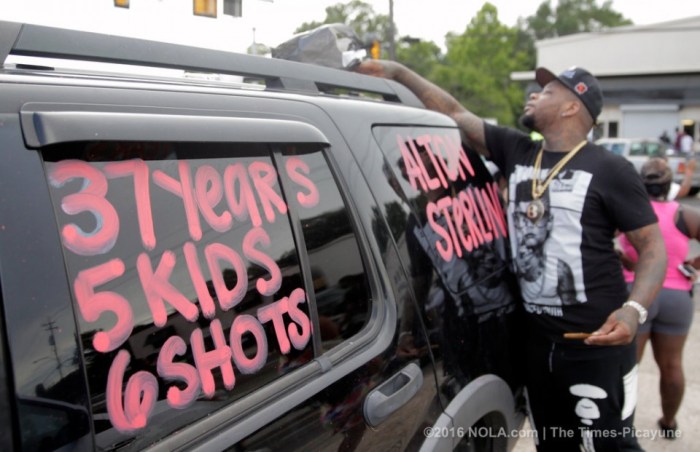
Baton Rouge Police shot and killed the father of five on July 5th.

The 37-year-old man was killed outside a convenience store in Louisiana because police allegedly got a tip someone was selling CDs and was armed. In the resulting scuffle, Sterling was shot and killed.

If the whole thing weren’t caught on a cell phone video, it probably wouldn’t be more than a sad headline. Just another black dude killed by police.

But the resulting attention has made his name a hashtag and his death a source of outrage – for good reason.

On the video, police tackle Sterling to the ground before gunshots are heard.

One of the officers shouts “gun” before shooting, but store owner Abdullah Mulfahi told the media that Sterling’s hand was not near any weapon and the alleged gun later recovered from his pocket was not visible.

People watch the video (or not) and immediately take sides.

Who is to blame – the police or Sterling?

Was the black man armed? Maybe – though Louisiana is an open carry state so he would be within his rights to do so.

What should he have done when confronted by police? What actions of his might have resulted in police not shooting him dead?

Did he have a record? Is that even relevant since police had no access to that information at the time?

Typically people come to conclusions based on their convictions and not based on the evidence. If you think black people are being victimized by police, then you’re probably on Sterling’s side. If you think black people are naturally violent and police rarely do any wrong, you’re probably on the side of law enforcement.

But what both sides are ignoring is a sense of context.

This was the 15th American killed by police so far in July alone.

Not the 15th black person. The 15th person. Period.

There’s some dispute over exactly how many people have been killed by police so far this year, but the number is surprisingly high. You’d think that would be something the federal government would keep track of, but no. The FBI’s Uniform Crime Reporting Program tabulates every criminal statistic imaginable – except homicide by law enforcement. Alarmingly, it leaves this to the private sector – almost as if it had something to hide.

Much of this is done by the news media, both in and out of the country. The Washington Post puts the number of Americans killed by police this year at 505 people. The Guardian puts it at 560. An open sourced database called Killed by Police puts the number at 580.

Any way you look at it, no matter which tally you go with, 2016 is turning out to be one of the deadliest years for police shootings since people have been counting.

It’s a problem for everyone. Police should not be killing such high numbers of civilians. In fact, in other countries, they don’t. Police kill more people in the U.S. in days than they do in other countries in years.

For instance, U.S. police killed 59 people in 24 days last year. In England and Wales, 55 people were killed by police in 24 YEARS!

And the numbers aren’t that high solely because the United States has a larger population. The entire nation of Canada has about as many people as the entire state of California, yet Canadian police killed 25 people last year to 72 by California law enforcement.

That may be due in part to a lack of accountability.

Despite such high body counts in this country, not a single police officer has served jail time for it in the last few years. Several officers went to trial in 2016, but none were convicted, according to the Wall Street Journal.

Last year had the highest number of officers being charged for shooting civilians in a decade. That number? 12. And none of them – not one – was convicted of murder or manslaughter.

We have a real problem here. American police kill far too many people.

However, this doesn’t mean that racism isn’t a motive in many of these police shootings. In fact, the numbers back that up.

Though more white people are killed by law enforcement in this country, it is black people who are killed at a disproportionately high rate. They only make up 13.2% of the population, yet they are twice as likely to be killed by police as whites. Nearly a quarter of all police homicides this year resulted in dead black folks.

What’s going on here?

First, we live in a police state. Officers often kill suspects with impunity and face little to no consequences. Not all police, certainly, but far too many.

Second, black folks are killed more regularly by police than whites. In fact, if all things were equal, you’d expect MORE white people to be killed than already are. Whites make up 77.7% of the population, yet they account for only half of the victims of police shootings.

This isn’t because black people are so much more violent than whites. According to the Center on Disease Control’s annual Youth Risk Behavior Survey, they engage in violent behavior at similar rates to whites.

For instance, they carry a weapon (whites 17.9% to African Americans 15.2%) and carry guns (whites 5.5% to African Americans 6.5%) at about the same rates. However, blacks are twice as likely to be arrested for weapons possession.

The same holds for assaults. African Americans report being in physical fights at similar rates (36.5% versus 32.5% for whites) but are three times more likely to be arrested for aggravated assault.

It should come as no surprise then that black people are more likely to be killed by police. This holds with everything else we know. When it comes to the criminal justice system, black people are penalized more often and that includes being shot and killed by law enforcement.

Why? Because they’re black. Because of societal attitudes, fears, phobias and prejudices.

For many of us, when we see Sterling’s last moments enacted on that cell phone video, we’re confronted with that fact. We put ourselves in his position. What could he have done differently? Whether he was guilty of a crime or not, what action on his part would have assured that he got out of this situation alive?

Eric Garner was choked to death by police while repeatedly saying, “I can’t breathe!” Tamir Rice was shot by police in two seconds. What exactly could a black person do to avoid being shot if law enforcement already perceives him or her to be a threat?

These are important questions. But they aren’t the only ones.

America has a problem with police violence. In fact, it has two problems. And we can’t solve one without solving the other.

We have to come to terms with this. It is not a case of racism or a police state. It is a case of BOTH.

Big Money Fails to Oust In-Coming Pittsburgh Schools Superintendent

DSC-4973-1

Democracy 1, Oligarchy 0.

That might be the score in the latest contest between corporate education reformers and the Pittsburgh Public School Board.

Special interest groups and the media had stirred up controversy for months over one line in newly hired superintendent Anthony Hamlet’s resume.

Last night the board voted to let the 46-year-old African American start his job as planned Friday morning.

The board voted 7-2 not to cancel his contract. He will be sworn in tomorrow to start a 5-year commitment in the city.

He had been unanimously hired May 18 from the Palm Beach County district in Florida where he had distinguished himself with an excellent record of leadership and enacting authentic reforms.

Though critics cited one line in his resume as too similar to a statement in a Washington Post article, the real reasons for the dispute are ideological.

Put simply, Hamlet favors reforms that have nothing to do with teaching to the test, charter school expansion, closing schools and other market driven policies.

This put him at odds with the usual gang of corporate sycophants:

1) The Campaign for Quality Schools Pittsburgh – a PAC recently formed to Make City Schools Great Again by promoting charter schools and other failed neoliberal reforms.

2) A+ Schools, an advocacy organization that used to champion the same kinds of authentic reforms school directors are trying to enact with Dr. Hamlet’s help. However, after getting a fat check from the Gates Foundation, the group has became a cheerleader for privatization and disaster capitalism.

3) Various foundations who immediately offered to pay for a new superintendent search if the district dismissed Dr. Hamlet – a measure that probably would have meant paying him at least a year’s salary to sit at home.

Why?

In short, they want a superintendent who thinks like them who they can control. They want to undermine our elected school board and community input process. They want to further THEIR agenda – not the education of our children.

Pittsburgh school directors are to be congratulated for not giving in to the monied interests.

Even the two directors who voted to remove Hamlet did so for good reasons. Though I thoroughly disagree with them, I think Terry Kennedy and Lynda Wrenn truly have the best interests of students at heart. They have always voted that way before.

It’s easy to write a blog about a district where you don’t live, as I do. They, however, are accountable to their constituents. I’m just a doofus with a WordPress account. They had a lot of information to process and made a tough decision. Thankfully, the other seven board members didn’t see it their way.

But that’s the beauty of it. This was democracy at work! At so many other urban districts throughout the country – even in similarly troubled Philadelphia – decision making “by and for the people” has become disbarred.

Many schools like Pittsburgh’s with a shrinking tax base, large pockets of crippling poverty and a history of state disinvestment are taken over by the state. Bureaucrats and flunkies make these decisions not members of a duly elected school board held accountable by the voters.

In fact, many calling for Hamlet’s dismissal were surely cheerleading just such a move in Pittsburgh. They were hoping to show that democracy doesn’t work in the Three Rivers community and must be replaced with … THEMSELVES.

The defeat of that position is the biggest victory here.

Now Hamlet and the board will get a chance to enact authentic reforms to help the children of Pittsburgh get the best possible education.

Now Hamlet will get to strengthen the restorative justice project already under way at 20 city schools. Instead of simply assigning detention or suspension for student misbehavior, administrators are encouraged to make students set things right after doing wrong.

In Florida Hamlet made a name for himself partnering with the criminology department at Florida Atlantic University on this same project.

It’s widely acknowledged in education circles that suspensions can have lasting impacts especially on black students making them more likely to enter the school-to-prison pipeline. Finding an approach to increase discipline without adversely affecting students’ prospects is imperative. This is especially true since Pittsburgh Public Schools have been known to suspend black students at a rate four times higher than white students.

Hamlet also will get to enact measures to transform Pittsburgh’s schools into a central part of the community and not apart from it. Like many on the board, he is an advocate for community schools. That means pushing for social services to help students and the community to make the schools the center of the neighborhood.

Hamlet has received support from all over the city including from the Pittsburgh Federation of Teachers.

However, in an unexpected move, some educators came out individually in favor of Dr. Hamlet even though doing so might mean putting targets of their backs from corporate forces.

High School teacher Jon Parker even wrote a blog about the issue where he pulled no punches:

“While the [Pittsburgh] Post-Gazette is complicit in this scheme to defame and destroy Dr. Hamlet, the real enemy here, as always, is A+ Schools. They simply cannot pursue their Gatesian agenda with a superintendent who believes in community schools. They need one who believes in firing teachers. They can’t pursue their agenda if the superintendent believes in collaboration rather than stacked ranking. And they can’t pursue their agenda of closing schools and turning them into charter profit factories if the narrative in our schools shifts away from “achievement” being measured by high stakes tests. Simply put, Anthony Hamlet is not their style, and they can’t stand that Pittsburgh’s community, through real grassroots activism and real community empowerment, elected a school board which genuinely engaged its community in a selection process that produced a once-in-a-lifetime superintendent selection.”


Erin P. Breault, a district teacher with three children who graduated from Pittsburgh Public, wrote to the Post Gazette to praise Dr. Hamlet:

“First, he will be a fine superintendent who will work to foster community schools, increase student learning outcomes and graduation rates. He will be an especially welcome breath of fresh air, not beholden to corporate “reformers” agenda. Second, I am especially alarmed about growing calls for his contract to be dissolved and if it is not, that our democratically elected school board be replaced by an appointed system.

This is outrageous. These attacks on Mr. Hamlet and on the process of the search need to be viewed in context. There are powerful interests including the Pittsburgh foundations, A+ Schools and Students First who are upset that their vision of privatization of our public schools has been challenged by our school district.

They have leapt into action, using their money, and political clout to engage into what amounts to character assassination.”


Kathy M. Newman, an associate professor of English at Carnegie Mellon University, wrote to the Post Gazette to school them on the definition of plagiarism:

“Mr. Hamlet’s resume is not a copyrighted work of art or nonfiction, such as a novel or a work of history. Nor is it a work of journalism. He was not trying to “pass off” (a legal term) the work of another artist or historian or journalist as his own.

…the outrage over Mr. Hamlet’s resume doesn’t acknowledge why it is that we demand citations from students and historians, or why artists might sue those who have appropriated their work. As the scholar Steven Dutch has argued, in an article called “Sense and Nonsense about Plagiarism,” citations “allow readers to check the accuracy of facts, gauge the credibility of the ideas being presented, know whether an idea is solidly established, controversial or hypothetical, and find further information.” When Mr. Hamlet borrowed a sentence from a Washington Post editorial to express his educational philosophy he did not, to use another phrase from Mr. Dutch, diminish the “credibility of the ideas being presented.”

Finally, the furor over Mr. Hamlet’s resume has had a tone of moral outrage so hysterical that I have been concerned about the toxic mixture of sanctimony and glee expressed by many people I otherwise like and respect. Again, according to Mr. Dutch, “the institutional hysteria over plagiarism [can become] a ‘witch-hunt.’ … Charges of plagiarism are fast becoming the blood sport of choice among academic bottom-feeders.”

Ouch. But perhaps the most incendiary remarks came from Churchill resident Lorraine Turner. In the Post Gazette, she accused the paper of outright racism in its criticism of Dr. Hamlet:

“As an African-American, we are taught this particular lesson many moons ago (along with the talk about police) growing up in, “Pittsburgh, Mississippi.” That lesson is: Black people must run twice as fast and jump twice as high as their white competitors. Black people must be exceptional with every “i” dotted and every “t” crossed. The comparison of President Barack Obama and Donald Trump will highlight this lesson…

…The editorial goes on using language to highlight nearly every antiquated, racist stereotype referencing black men: Mr. Hamlet made a “perfunctory apology” (he didn’t bow his head and say, “I’se so sorry), Mr. Hamlet “sounded like a nervous student” (just call him boy), then “a bad superintendent” (black is bad), “a good superintendent” (one approved by someone white), Mr. Hamlet “prefers recalcitrance to transparency’ (recalcitrance is when one is stubbornly resistant to authority or guidance — he thinks he’s actually going to have the power of the superintendent!)…

… I hope the board quotes a line from “The Wizard of Oz,” and tells your good ol’ boy editorial staff what the Good Witch of the East told the Bad Witch of West: “Go away, you have no power here!”

In the end, the power of the monied elites evaporated against the power of good ol’ fashioned democracy.

Because the fight against corporate education reform is a fight for representative government.

And the winners of today’s battle are as always our children, our grandchildren, our posterity.

Without Black Culture There Would Be No American Culture

Screen shot 2016-06-28 at 12.10.37 AM

“We’ve been floating this country on credit for centuries, and we’re done watching and waiting while this invention called whiteness uses and abuses us, burying black people out of sight and out of mind while extracting our culture, our dollars, our entertainment like oil – black gold, ghettoizing and demeaning our creations then stealing them, gentrifying our genius and then trying us on like costumes before discarding our bodies like rinds of strange fruit.”

With these words, Jesse Williams absolutely floored the crowd at the BET Awards Sunday night.

His acceptance speech for the Humanitarian Award was jaw dropping.

Here was a black actor on “Grey’s Anatomy” just telling it like it is on national TV.

He wasn’t afraid a business dominated by white people would take offense (and some white people did). Or if he was, he wasn’t going to let it stop him.

The activist who recently produced a documentary “Stay Woke: the Black Lives Matter Movement” said, “The burden of the brutalized is not to comfort the bystander… If you have a critique for the resistance… then you better have an established record of critique of our oppression.”

No more tone policing. No white fragility. Just if you’re with us, stand up – otherwise, sit down and shut up.

It was beautiful. And it got me thinking.

There are so many obvious truths about our country’s relationship with race that hardly anyone ever gives voice to – especially a white person like me.

So I’m going to add my voice to Jesse’s. I’m just going to say it.

It’s past time we admit it, white people.

American culture would not exist without black culture.

I don’t mean to say that white people are incapable of culture or that if black people had never been kidnapped and brought to our shores as slaves that white people wouldn’t have been able to devise a unique national character.

But if that had happened, it would have been a very different character than what we have today.

It might be America, but it would not be our America. It would be some other thing. I will leave it to speculative fiction to attempt to determine what that might have been like.

However, we need not resort to fantasy to see all the incredible things black people have given us. They’re everywhere, in everything – though usually staring back at us through a white face, heard from a white voice and monetized by a white industry.

The hundreds of years of struggle from slavery through Jim Crow through the modern prison state have given black people plenty of fertile ground with which to build our national culture. Traditionally white people have served as both oppressors and appreciators of the fruits of that oppression.

The most obvious example is music.

There is very little American music not based on black traditions. Even if it is performed by white musicians, even if it is written by white musicians – almost all American music owes an overwhelming debt to black people.

Take rock n’ roll, a style usually associated with white people. The majority of rock musicians are white. The majority of rock stars are white. The majority of rock listeners are white.

But it couldn’t exist without black music – specifically blues and jazz.

Rock n’ roll was invented during the second great migration, when black people from the southern United States came into contact with large groups of whites in big cities such as New York, Chicago, Cleveland, Buffalo, etc. It was the first time many white people heard black music like blues, work songs, etc. It was also the first time many black people heard European instrumentation. The resulting cultural collision was extremely fruitful.

Rhythm and blues (sometimes called “race music”) evolved into distinct new styles – country, jazz, gospel, folk and rock. In many ways the different styles had less to do with actual differences in the music than in rebranding black music for a white audience. When a black musician became known for a particular kind of music, the fledgling music industry tried to monetize it by finding a white musician who could do something similar and thus reach a larger audience.

They figured if X number of white people will listen to this music played by a black musician, X plus thousands more will listen to it if played by a white one. And they were right.

Black musician Chuck Berry was one of the first to play what we’d recognize as rock n’ roll. He took standard jump blues and played the two-note lead line on his guitar that until then was typically performed on piano. He put guitar at the center of the sound, amplified it, electrified it and rock was born.

The genre developed organically with many black musicians taking the lead – Fats Domino, Sister Rosetta Tharp, Goree Carter, Jimmy Preston, Bo Diddley, Little Richard, Joe Hill Louis, Guitar Slim, Howlin’ Wolf and many others.

However, the first certified rock hit “Rock Around the Clock,” was recorded in 1954 by an all white band, Bill Haley and His Comets. With this recording, the die was cast. The music was invented and developed mostly by black musicians, but it wasn’t a major success until it was recorded by white musicians.

The same thing can be seen with Elvis Presley, the so-called “King of Rock n’ Roll.” He wasn’t breaking any new ground. He was just the first white person who could sing like the black blues musicians who came before him. They toiled in obscurity. He cashed in.

This isn’t to say that no black musicians succeeded playing rock n’ roll. But it was predominantly white musicians who popularized the style that their black forebears had created.

To understand this, perhaps it is best to turn to the insight of Amiri Baraka (formerly known as LeRoi Jones). In his classic book “Blues People,” he dissects the complex American relationship of race and music through the 1960s.

Baraka writes that white and black America have different value structures. As such it is a very different thing for a black American and a white American to play the same music.

When a black musician like Louis Armstrong played jazz music – another invention of black culture – he was fulfilling the ideals of his culture. By contrast, when a white musician like Bix Beiderbecke played jazz music, he was rebelling against his.

There is something jarring and revolutionary when white musicians play black music, Baraka writes. In doing so, the music becomes devoid of race. It is no longer black music. It is just music.

However, the musicians who created it are not likewise freed from the ghetto. They’re still black even if their music no longer is.

So what are black musicians left to do but create new music that they can call their own?

This may explain why so few black performers play rock music anymore. It was taken from them. They had to move on.

Even so, their fingerprints are all over everything that came after. The Beatles, Rolling Stones, Led Zeppelin, Metallica, all the way through the White Stripes and Black Keys. Ask any hardcore fan to name the best rock guitarist who ever lived, and the answer is bound to come back – Jimi Hendrix. Yet, Eddie Van Halen made an awful lot more money.

Perhaps the most incredible thing is that black musicians have continued to develop new and more creative music after every appropriation. Funk, Rap, Pop, Hip Hop, modern R&B. One can see all of it as a progression of gentrification and subsequent creation.

It makes me wonder: why do we love black culture so much but not black people?

As Williams said to end his speech this weekend, “…just because we’re magic doesn’t mean we’re not real.”

Black people have achieved amazing things in America. But white people rarely give them their due.

For instance, people generally think of rap as a black thing. But the largest audience for the genre is us, white folks.

There’s something jarring about white teenagers singing along with every n-word in the lyrics of a black rapper’s song as if these kids had the right. We don’t, people.

As Baraka might say, it’s a very different thing when we say it. But it’s more than just rebellion.

Too often white people turn to music that is characterized as black as a way to mock that culture. We demand black culture be commodified in a way that makes sense to our vision of what black people are. And when someone like Williams comes forward to call us out on it, we resent it.

Look around, white folks.

We love our culture, but we’re ignorant of our history.

We enjoy living vicariously through a marketed vision of black struggle but we don’t do anything about the actual struggle before our eyes.

Our black brothers and sisters are crying out in pain. And we’re the cause.

No, we probably didn’t light any crosses afire on anyone’s lawn, but what about our attitudes? What do we say when race comes up? Do we indulge in gut reactions of colorblindness or do we actually listen to what black people have to say? Do we do anything but shrug?

This isn’t about white hate or white guilt. It’s about accepting our responsibilities.

We owe black people much of our very idea of what it is to be an American. Isn’t it time we started paying it back with love and action?