A Teacher’s Dilemma: Take a Stand Against Testing or Keep Abusing Children

 AJGE5E_2026469c

What am I?


Seriously. What is it I do for a living?


When I wake up to go to work in the morning, am I preparing to be a teacher or a test proctor?


Am I engaged in the practice of nurturing young minds or am I a tool of the establishment?


Should I be held accountable to the dozens of students in my classroom, their parents and the community – or to my administrators, the bureaucrats and moneyed interests ordering us around?


I ask these questions not as a rhetorical device. I really don’t know the answers. Because the solution begins with me.


Today was not a banner day in my classroom, and I can honestly say it was not my fault.


I had to give my 7th grade students the Classroom Diagnostic Tools assessment in Reading/Lit for grades 6-high school.


If you’re not familiar with the CDT, this is an optional test offered by Data Recognition Corporation for students in Pennsylvania’s public schools. It’s a way to assess student learning to predict whether they’ll pass there annual federally mandated standardized tests (also created by Data Recognition Corp. in the Keystone State). In addition, it offers example questions of the type that students struggled to answer correctly on the diagnostic.


It’s very helpful if you want to print out a buttload of test prep, give it to students and then read the paper quietly at your desk – something I never do.


For the second straight year, I’ve been forced to give it to my students three times annually – twice before the Pennsylvania System of School Assessment (PSSA) tests and once after.


I am not a fan.


Students hate it. It does not return valuable data. And it takes precious time that I could be using to actually teach something.


When I told my kids they were going to have to take the assessment this morning, one girl said, “I hate the CDTs. It stands for I Can’t Do This.”


Another girl had a more visceral reaction. When she saw the letters “CDT” on the board, she literally began rolling around on the floor and groaning.


These are the kinds of students I have – victims of generational poverty, malnutrition, childhood trauma, violence, drug abuse and systemic racism and prejudice. Strong-arming them into another standardized test isn’t doing them any favors.


Compare their reaction this morning to yesterday’s lesson.


We had just finished a unit on plot using Dr. Seuss stories and cartoons to illustrate complex concepts like exposition, conflict, rising action, climax, resolution, theme, etc.


I made a competitive review game through a program called Kahoot, and kids were out of their seats, jumping around, squealing with delight as they demonstrated their knowledge of what they’d learned. It got so loud one of the principals came running over from the office to make sure things weren’t getting out of hand. But what he found were students so engaged by the work they could barely contain themselves.


Heck! I even gave them a test of my own creation right afterward. There were no groans. There were no protests.


They sat at their seats like grown adults, concentrated and answered the questions to the best of their abilities.


Compare that with today’s assessment.


Behaviors off the hook. Sullen looks. Demands to use the restroom, go to their lockers, visit the nurse – ANYTHING but be here in class and do this test.


Why the difference?


Because they knew what was expected on MY test, and they knew they could meet my expectations. I was there for the lesson. I made the test. I would grade it. I have a relationship with these kids and they know I will assess them fairly.


But not on this standardized CDT nonsense!


Data Recognition Corp isn’t there for the lesson. It has no rapport with students. Kids don’t know what the expectations are and don’t think they can meet them. And they have no sense that this multi-billion dollar corporation will grade them fairly for their efforts.


So they act out.


They throw wads of paper or airdrop pictures to each others’ iPads.


And here I am in front of this room of unruly children forced to have to defend the bullcrap garbage that I’m being coerced to do to them.


I want to apologize. I want to tell them this is not my idea. And after a while, I even DID that. But it’s no use.


It matters little whether the executioner does his job with reluctance or not. He’s still here to end your life. And I was still cast in the role of ending their education for the day and replacing it with “proof” that they aren’t good enough.


When the test was over, so many children showed me their scores with hurt faces.


“Mr. Singer, I really tried!” one boy said.


“This is rigged!” another said.


And what am I supposed to say to that? Should I explain how they’re right – how standardized tests have always been culturally and economically biased? Why would they care!? What kind of teacher would that make me!?


I know this is wrong, but I still do it!?


What use am I?


What purpose do I serve enforcing policies I know to be detrimental?


I went through five years of college to become a teacher – not a prison guard. But on days like today that’s what I am. I’ve devoted over a decade of my life to nourishing children, not ordering them all to march in line single file.


But here I am, a paid thug who browbeats and coerces innocents into doing things they don’t want to do for purposes that won’t benefit them and will in fact be used against them.


I wonder what the school board would say if I had the guts to stand in front of them at a public meeting and tell them.


I guess I’ll just have to keep wondering because the last time I tried to address that august body without an explicit invitation, I was told I wasn’t allowed to do so since I don’t live in the district where I teach.


But sometimes I question whether the elected representatives of my district even understand what I’m being bulldozed into doing in their name.


Do you know I am abusing your children? I am crushing their creativity, their self-respect, their curiosity. Is that really what you want of me? Is that what you hired me for?


Don’t get me wrong.


It’s not really anything new. I’ve been doing this for almost 15 years. It’s just harder every year.


I heap on justifications – you have to do the bad stuff so you can do the good stuff. You have to enforce the testing so you can do authentic teaching.


And every year the mandates get more restrictive, the teaching gets a little less and the testing a bit more.


Meanwhile, politicians pretend like they’re doing something to fix it. Gov. Tom Wolf (whom I generally like) cuts off a few days from the PSSA tests this year. But he keeps the recommendation that we take the CDTs. He keeps the entire test-and-punish framework in place. Like most Democrats, he’s willing to twiddle around the edges but has no guts to do away with what’s wrong and replace it with what’s right.


Meanwhile, parents in my state are generally clueless.


You have some strong advocates here and there. Some moms and dads who understand what’s going on. But most are either oblivious, too busy putting food on the table, in jail or dead.


I used to send home a letter to parents reminding them of their right to opt out of standardized tests. It almost got me fired.


And for my efforts, I think maybe one or two parents over five years actually took me up on it.


I go to my local union and tell them my concerns. They nod and ask for more information and then quietly forget it.


Meanwhile, the national unions are behind the testocracy 100%. They’ll wag their fingers and complain about testing, but they’re too busy making sure the teaching profession even exists tomorrow to stop for small potatoes like bad practices.


I feel so alone here.


I’m pulling my hair out and the only response I get is from the choir (Hallelujah!) and the corporate education reformers (How dare you!?).


The majority stays silent. And complicit.


I’m just not sure I can do it anymore.


I’ve thought about calling in sick whenever I have to give a standardized test. It would be a lot of days, but I could do it.


That might be safe, but it would be cowardly.


I’d just be saving myself the pain and humiliation of giving the tests. My students would still be forced to take them.


So what do I do?


I write.


I write blogs like this one.


I pound out my cares and reservations, put them in a virtual bottle and set it adrift on the seas of the Internet.


It’s a constant gamble.


Someday someone may read them who can end my career.


Or maybe someone with the power to make a difference will read them.


Maybe that’s you.


Maybe it’s all of us.


I don’t know.


I have no solutions today. Just shame and regrets.


A dilemma that I cannot solve.

Dear Teachers, Don’t Be Good Soldiers for the EdTech Industry

FullSizeRender

Dear fellow teachers,

Thank you for coming to this meeting on such short notice.

I know you have plenty more important matters to attend to this morning. I, myself, left a pile of ungraded papers on my desk so I could get here. Not to mention I urgently need to fix my seating charts now that I’ve finally met my students and know who can sit with whom. And I’ve got to track down phone numbers for my kids’ parents and go through a  mountain of Individual Education Plans, and… Well, I just want you to know that I get it.

There are a lot of seemingly more pressing concerns than listening to a teacher-blogger jabber about the intersection of politics and our profession.

Is that all of us? Okay, would someone please close the door?

Good. No administrators in here, right? Just classroom teachers? Excellent.

Let’s speak openly. There’s something very important we need to talk about.

There is a force out there that’s working to destroy our profession.

Yes, ANOTHER one!

We’ve got lawmakers beholden to the corporate education reform industry on the right and media pundits spewing Wall Street propaganda on the left. The last thing we need is yet another group dedicated to tearing down our public schools.

But there is. And it is us.

You heard me right.

It’s us.

There is an entire parasitic industry making billions of dollars selling us things we don’t need – standardized tests, Common Core workbook drivel, software test prep THIS, and computer test crap THAT.

We didn’t decide to use it. We didn’t buy it. But who is it who actually introduces most of this garbage in the classroom?

That’s right. US.

We do it. Often willingly.

We need to stop.

And before someone calls me a luddite, let me explain. I’m not saying technology is bad. It’s a tool like anything else. There are plenty of ways to use it to advance student learning. But the things we’re being asked to do… You know in your heart that they aren’t in the best interests of children.

I know. Some of you have no choice. You live in a state or district where teacher autonomy is a pathetic joke. There are ways to fight that, but they’re probably not in the classroom.

It’s not you who I’m talking to. I’m addressing everyone else. I’m talking to all the teachers out there who DO have some modicum of control over their own classrooms and who are told by their administrators to do things that they honestly disagree with – but they do it anyway.

We’ve got to stop doing it.

Corporations want to replace us with software packages. They want to create a world where kids sit in front of computers or iPads or some other devices for hours at a time doing endless test prep. You know it’s true because your administrator probably is telling you to proctor such rubbish in your own classroom so many hours a week. I know MINE is.

Listen, there are several reasons why we should refuse.

First, there’s simple job security. If your principal brought in a Teach for America temp and told you this lightly trained fresh from college kid was going to take over your classes, would you really sit down and instruct her how to do your job!?

I wouldn’t.

That’s the entire point behind this tech industry garbage. You are piloting a program that means your own redundancy.

You are engaged in an effort to prove that they don’t need a fully trained, experienced, 4-year degree professional to do this job. They just need a glorified WalMart greeter to watch the kids as they push buttons and stare at a screen. They just need a minimum wage drone to take up space while the children bask in the warm glow of the program, while it maps their eye movements, catalogues how long it takes them to answer, records their commercial preferences and sells all this data to other companies so they can better market products – educational and otherwise – back to these kids, their school and their parents.

This isn’t about improving educational outcomes. It’s about bringing the cost down and pocketing the savings as profit.

It’s about replacing the end-of-the-year standardized test with daily mini stealth assessments that are just as high stakes and just as effective at providing an excuse for the state or the feds to swoop in and steal control, disband the school board and give the whole shebang to the charter school operator who gives them the most generous campaign donations.

Do NOT be a good soldier here. Do not just follow orders. Doing so is weakening our entire profession. It is putting our jobs in jeopardy. And it’s about time our national teachers unions figured this out instead of conceding the point so their leaders can keep a seat at the table. Someone needs to tell them they shouldn’t be sitting inside the building. They should be with us, outside surrounding it with signs and pitchforks.

The EdTech shell game is not about improving student learning. It’s a commercial coup, not a progressive renaissance.

Think about it.

They call this trash “personalized learning.” How can it really be personalized if kids do the same exercises just at different rates? How is it personalized if it’s standardized? How is it personalized if it omits the presence of actual people in the education process?

It’s teach-by-numbers, correspondence school guano with graphics and a high speed Internet connection.

But we give in. We don’t want to rock the boat. We’re rule followers, most of us. We do what we’re told.

Most teachers were good students, and obedience is too often a defining quality of those who succeed in our education system.

I get it. You don’t want to be a fly in the ointment. You don’t want to make yourself a target.

Me, too.

How dearly I would love to be able to just comply. But I can’t simply go along with something I know in my heart to be wrong. And this is wrong on so many levels.

I sat through a meeting much like this one earlier this year where I was told exactly which programs to force on my students. All the while good teachers whom I respect went through the motions as if nothing was wrong. They talked about how to organize our classes in the system, how to assign test prep and how often, and how to access the data.

But we never discussed why.

We never discussed if doing so was a good idea. That was all taken for granted. It was a decision reserved for someone else, someone from a higher pay grade.

Yet classroom experience is rarely commensurate with salary scale especially once you cross the line into management. Nor is the experience of a handful of administrators equal to that of a plentitude of staff!

No. I’m sorry. At very least that is a discussion WE should be having.

It is the TEACHER’S job to determine what is educationally appropriate. Not the administrators. At most, the building principal should be part of that discussion in her role as lead teacher. But the resolution to go ahead or not should be made together as a staff.

And if an individual teacher thinks based on their own experience with their own students that they should go in a different direction, they should be respected enough as a professional to have the autonomy to do so.

Teachers have to abide by best practices, but test prep in any form is NOT a best practice.

It’s time we stood up en masse and made that clear.

We are our own worst enemy in this regard.

We are too submissive. Too meek.

This world requires teachers to be revolutionaries, to be radicals.

And that doesn’t end in the classroom.

We need to educate parents and the community about what’s happening. The classroom doors are too often closed to the public. The only information they get is from anemic administrators and a mass media that invariably just reports whatever propaganda the corporation puts on the press releases.

We are responsible for our students. We must protect them from the vultures out there trying to water down their educations and reduce the quality of their learning.

We are not the only ones who can take a stand. In fact, IF we are the only ones who do it, we will certainly fail.

But, along with parents, students and concerned citizens, we MUST be part of that resistance.

We MUST take a stand for our children and our profession.

Because without us, there is no hope of success.

So we can no longer afford to be good soldiers in someone else’s army.

It’s time to have the courage of our convictions.

It’s time to rise up, walk hand-in-hand to the front of the staff meeting and tell our administrators:

NO.

Because if we don’t, no one else will.

Why I Teach

https___blueprint-api-production.s3.amazonaws.com_uploads_card_image_488464_d6180c5d-946d-4770-9d02-091555a03a3b

Every year it’s the same nightmare.

I’m in front of a class of middle school students who aren’t paying any attention to me.

I point to the board, stamp my foot, even scream in vain.

But the children keep acting up – throwing pencils, swearing, hurting each other’s feelings.

It’s like I’m invisible.

And then I wake up.

Every teacher probably has a similar dream the night before their first day with students.

It’s a dream of impotence and redundancy.

Kind of like the businessmen and their political puppets claim we, teachers, are every day.

But the reality is much different.

Kids come bouncing in to my room, bristling with energy, half concealed hopes and fears.

Before they come in, I’m full of doubt: Can I still do this for another year? Will I be able to keep up with the work load? Will I be able to accommodate all the extra services for every special education student in my mainstreamed classroom? Do I have enough desks, pencils, paper? Have I planned enough for the first week? Will I be able to keep students interested, entertained, disciplined, engaged, working, inspired?

But the second the kids enter the classroom – literally the exact second – all my doubts disappear.

There’s no time.

I have more than two dozen children to see to at any given moment – and their needs outweigh any of mine.

It wasn’t until about halfway through the day that I even had an instant to myself to stop, breathe and reflect.

After my first bathroom break in more than 3 hours, then grabbing my lunch and collapsing into a seat- the first time I’m off my feet with no anxious little faces looking up to me – I think back on my day and realize – I absolutely love this!

No, really.

My feet hurt, my temples throb from making a hundred tiny decisions every 40 minutes, my body feels like it’s already been through a war… But there is no place in the world I would rather be.

Look what I’ve already accomplished today!

I took about 50 anxious human beings and made them feel like it was going to be okay.

I made 50 faces smile, sigh and relax.

I worked for hours on a new syllabus last week with manga graphics and punchy repartee, and when the kids got it today, they knew this class wasn’t going to be boring. I planned some ice breaker games to get them focused on our budding community of learners. I modeled how we can interact and still respect each other.

And in return I heard: “This is the best class!” “Mr. Singer is my favorite teacher!” “I don’t like to read or write but I’m really looking forward to doing your homework!”

How can you hear such things and not come away energized and new? How can you see such things and not feel a warm glow in your heart?

One of my first assignments is to have students write a letter about themselves. It’s now day 3 and I’m sitting at my desk reading through them.

It’s heartbreak city. Dead or absent parents, lost friends and pets, moving from place-to-place, older brothers and sisters serving as caregivers, pledges to work hard this year and make some missing adult proud. I find myself tearing up and writing supportive comments: “That’s so sad.” “I hope you like it here.” “You’ve already made me proud.”

I go through my Individual Education Plans and see a catalogue of hurt and trauma. Babies, they’re just babies, and they’ve gone through more than I have in my whole life. And I’m more than three times their age!

How can I not come to school every day and give my very best?

A public school is more than a building to me. It’s a temple to humanity. It’s where we go to offer ourselves to other people.

Every action, every thought spent on these children is holy. The tiniest gesture is magnified through infinite time and space. When I help a child gain confidence in her reading, I help not just her. I help everyone she will ever come into contact with –her co-workers, her friends, family, even her own children if she someday has some.

It’s humbling. Amazing. Staggering.

Where else can you see the accumulated hurt of the world and actually make a dent in it? Where else can you reach out not just to a cause or an idea but to a living person?

I’m lucky. I am so lucky. My circumstances allowed me to do whatever I wanted with my life.

I could have become a doctor or a lawyer. I could have gone into business and made a whole mess of money. But I never wanted any of that. I wanted to make a difference. I wanted to help people.

I remember the pitying looks peers would give me in my 20s. What a waste, they seemed to say. But I’ve never regretted it.

This is what I was meant to do. It’s the only thing I ever could and still respect myself.

Some folks will tell you teaching is about numbers and data. Increase these test scores. Cut costs by this much. Boost profits, escalate the graph, maximize effectiveness.

These people are fools.

Teaching has nothing to do with any of that. It’s about the children. Being there for them. Being an active part of eternity.

Thankful eyes, delighted smiles, joyous laughter. Ameliorating hurt. Igniting a tiny candle whose light will grow to encompass sights I will never see.

That’s why I teach.

Who is Responsible for Student Achievement?

achievementseries


Billy is an average middle school student.


He sits down and takes a test.


The grade comes back.


Who is responsible for that grade?


This should be the dumbest question you can ask in the field of education.


The answer should be obvious.


Billy is responsible.


Billy did the work, he took the test, he earned the grade.


But all across this great country of ours we’re giving the wrong answer.


We’re saying teachers are responsible for that grade.


This is ridiculous. Teachers could not do the work for the student. Teachers could not take the test for the student. How can you possibly assume the teacher is responsible for the grade?


In fact, if the teacher really were responsible – if she did all the work and took the test – how could you rationally say this grade belonged to the student? No, it wouldn’t be Billy’s, it would be his teacher’s.


The truth goes something like this: You are responsible only for things within your control. The greater your degree of control, the greater your degree of responsibility.


This is not complicated.


It is simple logic. Cause and effect.


But ignoring it is perhaps the most virulent, incorrigible, fact-resistant mistake in the entire field of public education.


Lawmakers are getting it wrong. The media is getting it wrong. Superintendents, principals – even teachers are getting it wrong.


And the reason is somewhat pernicious.


We’ve been sold a lie.


We’ve been told for so long that educators are responsible for their students’ work that we’ve begun to accept it without question.


Just today at a training in my district, I was shown a spreadsheet of student test scores and told in no uncertain terms that this was something I have control over.


I DON’T.


I don’t have control over the raw scores. I don’t even have control over how much a student improves from one year to another.


The student does.


HE controls how hard he works on assignments. HE exhibits the most control over the results of his assessments.


This doesn’t mean I’m completely helpless.


I do have control over certain aspects of students’ academic experience.


I control what work is assigned, when it is assigned and to whom.


I control whether there is extra credit, what counts as homework, who gets extra help, etc.


In many cases, I even get to decide whether students have completed their work and if assessments have been completed successfully.


As long as I am exhibiting best practices, giving age-appropriate work and evaluating it fairly, I’m doing my part.


It is not then justified to assume I am solely responsible for the end result.


I raise the hurdles, but the student actually goes through the obstacle course.


The teacher is a factor, but not the largest one. That is the student, Billy.


Yet he is not alone here. Besides, me, his teacher, there is also the principal, the student’s parents, his friends and even society as a whole.


All of these and more contribute to student success.


The principal controls school policy. He determines what discipline the student receives, the clarity of school rules, etc.


Likewise, students’ friends are part of their social network. They can help with homework, form a study group, or distract from school work, denigrate work ethic, etc.


Society also plays a role. If a student is part of a community that values education and work ethic, that student will more likely put forth more effort. If the student lives in a community where school is seen as unimportant and teachers are not respected, that will have a negative impact, etc.


And the number one factor other than the student, himself, that contributes to his success is parents. They control home life, emotional support, tutoring, nutrition, etc.


All of these complex factors combine to add up to an individual student’s success. However, at the end of the day, it is the student, himself, that bears the brunt of the responsibility for what he does.


That’s why we call it HIS grade and not someone else’s.


This is the most obvious thing in the world, but it has certain consequences for education policy.


For instance, it immediately invalidates the majority of teacher evaluations given throughout the country. The reason? Most evaluations are based at least in part on student test scores.


As we’ve seen, this misrepresents the student-teacher relationship. It blames the teacher for things well beyond his or her control.


It turns students into passive objects acted on by magical super teachers who can somehow make them learn simply by – what – endless repetition of test prep materials?


Why would students put forth their best in this scenario? If they’re failing, it’s somehow not their fault. It’s their teachers!


But even worse than this misrepresentation, it completely ignores a plethora of vital factors in the education process.


Parents, for instance, are crucially important, but we’re leaving them completely out of the loop.


When parents struggle to fulfill their responsibilities, why is there little to no help? The answer: because we’ve hidden the fact that such responsibilities even exist. We’ve thrown it all on the teacher and the school.


All these out-of-school factors are obscured, yet taken together they are almost determinate. After all, this is why poor and minority students disproportionately struggle academically.


You can demand every student jump six feet straight up, but those with the best resources will meet this goal much more frequently than those without.


And who is in control of those resources? Who decides which children get the smallest class sizes, the best home environments, the most conducive social networks, etc.?


The myth of teacher accountability is what stops such resources from being sent.


We’re told all you need is a good teacher.


But this is not true.


You need much more.


The ultimate responsibility may rest with the student, but until we all realize and acknowledge our collective responsibilities to all students, success will always be out of reach for far too many of them.


Billy may take the test, but it is society that is failing to meet its responsibilities.

Why Won’t Republicans Repeal Common Core?

277661_5_


It was a constant refrain from Donald Trump on the stump.


He was going to repeal Common Core. How did we know? He kept repeating it over-and-over.


“We’re cutting Common Core. We’re getting rid of Common Core,” he said during a debate in Detroit.


“Common Core is a total disaster. We can’t let it continue,” he said in a campaign ad.


But then, he did a complete 180:


“We are going to do some things special. Okay. Are you ready? Common Core we’re going to keep.”


What!?


It didn’t go down so well with his supporters. He was literally booed. So he took to Twitter with the following:


“I was referring to the fact that Jeb Bush wants to keep common core.”


Screen Shot 2017-08-11 at 11.41.06 PM

Uh, okay?


So what’s his position now? Someone asked him about it in New Hampshire. His response:


“I didn’t know Common Core was so complicated. Isn’t this ridiculous?”


On that we can agree.


But it really doesn’t matter.


POWER TO THE STATES


Whether Trump supports Common Core or not, he’s actually kind of powerless to do anything about it.


Republicans have been arguing for years that the federal government can’t tell the states what they should be teaching. That’s the crux of opposition, and the newly reauthorized federal law governing K-12 schools, the Every Student Succeeds Act (ESSA), underlines it.


The power is unequivocally in the hands of governors and state legislatures.


The states control which academic standards their public schools are supposed to subscribe to or not. And since the beginning of 2017, the states are overwhelmingly in Republican control.


There are 98 partisan state legislative chambers in the United States. Republicans dominate 67 of them. In fact, the GOP controls both legislative chambers in 32 states – the most it has in the party’s history! And in 24 of those states, Republicans also run the show in the Governor’s mansion – the trifecta!


In short, despite any limits on Presidential power, the GOP has never been in a better position to get rid of Common Core.


If Republicans truly wanted to repeal it, they could do so tomorrow, and there’s zero Democrats could do about it in almost half of the country.


Yet, Republicans don’t.


They haven’t.


And they don’t seem in any rush to put it on their agenda in the future.


Which brings me to a serious question any critic of Common Core has to answer: WHY!?


Republicans say they hate Common Core.


They have the power to get rid of it.


Why don’t they do it?


THE STATE OF COMMON CORE


Despite any comments to the contrary, any blathering talking head nonsense from media pundits, the facts remain the same.


Common Core is still the law of the land in 36 states and the District of Columbia.

Screen Shot 2017-08-11 at 11.46.51 PM

Sure, some legislatures have changed the name and made nominal revisions (Hello, Pennsylvania!) but they’re still essentially the same standards applied in the same way. The Common Core’s own Website doesn’t distinguish between states that have the standards outright and those where they have been slightly revised or renamed.


Specifically, nine states have announced plans to rewrite or replace the standards, but in the majority of these cases, they have resulted merely in slight revisions. Only Missouri, Oklahoma, and Tennessee appear to have created significantly different standards, according to Education Week.


So what’s the hold up?


MAIN OBJECTIONS TO THE CORE


Full disclosure: I am not a Republican. I am the farthest thing you could find to a Republican. But on this one issue we agree.


No, I don’t think Common Core will make your child gay or indoctrinate kids into a far left worldview or any of a number of bizarre, crackpot criticisms you might hear from mentally ill pundits being exploited by far right media conglomerates. Nor am I opposed simply to undo any signature legislative achievements of our first black President.


But I do think there are several rational reasons to be against Common Core. The standards were written almost exclusively by representatives of the standardized testing industry with input from very few practicing classroom teachers and zero child psychologists. They have never been tested and proven effective. In many cases, they are developmentally inappropriate. They were adopted non-democratically. And – perhaps worst of all – they commit schools to the failed educational management technique of test-and-punish.


THAT’S why I’m against Common Core.


But it really doesn’t matter.


Even if people like Glenn Beck and I disagree on the reasons why, we both agree on the course of action – repeal Common Core.


Yet the incumbent batch of GOP lawmakers across the country are letting us both down.


If one has to be beaten by Republicans, at least let them accomplish the things that have bipartisan support. That includes repealing Common Core.


Though the media likes to characterize this as a conservative issue, it’s not just Republicans who want to get rid of the Core. Regardless of politics, most people dislike the standards. They aren’t popular with adults. They aren’t popular with children. And most tellingly, they aren’t popular with classroom teachers.


According to the most recent Education Next poll, less than half of all Americans, 49%, favor the policy. In partisan terms, that’s 37% of Republicans and 57% of Democrats. And that support has been steadily dropping every year – by 20 points for Republicans and seven for Democrats since 2013.


And among teachers, the drop is even more dramatic. Only 40% now favor the Core. That’s a drop of 36 points among those who know the standards best!


POLITICAL PARALLELS


So let’s get rid of them.


For once I’m with Trump.


But the legislatures just won’t do it.


In some ways, this shares parallels with the healthcare debate.


Before going forward, let me just say that I am NOT in favor of repealing Obamacare and going back to the previous system. Nor am I in favor of repealing without a replacement or any of the so-called “skinny” plans put forth by the GOP.


I think we need single payer healthcare. Medicare for all.


But be that as it may. The debate offers us a similar example from the federal level.


Republicans say they hate Obamacare yet despite the fact that Democrats can do nothing to stop them, they refuse to repeal it.


In this case, the reason is obvious – they have nothing with which to replace it.


After all these years, they can’t come up with a plan that will improve upon the one already in place.


But this isn’t the case at the state level when it comes to Common Core.


Each and every state had a set of academic standards before Common Core. In most cases, these standards were actually far superior.


All the legislatures would have to do is reinstate them.


Pennsylvania’s standards were particularly reasonable, flexible yet grade appropriate and comprehensive.


We could go back to them tomorrow.


But we don’t.


Why?


It’s that same question again.


What is holding us back?


STANDARDIZED TESTING


Here’s my theory: it’s the testing.


One of the most frustrating things for Common Core critics is when apologists say they hate standardized testing but love Common Core.


The two are inextricably interlinked. You can’t have Common Core without the testing. That is the whole point of the standards – to tell districts what to focus on because those things will be on the federally mandated high stakes standardized tests.


If states repeal Common Core, what happens to these tests?


Before adopting the Core, each state had a test aligned to its own specific standards. Even where some states had the same tests, their standards were significantly similar to allow this. In any case, most states that have adopted the Core have had to buy new, more difficult tests.


Sure, we could all go back to the tests we used to give, but this would present certain problems.


First, many states were taking tests that were already being aligned with Common Core before they officially adopted it. If they got rid of the standards, they couldn’t go back to the old tests because they’re already Common Core specific.


In theory, they could ask to reinstate older versions of the test that aren’t Common Core aligned. However, in practice for some states, this might necessitate the creation of yet another batch of new tests.


However, in many states like Pennsylvania, this wouldn’t be an issue. Before the Core, they had their own tests based on state specific standards. There’s really no reason why they couldn’t dust off these old tests and put them back into circulation.


The problem is that this would require politicians to justify the millions of dollars (at least $7 billion nationally) they wasted on the new tests, new workbooks, new textbooks, etc.


Lawmakers would have to own their mistakes.


They’d have to say, “My bad!”


And most of them aren’t about to do that.


Of course, there is a third option: they could undo the high stakes testing altogether. They could characterize this not as a misstep but a reform.


According to the ESSA, all states have to give federally mandated standardized tests from grades 3-8 and once in high school.


But what exactly those tests look like is debatable.


The federal government is supposed to give them leeway in this matter. What better way for the Trump administration and Betsy DeVos to demonstrate their commitment to local control than by approving accountability plans that don’t include standardized testing?


States could substitute student projects, classroom grades, internships, even community service for this mandate.


I’m sure if lawmakers were really serious about getting rid of Common Core, they could figure out a way to make this work. It would just require a commitment to patching up the massive hole in our school funding system where the standardized testing industry has been sucking away tax dollars that could be better used elsewhere – like in the actual act of teaching students!


THE CYNICAL INTERPRETATION


Which brings me to perhaps the most cynical interpretation of the data.


Republicans may be avoiding the Common Core issue because their opposition up to now was simply disingenuous partisan infighting. They could be craven servants to the testing industry. Or – and this is the worst case scenario – they could have another endgame in mind entirely.


Whenever the issue is brought up these days – whenever ANY educational issue is brought up – the Trump administration almost always pivots to school choice.


For instance, here’s Trump adviser Kellyanne Conway during an interview with Jake Tapper on CNN.


Education Secretary Betsy DeVos “will get on with the business of executing on the president’s vision for education,” Conway said. “He’s made very clear all throughout the campaign and as president he wants to repeal Common Core, he doesn’t think that federal standards are better than local and parental control…And that children should not be restricted in terms of education opportunities just by their ZIP code, just by where they live. We’ve got to look at homeschooling, and charter schools, and school choice and other alternatives for certain students.”


It’s possible that today’s Republicans at both the state and federal level aren’t concerned with repealing Common Core because it’s irrelevant to their ultimate goal – repealing the very notion of public education.


If every school or almost every school was a charter, voucher or homeschool, Common Core would be a moot point.


After all, choice schools don’t have to follow most regulations. That could include using the Core.


This is especially true at voucher schools and homeschools. They can do pretty much whatever they please in most states. If they don’t want to use Common Core, the states have little power (as yet) to force them to do so. Of course accepting tax-payer funding does open them up to being regulated in the future if the political winds change.


On the other hand, charter schools often allegedly do use Common Core, but regulations are so lax with so few measures to hold them accountable for anything in most states that whether they’re actually using the standards and to what extent is anyone’s guess. Unscrupulous charter operators could conceivably forgo the standards regardless of state mandates with little fear of being found out or contradicted.


This may be the ultimate selling point for school choice. Almost anything goes. It could certainly allow schools to circumvent Common Core, just as it allows them to circumvent civil rights protections, fiscal responsibility, democratic local control – really any kind of protections to ensure taxpayer money is being spent responsibly and kids are actually being educated.


In short, it hammers a nail with a bazooka. Yet conservative lawmakers may only be concerned with who’s selling the bazooka and not who gets hit by the shrapnel.


For a long time now, education policy has been about where the money is, and that is unequivocally behind school choice. What these policies lack in public support they make up for in sugar daddies. Billionaires on both sides of the aisle have been pouring cash into these efforts for years.


Just imagine! Anyone with the backing can start a school and pocket as much of the tax dollars originally meant to educate kids but now transformed into sweet, sweet profit!


In fact, the point behind high stakes testing was primarily to undercut support for public schools. It was to “prove” our schools were failing and needed to be replaced with charter and voucher schools. But once we’ve gotten rid of public schools, the testing won’t be as necessary.


It will become just another revenue stream in a multitudinous school system where education only has meaning in how much it can profitize students and enrich investors.


That may be the true endgame for policymakers.


Common Core is just one of a number of schemes they’re pushing to take advantage of the country’s fastest growing revenue stream: our children.


CONCLUSIONS


THIS is why lawmakers – both Republican and Democrat – won’t get rid of Common Core.


They are bought and sold employees of Wall Street and Corporate America.


Too many people are making a fortune off the backs of our children – charter and voucher school investors, book publishers, software companies, test manufacturers, private prison corporations! They aren’t about to let their profits take a nosedive by allowing their paid agents in the legislature to turn off the gravy train.


THAT’S why Republicans haven’t ended Common Core.


That’s why they never will.

I Am Not A Hero Teacher

Screen Shot 2017-08-01 at 10.53.52 AM


I’m sorry.


I am not a hero teacher.


I am not stronger than a locomotive.


I cannot jump tall ignorance in a single bound.


I am not faster than a tax-cutting zealot.


Up in the air – it’s a bird, it’s a plane, but it’s certainly not a teacher because we can’t fly.


I am not bullet proof.


If a gunman storms the building and shoots me, I will be wounded and may die.


Giving me a gun doesn’t help, either, because I am not a marksman.


I am just a man.


I cannot stand in front of a class of thirty and give them each my undivided attention. Not all at once.


When students ask a question, I need time to answer it.


When students hand in a paper, I need time to grade it.


During the workday, I need time to plan my lessons. I need time to call parents. I need time to read all the individual education plans, fill out all the weekly monitoring forms, finish all the administrative paperwork.


At the end of a long day, I get tired and need rest.


At the end of a long week, I need time to spend with my family.


At the end of a long year, I need time to myself – to get a summer job, to take continuing education courses, to plan for next year, to heal.


I need a middle class income – not because I’m trying to get rich, but because I’m human. I need food and shelter. I have a family for whom I need to provide. If you can’t give me that, I’ll need to move on.


Sorry, but it’s true.


I’ll tell you one thing I don’t need. I don’t need the state, federal or local government telling me how to do my job. When I plan my lessons, I need the freedom to teach children in the way that seems most effective to me – the professional in the room.


I also don’t need some bureaucrat telling me how to assess my students. I don’t need some standardized test to tell me what kids have learned, if they can read or write. I’ve spent an average of 80 minutes a day with these children for five days a week. If I can’t tell, I don’t deserve to be in the classroom.


And I don’t need my principal or superintendent setting my colleagues and me against each other. We’re not competing to see who can do a better job. We should be collaborating to make sure everyone succeeds.


What do I need? My union, for one.


I need my right to collective bargaining. I need the power to gather with my colleagues and co-workers so we can create the best possible work environment for myself and my students. I need due process, tenure, so I can’t be fired at the whim of the school board or administrators without having them prove my inequities.


I need my work to be evaluated fairly. Judge me on what I do – not on what my students do with what I’ve given them.


And when it comes to the racial proficiency gap, don’t look to me to exert some kind of supernatural teacher magic. I am not a white savior who can make school segregation, racism and prejudice disappear. I try to treat every student fairly, but my actions can’t undo a system that’s set up to privilege some and disadvantage others.


I guess what I’m trying to say is that if you’re expecting a superhero, I’m bound to disappoint.


And that DOES seem to be what many of you expect us to be.


Seven years ago, Davis Guggenheim characterized the public schools as if we were Waiting for Superman.


Things are so screwed up, he alleged back then, that we need someone with superpowers to swoop in and fix it all.


But there is no superman. There’s just Clark Kent.


That’s me – a bespectacled shlub who shows up everyday in the naive hope that he can make a difference.


According to landmark research by Dan Goldhaber and James Coleman, only about 9 percent of student achievement is attributable to teachers.


That’s right – 9 percent.


If you add in everything in the entire school environment – class size, curriculum, instructional time, availability of specialists and tutors, and resources for learning (books, computers, science labs, etc.), all that only accounts for 20 percent.


There’s another 20 percent they can’t explain. But the largest variable by far is out of school factors. This means parents, home life, health, poverty, nutrition, geographic location, stress, etc. Researchers estimate those count for 60 percent of student success.


Yet we somehow expect teachers (9%) to do it all.


I’m sorry, America. I can’t.


More than half of all public school students live in poverty. No matter how hard I try, I cannot solve that all by myself.


I try to teach children how to read though many are hungry and traumatized by their home lives.


I try to teach children how to write though many haven’t slept the night before, haven’t taken their ADD medication and – to be honest – many haven’t even shown up to school yet.


I most certainly try to get them to pass culturally biased, developmentally inappropriate standardized tests without sucking away every bit of creativity from the classroom.


But much of this is beyond my control.


I can’t help that the federal, state and local government are cutting school funding. I can’t help that my impoverished district has few school supplies, the students enter the building without them because their parents are too poor to buy them. But I can – and do – spend out of my own pocket to make sure all of my students have pencil, paper, whatever they need.


I can’t help that officials at every step of the way want me to narrow my teaching to only things that will appear on the yearly standardized test, that they want me to present it as a multiple choice look-a-like item, that they want me to teach by pointing at a Common Core standard as if that held any meaning in a child’s life. But I can make the lesson as creative as possible and offer kids a chance to engage with the material in a way that connects to their real lives, desires and interests.


I can’t help that kids don’t read like they used to and instead experience the bulk of text on the Internet, Facebook or Twitter. I can’t help that most of their real world writing experience is limited to thumbing social media updates, comments on YouTube videos or communicating through a string of colorful emojis. But I can try to offer them meaningful journal topics that make them think and offer them the chance to share their thoughts in a public forum with their peers.


There’s nothing super about any of it.


But it’s the kind of things teachers do everyday without anyone noticing. It’s the kind of thing that rarely gets noted on an evaluation, rarely earns you a Thank You card or even an apple to put on your desk.


However, when the day is done, students often are reluctant to leave. They cluster about in the hall or linger in the classroom asking questions, voicing concerns, just relieved that there’s someone there they can talk to.


And that’s reason enough for me to stay.


The odds are stacked against me. Help isn’t coming from any corner of our society. But sometimes despite all of that, I’m actually able to get things done.


Everyday it seems I help students understand something they never knew before. I’ve become accustomed to that look of wonder, the aha moment. And I helped it happen!


I get to see students grow. I get to nurture that growth. I get to be there for young ones who have nobody else.


It’s a wonderful feeling.


I know I’m making a difference.


So, yes, I’m no superman.


I have no special powers, no superhuman abilities. I can’t fix all of our social problems all by myself.


But I help to make the future.


That’s why I do what I do.


Thank you for letting me do it.

School Voucher Industry Strikes Back: We’re Segregated!? No, You’re Segregated!

144447167


In what must count as another new low in American discourse, the school voucher industry is striking back against claims that their products lead to greater segregation of students.


Randi Weingarten, President of the American Federation of Teachers (AFT), had the audacity to voice the truth:


“Make no mistake: This use of privatization, coupled with disinvestment are only slightly more polite cousins of segregation,” she said a week ago during a speech at the AFT’s yearly convention.


To which school privatization mouthpieces quickly countered with the truth:


“If vouchers are the polite cousins of segregation, then most urban school districts are segregation’s direct descendants. The vast majority of our urban public school districts are segregated because of white flight and neighborhood neglect.”


This was from a statement by Kevin Chavous, founding board member of the American Federation for Children, the school privatization advocacy group that Secretary of Education Betsy DeVos used to lead.


So there you have it.


A nation of more than 325 million people, with a more than 241-year history reduced to – I Know You Are But What Am I?


The sad fact is that they’re both right.


School vouchers do lead to increased segregation (and so do charter schools, by the way, the method preferred by corporate Democrats). But many traditional public schools are, in fact, deeply segregated both racially and economically.


Does that mean that both systems – privatized and public – are equally at fault? Does it mean that both somehow get a pass for reprehensible behavior?


No and no.


First, we must explain why segregation is bad.


Peter Cunningham, former assistant secretary for communications and outreach at the Education Department under Obama, wagged his finger at Weingarten on the privatization propaganda Website, the 74.


He called out Weingarten’s hypocrisy, which takes some cojones for a man who only last year pondered aloud and in public whether segregation was really such a bad thing.


He had this to say last September:


“Maybe the fight’s not worth it. It’s a good thing; we all think integration is good. But it’s been a long fight, we’ve had middling success. At the same time, we have lots and lots of schools filled with kids of one race, one background, that are doing great. It’s a good question.”


Funny, isn’t it?


He calls out Weingarten because of public school segregation but defends charter schools because their segregation is somehow just swell.


Keep in mind. Cunningham is the executive director of the Education Post, a well-funded charter school public relations firm that packages its advertisements, propaganda and apologias as journalism. And he’s not about to poop where he eats.


So, yes, Mr. Cunningham, segregation is worth fighting.


When you have schools made up mostly of minority and/or economically disadvantaged students, it makes it easier to provide fewer resources and less funding to those children while sending the lion’s share to the white and wealthy.


That’s why in Brown v. Board the U.S. Supreme Court struck down “Separate but Equal” – because when races are kept separate, their schools are rarely equal.


This game of excusing one system based on the deficiencies of the other is pure sophistry.


You can’t defend voucher and charter schools from being segregated by reference to public school segregation. Nor can you ignore public school segregation by reference to the same at privatized schools.


They’re both bad, and they both need fixing.


To be fair, Weingarten seems to tacitly admit this about public schools.


She acknowledges the disinvestment in public education, how public schools have been systemically undermined by politicians and lobbyists, many of them advocating for privatized schools, so that they could use this disinvestment as an excuse for their own for-profit education schemes.


“…no amount of facts or evidence will sway voucher proponents from their agenda to starve public schools to the breaking point, then criticize their deficiencies and let the market handle the rest, all in the name of choice,” she said in a statement.


The fact of the matter is this: public schools have become more segregated not because teachers or administrators want it, but because of local, state and federal law; a series of subsequent Supreme Court decisions allowing it within district boundaries; the continuation of racist redlining in the loan and insurance industry; and the xenophobia of wealthy and middle class whites who prefer their kids be educated separately from those they consider undesirable.


These policies could be changed. The system could be fixed. All it would take is the will to do it.


Charter and vouchers schools, on the other hand, will never solve the problem of segregation, because they have turned that problem into a “solution.”


Schools serving poor and minority students aren’t getting the proper resources. So they propose further segregating them.


That’s a terrible idea. It’s like escaping from a leaky cruise ship by jumping into a leaky lifeboat. You’ll sink in both, but the lifeboat will sink quicker.


Yes, our public schools are segregated by race and class and therefore poor and minority students receive inequitable funding and resources. Charters and vouchers cannot possibly remedy that. They will always make it worse. Only a robust and integrated public school system can be truly equitable. A system that deifies choice cannot combat racism if it is freely chosen.


What Weingarten is getting at is this: if we want to help the nation’s children – all of the nation’s children – we must support and reform public schools.


We must also acknowledge that many of the problems of systemic disinvestment are caused by those who want to privatize in the first place.


We have let the wolf write our education policy. It should be no shock that his solution isn’t to build more houses of bricks but to process our little piggies into bacon.


Full disclosure: I am no fan of Weingarten.


I recently called for both her and National Education Association (NEA) President Lily Eskelsen Garcia to voluntarily step down because of undemocratic practices and mismanagement in both teachers unions.


However, I’ll stand up for her when she’s right, and in this instance, she is.


If anything, maybe she should have included charter schools in her criticism. I laid into her in June for writing an op-ed with Jonah Edelman, an anti-union activist, specifically praising charter schools over vouchers.


But I get it. Now that some charter school teachers have unionized and joined the AFT, she’s stuck between a rock and a hard place.


Frankly, it makes her ineffective in speaking out on this matter. I have nothing against charter school teachers. I know, personally, several very good educators who work at charter schools. In this job market, sometimes you have to take what you can get. However, the sad fact of the matter is that by their very structure, charter schools are inferior to public schools. They are less democratic, less transparent, less accountable and more easily subject to fraud and abuse of children. That’s not to say all charters are guilty of this, but just by being a charter school and being subject to the deregulated rules governing them, they are more susceptible to these errors than their traditional public school brethren.


But, of course, the same can be said of voucher schools. It’s just that you can’t criticize one privatization scheme without also criticizing the other.


Perhaps the biggest mistake Weingarten made was in glossing over the worst abuses of public schools. If she was going to call out the segregation at voucher schools, she also should have explicitly called it out at public schools.


But that’s something even our first black President Barack Obama refused to do. You’d think he’d make that a priority for his administration, but instead he favored the same school privatization schemes that just made it worse.


Currently, you’ll find no political party that actively champions integration. Democrats will give it more lip service than Republicans, but both parties either ignore it in practice or actively work against it.


The only use they have for it is as a club with which to hit the other side when issues like this come up.


You’re segregated!


No, YOU’RE segregated!


And so we are all lead over the cliff by partisans and fools.

Middle School Suicides Double As Common Core Testing Intensifies

Screen Shot 2017-07-24 at 10.35.30 AM


Here’s a high stakes testing statistic you won’t hear bandied about on the news.


The suicide rate among 10- to 14-year-olds doubled between 2007 and 2014 – the same period in which states have increasingly adopted Common Core standards and new, more rigorous high stakes tests.


For the first time, suicide surpassed car crashes as a leading cause of death for middle school children.

In 2014, the last year for which data was available, 425 middle schoolers nationwide took their own lives.


To be fair, researchers, educators and psychologists say several factors are responsible for the spike, however, pressure from standardized testing is high on the list.


In fact, it is a hallmark of other nations where children perform better on these tests than our own.


In our efforts to emulate these countries, we’ve inadvertently imported their child suicide problem.


In South Korea, one of the highest performing nations on international tests, youth suicide is a national epidemic.


According to the National Youth Policy Institute in Korea, one in four students considers committing suicide. In fact, Korea has the second highest youth suicide rate among contemporary nations.


For several years, the Korean school system has topped the roughly 70 member countries of the Organization for Economic Co-operation and Development (OECD) educational league, which measures 15-year-old students’ knowledge through the PISA test, an international student assessment exam within OECD member states.


However, the system is roundly criticized for its emphasis on memorization and test prep with little real-life application. In fact, 75 percent of South Korean children attend “cram schools” where they do little else than prepare for standardized assessments.


Likewise, Chinese students suffer similar curriculum and rates of child suicide. Though Shanghai students have some of the highest scores in OECD, abuse runs rampant.


According to the China Daily, teachers at Hubei Xiaogan No 1 High School in central Hubei province actually rigged their students up to IV drips in the classroom so they could continue studying after being physically exhausted.


Brook Larmer of the New York Times reports visiting student dormitories in Maotanchang, a secluded town in Anhui province, where the windows were covered in wire mesh to prevent students from jumping to their deaths.


In the United States, education “reform” hasn’t reached these depths, but we’re getting closer every year.


Efforts to increase test scores have changed U.S. schools to closer resemble those of Asia. Curriculum is being narrowed to only the tested subjects and instruction is being limited to testing scenarios, workbooks, computer simulations, practice and diagnostic tests.


A classroom where students aren’t allowed to pursue their natural curiosities and are instead directed to boring and abstract drills is not a place of joy and discovery. A school that does not allow children to express themselves but forces constant test prep is a lifeless environment devoid of hope.


But that’s not the worst of it.


American students are increasingly being sorted and evaluated by reference to their test score rather than their classroom grade or other academic indicators. Students are no longer 6th, 7th or 8th graders. They’re Below Basics, Basics, Proficents and Advanced. The classes they’re placed in, the style of teaching, even personal rewards and punishments are determined by a single score.


In some states, like Florida, performance on federally mandated tests actually determine if students can advance to the next grade. Some children pass their classes but don’t move on purely because of test scores well within the margin or error.


The results are devastating.


Marion Brady tells a gut-wrenching story on Alternet about a 9-year-old Florida boy who tried to hang himself after failing the state’s FCAT (Florida Comprehensive Assessment Test) by one point.


His mother explains that he had to take a summer remediation course and a retest, but still failed by one point. She couldn’t bear to tell him, but he insisted that he had failed and was utterly crushed.


After a brief period where he was silent, alone in his room, she became apprehensive:


“I … ran down the hall to [his] room, banged on the door and called his name. No response. I threw the door open. There was my perfect, nine- year-old freckled son with a belt around his neck hanging from a post on his bunk bed. His eyes were blank, his lips blue, his face emotionless. I don’t know how I had the strength to hoist him up and get the belt off but I did, then collapsed on the floor and held [him] as close to my heart as possible. There were no words. He didn’t speak and for the life of me I couldn’t either. I was physically unable to form words. I shook as I held him and felt his heart racing.


“I’d saved [him]! No, not really…I saved him physically, but mentally he was gone…The next 18 months were terrible. It took him six months to make eye contact with me. He secluded himself from friends and family. He didn’t laugh for almost a year…”


The boy had to repeat the third grade but is haunted by what had happened as is his mother.


And this is by no means an isolated incident.


According to U.S. Census Bureau statistics, the suicide rate for 5- to 14- year-olds jumped by 39.5 percent from 2000 to 2013. The rate for 15- to 24-year-olds, which was already 818% higher than for younger children, also increased during the same time period by 18.9 percent.


That’s more than 5,000 children and rising each year taking their own lives.


Again, high stakes testing isn’t responsible for all of it. But the dramatic increase along with a subsequent increase in high stakes testing is not unrelated.


The Alliance for Childhood, a nonpartisan, nonprofit organization that advises on early education, compiled a report from parents, teachers, school nurses, psychologists, and child psychiatrists noting that the stress of high-stakes testing was literally making children sick.


On testing days, school nurses report that their offices are filled with students complaining of headaches and stomachaches. There have even been reports of uncontrollable sobbing.


In 2013, eight prominent New York principals were so alarmed by this increasing student behavior that they wrote a letter to parents expressing their concerns:


“We know that many children cried during or after testing, and others vomited or lost control of their bowels or bladders. Others simply gave up. One teacher reported that a student kept banging his head on the desk, and wrote, ‘This is too hard,’ and ‘I can’t do this,’ throughout his test booklet.”


And they’re not alone.


In fact, student anxiety is so common on test day that most federally mandated tests include official guidelines specifically outlining how to deal with kids vomiting on their test booklets.


School counselors note increasing student anxiety levels, sleep problems, drug use, avoidance behaviors, attendance problems, acting out, etc. that increase around testing time and during test prep lessons. This is a major contributor, they say, to the unprecedented increase in the number of young children being labeled and treated for psychiatric illnesses ranging from learning disabilities and attention disorders to anxiety and depression.


And the psychological trauma isn’t limited to the students, alone. The adults also suffer from it.


In 2015, Jeanene Worrell-Breeden, a West Harlem elementary school principal, took her own life by jumping in front of a subway train to escape a standardized testing scandal. Under intense pressure from the federal and state government to improve academic achievement, she had allegedly instructed her staff to change students’ answers on a new Common Core aligned high stakes test.


But the trauma isn’t always so dramatic. Teachers and principals often suffer in silence. And when it affects the adults in the room, imagine what it does to the children.


It isn’t that teachers aren’t trying to teach or that students aren’t trying to learn. It’s that the expectations and testing are developmentally inappropriate.


Middle school children’s brains are still growing. They are only physically able to learn certain concepts and skills, but we’re forcing them to deal with increasingly advanced and complex concepts at younger ages.


And when expectations and high stakes consequences come crashing down on children, they can feel there is no way out.


This is why thousands of parents have refused to allow their children to take high stakes standardized testing.


This is why there is a growing grass roots movement against these sorts of assessments and other corporate school reforms.


It’s time the media connect the dots and report these sorts of stories in context.


Don’t just shrug when reporting on child suicide rates, if you report it at all. Give the microphone to experts who can point the finger where it belongs.


And the rest of us need to make sure our representatives at the state, local and federal level know where we stand.


High stakes testing is child abuse. We should not emulate other nations’ scores especially when they come at such a cost.


The fact that we don’t engage in the worst abuses of Asian schools should be a point of pride, not jealousy.


We should cherish and nurture our children even if other nations sacrifice theirs on the altar of competition and statistics.

The One Reform We Never Try: Increase Teacher Salary


Screen Shot 2017-07-20 at 4.10.21 PM


There are many suggestions for improving America’s public schools:


More standardized tests.


New academic standards.


Increase charter schools and/or allow kids to attend private schools with public money.


But one reform you hardly ever hear about is this: pay teachers more.


Isn’t that funny?


We’re willing to try almost everything else but that.


Sure, some folks want to tie teachers’ salaries to test scores, but that’s not increasing pay. That’s just doubling down on standardized testing.


Isn’t it shocking that no one is willing to invest more money into the actual act of educating children?


Consider this: full-time employees making minimum wage earn between $15,000-$20,000 a year. (Some states have voluntarily raised the minimum wage above the federally mandated $7.25 to as much as $10 an hour.)


Compare that to a teacher’s starting salary.


According to the National Association of Colleges and Employers (NACE), the low end for teachers entering the field is around $30,000. That’s a mere $10,000 above the most generous minimum wage.


There are places in this country where going into debt earning a four year degree in education, serving an (often unpaid) internship in the classroom and agreeing to teach the next generation gets you a few notches above fry chefs and WalMart greeters.


This isn’t to disparage burger cooks or grocery clerks. I, too, love a crispy French fried potato and a sincere greeting. But which profession is more important to our future as a nation? The quality of our service industries or the education of every single child in the country – all our future doctors, lawyers, politicians and… well… EVERYTHING!


Average starting salary for teachers nationwide is only $37,000, according to NACE.


Compare that to other professions.


Computer programmers start at $65,000. Engineers start at $61,000. Accountants (mathematics and statistics majors) start at $54,000. Even philosophers and priests (philosophy and religious studies majors) start at $45,000.


Are they more important than teachers? Do they provide more value for society?


I humbly suggest that they do not.


Who taught the programmers how to program? Who taught the engineers and accountants how to add and subtract? Who taught the philosophers how to think logically? Who taught the priests how to write their sermons?


TEACHERS. That’s who.


Yet if we judge purely by starting salary, we certainly don’t value their services much.


To be specific, they make 14 percent less than those from professions that require similar levels of education, according to the Economic Policy Institute.


Sadly, it only gets worse as time goes on.


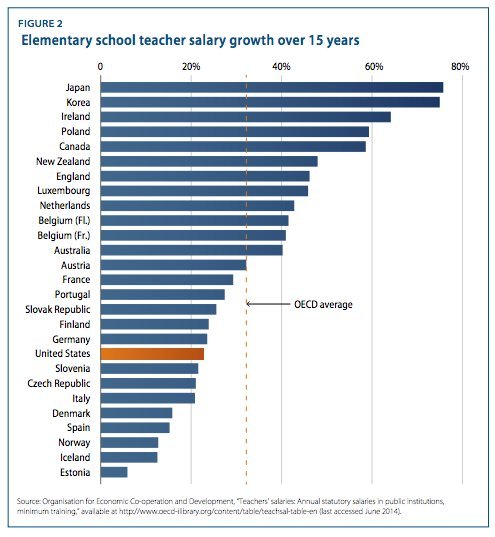
Teacher salary starts low, and grows even more slowly.


original


According to a report by the Center for American Progress, the average base salary for a teacher with 10 years of experience and a bachelor’s degree is $45,000. That’s a mere $800 annual raise. No wonder more than 16 percent of teachers have a second or third job outside of the school system. They simply can’t survive on the salary.


They can’t buy a home or even rent an apartment in most metropolitan areas. They can’t afford to marry, raise children, or eke out a middle class existence.


What effect does this have on students?


Well, for one, it often leaves them with inexperienced or exhausted teachers.


Nationwide, 46 percent of educators quit before reaching the five year mark. And it’s worse in urban districts, where 20 percent quit every single year!


That translates to more students learning from educators who are, themselves, just learning how to teach. If we took pains to keep them in the profession, think of what a positive impact that would have on the quality of education the nation’s students  receive – Teachers learning from experience and improving their practice every year instead of a continual flux of novices just trying to figure out the basics and survive!


But it’s not all intangibles. It costs bookoo bucks to constantly find and train new teachers – roughly $7.34 billion a year, to be exact. Imagine if we could invest that money into salaries instead.


This is exactly what they do in many other countries.


We’re always comparing ourselves with nations in Europe and Asia where students average higher standardized test scores. Yet we rarely enact the policies that got them these results.


Many of these countries recruit the top graduates to become teachers. How? By offering sweeteners and incentives to become a life-long educator.


In Singapore and Finland, for example, they actually cover the cost of the college coursework needed to become a teacher. And when it comes to salary, they leave us in the dust. In South Korea, they pay educators an average of 250 percent more than we do!


For many people, education is a calling. You feel drawn toward the job because it holds meaning to you. But how many people ignore that calling because of simple economics? There are plenty of things you can do with your life; If you can’t earn a living doing one thing, you may opt for something else.


How many more excellent teachers would we have in this country if we prized and rewarded those practitioners we already have?


It doesn’t take a deep dive into the news to see how teachers are treated in American society far beyond the low pay.


Everything that goes wrong in our public schools is laid at their feet whether they have any control over it or not. Child poverty, inequitable and inadequate resources, regressive and nepotistic policy, backward education legislation – it’s all somehow the teacher’s fault.


Imagine if we saw teachers as part of the solution! What effect would that have on teacher turnover?


Look no further than our foreign counterparts. In South Korea, turnover is only 1 percent per year. In Finland, it’s 2 percent. In Singapore, it’s 3 percent.


It’s certainly worth a try.


As reforms go, this is one with more evidence behind it than 90 percent of the garbage that comes floating out of partisan think tanks.


Pay teachers more.


Starting salary should be at least $65,000. End pay after 30 years should be at least $150,000.


THAT would boost educational outcomes.


And, please, don’t give me any nonsense about summer break, teacher tenure, the power of unions or whatever else you heard on talk radio or the corporate news media. Teachers average 53 hours a week August through June – making up for any downtime in the summer, tenure doesn’t mean a job for life – it means due process, and unions aren’t evil – they just ensure workers more rights than the bosses would like.


Moreover, don’t tell me we can’t afford it. We spend more on the military than the next 8 nations combined.


Imagine if we put a priority on raising our own children instead of guns and missiles. Imagine if we spent more on life than death.


Imagine if we tried the one reform left in the box – increase teacher pay.


Test-Based Accountability – Smokescreen for Cowardly Politicians and Unscrupulous Corporations

Screen Shot 2017-07-16 at 9.28.59 AM

There is no single education policy more harmful than test-based accountability.


The idea goes like this: We need to make sure public schools actually teach children, and the best way to do that is with high stakes standardized testing.


It starts from the assumption that the problems with our school system are all service-based. Individual schools or districts are not providing quality services. Teachers and administrators are either screwing up or don’t care enough to do the job.


But this is untrue. In reality, most of our problems are resource-based. From the get-go, schools and districts get inequitable resources with which to work.


This is not a guess. This is not a theory. It is demonstrable. It has been demonstrated. It is a fact.


No one even disputes it.


What is in question is its importance.


However, any lack of intention or ability on the part of schools to actually teach is, in fact, pure conjecture. It is a presumption, an excuse by those responsible for allocating resources (i.e. lawmakers) from doing their jobs.


Any time you hear senators or representatives at the state or federal level talking about test-based accountability, they are ignoring their own duties to properly provide for our public school children and pushing everything onto the schools, themselves.


That is the foundation of the concept. It’s hard to imagine more unstable ground from which to base national education policy.


But it gets worse.


With our eyes closed and this assumption swallowed like a poison pill, we are asked to accept further toxic premises.


Next comes the concept of trustworthiness.


We are being asked to question the trustworthiness of teachers. Instead, we are pushed to trust corporations – corporations that manufacture standardized tests.


I have no idea why anyone would think that big business is inherently moral or ethical. The history of the world demonstrates this lie. Nor do I understand why anyone would start from the proposition that teachers are inherently untrustworthy. Like any other group of human beings, educators include individuals that are more or less honest, but the profession is not motivated by a creed that specifically prescribes lying if it maximizes profit.


Business is.


Test manufacturers are motivated by profit. They will do that which maximizes the corporate bottom line. And student failure does just that.


Most of these companies don’t just manufacturer tests. They also provide the books, workbooks, software and other materials schools use to get students ready to take the tests. They produce the remediation materials for students who fail the tests. And they provide and grade the tests in the first place.


When students fail their tests, it means more money for the corporation. More money to give and grade the retests. More money to provide additional remediation materials. And it justifies the need for tests to begin with.


Is it any wonder then that so many kids fail? That’s what’s profitable.


There was a time when classroom teachers were not so motivated.


They were not paid based on how many of their students passed the test. Their evaluations were not based on student test scores. Their effectiveness used to be judged based on what they actually did in the classroom. If they could demonstrate to their administrators that they were actually making good faith efforts to teach kids, they were considered effective. If not, they were ineffective. It was a system that was both empirical and fair – and one to which we should return.


In fact, it was so fair that it demonstrated the partisanship of the corporations. Laws were changed to bring teacher motivation more in line with those of big business. Their evaluations became based on student test scores. Their salaries were increasingly tied to student success on these tests. And when some teachers inevitably felt the pressure to cheat on the tests, they were scapegoated and fired. There is no mechanism available to even determine if testing corporations cheat less than penalties for it.


After all, what is cheating for a testing corporation when they determine the cut score for passing and failing?


Yet this is a major premise behind test-based accountability – the untrustworthiness of teachers compared to the dependable, credibility of corporations.


Next, come the scores, themselves.


Time-after-time, standardized test scores show a striking correspondence: poor and minority students often do badly while middle class and wealthy white students do well.


Why is that?


Well, it could mean, as we’ve already mentioned, that poor and minority students aren’t receiving the proper resources. Or it could mean that teachers are neglecting these children.


There is a mountain of evidenceundisputed evidence – to support the former. There is nothing to support the later.


I’m not saying that there aren’t individual teachers out there who may be doing a bad job educating poor and minority children. There certainly are some. But there is no evidence of a systemic conspiracy by teachers to educate the rich white kids and ignore all others. However, there IS an unquestionable, proven system of disinvestment in these exact same kids by lawmakers.


If we used standardized tests to shine a light on the funding inequalities of the system, perhaps they would be doing some good. But this is not how we interpret the data.


Finally comes the evidence of history.


Standardized testing is not new. It is a practice with a past that is entirely uncomplimentary.


These kinds of assessments are poor indicators of understanding complex processes. Answering multiple choice questions is not the best way to determine comprehension.


Moreover, this process is tainted by the eugenicist movement from which it originates. Standardized testing is a product of the belief that some races are better than others. It is a product of white supremacy. It was designed by racist psychologists who used it to justify the social structure of past generations and roundly praised and emulated by literal Nazis.


It is therefore not surprising that test scores show privileged white kids as superior to underprivileged students of color. That is how the system was designed.


Why any educated person would unquestionably accept these scores as valid assessments of student learning is beyond me.


Yet these are the assumptions and premises upon which the house of test-based accountability is built.


It is a smokescreen to protect politicians from having to provide adequate, equitable, sustainable resources for all children. It likewise protects unscrupulous business people so they can continue to cash in on the school system without providing any real value for students.


We must no longer allow policymakers to hide behind this blatant and immoral lie.


Not only should voters refrain from re-electing any lawmakers whose constituents children are receiving inequitable school resources, they should not be eligible for re-election.


Not only should corporations not be trusted more than teachers, they should be barred from determining success or failure while also profiting off of that same failure.


In short, we need to stop worshipping at the altar of test-based accountability.


Schools can and should be held accountable. But it cannot be done with standardized tests.


Moreover, we must stop ignoring the role of policymakers and business in this system. They must also be responsible. We are allowing them to get away with murder.


It’s time to wake up and make them answer for what they’ve done to our nation’s children.