If You’re Not a Feminist – What the Hell is Wrong with You!!?

feminist-man

I am a male human being.

And you’d better believe I’m a feminist.

I wear that label proudly.

The other day a friend of mine heard one of my articles was published in Everyday Feminism. And he said, “Kind of a backhanded compliment. Isn’t it?”

Hell no!

What does that mean? Would someone suppose that a man being considered a feminist somehow made him less of a man?

On the contrary. I think it makes him more of one. It makes him a decent freakin’ person.

I just don’t understand this ridicule and fear of being called a feminist. I see it in both men and women.

The other day a co-worker said she’s all for the idea that men and women deserve equal pay for the same job, but she doesn’t consider herself a feminist.

Why the Hell not? That is a distinctly feminist point of view.

There seems to be this stigma about the term as if being a feminist was tantamount to being some sort of radical troublemaker. Some folks seem to think that feminists essentially hate men and seek them grievous harm.

It’s ridiculous.

A feminist is just someone who thinks men and women should have the same rights and opportunities.

That’s it. You can add more complicated terms, talk about economic, social and political rights, but it’s the same darn thing.

Being a feminist just means you’re not an asshole. That’s not a gender-specific value. Nor should it depend on your political affiliation, sexual preference or spirituality.

If you think all people, regardless of what they’ve got between their legs, deserve to be treated fairly, then SURPRISE! You’re feminist!

In the words of activist and academic Cheris Kramarae, feminism is “the radical notion that women are people.”

Some folks try to convince you otherwise. They play a card from the racist playbook. It goes like this:

Stop saying ‘Feminism.’ Women don’t deserve equal rights. All people do.

It’s the same passive aggressive trick of the closeted white supremacists who attack Black Lives Matter activists because “All Lives Matter!”

Listen, skeezicks, no one said “ONLY Black Lives Matter” just like no one said “ONLY women’s rights matter.” What you’re complaining about is pure baloney – a way to shut down the conversation and stop people from talking about inequalities that actually exist for women and people of color.

And don’t assume I’m excluding transgender people, either. LGBTs are just as deserving of fair treatment as cisgender folks, heterosexuals or anyone else.

Yes, feminism calls attention to the plight of women. It deserves that attention. We have a lot of work to do making that right. Why should I feel guilty about bringing that up?

I am perfectly comfortable being called a feminist. I have a mother, and I love her. I have two grandmothers, an aunt, a wife, a daughter. Most of us, whether we’re women or not, have important relationships with someone of the female persuasion. I can’t imagine why anyone would want to deny those loved ones equal treatment.

But you don’t have to know or care about a single woman. You could have sprung from the ground like a mushroom and lived in a dark corner without meeting anyone all your life. Why would you want to deny half of the human race fair treatment?

It’s a deep seated psychosis. Like so much else, the current Presidential election has brought it even more to the forefront.

For the first time in American history, a woman tops the ticket of a major political party. (She’s not even the only one. The Green Party has an impressive female candidate, too!) And just like in 2008 when Barack Obama became the our first President of color, the crazies are coming out of the woodwork.

I even had a female acquaintance tell me she couldn’t support Hillary Clinton because she didn’t feel comfortable with a woman in the Oval Office. She thought a woman would be too emotional to make those kinds of life-and-death decisions.

What a pile of crap!

It doesn’t matter if you support Clinton or not. Being a woman does not disqualify her from the Presidency. Women make life-and-death decisions every day. In fact, given that many women have the very machinery of life embedded in their own bodies, they may be MORE suited to these decisions than men. After all, they are empowered to decide whether new life comes into the world. They literally give birth to the future.

Men can be important parts of the process. But it’s not biologically required to the same degree.

Being the father of a daughter is the most important relationship in my life.

And I’ll admit it made me think about gender issues more deeply.

All parents see the world anew through their children’s eyes, and what I see from my little one’s point of view doesn’t fill me with confidence.

I see everywhere women have to prove themselves just to get in the door while men are assumed to be worthy of a shot just by virtue of their masculinity.

People listen to men more seriously than they do women. People expect men to take the lead. They expect women to follow. Men have much higher representation in almost all valued professions – doctors, lawyers, politicians.

It’s no wonder school teachers get no respect. They’re mostly women. As one of the few males in front of the classroom, I see this first hand on a daily basis.

So I try to do what I can to protect my daughter from ingesting these cultural stereotypes and sick ways of thinking.

Just the other day, we were listening to a Joan Jett song, and my little one asked if there were many good women rock stars. I responded by making her a playlist on my iPod filled with nothing but female fronted music groups. It’s full of artists like No Doubt, Cyndi Lauper, the Pretenders, Heart, Lauryn Hill, Patti LaBelle and Fiona Apple.

My daughter loves it. When we ride around in the car she invariably asks for “The Girl Album,” and I get it. She likes hearing people like her in that role. She likes seeing that it’s a possibility, that girls don’t have to take a backseat. They can lead. They’re just as important as boys any day.

That’s what being a feminist means.

It’s challenging your own patriarchal ways of thinking. It’s continually asking ‘Is this fair?” It’s having the courage to challenge the status quo and siding with the oppressed against the oppressor – even if the oppressor looks like you.

So Hell Yeah I’m a feminist. And if you’re not – really – what is wrong with you!!?

Instead of Nixing the Keystone Exams, PDE Recommends a Cornucopia of Tests

frustrated-student-300x199

The answer is in.

After a summer of intense study, the Pennsylvania Department of Education (PDE) has a solution to our exit exam problem.

Last year we almost failed half of our high school seniors state wide because they couldn’t pass all three of our poorly constructed Keystone Exams. So we decided not to count the scores for two years in order to find a way to fix the problem.

And now PDE has a recommendation for the legislature.

Drop the Keystone Exams? Base graduation on the completion of high school classwork?

NOPE.

PDE still loves standardized testing. It just wants to give kids more choice about which standardized tests they can take.

Instead of having to pass the Keystone Exams in Algebra I, Literature and Biology, state policy-makers suggest a veritable Whitman’s Sampler of test-heavy paths to graduation.

Four choices.

Four paths to a diploma.

And they all involve lots and lots of multiple choice, sharpen-your-number-two-pencil, standardized tests.

PDE suggests that students can:

1)         Achieve scores on all three Keystone Exams that when averaged out produce a passing score. So maybe you fail the Biology test but your Algebra I and Literature scores are high enough to even out to a passing score.

2)         Achieve a passing score on some other standardized test approved by the state – SAT, ACT, etc. So maybe you take the Keystone Biology exam and the SAT for English and Math.

3)         For vocational students only – get passing grades in your high school classes, and pass a standardized assessment made for vocational students or otherwise provide evidence of success in that field of study.

4)         Get passing grades in your high school courses and provide at least three pieces of evidence of postsecondary success. More on what counts as evidence later.

PDE estimates these new alternative graduation requirements will be much more effective than the old ones.

The first option of allowing an average score on all three Keystone Exams, for instance, would mean that 72% of Pennsylvania students would thus be eligible for graduation vs. 51% under the old requirement.

The remaining 28% of high schoolers could then meet the graduation requirement by following one of the other three paths.

In most cases, this means more standardized testing – you just get to choose which test to take.

Under the fourth option, students only need to pass their courses and provide three pieces of evidence that they deserve to graduate. But what counts as evidence?
Please pick three from the following menu:

1)         Earn a passing grade in a dual enrollment course. In other words, pass a class in high school that will count as a college credit – maybe an advanced foreign language or math.

2)         Pass the Armed Services Vocational Aptitude Battery (ASVAB) – the entrance exam to qualify for military service. I don’t think you have to actually enlist, but you have to take and pass the test.

3)         Get a letter from an employer guaranteeing you have full-time employment after high school.

4)         Attain a high value industry credential.

5)         Get a certificate that you successfully  completed an internship related to your career goals.

6)         Pass a standardized test such as the PA Career Academic Work Standards assessment and/or SAT.

One notable absence from these choices is a Project Based Assessment (PBA).

Previous legislation allowed students who failed the Keystones to complete PBAs in place of one or more tests. Students would research a specific topic with a trained tutor who would evaluate students’ work and provide feedback. It was designed for students unable or unwilling to pass specific Keystone Exams.

However, this was extremely expensive.

Over the past year, approximately 6,700 students throughout the state completed 15,700 PBAs. In many cases, it took them more than 30 hours to finish each assessment. This put a tremendous burden on local school districts to hire additional staff and remediate students from missed coursework. It also cost the state more money to hire additional people to score the PBAs.

According to the report, an unnamed suburban southeastern district told PDE it had to hire nine specialists at a cost of $900,000. A large unnamed urban district estimated PBAs would cost it an additional $4.1 million. PDE, itself, would need an additional $7 million to grade these assessments.

There were also concerns of whether the PBAs could be completed in a secure fashion to make sure students weren’t cheating. However, the majority of concerns were financial.

As a result, PDE recommended doing away with PBAs.

This leaves the question of what to do with students whose parents opt them out of standardized testing. Under previous legislation, these kids could take PBAs. It is unclear what they could do now to achieve the graduation requirement since so many of the options suggested by PDE involve taking some form of standardized test.

It remains to be seen if lawmakers decide to trample on parents rights in this way.

So that’s it. Four paths to graduation.

There are many ways in which these alternatives are an improvement to the old pass-the-Keystones-or-else requirement.

First, the new plan acknowledges that students don’t need to be equally strong in all academic areas. Someone going into technical school has less reason to demonstrate skill in Biology than someone entering the medical field, for instance.

Also, this provides different options to qualify for a diploma instead of different kinds of diplomas. It had been suggested that students who don’t pass all tests might get a second tier diploma, perhaps even one of several tiers of diploma. So a blue diploma might mean you did pretty good, but not as good as a gold diploma, etc. We can be thankful PDE nixed that terrible idea.

Another positive is that PDE acknowledges standardized tests are not the only possible measure of success. Moreover, some measures of that success can be fairly determined at the district level.

Personally, I wish they went further with this. The authors of the report admit that colleges and employers rarely look at standardized test scores. Report card grades are a much better predictor of future success at both the college and career level. PDE cites three different peer-reviewed academic studies that come to this conclusion, but state education officials don’t have the bravery to likewise conclude that standardized assessments are unnecessary. Instead they play around at the edges, allow choice among standardized assessments and a complicated metric relying heavily on these assessments.

Moreover, as refreshing as it is to have state government admit that we can trust our local school districts to make some decisions about their students, why can’t we go one step further and say local districts can determine who deserves a diploma, in the first place? For centuries this is exactly what our schools did. In fact, the majority of people currently holding down jobs were determined to be ready for those jobs or their college experiences by just those same local school districts. Is America so incompetent that it needs standardized test corporations to bless everyone before being allowed to graduate? Would we be a better nation if everyone had to pass a standardized test to qualify for the workforce?

In short, the report from PDE certainly represents an improvement on the current Keystone Exam graduation requirement. However, it shows a real lack of courage and conviction by state functionaries.

There is no academic reason to have a graduation requirement beyond traditional coursework. It will only suppress the graduation rate as it has in other states in which it has been enacted. If we really wanted to increase the quality of high school graduates, we’d invest in them. We’d lower class size. We’d provide a wide curriculum. We’d provide equitable funding for children at different points on the socioeconomic scale. We’d provide services and tutoring for our most disadvantaged students.

Instead, we’re still just putting up more hurdles and demanding kids pull themselves up by their own bootstraps.

Something clearly must be done.

If the legislature doesn’t make changes, the requirement to pass all three Keystone Exams will apply to current high school freshman and sophomores.

There’s never been an exit exam like this in Pennsylvania before – in fact, almost the entire workforce, business community and state leadership somehow managed to get by without one. But whatever; these children today need to prove themselves.

Kids, passing your courses isn’t enough anymore. You’ve got to pass a test. Several of them in fact.

Never mind that you have to pass tests to succeed in your courses. THOSE tests are designed by teachers. You have to pass a real test – something designed by a corporation.

As big business continues to floods our lawmakers with campaign cash, somewhere along the way our representatives decided to spend a truckload of our tax dollars on big business – to make tests. Can’t imagine why.

In 2014, the legislature decided you’d have to pass a series of 10 Keystone Exams in core subjects. Fail even one of them and you’d get nothing but a certificate of attendance. So 12-13 years of schooling and you get this:

“Hey! Remember Paulie?”
 
 
“Yeah?”
 
 
“He was here.”

However, creating 10 brand new tests costs an awful lot of money. Pennsylvania shelled out more than $200 million before lawmakers said, “Okay, that’s enough,” and stopped with just the three we have. But before even these could be made permanent prerequisites of graduation, the scores came in.

It wasn’t good. About half of all students in both traditional public schools and charter schools couldn’t pass them all.

Why?

Well, the Common Core aligned tests were of dubious quality and zero validity based on actual educational research. Also, we cut off educational supports by slashing school budgets by almost $1 billion a year. Oh, and we spent way more money on rich students than poor students earning us the dubious distinction of having the most inequitable school funding in the nation.

Not exactly a recipe for success.

So what was the state to do – move forward and withhold diplomas for half of all students? Or Toss out the tests and move on?

Instead, lawmakers came up with a unanimous compromise – more time. The legislature decided to pause the Keystone requirement for two years in order to better study what could be done.

And now PDE has it’s test heavy solution to move forward.

People of conscience need to stand up and oppose any kind of additional exit exam in Pennsylvania. Parents, teachers and students need to band together. School board directors need to pass resolutions. Thoughtful lawmakers need to put forward progressive legislation.
The resistance has already begun.

State Senator: Get Ready to Sue the PA Department of Education Over Common Core Testing

20110831_inq_rrxsrc31z-a

Pennsylvania State Sen. Andrew Dinniman is mad as Hell and he’s not going to take it anymore.

The West Chester Democrat is furious at the state Department of Education (PDE) over the Keystone Exams.

In February, the legislature unanimously passed a law to delay for two years using the Keystones as a graduation requirement for public school students. The exams will still be given to high school students in Algebra I, Biology and English, but passing them is not necessary to receive a diploma. During this time, the legislature is supposed to investigate alternate assessments above and beyond standardized testing.

However, Dinniman sent out an email to supporters this week claiming PDE is “blatantly ignoring the law and issuing directives to local school districts to use the exam if they want to for graduation.”

This goes against the delay, says Dinniman. The legislature is unsure requiring the Keystone Exam is a good idea, yet the state Senator contends the current administration is advising districts to move forward anyway.

Under the old law that was put on hold by the delay, if parents decided to opt their children out of standardized testing, students had to complete a Project Based Assessment. However, even though there is no test-based graduation requirement for current seniors, Dinniman says PDE still is forcing these children to complete Project Based Assessments.

“It appears that PDE is forcing the children of parents who opted out to take the Project Based Assessment, whose use is currently suspended by the legislature,” he says.

“There seems to be no respect by PDE for the rights of parents concerning their own children.”

Dinniman, who also serves as minority chair of the Senate Education Committee, has long been a critic of the Keystone Exams. He lead the charge to delay their implementation.

Now that PDE seems committed to the project despite concerns by legislators, he is asking for parents and other concerned citizens to contact him about suing the organization.

“If you know parents or organizations who might want to take PDE to court or file amicus briefs, let me know…  This is a matter of great importance. A number of us have been working for years against excessive testing and have serious concerns about Common Core.”

He will hold an open meeting for those concerned about the issue on Monday, Sept. 12, at 7:30 pm in his district office along One North Church Street in West Chester.

One of the issues at stake is the exorbitant costs of the Keystone and Pennsylvania System of School Assessment (PSSA) tests. With education budgets shrinking at the federal, state and local level, this money diverted to huge testing corporations could be better spent elsewhere.

Since 2008, the Commonwealth has spent $1 billion to proctor, grade and create new versions of the PSSA and the new Common Core-aligned Keystone Exams. Of that figure, $741 million went to Data Recognition Corporation.

Dinniman included in his email an explanation of the Commonwealth’s contract with Data Recognition Corp., a chart showing how much has been paid to the company, a list of materials PDE requested from the company but that has not yet been provided and an article written by education historian Diane Ravitch published in the New York Times explaining why these tests are troublesome.

In 2013, the state Conference of NAACP Branches issued a statement condemning the Keystone graduation requirement in extremely strong terms.

The organization called it a “present day form of Eugenics”, “a human rights violation”, “a clandestine social movement that strips children of their dignity and self worth” and that it would deprive impoverished and minority students  “of decent income, decent food, decent homes, and hopeful prospects as well as the security of justice.”

The statement can be read in full here.

In the halls of state government, Dinniman has been one of the most vocal critics of high stakes testing and national academic standards.

“I have been fighting against the use of these standardized tests as the sole determinants of high school graduation since they were first proposed by the previous [Corbett] administration in 2012.”

“Strong standards and effective assessments are needed in our schools, but they must come with the necessary resources and support to be implemented in a way that does not negatively impact both students and taxpayers,” he says.

Chester County, where Dinniman is from, has been a hotbed of testing criticism. Located in the southeastern most part of the state, parents, teachers and students publicly spoke out against the exams. Almost all school boards in the county passed resolutions opposing the Keystones and 58 superintendents and Intermediate Unit Directors up through the Philadelphia suburbs also expressed opposition.

If the delay had not been approved, this year’s seniors would have been required to pass all three Keystone Exams in order to graduate. Now the exams won’t be a graduation requirement until the 2018-19 school year.

The federal government still requires the exams be given for evaluative purposes, but it was the Republican dominated Tom Corbett administration that went the extra step of making the exams necessary to receive a diploma.

The delay is supposed to provide additional time to resolve consequences of implementing the exams. This means investigating and reporting on the following:

    • Alternative methods for students to demonstrate proficiency for graduation in addition to the Keystone Exams and project-based assessments.
    • Improving and expediting the evaluation of the project-based assessments.
    • Ensuring that students are not prohibited from participating in vocational-technical education or elective courses or programs as a requirement of supplemental instruction.

Moreover, the newly passed federal K-12 education legislation, the Every Student Succeeds Act (ESSA), allows the Commonwealth even more leeway to implement fairer and more affective means of assessment, Dinniman says.

“Until now, education policy has been largely dominated by regulations implemented by the State Board of Education in accordance with the federal government. Some of these regulations seemed to be enacted with little to no consideration of fiscal impacts or educational value,” Dinniman said.

“However, the state legislature has a Constitutional duty and responsibility to oversee and provide for ‘a thorough and efficient system of public education.’ Going forward, I believe the legislature will be more aggressive in reasserting its role in the process.”

Dinniman can be reached by phone at 610-692-2112 (District Office) and 717-787-5709 (Harrisburg Office).

He can be reached by email here.

He is on Facebook and Twitter.

Below is the full text of Dinniman’s Email:


(Source: optoutpa.blogspot.com)


To Supporters of Ending Common Core Exams in Pennsylvania:

Despite Act 1 of 2016, which suspended any use of the Keystone exams or the Project Based Assessments for graduation purposes during the two year period of 2016-18, the Pennsylvania Department of Education (PDE) is blatantly ignoring the law and issuing directives to local school districts to use the exam if they want to for graduation.

It certainly appears that PDE has shown their solid commitment to the Common Core testing process and the continued collection of data.  They don’t seem to care about or respect the law.  This is not government by the elected legislature but government by the bureaucracy.

You will be interested to learn the taxpayers of Pennsylvania, since 2008, spent $1.1 billion on these Common Core tests, with $741 million of that going to one testing company, Data Recognition Corporation (DRC).

Please view the supporting material at the following links:
1. An explanation of the Data Recognition Corp. (DRC) contracts.

2. A chart showing the DRC contracts, which come to $741,158,039.60, and the total paid to date of $440,512,625.69.

3. A listing of material requested from PDE but, as of this date, not provided.
4. A column from the July 23, 2016 New York Times providing background on these Common Core Exams, which in Pennsylvania are the Pennsylvania System of School Assessment (PSSA) and Keystone Exams.

Additionally, it appears that PDE is forcing the children of parents who opted out to take the Project Based Assessment, whose use is currently suspended by the legislature.  There seems to be no respect by PDE for the rights of parents concerning their own children.

So the question now is “what will we do about this situation?”  If you know parents or organizations who might want to take PDE to court or file amicus briefs, let me know.

In the meantime, I am having a meeting for those concerned about PDE’s actions in my district office, One North Church Street, West Chester, on Monday, September 12th, 2016 at 7:30 p.m.

This is a matter of great importance.  A number of us have been working for years against excessive testing and have serious concerns about Common Core.  Please invite your friends to join in the September 12th meeting.

Respectfully,

Andrew E. Dinniman

State Senator, 19th District

What’s More Important – Fighting School Segregation or Protecting Charter School Profits?

Screen Shot 2016-08-31 at 4.12.13 PM


No one wants school segregation.


At least, no one champions it publicly.


As a matter of policy, it would be political suicide to say we need to divide up our school children by race and socio-economics.


But when you look at our public school system, this is exactly what you see. After the triumphs of the Civil Rights movement, we’ve let our schools fall back into old habits that shouldn’t be acceptable in the post-Jim Crow era.


When we elected Barack Obama, our first President of color, many observers thought he’d address the issue. Instead we got continued silence from the Oval Office coupled with an education policy that frankly made matters worse.


So one wonders if people still care.


Is educational apartheid really acceptable in this day and age? Is it still important to fight against school segregation?


Peter Cunningham isn’t so sure.


The former assistant Secretary of Education under Obama and prominent Democrat worries that fighting segregation may hurt an initiative he holds even more dear – charter schools.


Cunningham is executive director of the Education Post, a well-funded charter school public relations firm that packages its advertisements, propaganda and apologias as journalism.


Everywhere you look Democrats and Republicans are engaged in promoting various school choice schemes at the expense of the traditional public school system. Taxpayer money is funneled to private or religious schools, on the one hand, or privatized (and often for-profit) charter schools on the other.


One of the most heated debates about these schemes is whether dividing students up in this way – especially between privately run charter schools – makes them more segregated by race and socio-economic status.


Put simply – does it make segregation worse?


Civil Rights organizations like the NAACP and Black Lives Matter say it does. And there’s plenty of research to back them up.


But until recently, charter school apologists have contested these findings.


Cunningham breaks this mold by tacitly admitting that charter schools DO, in fact, increase segregation, but he questions whether that matters.


He says:


“Maybe the fight’s not worth it. It’s a good thing; we all think integration is good. But it’s been a long fight, we’ve had middling success. At the same time, we have lots and lots of schools filled with kids of one race, one background, that are doing great. It’s a good question.”


The schools he’s referring to are charter schools like the Knowledge is Power Program (KIPP) where mostly minority students are selected, but only those with the best grades and hardest work ethic. The children who are more difficult to teach are booted back to traditional public schools.


It’s a highly controversial model.


KIPP is famous for two things: draconian discipline and high attrition rates. Even those kids who do well there often don’t go on to graduate from college. Two thirds of KIPP students who passed the 8th grade still haven’t achieved a bachelor’s degree 10 years later.


Moreover, its methods aren’t reproducible elsewhere. The one time KIPP tried to take over an existing public school district and apply its approach without skimming the best and brightest off the top, it failed miserably – so much so that KIPP isn’t in the school turnaround business anymore.


These are the “lots and lots of schools” Cunningham is worried about disturbing if we tackle school segregation.


He first voiced this concern at a meeting with Democrats for Education Reform – a well-funded neoliberal organization bent on spreading school privatization. Even at such a gathering of like minds, some people might be embarrassed for saying such a thing. Is integration worth it? It sounds like something you’d expect to come out of Donald Trump’s mouth, not a supposedly prominent Democrat.


But Cunningham isn’t backing away from his remarks. He’s doubling down on them.


He even wrote an article published in US News and World Report called “Is Integration Necessary?”


Here’s the issue.


Segregation is bad.


But charter schools increase segregation.


So the obvious conclusion is that charter schools are bad.


BUT WE CAN’T DO THAT!


It would forever crash the gravy train that transforms public school budgets into private profits. It would forever kill the goose that turns Johnny’s school money into fancy trips, expense accounts and yachts for people like Cunningham.


This industry pays his salary. Of course he chooses it over the damage done by school segregation.


But the rest of us aren’t burdened by his bias.


His claims go counter to the entire history of the Civil Rights movement, the more than hundred year struggle for people of color to be treated equitably. That’s hard to ignore.


People didn’t march in the streets and submit to violent recriminations to gain something that just isn’t necessary. They weren’t sprayed by hoses and attacked by police dogs so they could gain an advantage for their children that isn’t essential to their rights. They weren’t beaten and murdered for an amenity at which their posterity should gaze with indifference and shrug.


We used to understand this. We used to know that allowing all the black kids to go to one school and all the white kids to go to another would also allow all the money to go to the white kids and the crumbs to fall to the black kids.


We knew it because that’s what happened. Before the landmark Brown vs. Board of Education, it’s a matter of historical fact. And today it’s an empirical one. As our schools have been allowed to fall back into segregation, resources have been allocated in increasingly unfair ways.


We have rich schools and poor schools. We have predominantly black schools and predominantly white schools. Where do you think the money goes?


But somehow Cunningham thinks charter schools will magically fix this problem.


Charters are so powerful they will somehow equalize school funding. Or maybe they’re so amazing they’ll make funding disparities irrelevant.


For believers, charter pedagogy wields just that kind of sorcery. Hocus Pocus and it won’t matter that black kids don’t have the books or extra-curriculars or arts and humanities or lower class sizes.


Unfortunately for Cunningham, the effects of school segregation have been studied for decades.


“Today, we know integration has a positive effect on almost every aspect of schooling that matters, and segregation the inverse,” says Derek Black, a professor of law at the University of South Carolina School of Law.


“We also know integration matters for all students. Both minorities and whites are disadvantaged by attending racially isolated schools, although in somewhat different ways.”


Minorities are harmed academically by being in segregated schools. Whites are harmed socially.


At predominantly minority schools, less money means less educational opportunities and less ability to maximize the opportunities that do exist. Likewise, at predominantly white schools, less exposure to minorities tends to make students more insular, xenophobic and, well, racist. If you don’t want little Billy and Sally to maybe one day become closeted Klan members, you may need to give them the opportunity to make some black friends. At very least they need to see black and brown people as people – not media stereotypes.


Even Richard D. Kahlenberg, a proponent of some types of charter schools and a senior fellow at the Century Foundation, thinks integration is vital to a successful school system.


“To my mind, it’s hugely significant,” says Kahlenberg, who has studied the impact of school segregation.


“If you think about the two fundamental purposes of public education, it’s to promote social mobility so that a child, no matter her circumstances, can, through a good education, go where her God-given talents would take her.  The second purpose is to strengthen our democracy by creating intelligent and open-minded citizens, and related to that, to build social cohesion.


Because we’re a nation where people come from all corners of the world, it’s important that the public schools be a place where children learn what it means to be an American, and learn the values of a democracy, one of which is that we’re all social equals. Segregation by race and by socioeconomic status significantly undercuts both of those goals.”


We used to know that public education wasn’t just about providing what’s best for one student. It was about providing the best for all students.


Public schools build the society of tomorrow. What kind of future are we trying to create? One where everyone looks out just for themselves or one where we succeed together as a single country, a unified people?


A system where everyone pays their own way through school and gets the best education they can afford works great for the rich. But it leaves the masses of humanity behind. It entrenches class and racial divides. In short, it’s not the kind of world where the majority of people would want their children to grow up.


More than half of public school students today live in poverty. Imagine if we could tap into that ever-expanding pool of humanity. How many more scientific breakthroughs, how many works of art, how much prosperity could we engender for everyone!?


That is the goal of integration – a better world.


But people like Cunningham only can see how it cuts into their individual bank accounts.


So is it important to fight school segregation?


That we’re even seriously asking the question tells more about the kind of society we live in today than anything else.

Common Core’s New New Math has the Same Problem as the Old New Math

little tired boy sitting at a desk and holding hands to head


Bad ideas are like unlucky pennies – they keep coming back again.

Take the New Math. Or maybe I should say the New New Math.

Common Core State Standards suggests we teach children a new way to do arithmetic. We should focus on multiple ways to reach an answer with an emphasis on understanding the concept behind the problem rather than just manipulating numbers.

It sounds fine in theory – until you think about it for five minutes.

When learning a new skill, it’s best to master a single, simple approach before being exposed to other more complex methods. Otherwise, you run the risk of confusion, frustration and ultimately not learning how to solve the problem.

Take directions.

If you’re lost and you ask for directions, you don’t want someone to tell you five ways to reach your destination. You want one, relatively simple way to get there – preferably with the least amount of turns and the highest number of landmarks.

Maybe later if you’re going to be traveling to this place frequently, you may want to learn alternate routes. But the first time, you’re more concerned about finding the destination (i.e. getting the answer) than understanding how the landscape would appear on a map.

This is the problem with Common Core math. It doesn’t merely ALLOW students to pursue alternate methods of solving problems. It REQUIRES them to know all the ways the problem can be solved and to be able to explain each method. Otherwise, it presumes to evaluate the student’s understanding as insufficient.

This is highly unfair to students. No wonder so many are failing.

Sadly there’s some history here that should have warned us about the perils of this approach.

Common Core isn’t the first new math approach to come along. In the 1960s we had a method actually called “The New Math.” And like Common Core, it was a dismal failure.

Like the Core, it proposed to focus more on conceptual understanding, but to do so it needlessly complicated matters at the grade school level.

It introduced set theory, forcing students to think of numbers as groups of objects rather than abstractions to be manipulated. In an advanced undergraduate mathematics course, this makes perfect sense. In first grade, it muddles the learning tremendously.

To make matters even more perplexing, it mandates students look at numbers with bases other than 10. This is incredibly confounding for elementary students who often resort to their fingers to help them understand early math.

Tom Lehrer wrote a very funny song about the new math which shows how confusing it can be. The methods used to solve the problem can be helpful but an emphasis on the conceptual underpinning at early ages perplexes more than it helps:

Popular culture is full of sly references to this old New Math. Charles Schultz wrote about it in several Peanuts comic strips in 1965. In one such strip, kindergartener Sally gets so frustrated trying to solve a New Math problem she cries, “All I want to know is, how much is two and two?” New Math even made an appearance in the 1973 movie “There’s No Time for Love, Charlie Brown,” in which the titular Brown asks “How do you do New Math problems with an old Math mind?”

Screen shot 2016-08-27 at 3.10.40 PM

In the 1992 episode of the Simpsons, “Dog of Death,” Principal Skinner is elated that an influx of school funding will allow him to purchase school improvements. In particular he wants to buy history books that reveal how the Korean War ended and “math books that don’t have that base six crap in them!”

So where did this idea for New Math come from?

In 1957, the Soviets launched Sputnik sending Americans into a panic that they were being left behind by these Communist supermen. As a result in 1958, President Dwight D. Eisenhower passed the National Defense Education Act which dramatically increased school budgets and sent academics racing for ways to reform old practices. One product of this burst of activity was the New Math.
A decade later, it was mostly gone from our public schools. Parents complained they couldn’t help their children with homework. Teachers complained they didn’t understand it and that it needlessly confused their students.

Fast forward to 1983 and President Ronald Reagan’s National Commission on Excellence in Education. The organization released a report called “A Nation at Risk” that purported to show that public schools were failing. As a result, numerous reforms were recommended such as increased standardization, privatization and competition.

It is hard to overemphasize how influential this report was in education circles. Even today after its claims have systematically and thoroughly been debunked by statisticians like those at Sandia National Laboratories, politicians, pundits and the media persist with this myth of failing public schools.

“A Nation at Risk” birthed our modern era of high stakes testing and, in 2009, Common Core.

In theory, each state would adopt the same set of academic standards thereby improving education nationally. However, they were written by the standardized testing corporations – not working educators and experts in childhood development. So they ignore key factors about how children learn – just like the New Math of old.

In short, we repeated the same mistake – or a very similar one.

Children are not computers. You can’t program their minds like you would a MacBook or iPhone. In many ways, including math instruction, Common Core ignores these facts.

And so we have the same result as the old New Math. Parents all over the country are complaining that they can’t help their children with their homework. Teachers are complaining that the Core unnecessarily confuses students.

In some ways, the Core is worse than the old New Math because of its close connection with high stakes testing. In the ‘60s if a child didn’t understand how to add, he failed math. Today, if a child does that, he fails the standardized test and if that happens to enough students, his school loses funding, his teacher may be fired and his school may be closed. As such, the pressure today’s children undergo is tremendous. They aren’t just responsible for their own learning. They’re responsible for the entire school community.

Those are unfair burdens for school children – especially when the decisions that make it easy or hard for him to learn are not made by the student but by politicians, pundits and policymakers.

But perhaps most telling is this: it doesn’t help children learn.

Isn’t that what this was all supposed to be about in the first place?

Perhaps we don’t need a new math. Perhaps we simply need policymakers willing to listen to education and childhood experts instead of business interests poised to profit off new reforms regardless of whether they actually work.

Shouldn’t Our Schools At Least be as Logical as Dental Floss?

  Girl-flossing1

All my life I assumed flossing was essential to dental health.


It was safe, it was sound, it was normal.


Every day after brushing, I would stand before the bathroom mirror and carefully thread a mint-flavored filament through my teeth – like a chump.


And when I got to the dentist, I’d comfort myself that I had done the best I could to prevent cavities.


The hygienist would remove plaque and germs while scraping and sawing at my teeth with a specialized hook, and all the while I’d think, “At least I flossed every day!”


Yet now the federal government tells us that flossing is ineffective at best!


What!? After all these years!?


It turns out, there just is no evidence that flossing actually helps – never has been. So this summer for the first time in decades the good folks who compile federal dietary guidelines decided not to recommend the practice.


A total of 25 studies have concluded that the evidence for flossing is “weak, very unreliable,” of “very low” quality, and carries “a moderate to large potential for bias,” according to the Associated Press.


“The majority of available studies fail to demonstrate that flossing is generally effective in plaque removal,” said one review conducted just last year. Another 2015 review cites “inconsistent/weak evidence” for flossing and a “lack of efficacy.”


So flossing is out.


It’s not evidence-based.


It’s actually kind of shocking to see the federal government acting so logically.


Where’s the politics? Why aren’t Republicans taking one side and Democrats the other? Why isn’t the dental floss lobby making massive contributions to our lawmakers to influence the decision?


But we get none of that in this instance. Instead, here’s the evidence. It doesn’t support this policy. So let’s discontinue that policy.


I wonder what the world would look like if every government stance was as susceptible to argument, cause and effect, and rationality.


As a public school teacher, I’ve become inured to our lawmakers doing exactly the opposite. They look at the evidence, see it DOESN’T support an education scheme and then… they proudly give it their full support.


As a result, education policy is full of unfounded, fallacious and unproven practices.


Our schools are struggling under the burden of illogical laws. Our teachers are pulling out their hair at a series of half-baked mandates that go counter to everything they’ve learned about childhood development. And our students suffer from procedures that don’t help them learn and in fact actually do much to prevent them from doing so.


Take standardized testing, Common Core and school choice.


Our legislators think standardized testing is the best way to measure learning. Are you freaking kidding me!? In colleges and universities across the country where this has been studied in-depth for centuries, it’s been disproven, ridiculed and considered an antiquated way of thinking about learning. It went out with phrenology and eugenics!


Multiple choice tests like these have consistently been shown to correlate more closely with socioeconomic status than intelligence, retention or understanding. Put simply: if you’re rich, you do well. If you’re poor, you don’t.


Standardized tests as we know them were developed in the Victorian Age to “prove” that wealthy people were just smarter than poor people. They were created to show the innate inferiority of black and brown people and the natural superiority of the white race.


Yet these kinds of assessments still are the backbone of the public school system.


Another fallacious policy championed by many lawmakers is Common Core State Standards. But like The Four Temperments, the Geocentric Universe, and the Flat Earth Theory, they aren’t backed up by evidence. In fact, each of these disproven scientific hypotheses has MORE EVIDENCE behind it than Common Core! Each of these ancient models was based on evidence but later refuted. By contrast, Common Core was never empirically based. In fact, it has never even been studied. Someone just pulled it out of their butt!


Let me say that again: there has never been any proof that Common Core will help children learn. In fact, far from showing any improvement, since its adoption, student outcomes have plummeted. But in many states it’s the law of the land.


In truth, Common Core is a series of academic standards developed by the testing and publishing industry as a way to sell more standardized tests and remediation materials. They were only adopted because state officials were blackmailed to accept them. Otherwise, they wouldn’t have enough money to continue running their state schools. In many cases, the standards weren’t even voted on by state legislators but instead by appointed boards of education.


Yet today these standards (or very similar ones) are required in public schools across 42 states.


Finally, we have the political darling, school choice. Many Republicans and Democrats champion some form of choice and competition in our schools. They all think it will help, despite the fact that there’s more evidence for UFOs, Bigfoot and the Loch Ness Monster!


Very few countries try to help students by increasing their choices without also trying to increase the quality of those choices. Nowhere has it ever been shown that having more schools to choose from is better than less schools to choose from – if you don’t improve the quality of those schools. Simply having more options and having those options compete doesn’t make them better. As John Oliver pointed out recently, the town with the most pizzerias doesn’t necessarily have the best pizza.


In fact, in countries that have initiated school choice policies, they’ve seen educational quality drop – not rise. Yet billionaires all across the US push for us to adopt these policies all the while investing in schemes to enrich themselves if such a policy shift occurred.


It makes no sense. These are misguided, unfounded, and downright insidious ideas.


Yet everyday pundits, policy-makers and politicians still advocate for them – somehow with a straight face. And when someone who actually works in the schools like me points to the evidence – or lack thereof – I’m ignored.


In the words of Frank Zappa, “Modern Americans behave as if intelligence were some sort of hideous deformity.” And our education policies are doing nothing to fix it.


The problem is the very banality of corporate school reform. After almost two decades of these strategies pushed on both sides of the aisle, they’ve become the status quo. It’s just the way we do things.


They’re as common as… well… dental floss.


The federal government saw through the vapidity of that practice. Isn’t it time the administration does the same for corporate school reform?

Do Unions Belong in the Fight Against Corporate School Reform?

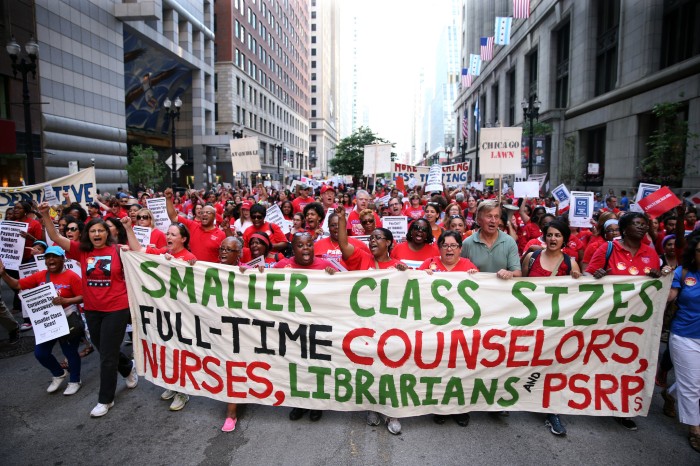
ct-chicago-teachers-rally-met-0610-20150609


In the fight for public education, the forces of standardization and privatization are running scared.


They’ve faced more pushback in the last few years – especially in the last few months – than in a decade.


The Opt Out movement increases exponentially every year. Teach for America is having trouble getting recruits. Pearson’s stock is plummeting. The NAACP and Black Lives Matter have both come out strongly against increasing charter schools.


So what’s a corporate education reformer to do?


Answer: Change the narrative.


They can’t control the facts, so instead they try to control the story being told about the facts.


It’s a classic propaganda technique. As Malcolm X put it:


“If you’re not careful, the newspapers will have you hating the people who are being oppressed, and loving the people who are doing the oppressing.”


Their story goes like this – yes, there is a battle going on over public education. But the two sides fighting aren’t who you think they are.


The fight for public schools isn’t between grassroots communities and well-funded AstroTurf organizations, they say. Despite the evidence of your eyes, the fight isn’t between charter school sycophants and standardized test companies, on the one hand, and parents, students and teachers on the other.


No. It’s actually between people who really care about children and those nasty, yucky unions.


It’s nonsense, of course. Pure spin.


They want you to believe that the corporate vultures preying on our public schools are really just misunderstood philanthropists. And those demanding a fair shake for their own children and communities are really just paid shills from a monolithic and uncaring bureaucracy.


In essence, they want you to believe two things:


1) Despite profiting off the system and zero evidence supporting the efficacy of corporate school policies, they’re motivated purely by empathy.


2) Unions are evil by definition and they pervert everything they touch.


I’m not going to bother with the first claim here. There is an inherent bias from those who wish to change the laws so they can more easily profit off of schools without actually helping students learn and in fact exist at the expense of that learning. If you can’t see through the propaganda wing of the Walmart corporation, the Broad Foundation and Big Daddy Bill Gates, you probably won’t be very receptive to anything else I have to say.


Instead I will focus on the second claim, because it is the more pernicious of the two.


Put simply, unions are not perfect, but they are not evil. In fact, they are essential to the health of public education.


Many progressives are upset with teachers unions because of the current Presidential election. Both the National Education Association (NEA) and the American Federation of Teachers (AFT) endorsed Hillary Clinton in the primary election without what many would consider adequately polling rank and file members. For better or worse, the endorsements were top-down affairs reflecting the preference of union leaders.


That’s not how unions are supposed to work. And it’s having consequences for the way both members and non-members view teachers unions.


Critics infer from this that unions don’t represent membership. They are de facto arms of the waiting Clinton administration and the neoliberal agenda.


There may be some truth to this, but it does not represent the whole picture. Not nearly.


Unions are like any other democratic organization. The larger the association, the further from the grassroots the decision making body.


In the mammoth national unions, decisions are made by representatives most removed from our schools. They probably were teachers or support staff at some point in the past, but that may be ancient history. Now they are professional leaders and therefore at a remove from the grassroots.


By contrast, in our local chapters, leaders are most often working classroom teachers. Decisions are made by those still meeting students’ needs on a day-to-day basis. As such, they retain an authenticity and expertise that may be more cloudy in the large bureaucracies.


This isn’t to say the national unions are by definition unconcerned with the needs of teachers and students. I’m sure that most of the NEA and AFT leadership who decided to endorse Clinton did it because they honestly believe doing so will help public education. And – who knows – they may be right. But what they forgot in this case was the democratic process they were tasked with preserving. As such, they may have to pay a price for their hubris when their terms are up.


In most cases, the leaders of national teachers unions are at too much of a remove to see what is best for our schools. And they usually know that. It is up to the rank and file to tell them what to do, and that’s what happens every year at representative assemblies through various caucuses made up of work-a-day members. And if leaders overstep their authority it is members’ duty to hold them accountable at election time.


So even though the national organizations are most likely to go astray, they often don’t. Usually even these giants are trying to improve the situation in our public schools.


However, it can’t be denied that the most intense and passionate activism happens a bit closer to where the rubber hits the road. It’s those local chapters that are there everyday and make the most difference. They are the heart and soul of unionism.


So when corporate education reformers sneeringly deprecate their opponents as mere unions, they’re glossing over an important distinction. Opposition to privatization and standardization policies doesn’t come from the leadership of the NEA and AFT. It comes from the grassroots. This is not a top down initiative. It is bottom up.


This is how it’s always been. There is no political organization directing the fight to save public education. The Democrats certainly aren’t overly concerned with reigning in charter schools. It was grassroots Democrats – some of whom are also union members – who worked to rewrite the party platform to do so. The Clinton campaign is not directing anyone to opt out of standardized testing. However, voters are demanding that Clinton be receptive to their needs – and some of them are union members.


There is no great union conspiracy to fight these policies. It’s called public opinion, and it’s changing.


That’s what scares the standardizers and privatizers. They’ve had free run of the store for almost two decades and now the public is waking up.


They’re desperately trying to paint this as a union movement when it’s not. Unions are involved, but they aren’t alone. And moreover, their involvement is not necessarily an impediment.


The needs of the community and the needs of teachers are the same.


Both want excellent public schools.


Both want the best for our students.


Both want academic policies that will help students learn – not help corporations cash in.


And both groups want good teachers in the classroom – not bad ones!


The biggest lie to have resonated with the public is this notion that teachers unions are only concerned with shielding bad teachers from justice. This is demonstrably untrue.


Unions fight to make sure teachers get due process, but they also fight to make sure bad teachers are shown the door.


In fact, in districts with strong unions, MORE bad teachers are fired – not less, according to a new study by economics Prof. Eunice Han from the University of Utah.


The study entitled The Myth of Unions’ Overprotection of Bad Teachers concludes that when unions are strong and successfully bargain for higher salaries, they have an incentive to help ensure ineffective teachers don’t receive tenure. In short, it costs too much to keep bad teachers on staff. It is in the interests of the collective bargaining unit to ensure those unfit to teach move along.


Moreover, Han also concludes that strong unions actually help reduce the dropout rate. It just makes sense. When you treat people like the professionals they are, when you give them autonomy and respect, they’re free to concentrate more energy into their jobs than fighting to keep those jobs.


But unions stand in direct opposition to the efforts of corporate vultures trying to swoop in and profit off of public education. Teachers provide a valuable service to students. If your goal is to reduce the cost of that service no matter how much that reduces its value to students, you need a weak labor force. You need the ability to reduce salary so you can claim the savings as profit.


THAT’S why corporate education reformers hate teachers and their unions. We make it nearly impossible to swipe school budgets into their own pockets.


So do unions belong in the fight against corporate education reform?


Answer: Heck yeah! In fact, they are essential to it.


We Are All Chicago Schools – More Layoffs, Less Help for Other People’s Kids

ct-rahm-emanuel-forrest-claypool-private-schools-20160505


“Fuck those kids.”


Mayor Rahm Emanuel couldn’t have been clearer if he’d said the above.


Chicago Schools Chief Executive Forrest Claypool couldn’t have made his priorities clearer if he’d given Chicago’s parents the bird and told them to “Kiss my ass.”


The Chicago Board of Education – made up of members all of whom are appointed by the mayor – decided to layoff 1,000 teachers and staff at the city’s public schools just a month before opening day. Sure, some may keep their jobs through reassignment, but hundreds will be unemployed.


This after a recent history of closing more than 80 schools and slashing thousands of jobs. Just last February, the district laid off 62 employees, including 17 teachers. In January, it laid off 227 staff members.


This begs several questions: How many teachers and support staff can Chicago Public Schools afford to lose? What exactly is this doing to its students? How is it affecting their future prospects to be taught by a skeleton crew?


The city’s leaders don’t give a shit.


And why should they? These aren’t their kids!


Emanuel’s children attend University of Chicago’s Laboratory Schools, a private institution. Claypool’s kids go to Francis W. Parker, a private school in Lincoln Park. Even Gov. Bruce Rauner’s six kids don’t go to public school. They’re all grown.


So this doesn’t affect them. Nor does it affect any charter school kids. Not a single one of these 1,000 cuts will occur at a city charter school.


It’s just the traditional public schools, those schools where approximately 85% of students are Latino or African-American. Just those schools where 87% of the children come from low-income homes. Just those schools where 12% of kids are reported to have limited English proficiency.


Yeah. Fuck those kids.


And the worst part is that it’s not necessary. Chicago doesn’t have to continue to abandon its neediest children.


When you’re in a family, you make sacrifices for your kids. If funds are tight, you make cuts elsewhere or maybe you even take another job. Anything to make sure you’re providing your children with the best.


But Chicago’s leaders aren’t interested in doing any of that for these kids because they just don’t care.


Otherwise they could find the money. The teachers union suggests declaring a TIF surplus and reinstating a corporate head tax. The city isn’t exactly a wasteland. Wealthy developers are looking to build yet Emanuel has no intention of inconveniencing them by making them pay a fair share of taxes. Instead, the full burden falls on the city’s working families. And he calls himself a Democrat!


There’s always enough money for projects leaders care about. For instance, there was no problem finding $250,000 to pay a law firm where Claypool and his handpicked general counsel, Ron Marmer, both formerly worked. Marmer still has financial ties to the firm! So cut a check to Jenner & Block LLP? YES! Ensure kids have all the teachers they need? HECK NO!


Strangely there’s $27 million hiding in the seat cushions to open a new charter school for the University of Chicago. The Woodlawn Campus of the University of Chicago Charter School will be part of the development around the newly-planned Obama Library. It’s a fitting symbol of the President’s legacy – a brand new privatized educational facility while a few blocks away traditional public schools molder in ruin.


Meanwhile, Gov. Rauner holds the state education budget hostage. Illinois lawmakers could only agree on a 6-month state budget in June. Republicans expressed concern about the state being responsible for bailing out Chicago Schools. It’s not our problem, they seem to think. Well of course not. These aren’t your kids.


It’s the same swindle we see throughout the country. Refuse to pay for public schools – especially the schools serving poor brown kids, and then shrug. “Look at the impasse,” they shout, hoping voters are too stupid to realize it’s an impasse created by these lawmakers, themselves! It’s a textbook disaster capitalism move, approved by the American Legislative Exchange Council (ALEC) and other conservative think tanks. But Rauner can at least be forgiven for being a proud Republican. This is, after all, the behavior progressives expect from GOP lawmakers.


What about Democrats like Emanuel? This isn’t the way progressives are supposed to act. They aren’t supposed to favor privatization over public schools. They aren’t supposed to fawn on big business and promise tax cuts, tax shelters, and every other kind of tax avoidance.


Some might say it’s just Emanuel. After all, for a Democrat he sure pals around with a lot of conservatives. He and Rauner are best buddies. When Emanuel earned his fortune, he was an investment banker, and one of his best clients was Rauner. They go out to dinner and even spend vacations together. Sure they occasionally criticize each other in public, but behind closed doors the ideological differences just melt away.


What about the rest of the Democrats? Surely they don’t agree with Emanuel’s tactics. They made sure to keep him away from the Democratic National Convention – out of sight, out of mind.


But if the party is really so opposed to these policies, where is the condemnation from party leaders?


I haven’t heard a peep from the Democratic nominee for President, Hillary Clinton, about these layoffs. Have you? She’s the de facto leader of the party and she’s got nothing to say about this. What does that tell you about her priorities?


Sure she’s cozied up to the two biggest national teachers unions who liked her so much they didn’t even need to consult the rank and file before endorsing her in the primary. Ronald Reagan had the support of the Professional Air Traffic Controllers Organization (PATCO) right up until he declared their strike illegal and demanded they return to work. Will Clinton, too, turn against union teachers once she’s used them for their vote in November?


But you know what? Forget Hillary. Where’s Bill? Where’s Tim Kaine? Where’s Barack and Michelle Obama? Where’s Joe Biden? Where’s Al Franken? Where’s Cory Booker?


We have to get beyond labels like Republicans and Democrats, liberals and conservatives. Almost all of them are neoliberals. They all believe essentially the same things.


And as proof I offer the deafening silence offered against Emanuel in Chicago.


He’s hurting school children.


But no one in power gives a fuck.

Pittsburgh School Director Donates Kidney to 7-Year-Old Student

Screen Shot 2016-08-06 at 12.13.07 AM


Moira Kaleida represents the best of public service.


Some people would give you the shirt off their backs.


She gave a sick child a kidney out of her body.


The Pittsburgh School Board Director isn’t related to the 7-year-old student. She is barely an acquaintance. She doesn’t even represent the ward in which he and his family live. But when she read a Facebook request asking for donors, she says it was a “no-brainer.”


“I thought if it were my kid, I’d want to know someone was out there trying,” Kaleida says.


“It really doesn’t affect my everyday life beyond the couple of weeks of recovery. But for him, it’s something that changes his life drastically.”


The child, Laith Dougherty, had already undergone two heart transplants, one when he was 3 months old and another when he was 3 years old. But in 2012, a test showed his kidneys were working at only 35 percent capacity. After a series of illnesses in the fall, they were down to 6 percent and he was on dialysis.


None of his immediate family was a match and his B blood type made finding one difficult. He was looking at a wait of between 6 months and two years before a donor could be found.


That’s when the family reached out to Facebook. Kaleida saw it, privately investigated to see if she was a match and when she was, she contacted Ghadah Makoshi, the child’s mother.


“It’s shocking to me because I had only met her once or twice,” Makoshi says. “It’s sacrifice to say, ‘I’m going to go through surgery and pain to make sure your kid survives.’ Most people wouldn’t do that.”


The surgery was done in June and the kidney began working immediately. Laith is expected to make a full recovery.


Kaleida is a woman of high ideals.


The 32-year-old mother of two doesn’t just talk the talk. She walks the walk.


Though she’s only been on the board since November, she has been on the right side of just about every issue.


She was the impetus behind the district’s newly approved transgender student policy. After principals and legal experts alerted her to the need for procedures to protect students’ rights and provide supports, she successfully lobbied her fellow school directors to take action.


“We’re moving forward on the right side of law and history,” she said at the time.


She’s also an advocate for community schools and the restorative justice discipline policies currently being enacted district-wide. She supports the idea that Pittsburgh schools should be at the center of the community providing medical care, wraparound services, before- and after-school programs, etc. to help keep children in the classroom. She favors a discipline policy not focused on punishing students but ensuring they make things right for their misbehavior.


To that end, she is a firm supporter of new Superintendent Dr. Anthony Hamlet. When Hamlet was attacked by corporate education reformers and big money interests earlier this summer, she stood by him.


She may be one of the most progressive members of a very high-minded board.


Though city schools struggle to keep afloat because of underfunding from the state and federal government plus an increasingly impoverished local tax base, the district has one of the best boards in the state.


In fact, in many similar urban districts like Philadelphia City Schools, there is no elected school board.


If a Political Action Committee (PAC) has its way, the same thing will happen here. Deep-pocketed investors are gathering funds to unseat as many Pittsburgh School Directors as possible and – if possible – push for the district to be run by government appointees, not duly elected representatives.


Kaleida’s story shows exactly why this would be a mistake.


Corporate cronies would never look out for the needs of the community the way actual residents do. People who live in the community, know the community and relate to the families and children living there are far superior to anyone making decisions based on a spreadsheet.


Kaleida is a lifelong resident and graduate of the district. When she ran for office, even the privatization-loving Pittsburgh Post Gazette couldn’t help but endorse her due to “her superior detailed knowledge of the city schools and their challenges.”


Kaleida dedicates herself to raising her children and volunteering for various organizations. She has given time to the International Cesarean Awareness Network (ICAN); NurturePA, which supports new mothers; and various neighborhood efforts. She also tries to find more funding for the district’s Pre-K initiative so it can provide services to even more children.


She represent District 6 neighborhoods including all or parts of Brookline, Beechview, Banksville, Mount Washington and Duquesne Heights.


Laith is lucky his school is represented by a woman like Kaleida. So are all the parents and children of Pittsburgh.


We need more school directors like her and her colleagues. And more than anything we need more local control of public education.

If Trump Drops Out, Will There Be Any Reason to Vote For Clinton?

hillary-clinton-donald-trump-getty-images-640x480

Rumor has it Donald Trump may be dropping out of the Presidential race.

We’ve heard these speculations before, but after kicking a crying baby out of one of his rallies, even his staunchest supporters are scratching their heads.

Does this guy even want to be President of the United States?

Only a few weeks ago a story was circulating that Donald Jr. was calling up potential Republican running mates asking if they wanted to run both domestic and foreign policy while his dad handled “Making America Great Again.”

From the very beginning of this unlikely Presidential run, people have questioned all kinds of things about the Trump campaign – chief among them was this: Is he serious!?

Donald Trump is the Republican standard barer – Isn’t he more of a Democrat? Isn’t he actually friends with his supposed Democratic challenger, Hillary Clinton? Didn’t he actually donate money to her first Presidential bid in 2008? Is he just a false flag for Clinton – someone so odious he’ll rally people to vote FOR HER rather than for him?

I have no idea whether this will actually come to pass. Win the nomination and then drop out? Anything is possible when you’re running a reality TV star for the highest office in the land. But it begs the question – what happens if he really does it? What happens if Trump drops out?

Certainly the Republicans will find SOMEONE to run in his stead. Maybe it will be his running mate, Mike Pence. Maybe the party elders will pick one of the usual suspects – Paul Ryan, Mitt Romney or Jeb Bush.

But in such a situation, what happens to the Democratic nominee?

Hillary Clinton is not popular on her own.

Her Presidential crusade is built on one thing: she’s not Trump.

For the most part, she isn’t running on what she’d do as commander in chief. Sure, she’s pulled out a bunch of progressive platitudes mostly cribbed from the Bernie Sanders campaign. But no one with any memory of the Clintons actually expects her to abide by them. If you don’t think the first thing she’ll do in office is approve the TPP, I’ve got a bridge to sell you in Brooklyn.

Hillary Clinton will say what she has to say to get elected. If you doubt that, please recall that when she went on one of the most popular black radio programs, they asked her what’s one thing she always keeps in her purse. She said, “Hot Sauce!” They incredulously asked if she was just saying that to get black votes, and she jokingly asked, “Is it working?”

Without Trump, why would anyone vote for Hillary Clinton?

She needs him to get elected. She needs the fire and brimstone of his campaign. She needs to be able to point to him and portray how terrible a Trump Presidency would be.

For example, take the Hitler analogies.

During the primaries, pundits cautiously feared breaking Godwin’s Law when it came to Trump. Sure, he has certain similarities with the National Socialist German Workers Party candidate of yore, but few were willing to conflate the two.

Now that Trump has miraculously earned his party’s unequivocal nomination, the gloves are off. Talking heads across the nation equate Trump and Hitler as if it were somehow axiomatic. And, yes, Trump is racist, sexist, xenophobic, etc. He feeds off these qualities in others. He uses them to propel his campaign. But he doesn’t have control of the military like the Nazis did in Germany – they hate him. He doesn’t have the groundwork of a party explicitly founded on the theory of racial purity. He hasn’t weakened the entire political system to the degree that it is willing to bow down before him and do whatever he wants.

A president, even a Trump president, can’t do whatever he likes. There are checks and balances. But the Clinton fear machine has us all convinced that the second he gets into office he’ll be launching nukes, rounding up undesirables and opening concentration camps.

Make no mistake – Trump would clearly be a terrible President. I do not dispute it. Very few people do. But the force of Clinton’s candidacy is based on Trump’s existence. Her campaign has talked up how he would bring forth a combination of the Holocaust and Armageddon. Without him in the game, the voting public loses it’s best reason to come to the polls for her.

She’s a war hawk. As President, her husband with her full support increased the prison industrial complex more than any other chief executive in history. She’s in favor of public school privatization, endless standardized testing and Common Core. She supports the same Wall Street friendly policies that helped crash the economy and evaporated jobs.

But she’s not Donald Trump.

If the Republicans put forth a milquetoast candidate, who’s to say if he’ll get much support from the base. The Trump faithful will still vote for the Donald, whether he’s officially on the ballot or not. The GOP vote would be fractured between Trump and Republican No. 2. And it’s hard to say who Independents, who make up the largest voting block in the country, will support. More likely than not, they’ll do what the usually do – stay home.

Unless…

Independents strongly favored Clinton’s Democratic challenger Bernie Sanders in the primaries. If Trump drops out, it provides an opening for a true progressive third party candidate, someone to get the Independents to the polls.

The only thing stopping some people from voting third party now is fear of Trump. They can’t accept letting him win. But if Clinton has no robust Republican challenger, it frees former Bernie supporters to back someone like Green Party candidate Jill Stein.

Stein is Bernie on steroids. She wants to boost the economy by forgiving all student debt. She wants single payer healthcare. She wants a Green New Deal – to reduce the size of the military while investing in environmentally friendly jobs at home. She’s against public school privatization, testing and Common Core. She makes Hillary Clinton look… well, like Donald Trump.

But she has a hard road ahead of her. She may not be on every state ballot. Not since George Washington has a third party candidate won the Presidency. Even Ralph Nader – who is erroneously blamed for turning the 2000 election in favor of George W. Bush – didn’t get enough votes to win a single district or electoral vote.

But in the political chaos following a Trump flame out, a chance opens up. Everything would be up for grabs.

Why vote for a neoliberal like Clinton without the fear of a neofascist like Trump? If too few people vote for a third party, Clinton wins. Nothing lost there. Meanwhile, it’s doubtful Republicans could pull off a victory without independents. But if Independents and almost half of the Democrats who voted for Bernie pull together behind Stein, there is a real chance of victory.

So keep your eyes on the flaming zeppelin that is the Trump campaign. The one person with more at stake than The Donald is Hillary Clinton.