
School Vouchers: Transubstantiate Your Cash For Fun and Profit

Screen Shot 2017-06-09 at 2.36.42 PM


When is a tax dollar not a tax dollar?

When it’s used to pay for a school voucher.

That’s the slight of hand behind much of our education policy today.

Lawmakers want to give away a huge bundle of your cash to religious schools, but they can’t because of that pesky old First Amendment.

The establishment clause sets up a distinct separation between church and state. It explicitly forbids public money being spent on any specific religion.

So these lawmakers do a bit of magic. They take that money, wave their hands over it, mumble a few secret words and Voilà! It’s no longer public; it’s private. And private money can be spent any way you want – even on religion.

Here’s how they do it.

You simply take public tax dollars and turn them into credits that can be used to pay for alternatives to public schools. Call it a “school voucher.”


But wait a minute. Isn’t that like a check? If Peter writes Paul a check, that money is no longer Peter’s. Now it’s Paul’s. Right?

Yes. But that’s not what’s happening here.

A school voucher isn’t a check. A check is an order to your bank to transfer funds to another account or to be exchanged for cash or goods or services. School vouchers do not come from your account. And they cannot be transferred into just any account or spent in any way.

They’re more like food stamps. It’s not money that can be used in any way you see fit. It’s money that can only be used to pay for a child’s education. And you can only use it at a private or parochial school.

You can’t go into a fancy restaurant and buy a filet mignon dinner with food stamps. Likewise, you can’t go to a real estate developer and buy a house using your school vouchers.

This money does not therefore change from public to private. Yes, individuals get a limited choice of how this money will be spent, but that’s true of all public money. Go to a local council meeting, a school board meeting, write your Congressperson, petition your state Senator – in all of these cases, you are exercising choice on how public tax dollars are being spent: Don’t spend tax dollars on that bridge. Don’t spend public money on that program.

Even in the case of food stamps, individuals decide how public dollars are spent for your private use – within specified limits.

If that was really private money, there would be no restrictions on how it could be spent – or certainly no more restrictions than on any other private money.

But lawmakers are pretending like this isn’t true. They’re pretending that simply changing the name of the money changes its substance. It’s a lie. It’s slight of hand. They’re trying to trick you into assuming a transformation has taken place that has not.


BAD DEAL


Moreover, it’s a metamorphosis we shouldn’t want in the first place.

Think about it.

We want our public money spent in an accountable fashion. We want there to be a record of how it was spent and what it was spent on. We want that information to be readily available, and if that money was misappropriated, we want to be able to act on that.


School vouchers remove much of that accountability. Private and parochial schools simply don’t provide the same transparency as traditional public schools. Often there is no elected school board, no public meetings, no open documents. Nada.


But if the parents who used the school voucher don’t like how the money is being spent, they can disenroll their child, right? So if they’re comfortable without this transparency, that’s all that matters, right?


Wrong. School vouchers are not paid for 100% by the parent. They are paid for with an aggregation of local tax dollars above and beyond what individual parents pay in school taxes.


In short, this is not just your money even if it’s spent on your kid. You shouldn’t be the only one who gets a say in how this money is spent. The community provided this money. The community should decide how it’s spent. At very least, the community should get a say.


If the community doesn’t want children to be raised with a distinctly Biblical view of history and science, the community shouldn’t have to contribute to that. If individual parents want to spend their own money on that, fine. That’s your prerogative. But school vouchers are made up of public tax dollars, yet we’re removing the majority of the public from having a voice in how that money is spent.


Moreover, traditional public schools are required not to discriminate against students. They can’t select against students based on learning disabilities, ethnicity, skin color, gender, religion, sexual orientation, etc. And that’s a really good thing. Everyone’s money is used to pay for these schools. These schools should serve everyone.


But private and parochial schools (and charter schools, too, by the way) aren’t held to this same standard. It’s telling, for example, that U.S. Secretary of Education Betsy DeVos has refused to commit to holding private and parochial schools that accept school vouchers accountable if they discriminate against children. She seems to be implying that the U.S. government will stand aside and let public tax dollars be spent to support schools that discriminate. And the reason they think they can get away with this is the cynical monetary alchemy outlined above: school vouchers are private money and can be spent any way parents want. It isn’t and they can’t.


This is government sanctioned money laundering, pure and simple.


Lawmakers have been bought off with huge donations from the privatization industry to enact legislation friendly toward private and parochial schools.


NAME CHANGE


In some cases, they don’t even use the name “school vouchers.” They call it education tax credit scholarships, but it’s effectively the same thing.


Instead of distributing the vouchers directly to parents, they allow businesses and individuals to make tax deductible donations to nonprofits set up explicitly to distribute vouchers for private and parochial schools.


The reason? People don’t like school vouchers. But if you call it a “scholarship,” it’s more palatable. For instance, while school vouchers are mostly supported by Republicans, a substantial number of Democrats support education tax credit scholarships.


In 17 states you can get substantial tax credits for donating to one of these private and parochial school scholarships.


Louisiana, Oklahoma, Pennsylvania, Rhode Island, and Virginia, for example, all provide tax credits worth between $65 and $95 on every $100 donated. Alabama, Arizona, Georgia, Montana, and South Carolina go even further by reimbursing 100% of the donation. You read that right. Donate $100, get $100 back.


Oh, but it gets much worse. Since these are considered donations, you can also claim them as charitable deductions and get an additional 35% off your taxes. So you donate $100 and get back $135! Yes. You actually make money off this deal!


In my home state of Pennsylvania, investors can even “triple dip” receiving a state tax credit, a reduction in their state taxable income, and a reduction in their federal taxable income. And, yes, that means they sometimes get back more in tax breaks than they provide in contributions.


Meanwhile all of these “savings” come from money stolen from local public schools. Businesses and individual investors are profiting off of the deteriorating conditions at public schools.


Ever wonder why class sizes are ballooning, teachers are being furloughed and electives are falling by the wayside? It’s because people are making money off children’s suffering.


In my home state of Pennsylvania, we call this the Opportunity Scholarship Tax Credit (OSTC) and the Educational Improvement Tax Credit (EITC) programs.


The state Budget and Policy Center estimates that about 76% of these “scholarships” go to religious schools. That was approximately $95 million dollars in 2014-15 (the last year for which data was available).


Many of these educational institutions are explicitly fundamentalist. This includes the 155 schools in the Association of Christian Schools International (ASCI) where they boast of “the highest belief in biblical accuracy in scientific and historical matters.” It also includes 35 schools in the Keystone Christian Education Association.


How many more parochial schools are using tax dollars to teach fundamentalist curriculum? Without an audit, we’ll never know.


And that’s a really significant issue.


These scholarships are supposed to be eligible only to low income students. Yet a significant number of them are being utilized at private schools with average tuitions of $32,000 – far more than the few thousand dollars provided by the scholarships. They are apparently being used by wealthy and middle class students who can already afford private schools but are using public tax dollars to reduce the cost.


A total of $11.2 million in EITC and OSTC tax credits went to just 23 of the most exclusive and expensive private schools in 2014-15. That’s 9% of the total. Suburban Philadelphia’s Haverford School, alone, received $2.2 million, buying down its $37,500 tuition.


How many parents misused these scholarships in this way? What is the racial and ethnic makeup of recipients? Again, without an audit, we don’t know.


This is not how public money should be spent.


We need to put the breaks on these initiatives, not expand them into a federal incentive program as the Trump Administration proposes.


Whether you call them education tax credit scholarships or school vouchers, these programs do not transform public money into private.


They are a scam. They are theft. And their biggest victims are children.

Report: Charter School Vampires Drain Traditional PA Districts Dry

o-VAMPIRE-FANGS-facebook

If you ever needed proof that charter schools harm traditional public school districts, look no further.

A new report by Pennsylvania’s Legislative Budget and Finance Committee concludes that these privately run but publicly financed schools often drain traditional public districts of funding.

The report conducted at the behest of the state House and Senate found that charter schools have attached themselves in some way to almost every district in the Commonwealth, but not equally. Half of the state’s traditional public schools suffer from 80% of the state’s charter parasites.

Moreover, 40% of traditional districts with “significant” charter enrollment are struggling to make ends meet. The reason: unfair state mandates about how traditional districts must pay their charter school hangers-on.

The report is based on interviews with 36 superintendents. A total of 29 of these leaders said charter schools hurt their districts. Only four superintendents mentioned any positive impacts at all.

Much of the damage comes from Pennsylvania’s insistence on funding charter schools out of traditional public school budgets. Instead of charter school money coming directly from the state, much of it comes from the traditional district where it has set up shop.

In effect, it’s like a leach sucking away money that could be going to traditional public school students. We’re one of only 13 states that does this.

It leads to many problems.

Chief among them are the state’s special education laws. Local districts are required to pay their charters extra money for special education students. But this additional funding isn’t based on the number of special needs students actually present in the charter school. It’s based on an arbitrary 16%. Local districts pay charters as if these schools had 16% special education students whether they do or not. This incentivizes charters to enroll less than 16% and pocket the difference.

It’s a system so corrupt that only one other state – Massachusetts – uses it.

We’ve always known the system allows for fraud. We just couldn’t prove it was actually taking place – until now. According to the Pennsylvania Department of Education (PDE), in the 2014-2015 school year alone, local districts gave roughly $294.8 million in special ed supplements to charter schools. However, actual charter expenditures on special ed were only $193.1 million.

That’s $101.7 million in profit for charter operators! Ca-ching!

It’s also more than $100 million set aside to educate children that’s not being used for that purpose!

But that’s not the only way charter schools are sucking out local districts’ finances.
Times are tough. Money is hard to come by. If a district struggles to pay its charter schools, the state steps in and withholds the amount of money due to the charter schools from the state funding it would normally send the district – and sends that money directly to the charters instead.

In effect, the state ensures charters are fully funded, while local districts are left to struggle.

And to make matters worse, when charters file a complaint, the state doesn’t even verify if it’s true. The state doesn’t check to see if the district actually did pay its charters or not. It just withholds whatever money charter operators say they’re owed.

Local districts can appeal overpayments to charters. Right now there are 317 general appeals pending for a total of nearly $30 million in disputed funding – half of which is from Philadelphia, alone!

Nor is this the only area where charters are given preferential treatment. When a charter school attaches itself to a traditional public school, that traditional district must pay to transport kids to the charter school – but it is not required to provide transportation to its own students.

Pennsylvania is one of only 11 states to require transportation to charter schools.

But that’s not the worst of it.

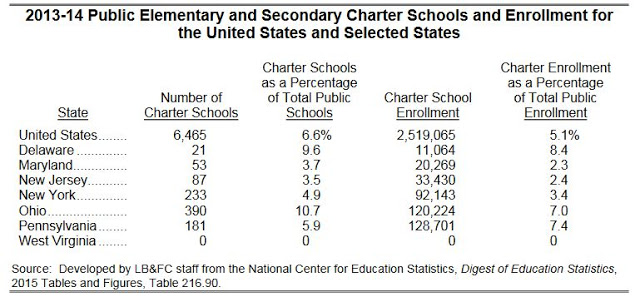
PA charter report

Now we come to cyber charter schools – the Count Draculas of the charter world.

The report estimates an additional $100 million in overpayments to cyber charters because of state law that overestimates their expenses. They are collecting much more money than they need to operate. They don’t have the same costs as brick-and-mortar institutions.

Cyber charter school students are given a computer and internet access. That’s about it. No costly building to run. Students usually do their lessons at home. Even when taking into account cyber charter staff, expenses are much lower than at other kinds of schools yet they are calculated without consideration of these differences.

Once again, state tax dollars that could be used to educate students become pure profit for charter operators. It is businessmen who win and students who lose.

The legislature used to acknowledge the burden charter schools put on local districts. The state budget used to include a line item reimbursing local districts for a percentage of their payments to charters. In 2010-11, that was $225 million. However, this money disappeared during the Gov. Tom Corbett administration when Republicans gained control of the legislature and prioritized tax cuts over charter school relief.

Though Corbett was defeated by Democrat Tom Wolf for the governorship, the legislature is still controlled by Republicans and the charter school reimbursement remains a distant memory.

But perhaps this new report signals a change in policy.

It contains several suggestions to fix Pennsylvania’s broken charter school laws. These include:

  • Permitting school districts to negotiate charter per pupil payment rates and methods.
  • Eliminating mandates for transportation that are inconsistent with services offered for district-operated schools.
  • Requiring the state to check with local districts when charter schools complain of underpayment.
  • Requiring greater transparency and fiscal accountability addressing problems like shell ownership, leasing, state payments, and conflict of interest policies.
  • Allowing audits of charter school funds.
  • Prohibiting the guaranteeing of loans where there is no direct school involvement.
  • Requiring charters to submit financial records for the district to review.
  • Requiring parents who place students in charters to first register with the local school district and then notify the district of changes in status.
  • Eliminating public school districts’ responsibility for charter school compliance with compulsory attendance requirements.

However, perhaps the biggest game changer is how charters set up shop in the first place.

Right now when charter operators want to open a school in a local district, the local school board gets to say yea or nay. However, school directors aren’t allowed to consider how this will financially impact the district. The report suggests this be changed; Districts should be allowed to approve or deny charters based on dollars and cents.

Currently local school directors are forced to approve charters that they know will hurt their students. This change would require charters to be equal partners with traditional districts or else be blocked. In effect, it would transform them from parasites to symbiotic organisms.

And as luck would have it, there are already two separate but similar bills that have been introduced that propose many of these changes.

One (Senate Bill 670) was introduced by Sen. Jim Brewster (D-McKeesport). The other (Senate Bill 198) was introduced by Sen. Vincent Hughes (D-Philadelphia). Brewster’s bill would “realign and redefine how local school districts, charter schools, students and taxpayers interact.” Hughes’ legislation would “provide local school boards with the tools to better oversee charter schools in their school districts.”

Charter school reform is something that members of both parties have expressed interest in. However, until recently Republican efforts at it have been light on reform and heavy on destructive means to further deregulate an already dangerously unregulated industry, thus worsening the problem.

Charter support has been strongly bipartisan. Champions of this new report claim that these suggested reforms aren’t anti-charter. They’re an effort to make both charters and traditional public schools work together instead of against each other.

Time will tell whether lawmakers are willing to do so.

Given the large donations received from the charter industry to lawmakers on both sides of the aisle, true reform may be difficult.

But at least we now have a state-sanctioned report to point to when referencing the multitude of problems associated with the industry.

Charters have been officially recognized by the state as parasites.

Will lawmakers do something to stop that unending sucking sound?

PA Senate Regulates Union Political Spending But Not Corporate Political Spending

screen-shot-2017-02-09-at-9-39-55-am


In a display of blatant hypocrisy, the Pennsylvania state Senate voted yesterday to further regulate labor unions political spending but not that of corporations.


By a vote of 28-22, the Senate passed a bill blocking government agencies from deducting union dues used for political activity from employees’ paychecks.


Even though six Republicans joined all Democrats in opposing SB 166, it now goes to the state House for consideration.


Typically only about 10 percent of union dues are used in politics. These are voluntary contributions employees ask to be deducted from their pay for lobbying in their own interests. Like contributions to the United Way or other charities, it’s an issue of convenience for employees but poses no significant burden on employers.


However, businesses such as insurance companies, big banks and financial companies also are involved in politics. Shouldn’t their spending be subject to similar controls?


Apparently not, according to Senate Republicans.


Leading Democrat Sen. Jay Costa (D-Forest Hills) proposed an amendment to the bill that would have put similar regulations on corporations in the state. It was defeated by a party line vote of 16-34.


Costa’s amendment would have required corporations that are organized in the Commonwealth to get shareholders consent before spending any more than $10,000 a year on politics.


It was a common sense measure meant to ensure that CEOs and board of directors are acting in the interests of their shareholders. However, Senate Republicans turned it down while ramping up restrictions on working people.


State Republicans have made it clear that the problem is not political spending. It is political spending by labor unions. It is political spending that more typically goes to the opposition party.


They don’t care how corporations participate in the political process. They only care about unions, which historically vote against Republicans.


It is impossible to conceive that political considerations played no part in their decision. After all, corporations are much more likely to donate to members of the GOP than they are to Democrats. Republicans can talk about liberty all they want, but voters know this is all about protecting contributions to the GOP while weakening such revenue streams to Democrats. Otherwise, why not level equal regulations for both parties?


Getting money out of politics is a noble goal. But that’s not what this is. It is about getting the opposition party’s money out while keeping bags of gold doubloons for you and yours.


The measure could just as easily sail through the House, which also has a hefty Republican majority. Pennsylvania is one of the most extreme examples of gerrymandering in the country, with many more Democratic votes being cast yet having a GOP majority in the legislature. However, it is doubtful Democratic Gov. Tom Wolf would sign this bill even if Republicans ram it through. So it’s prospects of being enacted are dim.


The measure would force unions to collect any dues or contributions on their own to fund get-out-the-vote efforts, lobbying or voter registration drives. Fortunately, it would still permit union deductions for non-political activities such as collective bargaining and grievances.


The bill is sponsored by Sen. John Eichelberger, (R-Duncansville) one of the most virulent anti-education lawmakers in the state. Eichelberger hasn’t seen a measure that harms school children, teachers or unions that he hasn’t written, himself, or at least supported. He is the architect behind Senate Bill 229, a measure that would strip teachers of sick days, bereavement leave and sabbaticals. The bill would make teachers bargain with their individual districts for any kind of leave.


Eichelberger is infamous for getting into verbal and digital confrontations with teachers at Altoona Area High School.


In one particular battle, a teacher allegedly yelled at the fiscally conservative state Senator for jogging during working hours, between 9 am and 5 pm. He also berated Eichleberger – a vocal critic of teachers’ pay scale – for the lawmaker’s own large salary.


A salary database on Open Pagov.org states the Altoona teacher makes just over $43,000. Eichelberger’s salary is $85,339, according to a state website.


For his part, Eichelberger wrote a letter to the district superintendent complaining that teachers were sending him derogatory emails during school hours.


The state Senator has turned this spat into public policy positions. Both he and Senate Republicans got a pat on the back from their corporate masters at the far right Commonwealth Foundation for the passage of the union regulation bill.


Once again, Republicans have targeted teachers, nurses and public safety workers, while championing corporations. No wonder union members rarely vote for the GOP.

Why Are So Many Democrats Behind Backdoor School Voucher Expansion in Pennsylvania?

 democrats_neoliberalism


Democrats are supposed to be liberals, progressives.


That means upholding the Constitution and the Separation of Church and State.


So why are so many Pennsylvania Democrats sponsoring an expansion of the state’s de facto school voucher bill?


A total of 11 out of 84 sponsors of HB 250 are Democrats. The bill would expand the Educational Improvement Tax Credit (EITC) and Opportunity Scholarship Tax Credit (OSTC) programs.


The Commonwealth already diverts $200 million of business taxes to private and parochial schools. That’s money that should be going to support our struggling public school system.


The new bill would add $50 million to each program for a total of $100 million more flushed down the drain.


Pennsylvania has a budget deficit. We’ve cut almost $1 billion a year from public schools. We can’t afford to burn an additional $300 million on private and church schools.


We expect Republicans to support this regressive nonsense. Especially in gerrymandered Pennsylvania, they’ve gone further and further right to please their Tea Party base and avoid being primaried.


But the few Democrats left in the House and Senate are likewise in districts that would never vote Republican. You’d expect them to get more and more progressive. Instead, even here we see them taking steps to the right!


Democratic sponsors of the bill are almost exclusively from the state’s urban centers – Philadelphia and Pittsburgh.


They are:


Vanessa Lowery Brown (Philadelphia County)

Donna Bullock (Philadelphia County)

Dom Costa (Allegheny County)

Daniel J. Deasy (Allegheny County)

Michael J. Driscoll (Philadelphia County)

Jordan A. Harris (Philadelphia County)

William F. Keller (Philadelphia County)

William C. Kortz II (Allegheny County)

Joanna E. McClinton (Delaware & Philadelphia County)

Harry Readshaw (Allegheny County)

Mark Rozzi (Berks County)


These corporate tax giveaways are based on the premise that our public schools are failures and that students must be rescued from them. The Commonwealth has developed a list of approximately 400 “failing schools” and created a voucher-like system allowing students living near them to take public taxpayer money to go to private and religious schools. Students can also go to another public school in a different district, if they will accept them. However, few public schools take part in the program because school boards know it’s just another attempt to weaken their districts.


How does the state define a “failing school”?


Partially it’s based on standardized test scores. Districts with the bottom 15% of reading and math scores on the Pennsylvania System of School Assessments (PSSA) and Keystone tests are supposed to earn this label. However, the state has been notorious for including districts that actually are making academic progress.


Since low test scores are highly correlated with poverty, that’s the real indicator. If you live in a poor enough district, you’re probably eligible.


What about charter schools?


It’s funny you asked. Though they often have subpar test scores, they rarely are included on the state’s list of “failing schools.” They even exclude most of the state’s execrable cyber charter schools. The Center for Research on Education Outcomes (CREDO) at Stanford University found that students in every single Pennsylvania cyber charter school performed “significantly worse” in reading and math than their peers in conventional public schools. But somehow that’s generally not failing enough to earn you a voucher-like tax credit.


How can we tell that students at private and parochial schools are doing better than those in public schools?


We can’t.


The scholarship organizations have no auditing requirements and almost no reporting requirements. Moreover, private and parochial schools don’t have to take the federally-mandated standardized tests! So there’s no way to do an apples-to-apples comparison!


But here’s the best part. The EITC law prohibits state administrators from requesting any information related to academic achievement. You’re not even allowed to ask!


However, the law goes out of its way to remove regulations on how these tax dollars are spent. For instance, schools taking these tax credits can spend as much as 20% of the money to cover pure administrative costs.


Yet the public schools are still responsible for many of the costs of students living in their attendance areas but who use these de facto vouchers. For instance, there’s no limit to how far away an EITC student can go with their publicly-subsidized scholarship. But the student’s home district is legally obligated to provide transportation for up to ten miles.


Vouchers have been repeatedly defeated on every referendum held on the subject in the entire country. One of the reasons people have been up in arms against Donald Trump’s nomination of Betsy DeVos as U.S. Education Secretary has been her support of vouchers.


What do voters have to do to tell legislators that they don’t want school vouchers – no matter what you call them? What do voters have to do to show that they support our public school system – a system that despite being underfunded and weighed down with corporate education reforms remains one of the best in the world?


And when will Pennsylvania’s Democrats start acting like Democrats on the subject?

Pennsylvania: No School Property Tax for the Rich, Poor Still Pay

propertytaxmoney

Eliminating property tax to fund public schools sounds like a great idea!

Until you read the fine print.

Because what Pennsylvania legislators are proposing won’t actually eliminate property taxes – unless you’re rich.

And it won’t ensure students get the funding they need.

And it will limit school boards’ local control.

But it will benefit the rich and big corporations, which is really the only reason we’re talking about it – AGAIN.

Let me break it down for you.

First, the bill being shopped around is called the Property Tax Independence Act or SB 76. It would get rid of all property taxes used to fund public schools and replace them with increases in sales and income taxes.

Somehow these increases would need to generate an additional $12 billion a year in revenue so that we can keep funding our schools at the present level. That’s some tax increase – and guess who’s going to pay the bulk of it – YOU.

Guess who’s not going to pay much of it – the huge corporations who used to pay property taxes on all those commercial, industrial, oil and gas properties.

This is a huge giveaway to big business, and it’s a substantial hike for regular Commonwealth citizens like you and me.

But that’s not all!

If you live in a poor school district, you’ll still have to pay property taxes. That’s right – if your district is in debt, you’ll still get a property tax bill to pay it off.

Considering that the state cut almost $1 billion a year in school funding for the past 6 years and that most districts have had to go into debt, increase taxes or both, you’re probably not going to see your property taxes go away anytime soon.

They might go down up to 40%. Or they might not go down at all. AND you still have to pay higher sales and income taxes.

But here’s the best part.

Pennsylvania has the dubious distinction of being the national leader in unfair school funding.

We spend 33% more money on our rich students than on our poor ones. That’s the greatest disparity in the entire country!

And that’s saying something in a nation where spending more on wealthy kids is the norm.

However, this new bill won’t do anything to change that. In fact, it will lock-in that disparity.

Rich districts that today spend $23,000 per student will still spend $23,000, and poor districts that today spend $8,000 per student will still spend $8,000. But instead of your tax dollars going to the kids in your community, they’ll go to the state to be distributed everywhere. This means folks living in poor neighborhoods will probably be paying higher taxes so that they can fund the wealthiest kids. Likewise, rich parents will probably pay less while the difference is made up from taxes collected from the poor.

Call me crazy, but that just isn’t fair.
Finally, it takes away a lot of the local control from your local school board.

At present, if your local district has needs, your board can meet them by raising taxes. But under this bill, the only entity that can do that is the legislature.

I know, I know – your taxes are already too high. But the issue is who is more suited to making that decision – Harrisburg or your own community?

This bill is nothing new. Legislators have been trying to sneak it through for years.

Back in 2015 it passed the House but was defeated in the Senate when the Lt. Governor cast the deciding ballot against it. In 2013, it almost passed as an amendment to another bill, but the nonpartisan Pennsylvania Independent Fiscal Office ruined it by projecting a $1 billion shortfall within four years if it were passed.

However, the makeup of the Senate has changed. Now we have two new members who campaigned promising to pass this legislation, so it might actually squeak through.

The bill is being shopped around by state Sen. David Argall (R-Schuylkill/Berks) who authored it along with the Pennsylvania Coalition of Taxpayer Associations.

This group claims to be a simple citizens organization made up of 87 nonpartisan tax-conscious advocacy groups. But a quick look at the names of these organizations includes multiple uses of terms like “patriot,” and “freedom,” and “liberty,” and “conservative,” and “tea party.”

Nonpartisan, my butt!

Moreover, the stated goal of the group is just to pass this legislation.

That’s not a group of concerned citizens. It’s almost a PAC!

The organization has even endorsed candidates – some of them noted progressive Democrats like state Sen. Andy Dinniman (D-West Chester) and James Brewster (D-McKeesport), who both voted for the legislation in 2015.

To make it even more complex, the authors of the bill have a point. Property taxes are a terrible way to fund schools. They ensure that some districts will be better funded than others based on the local wealth of the community.

However, this bill does nothing to fix the inherent problems for children or poor and middle class communities. It compounds them.

Ironically, Gov. Wolf proposed a compromise solution two years ago with his first budget. He suggested reducing residential property taxes by $3.8 billion, targeting the biggest cuts for the neediest taxpayers and neediest schools. Moreover, he proposed increasing funding to the most impoverished districts so they could catch up to the well-funded ones.

But Republicans, who control both houses, refused to even consider it.

So here we go again. We have another Trojan Horse proposal. A good idea has been twisted and bastardized so that it serves the wealthy and private enterprise while doing irreparable harm to children and the poor. And even though it is an example of far right ideology, it has received bipartisan support.

Gov. Wolf is set to propose his new budget sometime this month. Sen. Argall is expected to reintroduce SB 76 during the subsequent budget negotiations.

It is a piece of zombie legislation that no matter how fetid and rotten just refuses to die. But this time, it just might bite us.

PA Legislature Plans Taking Away Teachers’ Sick Days

thumbnail_teachers-sick-719435

Dear Pennsylvania legislators:

So now you want to take away teachers’ sick days.

Sabbatical, sick days, bereavement leaves – the Senate Education Committee voted 7-5 to strip them from the law and make teachers bargain for them with their districts.

So the next time I get sick, you don’t want to guarantee I can take the day off. If my mother dies, you don’t want to protect my right to attend her funeral.

The full legislature still has to vote on it, but that’s pretty cold.

Which brings me to my first question: Why do you hate public school teachers so much?

Seriously. What did teachers ever do to you? Did we give you a bad grade when you were kids? Did we give you detention? What did we ever do to earn such animosity?

You obviously must have something personal against teachers.

It’s understandable. Even though the majority of Pennsylvanians voted for Democrats, most of you are Republicans. You have gerrymandered the state so that you artificially have the majority, and as such you must espouse the most radical positions possible. Otherwise, you’ll be primaried by someone even farther right – a Tea Partier, a plutocrat, an anarcho-capitalist, a fascist.

We see the same thing playing out nationally. Hello, Donald Trump!

So it’s no surprise that after stripping public schools of almost $1 billion every year for the past five years, after tens of thousands of teachers have been laid off, after you’ve given away millions of dollars to private corporations to run fly-by-night charter schools or through tax credits to religious schools – well, it’s no surprise that you feel the need to continue the war on teachers.

It’s paying off for you big time.

Not so much for our school children. They have had to deal with increases in class size, narrowing of the curriculum, reductions in extra-curriculars, cuts in tutoring – just about every deprivation imaginable.

I wonder – do you realize that every attack against teachers is also an attack against students? Making sick teachers come to school won’t improve kids’ educations. Forcing educators to choose between work or seeing their loved ones off to their final resting places won’t boost test scores. Do you understand that or do you just not care?

Follow-up, if I may: do you realize that most public school teachers are women? Does that factor in at all? Which do you hate more, the gender of most teachers or the fact that we are unionized?

Oh, and Pennsylvania School Boards Association, don’t think we’ve forgotten you. We know you requested this mess, Senate Bill 229. Instead of standing with your teachers to fight for fair, equitable, sustainable funding, you’ve decided to ask the legislature if you can stiff teachers to make ends meet. We’re there for your kids everyday, and this is how you thank us. That’s gratitude.

It’s what we get for being one of the last workforces to be unionized. We have the temerity to demand fair treatment. You can’t just do whatever you like with us, you have to actually sit down with us at the bargaining table and talk.

Legislators, we know it’s something that infuriates your base. No, I don’t mean the people who vote for you. I mean your real base – the corporations, millionaires and billionaires who pay your real salaries – the unlimited and shadowy campaign contributions that, let’s be honest, are really nothing less than legal bribes.

We shouldn’t be surprised that you have prioritized taking away legal protections for teachers’ sick days. It is quite in line with what you want to do to the profession. You no longer want highly qualified teachers making a middle class income who then can stay in our schools for their entire careers. You want lightly trained temps who use teaching as a stepping stone to a job that pays enough to live.

After all, if we afford teachers the status of professionals, they might actually be able to jump all the other hurdles we’ve put in front of them and educate the poor.

That would be terrible.

Despite all the standardized testing, Common Core, value-added measures, budget cuts, and constant propaganda about “failing schools,” they might actually teach these kids to think. That’s the last thing you want.

A thinking public might see how much you’re screwing them over. They might actually rise up and fight. They might refuse to accept the status quo that you are so desperately trying to protect.

That’s your real endgame. And though it makes me sick, I suppose I will no longer be able to take off.

I’ll just spend the day, coughing and wheezing with the children.

Yours,

Steven Singer

The Gadfly on the Wall

Pittsburgh Public Schools Advised to Repeat Same Mistakes Over and Over and Over…

screen-shot-2017-01-19-at-8-18-55-am


“Insanity: doing the same thing over and over again and expecting different results.”

-Albert Einstein (attributed)


“AAAUUURGH!”

-Charlie Brown


If I crash my car right into a wall, the worst thing to do would be to get into another car and crash it right into the same wall!


But that’s what the Pittsburgh Post Gazette thinks city school administrators should do.


A new comprehensive report about Pittsburgh Public Schools concludes that standardization and Common Core have produced zero progress in the district over the last decade.


And the editorial board of the city’s largest remaining newspaper says this means administrators should stay the course – indeed, double down on test prep and uniformity.


The 175-page report by The Council of the Great City Schools affirms that the district showed little to no improvement in the last 10 years.


“In fact, analysis of student achievement trends shows little to no improvements since 2007,” the report went on. “Although some scores went up and others went down over the period, achievement gaps are about the same — if not wider — than they were when the work started.”


You would think this would be a scathing indictment of administrators during this time who focused on test prep and uniformity to the exclusion of more student-centered reforms. In particular, during the same time covered in the report, administrators paid for new curriculum designed to standardize instruction across schools and grade levels. They instituted a value-added bonus system rewarding principals who run the schools with the highest test scores. They even increased the length of the school day to drive achievement.


They did all this, and it didn’t help a bit.


Some might see that as proof of the error of past ways.


But not the Post Gazette.


In the minds of the editorial board, this is a ringing endorsement of those policies that got us nowhere.


Mark Roosevelt, superintendent from 2005 to 2010, and Linda Lane, superintendent from 2010 to 2016, are actually singled out by the paper as heroes of reform!


Wait a minute. These are the people in charge when the district apparently was stalled. If anything, these functionaries should bear the blame, not get a pat on the back. We should do anything BUT continuing their work which lead to this dismal report.


But instead, the editorial board writes, “[T]he work of Mr. Roosevelt and Ms. Lane was not in vain. They inaugurated a coherent system of reforms, made the federal benchmark known as ‘adequate yearly progress’ twice in three years, restored the district’s credibility with the foundation community, forged a closer relationship with the teachers union and generated a new sense of optimism. The course they charted is worth revisiting.”


What!?


Voters are fed up with number-worshipping flunkies who don’t see kids as anything but data points. That’s why the community has consistently replaced number crunching school directors and administrators with people who have a new vision of education – a community schools approach.


The editorial board may look down their noses at current Superintendent Dr. Anthony Hamlet who took over just this summer and the positive changes he’s been making with the new progressive school board, but he’s only doing what the public wants. And given this new report, a new direction is exactly what Pittsburgh Public Schools needs!


In the ivory tower of big media, they don’t see it this way.


In fact, the PG goes so far as to imply that Dr. Hamlet and the new board are somehow responsible for Roosevelt and Lane’s failures.


“It may be that they [Roosevelt and Lane] did not stay long enough for their efforts to take root,” writes the Post Gazette, “that the reforms became too cumbersome to manage or that they were unable to fully impose their will on a sprawling school district with many constituencies.”


Please. Dr. Hamlet’s presence has not halted Roosevelt and Lane’s march toward progress. This report demonstrates that they achieved very little. Moreover, Dr. Hamlet has only been in office since June. He hasn’t been in the district long enough to flush student test scores down the toilet – especially when for more than nine of those years he was working in Florida.


Neither can you blame the community for being fed up with corporate education reforms that apparently don’t work.


No. If this report by a consortium of the nation’s 70 largest urban school districts shows failure in ‘burgh schools, that belongs to the bosses at the top during the last 10 years. If this is a failure, it is Roosevelt’s and Lane’s, not Dr. Hamlet’s. Nor can you place it at the feet of school directors, most of whom are new to the board.


But the media mavens can be forgiven slightly for coming to such an odd conclusion, because it’s supported by the organization that wrote the report – the Council of the Great City Schools. After all, the Council suggested this push toward standardization in the first place.


In February 2006, this same Council advised Pittsburgh to “recommit to a standardized, districtwide curriculum to ensure that every classroom is focused on a common set of rigorous expectations for student learning.”


And now that same Council is saying that doing so resulted in a fat goose egg.


Great advice, Guys!


Pittsburgh residents spent $156,545 of taxpayer money to find that out.


Still, it’s not a total waste. It’s probably the most comprehensive look at the district in recent history and drew expertise from two dozen executives from eight different city school systems. It also included interviews with 170 staff and community members.


The third-party review was part of Dr. Hamlet’s transition plan and “acts as a blueprint” to transform the district, he said. It includes a detailed review of the district’s organization structure, staffing levels, instructional programs, financial operations, business services, disciplinary policies, and research and data functions.


Of particular interest is school discipline data showing that the district has an “extraordinarily high” suspension rate compared with other cities and that its disciplinary actions disproportionately affect students of color. In fact, this seems to justify moves by Dr. Hamlet to enact a restorative justice disciplinary program instead of a strict zero tolerance policy.

The report includes numerous suggestions for improvements across the board including revamping the district’s central office structure and updating the district’s outdated PreK-5 literary curriculum – initiatives that are already underway.


But when it comes to a repeated call for standardization and canned curriculum across the district, it should be ignored.


Put simply, we’ve tried that crap. It doesn’t help.


We’ve got to get beyond our love for standardized tests. We know that poor students don’t do as well on these types of assessments as middle class or wealthy students. It should be no surprise, then, that an urban district like Pittsburgh with a high percentage of impoverished students will also have low test scores.


It’s the poverty, stupid!


We need to do something to address that directly, not attack a district that’s lost almost $1 billion annually in state funding for the last five years.


Moreover, this obsession with Common Core is completely unfounded. It has never been demonstrated that aligning curriculum to the Core will increase test scores or increase learning. In fact, there is mounting research to show that these academic standards are developmentally inappropriate and actually prevent authentic learning – especially in reluctant learners.


The Council of the Great City Schools is enamored with these policies because the organization has taken millions of dollars in donations from the Gates Foundation and other organizations connected with the testing industry. Even many charitable foundations have aligned themselves with this lucrative business model where corporations cash in when students fail and then cash in again by selling them the remediation and Common Core texts they convince us we need to pass the tests.


The editorial board of the Post Gazette is likewise blinded by dollar signs and data.


Like far too many non-educators, they give far too much credence to a person’s bank account than her expertise. The same people pushing testing and new academic standards also benefit financially from them. They have created at least one PAC in the city with deep pockets looking to unseat unsympathetic board members and discredit Dr. Hamlet so that they can install their own representatives.


This is a battle with plain sense and logic. It’s also a battle for control of Pittsburgh Public Schools.

Does Eating a Free School Lunch Give Kids “an Empty Soul?”

children-eating-school-lunch

Just about everyone admits the importance of eating lunch – especially for growing kids in school.

But if you get that lunch for free, does it leave you with “a full stomach and an empty soul”?

Speaker of the U.S. House of Representatives Paul Ryan thinks so.

He famously made these remarks at the 2014 Conservative Political Action Conference:

“Take Obamacare—not literally, but figuratively here OK? We now know that this law will discourage millions of people from working. The Left thinks this is a good thing. They say, ‘hey, this is a new freedom—the freedom not to work.’ But I don’t think the problem is too many people are working — I think the problem is not enough people can find work. And if people leave the workforce, our economy will shrink—there will be less opportunity, not more. So the Left is making a big mistake here. What they’re offering people is a full stomach—and an empty soul. The American people want more than that.”

So, for Ryan, having affordable healthcare somehow has discouraged people from working. He seems to think there are millions of poor people out there who could get a job but have decided not to because their medical bills are too low.

It’s preposterous. Most poor people are working several minimum wage jobs just to get by. Very few people are sitting at home on the public dole, and those that are need help to find jobs, as he admits. They need help finding better jobs that pay higher wages. They need help getting the skills and training necessary to get those jobs. And they need for those jobs to actually exist! They don’t need condemnation or starvation to motivate them.

If Republicans like Ryan had offered a single jobs bill, perhaps such remarks would be excusable. If they had offered an alternative to Obamacare, likewise it might be excusable. In the absence of those things, his comments seem to be nothing more than a thinly veiled excuse for doing nothing to help the less fortunate.

But Ryan goes on:

“This reminds me of a story I heard from Eloise Anderson. She serves in the cabinet of my friend Governor Scott Walker. She once met a young boy from a poor family. And every day at school, he would get a free lunch from a government program. But he told Eloise he didn’t want a free lunch. He wanted his own lunch—one in a brown-paper bag just like the other kids’. He wanted one, he said, because he knew a kid with a brown-paper bag had someone who cared for him.”

There are several problems with these remarks. First of all, Anderson later admitted that it never happened. She never met a boy who said this. She got the whole thing from “The Invisible Thread,” by Laura Schroff, either from the book, itself, or a TV interview about the book.

Second, Anderson’s cherry picking this example from the book goes completely against what the author was trying to say. The book is the true story of a business executive and an 11-year-old homeless boy who partnered together with an organization called No Kid Hungry to fight child hunger. One key part of the program is connecting hungry kids with federal programs such as school lunches and food stamps. The group also opposed Ryan’s 2013 budget for its proposed reductions in the food stamp program. In short, Schroff was trying to show how important it was to provide free lunches to students – not that we should let them go hungry. Using Schroff’s book to justify cutting school lunch programs is like using Nelson Mandela’s autobiography as a justification for apartheid.

Getting a free lunch doesn’t mean no one cares for you. On the contrary, it means that everyone does, that your community has pitched in to make sure you are fed.

Many politicians and media talking heads refuse to see the realities of modern American life. Deregulation of the banking and corporate sector along with outsourcing and rampant union busting have resulted in an economy where most of the good paying jobs are gone. This puts a tremendous strain on our education system. As a result, more than half of public school students live below the poverty line. But how to meet their needs without stigmatizing kids for circumstances beyond their control?

Many communities around the country including my own, have stepped up with a solution. For the last two years, hundreds of districts throughout my state of Pennsylvania and throughout the nation have offered free lunches to all of their students regardless of family income. Rich kids, poor kids, all kids eat for free. Though students can still bring a lunch from home, having the option to eat at school removes the dichotomy of brown bags vs. cafeteria lunches. All are the same.

The program, called the Community Eligibility Provision, is available nationwide as part of the Healthy, Hunger-Free Kids Act passed in 2010. Its goal is to provide healthy lunches and breakfasts to millions of students nationwide, according to the U.S. Department of Agriculture.

Previously only low-income students or students from families receiving federal assistance received free breakfasts and lunches.

Now, only 40 percent of a single school or an entire district’s population must come from families receiving federal assistance through the Supplemental Nutrition Assistance Program (SNAP) and/or Temporary Assistance for Needy Families (TANF). They may also be homeless or come from foster homes. Once that 40 percent threshold is reached, all students receive free lunch and breakfast. Districts are compensated by the state and federal government.

Before this program, providing school lunches, even at cost, was a losing proposition. Most districts end the year with students owing them large sums for lunches. For instance, two years ago, $25,000 of debt remained with Pittsburgh schools because some students didn’t pay for their meals.

Districts could stop letting these children eat the school lunch, but no one wants to refuse a child a meal. Under the previous system, the extra cost for unpaid lunches and the cost to complete mountains of paperwork involved in collecting the money was put on the backs of local taxpayers. Under this new program, all of this disappears. Moreover, we create a community of children who are better fed and thus better ready for the demands of school.

And mark my words, this IS helping kids become better prepared for class.

As a teacher, I used to have to buy snacks and meals for my students. I had a drawer full of Ramen noodles for children who came to me hungry. Many kids suffer from food insecurity but don’t qualify for SNAP. This program solves that problem.

My own second grade daughter has never known anything else but this system. Though I can afford to pay or pack her a lunch, she prefers to eat what her friends are eating. My wife and I are often baffled that she’ll try new foods at school that she would never give a chance had we made them at home.

And the food is actually pretty good. It’s not gourmet, but it’s better than what you’d get at most fast food restaurants. I even eat it, myself, from time-to-time. I have to pay two bucks, but it’s still a bargain. I particularly like the baked chicken.

People complain about new federal guidelines that have made school lunches healthier, but what they’ve really done is made them better. Whole grain bread and buns taste pretty much the same and are better for you. Using less salt and grease is better all around.

I’ve even noticed the kids learning new things about food from the increased menu. When all this began, I remember many of the middle schoolers expressing disgust at the chicken because it was in whole pieces. They had only seen chicken in nugget form.

Now kids will walk up to the cafeteria ladies and ask to try this or that. Many times they discover something new that they like. It’s really cool to see. Even their manners have improved.

Just today little 5th graders were remarking at how soft and delicious the croissant was on the breakfast sandwich. They had never seen a bun like that before. I literally heard comments like “delicious” and “mouth-watering.”

That’s incredibly high praise for children. Sure some of them still find the food is disgusting, but they are in the minority.

Do the kids who eat these lunches have “an empty soul”?

No, that’s just Paul Ryan.

Who’s More Valuable – a Union Busting Lawyer or a Union Worker?

man-laughing-loudly-300

There he was standing in front of me in line.


New gray pinstriped suit. Silk red Armani tie. White button down shirt so bleached it hurt my eyes.


We were waiting to board our plane to take us to Houston. Me, a public school teacher. Him, a union busting lawyer.


I was on my way to an education and civil rights summit. He was going to an annual lawyers conference, one of many he attends each year.


I got all this information not from talking to the guy. He was jovial enough but he just couldn’t contain his backstory to a single audience. He was in the mood to talk to anybody and everybody as we waited for the stewardess to tell us it was okay to board.


He spent most of his time talking with two representatives of the natural gas industry who had visited my home of Pittsburgh to invest in our rich deposits of Marcellus shale – and incidentally poison our environment. He also joked with another lawyer further up in line and already tipsy.


I listened to him yuk it up about exclusive golf courses, wine country and the presidential election (he’s a Trump supporter) and felt a warm dislike spread through my chest.


I looked at my faded t-shirt and jeans and wondered how it was that this guy gets so much for what he does and I get so little. Oh I get all the intangibles, but he gets… well… the money, pride and prestige.


There he was asking the gas guys about a good steak place for lunch in Houston. I love steak. I’d like to eat a nice, juicy steak. But I can’t afford it.


I’m only able to make this trip because I took the least expensive flight (coach, by the way – guess where he was sitting) and I was sharing a hotel room with a college professor who had saved up enough discretionary funds to cover the room.


While the attorney was dining on steak, I’d be lucky to store up a muffin or two from the hotel’s complimentary breakfast.


Yet there he was telling the whole world his story unafraid that someone would take offense.


Well, I do take offense, buddy.


You make your living finding ways to make it harder for me to make mine. You spend your whole day looking for legal loopholes and documented precedents to take away protections at my job, cut my pay and make me work longer hours without overtime. You eat at expensive restaurants and wear Italian leather shoes while people like me live paycheck-to-paycheck. You are nothing but a parasite.


Yet no one else seemed to take offense at his braggadocio. Only me. The natural gas guys clapped him on the back and congratulated him on the delicious rib eye in his future.


It makes me wonder why unions are so often made to seem the villain and guys like this are seen as good ol’ boys at best and merely innocuous at worst.


I teach young children how to read and write. I open their minds to the world around them and show them how to think critically. I raise up the weak and give succor to the needy.


What value does he add to society? Seriously! How does he make the world one bit better than the way he found it?


Yes, I am a union employee and proud of it. I collectively bargain for a fair wage. I band together with my colleagues for a middle class income so I can afford to be a teacher. I demand professionalism and autonomy so I can do the job. I seek fair treatment so I’m not constantly looking over my shoulder in case a school board member would rather give my job to one of his cousins. And if you’re going to fire me, I ask for due process – proof of wrongdoing.


Somehow in the eyes of the public this makes me a monster.


But this guy gives you nothing. He provides no return on your investment except that he stifles me.


He makes it harder if not impossible for me to stay in the profession. He works so I can’t support my family. He endeavors for me to be paid the minimum wage so I won’t be able to come home and help my daughter with her homework but instead will have to move on to my second or third job. He argues that I should not be considered a professional and should not be treated like an intelligent person with an advanced degree but should be a factory widget who does as he’s told. He tries to make anxiety my normal state. And he seeks to ensure I can be fired at will with no proof, no reason, just an employers whim.


If he achieves his ends, my students will not have a productive atmosphere in which to learn. When you weaken teachers, you weaken students. We all say to put the kids first, but you can’t do that when you put teachers last.


He does all this and still has the gall to boast of it aloud in public. All while I stay silent, seethe and silently rave.


So we got on our plane, and when we landed in Texas went our separate ways.


I spent the weekend fighting for children and families. He partied with his partners. As a taxpayer, you pay a lot of money for his services. I’m a bargain, a steal. You get next to nothing from him. I open the gates for the next generation.


And somehow I’m the bad guy.

State Senator To Propose Rewriting PA Charter School Law To Hold the Industry Accountable

screen-shot-2016-10-12-at-4-50-04-pm


Pennsylvania’s charter school law is a national disgrace.


It allows charters to defraud the public and provide a substandard education to our children.


Charter school managers pay themselves with taxpayer money for leases on properties they already own. They funnel money through shell companies into their own pockets. Academic achievement at many charters is far below par.


And it’s all legal.


That’s why state Auditor General Eugene DePasquale has long called it the “worst charter school law” in the country. But his call for sweeping reforms from the legislature has fallen on mostly deaf ears.


Until now.


State Sen. Jim Brewster (D-45) is in the early stages of proposing legislation that would ensure charter schools are held as accountable as other public schools.


Specifically it would require these types of schools, which are ostensibly public but privately managed, to be transparent, fiscally solvent and responsible to taxpayers.


“It has become abundantly clear that systemic changes are needed in how brick and mortar and cyber charters operate in Pennsylvania,” Brewster says.  “There is a growing frustration that charters are unaccountable.”


The bill doesn’t have a Senate number yet, nor has its specific language been made available. However, the State Senator from McKeesport announced plans to formally propose it in Harrisburg within the next several weeks.


Brewster’s bill would:

  • Require local school boards to sign off on any new charter construction project costing more than $1 million. The project would have to be backed by a financing arrangement with a local industrial development authority or other government entity. This way charters would have to prove that new construction projects are fiscally sound and won’t be abandoned after wasting millions of taxpayer dollars.


  • Compel charter schools to prove they have the funds to keep running for the entire school year. They would have to post a bond, other type of surety, or agree to a payment escrow arrangement. This would ensure charters don’t close suddenly leaving students and parents in the lurch.


  • Limit the scope of the state Charter School Appeal Board to solely determining whether the local school board acted appropriately in reviewing charter school applications. The state should not be approving new charter schools. That power should remain at the local district level, though the state can determine if local school boards are acting within the bounds of the law.


  • Require officials from the state Department of Education (PDE) to visit the proposed site of a charter school to ascertain the condition of its physical building. Their report will then be made a part of the charter application. This way charters can’t get away with paying themselves for properties they already own and they won’t be able to open with substandard buildings.


  • Mandate that a charter school applicant obtain approval from multiple school districts if the charter school draws more than 25 students from a specific district. Every district impacted by the opening of a new charter should have a say whether it can open.


  • Upgrade accountability by requiring a quarterly report on the operations of the charter school to the local school board – with the report delivered in person by a charter school official. While traditional public schools report on operations monthly, reporting four times annually would greatly increase charter school transparency. At present charters don’t have to provide such reports sometimes for years after opening. Moreover, having a flesh and blood representative of the charter school at these meetings would allow for the public to ask questions about how their money is being spent.


  • Make a structured financial impact statement part of the charter school application. This would include an estimation of enrollment multiplied by tuition payments. The impact statement may serve as the justification for denial of a charter application. This would be huge. Traditional public schools can be sucked dry of funding from fly-by-night charters without their record of proven success. Necessitating an impact statement of this kind would truly make the local district and the charter school educational partners and not competing foes.


  • Increase the percentage of certified teachers at charters from 75 percent to 90 percent of faculty, though current faculty would be grandfathered in. Except under extreme circumstances, all teachers at traditional public schools are certified. Making charters raise the bar close to that of traditional public schools is an improvement – though Brewster has in the past proposed legislation to require 100 percent of charter teachers to be certified. It’s unclear why he’s settled on 90 percent here.


  • Prohibit charter board members from receiving payments for school lease arrangements.  This issue was highlighted in August in the auditor general’s report where he found $2.5 million tax dollars being defrauded in this way. Charter operators have complained that nothing they did was illegal. This measure would ensure that in the future such moves would be explicit violations of the law.


  • Impose a moratorium on the approval of new cyber-charter schools since their academic performance has been so consistently below that of traditional public schools and brick-and-mortar charters. In fact, A recent nationwide study found that cyber charters provide 180 days less of math instruction and 72 days less of reading than traditional public schools. (By the way, there are only 180 days in an average school year.)


Brewster said these reforms offer a place to begin real robust regulation of the charter industry. However, he is open to adding others.


“The auditor general has made a number of worthwhile recommendations and I’ve combined some of these ideas with other features to produce what I believe is an excellent starting point for comprehensive reform,” he says.


“We need to dig deep and look critically at the charter law to make sweeping changes. In this year alone, the auditor general has pointed out that the reimbursement process is flawed, that there were too many reimbursement appeals and that the cyber charter law reeked with ethical issues, poor oversight and a lack of transparency.


“It is clear that the charter law is not helping schools, charters themselves or the taxpayers.”


There are more than 150 charter schools statewide enrolling more than 128,000 students, according to state data. Nearly half of these schools are in the Philadelphia area.

Two years ago, DePasquale released a set of specific recommendations to improve the charter law, which Brewster drew upon when writing his proposed legislation. DePasquale’s suggestions called for an independent board to oversee charter school processes and functions — including lease reimbursements and student enrollment. He also suggested public hearings involving charter changes, limits on fund balances and guidelines on calculating teacher certification benchmarks.


Brewster said he is not unduly singling out the charter school industry. He says he is confident making these changes will help charter schools by ensuring only high quality institutions are allowed in the Commonwealth.


The Democrat Representing the 45th legislative District says he realizes that October is late in the year to be proposing such sweeping changes. He is doing so now to raise awareness of the issue, though he doesn’t expect it to come to a vote until the next legislative session at the earliest.


He hopes to bring up many of these issues tomorrow (Oct. 13) at a Senate Democratic Policy Committee hearing at the Monroeville Municipal Building in Monroeville in his district.


The legislature tried to pass a charter school reform bill (House Bill 530 ) this summer but it had been rewritten into more giveaways to the industry than regulations. For instance, it would have allowed charters to open almost anywhere in the state without approval from local school districts. As such, it lost support.


Government watchers cautioned that this charter Trojan Horse bill might rear its ugly head again in Harrisburg. Here’s hoping that Brewster’s bill has more success and isn’t likewise bastardized into a piece of legislation that gives away the store.


If there’s one thing most people agree about in the Keystone state, it’s that we need charter school reform. Brewster’s Bill may be the answer to our prayers.