The majority of teachers and principals in Pennsylvania hate standardized tests.
An increasing number of parents are refusing to allow their kids to take the tests.
And there may be better alternatives to the state’s Keystone Exams.
These were just some of the key findings of a blockbuster report from June 2019 by the state General Assembly’s Legislative Budget and Finance Committee.
However, now that things are returning to some semblance of normalcy, it seems that bureaucrats from the state Department of Education (PDE) are taking the wrong lessons from the report while the legislature seems to have forgotten it entirely.
The report was conducted because of legislation written by state Sen. Ryan P. Aument (R-Lancaster County). It directed the Legislative Budget and Finance Committee to “study the effectiveness of standardized testing, including the Keystone Exams and SATs, and their use as indicators of student academic achievement, school building performance, and educator effectiveness.”
The key findings are as follows:
1)The majority of principals and teachers disapprove of the state’s standardized tests – both the Pennsylvania System of School Assessment (PSSA) tests given in grades 3-8 and Keystone Exams given in high school. They think these tests are ineffective, expensive and harmful to district curriculum and students.
2) State law allows parents to opt their children out of testing for one reason only – religious grounds. Parents are using this religious exemption in increasing numbers. This puts districts in danger of violating federal participation and accountability standards.
3) It has been suggested that the state allow two additional reasons for parents to opt their children out of testing – philosophical grounds and health concerns. It is unclear whether doing so would increase overall opt outs or not.
4) The federal Every Student Succeeds Act (ESSA) passed in 2015 allows the use of the SAT and/or ACT test to take the place of high school standardized testing. It has been suggested the Commonwealth replace the Keystone Exams with these tests. The report finds the ACT and/or SAT would successfully determine college readiness and reduce the overall amount of standardized testing. However, this would not allow other uses of current state tests like evaluating teacher effectiveness and school building performance.This may not matter though because the report also casts doubt on whether the current tests (PSSA and Keystone Exams) do an adequate job of assessing teacher or building performance now or even if student tests can be accurately used to evaluate teachers and schools.
There’s a lot of information here. Let’s look at each finding in turn.
1) PA Educators Hate Standardized Tests
When it comes to the PSSAs, 67% of principals and 76% of teachers said the tests were ineffective indicators of student achievement.
There was slightly more support for the Keystone Exams. This time 45% of principals said the test was an ineffective indicator of student achievement (with 27% saying the tests were effective). Meanwhile, 60% of teachers said the test was ineffective.
Both principals and teachers said their curriculum had been narrowed to prepare students for PSSAs and Keystone Exams. Instead of going into more depth on regular classwork or learning new skills, the focus shifts to teaching to the tests.
Most principals (approximately 80-90%) said that students are taught test-taking skills, and their schools administered practice tests, bench-mark tests, and/or diagnostic tests to prepare students for the PSSA exams. This held for teachers, too, with 81-88% saying they teach test-taking skills and administer practice tests. Principals also said the costs of this additional test prep varied from $200 to more than $100,000.
Taking the tests also eats up valuable class time. Administering the assessments takes between 5.7 to 8 days for each kind of test – the PSSA and the Keystone Exams, according to Principals.
In addition, the report details the cost of giving these tests. In fiscal year 2017-2018, PDE paid $42.17 million for these tests. This is part of a national trend:
“Standardized tests and test preparation have subsequently become big business and that multibillion dollar business continued to grow since the enactment of NCLB and the subsequent enactment of ESSA. According to the Pew Center on the States, annual state spending on standardized tests increased from $423 million before the NCLB (enacted in 2002) to upwards of $1.1 billion in 2008 (to put this in perspective this reflects a 160 percent increase compared to a 19.22 percent increase in inflation during the same time period). A more recent study by the Brown Center on Education Policy at Brooking put the cost at upwards of $1.7 billion in 2011 related to state spending on standardized tests.”
2) Opt Outs on the Rise
Many states allow parents to opt their children out of standardized testing. Some do so in cases of a physical disability, medical reasons, or emergencies. A few allow opt-outs based on religious objection – like Pennsylvania. Some states allow opt-outs for any reason whatsoever.
The religious exemption is not used widespread throughout the state and most schools meet the 95% participation rate required by the federal government. However, use of the religious exemption is definitely on the rise – enough so that the authors of the report find it alarming:
“Meanwhile, as previously indicated in this section, schools throughout the country are experiencing and grappling with an increase in the number of parents seeking to have their children opt-out of standardized testing now that new state assessments have been implemented pursuant to the federal requirements. Pennsylvania is no exception to this trend and is also experiencing an increase in the number of parents utilizing the religious opt-out.”
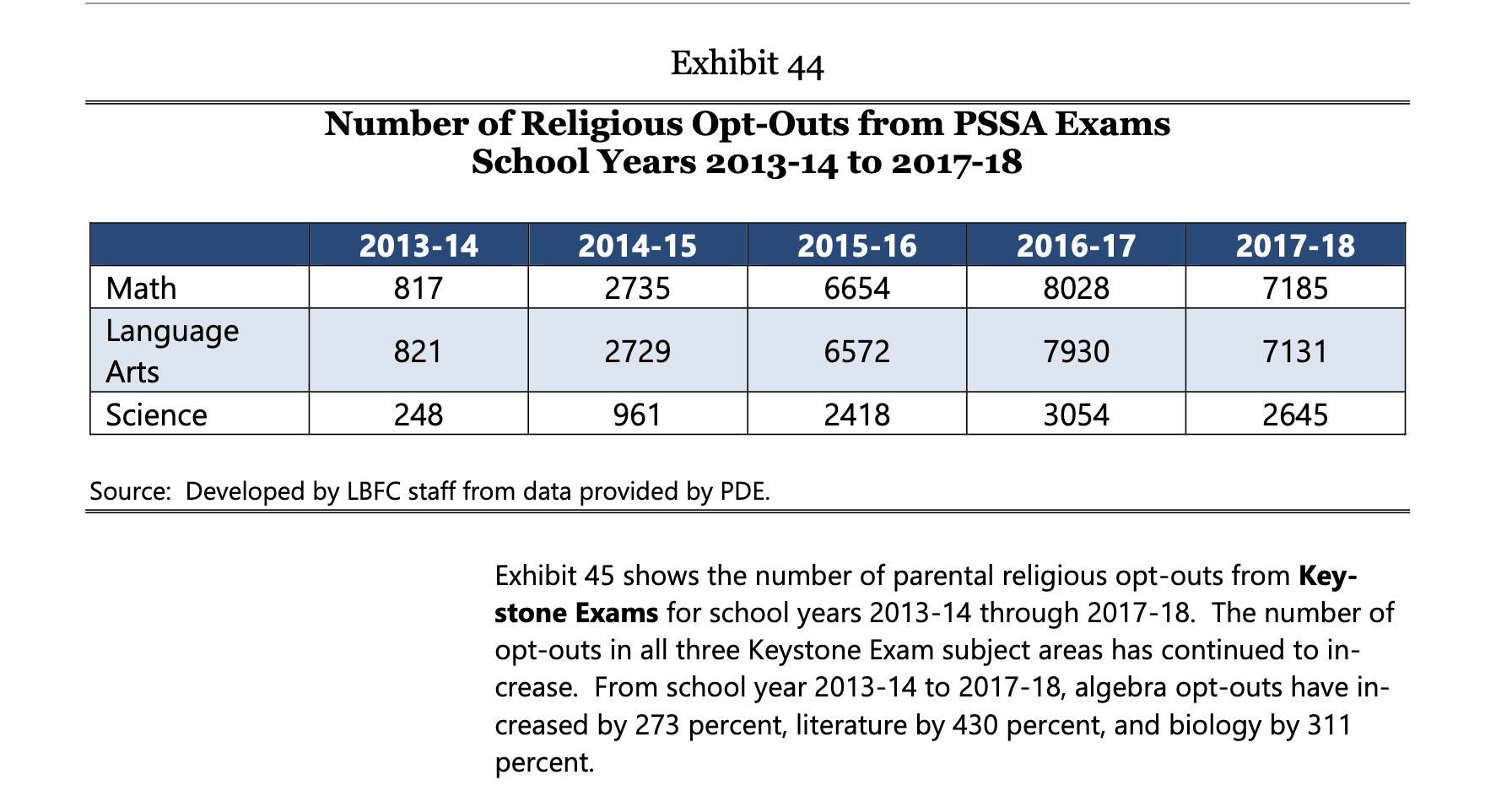
For the PSSA tests, opt outs increased from 2013-14 to 2016-17. However, total numbers in school year 2017-18 decreased sightly.
Opt outs went from 1,886 to 6,425 to 15,644 to 19,012 to 16,961.
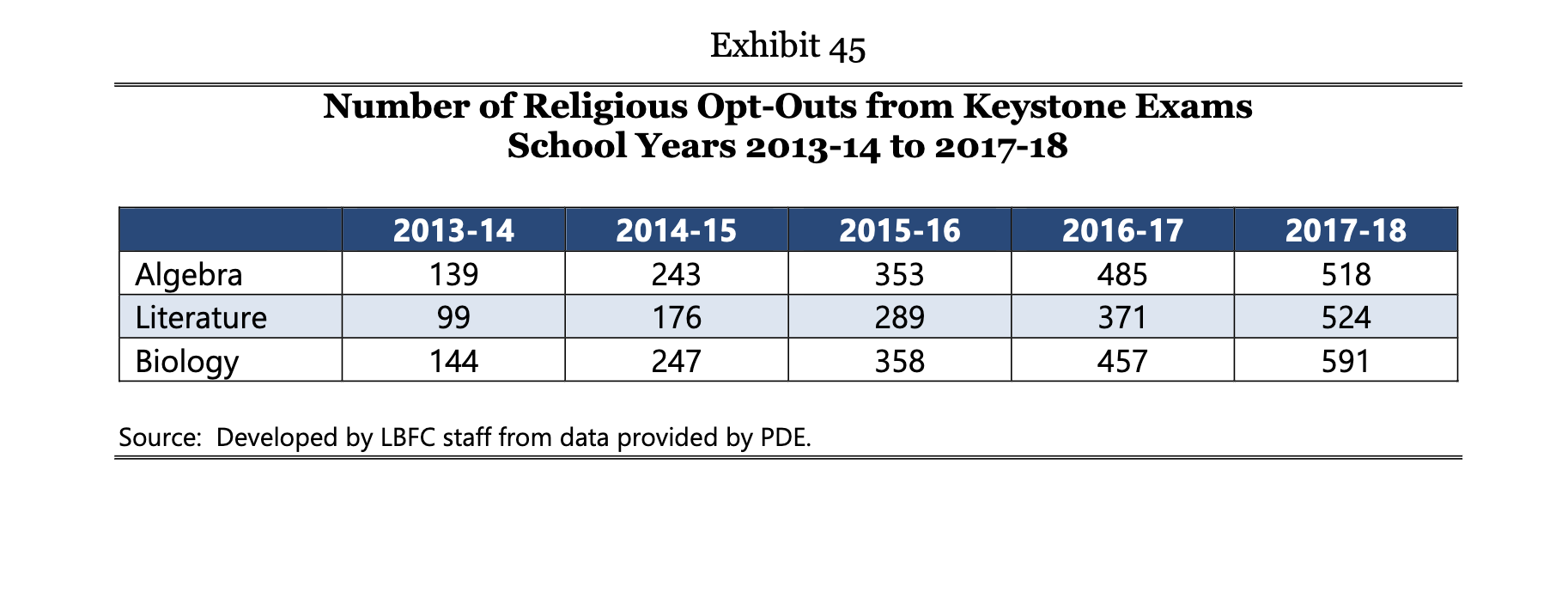
During the same time period for the Keystone Exams, opt outs steadily increased each year but were at lower overall rates.
For the high school test, opt outs went from 382 to 666 to 1,000 to 1,313 to 1,633.
These are vitally important figures because opt out data is rarely tabulated and released to the public. Many media accounts actually state the opposite of the data in this report – in particular that opting out has decreased since Congress passed the ESSA in 2015. Apparently the media got this one wrong.
Though the religious opt-out is the only reason specifically allowed in state Chapter 4 regulations, PDE reports there are five additional ways that students end up not taking the tests:
1) Other Parental Request – parents simply refusing to let their kids participate but not objecting based on specifically religious reasons.
2) No Attempt and No Exclusion Marked – students who are given the test but do not answer enough questions to receive a score.
3) No Test – no test record on file for unknown reasons.
4) Extended Absence – a student missed the testing and make-up window due to absences.
5) Other – does not fit any of the other categories.
Federal law – in particular No Child Left Behind (NCLB) and subsequent reauthorizations of that legislation – requires states to use student participation in standardized testing as a factor in a state’s accountability system. According to the report, any district with less than 95% of students taking the test should be “addressed.”
The report does not go into any further detail about what this means, other than to say that falling under 95% can:
“…ultimately result in a reduced achievement/proficiency measure… If the student participation rate falls below 95 percent, states are required to calculate student achievement/proficiency by dividing the number of students scoring proficiently by no less than 95 percent of the total students (which effectively assigns a score of “0” to all nonparticipants once the participation rate has fallen below 95 percent).”
In effect, the district gets a bad mark on a piece of paper. So what?
Under NCLB, schools with poor performance could receive sanctions like state takeover or lower funding. However, this is extremely unlikely – especially since the passing of ESSA. This newest reauthorization of the law gives states leeway in designing their accountability systems. It leaves the enforcement of this 95% participation rate up to the states, requiring them to develop an accountability plan in the event that a school or district fails to meet this standard.
So a school would only be punished if the state decided to do so. If a state legislature decided to allow parents to opt their children out for any reason at all, they would not have to take any punitive measures. Since the ESSA, the buck stops at the state house door on this one. California, for example, takes note of low participation rates but these rates are not factored into a school’s rating. On the other hand, Florida mandates direct intervention from the state’s Department of Education until participation rates are met.
3) Impact of New Reasons to Opt Out
This is where things get a bit sticky.
The report mentions the idea of expanding the options for opting-out of statewide assessments (e.g., PSSA and Keystone Exams) to include objections based on philosophical grounds or due to health issues.
On the one hand, the authors write “The impact of adding opt-out categories may be minimal.” They don’t know if more people would use the expanded options or if the same numbers who use the religious exemption today might simply divide themselves up among all three options.
The authors worry, however, that new pathways to opt out may increase the total number of people refusing the tests for their children and would reduce Pennsylvania’s participation rate in standardized testing.
This is a particularly troubling paragraph:
“The existence of opt-outs (religious or otherwise) has the potential to negatively impact a state’s participation rates and may potentially impact a state’s [Local Education Agency (LEAs)] and schools achievement/proficiency rate and ultimately the ability of a state to be in compliance with federally required assessments and accountability measures. Furthermore, providing opt-outs and giving parents notice of such has the potential to conflict with the message about the importance of standardized testing. Ultimately placing the state departments of education and local school districts in the potentially awkward position of having to explain why it is important for students to participate in testing (given the federal requirements), while also giving and notifying parents of the opt-out options for their children. In 2015, US Department of Education sent out letters to a dozen states flagging their low participation rates (statewide, or at the district or subgroup level) on the 2014-15 school year assessments and indicated that they needed to create a plan to reduce opt-outs due to low participation rates.”
This seems to be the order of the day at PDE. It’s why earlier this year, school administrators were advised by state officials to crack down on parents opting their children out of standardized tests.
And all of it is based on a cowardly and incomplete understanding of federal law. If Commonwealth schools fall below 95% participation in the test and get a bad mark on a worthless metric, it doest have to matter. No matter how many letters the federal government sends to the state legislature or PDE, the law is clear. The state is in charge here. Our legislature can choose to side with taxpayers, residents, and citizens or with civil servants and strongly worded letters.
4) Replacing the Keystone Exams
There’s not much more to add to this than the initial finding.
The authors of the report say there would be no problem with replacing the Keystone Exams with the ACT or SAT because these national tests would properly assess students’ college and career readiness.
The report is actually pretty shoddy in this regard not really examining the claims of the College Board which makes both tests. The authors just pretty much accepted the College Board’s word wholesale. Nor was their any evaluation of what teachers and principals thought about these tests like there had been for the PSSA and Keystone Exams.
However, the report does make a good point about test reduction. Many students already take the SAT or ACT test, so eliminating the Keystones would reduce the over all amount of tests they had to take.
Also the authors deserve credit for writing about how using student test scores to evaluate teachers and schools is seriously bad practice.
According to the report, 77 percent of principals and 93 percent of teachers said PSSA tests were not effective indicators for teacher evaluations, with similar figures for the Keystone Exams and building performance evaluations.
While everything in the report may not be 100% accurate, it includes important information that should be wider known.
In addition, the report has trustworthy data about opt outs throughout the Commonwealth. Unlike what has been reported in the media, opting out is not on the decline, it is on the rise.
The Keystone Exams should be thrown in the trash, because that’s what they are – trash. At very least they should be replaced with the SAT or ACT. Even better to remove any requirement for standardized tests wholesale – and that includes the PSSA.
The ESSA allows states a lot of leeway about how and what accountability system they use. There is no need to worry about some imperial federal power invading Pennsylvania to force our hand with standardized testing. We should call their bluff on this. I’ll bet that if we did so, many other states would do the same.
Standardized testing is another failed education policy. Our legislators would do good to read this report and make up their own minds about it.
Though a few years and disasters have happened since its publication, it doesn’t deserve to be forgotten by the very people who ordered it to be written in the first place.
Like this post? You might want to consider becoming a Patreon subscriber. This helps me continue to keep the blog going and get on with this difficult and challenging work.
SOME Civil Rights groups have demanded more testing, and others have demanded LESS.
The Journey for Justice Alliance (JJA), a group made up of 38 organizations of Black and Brown parents and students in 23 states, wrote Congress an open letter in July asking for an end to high stakes testing. And the JJA wasn’t alone. The alliance was joined by 175 other national and local grassroots community, youth and civil rights organizations who signed on to the letter to “…call on the U.S. Congress to pass an ESEA reauthorization without requiring the regime of oppressive, high stakes, standardized testing and sanctions that have recently been promoted as civil rights provisions within ESEA.”
However, the JJA’s call has been largely ignored by lawmakers and the media. A much smaller coalition of Civil Rights organizations in favor of testing, on the other hand, has been given so much press you’d be excused if you thought they represented the entire activist community.
It’s hard to say, but in October the prospect of rewriting the ESEA – the federal law that governs K-12 schools – seemed impossible. Neither Democrats nor Republicans could find any common ground. It looked like the law – which was last reauthorized in 2007 – would be pushed aside until at least the next president was sworn in.
But then like magic when the political situation changed and reauthorization seemed like it might actually happen, suddenly a coalition of Civil Rights organizations found their love for standardized testing.
It seems highly unlikely that these two events are unrelated.
But why would these organizations change their tune so quickly?
The sad fact is that standardized testing is big business in this country. Everyone from book publishers to software manufacturers to professional development providers to for-profit prisons depend on the continuation of the testocracy.
And many of these Civil Rights groups would be crippled without that Gates funding. Others seem more like think tanks that really have nothing to do with Civil Rights.
UNCF took more than $1.5 billion from Gates. Ostensibly that money is supposed to go to scholarships. And there’s nothing wrong with that. But how could the organization go against the wishes of perhaps its biggest donor? The consequences could be disastrous for UNCF’s entirely worthy mission.
One can imagine administrators stuck between a rock and a hard place having to compromise their stance against testing in order to continue helping people of color fulfill their dreams of going to college.
It took the Elementary and Secondary Education Act (ESEA) – a federal law designed to ensure all schools get equitable resources and funding – and turned it into a law about standardized testing and punishing schools that don’t measure up.
That includes so-called far left Dems like Bernie Sanders and Elizabeth Warren!
It comes down to the Murphy Amendment, a Democratically sponsored change to the ESEA.
This provision was an attempt to keep as many Test and Punish policies as possible in the Senate rewrite.
The amendment, “reads more like NCLB, with its detailed prescription for reporting on student test results, for ‘meaningfully differentiating among all public schools’ (i.e., grading schools), including publicly identifying the lowest five percent, and, among interventions, potentially firing staff and offering students the option to transfer to other schools and using part of the budget to pay for the transportation,” according to blogger Mercedes Schneider.
Education historian Diane Ravich adds, “This amendment would have enacted tough, federal-mandated accountability, akin to setting up an ‘achievement school district’ in every state.”
Thankfully it was voted down. The ESEA will probably not be affected. The rewrite was passed by both the House and Senate without these provisions. Once the two versions of the bill are combined, it is quite possible – maybe even probable – that we’ll have a slight improvement on NCLB. Sure there is plenty of crap in it and plenty of lost opportunities, but the ESEA rewrite looks to be a baby step in the right direction.
The problem is this: the failed Murphy Amendment shows the Democrats’ education vision. Almost all of them voted for it. Warren even co-sponsored it!
When it was defeated and the Senate approved the ESEA rewrite, Warren released a statement expressing her disapproval. But if you didn’t know about the Murphy Amendment, you could have read her criticisms quite differently.
She says the (ESEA rewrite) “eliminates basic, fundamental safeguards to ensure that federal dollars are actually used to improve both schools and educational outcomes for those students who are often ignored.”
That sounds good until you realize what she means. “Educational outcomes” mean test scores. She’s talking about test-based accountability. She is against the ESEA rewrite because it doesn’t necessarily put strings on schools’ funding based on standardized test scores like NCLB.
She continues, “Republicans have blocked every attempt to establish even minimum safeguards to ensure that money would be used effectively. I am deeply concerned that billions in taxpayer dollars will not actually reach those schools and students who need them the most…”
She is upset because Republicans repeatedly stripped away federal power to Test and Punish schools. The GOP gave that power to the states. So Warren is concerned that somewhere in this great nation there may be a state or two that decides NOT to take away funding if some of their schools have bad test scores! God forbid!
But the Dems won’t hear it. The Murphy Amendment seems to show that they’re committed to punishing poor schools and rewarding rich ones.
I really hope I’m wrong about this. Please, anyone out there, talk me down!
Up until now I’ve always been with the Democrats because they had better – though still bad – education policies than the Republicans. I’m not sure I can say that anymore. In fact, it may be just the opposite.
These days, the GOP has done a 180 and is the champion of states rights to make their own education policies.
Given the Obama administration’s continued emphasis on standardized testing, punitive accountability systems and top down education standards, a move away from federalism seems completely justified.
But this is becoming the heart of the debate even at the expense of children, parents and teachers.
NCLB allows parents to opt their children out of standardized testing, but school districts can be punished for it. If more than 5% of the students in a district don’t take the federally mandated tests for whatever reason (including parental opt out), the district’s Title I funding is put in jeopardy.
The House version says that opting out will not hurt your district. Period. But the Senate version leaves the matter up to the states. State legislatures get to decide if withholding your child from standardized testing will have punitive consequences for your district.
This is absurd.
It’s not a matter of States’ Rights vs. the Fed. It’s a matter of parental rights.
As a parent, I should have final say over what my child does or does not have to do in school. There may be limits in extreme circumstances (i.e. vaccines) and in terms of content (i.e. science, history), but in general the rights of parents and children should trump all others.
So many cooks who refuse to eat their own cooking!
But to return to the ESEA, pundits are lauding the Senate Opt Out restriction as a selling point between the versions of the proposed law. The House version has a better Opt Out provision, so you can choose it.
However, it is also poisoned from the start because (unlike the Senate version) it includes a backdoor voucher provision. Called Title I Portability, the House bill essentially would suck up funding now given to impoverished districts and spit it back into the lap of richer ones. Poor kids need additional funding because they go to poor schools that have less money to spend educating them. If a poor child goes to a rich school, she doesn’t need additional funding – the school already spends more to educate her than a poor district ever could. But the issue is a bit of a nonstarter anyway because Obama already has promised to veto any bill containing it.
So the only option is the Senate version, and they just sunk a big turd in it.
But like any factory farm sausage, you often have to learn to accept a few unsavory morsels in with the meat. Even if the final bill includes this Senate provision, it will be an improvement over NCLB. Punishing schools for parental opt outs is the status quo. If even a few states decide not to punish their schools because of parents choices, that will be a step in the right direction.
It’s just so frustrating to watch our myopic Congresspeople take such baby steps forward.
Why would anyone try to override parental concerns about testing?
If lawmakers really wanted to ensure all students were getting a quality education, they’d hold BOTH the state and federal governments accountable for equitably funding our schools. No more funding based on local wealth. No more poor kids getting less funding than rich kids. No more kids doing without because mommy and daddy have lousy paying jobs.
This week, the American Federation of Teachers decided – after years of opposing high-stakes testing – to embrace it.
That’s right. The second largest teachers union in the country took everything their constituent educators hate and gave it a big old sloppy wet kiss.
They call it grade span testing. Tests would still be given almost every year, but only three – one in elementary, one in middle and one in high school – would be high-stakes. The rest would just be “informational.”
Why not get rid of all high stakes tests?
Why not at least get rid of the “informational” ones and reduce the total to three?
ACCOUNTABILITY!
The idea goes something like this. We have to ensure our schools are serving the needs of all our students. And the ONLY way to do that is through standardized tests!
Huh!? The ONLY way!?
That’s what they’re saying. Anything else – unless it is coupled with test scores – is unreliable.
Classroom grades? Insufficient!
Portfolios of student work? Insufficient!
A sworn affidavit by classroom teachers on the lives of their firstborn children!? Probably insufficient, too!
To be fair, one could argue at least the AFT is trying to reduce the number of high-stakes tests. But the total number of tests will remain the same as it is now – ridiculously high! Kids will still test just about every year – much more than any other comparable country. Test prep will remain the de facto curriculum at most schools.
Moreover, the very idea that all the other non-high stakes tests could somehow remain purely informational is naive at best!
Even if the terrorists only put the gun to your head occasionally, that still perverts the whole process.
Why would the AFT change its long-held position now?
It’s no accident. The law that governs our entire K-12 school system is about to be rewritten.
Congress is trying to reauthorize the Elementary and Secondary Education Act (ESEA). When the law went through its last rewrite, it was called No Child Left Behind – a classic Bush era euphemism to hide that the legislation did exactly the opposite of its name.
It made annual standardized testing the centerpiece of our whole school system. We couldn’t do anything without it. Bubble tests became the only measure of success.
Forget that all the evidence shows standardized tests don’t actually measure student learning. They show parental income. Rich kids generally score high and poor kids score low.
Forget that they’re based on highly subjective cut scores that fluctuate each year and are determined by temporary workers most of whom have no education degree and have an incentive to fail the most students they can.
Forget that they steal time from actual learning, create an environment of fear and are the prime excuse to punish and close schools serving minorities and the poor.
ButACCOUNTABILITY!
Standardized tests return a score, yes. And if you ignore how that score is subjective and educationally inaccurate, you can pretend it’s a universal measure of learning. Then you can use it to justify almost anything as being educationally necessary.
Skimp on education funding? They deserved it because Accountability.
Privatize a school? They deserved it because Accountability.
Bust a union? They deserved it because Accountability.
That’s nonsense!
We used to know better.
Students used to be accountable to teachers and parents. If you didn’t do your homework or try your best in school, you’d earn a failing grade.
Teachers used to be accountable to their principals. Administrators would observe their teachers throughout the year and determine if they were doing a good job.
Principals were then accountable to superintendents who were, in turn, accountable to the school board and finally the community of voters.
The buck stopped at the voting booth. But not anymore!
Now the student, teacher, principal, superintendent, etc. are all at each others throats being held accountable to the standardized tests.
Who’s accountable for the tests? The for-profit corporation that developed them. And who is the corporation accountable to? It’s shareholders.
So we’ve gone from a system where the buck stopped at the community to one where it stops at investors.
Does no one else see a problem with this? Communities are made up of people many of whom have a vested interest in the children who live and go to school there. We’re talking about parents, teachers and taxpayers who want to live among other educated people.
But shareholders only care about getting a return on their investment. They don’t care about the quality of the service they’re providing – only that they can make money providing it. And if lowering the quality will raise the payout, so be it!
So when people justify standardized testing based on accountability, they’re really deifying the bottom line – profits.
But, of course, you can’t say that aloud.
The move is being cloaked in the costume of Civil Rights and progressive politics. The AFT partnered with the Center for American Progress – a privatization cheerleader that poses as a bastion of liberalism. Likewise, 19 Civil Rights organizations including the ACLU and NAACP were convinced to sign on.
Silly me. I thought Dr. King had a dream that everyone would be judged by the content of their character – not the results of their bubble tests!
But – say-it-with-me – Accountability.
There can be no alternative but standardized tests.
We can’t trust classroom grades. We can only trust cut scores.
We can’t trust teachers. We can only trust corporations.
We can’t trust the school board. We can only trust the shareholders.
And thank goodness! Otherwise, Congress might listen to what ordinary folks have to say!
Heck! Congress is starting hearings on it next week! They could vote to stop mandating annual standardized testing! Can you imagine how that would hurt the testing industry!? Billions of dollars might be lost! Imagine the kickbacks and political favors at risk!
So raise your glass to the bottom line, and say a prayer that the parents, teachers and taxpayers don’t do anything to hold us accountable…
Like, for example, emailing testimony against testing to the US Senate at FixingNCLB@help.senate.gov by Monday, Feb. 2.
-Special thanks to Aixa Rodriquez and Owen Jackman for being extra sets of eyes when my own couldn’t stay open anymore. If there are remaining errors, they are mine alone.








 gadflyonthewallblog