
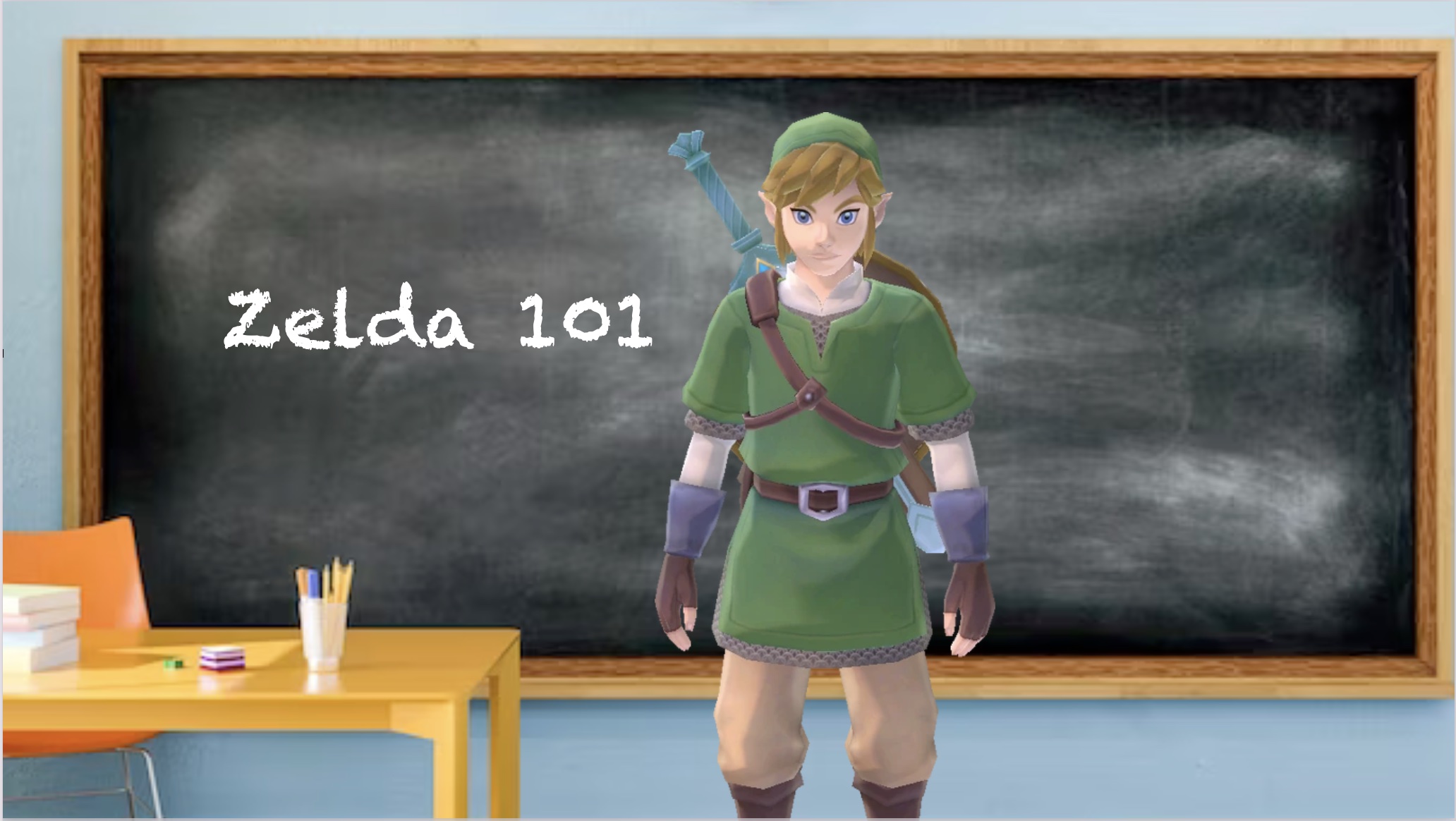
What Can Educators Learn from “Zelda: Tears of the Kingdom”?

So there I was, stranded at the bottom of a pit in the depths.

Shadows all around me, puddles of glowing purple gloom everywhere, the burbles of monsters slowly approaching…

No time to climb out – let’s build a hover bike!

And before you know it, I was zooming up and outta there!

Until I ran out of battery and went careening back to the ground. But I was out of the pit!

“The Legend of Zelda: Tears of the Kingdom” is a really great game – even for a nearly 50-year-old public school teacher like me.

As classes dwindled down in June and the summer approached, I noticed some of my students who had finished their work bringing the game in on their portable Nintendo Switch consoles.

Like me, they were enthralled by the level of choice the newly released game presents.

Rarely is there one answer to a problem.

The previous Zelda game in the series, “Breath of the Wild” (2017), threw the doors wide by giving players an open world to explore. No longer did you have to go down a linear path of which dungeons to complete in which order to defeat the bad guy. You could go in whatever direction you wanted, doing almost anything in whatever order you pleased.

The new game takes that even further. “Tears of the Kingdom” gives you three open worlds to explore and offers you the ability to build a wide range of contraptions to create your own solutions to problems.

For example, when I was stuck in that pit, I could have tried to climb out, I could have stood my ground, or I could have built almost anything imaginable that might help.

It’s that kind of increased choice that makes this game special and of particular interest to educators.

After all, this is something many of our students enjoy doing in their free time. The game sold 10 million copies in its first three days, becoming the fastest selling Nintendo game in history. That’s roughly $700 million and growing.

This doesn’t mean edtech companies should rush in to take over. Teachers and public schools are still the best way to educate students.

But the way I see it, if teachers can make learning more intrinsic and exciting, it’s a plus. These are my three major takeaways from the experience:

1) Power of the Sandbox

There are many types of video games.

Some are focused on action – such as shooting down the most enemies. Some focus more on puzzles to solve. Yet others are focused on building things like farms or homes or even civilizations.

Sandbox games are more self-directed. The idea is to create a space where gamers can do pretty much whatever they want. There’s no imposed objective. You’re given simple tools that you can easily see how to manipulate and you’re left to decide how to use them.

It’s based on the metaphor of leaving small children in a sandbox and just letting them play.

The most popular model is the game Minecraft. In it, players are thrust into a world made entirely of blocks that can be combined and recombined to build anything they want. It’s almost like a virtual world of LEGO bricks.

Players build structures like dream homes or space ships. Some tell stories. Some recreate real or imagined structures like the Eiffel Tower or the Death Star from “Star Wars.”

While there are also dungeons you can fight through to get more materials for your creations, the main emphasis seems to be on building.

Minecraft, in itself, is a very popular game and has been so since 2011.

However, “Tears of the Kingdom” takes this a step further by making the sandbox a tool in a world with a specific objective.

Like most Zelda games, you play as a character, Link, who has to save the princess, Zelda, and the kingdom of Hyrule from a bad guy, Gannondorf. The difference is that one of your tools to do that in this game is an ability to combine certain items together into structures.

These aren’t just blocks. They can be as complex as fans or lasers.

You can try to build a flying machine, but you have to make sure the fans or rockets or whether you’re using to propel them are pointing exactly where you want them, don’t consume too much battery, etc.

It takes design, testing, a knowledge of basic physics, etc.

For example, one of my first attempts at a plane kept flipping over. The reason – my fans were placed in opposite directions so that the lift given by one was counteracted by the other. Another device only went straight up. The reason – rockets only provide lift in one direction and quickly give out.

Players can easily get lost in building things. Sometimes that can seem way more interesting than the overall objective of beating the bad guy and winning the game.

However, there are certain game objectives that help you become a better builder – give you longer battery life, etc. So the game rewards you for progressing along each route – the story objective and the sandbox.

It’s a fascinating game loop that may keep this adventure fresh with replayability long after the main objective is complete.

So how does that impact education?

We know students like self-directed learning. If they are at all interested in the subject, giving them the power of following their natural curiosity can lead to amazing results.

This is often used in STEM lessons, where kids are given an objective and various tools and told to try to figure out how to achieve that objective. Who can build the highest tower that won’t fall over? Who can build the fastest race car on this track? Who can build a boat out of cardboard and duct tape that will float longest in a swimming pool? Etc.

However, it can also be done in other disciplines. You might study how the writer Langston Hughes communicates his message in a poem like “Mother to Son” and then ask students to do the same kind of thing in their own poem. You might read several stories and poems by a single author like Edgar Allan Poe and then ask students to find similarities between the author’s work and life.

In each instance, it’s not about just giving students tools and leaving them alone to discover what to do with them. It’s up to the teacher to provide a goal or a direction in which to go. The students take it from there.

The freedom of the sandbox by itself can be thrilling to some students in certain disciplines. But it can also be terrifying. Both aspects are necessary to reach the most students. When learning can be both intrinsic but directed, that’s when students get the greatest results.

We often pretend that students can do just as well without instruction – and there can be marvelous gains by some students in this way. However, teachers are there for a reason. We know the curriculum and many avenues to understanding it. We can point students many ways to understanding that they might not discover on their own.

Games like “Tears of the Kingdom” show the importance of both choice and direction.

2) Importance of a Learning Community

One of the things I was surprised about the most in “Breath of the Wild” and this new Zelda game is the way each created an online gaming community.

In particular with “Tears”, I found several YouTubers who focused on the game and made videos about nearly every aspect of it.

There were walk-throughs of various parts of the game: how to find different armor, defeat bosses and mini-bosses, build the best things, etc. However, there were also videos focused just on individual’s personal experiences with the game and even conjectures on the lore.

It is unclear how some of the elements from the first game impact the second that the developers kept intentionally vague. The community of players stepped in to fill in these gaps with theories that would put the best literary analysis to shame.

For example, the first game was full of Sheika Shrines. In the second game, the shrines were gone from most of the same locations. Instead there were new Zonai shrines in disparate locations. Why the discrepancy? There seems to be a growing consensus that the Sheika shrines were either dismantled by the Hyrulians and/or destroyed by Gannondorf when he reawakened to begin the current upheaval.

All of this really enhances the gaming experience. Not only do you feel less isolated, but you feel validated. You’re part of the act of making meaning out of the whole experience – listening to others, adding to the conversation, etc.

For example, there are certain enemies that just scared the heck out of me – chief among them were Gloom Hands. These are puddles of slime that come out of nowhere and shoot hands out at your character that can squeeze you to death in seconds.

Then I saw several videos where YouTubers explained how Gloom Hands freaked them out, too, (some complete with funny videos of them screaming when being ambushed by these creatures) and how to deal with them.

By watching these videos, I got to be much better at the game than I would have been otherwise. Some vloggers were so calm and reassuring when they said these sorts of creatures were easy to deal with and nothing to panic over that I felt way more confident. Moreover, if I did come across something that gave me trouble, I knew where to turn for help and guidance.

How important this is in the classroom!

Teachers often fill this role, but if we can create a community in the classroom, itself, that is even better. When students can discuss assignments and help each other through obstacles, that is so much better than the teacher being the only person in a position to help.

I try to foster as much discussion as possible in my classes through Socratic Seminars and informal groups. However, if you can get small group work to function while still being focused and productive, you can increase this aspect, too.

It’s all about the classroom you can create. You need shared values, empathy and students who understand how to best interact with each other. It’s easier said than done but a worthy goal for sure.

3) The Danger of Outside Assessment

This may be the most overlooked lesson from games to the classroom.

One of the biggest differences between the gaming and school experience is whether someone is looking over your shoulder or not.

In a video game, the player decides what he or she wants to get out of the experience. Do you want to simply beat the game? Or do you want to 100% it – achieve every goal the programmers put into it.

How long you take and how much you complete is up to you.

Sometimes the gaming community can contribute to this by giving opinions about which goals are worthy of completion, etc. However, whether you have achieved everything you want and the ultimate assessment of such things are really up to the individual.

Things are different in class.

On one level, students are assessed by their teachers. They grade assignments, give tests, etc. However, this is similar to the game, itself. When you fight Gannondorf, the game tells you whether you’ve beaten him and sometimes how well this is accomplished.

For example, there are a few different endings to the game that you can get depending on how well (or completely) you achieved certain objectives.

I think that’s similar to what the classroom teacher does. It’s part of the experience taken in context and (hopefully) well understood by the student.

The difference comes from forces outside the classroom.

Students don’t just achieve grades. They are also subject to standardized tests. These are assessments created out of context of the classroom, graded by hired hands, that are used to determine how well the curriculum has been learned.

They are artificial, biased and politically motivated.

Imagine if after playing a video game someone from the government had to come in and give you a score. Imagine if they made you play another (different) game to determine how well you did on this one. Maybe you feel like you aced “Tears of the Kingdom” but they said you didn’t do so well on “MarioKart” and thus failed the experience.

Outside assessment can kill intrinsic learning. It can make everything extrinsic – will this be on the test? What do I need to pass the test? Etc.

It would poison the video game experience as it poisons the classroom one.

We only allow it because of strange outdated ideas about learning and psychology. We pretend it’s all behaviorism – students given this stimuli should produce this response. We know that’s not how the human mind works, but politics and capitalism refuse to let us move beyond it.

Someone is making money off of this and we can’t disrupt that with real reform.

Perhaps if we looked more closely at how things function in the world of video games, we’d have a better idea of how to change things for the better in the classroom.

To better understand learning, we should look to the whole child – and the whole child’s experience outside of school.

This includes Zelda, Gannondorf and Link.


Like this post?  You might want to consider becoming a Patreon subscriber. This helps me continue to keep the blog going and get on with this difficult and challenging work.

Plus you get subscriber only extras!

Just CLICK HERE.

Patreon+Circle

I’ve also written a book, “Gadfly on the Wall: A Public School Teacher Speaks Out on Racism and Reform,” now available from Garn Press. Ten percent of the proceeds go to the Badass Teachers Association. Check it out!

Student Projects are Better Than Tests 


The class was silent. 


Students were hunched over their desks writing on paper, looking in books, consulting planners.  


I stood among them ready to help but surprised at the change that had overcome them.  


Maybe 10 minutes before I had heard groans, complaints and the kind of whining you only get from students at the end of the year.  


“Do we have to keep doing work!?” 


“Can’t we just watch a movie!?” 


“Ms. X- isn’t doing anything with her students!” 


And then I dropped the bomb on them.  


We had less than 3 weeks left in the school year. We had just finished our last text. In 8th grade that was “To Kill a Mockingbird” by Harper Lee. In 7th grade it was “Silent to the Bone” by E.L. Konigsburg.  


Now was the time for the infamous final project.  


Some kids asked me about it at the beginning of the year having heard about it from a brother or sister who had already graduated from my class. 


“Mr. Singer,” they’d say, “Is it true you give a 1,000 point project at the end of the year?” 


I’d laugh and ask who told them that, or if that sounded credible.  


“Do you really think I’d give a 1,000 point project!?” I’d say in my most incredulous voice, and they’d usually laugh along with me.  


But some of them still believed it.  


That was nearly 9 months ago. Yet it all came flooding back when I passed out the assignment sheet.  


In the world of education there are few truths more self-evident than this


Projects are better than tests. 


Just think about it for a minute. 


On the one hand you have a project – an extended group of related assignments demonstrating learning and culminating in a product of some sort – a paper, a poster, a movie, a presentation or some mix of these. 


On the other hand you have a test – a quick snapshot of skills taken out of context.  


Which do you think is the better assessment? 


Imagine a musician.  


You could have her answers questions about notation, rhythm and theory…. Or you could just have her play music.  


Which would best demonstrate that she can play? 


It’s the same with other subjects.  


Take a test on reading – or actually read.  


Take a test on writing – or actually write.  


Take a test on math – or actually….  


You get the picture.  


And so did my students.  


I place a huge emphasis on writing in my English Language Arts classes. In 8th grade, my students have already written at least a dozen single paragraph and two multi-paragraph essays. So they’re pretty familiar with the format. I try to get them to internalize it so that it’s almost second nature.  


So when the final project comes along, it’s really a culmination of everything we’ve done.  


In Harper Lee’s book, there is the symbol of the mockingbird: 


“Your father’s right,” she said. “Mockingbirds don’t do one thing but make music for us to enjoy. They don’t eat up people’s gardens, don’t nest in corncribs, they don’t do one thing but sing their hearts out for us. That’s why it’s a sin to kill a mockingbird.” 


We already discussed how several characters in the book could count as mockingbirds – Tom Robinson, Atticus Finch, Boo Radley, etc.  


So I have students write about mockingbirds in all of the texts we’ve read this year. That includes “The Outsiders” by S. E. Hinton, “The Diary of Anne Frank” and several short stories.  


In 7th grade, we’re at a slightly different place. 


At the end of the year, students have written nearly as many single paragraph essays but no multi-paragraph ones yet. I use the final project to introduce them to the concept and explain how it’s the culmination of what we’ve done before.  


Students write about characters that they like from all the stories we’ve read throughout the year. These would be characters from texts as diverse as the one by Konigsburg, “The Giver” by Lois Lowery, “A Christmas Carol” by Charles Dickens and several short stories.  


As projects go, it’s kind of narrow.  


In the past, I’ve had students make movies together interviewing various characters from their texts. I’ve had them design posters extolling various aspects of the Civil Rights movement. I’ve had them design graphics explaining the difference between internal and external conflict.  


But this is the end of the year – time to keep it simple.  


There’s actually a lot of research supporting this kind of assessment. 


Two separate studies were published by Lucas Education Research with Michigan State University (MSU), the University of Southern California (USC), and the University of Michigan. Researchers took either high school students or third graders and put them through a Project Based Learning (PBL) curriculum. 


The high school experiment conducted by MSU and USC involved 6,000 students in science and humanities from 114 schools about half of which were from low-income households. Students who were taught Advanced Placement (AP) U.S. Government and Politics and AP Environmental Science with a PBL approach outperformed their peers on AP exams by 8 percentage points in the first year and were more likely to earn a passing score of 3 or above, giving them a chance to receive college credit. In the second year, the gap widened to 10 percentage points. One key finding of the study, which included large urban school districts, was that the higher scores were seen among both students of color and those from lower-income households. 


The experiment with third-graders produced similar results. Students from a variety of backgrounds in PBL classrooms scored 8 percentage points higher than peers on a state science test. These results held regardless of a student’s reading level. 


In some ways, this should be obvious.  


When you put assessment in context it is more accurate. When you divorce it from its academic context (as you do with tests) it’s more abstract and less accurate. 


The problem is one of time and ease of execution. 


Put simply – tests are easy to give and grade. Projects are difficult.  


Even designing a good project can take lots of trial and error. Tests are often prepackaged and easy to design – you just have questions clustered around whatever skills you were hoping students would learn. 


It is very difficult for teachers to design entire courses with projects at every step of the way. Some might say it isn’t even desirable since such a course would probably not be able to cover as much material as traditional curriculum and it is generally preferable to use different modes of assessment in a single course. Let’s not forget that some students excel at tests and would suffer academically if the only kind of assessments were project based.  


My personal philosophy is one of moderation. Use projects when you can and when appropriate – but not always. And if you’re going to test, a teacher created assessment is orders of magnitude more valuable than a standardized one. 


And in terms of projects, the best is at the end. What better way to demonstrate the cumulative learning of a course than through a cumulative project?  


My students seem to agree. 


After the initial anxiety of such a hefty project, my kids in both grades settle down pretty quickly and get to work. I think they find the project comfortable because they’ve been exposed to almost every part of it before. This just brings it all together under one project.  


It’s the opposite of learned helplessness. Students already know they can do it. All they have to do is step up and get it done. 


That’s also why I make the project worth such a huge amount of points.  


I already double points for the last grading period. Doing that and having such a hefty final project sends the message to kids that they can’t slack off now. The work they do in the closing days of school will have an outsized impact on their grade. If kids care at all about that – and most still do in middle school – they’ll make the effort.  


It also helps fill the last few days and weeks with a focus on process. Nothing has to be memorized. Nothing is beyond anyone’s ability. We’re going to work together – each student and me – to make sure the final project gets done.  


Usually they accomplish it with flying colors.  


It’s something they often remember and pass on in legend to their younger siblings who bring it up in hushed tones when they enter my classroom for the first time. 


Like this post?  You might want to consider becoming a Patreon subscriber. This helps me continue to keep the blog going and get on with this difficult and challenging work.

Plus you get subscriber only extras!

Just CLICK HERE.

Patreon+Circle

I’ve also written a book, “Gadfly on the Wall: A Public School Teacher Speaks Out on Racism and Reform,” now available from Garn Press. Ten percent of the proceeds go to the Badass Teachers Association. Check it out!


Classroom Grades Show Learning Better than Standardized Test Scores

“Not everything that counts can be counted, and not everything that can be counted counts.”

William Bruce Cameron

This summer my family suffered a tremendous blow.

My grandmother, Ce Ce, died.

She was in her 90s and had been unwell since before COVID. But she was also our matriarch, the point around which so much of our interrelations orbited and met.

After the funeral, I found myself at my uncle’s house somehow tasked with watching over several young cousins who had had just about enough of sitting around quietly in itchy suits and dresses.

To get a moment to myself, I set them a task: go downstairs among the assorted relatives and ask them to tell you a story about Ce Ce. Best story wins.

They went off like an explosion. And when they came back, they each had a touching tale about Ce Ce.

One was about how she defended a niece who wanted to marry someone of another faith. Another story was a fond recollection of the sweet and sour spaghetti sauce she used to make, the recipe of which is lost forever.

I was even surprised to hear some stories I had never known like that after my grandfather died, a semi-famous painter had asked Ce Ce on a date!

When my little cousins’ recitations were done, they were united in one thing – wanting to know who won.

I stumbled. I stammered.

I really had no way of judging such a thing.

They had all brought back such wonderful stories. Who won? We were ALL enriched by hearing them.

And that’s kind of how I feel about learning.

It is a fool’s errand to try and compare one person’s acquisition of knowledge with another. But that’s exactly what our current education system is built on.

Unless opted out by a parent or guardian, every public school child in America is required to take standardized tests in grades 3-8 and once in high school.

And the results of these tests are used to make high stakes decisions about which classes the students can enroll in, which enrichments, field trips or remediation they require, and even how much funding will be given or withheld from the schools and districts where they attend.

As a result, the social effects of poverty and racial discrimination end up being transformed into numbers. Thus, instead of being seen as indictments of the economic and racist status quo, they are viewed as the problem of schools and the individual students, themselves.

Standardized tests purport to show that poor children and/or children of color aren’t learning at the same rate as other children. So by the end of 12th grade they have learned less. When they are discriminated against in the job market then, that discrimination is justified – because it is not based on economics or race; it is based on numbers.

However, to perform this alchemy, we have to ignore the fact that standardized assessments are not the only way to determine whether students have learned anything. In fact, for the majority of students’ school experience that learning is assessed by something else entirely – classroom grades.

What if we took classroom grades as seriously as we take standardized test scores?

What if we valued them MORE?

The world would be a very different place.

The entire narrative of failing students and failing schools would turn on its head. After all, graduation rates have steadily increased over the last decade.

Students are completing more courses and more difficult courses. And students are even getting higher grades in these classes!

Yet at the same time, standardized test scores on national exams have remained at about the same level or gone down.

How is that possible?

The new analysis comes from the U.S. Department of Education, and tracks transcripts of a representative sample of high school graduates in 1990, 2000, 2009, and 2019.

It does not include scores from 2020 and 2022 when both classroom grades and national test scores fell. But that’s clearly because of the pandemic and the fact that most students educations and testing schedules were disrupted.

Before COVID, students increasingly were taking higher-level courses, and their Grade Point Averages (GPAs) were steadily rising — from an average of 2.68 in 1990 to 2.94 in 2000, 3.0 in 2009, and 3.11 in 2019. 

This is true of students from all backgrounds, but disparities still existed. On average, white and Asian students had higher GPAs than Black and Hispanic students. Though girls, overall, had higher GPAs than boys.

However, on the National Assessment of Educational Progress (NAEP), given to a sample of students across the country, test scores during the same period did not show a similar increase. Math and reading scores in 2019 were slightly lower than in 2009 and unchanged from 2005. Science scores haven’t budged since 2009. 

Why the disparity?

It seems that either teachers are making it too easy to get good classroom grades or standardized testing does not assess student learning accurately.

Scholars, teachers, parents and students have been complaining about the validity of standardized testing for more than a century. But business interests make billions of dollars off the industry it creates. Guess which group policymakers continue to heed over the other.

It doesn’t take much to show why classroom grades are better at assessing student learning. Compare them with standardized test scores.

Students earn grades based on a wide range of assessments, activities, and behaviors – quizzes, class participation, oral and written reports, group assignments, homework, and in-class work.

Standardized tests, on the other hand, are not assigned on such a multifaceted range of factors. Instead, they are designed to obtain a measure of student proficiency on a specified set of knowledge and skills within limited academic areas, such as mathematics or reading.

Classroom grades are tapestries sown from many patches showing a year’s worth of progress. Standardized tests are at best snapshots of a moment in time.

In class, students can speak with teachers about grades to get a better sense of how and why they earned the marks they did. They can then use this explanation to guide them in the future thus tailoring the classroom experience to individuals.

The value seen in standardized test is its apparent comparability. Scores are supposed to reflect student performance under roughly the same conditions, so the results can be equated and analyzed.

So the biggest difference isn’t a matter of validity, it is pragmatism. Test scores can be used to rate students from all over the country or the world. They can be used to sort kids into a hierarchy of best to worst. Though why anyone would want to do that is beyond me. The purpose of education is not like the National Football League (NFL). It’s to encourage learning, not competition based on a simulation of learning.

And there is evidence that classroom grades are more valid than standardized test scores.

After all, high stakes assessments like the Scholastic Aptitude Test (SAT) do NOT accurately predict future academic success as classroom grades, in fact, do.


Kids with perfect scores on the SAT or American College Testing (ACT) tests don’t achieve more than kids who received lower scores or never took the tests in the first place.


Numerous studies have shown this to be true. The most recent one I’ve seen was from 2014.


Researchers followed more than 123,000 students who attended universities that don’t require applicants to take these tests as a prerequisite for admission. They concluded that SAT and ACT test scores do not correlate with how well a student does in college.


However, classroom grades do have predictive value – especially when compared to standardized tests. Students with high grades in high school but middling test scores do better in college than students with higher test scores and lower grades.

Why? Because grades are based on something other than the ability to take one test. They demonstrate a daily commitment to work hard. They are based on 180 days (in Pennsylvania) of classroom endeavors, whereas standardized tests are based on the labor of an afternoon or a few days.

Classroom grades would not have such consistent predictive value if they were nothing but the result of grade inflation or lenient teachers.

In fact, of the two assessments – classroom grades and standardized tests – one is far more essential to the daily learning of students than the other.

We could abolish all standardized testing without any damage to student learning. In fact, the vacuum created by the loss of these high stakes tests would probably result in much less teaching to the test. Days, weeks, months of additional class time would suddenly appear and much more learning would probably take place.

Academic decisions about which classes students can enroll in or what remediation is necessary could just as easily be made based on classroom grades and teacher observations. And funding decisions for schools and districts could be made based on need and equity – not the political football of standardized testing.

However, getting rid of classroom grades would be much more disruptive. Parents and students would have few measures by which to determine if students had learned the material. Teachers would have fewer tools to encourage children to complete assignments. And if only test scores remained, the curriculum would narrow to a degree unheard of – constant, daily test prep with no engagement to ones life, critical thinking or creativity.

To be fair, there are mastery-based learning programs that try to do without grades, but they are much more experimental and require a complete shift in how we view learning. This is a more holistic system that requires students to demonstrate learning at one level before moving ahead to the next. However, it is incredibly labor intensive for teachers and often relies heavily on edtech solutions to make it viable.

I’m not saying this is an impossible system or even taking a stance on its value. But a large scale shift away from classroom grades would be chaotic, confusing and probably a failure without serious support, scaffolding and parental, teacher and student buy-in.

At the end of the day, classroom grades are the best tool we have to determine whether learning has taken place and to what degree. We should do everything we can to change the way policymakers prefer the standardized approach to the personalized one.

To return to a fuller quote by sociology professor Cameron with which I began this article:

‘It would be nice if all of the data which sociologists require could be enumerated because then we could run them through IBM machines and draw charts as the economists do. However, not everything that can be counted counts, and not everything that counts can be counted.”

Thus, the urge to quantify student learning seems predicated on the popular maxim: If you can’t measure it, you can’t manage it.

Standardized testing is about managing students – sorting them into valuable and disposable for the workforce.

Classroom grades are actually concerned with the project at hand – assessment of learning.

Which brings me back to my little cousins.

When I told them I couldn’t possibly pick a winner between them based on their stories, there were lots of groans of annoyance.

They viewed the whole project as a competition and they wanted to win.

I hope on reflection they’ll see that we all won.

Everything isn’t a contest. We are not all opponents.

If they can grasp that, it would be the greatest lesson I could teach.


Like this post?  You might want to consider becoming a Patreon subscriber. This helps me continue to keep the blog going and get on with this difficult and challenging work.

Plus you get subscriber only extras!

Just CLICK HERE.

Patreon+Circle

I’ve also written a book, “Gadfly on the Wall: A Public School Teacher Speaks Out on Racism and Reform,” now available from Garn Press. Ten percent of the proceeds go to the Badass Teachers Association. Check it out!

Teachers Are Not Responsible for Student Growth or Achievement

thumbnail_Screen Shot 2019-11-21 at 8.55.01 AM

 
Earlier this week, I was rushed to another urgent early morning staff meeting at my school.


I had my laptop with me and was frantically trying to get everything ready that I’d need for the day.


Text dependent analysis question? Check.


Discussion guide to introduce the concept of science fiction? Check.


Questions on literacy, analogy, vocabulary and sentence structure suitable for 7th grade? Check.


The same suitable for 8th grade? Check.


And as I was anxiously trying to get all this together in time for me to rush to my morning duty when the meeting was over, I quickly took a sip of my tea and tried to listen to what my administrator was saying from the front of the room.


He handed out two white sheets of paper with a compilation of standardized test scores – last year’s and those from the year before.


He asked us what we noticed about these two sets of scores and I almost spit out my tea.


“THIS IS WHAT YOU BROUGHT US HERE FOR!?” I wanted to shout.


“THIS IS WHAT YOU’RE STOPPING US FROM DOING OUR WORK TO DISCUSS!?”


But I choked down my response and waited for someone to tell him what he wanted to hear.


The scores have gone down in the preceding year.


Nothing drastic but enough.


When he got his answer – actually he had to say it himself because none of us were ready to play this game so early in the morning – he offered us an olive branch.


Isn’t that the way of it? Shame then reconciliation. Blame then peace.


Those are just the achievement scores, he said. Admin. generously doesn’t expect us to be able to do much about those. They go up one year and down the next.


But look at these growth scores!


That’s where we can have an impact!


And again I felt my throat convulse and a mouthful of Earl Grey came back up my gullet.


Growth!?


It doesn’t make that much difference whether you look at growth or achievement. If you’re holding teachers accountable for either, you’re expecting us to be able to do things beyond our powers as mere mortal human beings.


I hate to break it to you, but teachers are not magical.


We cannot MAKE things happen in student brains.


Nothing we say or do can cause a specific reaction inside a human mind.


That’s just not how learning and teaching works.


We can INFLUENCE learning.
 
We can try to create some kind of optimum condition that is most likely to spark learning.


But we cannot make it happen like turning on a switch or lighting a candle.


Let me give you a real world example.


The day before the meeting I was conferencing with a student about his essay on Charles Dickens’ “A Christmas Carol.” I pointed out that he had misspelled Christmas as “Crismist.”


He refused to fix it.


Literally refused.
 
I pointed out that the word was already typed out and spelled correctly in the prompt. All he had to do was erase what he had written and rewrite it correctly.


He said he didn’t care – that it didn’t matter.


So I tried to explain how people who don’t know him would read this paper and make snap judgments about him based on simple mistakes like this.


I told him that I knew he was smart, that I had heard his verbal discussion of the story and was impressed by his arguments about Scrooge’s character. He had made good points about Scrooge’s guilt being motivated by fear and that once the ghosts were gone he might return to his old ways.


But no one was going to get that far or give him the benefit of the doubt if he didn’t even try to spell Christmas correctly!
 
And he still wouldn’t do it.


That is literally where I was yesterday – yet today my administrator wanted to hold ME accountable for this kid’s growth!


As this child’s teacher, it IS my responsibility to try to reach him.


I am responsible for providing him with every tool I know how that can help him succeed.


I am responsible for trying to motivate, inspire and explain. I am responsible for knowing what are best practices and using them.


By all means – evaluate me on that.


But I can do nothing about what a student actually does with all I give him.


To paraphrase the old adage about horses, I can lead a student to knowledge, but I can’t make him think.


And, moreover, I shouldn’t be forced, myself, only to be able to acknowledge certain kinds of thinking. If a student’s ideas don’t fit neatly into a multiple choice framework, I shouldn’t be impelled to ignore or constrain them.


That may seem simple or even obvious with reflection, but it also goes counter to nearly every teacher evaluation system in practice in the United States.


Because that’s really what’s motivating my administrator’s directives here.
 
He’s just being real, he said. This is what we’ll be evaluated on and it’s something we can impact.


Then he asked us what each of us can do to better impact student growth.


Hands went flying into the air to offer suggestions about how administration could help us better accomplish these goals.


How about some consistency in which courses we’re instructed to teach from year-to-year?


How about not splitting up classes so that students leave one room to have a special and then return to finish a course already in progress?


How about mandating fewer diagnostic tests so there’d be more instruction time?


Well that last one was just too much. We were told that Admin. planned to do just the opposite – to make the Classroom Diagnostic Tools (CDT) tests MORE invasive by changing the schedule to make them appear more like the end of the year state mandated tests.


He said eventually we could look at some of these other ways to change things administratively, but he wanted to put the onus on us. What can WE do to increase growth?


A hand went up.
 
If we help a student grow this year, won’t there be less room for him to grow next year – at least within a given academic standard? Don’t we reach a point of diminishing returns?


To which I wanted to add – where are we measuring growth from? One standardized test to another? That’s not authentic learning – it’s assessing how well students take a test and how well they think like the corporation that makes and grades it.


But the meeting was already over.


The bell rang and we had to rush to our duties.


I scrambled back to my classroom to deposit my computer before getting to the cafeteria just as student breakfast began.


This is madness, I thought.


Growth and achievement. It’s all just gas lighting educators for not being superhuman.


The decision makers either don’t understand how learning works or they don’t care to understand.


They are putting everything on teachers and students without providing either of us with the tools we need to succeed.


Students need more than another standardized test. And they need more than another teacher who only cares about their test scores – regardless of whether you measure them in growth or achievement.


These kids are stressed out, living under immense pressure, coping with poverty, prejudice, an unstable society, climate change, an uncertain future and an economy that promises them little more than crushing debt as a best case scenario.


Educators are supposed to wade into all that, say a few incantations and it will all just go away?


Many parents are struggling so much to provide for their kids they don’t have time to help with homework, provide guidance or support. And you think I’ve somehow got the secret sauce in my teacher’s bag?


Wake up, America.


It’s time we faced a truth about our schools.


Teachers can’t do it all alone.
 
Growth, achievement, whatever.


Until society commits to supporting its children with equitable resources, social justice and an evaluation system that’s more valid than standardized testing, the next generation will continue to struggle.


If you want to make an impact, a good place to start would be a realistic conception of what it means to be a teacher and what we actually can and should be held responsible for.


Like this post? I’ve written a book, “Gadfly on the Wall: A Public School Teacher Speaks Out on Racism and Reform,” now available from Garn Press. Ten percent of the proceeds go to the Badass Teachers Association. Check it out!

book-2

NAEP Test Scores Show How Stupid We Are… To Pay Attention to NAEP Test Scores

thumbnail_Taking-a-test-567860523df78ccc15365b27
 
Brace yourselves!


America’s NAEP test scores in 2019 stayed pretty much the same as they were in 2018!


And the media typically set its collective hair on fire trying to interpret the data.


Sometimes called the Nations Report Card, the National Assessment of Educational Progress (NAEP) test is given to a random sampling of elementary, middle and high school students in member countries to compare the education systems of nations.


And this year there was one particular area where US kids did worse than usual!


Our scores went down in 8th grade reading!


To be honest, scores usually go up or down by about one or two points every year averaging out to about the same range.


But this year! Gulp! They went down four points!


FOUR POINTS!


What does that mean?


Absolutely nothing.


They’re standardized test scores. They’re terrible assessments of student learning.


You might as well compare the relative body temperatures of randomly selected students and wonder why we aren’t bridging the body warmth gap with the somber hummingbird! I mean it has an average  temperature of 114 F! And the best we can do is a measly 98.6 F! Why won’t enough kids get a fever for America!?


If test scores have any meaning at all – it’s parental wealth. Rich kids tend to score higher than poor kids. That’s partially because of the inequality of resources each receive, but also because of racial, cultural and economic bias embedded in the questions.


So the NAEP shows us what any study of parental income would show. America has a lot of poor kids and underfunded schools.


Thanks, NAEP! There’s no way we could ever have figured that out without you!


But having this information come to us via test scores allows us to deflect from the real problem and instead continually blame the victim.


Why can’t these poor kids from impoverished schools score as well as kids from richer countries with more well-funded schools?


I can’t imagine!


Typically politicians used the results to push their pet policies.


Education Secretary Betsy DeVos used the scores to wash her hands of the entire public education system. I know – isn’t her job to safeguard public schools? It’s like a zoo keeper complaining that the penguins aren’t bringing in enough visitors and then refusing to feed them.


DeVos proposed we improve test scores by cutting $4.8 billion from public schools in 2020 and instead pumping $5 billion to a tax credit school voucher scheme that props up private schools.


I know that sounds dumb, but before you judge her, realize she also proposed cutting federal funding for afterschool programs, teacher professional development, student support and enrichment programs.


So there.


Education Blogger Peter Greene claims that this move is based on a reading comprehension problem the Education Secretary is having, herself.


She says that the NAEP results mean that 2/3 of American students read below grade level. However, Greene points out that she is conflating two different things – grade level proficiency and NAEP proficiency.


Here’s what the NAEP wrote:


“The NAEP Proficient achievement level does not represent grade-level proficiency, but rather competency over challenging subject matter. NAEP Achievement levels are to be used on a trial basis and should be interpreted and used with caution.”

 
Which kind of begs the question of why we need these scores in the first place.


There is much clearer data out there.


A study by the Center on Budget and Policy Priorities concluded that 29 states spent less per student in 2015 than they had before the Great Recession.


And the federal government has done little to help. Since 2011, spending on major K-12 programs – including Title I grants for underprivileged students and special education – has been basically flat.


According to the Economic Policy Institute in Washington, today’s public schools employ at least 250,000 fewer people than they did before the recession of 2008–09. Meanwhile enrollment has increased by at least 800,000 students.


So to ensure our students had the same quality of service children received only a decade ago, we’d need to hire almost 400,000 more teachers!


That’s how you cut class size down from the 20, 30, even 40 students packed into a room that you can routinely find in some districts today.


If we looked at realities like these instead of test scores – which at best provide us data at several removes – we might actually be motivated to reach solutions.


For instance, the U.S. is one of the only countries in the world – if not probably the ONLY country – that funds schools based largely on local taxes. Other developed nations either equalize funding or provide extra money for kids in need. In the Netherlands, for example, national funding is provided to all schools based on the number of pupils enrolled. But for every guilder allocated to a middle-class Dutch child, 1.25 guilders are allocated for a lower-class child and 1.9 guilders for a minority child – exactly the opposite of the situation in the U.S.


If we want to compare the US to other countries, this is a perfect place to start.


But a focus on test scores obscures the differences.


Virtually all of the top scoring countries taking these exams have much less child poverty than the U.S. If they had the same percentage of poor students that we do, their scores would be lower than ours. Likewise, if we had the same percentage of poor students that they do, our scores would go through the roof! We would have the best scores in the world!


These scores just mirror back to us our child poverty rate – that more than 1/3 of our students live below the poverty line and more than half of public school students qualify for free or reduced lunches.


But this myopic focus on standardized tests also blinds us to the ways our system is superior to that of many other countries.


We do something that many international systems do not. We educate everyone! Foreign systems often weed children out by high school. They don’t let every child get 13 years of grade school (counting kindergarten). They only school their highest achievers.


So when we compare ourselves to these countries, we’re comparing ALL of our students to only SOME of theirs – their best academic pupils, to be exact. Yet we still hold our own given these handicaps!

 
This suggests that the majority of problems with our public schools are monetary. Pure and simple.


At least House Democrats passed a Labor-HHS-Education funding bill to increase public school funding by $3.5 billion. Even if it were somehow passed by the Republican controlled Senate, that’s a drop in the bucket after decades of neglect – but it’s something!


It’s certainly better than DeVos who claims that funding somehow doesn’t matter for public schools – only for her pet charter and voucher schools.


A 2018 review by Northwestern University found that in 12 out of 13 studies increased spending had a positive effect on student outcomes. And that result has been verified by studies since then in California, Texas, Wisconsin and other states.

 
Money makes a difference.


Money spent on students – not more testing.


So why the drop in this year’s 8th grade reading scores?


Who knows? It could be a spike in the rate or effect of child poverty in the middle school years.


It could be the impact of decades of high stakes testing on middle school curriculum – narrowing what is taught and muscling out authentic instruction.


Frankly it doesn’t matter because the data is suspect.


Standardized testing will never give us an accurate picture of what is going on with our students or our schools.


And until we, as a society, finally realize that and focus on things that actually matter, we will continue to fail the only test that matters – how well we provide for our children.


Like this post? I’ve written a book, “Gadfly on the Wall: A Public School Teacher Speaks Out on Racism and Reform,” now available from Garn Press. Ten percent of the proceeds go to the Badass Teachers Association. Check it out!

book-4

The Absurdity of Standardized Testing: Caught Between Prediction and Assessment

thumbnail_Screen Shot 2019-09-19 at 2.07.03 PM

 
Standardized testing is truly absurd.

 
It’s both a prediction and an assessment.


You take a test to determine what you’ve learned and that will in turn predict what you will be able to learn in the future.


We hardly ever do this anywhere else in life.


We don’t measure babies’ leg muscles to predict whether they’re ready to walk. We let them do what they do, possibly with some encouragement and positive models of locomotion, and they do it.


There are cognitive and developmental benchmarks we look for, and if children don’t hit them, we provide help. But no further prediction is necessary – certainly not based on artificial markers put together by corporate interests.


In most situations, predictions are superfluous. We just assume that everyone can learn if they so desire – unless something happens to make us think otherwise. And whether someone actually learns something is demonstrated by doing the thing, itself.


The only time we link prediction and assessment so closely is when the consequences of failure are irreversible – like when you’re going solo skydiving for the first time. If you jump out of an airplane and don’t know how to pull the ripcord to get your parachute to work, you probably won’t get a second chance to try again.


But most things in life aren’t so dire.


The world of standardized testing is very different. The high stakes nature of the assessments are what ramp out the consequences and thus the severity.


Testing looks at learning like two points on a map and sets up a gate between points A and B.


In order to cross, you have to determine if you’ve passed through the previous gate. And only then can you be allowed to progress on to point C.


But this is wrong on so many levels.


First, you don’t need a test to determine which point you’re at. If Point B is the ability to add, you can simply add. If it’s the ability to write a complete sentence, you can simply write a sentence.


There is no need to fill out a formal multiple-choice assessment that – depending on the complexity of the task being considered – is completely inadequate to capture the subtleties involved. The task, itself, is enough.


Imagine if you were testing whether someone had learned how to drink a glass of water. You could just give them a cup filled with H2O and see if they can gulp it down. Or you could have them sharpen their number 2 pencil and answer questions about how their throat works, their digestive and excretory systems and the chemical composition of agua – all answers predetermined to A, B, C or D.


Observation of a skill, we are told, is not enough to determine success because it relies on the judgment of an observer. A standardized test replaces the observer with an impersonal, distant testing corporation which then assesses only predetermined markers and makes decisions devoid of any situational context.


This is done to remove observational bias but it doesn’t avoid bias altogether. In setting up the markers and deciding which elements of the task are to be assessed (or in fact can be assessed in such a distant manner), the testing corporation is inserting its own biases into the process. In fact, in any assessment conducted by human beings, this would be inevitable. So going through this maze of perceived objectivity is really just a matter of subterfuge meant to disguise the biases of the corporation.


Second, assessing people in this way is extremely unnatural because very few fields of knowledge can be divided and subdivided into two or more discrete points.


When writing a complex sentence, for example, you need to know not just spelling and grammar but logic, handwriting, subject matter, colloquialisms, literary devices, and a plethora of other cultural and linguistic artifacts.


Moreover, there is not always a natural progression from Point A to B to C. Sometimes A jumps directly to C. Sometimes B leads directly to A. Sometimes A leads to Z.


Knowledge, skills and human cognition are far too complex a web to ever hope to be captured by such a reductive enterprise. But by insisting that we make this complexity fit into such a small box, we end up depriving people of the right to move on. We say predictive models show they aren’t ready to move forward and so we bury them in remediation. Or we deny them access to important opportunities like advanced classes, electives, field trips, extracurricular clubs or even post-secondary education.


Third, this emphasis on knowledge as discrete bits of information or skills (often called standards) leads to bad teaching.


Assessment expert W. James Popham provides a helpful distinction: “curriculum teaching” vs. “item teaching.” Curriculum teachers focus on the full body of knowledge and skills represented by test questions. For instance, if the test is expected to include questions about decimals, the teacher will cover the full range of knowledge and skills related to decimals so students understand what they are, know how to manipulate them, understand how to use them to solve more complex problems, and are able to communicate about them.


By contrast, item teaching involves narrowing instruction, organizing lessons around look-a-like questions that are taken directly from the test or represent the kinds of questions most likely to be found on the test. In this way, the teacher only provides the chunks of knowledge students are most likely to encounter on exams. For instance, item teachers might drill students on a certain set of vocabulary words that are expected to be assessed rather than employing instructional strategies that help students build a rich vocabulary that best contributes to strong reading comprehension.


A focus on standardized testing or even trying to educate in a system where these tests are attached to high stakes, results in an increase in item teaching. We often call it teaching to the test.


I’m not saying that item teaching is always bad. But curriculum teaching is to be much preferred. It is a best practice. The problem is when we resort to endless drills and give students innumerable questions of the exact type we expect to be on the test.


So when we find students who have made dramatic improvements on standardized tests, we often don’t find equal improvements in their over all knowledge or ability.


Test scores are often a false positive. They show students have mastered the art of taking the test but not necessarily the knowledge or skills it was meant to assess.


They are more like trained circus animals who can jump through flaming hoops but would be lost in the wild.


That’s why certain computer modeled artificial intelligences are able to pass standardized tests but would fail preschool.


These reflections have troubling implications for our system of standardized testing.


The false curtain of objectivity we’ve set up in our assessments may also be hiding from us what authentic learning is taking place and it may even hinder such learning from taking place at all.


Any sane society would halt such a system with these drawbacks. It would stop, regroup and devise a better alternative.


To continue with such a pedagogical framework truly would be the most absurd thing of all!


Like this post? I’ve written a book, “Gadfly on the Wall: A Public School Teacher Speaks Out on Racism and Reform,” now available from Garn Press. Ten percent of the proceeds go to the Badass Teachers Association. Check it out!

book-2

Don’t Worry About Grade Inflation. Worry About Grading Fairly.

your-childs-grades-go-down-1494627682


Hard work should be rewarded.


If you earn an A in a given class, you should get an A on your report card.


And this is true no matter how many of your classmates work just as hard as you do.


If everyone in class gives it their best shot, they should all get A’s. It is not the teacher’s job to split hairs and sort kids into arbitrary categories in order to preserve a monetary myth about grades’ value based on a model of scarcity.


Those who demand otherwise are under the spell of one of the oldest myths in academia – grade inflation.


It goes like this: You can’t give all your students excellent marks! That would devalue what it means to get an A!


To which I reply: Bullshit.


Almost every plane that leaves an airport lands safely. Does that devalue what it means to travel? When you arrive at your destination, are you upset that everyone else has arrived safely or would you feel better if some of the planes crashed?


According to the American Journal of Public Health, 93% of New York City restaurants earn an “A” from the health department. Does that shake your faith in the food service industry? Would you feel better if more restaurants were unsanitary? Would your food digest more efficiently if there were more people going home with stomach pain and food poisoning?


Of course not! In fact, these stats actually reassure us about both industries. We’re glad air travel and eating out is so safe. Why would we feel any different about academia?


The idea of grade inflation is a simple imposition of the concept of economic value onto learning. It has no meaning in the field of academics, psychology or ethics. It is just some fools who worship money imaging that the whole world works the same way – and if it doesn’t, it should.


It’s nothing new.


Conservatives have been whining about grade inflation for at least a century. It’s not that the quality of teachers has declined and they’re letting all their students pass without doing the work. It’s that certain types of curmudgeons want to justify their own intelligence by denying others the same privilege.


It’s the “I’ve Got Mine” philosophy.


We see the same thing with Baby Boomers who grew up in the counter culture and pushed for progressive values in their youth. Once they got everything they wanted for themselves, they became conservatives in their old age and worked to deny the same things for subsequent generations.


It’s the very definition of Age scoffing at Youth – a pathology that goes back at least to Hesiod if not further. (Golden age of man, my foot!)


Moreover, there is no authentic way to prove grade inflation is actually happening. Grades are a subjective measure of student learning. They are human beings’ attempt to gauge an invisible mental process. At best they are frail approximations of a complex neural process that is not even bounded temporally or causally. If a student doesn’t know something now, they may come to know it later even without further academic stimulus. Moreover, isolating the stimulus that produced the learning is also nearly impossible.


The important thing is not grade inflation. It is ensuring that grades are given fairly.


If students work hard, they should be rewarded.


I am very upfront with my students about this. And doing so seems to have a positive and motivating effect on them.


This year, I had students who told me they had never read a book from cover-to-cover before my class. I’ve had students look at their report cards in shock saying they’ve never received such high marks in Language Arts before. And doing so makes them want to try all the harder next year to repeat the results.


They leave me excited about learning. They feel empowered and ready to give academics their all. Because the greatest lesson a teacher can instill is that the student is capable of learning.


Don’t get me wrong. I don’t just hand out these grades. Students have to earn them. They have to demonstrate that they have actually learned something.


Everyone rarely measures up to the challenge. But that’s not the point. Everyone COULD. There is nothing in my design that prohibits that outcome. I don’t start with the assumption that I’ll only have 3 A’s, 4 B’s, 10 C’s, etc.


In fact, it is THAT scarcity model that dumbs down academics. If I grade on a curve like that, I have to give out a certain number of high marks regardless of achievement. I’m committed to giving out those 3 A’s regardless of whether that trio of students deserve it or not. However, in my abundance model, I give exactly the number of A’s that are deserved. If that’s zero, no one gets an A. If that’s everyone, then everyone gets an A. It all depends on what students actually deserve, not some preconceived notion about how the world works.


To do this, I give very few tests. I just don’t find them to be very helpful assessments.


A test is a snapshot of student learning. It has its place, but the information it gives you is very limited.


Most of my grades are based on projects, homework, essays, class discussion, creative writing, journaling, poetry, etc. Give me a string of data points from which I can extrapolate a fair grade – not just one high stakes data point.


This may work to some degree because of the subject I teach. Language arts is an exceptionally subjective subject, after all. It may be more challenging to do this in math or science. However, it is certainly attainable because it is not really that hard to determine whether students have given you their best work.


Good teaching practices lend themselves to good assessment.


You get to know your students. You watch them work. You help them when they struggle. By the time they hand in their final product, you barely need to read it. You know exactly what it says because you were there for its construction.


For me, this doesn’t mean I have no students who fail. Almost every year I have a few who don’t achieve. This is usually because of attendance issues, lack of sleep, lack of nutrition, home issues or simple laziness.


I only have control over what happens in the classroom, after all. I can call home and try to work with parents, but if those parents are – themselves – absent, unavailable or unwilling to work with me, there’s little I can do.


And before you start on about standardized testing and the utopia of “objectivity” it can bring, let me tell you about one such student I had who was not even trying in my class.


He never turned in homework, never tried his best on assignments, rarely attended and sleepwalked through the year. However, he knew his only chance was the state mandated reading test – so for three days he was present and awake. The resulting test score was the only reason he moved on to the next grade.


Was he smart? Yes. Did he deserve to go on to the next grade not having learned the important lessons of his classmates? No. But your so-called “objective” measure valued three days of effort over 180.


The problem is that we are in love with certain academic myths.


MYTH 1: Grading must be objective.


WRONG! Grading will never be objective because it is done by subjective humans. These standardized tests you’re so in love with are deeply biased on economic and racial lines. Whether you pass or fail is determined by a cut score and a grading curve that changes from year-to-year making them essentially useless for comparisons and as valid assessments. They’re just a tool for big business to make money off the academic process.


MYTH 2: Learning is Economics.


WRONG! Grades are not money. They don’t function in any way like currency or capital. They aren’t something to be bought and sold. They are an approximate indication of academic success. Treating them as a commodity only degrades their value and the value of students and learning, itself.


Treating grades economically actually represses the desire to learn, dispels curiosity and eliminates the intrinsic value of education.


So go ahead – inflate the “value” of your grades.


Give A’s to every student who deserves it.


That’s how you promote learning and fairly assess it.


Like this post? I’ve written a book, “Gadfly on the Wall: A Public School Teacher Speaks Out on Racism and Reform,” now available from Garn Press. Ten percent of the proceeds go to the Badass Teachers Association. Check it out!

WANT A SIGNED COPY?

Click here to order one directly from me to your door!

book-1