I Was a Radical Republican – For About a Week – And I Didn’t Change a Single Progressive View

Republican

I do not like Ronald Reagan.

I own no guns.

Back in high school I won a debate arguing for pro-choice.

Trickle Down sounds more to me like a bladder condition than an economic theory.

So why was it that last week so many right wingers were retweeting me on Twitter?

Did I say “retweeting”? They were taking my words and memes and sending them out to the Twitterverse as their own thoughts with a reference to my account.

I’m a little ashamed to admit it, but I think Michelle Malkin pushed down the new heart emoticon on something I wrote.

She may have retweeted me, too. Heck! I may have retweeted her back!

“What new Hell is this?” I thought. “Why am I getting so much love from people who – if they met me in person – would probably try to give me a wedgie and scream, “NERD”?

It turns out I was caught in a maelstrom of political events. And his name is John King.

President Barack Obama named the former New York Education Commissioner as his pick to replace Arne Duncan as US Secretary of Education.

As a public school teacher, this really pissed me off. It pissed off just about every public educator in the country.

Are you kidding, Obama!? John-Freaking-King!? The guy whose only previous experience was teaching for three years at a “no excuses” charter school!?

This is the guy who oversaw the systematic destruction of schools in one of the most populous states in the country all the while pointing his finger at teachers. He approved an obviously fraudulent charter school run by an obvious conman. He ignored and dismissed parents at various education forums. The people of New York hated him so much, he sparked the largest opt out movement in the nation.

And THIS is the guy you’re nominating as Secretary of Education!?

It’s not like he’s even pretended to change his stripes. After New Yorkers booted him out of their state, he was offered a job at the US Department of Education – a prime example of falling upward. Soon afterward, his wife took a job at a corporate education reform company, Bellwether Education Partners!

Isn’t that a conflict of interest? I mean – through her – Bellwether will have the ear of the highest education official in the land. And the rest of us will just be supplicants sending letters, making phone calls hoping for an audience with the King.

THIS was why I was upset. THIS was why I was writing angry blogs and pounding out my rage on Twitter.

And I wasn’t alone.

The usual gang of educators and far left progressives gave me the usual support.

But we were soon joined by a tsunami of social media activists from the other side of the aisle.

Very soon someone made a popular hashtag, #StopJohnKing, and I started seeing hundreds of retweets, restatements and messages of support.

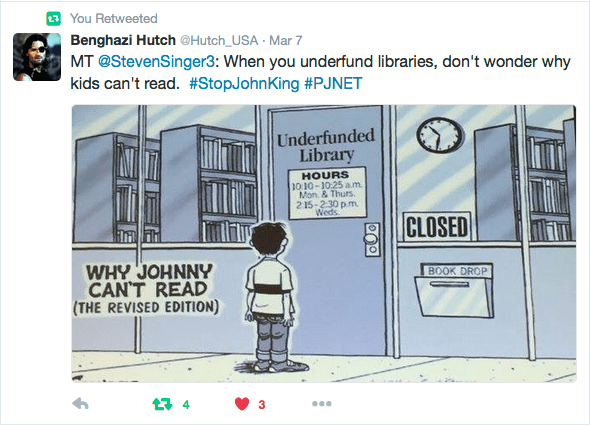
Two of my tweets were particularly popular: one about the conflict of interest of King’s wife working for Bellwhether, the other a seemingly unrelated message about the need to fund public libraries.

Screen shot 2016-03-16 at 11.06.15 PM

Screen shot 2016-03-16 at 11.06.40 PM


That’s when I started to notice the Twitter accounts of the people joining in. There were folks proclaiming their love for Ted Cruz and Donald Trump. They described themselves as libertarians and refused to speak to “libtards.” And the pictures on their Twitter accounts were often famous conservatives, racist cartoons of the President, pictures of themselves packing heat or just the darn guns, themselves.

“What the heck have I gotten myself into?” I thought.

That’s when I questioned why they were supporting me. For many of them I wondered if it had less to do with how terrible King would be as Education Secretary than with who nominated him in the first place.

Ever since Antonin Scalia died, many Republicans have sworn a blood oath not to approve any of Obama’s nominees – for the Supreme Court or ANY office.

For them this wasn’t about opposing a terrible Presidential pick. It was about blocking everything Obama did.

I had to face it. I had become a radical Republican, and I hadn’t even needed to change one of my positions to do it. The GOP came to me.

I have to admit, my right wing supporters were mostly very nice. I felt like I had a stronger group behind me than during most progressive campaigns.

There was some strain, however. A few times I could tell they were choking back anti-union rhetoric. “Why don’t we fund our libraries? Because unions,” apparently. “Who needs libraries – I home school.” That kind of thing.

And unfortunately, my progressive buddies were starting to notice the right wing support and take offense.

I got trolled by several lefties demanding I support Common Core.

“How can you be against it?” they’d ask. “Rand Paul hates Common Core. Do you agree with Rand Paul?”

I’d respond politely that even a broken clock is right twice a day.

Card-carrying Democrats refused to listen to any criticism of the Obama administration’s education policies. Little did these progressives realize, they were the exact opposite of the GOP activists they hated.

Many Republicans hate Common Core because Obama touched it. Many Democrats love it for the same reason.

The majority of teachers throughout the country hate it because we’ve read it, tried to use it and seen what a load of bullshit it is. We know it was developed with very little input from classroom teachers or child psychologists. We know it has no research behind it to show that it works. We see how it erodes our autonomy in the classroom and increases the amount and difficulty of high stakes tests for our students.

But my progressive friends refused to accept that anything Saint Hope and Change approved could be so terrible.

I’d turn to my newfound Republican posse only to find many of them hated Common Core beyond reason. It wasn’t just bad practice – it was going to turn our kids gay. It was a liberal plot to make children progressive atheists.

Oy vey.

The week just flew by. Eventually the Senate voted to approve King, both Democrats and Republicans – though the opposition was almost entirely in the GOP.

In my home state of Pennsylvania, the Senator I can usually count on to have my back (Bob Casey) stabbed me in the same place. And the Senator who usually only votes for things that are officially endorsed by Lord Satan, himself, (Pat Toomey) was my boy.

What kind of a topsy-turvy world am I living in!?

Elizabeth Warren – the liberal lion – said she wasn’t going to vote for King but ultimately gave in. Oh, Elizabeth. They got to you, too?

There were two points of light though. First, there was one Democrat who actually voted against him: Senator Kirsten Gillibrand from New York – the sight of King’s last catastrophe. Second, my Presidential candidate, Bernie Sanders, didn’t vote at all. Fwew! I can irrationally justify that – he was too busy, that’s all. Bernie would never have voted for King. Tee-hee!

So once again we see the two major parties as mirror images of each other. Where Republicans made the right choice for the wrong reason, Democrats made the wrong choice for the right one. Progressives were circling the wagons around the President. They were making a point that they weren’t going to let the evil GOP block his nominees – even if one of those nominees was an absolute pathetic failure.

This is politics in 2016, folks.

Decisions are rarely made because of logic, experience, or sound judgement. It’s all political maneuvering, personal gain or both. Meanwhile, the world goes to Hell.

After the vote, I got a smattering of conservative retweets and then… nothing. As quickly as they had come, they were gone.

My tiny caucus of teachers, academics and other ne’er-do-wells are still there. We shout our truths into the wind hoping someone will hear.

On days like today it seems impossible.

But perhaps there is a silver lining in there somewhere. If people from such opposite sides of the political spectrum can agree on something like how terrible John King is, maybe there’s hope. If we can shake hands over the fatuousness of Common Core, maybe we can find other points of agreement.

Maybe these brief moments of concord are opportunities for understanding. Sure my GOP compatriots supported me for the wrong reasons, but maybe some of them were exposed to the right ones.

I know I’ve learned from them. I consider myself an FDR Democrat with an abiding faith in a strong federal government. But even I can see how both the Bush and Obama administrations overstepped their power with No Child Left Behind and Race to the Top.

I don’t buy any of that baloney about Big Government vs. Small Government. But I do think that some things like education policy don’t belong at the federal level. The federal government should ensure public schools are funded properly and maybe regulate outright abuses, but local communities and districts should be deciding how to educate the children in their care.

If those ideas rubbed off on me, what rubbed off on my brief Twitter followers?

Will there come a day when we meet again, join hands and fight for our common good?

Can we overcome the blinders of party and politics to build a better world?

#IHopeSo
Blinded by Pseudoscience: Standardized Testing is Modern Day Eugenics


eugenics-testing.jpg


Adolph Hitler was a big fan of standardized testing.


It helped justify much of the horrors of the Nazi regime.


National Socialism is nothing but applied biology,” he said.


In other words, it’s just science, people. Some races are simply inferior to others. Black people, Jews, Gypsies, Hispanics – they just can’t hold a candle to the superior races of Northwestern Europe.


And Hitler based much of this on the “science” of Eugenics, especially the work done in America in the 1910s and ‘20s.


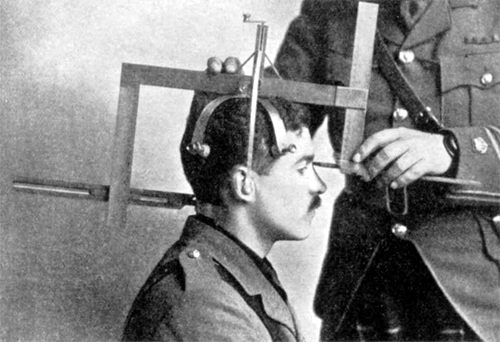
Eugenicists used a flawed and biased interpretation of Gregor Mendel’s laws on heredity to argue that lawlessness, intelligence, and even economic success are passed down in families due to dominant or recessive genes. Moreover, the negative traits are widespread in certain races and the positive ones in others.


Practitioners like Carl Brigham used IQ tests to PROVE white people were just the best and everyone else, well, maybe they should just stop breeding. (In fact, laws were passed in the U.S. imposing mandatory sterilization on thousands based on the conclusions of these “scientists.”)


Brigham was a U.S. Army psychologist who used WWI data to declare that whites (especially those born inside the United States) were the most intelligent of all peoples and that immigrants were genetically inferior. He went on to refine his work into an even better indicator of intelligence the he called the Scholastic Aptitude Test or S.A.T.


Perhaps you’ve heard of it.


In his seminal work, A Study of American Intelligence, Brigham concluded that American education is declining and “will proceed with an accelerating rate as the racial mixture becomes more and more extensive.”


To combat this mixture, eugenicist education reformers encouraged schools to rigidly track students into low, middle and high level classes – similar to the way many of our schools are organized today.


Lewis Terman, Professor of Education at Stanford University and originator of the Stanford-Binet intelligence test, expressed these views in his textbook, The Measurement of Intelligence (1916). He wrote:


“Among laboring men and servant girls there are thousands like them [feebleminded individuals]. They are the world’s “hewers of wood and drawers of water.” And yet, as far as intelligence is concerned, the tests have told the truth. … No amount of school instruction will ever make them intelligent voters or capable voters in the true sense of the word.


… The fact that one meets this type with such frequency among Indians, Mexicans, and negroes suggests quite forcibly that the whole question of racial differences in mental traits will have to be taken up anew and by experimental methods.


Children of this group should be segregated in special classes and be given instruction which is concrete and practical. They cannot master, but they can often be made efficient workers, able to look out for themselves. There is no possibility at present of convincing society that they should not be allowed to reproduce, although from a eugenic point of view they constitute a grave problem because of their unusually prolific breeding” (91-92).


This was the original justification for academic tracking. Terman and other educational psychologists convinced many schools to use high-stakes and culturally-biased tests to place “slow” students into special classes or separate schools while placing more advanced students of European ancestry into the college preparatory courses.


Compare that ideal to the increasingly segregated American schools of today. We have schools for the rich and schools for the poor. We have schools for black and brown kids and schools for whites.


Terman would have been in heaven!


It was the work of patriots like Brigham and Terman that the Nazis relied on heavily to justify their forced sterilization programs and ultimately the Holocaust, itself.


Does that sound extreme? It isn’t.


At the Nuremberg Trials, Nazi scientists repeatedly praised the work of American eugenicists, who uncoincidentally also created the standardized test model of education favored by corporate education reformers today.


It’s easy to follow their logic. If certain races can be scientifically proven to be inferior, it is a small step to thinking that they should be stopped from breeding or eradicated from the face of the planet altogether.


And the pseudo-scientific justification for this scheme was standardized testing. The IQ test – which has since been shown to be incredibly biased – was used to justify mass murder. And then Brigham refined that same test into our most popular current standardized assessment – the SAT. In fact, all standardized tests that students are forced to take today owe a huge debt to the SAT and other standardized assessments used by Terman and other eugenicist educators.


The resemblance between testing in the 1910s and the 2010s is obvious to those who will but look.


Similar to the IQ test, modern standardized exams like the Partnership for Assessment of Readiness for College and Careers (PARCC) repeatedly have been shown to be biased in favor of affluent and white test takers. Supporters bemoan the “racial proficiency gap,” but that’s just a nice way of wondering why the same folks Hitler thought were “inferior” don’t do well on our modern tests.


This is no accident. It’s how the assessments are designed.


The IQ test is supposed to demonstrate an innate intelligence. However, modern psychologists have become increasingly skeptical that intelligence is fixed. So standardized assessments like the SAT are supposed to somehow show BOTH what students have learned AND their innate intelligence. That’s the justification behind the high stakes. You have to pass the SAT to show you’re smart enough to do well in college.


Such outright racism would not be tolerated today, so it becomes cloaked in doublespeak. It’s good that poor black students don’t score well on standardized tests because that shows us they need extra help. And then, instead of providing any help, we close their schools or turn them over to fly-by-night charter operators.


Once again, standardized tests are used as the justification for doing something obviously racist. If anyone said, “We’re going to close and privatize all the schools serving minorities and the poor,” people would revolt. However, when you say we’re doing it because of standardized tests – because of “science” – people just shrug and say, “You can’t argue with that!”


The same goes for Common Core State Standards. States were bribed to enact them so that the reasons for attacking public schools would be uniform across the country. This provides another level of pseudo-scientific justification.


They are supposed to ensure every student who graduates high school will be “college and career ready.” However, now that Common Core has been adopted in 46 states and their tests have become aligned with the standards, we’ve seen student scores take a nosedive. Only our rich white kids apparently are ready for college.


So what will we do with those who fall below the mark? We’re sending no additional resources to help them increase their achievement. We’ll just close their schools and/or privatize. And to make sure none of them escape, we’ll make passing the Common Core tests a graduation requirement.


This does not level the playing field. This does not – as some corporate education reformers claim – ensure the sanctity of students Civil Rights. It extensively violates them!


The education model of Test and Punish is a modern eugenics movement. We’re shellacking over class divides so that those below a certain point have no possibility of ever rising to the white place. And I do mean “white.”


Standardized testing is not a ladder of social mobility. It is a means of keeping certain people in their proper place.


Some try to deny the racial component by pointing to the intersection with class. Testing impacts poor white children as it does poor black ones.


To a degree this is true, but remember our eugenic forerunners saw everything in purely racial terms. For instance, today, few people would claim Judaism is a race. It is a religion. It is essentially a belief system, not a set of shared genes even though some adherents do share genetic characteristics after centuries of segregation. But the Nazis considered them a race and, thus, systematically murdered 6 million of them.


The same goes for the poor. Brigham and his Nazi admirers thought that people were poor mainly because of their genes. They are genetically predisposed to being lazy and good for nothing, so they can’t keep a job or advance themselves. Therefore, they’re poor. Pause for a moment to consider the large numbers of people in America today who would agree with them.


Standardized testing treats the poor the same way it does minorities. In fact, it is just the lack of opportunities that come with poverty that cause the very scores that are being used to denigrate these people. Lack of proper nutrition, food insecurity, lack of prenatal care, early childcare, fewer books in the home, exposure to violence – all of these and more combine to result in lower academic outcomes.


But standardized testing puts the blame on the victim. Students score badly because they aren’t working hard enough, corporate reformers say. These kids don’t have enough “rigor.”


To make sure few people actually volunteer to help, we blame their teachers, as well. We make the education profession as unattractive as possible, indicting teachers for all societies ills knowing full well that this will result – as it has – in a nationwide teacher shortage. Then we can deprofessionalize the field and replace educators who have four-year-degrees with lightly trained Teach for America temps.


These kinds of shenanigans didn’t fool the anti-racists of the past.


The great African American scholar W. E. B. Du Bois remarked in 1940, “It was not until I was long out of school and indeed after the [First] World War that there came the hurried use of the new technique of psychological tests, which were quickly adjusted so as to put black folk absolutely beyond the possibility of civilization.”


He could be talking about No Child Left Behind.


In “Intelligence Tests and Propaganda,” scholar Horace Mann Bond issued a warning about the misuse of IQ tests:


“But so long as any group of men attempts to use these tests as funds of information for the approximation of crude and inaccurate generalizations, so long must we continue to cry “Hold!” To compare the crowded millions of New York’s East Side with the children of Morningside Heights [an upper class neighborhood at the time] indeed involves a great contradiction; and to claim that the results of the tests given to such diverse groups, drawn from such varying strata of the social complex, are in any wise accurate, is to expose a fatuous sense of unfairness and lack of appreciation of the great environmental factors of modern urban life.”


He could be talking about Race to the Top.


Karen Lewis, a present-day Chicago teacher and president of her union, says this:


“What many people do not know is that the use of standardized tests has its origins in the Eugenics movement …we have to be clear about the original purpose of standardized tests.


In a society fascinated by statistics, we are often compelled to reduce everything to a single number. Those of us who work with children know that there are so many characteristics that cannot be quantified.


Ask yourselves whether you want to be part of a legacy born of the unholy alliance between the concept of  “natural inequality” and the drudgery that has been imposed on many of our classrooms.”


Make no mistake. Corporate Education Reform is modern day eugenics. It pretends to justify increasing standardization and privatization of public schools through flawed and biased assessments. Its claims that any of this is actually supported by research are spurious. At heart, these are articles of faith – not science. Neither Common Core nor high stakes testing nor charterizing impoverished schools nor putting districts into receivership nor evaluating teachers based on student test scores – none of it has ever been shown in peer-reviewed studies to help students learn.


Corporate Education Reformers are asking all of us to have faith in a racial and economic social order that benefits those already at the top and keeps the rest of us in our place.


And for anyone who questions it, we are continually blinded by their pseudoscientific justifications.

Less Resources, Harder Tests: Common Core in the Last Days of Obama

teaching_testing


The bell hadn’t even rung to begin class yet, but Ce Ce already had enough.


She saw the pile of standardized test look-a-like sheets on the front desk and immediately asked if she could go to in-school suspension.


I’m not kidding.


She’d prefer to spend the day in silence doing homework isolated from the rest of the class than practicing high stakes testing with her peers.


And she’s not alone. This happens every year now. As assessment season gets closer, administrators push teachers to do test prep. And students revolt.


I’m not exactly sure why. Test replicas are not my favorite things to do, either, but they’re not THAT bad. I don’t think it can be my teaching since the mutiny usually happens before I’ve even begun.


It’s the testing. Pure and simple. Some students are so demoralized by the very prospect of skill-and-drill that spending one more second reading passages and filling in bubbles seems a fate worse than death.


And I can’t really blame them.


In the last two years, Pennsylvania has modified its mandatory assessments until it’s almost impossible for my students to pass.


Bureaucrats call it “raising standards,” but it’s really just making the unlikely almost unthinkable.


Impoverished students have traditionally had a harder time scoring as well as their wealthier peers. But the policy response has been to make things MORE difficult. How does that help?


Consider this: If a malnourished runner couldn’t finish the 50 yard dash, forcing him to run 100 yards isn’t raising standards. It’s piling on.


Oh. Both your arms are broken? Here. Bench press 300 lbs.


Both your feet were chopped off in an accident? Go climb Mt. Everest.


That’s what’s happening in the Keystone State and across the country. We’re adding extra layers of complexity to each assessment without regard to whether they’re developmentally appropriate or even necessary and fair to gauge individual skills.


Where Common Core State Standards have been adopted (and Pennsylvania has its own version called PA Core), annual tests have become irrationally difficult. That’s why last year’s state tests – which were the first completely aligned to PA Core – saw a steep drop off in passing scores. Students flunked it in droves.


Where the previous tests were bad, the new ones are beyond inappropriate.


Take Text Dependent Analysis (TDA). It’s something we’ve always done in language arts classes, but it’s meaning has subtly changed thanks to PA Core.


Two years ago, it used to denote that students had to refer to the text when writing essays. Now it’s come to mean something more – referring to the text (or texts) with at least two degrees of complexity.


On the Reading section of the Pennsylvania System of School Assessment (PSSA) tests, students must peruse several passages and respond in writing.


Before PA Core, middle school students might have had to read one passage and then explain what its main idea was. This would require them to cite specific examples from the text. For instance, “This passage is mostly about bears because the author writes about hunting them in the Klondike, the ways in which their habitat is affected and their hibernation instinct.” Then students would have to go into more detail highlighting sections of text that support this.


Now students have to read TWO passages and write about something that pervades BOTH but is still tremendously complex. For instance, a 6th grade example released from the state has students read a poem and a folktale about people tricking others into sharing food. Then they have to write about the theme of both pieces and analyze how it is developed in each text using specific references.


The texts concern nothing most students would find interesting and are difficult to understand for children of that age. Moreover, properly developing an essay of this type should be done over the course of several classes. But middle schoolers are expected to do this in a single testing session.


Test proctors are instructed to put aside about 80 minutes for the essay and several related multiple choice questions though, technically, students can take as long as they’d like. They could be given extended time to write for several hours if they want. But most children at this age simply don’t have that kind of stamina. They are not physically and mentally prepared to sit and concentrate like that.


It’s a task many adults would find challenging, but we’re expecting 10- and 11-year-olds to do it!


Can middle school students (ages 10-14) handle this level of complexity, especially in such a short amount of time?


Honestly, it depends on the child. Everyone matures at a different rate. However, for most of the students I have taught in over a decade of middle school experience as a Nationally Board Certified teacher with a Masters Degree in Education, it is my professional opinion that this level of mastery is out of reach.


In fact, at an in-service training, administrators at my building had the entire teaching staff attempt this essay to show us what was expected from students. The general consensus was that it was unreasonable.


Requiring this level of difficulty simply ignores children’s basic humanity. Most of my students come to me not knowing how to write a good essay. If they were all computers, I could break up everything they needed to know into small bits, give it to them piecemeal over the course of the year, and they would learn. But they are not computers – they are children.


That’s why they rebel. We’re demanding more from them than they can give.


It might be different if we met them half way. It might be more reachable if higher expectations came with additional help.


If my students had any chance to achieve at this level so early in their cognitive development, we would need to bring in a team of writing specialists, a flurry of councilors, nutritionists, and wrap around social services. However, no resources have been added to help students meet these added testing hardships. In fact, Pennsylvania has slashed school budgets by almost $1 billion annually.


All the responsibility is thrown on the underfunded schools as if the few teachers who haven’t already been furloughed can somehow perform magic.


A surgeon can’t operate without tools. Nor is he expected to do the job of nurse and physical therapist as well.


It’s a matter of less resources and harder tests, then blame teachers when it doesn’t work.


It’s not just bad policy; it’s a denial of reality.


Add to that the social, cultural and economic aspects. Lawmakers pretend everyone is starting from the same point, but this is demonstrably untrue.


I teach mostly black and brown kids at a high poverty district. Many of my students only get a hot meal at school. They’re malnourished, violence-scarred, and under-equipped. They have few books in the home. Their parents aren’t around because the adults are working multiple jobs to support them. They live in violent neighborhoods where gunshots, drive-bys and premature death are commonplace. And you think they somehow have the same chances of scoring well on standardized assessments as children without these problems!? You expect them to prioritize standardized testing!?


And after years of being subjected to child abuse as education policy, the only thing they’ve learned from testing is that they’re not good at it and they might as well not try.


Is it any wonder some of them would rather sit in our school’s version of prison than stay in class and practice test taking strategies?


We’re running up against the nature of cognition and how young minds grow. We’re ignoring the social, cultural and economic conditions in which these children live. And we’re pretending this is somehow a fair and just accounting of children’s academic skills and their teachers’ effectiveness.


Children need to be engaged. They need to see how an assignment affects their lives. They need to care. They need intrinsic motivation, which is almost impossible to find for a test that is essentially extrinsic.


Our current education policy is the equivalent of holding a gun on children and demanding they perform almost impossible tasks.


It is time to stop the violence. It’s time to end the child abuse.


But is anyone listening?

Hillary Clinton’s Campaign Manager is a Longtime Corporate Education Reformer

Clinton Gives Speech On American Global Leadership At Washington Conference


Meet John Podesta.


He’s a Washington lobbyist working hard to support high stakes tests, Common Core and charter schools.


He’s also Hillary Clinton’s campaign manager.


That’s right – the 2016 Democratic Presidential candidate who has been endorsed by the leaders of the national teachers unions has a corporate education reformer running her campaign.


Here are a few choice quotes from a speech Podesta gave in 2012 to the Foundation for Excellence in Education, a corporate education reform think tank established by Jeb Bush.


On Competition in Education:


“I think this emphasis that President Obama and Secretary Duncan have placed on competition – not just Race to the Top but competition throughout the system of education – is quite a good one, and I think the federal resources can be used to both support the development of new models and can force state experimentation in a way that’s quite healthy.”


On Using Student Test Scores to Evaluate teachers:


“In my view, [education] requires an accountability system that ensures students achieve at the highest levels… It requires a teacher and principal workforce that are rigorously trained, highly skilled and comprehensively evaluated.”


On Teachers Unions’ Resistance to Corporate Education Reform:


“I would argue that while there are clearly still strong rejectionist voices in unions, national union leadership has come a fair distance in recognizing that teacher effectiveness matters, and that evaluation systems need to include student outcomes… The majority of teachers have less than 10 years experience, and younger teachers know what counts. They’re more reform minded… So the question I think for reformers is how do you keep the pressure on unions to change, how do you keep the pressure on to put kids first without demonizing teachers in the process?”


On School Vouchers and charter schools:


“I think vouchers are an unneeded distraction. We should concentrate on PUBLIC school choice.”


On the Bipartisanship of Corporate Education Reform:


“In my opinion, the Obama administration has made its key priorities clear. The Republicans are pretty much in the same place…”


On the new frontier for Corporate Education Reform:


“Early childhood education is ripe for investment and reform.”


It’s all there on video. I strongly recommend you put aside 42 minutes and watch Podesta cozy up to Bush and Chester E. Finn, President of the ultra-reformy Thomas B. Fordham Institute.


Podesta is probably the single most effective person at destroying public education of which you’ve never heard.


You know Arne Duncan – the worst U. S. Secretary of Education of modern times. But did you know that Arne wasn’t President Barack Obama’s first choice?


Obama almost picked Linda Darling-Hammond – his education advisor during his 2007 campaign. Hammond is a former teacher turned Stanford education professor. She is also a vocal critic of Teach for America.


However, Podesta oversaw the transition committee that helped Obama make cabinet choices. Ultimately, the responsibility rests with the President, but it was Podesta who suggested and lobbied for Duncan, the know-nothing Chicago Schools CEO for U.S. Education Secretary. In fact, Duncan’s selection is an achievement of which Podesta is given gleeful responsibility by the privatization and standardization crowd.


And now guess whose ear he is whispering into?


Podesta has a long history with the Clintons. He was Bill’s Chief of Staff for three years during which time the President pushed hard for voluntary national standards – a school policy that has become known by another name – Common Core State Standards.


Podesta also founded the reform think tank Center for American Progress, a bastion for neoliberal thought. The organization routinely hires the crème de la crème of corporate education reformers who then push for test and punish policies in the media and on Capital Hill.


Podesta has already helped push Hillary closer to the dark side.


Remember when she shocked the neoliberal establishment by suggesting that some charter schools game the system by refusing to accept the most challenging students? (Which, by the way, is 100% factual.)


This really turned off some super-wealthy donors. According to the Wall Street Journal, after hearing the comment, one of Clinton’s longtime supporters, Eli Broad, turned off the money faucet.


Broad allegedly refused requests for contributions to a Clinton-friendly super PAC until Podesta personally assured him Hillary supports charter schools.


Also running interference on this issue was Clinton’s education adviser Ann O’Leary.


She wrote an op-ed calming charter fans because Hillary does, in fact, support charter schools – if they’re equitable and accountable.


Unfortunately, O’Leary has a strong corporate education reform streak, herself.


While an aide to Clinton in the Senate in 2001, O’Leary pushed Hillary to support No Child Left Behind (NCLB).


This was the bill that changed the federal role in education from ensuring equity to enacting an endless series of high stakes tests and expanded school privatization more than ever before. By it’s own measures of success, it was a terrible failure.


But O’Leary sees it differently.


“It was a really important moment,” O’Leary says. “When you look back at what happened, this was serious, bipartisan, constructive work. We were committed to high standards and helping states get there.”


O’Leary has somewhat stepped back her support of this bill. However, she blames the problems on implementation and not on the basic idea of high stakes testing.


She takes the same tack with Common Core. Implementation is the problem, not the policy.


And THIS is the woman advising Clinton on education!


By the way, she served with Podesta on the same Obama-Biden transition team that helped create our current disastrous U.S. Department of Education, though her focus was early childhood.


If Hillary Clinton really wants to forge a new path for U. S. schools, it’s surprising she’s surrounding herself with the same people responsible for the status quo.


Funded by wealthy privatizers, advised by standardization true believers, it is difficult to accept a second Clinton Administration would be anything more than a seamless continuation of the Testocracy.


Special thanks to Jake Jacobs who brought much of this to my attention.


Dr. Jill Stein is the Best 2016 Presidential Candidate, But Can She Win?


GetAttachmentThumbnail

In 2008, I shook Barack Obama’s hand.


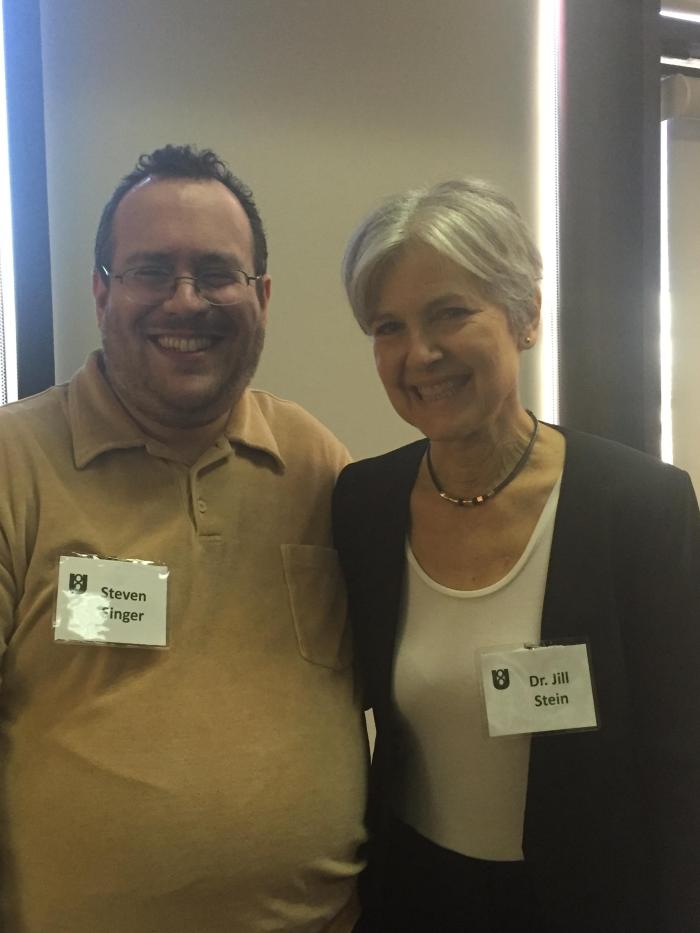
Yesterday Dr. Jill Stein gave me a hug.


Eight years ago, I was so inspired by Obama’s campaign speech in my hometown of Pittsburgh that I rushed forward along with the crowd to grab his hand. It was soft but firm with a tinge of moisturizer. Now I look at his incredibly regressive education policies and feel the need to scrub my palm.


This weekend in Philadelphia, I was at the United Opt Out Conference and saw Stein sitting in the audience.


I walked past the Green Party Presidential candidate the first time thinking I must be mistaken. Then her name tag removed all doubt.


“You’re Jill Stein!” I stuttered.


She smiled warmly, stood up and said, “You’re Steven Singer!”


I want to believe she knew who I was, but I was wearing a name tag, too.


We talked for a moment about what most of us were here for – education policy. She reaffirmed that she wanted to end all high stakes testing and school privatization.


Think of it – a presidential candidate speaking in specifics. Not “We test too much.” Not “Some charter schools are bad.” But I want to end these two perverse school policies!


And to top it all off, before she hurried off to tidy up as the time approached for her campaign speech, she game me a warm, tight hug.


Compare that to Hillary Clinton or Bernie Sanders.


As part of the Badass Teachers Association, we reached out to all the Democratic and Republican candidates on these exact same issues. The Republicans ignored us entirely, but both Democrats gave us phone calls by campaign aides.


Even then, the Democratic response was far from convivial. It mostly came down to something like “Education is important.” Well, duh.


In Sanders’ case, we had to conduct an impromptu sit-in at the Senator’s Washington office before anyone would talk to us about policy. And Hillary only started to speak in measured tones about public schools after our national teachers unions voted to endorse her – well, the leaders of those unions voted. No one ever really asked us, rank-and-file.


Moreover, when Sanders voted for the horrible Murphy Amendment of what became the Every Child Succeeds Act, several teachers including myself wrote him an open letter asking him to explain his apparent support for a Test and Punish education provision. One of his aides sent us a replysome nonsense about accountability.


And Jill Stein just gave me a hug.

The difference is huge!


When activists were holding this conference centering on the movement to Opt Out of Standardized testing, Sanders and Clinton didn’t even send campaign literature. Stein came in person and even gave a keynote address!


Don’t get me wrong. Hillary is far preferable to any Republican candidate seeking the office. I just wish her Presidential bid wasn’t funded by the very people we’re fighting against.


I love Bernie, too. I’ve even got the t-shirt to prove it. I just wish he loved us as much by throwing out a few more specifics. The general thrust of his campaign seems tailor-made to support test resistance and a fight against corporate education reform, but he rarely connects the dots with anything that we could hold him accountable for saying.


And then you have Stein, perhaps the most human politician I’ve ever met.


One look at her platform and it’s obvious she’s the best candidate for President in 2016. But is she electable?


Think about that for a moment.


What does it say about our country?


Design an excellent platform that benefits the most people, organize a movement to get your message out there, draw on the experience of experts in various fields… and you’re an incredible long shot to win the office.


The media says the same thing about Sanders as he speaks to overcapacity crowds and struggles against party politics seemingly written to hobble any populist campaign like his.


Yet Stein has no giant crowds. She has no adoring fans, no comedian on Saturday Night Live giving her friendly jibes.


She’s almost completely ignored by the media. Yet her actual policies make even a progressive like Sanders look like… well… Hillary Clinton!


For instance, Sanders wants to make college free to everyone. Stein wants to do that, too, AND erase all existing student debt.


Sanders is (kind of) against for-profit charter schools but has been vaguely supportive of Test and Punish school accountability practices. Stein is unequivocally against all forms of school privatization and high stakes standardized testing.


Sanders wants single-payer healthcare paid for by raising taxes (but net savings over all). Stein wants single-payer healthcare paid for by cutting our bloated military budget with no raise in taxes.


In fact, while Sanders is against unnecessary military action and an increase in military spending, he is in favor of keeping the $1 trillion military budget mostly intact. Stein wants to cut it by 50%, stop selling weapons to Saudi Arabia, stop giving weapons to Israel, freeze terrorist-funder’s bank accounts, end the War on Terror and engage in a policy of peace.


Moreover, Stein wants the savings from slashing our biggest federal expenditure to be used to fund a New Green Deal, creating full employment and a living wage all while transitioning to 100% clean energy by 2030!


Correct me if I’m wrong, but all of Stein’s policies sound rather sane and measured. Yet she is the one the media labels a radical and out-of-touch – if they talk about her at all.


It’s a testament to how perverted our politics have become: Sanity looks like the exact opposite. Logic and intelligence are revolutionary concepts.


And only the activists and intellectuals seem to know this is happening.


When Stein was done speaking, someone asked her the inevitable question about Ralph Nader. Wouldn’t casting a ballot for her just divide the Democratic vote and give the race to the Republicans as it did in 2000?


Her response was a bit evasive – the only time, in fact, where she seemed a bit uncomfortable.


She said that Nader wasn’t a member of the Green Party, where she is. She is engaged in building the party and the movement even beyond 2016.


On the one hand, it sounded like she was suggesting that even if she loses, it will bring real progressive issues into the limelight. However, this is not what happened when Nader lost as a third party candidate against Bush and Gore.


On the other hand, she stressed that she actually could win. About 43 million people are trapped by student debt, which she wants to unilaterally eliminate, she said. That’s a large enough chunk of the population that if they all voted for her, she would win.


It’s time for a Hail Mary moment, she said. We have to take a chance to vote for the best policies and not continue to compromise by supporting the lesser evil. Concession is the road to what we have now – continued oligarchy and global hegemony.


We need a functioning world for our children. If we don’t do something about Climate Change, the Earth may not be habitable in as little as five decades.


It’s now or never, she said.


I offer all this not as an endorsement of Stein. Nor of Sanders or Clinton (though seriously stay away from the Republicans, they’re freaking crazy).


I offer this only as food for thought.


Stein is offering us the best platform, bar none. But can we afford to vote for her? Can we afford not to?

How Radical Must We Be To Get the Schools Our Children Deserve? United Opt Out Musings

GetAttachmentThumbnail-3

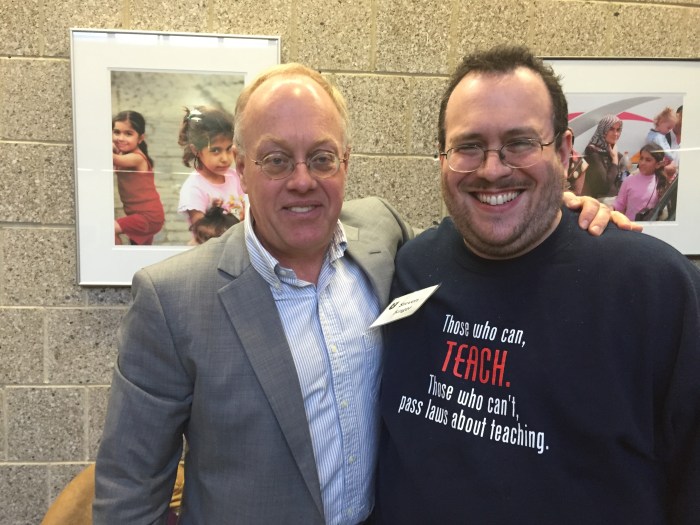
There was a point during Chris Hedges keynote address today when I could barely catch my breath.


My chest was heaving, tears were leaking from my eyes and I wasn’t sure I would be able to stop.


The Pulitzer Prize winning journalist had his audience enraptured at the United Opt Out Conference in Philadelphia Saturday morning.


I’ve read Chris before. We’ve all read Chris before. But I had never seen or heard him speak.


It was kind of like hearing a good sermon by a pastor who felt every word he said. And that really was it – Chris FELT every word.


When I’ve read Hedges’ articles on Truthdig, I’ve found myself getting angry. He stirs me up. He disturbs me, makes me feel uncomfortable. And when I heard him speak today I was surprised that he seemed to be reacting the same way to his own words.


When he talked about teaching teenage prisoners, he was emotionally invested in the story he was telling. When he criticized American neoliberal policies, he was just as angry as his audience.


The only difference was that his sorrow and rage somehow became transformed in his throat into something akin to poetry.


He turned the struggle of the oppressed into something beautiful. He transformed the hurt in my chest into something profound. He mutated my disturbance into a sense of actions-to-be.


I won’t repeat the words he said. I’d never be able to reproduce them with anything resembling his eloquence. But I will remark on one of his closing remarks because it hit me like a splash of cold water.


Rebellion, he said, is not about changing the world. It’s about changing yourself.


When you stand up for what is right, you become a better person – whether you achieve your goal or not. In a sense, it doesn’t matter if we destroy the testocracy. But in trying, we transmute ourselves into something better.


I don’t know if that’s true, but I’d like to think so.


I don’t know if we will ever destroy the system of Test and Punish, but I know I can try. I know I can put myself on the line and damn the consequences.


All weekend at the United Opt Out Conference we’ve been talking about rebellion and revolution. There’s no weak tea here in the City of Brotherly Love. No half measures. We’ve been discussing tearing the system down piece-by-piece.


A timid voice speaks up in the back of mind, “Do we really need to do all that? Do we really need revolution just to keep our public schools and make them into something worthy of our children?”


I think I’ve been trying to answer that question for a while now. Maybe a lot of us have.


In a rational country, our demands wouldn’t be so radical.


We want public schools centered on the good of all, not the profit of some. We want educationally valid curricula for our children. We want some control over the school system – both as parents and teachers.


Is that so much to ask? Is that such a lunatic request?


And as I listened to Hedges and Dr. Antonia Darder, Dave Green, Jonathan Pelto, Dr. Denisha Jones, Ceresta Smith, Yohuru Williams, Aixa Rodriguez and many, many others, I heard another timid voice begin to answer the first.


“Yes.”


The system of standardization and privatization of public education confronts students of color and impoverished students head on. They are in the front lines. Yet few people outside of activists seem willing to admit it.


Perhaps the most impressive thing about this conference has been its ability to put issues of human rights at the center of the argument. That’s the essential concept. We’re not just talking about bad education policies. We’re not just talking about schemes for billionaires to make more money. We’re talking about the systematic oppression of a group of people and the widespread complacency and complicity of the majority of the populace.


How do you combat such a monster without being revolutionary? How do you fight for your child without being a rebel?


More has happened at this conference than I can adequately put into words. I’ve met so many incredible people. Some of them I knew, some I had met before, some had only been names I had seen on my computer screen.


I will leave here Sunday feeling refreshed and energized, ready for the battles ahead.


Am I a radical?


Am I becoming a better person?


I don’t know.


But I will keep fighting.


Because I love my daughter, I love my students and I love all children everywhere.


Photo Gallery:


NOTE: This article was given a shout out on Diane Ravitch’s and Jonathan Pelto’s blogs.


United Opt Out Conference Highlights Dual Role of Technology in Education

FullSizeRender


Technology is the most powerful weapon we have against corporate education reform.


It is also our greatest foe.


Such were the remarks of Dr. Stephen Krashen at the United Opt Out Conference on Friday.


The linguist, educational researcher and activist gave the opening keynote address to hundreds of people who traveled to Philadelphia for the conference.


Krashen, who is known for his work on second language acquisition and bilingual education, has been a strong critic of the test and punish policies of the Barack Obama administration.


He warned the assembly of parents, students, teachers, professors and activists about the dangers of Competency Based Education (CBE), the next big thing in the movement to dumb down public schools.


CBE is touted as a way to reduce high stakes standardized testing by allowing students to work at their own pace while on various computer programs. However, Krashen sees this is an increase in testing.


In effect, it’s testing everyday. The computer programs used in CBE are little more than the same kinds of questions you’d see on a standardized test. An emphasis on CBE would replace a robust school curriculum with never-ending test preparation and multiple-choice assessment.


In the hands of a classroom teacher, technology can be an excellent tool to help kids learn. However, top-down policies like CBE only take away educators’ autonomy and turn them into mere facilitators of prepackaged materials of dubious quality.


He noted that the National Governors Association – an organization promoting CBE and Common Core State Standards – admits that there is no research supporting this new policy. But they’re suggesting we do it anyway. In fact, provisions to increase CBE are embedded in the new federal education law – the Every Child Succeeds Act (ESSA).


He sees this as a massive boondoggle to swipe the $600 billion we spend on technology in schools. After all, CBE will require increasingly newer computers at every school that will need to be constantly replaced as they become obsolete.


Krashen quoted Gerald Bracey: “There’s a growing technology of testing that permits us now to do in nanoseconds things we shouldn’t be doing at all.”


There is light at the end of the tunnel though.


The same technology that is being used to pervert the education system can be used to help save it.


Krashen advised activists to use the power of social media to spread the word about CBE and other Trojan Horse reforms – policies that look like they’re helping children while actually hurting them.


“The Internet is our underground,” he said, “Facebook and Twitter are our weapons.”


Though policymakers and journalists rarely listen to experts like classroom teachers, the Internet allows us to spread our message. We don’t need anyone’s permission to speak up. We are all free to do so and should do it more often.


I know many people are scared to speak up, he said, but we can all educate ourselves about what’s happening and then share it and retweet it. We need to do more of this. We need to reach a critical mass. We need to show the world the truth and that it can’t be ignored and buried under the dominant media and political narrative being sold to the public as if it were truth.


These policies, while dangerous in and of themselves, also overshadow the real needs of our school children – namely devastating, generational poverty.


When Congress passes No Child Left Unfed, No Child Without Healthcare, and No Child Left Homeless, then when can talk about No Child Left Behind and Every Child Succeeds, he said.


Dr. Martin Luther King spoke about this issue, claiming that solving poverty would in turn solve any problems with education.


Krashen’s keynote was an exciting beginning to a conference that promises to be eye-opening, exciting and energizing to the community of people fighting to take back our schools from the oligarchy.


Photo Gallery:


How to Get Rich From Public Schools (Without Actually Educating)

Get-Rich


Gold!


There’s gold in them thar schools!


Don’t believe me?


When you drive by an inner city school, it doesn’t exactly look like the Taj Mahal. Does it? Even relatively upscale suburban schools wouldn’t be mistaken for a house on MTV Cribs. And some of those fly-by night charter schools look more like prisons than Shangri-La.


But I’ve got it on good authority that there’s $1.3 trillion available for someone who knows how to take it.


That someone is Harold Levy, an expert on how to get rich through school privatization.


The former chancellor of the New York City School System has begun a second career managing an investment company.


“For-profit education is one of the largest U.S. investment markets, currently topping $1.3 trillion in value,” according to the Website for one of his master classes for rich investors.


Wooo-weee! That’s a lot of money!


To put it in context, that’s more than 10 times the amount the federal government spends on education per year. And it’s all yummy profit!


So how do you get your hands on some of those delicious taxpayer greenbacks?


You gotta’ invest.


No! I don’t mean increase education budgets for traditional public schools that can barely make ends meet! I mean invest in shiny new charter schools.


Here’s how it works.


Lend money to a for-profit company to build a new charter school. If you do it just right, you’re almost guaranteed to double or triple your money in seven years.


You’ll want to take advantage of the New Markets Tax Credit (NMTC), which began in 2000 at the end of President Bill Clinton’s administration. This will give you a whooping 39 percent tax credit. But here’s the best part, since it’s money you’re lending, you also get interest on it! And if that weren’t enough, you can piggyback all kinds of additional federal tax credits on top of that – things like historic preservation or job creation or Brownfield’s credits.


That doesn’t sound legal, does it? But it is!


In case that has you feeling queasy, you can hide what you’re doing by funneling the whole thing through a large non-profit organization like the Gates Foundation. They’ll be more than happy to help. They’ve done it for so many before you anyway.


However, make sure you whisk this money through something called a Community Development Entity (CDE). The federal website explains this can be either a “domestic corporation or partnership.” And it must have “a primary mission of serving LICs [Low Income Communities].” (Snicker!)


Here’s the best part. A CDE isn’t required to release information about who its donors are or how much they’re spending. So on paper the CDE – not you – gives the money to the non-profit, which, in turn, loans the money to a charter management organization. It’s like money laundering. No one can tell where the funds came from and thus it’s easy to escape from federal regulations or any appearance of wrongdoing.


There is a catch, however. You’re probably going to need a substantial amount of capital to put forward – at least a million bucks or so. No bank’s going to waste its time with only a few hundred thou.


This method is perfect for those who are already wealthy and want to increase their wealth or hedge fund managers out to boost their clients’ portfolios.


But maybe you just aren’t into the whole hedge fund game. Maybe you’re not the banking and investing type.


You can still make oodles of cash off public schools through real estate.


Here’s what you do – buy up cheap inner city properties that can be renovated or repurposed for charter schools. Then when a school privatization firm wants to set up shop in an impoverished city like Philadelphia, Chicago or Detroit, it needs someone like you to open the door.


You’ll get to charge the charter corporation rent and – get this – that’s not price capped! You can charge whatever you want! As long as you’ve got a good spot and no one else is trying to beat you to it, charter corporations are willing to pay bookoo bucks to get their money-making enterprises rolling!


A good rule of thumb comes from privatization expert Charter Schools USA, which recommends rental costs not exceed 20 percent of a school’s budget. However, there are plenty of examples of charter schools paying 25, 30 even up to 43 percent of their money just on rental costs! Ca-Ching!


And if you really want to boost the bottom line, open a charter school, yourself! That way you can both rent out the real estate and pay for it!


Think about it. Who sets the rental price? You do. Who pays the rental price? You do. So you can pay yourself WHATEVER YOU WANT! And where does the money come from? The taxpayers!


Doesn’t sound legal does it? But it is!


According to the Miami Herald, which conducted an in-depth investigation into these practices, many of the highest rents are charged by landlords with ties to the management companies running the schools. Property records show at least 56 charter schools in Miami-Dade and Broward counties sitting on land whose owners are tied to management companies.


Of course there are so many other ways to set things up like this with a charter school. Unlike most traditional public schools, charters contract with for-profit companies for everything from curriculum development to construction. So there are many opportunities for creative investors to figure out how to both set the price and pay it TO THEMSELVES!


Moreover, every state has different laws about charter schools so check for loopholes. You’ll find ‘em!


Just don’t forget to set up that CDE to hide your shady dealings from the public. After all, if taxpayers could easily see how you’re sucking up their hard-earned money that they thought was going to help school children (Tee-hee!) they wouldn’t be happy.


And if you’re reading this from somewhere outside of the USA, don’t despair. You, too, can make a ton of money off school privatization in the United States. It’s like the Statue of Liberty says – wealthy foreign nationals welcome! (Or something like that.)


Since the Immigration Act of 1990, investors have been allowed to purchase visas for their families by investing in U.S. corporations. Just stash some cash into a hotel, ski resort or charter school and – voilà! – Move directly to GO and collect way more than $200!


It’s called the EB-5 visa for Immigrant Investors. For the low price of at least $1 million -or $500,000 to a rural or high unemployment neighborhood — you can get visas for the whole family.


Sounds like some crazy new loophole – right? It isn’t. It’s been around for decades. Every year, the federal government hands out 10,000 of these visas. So while Syrian refugee children drown seeking asylum, wealthy foreign nationals get an express ticket to the US of A.


You might be thinking, ‘That gets me into the country, but where do I cash in?’ Easy. You now have a stake in a U.S. charter school and have access to all the same easy money as native-born investors.


It’s an incredibly lucrative model even for those more interested in the Prophet than profit.


Just look at Gulen charter schools. It’s the largest single charter school network in the country. More than 150 schools in Texas, Ohio, Illinois and other cities are funded by Turkish investors following an Islamic nationalist named Fetullaf Gülen. These schools are part of a “worldwide religious, social and nationalistic movement in his name,” according to the New York Times.


Be warned. Many of these schools are under investigation for using U.S. taxpayer dollars meant to educate U.S. children in non-educational or otherwise shady ways. Some of this tax revenue has allegedly been spent on political and religious causes championed by the Prophet Gülen. Other funds have gone to controversial educational practices. For instance, instead of hiring local teachers, the chain is infamous for shipping in Turkish educators to the United States. As if it wouldn’t be cheaper to hire locals! And guess where the money comes from to pay for these Turkish teachers’ visas? That’s right – from the charter school’s funding!


Still. Even with a few setbacks, there’s never been a better time to invest in the privatization of public education. Sure there are financial, behavioral and educational scandals at charter schools throughout the country being discovered everyday. But fortune favors the brave!


Money is just hanging on the tree waiting to be plucked. It’s hard to walk into a charter school and not come out with pockets fit to bursting with cold, hard cash.


In fact, the only folks not making bank in this whole scheme are the teachers!


Don’t be one of them.


Teachers at charter schools – where unionizing is often prohibited – take home even less than those working at traditional public schools. And those traditional educators aren’t getting rich, either.


A new report by the Center for American Progress argues that U.S. teachers usually have bad starting pay and are unlikely to see major salary gains even after several years of teaching.


Growth in teacher salaries is especially bad when comparing the U.S. to other developed countries:

Screen Shot 2016-02-23 at 7.48.08 AM

“The bottom line is that mid- and late-career teachers are not earning what they deserve, nor are they able to gain the salaries that support a middle-class existence,” the report concluded.


There appears to be a golden rule in education: the less you actually help students learn, the more money you get to take home.


Perhaps if public schools were kept out of private hands where profit is the overwhelming motivation for everything you do, things would be different. But thank goodness that isn’t happening!


Someday people may wake up and demand more for their tax dollars and for their children. But until then…


There’s gold in them thar schools!


Don’t be a sap. Don’t be a teacher. Don’t help children. Invest in a fly-by-night charter school and get rich!


NOTE: This article also was published in Commondreams.org.


‘We’re Sorry Teachers are Unfairly Blamed’ says John King – Man Responsible for Unfairly Blaming Teachers

John King AP

Sometimes the messenger matters.

You wouldn’t expect Native Americans to believe an apology from Christopher Columbus.

You wouldn’t expect African Americans to believe an apology from David Duke.

So why the heck do the Democrats expect teachers to believe an apology from John King!?

The acting U.S. Secretary of Education is – himself – responsible for more attacks on public educators than almost anyone else.

In his former role as New York Chancellor of Education, he refused to fix a school system he was responsible for destroying all the while pointing his finger at teachers.

However, late last month in his new federal position, King gave a speech at a Philadelphia high school acknowledging the mistakes of the Obama administration in tying teachers’ evaluations to student test scores – a practice he was guilty of in New York.

“I think there’s just such an urgency around making sure that teachers feel valued in our society,” King said in an interview with the Washington Post in January.

“It’s one of the things I worry a lot about. I want young people to see a future for themselves as teachers.”

Seriously!?

Were you worried about teachers in New York when you tied their evaluations to unproven and inferior Common Core tests? Were you worried about students when you approved an obviously fraudulent charter school run by an obviously fraudulent con man? Were you worried about the profession when you ignored and dismissed parents at various education forums? Were you worried about public schools when you sparked the largest opt out movement in the country?

I’m sorry, but this apology rings hollow to most educators. We know you. We know that your biggest qualification for your position in charge of the nation’s public school system is a three year stint teaching in a “no excuses” charter school with a high suspension rate.

It’s kind of hard to believe you mean a thing you say. And by extension, it’s hard to believe a thing President Barack Obama says about education, either. He was the dunderhead who picked Arne Duncan to be his first Secretary of Education and then you to succeed him.

It must be an election year.

Since a few months before the Presidential Primaries, the Democrats have been apologizing for the damage they’ve done to public education.

Obama says he wants to reduce standardized tests. That’s great – with less than one year left in his second term! After increasing it beyond even the wildest dreams of his predecessor George W. Bush!

But since we’re talking apologies here, are you, Mr. King, willing to actually do anything to make things better for the nation’s teachers?

For instance, do you think the U.S. Department of Education should be exempt from regulatory capture? In other words, should a regulatory agency like the Department of Ed advance the commercial or political interests of special interests that dominate the industry it is charged with regulating?

In other words, should any employee of the department or their immediate family be permitted to collude with the corporate interests seeking special favor in the field of education? Should a prominent member of the department also be allowed to work for an industry seeking to profit off our public schools? Should his wife?

No? Then perhaps your wife Melissa Steele King shouldn’t be accepting a position at Bellwether Consultants, a leading corporate education reform organization. They represent The New Teachers Project, New School Venture Fund, KIPP, IDEA Charter Schools, Gulen Charter Schools, Rocketship Charters and many others.

So while classroom teachers will only be able to communicate with you through official correspondence, a representative of the standardization and privatization movement will be right across from you at the dinner table every night!

If you really wanted us to take you seriously, your family wouldn’t be pulling this crap.

Your latest apology is just an attempt to smooth over your own Senate education committee confirmation hearing on Thursday, Feb. 25. You want to show how much bipartisan support you have so you can become the official Education Secretary and not just acting Education Secretary.

Look, you might say. I just threw a bone to teachers. They love me!

What a steaming pile of bullshit!

Does that offend you? Oh. Then please accept my most heartfelt apology.


NOTE: Diane Ravitch also posted about this article on her blog.


Should Teachers Have Strong Opinions?

istock_000013919699_490x356


I am an opinionated person. I am also a public school teacher.


Those two things should not be mutually exclusive.


You should not have to give up the one to be able to do the other.


Teachers should not have to relinquish their judgment in order to run an effective classroom. In fact, you might expect good judgment to be a prerequisite to doing the job well.


Yet it seems many people disagree. They like their teachers tame, docile and opinion-free.


That’s just not me.


Now don’t get me wrong. I’m not saying teachers should instruct their students to think just like them. I’m not saying they should indoctrinate or unduly influence the young people in their care.


Just the opposite. They should spur their students to think for themselves. They should teach the young how to entertain an idea without immediately accepting it.


But they have no business telling students, “This is what I believe.” They have no business misusing their authority to make their views seem normative.


So I agree that teachers should be careful about expressing their opinions in the classroom. The problem comes after the school day is through.


When a teacher goes home, all bets are off. When a teacher is not in front of a class of impressionable children, he or she should be afforded the same rights and privileges of any other citizen – and that includes the right to form an opinion and express it publicly.


I am an educator. Hear me roar.


That’s why – like many people in my field – I write an education blog.


I’m sick of the media reporting on K-12 schools but never asking classroom teachers their opinions.


Almost all major education policy in our country is made with little-to-no input from teachers: Common Core, high-stakes testing, value added measures, charter schools, Teach for America, school funding – the list goes on and on.


No one asks us what we think so many teachers scribble down their private musings and send them adrift on the Nile of the Internet.


This makes some people very angry.


These folks often respond: How dare they!? No one asked their opinion!


EXACTLY.


Some of us, teachers, even dare to address issues that don’t directly affect the classroom: racism, sexism, police brutality, the prison system, parenting – Heaven forbid – POLITICS!


Those who criticize us for commenting on such disparate matters have a very narrow view of relevance. Just because a subject doesn’t include the word “school” doesn’t make it irrelevant to the classroom. Most of my students are impoverished and minorities. You think racism doesn’t impact their lives? You think I see nothing of the effects of poverty? You think I have nothing to say about my children’s relationship with the police?


Still, few things upset some readers as much as the knowledge that I both teach and think.


“I’m glad my child doesn’t have a teacher like you,” some of them say. Or “No one who feels the way you do should be allowed in a classroom.” Or “This is why I homeschool.”


It’s funny. You never hear people speak this way of any other profession. Only teachers. We are demanded to pass a purity test from which even the priesthood is exempt.


The clergy are rarely instructed to keep their noses out of politics. They’re even invited to do so from the pulpit. But teachers? No way! Not even on our off hours.


It’s almost as if some folks think teachers are incapable of forming an opinion and not blurting it out in class. “Stop coloring, children! I must regale you with the inadequacies of former Supreme Court Justice Antonin Scalia!”


It’s ridiculous. But it makes me wonder. How much of this restraint do these critics practice in their own homes?


Do these same people who fear a teacher’s opinion stop themselves from influencing the views of their own children? Do they let their little ones make up their own minds about the world or do they tell them what to think?


It’s not surprising that most people hold the same religion as their parents. Do we all start with an unbiased view of faith and just magically find the beliefs of our fathers the most suited to our own lives? Or do most parents stack the deck? Don’t most of us actively teach our children THIS is the way to believe?


I wonder if these critics of teachers are really just afraid educators will disrupt their own work. How many parents want their own children to believe the same way they do? How many are afraid the schools will allow children to come to different conclusions? How many are afraid of being alienated from their own progeny?


I’ll let you in on a little secret. I’m a parent, too.


And, yes, I say things to my own child that I would not tell my students. If she asks a question, I give her a full answer including what I think about it. That’s a parent’s prerogative.


However, I don’t insist she believe as I do. My daughter knows I want her to make up her own mind. I appreciate our differences and love her even more because of them.


I don’t want her to be a carbon copy of me. Nor do I want that of my students or my readers.


I just want a fair hearing.


Hello, World! This is what I think! This is why I think it!


And I wait for the world to answer back.
I send my little message in a bottle onto the waves of the Interwebs.


I just wish it sometimes didn’t return with a note telling me to shut up because I’m a teacher.


NOTE: This article was also discussed on Diane Ravitch’s blog.