The Lone Voice of Dissent Against Standardized Testing

Businesswoman shouting through the megaphone in the open air.


Everybody wants to fight the good fight.


Until the battle begins.


Then many of us are all too ready to give in to what was intolerable just a moment before.


To paraphrase Thomas Paine:


These are the times that try men’s souls. The summer soldier and the sunshine patriot will, in times of crisis, shrink from service, but those who stand up in time of need deserve the love and thanks of every man and woman.


I see this almost every day in our schools.


Ask nearly any teacher what they think about high stakes standardized testing, and they’ll complain until they’re blue in the face.


They’ll give you gripes and grievances galore.


The tests take too long. They’re not valid assessments. They narrow the curriculum. They’re dumbing down the teaching profession and ripping away our autonomy.


To which I say – Amen, Sister!


Standardized tests more accurately measure economics than academics – poor kids generally fail and rich kids pass. They’re culturally biased, poorly put together, unscientifically graded and demonstrate a gobbsmacking conflict of interest.


Two conflicts of interest, actually.


First, the people who make the tests, grade the tests and thus have a financial interest in failing the most students possible because that means we have to buy more remediation material which they also conveniently sell.


Second, these test scores are used by the school privatization industry to unfairly label public schools failures so they can more easily sell fly-by-night charter and voucher schools.


So, yeah. Almost all of us agree standardized testing sucks.


But when there’s an administrator present, I too often find I’m the only one willing to speak that truth. My colleagues, who are pleased as punch to gripe in private, suddenly go quiet in the presence of their superiors.


What’s worse, some of them don’t just stay quiet – they offer arguments to support whatever nonsensical test-based solution our boss has in mind today.


Let’s say an administrator suggests we do something about the handful of students who opt out of standardized tests.


We could just respect the rights of parents who have handed in their written intention to opt their children out under a religious exemption – the only option in Pennsylvania. Or we could do as the administrator suggests and force kids who’ve been opted out to take a standardized look-a-like assessment.


I hear something like that, and I’m on my feet ready to fight.


But I find myself standing there alone.


“You can’t do that,” I say.


“It violates state law. In particular, Pennsylvania Code Title 22 Chapter 4, section 4.4.


(Okay, I had to look up the particulars later, but I made sure the administrator got them.)


Consider subsection (d) (4). And I quote:


If upon inspection of a State assessment parents or guardians find the assessment to be in conflict with their religious belief and wish their students to be excused from the assessment, the right of the parents or guardians will not be denied…”


Or how about subsection (d) (3):


“School entities shall adopt policies to assure that parents or guardians [have]… (3) The right to have their children excused from specific instruction that conflicts with their religious beliefs, upon receipt by the school entity of a written request from the parent or guardians.” (Emphasis mine)


In other words, parents have a right to excuse their children from the tests and/or instruction such as test look-a-likes.


If we go forward with requiring students who are opted out to take tests that are just like the ones their parents instructed us NOT to give, we will be violating parents’ rights under state law.”


That seems pretty airtight to me.


But the administrator disagrees.


And I look around at the assembled mass of workaday teachers for support.


Not a peep.


Instead I get this:


-We’re being evaluated on these standardized tests, we have to make sure kids take them seriously.


-I see where you’re coming from but we have to do something about these kids who are opting out just to get out of doing the work. They don’t have any real intellectual objection. They’re just lazy.


-We’ve got to do something about grade inflation.


Oh. Em. Gee.


Yet after the meeting, some of them cautiously walk up to me asking my opinion of what went down.


YOU DON’T WANT TO HEAR MY OPINION RIGHT NOW!


Take my word for it.


Tomorrow or the next day or the next week, they’ll be complaining again.


I’ve seen some of these people reduced to tears by administrators unfairly manipulating them based on their students’ test scores.


Yet none of them have the guts to stand up and be counted when the moment comes.


I say again – everyone wants to fight. But no one wants to do the fighting.


They want someone else to do it for them.


Does that make you angry?


It makes me furious.


But if you feel that way, you’ve got to do something about it.


You think teachers are too cowardly? What have YOU done to fight corporate education reform today?


You think too many administrators are quislings. You think the lawmakers are bought and sold. You think the public schools are under attack.


Well, get off your ass and do something.


I am tired of being the lone voice of dissent here.


All across the country there are people like me – people willing to stand up and fight.


But it’s a big country, and we’re usually spread pretty thin.


We need people willing to put their money where their mouths are – right here, in our hometowns.


Put up or shut up, America.


Do you want a school system that serves the needs of children?


You’ve got to make it happen.


I can’t do this all by myself.

When Students Stay Up All Night Playing Fortnite and You’ve got to Teach Them in the Morning

ne13feb40-ALL-addicted-to-video-games-L13FCA50-51A


There is something monstrously unfair about our teacher evaluation systems.


If your students fail because they were up all night playing video games, it’s your fault.


Seriously.


When students fail at academic tasks, there is no responsibility attributed to the students, no responsibility attributed to the parents and certainly no responsibility given to society.


It’s all just thrown on the teacher because, hey, someone’s got to be responsible. And it might as well be them.


I’ve written scores of articles about how standardized tests forced on students by the federal government are unfair.


They are developmentally inappropriate, culturally biased, and subject to a deep conflict of interest because the people making the tests get more money if test takers fail.


The tests drive the curriculum instead of the other way around. The scores needed to pass change from year-to-year invalidating annual comparisons. And many lawmakers pushing for these assessments are funded by the school privatization industry that uses failing test scores to sell its own fly-by-night brand of education.


These are real problems our education system faces every day.


But we mustn’t forget an even more fundamental one: we’re all responsible for student success or failure.


Not just teachers. EVERYONE.


Society, lawmakers, business people, parents – but those most responsible are the students, themselves.


Case and Point—


Over the last few months a word has entered my students’ vocabulary that hadn’t been there before: Fortnite.


It’s not that they’re so interested in an antiquated term for a two-week period. It’s the name of a popular multiplayer on-line shoot-em-up video game for PlayStation 4, Xbox One, Windows, and Mac. Players build forts with teammates to defend against other players or enemies.


Apparently, many of my students got it for Christmas. Or since there’s a free on-line version, they were turned on to it by others who had gotten the deluxe version as a present.


It started as an undercurrent of trash talk. “You suck at Fortnite.” “You can’t beat me on Fortnite.” “You just wish you could take me on Fortnite.”


And then it started to manifest physically.


Those same kids would come in to school with Fortnite Face – glassy red eyes, heads slumped on the table and the inability to stay awake for more than 10 minutes at a time.


It’s not all of my students, but it’s a significant percentage. Almost all boys. And almost all at a distinct learning disadvantage.


Teaching them is like teaching someone in a deep sea diver suit. They can’t really see or hear you very well. And any message you get back from them sounds like it’s coming from the bottom of the ocean.


When I noticed it, I cleared as much of my schedule as I could to call parents. It’s hard because administration decided not to fill positions in my department for teachers who retired last year – so all our classes are larger. And they gave me a new class I haven’t taught in years so the planning load is more cumbersome.


Plus I have as many special education students as legally allowed in every class, which requires mountains of extra paperwork and monitoring for each child.


And of course the phone in my room doesn’t call out and the cell reception is terrible, so I have to move to one of the few phones that will actually allow me to contact parents and try to communicate my concerns.


Most parents I talked to noticed the same things I had. Fortnite was taking over their children’s lives. Their kids were playing the game at every opportunity and ignoring most everything else.


However, most parents I couldn’t reach. Those cricket burner phones get disconnected quick. Others go straight to a voicemail box that’s so full it won’t accept new messages. Others allow me to leave a message that will never be returned.


But sometimes I did get through. And sometimes parents didn’t simply throw up their hands and say they don’t know what to do. Sometimes a parent actually laid down ground rules or took the game away.


However, if I’m being honest, contacting parents did not solve my problem.


I’m not blaming them. Most of my students live below the poverty line. That means their folks are working two or three jobs just to make ends meet. Or they’re grandparents raising their sons’ or daughters’ kids. Or they’re foster parents with a full house.


They’re doing the best they can. But it doesn’t end up stopping the addiction.


And – let’s be honest – it is an addiction.


For the first time in 2018, the World Health Organization recognized video game addiction as a real thing. Not every video game. Not every time someone sits down to play a video game. But video games can lead to addictive behavior.


That’s what I’m seeing in my students.


So after talking with as many parents as I could, I came to a mostly dead end.


My next step was to try to use student interests to influence instruction.


We were in the middle of a poetry writing unit. So I allowed students to write their poems about Fortnite.


That perked up a few heads.


Here’s a cinquain about Fortnite. Here’s an acrostic, a narrative, a concrete poem in the shape of a soldier or his gun.


To be honest, none of them were masterpieces.


They were just the normal trash talk and braggadocio written down in verse.


So I got an idea. Use the heightened competitive urge to push artistry.


We came to limericks – a difficult but fun type of poetry with five lines, a specific rhyme scheme and meter.


We read funny examples, we sang the rhythm together in chorus – da Dum da da Dum da da Dum – and then I set them the task of writing their own limericks.


With one twist. Whoever wrote the best limerick would get a homework pass.


That got them going like a shot.


All of my Fortniters perked up.


They wrote like I’d never seen.


Each wanted to one-up the others. And no one wrote about the game.


By the end of class, we had some pretty good poems. I wouldn’t say they are the best ever written, but they were miles better than where we were before.


So what does it all mean?


When we talk about video games these days, the conversation usually strays toward violence.


Pundits caution that video games will desensitize children and make them more prone to aggression and acting out. It might even contribute to the creation of school shooters.


Wrong.


In general, video games don’t make children more violent. Fortnite is a game where students shoot each other with guns all night long and it hasn’t made my students any more aggressive or violent than they already were.


Many cultures like the Japanese are much more into video games than ours and they have fewer violent incidents or school shootings.


However, video game addiction is a real thing and it impacts learning.


Some corporations want to try to harness this addiction to push learning. Hence the move to personalized or competency based education. That’s pure rubbish.


It’s a way to monetize education without paying attention to what’s best for kids. The same with gamification – using game theory to drive instruction.


And don’t think I’ve lost sight of my own use of competition in class. I haven’t.


Games and competition can be used to positive ends in moderation.


You can motivate reluctant kids to do things they wouldn’t normally do with competition. But it doesn’t work for everyone and it doesn’t work all the time.


It needs to be a novelty. Any tool can be overused.


Even video games aren’t bad in moderation. I used to be a gamer, myself.


The problem is when it becomes an addiction.


Our social structures can’t handle it.


Game corporations only care if it makes money. Parents are often stressed to the limit just to provide the basics.


The only group we require to be responsible is teachers.


And that’s just not going to work.


Video game addiction is another area where it becomes painfully clear how much work we all need to do to help our children succeed.

Arming Already Stressed Out Teachers Will Only Increase the Chance of School Shootings

1541539


It happened in Georgia yesterday.


A beloved social studies teacher locked himself in his classroom while his students stood outside the door.


When the principal came with the key, the teacher fired a handgun through an exterior window.


Students ran, one even twisting her ankle in the escape.


Thankfully, no one else appears to have been injured.


However, the incident brings into focus a vital component of the gun debate.


Teachers are already under tremendous stress.


Arming them won’t stop gun violence. All it does is add another potential shooter.


It’s only been about two weeks since a shooting at Stonemason Douglas High School in Florida left 17 dead.


That’s at least 19 school shootings so far in 2018 – and it’s only the beginning of March!


In that time, the national media and the Trump administration have focused on one specific solution to stopping such violence from happening again: giving teachers guns.


The latest incident in Georgia underlines why this is such a terrible idea.


Teachers are not super heroes.


Take it from me. I’m an almost 15 year veteran of the middle school classroom in western Pennsylvania.


We’re just human beings.


My colleagues and I have all the same human failings and weaknesses as everybody else.


We get tired and overworked and put upon and stressed and sometimes…


…Sometimes we don’t handle it well.


I know some people don’t want to hear it.


Society has piled all kinds of responsibilities and unreasonable expectations on our shoulders.


We’re no longer allowed to be just educators.


We’re parents, counselors, disciplinarians, doctors, psychologists, lawyers, nutritionists…. The list goes on-and-on.


And now politicians actually want us to add law enforcement to the job description?


We’re already under colossal pressure, and some folks want to add a gun to that situation?


That’s lighting a fuse.


But don’t just take my word for it.


Back in 2015, tens of thousands of educators filled out the Quality of Worklife Survey conducted by the American Federation of Teachers and the Badass Teachers Association.


After responses from 91,000 school employees and 31,000 who completed the entire 80-question survey, a picture of the emotional landscape became clear.


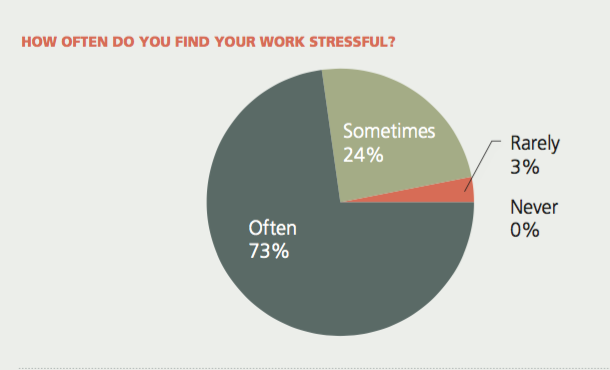
A total 73% of respondents said they often feel stressed at work.

Screen Shot 2018-03-01 at 12.48.15 PM

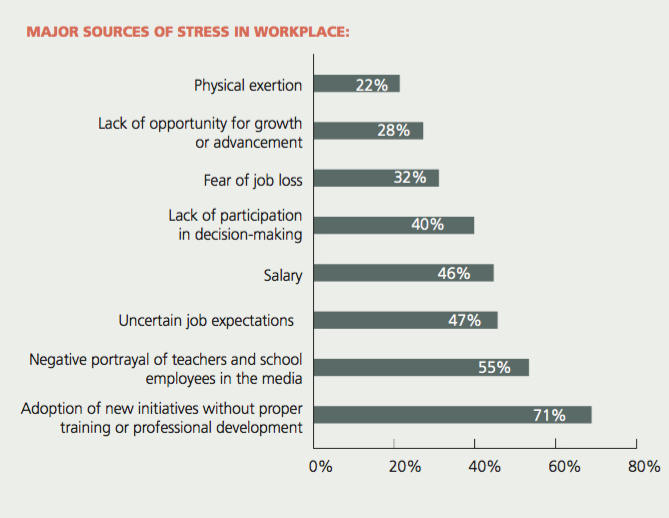
The reasons? Adoption of new initiatives without proper training or professional development (71%), negative portrayal of teachers and school employees in the media (55%), uncertain job expectations (47%) and salary (46%) were the most common responses.

Screen Shot 2018-03-01 at 12.48.58 PM

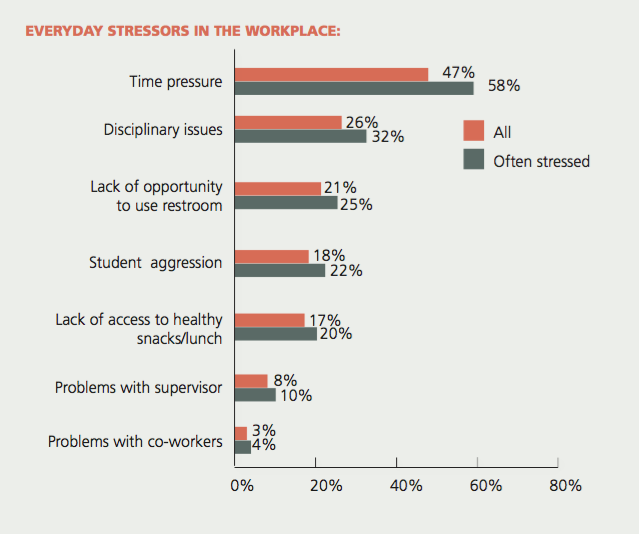
The survey identified the following as most common everyday stressors in the workplace – time pressures, disciplinary issues and even a lack of opportunity to use the bathroom.

Screen Shot 2018-03-01 at 12.49.11 PM

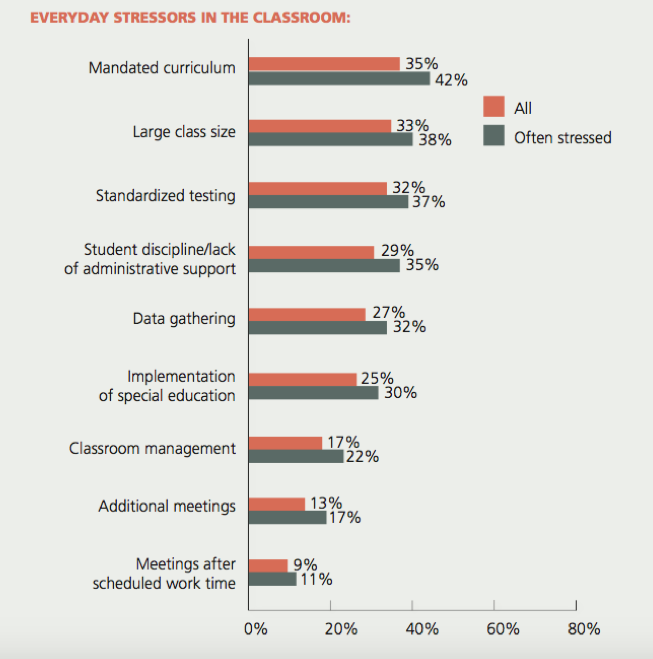
Focusing just on the classroom, top stressors were mandated curriculum, large class sizes and standardized testing.

Screen Shot 2018-03-01 at 12.49.35 PM

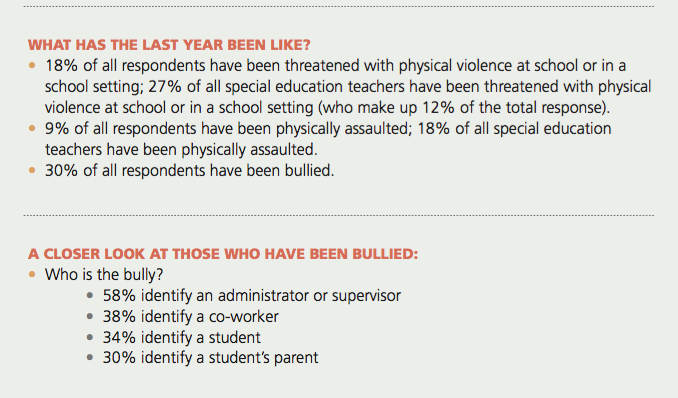
Many teachers claimed to be the victims of violence at school.


A total 18% of all respondents said they had been threatened with physical violence – though the percentage jumped to 27% when looking solely at special education teachers.


A total of 9% of all respondents claimed to have been physically assaulted at school. Again the percentage jumped to 18% of all special education teachers.


But it’s not just physical assault.


A total of 30% claim to have been bullied by administrators (58%), co-workers (38%), students (34%) and student’s parents (30%).

Screen Shot 2018-03-01 at 1.03.57 PM

This is the situation where policymakers want to throw firearms.


Most gun violence doesn’t involve a shooter doing harm to others. The great majority of gun deaths are self-inflicted.


Even without adding guns to the mix, several high profile teachers and administrators already have committed suicide.


In October of 2010, for example, a California elementary school teacher named Rigoberto Ruelas, Jr. took his own life after the Los Angeles Times published a report labeling him a “less effective teacher.” Despite the fact that students and parents praised Ruelas, who taught in one of poorest schools in his district and who also was born, raised and continued to live in area where his school was located, the Times targeted him among other so-called “less effective” teachers as part of a major propaganda campaign.


And this isn’t an isolated incident. In July of 2015, a New York City principal under investigation for altering Common Core test scores, killed herself by jumping in front of a subway car.


Adding guns to this situation will just mean more teachers taking their own lives with a bullet.


That may have been the intent of the Georgia teacher in yesterday’s shooting.


Local police said they didn’t think he was trying to injure anyone else. When he shot his gun out of the window, he appeared to be trying to get others to leave him alone.


Arming teachers is a terrible solution to school violence. It’s taking an already stifling room and turning up the heat.


We need sensible gun regulations to reduce the pressure, not increase it.


We need sensible school policies that treat teachers and students like human beings and not just cogs in the system.


But this requires us to break out of a dangerous pattern in how we deal with social problems.


When we see a problem, we generally just shrug and leave it up to public schools and teachers to solve.


Inadequate resources – leave it to teachers to buy school supplies out of pocket.


Inequitable funding – increase class size and leave it to teachers to somehow make up the difference.


We can’t do the same with gun violence. We can’t just toss teachers a gun and tell them to sort it out.


Teachers can’t solve all of society’s problems alone.


That’s going to take all of us.


And we’ll need more than disingenuous proposals like answering gun violence with more guns.

Gamification – The Hottest New Trend to Monetize Education

Screen Shot 2018-02-26 at 3.14.37 PM


When I was a kid, Super Mario Bros. was my jam.


After school, I couldn’t wait to take on the role of plucky plumber Mario or his brother Luigi. I’d jump on a few turtle shells, bounce over a bottomless pit and smash just the right secret brick to get my flashing star power up and wipe the floor with endless levels of Koopa Troopas.


But through it all, I never really learned anything.


With the possible exception of a few Italian stereotypes, the only knowledge I gained was where the warp zones were, which blocks to hit and the muscle memory necessary to defeat the next bad guy.


However, now-a-days that’s all changed.


Someone in marketing and accounting has decided that the same techniques I used to save Princess Toadstool would make an exceptional method of pedagogy.


They call it gamification, the process of making academic lessons, courses and objectives look more like video games.


Sure, the process has applications in the business world and advertising, but its biggest market has been education.


In fact, the Gamification industry is worth $2 billion worldwide and some estimate it to jump to $22 billion by 2022.


Want to teach grammar? Welcome to the good ship Verb sailing on the seas of Nouns and Pronouns. Interjections, A-hoy!


Wish your students knew fractions? Let them blast away the wrong numbers so only the correct numerator matches with the correct denominator.


That kind of thing.


It’s incredibly popular in some circles.


Advocates claim it increases student engagement and enthusiasm, provides instant feedback and the opportunity for social interactions.


Critics say it reduces students’ attention spans, narrows the curriculum and replaces human interaction with canned interfaces.


But when something is bringing in this kind of cash for big business, it’s kind of beside the point whether it works or not.


It’s the latest form of snake oil out of the cobra factory, and your teacher may be forced to pour it into your children’s brains.


That’s just Education 2018. Under the old model, the hucksters would have to approach each teacher one-at-a-time and convince them to try the shinny new toy in the box. But when you remove teacher autonomy, that frees all the used car salesmen to go right to the one person in your district – often the technology coordinator or academic coach – who controls the purse strings and convince him or her to buy what they’re selling.


In short, I’m not a fan.


In fact, I think gamification is one of the dumbest fads to hit public schools since standardized testing.


Don’t get me wrong.


Games can have limited use in the classroom.


My students love reviewing already mastered material in teams or competing against each other individually.


But there’s a big difference between playing Jeopardy or Kahoot with soon-to-be-tested material and plopping kids on an app or software package that pretends to teach them the concept.

There’s a world of difference between a 10-minute detour and an entire curriculum structured around game theory.


The biggest problem seems to be this.


Games are not intrinsically valuable.


They are good or bad based on the amount of fun they provide the user.


Be honest. No one really cares if Link puts together the Tri-force. No one is losing any sleep over rampaging Metroids on the loose. No one is putting out an Amber Alert the next time Princess Peach is inevitably kidnapped by Bowser. The only thing that matters is if meeting these objectives and countering these fictional bad guys is fun and exciting.


However, the same is not true for the ends of education.


People care whether you can read and write. You may lose sleep over being unable to add, subtract, multiple and divide. Co-workers will be alerted if you don’t comprehend the basics of science and history.


And the higher the skill we’re aiming for, the greater the degree of importance.


Gamification divorces these two ends. It turns education from an intrinsic activity into an extrinsic one.


This is a big deal.


Students shouldn’t struggle through a reading passage so they’ll get a score or a badge. They should actually care about what they’re reading.


My students and I just finished reading Lois Lowry’s “The Giver,” and they loved it.


After the first few chapters, they weren’t reading for a grade or to please me, their teacher. They truly wanted to know what would happen next. And to fully understand that, they had to exercise and refine their reading skills.


Look at it like this.


When I was playing Super Mario Bros., I often took a few warp zones to the last board so I could beat Bowser quickly and win the game. But that means I skipped over most of the first seven boards.


This didn’t matter because the only reason to play was to win. But if those first boards had included something important to the experience, skipping them would have greatly diminished my experience.


Gamification reduces learning until its meaningless. Why would anyone want to know something unless it carried with it a video game like reward?


And that’s merely the worst part.


In practice, most of the applications and software being pushed on kids to increase enthusiasm and motivation aren’t really very much fun at all. After a few times through, there isn’t much reason to plow through exposition heavy content with little to do. This material doesn’t connect to students’ lives, it doesn’t foster authentic competition, it doesn’t stoke their sense of wonder – it’s just a boring set of hoops to jump through to satisfy the instructor.


Admittedly, it does provide instant feedback, but that doesn’t matter if students don’t care about the matter at hand.


Social interactions are possible here but rarely have I seen this opportunity explored. A good group project will get students more engaged socially than messaging back and forth about the software challenge du jour.


Education can be so much more than this.


Students are being robbed of authentic interactions, authentic instruction and authentic learning.


Not all things should be turned into a game.


Gamification is another example of trying too hard to market something to people who won’t actually be using it in the hopes that they won’t notice it doesn’t actually work that well.


The consumer isn’t the gamer – it’s the administrator who buys the program. And the people best suited to assess the program’s success – teachers and students – aren’t even part of the equation.


It’s about monetization, not education.


Mario may grab a bunch of coins on his way to save the princess, but it is the corporations who are getting rich off this sad fad.


All that glitters is not gold, just as all that is new and technological is not cutting edge.


Can we stop letting big business drive the field and let education be determined by educators?


Otherwise, it will be game over for an entire generation of kids duped into accepting crap for curriculum.

Gadfly on the Road – Reflections on My First Book Signing

28056398_10155659682963860_9112619102652029542_n


So there I was standing at a podium in Barnes and Noble before an audience of 25 people who had come to hear me talk about my book.


Speech uploaded to my iPad – check.


Cough drop – check.


Fear that no one would take me seriously – Oh, double, triple check!


Let me just say there is a big difference between sitting behind a keyboard pounding out your thoughts for consumption on the Internet, and being somewhere – anywhere – in person.


I’ve spoken at rallies. I’ve spoken at school board meetings. I’ve spoken in private with lawmakers and news people.


But none of that is quite like being the center of attention at your own invitation, asking people to take time out of their busy lives and drag their physical selves to some prearranged place at some prearranged time just to hear whatever it is you’ve got to say.


I had been practicing my remarks for weeks after school.


I had a 15-20 minute speech ready to go – a distillation of the main themes in my book, “Gadfly on the Wall: A Public School Teacher Speaks Out on Racism and Reform.”


Would people hear what I had to say?


I surveyed the audience. A few people I didn’t know. But there was my mom and dad, a bit more grey haired than I remembered yet doing their parental duty. There were a few colleagues from work – teachers, aides and substitutes. There were a few students standing in the back with their parents. One of my old high school buddies even showed up though he lived about a half hour away.


And there in the second row was my daughter.


For a moment, the whole world seemed to be nothing but her 9-year-old face – a mix of emotions – curiosity, nervousness, boredom.


In that moment, everything else disappeared. I had an audience of one.


I began.


It was surreal.


I spoke the words I had written weeks before, pausing to look up at the audience when I could.


Somehow I was both more and less nervous. I stumbled over parts that had caused no problems when alone. And I hit other points with more passion and purpose than ever before.


At certain points I found myself getting angry at the people behind the standardization and privatization of public education.


I rebuke these greedy saboteurs just about every week on my blog. But there was something different about putting the words on my tongue in public and letting the vibrations beat a rhythm on the ear drums of those assembled before me.


It was like reciting a spell, an incantation. And the effect was visible on the faces of those in front of me.


I glanced at my daughter, expecting her to be nagging her Pap to take her to the children’s section, but she was as entranced as the others.


And was I kidding myself or was there another emotion there? Pride?


I finished my remarks, getting a few laughs here and there. Anger and mirth in equal measure.


I thanked everyone for coming and took questions.


There were quite a bit.


Which aspect of corporate education reform was the worst?


Is there any way for parents to protect their children from standardized testing?


How has the gun debate impacted the move to privatization?


My mother even asked what alternative methods of assessment were preferable to standardized testing.


It went back and forth for a while.


When it seemed to die down, I thanked everyone for coming and said I would be there for as long as anyone would like to talk one-on-one and sign any books if people would like.


I had a line.


Thankfully, my wife brought me the nicest sharpie marker just before I got up there.


I tried to personalize as much as I could but everything seemed to be a variation on “Thanks for Coming.”


Students came up to me with huge grins. Parents asked more questions about their children. Lots of handshaking and hugs.


Teachers came up to tell me I had done a great job. Many introduced me to their kids – most itty bitty toddlers.


A former student who had already graduated got really serious and said, “It was about time someone said that.”


And it was over.


The store manager told me how many books we sold. I had no idea if that was good or bad, but he seemed well satisfied.


I packed everything up in my car and then went looking for my family.


I found them in the children’s section.


They had picked out a few books Mommy was purchasing. A really nice one about Harriet Tubman among them.


My daughter was sitting alone by a toy train set. She was worn out. It had been a long day.


“Daddy!” she said when she saw me. “You were amazing!”


And that was it.


That was all I’d needed.


She asked me about this or that from the speech. Obviously she didn’t understand the ins and outs of what I had said, but some of it had penetrated.


We talked about racism and why that was bad. We talked about what we could do to help stop it.


The rest of the time she held my hand and took me on a tour of the store.


I have hope for a better world, but if I’m honest, I’m not sure if writing this book or my activism or any of it will ever actually achieve its goal.


As ethicist Reinhold Niebuhr wrote, “Nothing that is worth doing can be achieved in our lifetime.”


But I’ve shown my daughter where I stand.


I’ve shown her where I think it’s appropriate to stand.


I’ve shown the same to my students, my family, my community.


They’ll do with that what they will.


I just hope that one day when I’m gone, my daughter will remember what I taught her.


She’ll remember and feel my presence though I’m long gone.


Photos:


Videos of the majority of my speech:

Part 1:

Part 2:

Part 3:


Teaching is Hard Enough Without the Threat of Imminent Death


rtx4ixrd_wide-ec69ed4d214c944339605f9d2a2cfb1e23c8499f-s900-c85


I am so sick of coming to school and having an impromptu meeting to discuss why my students and I might die today.


Really.


Every time there’s a major school shooting somewhere in the nation it seems a copycat makes a threat in my own backyard, and we react.


The police tell us it’s not a credible threat so school stays open.


However, be vigilant.


Be aware that our students know about the threat and will be talking about it.


We’ll bring in bomb-sniffing dogs…


But try to maintain calm and order.


There will be a lock down drill in a few days…


But try to make the kids feel safe and secure.


An older student violently attacked a classmate last week after threatening to go on a spree…


But attempt to establish an atmosphere conducive to learning.


To which, I say: are you freaking kidding me?


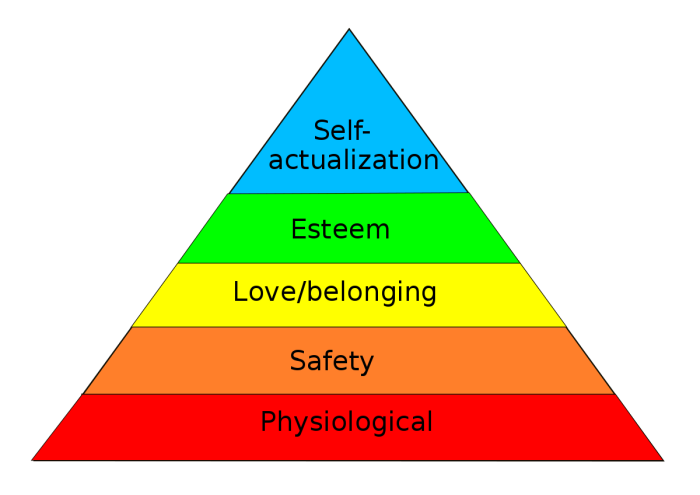
I know Maslow’s Hierarchy of Needs.


1200px-MaslowsHierarchyOfNeeds.svg


There are certain basic necessities anyone must have in order to become a fully actualized person.


After physiological necessities like food and water, safety is absolutely fundamental.


Without it, you can’t get people to focus much on anything else.


You can’t get children to pay attention to nouns and verbs, for instance, if they’re afraid they’re going to be shot and killed.


You can’t get them to care about writing a complete sentence, if they feel like they may have to duck and cover at any moment.


You can’t get them to bother with abstract reading comprehension if they’re afraid of imminent death!


Oh, and by the way, I’m not exactly at my best either!


My lesson plans aren’t going to win any awards when the best solution our legislators can come up with is giving me a loaded pistol to keep in my desk drawer!


Well, Yippee Ki Yay! I’m a teacher! Pew! Pew!


My 7th grade students are literally frightened that going to school on any given day may lead to the end of their lives.


Every couple of weeks on the news it’s another school shooting and another body count, while lawmakers do nothing to ensure it won’t happen again tomorrow.


Every few days, it’s a rumor about this or that troubled kid we all know snapping and throwing a gun in his backpack. Or it’s an anonymous threat scrawled on a wall or a social media page.


Today it was teaching classes where half the kids were missing because their parents held them out of school afraid a vague rumor of imminent violence was true.


And as I tried to assure those who did show up that everything was okay, law enforcement checked the lockers with K-9 police dogs looking for weapons or drugs.


What the heck are we coming to?


I work in a police state and my students are being asked to learn in a penitentiary.


And the teachers should get guns.


And the principals should get guns.


And the parents should get guns.


And the guns should get little tinier guns to protect themselves from even more guns!


This is madness.


We’re begging for a political solution but our political system is a shambles. Nothing puts that in starker contrast than the gun debate.


The overwhelming majority of Americans want sensible gun laws – an assault weapons ban, closing the gun show loophole, mental health screenings, etc.


If we lived in an authentic Democratic Republic, we’d have them. But we don’t, because we live in a plutocracy.


One industry has enough power and influence that the only solution our policymakers can safely suggest is one that increases that same industry’s bottom line.


It’s like Tony the Tiger suggesting the only cure for obesity is to eat more Frosted Flakes! They’re Ggggrrrreeeaaaattt!


A teacher’s job is hard enough without society crumbling all around us.


But that doesn’t mean the children aren’t learning.


They’re watching the world burn with wide eyes. They’re taking in every flame, every bullet hole, every cowardly senator, representative and chief executive.


They’re watching and taking names.


At the end of the year, policymakers will wag their fingers at the nation’s teachers about failing standardized test scores.


They’ll bemoan sinking academic standards, powerful labor unions and a lack of moral fiber as the cause of a generation of children who lost out on an education while cowering under bulletproof backpacks.


But this generation refuses to be lost.


Despite everything, they’ve left a trail of breadcrumbs back to sanity.


They are emotionally damaged by a country that no longer functions, but they know the truth.


They know who’s responsible. And they know what to do about it.


When they reject our society, we’ll know why.


Because the next generation will be nothing like us.


And on a day like today, that’s the most hopeful thought I can offer.

Economists Don’t Know Crap About Education

3c19197


I hate to be blunt here, but economists need to shut the heck up.


Never has there been a group more concerned about the value of everything that was more incapable of determining anything’s true worth.


They boil everything down to numbers and data and never realize that the essence has evaporated away.


I’m sorry but every human interaction isn’t reducible to a monetary transaction. Every relationship isn’t an equation.


Some things are just intrinsically valuable. And that’s not some mystical statement of faith – it’s just what it means to be human.


Take education.


Economists love to pontificate on every aspect of the student experience – what’s most effective – what kinds of schools, which methods of assessment, teaching, curriculum, technology, etc. Seen through that lens, every tiny aspect of schooling becomes a cost analysis.


And, stupid us, we listen to them as if they had some monopoly on truth.


But what do you expect from a society that worships wealth? Just as money is our god, the economists are our clergy.


How else can you explain something as monumentally stupid as Bryan Caplan’s article published in the LA Times “What Students Know That Experts Don’t: School is All About Signaling, Not Skill-Building”?


In it, Caplan, a professor of economics at George Mason University, theorizes why schooling is pointless and thus education spending is a waste of money.


It would be far better in Caplan’s view to use that money to buy things like… oh… his new book “The Case Against Education: Why the Education System Is a Waste of Time and Money.”


His argument goes something like this: the only value of an education is getting a job after graduation.


Businesses only care about school because they think it signifies whether prospective employees will be good or bad at their jobs. And students don’t care about learning – they only care about appearing to have learned something to lure prospective employers. Once you’re hired, if you don’t have the skills, employers have an incentive to give you on the job training. Getting an education is just about getting a foot in the door. It’s all just a charade.


Therefore, we should cut education funding and put kids to work in high school where they can learn how to do the jobs they’ll need to survive.


No wonder economics is sometimes called “The Dismal Science.” Can you imagine having such a dim view of the world where THAT load of crap makes sense?


We’re all just worker drones and education is the human equivalent of a mating dance or brilliant plumage – but instead of attracting the opposite sex, we’re attracting a new boss.


Bleh! I think I just threw up in my mouth a little bit.


This is what comes of listening to economists on a subject they know nothing about.


I’m a public school teacher. I am engaged in the act of learning on a daily basis. And let me tell you something – it’s not about merely signifying.


I teach 7th and 8th grade language arts. My students aren’t simply working to appear literate. They’re actually attempting to express themselves in words and language. Likewise, my students aren’t just working to appear as if they can comprehend written language. They’re actually trying to read and understand what the author is saying.


But that’s only the half of it.


Education isn’t even just the accumulation of skills. Students aren’t hard drives and we’re not simply downloading information and subroutines into their impressionable brains.


Students are engaged in the activity of becoming themselves.


Education isn’t a transaction – it’s a transformation.


When my students read “The Diary of Anne Frank” or To Kill a Mockingbird, for example, they become fundamentally different people. They gain deep understandings about what it means to be human, celebrating social differences and respecting human dignity.


When my students write poetry, short fiction and essays, they aren’t merely communicating. They’re compelled to think, to have an informed opinion, to become conscious citizens and fellow people.


They get grades – sure – but what we’re doing is about so much more than A-E, advanced, proficient, basic or below basic.


When the year is over, they KNOW they can read and understand complex novels, plays, essays and poems. The maelstrom of emotions swirling round in their heads has an outlet, can be shared, examined and changed.


Caplan is selling all of that short because he sees no value in it. He argues from the lowest common denominator – no, he argues from the lowest actions of the lowest common denominator to extrapolate a world where everything is neatly quantifiable.


It’s not hard to imagine why an economist would be seduced by such a vision. He’s turned the multi-color world into black and white hues that best suit his profession.


In a way, I can’t blame him for that. For a carpenter, I’m sure most problems look like a hammer and a nail. For a surgeon, everything looks like a scalpel and sutures.


But shame on us for letting one field’s myopia dominate the conversation.


No one seems all that interested in my economic theories about how to maximize gross domestic product. And why would they? I’m not an economist.


However, it’s just as absurd to privilege the ramblings of economists on education. They are just as ignorant – perhaps more so.


It is a symptom of our sick society.


We turn everything into numbers and pretend they can capture the reality around us.


This works great for measuring angles or determining the speed of a rocket. But it is laughably unequipped to measure interior states and statements of real human value.


That’s why standardized tests are inadequate.


It’s why value added teacher evaluations are absurd. It’s why Common Core is poppycock.


Use the right tool for the right job.


If you want to measure production and consumption or the transfer of wealth, call an economist.


If you want to understand education, call a teacher.

Study Suggests Bringing “No Excuses” Discipline Policies from Charter to Public Schools

no_excuses_charter


The teacher begins class by taking out her Glock.


She casually walks to the front of the room and shoots a misbehaving student in the head.


All the others immediately begin working on their assignment.


It sounds like something from a horror movie. But it’s actually not all that far away from what real researchers at the Brookings Institution and Princeton University are suggesting we do.


Sarah Cohodes has written a new report called “Charter Schools and the Achievement Gap” that praises “No Excuses” discipline policies at urban charter schools and suggests they be more widely implemented at traditional public schools serving the poor and students of color.


I wish I were kidding.


Let’s return to the hyperbolic situation with which I began this article.


The noise of a gunshot brings the principal racing to the classroom.


She notices the slumped bleeding body of the shot child and walks up to the teacher ready to physically disarm and arrest her. But then she notices all the rows of neatly placed desks and the children diligently doing their work.


She glances down at a paper here and there and notices that the children are getting most of their work correct.


So she turns to the teacher and says, “Carry on, Ms. C. You seem to have everything under control here.”


That’s perhaps the most immediate concern brought by Cohodes research – it proposes to evaluate a discipline model based solely on its academic results and completely ignores other aspects of the student experience. For instance, how does the model affect students’ social and emotional development? Is it harmful to students’ curiosity, self-motivation and psychological well-being?


Pardon me, but these are important issues.


I don’t care if my fictional teacher’s shoot first discipline policy gets students to do exceptional classwork. My daughter will not be enrolled in that class – nor do I expect anyone would want their child to learn in such an environment regardless of how well it maximized test scores.


Let me be clear. This is hyperbole, but with a point.


“No Excuses” discipline policies don’t result in any gunshot wounds or deaths (to my knowledge), but they do create environments that are not conducive to the flourishing of children.


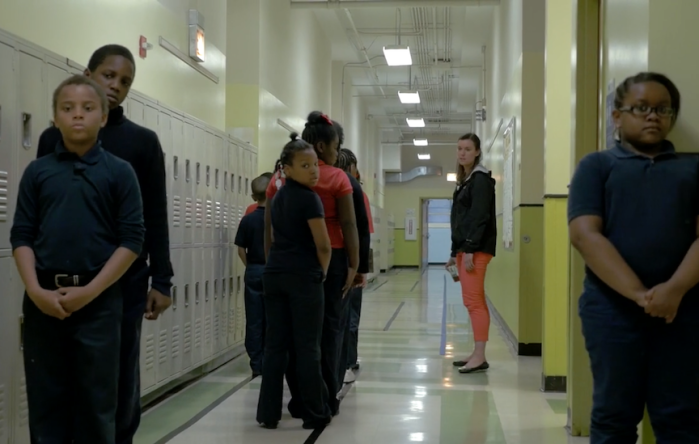
For instance, at a New Orleans charter school, students were punished for not standing straight, not sitting up straight, for putting their heads down, for closing their eyes for too long, for not tracking speakers correctly with their eyes! Between classes students had to walk single file between the wall and a line marked with orange tape. And they had strict dress codes.


This is not school. It is prison.


And it’s unsurprising that these sorts of discipline policies are found at urban charter schools like the KIPP network serving mostly poor and minority students.


Cohodes champions them because – in her view – they get results.


I say that she is missing the point.


Her view of what is important in school is far too narrow.


Moreover, it’s based on a misconception of what constitutes academic success.


Cohodes concludes “No Excuses” policies work solely because schools with such policies tend to have students who get higher test scores.


This is to make a few assumptions.


First, it assumes that the number of students weeded out by such discipline policies isn’t significant enough to wipe out the apparent increase in scores. The punishment for breaking the rules at these schools is often detention, suspension or expulsion. Every child who is enrolled at the beginning of the year isn’t there by testing time. How do we know that the school hasn’t lost so many students who couldn’t obey the rules that they wipe out any gains in testing?


Second, she is assuming standardized testing provide accurate assessments of knowledge and skills. This is far from an accepted premise. These tests have repeatedly been shown to be both economically and racially biased. Cohodes is assuming that since the students scoring better on the assessments are still poor and predominantly black, what they’re being tested on is fair.


Standardized tests are poor assessments. Multiple choice exams do not possess the flexibility to allow for creativity and depth of knowledge. They simply expect a “standard” student to think a certain way and reward dissimilar students for conforming to that standard.


“No Excuses” charter schools may be better at getting different children to act and think alike, but that is not necessarily an endorsement.


Cohodes concludes that these gains in test scores are ultimately beneficial because they will lead to success at college. However, numerous studies have shown that charter school students end up dropping out of college at higher rates than traditional public school students. They simply haven’t learned how to motivate themselves to learn without the rigid, military structures of the charter school environment. One can imagine similar outcomes for charter students (successful charter students) who immediately enter the workforce.


None of these considerations make it into Cohodes research.


She jumps from the brilliant standardized success of “No Excuses” charter schools to the need to include these policies in traditional public schools.


Cohodes worries that the charter school sector can never fully compete with traditional public schools, so we need to make traditional public schools more like charter schools.


However, I cannot imagine many parents would jump at the chance to have their children treated like prison inmates for the chance of higher test scores.


Unlike charter schools, public schools have school boards. They have to make their decisions in public and are accountable to voters who can come to the public meeting, protest and even run for a seat on the board themselves.


In short, this is a terrible idea.


It is somewhat staggering that a grown adult could look exclusively at the data and come to such a conclusion without considering what it means for flesh-and-blood students.


Not only that, but we’re talking about predominantly black and brown students. Is it somehow more acceptable because we’re talking about turning schools serving darker skinned students into Guantanamo Bay? Would it be as acceptable for rosy cheeked affluent white kids?


This is what happens when you let economists set public policy.


It is essential that we include parents, teachers, psychologist and even students in the processes. Otherwise, we’ll continue to get heartless number crunching offered as sincere solutions to our problems.

School Choice Week – Choosing Away Your Choice

Sleazy_Businessman


School Choice Week is one of the greatest scams in American history.


It is a well-funded, thoroughly organized attempt to trick parents into signing away their right to make educational choices about their children.


Seriously.


It goes like this:


Salesman: Would you like a choice?


Parent: Sure!


Salesman: Then just agree to never have another choice again.


That’s it in a nutshell.


Choose not to choose.


When you decide to send your child to a so-called choice school – a charter or voucher institution – you lose almost every other choice about what happens at your child’s school.


Sound impossible?


Let me count the decisions you lose by signing on the dotted line.


When you send your child to a school paid for with public money but run by a private organization, you lose:


AN ELECTED SCHOOL BOARD, so you have no say about what the school does.


OPEN DOCUMENTS, so you have no right to see budgets, spending agreements, bids, contracts, etc.


OPEN MEETINGS, so you have no public place to speak up to the people who run your school.


RIGHT TO SELF-GOVERNMENT, so you have no right to run for a leadership position on the school board. Instead you’re at the mercy of appointed flunkies.


THE RIGHT OF ENROLLMENT, so school operators get to choose whether your child gets to attend, unlike public schools which have to accept your child no matter what – so long as you live in the district.


QUALITY SERVICES, so school operators can cut services for your child and pocket the savings as profit or use it to advertise to get more paying butts in seats.


QUALITY TEACHERS, because most charter and voucher schools aren’t required to hire educators with 4-year degrees, and since they don’t pay as well as public schools and often refuse to let their teachers unionize, they attract less experienced and distinguished educators.


DIVERSE CLASSMATES, because charter and voucher schools increase segregation. Your children will be educated with more kids that look just like them. That’s healthy!


And that’s merely at MOST privatized schools. But that’s not all. At some privatized schools you can lose even more! You may also lose:


COMMON SENSE DISCIPLINE POLICIES, so your children will be held to a zero tolerance discipline policy where they may have to sit quietly, eyes forward, marching in line or else face aggressive public reprimands and harsh punishments.


AN UNBIASED SECULAR EDUCATION, so your children will be taught religion and politics as if they were fact all funded by public tax dollars! Hear that sound? That’s our Founders crying.


FREE TIME, so you’ll be required to volunteer at the school regardless of your ability to do so. Gotta’ work? Tough!


MONEY, so you’ll have to pay tuition, buy expensive uniforms, school supplies or other amenities.


And if your children are struggling academically, you may also lose:


ENROLLMENT, so your child is given the boot back to the public school because he or she is having difficulty learning, and thus costs too much to educate.


You lose all that if you decide to enroll your child in a charter or voucher school!


But that’s not all!


If you DON’T decide to send your child to a so-called choice school, you can still lose choice!


Why? Because of the rubes who were fooled into give up their choice. When they did that, they took some of your choices, too.


Because of them, you still lose:


-NECESSARY FUNDING, because your public school has to make up the money it lost to charter and voucher schools somewhere, and that means fewer resources and services for your child.


-LOWER CLASS SIZES, because your public school has to fire teachers and increase class size to make up for lost revenue.


-FAIR ASSESSMENTS, because the state and federal government require your child to take unfair high stakes tests to “prove” your public school is failing and thus justify replacing it with a charter or voucher schoolas if those have ever been proven to be better, but whatever! CA-CHING! CA-CHING!


This is what you get from School Choice Week.


It’s a uniquely American experience – selling the loss of choice — as choice.


And all the while they try to convince you that public schools are the ones that take away your alternatives.


Yet public schools are where you get all those things you lose at privatized schools.


You get elected school boards, open documents, open meetings, the right to self-government, the right of enrollment, quality services, quality teachers, diverse classmates, common sense discipline policies, an unbiased secular education, free time and money! That’s right! You actually get all that and more money in your pocket!


I’m not saying public schools are perfect. There are many ways they need to improve, but it’s difficult to do so when many of the people tasked with improving these schools are more concerned with sabotaging them to make room for privatized systems.


These are paid employees of the charter and voucher school movement who want to kill public schools – BUT THE KILLER IS ALREADY IN THE HOUSE!


Imagine if we dedicated ourselves to making our public school system better!


Imagine if we committed to giving parents and students more choices in the system and not trying to replace that system with one that gives all the benefits and choices away to corporate vultures!


So, yeah, School Choice Week is a scam.


But, hey, enjoy those yellow scarfs.


devosbetsey_011818gn7_lead

Few Kids in the World Can Pass America’s Common Core Tests, According to New Study

chinese-children-crush-americans-in-math-thanks-to-a-mindset-americans-only-display-in-one-place-sports


Could you jump through a hoop?


Probably if it were lying on the ground.


But what if it were held slightly higher? Let’s say waist high? Sure.


Shoulder height? Maybe with some practice.


How about if we raised the hoop to the rafters of a three story auditorium? Could you jump through THAT?


No. Of course not.


You could train with the world’s greatest coach, with the best equipment, 24-hours a day and you still couldn’t jump that high.


Yet that’s kind of what the U.S. has been expecting of its public school students – minus the resources.


We hold the hoop ridiculously out of reach and then blame them when they can’t jump through it.


But don’t take my word for it.


This is the conclusion of a new study that came out in January called “How High the Bar?” by the National Superintendents Roundtable and the Horace Mann League.


They found the benchmarks for passing the National Assessment of Educational Progress (NAEP) and American Common Core tests put success out of reach for most students the world over.


To do so, they linked the performance of foreign students on international tests of reading, mathematics, and science to the proficiency benchmarks of NAEP and thus Common Core aligned tests which use NAEP benchmarks to determine passing or failure.


The difference is the NAEP is only meant to compare how students in various states stack up against each other. Common Core tests, on the other hand, apply exclusively to kids within states.


No one’s actually expected to pass the NAEP. It’s only given to a sample of kids in each state and used to rank state education systems. The U.S. government, however, gives almost all its students Common Core tests and expects them all to pass – in fact, failure to do so could result in your public school being closed and replaced with a charter or voucher institution.


However, in both cases, the study concluded the score needed to meet the bare minimum of passing was absurdly too high – so much so that hardly any group of children in the entire world met it.


It’s important to note that these aren’t standardized testing skeptics.


They believe in the assessments. They even believe in Common Core. What they don’t believe in is the benchmarks we’re expecting our kids to meet to consider them having passed.


And this has massive consequences for the entire education system.


The media has uncritically repeated the lie that American public schools are failing based almost exclusively on test scores that show only one third of our students passing.


But if the same tests were given to students the world over with the same standard for success, even less would pass it, according to the study. If we drew the red line on international tests at the same place we draw it on the NAEP and  Common Core tests, almost every child in the world would be a dunce.


Kids from Singapore would fail. Kids from South Korea would fail. Kids from Japan would fail. You name a country where kids do nothing but study for high stakes standardized tests, and even they couldn’t meet our uniquely American criterion for passing.


In fact, the percentage of our students who do pass under these ridiculous benchmarks often exceeds that of other countries.


So when you hold kids up to impossible standards a few actually make it – and more of our kids do than our international peers.


That doesn’t mean the benchmarks are good. But it doesn’t mean the American education system is failing either. In fact, just the opposite.


We have a high stakes standardized testing system that not only does not assess kids fairly, but it actually hides their success!


In the words of the study’s authors, “…the analysis suggest the U.S. has established benchmarks that are neither useful nor credible.”


How did this happen?


It comes down to one word – proficient.


If you’re proficient, it’s thought you’re competent, you are able to do something. You might not be incredible at it, but you can get the job done.


Kind of like this:


Hey. Did you hear about my leaky faucet? The plumber fixed it after three tries because he’s proficient at his job.


Oh really? My plumber fixed my leaky faucet in only one try and didn’t even charge me because she’s advanced at her job.


That sort of thing.


There are only four scores you can achieve on most standardized assessments: Advanced, Proficient, Basic and Below Basic. The first two are considered passing and the last two are failing.


However, this doesn’t line up with the five general grades most public schools give in core subjects:


A – Excellent

B – Very good

C – Average

D – Poor

F – Failing


A-D is usually considered passing. Only F is failing.


So you might expect them to line up like this:


Advanced – A and B

Proficient – C

Basic – D

Below Basic – F


However, that’s not how they line up on NAEP. According to Diane Ravitch, who served on the National Assessment Governing Board, the federal agency that supervises NAEP, they line up like this:


Advanced – A+

Proficient – A

Basic – B and C

Below Basic – D and F


This is important, because saying someone scored a proficient on the NAEP doesn’t mean they’re just okay at it. It means they’re excellent but have room to improve.


The problem is that when developers of Common Core tests set their benchmarks, they used almost the same ones as the NAEP. Yet the NAEP benchmarks were never meant to be the same as grade level ones. Confounding the two puts mere passing out of reach for most students.


And that’s not just out of reach for most American students. It’s out of reach for international students!


In short, American students are doing B work on their Common Core tests and failing with a Basic. Yet in other countries, this would be passing with room to spare.


Moreover, when you hear that only one third of American students are Proficient or above, that means only one third are doing A or A+ work on their Common Core tests. That’s actually rather impressive!


According to the study:


“National judgments about student proficiency and many state Common 
Core judgments about “career and college readiness” are defective and misleading… 
According to NAEP officials, Proficient does not mean grade level performance. The misuse of the term confuses the public. The effects of this misuse are reflected in most Common Core assessments…


NAEP’s term “Proficient” does not even mean proficient. “Students who may be proficient in a subject, given the common usage of the term, might not satisfy the requirements for performance at the NAEP achievement level.”


The report even cites other independent analysts that have come to similar conclusions such as the U.S. General Accounting Office, the National Academy of Sciences, and the Brookings Institution.


In short:


“Advocates who push for school improvement on the grounds of questionable benchmarks are not strengthening education and advancing American interests, but undermining public schools and weakening the United States.”


Some specifics.


The study was conducted by comparing performance of foreign students on international tests of reading, mathematics, and science with the NAEP and American Common Core tests.


Very few foreign students were able to score high enough to meet what is considered proficiency on the NAEP and Common Core tests.


In fact, in 4th grade reading, not a single nation was able to meet the benchmark.


In 8th grade math, only three nations (Singapore, South Korea and Japan) had 50 percent or more students who could meet the criterion.


In 8th grade science, only one nation (Singapore) had 50 percent or more students meeting the benchmark.


But wait.


Even though the benchmarks are unfair and few nations children could meet them, the percentage of U.S. children who did meet them was higher than most other nations.


Take 4th grade reading.


Screen Shot 2018-01-22 at 8.48.54 AM


No one had 50% or more of its kids scoring a proficient or advanced. But 31% of U.S. kids actually met the benchmark, putting us fifth behind only Singapore, the Russian Federation, Finland, and England.


Only 31% of our kids could do it, but only four other nations out of 40 could do better.


That’s kind of impressive. Yet judging our scores in abstraction solely on this unrealistic proficiency standard, we’re failures. The whole process hides how well our kids actually do.


Bottom line, Common Core benchmarks are too high and paint an unfair picture of our education system, according to the study:


“When citizens read that “only one-third” or “less than half” of the students in their local schools are proficient in mathematics, science, or reading, they can rest assured that the same judgments can be applied to students throughout most of the world…


Globally, in just about every nation where it is possible to compare student performance with our national benchmarks, the vast majority of students cannot demonstrate their competence because the bars are set unreasonably high.”


Screen Shot 2018-01-22 at 8.47.29 AM


At very least, this invalidates the scores of the NAEP and every Common Core test yet given in this country. It demands we set new benchmarks that are in line with grade level performance.


At most, it casts doubt on the entire process of high stakes standardized testing.


It demonstrates how the data can be manipulated to show whatever testing corporations or other interested parties want.


Standardized testing is a gun, and we have been demanding schools shoot themselves in the foot with it.


Instead of trying to hold our schools to impossible standards, we should be holding our lawmakers to standards of common decency. We should concentrate on equitable funding, reintegration, and supporting our public school system and public school teachers. Not enriching private testing corporations so they’ll paint a misleading picture of student performance to justify pro-privatization schemes.


When will our policymakers rise to meet the benchmarks of honesty, empathy and caring about the well-being of children?


In the final analysis, that may be bar they are simply incapable of reaching.