How to Oppose White Supremacists Without Becoming a Monster, Yourself

Men-Hug-Rally


There is a danger in opposing white supremacists.


In confronting such an odious set of beliefs, you can justify suspending your own strongest held moral convictions as a necessary end to defeating their prejudices.


It’s easy to see how this might happen.


When hearing an ignorant troll like Richard Spencer arrogantly spouting warmed over Nazi propaganda, it is quite natural to wish to issue a rebuttal in the form of your fist.


You can follow the logic all the way from your heart to your knuckles.


Your thought process might go something like this:


This fool is so enamored with violence, let him suffer the consequences of it.


But that is conceding the point.


That is giving the white supremacist his due. It’s entering his world and playing by his rules.


Oh, I’m sure it’s satisfying, but it’s the wrong way to respond.


However, on the other hand one can’t simply smile and nod during Spencer’s tirade and then expect to reciprocate with an academic treatise.


No cogent, logical, professorial come back is going to counter the purely emotional arguments made by white supremacists.


They are stoking fear and hatred. Logic is useless here.


So what are anti-racist anti-facists like ourselves supposed to do when confronted with people like this?


We have to walk a razor’s edge between two poles.


On the one hand, we can’t tolerate intolerance.


I know that’s paradoxical. But it’s true.


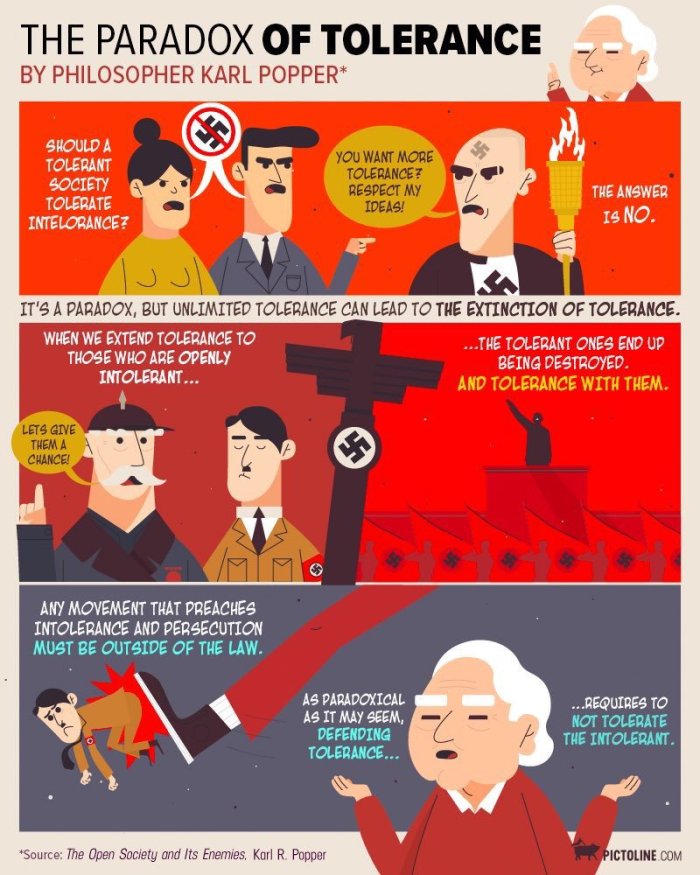
As Vienna-born philosopher Karl Popper put it in The Open Society and Its Enemies, unlimited tolerance leads to the destruction of tolerance.


If we tolerate the intolerant, if we give them equal time to offer their point of view and don’t aggressively counter their views, they will inevitably resort to violence and wipe our side out.


This doesn’t mean immediately punching them in the face or violently attacking them. For Popper, we should let rationality run its course, let them have their say and usually their ideas will be rejected and ignored.


However, if this doesn’t happen and these ideas start to take root as they did in Nazi Germany (or perhaps even today in Trump’s America), then Popper says we must stop them by “fists or pistols.”


In short, Popper writes:


“We should therefore claim, in the name of tolerance, the right not to tolerate the intolerant. We should claim that any movement preaching intolerance places itself outside the law, and we should consider incitement to intolerance and persecution as criminal, in the same way as we should consider incitement to murder, or to kidnapping, or to the revival of the slave trade, as criminal.”


Popper believed in the free expression of ideas, but when one of those ideas leads to violence, it is no longer to be tolerated. Then it is outside the law and must be destroyed.
 

DHtG6mmUwAAEYm6


What then do we do with our commitment to nonviolence?


Do we reluctantly agree to push this constraint to the side if push comes to shove?


No. This is the other pole we must navigate between.


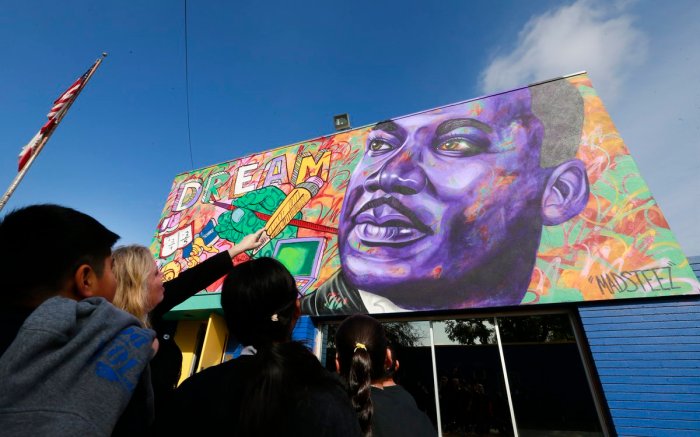
On the second to last day of his life, April 3, 1968, Dr. Martin Luther King, Jr., gave a speech stating his unequivocal commitment to the principal of nonviolence:


“It is no longer a choice between violence and nonviolence in this world; it’s nonviolence or nonexistence. That is where we are today.”


The next day he was shot to death. These are among the last words he spoke in public.


That King was to be martyred in the cause of justice would not have surprised him.


He had already received several death threats and attempts on his life.


He knew that his continued efforts to fight for human dignity would probably result in the premature ending of his life someday. He knew all that yet he still prescribed nonviolence.


There was simply no other way for him to exist.


Mahatma Gandhi, who influenced Dr. King and our American fight for civil rights with his own nonviolent revolution in India, went even further.


At the start of WWII, he wrote that the British should lay down their arms and let the Nazis invade the United Kingdom without offering any violent resistance. They should even let themselves be slaughtered if it came to it. He made similar remarks to Jews facing the Holocaust.


That’s pretty extreme.


But can you imagine its effect?


No one followed Gandhi’s advice. We fought the Germans in WWII and won. We crushed their pathetic thousand year Reich and threw their prejudiced ideals on the trash heap of history.


And yet here we are today. In Charlottesville. In Portland. In Washington, DC.


The scared and ignorant have rooted through the trash and recycled those same odious ideals.


The war ended, but the battle goes on.


Would that have happened had we met violence with nonviolence?


I don’t know the answer. No one does.


But it respects an important point – we can’t ultimately fight our way to peace. Not without killing everyone else. And then why would the solitary survivor wish to live?


There is an inherent flaw in humanity that continually incites us to kill each other.


We can never have true peace unless we find a way to stamp out that flaw.


Nonviolence is the closest we’ve ever come to finding a solution.


So there you have it, the Scylla and Charybdis of our current dilemma.


We must try to navigate between them.


We must not tolerate the intolerance of the white supremacists. But we must also not allow our opposition of them to change us into that which we hate.


I know it sounds impossible. And I certainly don’t have all the answers about how we do it.


To start with, when white supremacists advocate violence of any kind, we must seek legal action. We must use every tool of the law, the courts, and law enforcement to counter them.


This requires political power. We must organize and keep them politically marginalized and weak.


We must take every opportunity to speak out against white supremacy. We must continue to make their ideal socially and culturally repugnant. At the same time, we must also reach out to them in the spirit of healing and love. We can’t give up on them, because they, too, are our brothers and sisters.


Yet if they resort to violence, we can feel justified in protecting ourselves and those they wish to victimize.


But the keyword here is “protect.”


We should go no further. We should not attack.


I know that is a hard line to walk.


Maybe it’s not even possible. Still, we must try.


It might feel satisfying to punch a Nazi. Heck! I’m sure it would. But we cannot allow ourselves to become like them.


Because the real enemy is not them.


It is their fear and ignorance.


And if we’re honest, we hold the same disease deep inside our own hearts.


We cannot defeat racism and prejudice unless we overcome our own flawed humanity.

Twenty-One Reasons People Hate, Hate, HATE Betsy DeVos

n7kdmgvgx13jmo6cvmpu


Lesley Stahl: Why have you become, people say, the most hated Cabinet secretary?


Betsy DeVos: I’m not sure exactly how that happened…

I’m more misunderstood than anything.


The above exchange from last night’s 60 Minutes interview highlights an important point about our Education Secretary.


She is deeply unpopular, but not because she’s misunderstood. If anything, she’s understood too well.


We know what she stands for and we don’t like it.


If she was really so misunderstood, why didn’t her answers in the interview veer away from the same usual canned responses she’s given time-and-time-again to the same type of questions?


What’s wrong with schools? NOT ENOUGH CHOICE.


How do we prevent school shootings? LET SCHOOLS ARM TEACHERS.


You didn’t really even need DeVos to show up to the interview to be able to guess with a high degree of accuracy what her answers would be.


In fact, many of her responses seemed to have been coached – as if someone had prepared her with talking points before the interview even took place.


So without further ado, here is my exhaustive list of all the reasons I can think of why people really, REALLY hate Betsy Devos. If I’ve left something out, please feel free to add it in a comment.


WHY PEOPLE HATE BETSY DEVOS:


1) She didn’t earn her position as Education Secretary. She bought it. And even then it took a tie breaking vote by Vice President Mike Pence to shove her down our throats.


2) She wants to spend tax dollars to boost privatized schools in which she has a financial stake.


3) She doesn’t mind taking funding away from public schools to do it.


4) She wants to destroy the entire system of public schools which enroll 90% of America’s children.


5) She doesn’t really know what public schools are, having never attended one or having never sent her children or grandchildren to one.


6) She wants to arm teachers not because it will protect kids from school shooters, but because that boosts her family’s investment portfolio. (i.e. her brother’s mercenary army for hire, Blackwater)


7) She won’t make charter and voucher schools give the same services to special education kids as those provided by traditional public schools.


8) She’s getting rid of students’ civil rights protections while adding protections for nefarious student loan providers and fly-by-night on-line schools.


9) She’s rescinded rules that protected trans students.


10) She’s considering rescinding rules that protect minority students from being unfairly and disproportionately disciplined by schools.


11) She’s made it harder for victims of sexual assault and harassment to report abuse and easier for those accused to avoid prosecution.


12) She talks about state’s rights to determine their own education systems while using the power of the federal government to coerce them to doing things her way.


13) She wastes public tax dollars. She is the only Cabinet member protected by Federal Marshals, which costs us nearly $1 million a month. Whether this is necessary or not, as a billionaire she could save the taxpayers money by taking on this cost, herself.


14) She doesn’t care if the public doesn’t want her at their school or event. She goes anyway and then pretends to be angry that protestors showed up. She doesn’t seem to understand that as a public servant she should serve at our pleasure – not the other way around.


15) She uses tragedy as a photo-op – as she did when she visited the Parkland school to promote arming teachers. She didn’t meet significantly with students or staff. She didn’t listen to their concerns. She even bailed on her own press conference there when the queries weren’t to her liking.


16) She has no problem whitewashing black history as she did when she claimed historic black colleges were pioneers of school choice. In reality they had no choice. For many African Americans at the time, it was create black colleges or forgo post-secondary education at all.


17) She is ignorant (purposefully or not) of the results of her own policies. Her advocacy of school choice in her home state of Michigan has weakened that state’s public schools, not strengthened them.


18) She’s out of touch with average Americans. She’s the richest member of Trump’s cabinet and often travels in her on super luxury yacht.


19) She’s rich not because she earned it, but because she was born into it and married into even more wealth. Moreover, much of her wealth is due to her family’s Amway fortune – basically it’s founded on rooking average people out of their hard earned money with what’s essentially a pyramid scheme.


20) She’s arrogant. She smiles vacantly at topics that don’t deserve a smile – they deserve serious regard.


21) She is extremely biased and partisan. She is supposed to serve the public interest, but her radical Christian Fundamentalism and anti-LGBT activism make her untrustworthy to serve in that capacity. Statements such as “There is enough philanthropic dollars in America to fund what is currently the need in education… Our desire is to confront the culture in ways that will continue to advance God’s kingdom,” do not help.


Okay. That’s all I can think of – though more may pop into mind as soon as I publish this. If I missed something please include it in the comments.


Hopefully this answers DeVos’ question about why she’s hated.

Gadfly on the Road – Reflections on My First Book Signing

28056398_10155659682963860_9112619102652029542_n


So there I was standing at a podium in Barnes and Noble before an audience of 25 people who had come to hear me talk about my book.


Speech uploaded to my iPad – check.


Cough drop – check.


Fear that no one would take me seriously – Oh, double, triple check!


Let me just say there is a big difference between sitting behind a keyboard pounding out your thoughts for consumption on the Internet, and being somewhere – anywhere – in person.


I’ve spoken at rallies. I’ve spoken at school board meetings. I’ve spoken in private with lawmakers and news people.


But none of that is quite like being the center of attention at your own invitation, asking people to take time out of their busy lives and drag their physical selves to some prearranged place at some prearranged time just to hear whatever it is you’ve got to say.


I had been practicing my remarks for weeks after school.


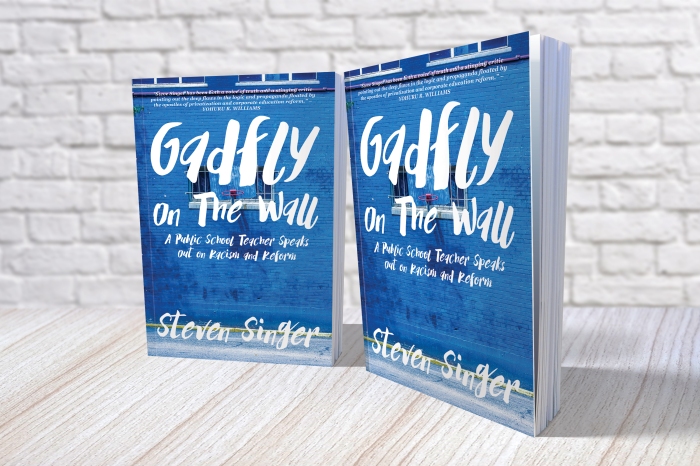
I had a 15-20 minute speech ready to go – a distillation of the main themes in my book, “Gadfly on the Wall: A Public School Teacher Speaks Out on Racism and Reform.”


Would people hear what I had to say?


I surveyed the audience. A few people I didn’t know. But there was my mom and dad, a bit more grey haired than I remembered yet doing their parental duty. There were a few colleagues from work – teachers, aides and substitutes. There were a few students standing in the back with their parents. One of my old high school buddies even showed up though he lived about a half hour away.


And there in the second row was my daughter.


For a moment, the whole world seemed to be nothing but her 9-year-old face – a mix of emotions – curiosity, nervousness, boredom.


In that moment, everything else disappeared. I had an audience of one.


I began.


It was surreal.


I spoke the words I had written weeks before, pausing to look up at the audience when I could.


Somehow I was both more and less nervous. I stumbled over parts that had caused no problems when alone. And I hit other points with more passion and purpose than ever before.


At certain points I found myself getting angry at the people behind the standardization and privatization of public education.


I rebuke these greedy saboteurs just about every week on my blog. But there was something different about putting the words on my tongue in public and letting the vibrations beat a rhythm on the ear drums of those assembled before me.


It was like reciting a spell, an incantation. And the effect was visible on the faces of those in front of me.


I glanced at my daughter, expecting her to be nagging her Pap to take her to the children’s section, but she was as entranced as the others.


And was I kidding myself or was there another emotion there? Pride?


I finished my remarks, getting a few laughs here and there. Anger and mirth in equal measure.


I thanked everyone for coming and took questions.


There were quite a bit.


Which aspect of corporate education reform was the worst?


Is there any way for parents to protect their children from standardized testing?


How has the gun debate impacted the move to privatization?


My mother even asked what alternative methods of assessment were preferable to standardized testing.


It went back and forth for a while.


When it seemed to die down, I thanked everyone for coming and said I would be there for as long as anyone would like to talk one-on-one and sign any books if people would like.


I had a line.


Thankfully, my wife brought me the nicest sharpie marker just before I got up there.


I tried to personalize as much as I could but everything seemed to be a variation on “Thanks for Coming.”


Students came up to me with huge grins. Parents asked more questions about their children. Lots of handshaking and hugs.


Teachers came up to tell me I had done a great job. Many introduced me to their kids – most itty bitty toddlers.


A former student who had already graduated got really serious and said, “It was about time someone said that.”


And it was over.


The store manager told me how many books we sold. I had no idea if that was good or bad, but he seemed well satisfied.


I packed everything up in my car and then went looking for my family.


I found them in the children’s section.


They had picked out a few books Mommy was purchasing. A really nice one about Harriet Tubman among them.


My daughter was sitting alone by a toy train set. She was worn out. It had been a long day.


“Daddy!” she said when she saw me. “You were amazing!”


And that was it.


That was all I’d needed.


She asked me about this or that from the speech. Obviously she didn’t understand the ins and outs of what I had said, but some of it had penetrated.


We talked about racism and why that was bad. We talked about what we could do to help stop it.


The rest of the time she held my hand and took me on a tour of the store.


I have hope for a better world, but if I’m honest, I’m not sure if writing this book or my activism or any of it will ever actually achieve its goal.


As ethicist Reinhold Niebuhr wrote, “Nothing that is worth doing can be achieved in our lifetime.”


But I’ve shown my daughter where I stand.


I’ve shown her where I think it’s appropriate to stand.


I’ve shown the same to my students, my family, my community.


They’ll do with that what they will.


I just hope that one day when I’m gone, my daughter will remember what I taught her.


She’ll remember and feel my presence though I’m long gone.


Photos:


Videos of the majority of my speech:

Part 1:

Part 2:

Part 3:


Teaching is Hard Enough Without the Threat of Imminent Death


rtx4ixrd_wide-ec69ed4d214c944339605f9d2a2cfb1e23c8499f-s900-c85


I am so sick of coming to school and having an impromptu meeting to discuss why my students and I might die today.


Really.


Every time there’s a major school shooting somewhere in the nation it seems a copycat makes a threat in my own backyard, and we react.


The police tell us it’s not a credible threat so school stays open.


However, be vigilant.


Be aware that our students know about the threat and will be talking about it.


We’ll bring in bomb-sniffing dogs…


But try to maintain calm and order.


There will be a lock down drill in a few days…


But try to make the kids feel safe and secure.


An older student violently attacked a classmate last week after threatening to go on a spree…


But attempt to establish an atmosphere conducive to learning.


To which, I say: are you freaking kidding me?


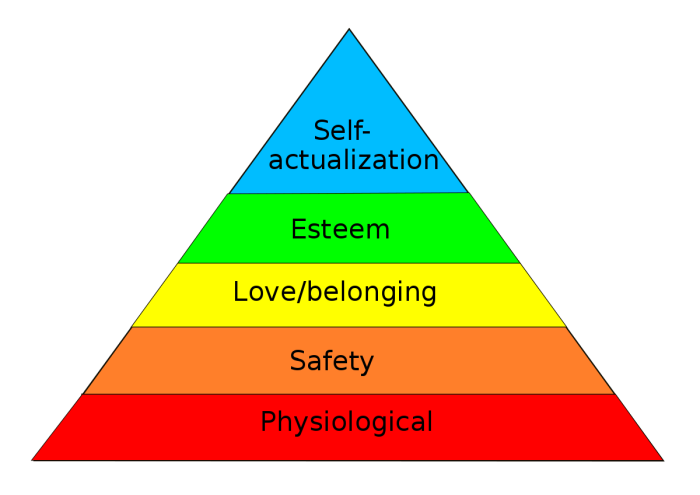
I know Maslow’s Hierarchy of Needs.


1200px-MaslowsHierarchyOfNeeds.svg


There are certain basic necessities anyone must have in order to become a fully actualized person.


After physiological necessities like food and water, safety is absolutely fundamental.


Without it, you can’t get people to focus much on anything else.


You can’t get children to pay attention to nouns and verbs, for instance, if they’re afraid they’re going to be shot and killed.


You can’t get them to care about writing a complete sentence, if they feel like they may have to duck and cover at any moment.


You can’t get them to bother with abstract reading comprehension if they’re afraid of imminent death!


Oh, and by the way, I’m not exactly at my best either!


My lesson plans aren’t going to win any awards when the best solution our legislators can come up with is giving me a loaded pistol to keep in my desk drawer!


Well, Yippee Ki Yay! I’m a teacher! Pew! Pew!


My 7th grade students are literally frightened that going to school on any given day may lead to the end of their lives.


Every couple of weeks on the news it’s another school shooting and another body count, while lawmakers do nothing to ensure it won’t happen again tomorrow.


Every few days, it’s a rumor about this or that troubled kid we all know snapping and throwing a gun in his backpack. Or it’s an anonymous threat scrawled on a wall or a social media page.


Today it was teaching classes where half the kids were missing because their parents held them out of school afraid a vague rumor of imminent violence was true.


And as I tried to assure those who did show up that everything was okay, law enforcement checked the lockers with K-9 police dogs looking for weapons or drugs.


What the heck are we coming to?


I work in a police state and my students are being asked to learn in a penitentiary.


And the teachers should get guns.


And the principals should get guns.


And the parents should get guns.


And the guns should get little tinier guns to protect themselves from even more guns!


This is madness.


We’re begging for a political solution but our political system is a shambles. Nothing puts that in starker contrast than the gun debate.


The overwhelming majority of Americans want sensible gun laws – an assault weapons ban, closing the gun show loophole, mental health screenings, etc.


If we lived in an authentic Democratic Republic, we’d have them. But we don’t, because we live in a plutocracy.


One industry has enough power and influence that the only solution our policymakers can safely suggest is one that increases that same industry’s bottom line.


It’s like Tony the Tiger suggesting the only cure for obesity is to eat more Frosted Flakes! They’re Ggggrrrreeeaaaattt!


A teacher’s job is hard enough without society crumbling all around us.


But that doesn’t mean the children aren’t learning.


They’re watching the world burn with wide eyes. They’re taking in every flame, every bullet hole, every cowardly senator, representative and chief executive.


They’re watching and taking names.


At the end of the year, policymakers will wag their fingers at the nation’s teachers about failing standardized test scores.


They’ll bemoan sinking academic standards, powerful labor unions and a lack of moral fiber as the cause of a generation of children who lost out on an education while cowering under bulletproof backpacks.


But this generation refuses to be lost.


Despite everything, they’ve left a trail of breadcrumbs back to sanity.


They are emotionally damaged by a country that no longer functions, but they know the truth.


They know who’s responsible. And they know what to do about it.


When they reject our society, we’ll know why.


Because the next generation will be nothing like us.


And on a day like today, that’s the most hopeful thought I can offer.

Go Ahead, SCOTUS. Rule Against Unions in Janus Case. You’ll Only Make Us Stronger

1060x600-8abcfe3a7759726bb00893d08cc17540


Bwa-hahahaha!


The corporate owned far right has been trying to destroy labor unions for decades.


But this time they may have finally overplayed their hand.


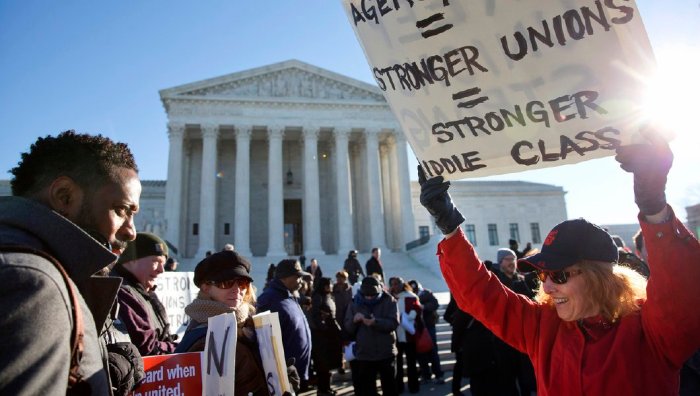
The upcoming Janus v. AFSCME Council 31 case set for a ruling by the U.S. Supreme Court on Feb 26 has been billed as the final nail in the coffin for public sector unions.


With the pitifully weak Democrats giving up President Obama’s pick for the bench in favor of Trump’s absurd choice, Neil Gorsuch, the court has a decidedly conservative bias.


So court watchers expect the latest challenge to collective bargaining rights to come out in favor of the corporations and billionaires who have spent truckloads of money to ensure the little guy has less of a say in the workplace.


BUT! They aren’t taking into account how stupid these far right shills truly are!


The case comes down to this: some people working in a union job don’t think they should have to pay union dues even though they benefit from the contract negotiated by their union. They affirm that being part of a union is political speech and thus they cannot be compelled to pay – yet somehow they should be able to keep all the benefits of being in a union, anyway.

Cartoon-JanusVAfscme-768x557

So the union gets me a raise and better healthcare, but – even though none of my dues go to pay for political campaigns (that money is donated separately and voluntarily) – just being in a union is a political act.


If the court rules in favor of this position, unions would no longer be able to compel members to pay dues.


Pay them, don’t pay them – there’s nothing the union could do.


Conservatives are betting that if dues become voluntary on a person-by-person basis, at least a few members will opt out and thus weaken union finances and ability to collectively bargain for everyone.


But what they don’t seem to understand is that a decision like this would overturn decades of established law.


It would overturn mountains of legal decisions that provide the foundation for how our government works.


In short, how many times are we compelled to pay for things we don’t necessarily believe in?


Answer: every freakin’ day!


How much of my tax dollars go to the military? What if I don’t want my taxes used to pay for a bloated war machine?


How much of my hard earned money is wasted on corporate subsidies? What if I don’t want to prop up huge multinational businesses already making record profits?


How much of my money go to privatized schools? What if I’m against charter and voucher schools and want my taxes instead to fund fully public schools with elected boards, transparency and who have to accept all students regardless of ability?


If the court rules against unions, then I guess I won’t have to pay my taxes anymore – or at very least, I will have to be given the option of where my tax dollars go.


Not just SOME of my tax dollars – every single penny on a line-by-line basis for every single tax payer in the United States!


An Illinois based engineering union wrote in detail about exactly how such a ruling would change the landscape. Operating Engineers Local 150, wrote on their blog titled, “Union Busters Set Themselves Up for Janus Backfire”:


“If not bargaining is protected free speech, then bargaining will conversely be protected free speech, giving union workers new protections that we’ve never enjoyed before.  For example:

  1. Governor Scott Walker’s now infamous Act 10, the law that destroyed public sector collective bargaining in Wisconsin, will be declared an unconstitutional, content-based restriction on speech and association.


  1. Every state in America will now be subject to bargaining with their public sector employees, even if they didn’t previously.


  1. Local municipalities will be subject to numerous taxpayer lawsuits based upon forced contributions to lobbying groups.


  1. The municipal lobbying industry, currently an extremely large source of revenue for lobbyists, will be decimated as taxpayers now have a First Amendment right to demand their tax dollars are not used for lobbying or political advocacy.


  1. Public Sector pensions will be adversely affected as participants demand that their forced pension contributions are not used for corporate speech.


  1. Municipal advertising, tax increment financing, and all other types of tax breaks (think Foxxcon in Wisconsin) will be subject to litigation based upon taxpayers’ First Amendment rights to opt-out of this type of speech. The same burdensome calculations that are currently leveled only upon unions would become widespread.”


Shaun Richman, a former organizing director for the American Federation of Teachers, agrees.


In an article for In These Times called “How A Supreme Court Decision to Gut Public Sector Unions Could Backfire,” he writes:


“The ruling could both wildly increase workers’ bargaining power and clog the lower courts with First Amendment challenges to routine uses of taxpayer money. At a minimum, it has the potential to turn every public sector workplace dispute into a constitutional controversy…”


Frankly, this is kind of exciting.


In trying to stifle workers’ free speech, conservatives may unravel the statutes that have muzzled us for years.


A decision against unions by the Supreme Court would open the way for thousands of cases throughout the court system – challenge after challenge. Certainly conservative justices would try to staunch the tide, but they simply couldn’t stop every case – especially after such a dangerous precedent has been set!


The SCOTUS would be unleashing chaos on the justice system, and I, for one, hope that every workers union takes advantage of it.


Every individual across the political spectrum should file suit against whichever political peccadillo they want. Evangelicals can file against public schools using their tax dollars to teach evolution. Libertarians could file against having a standing army. Liberals could file against oil pipelines.


And on and on and on.


Meanwhile, those workers unions that conservatives are hoping will be destroyed will be just fine.


You think workers won’t pay their union dues? Some might try, but doing so will have immense personal ramifications. At very least, it will make those individuals social pariahs. Who wants to associate with someone who thinks they should get all the benefits without paying like everyone else?


Moreover, I don’t advocate violence against anyone, but stiffing your co-workers on your union dues is a sure fire way to get slashed tires. Do you put your lunch in a communal fridge? I wouldn’t eat that after word gets out you’re a free rider. Not unless you like to share your co-worker’s saliva.


Again, I’m not advocating for any of that, but it’s just the way humans behave. We don’t like paying for any other able-bodied person whose “political” decision puts our lives and livelihoods in jeopardy.


The end result of a ruling against unions would forever put collective bargaining rights firmly under the protection of the First Amendment.


It would protect all speech – including union rights.


So I say, go ahead, SCOTUS, make our day!

Crippled Puerto Rico Offered School Privatization as Quick Fix for Woes

10-Puerto-Rico-Read-Aloud-02-story-thumb-600x388-27787-thumb-600x388-27961


You’re Puerto Rico’s school system.


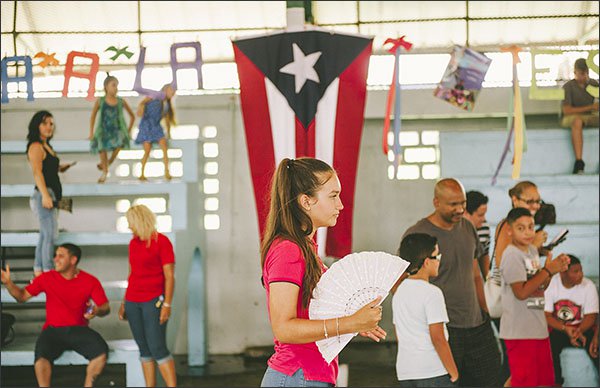
More than five months since a devastating hurricane hit the island’s shores, some 270 schools are still without power.


Roughly 25,000 students are leaving with that number expected to swell to 54,000 in four years. And that’s after an 11-year recession already sent 78,000 students  seeking refuge elsewhere.


So what do you do to stop the flow of refugees fleeing the island? What do you do to fix your storm damaged schools? What do you do to ensure all your precious children are safe and have the opportunity to learn?


If you’re Puerto Rico’s Governor Ricardo Rossello, you sell off your entire system of public education.


After an economic history of being pillaged and raped by corporate vultures from the mainland, Rossello is suggesting the U.S. Territory offer itself for another round of abuse.


He wants to close 300 more schools and change the majority of those remaining into charter and voucher schools.


That means no elected school boards.


That means no public meetings determining how these schools are run.


It means no transparency in terms of how the money is spent.


It means public funding can become private profit.


And it means fewer choices for children who will have to apply at schools all over the island and hope one accepts them. Unlike public schools, charter and voucher schools pick and choose whom to enroll.


Make no mistake. This has nothing to do with serving the needs of children. It is about selling off public property because it belongs to poor, brown people.


Something similar happened in New Orleans after Hurricane Katrina.


A district that served mostly black and poor children was swiped by private interests and turned almost exclusively into charter schools.


The results have been an abysmal academic record, the loss of black teachers, black neighborhoods, cultural heritage and in its place support for a status quo that just doesn’t care to provide the proper resources to students of color.


If the Governor and his wealthy backers have their way, Puerto Rico will be yet another ghettoized colony gobbled up by industry.


However, the people aren’t going to let this happen without a fight.


Mercedes Martinez, President of the Federacion de Maestros of Puerto Rico, an island teacher’s union, released the following statement:


“Dear comrades in the diaspora, now more than ever we need your unconditional solidarity.


Governor Roselló just announced his plan to shut down 307 schools, implement charter schools and vouchers. Disaster capitalism at its best. Added to the announcement of the privatization of PREPA. [Puerto Rico Electric Power Authority]


The way to victory is already paved, organized and militant resistance, concrete proposals to improve the public goods that we have, unity and organization. Be our voice in the states and let the world know that corporate reformers want to make PR the next New Orleans as they did after Katrina.


The hurricane has been the perfect storm and excuse for them to advance their plans. Today the so called “educational reform” will be sent to the legislature.


We will give the hardest fight of our lives, and we will triumph. Send letters and videos of support with our struggle. Teachers United, will never be defeated!


Lucha sí”


I don’t know about you, but I stand with these brave teachers, parents and their students.


I may live in Pennsylvania, my skin may be white, but I do not support the theft of Puerto Rico’s schools.


These children have just as much right as mine to a free and appropriate education. Their parents deserve the right to control their districts. They deserve transparency and self-rule.


They deserve the choice to guide their own destinies.


Teachers’ opposition to the move comes even though the Governor is proposing a $1,500 raise for all educators. Martinez says it could come to a general strike.


Their cause has hope on its side – especially in blocking the proposed school vouchers.


The Governor’s voucher proposal wouldn’t go into effect until the 2019-20 school year. However, the Puerto Rico Supreme Court struck down a similar program in 1994 when the current governor’s father, Pedro Rossello – himself a former governor – tried to push it through. The court ruled the island’s constitution forbids public money being used to fund privately run schools.


From this day forward, let us always remember what they did to New Orleans. Let us remember what they are trying to do to Puerto Rico.


Corporate school reform is not about making better schools. If it was, you would see plans like this being proposed in Beverly Hills and rich white neighborhoods across the country.


But somehow that never happens.


These schemes only show up in poor communities populated predominantly by people of color.


While the rest of our public schools are celebrating Black History Month, the children of Puerto Rico are reliving the struggle for their civil rights.


They are still the victims of colonization and brutality.


But they are not alone.


I stand with the people of Puerto Rico.


Will you stand, too?


Will you speak out for Puerto Rico?


Like this post? I’ve written a book, “Gadfly on the Wall: A Public School Teacher Speaks Out on Racism and Reform,” now available from Garn Press. Ten percent of the proceeds go to the Badass Teachers Association. Check it out!

book-4

Nationwide Charter School Expansion Slowing Down

woman tired from running.jpg.838x0_q67_crop-smart


Charter schools used to be seen as the hot new concept in education.


But that fad seems to have jumped the shark.


For two decades since the first charter school law was passed in Minnesota, they’ve grown at about 6 to 7 percent nationally.


But for the last three years, that growth has dropped each year – from 7 to 5 to 2 percent.


170216-blog-chart-growth-declining


Even states that historically boasted the most growth are falling behind. Of charter powerhouses Texas, Florida, Ohio and California – only Texas has shown a significant upward trend.


170217-blog-graph-big-four


So what happened?


How did the hippest new thing to hit education since the chalk board suddenly hit such a wall? After all, it wasn’t so long ago that every celebrity from Magic Johnson to Andre Agassi to Deion Sanders to Sean “Puffy” Combs to Pitt Bull had their own charter school. Even Oprah Winfrey, the queen of multimedia, donated millions to charter networks in Louisiana, California, Pennsylvania, Colorado, Texas and her home state of Illinois.


How could something with so much high profile support be running out of gas?


The Center on Reinventing Public Education (CRPE) has a theory.


The charter school funded think tank (read: propaganda network) released a report boiling the issue down to three factors: real estate costs, a teacher shortage and political backlash.


Real estate costs? Yes, few public schools want to offer you public property to put your privately run school that will inevitably gobble up a good portion of its funding and turn a portion of that into profit for private investors.


Teacher shortage? Yes, when you pay your educators the least, don’t allow your employees to unionize, and demand high hours without remuneration, you tend to find it harder than most educational institutions to find people willing to work for you.


Political backlash? DING! DING! DING!


Of course, most people who aren’t paid by the charter school industry – as those working for CRPE are – would simply call this a charter school backlash – not political, at all.


This isn’t one political party seeking advantage over another. It’s concerned citizens from both sides of the aisle worried about the practices of the charter school industry.


The general public is starting to understand exactly what charter schools are and why they are a bad idea for children and society.


For instance:
-Charter schools are rarely controlled by elected school boards – they’re run by appointed bureaucrats.


-They are often run for profit –which means they can reduce services for students and pocket the savings.


-They cherry pick which students to enroll and how long to keep them enrolled – they only let in the easiest to teach and give the boot to any that are struggling before standardized testing time.


-And they very often close unexpectedly and/or are the site of monetary scandals where unscrupulous charter school operators take the money and run.


Moreover, it’s no accident that much of the criticism of charter schools comes from people of color. About one quarter of all charter school students are black, whereas black students make up only 15 percent of enrollment at traditional public schools.


To put that in perspective, approximately 837,000 black students were enrolled at charter schools during the 2016-17 school year. Yet civil rights organizations are concerned that this over-representation is having negative consequences on students of color.


The National Association for the Advancement of Colored People (NAACP) has issued numerous criticisms of charter schools most recently calling for a moratorium on them. So has the Movement for Black Lives and the Journey for Justice Alliance.


In addition to the concerns already mentioned, civil rights advocates are concerned with the tendency of charter schools to increase racial segregation.


Seventy percent of black charter school students have few white classmates, according to a study by the Civil Rights Project at UCLA.


But some charters are even worse. More than 1,000 of the nation’s 6,747 charter schools had student bodies made up of at least 99% minority students, according to an Associated Press analysis from three years ago. And it’s getting worse!


Certainly increasing segregation is a problem even at traditional public schools, but nothing like the numbers we’re seeing in the charter school sector.


Civil rights leaders know that “separate but equal” schools don’t work because when they’re separate, they’re rarely equal.


For instance, charter schools suspend students at a much higher rate than traditional public schools. Some charters suspend more than 70% of those enrolled, according to an analysis from the Center for Civil Rights Remedies at the University of California, Los Angeles.


Researchers found the situation is even more dire for minorities. Black students are four times more likely to be suspended than white students, and students with disabilities are twice as likely to be suspended as non-disabled students.


With all these problems dogging their heels, it’s no wonder that the charter school juggernaut is starting to lose momentum.


Instead of concentrating solely on why these schools are losing popularity, we should also ask what set them shooting off into the stratosphere in the first place.


After all, no one was really crying out for private schools run with public money.


No one, that is, except big business and greedy investors looking for a quick buck.


Since the Clinton administration, charter school investments get automatic tax credits that allow investors to double their money in as little as 7 years. Lobbying at the state and federal level by charter schools and their investors and contractors have enabled a monetary scam to enrich private industry at public expense.


Put simply, charters are not subject to the same instructional, operational, fiscal, accounting or conflict of interest rules as traditional public schools. Therefore, in most states it’s perfectly legal for a charter school operator to give his brother the instructional contract, his sister the maintenance contract and his uncle the textbook contract. He can replace the teachers with computer programs and apps, while his own privately held company rents and leases the school building at a hefty markup – all with public money.


And somehow that’s still called a “public” school.


We have to face this simple fact: Charters took off not because they were a good idea to help kids learn, but because they were an excellent way to make a lot of money off of the government. It was a way to steal money meant to help children.


What we’re seeing in terms of a backlash is just a more common realization of the motives behind charter schools echoed in the negative consequences these schools leave behind.


And in the Trump era, charter schools can’t hide behind a friendly face like Barack Obama.


The neoliberal agenda is as fervently being pushed by the right wing as the left – more so.


This slowdown may signal that people have gone beyond politics.


We don’t care what the left and the right wish to sell us. We’re not willing to buy the charter school boloney anymore. If our policymakers want to continue getting our votes, they may need to give in to what the people actually want and stop trying to lead us over the cliff and feed us to the sharks.

School Choice Week – Choosing Away Your Choice

Sleazy_Businessman


School Choice Week is one of the greatest scams in American history.


It is a well-funded, thoroughly organized attempt to trick parents into signing away their right to make educational choices about their children.


Seriously.


It goes like this:


Salesman: Would you like a choice?


Parent: Sure!


Salesman: Then just agree to never have another choice again.


That’s it in a nutshell.


Choose not to choose.


When you decide to send your child to a so-called choice school – a charter or voucher institution – you lose almost every other choice about what happens at your child’s school.


Sound impossible?


Let me count the decisions you lose by signing on the dotted line.


When you send your child to a school paid for with public money but run by a private organization, you lose:


AN ELECTED SCHOOL BOARD, so you have no say about what the school does.


OPEN DOCUMENTS, so you have no right to see budgets, spending agreements, bids, contracts, etc.


OPEN MEETINGS, so you have no public place to speak up to the people who run your school.


RIGHT TO SELF-GOVERNMENT, so you have no right to run for a leadership position on the school board. Instead you’re at the mercy of appointed flunkies.


THE RIGHT OF ENROLLMENT, so school operators get to choose whether your child gets to attend, unlike public schools which have to accept your child no matter what – so long as you live in the district.


QUALITY SERVICES, so school operators can cut services for your child and pocket the savings as profit or use it to advertise to get more paying butts in seats.


QUALITY TEACHERS, because most charter and voucher schools aren’t required to hire educators with 4-year degrees, and since they don’t pay as well as public schools and often refuse to let their teachers unionize, they attract less experienced and distinguished educators.


DIVERSE CLASSMATES, because charter and voucher schools increase segregation. Your children will be educated with more kids that look just like them. That’s healthy!


And that’s merely at MOST privatized schools. But that’s not all. At some privatized schools you can lose even more! You may also lose:


COMMON SENSE DISCIPLINE POLICIES, so your children will be held to a zero tolerance discipline policy where they may have to sit quietly, eyes forward, marching in line or else face aggressive public reprimands and harsh punishments.


AN UNBIASED SECULAR EDUCATION, so your children will be taught religion and politics as if they were fact all funded by public tax dollars! Hear that sound? That’s our Founders crying.


FREE TIME, so you’ll be required to volunteer at the school regardless of your ability to do so. Gotta’ work? Tough!


MONEY, so you’ll have to pay tuition, buy expensive uniforms, school supplies or other amenities.


And if your children are struggling academically, you may also lose:


ENROLLMENT, so your child is given the boot back to the public school because he or she is having difficulty learning, and thus costs too much to educate.


You lose all that if you decide to enroll your child in a charter or voucher school!


But that’s not all!


If you DON’T decide to send your child to a so-called choice school, you can still lose choice!


Why? Because of the rubes who were fooled into give up their choice. When they did that, they took some of your choices, too.


Because of them, you still lose:


-NECESSARY FUNDING, because your public school has to make up the money it lost to charter and voucher schools somewhere, and that means fewer resources and services for your child.


-LOWER CLASS SIZES, because your public school has to fire teachers and increase class size to make up for lost revenue.


-FAIR ASSESSMENTS, because the state and federal government require your child to take unfair high stakes tests to “prove” your public school is failing and thus justify replacing it with a charter or voucher schoolas if those have ever been proven to be better, but whatever! CA-CHING! CA-CHING!


This is what you get from School Choice Week.


It’s a uniquely American experience – selling the loss of choice — as choice.


And all the while they try to convince you that public schools are the ones that take away your alternatives.


Yet public schools are where you get all those things you lose at privatized schools.


You get elected school boards, open documents, open meetings, the right to self-government, the right of enrollment, quality services, quality teachers, diverse classmates, common sense discipline policies, an unbiased secular education, free time and money! That’s right! You actually get all that and more money in your pocket!


I’m not saying public schools are perfect. There are many ways they need to improve, but it’s difficult to do so when many of the people tasked with improving these schools are more concerned with sabotaging them to make room for privatized systems.


These are paid employees of the charter and voucher school movement who want to kill public schools – BUT THE KILLER IS ALREADY IN THE HOUSE!


Imagine if we dedicated ourselves to making our public school system better!


Imagine if we committed to giving parents and students more choices in the system and not trying to replace that system with one that gives all the benefits and choices away to corporate vultures!


So, yeah, School Choice Week is a scam.


But, hey, enjoy those yellow scarfs.


devosbetsey_011818gn7_lead

Men, Too, Need No Longer Suffer in Silence the Pain of Sexual Harassment

sad-man-silhouette-on-bench


This is one of the hardest articles I’ve ever written.


I’ve started it several times. And each time I deleted it.


After all, what right do I have to talk about sexual harassment?


I wasn’t raped.


I wasn’t drugged, beaten or blackmailed.


No one physically abused me in any way that did lasting physical harm.


But I was misused.


I was harassed.


And I shouldn’t have been.


I was made a victim, and my victimizer was a woman.


That, alone, shames me to my core.


I’m a grown man.


We’re not supposed to care about things like this.


We’re supposed to be unfeeling, undisturbed, stoic cowboys with our eyes ever fixed on the horizon.


If anything, I should be the one accused, not the accuser.


Some would deny that you even CAN sexually harass a man.


They’d look at the cultural ideal of manhood as an emotionally stunted beast of burden, and say men are too callous and shallow to be susceptible to this sort of pain. After all, men are always ready for the next sexual encounter. Or we should be, because that’s what it means to be a man.


But they’re wrong.


Men have feelings, too. We hurt. We cry. And we can be scarred by unwelcome advances.


So what happened?


It was almost thirty years ago.


I was just a kid in middle or high school – 8th or 9th grade.


It was in pottery class.


I’ve always loved the arts. I used to draw every spare second. My notebooks were covered with doodles and sketches. Cartoon dinosaurs and skulls. Sometimes an alien or dragon.


And I loved working with clay, too.


For years my mother had a vase I made in that pottery class. It was fat on the bottom with a slender neck. Purple glaze on the outside with a blue interior. Mom displayed it proudly in her dinning room, sometimes with a few flowers inside, until one day it accidentally fell from a shelf and shattered.


I might have been working on that same vase when it happened. I really can’t remember.


I think it was a pinch pot.


I was standing at a table I shared with three or four other students, wrapping tubes of hand rolled clay around and around into the shape of a container, when someone came up behind me, grabbed my butt and squeezed.


I jumped in surprise, and said “Ohh!” or something.


Then I heard, “Hey, sweet cheeks!”


And laughter. All coming from the other side of the room.


I turned my head to see who it had been.


It was a girl I hardly knew though she had been in my classes since first grade.


Let’s call her Nancy.


She was a chunky but not unattractive girl from the other side of the room.


She walked back to her friends, both boys and girls, at her table, and they were all losing it over what had happened.


I blushed and turned back to my work, feeling like the clay my fingers molded.


I couldn’t even process what had happened.


Why had Nancy just walked over to me and pinched my butt?


It wasn’t even a playful pinch. It wasn’t grabbing someone with the palm of your hand and giving a squeeze. She had clawed into my flesh, secured a good hunk and pulled.


It was angry and mean.


I didn’t understand. What had I ever done to her?


I barely knew her. I hadn’t said more than ten words to her in eight years.


“You like that?” she asked from across the room.


I just kept working on my pot, looking at it as if it were the only thing left in the universe.


The others at my table were giggling, too.


I remember it like a scene in slow motion. Me rolling out and unwinding the clay. Everyone else laughing. Nancy smirking.


And then she came back and did it again!


I jumped and squealed.


But I did nothing. I said nothing.


She pinched me at least three or four more times. Maybe more.


And she said something each time.


And like it was on a script, always the laughter and guffaws.


Eventually I think I started to quietly cry.


That’s when it stopped mostly.


The others at my table were as silent as I was. When they saw my reaction, I think they got embarrassed.


We were all working with incredible concentration trying not to acknowledge what was happening.


I made sure not to turn and look behind me. But I could hear the snickers.


Where was the teacher?


The room had a strange L-shape. At the foot of the L was a kiln where she was diligently firing last week’s pottery. From where she was, she probably couldn’t see the rest of us working at our tables.


I don’t think she saw anything. She never said anything if she did.


When she returned to our side of the art room, she may have asked if I was okay. I’m not sure. I probably just shrugged it off. Maybe asked to go to the bathroom.


Why did this bother me so much?


Because I wasn’t asking for anyone to come over and touch me like that.


I just wanted to make my stupid pot. I just wanted to be left alone.


I didn’t want to be treated like anyone’s joke. I didn’t want my physicality to be the cause of anyone’s laughter.


It’s not that Nancy was a pariah or a terrible person or anything. If things had been different, I might have responded differently.


But when you’re a guy in high school, you aren’t allowed to be upset when a girl comes and pinches you.


You’re supposed to respond a certain way.


I couldn’t ask her to stop. I’m supposed to love it.


Even if it’s a joke.


Even if it’s a way to denigrate me in front of the whole class. Even if it’s a way to proclaim me the most undesirable boy in the whole room.


It felt like someone pointing at a banana peel in the trash and mockingly saying, “Yum! Yum!”


But I was the garbage.


It certainly made me feel that way.


I’m not sure why this has bothered me for so long.


Maybe it’s the feeling of powerlessness – that there was nothing I could do. Maybe it was a feeling that I should be reacting differently. I should be more assertive either telling her to leave me alone or maybe actually liking the physical contact.


I’m not sure how to explain it.


I was made to feel inferior and degraded.


Perhaps that’s why I’ve remained silent about it all these years. The only solution had seemed to be to forget about it and move on.


Yet doing so leaves a cold lump in your chest. Oh, it won’t kill you. But it’s always there. You just learn to live with it.


I suppose in writing about it, I’m trying to rid myself of that lump.


I don’t know if it will work. But I’m tired of carrying it around with me anymore.


We’re living in a remarkable moment. Women everywhere feel empowered to share their stories of abuse at the hands of men. Shouldn’t I feel empowered to share my story of abuse at the hands of a woman?


But there does seem to be a disconnect here. A disanalogy.


No matter who you are, everyone has been the victim at one point or another.


Whether you’re male or female, rich or poor, black or white – everyone has been on the losing side.


However, some people use that truth as an excuse to pretend that all groups have been equally targeted. They use it as a way to justify the marginalization and minimalization of women and people of color, for instance, groups that have been most often earmarked for abuse.


Let me be clear – I firmly reject that. I am not All Lives Mattering sexual harassment and abuse. Clearly, women have born the brunt of this burden and men have more often been the cause.


But that doesn’t mean that men are immune to being victimized or that women are incapable of being aggressors.


Perhaps that’s my point in writing this – to caution against easy expectations and easy labels.


Toxic masculinity exists because we have toxic expectations for men and boys. Our society molds them into the shape of our collective expectations.


It’s about time we expect more from men.


And it’s time we allow them the space to be hurt so that they, too, need no longer suffer in silence.

Public Schools Best Fulfill Dr. King’s “Purpose of Education”

CZCqp_RUkAE-ZHI


What is the purpose of education?


Is it to train the next generation of workers?


Or is it to empower the next generation of citizens?


Is it to give children the skills necessary to meet the needs of business and industry?


Or is it to provide them the tools to self-actualize and become the best people they can be?


In today’s world, our leaders continue to insist that the answer to the question is the former corporate training model. Knowledge is only valuable if it translates to a job and thus a salary.


But we didn’t always think that way.


As another Martin Luther King Day is about to dawn this week, I’m reminded of the man behind the myth, a person who clearly would deny this materialistic view of learning.


When we think of Dr. Martin Luther King, Jr., we usually think of the towering figure of the Civil Rights Movement who gave the “I have a dream” speech during the March on Washington in 1963.


However, as a teacher, I find myself turning to something he wrote in 1947 when he was just an 18-year-old student at Morehouse College.


While finishing his undergraduate studies in sociology, he published an essay in the student paper called “The Purpose of Education.”


Two sections immediately jump off the page. The first is this:


“We must remember that intelligence is not enough. Intelligence plus character–that is the goal of true education. The complete education gives one not only power of concentration, but worthy objectives upon which to concentrate. The broad education will, therefore, transmit to one not only the accumulated knowledge of the race but also the accumulated experience of social living.”


So for King it wasn’t enough for schools to teach facts. It wasn’t enough to teach skills, math, writing, reading, history and science. The schools are also responsible for teaching children character – how to be good people, how to get along with each other.


It’s a worthy goal.


But 2018 contains a far different educational landscape than 1947.


When King wrote, there were basically two kinds of school – public and private. Today there is a whole spectrum of public and private each with its own degree of self-governance, fiscal accountability and academic freedom.


On the one side we have traditional public schools. On the other we have fully private schools. And in the middle we have charter, voucher and home schools.


So which schools today are best equipped to meet King’s ideal?


Private schools are by their very nature exclusionary. They attract and accept only certain students. These may be those with the highest academics, parental legacies, religious beliefs, or – most often – families that can afford the high tuition. As such, their student bodies are mostly white and affluent.


That is not King’s ideal. That is not the best environment to form character, the best environment in which to learn about people who are different than you and to develop mutual understanding.


Voucher schools are the same. They are, in fact, nothing but private schools that are subsidized in part by public tax dollars.


Charter schools model themselves on private schools so they are likewise discriminatory. The businesses who run these institutions – often for a profit – don’t have to enroll whoever applies. Even though they are fully funded by public tax dollars, they can choose who to let in and who to turn away. Often this is done behind the cloak of a lottery, but with no transparency and no one checking to ensure it is done fairly, there is no reason to believe operators are doing anything but selecting the easiest (read: cheapest) students to educate.


Charter schools have been shown to increase segregation having student bodies that are more monochrome than those districts from which they cherry pick students. This is clearly not King’s ideal.


Homeschooling is hard to generalize. There is such a wide variety of experiences that can be described under this moniker. However, they often include this feature – children are taught at home by their parent or parents. They may or may not interact with their academic peers and the degree to which they meet and understand different cultures is variable to say the least. They may meet King’s ideal, but frankly the majority of them probably do not.


So we’re left with traditional public schools. Do they instill “intelligence plus character”?


Answer: it depends.


There are many public schools where children of different races, nationalities, religions, and creeds meet, interact and learn together side-by-side.


Students wearing hajibs learn next to those wearing yarmulkes. Students with black skin and white skin partner with each other to complete class projects. Students with parents who emigrated to this country as refugees become friends with those whose parents can trace their ancestors back to the Revolutionary War.


These schools are true melting pots where children learn to become adults who value each other because of their differences not fear each other due to them. These are children who not only learn their academics as well – if not often better – than those at competing kinds of schools, but they also learn the true face of America and they learn to cherish it.


This is the true purpose of education. This is the realization of King’s academic ideal and his civil rights dream.


However, this is not the case at every public school.


While there are many like this, there are too many that are increasingly segregated. In fact, in some areas our schools today are more segregated than they were at the time of Dr. King’s assassination.


These are schools that get the lion’s share of resources, that have the newest facilities, the widest curriculum, the most affluent clientele.


So, no, not even all public schools meet this ideal. But those that don’t at least contain the possibility of change.


We could integrate all public schools. We could never integrate our charter, voucher and private schools. That goes against their essential mission. They are schools made to discriminate. Public schools are meant to be all inclusive. Every one could meet King’s ideal, if we only cared enough to do it.


Which brings me to the second section of King’s early essay that pops off the page:


“The function of education, therefore, is to teach one to think intensively and to think critically. But education which stops with efficiency may prove the greatest menace to society. The most dangerous criminal may be the man gifted with reason, but with no morals.”


Seventy one years ago, King was warning us about the situation we suffer today.


When we allow academics to be distinct from character and understanding, we put ourselves at the mercy of leaders with “reason, but with no morals.”


We put ourselves and our posterity in the hands of those like President Donald Trump, the fruit of a fully private education.


Racism and privilege become the defining characteristics of a class without character, in King’s sense.


If we want to reclaim what it means to be an American, if we want to redefine ourselves as those who celebrate difference and defend civil rights, that begins with understanding the purpose of education.


It demands we defend public schools against privatization. And it demands that we transform our public schools into the integrated, equitable institutions we dreamed they could all be.