If your students fail because they were up all night playing video games, it’s your fault.
Seriously.
When students fail at academic tasks, there is no responsibility attributed to the students, no responsibility attributed to the parents and certainly no responsibility given to society.
Apparently, many of my students got it for Christmas. Or since there’s a free on-line version, they were turned on to it by others who had gotten the deluxe version as a present.
It started as an undercurrent of trash talk. “You suck at Fortnite.” “You can’t beat me on Fortnite.” “You just wish you could take me on Fortnite.”
And then it started to manifest physically.
Those same kids would come in to school with Fortnite Face – glassy red eyes, heads slumped on the table and the inability to stay awake for more than 10 minutes at a time.
It’s not all of my students, but it’s a significant percentage. Almost all boys. And almost all at a distinct learning disadvantage.
Teaching them is like teaching someone in a deep sea diver suit. They can’t really see or hear you very well. And any message you get back from them sounds like it’s coming from the bottom of the ocean.
Plus I have as many special education students as legally allowed in every class, which requires mountains of extra paperwork and monitoring for each child.
And of course the phone in my room doesn’t call out and the cell reception is terrible, so I have to move to one of the few phones that will actually allow me to contact parents and try to communicate my concerns.
Most parents I talked to noticed the same things I had. Fortnite was taking over their children’s lives. Their kids were playing the game at every opportunity and ignoring most everything else.
However, most parents I couldn’t reach. Those cricket burner phones get disconnected quick. Others go straight to a voicemail box that’s so full it won’t accept new messages. Others allow me to leave a message that will never be returned.
But sometimes I did get through. And sometimes parents didn’t simply throw up their hands and say they don’t know what to do. Sometimes a parent actually laid down ground rules or took the game away.
However, if I’m being honest, contacting parents did not solve my problem.
So after talking with as many parents as I could, I came to a mostly dead end.
My next step was to try to use student interests to influence instruction.
We were in the middle of a poetry writing unit. So I allowed students to write their poems about Fortnite.
That perked up a few heads.
Here’s a cinquain about Fortnite. Here’s an acrostic, a narrative, a concrete poem in the shape of a soldier or his gun.
To be honest, none of them were masterpieces.
They were just the normal trash talk and braggadocio written down in verse.
So I got an idea. Use the heightened competitive urge to push artistry.
We came to limericks – a difficult but fun type of poetry with five lines, a specific rhyme scheme and meter.
We read funny examples, we sang the rhythm together in chorus – da Dum da da Dum da da Dum – and then I set them the task of writing their own limericks.
With one twist. Whoever wrote the best limerick would get a homework pass.
That got them going like a shot.
All of my Fortniters perked up.
They wrote like I’d never seen.
Each wanted to one-up the others. And no one wrote about the game.
By the end of class, we had some pretty good poems. I wouldn’t say they are the best ever written, but they were miles better than where we were before.
So what does it all mean?
When we talk about video games these days, the conversation usually strays toward violence.
In general, video games don’t make children more violent. Fortnite is a game where students shoot each other with guns all night long and it hasn’t made my students any more aggressive or violent than they already were.
Many cultures like the Japanese are much more into video games than ours and they have fewer violent incidents or school shootings.
However, video game addiction is a real thing and it impacts learning.
And don’t think I’ve lost sight of my own use of competition in class. I haven’t.
Games and competition can be used to positive ends in moderation.
You can motivate reluctant kids to do things they wouldn’t normally do with competition. But it doesn’t work for everyone and it doesn’t work all the time.
It needs to be a novelty. Any tool can be overused.
Even video games aren’t bad in moderation. I used to be a gamer, myself.
The problem is when it becomes an addiction.
Our social structures can’t handle it.
Game corporations only care if it makes money. Parents are often stressed to the limit just to provide the basics.
The only group we require to be responsible is teachers.
And that’s just not going to work.
Video game addiction is another area where it becomes painfully clear how much work we all need to do to help our children succeed.
We’re making murals of artists from the Harlem Renaissance. We’re jamming to jazz, blues, R&B and hip hop. We’re reading excerpts from the “Autobiography of Malcolm X.” We’re writing journals about what it means to be the people we are and to come from wherever we come from.
In short, we’re having a lot of fun.
But each child responds differently to the siren call of Black History – especially when the person making the call is a white teacher, like me.
Today I asked my classes of 7th grade students – most of whom are impoverished and/or minorities – “Would you like to talk about some Black History?”
And the responses I got were all over the place.
Some of the children enthusiastically took to their feet with a robust “Yeah!”
Others nodded. Some were merely quiet as if they didn’t think I were asking a real question. And some honestly ventured “No.”
In one class, a white student got so upset at the suggestion we spend valuable class time on Black History that he fell to the floor and almost hide under the table.
I’ll admit I was somewhat shocked by that.
What was he so reticent about? I mean I know the kid. He loves black culture. We all do. What does he have against learning about black people?
He’s a big heavy metal fan. What’s heavy metal without Jimi Hendrix?
He loves standup comedy. What’s standup comedy without Richard Pryor, Eddie Murphy or – heck – even Steve Harvey?
And didn’t I see him the other day watching the preview to Marvel’s “Black Panther” with baited breath?
“What’s wrong?” I asked him on the floor.
“Mr. Singer, I really don’t want to learn about Black History.”
And it was on the tip of my tongue, but I didn’t say it – “Dude, if anyone needs to learn Black History, it’s you.”
I patted him on the back and told him he’d survive. But I let him stay on the floor.
The kids were almost hypnotized. I’m not sure if it was the images from the movie “Selma,” the gorgeous singing and piano playing or the unexpected joy of hearing someone rapping in class.
When it was over, most of them couldn’t wait to talk about a few well-chosen people of color.
We started with the black power fist from the 1968 Olympics, talked about Tommie Smith and John Carlos, why they did what they did and even how it related to modern day protests like those initiated by Colin Kaepernick.
In short, it would be difficult to find a more productive 20-30 minutes. Kids were engaged and thoughtful, many looking up further details on their iPads as the bell rang and they left the room.
All except the white child on the floor.
He had participated in the discussion – reluctantly. But he hadn’t moved from his cave.
“Can I talk to you, Mr. Singer?” he said.
I told him, “Sure.” And he went on to tell me the kinds of things his grandparents say about black people.
He told me about their virulent opposition to Kaepernick, how they though black people were just whining about nothing and that racism had been over for fifty years.
It’s a hard position to be put in by a student.
You don’t want to contradict their folks, but you can’t let untruths pass by either.
I asked him what he thought about it. He wasn’t so sure.
So I told him just to think about what we had said. I asked him to keep an open mind.
For instance, I said, if Kaepernick shouldn’t take a knee during the National Anthem, when should he protest?
“How about with a sign in the street?” he said.
To which I responded that black people have done that and been told that was just as unacceptable.
By this time another student came back into the room and walked up to us. She was a white girl who’s usually very quiet.
“Mr. Singer, thank you for talking with us about all that stuff today,” she said.
I told her she was welcome and asked her what she thought about it.
“I just wish all this stuff wasn’t happening,” she said.
I asked her to elaborate.
“I mean that black power fist thing you showed us, that was like a hundred years ago.”
“Fifty years,” I corrected and she repeated me.
“And it’s still happening,” she said. “I just don’t understand why. Why can’t we all just live in peace?”
I smiled at her and the boy who had been quietly listening.
We spoke a bit further and they walked off together in deep conversation.
There are many great reasons to talk about Black History.
Allowing kids to think for themselves means allowing them to come to conclusions you might not agree with.
The boy from my class might come in next week further convinced of his grandparents’ prejudice. Or he might not. But I suspect he will have thought about it some.
Sarah Cohodes has written a new report called “Charter Schools and the Achievement Gap” that praises “No Excuses” discipline policies at urban charter schools and suggests they be more widely implemented at traditional public schools serving the poor and students of color.
I wish I were kidding.
Let’s return to the hyperbolic situation with which I began this article.
The noise of a gunshot brings the principal racing to the classroom.
She notices the slumped bleeding body of the shot child and walks up to the teacher ready to physically disarm and arrest her. But then she notices all the rows of neatly placed desks and the children diligently doing their work.
She glances down at a paper here and there and notices that the children are getting most of their work correct.
So she turns to the teacher and says, “Carry on, Ms. C. You seem to have everything under control here.”
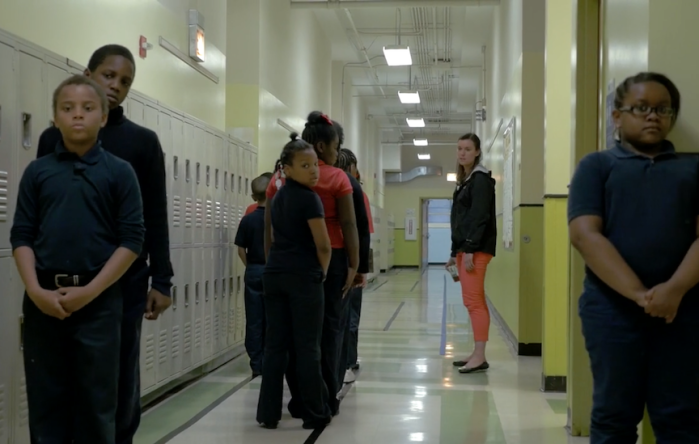
For instance, at a New Orleans charter school, students were punished for not standing straight, not sitting up straight, for putting their heads down, for closing their eyes for too long, for not tracking speakers correctly with their eyes! Between classes students had to walk single file between the wall and a line marked with orange tape. And they had strict dress codes.
Second, she is assuming standardized testing provide accurate assessments of knowledge and skills. This is far from an accepted premise. These tests have repeatedly been shown to be both economically and racially biased. Cohodes is assuming that since the students scoring better on the assessments are still poor and predominantly black, what they’re being tested on is fair.
However, I cannot imagine many parents would jump at the chance to have their children treated like prison inmates for the chance of higher test scores.
It is somewhat staggering that a grown adult could look exclusively at the data and come to such a conclusion without considering what it means for flesh-and-blood students.
This is what happens when you let economists set public policy.
It is essential that we include parents, teachers, psychologist and even students in the processes. Otherwise, we’ll continue to get heartless number crunching offered as sincere solutions to our problems.
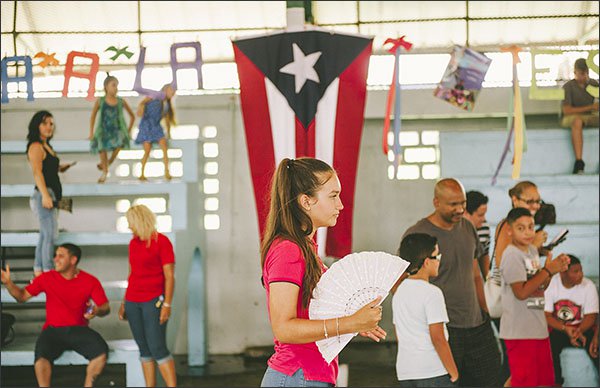
Roughly 25,000 students are leaving with that number expected to swell to 54,000 in four years. And that’s after an 11-year recession already sent 78,000 students seeking refuge elsewhere.
So what do you do to stop the flow of refugees fleeing the island? What do you do to fix your storm damaged schools? What do you do to ensure all your precious children are safe and have the opportunity to learn?
And it means fewer choices for children who will have to apply at schools all over the island and hope one accepts them. Unlike public schools, charter and voucher schools pick and choose whom to enroll.
The results have been an abysmal academic record, the loss of black teachers, black neighborhoods, cultural heritage and in its place support for a status quo that just doesn’t care to provide the proper resources to students of color.
If the Governor and his wealthy backers have their way, Puerto Rico will be yet another ghettoized colony gobbled up by industry.
However, the people aren’t going to let this happen without a fight.
Mercedes Martinez, President of the Federacion de Maestros of Puerto Rico, an island teacher’s union, released the following statement:
“Dear comrades in the diaspora, now more than ever we need your unconditional solidarity.
Governor Roselló just announced his plan to shut down 307 schools, implement charter schools and vouchers. Disaster capitalism at its best. Added to the announcement of the privatization of PREPA. [Puerto Rico Electric Power Authority]
The way to victory is already paved, organized and militant resistance, concrete proposals to improve the public goods that we have, unity and organization. Be our voice in the states and let the world know that corporate reformers want to make PR the next New Orleans as they did after Katrina.
The hurricane has been the perfect storm and excuse for them to advance their plans. Today the so called “educational reform” will be sent to the legislature.
We will give the hardest fight of our lives, and we will triumph. Send letters and videos of support with our struggle. Teachers United, will never be defeated!
Lucha sí”
I don’t know about you, but I stand with these brave teachers, parents and their students.
I may live in Pennsylvania, my skin may be white, but I do not support the theft of Puerto Rico’s schools.
They deserve the choice to guide their own destinies.
Teachers’ opposition to the move comes even though the Governor is proposing a $1,500 raise for all educators. Martinez says it could come to a general strike.
Their cause has hope on its side – especially in blocking the proposed school vouchers.
The Governor’s voucher proposal wouldn’t go into effect until the 2019-20 school year. However, the Puerto Rico Supreme Court struck down a similar program in 1994 when the current governor’s father, Pedro Rossello – himself a former governor – tried to push it through. The court ruled the island’s constitution forbids public money being used to fund privately run schools.
From this day forward, let us always remember what they did to New Orleans. Let us remember what they are trying to do to Puerto Rico.
Corporate school reform is not about making better schools. If it was, you would see plans like this being proposed in Beverly Hills and rich white neighborhoods across the country.
Even states that historically boasted the most growth are falling behind. Of charter powerhouses Texas, Florida, Ohio and California – only Texas has shown a significant upward trend.
So what happened?
How did the hippest new thing to hit education since the chalk board suddenly hit such a wall? After all, it wasn’t so long ago that every celebrity from Magic Johnson to Andre Agassi to Deion Sanders to Sean “Puffy” Combs to Pitt Bull had their own charter school. Even Oprah Winfrey, the queen of multimedia, donated millions to charter networks in Louisiana, California, Pennsylvania, Colorado, Texas and her home state of Illinois.
How could something with so much high profile support be running out of gas?
The charter school funded think tank (read: propaganda network) released a report boiling the issue down to three factors: real estate costs, a teacher shortage and political backlash.
Real estate costs? Yes, few public schools want to offer you public property to put your privately run school that will inevitably gobble up a good portion of its funding and turn a portion of that into profit for private investors.
Teacher shortage? Yes, when you pay your educators the least, don’t allow your employees to unionize, and demand high hours without remuneration, you tend to find it harder than most educational institutions to find people willing to work for you.
Political backlash? DING! DING! DING!
Of course, most people who aren’t paid by the charter school industry – as those working for CRPE are – would simply call this a charter school backlash – not political, at all.
This isn’t one political party seeking advantage over another. It’s concerned citizens from both sides of the aisle worried about the practices of the charter school industry.
The general public is starting to understand exactly what charter schools are and why they are a bad idea for children and society.
-They cherry pick which students to enroll and how long to keep them enrolled – they only let in the easiest to teach and give the boot to any that are struggling before standardized testing time.
-And they very often close unexpectedly and/or are the site of monetary scandals where unscrupulous charter school operators take the money and run.
Moreover, it’s no accident that much of the criticism of charter schools comes from people of color. About one quarter of all charter school students are black, whereas black students make up only 15 percent of enrollment at traditional public schools.
To put that in perspective, approximately 837,000 black students were enrolled at charter schools during the 2016-17 school year. Yet civil rights organizations are concerned that this over-representation is having negative consequences on students of color.
Seventy percent of black charter school students have few white classmates, according to a study by the Civil Rights Project at UCLA.
But some charters are even worse. More than 1,000 of the nation’s 6,747 charter schools had student bodies made up of at least 99% minority students, according to an Associated Press analysis from three years ago. And it’s getting worse!
Researchers found the situation is even more dire for minorities. Black students are four times more likely to be suspended than white students, and students with disabilities are twice as likely to be suspended as non-disabled students.
With all these problems dogging their heels, it’s no wonder that the charter school juggernaut is starting to lose momentum.
Instead of concentrating solely on why these schools are losing popularity, we should also ask what set them shooting off into the stratosphere in the first place.
After all, no one was really crying out for private schools run with public money.
No one, that is, except big business and greedy investors looking for a quick buck.
Since the Clinton administration, charter school investments get automatic tax credits that allow investors to double their money in as little as 7 years. Lobbying at the state and federal level by charter schools and their investors and contractors have enabled a monetary scam to enrich private industry at public expense.
Put simply, charters are not subject to the same instructional, operational, fiscal, accounting or conflict of interest rules as traditional public schools. Therefore, in most states it’s perfectly legal for a charter school operator to give his brother the instructional contract, his sister the maintenance contract and his uncle the textbook contract. He can replace the teachers with computer programs and apps, while his own privately held company rents and leases the school building at a hefty markup – all with public money.
What we’re seeing in terms of a backlash is just a more common realization of the motives behind charter schools echoed in the negative consequences these schools leave behind.
The neoliberal agenda is as fervently being pushed by the right wing as the left – more so.
This slowdown may signal that people have gone beyond politics.
We don’t care what the left and the right wish to sell us. We’re not willing to buy the charter school boloney anymore. If our policymakers want to continue getting our votes, they may need to give in to what the people actually want and stop trying to lead us over the cliff and feed us to the sharks.
–THE RIGHT OF ENROLLMENT, so school operators get to choose whether your child gets to attend, unlike public schools which have to accept your child no matter what – so long as you live in the district.
–QUALITY TEACHERS, because most charter and voucher schools aren’t required to hire educators with 4-year degrees, and since they don’t pay as well as public schools and often refuse to let their teachers unionize, they attract less experienced and distinguished educators.
You get elected school boards, open documents, open meetings, the right to self-government, the right of enrollment, quality services, quality teachers, diverse classmates, common sense discipline policies, an unbiased secular education, free time and money! That’s right! You actually get all that and more money in your pocket!
This is one of the hardest articles I’ve ever written.
I’ve started it several times. And each time I deleted it.
After all, what right do I have to talk about sexual harassment?
I wasn’t raped.
I wasn’t drugged, beaten or blackmailed.
No one physically abused me in any way that did lasting physical harm.
But I was misused.
I was harassed.
And I shouldn’t have been.
I was made a victim, and my victimizer was a woman.
That, alone, shames me to my core.
I’m a grown man.
We’re not supposed to care about things like this.
We’re supposed to be unfeeling, undisturbed, stoic cowboys with our eyes ever fixed on the horizon.
If anything, I should be the one accused, not the accuser.
Some would deny that you even CAN sexually harass a man.
They’d look at the cultural ideal of manhood as an emotionally stunted beast of burden, and say men are too callous and shallow to be susceptible to this sort of pain. After all, men are always ready for the next sexual encounter. Or we should be, because that’s what it means to be a man.
But they’re wrong.
Men have feelings, too. We hurt. We cry. And we can be scarred by unwelcome advances.
So what happened?
It was almost thirty years ago.
I was just a kid in middle or high school – 8th or 9th grade.
It was in pottery class.
I’ve always loved the arts. I used to draw every spare second. My notebooks were covered with doodles and sketches. Cartoon dinosaurs and skulls. Sometimes an alien or dragon.
And I loved working with clay, too.
For years my mother had a vase I made in that pottery class. It was fat on the bottom with a slender neck. Purple glaze on the outside with a blue interior. Mom displayed it proudly in her dinning room, sometimes with a few flowers inside, until one day it accidentally fell from a shelf and shattered.
I might have been working on that same vase when it happened. I really can’t remember.
I think it was a pinch pot.
I was standing at a table I shared with three or four other students, wrapping tubes of hand rolled clay around and around into the shape of a container, when someone came up behind me, grabbed my butt and squeezed.
I jumped in surprise, and said “Ohh!” or something.
Then I heard, “Hey, sweet cheeks!”
And laughter. All coming from the other side of the room.
I turned my head to see who it had been.
It was a girl I hardly knew though she had been in my classes since first grade.
Let’s call her Nancy.
She was a chunky but not unattractive girl from the other side of the room.
She walked back to her friends, both boys and girls, at her table, and they were all losing it over what had happened.
I blushed and turned back to my work, feeling like the clay my fingers molded.
I couldn’t even process what had happened.
Why had Nancy just walked over to me and pinched my butt?
It wasn’t even a playful pinch. It wasn’t grabbing someone with the palm of your hand and giving a squeeze. She had clawed into my flesh, secured a good hunk and pulled.
It was angry and mean.
I didn’t understand. What had I ever done to her?
I barely knew her. I hadn’t said more than ten words to her in eight years.
“You like that?” she asked from across the room.
I just kept working on my pot, looking at it as if it were the only thing left in the universe.
The others at my table were giggling, too.
I remember it like a scene in slow motion. Me rolling out and unwinding the clay. Everyone else laughing. Nancy smirking.
And then she came back and did it again!
I jumped and squealed.
But I did nothing. I said nothing.
She pinched me at least three or four more times. Maybe more.
And she said something each time.
And like it was on a script, always the laughter and guffaws.
Eventually I think I started to quietly cry.
That’s when it stopped mostly.
The others at my table were as silent as I was. When they saw my reaction, I think they got embarrassed.
We were all working with incredible concentration trying not to acknowledge what was happening.
I made sure not to turn and look behind me. But I could hear the snickers.
Where was the teacher?
The room had a strange L-shape. At the foot of the L was a kiln where she was diligently firing last week’s pottery. From where she was, she probably couldn’t see the rest of us working at our tables.
I don’t think she saw anything. She never said anything if she did.
When she returned to our side of the art room, she may have asked if I was okay. I’m not sure. I probably just shrugged it off. Maybe asked to go to the bathroom.
Why did this bother me so much?
Because I wasn’t asking for anyone to come over and touch me like that.
I just wanted to make my stupid pot. I just wanted to be left alone.
I didn’t want to be treated like anyone’s joke. I didn’t want my physicality to be the cause of anyone’s laughter.
It’s not that Nancy was a pariah or a terrible person or anything. If things had been different, I might have responded differently.
But when you’re a guy in high school, you aren’t allowed to be upset when a girl comes and pinches you.
You’re supposed to respond a certain way.
I couldn’t ask her to stop. I’m supposed to love it.
Even if it’s a joke.
Even if it’s a way to denigrate me in front of the whole class. Even if it’s a way to proclaim me the most undesirable boy in the whole room.
It felt like someone pointing at a banana peel in the trash and mockingly saying, “Yum! Yum!”
But I was the garbage.
It certainly made me feel that way.
I’m not sure why this has bothered me for so long.
Maybe it’s the feeling of powerlessness – that there was nothing I could do. Maybe it was a feeling that I should be reacting differently. I should be more assertive either telling her to leave me alone or maybe actually liking the physical contact.
I’m not sure how to explain it.
I was made to feel inferior and degraded.
Perhaps that’s why I’ve remained silent about it all these years. The only solution had seemed to be to forget about it and move on.
Yet doing so leaves a cold lump in your chest. Oh, it won’t kill you. But it’s always there. You just learn to live with it.
I suppose in writing about it, I’m trying to rid myself of that lump.
I don’t know if it will work. But I’m tired of carrying it around with me anymore.
We’re living in a remarkable moment. Women everywhere feel empowered to share their stories of abuse at the hands of men. Shouldn’t I feel empowered to share my story of abuse at the hands of a woman?
But there does seem to be a disconnect here. A disanalogy.
No matter who you are, everyone has been the victim at one point or another.
Whether you’re male or female, rich or poor, black or white – everyone has been on the losing side.
However, some people use that truth as an excuse to pretend that all groups have been equally targeted. They use it as a way to justify the marginalization and minimalization of women and people of color, for instance, groups that have been most often earmarked for abuse.
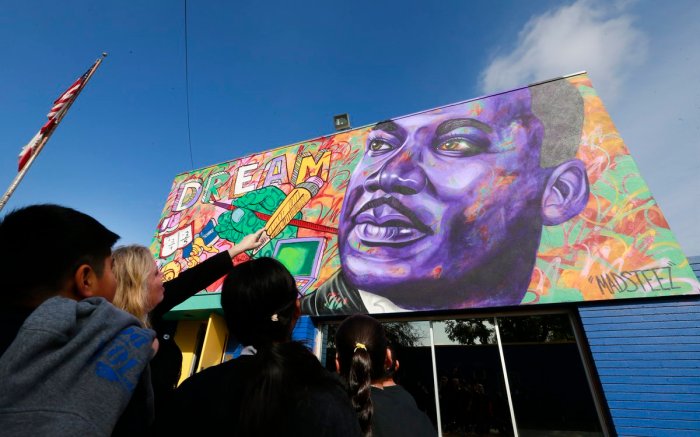
When we think of Dr. Martin Luther King, Jr., we usually think of the towering figure of the Civil Rights Movement who gave the “I have a dream” speech during the March on Washington in 1963.
However, as a teacher, I find myself turning to something he wrote in 1947 when he was just an 18-year-old student at Morehouse College.
While finishing his undergraduate studies in sociology, he published an essay in the student paper called “The Purpose of Education.”
Two sections immediately jump off the page. The first is this:
“We must remember that intelligence is not enough. Intelligence plus character–that is the goal of true education. The complete education gives one not only power of concentration, but worthy objectives upon which to concentrate. The broad education will, therefore, transmit to one not only the accumulated knowledge of the race but also the accumulated experience of social living.”
So for King it wasn’t enough for schools to teach facts. It wasn’t enough to teach skills, math, writing, reading, history and science. The schools are also responsible for teaching children character – how to be good people, how to get along with each other.
When King wrote, there were basically two kinds of school – public and private. Today there is a whole spectrum of public and private each with its own degree of self-governance, fiscal accountability and academic freedom.
So which schools today are best equipped to meet King’s ideal?
Private schools are by their very nature exclusionary. They attract and accept only certain students. These may be those with the highest academics, parental legacies, religious beliefs, or – most often – families that can afford the high tuition. As such, their student bodies are mostly white and affluent.
That is not King’s ideal. That is not the best environment to form character, the best environment in which to learn about people who are different than you and to develop mutual understanding.
Charter schools model themselves on private schools so they are likewise discriminatory. The businesses who run these institutions – often for a profit – don’t have to enroll whoever applies. Even though they are fully funded by public tax dollars, they can choose who to let in and who to turn away. Often this is done behind the cloak of a lottery, but with no transparency and no one checking to ensure it is done fairly, there is no reason to believe operators are doing anything but selecting the easiest (read: cheapest) students to educate.
Homeschooling is hard to generalize. There is such a wide variety of experiences that can be described under this moniker. However, they often include this feature – children are taught at home by their parent or parents. They may or may not interact with their academic peers and the degree to which they meet and understand different cultures is variable to say the least. They may meet King’s ideal, but frankly the majority of them probably do not.
So we’re left with traditional public schools. Do they instill “intelligence plus character”?
Answer: it depends.
There are many public schools where children of different races, nationalities, religions, and creeds meet, interact and learn together side-by-side.
Students wearing hajibs learn next to those wearing yarmulkes. Students with black skin and white skin partner with each other to complete class projects. Students with parents who emigrated to this country as refugees become friends with those whose parents can trace their ancestors back to the Revolutionary War.
We could integrate all public schools. We could never integrate our charter, voucher and private schools. That goes against their essential mission. They are schools made to discriminate. Public schools are meant to be all inclusive. Every one could meet King’s ideal, if we only cared enough to do it.
Which brings me to the second section of King’s early essay that pops off the page:
“The function of education, therefore, is to teach one to think intensively and to think critically. But education which stops with efficiency may prove the greatest menace to society. The most dangerous criminal may be the man gifted with reason, but with no morals.”
Seventy one years ago, King was warning us about the situation we suffer today.
When we allow academics to be distinct from character and understanding, we put ourselves at the mercy of leaders with “reason, but with no morals.”
Racism and privilege become the defining characteristics of a class without character, in King’s sense.
If we want to reclaim what it means to be an American, if we want to redefine ourselves as those who celebrate difference and defend civil rights, that begins with understanding the purpose of education.
It demands we defend public schools against privatization. And it demands that we transform our public schools into the integrated, equitable institutions we dreamed they could all be.
It’s funny. When you close schools serving minority students, they tend to move away.
That’s what’s happening in Chicago.
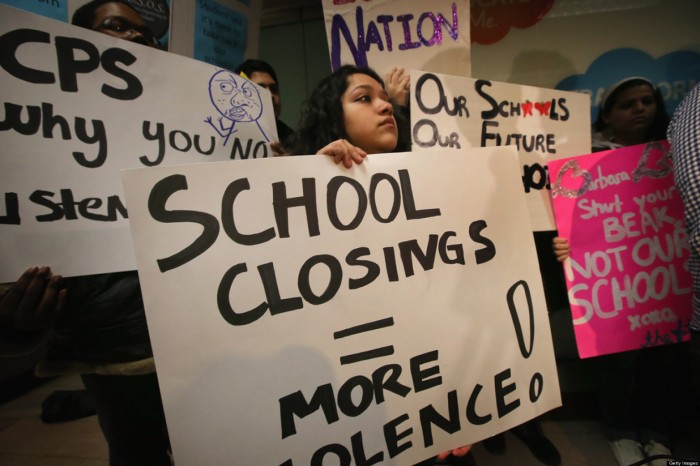
In the last seven years, Mayor Rahm Emanuel closed 49 schools serving mostly students of color. And from 2015 to 2016, alone, the city lost 12,000 black residents.
Huh.
Who would have ever thought that cutting funding to services for minorities might make them get up and leave?
But God forbid you suggest this is intentional!
These are just disparate facts. There is no conceivable causal link between making life intolerable for people and their leaving.
When has that ever happened before?
The Great Migration (1919-1950) when hundreds of thousands of blacks moved from the deep south to the shores of Lake Michigan looking for better opportunities?
Well, sure, but when else has that ever happened?
You can’t connect one dot to another.
That would just be rude.
Yet that’s just what Chris Kennedy, a candidate vying to run against Illinois Governor Bruce Rauner on the Democratic ticket, did this week.
“My belief is they’re being pushed out. This is involuntary. That we’re cutting off funding for schools, cutting off funding for police, allowing people to be forced to live in food deserts, closing hospitals, closing access to mental health facilities. What choice do people have but to move, to leave?” Kennedy said at a press conference.
“And I think that’s part of a strategic gentrification plan being implemented by the city of Chicago to push people of color out of the city. The city is becoming smaller and as it becomes smaller, it’s become whiter.”
The establishment immediately pushed back against him.
The Chicago Sun-Times couldn’t find any fault with Kennedy’s facts, but they called his interpretation “irresponsible.”
Emanuel’s office likewise issued a press release likening Kennedy’s claims with those of Republicans like Rauner and President Donald Trump, even though both of those individuals would be more likely to champion a plan to kick blacks out of Chicago than criticize it.
Kennedy’s remarks simply echo what black Chicagoans have been saying for years.
“To deny us the right to improve our schools as community institutions is a violation of our human rights. To destabilize schools in our community is a violation of our human rights. To have communities with no neighborhood schools is a violation of our human rights. . . . We are America’s mirror. Do you have the courage to accept what you see?”
Kennedy really isn’t saying anything different. He’s just echoing the concerns of the community he wants to represent.
“I don’t know what you can say when the strategic plan for Chicago Public Schools suggest that the entire community of Englewood can go an entire year without access to a high school,” Kennedy said this week.
“What are you saying to the people there? No one’s going to move there who’s got a high school kid. And anybody with a high school kid has to think about what they’re going to do. It’s just a device to empty out the community.”
The problem is not limited to Chicago. It’s emblematic of public school policy nationwide.
From 2003-2012, in New York City, 117 schools were closed. Sixty-three percent of the students affected were black.
In 2008, 23 schools were closed in Washington, DC. Ninety-nine percent of the students affected were black, Latino or Hispanic.
Since 2005, in Detroit, 130 schools have been closed. Ninety-three percent of the students affected were children of color.
And one and on.
We intentionally segregate students based on race and class, then allocate funds accordingly. Richer whiter students get all the resources they need. Poorer blacker students get crumbling schools, narrowed curriculum until their schools are shuttered and they’re forced to either move away or put up with fly by night charter schools.
Look at what happened in New Orleans.
After Hurricane Katrina in 2005, the state took over 107 of the city’s then-128 public schools, removing them from local control of the residents. The majority of these schools were turned into charters, closed or simply never reopened – a move affecting 90 percent of black students and only 1 percent of white students.
They call it school choice, but parents don’t have choice when 80 percent attend charter schools – some of which run a lottery enrollment process, she said. As a result, parents are forced to apply to multiple charter schools to ensure their children have somewhere to go to learn.
Your choice is between charter schools – 79 percent of which are rated “D” or “F” – and 15 state run public schools that are all rated “D” or “F,” she said.
“African-American students are more likely than their white counterparts to experience schools that are at risk of being closed down, phased-out, turned around or co-located,” Harper-Royal said. “To guarantee me a seat in a failing school system is not ‘choice.’ It’s racist is what it is.”
This is the reality for poor and minority students across the country.
These are all choices that result in winners and losers.
It’s time we recognized that. If we really want to champion civil rights and equity for all, we need to stop promoting racism as school policy and pretending to be surprised at the results.
In this article, I’m going to try to explain in the most simple terms I know the reality of segregation in our schools, how it got there and the various forms it takes.
I do this not because I am against public education. On the contrary, I am a public school teacher and consider myself a champion of what our system strives to be but has never yet realized. I do this because until we recognize what we are doing and what many in power are working hard to ensure we will continue doing and in fact exacerbate doing, we will never be able to rid ourselves of a racist, classist disease we are inflicting on ourselves and on our posterity.
America, the Segregated
It’s never been one monolithic program. It’s always been several co-existing parallel social structures functioning together in tandem that create the society in which we live.
I’m reminded of possibly the best description of American segregation on record, the words of the late great African American author James Baldwin who said the following on the Dick Cavett Show in 1968:
“I don’t know what most white people in this country feel. But I can only conclude what they feel from the state of their institutions. I don’t know if white Christians hate Negroes or not, but I know we have a Christian church that is white and a Christian church that is black. I know, as Malcolm X once put it, the most segregated hour in American life is high noon on Sunday.
That says a great deal for me about a Christian nation. It means I can’t afford to trust most white Christians, and I certainly cannot trust the Christian church.
“I don’t know whether the labor unions and their bosses really hate me — that doesn’t matter — but I know I’m not in their union. I don’t know whether the real estate lobby has anything against black people, but I know the real estate lobby is keeping me in the ghetto. I don’t know if the board of education hates black people, but I know the textbooks they give my children to read and the schools we have to go to.
“Now this is the evidence. You want me to make an act of faith, risking myself, my wife, my woman, my sister, my children on some idealism which you assure me exists in America, which I have never seen.”
As Baldwin states, there are many different ways to keep black people segregated. There are many different flavors of the same dish, many different strains of the same disease.
We can say we’re against it, but what we say doesn’t matter unless it is tied to action.
You can say you’re in favor of equity between black and white people all day long, but if the policies you support don’t accomplish these things, you might as well wear a white hood and burn a cross on a black person’s lawn. It would at least be more honest.
Segregated Schools
In terms of public education, which is the area I know most about and am most concerned with here, our schools are indeed set up to be segregated.
If there is one unstated axiom of our American Public School System it is this: the worst thing in the world would be black and white children learning together side-by-side.
They point to inequalities they, themselves, helped create and use them to push for a system that would create even worse inequality. They point to the segregation that they, themselves, helped install and use it as an excuse to push even more segregation.
And they do so by controlling the media and the narrative. They call themselves reformers when they’re really vandals and obstructionists looking to subvert the best in our system in order to maximize the worst.
School Segregation Today
Sure we don’t have very many all white or all black schools like we did before Brown v. Board. Instead we have schools that are just predominantly one race or another.
ALL kids are not divided by race. Just MOST of them.
White people and black people tend to live in different neighborhoods. Some of this is a choice. After a history of white oppression and racial strife, people on both sides of the divide would rather live among those with whom they identify.
Black people don’t want to deal with the possibility of further deprivations. White people fear retaliation.
However, white people generally enjoy a higher socio-economic status than black people, so there is some push back from black folks who can afford to live in whiter neighborhoods and thus enjoy the benefits of integration – bigger homes, less crowding, less crime, access to more green spaces, etc. But even when there is a desire, moving to a white neighborhood can be almost impossible.
State and federal laws, local ordinances, banking policies and persistent prejudice stand in the way.
In short, red lining still exists.
Real estate agents and landlords still divide up communities based on whom they’re willing to sell or rent to.
And this is just how white people want it.
They’re socialized to fear and despise blackness and to cherish a certain level of white privilege for themselves and their families.
And if we live apart, it follows that we learn apart.
The system is set up to make this easy. Yet it is not uncomplicated. There is more than one way to sort and separate children along racial and class lines in a school system.
There are several ways to accomplish school segregation. It comes in multiple varieties, a diversity of flavors, all of which achieve the same ends, just in different ways.
By my reckoning, there are at least three distinct paths to effectively segregate students. We shall look at each in turn:
Put the white neighborhoods in District A and the black ones in District B. It’s kind of like gerrymandering, but instead of hording political power for partisan lawmakers, you’re putting your finger on the scale to enable academic inequality.
However, sometimes you can’t do that. Sometimes you don’t have the power to determine the makeup for entire districts. Instead, you can do almost the same thing for schools within a single district.
That means the whiter districts get higher paid and more experienced teachers. It means they have broader curriculum, more extracurricular activities, a more robust library, more well-trained nursing staff, more advanced placement courses, etc.
Fewer funds mean fewer resources, fewer opportunities, more challenges to achieve at the same level that white students take for granted. A budget is often the strongest support for white supremacy in a given community or society as a whole. In fact, if you want to know how racist your community is, read its school budget. You want accountability? Start there.
The same holds even when segregation is instituted not at the district level but at the level of the school building.
It may sound ridiculous but this is exactly what happens much of the time. You have gorgeous new buildings with first class facilities in the suburban areas and run down crumbling facilities in the urban ones – even if the two are only separated geographically by a few miles.
Like any parasite, charter and voucher schools only survive in the proper environment. It usually looks like this.
Sometimes no matter how you draw the district lines or how you appropriate the buildings, you end up with a black majority and a white minority. That’s a situation white parents find simply intolerable.
White children must be kept separate and given all the best opportunities even if that means taking away the same for black children.
Once again, this creates the opportunity for a resource gap. The charter and voucher schools suck away needed funds from the public schools and then are subsidized even further by white parents.
The quality of education provided at these institutions is sometimes better – it’s often worse. But that’s beside the point. It’s not about quality. It’s about kind. It’s about keeping the white kids separate and privileged. It’s about saving them from the taint of black culture and too close of an association with black people.
Second, the situation can work in reverse. Instead of dividing the whites from the blacks, it divides the blacks from the whites.
This happens most often in districts where the divide is closer to equal – let’s say 60% one race and 40% another. Charter and voucher schools often end up gobbling up the minority students and leaving the white ones in the public school. So instead of white privatized and black public schools, you get the opposite.
And make no mistake – this is a precarious position for minority students to be in. Well meaning black parents looking to escape an underfunded public school system jump to an even more underfunded privatized system that is just waiting to prey on their children.
Unlike public schools, charter and voucher institutions are allowed to pocket some of their funding as profit. That means they can reduce services and spending on children anytime they like and to any degree. Moreover, as businesses, their motives are not student centered but economically driven. They cherry pick only the best and brightest students because they cost less to educate. They often enact zero tolerance discipline policies and run themselves more like prisons than schools. And at any time unscrupulous administrators who are under much less scrutiny than those at public schools can more easily steal student funding, close the school and run, leaving children with no where to turn but the public school they fled from in the first place and weakened by letting privatized schools gobble up the money.
The result is a public school system unnaturally bleached of color and a privatized system where minority parents are tricked into putting their children at the mercy of big business.
3) Tracking
But that’s not all. There is still another way to racially segregate children. Instead of putting them in different districts or different schools, you can just ensure they’ll be in different classes in the same school.
However, it most often results in further stratifying students socially, economically and racially.
Here’s how it works.
Often times when you have a large enough black minority in your school or district, the white majority does things to further horde resources even within an individual school building or academic department.
In such cases, the majority of the white population is miraculously given a “gifted” designation and enrolled in the advanced placement classes while the black children are left in the academic or remedial track.
It enables bleaching the advanced courses and melanin-izing the others. This means administration can justify giving more resources to white students than blacks – more field trips, more speakers, more STEAM programs, more extracurriculars, etc.
And if a white parent complains to the principal that her child has not been included in the gifted program, if her child has even a modicum of ability in the given subject, more often than not that white child is advanced forward to the preferential class.
CONCLUSIONS
Segregation is a deep problem in our public school system. But it cannot be solved by privatization.
In fact, privatization exacerbates it.
Nor is public education, itself, a panacea. Like any democratic practice, it requires participation and the economic and social mobility to be able to participate as equals.
Schools are the product of the societies that create them. An inequitable society will create inequitable schools.
Segregation has haunted us since before the foundation of our nation.
They don’t want their children to be educated among black students – maybe SOME black students, maybe the best of the best black students, but certainly not the average run of the mill brown-skinned child.
This has to stop.
There are plenty of benefits even for white students in an integrated education. It provides them a more accurate world-view and helps them become empathetic and prize difference.







 gadflyonthewallblog