My Students Are Scared of Donald Trump


trump-800x430


“Are they gonna’ make us all leave?”


That was the question one of my 8th grade students asked today.


He sits in the front row – quiet, reserved, eyes usually pointed sullenly at his desk.


He doesn’t ask questions. Not publicly.


If he has something to say, he’ll ask me before or after class.


But there he was with his hand in the air and his eyes firmly fixed on mine.


“Tyree, are you afraid someone’s going to make you leave your country?”


He nodded and I saw several other black faces nodding throughout the room.


“Are you afraid someone’s going to send you… where… to Africa?”


“Yeah,” Tyree said for the group.


I teach Language Arts at an under-resourced school in Western Pennsylvania. I’m white and most of my students are black. Almost all of them are from poor families. Very few are Hispanic or Muslim.


We had been discussing the Holocaust in preparation to read “The Diary of Anne Frank.”


I often try to make connections with current events during this time, but today I didn’t have to do any connecting. My students did it for me.


“I don’t like Donald Trump,” Jacklyn said. “He’s racist.”


And Tyree spoke again – impatiently, nervously – “Who are you voting for, Mr. Singer?”


I paused. “I don’t think it would be appropriate for me to say,” I responded, “but I will say this…”


And I looked all of them in the face.


“Not. Donald. Trump.”


You could feel the sigh go through them like a physical thing.


They are actually scared. And something like it happened in every class today.


I mentioned Adolph Hitler and they came back with Donald Trump.


History had come alive. It was a boogeyman haunting the shadows. And the only thing that dispels shadows is light.


I had to reassure them. It wasn’t in my lesson plan. I had done no prior research for it, but this was the direction they were pulling me. I had had no intention of talking about Donald Trump, but we needed to go there.


We had a discussion comparing and contrasting the two men. They both wrote books, but “Mein Kampf” is very different than “The Art of the Deal.” Both were captivating speakers who promote violence, but Trump speaks at a third grade level. Both said hateful things against minorities, but only Hitler advocated eradicating people from the face of the Earth. Both proposed minorities be monitored by the government but Hitler focused mostly on Jews while Trump focuses mostly on Muslims.


The conversation went on.


In over a decade in the classroom, I’ve never had students so upset about politics. Sure they get angry when unarmed people of color are shot by the police. Sure they feel the pull of Baltimore and Ferguson. But never have they cared about who’s running for President. They won’t be able to vote, themselves, for five or more years.


But they wanted to talk public affairs. What was I to do? The purpose of history is to learn from it. We look to the past so we won’t repeat it. Yet that was a lesson I didn’t need to teach. They already knew it. That’s why they were bringing this up.


We talked political parties. We discussed how the Nazis were a political organization like the Democrats and the Republicans are today. We talked about how Hitler had been a house painter and Donald Trump was a reality TV star who inherited most of his money.


And we talked about racism.


Why people hate others. The definition of prejudice – how racism is one kind of prejudice but there are many others – hating people because of religion, because they’re disabled, because of their sexuality.


Jermaine said he was uncomfortable going to the bathroom in public in case someone gay walked in.


I asked if he thought a gay man would try to make a move on him while he was on the toilet. I asked if he’d ever make a move on someone while that person was on the toilet.


The class laughed.


Someone mentioned Chicago and how protesters had forced Trump to cancel his rally. Yes. An 8th grade student knew about that.


And then someone mentioned Bernie Sanders. Yes. They brought him up, too.


Some of my kids liked him because they said he wasn’t racist. Others thought he would legalize marijuana.


So I asked if anyone knew about the other candidates. And that’s where their news-savvy faded. Someone said something strange about Hillary Clinton that they heard she was against soil. I still don’t know what he meant.


Another child said he heard Tom Cruise was running. “TED Cruz,” I corrected. None had heard of John Kasich.


I explained how a primary election works. We talked about how Hitler was elected. We talked about the Reichstag vs. Congress.


“Didn’t we have concentration camps here in America?” someone asked. So we talked about Japanese internment camps and compared those to what you’d find in Europe.


At some point I lost track of all we talked about. But when the bell rang, the tension was gone.


They got up calmly and went to the door. Many of them made a point to cheerfully say goodbye or dap me up on their way. You always know middle school students love you when they do that.


Jason stopped by my desk on the way out and said, “My dad’s going to vote for Donald Trump.” He was blushing.


“He may have good reasons,” I said. “Maybe you should ask him about it.” He smiled and walked out.


Only one student was left.


“You, okay, Tyree?” I asked.


He was grinning. “You’d be a good history teacher, Mr. Singer,” he said.


I shook my head. “And you’re a good history student.”


I clapped him on the back, before writing him a pass to his next class.


My plans sat murdered on my desk.


But I had taught a much better lesson.


Nothing happens without cause.


We can understand it if we try.


Understanding is the key to prevention.


And we’re in this together.


NOTE: All student names have been changed to protect their anonymity.

.

 

Why is It So Hard to Vote in America? Voter Suppression is Desperation Politics


635942902228020220-Presidential-Primary-9


No one should have to stand in line an entire work day to vote.


But that’s what happened to people in yesterday’s Arizona primary election.


Lines stretched literally for miles. People actually ordered pizza to be delivered to them IN LINE!


Citizens were already getting in line when polls opened at 6 am, and hundreds were still in line when polls closed at 7 pm. The last ballot wasn’t cast until midnight – a new record for the Grand Canyon State!


What the fuck!


The most populous county in the state, Maricopa County, reduced polling locations from 200 during the last election to just 60 this year. That amounts to over 20,000 voters for every location.


The reason? They were trying to save money.


Let that sink in. When you run government like a business, services suffer. It means fewer resources for your schools. More lead in your water. And long as fuck lines to vote.


Oh. And if your skin happens to be black or brown, you get it even worse.


Hispanics and Latinos make up more than 40% of the population of Phoenix (30% state wide). Yet in these densely populated neighborhoods, there were few to no polling places open. I can’t imagine why!


And to top it all off, this “oversight” was used for political gain.


At roughly 8:30 pm, a little over an hour after polls closed, with less than one percent of precincts reporting, the Associated Press declared Hillary Clinton the winner of the Arizona primary.


In Democratic primaries delegates are awarded proportionally. It’s not winner take all. Delegates are awarded by the percent of the vote each candidate receives. If the race is really close delegates are split.


Prematurely declaring Hillary the winner while hundreds are still waiting to vote discourages Bernie Sanders supporters from staying in line and, thus, can reduce the number of delegates he receives.


These are not the actions of a robust Democracy. These are the actions of a de facto oligarchy trying desperately to crush any last remnants of majority rule.


In an age when you can buy anything you want on-line, why do we have to wait on line to vote? If the Internet is safe enough for global commerce and government, why is it too risky for casting a ballot?


It isn’t. The only reason this hasn’t happening is because it would dramatically increase voter turnout. It makes things too easy. While pundits decry “slacktivists” on Facebook and massive political participation on Twitter, they actively discourage bringing Democracy to those same forums.


It’s the same reason why election day isn’t a holiday. If people didn’t have to sneak voting in before or after work or during their lunch break, too many of us would be heard.


During every election cycle, there is an outcry against shady practices like what happened in Arizona, but we never do anything about them after the election cycle. We look at our antiquated primary and caucus system (especially on the Democratic side) and wonder how a modern country can actually function this way. We shake our heads at the Electoral College and maybe make some noise about changing it until the next President is sworn in. Then we all go silent.


Meanwhile, voter suppression efforts gain ground every year – even when the White House isn’t changing hands.


Despite low turnout and nearly non-existent cases of voter fraud, state legislatures are making it increasingly more difficult to vote.


A total of 36 states now have draconian Voter ID laws on the books – 33 of them are being enforced this cycle. During the 2015 legislative session, at least 113 bills that would restrict access to registration and voting were introduced or carried over in 33 states, according to the Brennan Center for Justice.


I know. I was part of the successful effort that defeated one of the most severe Voter ID laws in the country in my home state of Pennsylvania. State Rep. Mike Turzai proudly bragged in 2012 that our law would give the state to a Republican president. After protests and petitions from Philadelphia to Pittsburgh and everywhere in between, the state Supreme Court struck it down.


Meanwhile, other states are trying to enact the same kinds of laws that were ruled unconstitutional in the Keystone State. Wisconsin’s Voter ID law is almost identical to the defunct Pennsylvania legislation. Instead of being defeated, Republican lawmakers are trying to restrict the kinds of permissible identification and prohibit country and town governments from issuing any IDs to residents for free.


And last year, a year after enacting a voter ID law, Alabama shuttered 31 driver’s license offices — most of them in rural, impoverished, majority-black counties. Civil rights groups have filed suit, arguing that the change disproportionately affects racial minorities.


All across the country, early voting hours are being cut. Same day registration is being discontinued. Mountains of paperwork are being required to ensure proof of citizenship. And mysteriously people who have had no problems voting for decades are finding themselves given provisional ballots because of bookkeeping errors.


This has to stop.


Either we live in a country governed by majority rule or not.


Corporations and billionaires set national policy. If we want any chance in taking back our country, we must continue to have the right to vote.


Voting should be protected. It should be free and easy. It should be every citizens right.


Fight for it, America. Fight like your life depends on it.


Your freedoms certainly do.

The One Reason Bernie Sanders is the Best Mainstream Candidate for Parents and Teachers

gettyimages-511353506
It really all comes down to this.

You can talk all day about delegates and superdelegates.

You can talk about polls and electability.

You can talk about political experience, likeability, and authenticity. You can talk about political dynasties, union endorsements and campaign ads. You can talk about how many people show up at who’s rallies and who did what during the Civil Rights movement.

But when push comes to shove, there is one undeniable reason Bernie Sanders is the best mainstream 2016 Presidential candidate: He is running against privatization.

That’s it. Sold.

Everything else is nice. It adds to the appeal, but that one essential reason is enough to tip the scales – knock them over, really – to Bernie’s favor.

America’s parents and teachers are fighting a battle for our children’s schools. Lawmakers on both sides of the aisle stand against us. They are giving away the store. They are selling our system of public education – once the envy of the world – to for-profit corporations piece-by-piece.

They are stealing our schools out from under us, giving them to unscrupulous charter school operators who are stripping away services for our children so that they can pad their own bottom line.

And only Bernie truly stands against them.

It’s not about who said what. It doesn’t matter if he slipped up and said something ignorant about “public charter schools.” It doesn’t matter if Hillary Clinton, too, has occasionally criticized charters.

What matters is that standing against privatization is the backbone of the Sanders campaign. It is the bedrock which supports all of his other platforms. It is the foundation of his entire career in politics.

Might he screw it up once in office? Sure. He’s only human. But the odds are in our favor that he’ll actually improve things.

Hillary Clinton is an intelligent, capable politician. She is not the evil witch that the Right paints her to be. However, her campaign is largely supported by the same people who are privatizing our schools. They aren’t giving her all that money for her to act against their interests.

Might she make some compromises that forestall the worst effects of privatization? Sure. But odds are against us that she’ll be much help. The best scenario we can expect from another Clinton administration is a continuation of the status quo – a status quo that has dramatically increased school privatization.

There are worse things, but can’t we do better than vote for 4-8 more years of slow educational death?

If privatization is the first front of the war against public schools, standardization is the second. Schools are being forced to march in lockstep with Common Core Standards while giving a barrage of high stakes tests.

Both Sanders and Clinton have spotty records here. Sanders voted against the terrible No Child Left Behind legislation that spawned the beast, while Clinton helped nurture it. However, just this year Sanders joined Congressional Democrats trying to continue the era of test and punish through the Every Student Succeeds Act (ESSA) – some of which failed and some of which became part of the final law.

But it doesn’t really matter.

Standardization is the claw of the beast. Privatization is the beast, itself.

High stakes testing is the justification for privatization. Low test scores at under-resourced schools are the excuse for turning them into charters. If Sanders stops the move to charterize, he removes the reason to standardize. A dead lion will not use its claws.

Moreover, he’s had some genuinely good ideas about how best to improve our schools. It was Sanders who inserted into the ESSA a provision allowing some states to develop alternatives to standardized testing.

While most Democrats champion increasing funding to the neediest districts, they blame their inability to do so on the Republicans. Meanwhile, Sanders has proposed rewriting the way schools are funded in the first place. He is the only mainstream candidate with a plan to ensure every school in America receives equitable funding. His solution: federalize pubic school budgets similar to the Scandinavian model that has been proven effective. Is it a risk? Sure. Might it not work? Sure. But at least Bernie has new ideas that could potentially do more than just put Band-Aids on decades of wrongheaded school policies.

This is radically more than just fighting privatization – it is turning it around in its tracks. Only Bernie is actually suggesting a robust, equitable education for all children from preschool through college.

THAT’S why I support Bernie Sanders. THAT’S why I can’t wait to cast my vote in the Pennsylvania primary. THAT’S why so many teachers, parents and concerned citizens are feeling the Bern.

Come join the Revolution already in progress.

It is our fight to win or lose.

Hillary Clinton’s Campaign Manager is a Longtime Corporate Education Reformer

Clinton Gives Speech On American Global Leadership At Washington Conference


Meet John Podesta.


He’s a Washington lobbyist working hard to support high stakes tests, Common Core and charter schools.


He’s also Hillary Clinton’s campaign manager.


That’s right – the 2016 Democratic Presidential candidate who has been endorsed by the leaders of the national teachers unions has a corporate education reformer running her campaign.


Here are a few choice quotes from a speech Podesta gave in 2012 to the Foundation for Excellence in Education, a corporate education reform think tank established by Jeb Bush.


On Competition in Education:


“I think this emphasis that President Obama and Secretary Duncan have placed on competition – not just Race to the Top but competition throughout the system of education – is quite a good one, and I think the federal resources can be used to both support the development of new models and can force state experimentation in a way that’s quite healthy.”


On Using Student Test Scores to Evaluate teachers:


“In my view, [education] requires an accountability system that ensures students achieve at the highest levels… It requires a teacher and principal workforce that are rigorously trained, highly skilled and comprehensively evaluated.”


On Teachers Unions’ Resistance to Corporate Education Reform:


“I would argue that while there are clearly still strong rejectionist voices in unions, national union leadership has come a fair distance in recognizing that teacher effectiveness matters, and that evaluation systems need to include student outcomes… The majority of teachers have less than 10 years experience, and younger teachers know what counts. They’re more reform minded… So the question I think for reformers is how do you keep the pressure on unions to change, how do you keep the pressure on to put kids first without demonizing teachers in the process?”


On School Vouchers and charter schools:


“I think vouchers are an unneeded distraction. We should concentrate on PUBLIC school choice.”


On the Bipartisanship of Corporate Education Reform:


“In my opinion, the Obama administration has made its key priorities clear. The Republicans are pretty much in the same place…”


On the new frontier for Corporate Education Reform:


“Early childhood education is ripe for investment and reform.”


It’s all there on video. I strongly recommend you put aside 42 minutes and watch Podesta cozy up to Bush and Chester E. Finn, President of the ultra-reformy Thomas B. Fordham Institute.


Podesta is probably the single most effective person at destroying public education of which you’ve never heard.


You know Arne Duncan – the worst U. S. Secretary of Education of modern times. But did you know that Arne wasn’t President Barack Obama’s first choice?


Obama almost picked Linda Darling-Hammond – his education advisor during his 2007 campaign. Hammond is a former teacher turned Stanford education professor. She is also a vocal critic of Teach for America.


However, Podesta oversaw the transition committee that helped Obama make cabinet choices. Ultimately, the responsibility rests with the President, but it was Podesta who suggested and lobbied for Duncan, the know-nothing Chicago Schools CEO for U.S. Education Secretary. In fact, Duncan’s selection is an achievement of which Podesta is given gleeful responsibility by the privatization and standardization crowd.


And now guess whose ear he is whispering into?


Podesta has a long history with the Clintons. He was Bill’s Chief of Staff for three years during which time the President pushed hard for voluntary national standards – a school policy that has become known by another name – Common Core State Standards.


Podesta also founded the reform think tank Center for American Progress, a bastion for neoliberal thought. The organization routinely hires the crème de la crème of corporate education reformers who then push for test and punish policies in the media and on Capital Hill.


Podesta has already helped push Hillary closer to the dark side.


Remember when she shocked the neoliberal establishment by suggesting that some charter schools game the system by refusing to accept the most challenging students? (Which, by the way, is 100% factual.)


This really turned off some super-wealthy donors. According to the Wall Street Journal, after hearing the comment, one of Clinton’s longtime supporters, Eli Broad, turned off the money faucet.


Broad allegedly refused requests for contributions to a Clinton-friendly super PAC until Podesta personally assured him Hillary supports charter schools.


Also running interference on this issue was Clinton’s education adviser Ann O’Leary.


She wrote an op-ed calming charter fans because Hillary does, in fact, support charter schools – if they’re equitable and accountable.


Unfortunately, O’Leary has a strong corporate education reform streak, herself.


While an aide to Clinton in the Senate in 2001, O’Leary pushed Hillary to support No Child Left Behind (NCLB).


This was the bill that changed the federal role in education from ensuring equity to enacting an endless series of high stakes tests and expanded school privatization more than ever before. By it’s own measures of success, it was a terrible failure.


But O’Leary sees it differently.


“It was a really important moment,” O’Leary says. “When you look back at what happened, this was serious, bipartisan, constructive work. We were committed to high standards and helping states get there.”


O’Leary has somewhat stepped back her support of this bill. However, she blames the problems on implementation and not on the basic idea of high stakes testing.


She takes the same tack with Common Core. Implementation is the problem, not the policy.


And THIS is the woman advising Clinton on education!


By the way, she served with Podesta on the same Obama-Biden transition team that helped create our current disastrous U.S. Department of Education, though her focus was early childhood.


If Hillary Clinton really wants to forge a new path for U. S. schools, it’s surprising she’s surrounding herself with the same people responsible for the status quo.


Funded by wealthy privatizers, advised by standardization true believers, it is difficult to accept a second Clinton Administration would be anything more than a seamless continuation of the Testocracy.


Special thanks to Jake Jacobs who brought much of this to my attention.


Dr. Jill Stein is the Best 2016 Presidential Candidate, But Can She Win?


GetAttachmentThumbnail

In 2008, I shook Barack Obama’s hand.


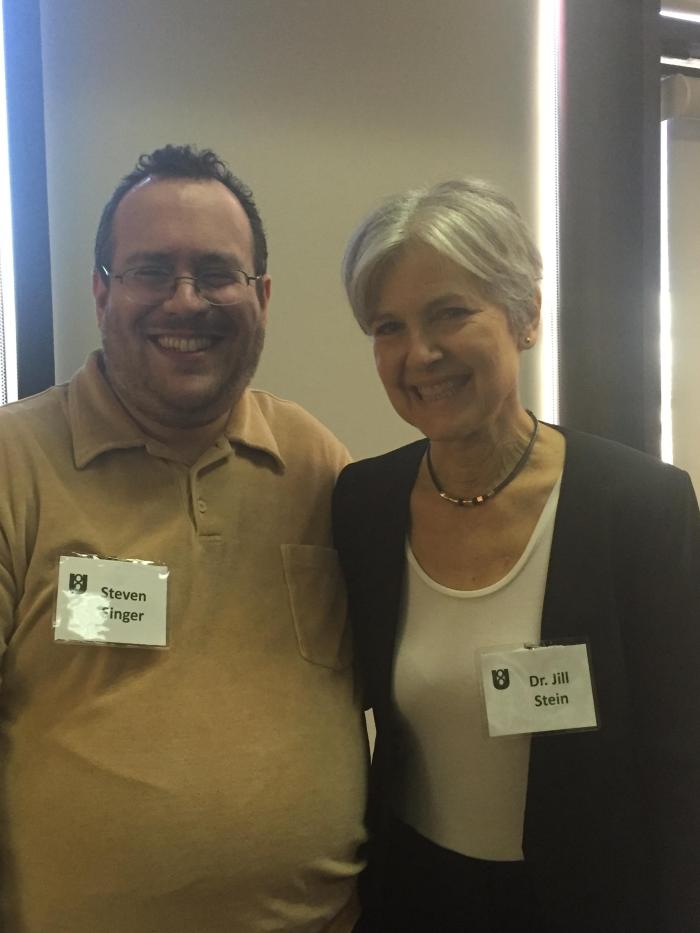
Yesterday Dr. Jill Stein gave me a hug.


Eight years ago, I was so inspired by Obama’s campaign speech in my hometown of Pittsburgh that I rushed forward along with the crowd to grab his hand. It was soft but firm with a tinge of moisturizer. Now I look at his incredibly regressive education policies and feel the need to scrub my palm.


This weekend in Philadelphia, I was at the United Opt Out Conference and saw Stein sitting in the audience.


I walked past the Green Party Presidential candidate the first time thinking I must be mistaken. Then her name tag removed all doubt.


“You’re Jill Stein!” I stuttered.


She smiled warmly, stood up and said, “You’re Steven Singer!”


I want to believe she knew who I was, but I was wearing a name tag, too.


We talked for a moment about what most of us were here for – education policy. She reaffirmed that she wanted to end all high stakes testing and school privatization.


Think of it – a presidential candidate speaking in specifics. Not “We test too much.” Not “Some charter schools are bad.” But I want to end these two perverse school policies!


And to top it all off, before she hurried off to tidy up as the time approached for her campaign speech, she game me a warm, tight hug.


Compare that to Hillary Clinton or Bernie Sanders.


As part of the Badass Teachers Association, we reached out to all the Democratic and Republican candidates on these exact same issues. The Republicans ignored us entirely, but both Democrats gave us phone calls by campaign aides.


Even then, the Democratic response was far from convivial. It mostly came down to something like “Education is important.” Well, duh.


In Sanders’ case, we had to conduct an impromptu sit-in at the Senator’s Washington office before anyone would talk to us about policy. And Hillary only started to speak in measured tones about public schools after our national teachers unions voted to endorse her – well, the leaders of those unions voted. No one ever really asked us, rank-and-file.


Moreover, when Sanders voted for the horrible Murphy Amendment of what became the Every Child Succeeds Act, several teachers including myself wrote him an open letter asking him to explain his apparent support for a Test and Punish education provision. One of his aides sent us a replysome nonsense about accountability.


And Jill Stein just gave me a hug.

The difference is huge!


When activists were holding this conference centering on the movement to Opt Out of Standardized testing, Sanders and Clinton didn’t even send campaign literature. Stein came in person and even gave a keynote address!


Don’t get me wrong. Hillary is far preferable to any Republican candidate seeking the office. I just wish her Presidential bid wasn’t funded by the very people we’re fighting against.


I love Bernie, too. I’ve even got the t-shirt to prove it. I just wish he loved us as much by throwing out a few more specifics. The general thrust of his campaign seems tailor-made to support test resistance and a fight against corporate education reform, but he rarely connects the dots with anything that we could hold him accountable for saying.


And then you have Stein, perhaps the most human politician I’ve ever met.


One look at her platform and it’s obvious she’s the best candidate for President in 2016. But is she electable?


Think about that for a moment.


What does it say about our country?


Design an excellent platform that benefits the most people, organize a movement to get your message out there, draw on the experience of experts in various fields… and you’re an incredible long shot to win the office.


The media says the same thing about Sanders as he speaks to overcapacity crowds and struggles against party politics seemingly written to hobble any populist campaign like his.


Yet Stein has no giant crowds. She has no adoring fans, no comedian on Saturday Night Live giving her friendly jibes.


She’s almost completely ignored by the media. Yet her actual policies make even a progressive like Sanders look like… well… Hillary Clinton!


For instance, Sanders wants to make college free to everyone. Stein wants to do that, too, AND erase all existing student debt.


Sanders is (kind of) against for-profit charter schools but has been vaguely supportive of Test and Punish school accountability practices. Stein is unequivocally against all forms of school privatization and high stakes standardized testing.


Sanders wants single-payer healthcare paid for by raising taxes (but net savings over all). Stein wants single-payer healthcare paid for by cutting our bloated military budget with no raise in taxes.


In fact, while Sanders is against unnecessary military action and an increase in military spending, he is in favor of keeping the $1 trillion military budget mostly intact. Stein wants to cut it by 50%, stop selling weapons to Saudi Arabia, stop giving weapons to Israel, freeze terrorist-funder’s bank accounts, end the War on Terror and engage in a policy of peace.


Moreover, Stein wants the savings from slashing our biggest federal expenditure to be used to fund a New Green Deal, creating full employment and a living wage all while transitioning to 100% clean energy by 2030!


Correct me if I’m wrong, but all of Stein’s policies sound rather sane and measured. Yet she is the one the media labels a radical and out-of-touch – if they talk about her at all.


It’s a testament to how perverted our politics have become: Sanity looks like the exact opposite. Logic and intelligence are revolutionary concepts.


And only the activists and intellectuals seem to know this is happening.


When Stein was done speaking, someone asked her the inevitable question about Ralph Nader. Wouldn’t casting a ballot for her just divide the Democratic vote and give the race to the Republicans as it did in 2000?


Her response was a bit evasive – the only time, in fact, where she seemed a bit uncomfortable.


She said that Nader wasn’t a member of the Green Party, where she is. She is engaged in building the party and the movement even beyond 2016.


On the one hand, it sounded like she was suggesting that even if she loses, it will bring real progressive issues into the limelight. However, this is not what happened when Nader lost as a third party candidate against Bush and Gore.


On the other hand, she stressed that she actually could win. About 43 million people are trapped by student debt, which she wants to unilaterally eliminate, she said. That’s a large enough chunk of the population that if they all voted for her, she would win.


It’s time for a Hail Mary moment, she said. We have to take a chance to vote for the best policies and not continue to compromise by supporting the lesser evil. Concession is the road to what we have now – continued oligarchy and global hegemony.


We need a functioning world for our children. If we don’t do something about Climate Change, the Earth may not be habitable in as little as five decades.


It’s now or never, she said.


I offer all this not as an endorsement of Stein. Nor of Sanders or Clinton (though seriously stay away from the Republicans, they’re freaking crazy).


I offer this only as food for thought.


Stein is offering us the best platform, bar none. But can we afford to vote for her? Can we afford not to?

Charter School Champion Hates Bernie Sanders, Prefers Hillary Clinton

Screen shot 2016-02-20 at 12.36.03 AM

Bernie Sanders doesn’t like charter schools enough.

To me that’s an endorsement.

But to Shavar Jeffries, it’s a condemnation.

Jeffries took to the pages of the New York Daily News to decry Sanders position and champion Hillary Clinton’s.

Jeffries is the executive director of Democrats for Education Reform (DFER), a hedge fund front promoting the privatization of public education.

Despite its name, the group doesn’t represent the views of most Democrats. It represents the neoliberal branch of the party that has heavily influenced the education policy of Barack Obama, Arne Duncan, Cory Booker, Bill Gates and other prominent so-called liberals.

One can see why Jeffries isn’t Feeling The Bern. Sanders famously said THIS in January about the industry DFER promotes:

I’m not in favor of privately run charter schools. If we are going to have a strong democracy and be competitive globally, we need the best educated people in the world. I believe in public education; I went to public schools my whole life, so I think rather than give tax breaks to billionaires, I think we invest in teachers and we invest in public education. I really do.

More to Jeffries’ taste is Hillary Clinton who he says backed off on her own charter school criticism.

Back in November, Clinton correctly condemned most charter schools for not enrolling the most challenging students.

She said:

Most charter schools — I don’t want to say every one — but most charter schools, they don’t take the hardest-to-teach kids, or, if they do, they don’t keep them. And so the public schools are often in a no-win situation, because they do, thankfully, take everybody, and then they don’t get the resources or the help and support that they need to be able to take care of every child’s education.

Anne O-Leary, a Clinton aide, eventually clarified these comments saying Clinton supports those charters that are both equitable and accountable.

Neither candidate for the Democratic nomination for President has given an in-depth policy speech on K-12 education.

These statements on charter schools are some of the most substantial made by either candidate on the issue.

Clinton has been lambasted in the media for her comments. Many publications – leaning both left and right – complained that she was caving in to powerful teachers unions like the National Education Association (NEA) and the American Federation of Teachers (AFT) both of which endorsed her in the primaries. On the other hand, Clinton also has been criticized for not going far enough against the school privatization industry. Some observers highlight her continuing ties to Wall Street and many of the same neoliberal figures responsible for our disastrous corporate education reform policies.

By contrast, Bernie’s comments have been met with mostly praise from his base and shrugs from his opponents.

Both candidates views on the subject have evolved over the years. Sanders has gone from being pro- to anti-charter. Clinton has gone from being pro-charter to pro-charter with some provisos.

Back in 1998, Congressman Sanders voted in favor of the Charter School Expansion Act. Now he’s against the industry. Meanwhile, Clinton has long been a champion of charter schools. Her criticism of some of these schools is a new wrinkle.

It’s nice to see the issue getting some attention.

Charter schools have increased exponentially across the country in the last two decades, but they have little transparency or accountability. As a result, monetary scandals have exploded like wildfire from state-to-state. Millions of public dollars have disappeared into private corporations’ bank accounts leaving little to show for it.

Nationally, research shows that charter schools do no better at educating children than public schools. In fact, in many cases they do a much worse job. And when it comes to cyber charter schools, the situation is even more unevenly stacked in traditional public school’s favor.

Scandals also are surfacing about how charters treat their students. Stories of harsh discipline policies and violating students rights are emerging everyday. Moreover, there are countless accusations that – as Clinton points out – many charters select only the easiest students to educate and sometimes expel struggling students before state-mandated standardized tests.

Finally, charters increase the cost of educating children in a particular district by adding another parallel school system. However, these extra costs are taken out of the traditional public school’s budget thereby further destabilizing it and forcing less services and higher class sizes for students who don’t enroll in new charters.

I’m glad both Democratic candidates are critical of this status quo.

However, Jeffries denunciation of Sanders and defense of Clinton may backfire.

If an odious organization like DFER is in favor of Clinton, shouldn’t the rest of us back Sanders?


NOTE: This article also was published on the Badass Teachers Association blog.


Judging the Judge: What Antonin Scalia’s Death Means to the People I Love

antonin-scalia-26

I am not sad Antonin Scalia is dead.

Wow! It feels so good to say that out loud!

Come on. Admit it. You probably feel the same way.

I know. I know. Everywhere you turn, people are going out of their way to talk about the ramifications of the 79-year-old Supreme Court Justice’s death without passing judgement on him.

“Let’s keep it classy,” they say.

Oh. Stop it.

In his 30 years on the bench, Scalia hurt an awful lot of people. And I mean real, live people – not ideological constructs, not hypotheticals – but moms, dads, husbands, wives, daughters, and sons.

The aggregate amount of misery in the world was drastically increased by his being in it. And now that he’s gone, much of that misery may be relieved.

So please curb any shock you may feel at my thesis. And spare me the false praise of a truly reprehensible human being.

He was against women controlling their own bodies, efforts to desegregate our schools, an individual’s right to love whomever they choose, refraining from executing mentally disabled or teenage prisoners. Heck! He was even against police reading suspects their Miranda Rights!

This was a person who said black people should go to “slower” colleges, homosexuality was the same as murder or bestiality, sex discrimination is constitutional, and maybe we have a right to all carry around rocket launchers in public.

If it is outrageous to feel relief at the death of this man, you may call me outrageous.

I’m not usually the kind of person who celebrates someone else’s death. Not even a famous person.

But you have to admit that the people we love are a lot better off without Scalia in the world.

It’s not like he kept all this to himself. He wasn’t some lone drunkard in the back of the bar mumbling sexist, racist views. He wasn’t your ancient uncle who you only see twice a year making people uncomfortable at the dinner table. He was a judge in the highest court in the land, and his demented and warped world view drove public policy impacting… well… everyone.

He was the deciding vote in several 5-4 decisions that – if they had gone differently – would have greatly benefited every person in this country.

You can thank him for the Presidency of George W. Bush and Citizens United. Let that sink in for a moment.

Imagine all the horrific blunders of the Bush Presidency – easily the worst administration in my lifetime. If the Supreme Court hadn’t given the highest office in the land to Dubya, arguably we wouldn’t have had the Irag War, the Great Recession, No Child Left Behind, the slow response to Hurricane Katrina – maybe even 9-11.

And if you hate what our elections have become, imagine if we didn’t have the Citizens United verdict. Campaign donations would have to be made in public with some limits on how much individuals and corporations can contribute.

How much better the world would have been without these terrible decisions!

I’m not saying Scalia wasn’t a good man in his personal life. I have no idea what he was like to the people he loved. For all I know he may have been a good friend, a loving husband, father and grandfather. He probably had people he cared about and who cared about him. And to those people I send my condolences.

However, he did great harm to just about everyone else. And for that I feel nothing but relief at his death.

Who am I to bask in such schadenfreude?

I am a father and public school teacher.

I have a seven-year-old daughter and several classes full of mostly impoverished and minority students.

And Scalia’s death is good for everyone I care about.

If he were still alive, there was so much more damage he could have done. Take the Friedrichs case, an important one for teachers like me.

The case is an attempt to strip teachers unions of the right to charge members for their services. If the court rules in favor of Friedrichs, it would overturn decades of established law against free riders. People would be allowed to be in a union, enjoy higher salary and benefits negotiated by that union, but not pay dues. It would be absurd. Yet with Scalia still on the bench, most court watchers seem to think we would have had another terrible 5-4 decision.

However, with Scalia’s death, the best anti-union forces would probably receive is a 4-4 decision – not enough to overturn established law. True the case has already been heard by the justices, but a ruling has not yet been handed down. According to the Supreme Court blog, even if Scalia had already written a ruling on this matter, it would be void. Any rulings he wrote that have not yet been made public don’t count.

So the most likely outcome now is that millions of people will continue to be protected from unfair labor practices. And you expect me not to have a big ‘ol smile on my face!?

So where do we go from here?

President Barack Obama will select who is to succeed Scalia. Numerous excellent choices have been floated. If Obama chooses any one of them, he would probably tilt the court fractionally to the left.

Before the body was even cold, Republicans vowed to block any nominee Obama makes until the next President is sworn in. Some are trying out the talking point that Supreme Court Justices have never been sworn in during an election year. But if that were true, we wouldn’t have Justice Anthony Kennedy who was confirmed during the last year of Reagan’s presidency.

Funny. The U.S. Constitution clearly states that the President has the right to nominate Supreme Court Justices with the advice of Congress. Yet so many of these right leaning partisans who considered themselves Constitutionalists last week suddenly find themselves against that revered document today.

I wonder how Scalia would have argued such a situation.

Not really. He was the one who taught the rest of his party how to twist the words of the founding fathers to mean whatever the far right favors this week.

Obama still has more than 300 days in office. If Republicans try to block his nomination until a new face tops the Executive, it would be the longest such obstruction in a century. Of sitting justices, the longest confirmation period was for Clarence Thomas who took 106 days to be approved by Congress.

And that brings us to the 2016 Presidential race.

Scalia’s death is likely to have a huge impact on whom becomes our next President.

If Republicans block Obama’s Supreme Court nominee, it would probably increase voter turnout. Whenever that happens, it favors Democrats since they have more registered members than the GOP.

Either way, Scalia’s death is probably beneficial to whomever the Democratic nominee will be. If either Hillary Clinton or Bernie Sanders get the nomination, supporters of the defeated candidate are more likely to support the reigning Democrat.

Even if voters don’t like the winner’s policies as much as their preferred candidate, they’re likely to support the nominee in order to continue tipping the Supreme Court to the left. After all, three additional justices are 70 or older. Stephen Breyer is 77, Anthony Kennedy is 79, and Ruth Bader Ginsburg is 82.

We have had a long haul these last 15 years. Much social progress has been stalled.

But now that Scalia is out of the picture, the future looks bright.

Maybe things really will turn out alright. Maybe we’ll actually have a chance to build that better world we’ve all been dreaming about.

Rest in Peace, Scalia. The nation can’t wait to move on without you.

What Antonin Scalia’s Death Means to the People I Love

antonin-scalia-26

I’m not sad Antonin Scalia is dead.

Wow! It feels so good to say that aloud!

Come on. Admit it. You feel exactly the same way.

I know. I know. Everywhere you turn, people are going out of their way to talk about the ramifications of the 79-year-old Supreme Court Justice’s death without passing judgement on him.

“Let’s keep it classy,” they say.

Oh. Stop it.

In his 30 years on the bench, Scalia hurt an awful lot of people. And I mean real, live people – not ideological constructs, not hypotheticals – but moms, dads, husbands, wives, daughters, and sons.

The aggregate amount of misery in the world was drastically increased by his being in it. And now that he’s gone, much of that misery may be relieved.

So spare me any shock at my thesis. Spare me the false praise of a truly reprehensible human being.

He was against women controlling their own bodies, efforts to desegregate our schools, an individual’s right to love whomever they choose, refraining from executing mentally disabled or teenage prisoners. Heck! He was even against police reading suspects their Miranda Rights!

This was a person who said black people should go to “slower” colleges, homosexuality was the same as murder or bestiality, sex discrimination is constitutional, and maybe we have a right to all carry around rocket launchers in public.

If it is outrageous to feel relief at the death of this man, you may call me outrageous.

I’m not usually the kind of person who celebrates someone else’s death. Not even a famous person.

But you have to admit that the people we love are a lot better off without Scalia in the world.

It’s not like he kept all this to himself. He wasn’t some lone drunkard in the back of the bar mumbling sexist, racist views. He wasn’t your ancient uncle who you only see twice a year making people uncomfortable at the dinner table. He was a judge in the highest court in the land, and his demented and warped world view drove public policy impacting… well… everyone.

He was the deciding vote in several 5-4 decisions that – if they had gone differently – would have greatly benefited every person in this country.

You can thank him for the Presidency of George W. Bush and Citizens United. Let that sink in for a moment.

Imagine all the horrific blunders of the Bush Presidency – easily the worst administration in my lifetime. If the Supreme Court hadn’t given the highest office in the land to Dubya, arguably we wouldn’t have had the Iraq War, the Great Recession, No Child Left Behind, the slow response to Hurricane Katrina – maybe even 9-11.

And if you hate what our elections have become, imagine if we didn’t have the Citizens United verdict. Campaign donations would have to be made in public with some limits on how much individuals and corporations can contribute.

How much better the world would have been without these terrible decisions!

I’m not saying Scalia wasn’t a good man in his personal life. I have no idea what he was like to the people he loved. For all I know he may have been a good friend, a loving husband, father and grandfather. He probably had people he cared about and who cared about him. And to those people I send my condolences.

However, he royally screwed just about everyone else. And for that I feel nothing but relief at his death. If only it had come sooner.

Who am I to bask in such schadenfreude?

I am a father and public school teacher.

I have a seven-year-old daughter and several classes full of mostly impoverished and minority students.

And Scalia’s death is good for everyone I care about.

If he were still alive, there was so much more damage he could have done. Take the Friedrichs case, an important one for teachers like me.

The case is an attempt to strip teachers unions of the right to charge members for their services. If the court rules in favor of Friedrichs, it would overturn decades of established law against free riders. People would be allowed to be in a union, enjoy higher salary and benefits negotiated by that union, but not pay dues. It would be absurd. Yet with Scalia still on the bench, most court watchers seem to think we would have had another terrible 5-4 decision.

However, with Scalia’s death, the best anti-union forces would probably receive is a 4-4 decision – not enough to overturn established law. True the case has already been heard by the justices, but a ruling has not yet been handed down. According to the Supreme Court blog, even if Scalia had already written a ruling on this matter, it would be void. Any rulings he wrote that have not yet been made public don’t count.

So the most likely outcome now is that millions of people will continue to be protected from unfair labor practices. And you expect me not to have a big ‘ol smile on my face!?

So where do we go from here?

President Barack Obama will select who is to succeed Scalia. Numerous excellent choices have been floated. If Obama chooses any one of them, he would probably tilt the court fractionally to the left.

Before the body was even cold, Republicans vowed to block any nominee Obama makes until the next President is sworn in. Some are trying out the talking point that Supreme Court Justices have never been sworn in during an election year. But if that were true, we wouldn’t have Justice Anthony Kennedy who was confirmed during the last year of Reagan’s presidency.

Funny. The U.S. Constitution clearly states that the President has the right to nominate Supreme Court Justices with the advice of Congress. Yet so many of these right leaning partisans who considered themselves Constitutionalists last week suddenly find themselves against that revered document today.

I wonder how Scalia would have argued such a situation.

Not really. He was the one who taught the rest of his party how to twist the words of the founding fathers to mean whatever the far right favors this week.

Obama still has more than 300 days in office. If Republicans try to block his nomination until a new face tops the Executive, it would be the longest such obstruction in a century. Of sitting justices, the longest confirmation period was for Clarence Thomas who took 106 days to be approved by Congress.

And that brings us to the 2016 Presidential race.

Scalia’s death is likely to have a huge impact on whom becomes our next President.

If Republicans block Obama’s Supreme Court nominee, it would probably increase voter turnout. Whenever that happens, it favors Democrats since they have more registered members than the GOP.

Either way, Scalia’s death is probably beneficial to whomever the Democratic nominee will be. If either Hillary Clinton or Bernie Sanders get the nomination, supporters of the defeated candidate are more likely to support the reigning Democrat.

Even if voters don’t like the winner’s policies as much as their preferred candidate, they’re likely to support the nominee in order to continue tipping the Supreme Court to the left. After all, three additional justices are 70 or older. Stephen Breyer is 77, Anthony Kennedy is 79, and Ruth Bader Ginsburg is 82.

We have had a long haul these last 15 years. Much social progress has been stalled.

But now that Scalia is out of the picture, the future looks bright.

Maybe things really will turn out alright. Maybe we’ll actually have a chance to build that better world we’ve all been dreaming about.

Rest in Peace, Scalia. The nation can’t wait to move on without you.

The Credibility Gap Between Bernie Sanders and Hillary Clinton

bernie-sanders-y-hillary-clinton

I Believe Bernie Sanders. I Don’t Believe Hillary Clinton.

Really. It’s that simple.

These two candidates vying for the Democratic nomination for the Presidency both have things going for them. But at the end of the day one of them is much more credible than the other.

They’re both career politicians.

Sanders has been a Vermont Senator for nine years, a U.S. Representative for 16 years, and Mayor of Burlington for eight years.

Clinton was Secretary of State for four years, a New York Senator for eight years, and – most famously – First Lady of the United States for eight years and of Arkansas for 11 years.

But when they speak, only Sanders seems genuine.

I know that’s a personal value judgement. Maybe it doesn’t hit you the same way.

I just don’t know how it could hit you differently.

For instance, both candidates say they’re going to keep the banking industry in check and stop the risky practices that crashed the economy under President George W. Bush. However, that same industry is Clinton’s main financial supporter while Sanders has almost nothing to do with them.

Look at the facts.

Clinton admittedly accepts a massive amount of donations from Wall Street – $824,000 from Citigroup, $760,000 from Goldman Sachs, $696,000 from JP Morgan Chase, $636,000 from Morgan Stanley and the list goes on and on. More than 760 of Clinton’s over all donors list their occupation as CEO or another form of chief executive, according to CNBC.

Meanwhile, Sanders has accepted almost nothing from Wall Street, doesn’t have a super PAC and still raises nearly as much money in donations as Clinton. Small individual contributions make up 70% of his campaign cash. His biggest contributors are from retirees, unions and progressive political organizations – $105,000 from Machinists/Aerospace Workers Union, $93,000 from the Teamsters union, $89,000 from the National Education Association.

So when Sanders says he’s going to break up the big banks and regulate Wall Street, I believe him. Apparently, they do, too, since they aren’t giving him any money.

But when Clinton says she’s going to hold Wall Street accountable, too, it’s just laughable. Why else would they be giving her all this money? Are they paying her to get tough on THEMSELVES!? As Sanders supporter Dr. Cornell West puts it, “I was born at night but not last night.”

The same thing goes for healthcare.

Both candidates say they want to reform the system to make it more affordable and fair. However, Sanders supports a single payer Medicare for all system, while Clinton supports tweaking the existing Obamacare system.

Two decades ago, Clinton agreed with Sanders. Now she receives $13.2 million in donations from the medical and insurance industry – $11.2 million when she was a Senator and $2 million since she began her presidential campaign. From 2013-2015 she received more than $2.8 million in speaking fees alone from the industry.
It’s funny how all that cash coincided with a change in her healthcare policy. She just said recently that single payer will “never, ever” happen.

By contrast, Sanders doesn’t receive sizable donations from the industry at all. Though he voted for Obamacare, he made it clear he thought it was a first step toward the better system he still supports.

So I suppose both are credible in this regard, but Sanders seems to be holding his position more because of conviction than monetary gain. Moreover, how much tweaking of the current system would Clinton really support while still in the pay of the healthcare industry?

However, it’s not all about campaign contributions.

Sanders positions have been fairly rock solid throughout his long career. Clinton’s have changed.

Look at mass incarceration – a huge problem in the United States. We have more than 2 million people incarcerated, many for low level infractions, boosting a for-profit prison industry. By contrast, China – with four times our population – only locks up 1.6 million of its citizens. The US has only 4 percent of the world population but locks away nearly a quarter of the world prison population. Thirty Seven states have higher incarceration rates than most nations, large or small.

When she was First Lady, Clinton supported her husband’s tough on crime legislation. “We need more prisons,” she said in 1994, “to keep violent offenders for as long as it takes to keep them off the streets.” Now that the devastating results of that policy have become clear, Clinton has changed her tune. “We must end the era of mass incarceration,” she said in October of 2015.

That’s quite a switch, and its fairly new. The last time she ran for president, she criticized her rival Barack Obama for being soft on crime and not committing to opening more prisons. Now on the campaign trail she tries to convince us she hates mass incarceration MORE than Obama. In 8 years, she went from a prison booster and belittling Obama for not loving prisons to a prison skeptic.

Did she just evolve on this issue? Has she finally come around to seeing things the right way? Or is she pandering to what she thinks voters want to hear?

Sanders, on the other hand, has been against mass incarceration for most of his career. He’s been speaking about the dangers of ballooning prison populations for more than a decade. As far back as 1994, he said, “Mr. Speaker, all the jails in the world, and we already imprison more people per capita than any other country, and all the executions in the world, will not make that situation right. We can create meaningful jobs, rebuilding our society, or we can build more jails.” Compare that with his statement from July of 2015: “The result of kids not being in school and kids not having jobs is that tragically, today, we in this country have more people in jail than any other country on Earth.”

This issue has become a popular rallying cry recently receiving support from people across the political spectrum. But Sanders was championing it when no one else was paying attention. Clinton has suddenly seen the light.

But it’s not even just past policy decisions.

Clinton is guarded and only seems to make statements that will get her political points. Sanders says things that are sure to loose him votes but that he apparently believes.

For instance, he recently came out in favor of the federal government being largely responsible for public school funding. As a nation, we have drastic monetary and resource inequalities in our nations schools, but no one else is talking about ways to fix it. The trend has been to cut funding. Yet Sanders is willing to put forward a common sense solution the rest of the world has proven works. It’s not bound to get him many votes, though, even from some education advocates afraid of recent federal overreaches in school policy.

Another example is religion. No presidential candidate in recent memory – perhaps ever – has openly admitted to being irreligious. Both Democrats and Republicans usually fall all over themselves to prove how pious they are in their everyday lives. Clinton, for instance, responded during this election cycle that her favorite book is the Bible. Conversely, Sanders admitted he is not a part of any organized religion, though he considers himself Jewish.

That might not get him many votes. But it is refreshingly honest. There is no reason to say something like that unless it were true.

Moreover, Sanders seems like more of genuine person than Clinton. In 1987 when he was Mayor of Burlington, Sanders recorded a folk album. Yes, folk music! It’s called “We Shall Overcome.” The late night shows have been playing it and getting laughs at his expense, but when they bring it up to Sanders, he just laughs and admits that he wasn’t much of a singer.

Can you imagine anything like that from Clinton? Sure, Bill played the saxophone, but Hillary? There is nothing so personal that has leaked to the public. Moreover, the folk song lyrics that Sanders sings are in-line with his political ideology.

Heck! The very fact that Hillary is famous for getting a $600 haircut while Sanders often lets his grey locks fly whichever way they want! It seems like Clinton is trying too hard to convince us, while Sanders is kind of like – here I am, this is me, what you see is what you get.

Ultimately questions of credibility are very personal. People will feel differently. However, looking at the facts, I find it impossible to believe Clinton’s rhetoric and impossible not to believe a good deal of Sanders’. We’ll see how voters feel as the primary elections begin today.

Unions Can’t Just Be About What We’re Allowed to Do: Social Justice Unionism

7983807401_6b0075f742_b.sm_a

If labor unions were an animal, they’d be an old hound dog napping on the porch.

They’re slow to get up and chase away burglars but they do like to howl at night.

Most of the time you don’t even know they’re around until the dinner bell rings. Then that ancient mutt is first to bolt into the kitchen to find a place at the table.

It’s kind of sad really. That faithful old dog used to be really something in his youth.

He was fierce! He’d bark at trespassers even tearing them apart if they threatened his patch of land.

Old Uncle Sam used to yell at him and even threaten the pooch with a rolled up newspaper, but that dog didn’t care. He had a sense of right and wrong, and he didn’t mind getting into deep trouble fighting for what he thought was fair.

Today, however, the only thing that really riles him is if you threaten to take away his ratty old bone.

Let’s face it. Unions have become kind of tame. They’re housebroken and not much of a threat to those people waiting in the shadows to rob us blind.

Some people say we’d be better off without them. But I don’t agree. Even a decrepit canine can act as a deterrent, and thieves sure are frightened of dogs.

Think about all unions have given us: the weekend, child labor laws, vacation time, pensions, lunch breaks, healthcare, the 8-hour day, maternity leave, safety measures, due process, sick leave and free speech protections on the job!

They didn’t get us all that by sitting politely at the table with their hands crossed. They didn’t do all that by contributing modest sums to political campaigns. They didn’t do it by obsessively protecting collective bargaining at the expense of all else.

Unions used to take to the streets. They took over the job site. They marched with signs and placards. They exercised people power.

And the government was scared of them. The President called out the army to get them back to work. Lawmakers hired mercenaries to break strikes with clubs and guns. But eventually Congress passed laws to placate them.

Unfortunately, That was a long time ago.

For decades the pendulum has been swinging against us. Federal and state laws have become increasingly restrictive. They want to tell us when we can strike and how long. They want to tell us when and if we can collect dues. And – frankly – they want to tell us to just disperse and do whatever the bosses want – because the business class has already bought and paid for our politicians.

For decades we’ve heard to their propaganda on TV, the radio and the print media. Well-paid shills have poured their poison in our ears about the evils of the labor movement. They’ve spoken these lies so often lots of people believe them.

Workers used to fight to make sure everyone got a fair deal. Now the working man has been brainwashed to focus instead on making sure no one else gets more than him. And the bosses are laughing all the way to the bank.

Union membership is at the lowest it’s been in a century. So are wages adjusted for inflation. A family of four used to be able to get by comfortably on one salary. Now it can barely make ends meet with two.

Yes. There’s no doubt about it. We need unions today more than ever.

But for unions to survive, they must change. They have to become a reflection of the membership and not just of the leaders.

During this presidential election cycle, we’ve seen our largest national unions – the National Education Association (NEA) and American Federation of Teachers (AFT) endorsing a candidate without bothering to actively poll their members. We’ve seen them speak for us on policy decisions without asking our opinions. We’ve seen them act just like the corrupt politicians who we should be fighting against.

Yes, it is time for a change. No longer can our unions be run from the top down. They must be run from the bottom up. They shouldn’t tell us what to do. We, the membership, should be giving orders to them.

Moreover, we need to stop obsessing about collective bargaining. I’m not saying that’s unimportant. But it can’t be the only thing we do.

Our unions used to be in the midst of larger social movements. We were part of the Civil Rights movement. We were part of the push for desegragation. We were part of the fight to protect children and provide them a decent education.

We need to continue that today. And in some places we are already doing that! Look to Chicago, Detroit and Philadelphia. Teachers unions in those urban areas are fighting not just for better pay and benefits but for the communities they serve. Detroit teachers en mass are calling off sick to protest horrible conditions in the schools. Chicago teachers are marching in the streets with the community to demand indictments for police murdering their black and brown students. Philadelphia teachers are supporting students who walk out of class to protest state disinvestment and toxic testing.

THIS is what unions should be doing. We should be fighting for social justice. We should be a central part of the struggle to turn the tide against corporatization, privatization and standardization of our country’s public goods. We should be marching hand-in-hand with BlackLivesMatter activists. We should be in the front lines of the fight to save our environment and replace fossil fuels with renewable energy.

We must be part of the community and not apart from it. We must share in the struggles and goals of those we serve. We must be an example of the old truism that a rising tide raises all ships. After all, the word “union” literally means together. By definition we must all be in this together or else we’re not even really a union.

And to do this we have to stop being so concerned with what they tell us we can do.

We live in a democratic society. The government gets its power from us, from our consent. That means that if there are enough of us, we trump their corrupt laws. They only get to make those laws because we say so. And court decisions – even Supreme Court decisions – mean nothing next to the court of public opinion.

The bosses buy the politicians and tell them to legislate us into a box. It’s time to break out of that box. We can’t be afraid to take our power back. We shouldn’t be afraid of our government. Our government should be afraid of us.

How do we do it? Organize.

If you belong to a union, roll up your sleeves and get active. Run for office. Convince like-minded folks to join you. Take over your local. Spread to your national.

If you don’t belong to a union, start one at your job. Talk to your co-workers. Talk about the benefits for each of you and your neighborhoods. Fight for your rights.

I know. It’s a whole lot easier to complain. Real change, though, takes real work.

We used to know these things. Somewhere along the line we forgot.

So wake up, you yeller cur dog, and get off the porch. Take to the streets.

Because the surest way to take back our country is to take back our unions.