Betsy DeVos – Extreme Image Makeover as Champion of Special Needs Children

Screen Shot 2017-12-11 at 4.21.29 PM


Meet Betsy DeVos, Champion of Students With Special Needs.


At least that’s who she’s pretending to be this week.


The wealthy Republican mega-donor who bought her position as Secretary of Education published an article in the current issue of Education Week called “Commentary: Tolerating Low Expectations for Students With Disabilities Must End.”


It was almost like she expected us all to forget who she actually is and her own sordid history with these kinds of children.


Up until now, the billionaire heiress and public school saboteur always put the needs of profitizers and privateers ahead of special needs children.


During her confirmation hearing, she refused to say whether she would hold private, parochial and charter schools receiving tax dollars to the same standard as public schools in regard to how they treat special education students. Once on the job, she rescinded 72 federal guidelines that had protected special education students.


But now she’s coming off like a special education advocate!


What a turnaround!


It’s almost like David Duke coming out in favor of civil rights! Or Roy Moore coming out in favor of protecting young girls from pedophiles! Or Donald Trump coming out in favor of protecting women from crotch grabbing!


It begs the question – who exactly is she trying to fool?


Does Education Week really expect us to buy

this crap? Or has the so-called corporate media enterprise simply caved to the Trump administration’s demand to publish a puff piece for rubes without any journalistic integrity?


Real journalists might have published this BS, but only after giving readers the proper context.


Not Education Week. The only nod toward objectivity was inserting the word “Commentary” in the title of DeVos’s article.


It’s almost like saying – DeVos ALLEGEDLY champions students with special needs.


Give me a break.


She’s championing a feel good decision from the US Supreme Court from March. Way to get on that, Betsy!


Moreover, the decision isn’t exactly substantive.


It basically says that public schools need to ensure their special education students make more than minimal academic progress.


Great! Who doesn’t want that?


Has Congress jumped on this decision to increase federal aide to help public schools meet this requirement?


Nope.


And neither is DeVos calling for any additional federal help. In fact, her administration is proposing CUTTING federal special education funding.


Yet when the Individuals with Disabilities Education Act (IDEA) was enacted in 1975 by the Gerald Ford administration, the federal government was supposed to fund 40% of the cost of all special education students. It has never met that promise.


Today, the federal government only shoulders 15.7% of the cost with the states and individual districts picking up the rest.


This is extremely unfair.


It costs roughly twice as much to educate a special education student as a non-special education student. Yet the numbers of special needs students are on the rise.


According to the U.S. Census Bureau’s 2015 statistics (the most recent available), students with special needs account for 8.8% of the population. That’s up an additional 100,000 students from the previous year.


And the areas with the largest increase of special needs students are the most impoverished.


So we’re expecting the poorest communities to take up the largest percentage of the tab.


There are several bills in Congress demanding the federal government increase funding to the 40% threshold, but DeVos didn’t see fit to mention them.


To her, money is a thing only worth being lavished on private, parochial or charter schools.


Instead, she mentioned “personalized” education as a remedy for special needs students in public schools.


She wrote:


“No two children are the same. Each has his or her own unique abilities and needs. Personalized, student-centered education can help all children thrive, especially children with disabilities.” (Emphasis mine)


Though few people really disagree with this statement, the use of the word “Personalized” sets off alarm bells.


The term has come to mean “personalized learning” or “competency based education” which is code for making students sit on a computer or a device for hours at a time completing stealth assessments. These are programs made to look like video games that really just assess the same standardized material on the typical fill-in-the-bubble high stakes test.


And the results of these assessments are likewise used against schools and students as an excuse to privatize and strip them of local control, legal protections and mandated transparency.


There are authentic ways to use technology to help kids learn, but the rush by corporations to cash in on this emerging market has been largely unregulated, unstudied and unchallenged.


DeVos has already noted her commitment to edtech solutions to academic problems.


At a conference for edtech investors earlier this year she said:


“We’ve just scratched the surface in the role technology can play. I only have to look at my young grandchildren to see how powerful tech is. It is a thousand flowers, and we haven’t planted the whole garden.”


Another place she can look is her investment portfolio.


Both she and her husband have a $5 million and $25 million investment in a shady “brain performance” company called Neurocore. DeVos even sat on the company’s board until she got her job as Secretary of Education and had to step down.


The company claims to be able to train young brains to think better by hooking kids up to hats with wires hanging out of them.


I’m not kidding. The whole things goes against just about every peer-reviewed study in the field of neuroscience, but DeVos claims her company can help cure attention-deficit/hyperactivity disorder, autism, anxiety, stress, depression, poor sleep, memory loss and migraines.


In other words, hooking kids up to machines of dubious scientific value is the cure for special education.


This is where we are people.


Our government is run by frauds and hucksters.


And the media calmly gives them an unchallenged platform to spout whatever nonsense they like with little to no skepticism.


So Betsy DeVos is a champion for students with disabilities, huh?


File that under B for Bullshit.


Like this post? I’ve written a book, “Gadfly on the Wall: A Public School Teacher Speaks Out on Racism and Reform,” now available from Garn Press. Ten percent of the proceeds go to the Badass Teachers Association. Check it out!
book-4

Two Theories Why Facebook Keeps Blocking Me When I Write About School Privatization

 AdobeStock_115924725-1080x675 

Facebook blocked me.


Again.


What did I do?


Did I post Russian-sponsored propaganda?


Nyet.


Did I post Nazi or racist memes?


Nein.


Did I post fraudulent or debunked accounts of factual events?


No.


So what did I do?


I had an opinion.


I took that opinion and wrote about it. I backed it up with facts, analogies, literary references and examples from my own experience as a classroom teacher in public school.


I took all that, wrote it up in a blog called “The False Paradise of School Privatization,” and posted it on Facebook.


It was the same kind of thing I do several times a week.


Write a blog. Post it on various Facebook pages and on Twitter.


And wait to see if anyone reads it.


But this time – BOOM!


I hadn’t even posted it to a handful of pages before the cyber arm of Mike Zuckerberg’s robo-security came down on me.


The same thing happened in October when I wrote an article called “School Choice is a Lie. It Does Not Mean More Options. It Means Less.”


I had hoped that that first time was just a fluke or that by now I had since sufficiently proven myself to be a human being and not some nefarious bot.


But no such luck.


After posting my latest article a few times on Monday, I got this message:


“ACTION BLOCKED


You have been temporarily blocked from performing this action.”


And I got a choice of clicking on:


“This is a mistake”


Or


“OK”

IMG_8706

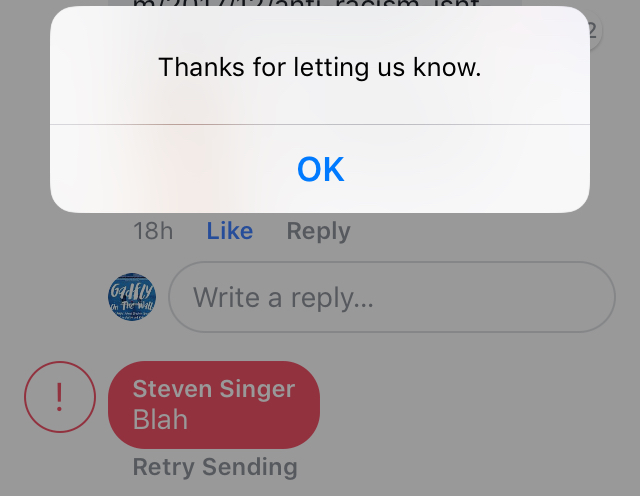
So I clicked on “This is a mistake,” and got the following:


“Thanks for letting us know.”


My only choice was to click “OK.”

IMG_8707

At some point I got a message telling me that I was blocked until Dec. 11 – a full week from my offense.


And now I have limited use of the social media platform.


I can still see posts.


I can like posts.


For some reason, I can even post and comment on my own page. But I can’t comment or post on other pages without getting the same error message.


At least I can’t do it consistently.


I’ve experimented and found that sometimes I can share posts to different pages. Sometimes I can’t.


It’s a bizarre, wonky system.


And it gets in the way of my work as an education blogger.


Facebook has more than 1.5 billion accounts. That includes more than 80% of all Americans.


Sharing my blog on the site gets me more readers than anywhere else.


Twitter is great and certainly more free. But when you push out a tweet, no one sees it unless they’re looking at their feed at that exact moment. Unless it gets retweeted – or you’re a famous unhinged former reality TV star turned President, then people seek out your own personal brand of nuclear-apocalypse-threatening madness.


So why does this keep happening to me?


I have two theories.


1) I am being purposefully censored by Facebook.


2) Facebook algorithms are targeting me because of how I post.


Let’s look at the first theory.


Could someone be actively censoring me?


Yes.


The proposal has a certain plausibility because the powers that be at Facebook undoubtedly disagree with what I have to say.


Mark Zuckerberg, Facebook’s founder, is a huge supporter of edtech, standardized testing and school privatization. He’s spent hundreds of millions of dollars trying to make public schools rely more heavily on high stakes tests, evaluating teachers on their students’ scores and pushing Personalized Education software packages on public schools. And when that doesn’t pan out, he’s even backed his own charter schools to do the same.


But that’s not all.


Since early January of this year, he’s had Campbell Brown on the job as the arbiter of truth for his on-line platform.


That’s right.


Brown, a school privatization lobbyist and former NBC and CNN personality, heads Facebook’s News Partnership Team.


The newly created position was part of Zuckerberg’s attempt to limit fake news on his social media platform while prioritizing information in the mainstream media.


What exactly is fake news? Whatever Campbell Brown says it is.


This is quite a lot of power to give one person, especially someone who has a reputation for partisanship.


Brown, after all, co-founded a charter school propaganda network called The 74, funded – unsurprisingly – by Betsy DeVos, Republican mega-donor and current Secretary of Education.


After leaving the anchor’s desk, Brown has had a second career helping corporations destroy public schools and public school teachers.


And she does. Not. Like. Me.


Let’s just say we’ve gotten into a few Twitter skirmishes.


When she became the face of a New York lawsuit attacking teacher tenure in 2014, she received a tidal wave of public backlash. So she went on the Colbert Report to complain about how those fighting for workplace protections for themselves and their students were “silencing the debate” on how best to reform public education.


I responded with a blog called “Shhh! Who’s Silencing the Debate on Real Education Reform” claiming that Brown was actually doing the very thing she claimed to be decrying in shutting out teachers’ voices and rights.


She responded by cherry picking her rudest critics and tweeting “Sorry Steve but sadly this is not what I characterize as debate,” as if I had had anything to do with these comments.

IMG_8708

As if any movement should be judged by its most extreme elements.


As if attacking someone’s job, someone’s kids and their future was fine so long as you did so with a smile and a polite comeback.


I don’t condone personal attacks, but I certainly understand them. In any case, Brown used the extreme fringes of her critics to condemn us all and conveniently refused to engage us – even those who had been unceasingly polite.


That lawsuit eventually failed, but Brown somehow landed on her feet.


Now she’s the one who gets to choose truth and falsity on Facebook.


Could she be actively working against people like me?


Yes.


Could she be directing Facebook’s programmers to select against posts that are negative to her pet projects?


Yes.


But there’s no way to know if she’s actually doing it.


Which brings me to my second theory.


Perhaps mindless Facebook algorithms are targeting me because of how I post.


I do, after all, try to post my articles on as many pages as I can.


They’re mostly pages focused on education and education policy with a few political and anti-racism sites thrown in, too.


Maybe I’m posting too quickly.


I might be triggering one of Zuckerberg’s bots to think I’m a bot, too, spamming up the works with advertising.


However, there’s a few problems with this theory.


Let’s say it’s true.


Why would that, alone, be reason to block me?


I’m not posting advertisements. I’m not asking for money. My blog doesn’t sell adds other than those WordPress puts on there, itself, so I can keep the page for free.


If an algorithm is stopping me because it thinks I’m unfairly selling something, it’s the result of some badly written code, indeed.


When programmers write code, that’s not impartial. It betrays their values. It betrays certain decisions about what’s acceptable and what isn’t.


For instance, I keep getting advertisements from Facebook asking me to pay money to the social media network so that they’ll post my articles on other people’s site for me.


I get reminders like “Boost this post for $3 to reach up to 580 people.”

IMG_8712

Oh, really?


So I’m blocked because I posted my own writing to sites that have accepted me as a member and whose membership includes many I consider friends and colleagues. But for a fee, Facebook will post that same article to various sites filled with people I’d consider to be complete strangers.


Somehow that doesn’t “violate community standards” – the reason they said they blocked me in October.


This is very telling.


It seems to indicate that there is nothing wrong with what I’m doing, per se. It’s just that Facebook wants to encourage me to let them do it for me – so they can monetize my account.


They’re stopping me from doing this on my own, because they think I’m a sucker who should pay them for the right to communicate with others.


And that’s a very real possibility.


These blockages may not be political. They may be a simple marketing strategy.


So what can I do about it?


Well, first I need to wait a week until my account is unfrozen and I get back all the features Facebook users usually enjoy.


Then I can try to go back to the way things were posting my articles at all my favorite virtual watering holes.


Only slowly.


Much more slowly.


I figure if I only post once every five minutes or so, I can have my article at all the places that seem to like having them in about the course of an evening.


But I have a life, damn it!


I can’t spend the twilight hours posting and waiting and posting and waiting.


I guess another alternative is to rely on friends to post for me.


Spread the love.


Have others circulate my articles far and wide.


And that’s a great strategy. It’s very hard for Facebook to do anything about it.


But it requires me to impose on others. I don’t like doing it.


My readers, friends and supporters have lives, too.


They have more important things to do than post my writing all over the Internet.


So where does that leave me?


I’m not sure.


If I continue as I have, I’m bound to be blocked and thrown in Facebook Jail again.


Even if I don’t, I’m at the mercy of the wealthy elites who control the network.


And if the FCC does away with Net Neutrality, as they’re threatening to do in a matter of days, it may not even matter.


Regardless of where I post on Facebook, my blog site will probably be slow to the point of molasses and maybe even shut down entirely.


This is the brave new world of the plutocracy unrestrained.


This is American fascism triumphant.


I am only a single point of the resistance.


My voice is only as powerful as those who share it.


If Facebook, Twitter or WordPress somehow takes me down, I’ve written a book, “Gadfly on the Wall: A Public School Teacher Speaks Out on Racism and Reform,” now available from Garn Press. Ten percent of the proceeds go to the Badass Teachers Association. Check it out!

book-1

Anti-Racism Isn’t About Making White People Feel Better

Shocked-student


Racism is pretty strong stuff.


It’s a debilitating disease that every white American (even me) suffers from to some degree.


There is no cure.


But it can be treated.


That treatment? Anti-racism.


You don’t want to be racist? Do something to fight the system of oppression. Do something to dismantle white supremacy.


Yet too many white people – well-meaning white people – seem to think that fighting racism is really just about making themselves feel good.


Don’t get me wrong – anti-racism can exhilarate you.


Anytime you do the right thing, your body can reward you with a burst of positive feelings.


And there’s nothing wrong with that.


In fact, it’s nature’s way of positively reinforcing being true to yourself.


However, don’t for one minute conflate this good feeling into an end in itself.


Fighting racism isn’t about you or your feelings.


It’s about ending the systematic oppression of people of color.


It’s about ensuring equal rights and protections under the law.


It’s about fostering understanding and harmony between all peoples.


If that makes you feel good? Great! But that’s not why you should do it.


Some may suggest motivations don’t matter. But they do.


Our reasons for acting in certain ways have subtle effects on what we do and how we do them.


For example, a well-meaning white person might want to engage in a multi-racial discussion group on the issues of racism and prejudice.


Good idea.


But that same well-meaning white person might think a proper topic of conversation in such a group might be how difficult it is for white people to find an acceptable descriptor for black people.


Should I call them black? African American? People of color? What’s correct? No matter what I do I might get called racist. Yet black people can call each other the N-word and no one says anything.


Um. Okay. I can see how this causes confusion. Sometimes I’m uncertain if a certain descriptor will cause offense, too. But my struggle with finding the right word isn’t equivalent to black people calling each other the N-word. Nor is it an occasion to denigrate black folks for coopting a term historically used as a put down and turning it into something altogether positive and new.


The point of communication between racial groups isn’t to throw shade on their cultural norms or even to find an acceptable term with which to label each other. It’s to find ways to work together to equalize everyone’s rights.


Unarmed black folks are killed by the police at a higher rate than white folks. Black people get more severe sentences from the criminal justice system than white people for the same crimes. Children of color are more likely to go to an underfunded school than white kids.


THESE are topics worthy of discussion. These are topics around which you can organize and take action.


What would black folks like us to call them? Jeez. Just ask if you’re uncomfortable, and, white folks, don’t use the N-word. Ever.


In my experience, when you’re in the trenches together fighting racial oppression, few people question your descriptors.


And another thing. When engaged in anti-racism, don’t elevate yourself to a privileged position.


Want to have a multi-racial discussion on racism? Great. But don’t set yourself up as the moderator.


As a white person, you will never know what it’s like to be black. You may have black friends or even relatives. You may – like me – have students who you care about who suffer the effects of racial oppression right before your eyes.


But that doesn’t mean you know from the inside what it’s like.


Even if you’ve been the object of hate because of your religion, nationality, sexuality, social class or any other reason, you don’t quite know what it’s like in this context.


You can and should sympathize. You can and should feel empathy. But you are not the expert here, and you shouldn’t set yourself up as one.


Which brings me to a criticism I sometimes hear about myself: what business do white people have being engaged in this fight at all?


I’m white, after all. What gives me the right to talk about racism?


Well, first of all, it depends on who I’m talking to – who’s my audience.


I never deign to speak down to people of color about the system they live under. I’m not trying to explain oppression to the oppressed.


I’m trying to explain oppression to the oppressor.


I’m talking to white people.


And, for better or for worse, white people tend to have more of an open mind to behavioral criticism coming from another white person than if it comes from a black person.


White supremacy needs to go. White privilege needs to go. But before we can dismantle them, we can use them to aide in their own destruction.


As white allies, we can use the same system that keeps our black and brown brothers and sisters down to help raise them up.


So it’s not only acceptable for white people to address and confront other whites about racism, it is our duty to do so.


That is where we belong in this fight.


It’s not black people’s job to explain racism to white folks. It’s our job.


We must open other white people’s eyes. We must force them to confront a system in which we’re comfortable and privileged.


We must show how our comfort and privilege is unfairly hurting those who are just like us but with an abundance of melanin.


To do so requires recognition of the problem and an honest desire to help.


It requires us to be unselfish.


It requires us to be selfless.


Fighting racism may make us feel like better people, but that is not the reason we do it.


We do it because it’s the right thing to do.


We do it because we want our society to change.


We do it because we honestly care about people of color.

The False Paradise of School Privatization

0*PJpHmJA0FZaqrzd0


Create a perfect world!


Go ahead! Don’t be shy!


What kind of government would you like? Republic, Monarchy, Dictatorship, Anarchy? Some combination or original system?


It’s all up to you.


How would you structure the economy? Capitalistic, Socialistic, Communistic? Something else?


You decide.


What would a family look like in your perfect world? How would careers be prepared for and chosen? What level of technology would you choose?


All these and more must be answered when creating the ideal community for you and I to live in.


It’s what Sir Thomas Moore famously did in his 1516 novel Utopia” about an impossible “best state” for civil society.


And it’s what I had my 7th grade students do last week in preparation for reading Lois Lowery’s contemporary science fiction novel, “The Giver.”


In small groups, my little ones clustered together at their tables and gave social planning a go.


It was stunning the variety of societies they created.


A group of kids with a history of confronting authority designed a nominal anarchy with an inherited monarchy controlling the military. Those with the highest grades decided all the decisions should be made by people like them in an oligarchy while the underachievers just played video games.


One of my favorites though was a group equally divided between boys and girls that decided to let women make all the rules except who could marry whom. That was decided only by the men, but women got to decide when to have kids and how many to have.


It was fascinating to see how their little minds worked. And even more so how their ideal societies reflected their wants and values.


But it was all a preview to Lowery’s novel of a futuristic society where utopia soon descends into its opposite – dystopia.


As it often does. In fact, the word coined by Moore literally means “nowhere.”


So it made me wonder about the most utopian thinking we find in modern life – education policy.


The economists, think tank partisans and lobbyists love to denigrate the public school system and pine for an alternative where corporate interests and business people make all the rules.


Sure they have literally billions of dollars behind them and a gallery of famous faces to give them legitimacy.


But they’re really just engaged in a more high stakes version of Moore’s novel or the assignment my kids did this week.


After all, what is a charter school but some naïve person’s ideal of the perfect educational institution? What’s a voucher school but a theocracy elevated to the normative secular level?


In each case, these world builders do the same as my middle schoolers – they build a system that would be perfect – from their own individual point of views and biases.


In his book, “Utopian Studies: A Guide,” Prof. Gregory Eck writes:


Because… utopia is rooted in theory, it will not always work.  In fact, more is written about the failure and impossibility of utopia than of its success, probably because the ideal has never been reached.


And why is that ideal never reached? Margaret Atwood, the author of more than a few dystopian novels, has an answer.


“Every utopia,” she says, “…faces the same problem: What do you do with the people who don’t fit in?”


One person’s paradise is another person’s Hell.


So the idea of designing one system that fits all is essentially bound to fail.


But doesn’t that support the charter and voucher school ideal? They are marketed, after all, as “school choice.” They allegedly give parents and children a choice about which schools to attend.


Unfortunately, this is just a marketing term.


Charter and voucher schools don’t actually provide more choice. They provide less.


Think about it.


Who gets to choose whether you attend one of these schools? Not you.


Certainly you have to apply, but it’s totally up to the charter or voucher school operators whether they want to accept you.


It is the public school system that gives you choice. You decide to live in a certain community – you get to go to that community’s schools. Period.


Certainly some communities are more accessible than others, and they are more accessible for some people – whether that be for economic, social, racial or religious reasons.


But you have much more choice here than you do from a bunch of nameless bureaucrats making decisions in secret that they never have to justify and for which they will never be held accountable.


What about curriculum? Don’t charter and voucher schools offer choice of curriculum?


No. They have one way of doing things. They have one curriculum. Either accept it or get out.


This is how we do things at KIPP. This is how we do things at Success Academy. You don’t like it, there’s the door.


By contrast, public schools tailor their curriculum to meet the needs of individual students. Each teacher does something different for every child in his or her charge whether those children are in special education, regular education, Emotional Support, the English as a Second Language Program, the academic or honors track.


Charter and voucher schools are naive utopias.


They propose one ideal way to teach all children and they expect parents to jump at their cultish schemes. All students will wear these sorts of uniforms and chant these sorts of phrases in response to these orders, etc. All children will be expected to provide marketing research to corporations on competency based learning programs and let their data be mined by these advertisers.


Because at these schools the emphasis is not on the curriculum. It’s on the system, itself.


These are privatized schools. They are schools run by private industry – not the public.


Decisions are not made by duly-elected representatives of the community in the light of day. They are made behind closed doors by corporate stooges.


THAT is the great innovation behind these schools. Everything else is mere window dressing.


If one of these schools found a better way to teach, public schools could pick it up and do it even better because the teachers and principals would be accountable for doing it correctly.


Funny how that’s never happened.


These so-called lab schools have never produced a single repeatable, verifiable innovation that works for all students without cherry picking the best and brightest.


Not once.


That’s because the utopia these policy wonks are interested in building isn’t for the students or parents. It’s for the investors.


They want to maximize return on investment. They want to decrease costs and increase profits. And whatever happens to the students is purely secondary.


It may be the ideal situation for the moneymen, but it’s often pure torture for the students. Charter schools are closed without notice, the money stolen under cloak of night. Voucher schools fool kids into thinking creationism is science and then are no where to be found when reputable colleges want nothing to do with their graduates.


Let me be the first to say that public school is no utopia.


We have real problems.


We need adequate, equitable and sustainable funding. We need integration. We need autonomy, respect and competitive pay for teachers. We need protection from corporate vultures in the standardized testing, publishing, edtech and school privatization industries.


But at heart, public schools are a much better choice because they don’t pretend to be perfect.


They are constantly changing. Teachers are constantly innovating.


A handful of years ago, I never had students design their own utopias before reading “The Giver.” But a colleague came up with the idea, I modified it for my students and we were off.


If I teach the same course next year, I’d modify it again based on what worked and what didn’t work this year.


I’m not expecting to be perfect.


I’m just doing the best I can.


Or as Jack Carroll puts it:


Perhaps the greatest utopia would be if we could all realize that no utopia is possible; no place to run, no place to hide, just take care of business here and now.


NOTE: A version of this article originally was published under the title “Creating a Charter or Voucher School is Like Designing a Utopia – Biases Prevail.” I reworked some of it, including the title, because I thought readers were confused by my intent and may have passed it over under a mistaken assumption about its contents.


Like this post? I’ve written a book, “Gadfly on the Wall: A Public School Teacher Speaks Out on Racism and Reform,” now available from Garn Press. Ten percent of the proceeds go to the Badass Teachers Association. Check it out!
book-3

“We Want Our Money Back!” – The Rallying Cry of the 99% After GOP Tax Scam Passes Senate

resist_1

We want our money back!

Every penny!

With interest!

Do you hear us, Republican Senators?

Early this morning while most of us slept, you passed a $1.5 trillion tax giveaway to the wealthiest people in America!

And you did it 51-49 with only one Republican, Bob Corker of Tennessee, joining all Democrats against it.

This was a 500 page piece of lobbyist-written legislation hastily put together – in some cases scribbled in pen across type written pages – that no one had a chance to read before voting.

I am no fan of the corporate Democrats who have taken over what used to be a progressive party. But we can’t blame them for this one.

This scandal belongs entirely on the shoulders of Republicans.

The Dems even offered a resolution to delay the vote so that legislators had a chance to read it. All 52 Republicans voted against it!

This is what happens when the people lose control of their government.

This is what happens when the rich control lawmakers with their money.

There is no longer any doubt that we no longer live in a Republic. We no longer have any form of representative Democracy. We live in a pure plutocracy.

The rich pay the representatives and the representatives do what the rich want.

The wealthy are their real constituents. We are merely patsies told polite falsehoods to keep us in line.

You have no political power.

None.

Governments get their legitimacy from the consent of the governed.

You did not give your consent to give away more than a trillion dollars to rich douchebags who don’t need it. But Republicans gave it to them anyway.

Therefore, our government has no legitimacy.

We are an occupied people.

We are the victims of a palace coup.

The question remains if there is even a semblance of democratic principles left to allow us to regain what has been stolen.

The present plutocracy is weak. It has not had time enough to consolidate its power.

The old plan of gradually stealing control under cover of neoliberal policies has been abandoned. This is a naked power grab.

Perhaps it will be the jolt we need to snap us all awake.

Perhaps it will be enough to move the 99% to grab what little remains of the system set up by Washington, Jefferson, Madison, Hamilton and the other founders.

We must rise up and demand these crooks pay us back.

“We want our money back!” should be our rallying cry.

If there are any lawmakers left in the halls of power that want to represent us, they should take a page from the GOP handbook.

How many times did Republicans propose overturning Obamacare regardless of whether they had the votes or the power to do so?

We must do the same with this tax scam bill.

At every turn, we should propose repealing the bill and forcing the wealthy to pay back every red cent they stole! With interest!

It doesn’t matter if it won’t pass. Do it.

Clog the wheels of power with our cries. Don’t let them do a single thing more to make the lives of the majority of the population worse.

Democrats, now is your last chance to show us where you really stand.

You and I both know that if the Republicans had offered even the slightest concessions, many Dems would have voted for almost the same tax scam bill. It would have been a terrible piece of legislation that stole banks full of money from you and me. But it wouldn’t have been quite as terrible.

Frankly, that’s not enough, Democrats.

You aren’t to blame for what just happened, but you haven’t proven yourselves to be part of the solution.

If you want our continued support, you need to move to the left. HARD!

The masses have been stoked and stirred by this scandal. The political landscape has never been more primed for a landslide against the ruling class.

Democrats could take advantage of this and earn a blue wave next year.

But this will only happen if you run candidates that are willing to fight on our side in the class war that has already begun.

Bernie Sanders is great, but let’s be honest. He’s kinda elderly, and he’s a moderate.

That’s right. “Crazy” Bernie with his “kooky” socialist ideas is in the middle of any sane political spectrum. He only seems like a radical because of how far to the right the spectrum has shifted in this country.

We need real progressives who aren’t afraid to take on the establishment and fight inequality, police brutality, white supremacy, school privatization and a host of ills that – frankly – Democrats have historically championed almost as much as Republicans.

The pieces are all lined up. The board is ready to play.

We will support anyone who supports us.

We are coming for Republicans.

They will be repealed and replaced.

We will get back every penny they just stole last night. And we will grab every Richy Rich plutocrat by the heels, turn them upside down and shake until we get back every penny they took – with interest.

We will wring every last drop of Democracy we can from this government.

And if we find that there is not enough left…

History has an answer for what comes next.

Americans don’t take kindly to taxation without representation.

And that’s exactly what Republicans gave us this morning.


Like this post? I’ve written a book, “Gadfly on the Wall: A Public School Teacher Speaks Out on Racism and Reform,” now available from Garn Press. Check it out!

book-3

Creating a Charter or Voucher School is Like Designing a Utopia – Biases Prevail

IMAG8858


Create your own Utopia!


Go ahead! Don’t be shy!


What kind of government would you like? Republic, Monarchy, Dictatorship, Anarchy? Some combination or original system?


It’s all up to you.


How would you structure the economy? Capitalistic, Socialistic, Communistic? Something else?


You decide.


What would a family look like in your perfect society? How would careers be prepared for and chosen? What level of technology would you choose?


All these and more must be answered when creating the ideal community for you and I to live in.


And that’s exactly what I had my 7th grade students do this week in preparation for reading Lois Lowery’s science fiction novel, “The Giver.”


In small groups, my little ones clustered together at their tables and gave social planning a go.


It was stunning the variety of societies they created.


One group had a nominal anarchy with an inherited monarchy controlling the military. Another had an oligarchy of the smartest people who got the best grades to make all the decisions while everyone else played video games.


One of my favorites though was a group who decided to let women make all the rules except who could marry whom. That was decided only by the men, but women got to decide when to have kids and how many to have.


It was fascinating to see how their little minds worked.


But it was all a preview to Lowery’s novel of a futuristic society where utopia soon descends into dystopia.


As it often does.


So it made me wonder about the most utopian thinking we find in modern life – education policy.


The economists, think tank partisans and lobbyists love to denigrate the public school system and pine for an alternative where corporate interests and business people make all the rules.


Sure they have literally billions of dollars behind them and a gallery of famous faces to give them legitimacy.


But they’re really just engaged in a more high stakes version of the assignment my kids did this week.


After all, what is a charter school but some naïve person’s ideal of the perfect educational institution? What’s a voucher school but a theocracy elevated to the normative secular level?


In each case, these world builders do the same as my middle schoolers – they build a system that would be perfect – from their own individual point of view.


In his book, “Utopian Studies: A Guide,” Prof. Gregory Eck writes:


Because… utopia is rooted in theory, it will not always work.  In fact, more is written about the failure and impossibility of utopia than of its success, probably because the ideal has never been reached.


And why is that ideal never reached? Margaret Atwood, the author of more than a few dystopian novels, has an answer.


“Every utopia,” she says, “…faces the same problem: What do you do with the people who don’t fit in?”


One person’s paradise is another person’s Hell.


So the idea of designing one system that fits all is essentially bound to fail.


But doesn’t that support the charter and voucher school ideal? They are marketed, after all, as “school choice.” They allegedly give parents and children a choice about which schools to attend.


Unfortunately, this is just a marketing term.


Charter and voucher schools don’t actually provide more choice. They provide less.


Think about it.


Who get to choose whether you attend one of these schools? Not you.


Certainly you have to apply, but it’s totally up to the charter or voucher school operators whether they want to accept you.


It is the public school system that gives you choice. You decide to live in a certain community, you get to go to that community’s schools. Period.


Certainly some communities are more accessible than others, and they are more accessible for some people than others – whether that be for economic, social, racial or religious reasons.


But you have much more choice here than you do from a bunch of nameless bureaucrats making decisions in secret that they never have to justify and for which they will never be held accountable.


What about curriculum? Don’t charter and voucher schools offer choice of curriculum?


No. They have one way of doing things. They have one curriculum. Either accept it or get out.


This is how we do things at KIPP. This is how we do things at Success Academy. You don’t like it, there’s the door.


By contrast, public schools tailor their curriculum to meet the needs of individual students. Each teacher does something different for every child in his or her charge whether those children are in special education, regular education, Emotional Support, the English as a Second Language Program, the academic or honors track.


Charter and voucher schools are naive utopias.


They propose one ideal way to teach all children and they expect parents to jump at their cultish schemes. All students will wear these sorts of uniforms and chant these sorts of phrases in response to these orders, etc. All children will be expected to provide marketing research to corporations on competency based learning programs and let their data be mined by these advertisers.


Because at these schools the emphasis is not on the curriculum. It’s on the system, itself.


These are privatized schools. They are schools run by private industry – not the public.


Decisions are not made by duly-elected representatives of the community in the light of day. They are made behind closed doors by corporate stooges.


THAT is the great innovation behind these schools. Everything else is mere window dressing.


If one of these schools found a better way to teach, public schools could pick it up and do it even better because the teachers and principals would be accountable for doing it correctly.


Funny how that’s never happened.


These so-called lab schools have never produced a single repeatable, verifiable innovation that works for all students without cherry picking the best and brightest.


Not once.


That’s because the utopia these policy wonks are interested in building isn’t for the students or parents. It’s for the investors.


They want to maximize return on investment. They want to decrease costs and increase profits. And whatever happens to the students is purely secondary.


It may be the ideal situation for the moneymen, but it’s often pure dystopia for the students. Charter schools are closed without notice, the money stolen under cloak of night. Voucher schools fool kids into thinking creationism is science and then are no where to be found when reputable colleges want nothing to do with their graduates.


Let me be the first to say that public school is no utopia.


We have real problems.


We need adequate, equitable and sustainable funding. We need integration. We need autonomy, respect and competitive pay for teachers. We need protection from corporate vultures in the standardized testing, publishing, edtech and school privatization industries.


But at heart, public schools are a much better choice because they don’t pretend to be perfect.


They are constantly changing. Teachers are constantly innovating.


A handful of years ago, I never had students design their own utopias before reading “The Giver.” But a colleague came up with the idea, I modified it for my students and we were off.


If I teach the same course next year, I’d modify it again based on what worked and what didn’t work this year.


I’m not expecting to be perfect.


I’m just doing the best I can.


Or as Jack Carroll puts it:


Perhaps the greatest utopia would be if we could all realize that no utopia is possible; no place to run, no place to hide, just take care of business here and now.


Like this post? I’ve written a book, “Gadfly on the Wall: A Public School Teacher Speaks Out on Racism and Reform,” now available from Garn Press. Check it out!

book-3

Killing Net Neutrality Would Muzzle Many Teacher-Activists 

thumbnail_c7tcqv4e6khwocrbse2l

As a blogger, I’m a big fan of net neutrality.

If the communications giants get to favor or block particular Websites, people-powered blogs like this one probably would become isolated and irrelevant.

As it stands, the Federal Communications Commission (FCC) is expected to vote Dec. 14 to undo strict regulations on Internet service providers like Comcast and Verizon that stops them from slowing down or blocking any sites, apps, or otherwise deciding which content gets to users faster.

If the Republican controlled five-member committee votes as expected, it would muzzle free speech.

It would effectively stifle hundreds, thousands of grassroots activists who’ve taken to the Web to educate and protest against the plutocracy strangling our democratic freedoms.

Think about it.

Close your eyes and imagine a United States where you couldn’t access your favorite Websites without paying a fee or – as in China – maybe even at all.

Want to know why standardized testing is harming our children and their schools? Sorry. That costs extra.

Want to know why Betsy Devos’ latest plan to give your tax dollars to Roy Moore’s Christian Fundamentalist Middle School and Dating Center endangers child welfare? Sorry. That information is no longer available.

Sure, you could probably look it up in the library and find it in a book, but that requires a complete change in how we consume media.

Most of us get our news on-line. We don’t read paper newspapers or glossy photo-print magazines. Books, when we read them, are often occasional pleasures or e-texts.

Searching out such material would take a paradigm shift back to the way we used to do things 10 or 20 years ago. It wouldn’t be impossible, but it would be onerous.

Remember traveling everywhere with a pile of books weighing down your bag, or a newspaper and magazines folded under your arm? People seeking such information would really need to want it.

Moreover, articles published in this way would almost surely become out of date quickly at least in regards to particulars. You can easily write something about the evils of charter and voucher schools in general that will be true for years if not decades, but it won’t as easily apply to individual charter and voucher schools by the time it’s published and been on the shelf for a while.

Additionally, writing and publishing such articles would become increasingly more difficult. Unless individuals or groups of activists bought up archaic printing presses or somehow funded mass media campaigns at Kinko’s and there were likewise an as yet undiscovered distribution engine that could disperse such periodicals across the country and the world – unless all of that, the resistance would be relegated to mostly scholarly tomes.

Take it from me: writing a book is not easy.

I just published my first volume of some of my best blog articles for Garn Press called “Gadfly on the Wall: A Public School Teacher Speaks Out on Racism and Reform.”

I am embarrassingly proud of it, but this would not work for everyday activism.

Even though most of the articles were already written, it took a team of us months to revise them, insert end notes, edit, format, design a cover, market and all the other multidinous things that go into the process.

Whereas, with a blog, I can just write it and press “publish.”

The result isn’t as neat. It isn’t as error-proof. There’s bound to be spelling and grammar problems. It doesn’t pack nearly the authoritative punch. —But it’s so topical and subversive that it can slice through steel.

Campbell Brown can’t publish a billionaire-funded diatribe against those greedy teachers and their damn unions and their precious tenure without an army of teachers taking to the Web and showing her the error of her ways.

Bill Gates can’t send his well-paid trolls off to write op-eds praising Common Core without a grassroots tsunami of educators, parents and students responding with scores of counternarratives throughout the blogosphere.

And it’s net neutrality that allows us to do it.

The democratization of information made possible by the free Internet has greatly empowered the voices of the wise but penurious.

You no longer need a printing press or a think tank or a media empire to get information before the public.

Sure this means that even the lunatic fringe gets a voice in the conversation that is American culture, but it also allows ideas to win or lose based more on merit than money.

If enough people share an article on-line, it gets read. People see it. They know it.

False information is eventually found out, disproven and neutralized. But a factually-based critique of bad policy? That can move mountains. It can change the world.

And it has!

Think of how even neoliberal policymakers have rushed to claim they’re in favor of reducing standardized testing. Longtime standardization supporters like former President Barack Obama had to distance themselves from their own policies or face the torches and pitchforks of moms and dads everywhere.

Think of how Democratic and Republican partisans clamored over each other to denounce Common Core. Heck! The movement was so successful President Donald Trump even jumped on the bandwagon and used it as a rallying cry to help install himself in office.

And think of how the reaction to Trump’s dismal and dimwitted Education Secretary, Devos, caused a stampede away from school vouchers and even to some extent charter schools. Even longtime champions of privatization like Jeb Bush and Cory Booker are afraid to offer even a tentative thumbs up for fear of the Web’s blitzkrieg of Tweets, Facebook posts, blogs and other shade.

None of this would be possible without the Internet and the blogosphere.

None of this would be possible without net neutrality.

It’s no wonder Trump and his cronies want to destroy it. The open communication and debate on the Internet is a clear and present danger to his policies.

It is dangerous to the neoliberals and conservative fascists alike.

Though the movement fighting against corporate education reform has been rightly critical of unlimited technology for technology’s sake in our classrooms, that same confederation owes a great debt to technology for its current power.

We meet on Facebook and plan actions to be conducted IRL – In Real Life. Groups like the Badass Teachers Association, the Network for Public Education and United Opt Out use the technology to spread truth and question authority.

If the life line of net neutrality is severed, so will much of our activist networks.

I know we’re all concerned about competency based education, Teach for America and toxic testing, but we have to make room for net neutrality, too.

The 99% rely on it for the free exchange of ideas and the unhindered expression of our speech.

If the Trump administration crushes that venue, it will seriously weaken our ability to resist.

So before that day comes, exercise your rights.

Raise your voice for net neutrality – before it’s too late.


Please go to www.gofccyourself.com and urge the FCC to keep Net Neutrality.

Public School Teachers Are Absent Too Much, Says Charter School Think Tank

school-shadows


Have you ever heard of media bias?

I don’t think many so-called journalists have.

At least their editors haven’t or perhaps they just don’t care.

Otherwise, why would self-respecting hard news purveyors publish the results of a study by charter school cheerleaders that pretends to “prove” how public school teachers are worse than charter school teachers?

That’s like publishing a study denigrating apples written by the national pear council.

 
Breaking news: Pepsi says, “Coke sucks!”

In a related story McDonalds has startling evidence against the Burger King!

THIS IS NOT NEWS!

THIS IS PROPAGANDA!

I know it’s become trendy to defend the media when our lame-ass President attacks every factually-based report that puts him in a bad light as “fake news.” But the giant media conglomerates aren’t doing themselves any favors with lazy reporting like this.

And I know what many journalists are thinking when they do it, because I used to be one:

I’ll publish the report and include dissenting opinions and that will be okay because I will have shown both sides and readers can make up their own minds.

But what’s the headline? What’s the spin? Who is David in this story and who is Goliath? When multiple stories like this appear all over the news cycle, what impression is made on your readers?

It’s the same thing with climate science. Ninety seven percent of climate scientists say global climate change is man-made and happening. Yet the news gives us one scientist and one crank climate denier and pretends like that’s fair and balanced.

And here we get one biased neoliberal think tank vs. millions of public school teachers all across the country and since you’ve given us an equal number to represent each side, you pretend THAT’S fair and balanced.

It isn’t.

But who’s paying your advertising revenue?

Who owns the media conglomerates that publish your articles?

Often the same people publishing bullshit reports like this one. That’s who.

No wonder they get so much coverage!

So here’s the deal.

The Fordham Institute wrote a report called “Teacher Absenteeism in Charter and Traditional Public Schools.” They concluded that 28.3 percent of teachers in traditional public schools miss eleven or more days of school versus 10.3 percent of teachers at charter schools.

To come up with these figures they used data from Betsy Devos’ Department of Education.

So let the hand-wringing begin!

Look how bad public school teachers are and how much more dedicated is the charter school variety! Look at how much money is being lost! Look at the damage to student academic outcomes!

Won’t someone think of the children!?

WHY WON’T SOMEONE PLEEEEAAASSSEEE THINK OF THE CHILDREN!!??

This report brought to you by the Bill and Melinda Gates Foundation, Bloomberg Philanthropies, the Eli and Edythe Broad Foundation, the College Board, Education Reform Now, the Walton Family Foundation and a host of other idle rich philanthrocapitalists who are drooling over the prospect of privatizing public schools and hoovering up public money as private profit.

Oh. If that’s not enough, Fordham actually runs a series of charter schools in Ohio.

Biased much?

So what’s wrong with the report?

First of all, it’s not news.

Neoliberal think tanks have been publishing propaganda like this for at least a decade. Play with the numbers here, look only at this data and we can paint a picture of “failing” schools, “failing” teachers and therefore justify the “need” for school privatization.

Second, look at all the important data Fordham conveniently leaves out.

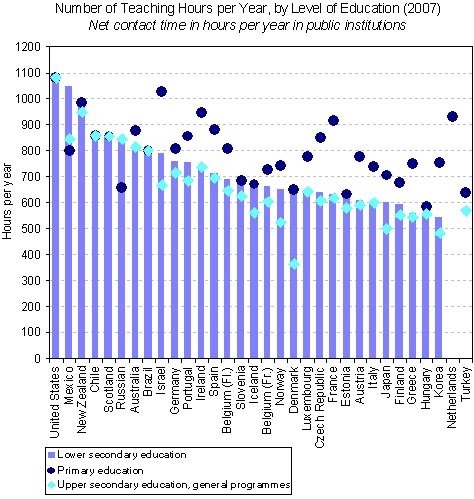
Look at the number of hours public school teachers work in the United States vs. those in other comparable countries, say those included in The Organization for Economic Cooperation and Development (OECD).

In fact, the OECD (which is not biased one way or another about American school privatization) released a mountain of statistics about how many hours teachers work in various countries.

The result: in the United States teachers on average spend more time teaching and receive less pay than those in other countries.

American teachers spend on average 1,080 hours teaching each year. Across the O.E.C.D., the average for most countries is 794 hours on primary education, 709 hours on lower secondary education, and 653 hours on upper secondary education general programs.


teachingtime
Source: OECD


Yet American teachers start at lower salaries and even after 15 years in the profession, earn less money than their international counterparts.

So – assuming Fordham’s absenteeism statistics are accurate – why do public school teachers miss so much school? They’re exhausted from the hours we demand they keep!

But what about charter school teachers? Aren’t they exhausted, too?

Some certainly are.

Working in a charter school often requires grueling hours and fewer benefits. That’s why charters have a higher turnover than public schools.

Since they’re often not unionized, charter schools usually have younger, less experienced staff who don’t stay in the profession long. In fact, they rely on a constant turnover of staff. At many of the largest charter chains such as Success Academy and the Knowledge is Power Program (KIPP), teachers average only 4 years before moving on to another career, according to the New York Times. And this is typical of most charter chains.

So why don’t charter school teachers take as many sick days as traditional public school teachers? Maybe because when they check out, they often don’t check back in.

Moreover, there is a significant difference in the student population at both kinds of school – privatized vs. public.

As their marketing departments will tell you, the students in a charter school choose to be there. The charter schools often weed out the students with behavior problems, special needs or those who are otherwise more difficult to teach. As a result, the strain on teachers may not be as severe. When you’re only serving kids who want to be there and who are easy to teach, maybe you don’t need as much downtime.

Public school teachers, on the other hand, face real dangers from burnout.

According to a study by Scholastic (that actually goes counter to its pro-privatization bias), we work 53 hours a week on average. That comes out to 7.5 hours a day in the classroom teaching. In addition, we spend 90 minutes before and/or after school mentoring, tutoring, attending staff meetings and collaborating with peers. Plus 95 additional minutes at home grading papers, preparing classroom activities and other job-related tasks.

And for teachers who oversee extracurricular clubs, that’s even more work – 11-20 additional hours a week, on average.

Add to that the additional trauma public school children have experienced over the last decade. More than half of public school students now live below the poverty line. That means increased behavior issues, increased emotional disturbances, increased special needs, increased malnutrition, increased drug use – you name it.

Public school teachers deal with that every day. And you seriously wonder that some of us need some downtime during the year to deal with it.

Moreover, let’s not forget the issue of disease.

Working in a public school is to immerse yourself in a petri dish of bacteria and viruses. My first year teaching, I got so sick I was out for weeks until I developed immunities to strains of illnesses I had never been exposed to before.

Kids are constantly asking for tissues and blowing their noses and sometimes not even washing their hands. This is why teachers often purchase the tissues and hand sanitizers that school districts can’t or won’t – we’re trying to stop the spread of infection.

When teachers get sick (and often bring these delightful little maladies home to their spouses, children and families) what do you expect them to do? Continue going to work and further spreading the sickness around to healthy children?

And speaking of illness, let’s talk stress.

Stress is a killer. Do you think pushing the responsibility for the entire school system on to teachers while cutting their autonomy has an effect on teachers individual stress levels?

I can tell you from my own personal experience I had two heart attacks last year. And in the 15 years I’ve been a teacher, my health has suffered in innumerable ways. I’m actually on medication for one malady that makes me immunosuppressed and more susceptible to other illnesses.

So, yeah, sometimes I need to take a sick day. But if you ask most teachers, they’d rather stay in the class and work through it.

Having the day off is often more trouble than it’s worth. You have to plan an entire lesson that can be conducted in your absence, you have to give the students an assignment to do and you have to grade it. Even with the day off, you have a mountain of work waiting for you when you return.

So as a practicing public school teacher, I dispute the findings of the Fordham Institute.

They don’t know what they’re talking about.

They have focused in on data to make their chosen targets, public school teachers, look bad while extolling the virtues of those who work in privatized systems.

There is a manufactured shortage of teachers across the country. We’ve got 250,000 fewer teachers in the classroom than we did before the great recession of 08-09. Yet class enrollment has increased by 800,000 students.

So if we wanted today’s students to have the same experience as those of only a decade ago, we’d need to hire at least 400,000 more teachers.

I wonder why college undergraduates aren’t racing to become education majors. I wonder why there aren’t more incentives to get more teachers in the classroom and why there isn’t a boom of more teaching jobs.

And I wonder why reports like this are talked about as if they were anything but what they are – school privatization propaganda.

The Completely Avoidable Teacher Shortage and What To Do About It

teachers-wanted_slide-f490f6ba4043bb11d14c641c5fd6a253f638a74b-s900-c85

Hello?

Lo-lo-lo-lo…

Is anybody here?

Ere-ere-ere-ere…

Is anyone else left? Am I the only one still employed here?

Somedays it feels like it.

Somedays teaching in a public school is kind of like trying to run a resort hotel – ALL BY YOURSELF.

 
You’ve got to teach the classes and watch the lunch periods and cover the absences and monitor the halls and buy the pencils and tissues and fill out the lesson plans and conduct the staff meetings and…

Wouldn’t it be better if there were more people here?

I mean seriously. Why do we put the entire responsibility for everything – almost everything – involved in public education and put it all on the shoulders of school teachers?

And since we’re asking questions, why do we ALSO challenge their right to a fair wage, decent healthcare, benefits, reasonable hours, overtime, sick leave, training, collective bargaining… just about ANYTHING to encourage them to stay in the profession and to get the next generation interested in replacing them when they retire?

Why?

Well, that’s part of the design.

You see today’s public schools employ 250,000 fewer people than they did before the recession of 2008–09. Meanwhile enrollment has increased by 800,000 students.

So if we wanted today’s children to have the same quality of service kids received in this country only a decade ago, we’d need to hire almost 400,000 more teachers!

Instead, our children are packed into classes of 25, 30 even 40 students!

There’s no way a single teacher can give all those children her undivided attention at all times. There’s no way she can provide them with the kind of individualized instruction we know kids need in order to fulfill their potentials.

So why did we let this happen? Why do we continue to let this happen?

First, you have to understand that there are two very different kinds of public school experience. There is the kind provided by the rich schools where the local tax base has enough money to give kids everything they need including small class sizes and hiring enough teachers to get things done efficiently. And there’s the poor schools where the majority of our kids get educated by the most dedicated put upon teachers who give 110% everyday but somehow can’t manage to keep all those plates spinning in the air at the same time so the media swoops in, wags its finger and proclaims them a “failure.”

Bull.

It’s not teachers who are failing. It’s a system that stacks the deck against them and anxiously anticipates them being unable to meet unfair and impossible expectations.

Why do we let THAT happen?

Mainly because the people with money don’t care about poor and middle class children.

But also because they see the supposed failure of public schools as a business opportunity.

This is a chance to open a new market and scoop up buckets of juicy profit all for themselves and their donors.

It’s called privatized education. You know – charter schools and vouchers schools. Educational institutions not run by the public, not beholden to elected officials, but instead by bureaucrats who have the freedom to act in the shadows, cut student services and pocket the savings.

THAT’S why there’s a teacher shortage.

They want to deprofessionalize the job of teaching.

They don’t want it to be a lifelong career for highly trained, creative and caring individuals.

Why?

Those are people they have to pay a living wage. Those are people who know a thing or two and might complain about how the corporate scheme adversely affects the children in their care.

That’s why!

So these business people would rather teaching become a minimum wage stepping stone for young adults before they move on to something that pays them enough to actually support themselves and their families.

And to do that, the powers that be need to get rid of professional teachers.

People like me – folks with national board certification and a masters degree – they need to go.

THAT’S why class sizes are so large. That’s why so few young people are picking teaching as a major in college.

It’s exactly what the super-rich want.

And it doesn’t have to be some half mad Mr. Burns who makes the decisions. In my own district, the school board just decided to save money by cutting middle school math and language arts teachers – the core educators who teach the most important subjects on the standardized tests they pretend to value so much!

I’m under no illusions that my neighborhood school directors are in bed with the privatization industry. Some are clueless and some know the score. But the decision was prompted mostly by need. We’re losing too many kids to the local charter school despite its terrible academic track record, despite that an army of kids slowly trickle back to us each year after they get the boot from the privatizers, our district coffers are suffering because marketing is winning over common sense.

So number crunching administrators had a choice – straighten their backbones and fight, or suggest cutting flesh and bone to make the budget.

They chose the easier path.

As a result, middle school classes are noticeably larger, teachers have been moved to areas where they aren’t necessarily most prepared to teach and administrators actually have the gall to hold out their clipboards, show us the state test scores and cluck their tongues.

I actually heard an administrator this week claim that my subject, language arts, counts for double points on the state achievement rubric. I responded that this information should be presented to the school board as a reason to hire another language arts teacher, reduce class sizes and increase the chances of boosting test scores!

That went over like a lead balloon.

But it demonstrates why we’ve lost so much ground.

Everyone knows larger class sizes are bad – especially in core subjects, especially for younger students, especially for struggling students. Yet no one wants to do anything to cut class sizes.

If the state and federal government were really committed to increasing test scores, that’s the reform they would mandate when scores drop. Your kids aren’t doing as well in math and reading. Here’s some money to hire more teachers.

But NO.

Instead we’re warned that if we don’t somehow pull ourselves up by our bootstraps, they’ll close our school and give it to a private company to run – as if there were any evidence at all that this would help.

But, the school privatization cheerleader rebuts, why should we reward failing schools with more money?

The same reason you reward a starving stomach with more food. So the hungry person will survive!

Right now you’re doing the same thing with the testing corporations. They make the tests and grade the tests. So if students fail, the testing corporations get more money because then students have to take — MORE TESTS! And they are forced to take testing remediation classes that have to buy testing remediation materials produced by – wait for it – the same companies that make and grade the tests!

It’s a scam, ladies and gentlemen! And anyone who looks can see it.

But when you bring this up to administrators, they usually just nod and say that there’s nothing we can do about it. All we can do is keep trying to win the game – a game that’s rigged against us.

That’s exactly the attitude that’s gotten us where we are.

We can’t just keep doing it, keep appeasing the testing and privatization industry and their patsies in the media and government.

We must fight the system, itself, not go along with it.

We need to get on a bus and go to the state capital and Washington, DC, as a staff and protest. We need our school boards to pass resolutions against the unfair system. We need class action lawsuits. We need to tell everyone in the media what we know and repeat it again and again until it becomes a refrain.

And when we get these unfair evaluations of our under-resourced impoverished and multicultural districts, we need to cry foul. “Oh look! Pearson’s tests failed another group of mostly brown and black kids! I wonder what they have against children of color!”

Force them to change. Provide adequate, equitable and sustainable funding so we can hire the number of teachers necessary to actually get the job done. Make the profession attractive to the next generation by increasing teacher pay, autonomy, resources and respect. And stop evaluating educators with unproven, disproven and debunked evaluation schemes like value-added measures and standardized test scores. Judge them on what they do and not a trussed up series of expected outcomes designed by people who either have no idea what they’re talking about or actively work to stack the deck against students and teachers.

But most of all — No more going along.

No more taking the path most traveled.

Because we’ve seen where it leads.

It leads to our destruction.

Black Progress Does Not Come At White Expense

People of different races hold hands as they gather on the Arthur Ravenel Jr. bridge in Charleston


Relax, white people.


Take a breath.


It’s okay.


America survived its first black President.


You didn’t have to freak out and elect a neo-authoritarian-pseudo-populist!


Holy Crap!


Donald Fucking Trump!


Talk about an over-reaction!


But I get it.


You’re scared.


You’re used to the faces of authority being white and male. Yet for eight whole years you had to endure Barack Obama – a far from perfect neoliberal politician, who none-the-less gave the U.S. the most stable two terms in decades.


And then you were asked to vote for a white face (sigh!) that unfortunately was attached to breasts and a vagina! Oh the horror!


Seriously, white people. Sit the fuck down and listen to some sense.


You don’t need white supremacy.


You don’t need male supremacy.


You can function just fine in a world where people of color and women have the same rights as you and yours.


I know. Sounds crazy! But it’s true.


Think about it.


Let’s say unarmed black people were no longer killed by police at a higher rate than white people.


Would that hurt you?


I don’t think so. In fact, it might actually help, because then we could focus on the fact that police in this country kill far too many unarmed people – of any race – than they should. In most countries, they make lots of arrests but kill almost no one. Here, they kill hundreds – thousands!


We need to demilitarize law enforcement. We need new training programs that emphasize de-escalation of violence – not a shoot-first-ask questions-later mentality.


And it’s hard to focus on that when racism and prejudice get in the way. We need to fix racism first. Only then can we address the root issue.


Here’s another example.


Let’s say we had truly integrated public schools.


No run down under-resourced schools that just happen to serve mostly students of color and yet across town we’ve got the Taj Mahal with marble columns and a broad curriculum that just happens to serve the best and whitest.


Instead we’d have schools that serve everyone – a broad mix of cultures, races and ethnicities all properly resourced and offering a broad range of curriculum and extra-curricular activities.


Would that hurt you?


I don’t think so. In fact, it would actually help because every child would get what he or she needs to succeed. Crime would drop, and even prejudiced and racist attitudes would begin to disappear because it’s harder to hold xenophobic views about people who you actually know because you’ve learned everything with them since you were in kindergarten.


There’s one thing you have to understand. Racism isn’t an ideology. It’s a sickness. It’s a virus that blinds people to real truths about the world and makes them more prone to holding views that are just plain wrong.


The same with sexism, anti-Semitism, homophobia and a plethora of modern day maladies that should have gone the way of small pox and polio.


Inoculating yourself against prejudice will not hurt you. Living in a society where everyone has the same rights doesn’t impinge on those you already have.


Yes, it will mean dismantling white supremacy. But that’s a good thing. You don’t really want the world to prize you just because of the color of your skin.


Do you?


Do you want to get into college just because you’re white?


Do you want to get a job just because of the hue of your epidermis?


Do you want the sum total of your value as a human being to be dependent on the way light reflects off your skin?


I don’t.


I’m white, and I don’t want that for me or my posterity.


I want people to judge me for me – not some preconceived notion of who I am based on culturally received generalities and the amount of melanin in my outermost cells.


Fuck that shit.


I’m me. And if that’s not good enough for anyone they can just go and jump in the river.


I don’t need white supremacy. And I don’t want it.


I refuse to sit back and accept things I don’t deserve while others are denied what they do deserve just so I can get some free stuff.


I refuse to let my society continue to be built on a foundation of prejudice and cruelty.


We’re all human beings. It’s time we treated everyone as such.


That means everyone gets the same human rights.


To paraphrase Oprah – YOU get human rights, and YOU get human rights and EVERYONE gets human rights!


For white people that means losing a certain sense of normativity.


White will no longer be considered normal. Neither will male.


It’s just another way to be – no better or worse than any other.


That doesn’t mean being ashamed of your whiteness. Hell. We can revel in it.


Imagine reconnecting with all the messy ethnicities we’ve plastered over to claim this homogenous white overclass! Imagine being Polish again, and Czech and German and Scandinavian and so many other nationalities that we barely connect with because we don’t want to draw attention to ourselves as anything other than white — That’s me. Just white. Plain white. Nothing to see here. White.


We’ve had to sacrifice a whole lot to get that status. But we don’t have to keep sacrificing. We can be who we are, too.


The Alt-Right Nazis are out there in the streets chanting, “You will not replace us.”


How about we replace ourselves.


Why don’t we redefine who we are as – who we are.


Not homogenous. Not white. But specific human beings belonging to various cultural, ethnic and religious groups and societies.


Human beings all taking part in the symphony of homo sapia, engaged in a robust love of all things people and a recognition that all people are human.


Think for a moment what that truly means.


Take a deep breath.


Let it in. Let it out.


It means letting go of this irrational fear that anti-racism is anti-white.


So, let me say it again – no. Black progress will not come at white expense. Nor will female progress or anyone’s progress.


Because we go through this life together.


We are one race. We are one people – though we are also many – and we will survive or perish together.


Take my hand and let’s build a better world for all of us.


Let us all benefit.


Let us all progress.


Together.