Teaching is Hard Enough Without the Threat of Imminent Death


rtx4ixrd_wide-ec69ed4d214c944339605f9d2a2cfb1e23c8499f-s900-c85


I am so sick of coming to school and having an impromptu meeting to discuss why my students and I might die today.


Really.


Every time there’s a major school shooting somewhere in the nation it seems a copycat makes a threat in my own backyard, and we react.


The police tell us it’s not a credible threat so school stays open.


However, be vigilant.


Be aware that our students know about the threat and will be talking about it.


We’ll bring in bomb-sniffing dogs…


But try to maintain calm and order.


There will be a lock down drill in a few days…


But try to make the kids feel safe and secure.


An older student violently attacked a classmate last week after threatening to go on a spree…


But attempt to establish an atmosphere conducive to learning.


To which, I say: are you freaking kidding me?


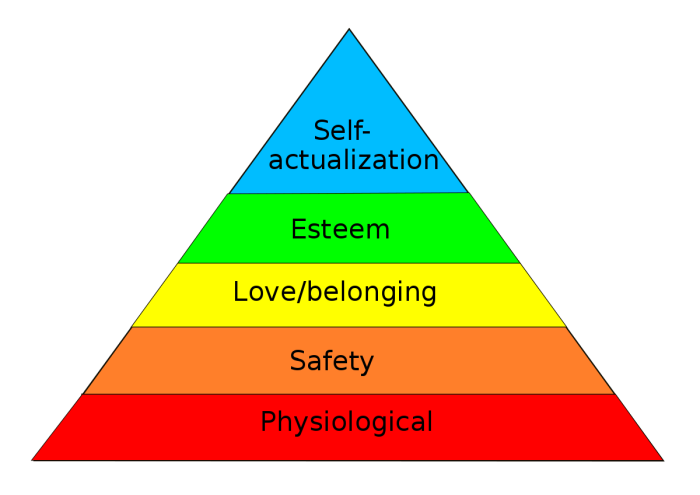
I know Maslow’s Hierarchy of Needs.
 

1200px-MaslowsHierarchyOfNeeds.svg


There are certain basic necessities anyone must have in order to become a fully actualized person.


After physiological necessities like food and water, safety is absolutely fundamental.


Without it, you can’t get people to focus much on anything else.


You can’t get children to pay attention to nouns and verbs, for instance, if they’re afraid they’re going to be shot and killed.


You can’t get them to care about writing a complete sentence, if they feel like they may have to duck and cover at any moment.


You can’t get them to bother with abstract reading comprehension if they’re afraid of imminent death!


Oh, and by the way, I’m not exactly at my best either!


My lesson plans aren’t going to win any awards when the best solution our legislators can come up with is giving me a loaded pistol to keep in my desk drawer!


Well, Yippee Ki Yay! I’m a teacher! Pew! Pew!


My 7th grade students are literally frightened that going to school on any given day may lead to the end of their lives.


Every couple of weeks on the news it’s another school shooting and another body count, while lawmakers do nothing to ensure it won’t happen again tomorrow.


Every few days, it’s a rumor about this or that troubled kid we all know snapping and throwing a gun in his backpack. Or it’s an anonymous threat scrawled on a wall or a social media page.


Today it was teaching classes where half the kids were missing because their parents held them out of school afraid a vague rumor of imminent violence was true.


And as I tried to assure those who did show up that everything was okay, law enforcement checked the lockers with K-9 police dogs looking for weapons or drugs.


What the heck are we coming to?


I work in a police state and my students are being asked to learn in a penitentiary.


And the teachers should get guns.


And the principals should get guns.


And the parents should get guns.


And the guns should get little tinier guns to protect themselves from even more guns!


This is madness.


We’re begging for a political solution but our political system is a shambles. Nothing puts that in starker contrast than the gun debate.


The overwhelming majority of Americans want sensible gun laws – an assault weapons ban, closing the gun show loophole, mental health screenings, etc.


If we lived in an authentic Democratic Republic, we’d have them. But we don’t, because we live in a plutocracy.


One industry has enough power and influence that the only solution our policymakers can safely suggest is one that increases that same industry’s bottom line.


It’s like Tony the Tiger suggesting the only cure for obesity is to eat more Frosted Flakes! They’re Ggggrrrreeeaaaattt!


A teacher’s job is hard enough without society crumbling all around us.


But that doesn’t mean the children aren’t learning.


They’re watching the world burn with wide eyes. They’re taking in every flame, every bullet hole, every cowardly senator, representative and chief executive.


They’re watching and taking names.


At the end of the year, policymakers will wag their fingers at the nation’s teachers about failing standardized test scores.


They’ll bemoan sinking academic standards, powerful labor unions and a lack of moral fiber as the cause of a generation of children who lost out on an education while cowering under bulletproof backpacks.


But this generation refuses to be lost.


Despite everything, they’ve left a trail of breadcrumbs back to sanity.


They are emotionally damaged by a country that no longer functions, but they know the truth.


They know who’s responsible. And they know what to do about it.


When they reject our society, we’ll know why.


Because the next generation will be nothing like us.


And on a day like today, that’s the most hopeful thought I can offer.
When Will It Happen Here?


classroom


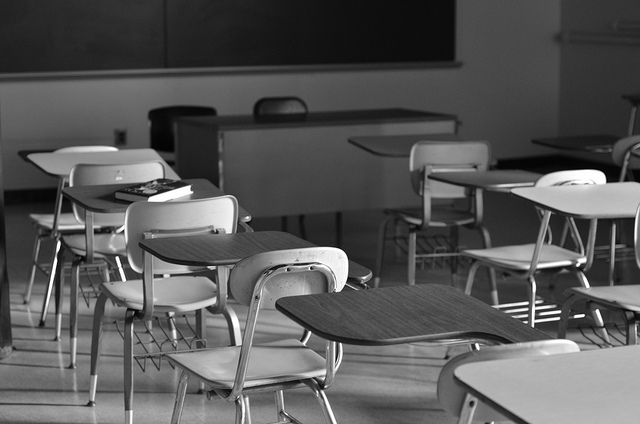
It could happen at anytime in my classroom.


The thing we’ve all been dreading.


A hasty announcement of lock down. An unexpected fire alarm. The sounds of shouting, running feet and… gunshots.


The lights could go out. The door could burst in.


There’s really very little we could do.


My room has no windows. No closets. Nowhere to hide.


These are the thoughts going through my head as my students sit at their desks during homeroom this morning.


Jayden is taking off his hoodie before the principal catches him out of dress code.


Alaina is pestering me for a pass to the library.


Darnell is surreptitiously munching on a pixie stick stashed in his book bag.


It’s all so mundane, so subdued, so quiet.


A few kids are on the computers in the back, others at their desks reading books, writing papers, or listening to music on their iPads.


But there’s very little conversation.


The class of middle schoolers is restrained, thoughtful – which is unusual for children of 12 or 13.


I sit slumped at my desk – exhausted though I haven’t even taught my first class yet.


The news from last night still plays in my head.


Seventeen people killed by an expelled student at a high school in Parkland, Florida.


Or was it two killed in Kentucky?


How long was it since the last one?


And now here we are – back in the line of fire.


I can’t help but think about my daughter somewhere across town. She’s probably just entering her third grade classroom maybe munching on the remains of a candy heart from Valentine’s Day. Just like me and my students, she’s in the cross hairs.


But what can we do about it?


I can’t hold her out of school forever. I can’t quit my job and work from home. Even if I could, there’s absolutely nothing I can do for the twenty children quietly sitting at their desks in the room with me, abiding the rules of a society too broken to protect us.


After last night, it feels like things have changed somehow.


There have been 18 school shootings so far this year. And it’s only February. Most have resulted in zero injuries.


Of those where people were hurt, the person most in danger was the shooter. But I can’t stop thinking about those cases where a hunter came to school to kill children and teachers.


As an educator, I’ve been taught how to handle just about every situation.


If one of my children acts out, or doesn’t hand in her homework, or even throws up – I know what to do.


But none of my training has prepared me to out teach a semiautomatic weapon.


I can’t differentiate past a bullet.


There is no paperwork that will invalidate the gunpowder or slow the endless rounds through whatever they come into contact.


If someone comes to school with a gun and a will to kill, I will be little more than a target.


But don’t get me wrong.


This doesn’t mean society should gift me a handgun to keep in my desk next to the chalk.


I am not a law enforcement officer or an action hero. I’m a teacher.


You don’t want me returning fire at every mindless bureaucratic hitch in the schedule. You want me assigning essays and chapter readings. You don’t want me keeping a gun out of reach of curious youngsters always at my desk and in my personal space. You want me safeguarding student assignments and – heck – my cell phone that kids keep trying to snatch and look through my camera roll.


What we need is real gun control legislation.


We need an assault weapons ban.


We need to close the gun show loophole.


We need buyback programs to get the mountains of firearms off the streets and out of the arsenals of a handful of paranoid “survivalists”.


In short, we need lawmakers willing to make laws.


We need legislators who will represent the overwhelming majority of the public and take sensible action to protect the people of this country.


What we don’t need are the trolls who hijack every conversation arguing the semantics of the term “assault rifle” or “terrorist.”


We don’t need weak politicians cautioning against “politicizing” mass shootings because the violence is too fresh.


We don’t need anyone’s thoughts and prayers.


We need action.


And we need it yesterday.


Some people are calling on teachers to take action to force our lawmakers to finally do something.


They suggest a national teachers strike on May 1st – May Day – if Congress refuses to act.


That sounds like a good idea to me.


I’m game.


But we need more than that.


We need everyone who feels the same way to join in the fight.


Parents, children, grandparents, principals, police, firefighters, soldiers and nurses – the multitudinous faces of America must come together to fight this monstrosity as one.


I may sit in that classroom.


My students and my daughter may be in danger.


But America must be the shield.


America must rise up and protect our future.


WE must take charge.


Otherwise, it is not a case of can it happen here.


It is a case of when.

Crippled Puerto Rico Offered School Privatization as Quick Fix for Woes

10-Puerto-Rico-Read-Aloud-02-story-thumb-600x388-27787-thumb-600x388-27961


You’re Puerto Rico’s school system.


More than five months since a devastating hurricane hit the island’s shores, some 270 schools are still without power.


Roughly 25,000 students are leaving with that number expected to swell to 54,000 in four years. And that’s after an 11-year recession already sent 78,000 students  seeking refuge elsewhere.


So what do you do to stop the flow of refugees fleeing the island? What do you do to fix your storm damaged schools? What do you do to ensure all your precious children are safe and have the opportunity to learn?


If you’re Puerto Rico’s Governor Ricardo Rossello, you sell off your entire system of public education.


After an economic history of being pillaged and raped by corporate vultures from the mainland, Rossello is suggesting the U.S. Territory offer itself for another round of abuse.


He wants to close 300 more schools and change the majority of those remaining into charter and voucher schools.


That means no elected school boards.


That means no public meetings determining how these schools are run.


It means no transparency in terms of how the money is spent.


It means public funding can become private profit.


And it means fewer choices for children who will have to apply at schools all over the island and hope one accepts them. Unlike public schools, charter and voucher schools pick and choose whom to enroll.


Make no mistake. This has nothing to do with serving the needs of children. It is about selling off public property because it belongs to poor, brown people.


Something similar happened in New Orleans after Hurricane Katrina.


A district that served mostly black and poor children was swiped by private interests and turned almost exclusively into charter schools.


The results have been an abysmal academic record, the loss of black teachers, black neighborhoods, cultural heritage and in its place support for a status quo that just doesn’t care to provide the proper resources to students of color.


If the Governor and his wealthy backers have their way, Puerto Rico will be yet another ghettoized colony gobbled up by industry.


However, the people aren’t going to let this happen without a fight.


Mercedes Martinez, President of the Federacion de Maestros of Puerto Rico, an island teacher’s union, released the following statement:


“Dear comrades in the diaspora, now more than ever we need your unconditional solidarity.


Governor Roselló just announced his plan to shut down 307 schools, implement charter schools and vouchers. Disaster capitalism at its best. Added to the announcement of the privatization of PREPA. [Puerto Rico Electric Power Authority]


The way to victory is already paved, organized and militant resistance, concrete proposals to improve the public goods that we have, unity and organization. Be our voice in the states and let the world know that corporate reformers want to make PR the next New Orleans as they did after Katrina.


The hurricane has been the perfect storm and excuse for them to advance their plans. Today the so called “educational reform” will be sent to the legislature.


We will give the hardest fight of our lives, and we will triumph. Send letters and videos of support with our struggle. Teachers United, will never be defeated!


Lucha sí”


I don’t know about you, but I stand with these brave teachers, parents and their students.


I may live in Pennsylvania, my skin may be white, but I do not support the theft of Puerto Rico’s schools.


These children have just as much right as mine to a free and appropriate education. Their parents deserve the right to control their districts. They deserve transparency and self-rule.


They deserve the choice to guide their own destinies.


Teachers’ opposition to the move comes even though the Governor is proposing a $1,500 raise for all educators. Martinez says it could come to a general strike.


Their cause has hope on its side – especially in blocking the proposed school vouchers.


The Governor’s voucher proposal wouldn’t go into effect until the 2019-20 school year. However, the Puerto Rico Supreme Court struck down a similar program in 1994 when the current governor’s father, Pedro Rossello – himself a former governor – tried to push it through. The court ruled the island’s constitution forbids public money being used to fund privately run schools.


From this day forward, let us always remember what they did to New Orleans. Let us remember what they are trying to do to Puerto Rico.


Corporate school reform is not about making better schools. If it was, you would see plans like this being proposed in Beverly Hills and rich white neighborhoods across the country.


But somehow that never happens.


These schemes only show up in poor communities populated predominantly by people of color.


While the rest of our public schools are celebrating Black History Month, the children of Puerto Rico are reliving the struggle for their civil rights.


They are still the victims of colonization and brutality.


But they are not alone.


I stand with the people of Puerto Rico.


Will you stand, too?


Will you speak out for Puerto Rico?


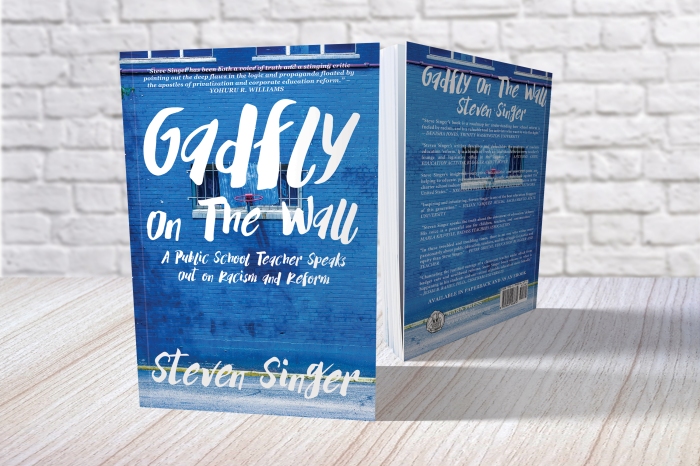
Like this post? I’ve written a book, “Gadfly on the Wall: A Public School Teacher Speaks Out on Racism and Reform,” now available from Garn Press. Ten percent of the proceeds go to the Badass Teachers Association. Check it out!

book-4

The Further You Get From Public Schools, the Greater the Chance of Child Abuse

nn_mal_house_of_horrors_180118_1920x1080.nbcnews-ux-1080-600


A California home-school where parents shackled, starved and abused their children is a symptom of a larger disease.


And that disease is privatization.


David Allen Turpin and his wife, Louise Anna Turpin, were arrested after police found the couple’s 13 children living in deplorable conditions in their Perris, California, home.


Some of the children were actually young adults but were so malnourished investigators at first mistook them for minors.


It is a situation that just could not have happened had those children been in the public school system.


Someone would have seen something and reported it to Child Protective Services. But school privatization shields child predators from the light and enables a system where minors become the means to every adult end imaginable.


Let me be clear. Privatization is defined as the transfer of a service from public to private ownership and control.


In education circles, that means home-schools, charter schools and voucher schools – all educational providers that operate without adequate accountability.


We are taking our most precious population – our children – and allowing them to be educated behind closed doors, out of sight from those tasked with ensuring they are getting the best opportunities to learn and are free from abuse.


And since home-schooling operates with almost zero oversight, it is the most susceptible to child neglect and mistreatment.


Children who in traditional public schools would have a whole plethora of people from teachers to counselors to principals to cafeteria workers who can observe the danger signs of abuse are completely removed from the home-school environment.


Home-schooled children receive their educations almost exclusively from parents.


While most moms and dads would never dream of abusing their kids, home-schooling provides the perfect cover for abusers like the Turpins to isolate children and mistreat them with impunity.


It is a situation that at least demands additional oversight. And at most it requires we rethink the entire enterprise as dangerous and wrongheaded.


Charter and voucher schools at least utilize whole staffs of people to educate children. The chances of something like this happening at these institutions is much smaller. However, both types of school also are much less accountable for their actions than traditional public schools.


And that is the common factor – responsibility. Who is being held answerable when things go wrong? At traditional public schools, there is a whole chain of adults who are culpable for children. At these other institutions, the number of people in the hot seat shrinks to zero.


Much of that has to do with the regulations each state puts on privatized schools.


Just look at the regulations governing home-schooling.


In 14 states including Delaware, California and Wisconsin, parents don’t have to do anything but let the school district know they’re home-schooling. That’s it! And in 10 states including Texas, Illinois and New Jersey, you don’t even have to do that!


Kids just disappear without a trace. If no one reports them missing, we assume they’re being home-schooled.


But even in states that appear to be more exacting on paper, the reality is a virtual free-for-all.


Take my home state of Pennsylvania. To begin home-schooling, parents must notify the superintendent, have obtained a high school degree themselves, provide at least 180 days of instruction in certain subjects and maintain a portfolio of their child’s test results and academic records.


That sounds impressive. However, this doesn’t really amount to much in practice because these regulations have few teeth. Hardly anyone ever checks up to make sure these regulations are being met – and they’re only allowed to check up under certain circumstances and only in certain ways and at certain times!


Even when it comes to charter and voucher schools, most states, including Pennsylvania, go little further than that.  


Frankly, most of the time we don’t know what happens in charter and voucher schools, because few state governments insist on audits, unscheduled visits or reports.


For instance, though few charter or voucher schools starve, lock up or torture students, many have zero tolerance discipline policies. Few would claim even these controversial behavior management systems sink to the level of some home-school parents who have allegedly withheld food and bound children’s hands with zip ties. But adolescents being forced to sit silently with their eyes looking forward, hands on the table or else receive loud rebukes – as they are in many charter or voucher schools – may qualify as another kind of abuse.


Moreover, all privatized schools can withhold providing a proper education. Home-school parents can refuse to teach their children not just truths about science and history but the basics of reading, writing and math. Likewise, charter and voucher schools can cut student services and pocket the savings as profit. And no one is the wiser because the state has abrogated its responsibility to check up on students or even require they be taught much of anything at all.


Meanwhile, none of this is possible in the traditional public school setting because it must operate in the light of day. It is fully accountable to the public. Its documents are public record. Decisions about how it should be run and how tax dollars are spent are made at open meetings by duly-elected members of the community.


Some, including myself, would argue that the regulations required of public schools by the state and federal government are sometimes too onerous, unnecessary or even just plain dumb. But that doesn’t change the fact that regulations are necessary. It just leaves open the question of which ones.


The bottom line is this: Public school is the equivalent of teaching children in an open room with qualified educators that have proven and continue to prove they have no criminal record and are able and ready to educate.


Privatized schools are the equivalent of teaching children in a closed room with educators who may not deserve the name and may or may not have deplorable criminal pasts.


Looked at in the abstract, no one in their right mind would conceivably suggest the latter is a better educational environment than the former. However, we have been subjected to an expensive propaganda campaign to make us think otherwise.


Look. I’m not saying public schools are perfect. Certainly students can be abused there, too. The media salaciously reports every doe-eyed teacher who stupidly has a sexual relationship with a student – whether it be at a public or privatized school. But in comparison with the worst that can and often does happen at privatized schools, these incidents at public schools are extremely rare (1 in 800,000) and of much less severity.


Though both are bad, there is a world of difference between the infinitesimal chance of being propositioned by your high school teacher and the much more likely outcome of being treated like a prison inmate at 13 by the charter school corporation or being starved, shackled and beaten by your parents!


Human beings aren’t going to stop being human anytime soon. Wouldn’t it be better to entrust our children to an environment with regulations and accountability than letting them go off in some locked room and just trusting that everything will be alright?


Our posterity deserves better than privatization.


They deserve the best we can give them – and that means fully responsible, fully regulated, fully accountable public schools.

Men, Too, Need No Longer Suffer in Silence the Pain of Sexual Harassment

sad-man-silhouette-on-bench


This is one of the hardest articles I’ve ever written.


I’ve started it several times. And each time I deleted it.


After all, what right do I have to talk about sexual harassment?


I wasn’t raped.


I wasn’t drugged, beaten or blackmailed.


No one physically abused me in any way that did lasting physical harm.


But I was misused.


I was harassed.


And I shouldn’t have been.


I was made a victim, and my victimizer was a woman.


That, alone, shames me to my core.


I’m a grown man.


We’re not supposed to care about things like this.


We’re supposed to be unfeeling, undisturbed, stoic cowboys with our eyes ever fixed on the horizon.


If anything, I should be the one accused, not the accuser.


Some would deny that you even CAN sexually harass a man.


They’d look at the cultural ideal of manhood as an emotionally stunted beast of burden, and say men are too callous and shallow to be susceptible to this sort of pain. After all, men are always ready for the next sexual encounter. Or we should be, because that’s what it means to be a man.


But they’re wrong.


Men have feelings, too. We hurt. We cry. And we can be scarred by unwelcome advances.


So what happened?


It was almost thirty years ago.


I was just a kid in middle or high school – 8th or 9th grade.


It was in pottery class.


I’ve always loved the arts. I used to draw every spare second. My notebooks were covered with doodles and sketches. Cartoon dinosaurs and skulls. Sometimes an alien or dragon.


And I loved working with clay, too.


For years my mother had a vase I made in that pottery class. It was fat on the bottom with a slender neck. Purple glaze on the outside with a blue interior. Mom displayed it proudly in her dinning room, sometimes with a few flowers inside, until one day it accidentally fell from a shelf and shattered.


I might have been working on that same vase when it happened. I really can’t remember.


I think it was a pinch pot.


I was standing at a table I shared with three or four other students, wrapping tubes of hand rolled clay around and around into the shape of a container, when someone came up behind me, grabbed my butt and squeezed.


I jumped in surprise, and said “Ohh!” or something.


Then I heard, “Hey, sweet cheeks!”


And laughter. All coming from the other side of the room.


I turned my head to see who it had been.


It was a girl I hardly knew though she had been in my classes since first grade.


Let’s call her Nancy.


She was a chunky but not unattractive girl from the other side of the room.


She walked back to her friends, both boys and girls, at her table, and they were all losing it over what had happened.


I blushed and turned back to my work, feeling like the clay my fingers molded.


I couldn’t even process what had happened.


Why had Nancy just walked over to me and pinched my butt?


It wasn’t even a playful pinch. It wasn’t grabbing someone with the palm of your hand and giving a squeeze. She had clawed into my flesh, secured a good hunk and pulled.


It was angry and mean.


I didn’t understand. What had I ever done to her?


I barely knew her. I hadn’t said more than ten words to her in eight years.


“You like that?” she asked from across the room.


I just kept working on my pot, looking at it as if it were the only thing left in the universe.


The others at my table were giggling, too.


I remember it like a scene in slow motion. Me rolling out and unwinding the clay. Everyone else laughing. Nancy smirking.


And then she came back and did it again!


I jumped and squealed.


But I did nothing. I said nothing.


She pinched me at least three or four more times. Maybe more.


And she said something each time.


And like it was on a script, always the laughter and guffaws.


Eventually I think I started to quietly cry.


That’s when it stopped mostly.


The others at my table were as silent as I was. When they saw my reaction, I think they got embarrassed.


We were all working with incredible concentration trying not to acknowledge what was happening.


I made sure not to turn and look behind me. But I could hear the snickers.


Where was the teacher?


The room had a strange L-shape. At the foot of the L was a kiln where she was diligently firing last week’s pottery. From where she was, she probably couldn’t see the rest of us working at our tables.


I don’t think she saw anything. She never said anything if she did.


When she returned to our side of the art room, she may have asked if I was okay. I’m not sure. I probably just shrugged it off. Maybe asked to go to the bathroom.


Why did this bother me so much?


Because I wasn’t asking for anyone to come over and touch me like that.


I just wanted to make my stupid pot. I just wanted to be left alone.


I didn’t want to be treated like anyone’s joke. I didn’t want my physicality to be the cause of anyone’s laughter.


It’s not that Nancy was a pariah or a terrible person or anything. If things had been different, I might have responded differently.


But when you’re a guy in high school, you aren’t allowed to be upset when a girl comes and pinches you.


You’re supposed to respond a certain way.


I couldn’t ask her to stop. I’m supposed to love it.


Even if it’s a joke.


Even if it’s a way to denigrate me in front of the whole class. Even if it’s a way to proclaim me the most undesirable boy in the whole room.


It felt like someone pointing at a banana peel in the trash and mockingly saying, “Yum! Yum!”


But I was the garbage.


It certainly made me feel that way.


I’m not sure why this has bothered me for so long.


Maybe it’s the feeling of powerlessness – that there was nothing I could do. Maybe it was a feeling that I should be reacting differently. I should be more assertive either telling her to leave me alone or maybe actually liking the physical contact.


I’m not sure how to explain it.


I was made to feel inferior and degraded.


Perhaps that’s why I’ve remained silent about it all these years. The only solution had seemed to be to forget about it and move on.


Yet doing so leaves a cold lump in your chest. Oh, it won’t kill you. But it’s always there. You just learn to live with it.


I suppose in writing about it, I’m trying to rid myself of that lump.


I don’t know if it will work. But I’m tired of carrying it around with me anymore.


We’re living in a remarkable moment. Women everywhere feel empowered to share their stories of abuse at the hands of men. Shouldn’t I feel empowered to share my story of abuse at the hands of a woman?


But there does seem to be a disconnect here. A disanalogy.


No matter who you are, everyone has been the victim at one point or another.


Whether you’re male or female, rich or poor, black or white – everyone has been on the losing side.


However, some people use that truth as an excuse to pretend that all groups have been equally targeted. They use it as a way to justify the marginalization and minimalization of women and people of color, for instance, groups that have been most often earmarked for abuse.


Let me be clear – I firmly reject that. I am not All Lives Mattering sexual harassment and abuse. Clearly, women have born the brunt of this burden and men have more often been the cause.


But that doesn’t mean that men are immune to being victimized or that women are incapable of being aggressors.


Perhaps that’s my point in writing this – to caution against easy expectations and easy labels.


Toxic masculinity exists because we have toxic expectations for men and boys. Our society molds them into the shape of our collective expectations.


It’s about time we expect more from men.


And it’s time we allow them the space to be hurt so that they, too, need no longer suffer in silence.

Funny How School Closings Are Merely Accidental Racism. Never Intentional.

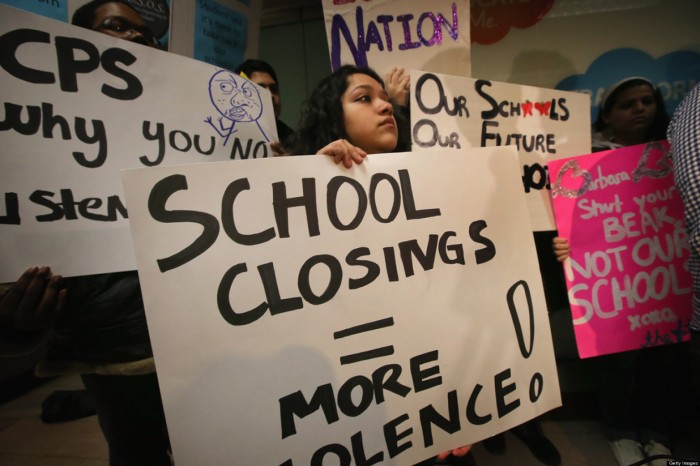
Students Protest School Closings At Chicago Public Schools Headquarters


It’s funny. When you close schools serving minority students, they tend to move away.


That’s what’s happening in Chicago.


In the last seven years, Mayor Rahm Emanuel closed 49 schools serving mostly students of color. And from 2015 to 2016, alone, the city lost 12,000 black residents.


Huh.


Who would have ever thought that cutting funding to services for minorities might make them get up and leave?


But God forbid you suggest this is intentional!


These are just disparate facts. There is no conceivable causal link between making life intolerable for people and their leaving.


When has that ever happened before?


The Great Migration (1919-1950) when hundreds of thousands of blacks moved from the deep south to the shores of Lake Michigan looking for better opportunities?


Well, sure, but when else has that ever happened?


You can’t connect one dot to another.


That would just be rude.


Yet that’s just what Chris Kennedy, a candidate vying to run against Illinois Governor Bruce Rauner on the Democratic ticket, did this week.


He said that Emanuel is running a “strategic gentrification plan” to intentionally push black residents out of the city.


“My belief is they’re being pushed out. This is involuntary. That we’re cutting off funding for schools, cutting off funding for police, allowing people to be forced to live in food deserts, closing hospitals, closing access to mental health facilities. What choice do people have but to move, to leave?” Kennedy said at a press conference.


“And I think that’s part of a strategic gentrification plan being implemented by the city of Chicago to push people of color out of the city. The city is becoming smaller and as it becomes smaller, it’s become whiter.”


The establishment immediately pushed back against him.


The Chicago Sun-Times couldn’t find any fault with Kennedy’s facts, but they called his interpretation “irresponsible.”


Emanuel’s office likewise issued a press release likening Kennedy’s claims with those of Republicans like Rauner and President Donald Trump, even though both of those individuals would be more likely to champion a plan to kick blacks out of Chicago than criticize it.


Kennedy’s remarks simply echo what black Chicagoans have been saying for years.


FACT: Since 2001, 72 Chicago schools have been closed or phased out. Ninety percent of the students affected are black.


And now Emanuel is suggesting closing four additional schools – all from the predominantly African American Englewood community.


Sure, eventually they’ll be replaced by one new school, but only after at least a year without any high school in the area.


When the new school finally opens, the neighborhood will be less black and better suited to what? Gentrification!


Jitu Brown, National Director for a broad based collective of civil rights organizations called Journey 4 Justice, estimates that more than 30,000 people of color have fled Chicago since Emanuel took office.


Brown led a group of community members to sit in at the Chicago Board of Education today to protest the proposed closings.


“Rahm wants to close successful black grammar school to make room for upper income families! We have proof! That’s why we sit-in,” he tweeted.


Back in 2013, Brown broke down his argument at a hearing before the US Department of Education:


“To deny us the right to improve our schools as community institutions is a violation of our human rights. To destabilize schools in our community is a violation of our human rights. To have communities with no neighborhood schools is a violation of our human rights.  . . . We are America’s mirror. Do you have the courage to accept what you see?”


Kennedy really isn’t saying anything different. He’s just echoing the concerns of the community he wants to represent.


“I don’t know what you can say when the strategic plan for Chicago Public Schools suggest that the entire community of Englewood can go an entire year without access to a high school,” Kennedy said this week.


“What are you saying to the people there? No one’s going to move there who’s got a high school kid. And anybody with a high school kid has to think about what they’re going to do. It’s just a device to empty out the community.”


The problem is not limited to Chicago. It’s emblematic of public school policy nationwide.


From 2003-2012, in New York City, 117 schools were closed. Sixty-three percent of the students affected were black.


In 2008, 23 schools were closed in Washington, DC. Ninety-nine percent of the students affected were black, Latino or Hispanic.


Since 2005, in Detroit, 130 schools have been closed. Ninety-three percent of the students affected were children of color.


And one and on.


We intentionally segregate students based on race and class, then allocate funds accordingly. Richer whiter students get all the resources they need. Poorer blacker students get crumbling schools, narrowed curriculum until their schools are shuttered and they’re forced to either move away or put up with fly by night charter schools.


Look at what happened in New Orleans.


After Hurricane Katrina in 2005, the state took over 107 of the city’s then-128 public schools, removing them from local control of the residents. The majority of these schools were turned into charters, closed or simply never reopened – a move affecting 90 percent of black students and only 1 percent of white students.


Karran Harper-Royal, a New Orleans parent and cofounder of the national group Parents Across America, argued at the same hearing in 2013 before the US Department of Education that the result was racist.


They call it school choice, but parents don’t have choice when 80 percent attend charter schools – some of which run a lottery enrollment process, she said. As a result, parents are forced to apply to multiple charter schools to ensure their children have somewhere to go to learn.


Your choice is between charter schools – 79 percent of which are rated “D” or “F” – and 15 state run public schools that are all rated “D” or “F,” she said.


“African-American students are more likely than their white counterparts to experience schools that are at risk of being closed down, phased-out, turned around or co-located,” Harper-Royal said. “To guarantee me a seat in a failing school system is not ‘choice.’ It’s racist is what it is.”


This is the reality for poor and minority students across the country.


It’s refreshing to hear a Democrat brave enough to actually speak the truth about it – especially since Democrats have been as apt to preside over these corporate education reform policies as Republicans.


Closing black schools and keeping white ones open is not an accident.


Neither is continuing school segregation, the proliferation of charter and voucher schools and the continued insistence that the only way to hold educators accountable for actually educating is high stakes standardized testing.


These are all choices that result in winners and losers.


It’s time we recognized that. If we really want to champion civil rights and equity for all, we need to stop promoting racism as school policy and pretending to be surprised at the results.

Hidden Gadfly – Top 5 Stories (By Me) You May Have Missed in 2017

7fd6a56c2ffc7a03c9fd2f431a543e92


So that was 2017.


It was a year that frankly I wasn’t sure I’d survive.


But I did. We did. Together.


I think if there’s any lesson from the last 365 days, it’s that: We can endure anything if we stay united.


We’ve taken down titans of industry simply by acts of belief. When women came forward with credible tales of abuse, for the first time we – as a society – actually believed them.


We’ve taken down the most morally repugnant child abusers with designs on national office simply by supporting the black vote. And no matter how much power tried to disenfranchise our brothers and sisters of color, we stood by them and made sure their voices were heard.


We’ve taken down the authors of some of the most backward legislation in the country by supporting the very people who were targeted – I’m talking about Danica Roem the first transgender state legislator in the country taking down the author of Virginia’s bigoted bathroom bill! Absolutely amazing!


These are the kinds of things we need more of in the New Year.


If you take all the “minorities” in this country – minorities of gender, race, sexuality, creed, religion, etc. – if you add us all together, we actually are the majority!


When you add white people of conscience with black people, Latinos and Hispanics, LGBTs, women, Muslims, and every other historically disenfranchised group, we have the upper hand. And when you compare economic disparities of the 99% vs the 1% or poor vs rich, it’s not even close!


And I’m not talking about some time in the future. I’m talking about right now!


All we need to do is stand together and fight for each other.


Our democracy is in tatters, but not much needs to remain to empower our overwhelming supermajority.


So as 2018 is about to dawn, I am filled with hope for the future. A truly amazing year may be about to dawn. It’s all up to us.


In the meantime, I take my last look over my shoulder at the year that was.


As an education blogger, I write an awful lot of articles, 119 articles so far this year. In fact, this piece – which will probably be my last of the year – brings me to 120!


I’ve already published a countdown of my most popular articles. If you missed it, you can still read it here.


However, as is my custom, I like to do one final sweep of my annual output counting down honorable mentions. These are the top five articles that maybe didn’t get as many readers, but that I think deserve a second look.


I hope you enjoy my top 5 hidden gems before I place them in the Gadfly vault and begin the hard work of making 2018 a better tomorrow:


5) Standardized Testing Creates Captive Markets


Published: April 8 thumbnail_Screen Shot 2017-04-07 at 10.41.23 AM


Views: 4,301


Description: Standardized testing is often championed by people who claim to be free market capitalists. Yet it struck me that there was nothing free about the market being perpetrated on public schools when it comes to high stakes tests. Schools don’t give these tests because anyone in these districts actually thinks they help students learn. We do it because we’re forced by federal and state governments. It’s a racket, and in this article I explain exactly how and why.


Fun Fact: This article was well received, but I thought it might deserve to be even more so. Education writer and classroom teacher Frank Stepnowski wrote about it in his most recent book RETRIBUTION: A scathing story of mandatory minutiae, softening students, pretentious parents, too much testing, common core conundrums, and the slow death of a noble profession.” He was so taken by it he even taught my piece to his high school composition students. In addition, education historian Diane Ravitch probably liked this article more than any single work I’ve ever written. She positively beamed on her blog calling it, “One of the best articles you will ever read about standardized testing.” I guess it’s no wonder that I included it in my first book published just a few months ago, “Gadfly on the Wall: A Public School Teacher Speaks Out on Racism and Reform.” In particular, Ravitch wrote:


“When I read this post by Steven Singer, I was so excited that I thought about devoting an entire day to it. Like posting it and posting nothing else for the entire day. Or posting this piece over and over all day to make sure you read it. It is that important.


Steven’s post explains two different phenomena. First, why is standardized testing so ubiquitous? What does it have a death grip on public education?


Second, in the late 1990s, when I was often in D.C., I noticed that the big testing companies had ever-present lobbyists to represent their interests. Why? Wasn’t the adoption of tests a state and local matter? NCLB changed all that, Race to the Top made testing even more consequential, and the new ESSA keeps up the mandate to test every child every year from grades 3-8. No other country does this? Why do we?”


4) I Am Not A Hero Teacher


Published: Aug. 1 Screen Shot 2017-08-01 at 10.53.52 AM


Views: 2,137


Description: According to landmark research by Dan Goldhaber and James Coleman, only about 9 percent of student achievement is attributable to teachers. The entire school experience only accounts for 20%. By far, the largest variable is out of school factors, which accounts for 60% of a student’s success. Yet we insist on holding teachers accountable for nearly 100% of it. We demand our teachers be superhuman, give them next to zero support, and then get indignant when they can’t do it all alone. Sorry, folks, I’m just a human being.


Fun Fact: Our expectations for teachers are ridiculous. We want them to do everything and then we blame them for acting like saviors. I think it’s vital that people acknowledge this impossible situation we put educators in and start to take more social responsibility. Your schools won’t get better until you do something about it. Stop complaining and get to work. That means voting for lawmakers who support public education. That means attending school board meetings. That means holding the decision makers responsible. Not just taking advantage of an easy scapegoat.


3) A Teacher’s Dilemma: Take a Stand Against Testing or Keep Abusing Children


Published: Sept 8 AJGE5E_2026469c


Views: 1,262


Description: What does a teacher think about when he or she is forced to give a standardized test? This article is my attempt to capture the no-win situation that our society forces on teachers every year. Apparently we must choose between doing things that we know are harmful to our students or taking a stand and possibly losing our jobs. You become a teacher to help children and then find that harming them is in the job description. Is this really what society wants of us?


Fun Fact: This article resonated deeply with some readers. In fact, a theater group in Ithaca, NY, Civic Ensemble, was so inspired by it that they used my article as the basis for a scene in a play made up of teacher’s real life stories about the profession. The play was called “The Class Divide.” You can watch a video of a practice performance of my scene here.


2) Top 10 Reasons Public Schools are the BEST Choice for Children, Parents & Communities


Published: Sept. 15 thumbsup


Views: 734:


Description: A lot has been written about why charter and voucher schools are bad for parents, students and society. Less has been written about the ways that public schools do better than privatized education. This was my attempt to illuminate the ways public schools are better. They attract better teachers, have a more robust sense of community, have more educational options, have greater diversity, are more fiscally responsible – and that’s just the first five!


Fun Fact: When you list all the ways public schools are better than privatized ones, it becomes hard to imagine why they’re struggling. Public schools are clearly the best choice. The fact that they are being sabotaged by the privatization industry and their creatures in government is inescapable.


1) Black Progress Does Not Come At White Expense


Published: Nov. 14

People of different races hold hands as they gather on the Arthur Ravenel Jr. bridge in Charleston


Views: 219


Description: When you ask racists why they oppose racial equity, the number one reason they give is the feeling that equity is a zero sum game. If black people are put on an equal footing with white people, then white people will ultimately lose out. This is patently untrue. White people will lose supremacy over other races, but they need not become subservient or lose their own rights. We can champion fairness for all without doing ourselves harm.


Fun Fact: This article kind of died on the vine, but I’m still proud of it. I think it is one of my best this year expressing my own thoughts and feelings about antiracism. I just wish more people had read it, because it sounds like this is an idea that more white people need to hear. We can only build a better world hand-in-hand.


NOTE: Special thanks to my fellow education blogger, Russ Walsh, who originally gave me the idea to write a countdown of under-read articles. He does it, himself, every year at his own excellent blog. If you’re new to the fight against corporate education reform, Russ has written an excellent primer on the subject – A Parent’s Guide to Public Education in the 21st Century: Navigating Education Reform to Get the Best Education for My Child.


Gadfly’s Other Year End Round Ups

This wasn’t the first year I’ve done a countdown of the year’s greatest hits. I usually write one counting down my most popular articles (like the one you just read from 2017) and one listing articles that I thought deserved a second look. Here are all my end of the year articles since I began this crazy journey in 2014:

2017

What’s the Buzz? A Crown of Gadflies! Top 10 Articles (by Me) in 2017

thumbnail_Screen shot 2017-12-26 at 3.44.17 PM

2016

Worse Than Fake News – Ignored News. Top 5 Education Stories You May Have Missed in 2016

ignoring-wisdom

Goodbye, 2016, and Good Riddance – Top 10 Blog Post by Me From a Crappy Year

screen-shot-2016-12-27-at-3-29-49-am

 2015

Gadfly’s Choice – Top 5 Blogs (By Me) You May Have Missed from 2015

Screen shot 2016-01-02 at 11.01.09 PM


Who’s Your Favorite Gadfly? Top 10 Blog Posts (By Me) That Enlightened, Entertained and Enraged in 2015

Screen shot 2015-12-30 at 12.57.49 AM

2014

Off the Beaten Gadfly – the Best Education Blog Pieces You Never Read in 2014

Wonderfull illusion art painting

Top 10 Education Blog Posts (By Me) You Should Be Reading Right Now!

computer-people-png-300x202


Still can’t get enough Gadfly? I’ve written a book, “Gadfly on the Wall: A Public School Teacher Speaks Out on Racism and Reform,” now available from Garn Press. Ten percent of the proceeds go to the Badass Teachers Association. Check it out!

book-4


Betsy DeVos – Extreme Image Makeover as Champion of Special Needs Children

Screen Shot 2017-12-11 at 4.21.29 PM


Meet Betsy DeVos, Champion of Students With Special Needs.


At least that’s who she’s pretending to be this week.


The wealthy Republican mega-donor who bought her position as Secretary of Education published an article in the current issue of Education Week called “Commentary: Tolerating Low Expectations for Students With Disabilities Must End.”


It was almost like she expected us all to forget who she actually is and her own sordid history with these kinds of children.


Up until now, the billionaire heiress and public school saboteur always put the needs of profitizers and privateers ahead of special needs children.


During her confirmation hearing, she refused to say whether she would hold private, parochial and charter schools receiving tax dollars to the same standard as public schools in regard to how they treat special education students. Once on the job, she rescinded 72 federal guidelines that had protected special education students.


But now she’s coming off like a special education advocate!


What a turnaround!


It’s almost like David Duke coming out in favor of civil rights! Or Roy Moore coming out in favor of protecting young girls from pedophiles! Or Donald Trump coming out in favor of protecting women from crotch grabbing!


It begs the question – who exactly is she trying to fool?


Does Education Week really expect us to buy

this crap? Or has the so-called corporate media enterprise simply caved to the Trump administration’s demand to publish a puff piece for rubes without any journalistic integrity?


Real journalists might have published this BS, but only after giving readers the proper context.


Not Education Week. The only nod toward objectivity was inserting the word “Commentary” in the title of DeVos’s article.


It’s almost like saying – DeVos ALLEGEDLY champions students with special needs.


Give me a break.


She’s championing a feel good decision from the US Supreme Court from March. Way to get on that, Betsy!


Moreover, the decision isn’t exactly substantive.


It basically says that public schools need to ensure their special education students make more than minimal academic progress.


Great! Who doesn’t want that?


Has Congress jumped on this decision to increase federal aide to help public schools meet this requirement?


Nope.


And neither is DeVos calling for any additional federal help. In fact, her administration is proposing CUTTING federal special education funding.


Yet when the Individuals with Disabilities Education Act (IDEA) was enacted in 1975 by the Gerald Ford administration, the federal government was supposed to fund 40% of the cost of all special education students. It has never met that promise.


Today, the federal government only shoulders 15.7% of the cost with the states and individual districts picking up the rest.


This is extremely unfair.


It costs roughly twice as much to educate a special education student as a non-special education student. Yet the numbers of special needs students are on the rise.


According to the U.S. Census Bureau’s 2015 statistics (the most recent available), students with special needs account for 8.8% of the population. That’s up an additional 100,000 students from the previous year.


And the areas with the largest increase of special needs students are the most impoverished.


So we’re expecting the poorest communities to take up the largest percentage of the tab.


There are several bills in Congress demanding the federal government increase funding to the 40% threshold, but DeVos didn’t see fit to mention them.


To her, money is a thing only worth being lavished on private, parochial or charter schools.


Instead, she mentioned “personalized” education as a remedy for special needs students in public schools.


She wrote:


“No two children are the same. Each has his or her own unique abilities and needs. Personalized, student-centered education can help all children thrive, especially children with disabilities.” (Emphasis mine)


Though few people really disagree with this statement, the use of the word “Personalized” sets off alarm bells.


The term has come to mean “personalized learning” or “competency based education” which is code for making students sit on a computer or a device for hours at a time completing stealth assessments. These are programs made to look like video games that really just assess the same standardized material on the typical fill-in-the-bubble high stakes test.


And the results of these assessments are likewise used against schools and students as an excuse to privatize and strip them of local control, legal protections and mandated transparency.


There are authentic ways to use technology to help kids learn, but the rush by corporations to cash in on this emerging market has been largely unregulated, unstudied and unchallenged.


DeVos has already noted her commitment to edtech solutions to academic problems.


At a conference for edtech investors earlier this year she said:


“We’ve just scratched the surface in the role technology can play. I only have to look at my young grandchildren to see how powerful tech is. It is a thousand flowers, and we haven’t planted the whole garden.”


Another place she can look is her investment portfolio.


Both she and her husband have a $5 million and $25 million investment in a shady “brain performance” company called Neurocore. DeVos even sat on the company’s board until she got her job as Secretary of Education and had to step down.


The company claims to be able to train young brains to think better by hooking kids up to hats with wires hanging out of them.


I’m not kidding. The whole things goes against just about every peer-reviewed study in the field of neuroscience, but DeVos claims her company can help cure attention-deficit/hyperactivity disorder, autism, anxiety, stress, depression, poor sleep, memory loss and migraines.


In other words, hooking kids up to machines of dubious scientific value is the cure for special education.


This is where we are people.


Our government is run by frauds and hucksters.


And the media calmly gives them an unchallenged platform to spout whatever nonsense they like with little to no skepticism.


So Betsy DeVos is a champion for students with disabilities, huh?


File that under B for Bullshit.


Like this post? I’ve written a book, “Gadfly on the Wall: A Public School Teacher Speaks Out on Racism and Reform,” now available from Garn Press. Ten percent of the proceeds go to the Badass Teachers Association. Check it out!

book-4

The False Paradise of School Privatization

0*PJpHmJA0FZaqrzd0


Create a perfect world!


Go ahead! Don’t be shy!


What kind of government would you like? Republic, Monarchy, Dictatorship, Anarchy? Some combination or original system?


It’s all up to you.


How would you structure the economy? Capitalistic, Socialistic, Communistic? Something else?


You decide.


What would a family look like in your perfect world? How would careers be prepared for and chosen? What level of technology would you choose?


All these and more must be answered when creating the ideal community for you and I to live in.


It’s what Sir Thomas Moore famously did in his 1516 novel Utopia” about an impossible “best state” for civil society.


And it’s what I had my 7th grade students do last week in preparation for reading Lois Lowery’s contemporary science fiction novel, “The Giver.”


In small groups, my little ones clustered together at their tables and gave social planning a go.


It was stunning the variety of societies they created.


A group of kids with a history of confronting authority designed a nominal anarchy with an inherited monarchy controlling the military. Those with the highest grades decided all the decisions should be made by people like them in an oligarchy while the underachievers just played video games.


One of my favorites though was a group equally divided between boys and girls that decided to let women make all the rules except who could marry whom. That was decided only by the men, but women got to decide when to have kids and how many to have.


It was fascinating to see how their little minds worked. And even more so how their ideal societies reflected their wants and values.


But it was all a preview to Lowery’s novel of a futuristic society where utopia soon descends into its opposite – dystopia.


As it often does. In fact, the word coined by Moore literally means “nowhere.”


So it made me wonder about the most utopian thinking we find in modern life – education policy.


The economists, think tank partisans and lobbyists love to denigrate the public school system and pine for an alternative where corporate interests and business people make all the rules.


Sure they have literally billions of dollars behind them and a gallery of famous faces to give them legitimacy.


But they’re really just engaged in a more high stakes version of Moore’s novel or the assignment my kids did this week.


After all, what is a charter school but some naïve person’s ideal of the perfect educational institution? What’s a voucher school but a theocracy elevated to the normative secular level?


In each case, these world builders do the same as my middle schoolers – they build a system that would be perfect – from their own individual point of views and biases.


In his book, “Utopian Studies: A Guide,” Prof. Gregory Eck writes:


Because… utopia is rooted in theory, it will not always work.  In fact, more is written about the failure and impossibility of utopia than of its success, probably because the ideal has never been reached.


And why is that ideal never reached? Margaret Atwood, the author of more than a few dystopian novels, has an answer.


“Every utopia,” she says, “…faces the same problem: What do you do with the people who don’t fit in?”


One person’s paradise is another person’s Hell.


So the idea of designing one system that fits all is essentially bound to fail.


But doesn’t that support the charter and voucher school ideal? They are marketed, after all, as “school choice.” They allegedly give parents and children a choice about which schools to attend.


Unfortunately, this is just a marketing term.


Charter and voucher schools don’t actually provide more choice. They provide less.


Think about it.


Who gets to choose whether you attend one of these schools? Not you.


Certainly you have to apply, but it’s totally up to the charter or voucher school operators whether they want to accept you.


It is the public school system that gives you choice. You decide to live in a certain community – you get to go to that community’s schools. Period.


Certainly some communities are more accessible than others, and they are more accessible for some people – whether that be for economic, social, racial or religious reasons.


But you have much more choice here than you do from a bunch of nameless bureaucrats making decisions in secret that they never have to justify and for which they will never be held accountable.


What about curriculum? Don’t charter and voucher schools offer choice of curriculum?


No. They have one way of doing things. They have one curriculum. Either accept it or get out.


This is how we do things at KIPP. This is how we do things at Success Academy. You don’t like it, there’s the door.


By contrast, public schools tailor their curriculum to meet the needs of individual students. Each teacher does something different for every child in his or her charge whether those children are in special education, regular education, Emotional Support, the English as a Second Language Program, the academic or honors track.


Charter and voucher schools are naive utopias.


They propose one ideal way to teach all children and they expect parents to jump at their cultish schemes. All students will wear these sorts of uniforms and chant these sorts of phrases in response to these orders, etc. All children will be expected to provide marketing research to corporations on competency based learning programs and let their data be mined by these advertisers.


Because at these schools the emphasis is not on the curriculum. It’s on the system, itself.


These are privatized schools. They are schools run by private industry – not the public.


Decisions are not made by duly-elected representatives of the community in the light of day. They are made behind closed doors by corporate stooges.


THAT is the great innovation behind these schools. Everything else is mere window dressing.


If one of these schools found a better way to teach, public schools could pick it up and do it even better because the teachers and principals would be accountable for doing it correctly.


Funny how that’s never happened.


These so-called lab schools have never produced a single repeatable, verifiable innovation that works for all students without cherry picking the best and brightest.


Not once.


That’s because the utopia these policy wonks are interested in building isn’t for the students or parents. It’s for the investors.


They want to maximize return on investment. They want to decrease costs and increase profits. And whatever happens to the students is purely secondary.


It may be the ideal situation for the moneymen, but it’s often pure torture for the students. Charter schools are closed without notice, the money stolen under cloak of night. Voucher schools fool kids into thinking creationism is science and then are no where to be found when reputable colleges want nothing to do with their graduates.


Let me be the first to say that public school is no utopia.


We have real problems.


We need adequate, equitable and sustainable funding. We need integration. We need autonomy, respect and competitive pay for teachers. We need protection from corporate vultures in the standardized testing, publishing, edtech and school privatization industries.


But at heart, public schools are a much better choice because they don’t pretend to be perfect.


They are constantly changing. Teachers are constantly innovating.


A handful of years ago, I never had students design their own utopias before reading “The Giver.” But a colleague came up with the idea, I modified it for my students and we were off.


If I teach the same course next year, I’d modify it again based on what worked and what didn’t work this year.


I’m not expecting to be perfect.


I’m just doing the best I can.


Or as Jack Carroll puts it:


Perhaps the greatest utopia would be if we could all realize that no utopia is possible; no place to run, no place to hide, just take care of business here and now.


NOTE: A version of this article originally was published under the title “Creating a Charter or Voucher School is Like Designing a Utopia – Biases Prevail.” I reworked some of it, including the title, because I thought readers were confused by my intent and may have passed it over under a mistaken assumption about its contents.


Like this post? I’ve written a book, “Gadfly on the Wall: A Public School Teacher Speaks Out on Racism and Reform,” now available from Garn Press. Ten percent of the proceeds go to the Badass Teachers Association. Check it out!

book-3

Making Puerto Rico the New New Orleans – Steal the Schools and Give Them to Big Business to Run For Profit

IMG_8574

Charter school backers can’t help it.


They see a bunch of black or brown kids displaced by a natural disaster and they have to swoop in to help…


Help themselves, that is.


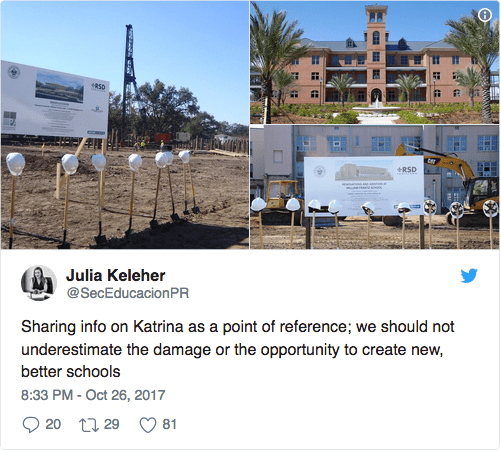
They did it in 2005 to New Orleans schools after Hurricane Katrina. Now they want to do it again in Puerto Rico after Hurricane Maria.


“This is a real opportunity to press the reset button,” said Puerto Rican Secretary of Education Julia Keleher.


“…this [is a] transformational opportunity for us to start to think fundamentally differently about what it is to be in school, and how one goes about getting an education.”

IMG_8573

A dozen years ago in Louisiana, that meant stealing almost the entire New Orleans public school system in the aftermath of Katrina. About 90 percent of the city’s 126 schools were given to the Louisiana Recovery School District, which turned them all into charter schools.


In effect, Louisiana state officials elected by the white majority stole control from local school boards elected by the city’s black majority. More than 7,000 teachers most of whom were people of color and had been displaced by the hurricane found themselves replaced by mostly white teachers brought in from other parts of the country.


Now, more than 10 years later, the New Orleans experiment has been shown to be a failure. Scores on standardized tests have improved (kinda), but the curriculum has narrowed, teacher turnover has doubled, disadvantaged and special education students have even fewer resources while schools fight over high achieving children, students spend hours being bused to schools far from their homes, communities have been erased, and parents have less control over how their own tax dollars are spent.


That is what Keleher and others want to repeat in Puerto Rico – wrest control away from the public and give it to big business all wrapped up in a bow.

Screen Shot 2017-11-09 at 12.34.02 PM

Why?


Public schools come with expensive perks like local control, transparent budgets and regulations to ensure all the money is being spent on students. It’s much cheaper to run these districts with unelected bureaucrats, closed-door budgets and the ability to grab as much of the cash as possible and stuff it into their own pockets.


It ’s not like anyone’s going to complain. These schools aren’t for rich white kids. They’re for poor brown ones.


It’s just colonialism, 2017 style!

IMG_8572

Jeanne Allen thinks that’s a great idea.

The founder and CEO of school privatization lobbying group, the Center For Education Reform, said that charterization is the best thing that could happen to Puerto Rican schools.


After dealing with the immediate effects of the hurricane, reformers “should be thinking about how to recreate the public education system in Puerto Rico.” And she should know. Allen was also involved in the New Orleans fiasco turning that system over to big business.


She added that charter school operators across the nation, including cyber charter school managers (whose schools often have even more wretched academic results), should be thinking about how to get involved in Puerto Rico post-Maria.


Keleher has already begun laying the groundwork.


Even though many Puerto Rican schools are only operational because of the work of teachers who have cleaned them up and have opened them despite being told not to by Keleher’s administration, the Education Secretary has pledged to lay off massive amounts of teachers and permanently close more schools – even schools that are structurally sound.


“Consolidating schools makes sense,” Keleher said in October. “They can go out and protest in the streets, but that doesn’t change the fact that we can’t go back to life being the same as it was before the hurricane.”


Puerto Rican teachers aren’t letting the vultures swoop in without protest.

IMG_8571

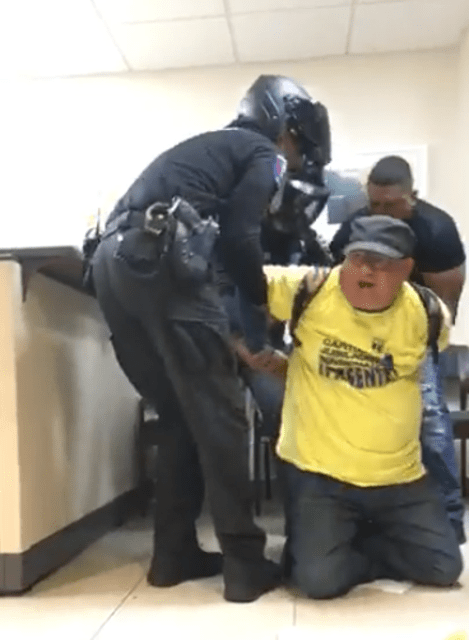
Just this week twenty-one teachers in the capitol of San Juan were arrested during a rally at the Education Department headquarters. They were demanding all structurally sound schools be opened immediately.


“Our schools have served students well and although we recognize that it can be expensive to repair some schools, what we are asking is that schools that are ready be opened,” said social worker Alba Toro just before the arrests.


Administration officials are claiming the teachers were taken into custody because they physically attacked the civil servants, but witnesses say the protest was entirely peaceful.

image

According to Education Safety Commissioner César González, the protesters assaulted at least three security employees and a public relations employee while inside the building.
However, protestors dispute this version of events. Eulalia Centeno, who was part of the group that went inside the building, but left before the arrests began, said that no violent acts were committed and that the protesters only demanded to see the secretary to request the opening of public schools.


Seven weeks after the hurricane, less than half of the island’s nearly 1,200 public schools are open in any capacity. Though many schools endured severe storm and flood damage, others were repaired and cleaned to shelter hurricane victims and are ready to take in students.

“Keleher is using the crisis as an opportunity to close hundreds of public schools, lay off senior teachers and privatize public education,” says Mercedes Martinez, President of the Federacion de Maestros of Puerto Rico, an island teachers union.

IMG_8570

Martinez was one of the teachers arrested during the protest.


When she was taken out of the building in handcuffs, her son was photographed leaning over a railing and patting his mother on the shoulder.


This is what real heroes do.


They refuse to back down despite the forces of prejudice and commerce stacked against them.


Will we let the charter school vampires suck Puerto Rico dry?

IMG_8574