We Are All Chicago Schools – More Layoffs, Less Help for Other People’s Kids

ct-rahm-emanuel-forrest-claypool-private-schools-20160505


“Fuck those kids.”


Mayor Rahm Emanuel couldn’t have been clearer if he’d said the above.


Chicago Schools Chief Executive Forrest Claypool couldn’t have made his priorities clearer if he’d given Chicago’s parents the bird and told them to “Kiss my ass.”


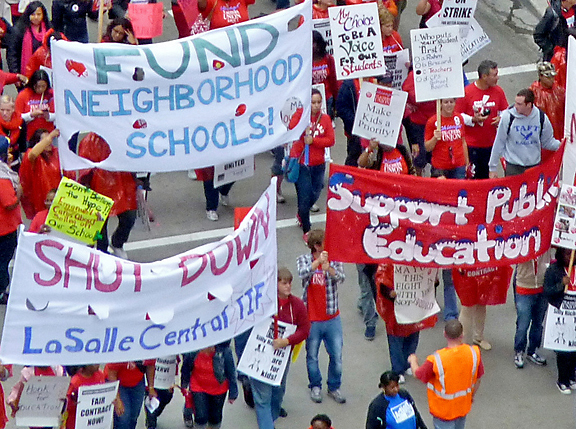
The Chicago Board of Education – made up of members all of whom are appointed by the mayor – decided to layoff 1,000 teachers and staff at the city’s public schools just a month before opening day. Sure, some may keep their jobs through reassignment, but hundreds will be unemployed.


This after a recent history of closing more than 80 schools and slashing thousands of jobs. Just last February, the district laid off 62 employees, including 17 teachers. In January, it laid off 227 staff members.


This begs several questions: How many teachers and support staff can Chicago Public Schools afford to lose? What exactly is this doing to its students? How is it affecting their future prospects to be taught by a skeleton crew?


The city’s leaders don’t give a shit.


And why should they? These aren’t their kids!


Emanuel’s children attend University of Chicago’s Laboratory Schools, a private institution. Claypool’s kids go to Francis W. Parker, a private school in Lincoln Park. Even Gov. Bruce Rauner’s six kids don’t go to public school. They’re all grown.


So this doesn’t affect them. Nor does it affect any charter school kids. Not a single one of these 1,000 cuts will occur at a city charter school.


It’s just the traditional public schools, those schools where approximately 85% of students are Latino or African-American. Just those schools where 87% of the children come from low-income homes. Just those schools where 12% of kids are reported to have limited English proficiency.


Yeah. Fuck those kids.


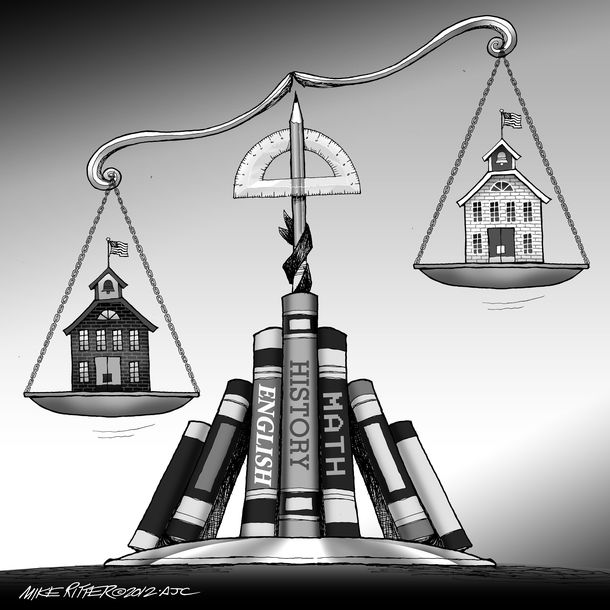
And the worst part is that it’s not necessary. Chicago doesn’t have to continue to abandon its neediest children.


When you’re in a family, you make sacrifices for your kids. If funds are tight, you make cuts elsewhere or maybe you even take another job. Anything to make sure you’re providing your children with the best.


But Chicago’s leaders aren’t interested in doing any of that for these kids because they just don’t care.


Otherwise they could find the money. The teachers union suggests declaring a TIF surplus and reinstating a corporate head tax. The city isn’t exactly a wasteland. Wealthy developers are looking to build yet Emanuel has no intention of inconveniencing them by making them pay a fair share of taxes. Instead, the full burden falls on the city’s working families. And he calls himself a Democrat!


There’s always enough money for projects leaders care about. For instance, there was no problem finding $250,000 to pay a law firm where Claypool and his handpicked general counsel, Ron Marmer, both formerly worked. Marmer still has financial ties to the firm! So cut a check to Jenner & Block LLP? YES! Ensure kids have all the teachers they need? HECK NO!


Strangely there’s $27 million hiding in the seat cushions to open a new charter school for the University of Chicago. The Woodlawn Campus of the University of Chicago Charter School will be part of the development around the newly-planned Obama Library. It’s a fitting symbol of the President’s legacy – a brand new privatized educational facility while a few blocks away traditional public schools molder in ruin.


Meanwhile, Gov. Rauner holds the state education budget hostage. Illinois lawmakers could only agree on a 6-month state budget in June. Republicans expressed concern about the state being responsible for bailing out Chicago Schools. It’s not our problem, they seem to think. Well of course not. These aren’t your kids.


It’s the same swindle we see throughout the country. Refuse to pay for public schools – especially the schools serving poor brown kids, and then shrug. “Look at the impasse,” they shout, hoping voters are too stupid to realize it’s an impasse created by these lawmakers, themselves! It’s a textbook disaster capitalism move, approved by the American Legislative Exchange Council (ALEC) and other conservative think tanks. But Rauner can at least be forgiven for being a proud Republican. This is, after all, the behavior progressives expect from GOP lawmakers.


What about Democrats like Emanuel? This isn’t the way progressives are supposed to act. They aren’t supposed to favor privatization over public schools. They aren’t supposed to fawn on big business and promise tax cuts, tax shelters, and every other kind of tax avoidance.


Some might say it’s just Emanuel. After all, for a Democrat he sure pals around with a lot of conservatives. He and Rauner are best buddies. When Emanuel earned his fortune, he was an investment banker, and one of his best clients was Rauner. They go out to dinner and even spend vacations together. Sure they occasionally criticize each other in public, but behind closed doors the ideological differences just melt away.


What about the rest of the Democrats? Surely they don’t agree with Emanuel’s tactics. They made sure to keep him away from the Democratic National Convention – out of sight, out of mind.


But if the party is really so opposed to these policies, where is the condemnation from party leaders?


I haven’t heard a peep from the Democratic nominee for President, Hillary Clinton, about these layoffs. Have you? She’s the de facto leader of the party and she’s got nothing to say about this. What does that tell you about her priorities?


Sure she’s cozied up to the two biggest national teachers unions who liked her so much they didn’t even need to consult the rank and file before endorsing her in the primary. Ronald Reagan had the support of the Professional Air Traffic Controllers Organization (PATCO) right up until he declared their strike illegal and demanded they return to work. Will Clinton, too, turn against union teachers once she’s used them for their vote in November?


But you know what? Forget Hillary. Where’s Bill? Where’s Tim Kaine? Where’s Barack and Michelle Obama? Where’s Joe Biden? Where’s Al Franken? Where’s Cory Booker?


We have to get beyond labels like Republicans and Democrats, liberals and conservatives. Almost all of them are neoliberals. They all believe essentially the same things.


And as proof I offer the deafening silence offered against Emanuel in Chicago.


He’s hurting school children.


But no one in power gives a fuck.

No New Charter Schools – NAACP Draws Line in the Sand

Line in sand


In the education market, charter schools are often sold as a way to help black and brown children.


But The National Association for the Advancement of Colored People (NAACP) isn’t buying it.


In fact, the organization is calling for a halt on any new charter schools across the nation.


Delegates from across the country passed a resolution at the NAACP’s national convention in Cincinnati last week calling for a moratorium on new charters schools. Approval of the new resolution will not be official until the national board meeting later this year.


This resolution isn’t a change in policy. But it strengthens the organization’s stance from 2010 and 2014 against charters.


Specifically, the resolution states:


“…the NAACP opposes the privatization of public schools and/or public subsidizing or funding of for-profit or charter schools…”


“…the NAACP calls for full funding and support of high quality free public education for all children…”


The resolution goes on to oppose tax breaks to support charter schools and calls for new legislation to increase charter school transparency. Moreover, charters should not be allowed to kick students out for disciplinary reasons.


This goes against the well-funded narrative of charter schools as vehicles to ensure civil rights.


The pro-charter story has been told by deep pocketed investors such as the Koch Brothers and the Walton Family Foundation. But the idea that a separate parallel school system would somehow benefit black and brown children goes against history and common sense.


The Supreme Court, after all, ruled separate but equal to be Unconstitutional in Brown vs. Board of Education. Yet somehow these wealthy “philanthropists” know better.


People of color know that when your children are separated from the white and rich kids, they often don’t get the same resources, funding and proper education. You want your children to be integrated not segregated. You want them to be where the rich white kids are. That way it’s harder for them to be excluded from the excellent education being provided to their lighter skinned and more economically advantaged peers.


Julian Vasquez Heilig, education chair of the California and Hawaiian NAACP chapter which proposed the new resolution, says its ironic charter schools are marketed as school choice.


The endgame, says Heilig, is to replace the current public schools with privatized charter schools. This is exactly what’s been proposed in the US territory of Puerto Rico.


It’s not about giving parents more choices. It’s about eliminating one option and replacing it with another. It’s about reducing the cost to educate poor and minority children while also reducing the quality of services provided. Meanwhile, public tax dollars earmarked to help students learn become profit for wealthy corporations running charter schools.


As the Presidential election heats up, it will be interesting to see how Hillary Clinton and Donald Trump address the issue. Already school choice policies have been wholeheartedly embraced by the Republican nominee. Not only does he favor charter schools, he also supports school vouchers and other schemes to privatize public tax money. This shouldn’t be a surprise since he ran his own private education scam – Trump University.


Clinton, on the other hand, has been more measured in her support, even criticizing some aspects of charter schools. However, her campaign has issued statements saying she supports only “high quality charter schools” – whatever those are.


Moreover, just this week at the Democratic National Convention, Clinton staffers met with hedge fund mangers from Democrats for Education Reform (DFER).


According to Molly Knefel who covered the meeting for Truthout, the mood was not positive toward ending corporate education reform strategies.


She reported that moderator Jonathan Alter worried about the argument becoming based on social justice.


“If it becomes a social justice movement, doesn’t that in some ways let, for lack of a better word or expression, Diane Ravitch’s argument win?” asked Alter. “Which is, ‘don’t blame any of us, don’t focus on schools; if we don’t solve poverty, nothing is going to get better.’ Isn’t there a danger of falling away from the focus on at least some responsibility on schools?”


Apparently Alter is falling back on the old chestnut that under-funded schools should be blamed and shut down if they can’t help the neediest children to the same degree as well-resourced schools. And any attempt to focus on underlying inequalities would somehow give teachers a free pass? I suppose Alter believes a fire company that can’t afford a fire truck should be just as effective as one with three new ones.


Meanwhile, longtime corporate education reformer Peter Cunningham was asked specifically if school integration was important. He responded tellingly:


“Maybe the fight’s not worth it. It’s a good thing; we all think integration is good. But it’s been a long fight, we’ve had middling success. At the same time, we have lots and lots of schools filled with kids of one race, one background, that are doing great. It’s a good question.”


The number of segregated schools where students “are doing great” is certainly in question. Perhaps he’s referring to well-resourced all-white private schools for the children of the rich and powerful. Or maybe he means the all-black charter schools where administrators handpick the best and brightest students and refuse to educate those most in need.


One hopes Clinton will continue to fight alongside the NAACP and other civil rights organizations like Journey for Justice and the Rev. William Barber’s Moral Mondays to defend public schools against the failed education policies of the George W. Bush and Barack Obama administrations.


Two weeks ago DFER President Shavar Jeffries criticized the finalized Democratic education platform for turning against corporate education reform. This transformation away from school privatization and standardized testing was the result of education activists Chuck Pascal of Pittsburgh, Troy LaRaviere of Chicago and Christine Kramar of Nevada who worked hard to ensure the platform – though non-binding – would at least set forth a positive vision of what our public schools should look like.


Make no mistake, the tide is turning. It is becoming increasingly difficult for charter supporters to claim their products boost minority children’s civil rights.


Too many people have seen how they actually violate them.

Killed for Being a Teacher – Mexico’s Corporate Education Reform

mexico-protests

In Mexico, you can be killed for being a teacher.

Correction: you can be killed for being a teacher who opens her mouth and speaks her mind.

You can be killed, kidnapped, imprisoned – disappeared.

That’s what happened to approximately six people a week ago at a protest conducted by a teachers union in the southern state of Oaxaca.

The six (some of whom were teachers) were gunned down by police and as many as 100 more people were injured near the town of Nochixtlan, about 50 miles northwest of Oaxaca City.

Conflict between teachers and governments has become commonplace across the globe as austerity and neoliberalism have become the policies du jour. Tax cuts for the rich lead to shrinking public services. And investment in the next generation through public education becomes a thing of the past.

Even here in the United States, educators are taking to the streets to protest a system that refuses to help students – especially poor and minority students – while blaming all deficiencies on one of the only groups that actually show up to help: teachers.

Though in America educators have been ignored, unjustly fired and even arrested for such protests, the Mexican government has resorted to all out murder.

How did it come to this? Follow the trail backwards to its source.

The activists in Oaxaca were protesting because several union officials had been kidnapped by the government and unjustly imprisoned the previous weekend.

Those union officials were asking questions about the 2014 disappearance and alleged murder of 43 protesting student teachers by agents of the government.

These student teachers, in turn, were fighting incoming President Enrique Peña Nieto’s education reforms.

Specifically, Nieto threatened to fire tens of thousands of teachers by using their impoverished, neglected and under-resourced students’ test scores against them.

The government provides next to nothing to educate these kids. And just like officials in the U.S., Nieto wants to blame a situation he created on the people who volunteered to help fix it. It’s like an arsonist blaming a blaze on the fire department.

Why’s he doing it? Power. Pure power.

Poverty in Mexico is more widespread than it is even in its northern neighbor. This is because the most populace Spanish-speaking country in the world also has one of the most corrupt governments on the face of the Earth: A government in bed with the drug cartels. A government that has no interest in serving the people whom it pretends are its constituents.

Since before the Mexican Revolution in 1810, teachers have been the center of communities in impoverished neighborhoods empowering citizens to fight for their rights. These teachers learned how to fight for social justice at national teacher training schools, which Nieto proposes to shut down and allow anyone with a college degree in any subject to be a teacher.

Not only would this drastically reduce the quality of the nation’s educators, it would effectively silence the single largest political force against the President.

In short, this has nothing to do with fixing Mexico’s defunct public education system. It’s all about destroying a political foe.

The government does not have the best interests of the citizens at heart – especially the poor. The teachers do.

Though more violent than the conflict in the United States, the battle in Mexico is emblematic of the same fight teachers face here.

It remains to be seen how this southern conflict will affect us up north.

People have died – literally died – fighting against standardized testing, value added measures, school privatization and the deprofessionalization of teaching. Will this make Bill Gates, John King, Campbell Brown and other U.S. corporate education reformers more squeamish about pushing their own education agenda? After all, they are trying to sell stratagems that look almost exactly alike to Nieto’s. How long can they advocate for clearly fascist practices without acknowledging the blood on their own hands, too?

For our part, U.S. teachers, parents, students, and activists see the similarities. We see them here, in Puerto Rico, in Britain, in much of Europe, in Africa and throughout the world.

We see the violence in Mexico, and we stand with you. From sea to shinning sea, we’re calling for an end to the bloodshed.

The Network for Public Education has issued an urgent appeal to the Mexican government to stop the violence. Members of the Chicago Teachers Union have taken to the streets to protest in solidarity with their brothers and sisters south of the border.

https://www.facebook.com/plugins/video.php?href=https%3A%2F%2Fwww.facebook.com%2Ftelesurenglish%2Fvideos%2F864024527074284%2F&show_text=0&width=560


We stand with you, Mexico.

We fight with you.

We bleed with you.

We are the same.

Peace and solidarity.

The Charter School Swindle – Selling Segregation to Blacks and Latinos

Screen Shot 2016-05-31 at 4.22.46 PM


Segregation now!


Higher suspension rates for black students!


Lower quality schools for Latinos!


These may sound like the campaign cries of George Wallace or Ross Barnett. But this isn’t the 1960s and it isn’t Alabama or Mississippi.


These are the cries of modern day charter school advocates – or they could be.


School choice boosters rarely if ever couch their support in these terms, but when touting charter schools over traditional public schools, this is exactly what they’re advocating.


According to the Civil Right Project at UCLA, “The charter school movement has been a major political success, but it has been a civil rights failure.”


It’s choice over equity.


Advocates have become so blinded by the idea of choice that they can’t see the poor quality of what’s being offered.


Because charter schools DO increase segregation. They DO suspend children of color at higher rates than traditional public schools. And they DO achieve academic outcomes for their students that are generally either comparable to traditional public schools or – in many cases – much worse.


In Brown vs. Board of Education, the U.S. Supreme Court ruled that it is Unconstitutional to have “separate but equal” schools because when they’re separate, they’re rarely equal. Having two parallel systems of education makes it too easy to provide more resources to some kids and less to others.


Who would have ever thought that some minority parents would actually choose this outcome, themselves, for their own children!?


After Bloody Sunday, Freedom Rides, bus boycotts and countless other battles, a portion of minority people today somehow want more segregation!?


It’s hard to determine the extent of this odd phenomena. Charter advocates flood money into traditional civil rights organizations that until yesterday opposed school privatization. Meanwhile they hold up any examples of minority support as if it were the whole story. However, it is undeniable that large minority populations still oppose their school systems being charterized.


It’s especially troubling for civil rights advocates because black and brown charter supporters have been sold on an idea that could accurately be labeled Jim Crow. And they don’t even seem to know it.


The reason is two-fold: (1) the success of privatization propaganda and (2) the erosion of our public school system.


Charter schools are big business. Many of them are managed by huge corporations for a profit. They are run at taxpayer expense with little to no oversight. As you might expect, this often results in multi-million dollar financial scandals and worse outcomes for students. But these facts have not fazed some of the public. Propagandists know how to sell people on things that are bad for them: Fast food, miracle cures and charter schools.


They’ve marketed corporate McSchools as if these were mostly charitable institutions founded for the sole purpose of making children’s lives better. Meanwhile, funds that might actually help kids learn are funneled to hedge fund mangers and investors: Schools don’t open yet tax money disappears. Student services are reduced below that offered at comparable neighborhood public schools. Charter students are expelled for low test scores or special needs. Yet the public still buys the glossy full-color advertisement without bothering about the small print.


One thing corporate education reformers have over advocates of traditional public schools is their willingness to talk about race. They clothe their arguments in the terms of the Civil Rights movement. They talk about having high expectations for children of color. They talk about closing the achievement gap. They talk about understanding the needs of minority children.


It’s all bullshit.


Their “high expectations” are really just an excuse for treating brown and black kids as if they weren’t human. They put these children under intense pressure, berating them for wrong answers and kicking them out if they don’t perform.


Yet the academic results produced at charter schools are often less than stellar. Sometimes they’re downright abysmal. Instead of addressing the fundamental inequalities inherent in the achievement gap – economically and culturally biased high stakes testing, shoddy and developmentally inappropriate academic standards, etc. – they reinforce that status quo. It’s like instead of fighting a prohibition against sitting in the back of the bus, they berate black folks for not enjoying the ride.


I’m sorry. But when it comes to understanding the needs of black and Latino kids, I refuse to believe children of color need a second-class education system. (Just as I refuse to believe Teach for America’s claim that all black kids really need are less experienced, less educated and less committed teacher trainees.)


Perhaps if traditional public schools actually addressed these issues head on, privatizers wouldn’t appear to be saviors. There are real problems faced by children of color in our school systems. They have real needs that most of our schools – charter, traditional, private or parochial – just are not meeting. But while charter schools pay lip service to the problems without fixing them and in fact often making them worse, public schools pretend these problems don’t exist in the first place.


No wonder some minority parents choose charter schools. At least there they get the illusion that someone cares about their needs.


In fact, privatizers couldn’t sell their substandard products if it weren’t for what we’ve allowed to happen to our traditional public schools. Segregation is made worse in charter schools, but it is also prevalent at our traditional public schools – though often to a lesser degree.


We have allowed traditional public schools to be largely segregated based on parental income. We have schools for poor kids and schools for rich kids. Thus, we have schools for black kids and schools for white kids. And guess which ones are well-funded and which go lacking?


This is what people are really talking about when they mention “failing schools.” They pretend as if the teachers are failing, the principals are failing, the democratic process, itself, is failing. In reality, it is our state and federal lawmakers who are failing. They have failed to provide equitable resources that our nation’s children need.


Schools cost money. If you don’t provide the funding necessary to properly educate children, you will get an inferior result. Meanwhile, pundits play with numbers and make false comparisons to hide this basic fact – we aren’t providing all kids with the resources they need to succeed. Rich kids have enough. Poor kids don’t. But we look at national averages, add in unfunded legal mandates and pretend that tells the whole story.


How does this happen? Segregation. In fact, we’re allowing segregation of place to determine segregation of school. Instead of counteracting an unfair status quo, we’re letting the way things are today determine how things will be tomorrow.


Fact: people of different ethnicities tend to cluster together, like with like. Part of this is because people tend to self-segregate with people around whom they feel most comfortable. However, this is also a function of social planning. Banks tend to shy away from giving loans to families of color who want to move into white neighborhoods. Moreover, white homeowners are often reluctant to sell to families of color. The result is an America made up of black neighborhoods and white neighborhoods.


In organizing our public schools we could try to overcome these differences, but instead we amplify them. In many states we insist that schools be funded based on local property taxes. So poor brown and black people who happen to live clustered together get poorly funded schools for their kids. And rich white folks who live together in their gated communities get well-funded schools for their progeny.


Is it any wonder then that some people of color buy into the charter school lie? They’re offered the choice between an obviously under-resourced public school or a glossy new charter school that actually offers them less. But they don’t see that far. They’re tired of the indifference behind traditional public school funding and opt to try something different. Unfortunately, it’s just another lie and a more pernicious one for several reasons.


First, charter schools take an already segregated population and make it worse. Second, they weaken the already stumbling traditional public schools by siphoning off their dwindling funding. And finally, they obscure the fact that it’s often the same policymakers who champion charters that are responsible for eroding public schools in the first place.


People of color would be much better served by sticking with their traditional public schools and fighting to make them better. For all their faults, traditional public schools often provide a better quality education. They have more resources and less flexibility to take away those resources. They have more well-trained and experienced staff. And since they serve a more diverse population, they offer the chance for people of similar economic backgrounds but diverse cultures to join together in common cause.


Dividing people makes them weaker politically. When people band together, they have power. They can fight more effectively for what they deserve. Perhaps this is the greatest problem with charter schools – they destroy communities and rob neighborhoods of the collective power that is their due.


In many areas of the country, communities of color know this. Ask them in New Orleans what they think of their all-charter school district. Ask them in Chicago what they think of the city’s plan to close public schools and turn them into charters. Ask them in Philadelphia or any urban district taken over by the state.


They’ll tell you straight out how privatized education is cultural sabotage. They’ll tell you how it’s the new colonialism, another element of the new Jim Crow. They’ll tell you how important it is to fight for our system of public schools.


And when privatizers and propagandists try to paint all communities of color as if they support charter schools, these folks will loudly cry foul.


They aren’t buying the snake oil. The rest of us need to step up and help those who have been swindled to see the truth. Likewise we need to recognize their truth – that the struggle for civil rights is ongoing.


Because we can’t win the fight against privatization without them. And they can’t win the fight for equality without us.


We need each other.


Public school advocates need to recognize it’s not all about testing, Common Core and privatization. We can’t be so afraid to talk about race. We need to recognize that racism is not an unnecessary distraction, it’s at the center of our struggle.


We need communities of color.


We need our black and brown brothers and sisters.


Because only together shall we all overcome this madness.

My Students Are Scared of Donald Trump


trump-800x430


“Are they gonna’ make us all leave?”


That was the question one of my 8th grade students asked today.


He sits in the front row – quiet, reserved, eyes usually pointed sullenly at his desk.


He doesn’t ask questions. Not publicly.


If he has something to say, he’ll ask me before or after class.


But there he was with his hand in the air and his eyes firmly fixed on mine.


“Tyree, are you afraid someone’s going to make you leave your country?”


He nodded and I saw several other black faces nodding throughout the room.


“Are you afraid someone’s going to send you… where… to Africa?”


“Yeah,” Tyree said for the group.


I teach Language Arts at an under-resourced school in Western Pennsylvania. I’m white and most of my students are black. Almost all of them are from poor families. Very few are Hispanic or Muslim.


We had been discussing the Holocaust in preparation to read “The Diary of Anne Frank.”


I often try to make connections with current events during this time, but today I didn’t have to do any connecting. My students did it for me.


“I don’t like Donald Trump,” Jacklyn said. “He’s racist.”


And Tyree spoke again – impatiently, nervously – “Who are you voting for, Mr. Singer?”


I paused. “I don’t think it would be appropriate for me to say,” I responded, “but I will say this…”


And I looked all of them in the face.


“Not. Donald. Trump.”


You could feel the sigh go through them like a physical thing.


They are actually scared. And something like it happened in every class today.


I mentioned Adolph Hitler and they came back with Donald Trump.


History had come alive. It was a boogeyman haunting the shadows. And the only thing that dispels shadows is light.


I had to reassure them. It wasn’t in my lesson plan. I had done no prior research for it, but this was the direction they were pulling me. I had had no intention of talking about Donald Trump, but we needed to go there.


We had a discussion comparing and contrasting the two men. They both wrote books, but “Mein Kampf” is very different than “The Art of the Deal.” Both were captivating speakers who promote violence, but Trump speaks at a third grade level. Both said hateful things against minorities, but only Hitler advocated eradicating people from the face of the Earth. Both proposed minorities be monitored by the government but Hitler focused mostly on Jews while Trump focuses mostly on Muslims.


The conversation went on.


In over a decade in the classroom, I’ve never had students so upset about politics. Sure they get angry when unarmed people of color are shot by the police. Sure they feel the pull of Baltimore and Ferguson. But never have they cared about who’s running for President. They won’t be able to vote, themselves, for five or more years.


But they wanted to talk public affairs. What was I to do? The purpose of history is to learn from it. We look to the past so we won’t repeat it. Yet that was a lesson I didn’t need to teach. They already knew it. That’s why they were bringing this up.


We talked political parties. We discussed how the Nazis were a political organization like the Democrats and the Republicans are today. We talked about how Hitler had been a house painter and Donald Trump was a reality TV star who inherited most of his money.


And we talked about racism.


Why people hate others. The definition of prejudice – how racism is one kind of prejudice but there are many others – hating people because of religion, because they’re disabled, because of their sexuality.


Jermaine said he was uncomfortable going to the bathroom in public in case someone gay walked in.


I asked if he thought a gay man would try to make a move on him while he was on the toilet. I asked if he’d ever make a move on someone while that person was on the toilet.


The class laughed.


Someone mentioned Chicago and how protesters had forced Trump to cancel his rally. Yes. An 8th grade student knew about that.


And then someone mentioned Bernie Sanders. Yes. They brought him up, too.


Some of my kids liked him because they said he wasn’t racist. Others thought he would legalize marijuana.


So I asked if anyone knew about the other candidates. And that’s where their news-savvy faded. Someone said something strange about Hillary Clinton that they heard she was against soil. I still don’t know what he meant.


Another child said he heard Tom Cruise was running. “TED Cruz,” I corrected. None had heard of John Kasich.


I explained how a primary election works. We talked about how Hitler was elected. We talked about the Reichstag vs. Congress.


“Didn’t we have concentration camps here in America?” someone asked. So we talked about Japanese internment camps and compared those to what you’d find in Europe.


At some point I lost track of all we talked about. But when the bell rang, the tension was gone.


They got up calmly and went to the door. Many of them made a point to cheerfully say goodbye or dap me up on their way. You always know middle school students love you when they do that.


Jason stopped by my desk on the way out and said, “My dad’s going to vote for Donald Trump.” He was blushing.


“He may have good reasons,” I said. “Maybe you should ask him about it.” He smiled and walked out.


Only one student was left.


“You, okay, Tyree?” I asked.


He was grinning. “You’d be a good history teacher, Mr. Singer,” he said.


I shook my head. “And you’re a good history student.”


I clapped him on the back, before writing him a pass to his next class.


My plans sat murdered on my desk.


But I had taught a much better lesson.


Nothing happens without cause.


We can understand it if we try.


Understanding is the key to prevention.


And we’re in this together.


NOTE: All student names have been changed to protect their anonymity.

.


Say It To My Face: Chicago’s Epic Trump Shutdown

trump_chicago_rally_ap_1457744693678_33791410_ver1.0_640_480
All fascists are cowards.

Especially Donald Trump.

The Reality TV star turned Presidential candidate is known for making bigoted statements at his rallies against Muslims, Latinos, women, black people, the disabled – basically anyone not white, male and straight.

So when thousands of these Muslims, Latinos, women, black people, etc. showed up at his rally in Chicago last night, Trump took a bold stance… and ran away.

He cancelled the rally rather than face them.

Sure there was the potential for violence if he had continued with his speech as planned, but that has never stopped him before. How many times have we seen cellphone videos of minorities being forcibly escorted from his campaign events, sometimes after being beaten or otherwise accosted? I don’t remember Trump canceling any of those events.

But when the people he denigrates show up in force, THAT’S when he pulls the plug. When voicing the same hostility-filled rant puts himself in danger, that’s when he turns tail.

THIS is your strongman, America! A sniveling coward who only has the guts to spout hate speech to a receptive audience!

Hilariously, his supporters are defending the Republican challenger’s brave retreat by appealing to the First Amendment.

Trump’s right to free speech is being violated, they say. What nonsense!

I just saw him on CNN complaining about it. And CBS. And NBC. And every other cable channel plus satellite! If that’s having your First Amendment rights violated, I wish someone would violate mine! Put my blog in the center of the 24-hour news cycle!

Let’s get one thing straight: the First Amendment guarantees your right to free speech. It does not guarantee a right to consequence free speech.

When you build a political campaign on the notion that some people are inferior to people like you, those so-called inferior people are eventually going to call you out.

There’s no hiding behind Uncle Sam’s coattails. YOU did that. You’re responsible for dealing with it.

Another popular response is that the protesters are sinking to Trump’s level. They’re meeting one mob with another.

Wrong. You cannot equate these two groups.

Trump’s supporters are embracing a message of hatred and intolerance. The protesters are espousing a message of love and tolerance. Trump’s supporters are singling out and beating individuals or small groups of minorities. The protesters are overwhelmingly nonviolent – though occasional sporadic violence did erupt at the rally most often when protesters defended themselves.

The protesters marched hand-in-hand into the lion’s den where they were vastly outnumbered. They put their lives on the line to make their views heard. They had the full expectation of being attacked and possibly killed, but they did it anyway. THAT is true bravery. THAT is true conviction – not someone who expected to be in a stadium full of like-minded people waiting to be whipped into a frenzy by a megalomaniac with extremely bad hair.

Which brings me to my favorite criticism of the Chicago protest. Some folks say the protesters had no idea what they were doing. They were just ignorant fools.

Exactly. People coming to protest hatred are ignorant and those coming to celebrate it are intelligent!

And finally we have the man, himself. The Donald has been crying on the news about the organized “thugs” who disrupted his rally.

He must really be rattled to call them “thugs.” Trump isn’t known for falling back on racist dog whistles. Usually he just says it outright. Did he forget his favorite N-word?

So once again Chicago shows us all the way.

The runaway Trump campaign can run roughshod over media criticism, wagging fingers and shaking heads. But the one thing it cannot handle is confrontation by the very people it denigrates.

Like a schoolyard bully, Trump retreats when you call him out.

You don’t like Muslims! Say it to my face!

You don’t like Latinos? Say it to my face!

You don’t like women…

This could take a while.

In the meantime, here’s to those brave Chicago protesters who stopped totalitarianism in its tracks!

They showed us that the only thing we need to truly make America great again is to recognize how great we are when we come together to fight for each other.

How to Get Rich From Public Schools (Without Actually Educating)

Get-Rich


Gold!


There’s gold in them thar schools!


Don’t believe me?


When you drive by an inner city school, it doesn’t exactly look like the Taj Mahal. Does it? Even relatively upscale suburban schools wouldn’t be mistaken for a house on MTV Cribs. And some of those fly-by night charter schools look more like prisons than Shangri-La.


But I’ve got it on good authority that there’s $1.3 trillion available for someone who knows how to take it.


That someone is Harold Levy, an expert on how to get rich through school privatization.


The former chancellor of the New York City School System has begun a second career managing an investment company.


“For-profit education is one of the largest U.S. investment markets, currently topping $1.3 trillion in value,” according to the Website for one of his master classes for rich investors.


Wooo-weee! That’s a lot of money!


To put it in context, that’s more than 10 times the amount the federal government spends on education per year. And it’s all yummy profit!


So how do you get your hands on some of those delicious taxpayer greenbacks?


You gotta’ invest.


No! I don’t mean increase education budgets for traditional public schools that can barely make ends meet! I mean invest in shiny new charter schools.


Here’s how it works.


Lend money to a for-profit company to build a new charter school. If you do it just right, you’re almost guaranteed to double or triple your money in seven years.


You’ll want to take advantage of the New Markets Tax Credit (NMTC), which began in 2000 at the end of President Bill Clinton’s administration. This will give you a whooping 39 percent tax credit. But here’s the best part, since it’s money you’re lending, you also get interest on it! And if that weren’t enough, you can piggyback all kinds of additional federal tax credits on top of that – things like historic preservation or job creation or Brownfield’s credits.


That doesn’t sound legal, does it? But it is!


In case that has you feeling queasy, you can hide what you’re doing by funneling the whole thing through a large non-profit organization like the Gates Foundation. They’ll be more than happy to help. They’ve done it for so many before you anyway.


However, make sure you whisk this money through something called a Community Development Entity (CDE). The federal website explains this can be either a “domestic corporation or partnership.” And it must have “a primary mission of serving LICs [Low Income Communities].” (Snicker!)


Here’s the best part. A CDE isn’t required to release information about who its donors are or how much they’re spending. So on paper the CDE – not you – gives the money to the non-profit, which, in turn, loans the money to a charter management organization. It’s like money laundering. No one can tell where the funds came from and thus it’s easy to escape from federal regulations or any appearance of wrongdoing.


There is a catch, however. You’re probably going to need a substantial amount of capital to put forward – at least a million bucks or so. No bank’s going to waste its time with only a few hundred thou.


This method is perfect for those who are already wealthy and want to increase their wealth or hedge fund managers out to boost their clients’ portfolios.


But maybe you just aren’t into the whole hedge fund game. Maybe you’re not the banking and investing type.


You can still make oodles of cash off public schools through real estate.


Here’s what you do – buy up cheap inner city properties that can be renovated or repurposed for charter schools. Then when a school privatization firm wants to set up shop in an impoverished city like Philadelphia, Chicago or Detroit, it needs someone like you to open the door.


You’ll get to charge the charter corporation rent and – get this – that’s not price capped! You can charge whatever you want! As long as you’ve got a good spot and no one else is trying to beat you to it, charter corporations are willing to pay bookoo bucks to get their money-making enterprises rolling!


A good rule of thumb comes from privatization expert Charter Schools USA, which recommends rental costs not exceed 20 percent of a school’s budget. However, there are plenty of examples of charter schools paying 25, 30 even up to 43 percent of their money just on rental costs! Ca-Ching!


And if you really want to boost the bottom line, open a charter school, yourself! That way you can both rent out the real estate and pay for it!


Think about it. Who sets the rental price? You do. Who pays the rental price? You do. So you can pay yourself WHATEVER YOU WANT! And where does the money come from? The taxpayers!


Doesn’t sound legal does it? But it is!


According to the Miami Herald, which conducted an in-depth investigation into these practices, many of the highest rents are charged by landlords with ties to the management companies running the schools. Property records show at least 56 charter schools in Miami-Dade and Broward counties sitting on land whose owners are tied to management companies.


Of course there are so many other ways to set things up like this with a charter school. Unlike most traditional public schools, charters contract with for-profit companies for everything from curriculum development to construction. So there are many opportunities for creative investors to figure out how to both set the price and pay it TO THEMSELVES!


Moreover, every state has different laws about charter schools so check for loopholes. You’ll find ‘em!


Just don’t forget to set up that CDE to hide your shady dealings from the public. After all, if taxpayers could easily see how you’re sucking up their hard-earned money that they thought was going to help school children (Tee-hee!) they wouldn’t be happy.


And if you’re reading this from somewhere outside of the USA, don’t despair. You, too, can make a ton of money off school privatization in the United States. It’s like the Statue of Liberty says – wealthy foreign nationals welcome! (Or something like that.)


Since the Immigration Act of 1990, investors have been allowed to purchase visas for their families by investing in U.S. corporations. Just stash some cash into a hotel, ski resort or charter school and – voilà! – Move directly to GO and collect way more than $200!


It’s called the EB-5 visa for Immigrant Investors. For the low price of at least $1 million -or $500,000 to a rural or high unemployment neighborhood — you can get visas for the whole family.


Sounds like some crazy new loophole – right? It isn’t. It’s been around for decades. Every year, the federal government hands out 10,000 of these visas. So while Syrian refugee children drown seeking asylum, wealthy foreign nationals get an express ticket to the US of A.


You might be thinking, ‘That gets me into the country, but where do I cash in?’ Easy. You now have a stake in a U.S. charter school and have access to all the same easy money as native-born investors.


It’s an incredibly lucrative model even for those more interested in the Prophet than profit.


Just look at Gulen charter schools. It’s the largest single charter school network in the country. More than 150 schools in Texas, Ohio, Illinois and other cities are funded by Turkish investors following an Islamic nationalist named Fetullaf Gülen. These schools are part of a “worldwide religious, social and nationalistic movement in his name,” according to the New York Times.


Be warned. Many of these schools are under investigation for using U.S. taxpayer dollars meant to educate U.S. children in non-educational or otherwise shady ways. Some of this tax revenue has allegedly been spent on political and religious causes championed by the Prophet Gülen. Other funds have gone to controversial educational practices. For instance, instead of hiring local teachers, the chain is infamous for shipping in Turkish educators to the United States. As if it wouldn’t be cheaper to hire locals! And guess where the money comes from to pay for these Turkish teachers’ visas? That’s right – from the charter school’s funding!


Still. Even with a few setbacks, there’s never been a better time to invest in the privatization of public education. Sure there are financial, behavioral and educational scandals at charter schools throughout the country being discovered everyday. But fortune favors the brave!


Money is just hanging on the tree waiting to be plucked. It’s hard to walk into a charter school and not come out with pockets fit to bursting with cold, hard cash.


In fact, the only folks not making bank in this whole scheme are the teachers!


Don’t be one of them.


Teachers at charter schools – where unionizing is often prohibited – take home even less than those working at traditional public schools. And those traditional educators aren’t getting rich, either.


A new report by the Center for American Progress argues that U.S. teachers usually have bad starting pay and are unlikely to see major salary gains even after several years of teaching.


Growth in teacher salaries is especially bad when comparing the U.S. to other developed countries:

Screen Shot 2016-02-23 at 7.48.08 AM

“The bottom line is that mid- and late-career teachers are not earning what they deserve, nor are they able to gain the salaries that support a middle-class existence,” the report concluded.


There appears to be a golden rule in education: the less you actually help students learn, the more money you get to take home.


Perhaps if public schools were kept out of private hands where profit is the overwhelming motivation for everything you do, things would be different. But thank goodness that isn’t happening!


Someday people may wake up and demand more for their tax dollars and for their children. But until then…


There’s gold in them thar schools!


Don’t be a sap. Don’t be a teacher. Don’t help children. Invest in a fly-by-night charter school and get rich!


NOTE: This article also was published in Commondreams.org.


Most Charter Schools are Public Schools in Name ONLY

charterart

Charter schools are public schools.

But are they?

Really?

They don’t look like a duck. They don’t quack like a duck. Do you really want to serve them confit with a nice orange sauce?

Sure, charters are funded by tax dollars. However, that’s usually where the similarities end.

They don’t teach like public schools, they don’t spend their money like public schools, they don’t treat students or parents like public schools – in fact, that’s the very reason they exist – to be as unlike public schools as possible.

Advocates claim charters exist as laboratory schools. They are free to experiment and find new, better ways of doing things. Once they’ve proven their successes, these improved practices will eventually trickle down to our more traditional houses of learning.

At least, that’s the ideal behind them. But to my knowledge it’s never happened.

As a public school teacher, I can never recall being at a training where charter operators taught us how to do things better with these time-tested strategies. I do, however, recall watching excellent co-workers furloughed because my district had to meet the rising costs of payments to our local charters.

Moreover, if the freedom to experiment is so important, why not give that privilege to all public schools, not just a subset?

The reality is much different than the ideal. In the overwhelming majority of cases, charter schools are vastly inferior to their more traditional brethren. To understand why, we need to see the differences between these two kinds of learning institutions and why in every case the advantage goes to our much-maligned, long suffering traditional public schools:

1) Charters Don’t Accept all Students

Charter schools are choosey. They don’t take just any old students. They only accept the ones they want. And the ones they want are usually easy and less expensive to teach.

The process is called “Creaming” because they only pick the cream of the crop. Then when these students who are already doing well continue to do well at a charter, the administrators take all the credit. It’s as if they were saying – Look how well we teach. All these former A-students continue to get A’s here at our school. It’s really quite an achievement. (Not.)

However, sometimes the bait-and-switch isn’t so obvious. Occasionally, charters actually do accept special needs and/or difficult students – for a few months. Then when the big standardized test is coming up, they quietly give these kids the boot. That way they can claim they accept everyone but still get excellent standardized test scores.

Ironically, that’s what they mean by “School Choice.” It’s usually touted as a way of giving alternatives to parents and students. In reality, the choice only goes to administrators. Not “Which school do YOU want to attend?” but “Which students do WE want to accept to make our charter look good?”

Keep in mind, this situation is allowed by law. Charters are legally permitted to discriminate against whichever students they want.

By contrast, traditional public schools accept all students who live within the district. It doesn’t matter if children have special needs and therefore cost more to educate. If a child lives within district boarders, your neighborhood public school will take him or her in and provide the best experience possible.

Bean counters complain about poor test scores, but traditional public schools aren’t gaming the system. They aren’t weeding out difficult students. They take everyone. Administrators have no choice. This is dictated by law. Public schools are equal opportunity educators.

2) Charters Have No Transparency

Have you ever been to a school board meeting? Ever listened to school directors debate the merits of one course of action versus another? Ever looked over public documents detailing district finances and how money is spent? Ever read over bids vendors provide for services? Ever spoken at a public meeting to school directors about what you think is the best way to proceed in a given situation? Ever had a school director or two disappoint and then worked to vote him or her out of office?

At traditional public schools, you can do all of this – even if you don’t have any children in the school system! At a charter school, you’re out of luck.

Charters rarely have to tell you how they spend their money, rarely debate management decisions in public, rarely invite or even permit you a seat in the audience. Heck! They don’t have to!

Charters survive on public money, but once that money goes in those charter doors, the public never sees it again. If you don’t like how the charter is treating your child, you can remove the little dear from the school. But if a non-parent doesn’t like how they suspect the charter is spending his or her tax money, there is absolutely no recourse. You are taxed without any representation. Wars have been fought over such things. It’s hard to imagine how that can be Constitutional.

In sum, traditional public schools are like most other government organizations. They are required by law to be transparent to the public. Charter schools, however, are money pits and what goes down those gaping holes is lost forever from public view.

3) Charters Advertise

Have you ever seen those huge billboards by the side of the road trying to convince motorists to send their children to a charter chain? Ever hear a radio advertisement about how happy little kiddos are at Brand X Charter School?

Those advertisements cost money. Your money, to be exact. You paid for those commercials. And what’s more, every penny spent on those glossy advertisements is one less that actually goes to educate your child.

By contrast, traditional public schools are not allowed to advertise. All their budget dollars have to be spent on things broadly educational. They have to spend on books, teachers, building upkeep, etc.

Not only are charters allowed to keep quiet about how they spend their money, even if they told you, it doesn’t all have to be spent on the children in their care. What could possibly go wrong with that?

4) Charters Defraud the Public

Despite all their best efforts at secrecy, charter school operators have been caught in countless financial scandals in recent years. According to Integrity in Education$200 million in taxpayer money was lost, misused, or wasted in just 15 of the 42 states that have charter schools.

These aren’t mere allegations. These abuses are well documented. The report states: “Charter operators have used school funds illegally to buy personal luxuries for themselves, support their other businesses, and more.”

Mountains of evidence demonstrate fraud throughout the country: Schoolchildren defrauded in Pennsylvania; “out-of-control” charters in Michigan and Florida; rampant misspending in Ohio; bribes and kickbacks, also in Ohio; revenues directed to a for-profit company in Buffalo, NY; subpoenas for mismanaged charters in Connecticut. Heck! In California alone, $100 million in fraud losses were expected just last year.

And that’s just the fraud we can see!

I’m not saying our traditional public schools are scandal free, but nothing like this level of malfeasance has been revealed. Traditional schools are under much stricter regulations. People are actually watching to make sure nothing like these charter scandals happen at our time-tested neighborhood schools. They are much better value for your money.

5) Charters Often Get Worse Results

It all comes down to teaching and learning. When we compare the results at charters versus traditional public schools, who does better?

Bottom line: the research shows that the overwhelming majority of charter schools are no better – and often much worse than traditional public schools. This is true even of studies backed by the charter school industry, itself!

For example, a recent study by charter-friendly CREDO found that in comparison to traditional public schools “students in Ohio charter schools perform worse in both reading and mathematics.”

In a study of Chicago’s public schools, the University of Minnesota Law School found that “Sadly the charter schools, which on average score lower that the Chicago public schools, have not improved the Chicago school system, but perhaps made it even weaker.”

Another report from Data First – part of the Center for Public Education – says, “the majority of charter schools do no better or worse than traditional public schools.”

However, there is plenty of evidence of charter schools producing dismal academic results for students. For instance, a Brookings report showed low performance in Arizona’s charter schools. A District of Columbia researcher for In the Public Interest group, “could not provide a single instance in which its strategy of transferring a low-performing school to a charter management organization had resulted in academic gains for the students.” The Minnesota Star Tribune reported that “Students in most Minnesota charter schools are failing to hit learning targets and are not achieving adequate academic growth.” Over 85 percent of Ohio’s charter students were in schools graded D or F in 2012–2013. In the celebrated New Orleans charter experiment, the Investigative Fund found that “eight years after Hurricane Katrina…seventy-nine percent of RSD charters are still rated D or F by the Louisiana Department of Education.”

That’s not exactly a record of success!

Meanwhile, our traditional public schools often do a much better job.

The National Assessment of Educational Progress (NAEP) reports that U.S. math and reading skills have improved for all levels of public school students since the 1970s, with the greatest gains among minority and disadvantaged students. Other results indicate that our schools achieve even greater success when properly funded.

The facts seem pretty clear. Charter schools are not like traditional public schools at all.

Most charter schools are a losing prospect for our children and our Democracy. Yet well-funded corporate lobbying interests continue to push charters as a public policy solution while instigating the closure of an increasing number of traditional public schools.

This is like closing hospitals and opening clinics on the power of crystals, snake oil and phrenology.

We need a national moratorium on new charter schools. We need to investigate every existent charter to determine if each are providing a quality service to students and not just the charter’s corporate share holders.

We know what works, and it isn’t charter schools. Support your friendly, neighborhood, traditional public school.

Why Aren’t Public Schools Too Big To Fail?

CafptbBUEAAEKKW.jpg_large

There’s a new fad sweeping the nation.

It’s called “Educational Accountability.” Here’s how it works.

If your neighborhood school can’t afford to pay its bills, just close it.

That’s right. Don’t help. Don’t look for ways to save money. Don’t look for new revenue. Just lock the doors.

It’s fun! And everyone in the federal and state government is doing it!
It’s the saggy pants of United States education policy. It’s the virtual pet of pedagogical economics. It’s the cinnamon challenge of learning-centered legislating.

Sorry, poor urban folks. We’re closing your kids’ school. What? Your little tots are entitled to an education!? Fine! Take them to some fly-by-night charter or else they can get stuffed into a larger class at a traditional school miles away. It’s really none of my business.

Meanwhile, as government functionaries pat themselves on the back and give high fives all around, academic outcomes for these children are plummeting.

Moving to another school rarely helps kids learn. They lose all their support systems, social networks, community identity, and self esteem while spreading resources even thinner at their new location often putting it on the chopping block for the next round of closings. Or worse they’re subject to the unregulated whims of a for-profit company devoted to cutting student services in the name of increasing shareholders profits until some charter CEO shutters the building, himself, and sneaks away like a thief in the night.

But what else can we do? If a school can’t pay its bills, it’s got to go. Right?

Wrong.

Is it really so surprising that poor schools can’t pay their bills? We force them to make ends meet by relying heavily on taxes from local residents – most of whom are dead broke!

How is someone who can’t feed himself going to support a robust school system? How is someone working three minimum wage jobs going to have enough left over at the end of the week to fund a broad liberal arts education? How is someone with the wrong skin color who can’t get a home loan or a well-paying job going to provide the capitol necessary for a 21st century learning experience?

But whatever. Close the poor schools and blame it on the poor.

Tee-Hee!

Chicago, Detroit, Philadelphia, Puerto Rico – You have to admit, there’s a kind of glee about the whole prospect. It’s one of the few things that both Democrats and Republicans agree on.

In fact, they love it so much they’ve found all kinds of excuses for shuttering schools that aren’t even so obviously based on their budgets.

Look at how we evaluate schools effectiveness.

Does your school serve a mostly poor, undernourished, minority population who start kindergarten already years behind grade level? Those kids need help. They need extra assistance, tutoring, counseling, health screenings, and a whole host of wraparound services. But instead of providing any of that, we demand one factor – the school – provide everything without providing them any resources.

That’s like judging a soup kitchen by weighing its customers before you give them any soup!

My God, Man! This poor fellow is malnourished!

Yes, he came in that way.

What are you putting in that soup!?

It doesn’t matter. He hasn’t had any yet. Besides. He needs more than just soup.

Enough of your excuses! I’m closing you down!

Moreover, we use the worst possible measurements of student achievement – standardized test scores – to tell if our schools are doing a good job. Never mind that these sorts of assessments repeatedly have been shown to demonstrate parental income more than academic achievement. And surprise! Surprise! They show our poor kids have poor scores!

And just in case a few kids somehow manage to overcome the odds, we sabotage the learning they might otherwise get from their schools with top down policies like Common Core State Standards.

How does this cripple educational outcomes? By hobbling the one group most in a position to actually make a difference – teachers.

Instructional autonomy? Bye! Bye! After all, who wants to hear from the people on the ground who can empirically judge the situation, determine what needs to be done and how best to do it? Instead, we give the power to think tanks and the testing industry to decide what is taught, when and how.

Common Core has never been proven to help kids learn. In fact, most teachers despise it, saying the standards are developmentally inappropriate, ill-conceived and unwieldy. Even under the best of circumstances, why would you take someone who barely has the resources to get by and then make things MORE difficult? That’s like taking an 80-pound starving child and forcing him to lift a 200 pound barbell over his head in order to qualify for his dinner.

Put your back into it, youngster!

I’m trying, Sir, but I’m so hungry.

Just use your grit!

Grits! Yes, please. I’m famished.

So what do we do? We close their schools! That’ll show ‘em!

And somehow we call this accountability.

Would you solve a measles outbreak by closing the hospital? Would you solve a burning building by closing the fire department? Would you solve an asteroid hurtling toward Earth by closing NASA!?

NO! OF COURSE YOU WOULDN’T!

In fact, when the wealthy are at a disadvantage, we do just the opposite.
Take the banking industry.

When Wall Street crashed the economy with risky speculation and absurdly short-sighted practices, did we close the banks?

No way! We bailed them out.

Why? They were too big to fail.

If we had let them spiral into insolvency – which everyone agrees they deserved to do – it would have had too large an impact on the country. Middle class folks would have lost their savings. Retirees would have lost their pensions. Businesses throughout the nation would have closed. The economy would have come to a grinding halt.

So the federal government saved the banks.

Now clearly there should have been strings attached to this bail out. Those responsible for the crash should have been prosecuted and forced out. At very least, the banks should have had to make concessions such as more regulation and stopping the risky practices that crashed the economy in the first place. (SPOILER ALERT: That didn’t happen.)

However, the idea was sound.

But why does it only apply to the big banks? Aren’t there other areas of public life that are too big to fail? And isn’t public education one of them – perhaps the biggest one?

Heck! Unlike the banks, our schools did nothing to deserve these wholesale closures. In fact, they’ve done an amazing job with the few crumbs we force them to subsist on.

Moreover, the result of letting them shut down would be just as catastrophic for our nation as a banking collapse. Maybe more so.

If our schools fail, we won’t have educated citizens. Future generations won’t be qualified for any but the most menial of jobs. They won’t be able to navigate the media, commerce, politics, science or any domain of civic responsibility.

Without our schools, we’ll calcify the economic structure. The rich will stay rich, the poor will stay poor and there will be next to no social mobility. Our country will exist as a neo-feudal state and most of us will be relegated to little more than serfs.

Is it too cynical to suggest that this is exactly why we haven’t bailed out our schools? The overwhelming majority of our nation’s wealth is held by only 1% of the population. Disinvesting in public education is exactly the kind of thing that would ensure the status quo is maintained or perhaps even tilted further in the favor of the super rich.

Any sane society, wouldn’t let this happen. If we don’t want this nightmare scenario, it’s time to bail out our schools.

Seriously. The federal government should step in.

Provide a huge influx of cash to the poorest schools so every institution of learning can count on adequate, equitable, sustainable funding. Stop judging them based on high stakes test scores. Stop sabotaging them with social schemes like Common Core. Let the experts – the teachers – actually run their own buildings.

This is what almost every other major country in the world does. Funding is federal. Policy is local. Get with the times, America!

And you can pay for it by enacting a fair tax plan. Worldwide, American companies keep 60 percent of their cash overseas and untaxed. That’s about $1.7 trillion annually. Imagine what that kind of revenue could do for our public schools!

Imagine if we taxed risky Wall Street speculation. Imagine if we made the super rich pay their fair share with tax rates similar to those we had when our national economy was at its best – the 1950s and ‘60s.

You want to make America great again? This would do it? You champion personal responsibility? This is what responsible government would do.

After all, what’s the purpose of government if not to create a level playing field for the next generation?

Call it a bail out, if you want. Or more accurately call it being answerable to the future, taking charge, rising to meet our duties, true accountability.

Stop closing public schools. Save them.


NOTE: This article also was published in the LA Progressive.


Unions Can’t Just Be About What We’re Allowed to Do: Social Justice Unionism

7983807401_6b0075f742_b.sm_a

If labor unions were an animal, they’d be an old hound dog napping on the porch.

They’re slow to get up and chase away burglars but they do like to howl at night.

Most of the time you don’t even know they’re around until the dinner bell rings. Then that ancient mutt is first to bolt into the kitchen to find a place at the table.

It’s kind of sad really. That faithful old dog used to be really something in his youth.

He was fierce! He’d bark at trespassers even tearing them apart if they threatened his patch of land.

Old Uncle Sam used to yell at him and even threaten the pooch with a rolled up newspaper, but that dog didn’t care. He had a sense of right and wrong, and he didn’t mind getting into deep trouble fighting for what he thought was fair.

Today, however, the only thing that really riles him is if you threaten to take away his ratty old bone.

Let’s face it. Unions have become kind of tame. They’re housebroken and not much of a threat to those people waiting in the shadows to rob us blind.

Some people say we’d be better off without them. But I don’t agree. Even a decrepit canine can act as a deterrent, and thieves sure are frightened of dogs.

Think about all unions have given us: the weekend, child labor laws, vacation time, pensions, lunch breaks, healthcare, the 8-hour day, maternity leave, safety measures, due process, sick leave and free speech protections on the job!

They didn’t get us all that by sitting politely at the table with their hands crossed. They didn’t do all that by contributing modest sums to political campaigns. They didn’t do it by obsessively protecting collective bargaining at the expense of all else.

Unions used to take to the streets. They took over the job site. They marched with signs and placards. They exercised people power.

And the government was scared of them. The President called out the army to get them back to work. Lawmakers hired mercenaries to break strikes with clubs and guns. But eventually Congress passed laws to placate them.

Unfortunately, That was a long time ago.

For decades the pendulum has been swinging against us. Federal and state laws have become increasingly restrictive. They want to tell us when we can strike and how long. They want to tell us when and if we can collect dues. And – frankly – they want to tell us to just disperse and do whatever the bosses want – because the business class has already bought and paid for our politicians.

For decades we’ve heard to their propaganda on TV, the radio and the print media. Well-paid shills have poured their poison in our ears about the evils of the labor movement. They’ve spoken these lies so often lots of people believe them.

Workers used to fight to make sure everyone got a fair deal. Now the working man has been brainwashed to focus instead on making sure no one else gets more than him. And the bosses are laughing all the way to the bank.

Union membership is at the lowest it’s been in a century. So are wages adjusted for inflation. A family of four used to be able to get by comfortably on one salary. Now it can barely make ends meet with two.

Yes. There’s no doubt about it. We need unions today more than ever.

But for unions to survive, they must change. They have to become a reflection of the membership and not just of the leaders.

During this presidential election cycle, we’ve seen our largest national unions – the National Education Association (NEA) and American Federation of Teachers (AFT) endorsing a candidate without bothering to actively poll their members. We’ve seen them speak for us on policy decisions without asking our opinions. We’ve seen them act just like the corrupt politicians who we should be fighting against.

Yes, it is time for a change. No longer can our unions be run from the top down. They must be run from the bottom up. They shouldn’t tell us what to do. We, the membership, should be giving orders to them.

Moreover, we need to stop obsessing about collective bargaining. I’m not saying that’s unimportant. But it can’t be the only thing we do.

Our unions used to be in the midst of larger social movements. We were part of the Civil Rights movement. We were part of the push for desegragation. We were part of the fight to protect children and provide them a decent education.

We need to continue that today. And in some places we are already doing that! Look to Chicago, Detroit and Philadelphia. Teachers unions in those urban areas are fighting not just for better pay and benefits but for the communities they serve. Detroit teachers en mass are calling off sick to protest horrible conditions in the schools. Chicago teachers are marching in the streets with the community to demand indictments for police murdering their black and brown students. Philadelphia teachers are supporting students who walk out of class to protest state disinvestment and toxic testing.

THIS is what unions should be doing. We should be fighting for social justice. We should be a central part of the struggle to turn the tide against corporatization, privatization and standardization of our country’s public goods. We should be marching hand-in-hand with BlackLivesMatter activists. We should be in the front lines of the fight to save our environment and replace fossil fuels with renewable energy.

We must be part of the community and not apart from it. We must share in the struggles and goals of those we serve. We must be an example of the old truism that a rising tide raises all ships. After all, the word “union” literally means together. By definition we must all be in this together or else we’re not even really a union.

And to do this we have to stop being so concerned with what they tell us we can do.

We live in a democratic society. The government gets its power from us, from our consent. That means that if there are enough of us, we trump their corrupt laws. They only get to make those laws because we say so. And court decisions – even Supreme Court decisions – mean nothing next to the court of public opinion.

The bosses buy the politicians and tell them to legislate us into a box. It’s time to break out of that box. We can’t be afraid to take our power back. We shouldn’t be afraid of our government. Our government should be afraid of us.

How do we do it? Organize.

If you belong to a union, roll up your sleeves and get active. Run for office. Convince like-minded folks to join you. Take over your local. Spread to your national.

If you don’t belong to a union, start one at your job. Talk to your co-workers. Talk about the benefits for each of you and your neighborhoods. Fight for your rights.

I know. It’s a whole lot easier to complain. Real change, though, takes real work.

We used to know these things. Somewhere along the line we forgot.

So wake up, you yeller cur dog, and get off the porch. Take to the streets.

Because the surest way to take back our country is to take back our unions.