Disowning the Lie of Whiteness

auschwtiztattoo 

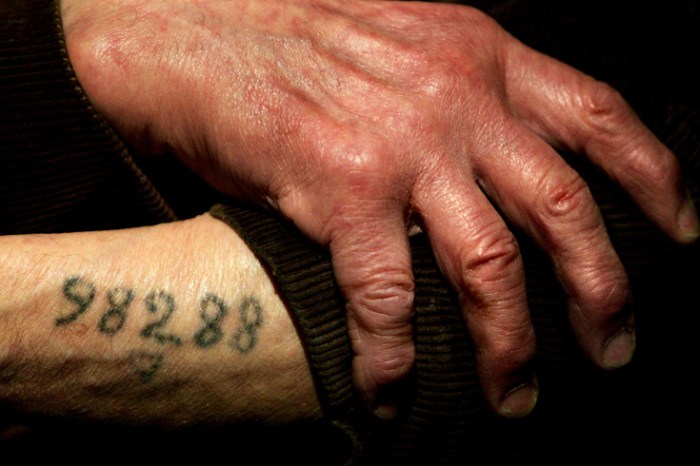
The most vivid memory I have of my great-grandfather is the tattoo on his arm.


It wasn’t an anchor or a sweetheart’s name or even the old faithful, “Mom.”


It was just a series of digits scrawled across his withered tan flesh like someone had written a note they didn’t want to forget.


Beneath the copious salt and pepper hairs was a stark number, the darkest stain on his skin.


Gramps is a kindly figure in my mind.


He died before I was even 10-years-old. All I really remember about him are wisps of impressions – his constant smile, a whiff of mothballs, how he always seemed to have butterscotch candies.


And that tattoo.


I think it was my father who told me what it meant.


When he was just a young man, Gramps escaped from Auschwitz. A guard took pity on him and smuggled him out.


His big European family didn’t make it.


My scattered relatives in the United States are all that are left of us.


Those are the only details that have come down to me. And Gramps isn’t here to add anything further.


But his tattoo has never left me.


It’s become a pillar of my subconscious.


The fact that someone could look at my kindly Gramps and still see fit to tattoo a numeric signifier on him as if he were an animal.


A little reminder that he wasn’t human, that he shouldn’t be treated like a person, that he was marked for erasure.


If I look at my own arm, there is no tell-tale integer peeking through the skin. But I am keenly aware of its presence.


I know that it’s there in a very real sense.


It is only the American dream that hides it.


Coming to this country, my family has made a deal, something of a Faustian bargain, but it’s one that most of us have accepted as the price of admission.


It’s called whiteness.


I am white.


Or I get to be white. So long as I suppress any differences to the contrary.


I agree to homogenize myself as much as possible and define myself purely by that signifier.


White. American. No hyphen necessary.


Anything else is secondary. I don’t have to deny it, but I have to keep it hidden until the right context comes to bring it out.


During Octoberfest I have license to be German. When at international village I can root for Poland. And on Saturdays I can wear a Kippah and be Jewish.


But in the normal flow of life, don’t draw attention to my differences. Don’t show everyone the number on my arm.


Because America is a great place, but people here – as in many other places – are drawn to those sorts of symbols and will do what they can to stamp them out.


I learned that in school when I was younger.


There weren’t a lot of Jewish kids where I grew up. I remember lots of cracks about “Jewing” people down, fighting against a common assumption that I would be greedy, etc. I remember one girl I had a crush on actually asked to see my horns.


And of course there were the kids who chased me home from the bus stop. The scratched graffiti on my locker: “Yid.”


The message was clear – “You’re different. We’ll put up with you, but don’t ever forget you are NOT one of us.”


There were a lot more black kids. They didn’t get it any easier but at least they could join together.


It seemed I had one choice – assimilate or face it alone.


So I did. I became white.


I played up my similarities, never talked about my differences except to close friends.


And America worked her magic.


So I’ve always been aware that whiteness is the biggest delusion in the world.


It’s not a result of the color wheel. Look at your skin. You’re not white. You’re peach or pink or salmon or rose or coral or olive or any of a million other shades.


Whiteness has as much to do with color as Red has to do with Communism or Green has to do with environmental protection.


It is the way a lose confederacy of nationalities and ethnicities have banded together to form a fake majority and lord power over all those they’ve excluded.


It’s social protection for wealth – a kind of firewall against the underclass built, manned and protected by those who are also being exploited.


It’s like a circle around the wealthy protecting them from everyone outside its borders. Yet if everyone banded together against the few rich and powerful, we could all have a more equitable share.


But in America, social class has been weaponized and racialized.


You’ll see some media outlets talking about demographics as if white people were in danger of losing their numerical majority in this country in the next few decades. But there’s no way it’s ever going to happen.


Today’s xenophobia is a direct response to this challenge. Some are trying to deport, displace and murder as many black and brown people as possible to preserve the status quo.


But even if that doesn’t work, whiteness will not become a minority. It will do what it has always done – incorporate some of those whom it had previously excluded to keep its position.


Certain groups of Hispanics and Latinos probably will find themselves allowed to identify as white, thereby solidifying the majority.


Because the only thing that matters is that there are some people who are “white” and the rest who are not.


Long ago, my family experienced this.


Before I was born, we got our provisional white card. And if I want, I can use it to hide behind.


I’ve been doing it most of my life.


Every white person does it.


It’s almost impossible not to do it.


How do you deny being white?


At this point, I could throw back my head and shout to the heavens, “I’M NOT WHITE!” and it wouldn’t matter.


Only in a closed environment like a school or a job or in a social media circle can you retain the stigma of appearing pale but still being other.


In everyday life, it doesn’t matter what you say, only how you appear.


I can’t shout my difference all the time. Every moment I’m quiet, I’ll still be seen as white.


It’s not personal. It’s social. It’s not something that happens among individuals. It’s a way of being seen.


The best I can do is try to use my whiteness as a tool. I can speak out against the illusion. I can stand up when people of color are being victimized. I can vote for leaders who will do something to dismantle white supremacy.


Not because I am some kind of savior, but because I know that my own freedom is tied to the freedom of those being oppressed by a system that provides me certain privileges.


But let me be clear: doing so is not the safe way to go.


In defending others you make yourself a target.


I get threats all the time from racists and Nazis of all sorts. They say they can tell just by looking at me that I’m not white at all.


The worst part is I’m not sure what I am anymore.


I don’t go to synagogue. I don’t even believe in God. But I’m Jewish enough to have been rounded up like Gramps was, so I won’t deny that identity. It’s just that I’m more than one thing.


That’s what whiteness tries to reduce you to – one thing.


I don’t want it anymore.


I’m not saying I don’t like the protection, the ability to be anonymous, the easy out.


But it’s not worth it if it has to come with the creation of an other.


I don’t want to live in a world where people of color are considered less than me and mine.


I don’t want to live in a world where they can be treated unfairly, beaten and brutalized so that I can get some special advantage.


I don’t want to live in a world where human beings are tattooed and numbered and sent to their deaths.


Because the Holocaust is not over.


American slavery is not over.


Neither is Jim Crow or lynching or a thousand other marks of hatred and bigotry.


Nazis march unmasked in our streets. Our prisons are the new plantation. And too many of our police use murder and atrocity to ensure the social order.


As long as we allow ourselves to be white, there will be no justice for both ourselves and others.


So consider this my renunciation of whiteness – and I make it here in public.


I know that no matter what I say, I will still be seen as part of the problem. And I will still reap the rewards.


But I will use what power is given me to tear it down.


I’m burning my white card.


I know it’s a symbolic gesture. But I invite my white brothers and sisters to add theirs to the flames.


Let us make a conflagration, a pillar of fire into the sky.


Let whiteness evaporate as the smoke it is.


Let us revel in the natural hues of our faces as we watch it burn.


Like this post? I’ve written a book, “Gadfly on the Wall: A Public School Teacher Speaks Out on Racism and Reform,” now available from Garn Press. Ten percent of the proceeds go to the Badass Teachers Association. Check it out!

WANT A SIGNED COPY?

Click here to order one directly from me to your door!

book-4

You Don’t Have to Be Perfect to Fight Racism. But You Have to Try

Screen Shot 2018-08-16 at 1.50.03 PM


I am a white guy who talks about racism.


I teach mostly students of color in a western Pennsylvania public school. I write a blog about education and issues of prejudice. And I participate in social justice campaigns to try and redress the inequality all around me.


But in my quest to be an anti-racist, one of the most common criticisms people hurl my way is to call me smug:


You think you’re so perfect!


You’re just suffering from white guilt.


You love black people more than your own people.


Things like that.


Well, I’ll let you in on a little secret.


I make mistakes.


All. The. Time.


I am just like every other white person out there. But I have recognized certain facts about my world and I’m trying to do something about them.


America is built on the genocide of over 110 million indigenous Americans and the enslavement of 30 million Africans. The idea of concentration camps didn’t originate with the Nazis. Hitler got the idea from U.S. treatment of Native Americans. Racism didn’t end with the Civil Rights Movement. It just changed shape and was hidden in the way we practiced health care, education, and policing all the way to mass incarceration.


And it’s getting worse. Hate crimes have jumped from about 70 incidents a year in the 1990s to more than 300 a year since 2001. And after Trump was elected, 900 bias-related incidents were reported against minorities within the first 10 days.


It does not make me special that I am trying to do what little I can about that. It just makes me human.


That’s it.


I am not perfect.


I am no better than anyone else.


But I am trying to do the right thing.


When I first became a teacher, I had the chance to go to the rich white schools and work with the wealthy white kids. I hated it.


I found that I had a real affinity for the struggling students, the poor and minorities.


Why? Probably because I have more in common with them than the kids who drove to school in better cars than me, wore more expensive clothes and partied with designer drugs.


Does that make me better than a teacher who stayed in the suburbs? No. But hopefully it gives me the chance to make a greater difference against white supremacy.


When I saw how unjust our school system is, I could have gotten out. Law school was definitely an option. So was becoming a technical writer or a job as a pharmaceutical ad rep.


But I dug in and spoke out.


I could have left, but who would be there to speak for my students? Who would speak truth to power about high stakes standardized tests, unaccountable charter and voucher schools, inequitable funding and the boondoggle of Common Core Standards?


So I got active in my union, spoke at rallies, lead marches on incorrigible law-makers and started a blog.


Does that make me better than teachers who kept plugging away at their jobs but didn’t rock the boat? No way. But hopefully I have a better chance at helping change things for the better.


When I saw that politicians in my state wanted to stop the parents of my students from voting by trampling their civil rights with a voter ID law, I started a campaign asking the officials that were tasked with enacting the law to ignore it.


It was a hard battle that made me do things I was not at all comfortable doing. You try asking a public servant on camera to break the law and go to jail for what he knew was right.


Strangely enough, it worked. Along with several other campaigns throughout the state, we got the voter ID law declared unconstitutional by the state Supreme Court.


Some people look at that and other accomplishments and think I’m conceited.


They say I’m a white savior hogging the spotlight for myself and keeping the very people I’m trying to help in my shadow.


That’s not my intention at all.


I wouldn’t be anywhere without the help and support of people of color.


Everything I’ve done in this fight has been with their help and encouragement.


Does that mean I’m impervious to making a racist comment? Does it mean I’ve never participated in a microaggression? Does it mean I see every racist impact of my society and my place in it?


Absolutely not.


I screw up every day.


Multiple times.


But that’s the point. You don’t have to be perfect. You just have to try.


One of the books that has helped guide me on this journey is Dismantling Racism: A Workbook for Social Change Groups, by Kenneth Jones and Tema Okun.


The chapter on “White Supremacy Culture” should be required reading for every activist organization or budding civil rights warrior.


The authors offer a list of characteristics that stem from white supremacy that can affect even the best intentioned of groups and individuals. These norms are difficult to name or identify but can lead to major dysfunction:


“They are damaging to both people of color and to white people. Organizations that are people of color led or a majority people of color can also demonstrate many damaging characteristics of white supremacy culture.”


And the number one characteristic is Perfectionism.


This involves the following bullet points:


  • “little appreciation expressed among people for the work that others are doing; appreciation that is expressed usually directed to those who get most of the credit anyway


  • more common is to point out either how the person or work is inadequate


  • or even more common, to talk to others about the inadequacies of a person or their work without ever talking directly to them


  • mistakes are seen as personal, i.e. they reflect badly on the person making them as opposed to being seen for what they are – mistakes


  • making a mistake is confused with being a mistake, doing wrong with being wrong


  • little time, energy, or money put into reflection or identifying lessons learned that can improve practice, in other words little or no learning from mistakes


  • tendency to identify what is wrong; little ability to identify, name, and appreciate what is right”


Solutions offered to this problem are:


“Develop a culture of appreciation, where the organization takes time to make sure that people’s work and efforts are appreciated;


develop a learning organization, where it is expected that everyone will make mistakes and those mistakes offer opportunities for learning;


create an environment where people can recognize that mistakes sometimes lead to positive results;


separate the person from the mistake;


when offering feedback, always speak to the things that went well before offering criticism;


ask people to offer specific suggestions for how to do things differently when offering criticism.”


These are things we should keep in mind as we try to move forward in this fight.


Certainly white people can be resistant to criticism and see any and every comment or appraisal as personal or demeaning – especially if that remark is made by a person of color.


Frankly, white people need to get a thicker skin about it. We need to realize that this impulse to personalize analysis is often a psychological attempt to avoid looking at oneself and what unconscious aspects of the social order one has internalized.


However, those offering criticism must realize that context is everything. We must create an environment where such remarks are constructive. Otherwise, they’ll do more harm than good.


None of this is easy.


But if we want to be anti-racists, that’s not the job we signed up to do.


Like this post? I’ve written a book, “Gadfly on the Wall: A Public School Teacher Speaks Out on Racism and Reform,” now available from Garn Press. Ten percent of the proceeds go to the Badass Teachers Association. Check it out!

WANT A SIGNED COPY?

Click here to order one directly from me to your door!

book-4

Since School Vouchers Don’t Increase Test Scores, Racism is an Acceptable Reason for Privatization, Says Advocate

Screen Shot 2018-07-24 at 10.20.41 AM

For decades, school voucher advocates claimed that sending poor kids to private schools with public tax dollars was acceptable because doing so would raise students’ test scores.


However, in the few cases where voucher students are even required to take the same standardized tests as public school students, the results have been dismal.


In short, poor kids at private schools don’t get better test scores.


So why are we spending billions of public tax dollars to send kids to privately run schools?


A 2018 Department of Education evaluation of the Washington, D.C., voucher program found that public school students permitted to attend a private or parochial school at public expense ended up getting worse scores than they had at public school.


Their scores went down 10 points in math and stayed about the same in reading.


These are not the pie in the sky results we were promised when we poured our tax money into private hands.


However, corporate education propaganda site, The 74, published a defense of these results that – frankly – makes some pretty jaw dropping claims.


The article is “More Regulation of D.C. School Vouchers Won’t Help Students. It Will Just Give Families Fewer Choices for Their Kids” by far right Cato Institute think tanker Corey DeAngelis.


In his piece, not only does he call for less accountability for voucher schools, he downplays the importance of standardized test scores.


And he has a point. Test scores aren’t a valid reflection of student learning – but that’s something public school advocates have been saying for decades in response to charter and voucher school cheerleaders like DeAngelis.


Supply side lobbyists have been claiming we need school privatization BECAUSE it will increase test scores. Now that we find this claim is completely bogus, the privatizers are changing their tune.


But that’s not the most shocking irony in DeAngelis article.


Parents don’t really care about the scores, he says. Instead they send their children to voucher schools because… You know what? I’ll let him tell it.


“Families choose schools for their children based on several important factors, including culture, individual attention, and, of course, safety. Research tells us that parents — unsurprisingly — often value these things more than standardized test scores.”


Certainly parents prefer their children have more individual attention. But many private schools have larger class sizes than public schools.


Moreover, reducing class size at all schools would be a more equitable reform than letting some kids enjoy smaller classes if they can just get into the right school.


However, it is his other two claims that sent my racist dog whistle senses tingling.


So parents don’t like the CULTURE of public schools. And they’re afraid public schools aren’t as SAFE.


Hmm. I wonder what culture these parents are objecting to. I wonder why they would think public schools wouldn’t be as safe.


Could it perhaps be fear of black students!?


I don’t want my little Billy to be exposed to all that rap music and kids with sagging pants. I don’t want my little Susie to cower in a class full of thugs and gangstas.


This is racist, stereotypical and just plain wrong about what you’ll actually find in public schools.


But it’s also typical white flight – the impulse behind the charter and voucher school movement in the first place.


Where did the boom for privatized schools come from historically?


It was a reaction to Brown vs. Board. When the US Supreme Court ruled in 1954 that segregated schools were unconstitutional, many white parents rebelled. They didn’t want their kids to go to school with THOSE kids. Hence, Georgia Gov. Herman Talmadge’s aborted plan to close all state schools and issue vouchers to private schools instead.


Hence, the plan that actually did take place in Price Edward County, Virginia, in 1959 where the public schools were closed and all taxpayer money for education was funneled to segregated white academies that would not admit black students. Though the term had yet to be invented, these were proto-“charter schools.” They were publicly funded but privately run. They were housed in privately owned facilities such as churches and the local Moose Lodge.


Hence, various segregationist “freedom of choice” plans in several states that allowed white students to transfer out of desegregated schools. Black students could apply but because of various administrative hurdles were never admitted.


This is the history of so-called school choice. And it is a history that DeAngelis, the 74 and the Cato Institute are willing to bring full circle.


School privatization advocates pretend they’re defending choice, but what choice are they championing?


The choice to segregate?


Pardon me, but I don’t think we should be spending public tax dollars to enable bigots.


If you want to shield your children from the horrors of kids with darker skin, do so on your own dime.


Public money should only be spent on policies that are in the public good – and that’s not segregation. It’s the exact opposite – integration.


Learning how to get along with people who are different than you is an essential skill for good citizens. Understanding that people of different races, ethnicities, religions and cultures are also human is vital if our nation is to survive.


Being exposed to another culture isn’t a bad thing. It’s the definition of the American melting pot.


Our public schools are not perfect. They suffer from targeted disinvestment – especially those situated in urban neighborhoods and those serving larger populations of children of color.


But that is because of the same segregation school privatization lobbyists are empowering. If all students went to the same schools, parents wouldn’t allow this kind of inequity.


In protecting their own kids, parents with power and resources would be protecting all kids.


But this isn’t the goal of privatization promoters. They don’t care about what’s best for children. They’re looking out for what’s best for the businesses running the privatized schools.


So what have we learned?


School vouchers do not increase test scores.


And when that excuse behind the entire school privatization movement is exposed as nonsense, opportunists have no problem using racism and prejudice to defend their industry.


Like this post? I’ve written a book, “Gadfly on the Wall: A Public School Teacher Speaks Out on Racism and Reform,” now available from Garn Press. Ten percent of the proceeds go to the Badass Teachers Association. Check it out!

WANT A SIGNED COPY?

Click here to order one directly from me to your door!

book-4

The NAACP Once Again Opposes High Stakes Standardized Testing!

cps_teaching_not_over_testing_sarah_ji


The nation’s oldest and largest civil rights organization has come out against high stakes standardized testing.


The National Association for the Advancement of Colored People (NAACP) distributed an issue brief yesterday at its national convention in San Antonio, Texas, titled “NAACP OPPOSES HIGH-STAKES EDUCATIONAL TESTING.”


The brief stated that the organization has concerns about using a single standardized test as a graduation requirement, as a prerequisite for advancement to the next grade or otherwise blocking students from receiving various educational opportunities. In its place, the organization favors the use of multiple measures, which may include standardized testing but should also include other assessments such as student grades and teacher evaluations.


In short, the brief concluded:


“Using a single standardized test as the sole determinant for promotion, tracking, ability grouping and graduation is not fair and does not foster equality or opportunity for students regardless of race, income, or gender.”


This is a huge policy shift from where the organization was just three years ago.


In 2015, the NAACP along with several other larger and older civil rights groups changed its position against testing to one in favor of it.


At the time, Congress was getting ready to pass a new education law, the Every Student Succeeds Act (ESSA). The civil rights organizations – many of whom had just asked Congress a year earlier to reduce standardized testing – suddenly demanded it be kept a federal accountability standard and that taking these tests was, itself, a civil right.


At the time, many education activists were shocked by the turnaround obviously coerced by the standardized testing and school privatization industry. For instance, see this email from Teach for America alum Liz King giving organizations an ultimatum to sign.


The new issue brief is more in-line with the NAACP’s history of opposition and activism against corporate education reform.


Once again we have the NAACP that advocated against standardized testing in the Debra P v. Turlington case (1981), where the Florida legislature made passing a single standardized test a graduation requirement. The NAACP supported black students who had a disproportionate failing rate on the test and claimed the Florida legislature was violating the Fourteenth Amendment. The courts eventually ruled against the plaintiffs but the issue has remained contentious to this day.


The new issue brief isn’t just a return to form. It builds on concerns that are still plaguing our schools.


Of particular note in the new issue brief is the caution that, “…when standardized tests are used by schools and school districts, that the tests be valid and reliable, measure what the student was taught and provide appropriate accommodations for disabled children.”


Many would argue that the new batch of Common Core aligned tests being used by states do not meet this requirement. They do not test what students have been taught – they test students’ ability to spit back the same kind of thinking of the person who wrote the test. Moreover, special needs students are rarely afforded the same accommodations on federally mandated standardized test day that they are allowed during every other assessment they take during the school year.


The brief continues:


“Furthermore, the NAACP is opposed to individual students being unfairly denied critical educational opportunities because of their performance on a single, standardized test.


This, itself, is a nationwide problem. Administrators are pressured to make district policies “data-driven” and thus deny students the chance to take advanced classes or go on special field trips because of performance on one multiple choice test.


The NAACP certainly could go farther in its criticism of high stakes testing.


Organizations like the Journey for Justice Alliance (JJA), a group made up of 38 organizations of Black and Brown parents and students in 23 states, have never wavered in their opposition to high stakes standardized testing. In 2015 while the NAACP and other well established groups defended testing, JJA was joined by 175 other national and local grassroots community, youth and civil rights organizations asking Congress to stop requiring standardized tests at all.


Standardized testing violates students civil rights – especially the poor and students of color.


It is nice to see the NAACP returning to the activism on which it built its justly deserved reputation.


What follows is the full text of the new NAACP issue brief:


“ISSUE BRIEF


Date: Summer, 2018


To: Concerned Parties


From: Hilary O. Shelton, Director, Washington Bureau


NAACP OPPOSES HIGH-STAKES EDUCATIONAL TESTING


THE ISSUE


Many states are relying on a single examination to determine decisions (such as graduating from high school or promoting students to the next grade), despite the fact that leading education experts nationwide recommend multiple measures of student performance for such decisions. While these “high-stakes” tests serve an important role in education settings, they are not perfect and when used improperly can create real barriers to educational opportunity and progress. Furthermore, one-time, standardized tests may have a disparate impact on students of color, many of whom have not had the benefit of high quality teaching staff (urban school districts have the greatest challenge in attracting and keeping high qualified teachers), adequate classroom resources, or instruction on the content and skills being tested by the standardized tests. Considering additional measures of student achievement, such as grades and teacher evaluations, adds not only to the fairness of a decision with major consequences for students but also increases the validity of such high stakes decisions.


Due to our concerns about the fairness of such testing, as well as the potential impact these tests have on the lives of our children, the NAACP has supported legislation in the past that would require that States follow the recommendation of the National Academy of Sciences and the National Research Council of the National Academy of Sciences. Specifically, the bills require that High Stakes decisions be based upon multiple measures of student performance and, when standardized tests are used by schools and school districts, that the tests be valid and reliable, measure what the student was taught and provide appropriate accommodations for disabled children. Furthermore, the NAACP is opposed to individual students being unfairly denied critical educational opportunities because of their performance on a single, standardized test.


The NAACP will continue to promote the initiatives that ensure equal opportunity, fairness, and accuracy in education by coupling standardized tests with other measures of academic achievement. Using a single standardized test as the sole determinant for promotion, tracking, ability grouping and graduation is not fair and does not foster equality or opportunity for students regardless of race, income, or gender.”


img_3315


Special thanks to Dr. Julian Vasquez Heilig who first released the issue brief on his education blog.


Like this post? I’ve written a book, “Gadfly on the Wall: A Public School Teacher Speaks Out on Racism and Reform,” now available from Garn Press. Ten percent of the proceeds go to the Badass Teachers Association. Check it out!

WANT A SIGNED COPY?

Click here to order one directly from me to your door!


book-2

Don’t Tread on Me, But Let Me Tread All Over You: The Credo of Personal Freedom and Limitless Greed

AR-801253793 

Every neighborhood has one.


A yellow flag showing a coiled spring of a snake above the motto, “Don’t Tread on Me.”


In my usually well-manicured suburb, you’ll find it waving bravely over the garbage house.


There’s three broken down RVs sitting on the lawn, a busted sofa in the back yard, a rotten picnic bench and several rusted out vehicles in various states of disrepair.


I’m not sure why the owners think anyone would want to tread on them. We’d much rather walk quickly on by without being seen or commented on.


Because in my experience that’s the thing about most of the people who fly this flag.


They’re indignant about anyone stepping on their rights but all too ready to step all over yours.


I remember it wasn’t really too long ago that this flag had no such connotations.


It was simply the Gadsen flag, a relic of the American Revolution. It was nothing more than a reminder of a time when we cherished our national independence from Great Britain and wanted to make sure they knew we didn’t want the King to come back and start ordering us around.


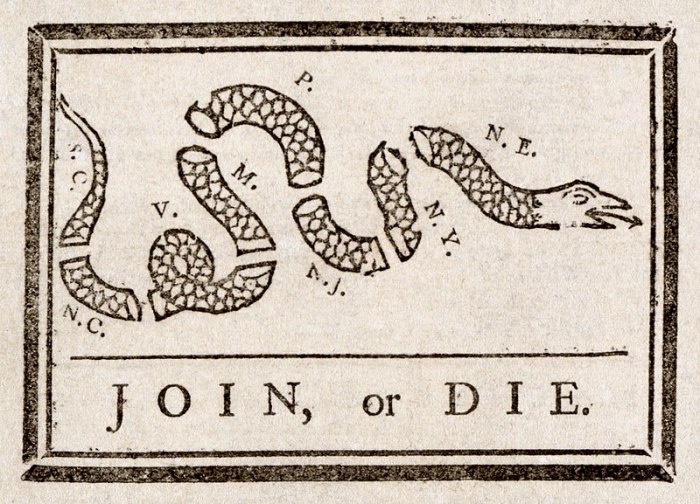
In fact, it was designed by American general and politician Christopher Gadsden in 1775. This “Sam Adams of South Carolina” modeled his patriotic statement first used by the Continental Marines on an earlier famous cartoon from Benjamin Franklin’s Pennsylvania Gazette.


800px-Benjamin_Franklin_-_Join_or_Die


You’ve probably seen it. A snake is cut into several pieces – each representing one of the colonies – with the motto, “Join or Die.”


So originally it was a call for unity, perhaps even federalism. It was a way of framing the argument that we’d be stronger as one nation than as a group of separate states.


Gadsen’s version was really a continuation of that same thought. It was as if he were saying, “Here we are, one unified nation ready to strike to protect itself from tyranny.”


It wasn’t until 2009 that Gadsen’s flag became associated with the radical right.


Like so many hitherto nonpartisan symbols, it was appropriated by the Tea Party movement, which tried to cast their libertarian extremism as somehow harkening back to the American Revolution.


Even the name Tea Party is a misnomer. The original Boston members of the Sons of Liberty who threw British tea into the harbor in 1773 were protesting taxation without representation. Modern day Tea Partiers were protesting the taxes levied by their own duly elected representatives.


They were poor people duped into thinking the rich paid too much despite the fact of gross income inequality and the wealthy not paying their fair share.


It’s this willful ignorance that typifies the contemporary right.


The truth doesn’t matter. It only matters what can be spun into a pithy sound bite that can be broadcast on Fox News or some other propaganda source and then repeated ad infinitum in place of any real debate or conversation.


To be fair, the left does it, too, but not nearly to the same degree.


When a topic makes the rounds of the 24-hour news cycle, you can hear the same canned responses from right and left on just about every channel regardless of who is speaking. The only difference is that the left usually makes at least passing reference to reality while the right closes its eyes and says whatever it believes to be true with perfect conviction.


The Gadsen flag is a perfect example of this hypocrisy.


The motto “Don’t Tread on Me” has come to mean radical individual freedom.


I can do whatever I like and there’s nothing you can do about it.


I can own as many guns as I like. I can teach my kids whatever facts I like. I can discriminate against anyone I like.


But there’s never a mention about other people except to limit what they can do in relation to the speaker.


In short, there’s nothing explicit about making this rule universal – I won’t tread on you if you won’t tread on me.


It’s just don’t tread on me and I’ll do whatever I like in relation to you.


After all, many of these personal freedoms the radical right cherishes actually do impact the rest of us.


Unregulated gun ownership means more shootings, more suicides, more deadly instances of domestic violence, more kids coming to school with semi-automatic guns in their book bags and more malls and theaters slick with bystander blood.


Moreover, if you teach your kids whatever facts you like, that means you indoctrinate them into your worldview. You don’t give them the chance to see the real world for what it is in case they may have different views on it than you do. This impacts both your children and the country, itself, which will have to somehow run with a greater portion of ignorant and close-minded citizens.


And don’t get me started on discrimination! You think you should be able to say whatever you like to whomever you like whenever you like. It’s fine to wear a t-shirt calling Hillary Clinton a “cunt” but when late night comedian Samantha Bee does the same to Ivanka Trump, you’re up in arms!


You think you can support laws that allow bakers to refuse to make wedding cakes for gay couples but are raving mad when a restaurateur refuses service to Sarah Huckabee Sanders!


This kind of sanctimonious duplicity has real world consequences.


Unarmed black people are shot and killed by police at a much higher rate than white people. Yet you won’t tolerate any protest, condemnation or protest. People can’t assemble in the streets, athletes can’t kneel during the national anthem, you won’t even allow the slogan “Black Lives Matter,” because you say, “All Lives Matter,” while in reality you mean “All Lives Except Black Ones.”


You oppose abortion but no one is forcing anyone to have abortions. In your headlong crusade for individual freedom you want to ensure that others don’t have this choice because they might choose differently than you. Or at least they might choose differently than you SAY you do, because when the light of day is cast upon you, we find an alarming number of hypocrites here, too.


There are too many far right politicians who campaign on overturning Roe v. Wade who pressure their mistresses to abort the unwanted issue of their indiscretion.


The underlying cause of such myopia is a perverse focus only on the self.


You look at what you want for you and pay no attention at all to what others should likewise be allowed.


It is the underlying selfishness of post Enlightenment Western thought come back to haunt us.


Hobbes and Locke and Smith told us that greed was good.


It’s what makes the world go round.


You look to your self-interest, and I’ll look to mine, and that’s what’s best for everyone.


However, they forgot that everyone doesn’t have the same power – physical, social, financial or political. Some people are strong and some are weak. Some are rich and some are poor. If you pull the shortest straw at the lottery of birth, you won’t be able to get the same things for yourself as those who won it as soon as the doctor slapped their newborn bums.


So we have layers and layers of class and economics. We have social structures designed to keep black people here and Hispanics there and white people at the top. We have a society that worships the rich and bedevils the poor. We have belief systems that praise one kind of sexuality only and demonizes anything that diverges from that norm. And the most defining thing of any newborn baby is what you’ll find between its legs.


“Don’t Tread on Me” has become a farce.


It’s a maxim hoisted on those with very little individual power to convince them to join together and become powerful while guarding the door for the wealthy.


They sit atop their mountains of trash as if they were dragons on piles of gold.


And they point their pitchforks at the rest of us as if we wanted a piece of it.


In this way, they make themselves the willing patsies of the ruling class.


It’s a sad thing to behold.


Because if we all just stopped for a second and recognized our common humanity, we’d agree that the status quo is unacceptable.


If we were more concerned about the rights of all than just our own rights, we’d agree that the wealth of this great nation has not been fairly distributed.


The snake is coiled and ready to strike but it is pointed in the wrong direction.


It shouldn’t be pointed at 99% of us. And it shouldn’t be so solitary.


It should be a sea of snakes, a great slithering mass of humanity, hissing and spitting with venom, our reptilian eyes focused on the elites.


Don’t tread on me?


Don’t tread on USSSSSSSSSSS!


Like this post? I’ve written a book, “Gadfly on the Wall: A Public School Teacher Speaks Out on Racism and Reform,” now available from Garn Press. Ten percent of the proceeds go to the Badass Teachers Association. Check it out!

WANT A SIGNED COPY?

Click here to order one directly from me to your door!

book-3

Antwon Rose’s Life Matters

antwon_rose.0


Antwon Rose could have been my student.


I teach 7th and 8th grade language arts in a district located minutes away from where the 17-year-old was shot and killed by police.


East Pittsburgh, the neighborhood where his car was stopped and where he ran from officers before being shot three times in the back, is minutes from my house.


He went to Woodland Hills School District, minutes from my house.


Michael Rosfeld, the officer who just started working at East Pittsburgh less than two hours before he shot and killed Antwon, had been fired with cause from his previous job as a security officer at the University of Pittsburgh, where I got both my graduate and undergraduate degrees and where my wife works.


The poem Antwon wrote about not wanting to become another statistic that was read aloud at a protest was the product of an assignment I give my own classes.


5b2d0d9d2200006a03eec478


So I say again – he could have been my student.


I have had many children like him.


Most of my kids are like him.


Promising, smart, burdened by fears no teenager should have to face.


When I look at the smiling picture of Antwon released to the media, he looks like so many others I have known and loved.


How many kids have passed before me worried that they’ll be the victims of police violence?


How many kids have sat in those seats trying to concentrate on my work while anxious about the reality of the streets they have to walk just to get home?


How many kids have been afraid that if the worst happens, the rest of us will forget their humanity?


I am a white teacher. I don’t know what it’s like to live as a black person in America except by extension of what my kids and others tell me.


When my daughter goes to school or plays in the yard, I don’t have to worry the police will consider her a threat simply because of the amount of melanin in her skin.


But I do see how white people like me blame a 17-year-old kid for his own death.


If he hadn’t been in that car, he’d still be alive. If he hadn’t run from police, they wouldn’t have shot.


Maybe. Maybe not.


But being in the wrong place at the wrong time shouldn’t bring with it a death sentence. Running away shouldn’t bring with it the finality of the grave.


Yesterday Allegheny County Medical Examiner’s Office ruled the death a homicide. That’s a good start.


But plenty of questions remain.


Rosfeld is still on unpaid leave. Why hasn’t he been arrested?


Civil rights writer Shaun King reports that when Rosfeld worked at the University of Pittsburgh, he had a history of harassing black students and was only let go after he harassed one of the chancellor’s own children. If true, was that reported to East Pittsburgh before they hired him?


Why is it police can apprehend white shooters with no violence, but when a suspect is black the rules of engagement start and end with bloodshed?


Protests have rocked this city for two days and will continue today.


And I’m glad.


We need answers to those and more questions. We need justice for Antwon.


But more than anything we need to recognize that he was a human being.


He was a little boy with his whole life ahead of him.


His life matters.


I don’t say “mattered” because even though he’s gone, his life still matters.


We can’t bring him back, but we can honor who he was.


We can recognize his common humanity is the same as anyone else’s.


We can give him and his family justice.


And we must – we MUST – make sure that things like this don’t happen again.


I’ve had far too many students die at the end of a gun.


At absolute minimum, the hand holding it shouldn’t belong to someone tasked with the job to serve and protect.


Like this post? I’ve written a book, “Gadfly on the Wall: A Public School Teacher Speaks Out on Racism and Reform,” now available from Garn Press. Ten percent of the proceeds go to the Badass Teachers Association. Check it out!

WANT A SIGNED COPY?

Click here to order one directly from me to your door!
book-1

African Immigrants Excel Academically. Why Don’t African Americans?

static.politico.com


The presence of melanin in your skin shouldn’t affect your academics.

But in America, it does.

On average, black students achieve less academically than white students. They have worse grades, lower test scores, meager graduation rates and fewer achieve advanced degrees.

The question is – why?

Why does pigmentation matter so much in this country? What about it brings such negative academic consequences?

This is especially apt since it doesn’t apply to foreign born black students who come here to study or those who recently emigrated here.

In fact, they see just the opposite effect – they earn some of the best grades, have some of the highest test scores, and disproportionately graduate from high school and achieve advanced degrees.

This is something that distinguishes foreign-born Africans – especially those from Sub-Saharan Africa – even from other immigrants. African immigrants sit near the top of the scale of so-called model minorities.

According to a report by Christine Gambino and associates at the Census Bureau, 41% of the African-born immigrant population earned a bachelor degree compared with 28% of the overall foreign-born population in the US.

The four African birth countries with the highest percentages of bachelor and higher degrees among their expat populations in the US are Egypt at 64%, Nigeria at 61%, South Africa at 57% and Kenya at 47%.

So why the difference?

Obviously, it’s not skin color.

Part of it seems to be qualities selected for in the immigration process, itself.

We don’t let just anyone come to the U.S. We have rigorous qualifications and prerequisites that have to be met. For instance, students who want to study here must get high marks on the SAT, Act and/or the TOFFEL – the language proficiency test. To do that, they need the money and resources to study for these exams. They are already some of the best achievers in their native countries.

Moreover, there is a huge cultural difference coming from Africa as opposed to coming from the United States. Native-born Africans have to deal with the effects of post-colonialism. It wasn’t so long ago that European nations conquered and plundered the African continent for gold and resources. That era has mostly ended, but those living there still have to deal with lingering consequences. This has an effect on everything from gender, ethnicity, class, language, family relationships, professions, religions and nation states.

However, native-born Africans do not have to navigate the world of American white supremacy. The affects of being black in this country may be much more harmful than negotiating post-colonialism.

For instance, most mainland Africans enjoy intact cultures. They are not the product of families that were torn apart, religions that were displaced and entire belief systems, world views and genealogies that were stolen.

Nigerian cultures, in particular, highlight the importance of learning.

One typical Nigerian saying goes like this:

“The best inheritance that a parent can give you is not jewelry or cash or material things, it is a good education.”

This is why academics in Nigeria are widely supported, mandatory and free.

Meanwhile, in America native-born black students grow up in a much more stressful and unstable environment. This translates to academic struggles.

For one, they are the victims of educational apartheid. Brown v. Board is more than 60 years old, but American schools have become increasingly segregated by race and class. Black students receive fewer resources than whites and their schools struggle to provide the same quality of education. Moreover, they are the target – either directly or indirectly – of privatization schemes that result in less control over their own schools and the further reduction of resources through charter and voucher schools that can cut services and pocket the savings as profit.

However, the problem is not just systemic. I hate to say it, but sometimes even American teachers put up obstacles to black students success due to (often unconscious) bias.

Most teachers are white. They have certain societally reinforced expectations of black students. When these children struggle, they are more often put into special education and stigmatized for their differences.

It is no doubt that black students are more often disciplined and suspended than white students – numerous studies have shown this.

I think this is due at least partially to white teachers’ expectations. It is tempting to see black student behavior as negative in the default. We too often label them “bad kids” and then try to find evidence to support it instead of giving them the benefit of the doubt or assuming they’re smart and well-behaved until proven otherwise.

African immigrants don’t have to deal with these stigmas to nearly the same degree. They don’t get the same negative label. They have more support from close-knit families. They have more positive role models including more college graduates in the family.

Another obstacle for American born black students is a cultural imputation against academic achievement. Doing well in school can be seen as “acting white.” In order to maintain popularity and prestige, they are steered away from the exact things that immigrant Africans are steered toward.

The poverty of American blacks plays a huge factor, too. Even in moderately successful African American homes, parents or guardians are often working multiple jobs or long hours to make ends meet. This reduces their ability to oversee their children’s homework and monitor academic progress.

It seems then that the so-called proficiency gap between native-born black and white students in this country is due to generational poverty, white racism and coping mechanism in their own culture.

If we want to help American-born black students, we need to realize, first, that this problem is not due to inherent racial deficiencies. It is the product of class warfare and white supremacy.

As such, it can be cured through progressive economic policies and anti-racist efforts.

The strongest argument for reparations comes from a recognition of the lingering effects of our history of slavery, segregation, Jim Crow and the prison industrial complex.

These are daunting problems, but they can be solved.

It just takes an honest appraisal of the issues and the social will to make things right.


Like this post? I’ve written a book, “Gadfly on the Wall: A Public School Teacher Speaks Out on Racism and Reform,” now available from Garn Press. Ten percent of the proceeds go to the Badass Teachers Association. Check it out!

WANT A SIGNED COPY?

Click here to order one directly from me to your door!

book-4

Dear Betsy DeVos, I Will NEVER Report My Students to ICE

4e78f0eb558f3.image 


Teachers fill a lot of roles in our public schools.


We’re mentors to kids in need.


We’re aides to students struggling with new concepts and skills.


We’re homework-givers, pencil-providers, idea-encouragers, lunch-buyers, scrape-bandagers, hand-holders, hug-givers, good listeners, counselors, caregivers and – yes – sometimes even butt-kickers.


It’s no wonder that we occasionally get mistaken for mothers and fathers.


But one thing we will never be is a snitch.


Secretary of Education Betsy DeVos recently intimated that principals and teachers could report their undocumented children to Immigration and Customs Enforcement (ICE).


She’s not going to say what we should do one way or another. She’s just saying that this is something we COULD do if we wanted.


If that results in those kids and their families being deported, well we are a nation of laws, after all.


It’s a remark that sounds so reasonable to some folks.


Luckily, I speak dog whistle.


So did the U.S. Supreme Court back in 1982 when justices ruled in Plyler v. Doe that schools cannot deny children their right to a free education based on immigration status.


When kids are afraid to learn because they or their parents or extended family may be undocumented, that has a smothering affect on the classroom.


When ICE raids a local business, we see a sudden drop in class attendance.


So if students thought their teachers or principals were scrutinizing them to determine their citizenship status, we’d be discouraging many with brown skin or extra-national credentials from ever coming back.


By suggesting that educators have a choice whether to obey established law or to become self-appointed border patrol officers, DeVos actually is prescribing how we should act.


Well, not this teacher, Betsy.


Not now. Not EVER.


No matter who you are – black, white or brown – a public school is a sanctuary. It is where kids of all different races and creeds come to escape from the ravages of poverty, violence and indifference.


Teachers are not the enforcers of our broken, bent and biased immigration policy. It is not our job to oblige xenophobia and bigotry.


It is our job to teach, to protect and inspire.


Sure, I’ve made my fair share of calls to parents, healthcare professionals and Child Protective Services.


I’ve reported abuse, addiction and mental illness.


But I did that to protect my kids. And I do think of them as my kids.


When these little people come toddling into my class, I take a kind of ownership of them.


For the time they’re here, we’re family. I take interest in their lives and they take interest in mine.


They know all about my wife and daughter, my parents and grandparents. And I know about theirs.


We don’t just learn grammar, reading and writing. We share our lives with each other.


We share a mutual trust and respect.


If I reported even a single student for a suspected immigration violation, I would lose that forever.


It’s sad how much things have changed in a little over year.


Hispanic names have become Anglicized. Angelo has becomes Angel. Julio has become Jules. Jorge is now George.


The dulcet melody of Spanish has been silenced. You’ll only hear it in muffled voices if you wander by a few lockers, but never in class.


My kids aren’t even 13 yet, but many of them have already learned to hide.


Don’t appear different. Don’t let anyone know your roots extend beyond national borders.


Be “normal.” Be homogenized, bland American.


That’s the world we’ve built and it’s the one that DeVos is encouraging with her tin pot nationalism.


Some things don’t change when you cross municipal lines – human decency is one of them.


So I won’t be reporting any of my students to ICE.


I won’t help the Gestapo separate parents and children based on citizenship status.


I won’t help set up ethnic checkpoints where armed guards get to ask “suspicious persons” for their papers.


White supremacy was bad enough before Trump was elected. I won’t help the unfortunately named Department of Homeland Security become the protector of a new white trash Fatherland.


I will defend my students. I will stand up for their safety and their rights.


That’s just what we do in public school. We look after our own.


Like this post? I’ve written a book, “Gadfly on the Wall: A Public School Teacher Speaks Out on Racism and Reform,” now available from Garn Press. Ten percent of the proceeds go to the Badass Teachers Association. Check it out!

WANT A SIGNED COPY?

Click here to order one directly from me to your door!
book-2

With Education Such a Low Priority in America, It’s No Wonder The Holocaust is Fading From Memory

web1_PSD052916Holocaust4-2


The Holocaust has never been more relevant than it is today.


Racism and prejudice are on the rise. Hate crimes are becoming more common. Anti-immigrant sentiment is becoming more widespread.


And anti-Semitic incidents have increased by 57 percent in the past year, according to the Anti-Defamation League.


Yet just last week, a comprehensive study of Holocaust awareness was released concluding that Americans are forgetting this vital chapter of our history.


After more than 1,350 interviews, Schoen Consulting found that 11 percent of U.S. adults and more than one-fifth of millennials either haven’t heard of the European Holocaust or aren’t sure what it is.


From 1933-1945, approximately 12 million people – 6 million of whom were Jews – were systematically put to death by Nazi forces.


However, even many of those who admitted to having some knowledge of these events were unsure about the specifics. For instance, one third of respondents – and 41% of millennials – said that only 2 million people were killed.


This is unacceptable.


But not unexpected.


Not in a country that has made education such a low priority for decades.


Only a handful of states mandate Holocaust curriculum in schools – Florida, Illinois, New Jersey, California, Michigan, Indiana, New York and Rhode Island – and each one does so to varying degrees of detail.


Other states like Pennsylvania have laws strongly encouraging the teaching of the Holocaust but not requiring it outright.


Wasn’t this why 42 states adopted Common Core – to make sure all students were learning the same things?


Well, first of all those standards were only adopted in English and Math. Social studies standards were far too controversial to make it over the partisan divide.


Moreover, Common Core has actually been an impediment to Holocaust studies, not a help.


A principal in Delaware refused to let a concentration camp survivor speak to students because he didn’t think it was rigorous enough under Common Core.


Another district tried to encourage critical thinking by asking students if the Holocaust was true or if it had been exaggerated – as if proven facts were up for debate.


Additionally, the reading standards push for texts to be taught as if they were standardized test items without proper context for a robust understanding. Combine that with an emphasis on texts that are exceedingly complex and it’s no wonder that young people’s understanding of this important part of history is fuzzy.


And I write this as an educator who taught the Holocaust in middle school for more than a decade.


The first thing I did was throw those corporate-written standards in the trash.


My 8th graders and I watched various award-winning documentaries such as “Auschwitz: If You Cried, You Died.” We read the play version of “The Diary of Anne Frank,” but supplemented it with various interviews and autobiographical articles from concentration camp survivors and even a presentation from community members who had first-hand experience of these events until their age and health made that impossible.


The whole unit culminated in a trip to the Holocaust Museum in Washington, DC.


Unfortunately, this does not appear to be the norm.


Though America students make up one third of the 1.7 million visitors to the National Holocaust Museum, 80 percent of Americans say they have never visited any Holocaust museum.


I get it. Teaching about this is hard.


It’s ugly and scary and repulsive – but it’s meant to be.


The DC National Holocaust Memorial  recommends the following guidelines for teaching about the European Holocaust:


“Be sensitive to appropriate written and audiovisual content. One of the primary concerns of educators teaching the history of the Holocaust is how to present horrific images in a sensitive and appropriate manner. Graphic material should be used judiciously and only to the extent necessary to achieve the objective of the lesson. You should remind yourself that each student and each class is different and that what seems appropriate for one may not be appropriate for all . . . Some students may be so appalled by the images of brutality and mass murder that they are discouraged from studying the subject further. Others may become fascinated in a more voyeuristic fashion, subordinating further critical analysis of the history to the superficial titillation of looking at images of starvation, disfigurement, and death . . . There is also a tendency among students to glorify power, even when it is used to kill innocent people. Many teachers indicated that their students are intrigued and, in some cases, intellectually seduced by the symbols of power that pervaded Nazi propaganda (e.g., the swastika and/or Nazi flags, regalia, slogans, rituals, and music). Rather than highlight the trappings of Nazi power, you should ask your students to evaluate how such elements are used by governments (including our own) to build, protect, and mobilize a society. Students should also be encouraged to contemplate how such elements can be abused and manipulated by governments to implement and legitimize acts of terror and even genocide.”


That’s what I tried to do.


This is the first year that I’m not explicitly teaching the Holocaust – and the only reason is because I’m not teaching 8th grade, I’m teaching 7th.


It’s not in my curriculum.


However, I know my students will get it when they advance to the next grade.


I wish that were true everywhere.


Unfortunately, a deep knowledge of history does not come from a society obsessed with standardization and privatization.


In fact, our policy of high stakes testing is an artifact of the eugenicist movement that inspired the Nazis. Our privatization movement is a holdover from the white flight reactionaries trying to circumvent the integration of Brown vs. Board.


We don’t do a comprehensive job teaching the Holocaust because we haven’t, as a society, learned its lessons.


We don’t teach the consequences of the European Holocaust because we haven’t come to terms with the consequences of our own American varieties. We haven’t acknowledged the effects of Europeans conquest and genocide of Native Americans, the slave trade, Jim Crow, Japanese internment or the prison industrial complex.


To teach the Holocaust we must take a step toward understanding where we, as a nation, have engaged in similar practices.


These are lessons vital to our survival and progress.


And that is exactly why it hasn’t been made a priority. It is exactly why we don’t have equitable education for all children in America.


Doing so would upset the status quo.


Doing so would be troublesome to the powers that be who use a racial and economic caste system to keep us all in line.


Understanding the Holocaust prevents us from reliving it.


And the people in power want to keep that door unequivocally open.


Like this post? I’ve written a book, “Gadfly on the Wall: A Public School Teacher Speaks Out on Racism and Reform,” now available from Garn Press. Ten percent of the proceeds go to the Badass Teachers Association. Check it out!

book-1

In Trump’s America, You No Longer Need to Pretend to be Against School Segregation

34f90d59-7c40-4530-84dc-bddbcc1c652d-9624969d


School segregation is kind of like war.


When asked point blank, no one wants to admit to liking it.


To paraphrase Motown singer songwriter Edwin Starr:


“Segregation. Huh, Good God.


What is it good for?


Absolutely nothing.”


However, when it comes to supporting actual integration programs or even just education policies that don’t make segregation worse, no one in politics really gives a crap.


Both Republicans and Democrats are heavily invested in ways to divide up school students along racial and economic lines – whether they be charter and voucher schools or strategic disinvestment in the public schools that serve the poor and minorities and hording resources for wealthy whites.


That’s why it’s somewhat shocking to hear the outrage over Trump judicial nominee Wendy Vitter.


Trump nominated the extremely partisan justice for a federal judgeship in Louisiana. Yet during a Senate hearing Wednesday, Vitter refused to answer a question from Sen. Richard Blumenthal (D-Conn.) about whether or not she believed the Supreme Court was right in its landmark 1954 decision, Brown v. Board of Education.


The decision overturned the excuse that we could educate white and black people in different facilities so long as they were “separate but equal.” In effect, it said that when we educate the races separately, their schools will never be equal.


And Vitter couldn’t bring herself to affirm this ruling.


“If I start commenting on ‘I agree with this case’ or don’t agree with this case,’ I think we get into a slippery slope,” she said.


“I don’t mean to be coy, but I think I get into a difficult area when I start commenting on Supreme Court decisions which are correctly decided and which I may disagree with,” Vitter said.


She added that the ruling was “binding” and that she would uphold it if confirmed as a judge.


And there we have it, people.


That’s where the bar is set during the Trump administration.


You no longer need to pretend to be against school segregation.


On the one hand, it’s more honest than most people in the political arena.


On the other, how far have we sunk when you don’t even need to feign decency in order to expect having a chance of Congress confirming you?


Let me be clear. Vitter’s nomination should not be approved.


Congress should draw a line in the sand and say that it cannot accept people who do not share bedrock American values on the bench.


If you aren’t in favor of integration, you have no place making decisions about race, class and education.


And that is the barest minimum.


That is merely decorum.


It’s like having the decency to condemn Nazis – something else Trump can’t bring himself to do.


What actually happens to Vitter will probably be determined by the degree of backlash against her.


As of Thursday afternoon, the video clip of Vitter’s comments about Brown V. Board had more than 1.7 million views, and was retweeted over 13,000 times.


A few months ago, another Trump judicial nominee, Matthew Petersen, withdrew from consideration after a video in which he couldn’t answer basic legal questions went viral.


But even if this reprehensible person who has no right sitting in judgement over anything more taxing than a checkbook gets turned away from the bench, we’ll still be far from where we need to be on school segregation.


Despite Brown vs. Board, many of our schools today are more segregated – not less – than they were in the 1960s.


And instead of putting on our big boy pants and tackling the issue, we’ve gone in the opposite direction.


On both sides of the aisle, lawmakers support charter schools. Republicans and a few Democrats support school vouchers. And just about everyone is fine with the fact that our public schools serve vastly disproportionate racial and economic populations yet rely on local tax revenues for funding and thus are inequitably resourced.


In every case, these policies make segregation worse. Yet hardly anyone in the halls of power or in the media even admits it is happening.


At most, you get a news story every anniversary of Brown v. Board about the increased segregation and a journalistic shrug. Well, we don’t know how to solve that one…


Yes, we do!


We need to integrate – not segregate.


We need to end school privatization.


We need to redraw district boundaries.


We need to audit school policies that keep the races apart within districts by building or by class.


And we need robust, equitable funding that can’t be manipulated to favor wealthy white kids.


That will take a lot more moral courage than partisan outrage against Vitter.


Oh, she deserves outrage, but because of her lack of morality, not her political party.


This can no longer be about if your political football team is in power or not.


It has to be about what’s right and wrong.


Caring about integration should be part of what it means to be an American – like freedom, justice and apple pie.


If it isn’t, we have a lot worse problems than one reprehensible would-be judge.


Like this post? I’ve written a book, “Gadfly on the Wall: A Public School Teacher Speaks Out on Racism and Reform,” now available from Garn Press. Ten percent of the proceeds go to the Badass Teachers Association. Check it out!

book-4